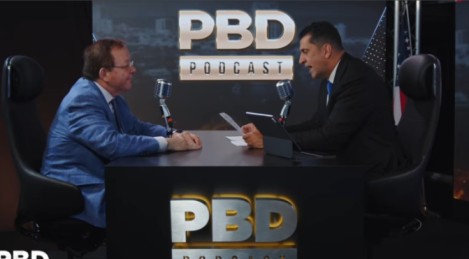
Read the full transcript of professor Robert Pape’s interview on PBD Podcast, May 9, 2026.
Editor’s Notes: In this provocative episode of the PBD Podcast #795, host Patrick Bet-David sits down with renowned academic and foreign policy expert Professor Robert Pape to discuss the crumbling state of international alliances. Drawing on his decades of experience advising multiple U.S. administrations, Pape makes the bold claim that “NATO is dead” and explains why traditional strategies of military and economic punishment often fail to deter adversaries like Iran. The conversation explores the complexities of nuclear diplomacy, the psychological “fight, flight, or freeze” responses of nations, and the humanitarian impact of global sanctions. This deep dive offers a critical perspective on modern warfare and the urgent need for a more realistic approach to American grand strategy.
Introduction and Background
PATRICK BET-DAVID: Nobody would know. So everybody who sees it like, wait a minute, what is your real name? Because your real name is not Patrick.
ROBERT PAPE: No, I understand.
PATRICK BET-DAVID: That’s the thing we get all the time. I’m like, I’m a Syrian Armenian. So anyway, it’s great to have you on, truly.
ROBERT PAPE: Yeah, really. Yeah. So I’m looking forward to this too.
PATRICK BET-DAVID: I’ve seen your stuff. I want to say we both agreed on the— in the back when we’re talking, I don’t know if anybody picks better title names for books than you.
ROBERT PAPE: Thank you.
PATRICK BET-DAVID: So you got Bombing to Win.
ROBERT PAPE: Yes.
PATRICK BET-DAVID: 1996.
ROBERT PAPE: What a great title for a book.
PATRICK BET-DAVID: Dying to Win. So one is Bombing to Win.
ROBERT PAPE: Yeah.
PATRICK BET-DAVID: Dying to Win, 2005.
ROBERT PAPE: And it’s deeper than that because if you had read Bombing to Win and you— I know you haven’t, but if you had read it, and the academic world did, as soon as they saw the title for my book on suicide terrorism, they already had half of the story. Because once you get inside and understand what it takes to win, and then you apply it here, so it has more meanings than— it’s a really interesting thing when you have multiple audiences.
And over time, I’ve been an academic, but it’s not only been an academic. I’ve been in the public since 1991. It’s a long time. This is not my first rodeo.
PATRICK BET-DAVID: Oh no, it’s not.
ROBERT PAPE: I mean, many, many times. And I’m not where you got— you guys live in the public, okay? I really still live in universities, but nonetheless, you understand multiple audiences, right?
PATRICK BET-DAVID: No, no question about it.
ROBERT PAPE: So that’s what these titles do, at least connect with multiple audiences.
PATRICK BET-DAVID: And then you got Cutting the Fuse, and your recent one, which is Our Own Worst Enemies.
ROBERT PAPE: That’s right.
Robert Pape’s Academic and Advisory Career
PATRICK BET-DAVID: You’re all over the place. You got your PhD from Chicago. We just had John Cochran here who’s also— I think he’s a professor there as well, PhD from University of Chicago. And then you did a lot of work with the U.S. Air Force teaching them for 3 years. And then aside from that, basically leadership decapitation of Saddam Hussein.
ROBERT PAPE: I know all about that. And then also it was Pyongyang, so we’re dealing with North Korea. So this is deep discussions here, actual—
PATRICK BET-DAVID: —that’s going through right now.
ROBERT PAPE: Yes, and then I modeled, starting in 2005, the bombing of Iran for 20 years. So there’s a lot of continuity with this work, and then I’ve been adding layers to it over time.
Advising Ron Paul, Obama, and Trump
PATRICK BET-DAVID: So what does the average person— because when you think about from the— there’s two things we experienced the last four years, you know, Russia’s going to attack Ukraine, okay, Russia’s going to destroy Ukraine, it didn’t happen, right? U.S., you know, and Israel, they’re going to attack Iran, but boom, it’s going to be done because Venezuela, quick, we got Maduro, we’re out. Oh, boom, you know, everything was so quick. Iran, maybe going to be 2 to 4 weeks. It’s not 2 to 4 weeks. So what is the— because you advised Ron Paul, you advised Obama, I think in the 2008 campaign.
ROBERT PAPE: And I just went to Ron Paul’s, just this weekend, I was at Ron Paul’s conference down in, about an hour outside of Houston, just literally 5 days ago. I had dinner at his house on Friday night. He’s phenomenal. He’s 90 years old. He is fire in the white heat. He stood up for 25 minutes on Friday night and gave a spectacular— no notes whatsoever. I mean, unbelievable. Getting rounds of applause on Friday night. And then he did it again on Saturday at noon. I’m just telling you, you know, you’ve been in the public eye. You stand up and give those speeches. I mean, oh my goodness gracious.
PATRICK BET-DAVID: 90.
ROBERT PAPE: He’s 90.
PATRICK BET-DAVID: We had him on the podcast last year. I’m like, I cannot believe this guy’s energy at this age. And he’s been at it for a long time.
ROBERT PAPE: And he’s just, I think, a bit like me, energized by the fact that this war is going the wrong way, and he just wants to do everything he possibly can to try to get on a better track. That’s really, I think, where’s that energy?
PATRICK BET-DAVID: And I want to talk to you about that. But it’s important because you did help Obama, you did help Ron Paul, libertarian, Democrat, and then at the same time you’ve advised presidents the last 20 years, including the Trump administration.
ROBERT PAPE: That was on Afghanistan. Important qualifier for the audience to know.
PATRICK BET-DAVID: And although you were not negotiating on the deal with Obama with Iran, you were— I read some places that you were advising, they were consulting.
The Origins of the JCPOA: Russia, Iran, and Nuclear Strategy
ROBERT PAPE: Well, there’s a whole story.
And so I called up Sean one night and I said, “Sean, you know, the number one problem that Obama’s going to face when he’s elected is Iran getting a nuclear weapon.” Now this is 2008, February 2008. Most people are not— they’re focusing on beating Hillary Clinton, okay? I’m just saying. And Sean and I agreed on that, and I said, “Sean, I got an idea. If you’re really going to get real pressure on Iran, we need Russia. We need Russia.” And I’m glad to explain why I said that. But we need Russia. And Sean said, “Well, Bob, I’m on the NATO team, you know, Russia hates our guts, how are we going to do that?” And I said, “I got an idea. We trade away national missile defense in Eastern Europe, which is basically a not very good system, and I think this would actually move Putin.” And Sean said, “I’ll write the memo.” He wrote the memo up the chain. That’s what Obama did, 2010.
So how did you get the JCPOA in 2015? This is not starting in the story of 2015. It starts in 2008 and it starts in 2010. You need Russia, and not just Russia saying, “Well, I won’t get involved.” You need Russia to be part of the public coalition. Once you bring in the target’s military allies, Patrick, now you got leverage and pressure. Right now, we’re totally not doing that, okay? And it’s— well, now they’re eating our lunch. But I’m just telling you that you’re talking to somebody who has been thinking about these problems for decades and who has said that— and I’ve said this even in print in 2008 in the Weekly Standard, the number one problem that Obama’s foreign policy is going to face is Iran getting a nuclear weapon, and everything needs to be organized around that. And he did. And he did.
PATRICK BET-DAVID: Would you consider JCPOA a success?
Why Punishment Fails as a Strategy
ROBERT PAPE: Oh, yes, but it’s a success because Russia and China were part of it, not because we had some brilliant diplomats and, oh yes, our diplomats are just so much better than all the other diplomats. When you’re in Washington, you want a job, you know how you get a job? You say you’re the best diplomat, everybody else is not. Okay, I’m not looking for that job. I’m looking to what would you actually do to solve the problem? And I’m perfectly happy being a professor at the University of Chicago who sits around, thinks about these ideas, comes up with an idea, and then tries to persuade a White House that this is a better way to go. And I’m not looking to become that person in Washington. And the reason is because most of the time they self-destruct and go up in flames and they end up having a disaster. So look at what—
PATRICK BET-DAVID: —who end up getting a job.
ROBERT PAPE: Oh my God. Yeah. Just look at over and over and over again.
PATRICK BET-DAVID: Post-career, post-job.
ROBERT PAPE: Almost every— I mean, since the last time we had somebody successful in the West Wing was 1991. Who’s that? Oh, Brent Scowcroft. Jim Baker as White House Chief of Staff, who just died. Colin Powell when he was good. You put then Colin Powell back up as Secretary of State, it’s a total disaster. Okay, his reputation goes like that.
Bombing Campaigns and the Misconception of Punishment
PATRICK BET-DAVID: Yeah, let’s bring it to today. So you’ve been studying this for a while, again, like your books, suicide bombing. You said, analyzing 30 major air campaigns across World War II, Korea, Vietnam, Gulf War, and found that bombing civilian populations and economic infrastructure consistently fails to break an enemy’s will.
ROBERT PAPE: Yeah, yeah, that’s the targeted population. This is the big point the public doesn’t get.
PATRICK BET-DAVID: They turn— okay, so what I would—
ROBERT PAPE: What the public thinks is— and President Trump probably thinks this, it’s not unique and it’s not a stupid thing to think. It’s a smart mistake. There are stupid mistakes where you make it because you’re stupid, and then there’s what I call smart people mistakes. So keep in mind, I’m educating people at the University of Chicago that have more than a triple-digit IQ. I’m educating not just people in the Air Force but future 3- and 4-star generals in the Air Force. These are not dumb people. These are people who are at the top of their game. They’re coming in, we’re spending months really focusing on things. So I have a very good understanding of where people start out, what their initial thoughts are.
And then I also spent a lot of time in the public. I just went to Ron Paul, spoke to 200 of his people, and then spent all day there. Do not do with a parachute in, parachute out, because I want to soak it up. I want to see— this is me getting face to face. I want to know where they’re coming from so I can better understand.
And I’m telling you, you ask me what is the number one misconception or mistake, first thing to say is it’s not a dumb person’s mistake. It’s a smart person’s mistake. And it’s that this punishment is actually going to work. Because once you believe that, then it’s just a matter of, well, what are the tools of the punishment? And do we have some smarter ways to do it? And so forth. But once you believe that it’s punishment who’s going to get states to give up these massive— topple governments, give up their weapons of mass destruction— once you believe it’s that, you’re going down all the wrong roads. And that’s what all this work really, really has shown.
And that’s why if you want to win— when we stopped the Bosnian Civil War, we didn’t do it through punishment. We did it through hammer and anvil. Basically, Bombing to Win lays out the strategy for this. So we won. We stopped the Bosnian Civil War.
PATRICK BET-DAVID: What did the administration not know about Iran pre-going in?
ROBERT PAPE: That punishment was going to fail.
PATRICK BET-DAVID: That punishment was going to fail?
ROBERT PAPE: Yeah, yeah, it’s either punishment of the regime. So again, there’s a couple different detailed ways or specific strategies, but if I’m talking to President Trump here, I’m going above the details because he wants face-to-face like I’m talking to you. I’m telling President Trump the big issue here and you yourself have said you don’t understand why, is that punishment is not working. You try to punish the regime, it’s not working. It’s making them harder. You now have the blockade and you’re trying to punish the economy, the society. It’s not working. You threaten all 92 million with punishment. It’s not working. The fundamental problem here is you think punishment, if you punish them enough, they’re going to cave. This is the fundamental misconception. They’re not going to cave.
PATRICK BET-DAVID: Is that they’re not going to cave, that punishment doesn’t work with anybody, or punishment doesn’t work with anybody?
ROBERT PAPE: No, no, doesn’t work with anybody.
PATRICK BET-DAVID: Tell me why.
The Psychology of Coercion and the Bully Analogy
ROBERT PAPE: The reason is because if I start to punish you, Patrick, and I want, say for example, that microphone from you, and I’m going to threaten to really take that pen and stab it in your hand. And you say, okay, I’ll give you the microphone. What am I going to do next? I want your computer or I’m going to do it again. What do I want next? I want the shirt off your back or I’m going to do it again. What am I going to do next? I want your bank account. What am I going to do next? I want your family. There’s no end. Once you go down this road, we need to just understand that.
And this is true in a lot of other— you see this in The Godfather, you know, how does the Godfather become the Godfather in Godfather Part II? He doesn’t keep giving in to the old guy. He literally kills him. That’s denial. That’s actually a denial strategy. And he becomes a godfather, but it’s not through punishment. He’s not actually engaging in the punishment spirals. You see what I’m saying?
And this is the problem. Another way to put it is, once you see that I’m willing to hurt you this way, everything becomes about future pain. It’s not just the current idea, because why am I going to stop? And this is just true in general.
So the punishment— now sometimes with the punishment, the other side just stays passive, so it doesn’t always have the backlash, but often if they have an opportunity, like once I start to threaten you to take that and threaten to hurt, put the pen in your hand, here what you’re going to start to think about is, well, wait a minute, they’re going to bring me a cup of coffee. And while I’m looking down, that’s when you’re going to hit me, because you’re lashing back because you’re worried that once I drink that cup of coffee, I’m coming right back at you with more demands, more threats to hurt you bodily.
This is just the way it is. So almost like on the playground, you start to give in to the bully, you’re his or her forever. You see, it’s not a—
PATRICK BET-DAVID: In this case, US is the bully and Iran is saying, “I’m not going to give in to you because I know long-term you’re going to get everything from me.” Oh, absolutely. But if you think about DNA and wiring of the people, you have 3 different types of people: fight, flight, freeze, right? So we’ve heard that before. Some are fighters.
ROBERT PAPE: That’s right.
PATRICK BET-DAVID: Some flight, some freeze.
ROBERT PAPE: Yes, but within that distribution, it’s a distribution that’s common across all people. So within that 92 million, let’s just say it’s a third, a third, a third. Well, that means you’ve got something like 25 to 30 million who are going to fight. Now maybe you’ll have 25 or 30 million who will freeze. Maybe you’ll even have 25 or 30 million who will do flight.
But once you have a third, or even 10 or 15%, as long as they have the guns, once you have that amount who will fight, you are in a different world of hurt. Because that’s what happens on the playground with the bully. So when I’m in 4th grade, Alvin was the bully. And he was a lot bigger— I mean, our relative difference, he was—
PATRICK BET-DAVID: You’re a big guy.
ROBERT PAPE: I was in 4th grade. He was in 7th grade.
PATRICK BET-DAVID: That’s a difference.
ROBERT PAPE: But in that age group, you also know that’s a big difference. So Alvin was going around being the bully, and then he started to pick on me, and I just went right at him, got him down to the ground. Now, truth is, I went home and I had to tell my mom I hit a door. I did. And I said I hit the door, just the kids, because I didn’t want to.
PATRICK BET-DAVID: What does Alvin do today, by the way?
ROBERT PAPE: I don’t know. That was a long time ago. I hope good. I hope good.
PATRICK BET-DAVID: Alvin, if you’re watching this, let us know what you’re doing.
ROBERT PAPE: We’d love to know where you’re at. Erie, Pennsylvania. St. Mary’s was the elementary school. But what happened is he left me alone. He left me alone, because you’re part of the fight community.
PATRICK BET-DAVID: Well, that’s not everybody.
ROBERT PAPE: No, that’s what I’m trying to say. But there were others on the playground. Once you see countries are not one-on-ones, countries are distributions of people, then you can see, even if you have 25% or so who are the fighters, that’s plenty, because they’re often the folks who are going to be the ones rising up as the leaders, because they will have fought at other different times.
PATRICK BET-DAVID: I don’t even think you need 20%. I think you need 1% of extremists. That’s all you need.
Extremists, Guns, and the Radicalization of Iran
ROBERT PAPE: Well, it depends on if they have the guns. That’s, again, once you get into the difference— and this is what I do— once you get into the difference between, okay, so now let’s say it’s not 25%. Now you’re talking about what you call extremists or terrorists. Well, then it’s a question of, do they have the guns and do they have enough acquiescence by the rest of the population? That’s the big issue. So that’s what happens when you have extremists. You can always find some one-percenters of extremists. But they need a minimum 10%, probably 20% of others to at least go along and often support, because they get killed. They get killed.
PATRICK BET-DAVID: Of the 1 million military or of the 92 million?
ROBERT PAPE: Of the— no, it’s more of, what I would say in the case of Iran is, well, what we’ve done is we’ve radicalized quite a bit of the 92 million at this point. So this is not a case where Iran is just 1%. But what I would say is that let’s start with the 25% who are fighters. Once you start to get into this, then you will have, with the leadership, thousands of extremists who are part of the regime, the revolutionary regime. And that’s because the Guardian Council over decades has promoted those kinds of people for political office. That’s because the Revolutionary Guard fought in the Iran-Iraq War, where in order to survive in that bloody war— which I know you lived through part of— where did you live in Tehran?
PATRICK BET-DAVID: Tehran. And my grandparents were from Bandar Pahlavi, which is north, right by the Caspian Sea.
ROBERT PAPE: I see. So Pahlavi. Very good. But you then—
PATRICK BET-DAVID: Bandar means port. So think Port Pahlavi is where my grandparents were— and we lived in Tehran, 10, 11 years.
ROBERT PAPE: And then you were, I think I heard, born in ’74, if I remember right?
PATRICK BET-DAVID: ’78.
ROBERT PAPE: ’78. So you’re just about coming of age where you would have been paying attention when—
PATRICK BET-DAVID: I remember the war with Saddam Hussein.
ROBERT PAPE: Yeah, that’s what I’m saying.
PATRICK BET-DAVID: I don’t remember the revolution because the revolution happened ’79, so I was an infant. I was born 3 months after the Shah went into exile.
Foucault, the Iranian Revolution, and the Failure of Punishment Strategy
ROBERT PAPE: Yeah, so the kind of fervor once you’re in a war of attrition like that— the kind of fervor, the emotions here— and they’re going in different directions, I’m not saying it all points in one direction, but these are emotional situations. This is infecting more than just 5 leaders at the top or even a few thousand at the top. It’s seeping into large parts of society.
Now maybe it’s not seeping into 100%. Again, you can also look at it as the fight or flight, but you are moving from that 1% of extremists, and you’re deepening that pretty far down. How far down? It’s a little hard to say, but it’s probably closer to 10-15%. And once you have that— and they have the guns— this is where you’re not getting a quick resolution.
If Iran was going to be knocked off relatively quickly, actually the time that it would have been most likely would have been when Saddam Hussein attacked right about a year after the revolution. Because the revolution wasn’t really fully consolidated yet. As you know, there was a liberal part of the revolution that happened before the religious part of the revolution. So there were all kinds of factions going on in the country at the time.
Foucault— I don’t know if you know that name— he’s a famous philosopher, liberal. He wrote articles for newspapers. He was at Berkeley and he was a big believer in getting rid of American imperialism. So he actually went to Tehran in the early part of the revolution, and he wrote articles for newspapers. This is before we had Substacks. And he was a big believer. And then he literally watched as the revolution he thought was so good, so well-intended, transformed into the worst, awful religious dictatorship, essentially, that he could possibly imagine. And he wrote, continued to write those articles until it got too dangerous, and then he published it as a book.
So if anybody wants to relive that period from a liberal’s perspective, you can read Foucault’s book on this. It’s the famous Foucault who wrote Discipline and Punish that many folks will have read. And you can really get a different window into this from somebody who starts out with all good intentions, everything looks optimistic, and this thing goes completely belly up.
And I think what you’re seeing here, Patrick, is the conservative flip side of that right now. People thought, had good intentions, they wanted X, Y, or Z to happen. They’re coming at it not from the liberal side of the house, from the conservative side of the house. And what they are seeing is the same problems Foucault saw. And it’s not because it’s a particularly liberal bias or conservative bias. People don’t understand that punishment is not a very good strategy.
Assessing the Iran Threat: Yellow Moving to Red
PATRICK BET-DAVID: So let me ask you, for a country— let’s just say, let’s go back to 8 weeks ago, pre-war.
ROBERT PAPE: Yeah, you get a call, you go to the White House, right?
PATRICK BET-DAVID: Let’s just say you go to the White House.
ROBERT PAPE: 3:15 on February 27th, Donald Trump says, “Hey, I’ve got Witkoff and my son-in-law Kushner here. Professor Pape, will you come in on the phone?”
PATRICK BET-DAVID: And you go in and they say, “Listen, when it comes down to Iran, how big of a threat do you think Iran is? To the safety of America and the world long-term? 30 years?”
ROBERT PAPE: I would say serious but not imminent. So what I would say is that it’s not just yellow. If you say green, no, it’s not green. Some people are trying to say no threat whatsoever. This is a big mistake. A lot of my Democratic friends don’t like it when I explain that this is a mistake. It’s not just even yellow. It’s kind of yellow moving to red.
The reason is because of all that enriched uranium that is now— I have visible evidence of it dispersing around the country. If I have that evidence, I already know what’s in the intel community. They’re going to have a lot more, and it’s going to point in that direction, showing trucks that are moving things from the areas that were hit.
PATRICK BET-DAVID: So if they’re moving things with those trucks, we’ve seen those clips, it means you probably didn’t hit what you thought you were going to hit.
ROBERT PAPE: And some of it is now in places you don’t know anymore. So I am not at all surprised to hear the most recent leaks just now, 8 weeks later, is 20%. We don’t know where 20% of that stuff is. So Pete Hegseth just yesterday testified, “We know where it all is.” I want to see that data, and he should publish that data, because I think the reality is, from what I’m hearing from the leaks—
PATRICK BET-DAVID: Isn’t that even a bigger threat if we don’t know?
ROBERT PAPE: Oh, for sure.
PATRICK BET-DAVID: Okay, so if we don’t know, so now let’s go to—
ROBERT PAPE: That’s how, by the way, I was able to predict so accurately what was going to happen in this war. So my predictions, not to be—
PATRICK BET-DAVID: But I don’t want to do prediction. This is what I want to know before we go. Let’s go to February 27th. What I’m going to go to is—
Iran Strategy: Long-Term vs. Short-Term Approaches
ROBERT PAPE: Let me explain the strategy. What should have been the strategy? Strategy number one is you don’t reject the deal, President Trump. You look at this as a long campaign. You look at this as you got a problem right now and it’s getting worse. And between us, President Trump, you made it worse when you bombed Fordow. Never say that publicly to you, but you wouldn’t want to say that publicly, but you know you wouldn’t be here in this room right now if bombing Fordow had solved the problem. So that made the problem worse. So we’re at this yellow now moving into early red.
So what do you need to do? You need to build an even stronger counterbalancing coalition that will have a real opportunity to build on the growing pro-democracy movement. There is a pro-democracy movement there. We know that the regime has just killed some tens of thousands of them, but you’re not going to solve this over a day or a week or so. You need to come up with a strategy over 2 or 3 years where you’re actually going to move this in the right direction, just like happened in Syria. So the model here would be closer to Syria, where over time— now Syria took 13 years, but over time this really did change.
And then the next step I would have said is, okay, so what’s the concrete thing that you need to do? You need not to have, as the operational counterbalancing coalition, simply this vague idea of the Abraham Accords. Okay, because the truth is that what’s happening with the Abraham Accords is there’s a big contradiction inside of it once it gets serious, which is you’re never going to be able to have the Saudi population, let alone not the leaders, or the UAE population support Israel as it’s conquering Muslim ground. It’s just not going to work. You know, you’re even talking about that in Gaza.
So what you need is you need to build a stronger anchor literally around Saudi Arabia and the UAE because they have the most to lose. This isn’t about Israel has the most to lose. If you go down this counterbalancing coalition, the governments that are going to be toppled in the next year or two are MBS and the UAE. So therefore, as you have said, President Trump, many times, you’ve got to align interests and strategy. Who has the most to lose here? It’s not Israel, it’s UAE and Saudi Arabia. They also have covertly tentacles, society tentacles, and you can build then a stronger societal bottom-up pressure here to change the revolution, change the regime.
And moreover, the Supreme Leader’s 86 years old. So what you really should be doing is not killing the Supreme Leader, because that’s only going to put in a stronger guy, the tougher guys. Let him die on his own, and what you’re playing for is to move the group of clerics who’s going to put the new Supreme Leader in to make it somebody who’s just one notch closer to your position. Not completely to your position, but what you want to do is have a longer-term strategy over a couple years.
PATRICK BET-DAVID: That would work. I don’t—
ROBERT PAPE: And why not?
PATRICK BET-DAVID: I don’t think that would work, and I’ll tell you why. Because again, my opinion—
ROBERT PAPE: And no, that’s absolutely the world.
PATRICK BET-DAVID: So I would sit there and I would think, every president that’s come in has tried to slow play Iran. They’ve all set the same script, from Bush to never trust when you’re negotiating with Iran, to Clinton’s, to Obama, 2025— they’ve all said the same thing about Iran is, you know, number one threat in the world. We’ve said it in many different ways, okay? And every one of them says that, who seems strong, but then when it comes down to doing it, hey, let’s negotiate, here’s some money for you, here’s pallets of money, and we’ve seen all the pictures.
ROBERT PAPE: No, that’s not where I’m going.
PATRICK BET-DAVID: I know you’re not, I know you’re not. But what I’m saying is, he, knowing his style, he watched what happened with Qasem Soleimani when he killed the number two guy. That guy was a player. He was their patron. So it’s not like they took out a regular guy. So he took out Patton and he watched how they retaliated and didn’t do anything. They hit a small base that nobody was—
ROBERT PAPE: Yeah, yeah, yeah.
PATRICK BET-DAVID: So then he’s sitting there watching this and he gets the chokehold with Venezuela. So he knows China’s relying on Venezuela. Then he goes and gets, you know, what happens with Panama. Panama’s president turns against CK saying you can’t have control of the two ports. So now he’s got China in trouble because China’s at the US under a lot of power. And I know you went to China last year for a couple weeks. I want to talk about that experience as well in a minute. So for him, if he waits to do it long-term—
ROBERT PAPE: Iran— no, no, no, there’s no waiting here.
PATRICK BET-DAVID: 2 to 3 years is long.
The Danger of Rapid Punishment: Lessons from History
ROBERT PAPE: No, no, no, no, no, no. But let me— so this is almost surely what he would say back. So I really like, Patrick, that what you’re articulating, because I’ve watched almost every single one of President Trump’s speeches over the last 2 years. I DVR them, so I really want to know what’s going on here.
PATRICK BET-DAVID: You’ve laughed a lot.
ROBERT PAPE: I’ve laughed, yeah. He’s actually pretty— I’ve been to Butler. I’ve been to actually 4 of his rallies all day. I’ve actually spent the whole weekend with 100,000 people there where you have to stand. Literally, there’s no place to sit. That’s why hundreds drop over and you’ve got to have all the paramedics there. Okay, so you may not have been there. Okay, I’ve been to 4 of these things and I’ve also been to Kamala Harris where people get there an hour before. No, with the Trump rallies, you’re— if you’re there at 7 AM, you’re late. Okay? If he doesn’t start talking until 5 or 6, and usually he says 5, it doesn’t get there until 6. Ridiculous. So, but, well, it’s not ridiculous. It’s the amount of fervor here.
PATRICK BET-DAVID: Oh, they love it.
ROBERT PAPE: So, yeah, but you’ve got to be there. I mean, this idea, just hear about it. If, I mean, being there, and I did 4 of them, my wife came with me on 3 of them. I mean, just to really— and it’s really— but this is what you’re articulating is very likely what he would say. And I would say, President Trump, there are two issues here to really explain. I definitely understand that you’re in a hurry here. You want to make this happen during your presidency. But here’s the big issue you need to hear, which is that idea of punishment, that you’re going to— your change to the past is rapid punishment, is exactly what other presidents have tried to do.
Bill Clinton tried to do this with Slobodan Milošević in March 1999, and that produced massive backlash, which made a problem that was a problem into a gigantic crisis. And this could be 10 times worse. And the reason is because what happens when you try to punish is what we were just describing before. You’re going to get a fight-or-flight response by a distribution of people inside the government and also in the society, and you only need a 25% or a third of that distribution to want to fight before this all becomes worse, because what you may think you’re going to do is knock off the worst of the worst here, but that’s not what’s really going to happen. What you’re doing is you’re taking a risk that when you try to speed this up, it will become 10 times worse and you’re going to have to walk away with a gigantic black eye. And that’s what happened to Bill Clinton when he tried to do this.
And that’s why when we went into this with the Balkans, after this whole thing blew up, yes, we finally fixed it, and I was giving advice there as well. Sandy Berger’s son was actually at Dartmouth where I taught at the time, so he was the National Security Advisor. But the bottom line is, sir, that this is not the way to win. You may think and hope to win this way, but what you’re doing is you’re taking a risk that’s even bigger.
When Japan attacked us at Pearl Harbor, they wanted a quick solution, and what happened is they unleashed a tiger— a much bigger tiger— and they got crushed. This is the danger. I understand the other way seems a bit slower, it seems not distinctive enough, but this is the way to actually win over time. And sir, you just had this happen in Syria, and you were part of this. So it is not the case that there’s no analogy that you cannot understand here.
But it is not Maduro. This is a mistake. This is a complete mistake. Okay, what Rodriguez is doing is not giving you any oil, sir. Yes, you can tell the public it’s this spectacular victory, but the bottom line is you went into that wanting oil companies to pump out 2 or 3 times more oil than they said. And the reason they’re not doing that, sir, and this is on my X account, by the way, when this came out, is not because you didn’t pick up Maduro. It’s because it is way too dangerous for those civilian contractors to go in. They told you that to your face. You did not like it, but the bottom line is that is the wrong analogy. The better analogy is actually Syria. It takes time, and you’re right, it’s risky, it may not work, but the other alternative is 10 times more risky.
Trump’s Political Calendar and the Pressure to Act Fast
PATRICK BET-DAVID: By the way, I agree that this is a very risky move he made, but the way I process it, let me clear my thoughts and then just—
ROBERT PAPE: Yeah, that’s okay.
PATRICK BET-DAVID: I think, you know, like you calendar your year, right? You and your wife, you sit down and say, “Hey, what are we doing? Hey, we’re going to go Christmas, anniversary, blah, blah, blah. Summer, we’re going here.” Okay. So I think of him as a calendar guy. Okay. And there’s some people calendar 3 months out, some people calendar a month, some people a week if you’re in sales, but some people calendar out 4 years. So he, my impression, tries to compress timeframes to do what would take somebody 3 terms to do, to do in 1 term.
And the way he looked at it, my opinion, is forget 2028, because if you try to have something like this go into the 2028 election year, you’re going to give the victory to the Democrats. So then you try to do it pre-midterms, enough time to see if you can get this thing done before the World Cup, and that’ll be a positive distraction and everybody moves on to the next story. If you get the victory, it helps you out. So he probably wasn’t expecting this to take as long as it did. So I’m thinking—
ROBERT PAPE: Sure, I’m with you.
PATRICK BET-DAVID: I think on the calendar side, there’s no way he can do it a long-term way. Because look at this as two terms: first two years, second two years. Pre-midterm is one term that you have. The second two years, you go into election 2028, and he probably wants his VP to win to kind of show, hey, look at me, I’m a president, my VP became the president, or one of my cabinet members like Rubio became president, or we kept—
Robert Pape’s Approach to Advising Power
ROBERT PAPE: So then my response is, “Sir, I can’t change your timeframe because he’s the president. I cannot do that. What I can then tell you is you need a dedicated backup plan and you need to organize an entire team because when this does go negative, as I’m telling you, and I’m telling you it’s 90% likely to go negative, and let’s say I’m wrong, sir. You’re right. I’m a professor. You’re the president of the United States. You’ve won reelection. I have not. Do this though, at a minimum, have a backup plan so that when this goes completely south, you actually have a plan here.”
And that is what I’ve done with the Air Force. So when I’ve had my debates in the Air Force in the 1990s, when I went toe to toe with the leaders of the Leadership Decapitation School, with the Chief of Staff of the Air Force, we had some of these classified debates over Easter with generals having to give up Easter with their families. Believe me, the idea that generals want to give up Easter with their families to listen to some 32-year-old professor — this is not going down well.
All right, but nonetheless, my real bottom line argument was, “You may be right, you’re going to do a bombing campaign that will do something no one has done in history in over 100 years, and I can’t tell you 100% for sure it will fail. But what I can tell you is the number one thing you should do is cover your risk.” And what that means is not putting it on the side and saying, “I’ll get to that if it—” No, you start now with an entire group of people and their job is Team B, their job. And you keep it classified, you keep it off to the side, but you don’t wait here. You do this now as you’re giving the go order. Because you know there’s some chance I’m right.
And this is the way you can actually move people in government, Patrick, because the truth is they do know things I’m not going to know. And that’s going to be true. The president has the greatest—
Robert Pape’s Political Independence
PATRICK BET-DAVID: Did you vote for him? Did you vote for him?
ROBERT PAPE: So I did.
PATRICK BET-DAVID: Because you’re a liberal Republican. Did you vote for him? Have you ever voted for him?
ROBERT PAPE: Have I ever voted for him? No, I have not. No, I have not. I voted for Republicans in the past, but not him specifically. Not him specifically. And I also have not always voted for the Democratic candidate. So one of the issues, Patrick, is that there are times here when I haven’t voted for anybody. And the reason is because if you go back — you just said I’m one of the rare people here who was supporting Ron Paul, who’s an extreme Republican, and also Barack Obama in 2008. What I’m doing is I’m looking for who has the best foreign policy for the country as a whole. And there are times when nobody has that best foreign policy.
PATRICK BET-DAVID: You sit it out.
ROBERT PAPE: And I can’t bring myself, for principled reasons — see, I’m not looking to— and this is probably why I don’t think I’ll probably ever have an offer to become a, say, National Security Advisor, because I’m not doing the— the way you become a National Security Advisor is not just you talk and get on the media, is you’ve got to be a consistent soldier. Which means you always will be politically behind whatever happens.
PATRICK BET-DAVID: I think you’re comfortable with that.
ROBERT PAPE: I get the vibe that you’re very comfortable with who you are and what you do. I’m absolutely comfortable, because I get an opportunity that very few people have had in the last 20 years.
PATRICK BET-DAVID: Right.
ROBERT PAPE: How many people have come in here who have advised for the presidential campaigns — a Republican who’s on those stages and a Democrat who’s on those stages at exactly the same time? And how many people have had an opportunity to advise 4 White Houses in a row, 2 Republican and 2 Democrat? That’s just a very rare thing.
PATRICK BET-DAVID: It is, it is very—
ROBERT PAPE: For me, but by the way, tremendous—
PATRICK BET-DAVID: But that’s also a reason why you get millions of views, that people want to know.
ROBERT PAPE: Well, and that’s also— and that’s why I’m being very upfront. You asked me here, and I’m telling you something, you push hard. No, I don’t always vote for the— there are times when I do just sit it out, and I don’t like it because I wish there— but this is what keeps me up at night. I’m not going to comment. You’ve heard me go pretty far down this road.
PATRICK BET-DAVID: Sitting this one out would have been a good one if you were going to vote for Kamala. I don’t know.
ROBERT PAPE: I hear you. I hear you. Let me just also say I was very much not just in a mind— so I advised the Biden White House probably a dozen times at the West Wing.
PATRICK BET-DAVID: The president?
ROBERT PAPE: Never spoke to Biden himself, but always in the West Wing — half in person, half on Zoom, because there was also COVID. And just to be clear, I was never a supporter of the open borders. And I thought — not just in a vague way — that this was adding to the fuel of the fire that’s happening inside the country.
So when you see the book that comes out, and it’s going to come out called Our Own Worst Enemies, you’re not going to see me just say, “Oh sure, if you had just voted for Harris, this would have all worked out. If you voted for Trump, it was all going to work out.” What you’re going to see me explain is our country has now got at a minimum 4 parties, and they have 2 radical wings, and those 2 radical wings are taking turns here and spiraling in ways that are breaking the country apart. And we can’t just keep doing that.
So that’s what you’re also seeing here in my personal behavior. No, I cannot really get behind the “just let’s just destroy the country a different way because then I could maybe have a cabinet off.” No, that’s not happening with Professor Pape. Professor Pape is completely comfortable and actually honored to be in the position.
The Role of Independent Voices
PATRICK BET-DAVID: We need guys in your position though. The regular people that are watching need folks like you to give your opinions for us to be like, “Why is he saying—” Like, I just had a lady on, Susan Kokinda, and she is saying all this stuff that Britain’s behind everything, and no one is saying that. So I’m like, why would she say that, right?
ROBERT PAPE: That’s right.
PATRICK BET-DAVID: And so you’re giving your own angles. I think we as the audience need to hear that on different opinions. But let me — let me go. So some people would say the following. Some people would say, Brian, when it comes down to the blockade, right?
ROBERT PAPE: Yeah.
Trump’s Strategy on Iran
PATRICK BET-DAVID: I’m watching Trump the last couple of weeks. He’s like, “Well, you know, with the ceasefire indefinitely is done, or 2 weeks you have time.” And then all of a sudden, “They better do a deal. It’s not a good idea. They better do deals.” And you’re almost wondering now — he’s not in a hurry. So either he’s not in a hurry because they have no other plans, or he’s not in a hurry because he feels the shutting down of the strait — the blockade — is destroying Iran’s economy. A million people don’t have a job, another million people are indirectly impacted, prices are up 67%. So people may turn against the regime and say, “We’re sick and tired of this.”
We don’t have the internet, so we don’t know if it’s happening or not. But some people may say the way he’s moving — you had King Charles, he seems relaxed, telling jokes. White House correspondents, everybody gets up and runs out, he’s still sitting there. He seems so calm, as if they have everything under control. What do you say to those people?
ROBERT PAPE: Well, a couple things. So first of all, President Trump is, in some ways, the greatest politician we’ve had as president in my lifetime. Now, often people will say Ronald Reagan. Others will say Bill Clinton. Others will say Barack Obama. And I realize people want their favorites here. It’s like fan favorites. They want that.
PATRICK BET-DAVID: I think Bill was amazing.
Trump’s Poise Under Pressure
ROBERT PAPE: But what’s really important to understand is that President Trump — if you saw what his demeanor was when he had just had a third assassination attempt — I think this is an even better example of what I’m about to describe here, is that he has been under personal pressure more than any of those other presidents.
So it’s true, Ronald Reagan did have Hinckley, and he, by the way, similar to President Trump, told jokes with the doctors as they were trying to save his life. So just to be clear, I don’t mean to say that there’s nobody who even had anything like— but President Trump faced that 3 times, and in all 3 of those times, it’s really quite stunning. His balance, his poise, his ability to look beyond the moment to what the moment would mean for the future — just unbelievable, unparalleled. Now, others maybe haven’t been tested as much, but he’s done this under fire 3 times.
And what he did on Saturday night was really quite remarkable in the following way. It wasn’t just poise under fire. What he said, which was extremely important — and I’m sorry to say the Democrats did not follow up on this as much — is basically he gave a unity speech. If you go back and listen to when he came to the podium after this, he said there was literally love in that room. Just remember that phrase.
PATRICK BET-DAVID: I’ve never heard that. I’ve heard that, yeah.
ROBERT PAPE: And what was in that room? The people in that room were not MAGA. This was not — I mean, of course his cabinet was there, so I—
PATRICK BET-DAVID: 90% is not MAGA. 80% is not MAGA.
ROBERT PAPE: So just imagine. This is a man whose wife could have been killed. It’s him — he could have been killed — if that shooter had just gotten another, say, 20 or 30 feet into that room. They were so packed like sardines in that room. If he had gotten off 5 or 6 shots, you probably have every single one of those bullets hitting a person, maybe multiple, depending on how this could work. So this was a true near-miss experience. And you can see how panicked the media was because they’re there. So if you compare their poise to President Trump’s, in this particular case, we need to understand that he really is the most poised individual that we have seen.
But not just a matter of poise — he was thinking about the future and he offered an olive branch in this case. And I have said this publicly on MSNBC — not just on Newsmax, not just on MSNOW. It’s really quite an honor, Patrick, to be involved in these, and it’s because I’m coming at it from what you’re seeing here. And the fact is that this would have been a great opportunity for Hakeem Jeffries to have reached out. Now, I don’t mean to make concessions. So this is what people are saying — well, should they make the concession with DHS?
PATRICK BET-DAVID: This needs—
The Escalation Trap: Tactics vs. Strategy
ROBERT PAPE: We need to get above this a little bit, and that’s where President Trump was going. He wasn’t on that night — he was, and on the 60 Minutes interview, he was not talking about, “I want this particular concession.” He was looking forward in a big picture way here that presidents do, that leaders do, not that staff do. So staff are going to come at you and say, “President Trump, get that deal, get that deal.” That’s not what he was doing. And I really believe maybe there’s still an opening here. I hope this week hasn’t closed it off. But you can see how quickly the angry politics — I call it violent populism — is coming back in. And I really believe that’s something we need to understand. There was an important olive branch there.
And by the way, with President Biden, one of the things I was doing a lot was I was showing the data on our surveys on support for political violence in the United States. And I was making the argument, and he and his people did. And he gave the speeches that certain — the way his rhetoric had to change. He gave a speech, a famous speech with red behind him called the Philadelphia Speech. And I specifically was arguing for a different approach.
And then with these assassination attempts — first the Pelosi attempt, which was just before the midterms, and then with the President Trump attempts here twice — he and then Kamala Harris, they used different rhetoric. Their rhetoric was not “we’re right, you’re wrong.” Their rhetoric was “let’s bring down the temperature overall.” And in our data, what we were tracking with our surveys is it actually was coming down over — that’s one of the — over the fall of 2024. So the rhetoric here was actually moderating. And then you could see the support for political violence literally declining in our surveys, so that when the election happened and the Democrats lost, I wasn’t at all surprised we didn’t have political violence. A lot of people were saying, “Where’s the violence?” Well, by bringing it down, the support for violence —
PATRICK BET-DAVID: They learned from the first term. I mean, there’s a bit of what you’re saying some people may say is naive, because the first time when he won, they couldn’t wait to get rid of him. They created rumors, Russia collusion, every day mainstream made his life a living hell, and they thought he would never get back in. So when they screwed up with Biden and then they brought Kamala in and they didn’t choose somebody else — like, who’s the fellow from Pennsylvania, who’s the governor?
ROBERT PAPE: Josh Shapiro. I think you mean from Pennsylvania.
PATRICK BET-DAVID: Yeah, I’m sorry. Yeah, from Pennsylvania. Like, if they would have chosen Josh Shapiro, who maybe would have been a better VP candidate to go, but no, they chose Kamala. Kamala was not qualified. She destroyed the border, all this stuff. The second time around when Trump won, the mainstream media has nothing to say. What are you going to say now?
ROBERT PAPE: Well, what I’m trying to point out, Patrick, is that you could have had a different outcome that was bottom-up, and that did not happen here. And it didn’t happen, and I believe part of the reason — you’re right, there’s another part. I don’t mean to say this is just a monocausal outcome — was you literally did have leaders, and I’m giving credit here to President Biden and some to Kamala Harris, but also if you look at Mike Johnson’s rhetoric here during this period of time. This was after the first Trump assassination attempt and after the second. Here you see it’s a much more moderated, “everybody needs to bring down the rhetoric.”
PATRICK BET-DAVID: I mean, the director of the FBI is going in the other direction. Yeah, but they celebrated that. They said, “What’s the big deal?” So to me, a part of the target with the word — you know, what’s being said — they’ve been trying to take this guy out for a while. Three times now they’ve tried, directly, indirectly, whatever you want to call it. But going back to it, so specifically on the blockade topic — yes, what do you say when some people are saying it’s working? You know, he is making progress. Iran is losing $450 a day, $13 billion a day, $14 billion a month. What do you say to that?
Tactical Success vs. Strategic Failure
ROBERT PAPE: They’re looking at tactics and they’re not seeing that the strategic effects are not coming like they want. So tactically, as with the bombing — when the bombs were launched against Iran on February, bombs hit target, bombs killed leader — with the blockade, tactically, you have the same thing. In fact, we’ve turned around something like 40 ships, 38 ships here that were carrying Iran’s oil. So tactically, that is a success. If you also look at it tactically from the perspective of, we’ve produced about a million unemployed right now in Iran. So that you can say is a tactical success.
But look at the Supreme Leader’s statement just a few minutes before we came on the show today. Look at what’s happening around the world in the last 36, 72 hours. This is a strategic disaster. These tactical successes are not leading to strategic success. Similar with the bombing — the bombing was tactically successful. In fact, I talked to the US Air Force. I have nothing but admiration for our military. They are doing a fantastic job with what they’re being ordered to do. They’re doing it above and beyond what you might expect — no shirking here and so forth. And that’s true with the blockade as well. So tactically, you’re seeing success.
But what we’re doing is it’s too easy to confuse tactical success with strategic success. And this is one of the big points I make on the escalation trap. Since I taught for the Air Force in the 1990s, this is one of the things I discovered by teaching colonels, lieutenant colonels, majors who were the best of the best — think of them as like the Top Guns. It was too easy for them to confuse tactical success with strategic, because for their last 12 to 15 years, they were tactical people. They were doing tactical operations and they’re being promoted — they’re the best of the best at tactics.
But what’s happening when they’re a mid-level officer, when they’re about to become a general, is this is a different game now. They’re not going to be in those cockpits now. This is not the same thing. They’re going to now have to think about strategy. Strategy is a different outcome. And the reason is because with tactics, what you’re thinking is how bombs hit a target or how ships block other ships. With strategy, it’s how does that military action affect politics. Politics.
No matter how many sorties you’ve flown in either an F-117, a B-2, or an F-35, you’re not focusing on politics there. That’s just not happening. When you’re suddenly now in the game of strategy, it’s: “If I do X to the enemy, what is it going to do politically to the enemy?” This isn’t just a matter of how many launchers I’m taking down. That’s my lane. That’s what I deal with in Bombing to Win. My work on economic sanctions and blockades — which is another 30 years of work — is also about the same thing. It’s not just how to — I know a lot about the details of the tactics, I have to. But when I’m talking to the White House, it’s about when you do X, what’s that going to do politically to the target?
That is not something you learn when you’re in deployment in Fallujah. That’s just not what’s going on. Now, you do actually learn more about it over time. And when you start to study it, as I do, a lot of those deployments, people will start to make some analogies, which is: “Oh yes, now I see that when we started out in 2004 and we had these more heavy-handed tactics, we were actually producing more terrorists than we were killing.”
And that was what, back then in 2003 and 2004, was the big issue I was engaged with — which is, I want to kill terrorists. I absolutely want to kill terrorists. It’s not that I want to let them off the hook. I want to know: how do I kill the current generation of terrorists without producing a second generation that’s even bigger? And even Don Rumsfeld finally started to say, “We’re producing more terrorists than we’re killing.” That’s why we changed strategy — not just tactics — but we literally changed our approach and we ended up defeating AQI. And we did this through a political strategy by empowering the Anbar Awakening, who were this set of Sunni tribes numbering 100,000. And we took a big risk here to get rid of AQI. What did we do? We gave them money. We gave the Sunni tribes money, not AQI.
PATRICK BET-DAVID: Mm-hmm.
ROBERT PAPE: But when we gave the Sunni tribes money, this was a big risk because maybe they would turn their guns on us. And I knew this up close and personal because in February 2007 — even though I was a critic of the war and I was saying we’re doing so much wrong — I was invited to go to the 3rd Infantry Division in February 2007, speak to all 150 of their officers two weeks before they deployed to Baghdad. Two weeks before they deployed.
PATRICK BET-DAVID: Wow.
Lessons from Iraq: Capping the Volcano
ROBERT PAPE: It was a two-hour briefing, and they wanted to know — no kidding — how could they calm this thing down. No politics were in the room there. This was no kidding, and their lives were on the line, Patrick. You think about that honor — when we talk about the honors that I have had, this is just one of the many. Unbelievable.
PATRICK BET-DAVID: If we were to make a list of the top 10 books that officers and generals and sergeant majors have had to read the last 30 years, both your books are going to be probably on the list.
ROBERT PAPE: But let me go back to this, because how you defeat terrorists is all part of a mix. So when I went in, I was asking — because I was brought into this big meeting with the intel officers who were bringing me in — and I said, “Well, will you tell me a little bit about your orders that you’re going to have when you go into Baghdad?” And they said, “Well, of course, sir, you understand it’s all classified, but what I can tell you is that we are debating here, and we haven’t decided whether we’re going to go into” — it’s called Sadr City in Baghdad, the Shia area of Baghdad.
And then I took that little bit of knowledge and I was able to reorganize it to explain to them over two hours that if they would do that, they would probably double the amount of suicide terrorism in Iraq at the time and make everything worse. And that what they needed to do was not go into Sadr City militarily — they needed to keep to their main footprint, which was these more Sunni neighborhoods. There were seven of them, so we got into the details. And that if they would do that, with some other ideas too, this would have the best chance of putting the cap — I called it capping the volcano.
Well, I can’t tell you that I only go into these things for two hours and then I go and take all the questions and go home, and then they listen to other people. Well, they never did go into Sadr City. I can’t tell you it’s because of what I said, but what I can tell you is we did cap that volcano.
And when we then — this was under Obama in 2010 and 2011 — when we ignored the problem and allowed the Anbar Awakening, that key force of Sunnis, to be crushed by the Shia Maliki government, of course ISIS was going to come back. And that’s why I was right there tracking this thing, and as soon as ISIS came back, I was right there with the strategy of how do you defeat ISIS.
So my goal here, Patrick, hasn’t always been to just say you’re doing something wrong. It’s been to come up with alternatives. That’s why when you ask me what would I have told President Trump on February 27th, I actually have an answer, and it’s not just making it up on the fly. It’s because —
PATRICK BET-DAVID: But you can’t go to the White House, knock on the door, “Do you mind if I come into your super secret classified meeting?” I do know — I think you said in one of the interviews — that both Iranian state TV and Russian state TV invited you to be on, or something like that.
Integrity, Influence Operations, and Lessons from China
ROBERT PAPE: Yeah, and I won’t go. In fact, they’ve just recently wanted to get me on the— they call you on WhatsApp or whatever, and you can’t really tell. I know you, when I get so many calls, I answered the call and they said, well, we sent you all these things. And I said, well, wait a minute, tell me more about your organization. This is where you have to ask about your organization. You’re famous. Not everybody’s famous like you.
And then it was Russian television actually. They had just masked the name of that. And I said, oh, I’m sorry. The reason is because I just made a decision in 2014. This actually goes back to when Russia took Crimea. So if you looked at my history here, in the years before Russia took Crimea, I went on RT. I used to do that. But then when Russia took Crimea, this was just quite clearly— I mean, this is just flat-out aggression. You’re literally seizing territory that’s not yours, and you’re doing it. Now it’s a fait accompli, didn’t really have fighting, but nonetheless.
So I had a lot to say in the media about what we should do about that as the pushback to that, but I just made a decision that I wasn’t going to do that. I’ve been offered trips to go to Iran multiple times, and I just won’t go. And the reason is because I’m not here to become a— look, if I’m not willing to be a pawn of Republicans or Democrats in my own country, why am I going to be a pawn of somebody else?
And also, Patrick, there’s lots of money here that— so when I make arguments in books, this does help certain groups. And you wouldn’t believe the amount of money that I’ve turned down because they throw money at you thinking, well, you’ll just do things— you’re kind of going in that certain direction.
And I’ll tell you a case with 2014, what really broke the back here, and the CIA knows this and the FBI knows this, but I’ll just tell the case publicly here. I got an email soon around the time that Putin took— Russia took Crimea, and it was from a New York law firm, and they wanted to have a conversation because they had some clients and they knew I thought economic sanctions were bad here. That’s true. I think they don’t work very well, and they wanted to talk to me about what I might be able to do.
So I got on the phone and here it was a set of lawyers in New York, and I won’t say who the firm was, but it was a set of lawyers in New York and they wanted to pay me and they were willing to pay me a lot of money to do Freedom of Information Act requests. They wanted me to get information about the economic sanctions on Russia. I said, wow, okay, so, but who’s your client? And they said, well, okay. It’s Rosneft. Now, Rosneft, if your listeners will go, is the conglomerate of Putin, the croniest of crony Putin conglomerates of oil and gas in Russia. So basically, I was being offered an enormous amount of money to do essentially work here for Putin, and I’m just not going to do that. And so if RT wants to know, this is the reason, okay? And everybody in the US government knows about this.
PATRICK BET-DAVID: Oh, you reported it to the government?
ROBERT PAPE: Oh, for sure. Oh, for sure. Oh, for sure. And by the way, you don’t—
PATRICK BET-DAVID: Was it people with money?
ROBERT PAPE: I’m not going to talk about the level of details. I just told you it was money. But what I’m saying is that people might say, well, wait a minute, do you have to report? I guarantee you— and that guarantee is a little strong— we should not be surprised that they already knew, that they already know all this stuff. We think, like, right now, if we take our cell phone out, the cell phone is closed, it’s all being completely monitored here. And you can turn it off and literally turn— that’s why you have to put— when you go in the West Wing, they’re not just turning off the cell phone, okay? They’re literally taking your cell phone and they’re putting it in this unbelievably basic safe thing that no amount of material— because we live in a world, Patrick, where it’s not because people are monitoring Professor Pape, it’s because they’re already monitoring everything from the other side.
So for me, I just simply am not going to go down these roads here. And it’s really just based on principle. And I’m perfectly glad to be at the University of Chicago where every single dime of what I spend is constantly accounted for. I mean, oh my God, the amount of paperwork you got to do. If I have a driver who takes me to the airport and it’s not through the Uber company, oh my goodness gracious, the amount of paperwork here.
PATRICK BET-DAVID: Yeah, so I got an email. The audience may think, wow, these types of things don’t happen. I got an email in 2018, 2019. I made 3 China videos criticizing China in a big way, and then I got an email from a PR firm in New York. We have the entire paper trail. This Chinese charity, this Chinese billionaire who was worth at the time $20, $30 billion, wants to give you $600,000. In return, he wants to invite you to a charity event, and he wants you to take $300,000 of the $600,000 and give it to the charity, and he wants to take a picture with you.
We got on a call. It was me, a guy named Gerard, and Mario get on a call. They’re presenting it to us. A man from China is on the call, the PR firm’s on the call. And I said, what charity is this? And they’re kind of going through, well, we want to show you China because we want you to see the greater part of China. I’m like, great. And so let me get this straight. You want me to take $600K and give it to a charity? Yeah, that’s all we want you to do. And you can keep the other $300,000. So you want to, for the rest of my life, hold me hostage that I took $600K from you guys? Yes.
ROBERT PAPE: Well, that’s the same. That’s the same. Remember how I told you the story that if you try to bully people, and as soon as you give the bully what they want here, they’re just going to do it again.
PATRICK BET-DAVID: Not interested.
ROBERT PAPE: This is just— so when I see these stories in the newspaper here, it just reminds me again, I’m in 4th grade, Alvin’s in 7th grade, and we got somebody trying to—
PATRICK BET-DAVID: We got to find this Alvin guy. Alvin, honestly, message us. We need to figure this out.
ROBERT PAPE: But I’m just pointing out that it’s—
PATRICK BET-DAVID: It doesn’t work with you.
ROBERT PAPE: It doesn’t. Well, it doesn’t work with me. And I—
PATRICK BET-DAVID: When is your birthday? What month’s— oh, April—
ROBERT PAPE: I just had my birthday. It was the same day as Ron Paul. I went to the Ron Paul— it was April 24th, last Friday, April 24th.
PATRICK BET-DAVID: Happy birthday.
ROBERT PAPE: Thank you very much. And it was a great present. I hadn’t seen Ron Paul in, God, 15 years, some long period of time. Been a long time because the issues had moved and so forth. And now the Iran war, there was a reason to bring it back together. Getting them back again, it’s really quite interesting to see what happened. And my wife got— I got to be there to see it all, which was really quite a— you know, there are these personal things that have a chance to show off a little bit. I love it.
PATRICK BET-DAVID: That’s great. So let’s talk China.
What Robert Pape Learned in China
ROBERT PAPE: So you went to China last year, I think last year, June, during the bombing of Fordo.
PATRICK BET-DAVID: Yeah, right, during the bombing of Fordo. You’re there for 2 weeks, 18 hours a day.
ROBERT PAPE: Yeah.
PATRICK BET-DAVID: And you’re in the factories, you’re in places. What did you learn about where China’s at that the rest of the world is not aware of?
ROBERT PAPE: Yeah, what I learned is we’re tracking about— I would say from the newspapers, that is Wall Street Journal, New York Times, even the business side— probably about 10% of the real big picture of what’s happening in China. What we are doing is taking a soda straw view of what’s happening, focusing on individual companies.
And I know because when I went, I wanted to visit the companies BYD, Xiaomi, which is another electric vehicle manufacturer. It’s like the Porsche level. And also Alibaba, also some laser advanced AI in Wuhan. And I wanted to go visit the companies because that’s what I thought I should do. I wanted to see, and I did, I visited the companies on the shop floor. I got a chance to see how the robots actually work for hours, not just for a few minutes. And I did learn some things there, and I’ll come back to the detail in just a second.
But by doing this, by going to not just Beijing and Shanghai, which many people will do all the time here, but by going to Wuhan, Hangzhou, Shenzhen, to actually go on the shop floor, spend hours and hours and hours there, then go to dinner with all the executives to really talk about the situation here, also in the Middle East, I learned something really big, Patrick, which is what China’s doing is not just simply uplifting a company. They are doing that. They’re uplifting whole cities.
So think not about an AI company in Pittsburgh. Think Pittsburgh itself is being uplifted. So what I saw— I’ll just pick Wuhan because Wuhan is an old steel city like Pittsburgh is. Now it’s 9 million, Pittsburgh’s about 350,000, so it’s bigger. But what they did in Wuhan was they are uplifting all of the medical industry. They are uplifting all of the city’s transit infrastructure with AI. I don’t just mean redoing the paving the potholes here. They are uplifting— when you go to get your driver’s license in these cities that I’ve been in, they have rebuilt the entire buildings where it’s not that they just accommodate your cell phone, it’s like start cell phone, build building around the idea of a cell phone.
This is a completely different experience where you go into the building to get, say, either a building permit or your driver’s license. You’re going in and the very first thing you do is you have to tap your phone so that you get everything downloaded on your phone because there’s an awful lot of forms you need to fill out. And you might try to do this at home, but they explained to me, yes, but when we try to do that, we need to have people standing on the side so that there’s always going to be a question here or there that you’re going to have.
And so then what do you have? You don’t have these long lines. The city of Chicago motor vehicle, oh my goodness gracious. Just imagine. If those of you could just imagine, it’s worse than you imagine, okay? But what happens in these advanced cities now is they have the equivalent of Starbucks right there. They have little areas for the kids to play. Because what the parents have to do, the adults have to come in, because they’ve got to go and work on their cell phones to fill out all these forms. And then they will have about 10% contact with humans, other people there, because it’s not going to be just— you can’t do everything on your phone, but it dramatically reduces all of the issues we deal with. So they are uplifting whole cities.
And then one of the big fears we have here about AI is it’s going to make everybody unemployed. That’s not what’s happening in Wuhan and Shenzhen and Hangzhou. You’re having massive construction because what you’re doing is you’re feeding AI in at every single street corner.
And this will probably happen to us very soon— when you get a speeding ticket now, you know how we have the red lights here? They take the picture and we get it about 2 weeks later, and you don’t know that it happened for 2 weeks. What happens in China? And they showed me literally— the driver showed me this— when you run that speeding ticket, you get it in 2 seconds. And they take it right out. And you could just push “pay now.”
PATRICK BET-DAVID: That is hilarious.
ROBERT PAPE: And so it’s happening like that kind of.
PATRICK BET-DAVID: And by the way, for me, I have way too many tickets. My license got suspended for the third time 2 weeks ago.
ROBERT PAPE: Well, I’m just—
China’s Technological Rise and America’s Challenge
PATRICK BET-DAVID: My wife’s like, you know, your license is— I’m like, what are you talking about? Yes, unpaid ticket.
ROBERT PAPE: So, but that doesn’t happen without massive construction. So their construction workers are actually doubled what they were over the last 10 years. The health industry is growing as well because all of this, it’s not about the company alone.
And then the other thing that I really was just knocked me off my socks was the integration with university systems. So now of course I’m a professor and I’m interested in doing that. And as I’m doing this tour, they want to hear my talks on, say, Trump foreign policy and tariffs, things like that. So that’s natural. I would also go to the university. But when I go to the universities, I’m getting these deep presentations, not just me talking to them, about how they’re integrating with the AI.
Because you’ve got basically AI that doesn’t need a BA. You’ve got AI that needs a BA, AI that needs a master’s, and AI that needs PhDs. And then they started to take me to these different firms. So a lot of the firms are what’s called vertically integrated, where what they’re doing is building their own silicon chips. So they took me to the chip factories. So this would be a chip factory I went in, say, Wuhan, which is part of a laser— AI laser company. So they have the AI lasers here that are doing all this special carving. With lasers and AI, but then they do their own chips. So they took me to the chips where you’ve got to get all dressed in the suits because you can’t have any spotty, any dirt that gets in.
And then they started to explain to me, and they showed me that what’s really happening here is you can’t do this with BAs. You’ve got to actually have masters, and some of the chip assemblies here need to be done with PhDs because it’s really very technical and very hands-on. Very specific. It’s not just people turning widgets or screwdrivers like Howard Lutnick was describing about a year ago on Sunday Show. This is a very different thing. So you need to— you want to work very closely with universities.
So I’m coming back and I’m looking— I’m from Erie, Pennsylvania. And I’ve seen Erie, Pennsylvania just kind of the bottom fall out over the last 30, 40 years— it breaks my heart. We basically used to have all these industries, we had paper industries, all these tool and die industries here. You know what the big industries in Erie, Pennsylvania are? Hospitals where you’re born and funeral parlors where you die. Okay, and this just breaks my heart here.
And what China’s doing is they’re not just uplifting a Deepseek or an Alibaba. They are creating webs of doing that. But 90% of this is happening in a much broader context where they’re taking, say, a St. Louis and they’re uplifting the whole area. They’re taking a Pittsburgh, they’re uplifting the whole city. They’re taking Detroit and they’re uplifting the whole city. And in that 2-week period, I went to these 4 areas. It’s about 50 million people that are being uplifted.
Now, maybe they haven’t uplifted anybody else. I don’t know. They’re telling me that if I went to the more rural areas, I’d be impressed there too. And maybe I will go back. But the bottom line is, let’s assume it’s only 50 million people— only 50 million people— and we’re going to look down on that. No, I think they’re 10, 20 years ahead of us, maybe even more. Not because they’re a couple months ahead or behind on Deepseek or ChatGPT, but because of uplifting entire cities here. And this is what Digital China is— uplifting this whole area.
And quite a few of these business owners, when I had dinners with them, they would tell me their personal story, just like when we started out here. And almost, you know, many of them had a very similar story, which was, “Well, in the 1980s or ’90s, I lived in rural areas and I didn’t even have shoes, and now look at me.” Okay, so this is— this could be America.
PATRICK BET-DAVID: Well, this is America. They kind of duplicated us without us. Kind of.
ROBERT PAPE: But where are we? Where are we right now? You see, I believe we are the juggernaut.
PATRICK BET-DAVID: We are the greatest country in the world that everybody copies and duplicates—
ROBERT PAPE: Then let’s get juggernauting, okay? So I am definitely not going to become a salesman or sort of supporter of China. I’m going and looking at this as, let’s get moving here. And I don’t think we’re even getting to first base. I don’t know if we’re really out of the batter’s box here. So we’ve got all these plans, we’ve got all these ideas, and I see the stock market and this—
PATRICK BET-DAVID: Have you been to Tesla’s headquarters? SpaceX’s headquarters? Have you been to NVIDIA’s headquarters? Have you been?
ROBERT PAPE: I have not. And with this show, invite me. With this show, invite me. Show me that you’re at least as ahead. Now, the other thing I want to say to your audience is right away, right now, they’re probably going to go and start to Google, “Oh, okay, Professor Pape is saying all this stuff, I’m going to go see for myself.” You can’t see it on Google, and the reason is because they won’t let—
PATRICK BET-DAVID: —what they’re doing in China. Yeah, yeah.
ROBERT PAPE: I mean, the actual shot, top floor, right? Just like you go in the West Wing, they take the cell phone, okay? They don’t want— they could easily be talking smack and bragging and showing all this off. They’re just not doing that. And that tells me we’re up against not just a competitor, but we’re up against somebody who wants to keep going under the radar.
PATRICK BET-DAVID: You know, it’s interesting because when you go to places like this, they’re only going to show you the good. They’re not going to show you the ugly, the bad, the fact that their population has decreased 5 years in a row. And some people are reporting that the number of them being 1.4 billion is not the real number, that it’s a lot less than that. Because if you do the math from the moment they went to one-child policy— you know, they’re inviting you to show you the best.
Robert Pape’s History with China — From 1979 to Today
ROBERT PAPE: Let me give you a little bit of background, a little bit more. So my first trip to China was 1979. 1979. I was a first-year undergrad at the University of Pittsburgh. I heard about a trip that 30 of our professors were going on to study the economic industries in China. A couple graduate students were going, and I said, “Well, are there any undergrads going?” No. So I wrote a letter to the chancellor. His name was Wesley Posvar. A two-page letter, brilliant idea. “You’re going to be the first university trip ever. Too bad you don’t have an undergrad going.” I got a free trip to China. So I always tell that story to my students. Just write those letters. What do you got to lose? Okay. And so I get a 5-week trip. This was not a short thing. 5 weeks.
PATRICK BET-DAVID: ’79.
ROBERT PAPE: 1979. And what we did is we went, started in Hong Kong. We went to— it’s called Canton. That’s not the Chinese name, but that’s the Americanization of it. And then we basically went to multiple cities just like I did here, and my presentation shows I have the before and after here. And Shenzhen is like unbelievable. It was just a little fishing village back then.
And what we did is with these 30 economists, I was there with them in the morning, we’d tour the shop floor. In the afternoon, we’d spend time with all the leaders here and all the stats and so forth that they wanted to collect because they wanted to know, could China change? That was the big issue here at the time.
Well, I started to go back in 2012. Now, 2012, this is after the Olympics. You’re talking about they don’t show you the best. Well, this was during the era of the Olympics.
PATRICK BET-DAVID: This is after the Olympics.
ROBERT PAPE: Well, they did, but this was during the air apocalypse, which your listeners can also look up. So the air apocalypse was the worst atmospheric pollution that we have had in any urban area, probably in about 100 years. We used to have this in, say, London, a long time ago in the 19th century, where there was so much soot in the air from all of the chimneys that were churning out all this coal-driven energy, it was literally pitch black at noon.
So when you’re in Beijing, you have to wear an N95 mask. This was before COVID. That’s the first time I wore an N95, and I still went even though maybe I shouldn’t have, but I still went because I wanted to see what it was really like. And I wore the N95. So I saw some— and I used to call it— you said that China had the one-child policy— I called the air apocalypse the “one-parent policy” because I said, what’s really— half joking, only half— I said China’s got a— doesn’t want to have Japan’s problem, too many old people. How do you do that? You have a lot of pollution.
But now what’s happened in the last 10 years is they’ve gone huge into solar, as most people know. Well, what does that mean? Far less pollution. Far less pollution here. And you know that because you go to the cities and they literally don’t have the air apocalypse. I was there. I physically was there where when you take off from Beijing, the airport in Beijing at noon, and it’s totally pitch black, once you’re at 15,000 feet, the sun. Okay, this was real. Real problems, you know, big problems, not just poverty.
And so I saw it, but I also see China cleaning things up. And we got to get moving here, Patrick. We got to stop talking about how we’re going to get moving and just deciding that certain billionaires are going to fund their companies or help their companies get ahead. We need to do more.
PATRICK BET-DAVID: See this picture? Is this kind of what you’re talking about, how it went from—
ROBERT PAPE: Oh, exactly. I have pictures.
PATRICK BET-DAVID: 10 days apart.
ROBERT PAPE: That’s right. And also then in— so in 2015 when I went to Wuhan, you would see Wuhan have— because it’s a steel— it was more of a steel company, steel. So if you had a picture from Wuhan 2015 there— yeah, there you go, there you go. I was literally giving talks in Wuhan. That’s exactly right. And then I went literally last June. Okay. And it’s just a different— now, does it ever get like that? It probably still does some, but I’m just pointing out that over time, what is happening here is change occurring in China.
And the other thing I learned is that very few people from America have gone to China since COVID. So before, in the last— see, the University of Chicago, we opened our Beijing Center about, now it’s almost 20 years ago, 18 years ago. We have a Hong Kong center. It was really the thing to do, the fad, if you were in universities around the Olympics. The Olympics started all the universities— Stanford, et cetera— opening these centers in China, a lot of them in Beijing. Well, what happened with COVID— and there’s also we’re mad at China because of COVID, I understand— but people stopped going. The amount of tourism in general has gone way down.
The Wuhan Lab and COVID Origins
PATRICK BET-DAVID: Specifically Wuhan, because you now know it was— it came out of the lab, and you now know they could have done something about it. They didn’t move quickly, and then boom.
ROBERT PAPE: That’s right. I went to the Wuhan lab. I actually went to the area that it was there. I took pictures of it, and so forth. So I have a bit of an understanding of where the market was versus where the lab was. How far is it?
PATRICK BET-DAVID: What is it?
ROBERT PAPE: Oh, it’s only a couple miles away. It’s very— I don’t think we’ve really gotten to the bottom of this with the public information. And I—
PATRICK BET-DAVID: You see the story that came out with Fauci’s— two days ago, I don’t know if you saw this or not, literally a story was dropped two days ago. Former Fauci— this was a New York Times story— “Former Fauci aide charged with conspiring to evade COVID-related records request. Ex-NIH official David Moore accused of stealing emails.”
NATO Is Dead: Robert Pape on the Alliance’s Collapse
ROBERT PAPE: Yeah, I haven’t seen that story, but just at the more basic level, Patrick, after Pearl Harbor — let me put this in a little context, okay? After Pearl Harbor, we had an intelligence failure. It took a couple years, but only a couple years, and then our Congress did a massive — I think it’s a 76-volume study of the intelligence failure of Pearl Harbor, how that was an intelligence failure in the middle of World War II. We did this, okay? So we didn’t wait till World War II was over. If you just compare that to what we have here, we have nothing like that coming out of Congress. And this isn’t like —
PATRICK BET-DAVID: I agree.
ROBERT PAPE: Well, and I just want to make the other point.
PATRICK BET-DAVID: I agree.
ROBERT PAPE: It’s not like we just need to flip parties here. What I see is that we are — whether we have the Democrats running it or we have the Republicans running it here, at least with these current extremes on both sides, we’re just not getting to the real information that would be helpful for the country.
I don’t think this is just about Epstein — I know that’s a big thing here, but it’s not just about one thing, Patrick. It’s about so many things. And I think that what you’re describing here — getting to the bottom of what exactly it is that we are protecting with all the sources of methane — you’re telling me we really can’t redact that? We could do this during World War II with Pearl Harbor. We really can’t make fantastic amounts of information available to the public to understand what happened, whether this was from a market, whether this was from a lab, whether we are providing the precursors to the stuff for the lab or not. Why does this have to be in conspiracy land?
I don’t believe this must be, and I believe that we used to operate in a world where we put massive amounts of information out there.
PATRICK BET-DAVID: “Conspiracy” is another one of those words to label on people so others question them, and mainstream media will use that. I agree. “Robert Pape, conspiracy theorist,” da da da da da, says this, you know.
ROBERT PAPE: So what I’m saying, Patrick, is exactly what —
PATRICK BET-DAVID: To get rid of that. Let’s just —
ROBERT PAPE: Let’s move forward on —
PATRICK BET-DAVID: Tens of millions of people agree with you to see, hey, what happened? Let’s find out more. But by the way, what’s your position with NATO? Where are you at with NATO?
ROBERT PAPE: NATO’s dead.
PATRICK BET-DAVID: You think NATO’s dead?
ROBERT PAPE: NATO’s dead. We’re writing its obituary.
PATRICK BET-DAVID: Tell me why.
Why NATO Is Dead: The Article 5 Problem
ROBERT PAPE: So the first thing people need to know about NATO is it’s not just a political alliance. It is a political alliance where leaders get together and we have Brussels and so forth. But it’s more than that. We have a thing that your listeners will hear called Article 5. We decide we’re going to fight together in a war. But much more than that — Article 5 says that when you agree with Article 5, there will be an, quote, “integrated command structure.” What does integrated command structure mean? An American general runs the militaries of all the other NATO countries. Like World War II with Eisenhower, a 5-star general.
So just pause for a moment — notice how this changes your thinking. Article 5 is not just, “Oh, now we’re going to fight together and then sort out the command lines of authority.” No. Article 5 is, once we agree — and we’ve only done this with Afghanistan, that’s the one time we’ve invoked Article 5 — it means that an American general is going to make the key decisions and sort out the roles and missions for everybody.
Because if you don’t have a CINC — a commander-in-chief in a theater, that’s what a CINC is — everybody’s going to not know their piece of what they’re supposed to do, their geographic location. All of that needs to be sorted out or you can’t efficiently fight, and you’ll have a lot of friendly fire casualties and all kinds of other problems. So you need an integrated command structure if you’re going to have what’s called a combined set of militaries, where you have militaries from other countries coming together.
Well, that was the beauty of NATO — we run the show militarily, not just as the biggest 800-pound gorilla on the planet.
Now, what you’ve had — not just last year with Trump tariffs hurting different countries — something very different happened with Iran. When President Trump failed strategically — tactically succeeded but failed strategically — what did he say? He wanted the European militaries to send their militaries in because we weren’t going to put our ships in harm’s way. Think about that. This is too dangerous for our ships to go into harm’s way. And what he said is he wanted them to put their ships in harm’s way.
Once you did that, I think there is no way that any European political leader or military leader is going to essentially follow orders under Article 5 by an American general. What Article 5 would mean, again, is that American commanders are going to be running the show. And what happened with this war is we have shown — by the lack of strategy, by the disastrous way this has unfolded — and then on top of all that, Patrick, for President Trump to say, “We want you to throw your bodies in front of our bodies” — this isn’t going to work.
And I am not at all surprised that what you see is Starmer — that’s the leader in Britain — Carney — you are seeing so much —
America’s Economic Dominance and the Real Power Equation
PATRICK BET-DAVID: You’re saying it from your angle, because we also led the way. We led from the front. We gave all this money to protect Ukraine because they treated them like a NATO ally. And so Trump probably used it as a way to show the world, “Look at these guys, they don’t even pay their 2%,” and he’s been able to increase it from 3% in 2014 to now 32%. But the messaging is important. The point is, all of this stuff we do for them and they don’t do anything for us — exposed to the world. Now why do we need to be part of NATO?
ROBERT PAPE: Let me come at this from a little different perspective. First of all, President Trump — starting in the first term, that’s mostly where that rhetoric came from. He did move them from 2%, and now the average is near 3%, and it’s going to soon be 3.5%. That part is not really what I’m — that’s true, and it was the first —
PATRICK BET-DAVID: Only 3% were paying 2%, now it’s 32%.
ROBERT PAPE: Exactly. That’s first-term President Trump. But let me tell you a set of data that you don’t hear very much in this regard — not even from the Democrats — which is, what matters for power in the world is your economy. It is so critical because it generates the money, the technology, and the resources for your military.
In 1990, when the Cold War ended, America’s economy was 26% of the world’s economy. Write it down: 26% of the world’s economy, 1990. World Bank numbers — these are all verified. What is it today?
PATRICK BET-DAVID: 15%?
ROBERT PAPE: No, 26, 27%. 2025 numbers. Now look at our European allies during this time. Let’s pick Germany, for example. Germany was about 6-7% of the world’s economy in 1990. What are they today? 3.5%. What about Britain? Britain was about 4.5% of the world’s economy in 1990. What are they today? 3%. France? Almost exactly with Britain — 4.5 to about 3. I could go through Italy. So what does that mean, Patrick? If you take power —
PATRICK BET-DAVID: I’m really curious what you think, because I’m wondering —
ROBERT PAPE: Let me show you the power right here. In 1990, compared to our European allies, we were certainly big, but notice they weren’t trivial — certainly as a group. But as we stayed at 26%, they’ve fallen by a third. They’ve fallen by a third, Patrick.
So the way I put it to my classes sometimes — I lay this out for them and I say, “Yeah, we say we’re Uncle Sucker, but who’s the sucker here? Who’s the real sucker here?”
I understand what President Trump is saying if he just looks at the statistic about who’s paying for defense. And he’s right on the numbers. This is not a mistake of numbers. President Trump is not getting his numbers wrong. But as a businessman — if you’re up against companies here, if you’re one of the big mega companies and you’re 26% of the market and your competitor is at 7-8% of the market, and you stay at 26% and they go to 4%, who’s got the power? Who’s gaining power? We’re gaining power.
I’m very concerned that what’s going to happen in the next 5 to 10 years is we’ll go from 26% to 22 or 23%, and other countries — and I’m mostly worried about China — are just going to eat our lunch. And then maybe even the Europeans will start to get their act together and become economically stronger.
I’m not saying they will for sure. But we have not had our lunch eaten from us since the end of the Cold War, and this is over 30 years. So this isn’t just a yearly thing.
I really believe that we are focusing on issues of tactics. We’re not focusing on the bigger picture numbers, the bigger picture outcomes that matter for America. And another point I want to make — what does Bob believe? I want us to be at 26%. I want us to be at 30%. I don’t want us going down.
So when we had our big conversation about China, I’m looking at this number. I’m looking at us pulling ourselves down and hurting ourselves with trade. And I’m not coming at this as some liberal normative “let’s make other people richer” argument. No, that’s not it at all. I’m looking at this from essentially a primacy lens — how does America remain the number one most powerful, wealthiest country in the world for the next 20 years?
And I think we need to understand that we have actually had quite a set of advantages versus Western Europe and also Japan. You know what Japan was in 1990? 10%. Japan was 10% in 1990. You look at Japan today, they’re 4%. So just think about that for a moment.
PATRICK BET-DAVID: What has China gone from? China —
ROBERT PAPE: China went from 2% in 1990 to 17%. 2 to 17.
PATRICK BET-DAVID: That’s the one that matters to me.
ROBERT PAPE: Well, yes, but the whole thing needs to matter to you — that’s what I’m telling you. Because you want us to be not just bigger and badder than China. You want us to be the biggest, baddest, richest at 26%. That’s what’s made America the place to come, the golden goose, the place to come for entrepreneurs.
PATRICK BET-DAVID: If we ain’t — nobody’s waking up in the morning going to China. Ain’t nobody waking up every morning going to China.
ROBERT PAPE: I’m worried that over time we are going to lose this. And I think what we need to do is understand that we’ve actually made out quite well versus Western Europe and also Japan. They’re not eating our lunch.
Trump, NATO, and the Question of U.S. Withdrawal
PATRICK BET-DAVID: Okay, so what do you think about the chances of the U.S. leaving NATO under Trump?
ROBERT PAPE: Well, he just announced — so just in the last 72 hours. I’ve been saying NATO has been dead for about 3 weeks now. I’ve been on a lot of these podcasts and so forth, and other people have asked me about this too. I’ve said, “NATO’s dead, we’re writing its obituary.” That line has been out there for 3 weeks.
Well, what just happened this week on Monday is Merz, the leader of Germany, has come out vigorously and he’s slapping Trump right in the face, saying that Iran has humiliated America. And then on top of that, if you look at the papers — and I looked at the actual documents that come out of the governments, not just what’s out on 30-second TikToks — they’ve come out with a new strategy, Patrick, and their new strategy —
PATRICK BET-DAVID: This one right here is to —
ROBERT PAPE: Yeah, this is the one.
VIDEO CLIP BEGINS:
UNIDENTIFIED SPEAKER: They let them travel to Islamabad and then leave again without any result. A whole nation is being humiliated by the Iranian leadership, especially by these so-called Revolutionary Guards. And in that respect, that’s the clip.
VIDEO CLIP ENDS:
America Can Be Beat: The Global Power Vacuum
ROBERT PAPE: So Americans may not want to hear that, and I can — I’m an American and that hurts me to hear that, but we need to understand that’s not unique. Macron thinks that, Starmer thinks that, that’s the leader of France and Britain. Carney thinks that, that’s the leader of Canada. They’re all globalists.
PATRICK BET-DAVID: All of them are globalists.
ROBERT PAPE: Undoubtedly, Xi thinks that. You look at the smiles on Putin’s face. So Putin just met with —
PATRICK BET-DAVID: Are you surprised they’re saying that? Because I’m not.
ROBERT PAPE: No, I’m telling you that they — what the world has learned, which they had not known since Vietnam, is that America can be beat. That’s what I’m telling you.
Now, when we had the Vietnam War, this was a material disaster, but it was a disaster for our power beyond simply the material consequences of what happened in Vietnam. Because that small country beat us. In fact, what started me on my quest to understand air power as a dissertation topic in the 1980s, I wanted to know how we could lose to such a small country.
I was going to go into the Foreign Service. I was going to become a — in the Reagan administration, I was going to go get a PhD. And I was — I told you, a liberal Republican. Reagan’s basically a liberal Republican. He might not admit it, but he — and I was going to go and try to spread democracy here, but I wanted to know if I’m going to do this, how did we lose? Because after all, I don’t want to lose here. That’s not the point.
But what you saw then is the military, not just the Reagan administration, we upended ourselves in the military. That school that I taught at, at the Air Force, it was a brand new school. Started in 1991 by Larry Welch, Chief of Staff of the Air Force, and he told me and other 4-star generals directly told me because they wanted to fix the problem they saw in Vietnam — is airmen did not know air strategy. And I was being hired because my book, my work — they wanted some civilians. Well, they couldn’t find any who studied air strategy, and I’m the one who actually came closest to thinking about strategy the way it should be understood. Which is not how to put a bomb on a target, but what happens when bombs hit targets to the politics of the situation.
And so that — we were in lockstep here at that point in time. What you are seeing here, though, is since Vietnam, we have not — we had Desert Storm, 1991. Yes, we’ve had other problems, but we haven’t had a disaster like this since Vietnam. And in Vietnam, America didn’t do things that are wrecking the world’s economy. So this could be even worse than Vietnam on that dimension.
Fragmentation in the Gulf
What you’re seeing with these world leaders is they have learned America can be beat. Why is the UAE pulling out of OPEC? They don’t want to be tethered to Saudi Arabia. Saudi Arabia, even though it’s a collective, is the biggest one in OPEC, and they call most of the shots in OPEC. And they, as we know, MBS was on the phone right next to Netanyahu in court encouraging Trump to do the regime change bombing.
So if that’s true, then you know that this Iranian regime, as it gets more powerful, they’re coming at — they want to topple now MBS, the Saudi regime. Why are you in the UAE wanting to hitch your wagon to that? It’s not that you want to have any love for Iran, but the last thing you want to do is get sunk by these groups over here.
PATRICK BET-DAVID: You think that’s why they left OPEC?
ROBERT PAPE: I don’t know for sure. I have no deep knowledge, but I said on my Substack that — this was before they left OPEC — I said that what you’re going to see is as Iran emerges as a far more powerful global player here, and it’s just beginning, in the Gulf, what you’re going to see is fragmentation.
That you had unity, you had this with the Abraham Accords, you had Trump, and this was Jared Kushner’s idea really from going back to the first Trump administration, where you’re going to try to counterbalance Iran. Now, he didn’t use that term, but that’s basically what’s happening here, what was happening. And so you’re going to build a coalition where it’s Israel, it’s the UAE, it’s Saudi Arabia. If you can bring in the other GCC countries, that’s great. And that’s what Trump’s — last May you saw he did a wide swing through the GCC countries. What they’re basically doing, among other things, is they’re building a counterbalancing coalition against Iran.
As Iran grows, and especially as everybody sees what is now being articulated — that America can be beat — this is not going to hold together. You are not going to be able to keep this counterbalancing coalition together. And it’s not because of Trump’s unique position. It’s because this is the pattern of history. This is going to fragment. And then I explained they would have different countries fragmenting in different ways. It wasn’t going to be a unison, everybody move to Iran. It’s fragmentation or atomization. And that’s what’s happening here.
Iraq was actually the beginning of this, as I point out in the Substack. They started to be far more critical of Americans. And what did Iran do? They started to let some Iraqi oil go through. So the more these countries are moving in — even Macron was making statements here that Iran found positive, and they let a French oil tanker through. And that’s one of the reasons why Trump decided to do the blockade, because he doesn’t want Iran feeling its oats and using its power in this way.
But what you’re seeing is, I believe, the beginning stages of what I was explaining would happen — fragmentation of the Gulf. It’s not greater unity in the Gulf. And it’s because once everybody knows America can be beat, there’s a power vacuum now in the Gulf. It’s literally a power vacuum. And the states are going to respond on their own, for their own survival. They may make mistakes, they may do something good for their survival, but they’re not going to simply listen to President Trump, Jared Kushner, and just simply say, “Oh sure, we’re just going to keep doing everything and following your lead.”
And with OPEC now, this is a real sign of disunity. And you see this in NATO here, and you saw with Japan — President Trump browbeat the leader of Japan, and she would not budge. Well, they’re only 4% of the world’s GDP now. They’re not 10% like they were. And why exactly are they throwing their bodies in front of this thing? Japan is an island state. I studied this in World War II. They are an island state. They depend so much on that incoming oil. That’s really one of the things that crushed Japan in World War II — we had a naval blockade that really worked to crush their military. Their civilian morale, they didn’t crush that, but it did work to weaken their military. Well, this is still true today with Japan. And so where are we bailing out Japan? So one thing we could do —
PATRICK BET-DAVID: They just got 910,000 —
ROBERT PAPE: No, let me give you a real policy.
PATRICK BET-DAVID: You want to get to 3 days ago — I think a ship showed up from the US. Rob, if you have that, I don’t know if you saw this.
The Escalation Trap
ROBERT PAPE: No, let me give you an actual policy here, Patrick, to show. So Japan’s economy is about to go into the toilet as a result of all this. Where’s the bill going through Congress that we’re going to backstop all the loss of Japan’s economy over the next 2 years? We’re going to backstop it with American cash coming out of Congress. Where is that, Patrick?
You want to get Japan on your side? You’ve just caused them — you don’t know how bad it’s going to be. I’m not saying you give a certain number. I’m saying it’s worse than that. We know the direction of where this is going for Japan. Why aren’t we saying, “If it costs $5 trillion to backstop you, Japan, here’s a blank check? We caused the problem. We will backstop you.” Where are we saying that to Western Europe? We’re not.
And so what are they hearing? They’re just hearing, “You want us to bail you out and take all your pain.” They’re not going to do it. It’s not just that we’re not admitting we’re losing. This is much worse than that. When we’re talking about these leaders, this is power politics of the first order here.
This would be like — this is like you’re getting in a deal with a set of companies and the leading company makes a decision that the whole group goes down. Well, what would the rest of them want before they walk? What if the leading company says, “Okay, it was my fault, I made a mistake, I’m going to backstop you for, say, a year.” Okay, that would be a business way to handle this. Where is that? Nowhere. And that is why President Trump is getting nowhere.
Now, I don’t think you could see right away getting that through the U.S. Congress right now — probably not happening. So this is why we’re in an escalation trap. I can give you solutions to get out of the trap.
PATRICK BET-DAVID: Just tells me how much more leverage is on his side. Everything you keep saying, I’m thinking, okay, that’s even more leverage — because we owe Japan what, 1.1 trillion dollars of our debt. I think they have more of our debt than China does, right?
ROBERT PAPE: So, well, they do, but if we welsh — if we —
PATRICK BET-DAVID: 1.24.
ROBERT PAPE: Yeah, but if we welsh on that, what that’s going to do is increase interest rates for the next round of debt. So bring Scott Bessent on and you talk to him about whether we should welsh on this for real. Get him to really —
PATRICK BET-DAVID: They’re planning on doing that?
ROBERT PAPE: No, no, I’m just telling you what will really happen.
PATRICK BET-DAVID: But they’re not even talking about that. Well, I’m just —
ROBERT PAPE: But I’m just —
PATRICK BET-DAVID: Non-issue.
ROBERT PAPE: Then we don’t have leverage. If we can’t welsh on their deal, we have no leverage over Japan.
PATRICK BET-DAVID: If you —
ROBERT PAPE: There’s no leverage there. They have leverage over us.
PATRICK BET-DAVID: Did you see the ship that just came in, us bailing them out to get some oil that came in — 900,000 barrels that came from the US just 2 days ago, and how they’re celebrating?
ROBERT PAPE: Yeah, that’s pennies on the dollar. This is pennies on the dollar. I’m glad he’s doing it. I’m not saying take it back.
PATRICK BET-DAVID: This is almost forcing —
ROBERT PAPE: This is pennies on the dollar.
PATRICK BET-DAVID: I get that, but this is forcing a lot of these countries around the world to come in and say, “Hey, hi, America! Hi, America!” They’re coming to us.
Trump’s Presidency and the World’s Response
ROBERT PAPE: Some may say, well, the real future here will be — if we want the rest of the world to come, they won’t come while Trump is a strong president because he caused the problem as they see it. You’re hearing them say that here. As we go to January, as the world suffers through this time, Trump’s presidency may be completely dead by that point. Now it may not be. We don’t know what’s going to happen in the middle.
PATRICK BET-DAVID: How many people have been saying this and the guy keeps winning?
ROBERT PAPE: No, I know, I hear —
PATRICK BET-DAVID: Drives people insane.
ROBERT PAPE: I hear, and I went to Butler and I spent all day with those — and I’m not telling you I have a —
PATRICK BET-DAVID: There’s a difference between being hopeful that he fails, which tens of millions are hoping he fails.
ROBERT PAPE: Yep.
PATRICK BET-DAVID: And then there is the other part where you’re like, if it fails —
ROBERT PAPE: Yeah, yeah, but I’m not going down that road exactly. Just bear with me. What I’m saying is from the perspective of whether these other countries will come and organize with the United States to push back on Iran with controlling the Strait of Hormuz — they’re not going to do that as long as President Trump is a strong president.
PATRICK BET-DAVID: Now, if you’re right — not going to do that as long as President Trump is a strong president.
ROBERT PAPE: No, because he may stab them in the back again, just like I’m saying with the bully. The problem here is that what President Trump did — you could say by not consulting, that’s kind of a nice way to put it — but what he did is he took actions where the biggest losers economically were actually not going to be the American consumer. We will lose. The biggest losers are going to be in Europe, they’re going to be in Asia. And so essentially he played with other people’s money and other people’s lives.
The Weight of History: Economic Pressure, Iran, and the Limits of Strategy
PATRICK BET-DAVID: They’ve been playing with our money for decades.
ROBERT PAPE: Well, go back to the numbers.
PATRICK BET-DAVID: But no, what I’m saying to you is, you’re saying it as if we’ve been taking care of the world for how long? You go back and you think about China. China wouldn’t be China without Nixon and Soviet Union because of the triangular diplomacy. They were worried that Soviet Union was getting so strong. So let’s open it up for China to get strong. So we’ve been taking care of everybody.
ROBERT PAPE: Yes, but let’s look at how much we’ve gained compared to everybody else. So 1990, the Cold War ends. Who makes more money on the Cold War ending than anybody else? It’s American companies. There’s a power vacuum because what you have is the Cold War ending, and that isn’t just ending in Eastern Germany, it’s ending in Africa, it’s ending in Asia. There’s a whole set of Soviet puppet states that suddenly face a giant vacuum.
Well, this is what the roaring ’90s was all about for America, a large part of it. There was some in our country as well, for sure, but a large part of this — and a lot of the business people will know this, and certainly Alan Greenspan will be able to come and tell you about this — is we are filling this gap. This is the spread of global capitalism to large parts of the world. Even Vietnam, for example. Vietnam today is almost a golden case of growth, and it’s really soaring from the 1990s on as the Cold War ends. Well, that is a success story for America.
So we can say, “Oh, poor us. All we’ve done has been taken advantage of by the world.” We’re making out like bandits here, and I think we need to understand that that’s really healthy for us. That’s how we’re staying at 26% of the world’s GDP.
PATRICK BET-DAVID: Yeah, but to say it’s hurting them and this is not fair what America is doing — well, if America eliminates a potential long-term enemy that would like to kill the Western way of doing anything, IRGC, that doesn’t want to do business with anybody, maybe that benefits the world. You could disagree and say you wouldn’t go in — I am with the 50.
ROBERT PAPE: I’m with you right there. It’s just we have no strategy to get there with President Trump.
PATRICK BET-DAVID: You think. You’re not on the inside. Can we make comments like that when we don’t know, right?
ROBERT PAPE: To be honest, all I can say is there is no evident sign of that strategy, and there’s a lot of evidence of everything going negative. So if this were 2 months ago, that would be a different story, Patrick, but it’s not 2 months. This is not just the opening days where we’re going to have a short air campaign and things are going to work out and President Trump has many off-ramps. We’re now at, I believe, day 60 if I remember right, so we are now starting the third month of this. It is high time now, if there is a strategy, for us to be confident in it.
PATRICK BET-DAVID: I agree.
ROBERT PAPE: What President Trump has said is his strategy, because he was given a set of options just a couple of days ago in the Oval Office. Does he start the bombing campaign up again? Does he pull out everything — we marched in, let’s completely march out? Or does he just keep the blockade? Those were the three options on the table. It’s not a strategy; those are just military options. They’re not being tied to ends. That’s just tactics.
He chose the middle ground to basically keep the blockade going. That’s not a strategy. That is a set of tactics. And there’s no connecting that to the outcome.
And I’m saying there’s a big problem with connecting it to the outcome. Where is the case of maximum economic pressure crushing a state like Iran? We have plenty of cases where we’ve done that. We just had Iraq. In 1990, we slapped on the toughest oil sanctions blockade in history, bringing down Iraq’s GDP by 47% for 12 years. For 12 years, we crushed Iraq’s GDP more than we had any other country before with economic sanctions. And it was really a tight blockade because we stopped the land routes as well. That’s what led us to do a ground war.
And what happened to Saddam Hussein’s regime? It did not crumble. It did not crack. What happens instead — and this is my area again, how the pressure affects the politics — when you take a country and you weaken it economically and you cut its pie in half and the government is still in place, what does the government get to do? Redirect the remaining half to its supporters, take away the resources from its opponents.
And that’s exactly what Saddam Hussein did, and that’s what the Iran government is doing. They’re going to privilege the Revolutionary Guard. They’re not going to first take money from the Revolutionary Guard to go pay the pro-democracy movement in Iran. That’s Saddam Hussein, same thing. Yes, the country’s economic pie is cut by half, but what happened is you became more beholden to support the dictator you didn’t like.
And by the way, that’s not unique to Saddam Hussein. When Germany occupied France in World War II, they beat France in 6 weeks and then occupied it for 4 years. Notice that there wasn’t an uprising by the French population. Why not? It’s because Germany held all the keys to the economic flows inside of occupied France, including the food. You wanted food and ration cards, guess what you had to do? Go to the factories that were working for the Germans. You don’t want to go work for the Germans? No problem, you just don’t get any food.
We have books on this. So when I’m talking about studying economic pressure, I’m not doing the hand-wavy stuff, Patrick. I’m going through case after case. And the truth is we just don’t have this case of economic pressure crushing the resistance, crushing the regime.
PATRICK BET-DAVID: Not yet.
Bombing to Win vs. Hoping to Win
ROBERT PAPE: Without military force. So what you see is economic pressure is a precursor to conquest. If you want to use military force to conquer territory, it makes perfect sense to weaken the enemy economically. The idea though that you weaken them economically and that alone — this is President Trump again up against the weight of history of 100 years.
This isn’t just simply a matter of, well, sometimes it works, sometimes it doesn’t. With regime change bombing — again, Bombing to Win is all about this. This is the book on regime change bombing. It shows since World War II, bombing alone has never toppled a regime. My work on economic sanctions, economic blockades, multiple academic articles about this, is showing side by side since World War I, economic pressure alone, meaning without follow-up ground conquest, is not toppling a regime.
Now, if you want to get them to negotiate on a price of trade or release a few hostages, you can have economic pressure do that. So minor goals can be achieved.
PATRICK BET-DAVID: This is massive.
ROBERT PAPE: But if you want the big ones — topple the regime, surrender weapons of mass destruction, stop a military offensive like they’re doing in Hormuz — the record shows Trump is up against the weight of history. And these are the things that he and his folks need to hear. And this isn’t coming from somebody who’s the liberal goody-two-shoes or somebody who’s just trying to torpedo Trump’s reign.
PATRICK BET-DAVID: You’d like to see him succeed?
ROBERT PAPE: Oh my God, I want to see—
PATRICK BET-DAVID: You would like to see the IRGC fall?
ROBERT PAPE: I would love to see the IRGC fall. I think it is one of the most evil regimes, and has become more evil, that we have seen on our planet. What we saw on January 19th, where within about 72 hours somewhere between 20,000 and 30,000 people were murdered in the streets — we have not seen that in a condensed period of time, that many people die at the hands of their own government, since the late 1980s when Saddam Hussein killed 20,000 Kurds in Iraq in about 2 weeks.
We’ve seen in Srebrenica — this was in July 1995 — we saw the Serbs kill 7,000 Muslims in about a weekend, 7,000. So we’ve seen some of this before. I don’t want to say we’ve never seen this before. What I’m saying is this regime has demonstrated it is one of the most evil regimes that we have seen on the planet, period. And it has just now become even more evil.
So no, I am all down for — as I said in 2008, I said the biggest problem Obama was going to have is Iran’s nuclear weapon. I didn’t say it was the rise of China. I didn’t say it was Russia. I didn’t say it was holding on to solving problems of 2% in NATO. I said this was the number one problem.
And I have to say, I was not part of the Obama administration, but everything I saw is he took it seriously. It was his number one problem, and he was willing to make deals with Russia and China in order to do what was necessary to build the coalition to get basically a weak deal. I am not saying that JCPOA was a great deal. I lay this out in my class in detail. I tell them exactly what the limits of it were, what the advantages of it were. I just want something better.
And the idea you’re going to throw away something that’s half a loaf for a magical hope of a full loaf? No. My books would then be called Bombing: Hoping to Win. I do not hope to win.
And on the left, they don’t like it either when Professor Pape gets in the room, because I complain about their economic sanctions and I explain that you’re killing people with these sanctions. You end up having the malnourished, the young people, the people under 5 years old — they die when there’s more malnutrition. They die when there’s more disease. So these economic sanctions, this economic pressure, is not humanitarian the way it’s often articulated.
And the truth is, when I go toe to toe with the folks on the left on this, which I’ve done in print, they don’t like it either. So I’m not really picking favorites here. I’m holding people to a common standard, which is: have a strategy to win that takes into account the downsides for real, not just blow it off and say, “Oh well, we’ll solve those when we come to them.”
Closing Remarks
PATRICK BET-DAVID: I think you’re fair, and I think it’s a voice that people need to hear. My opinion, this is why I listen and see what you’re saying, to see what blind spots I have. I hope the audience enjoyed it as much as I did. We’re going to put the links below to all your books, every one of them, especially the most recent one that came out. Rob, make sure we put the links to all three and maybe put the recent one all the way at the top so the audience can go find it. Direct link to Our Worst Enemies and the Substack that he has — if we can put the Substack there as well. Thank you very much, sir. This has been a pleasure. Thank you so much for coming down.
ROBERT PAPE: Excellent. And I so appreciate that. I believe you ask questions and push back the way your audience would if they were sitting right here. I’ve never met President Trump. I think maybe a version of it, although I suspect he would be pretty tough. Not necessarily nasty, but that’s fine. I’m up for that. Because if it turns out there’s a better position than what I’m offering, I’m down for that.
PATRICK BET-DAVID: But what I love about you—
ROBERT PAPE: —works for America.
PATRICK BET-DAVID: What I love about you is you’re about America winning. And as long as that — we can have different ideas and disagreements. As long as we both want to see this country win.
ROBERT PAPE: Absolutely.
PATRICK BET-DAVID: We’re on the same team. We don’t have to agree on everything. We want that to be the same.
ROBERT PAPE: Okay.
PATRICK BET-DAVID: Thank you.
ROBERT PAPE: Thank you very much. Absolutely.
PATRICK BET-DAVID: You know, this whole thing with Valentin and the PBD Podcast started with a phone me and Mario. That’s it. And it grew today to, you know, 15 million subscribers almost and 164 full-time employees. And that relationship, or you watching us and supporting us, wouldn’t happen without you. But did you know 51% of you that watch the content are not subscribed to the channel? And it would mean the world to us if you could press that subscribe button and notification. Why? It allows us to grow, hire more, do bigger interviews, have a bigger team, and deliver a better product to you. So if you haven’t yet, if you don’t mind, press that subscribe button. It would mean the world to us. Thank you so much.
Related Posts
- Diary Of A CEO: UFO Roundtable w/ Dr. Hal Puthoff & Dan Farah (Transcript)
- TRIGGERnometry: w/ Ex-Climate Activist Lucy Biggers (Transcript)
- Tucker Carlson Show: w/ Kevin O’Leary on Dystopian AI Future (Transcript)
- The Basement: Luigi Vendittelli – Why Bob Lazar Skipped Congress to Film in Montreal (Transcript)
- Interesting Times: Ray Dalio’s Theory of American Decline (Transcript)