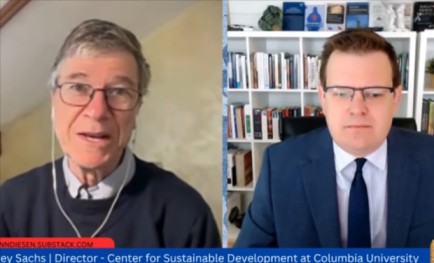
Read the full transcript of Professor Jeffrey Sachs’ interview on Greater Eurasia Podcast, May 12, 2026.
Editor’s Notes: In this episode, Professor Jeffrey Sachs joins Glenn Diesen to analyze the alarming shift in European security architecture toward what he describes as a new, exclusionary military bloc focused on confrontation with Russia. Sachs details the historical context of broken promises regarding NATO expansion and explores how the pursuit of American hegemony and regional Russophobia have replaced the goal of “indivisible security.” He warns that Europe’s current path toward remilitarization and the potential inclusion of Ukraine in a “European NATO” represents a dangerous march toward a wider conflict.
European Security Architecture: A New Military Bloc?
GLENN DIESEN: Welcome back. We are joined again by Professor Jeffrey Sachs to discuss the European security architecture, or well, the changes to it. So, thank you for taking the time.
JEFFREY SACHS: Ah, great to be with you as always. Thanks.
GLENN DIESEN: Well, we saw that after the Cold War we had essentially two options for a European security architecture. We could either have an inclusive European security architecture which included Russia, in which we pursued security with other members instead of security against non-members, like a military alliance. But we instead returned to bloc politics with NATO expansion. I think it was primarily to keep the US in Europe, but either way, it predictably revived this Cold War logic.
Anyways, now we see that European leaders are recognizing that NATO is fragmenting and the solution is instead of going back to those agreements we had in the early ’90s, the Europeans appear determined to develop a new NATO, that is a European NATO, which should include NATO — sorry, should include Ukraine and not Russia. So, but this time without the US protection.
So this is starting to feel like almost a determination to go to war with Russia. I was wondering, how do you make sense of this?
The 1990 Opportunity: Gorbachev’s Vision of a Common European Home
JEFFREY SACHS: Well, in 1990, as you say, there was an option on the table that was extraordinary, absolutely historic. It was put on the table by Soviet President Mikhail Gorbachev, and he meant it. I know, I watched, I was there, I was close up.
His proposition was a common European home, a common European home, that actually he said stretched right across Asia, in fact, from Rotterdam to Vladivostok, as it was put. The idea was that the divisions between Europe and the Soviet Union should be ended. The Cold War should be over. There would be internal reforms in the Soviet Union, democratization and demilitarization, and there would be a fundamental change of the security architecture, the disbanding of the Soviet military alliance, the Warsaw Pact, and at most an end to NATO as a, in any kind of expansionist or offensive operation.
Indeed, the promise, absolutely explicit, made by Germany and the United States in February 1990 in quest of German reunification, a formal end to World War II, and a response to Gorbachev’s offer, is that NATO would not move one inch eastward. And the commitment was undoubtedly made, no matter what is claimed today by those who defend NATO enlargement.
What was on the table was the concept enshrined actually 15 years earlier in the Helsinki Final Act as indivisible security, that there would not be bloc security. No country would join an alliance that would threaten a neighbor. And in particular, no country would join, for example, NATO in an expanding NATO that would threaten those outside of NATO. This was clear. It was on the table. And it was rejected.
Why NATO Expanded: Two Driving Forces
So this is quite an interesting point. What happened instead? Despite the commitment made very clearly by Germany and the United States in 1990, NATO expanded. And ultimately this led to the ongoing war in Ukraine. So why did that happen?
And I think you mentioned one reason. I think that there are two reasons. And those two reasons go back to even the origin of NATO.
One reason was to keep the United States in Europe as a security defender of Europe, but against who? The Soviet Union wasn’t an enemy. After the Soviet Union disintegrated in December 1991, dissolved into 15 former republics of the Soviet Union and now 15 independent nation states, there was no threat.
But some parts of Europe, particularly the countries of Central and Eastern Europe that had just come out of the domination by the Soviet Union said, well, now we want the United States to stay in. To protect us against any kind of Soviet or Russian revanchism. So especially these demands were heard in Central Europe, in the Czech Republic or Czechoslovakia at the time, then the Czech Republic, in Poland, in Hungary. We want Europe to be protected still by the United States, even though there was no evident or any real threat at the time.
There could be no more Soviet invasion. There was no Soviet Union. Russia was absolutely looking inward at internal restructuring and reform. It was dismantling the military-industrial complex. I know that. I was there. I saw that. That wasn’t a gimmick. That was a reality. It was begging for simple cooperation, for peaceful investment, for turning what had been a military-industrial industry into a civilian industry. That option was turned down.
And interestingly, Germany played a major role in pressing for NATO enlargement for that reason. German companies wanted to invest next door in Poland or in Hungary or in the Czech Republic or in Slovakia, Slovenia, and so forth. And they said, we’ll feel safer about our investments if these are also NATO countries. So Germany reneged on the clear, firm, unequivocal commitments that it had made to achieve reunification, to win Soviet support for unification. It immediately started to call for NATO enlargement, probably to protect new commercial investments that were being made in neighboring countries.
The American Hegemony Agenda
But there was a second idea. This was not the only reason for NATO enlargement.
The United States chose NATO enlargement also as a policy tool. For what? For hegemony.
The idea was now that NATO is essentially not a defensive alliance against a now nonexistent Soviet Union, but it becomes the military branch of US overseas power. And so NATO enlargement became part of the new unipolar world that American strategists decided that they would create with the fall of the Soviet Union.
In other words, the United States also made a choice. Should it make peace with Russia and see a recovery of Russia to a, let’s say, a great power status, not a belligerent country, but a powerful country, a country of 17 million square kilometers, roughly twice the size of the United States and the next largest countries? Or would the United States attempt to keep Russia down, maybe to divide it, but at a minimum to ensure that it could never rise again as any kind of threat, even though it wasn’t threatening anybody?
Well, the United States chose that approach while European countries, especially Germany and the countries of Central Europe said, we want more NATO. The United States also decided, yes, that’s a good idea, not to protect those countries, but to project American power.
Brzezinski and The Grand Chessboard
And the chief proponent of this idea, the chief ideologue, I would say, in the 1990s was Zbigniew Brzezinski, and he was a very smart man, a very interesting man. But he didn’t like Russia and he did not want Russia to have a strong, even if peaceful, standing. Perhaps as a Polish-American, he reflected Poland’s long history of anti-Russian sentiments dating back to the 18th century partition of Poland and even wars that went back to earlier centuries between the Polish-Lithuanian Empire and the Russians.
So Brzezinski definitely had no sympathy for Russia. He wanted to see it weak. He wanted to see it divided. And he saw NATO enlargement as a core strategy for that. And in his very interesting, provocative, and absolutely wrong and dangerous book in 1997, The Grand Chessboard, he played out the US geopolitical game of NATO enlargement.
He said that Eurasia is at the center of the world, and Ukraine is the geographic pivot of Eurasia. He who controls Ukraine controls Eurasia. By the way, China was seen as a secondary power, not of any real interest to the United States at the time, often on the periphery. The question was Russia and what to do about it.
And in this book, The Grand Chessboard, and an accompanying article written for Foreign Affairs called “Eurasian Grand Strategy” or something to that effect, I’m paraphrasing, Brzezinski said we should aim for a weak Russia. We should aim for, basically, the expansion of Europe and NATO. So both the economic and the military side to Ukraine. And “Russia without Ukraine can never be an empire.” That was Brzezinski’s basic formula.
So Ukraine became a prize, a geopolitical prize. If we take Ukraine, then we also banish forever any Russian pretensions to great power status. Brzezinski in his musings went on to the idea that, well, maybe Russia would just end up dividing. Maybe it would be, as he put it, a loose confederation of three component parts: a European Russia, a Siberian Russia, and a Far Eastern Russia.
Oh, these were delightful musings for Mr. Brzezinski. Russia basically disappearing as a strong state, being a client state, maybe one where American companies could gain access to Russian resources, but certainly one where Russia would never pose a threat.
The Convergence of European and American Interests
So these were the two lines of thought. For Europe, keep the United States in, it gives us security. For Germany in particular, expand NATO, it helps us to invest in the neighboring countries, because they’ll have a clear military security as well as eventual membership in the European Union. And for the United States, pieces on the global chessboard to ensure what was the new and clear policy after 1991, but in a sense, always the policy of the United States since 1945. And that was global hegemony.
But between 1945 and 1991, the Cold War intervened. There was a superpower rival. But after 1991, with no superpower rival on the scene, global hegemony came into clear view. The end of history had arrived, and NATO would be a very convenient instrument for the expansion of US power into Eurasia.
The Matlock-Kissinger Debate of 1994
I like to refer people to a fascinating debate that was shown on American television, took place on American television, I should say, in 1994 in what was called the MacNeil NewsHour with a very fine newsman, Robert MacNeil, who interviewed two people in 1994 about NATO enlargement. One was the last U.S. ambassador to the Soviet Union as the Soviet Union was ending, Jack Matlock, and the second was Henry Kissinger.
And Matlock said, don’t expand NATO. This could poison relations with Russia. This could undo the goodwill that is clearly here. And Matlock said, if things go sour later on, we’ll have plenty of time to regroup, to reinforce security, to build our defenses. But don’t antagonize Russia. Russia’s trying to be cooperative, friendly. It’s a bit down on its knees right now because of economic crisis. Don’t shake up a fragile but positive path to peace.
Kissinger says no. NATO must enlarge. And he’s asked by MacNeil, “Why, Mr. Kissinger, is Russia a threat?” And he says, “No, no, Russia’s not a threat.” “Well, is Russia threatening any of its neighbors?” “Oh no, Russia’s too weak. It’s not threatening any of its neighbors.” “Well, Mr. Kissinger, would NATO enlargement antagonize Russia?” “Ah, yes, yes, it would.” “Well, Mr. Kissinger, if Russia’s not a threat and it would antagonize Russia, why would you do it?”
And Kissinger gives the classic imperial answer. He says, “Well, if you can’t antagonize them when they’re weak, what are you going to do when they’re strong?” So it was anticipatory antagonism. In other words, we have to get in there when we’re strong and they’re weak. We have to provoke. We have to take the territory we can. We have to take the grounds that we can. And this is what exactly went down.
Kissinger later on started to say NATO enlargement to Ukraine is not a good idea. Even Brzezinski later on said that, I believe. But at the time in the 1990s, they were just gung-ho for American power.
The Three Waves of NATO Enlargement
And I can add one more thing, Glenn, which is that the Russians were really peeved as NATO started to enlarge, but it came in three waves, which we should understand.
When the first wave of NATO enlargement came in 1999 with Hungary, Poland, and the Czech Republic, and really pushed by those three countries as well, by Václav Havel and others who also wanted the NATO protection, the Russians swallowed hard. They were in a weak position. This was still a long way from their borders. They were unhappy. They thought they had been cheated, which they had been, but they went along with the NATO enlargement in this first wave.
And when President Putin became president, he was not antagonistic to Europe or to the United States. And famously, he explored Russia actually joining NATO and then found that, no, no, you don’t understand, NATO’s against you. This only became apparent later on.
The second wave of NATO enlargement brought NATO to Russia’s borders in the North Sea, in the Baltic States. So the wave in 2004 was 7 states: Latvia, Lithuania, and Estonia in the Baltic region, Slovenia and Slovakia, Bulgaria and Romania. This was also now real national security. The Black Sea was being now taken by NATO. The Baltic States were being taken by NATO.
And this 2004 expansion came in the wake of America’s withdrawal from the Anti-Ballistic Missile Treaty in 2002, which I think really shook the ground because now the nuclear balance was being undone by the United States as the US unilaterally walked away from the Anti-Ballistic Missile Treaty.
So 2004 was really a very, very bad expansion, and it put Russian backs up tremendously. And that’s when they said, don’t you dare come further. That’s when President Putin said at the Munich Security Conference in 2007, “Enough, you’ve cheated, you’ve reneged, but don’t come further.”
The 2008 Bucharest Summit: The Breaking Point
And of course, the United States being the United States, and Europe at that point being Europe, not unhappy too much about all this expansion, committed at the Bucharest NATO summit that Ukraine and Georgia — and Georgia, an Asian state in the South Caucasus that is in the belly of the South Caucasus, a real security concern for Russia — would also join a North Atlantic Treaty Organization that was not defending against anything. It was just expanding.
And the 2008 NATO summit was the breakpoint, and you can even trace it hour by hour in Angela Merkel’s memoirs because she knows. She knows that the NATO commitment to enlarge to Ukraine and Georgia was a casus belli. It could lead to war. She knew it. She resisted a specific timetable because she was afraid, but she gave in to the American pressures.
That was when Europe lost it all, in my view, when the cautious leaders of Europe said, okay, okay, NATO’s going to enlarge to Ukraine and to Georgia. That wasn’t about defense. It wasn’t even about investment security. It was just about American hegemony. It was an American project. It was pushed on Europe. Europe went along. When Angela Merkel folded her hand at the end of the first day of the NATO summit in 2008, that’s when Europe lost it. And that’s where we are today.
The 2014 Maidan Coup and Its Consequences
It took a US-backed coup in Ukraine in February 2014, the Maidan coup, to bring to power a government that even wanted NATO, because the vast majority of Ukrainians sensed, we don’t even want this, we’re neutral. But the US-backed coup led by Western Ukrainian far-right paramilitaries, in fact, that took over the government. And then the United States and Ukraine from then on were intent on NATO enlargement.
By the time the United States lost interest in this project, by the way, because Russia stood up to it and fought back and said, no, NATO’s not going to enlarge to Ukraine, the Europeans now take this as their grand project. And this comes back to your opening remark that Europeans are talking about a military alliance that includes Ukraine. Well, if they do so, they’re just meaning war with Russia. It’s nuts.
Look at a map. Ukraine should be neutral, period. This is the way to peace. And the Europeans are rejecting that for God knows what mindset reason, but it’s crazy.
Europe’s March Toward War: Security Dilemmas and Historical Failures
GLENN DIESEN: Well, as I said, the Europeans back then, at least they were cautious, and they knew that taking these steps, expanding NATO, especially to Ukraine, would create a war. And also, after all this time at the end of the Cold War trying to replace bloc politics with indivisible security, they actually had it. But they wouldn’t take yes for an answer.
And exactly, they knew the risk of reviving bloc politics. They knew that a Europe without Russia would inevitably, inevitably become a Europe against Russia. And this is why it’s so hard to understand what’s going through their minds, because this new military bloc, it can’t create hegemony. It is definitely not going to create anything that looks like security, because a European military bloc will instigate conflict, but without the American protection.
So it kind of begs what the purpose is. And if you see this together with other initiatives, such as all these European countries, including Germany, pushing these drone programs, this mass production of long-range drones for the explicit purpose of striking deep into Russia. They keep talking about deterrence and helping Ukraine, but the Europeans have gone to war now against Russia. It’s just difficult to — I don’t understand what the purpose is.
Madness and Russophobia: Understanding Europe’s Dangerous Mindset
JEFFREY SACHS: Yes, let me try to give you my explanation. First, let me say it’s madness. It’s suicidal. It’s a path of war. So what I’m about to say as explanation is not a justification. It’s trying to understand what is going on because this is crazy, what Europe is doing right now, thinking that it’s girding for war with a nuclear superpower. Crazy.
So what is going on? Well, part of it is really the mindset of Eastern Europe. Eastern Europe was under Soviet domination for 45 years basically, and they have this visceral hatred, fear, of Russia. And so a lot of this is driven by the Baltic states. It’s driven by Poland, certainly much less so by the Czech Republic or Slovakia, which actually resists all of this, or by Hungary, which has been resisting this, or by Bulgaria and Romania.
But the Baltic states and Poland are Russophobic to the core. That’s part of their long history. It’s part of their Cold War history. It’s a tremendous lack of understanding of history and an unwillingness, a radical unwillingness to understand anything from the Russian perspective. It’s very, very sad.
Even the Cold War, maybe we can discuss on another time, had its roots in terrible misunderstandings and security dilemmas. Russia was looking for protective space. Again, just like now, the United States and Britain were not interested in giving protective space to the Soviet Union then. They wanted a remilitarized Germany. So lots of mistakes were made that led to the division of Europe back in the Cold War period.
But from the mindset of the Eastern Europeans, that’s what’s driving them now, that Russophobia born of their history from 1945 to 1989, ’91. And I think it’s a huge mistake, a huge failure of understanding history, a huge misreading of everything going on right now. So this, I fear, is one major part.
Brussels, Germany, and the Failure of European Leadership
And then in Brussels, the European project depends on keeping these new entrants happy also. They don’t want a politically divided Europe. So who is their chief foreign policy spokesman? An Estonian of complete Russophobia. This is crazy for the European continent to go with the most Russophobic ideas as the guidelines. But that’s what they’re doing in part for their internal cohesion in Europe.
But there’s a second matter, Glenn, that I think is really, really important. Germany is failing its historic role right now of making a European peace, because what has happened was that for decades, German chancellors understood — make peace with Russia, make peace with the Soviet Union. This goes back to Ostpolitik with Willy Brandt. It continued with Helmut Schmidt. It continued with Helmut Kohl in 1990. It continued with Schroeder.
But it failed in part when German industry said, expand NATO so we can invest. That was the beginning. But then it failed with, unfortunately, Merkel’s lack of will. Because the will to resist NATO enlargement — she knew, she knew intellectually this was dangerous, but she went along with the United States. And this is rather regrettable.
But then it got worse and worse. Scholz became nothing but a factotum of the Biden administration. Not a peep of any thinking of how dangerous this situation is. And Merz, even worse. Merz, almost an open warmonger. Shocking for a German chancellor, actually. Completely shocking.
And so in addition to the Eastern European fears, understandable but wrongheaded in my view, is Germany’s lack of self-understanding, historical awareness, understanding that Germany broke its own commitment to the Soviet Union and then to Russia, that Germany is key to indivisible security in Europe. You have Merz now just openly saying we need to prepare for war. Why? It’s shocking.
I can’t quite say why. It’s such a bad misunderstanding of Germany’s real needs and real place in the world. It’s actually terrifying in a way. And maybe Merz also sees an economic dimension to this, the retooling of industry for war making. God forbid. Military Keynesianism. Is this really what Germany is about right now?
Germany is losing its industrial base, but what Merz is doing is going to possibly provoke a disastrous war, but leave Germany even farther behind economically. It’s completely the wrong track.
Two Strands Driving Europe Toward Catastrophe
So all of this is to say that I see two strands at work right now. Most of Western Europe, not so much in this agenda. Eastern Europe, absolutely — or much of Eastern Europe, the Baltics and Poland in particular, pushing this anti-Russophobic line. Germany, absurdly, tragically, unaware, self-unaware, now even championing this idea.
And then always in the background, one has to add, British Russophobia, because Britain, to my mind, is madness. It is imperial nostalgia to this moment. Even as Starmer goes down the drain, they put Ukraine as a great national project because they’ve hated Russia since 1840.
So just to add one coda to this. All of this is to say, Glenn, that at the best we have the classic security dilemma that Europe is taking defensive steps that are going to lead to war because they are really offensive in what they’re doing. But what we see is a complete lack of political and security imagination in Europe. What started as a misguided project for Central Europe and for American hegemony has turned into an absolutely profoundly dangerous European project for remilitarization that would be the march to war.
GLENN DIESEN: Oh yeah, it’s incredible that they took all the steps and how they’re also defining deterrence these days. If all your security is about deterrence, that’s horrible enough, but what they put under that category today has clearly nothing to do with deterrence. But exactly, here we are. Anyways, thank you very much for your analysis and have a great flight.
JEFFREY SACHS: Great. Okay, talk to you soon. Bye-bye.
Related Posts