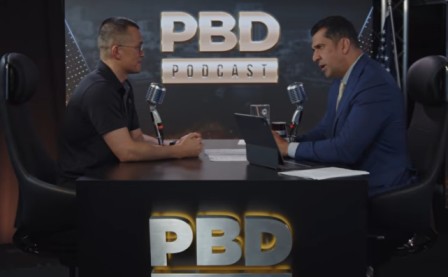
Read the full transcript of Binance Founder Changpeng Zhao’s interview on PBD Podcast #797, May 12, 2026.
Editor’s Notes: In this episode of the PBD Podcast, host Patrick Bet-David sits down with Binance founder Changpeng Zhao (CZ) for a candid look at his journey from a rural village in China to becoming one of the world’s most influential financial figures. CZ opens up about his recent legal challenges and sentencing, his early decision to sell everything for Bitcoin, and his perspective on the evolving landscape of global crypto regulation. The wide-ranging conversation also delves into his new book, Freedom of Money, providing a rare glimpse into the mindset of the man behind the world’s largest cryptocurrency exchange. Throughout the interview, CZ shares his vision for the future of technology while maintaining the simple and humble demeanor that continues to surprise many given his massive influence.
Introduction
PATRICK BET-DAVID: CZ, great to have you on the podcast.
CHANGPENG ZHAO: Thank you for having me. Pleasure to be here.
PATRICK BET-DAVID: I told my guys, I said, listen, I noticed everybody was going in the cigar lounge to meet you. I said, you better not ask him for a loan. You better not go and say you want a donation or a loan from this guy, because the first thing they found — what’s his net worth? Is he really worth $110 billion? That’s the first thing people want to find out. And you’re like, yeah, you know, he’s a pretty rich guy.
But it’s funny, I got all these things I want to go through with you, with your story. I was telling you earlier how your story is a movie. They could turn it into a movie at any time. And I hope it turns into a movie because you’ve lived an interesting life. But did you fly in from UAE?
CHANGPENG ZHAO: Yes.
Flying Out of UAE Amid Missile Alerts
PATRICK BET-DAVID: Okay, is it true that you guys just got attacked or you got bombed yesterday by Iran at a couple of oil facilities?
CHANGPENG ZHAO: I don’t know where they attacked, but as we were leaving, there were missile alerts and the flight was on, off, on, off when you were leaving. When we were leaving, yeah. So just on my way to the airport, the flight was off and then 20 minutes later the missile warning was resolved. It was on again, and then it was off again and on again. And then, yeah, so that’s how we fly. And we wait. So just before we were supposed to take off, there was off again. We said, well, let’s just wait for 20 minutes. And then we had a 20-minute window at the plane.
PATRICK BET-DAVID: What did the pilot say? The pilot said, hey, we don’t know. Are they given a safety protocol or no? Hey, we’re going to take off, it’s going to be fine. It’s going to be a long flight, we’re going to be okay. There’s going to be a little bit of turbulence. What warning did the pilot give?
CHANGPENG ZHAO: So the pilot’s just waiting for the — the pilot’s just following instructions. So whenever there’s a warning, they huddle everything into a safe room that’s like in the middle of the airport, away from glasses, windows, and stuff like that. And whenever the warning is off, you say, well, you can board the plane, and then you fly off. And it was actually no turbulence. It was a calm day.
PATRICK BET-DAVID: It was a calm day. No turbulence. Were you worried while you’re taking off or no?
CHANGPENG ZHAO: No, I wasn’t worried.
PATRICK BET-DAVID: Not worried. Okay.
CHANGPENG ZHAO: So like 99% interception rate, and super safe. Yeah, it is worrying because that missile flying in, but it’s super safe.
Why UAE Is the Safest Country in the World
PATRICK BET-DAVID: So living there yourself, you feel safe living in UAE?
CHANGPENG ZHAO: Very safe.
PATRICK BET-DAVID: You do?
CHANGPENG ZHAO: Very safe.
PATRICK BET-DAVID: When you think about all the things that you can’t — you can buy with money. You can go to a restaurant, the waitress doesn’t give you good service, you can buy the restaurant and say you’re no longer here. You have that kind of money. You can go to a sports game, you don’t like the team’s management, you can make a massive offer the next day and buy an NBA team or an NFL team. But when it comes down to security, living at a place, what made you pick UAE out of all the places to live in?
CHANGPENG ZHAO: I mean, it is the safest country in the world. Safest country in the world.
PATRICK BET-DAVID: You believe that?
CHANGPENG ZHAO: By far. Yeah.
PATRICK BET-DAVID: Tell me why.
CHANGPENG ZHAO: You can — if you drop your wallet on the street and it has like, I don’t know, $3,000 in there, you walk up, you come back in a week, it’s still there. You’ll find it, and people who find it will return it with cash in there. There’s zero, basically zero crime. There’s no petty crime, no big crimes, etc. And the physical security on the street translates into financial security. Fintech, it’s just very well run. And also the leadership of the country is very pro-business, very, very smart, very, very calibrated, extremely visionary. So it’s one of the best places to be.
PATRICK BET-DAVID: Yeah. Do you think about the importance of — what level of importance do you put on where to raise your family, on the strength of the military of that country in today’s turbulent times that we have? Do you say, man, I wish UAE had a stronger military or no?
CHANGPENG ZHAO: Well, I think I was actually surprised at how strong the military of UAE is. I didn’t know until there were missiles flying in and they were intercepting it.
I think UAE does rely very heavily on US support from a base, from military, from military equipment.
PATRICK BET-DAVID: They rely on us for that.
CHANGPENG ZHAO: I think so.
PATRICK BET-DAVID: Yeah.
CHANGPENG ZHAO: So they’re a very strong partner for the US. So I think they do quite well there. And then, other than that, I think that just the countries that are very well governed — if you have sensible leaders, you have smart leaders that are fair and that want the country to grow instead of growing their own pockets, then you have a pretty good country. Yeah.
The Shift from Tangible to Intangible Wealth
PATRICK BET-DAVID: I saw a stat the other day and I wonder how you answer this one. In the ’70s, in the S&P 500, it showed that 85 to 93% of the wealth was tied to tangible assets. In 1970.
CHANGPENG ZHAO: Yeah.
PATRICK BET-DAVID: So if somebody was a billionaire and they lived in a state, they ran a business, they couldn’t move to another state or they couldn’t move to another country because it’s tangible asset wealth that they have today. We’ve gone from 85 — yeah, 85 to 93% back in the days to now it’s the other way around. 92% is in intangible assets, patents, brands, Bitcoin, crypto, AI, all this stuff that they’re building.
Moving forward, do you think this is going to be a threat to countries that don’t know how to handle small business owners or big businesses? That person can say, great, I’m going to go move to UAE, I’m going to go to Singapore. How do you view that with how much of the wealth today is tangible instead of intangible?
CHANGPENG ZHAO: I think that’s a great point. I think I agree with you 100%, which is right now, if you look at the wealth today, it’s IP, it’s technology, it’s crypto. They have no borders. Even with IP and technology, there’s some country limitations, right? So if you run an IT company, let’s say AI, you run in the US or you run in China, you’re still kind of confined to those countries. Whereas in blockchain, in our industry, crypto, there’s no borders. Your Bitcoin is yours no matter where you are. You fly to a different country, you don’t have to even make a transfer. That crypto stays with you, right?
And also technology startups — we’ve seen a lot of technology companies amassing very high valuations. And those are the big, big drivers for this economy, for economies of countries and the world. They can be based anywhere. So this is good and bad. Now countries with favorable regulations, with good leadership, good regulations, good environments will attract the top talents. And talents are very mobile now, right? You get educated in one country, you can move to a different country very easily, and you learn your skill. You can also work remotely — Binance has remote work, 5,000 people working remotely. So all of this is possible now.
PATRICK BET-DAVID: So in how many countries, the 5,000?
CHANGPENG ZHAO: I don’t really know for sure, but more than 100 countries, I would say.
PATRICK BET-DAVID: You have 5,000 employees working for Binance. They’re all remote in 100+ countries.
CHANGPENG ZHAO: Everyone’s remote. Pretty much everyone’s remote. So I don’t run Binance anymore, but no, this is — the stats are pretty public.
PATRICK BET-DAVID: You still own 90% of it, though?
CHANGPENG ZHAO: No, actually, I’m a large shareholder, but not 90%. So quite a bit less than that.
PATRICK BET-DAVID: But you still have majority control, though. You’re above 50%.
CHANGPENG ZHAO: I’m the single largest shareholder. So majority. Yes. Yes. Okay.
PATRICK BET-DAVID: Got it. So even though after all this — which we’ll get into — even though all that stuff happened, they said you couldn’t be CEO. Still as a majority shareholder, you still carry a lot of influence.
CHANGPENG ZHAO: I think influence, yes. But I don’t run the company. I don’t try to. I don’t give them instructions. But my shareholder rights are intact. So I’m a shareholder. I get shareholder information.
America vs. UAE — Where Should Entrepreneurs Build?
PATRICK BET-DAVID: Yeah, that’s pretty wild. So 5,000 employees, 100+ countries. You know, you’re a thinker. When I watch you in interviews and things you say, I’ve watched you with Peter Schiff debate on the way you brought the kilo of gold. You’re like, here, let’s split it. You’re trying to kind of make the point of the difference between traveling through the airport.
Why live in UAE? Why not live in America? Why not? You know, from the outside yourself, because America’s always been known as the land of all opportunities, the place to be for entrepreneurs. Do you, as an outsider — you’re not an insider — do you view America as the greatest country to live in today, moving forward as an entrepreneur?
CHANGPENG ZHAO: Okay, I’ll give you a very blunt answer. I think since the last year and a half, I think America is probably back to being one of the best countries to live in. But during the Biden administration, it was one of the worst places to live in. I basically just tried to stay as far away from the US as possible during that time. They were very hostile on crypto, they were very hostile on our industry. So I just wanted to stay as far away as possible. It was not possible to run a crypto business in America before.
I think now it’s more possible. So I think in the last year and a half, we’re seeing a 180-degree reversal, which is great for the US economy, I think.
PATRICK BET-DAVID: Now, would you consider ever coming down here and living here or no, you’re happy in UAE?
CHANGPENG ZHAO: I think right now my lifestyle is pretty set up and it’s not easy getting US passports, etc. So I’m pretty content where I am, but I think we will definitely want to do more business and invest more in the US.
PATRICK BET-DAVID: So if I’m a friend of yours — I know you do some mentoring as well for some of the founders that you work with — and if I ask you, I said, look, I got a bunch of different places to live in, in the crypto space. Should I go build my hub out of America or should I build it outside of America? What advice would you give me?
CHANGPENG ZHAO: I think today I would say definitely do have a presence in America, but you may want multiple presences because the crypto regulations today are country-specific. US regulations don’t service the rest of the whole world, actually. I think UAE is actually one of the very few places that offer global crypto licenses for crypto exchanges. And that’s fairly new as well. So we’re still at the early stages of these regulatory frameworks in different countries. And the US, I think, is progressing extremely well, extremely quickly. I think there was some progress on the Clarity Act even last night.
But I think, yeah, the US is definitely one of the places to be. But I wouldn’t say — I always have a global view on business. I wouldn’t focus on only one country. I think we’re living, as we said before, in a world where the country borders are much fuzzier in terms of technology, in terms of digital assets. So have a global view instead of — we no longer need to do business in one country and then expand to another country and then expand to another country. We can do parallel progress.
PATRICK BET-DAVID: So even if you did get a passport to come down here, you would still choose UAE today?
CHANGPENG ZHAO: I think today my life is pretty set up in the UAE right now. I will probably just stay there. Yeah.
The Future of Wealthy Entrepreneurs and Global Tax Competition
PATRICK BET-DAVID: I want— again, the whole point with me is, do countries realize what’s going to happen to the future of these wealthy entrepreneurs, who their assets are intangible, that they can no longer bully them with regulation? Because they got 200 other countries that would love to have them. Maybe not all 200 of them, let’s just say 100 of them, they can go to have a decent life. And then 10 countries that are very competitive for business, say UAE, Singapore, some of these countries you can go to.
I wonder if, as bad as it is today, we see reports of people leaving California with the whole wealth tax. I don’t know if you’re following that closely or not. And we see what they’re talking about in New York. And a trillion dollars left New York and California during COVID. California just lost another trillion dollars, and their net migration rate report came out that they’re even losing more people now. And they want to offer this 5% tax, billionaire tax, on the couple hundred people that I have there.
I wonder if they’re going to realize how horrible of a move this is long-term, because you can go anywhere today. I wonder if they’ll figure that part out. What do you think?
CHANGPENG ZHAO: Well, what I hear is a lot of companies moving to Texas in the US, right? I don’t know the details, but generally at a high level, I think high taxes doesn’t work that well. When you impose high taxes or high transaction fees or just generally high cost for doing business, a business moves away. Basically you’re taxing on a much smaller volume. You actually get less net tax — less net fees or income or revenue, however, whatever you call it. The concept is about the same.
And as you said, now there are 200 countries, they are kind of actually competing for favorable regulations for businesses, favorable environments for businesses. So yeah, I do think that that consideration is definitely in play. So it’s not like the business won’t move and you can just tax the hell out of them. When you increase tax from like, I don’t know, from 1% to 10%, yeah, you might have less tax income. It’s not that straightforward.
Iran, the Gulf States, and Regional Geopolitics
PATRICK BET-DAVID: Being close to Iran, what is your opinion on what’s going on with Iran?
CHANGPENG ZHAO: Well, I didn’t follow geopolitics that closely before. I’m just like a business guy doing crypto, etc. But after the war started — I live in a country that was attacked by Iran. UAE did not initiate any attacks. UAE was the most missile attacked from Iran out of all countries. I think it’s just because of the physical proximity because they’re just across the water. But even being attacked, being the most attacked, they didn’t retaliate, right? So UAE held back. They probably could, but they didn’t. This goes to the wisdom of the country leadership.
But living there, seeing missiles flying overhead, can’t make me support Iran, right? So yeah, I’m against all wars. And also, based on my limited understanding, the fact that Iran hit every country in the Gulf is a bit crazy. I wish the war would stop soon. I wish people come to their senses. And also based on what I’m reading, it’s just like there’s no leadership there, right? There’s no leadership in Iran. It’s very chaotic. I really wish we can help put, or like somebody puts order in there and then people can move on to build businesses.
PATRICK BET-DAVID: You think it’s unify the Gulf states, like against Iran?
CHANGPENG ZHAO: I’m not too sure. I’m not an expert on this topic, but it doesn’t seem to be super unified. I think everyone have different opinions, right? We see UAE, like, now withdraw from OPEC, which is pretty significant and also which is pretty strategic. So there’s some diff— I wouldn’t say everything’s aligned. You have multiple countries, you have multiple personalities, you have multiple people involved. It’s a dynamic environment. Again, I’m not an expert on this kind of stuff.
CZ’s Background and the Origins of Binance
PATRICK BET-DAVID: No, I asked that because if— you’re also not a regular guy, though. You know, you have a lot of money, you have a lot of influence. You built one of the fastest growing companies, $2 billion. At the time it was the fastest. The total amount of money transactions that’s been done in Binance, I saw $125 trillion. I think I saw a number like that. So it’s not like you founded just a regular company. It’s a big company with a lot of influence and compliance.
And I know when you’re saying not all the Gulf states, UAE, Saudi— Saudi dictates prices for oil. So that’s probably not happy that UAE left and Qatar left in 2019. I was just wondering what your opinion would be on that, because safety matters at this phase.
So going back to it, your story, fascinating story. You know, before everybody learned about you with Binance at the time, I think you guys went from zero to billion the fastest out of any other company that we had. And then reports came out, you on Twitter, you have a massive following when it comes down to Bitcoin, the comments you’ve made, the stories of you selling your house for $900,000, all of that. But for some of the audience that maybe doesn’t know, before you became the business tycoon that you are today, how does the story begin?
CHANGPENG ZHAO: Oh, well, we trace back, right? I was born in a fairly rural village in China. I grew up there, moved to a city when I was 10, and then moved to Canada when I was 12. And then I did high school there. I did high school in Vancouver and then started college in Montreal at McGill. Didn’t graduate there. I did 4 years and then my intern boss gave me a job, then I delayed and delayed and I never went back to McGill. I started working.
And then I worked in Tokyo, New York, Shanghai, and then Singapore. So I started as an IT guy and then turned into an entrepreneur. I worked at Bloomberg in New York. So I was always in the sort of financial tech, fintech field. And then I started a company. I was a junior partner of an IT company. I started a company with 6 other older guys in Shanghai in 2005, did that for 8 years.
And then I came across Bitcoin in 2013 and I was like, this is the future technology. So at that time it was actually pretty interesting because I think there are 3 big technologies in my life: the internet, and blockchain. And at the time I didn’t know what was next, right? At the time I thought the next one was going to be like 10, 15 years later. Now we know it’s AI. So I think these are the 3 big technologies in my life. When the internet was happening, I was too young to really do anything meaningful with it. In the blockchain, when blockchain is happening, we got lucky. We founded a platform that’s impactful, that’s useful. And so yeah, that’s kind of how I came to be.
Who Was CZ in High School?
PATRICK BET-DAVID: If I was in high school with you, say you’re 14, 15 years old, who were you in high school? We’re in a class together. Who’s CZ?
CHANGPENG ZHAO: I was a normal kid. I was a bit geeky. I played a lot of sports and I was like an Asian kid in Canada that played volleyball, just a normal kid. I wasn’t super smart. I wasn’t the best in any academics. I was pretty decent in math and science, a bit weaker on the literature, like English, French. I was very bad in French. Yeah, but I was a normal kid.
PATRICK BET-DAVID: Did people, like, did you know you’re going to do something special? Like, was there something where you’re like, one day I’m— were you a driven kid or—
CHANGPENG ZHAO: No, no, no, it was not. There was no indications I was anything special. I was just a normal kid. Yeah, there was never any indications, “Oh, this guy is going to build a billion-dollar company.”
PATRICK BET-DAVID: Were you a dreamer? Would you dream about one day, you know, I’m going to do this, make my family proud? Was there any thoughts like that with you?
CHANGPENG ZHAO: No, I didn’t have any of that. I wanted to be successful. I wanted to do well, but I never dreamed of being a billionaire or like run the largest crypto exchange. Like, that’s just never— I just wanted to be financially successful. I want to have a successful career. I want to build a good life. I want to work. I always worked hard. But it was like, I wasn’t dreaming, “No, I want to be the—” whatever ranking, that just wasn’t me. Yeah.
The Accidental Billionaire
PATRICK BET-DAVID: So I don’t know if you read the book Accidental Millionaire. It was a book written about Apple, about Steve Jobs and Steve Wozniak. It was, I think, a former employee that wrote it, it’s a little bit of a disgruntled guy that was saying bad things about him. There’s a different copy of it. If you go to Accidental Millionaire and you put Apple, just go to images, you’ll see which one it is.
CHANGPENG ZHAO: Apple.
PATRICK BET-DAVID: That’s the one right there. Then they wrote a book called The Accidental Billionaire. If you notice, it’s only got 11 reviews. This came out in ’87. It’s actually a very good book for somebody in the space. Lee Butcher — actually a very good book I read. Then the book came out called An Accidental Billionaire, and that was written, I think, about Mark Zuckerberg, who, you know, he became a billionaire. Now, you— I don’t know what they call it. What’s 100? Centi? Is a hecta 10 centi, right? So you’re an accidental centi-billionaire.
CHANGPENG ZHAO: I’m not sure. I’m not sure I’m centi, to be honest. I think the Forbes estimates are a bit off. They’re too high.
PATRICK BET-DAVID: Okay.
CHANGPENG ZHAO: Yeah, but yeah, kind of accidental. Yeah.
Selling the Apartment and Going All In on Bitcoin
PATRICK BET-DAVID: And how did it happen? When you— because I know the story when you sold your property, if you want to share that story, when you sold the property and you bought all Bitcoin, what got you to the point of saying, “I have to be able to get into Bitcoin?”
CHANGPENG ZHAO: I started learning about Bitcoin in 2013, right? And at the time I was like, what, 36, 37? And I was like, okay, this is the future technology. This is bigger than the internet. And when the internet was happening, I was too young. So at 36, 37-ish, I wasn’t going to let this opportunity pass by. So I said, look, I just got to get involved in this new technology field. I don’t know what I’m going to do first. I don’t know what I’m going to do yet, but I’m going to buy Bitcoins first. So I sold my house, sold my apartment, and bought Bitcoin. So that was pretty clear to me. That was a very long-term conviction.
PATRICK BET-DAVID: What did you— is this a $900,000 apartment?
CHANGPENG ZHAO: Yes, this is a $900,000 apartment.
PATRICK BET-DAVID: And when you bought it at the time, what was the average price of Bitcoin?
CHANGPENG ZHAO: The average price I got in was about $600. I bought it— I got payments in installments, right? So I bought it at $800, $600, $400. So average to us.
PATRICK BET-DAVID: So if we do $900,000 divided by $600 times $81,000, you’re looking at $121 million, give or take something.
CHANGPENG ZHAO: Yeah, just about $100 million.
PATRICK BET-DAVID: Selling a $900,000 apartment turned into $121 million. The average person listening to this thinks that’s crazy. But what made you say, “This is what I’m going to be doing?” That’s a pretty bold decision to make. That’s a big risk to make.
CHANGPENG ZHAO: Well, number one, I saw the clear future of the technology. I don’t know what it’s going to be like exactly, but I know it’s going to grow.
PATRICK BET-DAVID: So what made you say that? What made you— is it a paper? Is it a white paper you read? Is it someone’s paper you read?
CHANGPENG ZHAO: Back then there was much less material about it. There was a white paper that I read. There was a forum called BitcoinTalk.org that I spent a lot of time on. And then going to conferences, meeting the people of the community made a huge difference. And also doing the first transaction with Bitcoin. When you install your own Bitcoin wallet and you realize, “Wait a second, this is a network I can send money to anyone, full control, there’s no bank involved, there’s no other fees involved, it’s instantaneous.” So once you realize that, it’s like, this is a technology for the future.
Not only did I just sell the apartment, I actually quit my job to look for a new job in this industry. So most people will say those two combined are pretty high risk. But I think as I detail in the book, risk is not based on the action, it’s based on your individual circumstance. For me, my risk tolerance at the time was high because I know I can get a job. If Bitcoin went to zero, I can get a job in a bank. I can get a job on Wall Street again.
From Bloomberg to Bitcoin: Early Career and Learning the Crypto World
PATRICK BET-DAVID: That confidence came from what? You’re just pure skill set and knowledge?
CHANGPENG ZHAO: Yeah. So by the time I learned about Bitcoin in 2013, between 2001 and 2005, I was working at Bloomberg in New York. And so I was doing entrepreneurship for 8 years afterwards. I thought my experience and everything else have increased. My value should have increased.
PATRICK BET-DAVID: At the time when you sold your apartment and you quit your job, how much did you have in liquid cash? Did you have some money or—
CHANGPENG ZHAO: Not very much because I put most of my cash into the company that was working before and the rest of the cash was in the apartment.
PATRICK BET-DAVID: Less than $500,000?
CHANGPENG ZHAO: Oh, way less, actually. Probably much less. The apartment money was pretty much all I had.
PATRICK BET-DAVID: The reason why I say this is it’s not like that was a— you made the decision because you had a couple million dollars in a bank from a previous exit. Oh no, no, you’re not rich at this time.
CHANGPENG ZHAO: No, no, no.
PATRICK BET-DAVID: Yeah, okay. Yeah, so that’s a risky decision right there, but you trusted your ability on the way to work and the skill set that you had and the knowledge that you had.
CHANGPENG ZHAO: Yeah, yeah. So I didn’t need the $900, $1,000 to maintain my lifestyle. I can work for income that will maintain my life.
PATRICK BET-DAVID: And you’re a minimalist even at that time?
CHANGPENG ZHAO: Yeah, I wouldn’t call myself a minimalist. I’m just pretty basic, right? So if you look at my table, it’s got all kinds of camera gadgets. I wouldn’t like minimal, like very clean. That’s how I think of minimalist. I’m just a normal basic guy.
PATRICK BET-DAVID: Got it.
CHANGPENG ZHAO: I don’t do anything fancy.
Discovering Bitcoin: The Poker Game That Changed Everything
PATRICK BET-DAVID: So when you found out about Bitcoin, was it like a 3 o’clock in the morning aha moment? You’re calling your friend, “Wake up, John, I got to tell you something, we’re going to do something special.” Did you have a moment like that, or was it gradual?
CHANGPENG ZHAO: Well, a friend told me— a friend, Ron Cao, told me about Bitcoin over a poker game. It was a very friendly poker game. And then afterwards I spoke to another friend whose name is Bobby Lee. He was just about to join BTC China, which is— at the time, not the comedian Bobby Lee. Different, different.
PATRICK BET-DAVID: Okay. When I think about Bobby Lee, all I think about is Bobby, the whole Theo Vaughn thing.
CHANGPENG ZHAO: Not this guy, not this guy. Yeah, but so there were a couple of friends who were around me, they were getting pretty serious into Bitcoin. I was like, okay, let me learn about this a little bit more.
PATRICK BET-DAVID: And so from there, is it inviting friends over, “Guys, we’re going to go do this, we’re going to go do that,” or no, it was more, “I got to go find a company to work for”?
CHANGPENG ZHAO: At the time, first I spoke to a bunch of guys. We tried to do a few different businesses. Basically like, let’s do this and that. I talked to a couple of friends in Taiwan who used to work for TSMC, the Taiwan Semiconductor manufacturer.
PATRICK BET-DAVID: Right.
CHANGPENG ZHAO: Basically all the Nvidia chips, all the AI chips, 80% of the world’s chips are manufactured there. We wanted to do a Bitcoin mining chip or a mining machine, but that didn’t materialize. It involves a lot of logistics, which are not my specialty.
PATRICK BET-DAVID: How close did you guys get to executing that?
CHANGPENG ZHAO: Not very close. We discussed business concepts. We had maybe even a business plan, but we didn’t pull the trigger. I did a couple of RoboCoin Bitcoin ATM machines. I actually sold a couple, but that also didn’t grow. And then I said, okay, well, instead of trying to do a startup, let me try to work for a company first. And I bumped into a few guys at Blockchain.info, and then I joined them for a few months.
PATRICK BET-DAVID: Big company, small company, startup?
CHANGPENG ZHAO: Very small company. I joined as the third person there.
PATRICK BET-DAVID: And who were they? Were they players? The other two guys, were they players in the Bitcoin space?
CHANGPENG ZHAO: Well, the founder— yeah, the founder is a 20-year-old kid who wrote a website that attracted 20 million users. Wow.
PATRICK BET-DAVID: At the time he was 20?
CHANGPENG ZHAO: At the time he was 21, 22. Yeah.
PATRICK BET-DAVID: And how old were you at the time?
CHANGPENG ZHAO: I was like 30. I was 36, 37.
PATRICK BET-DAVID: So a 36, 37-year-old goes and works for a 20-year-old to build a website with 20 million users.
CHANGPENG ZHAO: Well, he already built the website. I was just helping him, really. Yeah.
PATRICK BET-DAVID: So did you go in as an equity position player or no, just a regular person?
CHANGPENG ZHAO: No, I joined without much equity. I have an earnout to earn the equity, but I didn’t stay there long. I didn’t stay more than a year. So I didn’t have—
PATRICK BET-DAVID: Did he end up becoming a major player? Like, is he a known guy in Bitcoin today? Did he become very successful? His name is Ben Reeves.
CHANGPENG ZHAO: He’s the founder of the company, but he sold his shares later on for at least a few million, probably double-digit millions. But he’s a very low-key introvert, so he stayed out of sight.
PATRICK BET-DAVID: Yeah. Got it. Ben Reeves.
CHANGPENG ZHAO: Yeah.
PATRICK BET-DAVID: Is that part of Blockchain.com or—
CHANGPENG ZHAO: I think they later renamed to Blockchain.com. Yeah. The page doesn’t talk about Ben Reeves, but Ben Reeves is a true founder.
PATRICK BET-DAVID: Oh yeah, yeah. Benjamin Reeves. Peter Smith and Benjamin Reeves. Got it. So what did you learn from what he did? So now you’re working there. What did Ben do? Because you’re not there for too long.
CHANGPENG ZHAO: Yeah. Yeah.
PATRICK BET-DAVID: How long were you there?
CHANGPENG ZHAO: I was there for 8 months.
PATRICK BET-DAVID: And during that 8 months, was it an accelerated learning curve of finding out everything with Bitcoin?
CHANGPENG ZHAO: I learned a lot, actually. Number one is the community is very dynamic. So this guy Ben Reeves, his only marketing was based on one thread on bitcointalk.org, which is a bulletin, like a virtual bulletin forum.
PATRICK BET-DAVID: That’s what brought 20 million people.
CHANGPENG ZHAO: Yeah. And then also Blockchain.info at the time didn’t have a company. They don’t use bank accounts, they don’t have an office. They pay everybody in Bitcoin. When we grew to like 18 people, the company just paid every month, sent some Bitcoin to all the employees. It’s up to them how they handle those Bitcoins. They didn’t have an office. They didn’t even have the company back then. So it’s just 18 people working together, and they’re still growing. So I learned a lot of different stuff about blockchain, about crypto during that time.
PATRICK BET-DAVID: Got it. So the whole— did your idea of not having a headquarters kind of come from the experience here, that you don’t need it?
CHANGPENG ZHAO: That definitely contributed to when early on in Binance, I said, “Look, we don’t need a headquarters. We can pay everybody in crypto.”
From OKCoin to Launching Binance
PATRICK BET-DAVID: Got it. So then from there, 8 months later, what do you do next?
CHANGPENG ZHAO: I actually joined a Bitcoin exchange in China, OKCoin at the time. And then I learned a bit about how exchanges operate. Exchanges are actually much closer to what I know best. I’ve been dealing with trading systems quite a lot. So actually, He Yi hired me into OKCoin. Yeah.
PATRICK BET-DAVID: So that’s OKX. And then how long are you there with them?
CHANGPENG ZHAO: I was there also just under a year.
PATRICK BET-DAVID: Under a year?
CHANGPENG ZHAO: Yeah.
PATRICK BET-DAVID: So this turned into a big company. They got 5,000+ employees. This is San Jose, California. How big of a company is this?
CHANGPENG ZHAO: I think they’re about 2,000 to 3,000 people, maybe 5,000. I don’t know. But they’re still around. They’re a decent size exchange. They’re probably about, I would imagine, about 10 times smaller than Binance.
PATRICK BET-DAVID: 10 times smaller than Binance. Yeah. Even Coinbase. I saw the numbers. Even Coinbase is what, a third of your size?
CHANGPENG ZHAO: Depending on how you calculate by trading volume, they’re much less than that. But by Bitcoin reserves, they’re probably about— I actually don’t know the numbers off the top of my head anymore. By Bitcoin reserves, Coinbase has decent Bitcoin reserves. They started early.
PATRICK BET-DAVID: Got it. So from that company, from China, how much longer after that do you start Binance?
CHANGPENG ZHAO: So I left that company— that took me another— I left that company in 2015 and it was 2 years later in 2017 I launched Binance.
PATRICK BET-DAVID: So at this point when you’re leaving and you’re working at these different companies, are you sitting there saying, “I’m eventually going to start something, I’m eventually going to start something,” or is that not even on your mind right now?
CHANGPENG ZHAO: So in 2015, I said, “Look, I’m going to do my own startup.” And I actually wanted to do a Bitcoin exchange, basically very similar to what Binance is. But then the team I assembled, we only had tech guys and we don’t have a marketing team. And I wanted to do a Bitcoin exchange in Japan and none of us spoke Japanese.
So I tried to raise money from VC investors and they said, “No, there’s no way you can do this Bitcoin exchange thing, but you can provide the technology for Bitcoin exchanges.” So we pivoted to a technology company providing exchange systems to other exchanges, and we did that for 2 years. And then it was 2017, we said, “Well, there might be a chance that we can pivot to running a Bitcoin exchange ourselves.” So 2015, we tried to do a Bitcoin exchange, but we were not quite ready.
PATRICK BET-DAVID: Pre-’17, are you a known player in the crypto world and the Bitcoin world?
CHANGPENG ZHAO: I think I had a bit of a reputation by 2017 because back then—
PATRICK BET-DAVID: What would people say about you? Who was CZ pre-starting Binance? Like if somebody came up— right now we talk about Ben Reeves.
CHANGPENG ZHAO: Yeah.
PATRICK BET-DAVID: If somebody said, “Hey, CZ in 2017 pre-Binance,” what would they say about CZ?
CHANGPENG ZHAO: They would probably say CZ is a technology guy, been involved in the crypto industry relatively early, worked in a fairly senior position in a wallet company, senior position in an exchange company, and then built his own business as a technology exchange service systems company. That’s probably what people would say.
PATRICK BET-DAVID: Okay. And so from there, now you have a reputation. Are you at a point that if you start something, people want to work with you?
CHANGPENG ZHAO: Generally, yes.
PATRICK BET-DAVID: So now you start Binance.
CHANGPENG ZHAO: Yeah.
The Founding of Binance: “If I Don’t Do This, I’ll Keep Thinking About It for the Rest of My Life”
PATRICK BET-DAVID: When you start Binance, what were some of the big early meetings you guys had? You know, you think about the meeting that everybody has seen with Jack Ma when he’s doing Alibaba and he’s there with 5, 6, 7 guys. I’m sure you’ve seen this video. It’s not black and white, but it’s old video where you can tell it’s not a— did you have a meeting like that where you said, “Guys, here’s what we’re building”?
CHANGPENG ZHAO: Oh yeah, yeah, yeah, yeah. We had a meeting like that. We said, “Look, we’re going to build this thing called a crypto exchange, right?” Put the guys into a room and said, “This is what we’re going to build.”
And I told them, “Look, I’ve been for the last, I don’t know, 17 years in my career, I’ve always been working on exchange systems and now I think this is the time to build it. If I don’t do this, I’m going to keep thinking about this for the rest of my life. So if I don’t do this today, I might try again 2 years, 5 years, 10 years later. So it’s something that we have to do sooner or later and now might just be the right time to give it a shot.”
None of the other people objected. Everyone’s like, “Yeah, let’s go.”
PATRICK BET-DAVID: Was everybody in?
CHANGPENG ZHAO: Everybody was in.
PATRICK BET-DAVID: So nobody’s like, I don’t know, CZ, whether you’re going to be able to pull this off. Nobody doubted you?
CHANGPENG ZHAO: On my team, nobody doubted. Everyone’s just like, okay, sounds good, let’s go for it. But when I tried to raise money from VCs, no one invested. Like everyone’s like, no, no, the exchange space is too crowded. There’s too many exchanges out there already. You can’t do it. So that’s the VC investors. And then we did an ICO, initial coin offering. And then everyone wants to buy the ICO.
PATRICK BET-DAVID: This is the $15 million or so.
CHANGPENG ZHAO: This is the $15 million ICO. It was like a stark contrast.
The $15 Million ICO and 4,100x Returns
PATRICK BET-DAVID: So, and it’s $15 million. Am I correct when I say it gave 4,100x return?
CHANGPENG ZHAO: Yeah. Yeah, pretty much. Yeah.
PATRICK BET-DAVID: So if somebody would have put a dollar, it’s worth $4,300. If somebody would have put $1,000 into it, 4,100x would be what, $40,000, $400,000, $4.1 million? Yeah, just from $1,000.
CHANGPENG ZHAO: Yeah, yeah, yeah. Even more, depending on the BNB price at different times. Yeah. But at the time it was just crazy because we had a white paper and people were willing to give us $15 million for about half of the total supply of the coins.
PATRICK BET-DAVID: Did anybody give money that was a player where you’re like, oh wow, that guy is willing to give us money? Was there any players that got in?
CHANGPENG ZHAO: Oh yeah, yeah.
PATRICK BET-DAVID: Who were some of the big names?
CHANGPENG ZHAO: Well, they’re all crypto guys, right? So this guy, his name is Chen Bo. He runs— what’s his company name? Invictus. He did a couple of different companies, I think.
PATRICK BET-DAVID: China or Japan?
CHANGPENG ZHAO: He was in China at the time.
PATRICK BET-DAVID: He was in China. Okay, got it.
CHANGPENG ZHAO: And so when I asked him, he just told me that no, CZ, I’ll give you this much money. This is before he read the paper. This is before he read anything. He just said, oh, CZ, you’re going to do a project. I’m going to support you. I think he sent me, I want to say like 100 ETH at the time— I don’t know, I forgot the price. But he gave me like a couple hundred thousand dollars. Yeah.
PATRICK BET-DAVID: That’s pretty wild. So people have your back. People are believing what you’re going to be doing. They’re sitting there, they’re believers of what CZ is going to be doing. At what point was it when you’re like, guys, this thing’s off to the races, we built something special? When did that happen?
The Moment Binance Took Off
CHANGPENG ZHAO: I think it was about a month after launch. So we launched July 14th, 2017. A month after launch, we were growing. The first 3 weeks, the BNB price was actually underwater, was below the ICO price. That was a high pressure period. And then about a month later, the next week, BNB price went 29x. This is 2,900% in one week. In the fourth week. And then that’s when I thought, okay, this thing might work if it stays.
And also we look at our user growth on the platform. The users were growing like this. So there were real users with real trading. And then it was about— I forgot, it was like maybe 2 months, 3 months in, I asked our finance, like, how are we doing financially? The guy said, well, we’re making a couple hundred bitcoins. I thought that number was wrong. I was like, there’s no way we’re making that kind of fees.
PATRICK BET-DAVID: Couple hundred bitcoins?
CHANGPENG ZHAO: Back then, bitcoins were maybe like $3,000. Not like $70,000, $80,000 today. But yeah, it was like a couple hundred bitcoins in revenue. I was like, there’s no way that’s correct. And so we double-checked the numbers. We’re like, okay, then we got this correct. Well, then we probably got a viable business.
PATRICK BET-DAVID: Wow. 200 bitcoins a day?
CHANGPENG ZHAO: No, no, no, not a day. Over a period of time.
PATRICK BET-DAVID: Over that few weeks that you’re talking about?
CHANGPENG ZHAO: Over like maybe 1 or 2 months. I don’t—
PATRICK BET-DAVID: Yeah. And in your mind, that’s a lot at that point. Like things are starting to pick up for us. $600,000, right? 200 bitcoins at $300,000. Am I saying it correctly? $600,000? Yeah. I think so. So things started growing. And then how long did it take you guys until you got the billion-dollar valuation?
CHANGPENG ZHAO: I don’t know when the valuation is, but we are probably one of the fastest companies to reach $1 billion in profits. I think that took about a year.
PATRICK BET-DAVID: Profits took one year?
CHANGPENG ZHAO: Yeah.
PATRICK BET-DAVID: Not rev.
CHANGPENG ZHAO: Not rev. So it’s profits. Yeah. Well, at the time, profits and rev are pretty similar.
PATRICK BET-DAVID: Because your margins are so—
CHANGPENG ZHAO: Because our team is small, our cost is low. At that time. Our team was very small. And so yeah, that’s about a year.
The Competitive Landscape in 2017–2018
PATRICK BET-DAVID: So at that time, who are the top 5 biggest players in crypto, Bitcoin, in 2017, 2018?
CHANGPENG ZHAO: Yeah, there was Poloniex, which was the biggest, and then later on Bittrex became the biggest by the time we launched. Who else? Coinbase was up there, but not the biggest. There was Bitflyer in Japan who was pretty big for a while. Bitfinex was the biggest for a while too. Those were kind of like the 3 or 4 players.
PATRICK BET-DAVID: Got it. So a billion dollars in profits. Did you yet sense that you’re making enemies, or no? Everybody is good with you guys? You’re not getting weird phone calls? People are not upset at you? Other people are not experiencing envy? Or did you start experiencing enemies?
CHANGPENG ZHAO: We started experiencing jealousy even from day one. Just from day one we launched, competitors, other exchanges were somewhat hostile. But that’s just competition, right? That’s just business competition.
PATRICK BET-DAVID: Nothing dirty.
CHANGPENG ZHAO: Some of them are a little bit borderline, right? So there’s a lot of smear articles that are sponsored by our competitors, which is great for us, which is great for us because we’re a new platform. We couldn’t afford their advertising money and they were talking about us. So there have been attacks, what we call FUD — fear, uncertainty and doubt — basically false news, even from day one. But I thought that was just business competition. The regulatory scrutiny came much later. The regulatory scrutiny came like 2020, like 3 or 4 years later.
Year One: The Grind Behind the Growth
PATRICK BET-DAVID: Yeah. Year 1 where you’re going 0 to $1 billion in profits and you guys are getting, oh my God, we got 200 bitcoins. What are you talking about? What does your schedule look like year 1?
CHANGPENG ZHAO: Oh, that was year 1 was crazy.
PATRICK BET-DAVID: Give me the schedule. What does it look like? What are you doing?
CHANGPENG ZHAO: I basically will go home to sleep from like 2 AM to about 6 AM. Like that’s returning home and leaving home, right? So that’s shower and sleep in between. And then I will probably take a nap in the office like around 2 to 3 PM, somewhere around there, depending on who’s in, what meetings we have. And the team probably did the same, very similar stuff for basically a year.
The whole team was in the office the whole time. The office is very loud. It’s just buzzing with energy. It’s just people yelling over each other. It’s like a flea market. So yeah, that was like the first year and it was just constant issues, constant stuff happening.
PATRICK BET-DAVID: Yeah. Do you miss that?
CHANGPENG ZHAO: Actually, some part of me does. There’s a feeling that people really miss. It’s like fighting in the trenches with your comrades, with your teammates. That’s a very rewarding feeling. It’s a very strong social connection. But honestly, I don’t think my body can handle it now.
PATRICK BET-DAVID: When you tell the story and you go through a phase like that, the average person, they won’t believe it when you tell them the story.
CHANGPENG ZHAO: Oh yeah, yeah, yeah. Most people cannot imagine how hard we work.
PATRICK BET-DAVID: Were you ever hospitalized for anxiety, for exhaustion? Were you ever experiencing like dehydration where you had to go and get yourself an IV?
CHANGPENG ZHAO: No, I have not. But other people on our team have.
PATRICK BET-DAVID: On your team?
CHANGPENG ZHAO: Yeah, other people on our team. I tell people that entrepreneurship is a physically demanding activity. It’s not just mental, it’s a physically demanding activity. Our CTO still uses eyedrops from today — from those days he got an eye infection, he had to use eyedrops. He still uses that till today.
PATRICK BET-DAVID: So he’s still there.
CHANGPENG ZHAO: He’s no longer CTO now, but he’s still there. He’s one of the co-founders.
Loyalty, Friendship, and the Co-Founders
PATRICK BET-DAVID: The original people that were there, is it fair to say they’re all financially successful? Successful beyond wildest imagination?
CHANGPENG ZHAO: Yes, they all are successful. And 80% of the co-founders are still with the company. I’m actually one of the persons that stepped back. And even the people who left, we’re friends. So my co-founders made money. There’s a saying, especially in the Chinese communities, that I have been a pretty good leader, that I treated my people well.
PATRICK BET-DAVID: That’s good. And by the way, would you consider yourself Chinese? Like, if somebody asks you nationality, would you say I’m Chinese?
CHANGPENG ZHAO: No, I think I’m definitely— ethnicity-wise, I’m Chinese, right, by blood. But my thinking, my way of doing business, my mental process is much, much more Canadian, US even.
PATRICK BET-DAVID: Canadian, US.
CHANGPENG ZHAO: Yeah. I think my English accent is more US-centric, even though it may not be perfect. But the way I think and do business is much more US capitalist, Western ideology, freedom-driven, etc. Yeah.
Enter Sam Bankman-Fried
PATRICK BET-DAVID: So let’s go back to Binance. So you’re at $1 billion, you’re starting to get some articles being written about you, you’re getting some enemies coming to you. At this point, has Sam Bankman-Fried started anything or nothing yet?
CHANGPENG ZHAO: No, no, no. He started way later. Earliest I met him was January 2019. Yeah.
PATRICK BET-DAVID: So you start in ’17, you don’t meet him till ’19.
CHANGPENG ZHAO: Yeah.
PATRICK BET-DAVID: And does he have a name in the market? Like, do people know who he is or nothing yet?
CHANGPENG ZHAO: No. When I met him, I didn’t know who he was. Our client manager tells me, hey, Alameda was a pretty decent trader, a pretty big trader on Binance. Like, okay, who’s Alameda? Okay, I’ll go shake his hand.
PATRICK BET-DAVID: Got it. And that was Alameda, was him?
CHANGPENG ZHAO: Yeah.
PATRICK BET-DAVID: Okay. So in the market now, by 2020, who is Binance by 2020?
CHANGPENG ZHAO: By 2020, Binance has been the biggest crypto exchange for more than 3 years. So people just view Binance as the largest crypto exchange.
PATRICK BET-DAVID: But at that point, back to back to back, you’re the King Kong of the space.
CHANGPENG ZHAO: I wouldn’t say King Kong. Binance was the largest centralized exchange. But there’s decentralized, there’s blockchains, there’s other things — the stablecoins, there’s other businesses in the ecosystem.
The Zero-Fee Strategy
PATRICK BET-DAVID: The criticism that some people give is — and I wonder, of course it’s a strategy — when it’s the zero fee strategy that you had, how did you guys, what was your thinking behind that? What prompted you to say we’re not going to charge a fee, here’s how our approach is going to be, and the market’s going to react to it? How did that idea come about?
The Binance Business Model: Low Fees, High Volume
CHANGPENG ZHAO: I think it’s a very simple business idea where you want to provide a large amount of value and you only want to realize a small portion of it. So you want to provide a value of 10 and hopefully only take 5 for yourself. If you can do that consistently, people will do a lot of business with you. Your customers will come to you and you will grow quickly.
PATRICK BET-DAVID: Why didn’t others do it? If it’s such a simple thing, why didn’t the other guys do it?
CHANGPENG ZHAO: I think a lot of people have in their heads that they want to maximize their cut on each transaction. What you want to do is actually you want to minimize your cut on each transaction and you want to increase the number of transactions so that you multiply the scale. Many people just can’t handle it. Many people just want to take the maximum that’s possible. That’s ours.
But if, for example, you look at some of the largest businesses — Google makes fees on advertising, but they provide a lot of free infrastructure in the internet space. The time clock that we use is probably synced with a Google time server, and that’s completely free. The DNS services are completely free. So they provide a lot of infrastructure to run the internet completely free. They just make money from advertising, from some ads. And now the ads coverage is more spread across different products. But for years they only advertised on search — Gmail was no ads, Google Maps was no ads. For years, right? But they were able to make enough money to sustain themselves.
We had the same — we were in a very lucky, same fortunate situation where our revenues from a small amount of business, from a few businesses, was able to sustain us to provide more free services to everyone so that we can grow the industry, we can grow the crypto industry. And so if you provide a value of 10 and you charge only 2 and you can sustain yourself, and you can scale, your business will grow really fast. So many people don’t realize that you actually want to charge the minimum fee, the minimum cut, so you are sustainable and hopefully you can scale. If you can do that, you’ll make way more money than if you charge 8 or 9.
Where Binance Makes Its Money
PATRICK BET-DAVID: So where’s the real money made with Binance?
CHANGPENG ZHAO: Trading fees, actually.
PATRICK BET-DAVID: Trading fees.
CHANGPENG ZHAO: Just trading fees. When people trade, we charge a small commission, or Binance charges a small commission. That’s — yeah.
PATRICK BET-DAVID: Comparable to others, how much lower are you compared to others?
CHANGPENG ZHAO: I think compared to some, especially some of the US players, we’re probably 20x lower.
PATRICK BET-DAVID: So 20x lower.
CHANGPENG ZHAO: Yeah, in some places. We provide the lowest fees in the non-US markets. We don’t have access to the US markets yet.
PATRICK BET-DAVID: Yeah, got it. So 20 times less than competitors. So that got the world to come to you. So then you have volume. Did other people try to replicate that model as well?
CHANGPENG ZHAO: People do. People try to make it a zero fee, a very low fee. People even try to compensate, like pay users to trade on them. People try all kinds of different models.
PATRICK BET-DAVID: Has anybody succeeded as wildly as you guys did coming out?
CHANGPENG ZHAO: No, I would say no. Fees is one part. There are other parts — how you protect users, how good is customer service, how well you do things overall, how good is your technology. There are multiple things in play, but fees is important, I think.
Binance by the Numbers
PATRICK BET-DAVID: So can you give me some numbers? Because when I look at the numbers that I pulled up with what you guys have done, some of these numbers are wild when you look at the stats. Lifetime trading volume, $125 trillion. Total registered users globally, 280 to 300 million. At peak, you held 70% of market share during zero-fee promotions. Closest competitor, Bybit, only 8% of market share. Revenue estimate, $16 billion to $20 billion in 2024, 2025 — 2.5 times Coinbase. At peak promotions, 85% of total weekly volume was zero fee. Market share skyrocketed from 50% to 70% when you announced zero fee Bitcoin trading on July 20th, 2022. Some of these numbers are staggering. At what point — when did the company’s valuation hit $100 billion?
CHANGPENG ZHAO: Oh, actually, I’m not sure if that happened yet.
PATRICK BET-DAVID: What was the biggest milestone you guys celebrated? What was something where even you were shocked by it?
CHANGPENG ZHAO: I think Binance generally counts its number of users. That’s probably the easiest milestone. Trading volume is pretty easy to count as well. Valuation — Binance is a private company. I don’t think Binance has ever done a deal, had a raise, or had a —
PATRICK BET-DAVID: The numbers you will hear about is $100 to $300 billion. But to you, it’s a private company, so you don’t even know what it’s worth.
CHANGPENG ZHAO: There’s no transaction at those valuations. So those are estimates by third parties. The company has never raised money at those valuations. But for me personally as a shareholder, not running the company anymore, I just look at the user numbers. They publish that publicly. So 300 million, 315 million — those are good numbers to service users.
PATRICK BET-DAVID: Pretty wild.
CHANGPENG ZHAO: To service users.
PATRICK BET-DAVID: What do you think it can go in the future? I know you’re not running it. What do you think it can turn into?
CHANGPENG ZHAO: I think their CEO He Yi just announced that the target is 3 billion.
PATRICK BET-DAVID: Users.
CHANGPENG ZHAO: Users as the next target. But I don’t think that’s the ultimate target. That’s just the next target.
PATRICK BET-DAVID: What do you think would be the ultimate target?
CHANGPENG ZHAO: I think everybody on the planet should use money. And that’s humans. And then there are AI agents. Each person should have thousands of AI agents. So in the future, we may count humans plus agents. I don’t know.
AI Agents and the Future of Work
PATRICK BET-DAVID: Each of us should have thousands of AI agents working for us.
CHANGPENG ZHAO: Yeah.
PATRICK BET-DAVID: Working for us.
CHANGPENG ZHAO: Yeah. They can edit this podcast video for you. They can buy you coffee. They can book your trips, hotels, flights. Yeah.
PATRICK BET-DAVID: You just fired 15 people here, CZ. These are nice people here. You’re talking to them.
CHANGPENG ZHAO: They’re going to use their agents to do the work for them, and then you’re going to have more podcasts.
PATRICK BET-DAVID: So if you have 5,000 employees — not you, but you’re the majority shareholder. Binance has 5,000 employees today in 100+ countries. How many AI agents do you guys have?
CHANGPENG ZHAO: Actually, I don’t know how many agents they use. One number I just heard very recently — this just came from an anecdotal conversation — I think I heard they pay like $10 million per month on AI fees.
PATRICK BET-DAVID: Per month?
CHANGPENG ZHAO: Per month.
PATRICK BET-DAVID: Binance is paying $10 million a month in AI fees.
CHANGPENG ZHAO: It’s just tokens. AI tokens. That’s what I heard. This is second, third-hand information. I didn’t verify it.
PATRICK BET-DAVID: Very interesting. And what do they use that for? What do they do with that?
CHANGPENG ZHAO: I don’t know for sure, but I would suspect that is probably a majority on developer coding. I don’t know if they use cloud code or some other AI code. Probably coding is a big part. Customer support is a big part because customer support is also language interactions. I think those are probably the bigger two. I do encourage them to use more AI for risk monitoring, risk control, compliance. All of those areas can use AI, but I’m not sure if the models are very mature yet in those areas. I don’t think there’s a lot of training, a lot of data, etc.
The Future of AI: Progress and Threats
PATRICK BET-DAVID: What do you think maturity looks like in 5 to 10 years? When language learning model ChatGPT came out, life changed for everybody. Teachers didn’t know how to react. Universities were like, “Wait a minute, this is a perfect paper. Who wrote this paper?” Everything was a disruption, right? What is life going to look like where companies in 5, 10 years have tens of thousands of AI agents? What do you think is going to happen?
CHANGPENG ZHAO: I think we’re going to see a lot more, a lot faster progress. I always believe that technology is a tool that increases productivity and that leads to faster progress of our civilization. Hopefully we don’t get overrun by AI that becomes sovereign, etc. But I think before that, we’re going to see a dramatic increase in productivity and progress.
So we should be able to discover drugs much quicker, cure diseases. We should be able to discover new materials that are lighter and harder and stronger, and we can go explore space. We should solve many of the problems we can’t solve today, both economics and — I think we’ll just progress faster. We can build applications much faster. We can write software much faster already. So we are seeing much better apps, much more apps. Our productivity is just going to increase.
PATRICK BET-DAVID: When you do a SWOT analysis and you’re talking about AI and AI agents, what’s the T? What’s the threat long-term with AI?
CHANGPENG ZHAO: Well, obviously if AI becomes self-conscious and they want to compete — or they don’t even have to compete with us — if they just pursue a goal that we get in the way of and they just want to move us aside, then that’s the risk, right? So we just need to figure out how to build AI safely, which is difficult, I think, because of the competition right now.
PATRICK BET-DAVID: Yeah, how do you do that? Because if we as a society run as a higher regulated environment where maybe China is not running on a high regulated environment and they kind of lose control of the AI, what could happen if some people get a little too aggressive? Will there be a moment where there’ll be world AI regulation that everybody will deal with?
CHANGPENG ZHAO: I have a slightly — I’m not sure if regulation is the cure. I think it’s one of the solutions that will help. I think the industry itself has to self-regulate. By the time regulators figure out what’s going on, the problem’s already occurred.
PATRICK BET-DAVID: That’s right.
CHANGPENG ZHAO: Their speed is too slow. Regulators are always reactive, right? They see a problem, then they try to fix it and they’re very slow. Whereas the industry players, they’re competing. These are multi-hundred billion dollar companies competing for business, right? In China, US, maybe other countries as well. They have significant drivers to push progress to the max. But at the same time, long term, I do hope the positive forces will win. So it could be like you have a bad AI, then you have to make a good AI to combat it potentially.
PATRICK BET-DAVID: Who knows? Yeah, got it. So you’re going to have the bad AIs, which will naturally happen — the evil, the villain, the enemy — and it will produce more good to take over the bad and fight against it.
CHANGPENG ZHAO: I think so. I think in any industry, there’s always going to be some players that are unethical, bad. There’s always going to be a few bad apples. But by and large, I think our society overall — we are around because we have more positive forces. So I have a pretty optimistic view on humans, our civilization.
AI, Human Intelligence, and the Future of Technology
VIDEO CLIP BEGINS:
PATRICK BET-DAVID: Do you remember that conversation between Jack Ma and Elon Musk? Where Jack Ma is like, humans, AI can’t do anything that we’re doing. And they’re kind of— do you remember that exchange between the two of them? Rob, can you find that? It’s a short clip between two of them.
Is this the one? Jack Ma, humans or computers are smarter. Yeah, maybe start a little bit. Let’s just see how quickly it gets into it. Let’s see if we can get any of it. Press play when— go ahead.
Basically, there’s just a smaller and smaller corner of what— of intellectual pursuits, that humans are better than computers, and that every year it gets smaller and smaller, and soon we will be far, far surpassed in every single way, guaranteed. Is there a reaction from Jack Ma to Elon? See if there’s a part where he reacts. So we used to think, like, for example, being good at chess was an example of a smart human. I mean, right now your cell phone could crush the world champion of chess, literally.
JACK MA: My view is that computer may be clever, but human beings are much smarter. Clever is very academic, is knowledge-driven. Smarter is experience-driven. Computer is smart, is clever. But it’s human being. We invented the computer.
VIDEO CLIP ENDS:
PATRICK BET-DAVID: Okay, you can pause it right there. Who do you agree with?
CHANGPENG ZHAO: I’m not too sure, to be honest. I take a— I don’t take binary views on this type of things. I take a more gradient, balanced view. I think there’s somewhere— there’s multiple aspects to it. I think as we will see—
PATRICK BET-DAVID: This is a tough spot for you to be in because Jack Ma, you know, where he’s at, and Elon. I’m actually curious your thoughts on this.
CHANGPENG ZHAO: I think we will see increasing intelligence capabilities from AI, right? They can solve more and more problems and they can compute. The computational power is going to increase. They can do more and more complex things.
I’m not sure about the emotional, or what do you call it, the human, the sympathy, the sort of emotional aspects of it. I think AI so far is not sentient. They don’t have consciousness. They’re probably not sympathetic to a lot of the human emotions, et cetera. They may be able to— we may even be able to mimic that. AI may even be able to mimic that, but I don’t think they come— they’re the true human feelings.
And I think humans can use AI with this increased intelligence. Humans are very adaptable, right? So also based on business success, business success doesn’t come from intelligence alone, right? Smarter people don’t build large businesses. There’s a lot of fairness, ethicalness, EQ, a lot of other things that— interesting, right? So just being smart doesn’t mean you have more money, right? That’s just the word.
PATRICK BET-DAVID: So the point there is just because AI is smarter than human doesn’t mean their EQ and empathy is going to help them retain people. So somebody may argue down and say they don’t need people, they don’t need to have EQ because they’re talking to other AI agents that you don’t need to tell them how amazing they are. You don’t need to ask them how their wife and husband and kids are doing because they don’t need that validation. So makes drama a little bit easier. You don’t lose efficiency because somebody’s in a bad mood because you didn’t give them a high five that morning. So that argument may be made against humans.
CHANGPENG ZHAO: No, it can be. It certainly can be. So AI may be more efficient and less dramatic and less troublesome to manage, etc. So that is possible. But I don’t think they replace humans in that sense.
PATRICK BET-DAVID: You don’t think so?
CHANGPENG ZHAO: I don’t think so in the short term. And I also think that we will find the proper safety guardrails against it. So there might be some accidents, there might be some damages, there might be some problems. But I think over the long run, we will find the guardrails.
PATRICK BET-DAVID: So future looks bright?
CHANGPENG ZHAO: I think so. I’m always optimistic.
If CZ Were 35 Again: What Industry Would He Enter Today?
PATRICK BET-DAVID: I like it. By the way, if you were— if the 35-year-old CZ, who was working crazy hours those 12 months that you guys went zero to a billion in profits— if he’s the 35-year-old today in today’s market, what industry are you entering? What are you doing? What software are you using? What technology are you using? What would you get into today?
CHANGPENG ZHAO: Well, I think for me, I would still get into the same industry. I think you’ve got to— you can’t just chase every hot industry. You have to do what you do best. You have to do what you’re good at, what interests you, and what’s valuable for others. You’ve got to find the intersection of those three things. And those three things don’t change overnight.
For a young person, you can learn about blockchain or you can learn about AI. Both are good. So I wouldn’t change what I would do, but I would change the way I would do it a little bit. I would be much more focused, much less distractions. And just with hindsight, right, you would know like, okay, I can be so much more focused instead of getting distracted in a lot of different places, etc.
PATRICK BET-DAVID: Got it. So internet was first, blockchain was second, AI is third. What do you think is going to be fourth?
CHANGPENG ZHAO: I don’t know. That’s very hard to predict. Like, for example, before ChatGPT came out— well, AlphaZero, AlphaGo was there, right? That wasn’t a big industry. But then ChatGPT came, and that was suddenly, okay, all this AI thing’s happening. Before that, Sam may know, but I didn’t know. So I have to wait for it to happen to see what’s next. And what’s next is probably going to be another— I don’t know— another 10 years away.
PATRICK BET-DAVID: You think the next is going to be another 10 years away?
CHANGPENG ZHAO: No, I don’t know for sure. I’m just saying that roughly, right? I don’t know for sure.
PATRICK BET-DAVID: Because at any point we could wake up and something new is here. We’re like, wait a minute, what is the quantum computing and it’s going to take this long to build it. And all of a sudden, what if they do it faster? What could that turn into? So who knows what’s going to be taking place.
CHANGPENG ZHAO: It could happen tomorrow.
PATRICK BET-DAVID: Yeah, true, it can happen. So it’s a safer answer to say it could happen tomorrow.
CZ on SBF and the FTX Collapse
But so let’s go back to Binance. We’re talking about SBF when the conversation came up, Sam Bankman-Fried with FTX. So at one point you guys did have a relationship together, right? The two of you?
CHANGPENG ZHAO: Well, we had an investment into FTX. So there was—
PATRICK BET-DAVID: Was there ever a relationship or no?
CHANGPENG ZHAO: No, I wouldn’t— well, we know each other. We met each other. We had each other’s contact. But I wouldn’t call it a very close relationship. I probably talked to him less than 10 times in total.
PATRICK BET-DAVID: Did you guys ever break bread, just the two of you?
CHANGPENG ZHAO: We had— yeah, we had one meal together.
PATRICK BET-DAVID: Just the two of you?
CHANGPENG ZHAO: Just the two of us.
PATRICK BET-DAVID: What was that like?
CHANGPENG ZHAO: This is when he was seeking investment from Binance, right? So we just chatted, we’re just trying to get to know each other a little bit better, etc. We had one meal together, just the two of us.
PATRICK BET-DAVID: When you walked away, what was the feeling you got from him?
CHANGPENG ZHAO: The feeling I got is he was very high EQ.
PATRICK BET-DAVID: High EQ?
CHANGPENG ZHAO: He’s very—
PATRICK BET-DAVID: Really?
CHANGPENG ZHAO: Yeah. So he knows what to say. He knows to— this is the impression I got from him. He knows what to say, when to say it, in front of whom, in what circumstances. He will say the right stuff. He was very respectful to me. He was saying all the right stuff, like “we’re going to collaborate, we’re going to build this, we’re going to help to grow the crypto industry, we’re going to help the regulatory evolution.” He was saying all the right stuff, you know.
PATRICK BET-DAVID: Did you walk away saying, I like this guy, I trust this guy, sounds like a good player?
CHANGPENG ZHAO: We were actually— after that meal, we actually declined to invest. I think that was in summer 2019.
PATRICK BET-DAVID: Where was it at? Were you guys in the States?
CHANGPENG ZHAO: Actually, I think it was somewhere in Asia. Yeah, I think Singapore somewhere. But we actually turned— like, he wanted investment from us. We actually turned it down. And then he came back in November to our CFO at the time, Wei, and he made a much improved offer. And then we invested.
PATRICK BET-DAVID: Yeah. Why did you take the meeting the first time he came? Was he already a player? Was he somebody that was a known guy?
CHANGPENG ZHAO: At that time, he was one of the larger traders. He was a VIP trader. Alameda was a VIP trader on Binance. So the VIP managers, well, give him a meeting, right? I usually don’t meet with VIPs, but he had a specific proposal where he wants to build a futures exchange. He wants to build FTX. He wants us to invest.
PATRICK BET-DAVID: And this is where you guys put $2 billion into it?
CHANGPENG ZHAO: No, no, no, no. We put much less money into it. I think, if I’m not mistaken, we probably put a couple million dollars into it.
PATRICK BET-DAVID: And this is way early on.
CHANGPENG ZHAO: This is early on.
PATRICK BET-DAVID: Okay.
CHANGPENG ZHAO: I think we got close to $2 billion out of the deal when we exited at the time. And then we held them in FTT tokens. Part of it was in FTT tokens, which went to zero now.
PATRICK BET-DAVID: And that’s why they’re suing Binance, right? Then $1.76 billion or whatever the number is, right?
CHANGPENG ZHAO: There is an ongoing litigation.
PATRICK BET-DAVID: So actually then, though, you’re not involved in that litigation.
CHANGPENG ZHAO: I’m not too sure. I don’t think I’m— I think—
PATRICK BET-DAVID: But you haven’t gone to court.
CHANGPENG ZHAO: So my lawyer is handling it. I actually— but my lawyers did. They did advise me not to talk about ongoing litigations.
PATRICK BET-DAVID: Yeah. Well, if I remember correctly, your tweet or the decision was one of the reasons a lot of people said that caused them to go out, because you came out and you said, “We’re out, we’re not doing anything.” You were speaking to Sorkin, if I’m not mistaken— right, from— you got on with Aaron Sorkin, you guys are on MSNBC or CNBC. And then you said, no, I don’t feel good about it. You made some comments, we’re out. And then from there, everybody said, if CZ doesn’t feel good about it, there may be something going on here.
“The crypto billionaire who helped expose SBF’s insolvency calls him one of the greatest fraudsters in history and accuses media and thought leaders of being manipulated.” It’s pretty strong words right there. Who said that, by the way, Rob?
CHANGPENG ZHAO: I don’t think those were my exact words.
PATRICK BET-DAVID: Can you go a little bit lower on Fortune? “SBF is one of the greatest fraudsters in history. He is a master manipulator when it comes down to media and key opinion leaders.” He wrote in a tweet, “SBF perpetuated a narrative painting me and other people as bad guys. It was critical in maintaining the fantasy that he was a hero.”
CHANGPENG ZHAO: Can you click on that Tuesday tweet link to see if— I don’t think I would call him that. I don’t think I said all of those words.
PATRICK BET-DAVID: Good for you that you know whether you said that or not.
CHANGPENG ZHAO: It’s just not— not—
CZ on the FTX Collapse and the Tweet That Shook the Market
PATRICK BET-DAVID: Why would Fortune write something like that? Go right there, keep going lower, Rob. It’s critical maintaining his— he was one of the greatest fraudsters in history. Oh, there it is, that’s the tweet. “He’s a master manipulator when it comes down to media and key opinion leaders.” Is that your Twitter account or no?
CHANGPENG ZHAO: That looks— okay, this is the actual Twitter page, right? Okay, that— okay, that does look— okay, that doesn’t look like—
PATRICK BET-DAVID: So you don’t— you don’t— you don’t remember it? You were pissed off.
CHANGPENG ZHAO: I normally would not use that kind of language, so that was—
PATRICK BET-DAVID: That was pretty strong.
CHANGPENG ZHAO: That was strong. That was—
PATRICK BET-DAVID: What, what got you to the point of saying something like that about him?
CHANGPENG ZHAO: I think— can you scroll back up on top on that tweet a little bit more? Because it would be good to get some context here. I think this is probably a tweet I was responding to accusations of— oh yeah, so this is a list of wrong narratives I’ve seen recently.
PATRICK BET-DAVID: So “list of wrong narratives I’ve seen recently.” One, “CZ wants to be the savior of crypto. Crypto doesn’t need saving. Crypto is fine.” So “FTX was killed by XYZ. No, FTX killed themselves because they stole billions of dollars of user funds, period.” “SBF has good intentions but just made mistakes. Lying is never good intentions.” Go a little bit lower, Rob. “CZ’s tweet destroyed FTX. No healthy business can be destroyed by tweet. However, there was a tweet that may have— Caroline’s tweet 60 minutes after mine on November 6th shows data that it was the real cause for people to dump FTX. Caroline said, ‘But if you’re looking to minimize the market impact on FTT sales, Alameda will happily buy it all from you at $22.'” Go a little bit lower, Rob. She gave her floor price away. “SBF perpetuated a narrative painting me as other people. It was critical maintaining the fantasy that he was a hero. SBF is one of the greatest fraudsters.” Okay, so that’s where you said that.
CHANGPENG ZHAO: Okay, okay, okay, all right. Yeah, so yeah, I guess that was pretty strong language. I normally would not say that, but— you don’t remember this? I don’t remember the whole thread, right? Yeah, so there’s a lot of details in that thread. It’s not like one single message.
PATRICK BET-DAVID: And this is 2022, so it’s not like ChatGPT wrote that tweet. That’s you writing that tweet.
CHANGPENG ZHAO: Yeah, yeah, yeah. So this account is operated by me. So yeah.
PATRICK BET-DAVID: Okay. So, well, why such aggressive language towards him?
CHANGPENG ZHAO: I think at the time, a lot of people were saying that my tweet somehow killed FTX, right? Which I said, look, that’s not true. As I said here, I actually really like the answer.
PATRICK BET-DAVID: “Tweet cannot destroy great business.”
CHANGPENG ZHAO: Yeah, yeah. So I think there was a sequence of events here, right? So there was a CoinDesk reporting, and that was on early November, November 3rd or something. And then our finance people asked me, “CZ, we still hold the FTT tokens. Should we sell?” So I write a tweet. I said, yes, we should sell. And then our finance team moved the tokens on the blockchain, and people saw it, and people were asking questions. And then our finance team says, maybe you want to put a tweet out there saying, look, you want to clarify that we’re selling.
So yeah, so this is a tweet that I wrote. I said we’re going to sell our FTT tokens and this is the place where we got them and people can track it on the blockchain. I said we’re going to sell them over many months, right? We’re going to sell them slowly, not to have market impact. So many people blame me for causing the FTT—
PATRICK BET-DAVID: You don’t think you had any influence over it? I think your voice carries a lot of weight, especially at that time.
CHANGPENG ZHAO: Yeah, but this also— I think my voice carries weight. But also there’s a balance between being transparent and just doing this quietly. Like, we just sell our FTT tokens quietly without letting the market know.
PATRICK BET-DAVID: Well, I actually really like the approach you took. Okay, here’s what we’re doing. It’s being honest with the market. Your customers are seeing what you’re doing, but that doesn’t mean it doesn’t have a negative impact on FTX.
CHANGPENG ZHAO: It probably does have some market impact. But again, I think many people have tried to sell BNB tokens, which is our token, which is the token that we’re building. But again, if anyone selling can kill your business, you don’t have a business really, right?
SBF’s Political Donations and the Government’s Scrutiny of Binance
PATRICK BET-DAVID: No, that’s a good point. So now let me ask you. So this makes me think about something else. So at that time, reports came out. One report said that he gave $40 million to the Democratic Party. Then another report said he gave $70 million. Then a federal prosecutor came out and said it was $100 million that he gave up to a bunch of different people, by the way, on both sides of the aisle. So it wasn’t like it was only one side.
Were you— yeah, right. The federal prosecutors alleged that Sam Bankman-Fried used over $100 million in stolen FTX customers’ funds to make political donations ahead of the 2022 midterm elections. Were you doing anything like this at the time yourself?
CHANGPENG ZHAO: No, we couldn’t donate. I’m not a US citizen, so political donations are not possible for me, right?
PATRICK BET-DAVID: Political donations. So did anybody from the Biden administration come up to you and say, “Hey, if you give this much money, we’ll let this go?” Did you get anybody knocking on your door saying, “Can you support our political campaign by sending some Bitcoin, by sending some of this?”
CHANGPENG ZHAO: Not that I know. I don’t think that— I don’t know any of that.
PATRICK BET-DAVID: You don’t know any of that?
CHANGPENG ZHAO: It happened with me?
PATRICK BET-DAVID: Didn’t happen with you?
CHANGPENG ZHAO: No.
PATRICK BET-DAVID: So you don’t remember a phone call? You don’t remember an email or a text or anybody coming to— no, no, no one asked.
CHANGPENG ZHAO: No one asked us for donations.
PATRICK BET-DAVID: So yeah, do you sit in the back of your mind and— because right afterwards, how much after this did the government start knocking on your door to start saying, “Hey, we noticed Binance is doing X, Y, Z?” How soon after this did they come after you?
CHANGPENG ZHAO: I think the timing-wise is very coincidental, right? But yeah, I mean, we were outside of the US. I didn’t make a trip to Washington, D.C. at all. Sam Bankman-Fried was making all those trips. So no one asked us to even donate. We’re also foreign. I’m not a US citizen. I’m Canadian. Right. So yeah, we didn’t get asked. But I think there’s definitely— I don’t know if there’s any correlation, but definitely the timing is coincidental. We got a lot more scrutiny from the US SEC, from the other US agencies on us.
PATRICK BET-DAVID: Of course, you just took away one of their biggest— he was the biggest guy giving money to them. You just took that money away. You’re not going to make friends by doing that.
CHANGPENG ZHAO: Again, I don’t think I took them away. His business crashed.
PATRICK BET-DAVID: I get what you’re saying. No, but in their eyes, they don’t look at it that way. In their eyes it’s, “What are you doing? This guy’s giving us money. Knock it off.” And so they probably immediately wanted to target you because you put their biggest backer out. So you’re not making friends with the Democratic Party.
CHANGPENG ZHAO: Well, yeah, this happened end of 2022. By early 2023, BUSD, what we call the Binance USD stablecoin, was shut down. And then June, I think, the US SEC sued Binance, Binance US, myself.
PATRICK BET-DAVID: ’23.
CHANGPENG ZHAO: ’23. So 6 months after this.
PATRICK BET-DAVID: So 6 months. So then there you go. So then that makes sense. So 6 months after this, they come after you and they come after Binance.
CHANGPENG ZHAO: Pretty much, yeah.
The DOJ Investigation and Negotiations Begin
PATRICK BET-DAVID: And this was around the 100,000— what is it— the transactions with Hamas, with Hezbollah, with— who is it, Al Qaeda? No, I’m sorry, ISIS. Is that what caused it?
CHANGPENG ZHAO: I actually don’t even know what those transactions are, but yeah, there were negative articles about those things.
PATRICK BET-DAVID: Yeah, because there was something that I think I saw the Chief Compliance Officer saying in an email thread that, “Hey, these guys are making such little transactions they can’t even afford to buy an AK-47,” something like that, in an email exchange with a compliance office. They show the picture, it’s public right now, so it’s not like I’m reading anything that’s not public.
CHANGPENG ZHAO: Yeah.
PATRICK BET-DAVID: So when they first approached you, at what point did you know this is real? Because I’m sure when you’re big— you know, we run small. I’ve been running an insurance company for 20 years. We get lawsuit stuff that comes up and like, okay, yeah, we have— let’s call this. But sometimes you get something like, this is serious. When did you know this was serious?
CHANGPENG ZHAO: Early 2023. So I think it was January, February 2023. My legal team says, “Look, the DOJ wants to— the DOJ has a case and they’re pretty serious and they want to get to a deal.” So 2023 was when the negotiation—
PATRICK BET-DAVID: This is Garland.
CHANGPENG ZHAO: This is Garland. This is under Garland.
PATRICK BET-DAVID: Yeah.
CHANGPENG ZHAO: Yeah.
PATRICK BET-DAVID: This is Garland. And so his team is reaching out to your team.
CHANGPENG ZHAO: Yeah, I think people who are probably 3 or 4 levels below him.
PATRICK BET-DAVID: Did they at all reach out to you in 2022?
CHANGPENG ZHAO: I think there were some communications with our teams in 2022, but I think my involvement with the US DOJ negotiations started kind of in 2023.
PATRICK BET-DAVID: Okay. So, and then, you know, so when that comes in, you’re starting to see their team, you know, 3, 4 layers down, coming to you. Is it, “CZ, man, this is urgent, man. We got— this could be very nasty, very ugly.” At this point, is it getting— is it public already? Is the entire market reacting to it? Is the market writing about it or not yet?
CHANGPENG ZHAO: Not yet. It was— most of the negotiations were done privately. The market didn’t know about it. And yeah, it was done privately.
PATRICK BET-DAVID: Do you feel the negotiation with them and your legal team was fair? Did you feel that there was some animosity? Did you feel some things were unfair? How did you process it when their team was working with you?
CHANGPENG ZHAO: Fair or not, I think is very subjective, right? So on the receiving end, you always feel a bit unfair, but they were extremely aggressive. And the comment I heard most from my lawyers was, “No, they’ve never seen a case where a government takes a BSA, Banking Secrecy Act violation, this aggressively.” Yeah. So, yeah.
PATRICK BET-DAVID: And what was it about? What was the main premise of the case?
CHANGPENG ZHAO: At the beginning, my personal thought is— well, they said Binance violated the BSA Act, which I don’t dispute, right? We had US users in the first 2 years of our operations when we started in Asia and we were like a technology platform. So that part is fine.
But they really tried to say, “Look, Binance facilitated terrorist financing or actively facilitated illicit transactions.” Binance never does that. I never do that. It’s not my business. It’s not in my interest. I’m not here— I don’t even facilitate good transactions myself. It doesn’t scale, right? So I don’t handle like, no, VIP 1 wants to do, I don’t know, a $10 million buy. I handle it myself. We have a platform that people use.
So those allegations were, I think, quite extremely unreasonable. And to some extent, I think they were just hostile towards crypto. And we are the largest player in crypto.
The Impact of the DOJ Settlement on Binance
PATRICK BET-DAVID: Yeah, got it. So facilitating was the issue. And I think if I saw the number, it was $8 billion is what they said the total number was. And if we say $8 billion on $135, $125 trillion of money being moved, $8 billion may sound like a lot of money, but $8 billion on $125 is not a lot of money. It’s not like it’s going to impact your revenue in a major way.
So one could speculate and say, “All right, they were targeting—” that shouldn’t have happened because, you know, whenever you’re dealing with Hamas and Hezbollah and al-Qaeda and ISIS, you probably shouldn’t be looking the other way and compliance should look at it. Did you eventually after that create some controls that now triggers when something like that happens? Like, will you be able to tell, or can somebody still be able to create transactions without you guys catching it?
CHANGPENG ZHAO: Well, I think I’m no longer running Binance anymore, but I think they have a very, very strong compliance program. The compliance program is probably stronger than any bank in the world. The thing is, though, as strong as that is, no compliance program can be 100%.
Compliance programs rely on third-party tools like Chainalysis, Elliptic, to do the blockchain analysis to detect the transactions. And sometimes they’re slow. Sometimes when you call them today when the transaction is happening, they say it’s not a problem. And then 10 days later, when that address interacts with other addresses, then they label that address as bad. So you can be slow. You can be like a day later that the label—
PATRICK BET-DAVID: Banks deal with this all the time. Chase deals with this all the time as well. So no matter how good of a compliance you create, you’re going to go through it.
CHANGPENG ZHAO: Yeah. So as you said, there’s no way to block it 100%. But if you look at the percentages of what we call bad or illicit transactions, it’s much lower in crypto. In crypto, I think Chainalysis’ own report— Chainalysis is a third-party blockchain analyst compliance tool that all the US agencies use— their own report says only 0.41% of the transactions in crypto may be illicit, whereas in traditional finance it’s 2 to 5%. So this is like two orders of magnitude difference. So the percentage of transactions in crypto are much, much less in terms of illicit transactions.
Merrick Garland’s Press Conference and the $4.3 Billion Fine
PATRICK BET-DAVID: Yeah. And I saw this. That’s very good to know, because the market to be able to say on what some of the banking are doing — you guys are more secure than them. I’m sure it also brought more highlight on getting compliance tighter.
But Garland comes out in a press conference and he’s bragging about the fact that you’re paying the biggest corporate fee or fine for $4.3 billion. And then you think the company paid $4.3 billion, and I think you paid $50 million or so, and then you did 4 months. Where you went away, right? This whole thing. Rob, do you have that clip of Merrick Garland when he’s announcing this? Did you ever meet Merrick Garland or no? You guys have never had any interaction?
CHANGPENG ZHAO: No, no, no.
PATRICK BET-DAVID: You’re not in texting mode. You guys don’t text each other?
CHANGPENG ZHAO: No, no, no, no, no.
PATRICK BET-DAVID: Yeah, yeah. It was interesting when he did this to brag about it. So when this is going on, is it having a negative impact on Binance’s business itself? Oh yeah, it is for sure. So you’re seeing customers going away to a different place when this is going on?
CHANGPENG ZHAO: For sure.
PATRICK BET-DAVID: And how big was the impact?
CHANGPENG ZHAO: I would say, well, on Binance, it’s hard to measure, but Binance lost most of the banking rails both globally, and also Binance US lost all the banking rails in the US. So Binance US actually became a crypto-to-crypto only business. It doesn’t have US dollars.
PATRICK BET-DAVID: Put that to numbers like the audience knows. How much revenue did you lose? How much dollars was lost?
CHANGPENG ZHAO: Binance US lost probably 99% of the revenue.
PATRICK BET-DAVID: 99%. And how much is that? How much is that revenue?
CHANGPENG ZHAO: I don’t have the revenue numbers off the top of my head. Binance US raised around in 2021 at a $4.5 billion valuation. They probably lost 99% of that value at one point. Wow.
PATRICK BET-DAVID: Okay. So it was a real impact to the company.
CHANGPENG ZHAO: Oh yeah. This is real dollars.
PATRICK BET-DAVID: Got it. And so when that happens — Rob, do you have the part when he says it or no? Because the way he says it, you can tell he is celebrating. That he hurt somebody. He’s celebrating that he hurt somebody.
But you’re saying — because earlier in the podcast when we started, I asked you about living in America versus living in UAE. You said, “If you asked me this in 2022, no, US wasn’t a place to live.” Now, last 18 months, America is a much better place to live than it was a few years ago, 3 years ago. Why? Why would you say it’s different today than then?
Trump’s Pardon and America’s Pro-Crypto Shift
CHANGPENG ZHAO: I mean, today, US is pro-crypto and President Trump gave me a pardon. So it’s 180 degrees different from 2021, 2022, where we were dealing with negotiations with a very hostile DOJ. And US was clearly — and not just us, right? SEC sued a bunch of other crypto companies. There’s probably more than two dozen lawsuits from SEC, and some of them are US, but many of them are US companies too. So the environment is just a very different environment.
But to the credit of the US, the US Constitution — I didn’t realize this before. I thought for the next 20 years I’m just not going to set foot in the US, but here I am. So the US Constitution baked in a self-correcting mechanism, right? So every 4 years there’s an election and you can be very wrong for the 4 years and then there’s a point where people can vote. So yeah, this amazed me actually.
PATRICK BET-DAVID: The Constitution here in the States?
CHANGPENG ZHAO: The Constitution.
PATRICK BET-DAVID: Interesting.
CHANGPENG ZHAO: I think the Constitution of the United States is a very, very strong piece of paper. That’s probably strong, even stronger than the Bitcoin whitepaper.
PATRICK BET-DAVID: Wow, that’s powerful. So then, to get the context of dates right, when do you go away? When do you get the pardon?
CHANGPENG ZHAO: So I arrived in the US November 21st, 2023. And then I was supposed to be sentenced going through the court. I was sentenced on April 30th, 2024. I went to — I think I self-surrendered to prison on May 30th, 2024. I got out of prison on September 27th, 2024. So did 4 months there. And then I think on October 21st, 2025, I got the presidential pardon. So yeah, a year later.
PATRICK BET-DAVID: But what is the big deal about getting a pardon though, a year later? Like, what does it do? What benefit? You’re not a US citizen, you don’t live here, who cares about getting a pardon? Why was that such a big deal?
Why the Presidential Pardon Mattered
CHANGPENG ZHAO: It’s a big deal. Without a pardon, I’m labeled as a felon, so I have a criminal record. And especially in my industry where we deal with finances, we have to get financial licenses. My ability to — what they call the fit and proper as a UBO, Ultimate Beneficiary Owner — is significantly impacted. That means I cannot be a shareholder of many of our businesses, and/or we will limit our ability to get licenses. This is not just in the US, this is global, and in the US even more.
After the pardon, this goes away. It’s a full unconditional pardon. So the pardon is the big deal. With the pardon, we don’t get the fines back, but it’s still a big deal that we get our name cleared.
PATRICK BET-DAVID: Got it. So it helps you out for licensing and the way US qualifies you, the rest of the world will pay attention to it. So it kind of opens the market up for you, that if you choose to get back into business, you can.
CHANGPENG ZHAO: Yes. Yes.
PATRICK BET-DAVID: Okay. But you have to step down as the CEO of Binance.
CHANGPENG ZHAO: Yes. Yeah. Yes, that’s true.
PATRICK BET-DAVID: What can you do? What can you not do with Binance?
CHANGPENG ZHAO: I actually have a legal opinion from my lawyers, but basically, largely, my shareholder rights are intact. But now, given the pardon, I believe I have a lot more freedom, but I still don’t run Binance. And also the company still has two monitors on them, etc. So there’s still some limitations. But largely, nowadays, I don’t actually really want to run Binance either.
PATRICK BET-DAVID: So would you, after getting the pardon, could you now go back and be the CEO of Binance, or you couldn’t do it legally?
CHANGPENG ZHAO: I think there’s still some restrictions around that.
PATRICK BET-DAVID: Is it permanent or is there a time on it?
CHANGPENG ZHAO: I actually need to check with the lawyers. Nothing is really permanent in my opinion, but I believe that there’s still some restrictions today.
PATRICK BET-DAVID: So in 5 years, would it be an impossible thing that we get news that says CZ makes a comeback and is the CEO of Binance? Is there a possibility that that could happen?
CZ’s Future: Builder, Not Manager
CHANGPENG ZHAO: A very small possibility. I think even if I don’t have the itch to come back at all, even if I could, I probably — Binance has very strong leaders now. They run the company much better than if I were to go back. I view myself as more of a 0 to 1 kind of guy, where from 1 to 100, there are other people who are—
PATRICK BET-DAVID: To say that — that’s not easy to say. Most people don’t have the — that’s why you’re not an ego guy, though. For you to be able to say that, the average guy can’t say something like that.
CHANGPENG ZHAO: I’m a normal guy. I’m not—
PATRICK BET-DAVID: Yeah, you’re not a normal guy. But to say 0 to 1, and you’re not a 1 to 100 — very few founders can say that.
CHANGPENG ZHAO: I think it’s my personality, right? I like to create things, whereas running things, you have to be structured. There’s a lot of structure, a lot of bureaucracy. Even sometimes I hear about what’s happening in Binance and there’s bureaucracy that drives me nuts.
PATRICK BET-DAVID: Yeah, I can only imagine that. But it’s probably got to be also a little bit relieving to not have to make any decisions. You’re free.
CHANGPENG ZHAO: Yes.
PATRICK BET-DAVID: They have to do it. You’re free. You’re doing your own thing. And they’re going to have to run the company and you still are majority shareholder. So if the company goes to half a trillion, you’re going to be benefiting from it. So that’s a good place to be.
So, okay, so this happens. You’re off. By the way, did you ever meet with the president? Have you and the president ever met or no?
Meeting Trump at Davos
CHANGPENG ZHAO: No. I saw him in person in Davos where he was on stage and I was in the audience. We didn’t say hi. I didn’t get—
PATRICK BET-DAVID: What year was this?
CHANGPENG ZHAO: This last year. That was last year.
PATRICK BET-DAVID: Oh, that was last year?
CHANGPENG ZHAO: Yeah, yeah. This year actually was in January, right?
PATRICK BET-DAVID: This is the one where Newsom was standing on the side and didn’t let him give one of the talks? Yes. The controversy there? Yes. Did you see Newsom?
CHANGPENG ZHAO: No, I didn’t. I didn’t see Newsom.
PATRICK BET-DAVID: Did any of the Democratic guys approach you and recognize you? Did they come up to you?
CHANGPENG ZHAO: No, at least they didn’t come and talk to me. Yeah, I was only there for one day.
PATRICK BET-DAVID: Did you speak or was it just a networking dinner, conversations? I was there for a dinner and I spoke on stage for—
CHANGPENG ZHAO: I was on a panel, and then I had the Andrew Sorkin interview with CNBC. So I did those 3 things. I flew out.
PATRICK BET-DAVID: Is this it? This is Freeman, Binance. Yeah, yeah, yeah.
CHANGPENG ZHAO: Those were outside, so the sun— like, my glasses—
PATRICK BET-DAVID: Glasses look good on you, buddy. I got to tell you that you look good with those glasses on.
CHANGPENG ZHAO: The same glasses.
PATRICK BET-DAVID: Is it? Except that one— it’s the same.
CHANGPENG ZHAO: In the sun, it turns darker.
PATRICK BET-DAVID: Okay, well, the dark look is a good look. You got a James Bond looking, you know, look going on there for you.
The Merrick Garland Clip & Government Targeting
PATRICK BET-DAVID: But by the way, you want to play that Merrick Garland clip? I just love the way he says it, like he is celebrating your fall, right? Is this it, Rob? I believe so. Okay, go for it.
VIDEO CLIP BEGINS:
MERRICK GARLAND: Binance has agreed to plead guilty to willfully violating the Bank Secrecy Act, knowingly failing to register as a money transmitting business.
VIDEO CLIP ENDS:
PATRICK BET-DAVID: Go to the part about the biggest fine. The international— it was a 7-second clip. Billions of dollars. No, I wanted to get to the clip. Okay, you don’t have the clip. It’s okay, we don’t have to show it.
So he’s not a very much liked guy. He did a lot of weird things when he had power, and he was one of those guys that wanted to use his power to take down different guys. And if you weren’t willing to help them out and you took their biggest donor, I wouldn’t be surprised if he got a call from somebody to say, let’s target CZ. Not saying the stuff that you guys did, you know, didn’t probably break a couple laws that we have because of the transfers that was taking place. But still, you could tell they were interested in targeting a guy like you. Yeah, till the last minute they wanted to protect SBF. Sorry, you were going to say something?
CHANGPENG ZHAO: Yeah, no, they even attacked President Trump, right? Oh yeah, President Trump got charges, criminal charges, for bringing a document to his bathroom.
PATRICK BET-DAVID: Yeah, yeah, no, they tried it. They tried to destroy the president. And the good thing about the market is, like you said, the Constitution. It’s interesting for you to say how powerful the Constitution is, to go from there to where it’s at today.
Relationship with Trump and World Liberty Finance
PATRICK BET-DAVID: Relationship with Trump is— there’s a conversation about the fact that you help them with a technology that they have. What is the relationship with you and the family?
CHANGPENG ZHAO: There’s basically no relationship. There’s no business relationships, there’s no commercial relations.
PATRICK BET-DAVID: What is that company’s name? There’s a company name that they talk about, something Liberty, right?
CHANGPENG ZHAO: Oh, World Liberty Finance.
PATRICK BET-DAVID: Yeah. What’s the relationship with you and World Liberty Finance?
CHANGPENG ZHAO: We don’t have any.
PATRICK BET-DAVID: Nothing.
CHANGPENG ZHAO: We don’t have any relationships. Yeah, I think when they said— so World Liberty Finance issues a stablecoin called USD1, and USD1 is deployed on BNB chain, which is a public blockchain that anyone can deploy a smart contract. The smart contract is open source, and BNB chain’s developers probably give them like a sample code, which is pretty much publicly available. So that’s probably what they were referring to, making up a story saying— and this is nothing to do with Binance, nothing to do with me personally.
So we don’t have any stake in USD1 or World Liberty Finance. They don’t have a stake in us. There were reports about, you know, there was a deal about giving some equity of Binance or Binance.US to get a part. There’s no such transactions. They don’t own any equity in any of those entities.
PATRICK BET-DAVID: Yeah, that’s a story that you’ll see all over the place. The fact that, hey, there was— this was a back deal. You helped them out. This was their way in exchange for the pardon that you got, etc., etc.
Who Is Satoshi Nakamoto?
PATRICK BET-DAVID: But let me ask you the next question here. In regards to Satoshi Nakamoto— okay, article comes out recently. I’m sure you saw that where it says Adam Back is Satoshi Nakamoto. Now he comes out and he says that’s not true. But by the way, people have been saying this about him for 15 years, so it’s not like it’s a new thing. The typical name is he’s one of, and then they’ll talk about Hal Finney as another one, and there’s a couple other guys. Do you care to know who it is?
CHANGPENG ZHAO: I prefer not to know.
PATRICK BET-DAVID: Okay, so you’re part of the camp that says I prefer not to know.
CHANGPENG ZHAO: Yeah, I think it’s better if we don’t know who he is and he doesn’t come back, you know, he doesn’t come back in to become active again.
PATRICK BET-DAVID: Do you think there’s a chance that it’s him?
CHANGPENG ZHAO: There’s always a chance. There’s always a chance that it’s Hal Finney. I think Hal Finney probably has a higher chance than Adam Back.
PATRICK BET-DAVID: Really?
CHANGPENG ZHAO: I think so, yeah. Hal Finney would make a lot of sense because I think he passed away in 2013 or 2014. Yeah, early, right? And his background matches and he went away basically, right? So all of that matches what we’re seeing. If it’s Adam Back, then he’s very good at hiding his trail digitally, which is extremely difficult in today’s world. But Adam is a big contributor in the crypto ecosystem. So there’s a chance it could be him, that he just does a very good job of concealing it. It’d be fantastic. But yeah, there could be a few other potential people too.
PATRICK BET-DAVID: But your number one pick is it could be Hal Finney.
CHANGPENG ZHAO: If I were to pick one person, that would be Hal Finney. But it could be a group of people. You could even be software from the future. Who knows?
PATRICK BET-DAVID: Yeah, I saw you saying that software from the future came back, AI agent, and kind of wrote the thing. Yeah, to create this forum. In regards to Adam Back and Hal Finney, when you hear the stories with who could be behind it, you know, they said it was 10 people that exchanged emails. It’s about 10 people that could know it. These 10 people, can you imagine getting 10 people that none of them want to go tell the market that they know exactly who it is? You got to respect these 10 people.
CHANGPENG ZHAO: I think it was 10 people who have email exchanges with Satoshi, but they don’t even know though.
PATRICK BET-DAVID: So even the 10 don’t know who it is?
CHANGPENG ZHAO: I don’t think so.
PATRICK BET-DAVID: Because he used a pseudonym so nobody would know.
CHANGPENG ZHAO: They just receive an email, they can respond, but they never met him. They don’t know anything about him.
PATRICK BET-DAVID: You can’t track it where it’s coming from to see who it is.
CZ’s Lifestyle and Spending Habits
PATRICK BET-DAVID: So okay, you have enough money right now to do a lot of weird things, but you choose not to, right? You don’t have Ferraris. No, you don’t have Lambos.
CHANGPENG ZHAO: No.
PATRICK BET-DAVID: No, you don’t have crazy watches.
CHANGPENG ZHAO: No.
PATRICK BET-DAVID: Do you have a crazy art collection?
CHANGPENG ZHAO: No, I don’t.
PATRICK BET-DAVID: You don’t?
CHANGPENG ZHAO: I don’t.
PATRICK BET-DAVID: So is there anything that you’d want to own physically, you know, with the money that you have, that you’d say, I wouldn’t mind owning such and such? Is there any interest in anything physical?
CHANGPENG ZHAO: I own functional things. I like to enjoy outdoor sports because I feel like I can still enjoy them for maybe 1 or 2 decades and then I’ll get too old, so might as well enjoy them. Like, I like skiing, snowboarding, windsurfing, kite surfing. And just other than that, I have a very small home gym, like much smaller than this studio. And I just do some weights. And then the rest of the time I just enjoy hanging out with the family. So I don’t have any crazy obsessions. As I said earlier, I’m not a pure minimalist. I have a bunch of junk in my home, but they’re not that expensive.
PATRICK BET-DAVID: What do you drive?
CHANGPENG ZHAO: I have a Toyota van. I actually have a Lexus van now.
PATRICK BET-DAVID: You upgraded. How would you splurge? You bought a Lexus van?
CHANGPENG ZHAO: The Lexus van is a new one. Yeah, this one.
PATRICK BET-DAVID: You drive a Lexus van?
CHANGPENG ZHAO: Yeah. Well, I usually sit in the back. I have a driver. So that’s another luxury. But this van has a seat that goes flat. That’s my requirement for a car. Because my back is not so good. So I like to, especially on longer trips, if I drive from like Dubai to Abu Dhabi, etc., like for an hour, I like to lay down flat. That’s my requirement, but I’m happy with a van.
I actually, until very recently, I don’t think I’ve ever sat in a Lambo yet.
PATRICK BET-DAVID: Stop it.
CHANGPENG ZHAO: I don’t think I’ve— I’ve sat in a Ferrari a couple of times, my friend’s Ferrari.
PATRICK BET-DAVID: Never sat in a Lambo yet.
CHANGPENG ZHAO: I don’t think I’ve ever sat in one.
PATRICK BET-DAVID: No interest.
CHANGPENG ZHAO: My friend, another friend of mine has a Porsche. I sat in it, it’s like very uncomfortable. It’s like you’ve got to—
PATRICK BET-DAVID: It’s these crazy people that drive Porsches, right? And they’ve lost their mind.
CHANGPENG ZHAO: And they drive super fast.
PATRICK BET-DAVID: Yeah. Who wants to drive fast?
CHANGPENG ZHAO: Like, who wants—
PATRICK BET-DAVID: Yeah, you get your license suspended, reckless driving.
CHANGPENG ZHAO: Yeah.
PATRICK BET-DAVID: Get your act together, right, people?
CHANGPENG ZHAO: Yeah. So it’s like, for me, even when I enjoy outdoor sports like kitesurfing, I don’t go very fast. I’m scared of hitting the water really hard. I just chill, right? I’m here.
PATRICK BET-DAVID: How big is the house you live in?
CHANGPENG ZHAO: The house is decent. It’s like— I don’t know how to convert.
PATRICK BET-DAVID: 20,000 square foot house? Is it like—
CHANGPENG ZHAO: It’s about 20,000 square foot.
PATRICK BET-DAVID: Okay, so it’s a good house. You guys, at least you got a nice house.
CHANGPENG ZHAO: Yeah, but the house is like 15 years old. And the water leaks in my living room, like right beside the table. There’s like two stains on the floor of the water leak from the second floor.
PATRICK BET-DAVID: It doesn’t bother you?
CHANGPENG ZHAO: I would wish that it doesn’t leak all the time, but it happens. But it’s functional. I got a lot of rooms. I got like 8 or 9 rooms. So just good for a large family. Family, everybody. But it’s not a fancy house.
PATRICK BET-DAVID: So you don’t sit there and say, hey, you know, like these guys, I’m going to go buy one of the last 38 remaining T-Rex skeletons that are going between $25,000— that’s not you.
CHANGPENG ZHAO: No, that’s not—
PATRICK BET-DAVID: You’re not going to go buy a copy of the Constitution that is, you know, it’s been—
CHANGPENG ZHAO: I don’t collect art. I don’t collect anything. I don’t collect stuff. Even— yeah, so I’m just not a collector.
PATRICK BET-DAVID: Wow. What’s the craziest thing you splurged on? Anything?
CHANGPENG ZHAO: Nothing too crazy. Nothing too great. Yeah, nothing too crazy.
PATRICK BET-DAVID: Wow. So it’s kind of weird because, you know, for the average person, like, you know what, if I win the lottery, I’m going to buy this, I’m going to buy that, I’m going to buy that.
CHANGPENG ZHAO: Oh, I guess, if you ask that detailed question, I do fly private, right? Which is quite expensive. But I don’t want to go through the airport. I get recognized and then people want to talk to you on the airplane the whole way. So for the privacy and security, I do fly private.
PATRICK BET-DAVID: Flight or you bought a jet?
CHANGPENG ZHAO: I think I have a long lease. I actually might— I have a long lease on a jet or something.
PATRICK BET-DAVID: Okay, got it.
CHANGPENG ZHAO: Through a company. Yeah.
Giving Away 99% of His Wealth
PATRICK BET-DAVID: And then you’ve said something where, of your wealth at the end, you’re going to give 99% of it away.
CHANGPENG ZHAO: Yeah. Yeah.
PATRICK BET-DAVID: Why would you give it away?
On Wealth, Legacy, and Giving Back
CHANGPENG ZHAO: I don’t think I can spend more than 1% myself. And I want to use money for — I think money is an enabler for you to take care of yourself and then do impactful stuff. I think we get a lot of intrinsic reward when we can do positive stuff for our society. Basically, we came, we contributed, and then we leave. So I think I should try to make the money work. It’s actually very hard work to give it away, to make money, to do positive things, to make the maximum positive impact.
PATRICK BET-DAVID: I read this book on legacy planning, estate planning. And it said one of the worst things you can do at the end of your life is give the money to charity, because what ends up happening is the charity — the people at the time you may support — but the boards change and the values change, and then eventually they could be putting money into causes that you never supported.
Like Henry Ford started a charity back in the days, and he — because I think in the late ’30s, early ’40s, I think Roosevelt announced that they want to take 70% of your estate when you die. And because they needed the money, all the stuff that was going on. So he’s like, “We got to make some adjustments.” They start a charity, and then he goes from 3 people — him and his, they’re making the main decisions — and then he decides to add a board of 9. And then all of a sudden he starts noticing the money they’re putting into — it’s like, “I never supported stuff like this.” We no longer have control over it.
So the book’s entire premise is never ever leave your money in the hands of charity, because when leaders change, the types of people that work for charity typically don’t share common values with a creator, with a guy like you. So you’re going to have a hard time. You’re young right now, so your money is going to be a lot of money. You probably, by the time you’re done, you’re going to be a trillionaire. So where that money is going to go to — it’s a scary thought, giving to charity and they put the money in places you may not agree with.
CHANGPENG ZHAO: Actually, I agree with you that I actually hope to give that money away while I’m alive.
PATRICK BET-DAVID: Okay, because you know who they are. Yeah, that’s great. I’m with that, because maybe building your museum, schools, universities, some things like — you ever been to that museum in LA off the 405 freeway? The Getty Center. You ever been to the Getty Center?
CHANGPENG ZHAO: I think I have been there 20 years ago.
PATRICK BET-DAVID: Yeah, me too. I’ve been there 20 years ago. And this guy, J. Paul Getty, when he died, he created a museum that people can go to for free with the most amazing collection there. And I think the dividends or whatever he makes off the money pays for it. So at least that is a cause, right? But unfortunately, if you had a museum, it would be an empty museum because you don’t collect things.
CHANGPENG ZHAO: No, I don’t.
PATRICK BET-DAVID: So if we created a car museum, there would be no cars in it. There’d be a Lexus van in there. They would say, “This is CZ’s van from Lexus.” That — last question for you. You got all these things, and I’m curious to know how you’re going to answer this. You got all these things in the world that people want to know about. You have money to be able to get answers to a question. If you could use your resources to find out one thing that is not public to the world, what would it be?
The One Secret CZ Would Want to Know
CHANGPENG ZHAO: Oh, that’s an interesting one. That’s already known by other people. Not known publicly.
PATRICK BET-DAVID: No, but people know — like governments know, societies know — but it’s not to the public. Could be assassinations, could be events that took place, could be — you obviously said earlier you’re not interested in knowing Satoshi. You could know anything, one fact — moon, anything. What would it be?
CHANGPENG ZHAO: I think I will probably want to know how the gold standard — the 1971 when we switched off the gold standard.
PATRICK BET-DAVID: Nixon?
CHANGPENG ZHAO: What was — yeah, Nixon. What happened kind of behind the scenes there? What were those discussions?
PATRICK BET-DAVID: Out of everything, that’s what you would want to know?
CHANGPENG ZHAO: I’ve only had like 5 seconds to think about it.
PATRICK BET-DAVID: That’s pretty massive. That’s one of the things we talk about a lot. Yeah, because why that?
CHANGPENG ZHAO: Well, it’s relevant to our industry. I want to know what were the factors forcing the decision to move away from the gold standard. I actually kind of know the background, but I want to know what were the real discussions. The background is — no one has enough gold, right? So they want to move it off and the government can print fiat money. But I want to know what the conversations were, just to get the feel of the real — like, I wish somebody wrote a book, like authentic discussions that happened at the time.
PATRICK BET-DAVID: Yeah, it would be. Do you think it was a good move or bad move or necessary move? Like, you didn’t have a choice?
CHANGPENG ZHAO: It’s a bit of both, to be honest. I think there are pros and cons for that move, but staying on the gold standard probably will limit the economic development. I think some quantitative easing, some inflation is okay, is good, is also maybe necessary. But the problem is inflation always goes too high too quickly. So this is a balance. I’m not saying zero inflation is the best.
Usually when this kind of thing first happens — very similar to the trust of foundations or charity that you’re talking about — when this thing first starts, it’s always with good intentions, but with time the board changes and the mission moves and then people get more greedy and then it’s poorly managed. So that’s just human nature — things evolve, and often degrade over time. So I don’t think it was a bad move at the time particularly, but it’s hard to maintain that over time.
PATRICK BET-DAVID: Yeah, I mean, you’re limited, right, on how much you can lend because of limited supply. So we almost had to get off of it, but once we got off of it — what is it backed by? A promise. And this goes to Peter Schiff’s arguments, right? This is why gold, this is why gold, this is why gold.
CHANGPENG ZHAO: Yeah, but gold has a lot of limits, right? You don’t know whether it’s real or not. It’s not divisible, it’s not transportable.
PATRICK BET-DAVID: Funny, when you handed it to him, he’s like, “I don’t even know if this is real because I don’t know who minted it.” Remember when he said that?
CHANGPENG ZHAO: Yeah, yeah, yeah.
PATRICK BET-DAVID: He didn’t even trust it — “I don’t even know if this is real gold.” Yeah, you’re like, “No, I bought paper.” You paid $130,000 for it at the time, whatever the price was, $4,200. Yeah, you’re right. And by the way, even with Nixon, with the whole China deal at the time — because China was weak. It was number 8, 9, 10 in GDP, and Russia was at the top, and they were worried about the USSR and communism. So let’s strengthen these guys. And I look at China now. You go back to China often or no?
On China, Jack Ma, and the CCP Accusations
CHANGPENG ZHAO: I haven’t been to China for the last 7 years or longer.
PATRICK BET-DAVID: Any reason or no reason?
CHANGPENG ZHAO: China has not — China actually explicitly said that they don’t allow cryptocurrency exchange businesses. So China’s banned crypto exchanges. And if I go back, people will know I’m back. People want to have meetings with me. People want to have chats. I don’t want to be seen promoting.
PATRICK BET-DAVID: You’re not worried about safety? Like if you go in, they’ll keep you there. That’s not your concern?
CHANGPENG ZHAO: I’m not sure, to be very frank.
PATRICK BET-DAVID: Probably not a risk worth taking.
CHANGPENG ZHAO: Yeah. I don’t try to cause problems for people. I don’t try to go where I’m not welcome potentially. I think I’m welcome to go just as a traveler, but people will want to meet with me. They will want to talk about crypto. They will want me to go on stage, do a talk. And I — yeah.
PATRICK BET-DAVID: Do you talk to Jack Ma at all or no?
CHANGPENG ZHAO: No, I’ve never talked to Jack Ma. I’ve talked to other people very senior at Alibaba, but I’ve never talked to Jack Ma.
PATRICK BET-DAVID: Really? I thought you guys would have talked for sure.
CHANGPENG ZHAO: There were a couple of potential chances. He visits Masayoshi-san in Japan. We missed each other by a day. Binance Japan.
PATRICK BET-DAVID: That’d be an interesting sit-down.
CHANGPENG ZHAO: That’d be a very interesting sit-down.
PATRICK BET-DAVID: If you did an event in Singapore and had him fly out, that would be an interesting — I think the world would show up to entertain that conversation for sure.
CHANGPENG ZHAO: But I think Jack Ma has also become much more low-key.
PATRICK BET-DAVID: He has.
CHANGPENG ZHAO: So he’s —
PATRICK BET-DAVID: What happens when you talk a little bit and you say stuff about the government? They may silence you for whatever reason.
CHANGPENG ZHAO: He’s much more low-key, so I don’t think he’s going to do too many public talks.
PATRICK BET-DAVID: Do you think there was a conversation behind closed doors? “Hey, you better relax and not criticize us.”
CHANGPENG ZHAO: Most likely.
PATRICK BET-DAVID: Most likely.
CHANGPENG ZHAO: You never know for sure.
PATRICK BET-DAVID: Yeah, because he was everywhere. There was a time that he was one of the main entrepreneur voices.
CHANGPENG ZHAO: Yeah.
PATRICK BET-DAVID: And his stuff would go viral all the time.
CHANGPENG ZHAO: Yeah.
PATRICK BET-DAVID: And he was a likable guy — he had a sense of humor, personality. So yeah, it’s interesting he’s been a little bit quiet. Would China look at you as — they made you in their eyes, because you were born there? Is it kind of like, “Hey, we made you, we taught you our values and principles, without the way of our living, you wouldn’t be where you are right now?” Is that kind of how they would view —
CHANGPENG ZHAO: I don’t think so. I left at 12. So —
PATRICK BET-DAVID: You don’t think that’s the pride? Because the temperament you have is a very good temperament.
CHANGPENG ZHAO: Yeah. When people ask me — do I identify as Chinese or not? Ethnically, I’m definitely Chinese, but in terms of education and culture, no. The way you think about your value system is really built during your teenage years. So I spent that in Canada. And then after work, I was mostly outside of China. So most of my work style and thinking is more capitalist, capitalism. My way of doing business is much more American than Chinese, I would say.
But I know I have many, many Chinese friends. And there was also another common attack that people tried to attack me with — because I look Chinese, I must be part of the CCP or something like that. That’s completely false. It’s just —
PATRICK BET-DAVID: You’re part of the CCP?
CHANGPENG ZHAO: This is just completely false. I’ve been away from China for 30-something years. My business couldn’t operate in China. I’m a business guy, I’m never political. So that’s also — yeah. I don’t think China will try to view me as a Chinese business. We just don’t have those touch points.
PATRICK BET-DAVID: But the likelihood of you taking a trip to China in the next 5 to 10 years — probably slim to —
CHANGPENG ZHAO: I’m open to it. Like, for example, if I get invited, I will go, but I probably wouldn’t go unsolicited.
PATRICK BET-DAVID: So if Xi invited you — “Hey, we would like to have a meeting” — you’d go?
CHANGPENG ZHAO: Oh yeah, of course. If anybody that’s senior invites me —
PATRICK BET-DAVID: So then that means your fear isn’t really that high — that if you go there they may not let you leave?
CHANGPENG ZHAO: I don’t know.
CZ on Relationships, Mentors, and Freedom of Money
CHANGPENG ZHAO: I’m not feeling that. But I don’t— I visit countries who are pro-crypto. So if China says, look, come in, teach, help us with the crypto regulation, I’d be happy to go.
PATRICK BET-DAVID: And that’s why you’re in UAE. You feel safe being there because they’re pro-crypto. That makes you feel safe.
CHANGPENG ZHAO: Yeah, I feel safe in many countries, but I don’t spend time in non-pro-crypto countries because if they’re against crypto, what am I doing there? I’m just a sore in their eye.
CZ’s Network: Ray Dalio, Eric Schmidt, and Larry Fink
PATRICK BET-DAVID: CZ, relationship-wise, because I’m trying to see the profile that you have with your personality. Do you have close friends who are very, very well-known people in business, who are major influencers, like relationship with Musk, relationship with guys like that? Are they— would you consider some of those guys your friends?
CHANGPENG ZHAO: Yes, yes. So I have friends, mentors, coaches. So I view those guys more of my mentors. I have a relationship with Ray Dalio. I met with Larry Fink. Both of them wrote quotes for my book. And many, many guys like that. Masa from Japan. So many guys like that. Even Eric Schmidt, et cetera.
PATRICK BET-DAVID: Eric Schmidt’s phenomenal.
CHANGPENG ZHAO: He is a great guy. And he also knows all the problems. Like he went through all the problems we’re facing.
PATRICK BET-DAVID: Oh, he’s brilliant. Like when you hear him speak, if you get 2, 3 hours of content, you’re going to get smarter. Ray is phenomenal. We’ve had him on as well.
CHANGPENG ZHAO: Yeah, yeah.
PATRICK BET-DAVID: But there’s something different about Schmidt, the way he explains operating a business.
CHANGPENG ZHAO: Eric is much more on operations of a business, especially like a platform. I think Ray is much more macroeconomics, countries, debts, national bond curves, et cetera. So he’s much more into even politics, geopolitics, tension, war, money, et cetera.
PATRICK BET-DAVID: Yeah, he made a video. He made like a 25-minute video on YouTube that’s got 40 million views. Rob, can you go to Ray Dalio’s YouTube channel?
CHANGPENG ZHAO: Yeah.
PATRICK BET-DAVID: Am I saying it correctly?
CHANGPENG ZHAO: It’s a great— it’s a—
PATRICK BET-DAVID: Yeah, it’s very rare to make a video that long that gets that many views.
CHANGPENG ZHAO: The Cycles.
PATRICK BET-DAVID: Oh, The Cycles. Go to videos and then go to most popular. Holy s, look at that. Well, it’s the second one I was talking about. Does that say 297 million views? Yes, sir. Okay, go to the second one. Look at the second one. That’s the one everybody should watch. How long is the video? 43 minutes. 43 minutes. 165 million views. Principles for Dealing with Changing World Order* by Ray Dalio.
CHANGPENG ZHAO: Yeah, the book is really good too.
PATRICK BET-DAVID: Yeah, it is. We had every one of our executives read Principles when it first came out. Phenomenal book. Yeah. So, okay, so Ray Dalio, Eric Schmidt, and Larry Fink from BlackRock. Any relationship with Warren Buffett? Have you guys had interactions or no?
CHANGPENG ZHAO: No, zero interaction. Zero. Again, he’s not that open on crypto. I actually don’t try to go to people who are against crypto or anti-crypto or skeptical about crypto and try to convince them. I don’t try to convince people. I go to people who are willing to learn about crypto, who want to learn, and I go interact with them.
Why CZ Supported Elon Musk’s Acquisition of Twitter
PATRICK BET-DAVID: Makes sense. And then Musk, because you put half a billion dollars into Twitter when he was going through acquiring it. Yeah, he won the top 3, 4 investors, I think, into that. I think Ellison called him. There’s a call that Ellison says, “Hey, yeah, I’ll put some money into it, a billion dollars.” And I think Elon said, “You should put $2 billion, not a billion.” It’s like, “Okay, I’ll put $2 billion into it.” It was a funny conversation. So why Musk? Why supportive of Musk and what he’s doing?
CHANGPENG ZHAO: Oh, I think, well, free speech. The title of my book is Freedom of Money, right? So we want to increase the freedom of money for people all around the world. To do that, you have to have freedom of speech, right? And to have freedom of speech, you have to have freedom from slavery first. You have to have physical freedom first, and then you have freedom of speech, and then you have freedom of information, and then you have freedom of money.
So supporting freedom of speech is really important. I think the US has very good freedom of speech laws, principles, foundations, etc. And Twitter, or now X, is the platform where quite a lot of the global town square discussions happen. So I thought that’s a fairly meaningful cause for a crypto business to support. Yeah, so that’s pretty much it.
PATRICK BET-DAVID: Well, if that doesn’t happen, the world’s a different place.
CHANGPENG ZHAO: Yeah, yeah.
PATRICK BET-DAVID: Because Twitter forced everybody else to be more open — Facebook, YouTube, everybody. If Elon doesn’t do what he does, we’re in a very different climate today. Very different climate today. People forget how quickly— it was just a few years ago, the President of the United States was suspended from all social media.
CHANGPENG ZHAO: That’s crazy.
PATRICK BET-DAVID: How the hell— like, when history books write about this, they’re going to be like, “Wait, they suspended who? The US president? Really? Yes.”
CHANGPENG ZHAO: Yeah.
PATRICK BET-DAVID: So it was a big deal when that took place.
The Book: Freedom of Money
PATRICK BET-DAVID: So the book — do you want to share with us what some things are going to be in the book? Is there— is your car collection in the book in the middle with pages when you open it up?
CHANGPENG ZHAO: No, I don’t have a car collection, right? So yeah, the book is like small snippets of my life and my perspective of how I saw things over the last 40, 50 years almost. So it’s really honestly how I saw things and how I experienced things in small snippets. I’m not a great writer, so it’s very basic, simple English, but it’s very authentic, I think. It’s what I saw. So I hope people learn about myself, my journey, Binance’s journey, and also crypto’s journey through this book.
PATRICK BET-DAVID: Yeah, you’re super likable and you’re simple, humble, brilliant. Even though you don’t— you make it seem like anybody can start a company and get to $100 billion. You’re obviously very brilliant for what you’ve done and to overcome all the fires that have come your way.
So we’re going to put the link below for the audience to be able to go support the book Freedom of Money. And I was telling you before, the story is a crazy story that maybe one day they’ll make a movie about you and we’ll be sitting in the theater seeing all the different stories in it. And if that ever happens, whatever happens, I want to see the Lexus van in there. I think the Lexus van has to be in there. People have to know. And that’ll be a big sponsorship from Lexus. Lexus is going to get nice product placement, as they call it. CZ, appreciate you for coming down here. Truly an honor speaking to you. What a great story.
CHANGPENG ZHAO: Thank you, Patrick. Thank you for having me. It’s a great conversation.
PATRICK BET-DAVID: Anytime. Anytime. Thank you.
Related Posts
- Credibility Matters More Than Viral Success in the Creator Economy
- Transcript: Economist Surjit Bhalla Interview on DeKoder: India’s Economy
- Transcript of Jamie Dimon Interview: Firing Line with Margaret Hoover
- Transcript of Michael Saylor Interview on Bitcoin: Diary Of A CEO
- Transcript of Tom Siebel Interview on Only In America