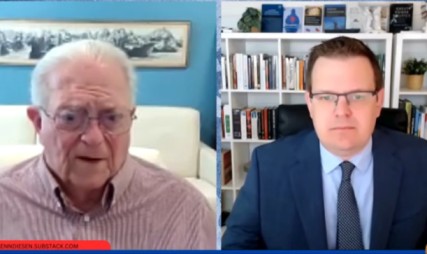
Read the full transcript of Ambassador Chas Freeman’s interview on Greater Eurasia Podcast, May 12, 2026.
Editor’s Notes: In this episode, Ambassador Chas Freeman joins Glenn Diesen to discuss the strategic implications of Donald Trump’s visit to Beijing, contrasting it with the historic 1972 opening of China. The conversation explores the shifting global order following what Freeman describes as a massive U.S. defeat in Iran, which has undermined international law and accelerated a pivot toward a multi-polar “Westphalian” system. Freeman provides a critical assessment of the current geopolitical landscape, where the “civilized garden” of the West is increasingly viewed as hypocritical by a Global South that now champions the very rules the U.S. has abandoned.
Welcome and Introduction
GLENN DIESEN: Welcome back. Today is Tuesday, May 12th, 2026, and we have the great pleasure of being joined by Ambassador Chas Freeman, the former U.S. Assistant Secretary of Defense. And, well, it’s good to see you again, my friend.
CHAS FREEMAN: Good to see you, Glenn.
Trump’s Visit to Beijing: Purpose and Context
GLENN DIESEN: Well, you are a Chinese speaker. Indeed, you were the translator of Richard Nixon when he visited China for, well, the purpose of opening up relations. And we now see that on Thursday it’s Trump’s turn to go to Beijing, where he will meet with Xi Jinping. And I was wondering, how are you assessing this meeting in terms of, well, why is he going and what’s on the agenda and what can we expect?
CHAS FREEMAN: It’s not clear why he’s going except for the gratification of his ego, which is not small and requires constant feeding. Because the Chinese are superb at pomp and circumstance for visitors. And he will have a chance to feel honored by the public events.
But the circumstances of this visit, since you mentioned the Nixon visit in which I participated, are very different from that time. That visit was in the context of an apparent Soviet inclination to invade and conquer China, eliminate or subjugate it to the Soviet Union, and the common concern about Soviet expansionism — a concern on the part of the United States that the removal of China from the geopolitical chessboard would so much alter the geopolitical geometry to the detriment of the United States that we had to reach out to China.
For their part, the Chinese felt threatened by the Soviet Union. They’d had skirmishes on their borders with the Soviets in both the Far East and in Central Asia, and they felt they needed protection. And indeed, Nixon created what I call the protected state. Now this is a term which applies also to World War II. The United States valued China’s continued independence, sovereignty, and existence because of the fact that it tied down an enormous part of the Japanese army. We didn’t really expect Chiang Kai-shek to be able to do anything terribly positive, but his primarily surviving served our geopolitical interests. Nixon applied that same concept of a protected state to China in the 1970s. So that was a meeting with great import. President Nixon tritely but correctly said it was “the week that changed the world.” This week will not be the week that changes the world, I don’t think.
Lack of Preparation and the Trade Agenda
And in fact, as seems to be fairly typical of the Trump administration, there’s really no evidence of serious preparation for this trip. And normally when you go to the summit, you have so-called sherpas who go before you and pave the way, reaching agreements or bringing agreements close enough so that the leaders can put them over the top. That does not seem to have happened here. And in fact, we have a hurried meeting today, I believe, in South Korea between the Chinese chief negotiator on trade matters and Treasury Secretary Bessant. This has all the earmarks of a last-minute effort to create something that should have been created over months previously.
So it’s very unclear what will happen in this meeting. President Trump has a group of senior American business executives, primarily from the electronics and cybernetics sector, with him. I’m sure he wants to sell Boeing aircraft to China. He would like to see the recovery of the soybean market that American unreliability has cost. No doubt there are issues to be discussed about artificial intelligence, where the Chinese now are neck and neck with the United States in the race for that.
The Chinese approach is, by the way, quite different from that of the States. The Americans are putting huge amounts of money into an effort to create general intelligence. The Chinese are applying AI to practical projects and doing so remarkably with open software rather than the closed software that Silicon Valley develops.
The West Asian Quagmire and China’s Position
So there are issues to be discussed. President Trump has contrived a Zugzwang, if you will — a situation like the one in chess where any move you make is going to cause you to lose — in the West Asian Persian Gulf region. I’m sure he would like help from the Chinese to extricate himself from the mess that he’s created. I don’t think that help is going to be forthcoming, despite the fact that the Chinese share an interest with the United States in opening the Strait of Hormuz. China is, after all, the world’s largest trading nation and its principal advocate of free trade. So that interest is shared. But beyond that, I don’t see shared interests that would impel the Chinese to do anything concrete.
And in fact, I think, Glenn, we are now beginning to see the outlines of the post-Iraq-Iran War future emerge, and they are not favorable to the West. I think the Chinese probably take the general attitude of, you know, “don’t interrupt your enemy when he’s making a mistake.”
Glenn’s Assessment: The Need for Great Power Diplomacy
GLENN DIESEN: Yeah, I would have liked to see Trump being joined by President Putin and meeting with Xi Jinping and have some kind of a great power compromise — some way of solving, because there’s been too many changes and often diplomats and politicians they only seek to make minor changes, but there’s a need to put all these huge conflicts which are brewing to rest.
So just shifting a little bit on trade, I think more is required now.
That being said though, I’m assuming that the talk on Iran will have, as you suggest, a key focus. But for the Chinese though, certainly they must feel that the US campaign against Iran has a bit of a Chinese target on it. That is, the efforts to take Venezuela, Iran, all of these energy suppliers offline essentially for China — well, it is their main target as the main peer competitor to the United States.
And I thought it was interesting what you said — the war in Iran, there’s no more good options anymore for the US. And I’m sure you saw the article by Robert Kagan essentially reaching the same conclusion. For those who are not familiar with him, he’s one of the ultimate leading neocons. He co-founded the Project for a New American Century in the ’90s. He’s the husband of Victoria Nuland, who had a key role in the regime change, the coup in Kiev in 2014. And he also recognizes that not only is this war being lost, but unlike Iraq, Yemen, Libya, Syria, or any other, there’s no pulling back or ending up in a favorable or acceptable new status quo. This appears to be a massive setback. So what exactly can Trump, in such a situation, hope to get from the Chinese?
Kagan’s Realism and the Collapse of the World Order
CHAS FREEMAN: I don’t think he can get very much, because I think — well, first of all, I’d agree that Robert Kagan has demonstrated that he’s a realist beneath the ideologue that he is famous for being. He’s a little off in my view on the facts of the war in West Asia, too influenced by Israeli optimism about things.
There is quite a faction, a Zionist faction in the United States, which parrots the Israeli desire and the United Arab Emirates’ desire to resume the kinetic warfare, on the basis, I think, of misperceptions of what the consequences of that would be. But still, he describes this debacle as the worst defeat of the United States in American history, and I think he’s right.
And with regard to the Chinese, I think they’re less concerned about how this war may relate directly to them than they are about the destruction of the world order that it entails. The United States is now engaged in serial violations of the basic principles of international law, including the launching of aggressive wars with no justification, not even an explanation, the murder of fishermen on the high seas, the abduction of a sitting president of a sovereign country — whatever you may think of him — and showed that the rules, which the Biden administration claimed to support but didn’t, are of no value and need not be heeded. And I think that is deeply disturbing to the Chinese, and perhaps to the Russians as well.
Strategic Consequences: Iran, Nuclear Proliferation, and the Gulf
But one result of this war is clearly going to be the cementing of a Sino-Russian relationship with Iran. And here, let me just, if I may, say why I do think Kagan is onto something.
I believe the results of this war with Iran are going to be, among others, Iran’s retention of the Strait of Hormuz. It will not be dislodged. Others, like the Indonesians, are now beginning to discuss creating tollbooths in the Straits of Malacca or the other two straits that go through Indonesia. I think international law on free navigation through straits, which is enshrined in the UN Convention on the Law of the Sea, is now very much in jeopardy. And that is not good news for anybody really, except Iran — Iran, which now has the ability, if Israel threatens it, to take action in the strait and energize the entire world against Israel.
Second, I don’t think Israel will have the United States at its back if it again attacks Iran. I think Israel’s been chastened, not defeated, but the United States certainly is not going to repeat this error in partnership with Israel in future.
Third, I believe the Gulf Arabs are quietly discussing with Iran the post-war situation — a post-war situation in which there will be no American military presence in the Persian Gulf, because far from constituting a shield, American bases on their territory have constituted a target. They understand that the United States had neither the will nor the ability to defend them against Iran. They understand that Iran is not going away. They understand that Iran’s arsenal is intact, largely intact. They understand that Iran is not going to cease improving that arsenal, and therefore they have to make a peace with Iran. And the terms of that peace are that they cease to host forces hostile to Iran.
The holdout is the UAE, which has actually dug deeper into its relationship with Israel and become dependent on Israeli forces for its defense. But that cannot last.
The Nuclear Proliferation Risk and the Decline of Sea Power
And then I think the major impact of all this, aside from devaluing sea power — which is a very important result. The fact that, as we’ve discussed before, the 3-mile limit, the 12-mile limit have now been replaced by a 2,000-kilometer or 1,500-mile limit in terms of how close you can get to the enemy you’re attempting to subdue — is very important.
But I think the most important result is that Iran has now been deprived of every argument it made against the development of nuclear weapons. And I take it from everything I hear that if Iran has not already built a nuclear bomb somewhere underground, it is almost certain to do so. Whether it then follows the Israeli example of denying that it’s done what everyone knows it’s done, or declares itself a nuclear weapons state as North Korea did and for the same reasons, is an open question.
But this war, which has now come down to an Israeli-American objective of doing what the JCPOA — the Joint Comprehensive Plan of Action — did diplomatically through the use of force, has now backfired. And we have a proliferation which will not stop with Iran. Other countries in the region will follow.
Tactics vs. Strategy: Trump in Beijing vs. Nixon in Beijing
One other lasting result of this war, I believe, is that the Gulf Arabs will accelerate their effort to diversify their international relations away from dependence on the United States. And you can see this with the Quadrumvirate — the Egyptian, Saudi, Turkish, Pakistani partnership, which we’ve discussed before — which has both military-industrial consequences and actual defense elements to it, including perhaps extended deterrence by Pakistan of attacks on Saudi Arabia.
So this is, I think, going back to your original question — President Trump in Beijing is an engagement in tactics, not strategy. The Nixon move was strategic, not tactical. This is the opposite. And what is really happening of a strategically transformative nature is happening in West Asia.
The Collapse of the Rules-Based Order
GLENN DIESEN: Well, I’m thinking in terms of this being the worst defeat in US history, what, yeah, how, I guess, why the consequences will be. Because we, well, we discussed Robert Kagan and, you know, he has an interesting book out. It’s called, it came out a while ago, it’s called The Jungle Grows Back. And again, this is the main idea that you have civilized people who live in a garden with rules and civilized societies, and the rest of the world, they are the barbarians, the jungle. I mean, in the 19th century, this kind of represented— this garden and jungle analogy represented those who can have sovereignty and those who are too barbaric to have it.
And anyways, his whole idea was that the US built an orderly, civilized system by controlling the jungle, but now the jungle is growing back. And, you know, often when people extend on this analogy, they point out that once you go out in the jungle, you don’t have to follow the same rules as you do in the civilised garden. And you do see some of the same ideas now that, you know, we don’t have to follow international law, like piracy, all of this is now acceptable because that’s what we have to do when we operate in the jungle among the savages, essentially. Sorry, not my language, but anyways.
I think it’s still interesting because my point is, he doesn’t walk around with sympathies for Iran or anything. I mean, I think, as you said, he’s a realist. That is, you know, despite all hegemonic aspirations, contempt for Iran, at least it seems that he has the common sense to understand that all this doesn’t really matter, that you do have to operate within the boundaries of reality, and reality is there won’t be any victory here. And in defeat, there’s no going back to the former status quo as well.
So what do you think— well, sorry for the long question— what do you think will be the wider consequences for the international system here? Because it looks like controlling the Strait of Hormuz, the Iranians can really transform the region. And well, expel the US in many ways, from military to the petrodollar. I mean, what do you see in the future here?
CHAS FREEMAN: Yeah, as I indicated, at least in the maritime domain, overturn the world order. But I see several ironies here, because I have been involved with China. I remember China very well when it was an outlaw. It was a rogue state. It called for revolution everywhere. It actually aided revolutionary movements, most of them not very effective, frankly, but it had purpose, for example, aiding the Puerto Rican independence movement, the American Indian movement, the Black Panthers, and others in the United States who sought the overthrow of the American constitutional order. Wasn’t very effective, but symbolically, that’s where China was.
And ironically, of course, that was China as part of the jungle, if you will. But China is now the principal defender of the UN Charter and international law. And you cannot find many instances of China— China cuts a corner or two, perhaps, on the law of the sea, but it is remarkably defensive of the order that the United States sponsored after World War II, in which China came to wealth and power. It recognizes the benefits of that.
And here’s what I would say: the jungle has adopted the civilized rules and the civilized garden has abandoned them. So we now hear, as you might expect, a defense of international law from the Global South, because the purpose of law is to protect the weak from the strong and to prevent predation. And we are now a predatory superpower. The West does not distinguish itself by complicity in actions like genocide in West Asia and so on and so forth. And it has very little sympathy in terms of NATO enlargement having provoked the Russian invasion of Ukraine, much, I should say, to Russia’s distress as well as to the misery of Ukraine.
So we’ve had a switch, and the enemy we now have is who we used to be. And so this is very ironic. I have an anecdote, indirect. I don’t know Robert Kagan, but we have a mutual friend. And I recall during the NATO-US effort to dismember Serbia in favor of Kosovo that I had an argument with my friend in which I said this was contrary to international law and it would set a precedent which we would regret, which indeed it did in the Crimea.
I also added that I thought it was a violation of the entire purpose of American diplomacy in the 20th century, which was to build some sort of reasonable facsimile of the rule of law internationally. And so we had the Kellogg-Briand Pact, farcical as it was. We had the United Nations. We had all of the Geneva Conventions and other international conventions in which the United States played a leading role. And he went to Robert Kagan and asked him what he thought about the thesis that American foreign policy had been devoted to building something like the rule of law. And Kagan said, “Oh no, it’s all about power.” Even then, this is quite a while ago, he was contemptuous of the rules that he extols when he talks about the civilized garden. He didn’t believe they bound us, those rules. And indeed they have not bound us. And that is a great deal of the cause of the mess that we’re in now.
There is a reason that all the great religious and philosophical thinkers— Confucius, Jesus, Rabbi Hillel in Baghdad earlier, the Buddha— they’ve all come up with some version of the Golden Rule. “You should not do to others what you do not want them to do to you.” That is the negative formulation of it by Confucius and Rabbi Hillel. Jesus was more ambitious: “You should do for others what you hope they will do for you.” But this is the basis of ethics, and we have tossed it out. We are back to emulating Athens in the Melian Dialogue. That, by the way, did in Athens eventually. Athens set aside its democracy, its respect for diversity of opinion and for the weak, and it found itself on the losing end of the Peloponnesian War. So we’re making the same mistake. And my guess is it’s going to take us quite a while to recover from this.
The Kosovo Precedent and the Rules-Based International Order
GLENN DIESEN: Yeah. Well, I’ve always been a bit critical of what’s referred to as this rules-based international order after the Cold War, and I tend to trace it back, since you mentioned the Kosovo War in ’99. Actually, I remember it well. I was in the army then in ’99, and I remember the invasion of Yugoslavia. The UN concluded somewhere along the line that it was not legal, but it was legitimate. And for me, I think this set the tone for the hegemonic world order because what it meant was we have international law in terms of legality, but we can also decouple legitimacy from legality by pointing to liberal democratic values.
And it was the political West that kind of monopolised on this claim, that is China, Russia can’t claim to act in liberal democratic values to sideline international law. So it became like a clause of exception only for us, the prerogative of the West. And I remember after Iraq, you have a lot of political leaders arguing that, well, we kind of need to formalise something like what we did in ’99 with Yugoslavia, that we have the opportunity to point to some kind of rules that, well, we can look away from international law when countries like China or Russia put down a veto because they don’t appreciate these values like we do.
So they started to talk about: how about a concert of democracy or a league of democracies? Something out of Orwell’s Animal Farm almost, that, you know, “all animals are equal, but some are more equal than others.” For me, this became the rules-based international order. That is, international law for all, but this exception you can claim by, you know, again, if the West wants to refer to liberal democratic values. It just seems that this was premised only on unipolar distribution of power. So if you have people like Kagan who have a sensible head on their shoulder, they would understand that claiming this kind of ideological exceptionalism, it doesn’t work anymore if it’s no longer supported by hegemonic distribution of power. But I’m assuming that Trump and Xi won’t go into this kind of issues.
Due Process, Rule of Law, and China’s Dilemma
CHAS FREEMAN: Well, there’s a very interesting connection between disdain for the rules abroad and disdain for due process at home, because the basic premise is the same. The purpose of due process is the assertion that outcomes are justified by whether they conform to the rules or not, whether the procedure by which they’ve been reached is fair. If it is fair, then, for example, if a court finds something in a law case, whether the decision is, in your opinion, just or not, if it is fairly arrived at, you must accept the quelling of the controversy. This is the outcome and it is legitimate, and it is lawful and legitimate.
But now, as you said, we distinguish this. So we no longer judge the fairness of elections by whether they were fairly conducted, but whether they have the right outcome from our point of view. And we suspend the Bill of Rights and constitutional protections of individual freedom, or against collective punishment, when we see the justification for another approach. So you cannot separate the domestic from the international in this regard.
And that does indeed raise serious questions, for example, about the Chinese performance internationally. Because can you have a country that believes not in the rule of law, but rule by law? If it believes in rule by law domestically, meaning the sovereign is not subject to the law, but the sovereign can make rules that bind everyone else and change them at will, however expediency dictates, is such a country with a domestic order like that capable of in fact respecting international law abroad? So far, yes. But this also is an expediency since China has been weak. And the weak cling to the law to protect themselves.
I wonder where we’re headed. Now we’ve destroyed the legitimacy of law, basically, to paraphrase your analysis. And where does that lead us? I think you can relate a lot of the malaise in the West to the collapse of respect for the rule of law, due process, and as you say, the decision to legitimize the unlawful.
What Does China Want?
GLENN DIESEN: Yeah, well, that’s not just an American problem. I see this across Europe as well. That is, they already have an outcome they want, and the law kind of is applied accordingly where it suits their objective. So again, the rule by law, as you said.
But I was wondering, how does— again, this is something that puts a dilemma for the Chinese, because on one hand, what was called, you know, this UN-based system of international law, it benefited China to a great extent. That is, since the 1980s, I mean, this is a spectacular rise. So they would like for this to continue, but they don’t want to live under US rule. So I’m not sure if neo-revisionist is appropriate, or how they want to have the existing system, but not the US hegemonic part.
So how do you think they are trying to get out of this? Because I don’t see a hegemonic intent or capability on the Chinese side. They have too many large powers around them, and for this reason, probably why they haven’t expressed any intent. But where do you think they want to go in terms of the relationship with the Americans? Because again, I’m not suggesting the Chinese are always benign in their intention, but I don’t see— it’s like arguing that Russia wants to dominate the Eurasian continent. There’s no evidence and there’s no capability. Usually when you assess a threat, you want to look at intentions and capabilities. I see neither on the Chinese side either. So what do the Chinese want from this? What do they want from the relationship with the Americans?
China’s Westphalian Tradition and the New World Order
CHAS FREEMAN: Well, basically the Chinese have emerged as the great defenders of the Westphalian Peace. And the concept that there is a sovereign equality of states, large and small, that every state is entitled to be immune from foreign intervention in its internal affairs. Regime change operations are the most dramatic violation of this order that you could come up with.
And the Chinese have a remarkable capacity. It’s not really racist, but it’s civilizational. If you’re Chinese, you’re civilized. If you’re not Chinese, you’re something else, not necessarily savage. Really the Chinese don’t give a fig how you govern yourself. They’re just as respectful of democracies as they are of totalitarian regimes. It’s not their business. They don’t want to engage themselves in that. So this is the curb on Chinese ambition. Let the foreigners do what they want. A very old tradition, by the way.
There’s an interesting connection which most people don’t seem to be aware of between the ancient trading patterns. In the Mediterranean, the wool trade in the English Channel later, and the Canton trade fair system. The Arabs invented something called the fundukh, which means hotel now, which meant a foreign enclave that was self-governing within another society. So there were fanatik, it’s the plural. They were these hotels, if you will, in major port cities in which foreigners governed themselves. This was the basis later for extraterritorial treaty ports. And it’s all connected. It’s a legal evolution of some interest. And the Chinese were very comfortable with that, as were the Arabs. They didn’t care if a bunch of Christian wool merchants wanted to make their own rules for commerce. That was fine, go ahead.
So there are reasons to hope that the Chinese in fact will not replicate the American, or I should say Western, interpretation of the tribute system. The tribute system was in many ways just a form of state trade, a kind of potlatch where each side provided goods in return for the receipt of goods, and tried to outdo each other in their munificence. We interpreted in the feudal context that if you go to Beijing and deliver copper from mines in Korea, that means you’re subordinating yourself to Beijing. No, not necessarily.
So we’re entering a new order and it’s not going to be based on Western precedents because we’ve basically trashed our own contributions to the garden, if you will. It’ll be based on something else. And there is an odd thing going on. It’s not just the West that is repudiating its own civilizational heritage. We’re seeing it repudiated in great countries like India, which is more and more resembling a one-party state, a religious party. Israel has made that transition. It’s not a democracy in many ways, even for Jews, and certainly not for anyone else.
And so we’re seeing this interpreted as authoritarianism as though that were some unique concept. There’s no club of authoritarians. I don’t think one authoritarian feels he or she has much in common with another authoritarian. Now, this is the category imposed on them by people who pretend to be democratic, but I’m not sure how democratic we really are these days. My own country seems to be a plutocracy. We have 900 billionaires, and some of them are multi-billionaires, who are dominating, guiding our politics.
There’s a very interesting Senate candidate in Maine. I think he may be of Norwegian origin, Platner, Graham Platner, who’s conducting town halls, and I urge you, if you have the time, to listen to one of them. He perfectly voices the disgruntlement of the masses with an indifferent elite that is basically plundering the society for its own benefit and neglecting the welfare of the common man. And I think this is the major thesis now in Western societies everywhere. It’s why you have Alternative für Deutschland in Germany, and why you have a fascist movement running Italy, and so on and so forth. And it explains a lot about Donald Trump, not his mental condition, which is a different issue.
Eurasian Westphalianism and the Iran Question
GLENN DIESEN: No, that’s a great point. I know I have to look into this one now, because that feels like it’s got a good description of where we are now. I liked what you said about China being a Westphalian country though. In my last book I also wrote about the Eurasian Westphalianism essentially, because in the Westphalian system, the whole point then was to focus on the distinctiveness of each culture, of each state, which would support the concept of sovereign equality. It’s essentially the opposite of a hegemonic system, because in a hegemonic system, you would assume that the hegemon would push universalism, the idea that they can represent other people, such as after the French Revolution, the Bolshevik Revolution, or indeed, I would say, after the Cold War with us as well.
However, it does seem, getting back to China and Trump, that the Chinese would have an interest in seeing Iran succeed here, though. I mean, to push the US out of the region. So how do you see each side playing their cards? I mean, given we kind of know what the Chinese want, we know what the US wants, so how do you think each side is in a position to push their agenda vis-à-vis the other side?
CHAS FREEMAN: I don’t think there’s going to be any meeting of the minds at all. The Israeli objective, which the United States has embraced, is the destruction of the Iranian state. The Chinese objective is the bolstering of the Iranian state. You’re quite correct, the Westphalian tradition lives on. The Five Principles of Peaceful Coexistence are a brilliant summary of it. Read them. You’ll find all of the essence of the results of Westphalia, which I don’t think those who created the order quite understood where it was going to lead. But all of these elements are in that Five Principles of Peaceful Coexistence statement, which very much guides China.
And if I suppose everyone in the world has an opportunity to become Chinese, in which case they might care what we do with each other. But if we don’t become Chinese, they really couldn’t care less how the inmates in foreign countries treat each other. So this is the opposite of the messianic traditions of Western ideology. There’s no mission civilisatrice. There’s no religious missionary element. The Chinese are not trying to convert anyone to their way of life. They in fact say that their ideology, such as it is, is sui generis and cannot be applied elsewhere. They leave it up to others to find lessons from their achievements. They don’t insist, as the United States does, that you conform to our values if you want to have a good relationship with us. So they have a great relationship with all sorts of countries that have virtually nothing in common with them except, of course, a desire to make money.
Now this is the one point on which Donald Trump and the Chinese appear to agree. In the West Asian War, the Iran War, he may have impoverished the Defense Department and depleted its weaponry, but he’s made a lot of money for himself and his family. So if there’s any winner in this war, in addition to the Russian Federation, which collects another $100 million a month for every $10 rise in the price of oil and is making billions of dollars now on a monthly basis, then it’s Donald Trump and the Trump family. One has to suspect that the remarkably well-timed oil trading futures activity that accompanies or precedes by 20 minutes the announcement of some false premise about where the situation in West Asia is going is not an accident, and that the principal beneficiaries of it are the people making the false statements about where things are going.
And so, one of the things that if Donald Trump lives to the end of his term, which it is looking less and less likely he will, then one of the consequences is going to be yet another travesty. We’ve gotten into the habit in many societies — I think of South Korea as an example — and Donald Trump obviously agrees with this practice, that once someone’s out of office, they’re prosecuted. Pinochet is accepted while he’s in office and he gets out and then you take him to court and lock him up if you can before he dies. The president of South Korea is jailed, the prime minister of Thailand, and so forth and so on. And now Donald Trump would like to accuse President Obama of treason and lock him up. And last night he said that Hillary Clinton should be sent to Haiti, which is not a place that many people want to go to these days.
Will China’s Non-Interventionism Last?
GLENN DIESEN: Yeah, fair enough. But I always wonder though if it is possible that China will change over time, if one assumes that the distribution of power essentially shapes intentions. Because the way Chinese speak today, it has a great resemblance to the way the United States spoke as well, because the US was also limited, it was non-interventionist, some would call it isolationist. It wanted to be an example to be emulated. And some would argue that it was perhaps Woodrow Wilson who first took that step by arguing to make the world safe for democracy. It shifted from a more passive position to a more active missionary one, to go out and essentially slay dragons. But yeah, it will be interesting to see if the Chinese rhetoric will change as its power grows.
CHAS FREEMAN: Well, they seem less hypocritical than we. At the very moment we were proclaiming our intention not to follow the example of the British in building an empire, we were building an empire. We had a slave population. We were conducting genocide against the indigenous inhabitants of North America. We overthrew the Hawaiian monarchy. And by the way, Robert Kagan’s jungle versus garden dichotomy is very racist. And we’ve had European leaders, I will not name them, you know who they are, who have used the same analogy in a very racist fashion.
The Chinese are unique only in that they’re more tactful about their view of foreigners. Anyway, I think the world we’re getting into is going to reaffirm a kind of anarchic version of the Peace of Westphalia, with many middle-ranking powers maneuvering at will. It’ll be a more complex geometry than the balance of power in Europe in the 19th century, which did maintain a measure of stability and keep wars under control for a century. I don’t know that you can do that if you have the number of actors in the world that we’re acquiring.
So if you look at the Persian Gulf, for example, I think the Saudis and the Iranians are going to be dealing with each other on a nominal basis of equality, but neither of them really regards the other as an equal. And the only thing they will have in common in the Persian Gulf of the future is that they will look to Russia and China, and perhaps India as well, more than they do to the United States to maintain peace and stability and foster development.
The Garden and the Jungle: Western Hypocrisy and Decline
GLENN DIESEN: Yeah, in Europe we had the EU foreign policy chief, former one, Josep Borrell. He made that comment 4 years ago that essentially the jungle is growing back, and it’s not enough to build tall walls to protect our beautiful civilized gardens from the savages outside the gates. It’s also necessary for the Europeans to go out and trim the jungle and civilize it and make it more like us. And so yeah, it’s an interesting analogy with, of course, the 19th century, with very heavy racist undertones.
CHAS FREEMAN: Yeah, there’s a bit of pride in Western civilization. My ancestor John Winthrop came up with the notion of the shining city on the hill. But it isn’t shining very much these days. And the savages in the jungle take a very dim view of what’s going on inside this allegedly civilized garden.
Sometimes I’ve heard people denigrate eunuchs, but you know, eunuchs run empires very effectively. They kept the Byzantine Empire going for hundreds of years beyond where it should have. But the problem with the eunuchs is that they’re very self-centered. They sit within the walls of the city or the empire, the Forbidden City in China. And they play games with each other and they’re not really concerned about what’s going on outside. And I think the world as a whole now looks at the West basically in the same way that common people regarded the eunuchs in these earlier imperial apparatuses. So we’re not highly regarded. We have a moral taint about us. We are regarded as hypocrites with double standards, and there is something to that.
GLENN DIESEN: Yeah, hard to dispute that these days. Anyways, I’ll be keeping my eyes on this meeting between Trump and Xi. Hopefully something good can come out of it because, well, something bad could come out of it too.
The Meeting and Its Implications
CHAS FREEMAN: I’m a little bit apprehensive because we have a very temperamental Mr. Trump meeting a very solid, self-controlled Mr. Xi, and Donald Trump takes offense and he blows his top. So he’s not the epitome of cool. So we shall see. I will heave a sigh of relief if nothing bad happens. I would very much like something good to happen.
GLENN DIESEN: Low expectations might be the ticket here, yeah. But I do know that Trump ideally would have gone to Beijing and have defeated Iran, essentially, which he could show off to China, pointing out, “We took out Venezuela, we took out Iran, now yeah, maybe it’s time to fall in line,” but I guess he will come with, yeah.
CHAS FREEMAN: He’s a supplicant. He’s not arriving as a victor. He’s arriving as a supplicant from a country that has exhausted itself in war and which is mired in debt and which is domestically unstable. Divided, polarized, where his own legitimacy measured by polling data is sinking and not rising. So he’s not in a strong position. I hope he enjoys the military parades and other things that will be staged for him.
A Path Beyond Hegemony?
GLENN DIESEN: Well, I’m thinking always something good can come from this, though. That is, if this kind of puts — if Iran becomes the final gravestone of the hegemonic aspirations, and also Trump can lower the ambitions to be that the US can pull a bit back, build up, restore the republic, be one of many centers of power, then within that format, it would be much easier to find common ground with China, Russia, Iran as well, if we can move beyond the hegemonic system and will join in on the Westphalian world order that our counterparts in the East are pushing. It would suddenly open up a huge diplomatic space, I think, for making peace.
CHAS FREEMAN: It may come because the American people have not suffered any significant pain during this debacle, but this summer, prices of gas at the pump, inflation, shortages of this, that, and the other are all going to make life quite difficult for many people. And we have the example of the surge of opposition to bad government that we’ve seen in Hungary. And something like that could happen in the United States. In which case, the way would be paved for reconsideration of the kinds of ill-considered behavior that you’re describing in another administration, not this one.
So anyway, I think clearly we’re at some sort of Zeitenwende, some sort of sea change in history, or turning point, and we’re not sure where this is going to lead us, but at the moment it’s pretty alarming.
Closing Remarks
GLENN DIESEN: Yeah, very much so. Well, thank you very much for your analysis, and I always look forward to getting your perspective. So thank you again.
CHAS FREEMAN: Have a pleasant evening, and thank you for what you do.
Related Posts