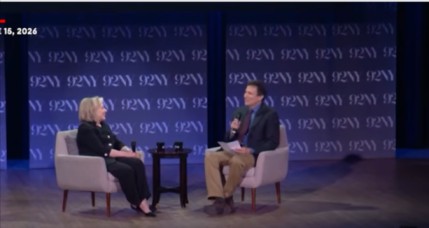
Read the full transcript of former Secretary of State Hillary Clinton in conversation with David Remnick at the 92nd Street Y in New York City, June 15, 2026.
Editor’s Note: In this candid discussion, Hillary Clinton reflects on the current state of American politics, characterizing the ongoing influence of Donald Trump and “Trumpism” as a sustained authoritarian threat. She also provides an introspective look at the Democratic Party’s recent electoral challenges and discusses the complexities of navigating geopolitical tensions in the Middle East.
Opening Remarks
DAVID REMNICK: I am so tired of getting standing ovations every time I walk in a room. It’s really tiresome. Oh, hi! Thank you for doing this.
HILLARY CLINTON: Oh, thank you so much, David.
Trump and the Threat of Authoritarianism
DAVID REMNICK: Secretary Clinton, in your book, Something Lost, Something Gained, you write about your state of mind after the reelection of Donald Trump. You describe yourself as someone who remains an optimist that worries a lot. Now, we all worry, but I want to grasp the extent of your agony. And I want to begin with a big question. Does Donald Trump and Trumpism represent a real and sustained era of authoritarianism in this country?
HILLARY CLINTON: Well, first, David, thank you for doing this with me. And it’s always great to be here at the 92nd Street Y. So thanks, everybody, for gathering.
And I really believe that he does represent the threat of authoritarianism. The people who enable him, who support him, who follow him have clearly decided that his kind of performance politics, his deliberate cruelty and behavior that has never been seen by any of us in an American president before, is exactly what they want to see for the country.
Now, the good news is his favorability is in the mid-30s. People who had supported him not because he was a wannabe authoritarian, but because he promised to lower prices and create a better future for people and their families, they’ve seen the reality. It doesn’t match the rhetoric. And so they have moved away from him.
But he is doubling down. He’s doubling down on his impulsiveness. And it’s very worrisome to me because I’ll end with this. I teach at Columbia University now, of course, with the dean there. She and I have been on this stage together. It’s called Inside the Situation Room. And we talk about the traits of leaders, their behavior, their psychology.
And there is a view that is rooted in how people make decisions — all of us, not just leaders — about what happens when someone finds themselves in what’s called the domain of loss. It’s a psychological concept. And almost counterintuitively, when people feel they are losing, they very frequently take greater risks. They double down on their behavior.
And that’s what I’m now worried about, because he’s lashing out. He’s demanding that we accept his version of reality, which is unhinged from the actual world that we live in and the actual consequences of his actions. So I think we have to be extremely vigilant and just ready to push back every chance we get.
Recognizing Trump as a Political Danger
DAVID REMNICK: You’ve been a New Yorker for a long time. You were around when Donald Trump was not a politician. You would see him here and there in New York City. At what point did you begin to see him as something other than a kind of figure in the jokersphere, the Spy Magazine aspect of New York City? Did you sense him as a political danger?
HILLARY CLINTON: Probably when he began to lead a movement questioning Barack Obama’s birthright citizenship. And before then, I was not aware. I hadn’t read Art of the Deal. I hadn’t followed some of his public utterances. Allegedly, he told the man who helped him — or wrote The Art of the Deal — the only book he had on his bedside was Mein Kampf. I did not know that.
DAVID REMNICK: Big seller.
HILLARY CLINTON: That’s right. And he also ran full-page ads accusing Ronald Reagan of weakness. So there had been a few eruptions that I was unaware of. I kind of viewed him as exactly the sort of figure you described.
But when he began to do the big lie about first Senator Obama, then President Obama, that’s when I began to pay attention and wondering, what’s really behind this? Why is he doing this? And so relentlessly — it didn’t matter.
And I remember talking to President Obama about it. And President Obama, like so many of us, it’s like, “Ah, who cares? I’m not going to respond to that.” And what we have learned is how important it is to respond. It used to be you could ignore that kind of outlandish claim and it wouldn’t last for long. But with the internet, it lives forever. And so he began to demonstrate his understanding of the new information ecosystem that we’re in.
Understanding Trump’s Base
DAVID REMNICK: How has your understanding of his support evolved? You were criticized a lot, probably rightly, for using the word “deplorables” for many of his followers. But how do you view the evolution of his followers and what it is that they want most of all from him?
HILLARY CLINTON: Well, first of all, I said only about half.
DAVID REMNICK: Were.
HILLARY CLINTON: So to be fair—
DAVID REMNICK: Well, are you doubling down on deplorable?
HILLARY CLINTON: Yeah, but I have to say — I gave a speech, for example, about something called the alt-right, which the press had no idea what I was talking about. Certainly the public had no idea what I was talking about. But I was beginning to see this really disturbing rhetoric.
But I also did try to draw a line between those who were following him because of that — it wasn’t a bug, it was the feature. They wanted to follow someone who was demeaning President Obama, was making claims about me, saying things like, “The Second Amendment people will take care of her.” I mean, terrible things that were in that campaign against me. And people didn’t take it seriously. People were like, “Oh, that’s just Donald. He’s just spouting off. Don’t worry about it.” I saw something darker.
But I was in not the strongest position since I was running against him to make that case. So I was trying to say, look, I understand there are people who believe that kind of stuff. But most of the people — at least half — who are following him, they want change. They are not satisfied with where we are in the country. They want a different economic reality. He’s promising all of this, promising that we’re going to have an economy that is just going to be the greatest in the world, and we’re going to bring back jobs that were lost to globalization, and all the rest of it.
So I really did understand the appeal to that. And as I campaigned throughout that year and a half or so against him, it was something that I was aware of. And I respected it, because people were feeling that it’s hard to succeed a two-term president of your own party. I knew that going into it. And people liked and respected President Obama, but they wanted something that might be a little different.
DAVID REMNICK: A little different.
HILLARY CLINTON: What?
DAVID REMNICK: A little different.
HILLARY CLINTON: Yeah, a little different, but they didn’t know how different at the time.
And so I really think that his followers — the ones I would put into the category of believing his promises — thinking, number one, that he could help them, but number two, that he cared about them, neither of which I think was really true. But people wanted to hang on to that.
And I believe that that kind of continued into his first term. The way he handled COVID is the reason I believe he lost. I actually think if he had done a better job handling COVID — because remember, he got more votes the second time, when he was running against Joe Biden. And Biden, of course, got the most votes anybody’s ever gotten, I think, still for president. But the people who were following him, COVID scared them, put them off. They might have thought, “Wait a minute, I can’t vote for that.”
Joe Biden in that first 2020 campaign ran on restoring the soul of the nation and all. I don’t know how effective that was, but it had a theme that he certainly used effectively. And then when Trump ran again, there was such a set of circumstances that led to him being elected in 2024 that were pretty unprecedented. But again, people voted for him believing that he would get inflation down and believing that he would give them a better deal economically.
Trump’s Dynastic Ambitions
DAVID REMNICK: I don’t want to jump too far ahead, but I think it’s fair to say that so far J.D. Vance has not covered himself in glory. And Marco Rubio probably doesn’t appeal to the base with quite the same stick-to-itiveness of Trump himself. And I wonder if you think it’s possible — and I think maybe this has run through your head — that the Trump family has dynastic ambitions, whether it’s Donald Jr. or someone in the family, who might pretend to succeed him?
HILLARY CLINTON: Well, David, you and I think alike. I think, number one, if he could figure out a way to stay, he would. My husband likes to say, “If he tries to stay, I’m running again.” But if that’s unlikely — which we have to hope it is — I don’t get the feeling he’s all warm and fuzzy about J.D. Vance. No. I don’t think he is warm and fuzzy about nearly anybody other than himself, and who is closest enough to him, and that is possibly a son or a daughter.
DAVID REMNICK: A son or a daughter.
HILLARY CLINTON: A son or a daughter.
DAVID REMNICK: And the daughter is thought to be cleverer than the son.
HILLARY CLINTON: Well, I’m not going to characterize them. It’s the blood relationship that matters.
DAVID REMNICK: Understood.
HILLARY CLINTON: So look, I mean, we’re speculating like we know something, which we don’t. I’m not hanging out at Mar-a-Lago and sort of picking up the bread crumbs of gossip. I think that—
DAVID REMNICK: I think you’d like it.
HILLARY CLINTON: Yeah, but given his psychology — given Trump’s psychology — he definitely, if he can’t do it himself, wants somebody he can control, and preferably somebody related to him. And that would be, I think, his hope.
Is Trump Disintegrating?
DAVID REMNICK: You’ve watched Trump over a long period of time. Debated him 3 times. You’ve observed him very carefully, obviously. Is he disintegrating? He just turned 80.
HILLARY CLINTON: I think he is certainly not what he was. He doesn’t come across, at least in the way that he presents himself, with as much energy. He falls asleep in lots of public meetings. I mean, poor Joe Biden — he shut his eyes once or twice. But Donald Trump is like falling asleep all the time these days. But part of that is he stays up all night posting on Truth Social. So he’s not getting enough sleep anyway, which is pretty disturbing because I don’t think people who are sleep deprived make good decisions on top of everything else.
I really think he has a number of traits that have gotten more obvious. He doesn’t even try to hide them — his impulsivity, his immaturity, his lack of curiosity about anything going on around him. Like when he launched the war against Iran and then, out of the White House, you hear, “Nobody told me about the Strait of Hormuz. I mean, nobody told me they could close the Strait of Hormuz. Where is the Strait of Hormuz?” You can’t make it up. It’s like some movie that you walk out of because it’s so outlandish.
DAVID REMNICK: Dr. Strangelove. Yes. Yeah, exactly.
The U.S.-Iran War and Its Aftermath
DAVID REMNICK: We’re talking on a day where the United States and Iran seem to have signed an agreement to end, at least for now, this war. Did the United States lose this war?
HILLARY CLINTON: Yes. Yes. The United States has come out weaker. Iran has come out stronger.
It’s not even an agreement. It’s a memorandum of understanding, which we haven’t even seen the details of. The little bit we know is that the strait, which was open without either tolls or fees, was closed, and under this memorandum, it will be reopened, although there may still be a desire by Iran to charge, quote, “fees,” which will have to be dealt with. The ballistic missile system seems to be, if not totally intact because of a bombardment during the course of this, certainly still operative. There is no nuclear deal. There is no agreement on controlling proxies. And what I’ve read is that there may be a huge transfer of money for reconstruction to Iran.
Now, I started the negotiations that led to the JCPOA, the agreement that President Obama eventually signed. It was an intensive diplomatic effort. We started by getting the UN Security Council to impose sanctions — global sanctions on Iran — in June of 2010. We then worked to get secret negotiations started through Oman. And those began with several meetings and with a plan about going forward, which I handed off to my successor, John Kerry.
But these were serious negotiations with high-level people. So when we sat across a table from Iranians, we had our own nuclear physicists there. As did they. We had experienced diplomats, people who had negotiated on many different fronts for many years. That’s not the way this administration does its business.
And so I think we have come out weaker. We’ve caused a lot of both confusion and, I think, some distrust in the larger region about what our goals were and what our staying power is.
So I believe until we see the agreement — which allegedly will be signed on Friday in Geneva — we don’t know what’s in it, and we don’t know what’s left out of it, and we don’t know how it’s going to be spun. But it doesn’t seem to me that it’s going to be an effective maneuver by Trump to claim some kind of victory.
Netanyahu, Iran, and the Push for War
DAVID REMNICK: You know, the United States doesn’t send bombers to Iran because anybody else commands it to, but it’s very clear that Bibi Netanyahu, Prime Minister of Israel, pushed and pushed Donald Trump to do this. We have an account by Maggie Haberman in the Times about meetings in the Situation Room in which, I think quite unusual, a foreign head of state urged the President of the United States to go to war against a third party, against Iran. It’s my understanding that when you were Secretary of State, Bibi Netanyahu made the same case. Tell me about that.
HILLARY CLINTON: Well, you’re absolutely right. When I was Secretary, it was a constant theme by Netanyahu and his then government, the then Defense Minister Ehud Barak, the former prime minister. It was relentless. It was a constant push.
DAVID REMNICK: What would he say to you?
HILLARY CLINTON: What?
DAVID REMNICK: What would he say to you?
HILLARY CLINTON: He would basically say, “We need to— you need to support us in attacking Iran.” And back then, this was 2009 to the end of 2012, we had more capacity than Israel did on several fronts to do that. And so there was a constant argument that we would have. And I remember one day I was on the phone for hours with Ehud, with Bibi, with others, and they would say things like, “Our planes are on the tarmac.” And I’d say, “Well, good luck. I mean, great. Why are you doing this?”
DAVID REMNICK: Where else would planes be other than in the air?
HILLARY CLINTON: But on the tarmac, ready to take off. Yes. Well, no, they’d be in the hangar, but they were on the tarmac. And you would say things—
DAVID REMNICK: You’re saying you were being played.
HILLARY CLINTON: All the time. All the time.
DAVID REMNICK: By an ally that receives an enormous amount of aid?
HILLARY CLINTON: Well, of course. And look, Bibi’s been obsessed, as long as I’ve dealt with him, with two things: Iran, as you know, and his desire to normalize relations with Saudi Arabia. The first formal meeting I had with him in 2009, probably March, at the State Department, it was absolutely, “How can we get normalization with Saudi Arabia, and how do we totally decapitate Iran?”
And he had this view that I think has become very clear in his dealings with Trump. Number one, decapitate the regime, it will fall. Number two, do enough bombing against enough critical infrastructure, try to disable the military insofar as possible, the people will rise up. And that was just never our read about what was going to happen, in part because this is a ruthless, theocratic regime that at least at the top levels, the clerical level, has a kind of apocalyptic view of their own importance in the struggle against Israel, the United States, the West. Their Sunni neighbors, the whole map that they look at.
And they are also a regime that learned, sadly, a lesson from the overthrow of the Shah. There’s a lot of analysis about why the Shah was finally deposed, but one of the arguments is, at the end, he would not murder his people. He would not order the mass murder of the demonstrators in the street. This regime has no such compunction.
So if you have a regime that has already proven, as it did last year, they were willing to kill 35,000, 40,000 Iranians over the protests that were going on, if you have this alliance between the clerics and the military, they have enough folks in their ranks to keep moving up and taking over. Our take on Iran was absent an effective armed opposition, which we’ve never seen, and absent some kind of internal dissent, whether like a general who would say, “I’m not going to tolerate this any longer.”
DAVID REMNICK: And not the Shah’s son sitting in Virginia or Paris.
HILLARY CLINTON: Well, I give him credit for being a voice, a voice for the aspirations of some of the Iranian people. I do give him credit. He’s tried to fill a role that you cannot fill from sitting in Virginia or wherever. But he at least tried to voice the legitimate discontent of the Iranian people. But this regime is not going to be toppled by appeals to their humanity, to the angels of their better nature. No, I mean, they are there to stay in power and to promote a very clear political religious agenda.
The JCPOA and the Decision to Strike Iran
DAVID REMNICK: So if I hear what you’re saying correctly, number one, Bibi Netanyahu bamboozled Donald Trump. And number two, I don’t imagine the intelligence changed radically about the state of play in Iran, that the president ignored not only the advice of his vice president and secretary of state, but the intelligence community telling him on the ground this would be a terrible idea?
HILLARY CLINTON: Well, I can’t speak to that. I don’t know what was presented to him. I also think coming off the attacks of last June, which I supported— I supported the very specific surgical attacks on the known nuclear weapons sites. I believed that that was a clear mission with very achievable goals. I didn’t know whether you could eliminate the program, but I thought you could certainly set it back. So I think coming off that, which was from their perspective successful, not—
DAVID REMNICK: Wouldn’t it have been better to stick with the JCPOA and renegotiate an extension?
HILLARY CLINTON: Well, 1,000%, David. And suppose Trump had said the following. Because when you are negotiating, you are your strongest threatening military action, not actually taking it. And suppose Trump back in his first term had said, “I’m not satisfied with this agreement.” There were— it wasn’t perfect. And I’m sure there are people in this audience that didn’t support it. But it was the best deal we could get to put a lid on the nuclear program. It didn’t deal with the ballistic missiles. It didn’t deal with the proxies.
So if Trump had said, “There are things about it I don’t like, and I am going to walk away from it unless we open up negotiations. And I believe that we need to open up negotiations, because otherwise I might be forced to take action.” That then gives you the pressure and the room to try to do something. That’s not what he did. He said, “Barack Obama did it, I’m out, we’re withdrawing.”
The Two-State Solution and Gaza
DAVID REMNICK: Let’s stay in the same region for a moment. I know that you’re for a two-state solution and see it as the only outcome that any kind of peace can exist for. But if I look at the Israeli polity, they don’t want a two-state solution, certainly not now. And if you look at the Palestinian polity, which is an even more complicated set of geographies and population, two-state solution is not anywhere near the offing there. So other than some constituents— now it’s diminishing— in the West and elsewhere, a two-state solution which was fought for so hard but began going out the window many years ago seems impossible. Am I wrong?
HILLARY CLINTON: You might be, but you might not be. And here’s why. I’m going to say something positive about Trump. So hold on.
DAVID REMNICK: Okay. I’ve got a grip on my chair right now.
HILLARY CLINTON: Trump’s 20-point plan for Gaza is actually a pathway to security for Israel, reconstruction for Gaza, and the possibility of self-determination, however defined, for the Palestinians. There are a lot of people who reject it because Trump did it, but it’s the only game in town. There’s nothing else.
And I’ve engaged in some Track II diplomacy with Israelis, not in the current government, former governments, military, intelligence, political officials, Palestinians, Arabs. So it’s a very painful discussion because these are experienced people with lots of scars to show for their efforts over many years, not just on peace, but on security, particularly for Israel.
But I really believe if we took this 20-point plan, which starts with the disarmament of Hamas— a huge, important step yet to be accomplished— but took all of the 20 points so that it wasn’t just disarm Hamas and maybe do some reconstruction and build some hotels, resorts on the coast. But if you really took the whole approach that is embodied in that 20-point plan. And I know there are people who are working to try to move forward on that. There is a glimmer of a possible path forward.
Now, having said that, you are dealing with two peoples that are even more traumatized than perhaps has happened in the past. I think you had Rachel Goldberg Polin on your podcast last week. And I met her during the time when I was trying to help and support families who were advocating to get the hostages back. And she writes this very moving, profoundly sad book about her son Hersh.
DAVID REMNICK: And we’ve had Mohammed Mawish and Mossad al-Boutouh, who lost multiple members of their—
HILLARY CLINTON: And I’ve met with them as well.
The Biden Administration and the War in Gaza
DAVID REMNICK: And did the Biden administration fail to push hard against the Netanyahu government? Did it give too free a rein to the Israeli government during the—
HILLARY CLINTON: I think it’s a very, very hard question to answer for this reason. As I said, October 7th was a mass trauma event. Clearly, the people who were murdered, the families who lost loved ones, the hostages, 250-plus who were taken into Gaza, it was a long, terrible trauma. And what I said to my class at Columbia after October 7th is you have to keep competing thoughts in your head.
DAVID REMNICK: 100%. But Biden came to Israel and the wisest thing, it seems to me, that he said was, “I feel your pain. I understand how horrible this is. We support you. But at the same time, do not repeat our mistakes and act out of prolonged vengeance.” He was obviously referring to Afghanistan and even more so to Iraq, the misadventures there, to say the least, and the damage they did and the lives lost there. And I think a lot of people would say that is exactly what Israel went ahead and did by such a prolonged war, and that the United States and the Biden administration and later the Trump administration did very little to put a pause to it.
HILLARY CLINTON: I think that, and again, I wasn’t there. I don’t know what the internal discussions were. But every time, what I would hear, every time, especially while the hostages were still being held, every time there was a push against Israel to change tactics, to avoid certain targets, the response would be, “We know that there are tunnels. We know there are something like 350 miles of tunnels. We know that they can be entered through a lot of these sites.” And it’s very difficult to refute that because we know that there were tunnels and we know that numbers of them entered into hospitals and schools and all kinds of civilian places.
Could and should the Israelis have been more careful with civilian casualties? Absolutely. There’s no doubt about that. But did they have a response to what they were trying to accomplish— rescuing hostages, getting access to Hamas leadership and fighters in these tunnels? They did. And trying to walk that line in the middle of a war is very hard.
So I try to imagine myself sitting in CENTCOM and talking to the Israeli military. I’m sitting at the CIA and talking to Mossad. And they are coming back not with totally unbelievable claims. They’re coming back with, “Here’s what our intelligence tells us. Here’s— we think if we can get there, get there. Maybe we can get Sinwar. Maybe we can rescue hostages.” And the fog of war was totally overwhelming. So in retrospect, could they, should they have done more? You can always say yes, and you can always hope so.
DAVID REMNICK: But when you hear Ehud Olmert refer to war crimes committed by the United States, when you hear a scholar like an Israeli scholar like Omer Bartov refer to genocide, or even David Grossman, a novelist you know well. Do you agree with them?
The Failures of October 7th and Netanyahu’s Political Future
HILLARY CLINTON: Again, I am looking at facts. I’m trying to figure out, and I have not reached my own conclusions because I don’t have — oftentimes there’s after-action reports. And the thing I am most critical of is there has been no after-action report about what happened leading up to October 7th, on October 7th, and post-October 7th. So we don’t have all the information I personally would like to see and know about.
So let me just say, because we teach these examples in this class. Prior to the Yom Kippur War, intelligence went to Golda Meir and said, “We have a source inside Sadat’s cabinet, in his office. He is telling us that the Egyptians are going to attack.” And the response from Dayan and obviously all of Golda Meir’s war cabinet was, “That’s ridiculous. They can’t do that.” And look what they did.
The original sin is: why did October 7th happen? What were the signals that were missed? What could have been done differently? What did Bibi Netanyahu think he was doing having Qatar pay Hamas millions and millions of dollars a month in order, in his thinking, to weaken the Palestinian Authority? What did he think was going to happen?
So I guess my point, David, is I want to know everything I can know. I want to know everything I can about the intelligence failures, the military decisions before I’m willing to say you could have done this or you should have done that or pass judgment.
DAVID REMNICK: I received a text today from the best journalist I know in Israel, a very keen defense analyst, and he said, “This memo of understanding is the end of Bibi.” In other words, that after the failures of October 7th, he had decided that his political future would rest on his revival of Israeli strength, the reassertion of Israeli strength. He never apologized for October 7th, never took responsibility for it, but that this would be his path forward. And then he would keep at bay all comers, whether it’s Gadi Eisenkot or whoever it might be.
But that this memo of understanding is understood in Israel as a defeat — a defeat of Bibi — and that this is the likely political end of him. I think a lot of people have gone broke predicting the political end of Bibi Netanyahu. Are you willing to go broke?
HILLARY CLINTON: He has certainly more than nine lives politically. But I think this is a real defeat for him, because as you say, and I agree, he did push Trump into the war against Iran. Trump was ill-prepared. The strategy was incoherent. We didn’t gain anything of real importance, and we may have lost a lot. But that means Bibi also lost, because to go into that kind of alliance and to push Trump to do something that Trump — I’m not sure even understood the implications of — and then for Trump wanting to get out of it, because what did he say a few weeks ago? “I’m bored. This is boring. Trying to make peace is boring.” So Bibi’s left out there by himself.
And there are several really serious questions. What he’s doing in Lebanon now is, to me, counterproductive. Israel has never had, as long as I can remember, a government that started out more open to working with Israel to try to disarm Hezbollah. Now, could the Lebanese Army have done it on their own? No. But could the Lebanese Army, with support from Israeli intelligence and maybe even Israeli military support in some forms, have gotten closer to it?
The Lebanese people were turning against Hezbollah, turning against their military activities, turning against their political project, which, as you know, their political arm is represented in the Lebanese government. And rather than trying to be, in my view, kind of smart about how to build up a Lebanese government for the purpose of disarming and neutering Hezbollah — which is definitely in Israel’s interest — Israel has been engaged in this bombardment of Lebanon.
I think they’re turning a blind eye to the settler violence in the West Bank, which is extremely dangerous. You look at the training of the Palestinian Defense Forces, which started under George W. Bush, continued under Obama, continued probably to this day, where Palestinians, under an agreement between Jordan and the United States, were trained in Jordan to provide security. And they were a partner to the IDF.
When what happened in Gaza — Hamas kept expecting to see uprisings in the West Bank, an uprising by Hezbollah, surrounding Israel on all sides. That didn’t happen at that time. Hezbollah started doing some rockets and other stuff, but I think mostly under Iranian pressure to step up and do that.
And so to be creating a tinderbox of potential uprising in the West Bank while you’re fighting Hezbollah, while Hamas still controls 40% of Gaza — and they control it militarily and civilly, and that has not been uprooted yet — I think Netanyahu believes that war is his friend because his political standing is under attack from a lot of different directions. And he wants to contain the opposition by creating conflict so that he tries to rally the country behind him.
I think this Iran deal may be the straw that finally breaks that and creates an opening for his departure in the upcoming elections and a government that is certainly going to be very concerned about Israel’s security, but might be somewhat more adept at dealing with these problems in a way that enhances Israel’s security.
And there’s a great line somebody said to me the other day: Israel was the startup nation. The amount of economic activity, technology, obviously defense businesses that sprang up. But I’m worried that if you don’t see a government that understands the importance of tending to Israel’s economy and future, you’re going to see a big exit by particularly young Israelis. And there is some evidence of that.
The 2024 Election: Biden’s Decision to Run
DAVID REMNICK: An exit of young Israelis and an exit of many Democrats from reflexive support of Israel as well. Let’s turn to some domestic concerns. A few weeks ago, the Democratic National Committee released an autopsy report on the 2024 election. It satisfied nobody. Not one person did it satisfy, except for maybe the Bidens, because it didn’t mention Joe Biden’s decision to run.
When you look back on this episode — and obviously we don’t have the distance of historians, but some time has elapsed — how do you analyze it? I know you had a long political alliance together, a complicated relationship, and so on and so forth. But when you look back on his decision to run, did he make a terrible mistake?
HILLARY CLINTON: He made a terrible mistake. He made a terrible mistake for himself, his legacy, and for the country. He had said that he would not run again. And counterfactual narratives are always a bit tricky, but I believe if he had kept to that plan and said, in, say, the late summer of ’23, that he wasn’t going to run, that he was going to pass the torch to the next generation, we would have had a real contest. And very sadly, I believe whoever emerged from that contest, whether it was the vice president or a governor or a senator or anybody else, would have beaten Donald Trump.
So I think it was a terrible miscalculation on the part of President Biden. But once he didn’t move and did not admit that he had said he was going to step aside and then decided not to and held on for as long as he did, we were in a terrible dilemma.
DAVID REMNICK: Why didn’t anybody say so? You’re a powerful figure, still a powerful voice in the Democratic Party. There are a select group of people with powerful voices — whether Nancy Pelosi, Barack Obama, et cetera. Nobody said this. And the press was no more vocal about it in many corners either. Why was it so difficult to speak about this?
HILLARY CLINTON: I think there were a lot of conversations going on behind the scenes. I certainly am aware of that, participated in a number of them. But there was no way to convince him by going public. And eventually, what convinced him was polling information.
DAVID REMNICK: But after a horrendous public disaster.
HILLARY CLINTON: Well —
DAVID REMNICK: Were there private discussions? Were there people on your level of eminence that went to Joe Biden and said, “Look, Joe, we love you. You did a great service to this country after Trump for four years. There were a lot of great, dare I say, liberal initiatives put into place, a great deal of healing in some ways, other mistakes that we’ve just had a conversation about. But it’s time. You’re not the guy you were 15 years ago. Enough already.”
HILLARY CLINTON: I know of a few people who tried that, and they were met with total denial. And not just from him, but from the people around him.
DAVID REMNICK: Joe Biden, check here.
HILLARY CLINTON: Before the debate, before what happened at the debate, there was a belief — and it was strongly held inside the White House — that he would win again. And at that point, before the debate, there was polling, there were endorsements, there was a glide path to winning. After the debate, I think they were in a state of sort of disbelief about what happened and kept trying to explain it, rationalize it, justify it. And there were a lot of people who publicly and privately then said, “That’s not recoverable.” Initially, that was denied — they thought it would be. And then eventually he made the decision.
DAVID REMNICK: To such a degree that that night Jill Biden said, “You did great, you answered all the questions” — a weird thing to say. And then after writing a book, said she thought that her husband had possibly had a stroke right there on the stage.
HILLARY CLINTON: I wasn’t there. I don’t know. I have no way of commenting on that.
DAVID REMNICK: Where were you when you watched that debate? Tell me how you experienced that debate.
HILLARY CLINTON: It was shocking.
DAVID REMNICK: You’re sitting at home watching TV?
HILLARY CLINTON: Yeah. It was a moment of disbelief. I thought maybe he had taken medication for a cold or for some kind of virus or something, that it had affected his ability to respond in a quick and expected way. Because I’d seen Joe Biden debate a lot. I was on the debate stage with him in 2008, right? And so I thought there had to be something that happened to him. I didn’t think of a stroke. I didn’t think it was that serious. But look, it happened. It’s over. It’s behind us. I don’t think it’s useful to keep beating that horse.
DAVID REMNICK: Well, one other retrospective question.
HILLARY CLINTON: Okay, beat one more horse. No.
DAVID REMNICK: Different horse.
HILLARY CLINTON: Poor horse.
DAVID REMNICK: A different horse. Poor horse.
HILLARY CLINTON: It’s a donkey.
DAVID REMNICK: I know that joke. It’s a good joke. Did Kamala Harris lose solely because she only had 100 days to run?
Kamala Harris and the Question of Identity in Politics
HILLARY CLINTON: I think that was definitely a factor. I think she also found herself in a really difficult position trying to run as the sitting vice president but separate herself from the sitting president. That’s really hard. When I ran, I’d been Secretary of State for President Obama. And there was part of the Democratic Party and certainly Republicans and independents who were favorable toward a lot that President Obama had done — not everything — and yet I was part of that administration, trying to separate myself, trying to chart my own course. Well, she was doing it in real time. There was no gap between her service, as there was with mine, and her campaign. So I think that was a real problem.
DAVID REMNICK: She seemed terrified to speak her mind.
HILLARY CLINTON: I think what she was worried about — first of all, there is still to this day, but back then even more intensely, people who really were grateful to Joe Biden. He defeated Donald Trump. He did do a lot in the legislative arena that we are benefiting from, whether it’s infrastructure, the CHIPS bill, being competitive worldwide, et cetera. Some people didn’t want to hear anything from any candidate, especially somebody that he picked to be the vice president, criticizing him. If it had been a governor or somebody else who had emerged from a different process, they could have done a lot more separating themselves from him.
DAVID REMNICK: And then there’s the other thing. I can’t tell you how many people — people on the left, people who consider themselves good feminists, enlightened about identity in all senses — will say to me, “Next time in ’28, we cannot take the risk. It can’t be a woman, it can’t be African American, et cetera, et cetera.” And I find this shocking. We’re a quarter of the way through the 21st century and we’re still having this conversation. You’ve lifted the microphone and you’re ready to go. I don’t need to continue.
Women’s Leadership and the Political Landscape
HILLARY CLINTON: Well, first of all, there is a global pushback on women’s rights. And part of that is being led by this administration. The first person that Trump fired was the woman commandant of the Coast Guard. The second person was the Black combat veteran Air Force general who was the chair of the Joint Chiefs. And the third person was the first woman to be chief of naval operations.
And we’ve seen what just happened last week with Hegseth, removing women and Black military officers from promotion. We’ve seen them taking down pictures of the first woman who flew with the Thunderbird formation, the first— the Black general, Chaffee James, who was an incredibly effective fighter pilot. There is an unabashed campaign to undermine both minority leadership and women’s leadership in public spaces. There’s no doubt about that. And not only is it happening in so-called IRL, real life, it’s happening online to just an extraordinary extent where the threats against women, the attacks on women.
So this is a moment where we are seeing the firing of women, not men. I mean, for heaven’s sakes, I’m not going to make any brief for the women that he fired from his cabinet. I didn’t agree with any of them. But Hegseth is still there. And so you think about the way that this man is treating women, the way he talks to women journalists, his whole behavior toward women is so disdainful.
So I think that’s in the culture. It’s not made up. When people say, well, I don’t know, I don’t know if we could vote for a Black candidate or a woman candidate. But my ultimate answer to that is it depends upon the candidate.
DAVID REMNICK: Well, let me ask you about one. The candidate that’s polling now the highest, among women certainly, is Alexandria Ocasio-Cortez. How would you feel about her as a standard bearer for the Democratic Party nationally?
HILLARY CLINTON: Well, those are not the same polls that I’ve seen. I think— look, she is a very talented politician, and she is like in the top 5, but so is Kamala Harris, and depending upon the poll, sometimes Gavin Newsom. I mean, so it’s a—
DAVID REMNICK: I mean, among women. I’m talking— Gavin Newsom is not that.
HILLARY CLINTON: I’m talking about what I consider to be reliable polls of voter sentiment, which is both men and women.
DAVID REMNICK: Right, of course.
HILLARY CLINTON: Because you’re not going to win with just women. I wish. That would be someday possible, but not. So I don’t know. It’s way too soon. But here’s what I really think. Number one, stay focused on the midterm elections. We have to win the House and hopefully the Senate.
DAVID REMNICK: OK?
HILLARY CLINTON: And we have some really good chances of doing that in the House, and I think we have a 50-50 chance in the Senate.
The 2026 Midterms and the Road to 2028
DAVID REMNICK: To win the Senate, one of the seats that the Democrats have to win is in Maine. How do you feel about him?
HILLARY CLINTON: I feel about him the way I feel about any candidate. I want to see what kind of candidate he actually turns out to be. The bumps on the road that he has experienced and some of the things he has said.
DAVID REMNICK: Bumps on the road?
HILLARY CLINTON: Yeah, I mean, clearly bumps on the road in terms of some of his prior behavior, some of his prior statements. And I will tell you, I served with Susan Collins. She is going to be very hard to beat, and it’s going to be a tough election. So I’m reserving.
DAVID REMNICK: But if you were a Mainer, would you pull the— where would you pull the lever?
HILLARY CLINTON: But I’m not a Mainer, I’m a New Yorker. No, but seriously, I mean, you’re going to let that pitch go by? Yeah, but David, look, I think we can get actually to what we need in the majority in the House, which will give us a check on him. I think this election has to be about affordability and accountability. And we need to start holding the people around Trump accountable. And we’re going to see whether we can take the Senate. But I think the House has to be the primary objective.
And then once that election is behind us, you’re going to have 10 or 12 pretty good candidates, in my view, running in 2028. And I don’t know who’s going to emerge because I don’t know who’s going to catch the moment. Who’s going to be able to convince the various factions of the Democratic Party to support him or her. But I wouldn’t rule out any woman who wants to run, or any African American, or any Latino, or anybody else. If they want to get into the arena, get in the arena. Show us what you can do, and see whether people will vote for you.
The Elites Problem and Political Acquiescence
DAVID REMNICK: Do you think the Democratic Party has an elites problem?
HILLARY CLINTON: You know, I think some people believe it does, and that I think is somewhat amusing because our elites are not stealing money from the Treasury to pay off the insurrectionists who attacked the Capitol, and our elites are not going around the world making business deals for their children, at least so far as I know. And so when people say that, they’re really saying, well, you guys, you’re in blue cities and blue states, and you don’t relate to us. And so I think that’s the problem. I think it’s more of a political identification problem.
But then the Republicans have a problem because, look, I mean, Donald Trump was from New York City. I beat him. Biden beat him, Harris beat him. So you just have to take what people say about your candidates and be ready to fight back. And the final thing I’d say about that is it’s really frustrating to me because literally, if a Democrat mispronounces a word, it’s as big a deal as a Republican who is supporting ICE agents on the street with masks. I mean, there’s just— it’s not equivalent. It’s a false equivalence a lot of the time.
Acquiescence, Oligarchy, and the Lessons of Russia
DAVID REMNICK: Secretary Clinton, I want to get to some questions from the audience, but I want to ask you one last one of my own. I lived in Moscow for 4 years during the collapse of the Soviet Union and then thereafter. And I would often think to myself, what would it be like to actually live in a society like this where I loathed my government? And would I be someone who, in order to keep my family together or to preserve my bank account, would I collaborate?
And I have to say, I hope not— with a minimum of righteousness, it has shocked me, shocked me to see the level of acquiescence in our society among elites who have turned on a dime in order to preserve their immense fortunes and to make them greater. We saw this at the inauguration. We see it in my world of the press day after day in ownership situations. We saw it, we see it with 60 Minutes and so much else.
And I wonder if you share this with me. We have such a sense of ourselves as Americans, as freedom-loving people, and we would defend it to the last. I don’t see that that’s a universal.
HILLARY CLINTON: Well, I’m afraid you’re right in terms of the acquiescence. And I was in the Senate very proudly representing New York for 8 years. There are still people on the Republican side I served with there. I don’t talk to them, but my former Democratic colleagues report to me they go into the cloakroom, they’re in the hallway.
DAVID REMNICK: But aren’t you sick about hearing about what they say in the cloakrooms?
HILLARY CLINTON: I am really sick of it. I’m very sick of it because they are betraying the kind of weakness that is undermining of a great country and our institutions, because they won’t stand up to them unless they’re on their way out.
DAVID REMNICK: Why not? Why not? Are these jobs so great that you can’t—
HILLARY CLINTON: For some people they are. So for some people, it’s simply staying in power, being able to feel like they are important. For some people, it’s literal threats. The only person I know who spoke publicly about this was Lisa Murkowski. And basically, if you are threatened the way some of these people are threatened and their families are threatened, and you think you can— you may be rationalizing, but you think, well, I can try to rein in more if I stay on the inside, so I can be against, but I can’t be against too much. That’s one thing.
But the people who are in positions of great economic power, like the tech companies and other large businesses, have been so disappointing in the way that they have basically aligned themselves with Trump, Trump policies, and in large measure, I guess, because they think, “It’s good for their business.” And what I have said privately and publicly is you are making a grave mistake, because you may think it’s good for your business today, but somebody who offers a bigger bribe— because make no mistake, these transactional deals they’re making are nothing but bribes. You support me or you don’t get this contract. You do support me, you’re going to get that contract. These are bribes. That is in the Constitution as an impeachable offense.
And so part of what I see happening is men— and they’re all men— basically convincing themselves they have to do this for the business, but what they’re not appreciating is that this kind of unchecked, unaccountable power can turn and bite them just as easily. You saw it. You saw it in Russia. You saw the transition from the collapse of the Soviet Union. And you saw the oligarchs being formed, the privatization. But then when Putin came along, it was, I want 5%. No, I now want 25%. I want 50%. And that’s why people say he’s the richest man in the world, because he’s basically—
DAVID REMNICK: I must say, he loves you. I have never seen somebody speak so harshly of anyone as to watch Putin speaking about Hillary Clinton.
HILLARY CLINTON: Well, I wear it as a badge of honor, but it did help. Contrary to what you hear from Donald Trump, he did help Donald Trump win, and partly because he knew what kind of leader I would be compared to Donald, whom he knew would not.
Audience Questions: Democratic Strategy and the Law
DAVID REMNICK: You have a question from the audience. Would you still defend the Democratic strategy, the Democratic Party strategy, of trying to capture the center when it has failed to repel Donald Trump two separate times? It feels as though the only thing Democrats agree on is being anti-Trump?
HILLARY CLINTON: Well, I think this year anti-Trump may work. So I’m not sure this year is the right time to try to answer that question. But also, if you look at where we have to win, the Electoral College is not our friend, and it certainly is not the Democratic Party’s friend. And so when you are planning a national campaign, as opposed to a congressional or state-by-state Senate campaign, you have to try to figure out how you’re going to win those independent voters, or you’re not going to win. You’re not going to win the Electoral College.
You can run up your margins. Remember, I beat him by nearly 3 million votes because I ran up my margins in New York and in California, Illinois, and all— it was great. So I won the popular vote and lost the election. And so when people say to me, you don’t need to try to appeal, well, go to Wisconsin. Go to Michigan. Go to Pennsylvania and try to look at how Josh Shapiro wins or Gretchen Whitmer wins. They win by appealing broadly, not narrowly. And so it’s frustrating, and I know it’s frustrating because all of this is so self-evident to us about what kind of government we should have, what kind of leaders we should have, what kind of candidates we should elect. But it’s a big country out there.
DAVID REMNICK: I want to ask you two quick questions about the law, and this is a beautifully crafted one. On a scale of 1 to 10, how worried are you about being locked up?
HILLARY CLINTON: Well, it’s not for lack of trying that I’m not. They continue to not only go after me, but go after all kinds of people that Trump considers his enemies. I’m not worried about it if the law matters and if the facts matter. I have nothing to worry about.
And what I’ve been slightly reassured about in the last couple of months is the way the courts are actually enforcing their orders. So the name is off the Kennedy Center. The $1.776 billion fund is enjoined. And so there is finally the pushback. Our big problem has been the Supreme Court. And the Supreme Court has enabled and approved so much of what he’s done on the so-called shadow docket. And that is what has given him the permission to go forward with a lot of the things that he has pursued, without there being yet any kind of final adjudication.
So when I think about the law, personally, I’m not that worried for myself, but I do see him continuing to unleash his private law firm, which used to be called the Justice Department, against people and forcing them to be investigated, spend money, everything to just put them at risk. So yeah, I do think that he is going to continue to do that, and we unfortunately are going to have to continue to fight back.
John Roberts and the Supreme Court
DAVID REMNICK: Has John Roberts in particular as Chief Justice failed the law?
HILLARY CLINTON: I voted against him as a senator. I met with him. I voted against Alito, and Alito was a much more obvious — right — movement conservative, a results-oriented judge. And so I had no doubt about what he would do. And I gave a speech on the floor.
John Roberts, though, as I looked into his past, when he clerked for Justice Rehnquist, he wrote a memo about reversing the Voting Rights Act back in the 1980s. So he has been a known commodity to some of us who paid attention for some time, but he comes across as more affable, a kind of country club person that you would have a nice dinner with.
But make no mistake about it, he led the charge against the Voting Rights Act. He led the charge against campaign finance reform. He has been on the side of the Federalist agenda since he was a young lawyer, a young law clerk. And this is his court.
And I think they have concluded, led by him, the majority certainly, that their job is to turn the clock back as much as possible on the 20th century. They believe in almost the height of corporate power. They believe in the role that corporations should play in our politics and basically undisclosed, unlimited money, plus then things like the Voting Rights Act, which they view as, in the way they describe it, unnecessary in a, quote, “colorblind society” that’s gotten beyond race. I don’t know where they live. I don’t know who they talk to. I don’t understand it. But that is their stated view.
But it’s really — I went to law school with Clarence Thomas. And so —
On Clarence Thomas
DAVID REMNICK: Did you know him?
HILLARY CLINTON: What?
DAVID REMNICK: Did you know him?
HILLARY CLINTON: Of course I did.
DAVID REMNICK: And what was he like then?
HILLARY CLINTON: He was kind of a guy with a grudge. He had a grudge.
DAVID REMNICK: Did you ever figure out what the grudge was?
HILLARY CLINTON: I think he — again, I can’t tell you all the reasons why I think that, because I don’t know enough about him. But I think he had a view that he was being treated unfairly in life. And when he got out of law school, he couldn’t really get a great job. And I just feel like, for some reason, he began to think that life would have been better — I don’t know how he believes this — without all of these laws and regulations. And so he is what he is. And he just gave a speech about — for the 250th commemoration, I think at Texas or somewhere, he gave a speech basically saying that the progressive movement had destroyed America and it needed to be reined in.
DAVID REMNICK: Secretary Clinton, thank you so much.
HILLARY CLINTON: Thank you, David.
Related Posts
- PoliticsGirl: w/ Historian Timothy Snyder (Transcript)
- Transcript: Trump Remarks At Medal of Honor Ceremony – June 18, 2026
- Diary Of A CEO: w/ US Vice President JD Vance (Transcript)
- Trump’s Press Conference at G7 Summit In France (Transcript)
- Mario Nawfal Interview: w/ Fmr. Rep Marjorie Taylor Greene (Transcript)