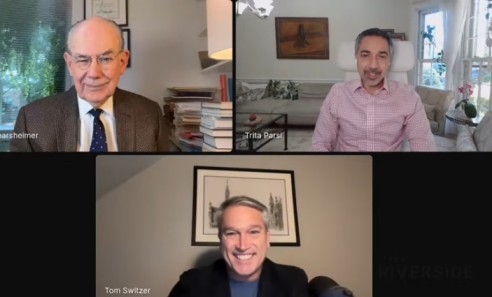
Read the full transcript of Switzerland with Tom Switzer podcast episode where guests John Mearsheimer and Trita Parsi discuss on the topic: “Can the US-Iran Peace Deal Hold?”, June 21, 2026.
Editor’s Note: In this episode of Switzerland with Tom Switzer, host Tom Switzer sits down with John Mearsheimer and Trita Parsi to discuss the volatile status of the U.S.-Iran memorandum of understanding amid stalled talks and continued regional tensions. The guests analyze why the Trump administration is shifting its stance toward Israel, arguing that the need to prevent an economic catastrophe is forcing a strategic pivot. They further explore the challenges of navigating a peace process while facing resistance from within Washington and the implications of this shifting dynamic for the future of U.S. foreign policy in the Middle East.
Introduction
TOM SWITZER: Hello, I’m Tom Switzer. Always great to have your company. Now today on the program, we’re going to be asking this question: will the US-Iran memo of understanding, will that hold? And I can’t think of two better guests to address this question than John Mearsheimer from the University of Chicago and Trita Parsi, who’s from the Quincy Institute for Responsible Statecraft.
Now, I should say from the outset, both gentlemen, both John and Trita, who’ve been on this program several times, their criticisms of the Iran War have been proven remarkably prescient, and it’s great to have them on the program. John, Trita, welcome back.
TRITA PARSI: Thank you.
JOHN MEARSHEIMER: Thank you, Tom.
The State of US-Iran Talks
TOM SWITZER: John, let’s just turn to the news of the day. Talks between Iran and the United States in Switzerland, they’re stalled. Iran says it has again closed the Strait of Hormuz following continued Israeli strikes in southern Lebanon. Donald Trump, for his part, has warned that the US could attack Iran over its support for Hezbollah. And the Israelis, they’re saying they have no intention of withdrawing forces from Lebanon. John, what’s going on here?
JOHN MEARSHEIMER: Well, I think there’s no question that there is a lot of resistance to this agreement from Israel and even inside the United States. I think that Trump is getting hammered from a lot of his former supporters for agreeing to this deal, and he’s terribly frustrated as a result, and he’s lashing out at the Iranians.
Furthermore, it’s proving very difficult for him to get the Israelis to abandon southern Lebanon, and I think that’s really the key issue, getting the Israelis out of southern Lebanon. And this frustrates Trump as well. And of course, from an Iranian perspective, it’s absolutely essential that the Israelis leave southern Lebanon. So it looks like there are a lot of bumps in the road today, and I think the big question you have to ask yourself is what’s going to happen moving forward.
And my view is that Trump has no choice but to settle this conflict on the terms laid out in the Memorandum of Understanding. And if the Israelis resist, Trump will just have to steamroll them. He has no choice. There’s no alternative here. There’s no winning strategy that is an alternative, and maintaining the status quo would be a disaster.
What I think is going on here is that lots of people do not understand that what’s motivating Trump is the threat of a Great Depression, the threat that the international economy is going to go off the precipice. He has said that. He’s talked about the possibility of, quote, “an economic catastrophe.” He’s made it very clear he does not want to be the second coming of Herbert Hoover.
Trump understands what’s going on. And once you take into account those calculations, what alternative does he have but to lean really hard on the Israelis and to work with the Iranians to operationalize the Memorandum of Understanding. So I think eventually this is going to be in large part sorted out.
Trump’s Rhetoric on the Strait of Hormuz
TOM SWITZER: You give credit to Trump for at least recognizing the need to shut this conflict down lest the global economy go off the cliff. He doesn’t want to be like Herbert Hoover and triggering the Great Depression of the 1930s. I get that. But then, what do you make of Trump’s warning today? He said this on the Fox News program, that the United States could become, quote, “the guardian angel of the Strait of Hormuz,” even suggesting that America might one day assume responsibility for securing the waterway and collect tolls on the oil and the gas passing through it.
JOHN MEARSHEIMER: He’s just bloviating. This is nonsense. We just fought a war and we couldn’t take control of the strait. How is he now going to take control of the strait? This is just not going to happen. And furthermore, if he tries to take control of the strait, the war will escalate in ways that will expedite how fast we’re moving toward the precipice. He would be insane to try to take the strait. So he’s just blowing a lot of hot air today.
And this is, you know, vintage Trump. He’s frustrated. He’s getting hammered by the lobby and by Israel, as I said, and he doesn’t like to admit the fact that this is really a case of unconditional surrender. You remember he called early on for unconditional surrender, but what he didn’t understand in the beginning was that it would be us, the United States, that surrendered unconditionally, not the Iranians. And he’s frustrated by that. You can understand it. And in typical Trump fashion, he’s lashing out. But the question you have to ask yourself again is, what alternative does he have to settling this conflict?
Iran’s Position on Uranium Enrichment
TOM SWITZER: Well, Trita, the Iranian president has insisted that Tehran will never surrender its right to enrich uranium. He made these remarks over the weekend, and Trump responded by warning that Iran’s leadership — and these are his words, quote — “had better watch its mouth or America would take over the rest of the country.” I take it you agree with John that this is Trump just talking the talk, he’s not really serious, he’s just frustrated.
TRITA PARSI: Trump is talking the talk.
It unfortunately can have very negative impact. We saw that in the talks today, there were news that Iranians had left. They hadn’t left in response to Trump’s threats over Twitter about controlling the Strait, but they did negate the opportunity for a photo op at the end in which all of them would be standing on the stage together. So it still has consequences, but I think everyone who knows what’s going on understands exactly what John said. If any of those things were possible, Trump would have already tried it, but it’s not possible. So he’s just talking to sound tough to a home audience at this point.
I think we should also be clear about one thing. I’ve lived through this once earlier, very close up with the Obama administration. Of course, you didn’t have a president on the American side that would speak in this manner back then, but there were a lot of theatrics. And we’re going to see that on crack for the next 60 days. A lot of meetings that are not going to get scheduled and all kinds of different things. The Iranians are leaving Switzerland, turns out that they weren’t. There’s going to be a lot of this, some of it legitimate, some of it illegitimate, but it’s just going to be part of the actual negotiation.
So if we react to each and every one of them, we’re going to get heart attacks halfway through. I think at this point we have to just take a step back and realize there’s going to be a lot of kind of false starts and things that are intended to look much worse than they actually are.
Israel’s Role and US Leverage
TOM SWITZER: Let’s bring in Israel here, because there’s no question that there are certain segments of the Israeli body politic that will go to great lengths to try to scuttle the deal. And the defense minister Katz says there are no restrictions on Israeli forces in Lebanon. John, the critics of both you and Trita would say that Israel is a sovereign democracy. It has a duty to its citizens to stop foreign bombardment.
TRITA PARSI: John?
JOHN MEARSHEIMER: Well, it is a sovereign state. But the fact is, it’s heavily dependent on the United States for economic aid, military aid, and for diplomatic aid. And the United States is a far more powerful state than Israel to begin with. And when you marry that to all of the dependencies that the Israelis have on the United States, that tells you that we have enormous coercive leverage.
And that means in a situation where you’re heading toward the precipice, where you may have a Great Depression, the United States will, in my opinion, use its coercive leverage to get the Israelis to behave. They won’t be happy about that, that’s understandable, but the basic facts of life in international politics are that the great powers are capable of coercing smaller states when their national interests, their vital national interests, are at stake. And that’s what’s going on here.
You know, Donald Trump, up until very recently, was the president who never challenged Israel. All sorts of people have been saying since he moved back into the White House in January 2025 that no president has been more accommodating of Israel than Donald Trump. And that was true. So the question you want to ask yourself: why has he done this 180-degree turn? Why is JD Vance, who is damaging his political future by being the point man for the Trump administration, willing to take on Israel, to criticize Israel in ways that were unthinkable a month ago? And the answer is that both Trump and Vance understand that we are heading toward the precipice, that they have no choice. So that, I think, is basically what’s going on here.
Trump and Vance’s Criticism of Israel
TOM SWITZER: Well, let’s just rehash what Trump and Vance have said in the course of the last few days. They’ve become noticeably more critical of Israel, Trita. This is Trump: “Bibi has no f*ing judgment on how he responds to Hezbollah.” And this: “Netanyahu is crazy. The Israelis keep killing innocent civilians. He needs to be more responsible.” That’s Trump on Bibi. And this is Vance, quote, “the Israelis, just like everybody else, have to respect this peace process that is fundamentally good for them and good for the entire region.”
Trita, is this Washington’s attempt to, if you like, de-specialize this relationship with Israel, that is, make it more normal? Or is it more complicated?
The Israel Factor and Congressional Constraints
TRITA PARSI: No, I think that is exactly what is going on here. And I agree with John. I would just add one thing. It’s not just that they’re walking towards the precipice because they were already walking towards the precipice a month or so ago. And we didn’t see this back then.
The reason why the change is coming now is because now the administration is also seeing the honeypot at the end of this process. It is not worth it for the Trump administration to have this fight with the Israelis unless they know they can get something good from the Iranians, meaning that there is some sort of a deal within reach. As soon as the MOU was signed, that’s when we saw the shift, because suddenly now it’s worth it for the administration to take on the Israelis.
And they’re doing so in a very systematic fashion. You have some of the comments by Trump, of course, plenty of comments by JD Vance. He said that Israel is a partner just like the UK and France. That is to de-specialize that relationship, reduce the status of Israel to the same status as France. Sure, the UK thinks it has a special relationship with the United States. No one in the United States believes that seriously, but nevertheless, none of them do. So this is a way to degrade it, and it’s a warning sign to the Israelis.
There’s another thing that he said that I think is very, very crucial, was actually said by Trump. He said that the Iranians are rational. He said that it is pleasant to deal with them, which I think a lot of people will have a hard time believing that he truly means. And he says that they’re looking out for their own interests and the interests of their people, I think he said. These are not off-the-cuff, insignificant comments. These are a direct attack on the three pillars of Israel’s narrative in Washington that has been promoted for the last 25-plus years and has essentially been very successful.
A narrative that holds that Iran is irrational, that it is ideological and that it is suicidal. If an entity is irrational and ideological, essentially you have eliminated both diplomacy and deterrence as a policy. You cannot have deterrence against an irrational actor. You add suicidal to the mix, and now suddenly you have no choice but to go for preventive war because the other side is willing to die and kill itself. So your only option is to actually attack them first.
The Israelis, of course, do not believe this narrative themselves. In fact, their own conduct shows that they don’t believe it, but it’s very effective in cornering the United States into having no option but to go for preventive war with Iran, which is exactly what the Israelis have been looking for for the last 20 years. So when Trump suddenly says, “The Iranians are rational, they’re pleasant to deal with, they’re looking out for the interest of their people,” he is negating all three of those pillars.
Now, whether they succeed in undoing that narrative or de-specializing the relationship, of course, depends on how much, if they stick to this line. Saying it once or twice is not enough. And of course, if there is an MOU. But I think they’re showing, not only the Iranians, of course, how far they’re willing to go, they’re showing the Israelis how far they’re willing to go. And in some ways, the ball is in Israel’s court.
The Israelis can keep on saying that they’re not going to walk out of Lebanon. Bottom line is both the US and the Iranian position is that Israel has to leave Lebanon by the end of this process, end of this MOU. From the American standpoint, I think the Iranians would like to see it happen much, much sooner. And of course, it’s not supposed to be any fighting in the process as they have this type of a phased withdrawal.
If the Israelis do not abide by that, then obviously there’s going to be challenges and problems. The Iranians, as we have seen, are willing to suspend the MOU, attack Israel, or potentially close the Strait of Hormuz or do other things. What is interesting, however, nothing they have done or said so far indicates that they would leave the MOU. It’s just about putting some pressure in order to get the Israelis to abide by the terms rather than the Iranians just throwing the whole thing out the window.
JOHN MEARSHEIMER: Tom, can I make—
TOM SWITZER: John, go ahead, follow on from Trita. John.
JOHN MEARSHEIMER: Yeah. I think one very important point that we want to keep in mind has to do with the difference between the Israel lobby’s and Israel’s effect on the public discourse in the United States and the effect of the lobby at the level of policy. And I think, as we’ve talked about on this show before, there’s no question that Israel and the lobby have really lost the game when it comes to the public discourse. Criticism of Israel inside of the United States is widespread. It’s been at the policy level where the lobby and Israel itself have continued to be so successful.
So what you see happening here is a huge crack at the policy level. It’s the first time we’ve seen that. But what that tells you is that if Trump and Vance are smart and they appeal in a sophisticated way to the public, they will be able to generate significant public support for the policies that they’re pursuing that the Israelis and the lobby don’t like. It’s not like Trump and Vance will be putting forth a policy or a strategy for dealing with Israel that’s not going to resonate with the public at large. All sorts of people in the public are going to understand exactly what’s going on here. And again, if Trump and Vance are smart, they will generate, I think, significant public support inside the United States for what they’re doing.
The Role of Congress in the Deal
TOM SWITZER: Are you both underestimating the power of the US Congress? Now, on this program just a few days ago, I spoke with Professor Foad Azadi. He’s from the University of Tehran, and he reminded our listeners of a quote from Pat Buchanan in 1990 that, “Congress is Israeli occupied territory.” Now, the administration, you know, you might be right about Trump and Vance, they might be going to great lengths to change things when it comes to America’s relationship with Israel. They might be willing to unfreeze Iranian assets, but Trita, to what extent will Congress play a role here in stymieing the administration? I mean, Congress may ultimately frustrate any lasting settlement when it comes to sanctions relief, correct, Trita?
TRITA PARSI: Yes and no. I think it’s important to remember the vast majority of primary sanctions that are imposed on Iran by the United States are done so through executive orders, which means that the president can actually lift them with a stroke of the pen. He does not need to go through Congress. A very large set of secondary sanctions are passed by Congress, those he can only waive or he would have to ask them to lift them, and that’s going to be a Herculean task.
But we should also remember he did manage to lift the Caesar Act, the sanctions on Syria, through Congress. And it was actually quite an achievement, I have to say, because Congress usually never lifts sanctions. Obama didn’t even try to lift the embargo on Cuba. He just lifted some of the executive orders. The embargo was untouched because he didn’t even want to take the fight in Congress on that issue. So I think there’s a significant distance the president can go without involving Congress.
Moreover, a lot of these secondary sanctions are going to become hollow without the foundation of primary sanctions underneath them. So many of them may actually become meaningless even if they’re on the books. Then there is the question of INARA, which is an act that requires that any nuclear deal needs to go through Congress for approval as well. Now the question is, if you notice, the president and no one on his team has talked about this as a nuclear deal. It seems like they’re going to be talking about this as a U.S.-Iran deal that goes long, far beyond the nuclear deal. And that may be because they’re looking at circumventing Congress on that issue as well, and never having to take the fight to Congress and INARA, because it’s not a nuclear arrangement or agreement that is being passed here.
I think ultimately Congress is going to have to have some say in all of this, but it’s not necessarily as straightforward as people have thought. Another thing that I think is important, I just want to add to what John said. John is absolutely right. I think this is actually going to be very good for JD Vance. This is what is going to boost his chances for 2028 if he manages to get this through. He is on stage, he’s looking presidential, he’s actually speaking very reasonably about all of these different issues. Of course, if it goes down, he will probably go down with it, but this was his best bet at this point. It is much better to deal with this issue than to deal with Greenland and ice issues in Minnesota. So I think this is actually quite a responsibility that he’s been given. Usually vice presidents don’t get to do things like this oftentimes.
But here’s where Congress and the Democrats come in, because John is absolutely right. This will actually work very well with the American public that is sick and tired of how pro-Israeli interests have pushed the United States in all kinds of directions, particularly towards war. But now you have a lot of bad faith criticisms of this deal from Democrats as well, senior Democrats, many of them who have actually been playing a very good role in all of this earlier on, but are now coming with all kinds of different attacks because they just want to make sure that this is as costly as possible for the administration.
And they’re pointing out things that are correct, that obviously this is not a strategic victory for the United States, but at the same time, we do not know what the final deal is. We don’t know the nuclear concessions the Iranians are going to give in the final deal because none of that has been specified. The MOU is just a framework. It is just setting the parameters of the talks. It’s not setting the details. And you can’t judge this ultimately without the details. And some of their criticism, by the way, are just flat out wrong, such as claiming—
TOM SWITZER: Intellectually dishonest.
TRITA PARSI: That’s what you’re saying. Intellectually dishonest, behaving exactly like the Republicans did in 2015. When they were, including Trump himself, throwing all kinds of dishonest attacks against this deal. What I worried about that is that they’re going to try to essentially— that the net effect of this will be that it will make it less attractive to the American public, but also they may actually create such resistance within Washington that the deal fails.
Well, guess what? If the deal fails, we’re likely going to go back towards some sort of a military confrontation. And that war will not just be Trump’s war. It will also be the Democrats’ war because they helped make sure that the exit from that deal was destroyed.
TOM SWITZER: Interesting. John, what do you make of all that?
JOHN MEARSHEIMER: I agree with what Trita said. I just want to come at it from a slightly different angle. In setting up the arrangements for this deal, the Iranians put the nuclear issue at the back end. The Americans wanted the nuclear issue up front, but the nuclear issue is of enormous importance. And as the negotiations go along, it’s going to be very difficult, if not impossible, for Trump to abandon the negotiations, not simply because of the economic consequences I was emphasizing before, but also because we have to get to the nuclear issue at some point.
There has to be some new version of the JCPOA down the road. And I think that once you get to the sort of final negotiations, where there are a number of economic issues on the table, like reparations, complete sanctions relief, the tollbooth and so forth and so on, the nuclear issue will be folded into those negotiations. And I think that you will be able to get an agreement. I didn’t think this for a long time, but the more I think about it, I think you’ll be able to get an agreement because the imperative to get a nuclear agreement is so important. And the fact that it’s so far down the road increases the likelihood quite significantly that you’ll have agreement as you march toward the final negotiations.
Critics and the Question of Iranian Intent
TOM SWITZER: Yeah, but to get an agreement, you still need some broad political consensus. And notwithstanding all the points that both John and Trita are making, you can just imagine the critics coming out in force, not just on the Republican side, but even the Democrats. They could argue that the new revenue that Iran will get will simply finance ballistic missiles and the regional proxy groups like Hezbollah and the Shia militia and so on and so forth. This is Republican Senator Roger Wicker. I know you disagree with this line, but you can imagine it perhaps taking hold in the public consciousness. He says, “The Iranian regime has not renounced its ultimate goal — Death to America. Death to Israel. The regime will invest every penny it receives to further that aim.”
The Gulf States’ Dilemma and the Path to Normalization
TRITA PARSI: It appears that the senator is not aware that the United States lost this war. This is part of the challenge in Washington, DC, that a lot of people are talking as if this went really well. I have no idea which planet they’re living on. I guess they’re watching Fox News every day. But this unrealistic— they all sound like Baghdad Bob at this point, making all kinds of demands of what needs to be achieved. Out of a war that actually really did not work out that well for the United States, that should never have been started.
And again, I think they’re not entirely unaware of it. I think they are doing so because they are under pressure from certain lobbies, et cetera, from the Israeli standpoint, and at the same time want to sound tough. But this is not easy in any way, shape, or form.
But again, I want to go back to something I said early on, because I don’t think it’s— it’s not just that the president realized what a disaster this would be. There’s a promise at the end of this that enables Trump to think he can turn this around and he can make it a win that will be part of his legacy. Because reality is, the Iranians, who for a long time have resisted it, are going for a deal that is much bigger than the JCPOA. And it could end up becoming a complete rapprochement.
I think it’s going to be very, very difficult to have that formally done, particularly since they’re not very keen on giving that to Trump, mindful of what Trump has done. But I think there is greater awareness on the Iranian side. A small deal will not survive. The next president can uproot it because it’s just not costly. It’s cheap to undo it. But if you manage to get American companies into Iran, if you anchor this through regional arrangements such as this investment fund— this is a reconstruction fund. It’s potentially going to be up to $300 billion. Well, the Iranians have already suffered $300 billion in damages plus in this war.
This is partly driven, or mainly driven frankly, by the regional states who have realized they cannot live under the American security umbrella. It is not particularly effective or reliable. They’re going to have to find some other way to live next to Iran, and part of that is going to be economic interdependence between the Iranians and some of the GCC states. As a buffer to prevent the likelihood of war, at least reduce it dramatically, similar to what Europeans did after World War II with the Coal and Steel Union.
So if you have a deal that is far deeper anchored in the region than the JCPOA was, if you have American companies going into Iran, which they didn’t after the JCPOA, the survivability of that deal is much stronger. But on the other hand, it also then gives Trump the ability to brag that he did something that was much bigger than the JCPOA, that this is a win beyond what happened militarily because Iran and America are no longer going to be enemies.
TOM SWITZER: Well, Donald Trump has spoken about meeting Iran’s Supreme Leader or even the president. I put that question to Professor Azadi on my program a few days ago, and he said that that would not happen because Trump is seen as too unpredictable, and in any case, he did preside over the killing of 3,500 Iranians since February 28th. John, what’s your response to Trita’s general point about renormalization of relations?
JOHN MEARSHEIMER: I think we could go a long way in that direction, and the reason is I just don’t think we have any alternative. To repeat what Trita said, we lost the war. We lost the war, and continuing to have hostile relations, continuing to fight with Iran is going to have disastrous economic consequences. I mean, what’s the alternative here? What are the hawks, what is the lobby talking about doing down the road? They want us to go back after Iran. They want us to renew the bombing campaign. This is a completely cockamamie idea. We tried it, we lost. Face up to the facts.
And it’s much better to work out some sort of meaningful security arrangement between the United States and Iran. And by the way, as Trita was saying, between Iran and the 6 GCC states, something has to be done there too. And by the way, I think from Israel’s point of view, it’s time for them to wake up and smell the coffee. The idea that they’re going to finish Iran off and they’re going to do away with Iran’s nuclear enrichment capability is not going to happen. And it would make much more sense for them to create some sort of modus vivendi.
Israel’s Reckoning and the Gulf States’ Reorientation
TOM SWITZER: Do you think this has concentrated the minds of the Israeli public in the lead-up to October’s election? I mean, Netanyahu may well lose that election. Could this be a bellwether issue in that election, John?
JOHN MEARSHEIMER: I think it’s too soon to tell, Tom. I mean, this is all just happening. I think even for all three of us, we’re kind of in the dark and trying to figure out exactly what’s going on. We have some concrete opinions, but a lot of it’s just tough to get your hands around. And I think for the average Israeli person, even for a lot of Israeli policymakers, they’ve been shocked by what happened. Remember, they believed that this was going to be a great victory. And the war only started on February 28th. And the realization that it’s a catastrophic defeat for Israel and the United States didn’t really come into play until probably a month ago. And I think it’s just going to take time for them to understand what’s going on. Now, you could make an argument they’ll never understand because they’re the Israelis, but—
TOM SWITZER: Well, they’ve been shocked, but Trita, what about the Sunni Gulf partners of the United States? Kuwait, Saudi Arabia, UAE, Bahrain, and so on and so forth. I mean, to what extent have they been shocked by this, and will they reorder their priorities in the region in the next few months and years?
TRITA PARSI: I think, again, like John said, they too don’t have many options at this point. They don’t really have a choice. They stood next to Iran, having the benefit of America’s military power behind them, under the illusion— of course, to turn out to be false— that it was going to be very effective against Iranians, that the Iranians would never dare to attack any US bases in the region, that the Iranians’ capabilities would never be able to essentially halt the US military, to grind it to a halt or anything like that. And now that military backing is gone, and they’re faced with an Iran that is very angry. They’re also very angry with Iran, of course, and there’s no other alternative for them.
China is not going to step in and be a security guarantor for them. They would never be so dumb to agree to something like that. Russia can’t do it. They’re looking at essentially diversifying their security baskets and their defensive baskets. And there’s also conversations about Pakistan, Egypt, Turkey, and Qatar to form some sort of a new backbone for the region. And to a certain extent, I’m sure it’s also aimed at partially balancing Iran.
But I think going forward, most of them are going to have a completely different balance between how much they want to contain Iran and how much they want to integrate and have economic interdependence with Iran. And it’s going to vary from state to state, but it’s just going to be a different balance for all of them, I suspect.
TRITA PARSI: One thing I could just add about this— part of the Israeli panic right now is totally justified. We’re looking at a situation in which Iran may end up becoming decontained out of this conflict while Israel becomes increasingly isolated and much more of a pariah. As JD Vance said, the United States is the only friend they have left. And at the same time, the relationship between the United States and Israel may be despecialized in Washington or throughout the United States. This is an absolutely disastrous outcome for the Israelis. And there’s some poetic justice to it because they were the ones who pushed for this.
A War That Defied All Expectations
JOHN MEARSHEIMER: Yeah, two quick points. One is, just to add to what Trita just said, I think the Israelis now have an appreciation of the missile threat that they didn’t have before the war started. And that threat will only grow with the passage of time because everybody in the region will build lots of very accurate and deadly missiles.
But the point I wanted to make is, if you think about where we were at on February 27th, I think almost everybody thought that Israel and the United States held most of the cards. I think even the Iranians thought that. I think they thought back to what happened in the 12-day war the previous year, 2025, the various attacks on Iran by Israel in 2024. And they, I think, understood they were going to have to fight a war, but they didn’t think they were holding that many cards. And we, of course, meaning the Israelis and the Americans, thought we held all the cards. And that’s why Trump could talk about unconditional surrender.
But as so often happens in wartime, as the conflict unfolded, it became clear to the Iranians that they were playing a very powerful hand in ways that I don’t think— Trita would know better than I do— but in ways I don’t think they anticipated. And we, meaning the Americans and the Israelis, certainly didn’t anticipate. So you end up in this situation as the war is coming to a conclusion that is really completely at odds with what almost everybody, including the Iranians, and again, go to the Gulf states, the Gulf states as well, thought going into the fight.
Trita Parsi’s Legal Situation and the Silencing of Dissent
TOM SWITZER: Let’s just change the subject finally. Trita, we talked about this briefly last week, but just to recap, The Free Press recently reported that the administration, the Trump administration, had launched an investigation into you with a view to revoking your legal permanent residency and even deporting you. The State Department publicly denied that such an investigation exists. Where do things stand now, Trita?
TRITA PARSI: I don’t think there’s been any change. I think what happened there, we talked about it last time, and I want to just also thank John for some very kind words that he gave in reaction to this, I think with Danny Davis. And yeah, so look, there was an attempt by them to trigger an investigation, getting some outside pressure through the press on the State Department. There probably were some people in the State Department who encouraged it, but it seems to have been squashed down very quickly, partly because of the outcry that came publicly, completely organic, but also because there were elements inside the administration who also opposed this. And the fact that the State Department came out within just a couple of hours and denied it, which is extremely unusual, tells you something.
So I think they tried. I think it backfired. I think they will absolutely try again. If there’s anything we should be absolutely confident about is that they’re relentless. And even after, for instance, they lost the debate on the JCPOA in 2015, they didn’t give up for a second. They kept at it and 2 and a half years later, they succeeded in undoing that deal. And I think that that’s going to be their strategy.
TOM SWITZER: Yeah, but you don’t want to underestimate their power though. I mean, they went to great lengths to stop Danny Davis from being in the Trump administration, remember?
TRITA PARSI: Certainly, certainly. So they will do that with whatever deal Trump gets. They will do that with trying to silence voices like mine and others. And hopefully I will be in the same shoes as John. They try to silence John for 20 years and they’ve utterly failed. And I think he’s more famous now than he’s ever been before. So yeah, I mean, it’s a different situation. I mean, thanks to alternative media, this is just so much more difficult for them.
The Mainstream Media’s Failure and the State of American Discourse
TOM SWITZER: Yeah, but it gets back to the point about the general mainstream media in the United States. I mean, I read the Wall Street Journal and the Washington Post every day. Just today, Sunday, the Washington Post runs a 1,600-word piece by Mark Thiessen from the American Enterprise Institute saying that America can still win this war, it just needs to up the ante, saying all the things that you’ve criticized today, John. And you’ll all too often hear that view in the Wall Street Journal, across all the major networks. And both of you— well, neither of you is interviewed by the mainstream media, with very rare exceptions. John, what is this controversy that did engulf Trita very briefly? What did that tell you about the state of American discourse in 2026?
The Rise of Alternative Media
JOHN MEARSHEIMER: Well, I think that you hit the nail on the head when you talked about the alternative media. When you have an alternative media, it reaches lots of people, it’s very hard to smear someone like Trita because all sorts of people in that alternative universe rise up and defend him because they fully understand what’s going on.
And if you look at the number of views that a lot of these platforms get, I mean, Tucker Carlson, for example, Judge Napolitano, Danny Davis, and on and on. They get lots of views, and a lot of the mainstream commentators who have videos that are posted on the internet get very few views because people are not interested in listening to them anymore.
It’s like the New York Times. I know all sorts of people who tell me they just don’t read the New York Times anymore. When I talk to my kids and their friends, and when I say my kids, they’re in their 40s, right? They and their friends, they don’t read the New York Times.
TOM SWITZER: What are you saying, you and I are dinosaurs for reading the New York Times, the Wall Street Journal every day, John?
JOHN MEARSHEIMER: No, because we have to be aware of what they’re saying. I religiously read the Wall Street Journal every day, especially the op-ed page and the opinion page, and I of course disagree fundamentally with what those folks have to say, but I read it just to keep up with it.
But I don’t think that many Americans are attuned to what they’re saying. And the problem is, Tom, that if you look at reality, if you look at what’s going on in the real world, and then you listen to what they’re saying, there’s a real disjuncture there. It just doesn’t make any sense. And I think that in this particular case, as Trita elucidated, worked to his advantage, thank goodness.
Closing Remarks
TOM SWITZER: Look, and in fairness to the New York Times, I should stress, and I’ve sent this article to both of you, there was a very good article about a week or so ago by Peter Beinart in the New York Times. He publicly defended you, Trita, and his article was on holding the foreign policy establishment to account for this monumental disaster. I’d encourage all viewers to check it out. Just Google New York Times and Peter Beinart’s last column. John, Trita, as always, it’s great to see you both. Let’s do it again soon. Thanks so much.
TRITA PARSI: Thank you.
Related Posts