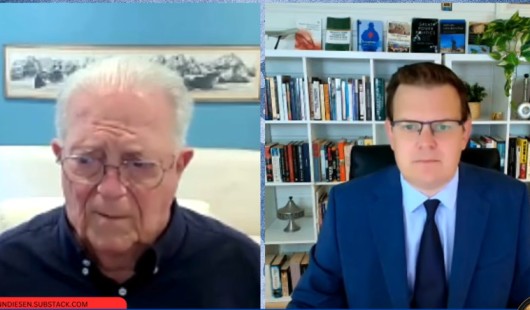
EDITOR’S NOTE: In this wide-ranging interview, host Glenn Diesen sits down with Ambassador Chas Freeman — former U.S. Assistant Secretary of Defense and former U.S. Ambassador to Saudi Arabia — to discuss the rapidly escalating conflict in Yemen, the unraveling of the U.S.-Saudi security partnership, and the broader collapse of American primacy across the Middle East. Ambassador Freeman offers a frank and deeply informed assessment of how Saudi Arabia might navigate its mounting crises, and what the decline of U.S. hegemony means for Israel and the wider region. This interview episode was premiered September 14, 2026.
TRANSCRIPT:
Saudi Arabia Under Fire: The Renewed War with Ansar Allah
GLENN DIESEN (00:00:00 – 00:00:49): Welcome back. Today is September 14th, 2026, and we are joined by Ambassador Chas Freeman, former US Assistant Secretary of Defense. And well, very relevant to today’s discussion is that Ambassador Freeman was also the US Ambassador to Saudi Arabia. So it’s great to see you again. And well, let’s start with Saudi Arabia. We see that Saudi Arabia has launched more than 300 air raids against Yemen over the past few days. And Ansar Allah, or the Houthis as we call them in the West. They are reportedly hitting Saudi Arabian radar systems, ammunition depots, airfields, aircraft hangars. I mean, how are you interpreting these developments, this escalation?
CHAS FREEMAN (00:00:50 – 00:06:17): Well, it’s tragic really because it all arose from an attack on Sana’a Airport by the Saudi-sponsored, internationally recognized government of Yemen, which only controls about 20% of the Yemeni population. Ansar Allah, the Houthis, control 80%.
They have just, as you know, conquered the Red Sea coast down to the Bab al-Mandeb, taking the port of Mokha, from which we get our mocha word for coffee. The Dutch began the trading there in the 16th century for coffee, and they now have a commanding position on the Strait of Bab al-Mandeb.
But they are also seeing there the escalation with the Saudis going on. There is a meeting today in Salalah, a town not too far from the Yemeni border in Oman. I have been there. It is quite an elaborate palace there, absolutely beautiful woodwork from Indian carvers. And the Iranian Foreign Minister, Araghchi, will be meeting with the foreign ministers of the 6 Gulf Cooperation Council members. Oman is the host, of course. Saudis and Iranians will be there and able to talk.
And my hope is that despite the impetuous nature of Mohammed bin Salman, he will authorize his foreign minister to seek Iranian mediation with the Ansar Allah, with the Houthis, to break the chain of escalation that is going on.
It’s not just military facilities that are being hit, but Abqaiq, which is the largest sort of node in the Saudi petroleum industry — Saudi Aramco — has been hit and badly hurt. And as a separate matter, possibly coordinated without the involvement of the Iraqi government, various Iraqi militias have been confirmed to have been the source of the strikes on the East-West pipeline in Saudi Arabia.
Saudi Arabia is now at war with Ansar Allah again, having seen the 4-year truce broken by its allies in Aden in the internationally recognized government. And it is also out of oil revenue since it can no longer export either through the Strait of Hormuz or through the Bab al-Mandeb. And it cannot produce, cannot deliver oil to Yanbu, the port on the Red Sea from which it has been exporting through smaller ships transiting the Suez Canal to the Mediterranean and markets up there.
So the Saudis are in real trouble. Ansar Allah is on the move, very aggressive. The prospect of a military solution to this is nil.
We know that Donald Trump claims the Ansar Allah, the Houthis, called him and said, “Look, we are not going to disturb anybody’s shipping. But anything going to or from Saudi Arabia or owned by Saudi Arabia will be attacked by the Yemenis, but other international shipping will not be.” And Donald Trump said, “That’s great.” So he’s refused 2 requests from the Saudis to back them in this reborn war.
This is not a good situation. What it does, in addition to the continuing Ukrainian strikes on Russian refineries, is put Donald Trump in a political box that he can’t escape from. He has apparently asked the Ukrainians to cease and desist their attacks on facilities that produce diesel. Diesel is now something over $6 a gallon in the United States, which is a crippling amount in terms of trucking and farm equipment, which depend on it. Supplies are drying up. The price is still rising. It’s going to go higher yet.
And Donald Trump faces midterm elections in the face of this. I say this with a little bit of sorrow because it appears that the only thing the American people care about is how much they pay for gasoline and diesel. They don’t seem to care about the damage to our country and to other countries and peoples that is being done with our wars of aggression in several places. But we’ll see a political reckoning, I think, in early November.
Saudi Arabia’s Options: The Case for Iranian Mediation
GLENN DIESEN (00:06:19 – 00:07:09): Well, given all these problems for Saudi Arabia, that is, as you said, their economic infrastructure — I mean, they’re heavily dependent on exporting oil. So their energy infrastructure is being either destroyed or put a blockade on it. And also, we see the Houthis striking a lot of their military assets. And the war waging now isn’t cheap either. And at the same time, the US seemingly can’t guarantee their security. Indeed, as you said, Trump is not bragging, but making a point that it’s not his problem. So what are the possibilities for Saudi Arabia now? I mean, how can they navigate themselves out of this mess?
CHAS FREEMAN (00:07:11 – 00:14:26): Well, as I suggested, they need a mediator with the Yemenis.
The only logical mediator is Iran. Saudi Arabia, after the war over the Strait of Hormuz is concluded one way or another, will need a cordial and cooperative relationship with Iran.
I think when Araghchi meets in Salalah with the Gulf Cooperation Council members, his counterparts from them today, one of the points he will make is that you must get rid of the American bases on your territory, which have been used to commit war crimes against Iran, start a war of aggression, and do a great deal of damage to Iranian infrastructure and the like. And I don’t know what the answer will be.
It’s pretty clear in the case of Saudi Arabia, which I know well, the basic bargain in the relationship has been broken. There was a meeting in 1945 between Abdulaziz, the founder of this 3rd Saudi dynasty and of modern Saudi Arabia, and Franklin Delano Roosevelt, the President of the United States, in the Great Bitter Lake of the Suez Canal aboard the USS Quincy. And pursuant to that, for decades, there was a partnership between the United States and Saudi Arabia by which in return for privileged access to Saudi hydrocarbon reserves and production, the United States protected Saudi Arabia against its more populous, more militaristic neighbors — with the implication, one of the implications being, that protection included restraining Israeli actions against Saudi Arabia.
Well, all of that has gone up in smoke. In the earlier war between the Houthis and Saleh and the Saudis, they struck Abqaiq, this junction in the Saudi Arabian Eastern Province of many oil pipelines, and Donald Trump did nothing. And that led to an acceleration in the Saudi effort to diversify their international relationships and their dependencies on others.
They’ve gone beyond that now. The Pakistan-Saudi Arabia-Turkey tripartite entente is an explicit repudiation of the American management of the security situation in the Persian Gulf and West Asia, and an attempt to replace it with indigenous forces that are not beholden to any particular patron abroad. That includes the Chinese and the Russians. But the Chinese and the Russians are quite happy to provide support when the United States fails to do so.
So we have seen this in a way at the recent BRICS summit meeting in New Delhi, where the one thing that many people could agree upon was the condemnation of the war with Iran, and the demand that means be found to end it.
But now in Salalah, if I understand what is happening, in addition to listening to Araghchi, the Gulf Cooperation Council countries are likely to signal their support for whatever it is that Oman and Iran have worked out to manage transit through the Strait of Hormuz. Well, that pulls the rug out from under the American blockade. How long can that blockade continue when, first of all, it appears to the rest of the world that the United States is collaborating, in effect, with Iran in cutting off their energy supplies, producing inflation, hardship, possible food shortages, and the like?
The ships that are conducting the blockade are in increasingly shabby and unsustainable condition. I mean, if you looked at the USS Abraham Lincoln when it arrived in Pattaya in Thailand — presumably where they allow these sailors to have a little bit of fun, although we’ve been assured that prostitution is illegal in Thailand, something I didn’t know — and if you look at that, it’s a rust bucket. It’s foregone usual maintenance for a very long time, and the other ships are in equally poor condition. They’re at the end of an unsustainable long supply chain which supplies food, fuel, and the like from very far away.
And they can’t — their original reliance on the headquarters of the 5th Fleet in Bahrain is impossible because that facility has been destroyed. Indeed, we now have American military sources, senior people, openly admitting that Iran has done a great deal of damage to the bases in the Persian Gulf, which have essentially become unsustainable, and that it has done great damage to the retreated position in Jordan. This is a contradiction of the White House line and Pete Hegseth’s line, which is “nothing to see here, go look someplace else.”
So from the Saudi point of view, it is now urgent to make peace with Iran, to find a solution to the war with the Houthis in order to resume the various programs that they have had to suspend or curtail. I mean, the Vision 2030 projects have all been curtailed earlier as a result of this war.
And now the Saudis have a problem. You mentioned the Houthis’ attacks on Saudi military facilities and equipment, and that equipment, with almost all of it, comes from the United States. And the United States is not in a position now to resupply it, having in effect shot its wad, as the saying goes, in a war with Iran.
So I think we will see whether the Saudis are capable of doing what Donald Trump is not, and that is admitting that they are in a very bad place, need to come to grips with that, and to make peace with those with whom they are at odds — accept defeat in effect, because this is a defeat for Saudi Arabia.
The Collapse of U.S. Hegemony and What It Means for Israel
GLENN DIESEN (00:14:29 – 00:16:42): Well, what you’ve been seeing though — the fighting in the Strait of Hormuz, the attacks on the Gulf states, and now the talks in Oman, as you said, which would pull the rug from beneath the United States — all of this signifies essentially a breakdown of the whole hegemonic security architecture led by the United States.
Indeed, we see a similar development taking place in Europe, except the Europeans would never talk to Russia. But otherwise, you see the security architecture built around the hegemon is now falling apart. And it just seems like the ideal situation for the United States since World War II has been this security architecture, because the US has been the principal security provider, and from this position has been able to extract great political and economic benefits. And given that no one actually challenges the United States either, it’s been a good deal. But this seems to have come to an end now, when they actually have to go and possibly fight for Saudi Arabia or any of these other countries. And as you see, the Europeans also want to pull the US into a war now.
But the real story then seems to be this — the decline of US primacy in the Middle East. But how does this affect a country like Israel though? Because if I was Israeli, I would think, over the past few decades, we could do whatever we want because the Americans were standing behind us. But at the moment, it’s very perplexing because as the US is in decline and Israel seems to be ramping up against all its neighbors, it doesn’t make much sense. You would think they would go the other way. That is, fine, strike a deal with your neighbors today about a new status quo if you think that your position tomorrow will be weaker than it is today. But again, we’re seeing the opposite. How do you see this? Do you explain this in the wider geopolitics, the domestic issues in Israel, or how do you make sense of this? Sorry, a big question.
The Erosion of U.S. Credibility in the Middle East
CHAS FREEMAN (00:16:43 – 00:25:28): Well, yes, this is the classic Glenn Diesen, what is this, a club sandwich of questions, I guess.
So, as you were speaking, I was reminded, since you’re an academic and we’re talking about suicide, which is the suicide of the United States with respect to its global primacy and specifically its primacy in the Middle East. Since you’re an academic, I’m sure you know the story of a member of the MIT faculty who was found dead in the faculty club, with 30 stab wounds in his back. And the faculty gathered and looked at him and said, this was the clearest case of suicide they’d ever seen. You know, the viciousness of academics is a legend. People in foreign affairs are more polite, but equally vicious, or I should say self-serving.
And the United States has basically done away with all of the reasons, really other than its supply of weaponry, which now it does not have. Too, it’s done away with all of the reasons for others to rely on us in the Middle East and in West Asia. When called to support those to whom we have pledged protection, we do not come. And this is now a consistent pattern. And it’s particularly clear in the case of Donald J. Trump. He does not come. Nothing to do with us. He says, when tankers are taken in the Strait of Hormuz before, or when Abqaiq is struck by the Houthis, or when military facilities in Saudi Arabia are struck, or when there is a blockade in the Red Sea of Saudi shipping.
So this all goes back to a pattern of behavior by the United States beginning with the response to the misnamed Arab Spring of 2011, when the United States reacted with glee to the removal of Hosni Mubarak, its protégé in Egypt, and did not come to the aid of anyone else. So in fact took advantage of the unrest to launch a campaign in support of jihadi takeover in Syria, which happened. You know, so now, I mean, you couldn’t imagine. We just had the anniversary of the 9/11 attacks on the United States by al-Qaeda. Now we are allies of al-Qaeda elements in Syria. I mean, who could have imagined this?
I was speaking with Ian Proud the other day, the peacemonger, and he mentioned that in Yekaterinburg, where he was consul, I guess, his quarters adjoined those of the American consul general, so they could just walk through. And one day he walked through and into the consul general, American consul general’s office. And there on the wall was a picture of the British burning of the White House in 1812 or ’14 or whenever it was. And he looked at his American colleague and said, this is interesting. Why do you have that up there? And he said, well, I show it to the Russians to tell them that, you know, relationships can change over time. Well, sometimes they change to become more intimate and sometimes the opposite. And that is what is going on here. The United States’ position in West Asia is no longer sustainable, and we’re seeing more and more indications of that.
Muawiya’s Hair and the Diplomacy of the Gulf
I want to make a comment on the fact that Islam has its own lore of diplomacy, and there are very many stories, but there is one saying that is particularly relevant in this context of opposition between the countries of the Gulf Cooperation Council, the Arab Gulf countries, and the Iranians. And that is Muawiya’s hair. Muawiya, who was a caliph, successor as the leader of Islam to the Prophet Muhammad, said, you know, if only one hair connected me to another party, if he pulled, I would yield. If he yielded, I would pull. Never lose contact with the enemy. Never give up diplomatic dialogue. This is, perhaps Islam has some lessons to teach Christendom in its current undiplomatic, anti-diplomatic state, I think. And Muawiya’s hair is a good example.
Israel’s Expanding Campaign and the Emerging Tripartite Entente
Anyway, what is happening in the region is, of course, distracting attention from the onslaught of Israel on the Palestinians and the Lebanese. Iran continues to insist, by the way, that one condition for agreement with the United States is that the United States pull the plug on these Israeli devastations of the Palestinians, the Lebanese, the Syrians, and others. Israel has very defiantly stated it will not do so. Netanyahu has gone to Gaza and said that it will be resettled, that it will all be taken. The various fascist members of his cabinet have declared that there will be a “voluntary” departure of the Palestinians from Gaza. The pogroms in the West Bank are attempting to engineer a departure of the Palestinians there. The Lebanese south is being devastated. It’s being turned into a replica of Gaza by the IDF.
And Israel continues to contest dominance in Syria with the Turks, to try to divide it between the Arabs, the Sunnis, the Shia, the Alawites, the Druze, the Kurds. All of the Armenians, all of the divisions in the Christians, all of the divisions in Syria, manipulating it, when the Turks are insisting on an integrated Syrian state that has the capacity to defend itself. So we’re seeing mayhem in the Levant, an escalating Israeli-Turkish confrontation, restiveness with the Camp David Accords on the part of Egypt and Jordan. And Jordan has nowhere to go. Egypt might.
It is the emergence of this tripartite entente, a cooperative security arrangement in the Persian Gulf between Pakistan with its nuclear weapons, abundant labor supplies and favored connection to China. Saudi Arabia with lots of money under normal circumstances, which today these circumstances are not normal. Saudi Arabia is borrowing money. It just asked for a major loan from the World Bank. And this indicates the distress. And finally, Turkey, which is an advanced industrial economy with a formidable army, truly, truly exemplary army. This is a formidable combination. Whether it can actually replace foreign dominance of the region is yet to be seen, but that is clearly the intent. And I don’t see that the Saudis have any choice but to go along with that.
And the Israelis are rightly alarmed by these developments, which are a fundamental check on the greater Israel project to which they remain devoted, and which I think is increasingly infeasible. So I’ll stop here. Since you provided a club sandwich, I thought I’d chew it for a while.
GLENN DIESEN (00:25:30 – 00:25:53): Well, I was wondering though, as you see now Saudi Arabia becoming weakened, is this something that would fill that vacuum? Because as you said, all these countries are weakening each other, but Turkey is getting stronger. But some would think that Israel might benefit from the weakening of Saudi Arabia, or not so much?
Saudi Arabia, the Gulf States, and the Realpolitik of the New Order
CHAS FREEMAN (00:25:54 – 00:29:22): Well, indeed, there is a theory that one of the objectives, not the main objective but an ancillary objective of the war on Iran that Israel instigated, was the weakening of the Gulf countries. We see in Israeli politics a lot of posturing against the Gulf Arabs, particularly against Qatar, which Naftali Bennett, a candidate for the prime ministership, but probably not a viable one, but we don’t know yet. He spends a great deal of time badmouthing the Qataris, in part because of their association with Netanyahu in the previous effort to divide the Palestinians, where Netanyahu counted on the Qataris to keep Hamas intact as a challenge to the Palestinian Authority, Fatah, and others. So that is a consideration.
But Glenn, I think, you know, the basic strength of these countries should not be underestimated. Once the Strait of Hormuz is reopened, now, apparently with some participation by them, if I construe the meeting in Salalah correctly, I don’t think there will be anything signed there, nothing final. This is a discussion on the way to a post-war order in the region. It is not the creation of a post-war order, but their natural resources will remain formidable.
They have all found nationalism, even in the smaller states, and are behaving accordingly. They’re no longer the prisoner of theological differences. The Sunni-Shia divide has greatly diminished in importance. It’s still there, but it is not the driving force that it was. You see countries like the United Arab Emirates, ruthlessly pursuing realpolitik, expanding their control in the Horn of Africa, the Red Sea, the other shore of the Red Sea, and in Libya, very adventurous, strategically aggressive posture, currently aligned with Israel. But clearly playing all sides off against each other. And so they are the primary example of realpolitik, but the others all follow it.
And as I said earlier, one key question of Mohammed bin Salman’s leadership in Saudi Arabia will be how he deals with the issue of resolving the conflict with the Houthis. And as I said, I don’t think he has any option other than — there is no military option. He needs a mediator, and the only plausible mediator is Iran. So I think he’ll be driven there. But, you know, there’s a lot in motion here. Perhaps we’re not talking about a club sandwich, but some kind of maelstrom.
GLENN DIESEN (00:29:25 – 00:29:47): Well, it’s just all of these conflicts are so linked together. It’s hard to just separate one from the other. You can’t. It’s just with the Israelis, it seems, you know, they have a way of getting out on top, you know, and, but this time around, it seems so self-destructive what is happening, and I just don’t see a good pathway for them anymore.
Israel’s Suicide: Pariah Status, Emigration, and Moral Crisis
CHAS FREEMAN (00:29:48 – 00:33:58): So you think the Israelis are the Hungarians of West Asia. They enter a revolving door behind you but come out ahead somehow. Maybe. But I think Israel’s luck is running out. Israel is committing suicide in every aspect of its, every element of its life. It has lost its international support. It is now a pariah. Even in the West, we see now rather cowardly but still pathbreaking moves against Israel. For example, in the UK and 11 other European countries, including Canada.
And we see the emigration rate from Israel of intellectuals and professionals skyrocketing. We see the army in increasing disarray, with the chief of staff of the IDF warning that it may fall apart. We see the divisions in Israel between those who favor Jewish democracy, fearing the autocracy of the fascist group now in charge. Some Israelis, not many, but objecting to the persecution and immiseration of the Palestinians or the genocide in Gaza and the depredations in the West Bank. I mean, in the older generation of Israelis, recently there was a tour of the West Bank by a group of elderly generals — retired generals from the IDF — who were horrified at what they saw, justifiably so.
So there is a holocaust going on against the Palestinians. And like the European Holocaust of the Jews, Gypsies, liberals, and communists, it is conducted by technological means. People are alarmed about the potential for artificial intelligence to do things that are inhuman. That’s already happening in Israel. They are using AI to murder people on a vast scale.
So there is much to be distressed about. And if you’re Israeli, or if you’re Jewish and not Israeli, do you want to be associated with these people? Is Zionism a legitimate expression of Judaism, or is it a heresy, a deviation of the sort that the Islamic State is with regard to Islam, or perhaps white nationalism is from Christianity? You know, I think there are serious moral issues that are troubling many people here.
And increasingly, there are people in Israel who doubt that Israel will get much beyond its 80th birthday, which is coming in a couple of years. So this is not good. And the question is, you know, Israelis have been asking the question, where are the Palestinians going to go? They now, you know, should be thinking, where are the Israeli Jews going to go? Who wants them after what they’ve done with this experiment with Zionism? I think there are terrible questions out there, and I don’t know the answers to them. Although I suspect that the refuge of both the Palestinians and the Israeli Jews will end up being Brazil, because it has the only intelligent immigration policy that I’m aware of, and space and accommodation and a history of tolerance, which is admirable.
GLENN DIESEN (00:34:01 – 00:35:35): Well, on the topic of collapsing or weakening alliances, how do you — what is your overarching view on what’s happening in Europe with NATO? Because again, NATO expansion was supposed to facilitate the collective hegemony of the West. It was a key pillar of the unipolar moment. And of course, Ukraine was supposed to be a big, powerful shield or a spear against the Russians.
Indeed, you probably read the same New York Times article back in February of 2024 about how after Yanukovych was removed — sorry, I’m preparing a big club sandwich again, but well, no. Well, after Yanukovych was toppled with the help of NATO countries back in February of 2014, you know you had this New York Times article pointing out that what a big score this essentially was for the United States, because with the Ukrainian assistance, the U.S. intelligence on Russia would be increased dramatically. They would have more access to Russian military technology communications. Interesting — yeah, getting more insights into its intelligence networks and also launching a covert war on Russia. I mean, you had all these different benefits, but now Ukraine is starting to look more and more like a liability as it’s becoming destroyed. What does — I mean, what does this war now do for NATO?
The Ukraine War, European Confusion, and the Shifting World Order
CHAS FREEMAN (00:35:36 – 00:43:57): Nothing. Nothing.
It has brought to light American strategic confusion, and it has revealed the European inability to provide clarity to counter that confusion or act despite it. And in fact, the war has demonstrated the validity of the Russian contention that Ukraine’s association with NATO would pose an intolerable threat to Russia. Every time a refinery is blown up in Russia with the assistance of NATO, targeting provided by Western intelligence services, the CIA, MI6, and others, the Russians are reminded that they cannot tolerate hostile foreign forces in Ukraine. That was the basis for their, I think, ill-considered but inevitable decision to invade in February of 2022.
So I think what this is ending up with is a situation where increasingly Europeans — using the American football analogy — fumbled this and dropped the ball on Ukraine, are now going to be confronted with a rump state of Ukraine, which is even more corrupt than it was before, which is impoverished, which is deindustrialized, which is no longer a threat to farmers in other countries because it can’t export its grain safely, which is managed by Western Ukrainian ultranationalists who are anathema to their neighbors, the Poles, Hungarians, and so on. And which is perhaps as a zone of weakness following the end of this war, they are going to face revanchism from countries like Poland or Hungary. In other words, there is no reason that Ukraine has to be immune to depredations from others.
So this is a cancer on Europe, and I think on Russia too, because I do not see Ukrainians reconciling themselves to the impending defeat that they seem likely to suffer. They have lost territory, they have lost population, they have lost their industry, they have lost their heat, and with a very hard winter coming, according to the meteorologists, this is pretty crucial. The Russians are clearly gearing up for the end of this war militarily. They do not believe that there is any diplomatic exit. The one they tried at Istanbul in March and April of 2022 was sabotaged by the West.
The West has no diplomatic answer to Ukraine. We have 2 unqualified real estate moguls from New York, personally representing Donald Trump with no official status whatsoever in an effort to mediate a conflict to which the United States is party. A mediation cannot be achieved by someone who is an active party in a dispute. And there is no yesable proposition out there for the Russians to agree to.
The Ukrainians seem increasingly desperate. Zelensky is obviously in serious political difficulty. There are challengers to him now more and more visible. Ukraine has lost its democracy. It’s lost its freedom of the press. It’s lost its freedom of religion. It’s lost its freedom of speech. It’s not going to get into the European Union because of all the factors I’ve mentioned. And it’s not going to be in NATO. So from the point of view of Ukraine, this war has been worse than a catastrophe. It’s been absolutely destructive on every front and leaves Ukraine maimed, barely alive, potentially.
What is the European answer to that? This was all preventable had Istanbul not been obviated by the intervention of Boris Johnson. Had Europeans not decided, contrary to their own diplomatic tradition, that talking to the Russians was morally prohibited. Life is full of villains, and sometimes you have to deal with them, and you have to deal with them pragmatically. You can’t deal with them by insults, as Donald Trump attempts to do with those he regards as villains. You can’t deal with them by non-communication, non-intercourse, as the Europeans do.
And it’s time for many reasons for the United States, for Europe, in particular the West, if you will, to reconsider the status quo. The status quo has achieved the level of sacredness. If you question the sacred status quo — I think you may have done this — you are committing sacrilege and you will receive death threats. And you will be condemned for capitulationism or whatever, all of the sins of statecraft that anyone can imagine.
Well, the fact is that the status quo may be sacred, but it’s disastrous for the West. And the absence of debate about it, the unwillingness to entertain for debate purposes if only that, alternative policy proposals, it’s catastrophic. The half-life of the West as a force in the world — about 12% of the world’s population is in the West, 88% is not. The 88% is rising. The 12% don’t seem to be doing that anymore.
Where is this heading? Can we afford not to consider alternatives to failed policies? Clearly, Ukraine is a failed policy. So is the war on Iran. So is the two-state solution in Palestine. So is, according to Donald Trump, the British defense of the Falkland Islands. Anyway, time to do some serious rethinking. And who’s going to do that?
Well, we’re seeing apparently — I don’t know what happened finally in the Swedish elections, but I gather the right did not achieve the overwhelming success that many predicted. Alternative für Deutschland did not turn out — or at least Saxony-Anhalt did not turn out to be a precedent. I don’t know about your own politics in Norway, but where is the rethinking to come from? Perhaps from the right, not the left. The left seems to be devoted to effectless posturing rather than reason.
The Sacred Status Quo and the Closing of the Overton Window
GLENN DIESEN (00:44:00 – 00:44:32): Yeah, there’s not many real credible alternatives, I think, across Europe, but you do see the political establishment being increasingly discredited as well as their — well, let’s call them mouthpieces in the media. So I think it’s just that there’s no alternatives emerging really, but the former status quo keeps falling apart. But my last question is sacred.
CHAS FREEMAN (00:44:32 – 00:44:39): It is sacred, and you must swear allegiance to it, Glenn. You’ll be in trouble. Well, you are in trouble.
GLENN DIESEN (00:44:40 – 00:45:56): Oh, I know. It’s very limiting. I noticed it’s a bit like in the Middle East. They say, do you condemn what Hamas did? And then they put this little moral pillar, and this is kind of the point of departure in any discussion. And they do the same with the war against Russia. That is, the point of departure in any public discussion will have to be, do you condemn Russia’s unprovoked aggression? And then, unless you see it through this lens that, yeah, Russia wants to restore the Soviet Union, and the response has to be to revive this Cold War bloc — if you deviate from this, there’s no room for you in polite society.
So it’s very — again, it’s so much self-harm here because as you said, we’re living in historic times here. The shift of power, the distribution of power, the way it’s dramatically shifting away from the West. We haven’t seen any such distribution of powers in centuries. And the only framework which we’re narrowed into to manage the narratives is to look back at some kind of a Cold War or something from the 20th century. It’s very frustrating.
Pilpul, the BRICS Summit, and the Rediscovery of Rules
CHAS FREEMAN (00:45:57 – 00:50:24): There are 2 ways of dealing with challenges to the sacred status quo. One is to close the Overton window and not allow discussion at all, which is indeed what many people do, as you suggest. But the other is, in the Eastern European Jewish tradition called pilpul. And pilpul is that when somebody raises a strategic question, you dive into the weeds and you discuss all sorts of annoying contradictory details that appear to discredit the strategic initiative that someone has proposed. Both are going on.
I want to make a point here, and I find it very interesting. There was just this BRICS summit in New Delhi, and one of the comments by Xi Jinping there really struck me because it suggests that the West has abandoned the idea of a rule-bound order, and suggests that expediency should outweigh rules and that arbitrary and capricious behavior is acceptable regardless. Xi Jinping used the analogy, he said, a world without rules is like an intersection with no traffic lights. It is an invitation to an accident.
In other words, it looks to me as though the Chinese and the others in the BRICS are rediscovering the merits of the rule of law internationally at the very moment when the West seems to be least loyal to its own traditions in this regard. In the case of the United States, we pay no attention to international law at all anymore. I think there’s still a bit of life in it in Europe. But sometimes only in a very strident, dogmatic, and counterproductive manner. I’m thinking of Kaja Kallas in particular. Very unrealistic, idealistic, but misguided statements, aspirations to break up the Russian Federation rather than deal with it, and so forth. I suppose on the principle of self-determination. I don’t know why.
Anyway, the effect is that the debate that should be happening is not happening in the West — but that does not mean that it’s not happening elsewhere. And I think it is. And I think it’s very interesting now we could have the BRICS grouping. The Indians chair it. That’s why they hosted the Delhi meeting through the end of December. And January 1st, the Chinese take over. The following January 1st, South Africa takes over. These are 2 countries that understand the need to translate suggestions of voluntary action into institutionally backed, funded programs that can be implemented.
The BRICS meeting in Delhi came up with a huge number of constructive suggestions, urging everyone to follow what were recognized as common interests, but it didn’t provide any organizational framework for implementing this suggestion or funding for doing so. I think the next stage in the BRICS is going to be that. And this is in effect the creation of an alternative to the United Nations, the post-war order that was ruled by the West. And it will be a return to the formulation of rules by consensus rather than by unilateral action, either Soviet or American or other countries’ unilateral actions. So I agree with you, this is an epochal change in progress. It’s not happening, unfortunately, in the world that you and I cherish. It’s happening elsewhere.
Nostalgia, Anarchy, and the Death of the Old Order
GLENN DIESEN (00:50:26 – 00:51:23): Well, Friedrich Nietzsche — he made the point that change entails — well, it’s when the old dies and it gives way to something new. But he made the point, if the old dies and nothing emerges to replace it, that’s anarchy. That is chaos. And I think that’s what we’re seeing though. The old order has already died and the status quo is already gone.
And I think in the West though, the irony is we’re holding onto a bygone era because that era was the peak for us, at least in the West, for stability and peace the past 30 years. And by refusing to adjust, to accept that that status quo is gone, we’re essentially — by refusing and even criminalizing debates and discussions — we are opening the doors now for full anarchy. Again, ironically, because we want to hold on to this previous era of stability.
CHAS FREEMAN (00:51:23 – 00:52:27): Well, nostalgia is no substitute for realism. And I’m reminded in the case of Palestine, West Asia, that the peace process, so-called, survived as nostalgia long after it had died as a reality. And it became an excuse for inaction and for tolerance of trends that have developed to a point which is truly disgusting.
So your point is valid. We are holding to nostalgia about values that we once professed. Perhaps we never really practiced them, but we attempted to do so, we aspired to do so. And they are dead now. And what is to replace them is uncertain, but it surely doesn’t look as though it’s going to come from the West.
Closing Remarks
GLENN DIESEN (00:52:31 – 00:52:32): Well, always a pleasure.
CHAS FREEMAN (00:52:34 – 00:52:52): Yes, we like to talk about grim things and you like to ask enormously complex, I think very realistic and pertinent questions. And I like to try to answer them, but I always fail. So anyway, thank you for what you do, Glenn.
GLENN DIESEN (00:52:53 – 00:52:53): Well, thank you.
Related Posts