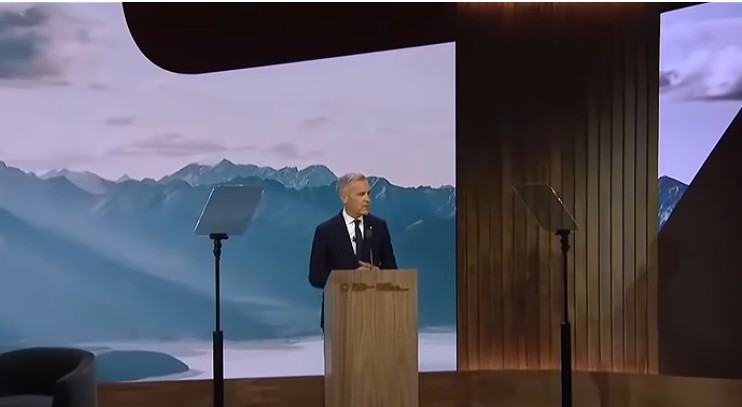
The following is a transcript of Prime Minister Mark Carney’s keynote address at the Canada Investment Summit 2026, held in Toronto on September 14–15, 2026. Following his remarks, Carney sat down for a fireside chat with PSP Investments CEO Deborah K. Orida to discuss trade diversification, competing for global capital, and Canada’s federal-provincial cooperation on major projects.
Opening
MARK CARNEY: There you go. Thank you. Thank you all. Thank you very much, Deb. Prime Minister Harper, thank you for being here. Dear friends, it’s a pleasure to address you this morning, and I’m going to begin in French — a few words in French. Canada is a proudly bilingual country, so I’ll begin in French and proceed in English.
Harbours and the Origins of Canada
I want to begin with harbours. The origins of the nation of Canada began in the summer of 1604, when the French explorer Samuel de Champlain sailed across the Atlantic to Nova Scotia’s South Shore.
He searched for safe anchorage around blustery Cape Sable and into the Bay of Fundy, where he found what he described as one of the finest harbours he’d ever seen. He named it Port Royal.
Port Royal offered shelter from the wild storms of the Atlantic, but it quickly became something far more: a base perfectly situated for trade, exploration, and the building of one of the most diverse and successful nations in history.
Today, four centuries on, my colleagues and I welcome you to a Canada which is both a safe harbour and a base perfectly situated to build in the new global economic order. That world is becoming, as we know, more dangerous and divided.
Sovereignty and openness are in tension. Economic integration has been weaponized — tariffs used as leverage, financial plumbing as coercion, supply chains as vulnerabilities to be exploited. At the same time, very positively, technological change is accelerating, but it’s changing the nature of war, the structure of economies, and the capacity of states to govern.
I’d suggest that Canada recognized this rupture earlier than most, and our response reflects two lessons that we’ve taken from it. First and foremost, we must take care of ourselves.
Second, we will always take care of each other. Taking care of ourselves means building our strength here at home and diversifying our partnerships abroad. We know we can’t control what others do, but we can be masters in our own home. This is our primary focus. It’s what our government, the provinces, the territories, the private sector, and above all, Canadians themselves have begun together — a great national effort to build Canada strong.
Building Canada Strong
In this process of building sustainable prosperity for Canadians, we are creating enormous opportunities for investors. Our goal is to catalyze $1 trillion of investment in Canada over the next five years — in energy, in transportation, in tech and data, in defence and beyond.
And to that end, in our first year as government, we cut taxes on incomes, capital gains, and business investment. We’ve begun building one Canadian economy by removing every single federal barrier to internal trade. We’ve made it easier for Canadian workers to take their skills anywhere in this country, and now we’re accelerating — working with provincial and territorial governments — new initiatives to tear down the barriers that have divided our economy for generations.
Our government has launched our most significant regulatory reforms to fast-track nation-building infrastructure. We’ve already referred 27 nation-building initiatives to our new Major Projects Office — new ports, mines, and energy corridors from every region of the country that now represent $500 billion in new private investment opportunities.
Canada as an Energy Superpower
We’re unleashing, in that process, our full potential as an energy superpower — by advancing a pipeline that would carry at least 1 million barrels of low-emission Alberta oil per day to Asian markets; by creating a new industry of large-scale carbon capture and storage; by doubling our LNG exports to 50 million tonnes annually by the end of this decade and then doubling them again right after; by building nuclear power across the value chain, from operational SMRs to utility-scale generators, while expanding world-leading uranium production; by doubling our electricity grid, building on our advantage of the lowest-cost power in the G7 and the second-lowest emission power in the OECD.
If you need clean, affordable power — and who doesn’t — Canada is your answer.
Just last month, Newfoundland and Labrador, Quebec, the federal government, and the Innu Nation announced the largest clean energy investment in North American history: 14 GW of hydro, wind, and storage — the functional equivalent of 18 Hoover Dams, enough to light, heat, and cool every home in Toronto, Montreal, and Vancouver combined. That’s what an energy superpower looks like when it decides to act like one. Canada is building its strength everywhere.
Defence and Global Partnerships
We’re undertaking the biggest increase in defence spending since World War Two. We’re now meeting our NATO obligations and have already provisioned in our budget the path to 4% of GDP in total defence spending by 2030. We will maximize the impact of that spending on our security and on our economy.
Our defence industrial strategy will catalyze $500 billion in investment over the next decade, building on Canadian strengths in aerospace, shipbuilding, AI, cyber, quantum, robotics, and autonomous systems — all dual-use applications that will drive innovation and productivity across the wider economy.
As I said earlier, Canada is now the best-connected economy in the world. In the past year, we’ve signed over 50 critical minerals agreements with more than 15 countries, unlocking $20 billion in investment while reducing dependence on foreign chokeholds in critical supply chains.
In the same period, we’ve signed more than 20 trade and security deals across five continents, completing our most recent deal with the UAE in a record 47 days. And I would like to pay tribute to the Emirates’ Minister of International Trade, who has joined us for that accomplishment.
Over the next six months, we intend to double the access that we currently have — 1.5 billion consumers around the world — with new trade deals with ASEAN, India, and beyond.
We’re also deepening ties with our most trusted partners.
We are the only non-European member of SAFE, the EU’s defence procurement initiative, and next month we will begin discussions with the EU, the world’s second-largest economy, to build a unique security and economic alliance.
Our core objective of all these partnerships is to increase our sovereignty, our strategic autonomy — because, as I said earlier, we live in a world where integration has been weaponized; because a country that cannot feed, fuel, or defend itself is not truly sovereign; and because today’s strategic autonomy extends to building partnerships in core capabilities across AI, payments, space, critical minerals, and clean energy. When we invest in these capabilities at home and combine them with the strengths of trusted partners abroad, we multiply their value. We create greater scale for Canadian companies, greater resilience for our country, and greater opportunities for investors.
And to our American friends, let me say this: we will always be neighbours, and Canada will continue to be the U.S.’s most important partner in many key areas. After all, even at times of disagreement over our long shared history, we have always maintained deep ties. These arrangements work best when we engage as true partners that respect each other’s traditions and sovereignty. And when those opportunities return, Canada will be an even better partner — stronger, more resilient, more independent, ready to advance our mutual economic and security interests.
Canada has this unparalleled market access because we have, as you’ve heard, what the world wants. We also have that access because our reputation as a reliable, predictable partner has rarely been more valuable in a world where transactions are replacing relationships and zero-sum is favoured over win-win. We are blessed with many commodities and capabilities in Canada, but we have earned our most valuable asset, which is trust.
Now, in our plan, we are just getting started, but the early results are encouraging. Canada is projected to have the second-fastest growth in the G7 this year and next. Our non-U.S. exports are up sharply and on track to double over the course of the next decade.
Foreign investment is running at nearly twice the rate of our nearest G7 peer, and Canada now ranks as the most attractive country in the world for infrastructure investment. Our capital markets host 40% of the world’s mining companies. Our pension funds are amongst the world’s most experienced infrastructure investors, our banks amongst the world’s most resilient. And it’s the combination of resources, energy, technology, talent, and capital brought together at scale that helps make Canada unique.
A Time to Double Down
Now, a ship is safe in a harbour, but lying in harbour is not what ships are for. Canada understands the world has changed. We know nostalgia is not a strategy, and we know that in a rupture, fortune favours the bold. As I’ve said, we’ve never been more connected, but we’ve also never been more ambitious. And so we are now going to double down on our strategy.
Fiscal Discipline
At a time when investors are demanding to be fully compensated for risk, we will maximize Canada’s fiscal advantage, which is already the strongest in the G7. And that starts with discipline. Our government is reducing the size of the civil service by 10%, cutting spending on consultants by 20%. Overall, we’re reducing annual growth in operating spending from over 8% — which it averaged over the previous decade — to less than 2%. This is not austerity as a fetish.
It’s part of our focus on distinguishing between operating and capital expenditures, so we can both preserve our vital social programs and ensure that our precious fiscal capacity is focused on growing our economy. I can announce today that we are on track to balance the operating budget next year, one year ahead of schedule, while maintaining the lowest overall deficit in the G7.
So, we enter this period of investment with the strongest fiscal position — the lowest net-debt-to-GDP ratio amongst major economies. This gives us the capacity to invest alongside private capital and the macroeconomic resilience that investors value in uncertain times. Going forward, we will increasingly optimize our balance sheet by recycling assets to free up capital to invest in building Canada strong.
Making Canada the Most Attractive Place to Invest
Our goal is simple: to make Canada the most attractive place in the G7 to invest. We’re strengthening our case in three ways.
First, we are making it cheaper to invest. Effective today, Canada will allow immediate expensing for most new capital investment. Two-thirds of all assets will now qualify — from machinery and manufacturing equipment to software, patents, R&D, fibre, rail, pipelines, and other infrastructure that’s needed to connect our economy.
The effect is straightforward: when you invest in Canada, you can deduct substantially more of that investment immediately. We call it the “productivity mega deduction,” in part because we used “super deduction” in the last budget. But we also call it the mega deduction because the advantage it confers is huge. Canada’s policy will now cover more than four times the capital assets previously eligible for immediate expensing.
Today’s announcement will make Canada by far the most tax-competitive advanced economy for new investment, with the lowest marginal effective tax rate in the G7 — less than half the U.S. rate, roughly one-third of the OECD average, and one-quarter of the G7 average. Put simply, your investment dollars will go a lot further in Canada than anywhere else in the advanced world.
The second thing we’re announcing today is that we will make it faster to build. We’ve already begun by accelerating major nation-building projects through the Major Projects Office, and now we will apply the same urgency and efficiency more broadly through the new Build Canada Strong Act. For projects and supply chains, our standard will be simple: one project, one review, one year. Canada will remain a country of high standards, but high standards do not require slow decisions. Speed, certainty, and predictability themselves are competitive advantages. Investors should know that when Canada says it wants something built, Canada will get it built.
And third, we will connect Canada even better to itself and to the world. I’m announcing today that we will seek private investment through long-term concessions to operate Canada’s four largest airports. Following best practice in other countries, the Government of Canada will retain ownership of the underlying land and assets, but we will unlock their true value by bringing in new capital and expertise to their operations and their growth.
We will reinvest the tens of billions of dollars of capital that we raise into infrastructure that Canada needs for the next generation. That will mean investing in regional airports, providing better and more affordable regional and remote air connections. It will mean a better passenger experience. It will mean investing in new local transportation infrastructure to make commutes easier and faster for all Canadians. And it will mean helping to finance new nation-building infrastructure, including a sovereign broadband backbone that connects Canadians from coast to coast to coast, with more direct and secure links to Europe and Asia.
I’d note that Canadian pension funds already successfully invest in and manage airports around the world. It’s time to bring that same expertise back home to directly benefit Canadians. And through our new sovereign wealth fund, the Canada Strong Fund, Canadians themselves will retain a stake in the future value that’s created.
Taken together, these three broad measures represent a fundamental shift in how Canada approaches investment: lowering the cost of capital, shortening the distance between decision and construction, unlocking public assets to build the infrastructure of the future, and ensuring that all Canadians directly benefit. We have the resources, the talent, the fiscal capacity, and the access to the world’s largest pools of capital. And now we’re matching those fundamental advantages with the speed, ambition, and execution needed to build.
Building Sustainably, Inclusively, and in Solidarity
Now, Canadians know that it’s not just what we build, it’s how we build. We will build sustainably, by protecting our lands and our waters and using our clean energy advantage to lower emissions and boost competitiveness. We will build inclusively, in full partnership with Indigenous peoples from the start, and I thank their leaders for joining us today. We will also ensure that Indigenous communities have direct stakes in the prosperity that we create together.
And we will build in solidarity with Canadian workers, creating the skills, careers, and opportunities that will ensure that the benefits of this transformation are as broadly shared as possible. In addition, through the Canada Strong Fund, we will invest alongside private capital in nation-building projects so that all Canadians have a direct stake in our future.
AI for All
I said we took two lessons from current events. One is one we know in our bones, which is that Canadians take care of each other. We believe in equal access to education, to healthcare, to social services. We are building universal childcare and affordable housing at scale. And those same principles inform our approach to artificial intelligence: AI for All.
Canadians — some of them in this room — helped develop AI. Now we intend to capture its potential across the entire intelligence infrastructure stack: the clean energy that powers it, the computing cloud that runs it, the frontier AI, quantum, and robotics that will transform our economy.
Our AI for All strategy is distinguished by a singular focus on empowering people. We will build AI literacy across Canada, give every post-secondary student access to a trusted AI agent, and help our workers and businesses — and our government — adopt AI to make them more productive and efficient.
Closing: Back to the Ports
So let me conclude by coming back to harbours, or more precisely, to ports. Canada, you guessed it, is building our ports again. Deepwater ports on the Atlantic, Hudson Bay, and the Pacific — new gateways to Europe and Asia, and, for the first time, new ports and trade corridors that open our Arctic to the world. We won’t use those harbours to shelter from that stormy world. Instead, we’re expanding our ports to connect to the opportunities in it.
This is Canada today: a country that’s building, trading, and investing with an ambition and speed not seen in generations. A country that’s predictable, reliable, and principled in a world that’s anything but. A country unleashing its enormous potential. We’re just getting started, and we look forward to our journey together. Thank you very much.
Fireside Chat: Prime Minister Carney and Deborah Orida
DEBORAH ORIDA: Good. Nice to see you.
MARK CARNEY: Good to see you. Great to be here in a room of friends.
DEBORAH ORIDA: So it’s impossible not to talk about the evolving trade situation. You’ve spoken about trade diversification. As investors, we think about diversification as a portfolio construction strategy that gives us resilience. Tell us about the trade diversification strategy for Canada and what it means for our investment opportunities.
MARK CARNEY: Well, thank you. And it’s fundamental to our strategy to build relationships — deeper relationships with a very wide range of trading partners. Mr. Harper is here — he started the Canada-EU process, which was completed. We have an opportunity now to deepen that partnership; I referenced some of that in my remarks. But it goes well beyond that — deepening our ties in Asia, India, ASEAN, our ties in the Gulf, with the electoral cycle in the fullness of time — not ours, but theirs — with Mercosur. So across a range of really the globe, we are finding that countries want to do more business with Canada. They want our investment, they want to invest in Canada, so we are working at speed to deepen that.
At the core of the strategy, aside from breadth, is depth in strategic areas, because we recognize the challenges with integration — the importance across those strategic capabilities, from critical minerals to space, if I can put it that way, energy, everything in between — where we have assets but we need complementary partners, and we find a very receptive audience for that. So we’ll deepen there, and then I’ll finish with underscoring what I said a moment ago: we continue to have, in the broad sense, open trade with the United States. 80% of our trade is tariff-free into the United States; more of their trade is tariff-free into Canada, I might add. And there is a mutually beneficial arrangement that can be had, and when it’s the right time to strike that deal, we will be ready to do that.
DEBORAH ORIDA: Brings me to my next point, which is: many of us built our investing careers in an era of increasing trade flows and growing economic integration. But today we’re in a new investing regime of increased complexity and volatility. In this new investing regime, how is Canada thinking about competing for global capital?
MARK CARNEY: Well, I think — it starts, as always, as you know, and the people in this room, you wouldn’t be in the room if you didn’t do this — you start with the basics, the fundamentals: macroeconomic stability. So you heard our comments on the fiscal side — maintaining the strongest fiscal position, balancing our operating budget, focusing precious fiscal capacity on building the economy, accelerating the economy. So it starts with that. Rule of law, honouring the contracts we sign, ensuring all of that. Again, believing in openness and being able to create openness.
We just talked about it — because we have much of what the world wants, because we’re a reliable partner, we are finding that we’re able to deepen and broaden our trading network, so we will be one of the countries in which capital can flow freely, goods can flow freely. We will have access, we expect, within the next six months, to 3 billion consumers covered under free trade agreements. That’s extraordinary. That’s unique, and that’s something we intend to maintain. All the other fundamentals, in terms of building up our infrastructure — catching up, if you will, on lost time in terms of our energy strength, all the way through to intelligence infrastructure, if I dare say — investment opportunities, but at a scale within an environment that provides stability and surety.
DEBORAH ORIDA: So it’s not an end to trade integration, and it’s not an isolationist strategy?
MARK CARNEY: Absolutely not. And I think — but you have to be — we’re not in a remorseless process of integration, as your question indicated, and I think you sensed this: we’re actually in a time when integration and sovereignty are in friction, and for countries that want to retain sovereignty — and Canada wants to retain sovereignty, for all the right reasons, including our unique culture — we need to use our assets to an advantage and pair with those that complement them. We are finding many opportunities to do so, many like-minded partners. And so we can both preserve our sovereignty and deepen our integration, creating prosperity here at home for Canadians.
DEBORAH ORIDA: So I was asked by many of the people in this room to challenge you.
MARK CARNEY: Good.
DEBORAH ORIDA: Canada has a reputation for being slow. As global investors, we know that capital has choices. As John says, it flows like water to good opportunities. So what makes this moment different?
MARK CARNEY: Yeah, I think — this room would know from experience the expression “time kills all deals,” and there’s limited attention. There’s many opportunities that investors here, and investors at PSP, investors in Canada, financial institutions in Canada, have around the world.
So — predictability. If we’re going to say no, a quick no is necessary. We’ll maintain our standard, being clear about the standards, but meeting that commitment: one project, one review, one year. And being clear. Now, it’s something I’m looking at Premier Eby here, Premier Main is there, Premier Kinew, others, Nathan Obed — all of us understand this imperative and are aligning so that we can give those decisions.
So what’s different now, I think, is the recognition of the issue — that we have an issue. That’s the first part of dealing with a problem: recognizing you had a problem. Working together for efficiency, we have cooperation agreements now with eight of the provinces, which means if they can do the job instead of us, they do the job, and there’s not this sequential thing. So there’s some basics. But there will be legislative changes. We’ve made some for major projects — what we call nation-building projects, these 27 — but when the House returns, we will introduce legislation that spreads this approach across all projects where the federal government is involved.
DEBORAH ORIDA: That’s one of the other things I was asked to ask you about — the federal-provincial relationship. Say more about that.
MARK CARNEY: Well, I think — let me start from Canadians and build up from that, because Canadians have reacted to the rupture in the global economy, and many factors are behind that. It’s not only about the change in U.S. policy but other factors. First, with, you know, some understandable anger — I guess, emotion — yeah, emotion is the neutral term — but then very quickly it has shifted to rolling up the sleeves, being positive, getting on with things.
It is a very positive attitude in the country. People are coming together — they want to do things, small and large, to move forward as a nation, and I think that’s reflected in the way governments are behaving. We’re looking for ways to work together, we’re finding ways to work together. Again, I’m not going to do justice to all the initiatives, but — he’s in the line of sight, so if you look at — and Premier Smith is here as well — if you look at the agreements, both in terms of, I’ll simplify it to the Alberta pipeline, carbon capture and storage, but linking into the Pacific Gateway Initiative, which is absolutely enormous — that is possible because we’re thinking in longer terms, we’re thinking about how we cooperate, how we work with First Nations from the start, in order to ensure that everybody is moving in the same direction.
And the core question, if I can finish on this, is: what are people for, not what are they against? We know we want to build, we want to come together, make the country stronger, more independent, work better for all. So what can we do together to build that? And we’re seeing that — you’re seeing just the tip of the iceberg, I think, at this event, in terms of the scale of what can happen.
DEBORAH ORIDA: I agree. I think this week has been really inspiring — the way that Canadians have come together, the way our friends have come together.
MARK CARNEY: It’s really — hopefully this is just the start.
DEBORAH ORIDA: Yes. But it is inspiring. So, thank you all for —
MARK CARNEY: Yeah.
DEBORAH ORIDA: — being here. Very good.
So we’ve talked a bit about what governments are doing to attract capital, so let me turn the conversation around and ask a different question. What can we, as global investors, do, and what do you need from us?
MARK CARNEY: Well, I think the first is we need perspective. You’ve seen many — I’ll take the example of the airport concession. There’s a lot of experience in this room with managing infrastructure assets around the world, whether it’s Heathrow or other airports — Sydney, other airports around the world. So what are the lessons from that? What should we avoid? How do we do this in a way that works best for the customers — the Canadians and visitors who are flying? The workers at the airport? How should we use the proceeds, and how does that work together?
So, first and foremost, your perspective — what works, what doesn’t. Secondly, connections. One of the things which I think is undervalued — we don’t undervalue it, but I think, you know, from the outside looking in, sometimes people don’t see just the network of companies, ideas, and technologies that you are deeply, deeply familiar with and can connect Canadian companies to, Canadian governments to, as well — that benefits everybody. And the efficiency of that process of working together is a tremendous advantage.
And, you know, I would say that part of the reason why we’ve invited you all here is to show what has changed, where we’re going, to hear your perspective on what else we need to do, what we should be doing — but also to develop more of that two-way relationship. Through PSP, CPPIB, Teachers’, Caisse de dépôt, and OMERS, among others, we’ve been exporting, if you will, expertise and capital — expertise and capital to the benefit of teachers, firefighters, and retirees, and it’s been the right thing to do. But we want to get some of that benefit coming back, and it really does start with the intangibles — the perspective, the experience, the connections, the technologies that come.
DEBORAH ORIDA: Yes, capital is important, but it’s those initial elements that make the difference.
MARK CARNEY: Thank you for that.
DEBORAH ORIDA: As you know, PSP has an airports platform — we own seven airports around the world, and we do think that the operating expertise and the capital can provide advantages, and we’re glad to have the opportunity to have a constructive conversation with you about it. So I have time now to ask you — when you were an investment banker, you worked on some privatizations. Now that you’re prime minister, what’s your perspective?
MARK CARNEY: I think — it won’t surprise you — that your responsibility, whether you’re a Prime Minister, a Premier, or a Mayor, is to all stakeholders. So, yes, there is a financial aspect to a transaction, but what’s the purpose of the transaction? How is it going to — let’s stick with the airports — how is it going to make the experience of going to Pearson Airport, Calgary, Vancouver, Montreal — how is it going to make that experience better? Safer, more efficient? How is it going to keep costs down? How is it going to improve the experience for the workers at the airport? How can we use the proceeds, which we would intend to do, to make our regional airports better, to make it cheaper to fly and connect into those major hubs? It’s very expensive, post-COVID — every Canadian knows. It’s very expensive — it’s often cheaper to go to Asia or Europe than it is to go across the country to some of our smaller airports. So how do we shift that? Where do we reinvest, and how are we building more broadly?
Whereas, of course, as an investment banker, in a specific transaction, you’re more focused on the specific transaction. Now, I will say — one of the things that we’ve taken, and we have taken advice on the approach, and we will have a consultation and other factors — but I think the experience of airports — we’re selling a concession, not privatizing the airport, as you know; it’s a difference — but that’s been an experience that’s been built up over the course of a few decades. So we’re getting the benefit of being late to this, if you will, because we’ve seen transactions that don’t work well, that don’t take all those stakeholders into account, and others that do, and we’re going to apply those lessons.
I also think the experience of investors has grown over time.
DEBORAH ORIDA: Yes. Twenty years ago, when I was an investment banker and CPP was writing the white paper on why infrastructure investing makes sense for Canadian pensions — we were some of the pioneers in infrastructure. But over the years, we’ve learned that community acceptance and the customer experience need to be underwritten and part of the plan. And I think we’ve learned that.
MARK CARNEY: Yes.
DEBORAH ORIDA: But you’re an investor, not an investment banker. That’s the difference.
MARK CARNEY: All due respect to our investment bankers. I crossed the Rubicon.
DEBORAH ORIDA: Thanks to Mark Wiseman. So, you said I could ask you one personal question. You told me last — a moment of weakness.
MARK CARNEY: Hopefully, Diana is —
DEBORAH ORIDA: Yes, okay.
MARK CARNEY: Oh gosh, you’ve got a good memory. So, I’m from Fort Smith, Northwest Territories, which is a small town above the 60th parallel, and when I was Governor of the Bank of Canada, I went back to my hometown and I was given the key to the city — key to the city of Fort Smith. Now, they don’t lock their doors in Fort Smith, so I’m not sure the advantage of it, but it’s very nice, and I sit very proudly. It was quite, you know — it was an emotional moment.
I went to the White House in the spring of last year, and at the end of the meeting, the president said, “Mark, I want to give you something really special.”
DEBORAH ORIDA: President Trump.
MARK CARNEY: President Trump, yeah. Yes. Yeah, President Trump — “want to give you something very special, Mark, so special.” And I opened this box, and it’s this big gold key, and I was like, “Wow, Mr. President, that’s fantastic.” He was like, “Yeah, it’s a key to the White House. You just bring it, they’ll let you in.” And then he says, “Maybe they’ll shoot you.”
I was like — and that sort of sums up the relationship that we have. So that’s kind of Canada to the U.S., you know — it’s like, in Canada, get the key, you’re in; in the U.S., they might shoot.
No, it was good. It was very nice. I have it, both, and I’m very grateful, Donald, if you’re listening — I am very grateful. It’s very good. He’s very good — he’s a good host.
DEBORAH ORIDA: Yeah. Thank you. Those are my keys. Just to be clear — if we give you a key to Canada, we’re not going to shoot you here. We’re going to welcome you.
MARK CARNEY: Thank you. Thank you for sharing.
DEBORAH ORIDA: Very good. All right. Thank you very much.
MARK CARNEY: Brilliant. Thanks very much.
DEBORAH ORIDA: Well, Mr. Prime Minister, as a Canadian, I’ll say: thanks for having vision, thanks for having ambition, thanks for sharing your inspiring words and your sense of humour. As a journalist, Mr. Prime Minister — thank you for making some news. And I’d like to thank Deb for a superb conversation, and thank them both for setting the tone so appropriately for today’s summit.
Closing
UNIDENTIFIED SPEAKER: You all know Canada is a vast and immense landmass. Beneath its surface lies some of the world’s greatest untapped mineral wealth. I’m talking about the raw materials the whole world is angling to secure: copper, nickel, cobalt, lithium. We all know this resource wealth exists here. The question is: who leads?
Related Posts