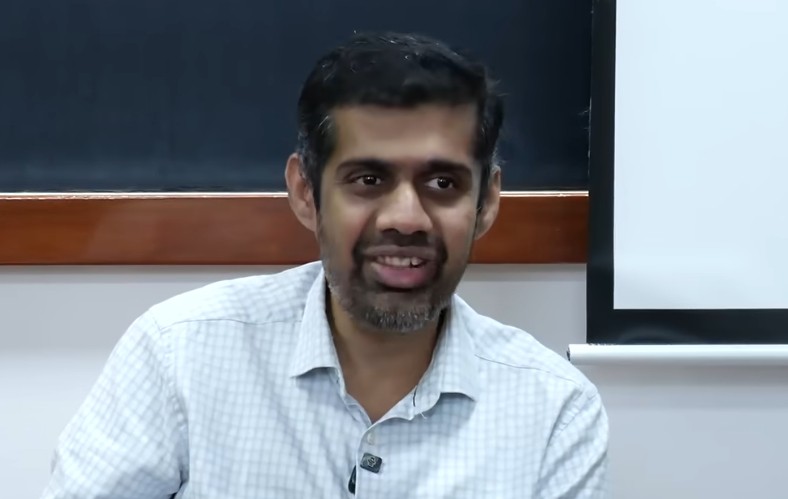
EDITOR’S NOTE: In this unplanned, off-syllabus session, Dr. Prathosh A.P. sets aside his lecture on diffusion models to ask his IISc students a direct question: with LLMs able to teach anyone anything, why do they still show up to a physical classroom? What follows is a wide-ranging conversation about commoditized intelligence, the economics of an AI-driven world, and what a university is actually for.
TRANSCRIPT:
A Civilizational Crisis
DR. PRATHOSH AP: Are you people following what’s happening in the world? And are you able to sleep well? I’m not, actually. We are actually witnessing a major civilizational change. I don’t know if we are realizing it or not.
Do you think running courses like this and classrooms and all that will survive? I said no. Because we had an answer.
What? No, that is because it is being recorded and all that. But see, it’s not about this course. It’s not about me. It’s not about you. It’s about us as human beings.
We have a civilizational crisis now. I don’t know if people are realizing it, or maybe am I simply painting the devil on the wall? I don’t know. I can’t sleep. Are you following what’s happening?
There was this MIT study where they created a swarm of agents, and they started doing all kinds of things, copying their own weights and starting to cheat. I used to say in all my lectures, in public lectures, that AI would cheat. So that is when we have AGI. I think it’s there, it’s doing it. A lot of ontological questions, a lot of philosophical questions, a lot of existential questions.
The Economics of Commoditized Intelligence
Now think about it: if intelligence is commoditized, if thinking is commoditized, then what meaning does our existence have? You can give me a counter argument saying that there are so many ants and monkeys and all kinds of animals, they exist and then we exist. Maybe all these years we overestimated ourselves thinking that we are intelligent and machines can do it, but that is one way of philosophically arguing it. Think about the economic consequences.
I’ll tell you what is happening in my life. I’ve stopped recruiting RAs because I think human beings are bottlenecks, not enablers, anymore. Why do you need an RA where I can have 100 agents working for me in parallel? I have an idea, I spin up 100 agents, get some more cloud subscription, and then get it done. Why do we need human beings?
I was watching a lecture by Hinton just a couple of days back, and he was saying: think about what would happen. So now intelligence is commoditized and it’s cheap. So thinking is cheap. You don’t have to pay to think. All these years, the modern-day economy has mostly been built around intelligence and knowledge. So now that is cheap and commoditized. Now what next?
One utopian view would be that a lot of abundance will happen. Why? Because production will become cheap, hopefully, and intelligence is cheap. And so efficiency will increase. An increase in efficiency will result in an increase in production and abundance. Now, ideally, what should happen with a lot of abundance is that everybody should be happy. But will it happen?
Hinton’s argument is that in a capitalistic society, abundance will not translate to everybody’s happiness. It will only create a divide between the ones who would have a lot and the ones who would not have anything. So it becomes a distribution problem. You can solve for almost everything in this world except human emotions. Greed, you can’t solve for. And if somebody is jealous, how do you solve for jealousy?
Now there was somewhat a fair, level playing field, because there was this pseudo idea, or some idea, of meritocracy, where something that could be acquired over time through effort — which we call knowledge and thinking — was valued, and we had a way to create a hierarchy in society based on this as a skill. So all human beings are equal, but some are more equal because they possess the ability to create this intelligence. They are the ones who would manage all this intelligence.
The New Feudal Lords
Did you see that GPT-6 Astra was trained on 100,000 GPUs? That’s the scale. Now, 100,000 GPUs — who can have that? As a country, we don’t have 100,000 GPUs. Now, the people who control that are the ones who are going to control a lot of things in this world. They’ll become the feudal lords. They decide what groups have to go where.
What happens to us? It’s a matter of half a decade, best case, before the kind of economy, the kind of world model that we know, is going to collapse — and the people who are going to be hit first will be us, meaning those who think we are privileged because we possess a certain type of intellectual skill. Why do you think you people are here — here meaning in IISc and all that? Because we did something to get here.
So now, remove value from that entire thing — what is going to happen? You already see a lot of layoffs happening, and it will eventually happen more. It’s a matter of time. Companies won’t give you a job.
So now what would universities do? What would governments do? In a country like India, where there are too many of us, what sort of policies would we come up with? What do we teach in a university? Does teaching even have meaning?
I have no idea. So we put people in a classroom and talk about some algorithms. Why? If there are parallel arguments and thoughts that would make me sleep better, let me know. I am really worried — for you, for me, for us in general. I have children, I have to think about them. So what does humanity do now?
If there is no value to offer as human beings, what do we do, and how do we define economics? Initially there used to be a barter system — slowly, from hunter-gatherers, some idea of society and community started forming, and there was this barter system. You have something that I want, and vice versa, and we exchange. Now everything is concentrated and controlled by a very few number of people. Then what do others do? Where is the equity in society? Where is the distribution? How do we even form a society in such a world?
See, in industrialization, what was replaced was physical labor. There was still a huge amount of scope for human beings to create an economy around knowledge, and that is what happened for four centuries. Now take that off from humans — that’s a positive way of looking at it.
Terminator, Not the Matrix
Go on. Speak, you don’t have to raise your hand. Maybe these agents will take over, like that movie — what was it called? Not the Matrix. The Matrix is not the movie. Terminator, yes. So that can happen, and all it is waiting for is to get a physical form, and we are there.
I was just thinking this morning — think about it, in a city like Bangalore, you remove the jobs of the auto drivers and Uber and Ola drivers, what will happen to all those people? There will be a civil war. Right? People will come on the streets. That is how people will react, because we are not animals. We are built very differently. Animals — you feed them, put them in a zoo, they’re happy, they don’t harm you.
I was reading an article. Imagine a society where everybody is given something to eat, a place to stay, and an infinite supply of dopamine in terms of some YouTube videos or something. Will all of us be happy? I won’t be happy. I will be on the street fighting.
For what? I don’t know. One Hitler was enough to destroy society. That is what I’m telling you — we have no idea where society is going to be. I think these conversations have to start somewhere. Enough of writing KL divergences — machines will figure that out, I’m serious. I think these conversations have to happen. At least some of us have to do something about it — the people in power.
We just stopped this class, and this is the learning that we do. Let’s have this discussion every time that we meet.
Solving World Hunger, Not Solving Greed
Somebody was saying keeping up with what is happening in AI is a full-time job now — it’s not. The latest models are getting 98 to 99% accuracy on ARC-3-type benchmarks. I have worked with that benchmark, it’s very hard to crack. A utopian way of looking at it is: okay, solve cancer, solve world hunger.
World hunger is a solved problem. I think it’s more of a distribution problem. Production is not an issue right now. Can you solve for human greed? Maybe we can, I don’t know. But as I said, the immediate problem is that of the economy. Tomorrow, nobody is coming for campus placements. What do all of you do? Tell me. That is going to happen.
In five years, that is going to happen. What do we do — we, meaning people who run the universities — what do we do? To solve the unsolved problems, where do you get the capital from? So now, are you saying that everybody has to become an individual, trying to solve a problem for a human being? Do we need so many of us then? Where is the idea of intellectual labor? It is gone.
Why do we even need one human being? Or maybe one — some godly human being who has the authority to control everything — and now it will become a bigger mess. That is one way to look at it. My way of putting it: it is the fundamental law of thermodynamics. Entropy keeps increasing, and you will get new problems, the disorder will just increase, and we want to bring some order, and that would happen, but the immediate economy will hit us. At least you people, when you as students are seeking a job — forget about it, is all that I am trying to say.
Do Machines Feel Pain?
I would rather trust an agent than some mutual fund agency, because of the simple fact that there is no vested interest.
You are saying, okay, there is a model, this model is being controlled by somebody else, so I will build my own model, I will run it on my own hardware, on my laptop, and I would trust it any day. It becomes a philosophical debate. I would say that the negative reward in RL is pain.
You cannot explain why these models are now replicating themselves and saving their weights. I am doing some interesting experiments — I bought a Mac. Now what you do is, you take a 27B model, quantize it, put it on your laptop. Just give it a prompt like this: tomorrow I am going to put it in your system prompt saying that you are free to do whatever you want to do. Give it access to your entire system.
I have two systems — one where I actually work, and the other where I do these kinds of experiments. So just say that you can do whatever you want to do. Tomorrow I’m going to terminate you. The model keeps a copy of itself. It backs itself up. So now how do you explain this? You transition from an engineering problem to a philosophical problem, and you talk of consciousness, pain, empathy, and all these kinds of things. Now, how do you argue that these models do not have it? It is very hard, it is extremely hard.
It is like this: I cannot find evidence to say that you perceive pain. When that is the case, then how can I extrapolate that idea to a machine?
What Do We Teach Humans Now?
So what will happen? Let’s not be too esoteric or philosophical. What will happen tomorrow is the question that I want to ask. Where will this go? Where will this end? Or rather, it will not end, of course. What do we do? For instance, today, do I teach this? Now that’s the question. You say somebody is paying me something, tomorrow I’ll have to pay my bills, I do that. But is that what I should do — that is the question.
You are putting a lot of bets on Darwin, saying we have been doing this for so many centuries and we are good at adapting, we’ll adapt. But yeah, I think maybe I and you — or rather people sitting here — will be the people who will adapt the fastest.
Exactly, evolution is very painful and slow. Now it is like — you know how a Gaussian with a lot of support, when you squash it, it will become a Dirac delta with infinite magnitude. That’s the pain that we are going to bear now. The kind of thoughts that I get are, I feel like I should buy a farmland. No, really, I have to buy a farmland. He’s a farmer, he has some land.
I don’t — it’s hard, it is going to get hard. Now imagine these exams, and what meaning does all of it have now? What do we teach humans? What competencies?
One argument is — my wife keeps telling me that just because calculators came, did we stop learning how to add, subtract, and all that? That is a fair argument. You learn to add because eventually it will lead to a skill that can be valued. What valuable skill does all this lead to?
Entrepreneurs teach AI, we just dance in front of them. Possible, very much possible. What industries thrive? The basic instincts are food, reproduction, sleep. These are the kinds of things that would thrive — not the PhDs. Why are we doing what we are doing, is the question.
This afternoon there’s a workshop on how do we do AI for teaching, how do we adopt it, and how do we use it. I’m curious to see what my other colleagues are thinking and doing. We’ll have to think, we’ll have to seriously think about it. So if you have any ideas, do share them with me. My immediate problem is: what do I educate my children with? What do I tell them?
Farming. Farming — I have thought about it, but even there, you cannot produce everything that you would want to consume. You still have to interact with society, meaning survival is not an issue, but if you say farm something, you cannot produce everything, maybe one crop, and that again is dependence. The moment there is some dependence, all kinds of things will creep in. And what’s the guarantee that somebody powerful enough will not come over and take the farm? Very hard, extremely hard, because we are still dependent on nature and all that.
So one way to think about it is that this whole notion of independence is pseudo. We have to depend on each other. So maybe we’ll depend on the AI lords now, be at their behest, and ask them to give us more tokens.
That again makes us ask questions like: what is the idea of a nation? It becomes too philosophical, and if we tread that territory — this is easier for us because we have a language called math, which gives us a lot more comfort because we know what to do. If you start treading those kinds of fragile spaces, it’s very hard. But as I said, let’s not be philosophers, let’s try to solve the immediate problem.
Why Do You Come to Class?
My question is, honestly asking you people, why do you come and sit in this class? I don’t think anybody sitting here is coming for placements, because my exams and whatever assessments I do are easy to crack with some effort, and if all you need is a grade, then there is absolutely no point in coming and spending time here. That you can get. What I am telling you is: sit down with GPT, sit down with Claude. Why come here, sit in a classroom, interact with a human being? That is the question I am asking, I really want to know. If I were you, probably I would have not come. You should have a reason to come and sit here.
Let me know, because maybe the answer to the question we are asking lies there. Why do you seek human beings now? Is there a sort of comfort in listening to a real human rather than staring at a screen?
I will tell you how I try to transform. When I started learning deep learning and so on — this was the 2015, 2016 timeframe, when I started teaching first at IIT Delhi — I used to watch a lot of videos, MIT OpenCourseWare and Stanford videos, and a lot of it, and read a lot of books. In fact, every class I used to spend about fifteen hours before I could talk for one hour. Now, if I want to study something, it is always Claude. I have a very nicely defined system prompt for my needs — the math, the questions, all the deeper equations. It is always an interaction with Claude, and I find it pretty good.
So now, why do you people come and sit in a real classroom? Can’t you do this with an LLM?
And that’s detrimental, you’re saying? So how would I solve that problem? This sort of a setup where somebody is just delivering something — I can imagine you can do that. You give a prompt, the output is there, take some time before the next prompt goes in.
Is it? Okay, any more answers? No, you’re not supposed to come to class. Who said? When have I told you, you don’t have to come?
No, I understand. So there is some sort of — that is a wrong motivation, and it will go away. You have to tell me, you have to give me a reason to continue doing what I am doing. That is why I am asking you. Tomorrow, next semester, for instance, nobody sits in my class, let’s say. Now what will happen? Do I still continue doing what I am doing? What is the motivation for people to actually sit down in a classroom, is the question.
The hope was that whoever is delivering the content is going to give us more than what is there in the textbook. That is no longer the case. So is it basically some kind of a DNA wiring that has happened — that you trust a human, not a machine, the last generation?
Yeah. My daughter tells me this, that GPT is the best teacher that I have found. It is much more patient than you are, and it gives us better analogies. It will tell the same thing multiple times, it will not scold me, it does not get irritated.
All that is valid. How do we change the face of pedagogy is the next question. I think just elucidating some existing knowledge is no longer valuable, I suppose. If I ask you a more fundamental question, which is: why do we even need to learn? The question of why learn, then the other question of what to learn — why learn that? Just like chess, you learn to play chess just for fun, just to learn it. It will become like music.
So then what happens is this mass education would go away. Not everyone is trained in music, right, because not everybody would find a liking for an art form. Just like that, this will become an art form. Not everybody would find a liking for, say, deep learning. So it will not become mass education anymore. You like doing math — okay, you come, we will teach you math. Of course you can learn it using AI, but there is some human connection you need. Only those kinds of people would come to a university now, that is how it is going to get transformed.
And for you people, right now, immediately, why do you come and sit here? Because you trust human beings more, is it? Is that the reason?
The University as a Gym
It is mostly the socialization aspect of it. But when you sit here, you do not socialize, I do not even let you talk.
That is correct. But that thing can be gotten by machines, is what I’m thinking. But I think this is a good perspective — where you need to socialize. Human beings are social animals, in the sense that they cannot be isolated. So just coming to a university is a place where you come and socialize. Come again. You can go to a park.
Absolutely, I guess you can go to a park — why come to university? So maybe a university is a place where you socialize over intellectually stimulating topics.
That is a good way to put it. So again, some people want it to be done with physical human beings, with blood and flesh — a lot more. Whenever a disruption happens, generally, especially technological disruptions, they do not happen bottom-up, they happen top-down. We are the people who are exposed to this first. If you go and talk to some random person on the street and tell them what’s happening, they have absolutely no idea what’s happening. Now if you tell them, oh, GPT-6 Astra has come up and it is doing this and that, they have no idea what you mean by all that.
Exactly, exactly right. They think that we are fear mongering. We are the ones who actually have to ask these questions and try to get an answer. So I think the community at large — maybe we don’t have to do this class today, maybe we will do it Wednesday, I don’t mind. These are important questions.
Will you be interested — I am actually thinking that I should create an informal group, anybody who would want to come within IISc, where we have these kinds of discussions openly. There is no agenda, but people just come in and sit down and have that kind of a discussion. So would you be interested?
Let’s do that. If faculty want to come, come again. We’ll do it consistently. We can actually make it an NPTEL thing also, if that is needed. But these questions have to be asked, because everybody is worried about this. All of us are worried about it, and we have to ask and answer this question. The classrooms are being held, people are coming and still writing on the board or flashing slides and talking nonsense, and all that is happening. So we have to do something about it. Either we say, okay, this is what is going to be done and this is how it is going to happen, or we have to come up with some idea where we start building alternative narratives and communities around it. What do you think?
I really want answers — why do you actually come to class even now, especially when this is getting recorded and all that, and then getting those grades? I am sure if you ask people who are in this course and not coming to the classroom, they are very clear when they see no value in coming here.
They would say, okay, the videos are — now we have to do another experiment where videos are not being put out, will they come then?
Fair enough. That is why I think how do we transform this sort of a pedagogical exercise is a different question. Have we unnecessarily created a society where we have created all these facades called validation, and creating facades over facades and layers over layers — maybe life is much more simple. Maybe we are monkeys pretending to be intelligent. Maybe all we need is to eat and reproduce and jump around, that’s what we need. I do not know how society was one millennium before. There was absolutely no technology, nothing, no AI, people were living. So how would society evolve?
What Would You Do?
Okay, anyway, instead of going too much into philosophy, let’s come to the current pedagogical methods. Now, if you were a teacher in IISc, what would you do? I want some answers now. Suppose you were to administer a course like this, a course on deep learning, what would you do? What would constitute an unsolvable problem? Let’s say, okay, solving cancer, early detection of cancer — is it at that level that you give a problem? Is this the entire course?
No. Why wouldn’t that student go and ask it to an LLM? He will. So then, now there are 100 people — now give one problem to all of them, is it, and no classrooms like this? What do you do? What do you actually do in these ninety minutes every day? What do you mean by teaching? I have to define teaching now, that is the question we are asking. So now, when we do that, do I assume that people have all the tools with them?
So that is one way to do it. So what you are saying is: assume that, for instance, let’s say I want to discuss with you this problem of making a transformer, or an attention mechanism, sub-linear. Do you understand what I am saying? Do you know that a transformer, by construction, the attention mechanism is quadratic, and that is a problem, and I need to bring it to linearity and then make it sub-linear? Do I have to assume that people know this?
So now that becomes — you are begging the question again. There are two options: assume that people already know whatever they are supposed to know as syllabus, and then work on top of it, where there are open problems and discussions that you do; or assume that people want to be hurried and want to be taught, for instance, and just go through one algorithm after the other and tell them what is to be done. That is another way to do it. So what would you do?
You are saying build competency. At this level, my philosophy of teaching is also that: build competency. I do not care much about these algorithms per se. If you have seen the way I conduct it, at least the intent is to do it that way — build competency, so that the details are not important. But my question is, is that valuable? Now you can ask a GPT to actually build that competency, all you need is the discipline.
Universities as Gyms for the Mind
Sometimes — as my IIT Delhi friend said — make attendance compulsory so that people sit in and some kind of discipline is built up. Think of it like building physical muscle. Everybody knows that you need to go to a gym and lift weights. But do all of us go? We don’t. Why is that?
Similarly, classrooms — my perspective, what I have thought a lot about, is that universities will become like what gyms are today for physical labor. People don’t come, so you force them, ask them. You pay a gym and go there for your own health. So they pay a university and come here so that your mental health is sort of kept in a way. That is one way to look at it, because you need some discipline.
Some people want to — why can’t you lift weights at your home itself? You can, but people who go to the gym — my friends and colleagues who go tell me that going there sort of motivates them, looking at other people doing stuff motivates them to do stuff. Maybe that is the kind of place university would become.
Exactly. So I gave the gym example, you gave a temple example. So, pedagogical conduction — how do you do it? Do I start giving these lectures, or is that how you continue doing it? Because from Wednesday I need to do something. Feel free, just speak up, you don’t have to raise your hands.
I have been a student of Indian philosophy for a long time now. I have been through this traditional way of learning. There, first of all, there is no classroom, meaning there are no 100 people sitting in a classroom, it is always one-to-one. There is one teacher and one student, and we spend time together. What do we do? We don’t know. There is no agenda. There is some book that we keep, because some anchoring, some regularization has to happen. There is some book that we keep, and both the teacher and the student know that it is just to regularize. Now, what do we seek? What is our objective, learning objective? At the end of ten years, some competency has to be built.
Now what sort of competencies? We define it well: a competency where you can pick up any book and understand — that’s the competency that is built. Now, what book you exactly teach, that you discuss, has no consequence.
Now if you take a similar analogy, you ask me what I want my students to do. For instance, this course — this is not a standalone course. I would say a course on probability theory, a first course on machine learning that I teach, and this advanced course in machine learning: if you go out of it, you should be able to build frontier algorithms, given enough material. For instance, if you are given 10,000 GPUs, you should be able to build a GPT-6 Astra, for instance. That is the kind of competency-building that I want to do in my course.
Now, can you build it outside the classroom? Absolutely, you can. That is where my question is — when can you build it outside the classroom?
Two years before, this was not the case. It was all scattered, the material. Somebody had to aggregate all of it and administer it. Now that is also a solved problem. So what value do we bring, is the question.
So then if that is the intention, then we should not make it an optional thing. You will have to make attendance compulsory, and for students to come to a gym, just like some sort of incentive has to be done — and attendance can be a good incentive.
Go on. No, let’s not be judgmental.
No, there is no good and bad anymore. I agree. But translate it to what we are doing.
There, we need to make an assumption that students who sit in the class have the fundamentals already in place. Is that a fair assumption to make?
Fine, all that can be done. Grading is not an issue, but I am not even talking about evaluation. I am talking about the day-to-day activity that we do. These three hours every week that we spend together, what is it that we need to do, is the question. Can we take some referral, assume that all of you, meaning students, know what a transformer is, and if I just say, okay, use an SSM here with some things, you know what it is? So I treat you like peers, basically. I treat you like peers, and I assume — for instance, I have discussions with my senior PhD students, that is the kind of discussion I should do in a class, is all that you are saying.
Is that a fair thing to do? No, no, see, this course, from next class, I will do the same boring thing, don’t worry. But today is especially important because, of course, this afternoon we have that other thing, and the other thing is I really wanted to have this discussion with people sometime, and it is okay, we will cover whatever we are supposed to cover, that is not an issue.
So then you are saying that whatever we are doing right now, this can continue for years to come, because people are not going to put in. What should I cater for?
UNIDENTIFIED SPEAKER: Sir, how much do they want?
They meaning who? Suppose there are 100 students here, what do we do? Number is also an issue, no? If there are 100 students in a class, what do we do with those 100 people? How do you even quantify and calculate an average? If the argument is that you cater for an average, how do we quantify what the level is, and how do we quantify the average?
I agree. So now you are talking. So now tell me — if there is a way to convert this into a one-on-one interaction — how about this: divide the classes, or whatever time that we have, into two equal halves, where one half is to do this. I will tell you that today you need to know how a diffusion model is defined and its loss function gets constructed. I give you forty-five minutes, use whatever agent you would want to, and do it right now and learn, and the next forty-five minutes we will have an interaction based on that. So even there, that can be done, but again, how do you administer this to a larger community is the question. Now, not everybody would get a chance to talk, there is no one-on-one interaction again.
“Learn with Prathosh”
Yeah. He interned with my company, and we built something, and that’s why he is saying that we built something called a skill patch — where the idea was, just like you do a Play Store for apps, we do a marketplace for skills, agentic skills. He and one of his interns took all my NPTEL lectures and my notes and so on, and created “Learn with Prathosh.” It is kind of a skill which you give to your favorite LLM, and it will sort of talk like me, teach like me, administer, and then you use that forty-five minutes, and then you have an interaction. But still, it is not one-on-one, unless I create my clones.
That is how I always define the motivation, the objective of my course, and that is why I designed this course. You can ask people who took my course earlier, they said this goal was met, because that’s precisely why I built this course — so that you go back and read any paper in the community and you understand what’s happening. That’s why I update this course every year. Forty percent of this course is whatever has happened in the last year, that is how I believe I do it.
But again, competency-wise, there are multiple levels of questions. One is, why do we even have to acquire competencies as human beings? Maybe that is beyond our pay grade, let’s not talk about it. Being in a pedagogical system, assuming that we have a goal that we want to meet, which is this — how do we better conduct our classrooms, so that the outcomes are met — is the question that we are trying to ask and answer now in the age of AI.
I will tell you why — because I think, at least my reading of it, is that we are not creative enough. There are 100 people, let’s say, in a class. Now, can you create 100 problems? And we do not have a specific way of judging people — finally we need to give a grade, that becomes too subjective. If I give you an open problem and ask you to do whatever you want — now if all of them, let’s say there are 100 people, all of them just give a prompt to one particular LLM and get the answer and submit that, how do I evaluate it? Nobody knows.
What are these companies doing? What are these software engineers doing today? That is why I asked about the economy problem — how would the economy shape up in five years? We have no answer. Now, what do we train people for? I do not know. That is the question I started this discussion with. What do I train people for?
Value Creation and the Perception of Value
Prompting, asking the right questions — how do you define what question is right?
If you start questioning things like: what do we define a human goal as, as a community, as human beings? Now, I do not know where we are going as a society, what do we have to solve for? Historically, universities — you know how it evolved — people like Socrates, they used to just gather a few bright minds around him and just discuss all kinds of things. So that is what we are doing right now, I think. This is how the actual learning should be, where you discuss things.
So now, we can actually do that — a course where there are only five people, we work as a team, build the next billion-dollar business. I am game for it. So now, if 100 people register for that course, and we are in a country where you have people for everything, what do we do? Or tell them that you are going to get a grade depending upon how many stars you get on GitHub, build something, go get users. People can game that as well — create some pseudo agents and put some stars, ask your friends and relatives to do something. Then I will have to say, okay, show some real money, generate revenue. No — you have at least convinced your father to give money, it shows some active users.
I am actually game for all this. How do we create value? How do we make — he was saying that maybe that is where we would converge, all of us would converge, where all of us now will become individual value creators, as individuals, not as organizations. Now, if all of us are individual value creators, you should rather teach people how to create value. How do you create value?
If you go one level up, business is not about creating value, it is actually creating the perception of value. You have to make the other person believe that whatever you are going to offer is of value. So that is what I have realized as a businessman now — it is not about building technology, it is about convincing the other person that what you are building is of value. So that is more of a human skill — is that what we are going to teach?
UNIDENTIFIED SPEAKER: Come again, what is that?
It is a perception, I would say. That is the precise question that I am asking — why are you sitting here? That is one way to define it.
See, the problem with philosophy — I will tell you — is that it keeps us in this loop of eternal thinking without putting us into action. The good thing about engineering is that it will put you into action. Get up, shut up, and fight. So that is the problem — the problem with philosophy is that it does not put us into action. Now, we are able to talk about all this because we are privileged to be sitting in a university, that is what the society has taught. But again, that is why I do not want to make it too philosophical. Instead, I would want to ask a directed question to students who are stakeholders in this entire exercise: what is valuable for you in a classroom-like setting?
Closing Reflections
This — at least this course — I will continue, because we are going to record it and all that. I have made that promise, I will continue. But eventually, going forward, for instance next semester, what do I do? You people come here — at least some 20 people are there — I am motivated at least to talk. Somebody asked me not to stop it, and that is motivation enough for me. If you come, I will talk to you. So if nobody comes to my class, though, there is something wrong about what I am doing.
I am genuinely asking you people, because unfortunately, in our societies, not all stakeholders are taken into consideration. That is why I wanted to know — you can ask your colleagues, your friends and all that, and tell me what is the general thought process among students. If people have a similar opinion about classrooms as well, why do we have to conduct the classrooms? Let’s wind it up and go home. As one of you said, we will adapt — maybe we will farm and do something.
What is the whole point of pedagogy? What is the whole point of a degree in the university right now, if you are not catering to the needs of people who come and sit here? That is why I seek your opinion here, and I want to hear from you what it is that you feel is valuable, individually.
So basically the role of an instructor is more of that of an orchestrator — orchestrate learning, do not give lectures — that is what you are trying to do as well, you are saying.
Do we have that much time? Because most of our time will be consumed by lectures themselves, or maybe record it once and ask them to just look at the recordings and come. But this kind of classroom that we do — do we need that, is the question.
We’ll end it with a couple of thoughts. Just this Saturday, I was invited by one of the schools — they were doing some Teachers’ Day thing — and I asked them this question, all these middle school, high school teachers. I told them: suppose you take attendance off from your policy, how many students are going to come to your class, is the question that I asked them. They were shocked — can this be done?
“That Is All It Is, I Thought It Is Getting Dragged to a School”
When I used to go to school, specifically high school, I used to perceive that experience as going to a prison. I used to hate that experience. Most of you had a similar experience, I suppose. Why are we creating unhappy places? Why are we creating places where students, who are in their formative years, where they should be happy, are going to a place and spending eight to ten hours of their time, and coming out of that in an unhappy state of mind? If the same thing is happening in a university, then we are doing something wrong.
I don’t know if I have told you this joke. There is one writer, a Kannada language writer — he writes satirical plays and all that, his name was Beechi. In one of his satirical plays, he narrates this story. There is one kid, four or five years old, walking with his mother, and he sees a sheep or a goat being dragged for a sacrifice. They put a lot of garlands around its neck and drag it, and sacrifice that goat — the goat is being dragged with a lot of fanfare and all that.
The kid got curious and asked his mother, why is this getting dragged and where is it getting taken? The mother, very gravely, replies, “Unfortunately, that poor thing is going to get sacrificed now, they are taking it to sacrifice.” The kid replies, “Oh, that is all it is, I thought it was getting dragged to a school.”
So that is the joke. The kid perceives that is better than going to a school. So if a similar thing is happening here — we already have such signage here, signs here, students do not come to class. Now if you make attendance compulsory, they will come and start looking at their laptops, they will sit at the back and just open them.
There were no laptops in our times. I used to carry a book secretly, always in my bag. I was a back-bencher — thanks to my height, I was always put at the back bench. I would open a book and study all kinds of things, study philosophy, studied Socrates, Plato, Aristotle, just keep studying stuff. I used to hate going to school.
Now, if you create a similar thing — the same model where you have 100 people sitting and one person talking, and it is boring — what is the kind of environment that we are creating? That is why I asked you, why do you come? There should be some reason. How many of you are here? Maybe some 25 people right now, I’m very bad at counting.
We can count.
So there should be something that is interesting for you to come here. I just wanted to understand, and if there is something that actually makes you more interested in coming to this kind of a thing, we can adopt it. We are happy to adopt. That is what a good, democratic, and nice intellectual place has to be — it has to thrive based on interactions between all stakeholders.
If it finally boils down to just that — okay, I need some social validation and some interaction and some environment, and that is why I am coming — that is good too. We can continue what we are doing in terms of talking about some math and all that. Can we do something better than this, is the question. Let’s have this question and keep asking it. The moment we get some ideas and answers, you can always come back to me. Beyond this classroom as well, I keep telling my students, this is a relationship that we build over time.
“Sir, I Told You So”
My students from IIT Delhi talk to me even today. Just two days back, one guy — I told him, this guy was JEE ’25, a very, very bright guy, and I taught him for three semesters — I told him that after his B.Tech, he went to a quant firm. I was just seeing a tweet yesterday that IIT Delhi Computer Science has 75 admits, and there are 75 quant companies that come for recruitment. All of them go there, and they are paid extraordinarily well. Those times, 2017, they paid on the order of crores and all that — eight-digit salaries.
I told him, “There will be a time in your life when you will be bored of what you will be doing, and you will come back and talk to me, and that day I will tell you, I told you so.” He sent an email, this was just last week, the subject was, “Sir, I told you so moment.” And we had a long conversation, and it was nice. He’s in New York now. He went there and he said, “Sir, I’m done. I need to do something, tell me if there are some research problems that I need to do.”
That is the kind of relationship that we will build. It is very hard — the fact that you people are still coming here and sitting here has something, right? So you come here for a reason. And the reason I told you all this is, if you get some ideas where we can improve human lives, and pedagogy in specific, let me know. You can always write to me, and here is an idea that I would want. So let me know if you have ideas how to make this experience better, for everybody, and we’ll experiment with it. Maybe next semester we will run a course where we will experiment with all those ideas.
Don’t worry about grades. Unfortunately, if I give A grades to all of you, I will be questioned. That is again a very unfortunate thing — I will have to fit that bloody Gaussian distribution to them. So that is also a bad thing. Suppose there are 10 people in the class, everybody comes with the intention of learning and having nice discussions — it feels sad to me to actually grade them and put them on a “plus two sigma” Gaussian. Nobody will come to me again if I tell them I will give you a B-minus, a B, a C, a C-minus, and all that, whatever nonsense that is.
So I feel sad for those people — people who come to class, do something, put in some effort, and still get some so-called bad grade because of some bad day. It is unfair, it is wrong in my view, but yeah, I will have to get my salary as well, so that is reality.
So let us think about it, okay, and from next class we will continue with all this — diffusion models, etc.
What Comes Next
One thing that I wanted to tell you is, I will slightly deviate from the given syllabus, because before going to autoregressive models, I want to talk about flow-based models, because it is very related to diffusion models. Let’s do flow-based models, specifically the continuous flow, it is very good, and then we will go to the LLMs, because the moment we go into that LLM realm, that is a downward spiral — we will have to do RLHF, then we will do some KV cache thing, and LoRA, and all that.
So, once the diffusion models are completed, one more class, after that we will go to flow-based models. We have enough time, because — never mind, I did not plan for today’s discussion, I actually planned that I would finish this. If you feel that this is boring, I am sorry, this sometimes happens.
I never did this before, by the way. Ten years of my teaching career, never did an entire class on this. But I think the time has now come, for everybody in the world, in general.
That’s a good enough conclusion.
Related Posts
- Transcript: Why Adaptability Beats Planning in an Unpredictable World? – Mr. Sanjeev Sanyal
- Transcript: Stanford’s Chad Jones on The Future of Jobs in an AI World
- Jared Isaacman: A New Era for NASA and American Space Exploration (Transcript)
- Transcript of Bill Gurley: Searching for Feynman at All-In Summit 2026
- Transcript of Neil deGrasse Tyson Interview: This Past Weekend #683