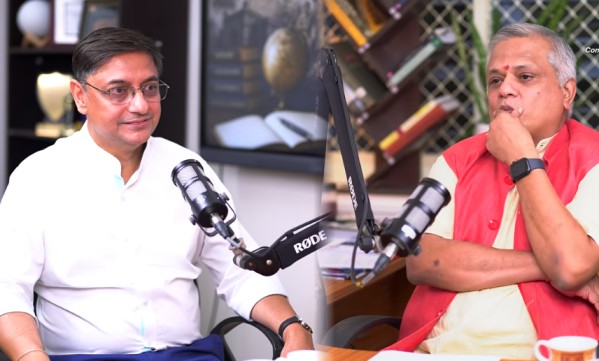
EDITOR’S NOTE: In this episode of the Professor Mahesh Podcast, Prof. Mahesh Panchagnula sits down with economist and author Sanjeev Sanyal to explore why adaptability beats planning in an unpredictable world. Drawing on his own winding career path and lessons from history, economics, and complexity theory, Sanyal makes the case that chasing the “right” decision is a myth, and that resilience, flexibility, and a willingness to wander matter far more than any single choice made at 18. This interview was premiered September 24, 2026.
TRANSCRIPT:
Introduction
PROF. MAHESH PANCHAGNULA: Namaskar and welcome to another episode of the Professor Mahesh Podcast, your resource to help you make informed career decisions. As we like to think, this is your future simplified.
Unpredictability. If there is one word that characterizes today’s world largely, it is the idea that there is no certainty. As it turns out, apparently, that’s the way the world has always been. And we’re going to learn more about how one could parse these uncertainties that we see all around us into a decision-making framework. So you can think through your own lives and sort of plan, as best as the word captures, your own future and careers.
To help us parse this, I have a thinker, an intellectual of this generation, Shri Sanjeev Sanyal. Thank you, Sanjeev.
SANJEEV SANYAL: Pleasure to be here.
PROF. MAHESH PANCHAGNULA: Sanjeev has been an MD and global strategist for Deutsche Bank, has been the principal economic advisor to the Finance Minister in the Government of India for many years, and currently an economic advisor to the Prime Minister. Welcome, Sanjeev.
It’s a delight to be talking to you today about a topic that I know many students are unaware of. Everything from the wars, AI, and the uncertainty that looms largely has become very apparent in the way millions of kids have made their decisions in June and July. This is the time when parents make their decisions. And early data that I have seen has been nothing like the last 3 or 4 years. So something is bothering parents.
And I want today’s conversation to provide a scaffolding, if that, to help the next generation of students to understand the world around and how they can apply this to their own lives. They’re obviously very anxious, and they feel that this perfect decision, which is what everybody is trying to optimize, is hard to reach. And especially when the child is 18, 17, the Indian education system requires them to precipitate towards a decision. So your early thoughts on how to think through this early decision? What are the essentials that you would say are non-negotiables, and what are to be let go?
The Myth of the “Right” Decision
SANJEEV SANYAL: So I think a major source of a lot of this anxiety comes from exactly what you said, making this right decision in the beginning. It’s a very waterfall view of the world that, in the beginning, you make some right decision. It could be about your career, or the right decision about the person to marry, or it could be the right decision about an investment or whatever it is. It is all based on this idea of an ideal design that you can have in the beginning.
This is really a mechanical view of the world, because basically it means that there is a particular pathway that the world will go down. And if only you worked hard and worked out in the beginning what that pathway was going to be, then you jump onto that pathway and life is set. You’ll hear this all the time from students — now my life is set. So this search for “life is set,” which is the idea that you just have to have gotten onto that correct railway line and then you are done. You just have to go down that path to some success nirvana.
This situation, I think, is a completely fundamental misunderstanding of how the world functions. And I’m not just talking about today’s times. Today, yes, we are facing a world where technology is getting disrupted, the global order is getting disrupted. But although you will get periods of relative calm, the world has always been about disruption.
So let me give you some examples of this. Here we are sitting in 2026. 6 years ago, I was sitting in January of 2020. I had no way of predicting that the next few years would get completely disrupted by something called COVID-19.
PROF. MAHESH PANCHAGNULA: Right?
SANJEEV SANYAL: I had never even heard about it in January. By February, this was my life. Right now, this is how the world has been. So if you thought this was in 2020, you go back 10 years earlier to 2010. In 2010, you would have said, oh my God, we’ve just been through a great financial crisis, the world is ending, what’s going to happen? If you went back another 10 years before that, you had the dot-com bubble blowing up, the Asian crisis. And if you went another 10 years before that — well, the Berlin Wall had fallen, the Soviet Union had collapsed. I could keep going through history.
And I would ask you, when in history were we on that great railway line leading to nirvana? It was always multiple pathways. Those looking back through history always think, looking backwards, that this was how history was going to unfold. In fact, history could have unfolded in multiple ways. So at every point in time, every generation is feeling extremely anxious about the future.
The problem is, we have ended up — maybe because of the way our education system is set up — causing excessive anxiety to the next generation, not because of growing uncertainty, but because we have created a certain architecture of thinking which suggests that if only you did X, Y, Z, you would end up on this “life is set” pathway.
Risk vs. Uncertainty
PROF. MAHESH PANCHAGNULA: Can I argue against that for just a minute? Because I really believe — let’s take our education system today. There’s roughly about 2.5 to 2.7 million engineering college-going students in India. More than half are pursuing something computer science++. That idea comes from a sort of beaten path. It’s a world of computer science.
SANJEEV SANYAL: Yeah, it’s basically a herd.
PROF. MAHESH PANCHAGNULA: Yes. But that herd is largely seeing a safe and secure future in the world of software engineering. At least it did in the past.
SANJEEV SANYAL: So would it be fair to say that these beaten paths almost always sort of will— So the point I’m making to you is, and then here what I will do is I’m going to introduce some economics here. In economics, you have two concepts. One is risk and the other is uncertainty. And the two things may sound very similar, but they’re actually fundamentally different things.
Risk is about a situation where the outcomes are probabilistic. So for example, a game of dice, the tossing of a coin, or many of your scientific experiments will be essentially ones of risk. So when you go and gamble, you are taking a risk. Although in casual conversation we use them interchangeably, uncertainty means something where you really cannot put probabilistic numbers on it — in a complex, non-deterministic world. And we can talk about complexity later.
But in a non-deterministic world, you can go down multiple pathways. There is no way, today, sitting here, that I can put a probability to the pathway the world will go down. And we are always living in this world. Once that event has happened, it looks obvious, but ex ante, it’s impossible to tell which pathway to go down.
So I think one of the problems is we have created a society with expectations that if only they did the right X, Y, and Z, then they would be on that pathway. And subsequently, once you’re on this, it’s only a matter of how hard you press the accelerator or not. So this is a steam-engine view of the world — it’s a Newtonian steam-engine view of the world. It’s about putting the steam engine onto the pathway. Then yes, some people will shovel more coal in, some people will shovel less coal in. But basically, it’s a matter of having made this original decision about the pathway. I’m just saying that that is a ridiculous way to think about the world, largely because the world does not actually function in this particular way.
PROF. MAHESH PANCHAGNULA: Then why is it that so many decisions are based on past performance, even though there’s a little asterisk, and every financial document, every financial product says past performance is not indicative of—
SANJEEV SANYAL: Absolutely. So as a former financial markets person, let me tell you, the one thing you should genuinely not care about is past performance, unless you’re taking a very long period of time. Yes, if there was, say, a fund manager who over a 50-year period has outperformed markets — yes, maybe he’s on to something. So you do have the Warren Buffetts of the world who outperform the world over very long periods of time. He probably does understand something interesting about the world.
But very often these documents will say “outperformed over 3 years.” Well, in fact, that tells you absolutely nothing. This is what Nassim Taleb talks about — being fooled by randomness. If you had a room full of monkeys throwing darts, the occasional one would indeed hit the bullseye. It tells you nothing about that monkey’s ability to hit the bullseye. Now, it’s a different matter if you pull that monkey out and it continues to throw darts and it keeps hitting the bullseye — yes, the monkey probably knows something. But over relatively 3-4 year time periods, which is short for history, I don’t think it tells you anything particularly useful about a fund manager’s ability to predict the world.
PROF. MAHESH PANCHAGNULA: And the same applies to students and their careers.
SANJEEV SANYAL: Absolutely.
PROF. MAHESH PANCHAGNULA: Right? There’s a direct parallel there. One last question before we go.
SANJEEV SANYAL: In fact, just do this, those of you — not so much for the students, but this could be for the parents. Go back and think about who your classmates were in class 6. And try to think truthfully to yourself: who would you have predicted as being the successful person in that class? I would be very, very surprised if you were able to pick the winner.
PROF. MAHESH PANCHAGNULA: I would agree with you on that.
SANJEEV SANYAL: Right. If, later in life, you turned out to be an extremely good financial investor, I would think that very, very few people would be able to do that. You could maybe do a basket of them at best, but even that — very honestly, I don’t think I would have picked the winners.
The Problem With “Safe” Careers
PROF. MAHESH PANCHAGNULA: That’s a very good analogy. That’s the sort of decision that students are largely getting into. One last question before we go into your own life story, and I’m very curious to hear that part of the conversation myself. There’s a word that students bandy among themselves quite a bit — “safe choice.” How — I mean, what is a safe career that they can now bank on, so to say? What would be the broad-brush view of such a career?
SANJEEV SANYAL: There isn’t one. So let me give you what most people would think is the safest possible thing. Well, today would be UPSC.
PROF. MAHESH PANCHAGNULA: The way the feet are voting, they think a software engineering job or a bank.
SANJEEV SANYAL: Well, that clearly is already proving to have diminishing results. But let’s say a bureaucrat’s job. And if I had to invent a job — everybody thinks the same. So first of all, you are taking a ridiculous risk in trying to get into this. 0.01% of those who take the UPSC exam will get through. So even upfront, as a bet, it’s a bad bet. Literally — people are putting 3, 4 years of the peak of their lives into this effort. I’m just saying that as a pure risk-taking exercise, it’s a bad risk. If you got up every morning and threw a stick, your probability of winning an Olympic gold at javelin is probably higher.
So a huge amount of effort, national effort, and by and large from the brighter students — it’s not the dumb students who are doing this, it’s the brighter students putting in the effort to do something where, first of all, your probability of success is very low. So first of all, at the entrance point, it’s a ridiculous risk to take. Now let’s say you get through. Yes, there will be the odd person who will become the cabinet secretary, the odd person who will become finance secretary, or whatever you think is the successful part of it. Most civil servants will not, right? So even the most set-in-life pathway is actually fraught with danger. Now this would be true for everything.
PROF. MAHESH PANCHAGNULA: Let’s take the cricket team.
SANJEEV SANYAL: Your cricket team, if I just—
PROF. MAHESH PANCHAGNULA: 5 million kids in formal coaching across India.
SANJEEV SANYAL: Yeah, now some tiny number will make it. So nothing is really safe in life. I mean, you could be setting up a business. In fact, if you attempt to become a Dhirubhai Ambani or Elon Musk or whatever, it’s also a high-risk activity. I would say it’s slightly less risky than some of these other activities, because even if you didn’t become Dhirubhai Ambani and became something less, you have made a lot of progress. But in wanting to do UPSC, if you didn’t make it through, you are zero.
PROF. MAHESH PANCHAGNULA: Exactly. And I worry about exactly the opposite.
SANJEEV SANYAL: So this kind of herd activity, in my view — and I have spoken very extensively on this — is a bad idea. Much better, and by the way, a much more fun way of living life, is to think of it as an adventure. There are many pathways you can go down. You make a choice, and you live with it. So right now, even for me — not just us two — even for me, there are many pathways my life could go down. I, by pure chance, and partly by choice, will go down some pathway. Now that pathway may lead to good things or bad things. It’s mostly about what I make of those situations that will determine whether I lived a successful life or not. There’s too much thought being given to that first initial choice.
Choosing Economics by Accident: Sanjeev Sanyal’s Own Story
PROF. MAHESH PANCHAGNULA: So that’s a fantastic segue point. Let’s talk about your own first initial choice. The 17, 18-year-old Sanjeev Sanyal, you went to Delhi University. Did you go to Miranda House or which was the—
SANJEEV SANYAL: No. So let me tell you how I ended up there in the first place. If you asked me at the age of 18 what I would do — let me say that I was what would be called a science-maths type. So one of the things I was very clear about at 18: I was very uncertain what I wanted to do in life, but I was very clear that whatever good thing came out of finally passing my class 12 exams would have nothing to do with literature and history and those kinds of subjects.
So now I could do something I enjoyed. As I said, science-maths type — so something in physics, chemistry, and economics was also another subject, which is kind of “mathy” enough that I would attempt. So that was the range of my thinking. At the age of 18, I had absolutely no clear idea what I wanted to do. I was what you would call a maths-science type — maths, science, economics, that was kind of the universe I would have thought I would go into. But I wasn’t very clear what it would be.
The one thing I was quite happy about, on finally passing out of school, was that I didn’t have to do anything to do with literature and history and those kinds of things. So I was done with that. And the other thing I was clear about was that I wanted to get out of the Kolkata of that time. This was the late 1980s. And those of you who know, it was a highly politicized environment. And given my own political and ideological bent, I would not have survived the university system of Kolkata of that period. So I knew I had to get out of Kolkata.
So what do I do? I basically get onto a train, I go to Delhi. Many of my classmates were going there. So I ended up in Delhi, went to Delhi University. And there were lots of options. I filled out various forms. In those days, there wasn’t a common system — you had to literally go from college to college with a piece of paper. So somewhere I went and filled in physics, somewhere I did maths, things like that. And I also went to Shri Ram College of Commerce. My best friend at that time, Anupam Bhatnagar, wanted admission there. And so he filled out the form. I also filled out the form. I didn’t want to do commerce, so I wrote economics.
So when various colleges — first round, second round, as you know how that works — at some point in time, I got admission to Shri Ram College of Commerce, which is, of course, an excellent college. And as I said, my best friend said he was going to opt for this college. So rather randomly, I ended up studying economics. I could quite easily have studied some science-type thing as well. Or I could have studied economics at another college. So I happened to end up at Shri Ram College of Commerce studying economics.
Then I did my 3 years. During this time, by the way, my father, who was in the civil service, moved to Delhi as well. He got posted to Delhi. So by the second year, I was living at home, which worked out quite well. We were living in a neighborhood called Motibagh. I finished my 3 years of study. And now I had to again think of what to do. And I still was entirely unclear about what it was that I wanted to do. But now I had one more thing I was sure about — I definitely did not want to have anything to do with the Indian government, or live in Motibagh, ever again.
So this was the thing — as it happened, I got a scholarship called the Rhodes Scholarship. So I said, okay, somebody is paying me to go abroad and see the world. Not because of any great thirst for knowledge or any other reason, but simply because somebody was giving me a scholarship and payment to go to Oxford. I ended up at Oxford, did a couple more degrees in economics. And then I reached the end of that. So now what does one do? I could carry on and do a DPhil, a doctorate. But I’m not quite an academic type. So somebody offered me a job in Singapore. I ended up in Singapore in the financial markets, working as an economist — a profession, by the way, I had never heard of till I actually began doing it. So, so far as you can tell, there isn’t too much of a pattern. I just made it up.
PROF. MAHESH PANCHAGNULA: The only pattern I discovered from this conversation is you knew what you did not want to do, and you just kept going in the other direction.
SANJEEV SANYAL: Yes, more or less that. That’s a fair way of thinking about it.
PROF. MAHESH PANCHAGNULA: Okay.
SANJEEV SANYAL: And so all these years later, what am I doing? As you remember, I didn’t want to work in government and live in Motibagh. Well, I work in government today, and I live in New Motibagh. I am known in the world as a person who writes books.
PROF. MAHESH PANCHAGNULA: Yes.
SANJEEV SANYAL: So, literature. And those books, many of them are related to history. So, you know, if you’re asking for career direction from me, maybe you’ve really got the wrong guy — or just the right guy.
PROF. MAHESH PANCHAGNULA: I could take it both ways. But I think there is a real example here that you don’t necessarily do something in a very linearly planned—
SANJEEV SANYAL: So what I’m doing very clearly is cutting out things I do not want to do, at least for the moment.
PROF. MAHESH PANCHAGNULA: Right.
SANJEEV SANYAL: And then I make the best of the direction I want to go. But I don’t close my mind. There may be, at some future date, a change of direction. So I would say I am actually playing on flexibility more than on direction.
PROF. MAHESH PANCHAGNULA: So I think that’s a very fair framework to think of. If you know what you don’t want to go near, it is best not to go near that. Right?
SANJEEV SANYAL: You may change your mind later on. But for now, opt for something else and carry on.
PROF. MAHESH PANCHAGNULA: And you just need to have that little confidence that wherever that other direction is going to take you is going to be just as rewarding. And you’d be just fine.
Willingness to Wander
SANJEEV SANYAL: Or also a willingness to slog it out if you happen to take the wrong direction. This is a very important part of this approach to living life. Because when you’re taking decisions in this particular manner, there will be periods you feel genuinely lost. But there is a very old saying: “Not all those who wander are lost.” So it is okay to wander. In fact, life is for wandering around. I’m sure in your life — you are right now doing podcasts.
PROF. MAHESH PANCHAGNULA: Okay.
SANJEEV SANYAL: Now, 10 years ago, if I asked you, you wouldn’t have even known what a podcast is.
PROF. MAHESH PANCHAGNULA: 100% right.
SANJEEV SANYAL: So therefore, you too have blundered into this thing. So I think people underestimate blundering around. In fact, much of science is blundering around. And the key, therefore, is not so much a directed search, but the fact that you were willing to go out there and test things out and allow serendipity to work in your favor.
PROF. MAHESH PANCHAGNULA: So I’ll just double-click on that for one step further. I think in many parents’ minds — students to a lesser extent, but many parents’ minds — it is the fear of abysmal failure that bothers them more than the greed of great success.
SANJEEV SANYAL: Yes.
PROF. MAHESH PANCHAGNULA: Okay. So how do they parse or convince themselves that in today’s India, or in a future India, this fear of abysmal failure for their ward is not something they should be worried about?
Failure, Colonization, and India’s Maritime History
SANJEEV SANYAL: So I think it comes from the fact that we were, perhaps for a very long period of time, a colonized country — where failure literally meant famine.
PROF. MAHESH PANCHAGNULA: Yes.
SANJEEV SANYAL: And utter destruction, or something like that. So since we went through that kind of history, maybe we began, in our heads, to frame catastrophic failure as being the bigger danger. But that is not how Indian history, if you take a longer view of it, actually is. If you go back into — we are all very proud of ancient and medieval India.
PROF. MAHESH PANCHAGNULA: Yes.
SANJEEV SANYAL: But go and look at those people and their thinking processes. They’re very different from ours today. I’m a big votary of India’s maritime history now, and think about it — these were people who got into small boats stitched together with rope and sailed into the utter unknown. These are our ancestors. They are not somebody else’s ancestors — that’s your and my ancestors, the ancestors of the kids who are listening to this video and the parents as well.
They were willing to do this, and they didn’t just do it in maritime exploration — they did it in intellectual explorations too, in mathematics, music, and all kinds of other arenas of human endeavor. So this risk-taking behavior is something that we need to begin to bring back. No amount of UPSC preparation is going to make you a new Sushruta. After all, Sushruta must have — how did he become a great surgeon? He must have taken a cadaver and cut it up multiple times. I’m sure when he did it, he was running lots of risks. I’m sure there were social sanctions against him. There were all kinds of things. Of course, he had no idea what he was cutting up and seeing. And it’s only later, when he became a great surgeon and the benefits of his surgical capabilities were being positively seen by his patients, that he would have been recognized. Otherwise, I can imagine even somebody like Sushruta, the father of surgery, would have initially faced enormous risks of all kinds.
Understanding Path Dependence
PROF. MAHESH PANCHAGNULA: Sure, sure. I think that’s a good place to leave that part of the conversation. I think it’s fair to say that you are one of the few public intellectual voices of this generation who creates an alternate framework for us to think through. We live in a world where the path is defined barely a few steps out, and the rest is—
SANJEEV SANYAL: If that—
PROF. MAHESH PANCHAGNULA: The rest is pitch darkness. And so we are literally walking the path in a path-dependent framework. And you’ve thought about this — we’ve talked of complexity as a mathematical framework, as a sort of physics-based framework that allows us to parse these things. How does one think through path dependence? I can see it in your own career. You started in Singapore, then Deutsche Bank, and today, as you say, you are an advisor to the government, advisor to the Prime Minister. This path dependence, at every step of the way, is something I really believe the audience should take away.
SANJEEV SANYAL: So let me sort of explain in a few words what on earth complexity is, because I think not all of your audience will be from a science background, or even then may not have studied complexity theory. Complexity is the idea that there are systems in the world which are non-Newtonian and are made up of all kinds of components, or agents, that are interacting with each other in many unpredictable ways. And this interaction leads to a series of outcomes.
Now, these outcomes — there are deterministic complex systems, and I’m here talking about something called non-deterministic complex systems. In this, basically, these interactions are not random, but they are fundamentally not predictable. So there is a certain logic to it. There may be certain governing principles, from time to time, which are called “strange attractors.” But by and large, the pathway very quickly goes into directions and path dependence, as you will see.
Now, this path dependence — why is it path dependent? Basically, it means, let’s say, at this point in time I can go down various pathways. Let’s say each one of these has equal possibility of going through. But once I have gone down one pathway, that is hardwired. All the other possible pathways I could have gone down have now disappeared. That is now my pathway. From that point, there is another set of further pathways I could go down. Now, somewhere, one of the paths I will take. But now I’m path dependent — then that decision, and all the others, and so on and so forth, into the future, into infinity. This is the general idea.
Now, once you have this framework, look at what happens here. I decide, at 18, to study economics and not physics or computer science, which was, by the way, an emerging thing in the late ’80s. Entirely arbitrary decision. From that decision — not through any planning at all — I had absolutely no interest in becoming an economist in government, certainly had never imagined I would be the Prime Minister’s economic advisor. I simply went down economics.
Then I happened, again by chance or choice, having become a financial markets economist, which by the way I did for 22 years — and I was quite successful at it, but not necessarily a path that leads back to policymaking and government. Sometimes it does, mostly it doesn’t. And then, again, it all depends on that original pathway that I took.
Now, does that mean I should have expended a great amount of energy in taking that original decision? No, that makes no sense, because the probability that I would have been able to work my way from that original decision to my current position is so remote that it’s actually a waste of time. My better approach is, having taken that decision, to make it work as best as I can going forward — taking advantage of the situations that emerge out of the decisions I took, and working hard on them at that point in time. That is what I actually basically did. “Staying in the moment” is one way of thinking about this, the Buddhist way. But I kept going, and this led me somewhere.
Now, it is entirely possible that along that path, I could have taken another pathway which could have led me somewhere else. Would it necessarily have been better or worse? I have no way of knowing. And frankly, it’s a waste of time thinking about it.
Decision Precipitators and the Package Trap
PROF. MAHESH PANCHAGNULA: So in these decisions, I call them decision precipitators.
SANJEEV SANYAL: Yes.
PROF. MAHESH PANCHAGNULA: You reach a Y junction, and you have to go either left or right. The Matrix — red pill or the blue pill kind of situation. The typical Indian thinking, particularly with careers, is: if this left pays ₹1 more than the right, I’m going to go down that. There is a very big angle of optimizing “package.” This word is again bandied about.
SANJEEV SANYAL: Well, nothing wrong in getting paid more, to be fair.
PROF. MAHESH PANCHAGNULA: But since that can’t be the only determinant, it cannot be the only determinant.
SANJEEV SANYAL: And let me here state one important point that needs to be made. Since a lot of this is about persisting down the pathways that you chose, for whatever arbitrary reason you chose them, and since persistence down those pathways matters — because it’s about path dependence — then one very important thing comes up, which is your ability to simply last the course. Now, this is why it is somewhat important to know whether you enjoy — “enjoy” is a rather strong word — can you at least tolerate the pathway that you are taking? That is why, at every point in time, I am eliminating the things that I don’t want to do.
PROF. MAHESH PANCHAGNULA: The rest are partly enjoyable. They’re not painful, at least.
SANJEEV SANYAL: They’re at least not painful, because not every decision at every point is going to be enjoyable. Even if I take a decision that I think is enjoyable, it may not turn out to be enjoyable. So I am taking a somewhat toned-down version of it. They are at least tolerable. If they are enjoyable, great — but at least they are tolerable, so that I can last the course down those pathways. This is why I actually spend more time thinking about eliminating the things I am not likely to be able to do for a long time, because I assume, ex ante, that there will be unpleasant bits to every decision.
Just to give you an example — it may look very glamorous to be the Prime Minister’s economic adviser, or before that, the principal economic adviser to the Finance Minister. But what does it mean? I was in the Finance Ministry as principal economic adviser through the COVID crisis. Not a pleasant situation to find yourself in, let me assure you. You’ve got enormous pressure on you. You’re taking decisions which you think are right, but you’re not quite sure. If you get it wrong, you’re going to be blamed for millions of people having bad things happen to them, even though, frankly, ex ante, you have no control over the situation.
I have had to do things including press briefings online while I was myself running a 102-degree fever with COVID. And yet I have to look calm, because it’s going out live. There are decisions to be made, and you have to do it. Now, is this a pleasant situation? Absolutely not. Would I have planned this?
PROF. MAHESH PANCHAGNULA: No.
SANJEEV SANYAL: And I literally could never have predicted that I was going to be in that situation. So I do plenty of unpleasant things all the time as part of this. It looks glamorous from the outside. But Neeraj Chopra looks very glamorous standing and getting a gold medal at the Olympics. In fact, most of his life is getting up in the morning, throwing a stick, and checking in and out of hotels for various events around the world. That is actually what he signed up for.
PROF. MAHESH PANCHAGNULA: He—
SANJEEV SANYAL: This getting up on the podium and getting the gold medal is a 10-second glimmer of what his life actually is like. So when the choice was made by Neeraj Chopra to become a sportsman, and specifically a javelin thrower, the choice he was not making is, “Do I become a gold medalist?” The choice he was making is, “Do I get up in the morning and throw a javelin? Do I think it’s a tolerable thing that I would want to do — to get up every morning and throw a stick?”
PROF. MAHESH PANCHAGNULA: And the whole rigor associated with that, and of course, your body.
SANJEEV SANYAL: Yeah, I know. And the enormous risk. You could be doing perfectly well till the night before the big day, and you get an injury. I’m sure it’s happened to him many times along the way. So the point I’m making is that the bigger thing you probably need to think about is whether you are making a decision about something you can last the course on.
And both of us will have seen this in the course of our lives. Now we are old enough to look back at some part of our lives and say, who were the people we thought would have been successful, and should have been successful, because they had the talent — but weren’t? In most cases, they were people who simply didn’t last the course. Midlife crisis — what is that about? They’re very, very successful. I come from a banking, financial-markets background — a profession that pays a lot, a very well-paying profession. But it is also a profession that sucks up all your energy and spits you out. So there’s high attrition. And by the time you’re in your late 40s, the people you’re dealing with are really warriors who have been through a lot. Despite that, you’re dealing with the elite of the elite — highly successful, most of whom would have done well in university, but more importantly afterward proved themselves in financial markets over several crises, and are there with really thick skin. And even there, at age 50, many of them just made their money and leave — they don’t want to go back onto a trading floor ever again. Why? Not because they can’t do it. They just say, look — and they’re getting paid enormously ridiculous amounts of money — many of them leave it because they just can’t keep going on. So being able to persist down the pathway is very important.
Impact Over Package: A Second Kind of Reward
PROF. MAHESH PANCHAGNULA: And alongside — if you don’t mind, I’ll make a little example out of some of the decisions you’ve made in your own career. Switching from Deutsche Bank to becoming an advisor to the government absolutely could not have been for monetary reasons.
SANJEEV SANYAL: No, clearly not. Clearly not, right?
PROF. MAHESH PANCHAGNULA: So there is a second element that should motivate people. It could be creating an impact.
SANJEEV SANYAL: It could be doing something different, creating an impact.
PROF. MAHESH PANCHAGNULA: Let’s talk about that angle. I want more students to absorb the beauty of that angle of decision-making. We are too caught up on package. And I think there’s a second remuneration that we all draw from our professional lives, which brings even more satisfaction.
SANJEEV SANYAL: So there’s another well-known quote — I forget who it came from, maybe Toynbee or somebody else, I can’t remember — but basically the quote is that if you are getting tired every day, exhausted by something that, once upon a time, you begged somebody to allow you to do, then you have the best life in the world. That means you are getting exhausted by the thing you really wanted to do.
So the point I’m making is, I’ve never found anybody unhappy because they’re working very hard. I have found people who no longer find whatever they’re doing as justifying them getting up the next day. So a human search for meaning is very, very important. You could be a very rich person and not find meaning. You could be a poor person and find meaning. These are important things.
And even for purely financial or corporate success, or just the conventional way of thinking about success — never mind meaning of life — even forgetting impact, if you just wanted a corporate career, just lasting the course would require you to get up every morning, go to the office, deal with people you may not necessarily like. And even if your overall job is something you enjoy doing, much of it is actually the willingness to do the boring bits.
Again, coming back to my own life — let’s take something else, other than the policymaking part. I’ve written some extremely successful books. Yes, these have been multiple bestsellers. One of them is now being converted into an Amazon Prime series. Now you think, hey, this sounds like a cool thing to do. Let me tell you what book writing really is. It’s an extremely lonely activity. Doing the research is very lonely. Then writing it out is very lonely. And then, as writers will tell you, there is no such thing as good writing — there’s only something called good editing, which means basically every one of my books has been edited 20 times. By the time I actually publish it, I don’t want to see my manuscript.
PROF. MAHESH PANCHAGNULA: I know exactly.
SANJEEV SANYAL: Everybody hates that. Ask any writer, they hate their manuscript. And it takes a long while before they can even pick up the book and read it again, because it really hurts your eyes to read it.
PROF. MAHESH PANCHAGNULA: Correct.
SANJEEV SANYAL: But that is what gets the quality. Right. So — the willingness to do the boring bits. As I said, great sportsmen — think about Virat Kohli. His life is mostly swinging a bat around at a ball. The cool bits you see, when he’s winning something — most of the time he’s actually at the nets.
PROF. MAHESH PANCHAGNULA: 99% of the time he’s off camera, sweating it out in a gym, running.
SANJEEV SANYAL: Or even more mundane things.
PROF. MAHESH PANCHAGNULA: Yes.
SANJEEV SANYAL: Checking in and out of hotels.
PROF. MAHESH PANCHAGNULA: Yeah.
SANJEEV SANYAL: These are the mundane realities of almost everything. So the unwillingness to do the boring parts — you’re a scientist, most of what you do is not the cool part of the experiment. Much of it will be fighting with finance, trying to get the equipment you want approved. I’m sure that is what you hate the most. But if you were not willing to do that, you couldn’t carry out any of your experiments.
PROF. MAHESH PANCHAGNULA: Sure.
SANJEEV SANYAL: So the science is almost — but that’s true of every endeavor.
Follow Your Passion? Not So Fast
PROF. MAHESH PANCHAGNULA: This is wonderful. I think let’s look at a young student and give them something they can take home. We often hear this — “do what you are passionate about.” And I’m sure we all say it. How do I know that my passion will pay me just enough to at least live a good life downstream? In other words, among the 2 or 3 passions I have as a young 17-year-old, 18-year-old, how do I pick the one?
SANJEEV SANYAL: I actually loosen it down, because I think that is generally right if you’re very clear what your passion is. Most people, like I told you, I had some passions, and I had some things I disliked. I went the other way around — I eliminated from it the things I disliked. I wasn’t sure where my passions would lead. In any case, at 18, you’re not even sure what your passions really are. You haven’t been exposed to the world. Your exposure is to whatever you learned in school, what your neighbors did, and maybe, these days, a little bit of whatever happened to be the social media influencer you followed. But basically, it’s an extremely limited view of the world.
There are many things you will discover in life that turn out to be your passions. So I think, first of all, for an 18-year-old, trying to follow a passion is a very big weight to put on that person, because, frankly, you don’t know what your passions are. Now, it’s a different matter if you happen to be Tendulkar and you have one clear passion, and it happens to be something you can pursue.
PROF. MAHESH PANCHAGNULA: And you’re good at it.
SANJEEV SANYAL: And you’re good at it. So it’s not only your passion, you’re also very good at it. And it’s very clear what it is. Sure, go and follow that one passion. 99.9% of the people here will not be clear what that is. So for most people, I would say, don’t get too worked up about that initial decision.
PROF. MAHESH PANCHAGNULA: Let me — what about the next 15, 20, 30 years of India? What gives you the confidence to say, “don’t get worked up, you’ll be just fine”? What are some high-level indicators you see?
The Changing Spirit of India
SANJEEV SANYAL: So I would say it is really the spirit of India that has changed. We are here at IIT Madras. 25 years ago, the kind of startups you are seeing here, the kind of experimentation going on, just the culture of taking risks did not exist. So, for whatever it’s worth, as a country, we are waking up.
The opportunities that are emerging now, of course, taking advantage of those opportunities is risk-taking. It’s about jumping into the unknown. And of course, a lot of it is going to be failure. Let’s be very clear. But it’s the way we deal with that failure, and our willingness to give it a shot, to try new things that nobody attempted before — that, I think, is something important.
Now here, parents do play a very important role. First of all, I don’t think parents should begin to dump their dreams on their children. They can give them some options. Sometimes the children may take them up. But sometimes they may not. And I think the burden of carrying out your parents’ dreams is sometimes too much of a burden to take. Let them find their own way. Stop giving this idea that it’s about taking a few great decisions in the beginning and your life is set.
You ask most successful people, they’ll tell you that they ended up wherever they did fairly arbitrarily. So be willing to live with the choices you made. And this is why I said, if you are willing to persist with some of the directions you took, and be willing to do some of the very boring things it takes to be successful, then simply by iteration, you will be able to find some place in the world. And even for those who don’t, it is not a life wasted, because life as an adventure was to go into the unknown in the first place.
PROF. MAHESH PANCHAGNULA: I am surrounded by students 24/7. One of the changes I have seen is students today have very clearly learned how to wear failure as a badge of honor. It is really — they’re quite happy to flaunt it on their resume, that they tried something somewhat ambitious and failed.
SANJEEV SANYAL: Yeah, if you haven’t burnt your fingers a few times, that means you have never attempted to light a lamp. So I think, as a society — maybe a few generations ago it was not possible, we were too poor, too close to the edge. I do think for a very significant part of our population, there are still people who are very poor and maybe too close to the edge. But for a significant part of our population, it is now true that they could take a few risks, fail, and reasonably expect to still have shelter and food on the table.
But it does mean a few things. One is that they start out down that path fairly early in life — not that they do this after trying everything else and then do the right thing. That’s why I encourage students to start working or doing things while they are still at university, because you’re going to fail a few times, so you might as well do it fairly early.
PROF. MAHESH PANCHAGNULA: Yeah.
SANJEEV SANYAL: And secondly, having gone down a few pathways, do expect that you will have to persist through some decisions which may be wrong. It’s okay. Everybody is taking wrong decisions, but you have to have the courage to take the hit and trudge along, trudge on.
PROF. MAHESH PANCHAGNULA: When the tide is rising, these little waves that come and bring your boat down cannot really dampen the—
Culture, Risk-Taking, and the European Renaissance
SANJEEV SANYAL: Yes, so that’s why I keep saying that economics, politics, science — all of these are ultimately downstream of culture. If you have a society that has a culture of risk-taking, of innovation, which doesn’t look down on failures, which allows for this “life lived as an adventure” approach, then you will begin to see many of these other things.
So, I mean, don’t just take India. Let’s — it’s sometimes easier to think about this if you take another society you can be more dispassionate about. So I’ll give you another example. Think of Europe circa 1400. Now, in the previous 1,000 years, Europe hadn’t done anything particularly exciting. In fact, if anything, it had been in what is called the Dark Ages. After the Roman and Greek periods, where it had flourished, there had been 1,000 years in which Europe was at the edges of civilization. India, or the Arab world, were really where the action was. Europe somehow survived and kept going.
And then, around 1400, something happens. It starts in northern Italy, and then it spreads. It’s called the Renaissance — the rebirth. Somehow, Europeans rediscovered that spirit, and you see it spreading very quickly. So within a few generations, you see unbelievable innovations happen in different countries.
Let’s take Elizabethan Britain. Britain was not a very important place till the late 1500s. And then, within a generation, they have defeated the Spanish Armada. But at the same time, they have Shakespeare, who has written these amazing plays and has changed the language forever. You have Francis Drake, who has circumnavigated the world. And all kinds of new things are happening within generations. The same people who circumnavigated the world and defeated the Armada were the same people watching Shakespeare’s plays. It happens within a very, very short period. Something clicks in their culture.
Or take late 19th-century Victorian Britain. They had conquered much of the known world — the greatest empire that had ever been. They were also doing amazing scientific progress. All the steam-driven technologies, much of the technology of the modern world, were invented in the Britain of the 19th century, triggering the Industrial Revolution. But these were also the people who were writing great literature. Even today, you can read Sherlock Holmes and think it’s a great piece of literature, and it’s written by the same people.
So it’s quite extraordinary, the spirit that animated these people. Of course, they also, in the great cruelty of colonialism, came from the same group of people. But the amount of energy that came out of this very small island in a very short period of time, or Europe more widely over the last 500 years — why didn’t it happen in the previous 1,000 years? Let’s say genetics is the same, so what triggered it? It was a change in the culture of risk-taking that fundamentally flipped.
Artificial Intelligence and the Future of Careers
PROF. MAHESH PANCHAGNULA: This year’s career choices or branch choices that students largely made in June and July, like I said, the early decisions seem to indicate a move away from computer science. It’s almost like there’s a fear of artificial intelligence. Let’s talk about AI for a brief while — talk of what it is likely to be, its impact in the next 5 years. I don’t think we can talk beyond 5, because this is a tool that’s changing by the week. What do you see? Where do you see AI going, particularly in terms of where it could influence job prospects?
SANJEEV SANYAL: So the one thing I can tell you is that not even the greatest of experts will be able to judge where this is going. One of the interesting things about history — putting my historian hat on — is that even those who invented various technologies very often had no idea how they would end up being used. Those who invented gunpowder in China were more interested in using it for fireworks. Its ultimate use for world conquest was actually developed on the other side of the planet, by the Europeans. The Chinese did use it for some rudimentary guns, but it was really the Europeans who figured it out. The same thing happened with the steam engine — the British invented the steam engine and railways, but it’s the Japanese and the Chinese who have the best railways in the world today.
So the point I’m making to you is that nobody quite knows where these things will go. We have lived through the internet and the social media expansion. When social media was originally invented, one of the ways the inventors, so to speak, of social media at that time — going back to the 2000s — marketed it, was: isn’t this great, the world will be such a place where anyone can interact with anyone else on the planet. And this will mean that extremism will disappear, because everybody will now interact with everybody else, and they’ll all move to some golden mean of some sort. What in fact—
PROF. MAHESH PANCHAGNULA: The exact opposite has happened.
SANJEEV SANYAL: The exact opposite has happened, because the algorithms have actually created echo chambers. In fact, I don’t think the people who were inventing social media 25 years ago were being facetious. They probably genuinely believed everybody would now be one happy family, that everybody could interact with everybody else. But in fact, what happened, as you said, is that the algorithms they were creating were leading to the exact opposite outcome. Maybe later on they may have fed into it, but I think in the beginning, they genuinely didn’t understand what they were inventing.
So I’m just telling you that I have no doubt that artificial intelligence will have a great impact. But I think the interesting part will be all the unintended consequences of this. The pathways it will take will be very different from the ones we envisage today. And it’s probably, just like any complex system, AI too is a complex evolving system with unintended consequences. The people who will survive in this are not the great people with foresight, but the people who are flexible and are willing to work with the system as it evolves.
Because here too, path dependence will happen. AI can go down many pathways. At some point, all this money that’s been poured into AI will flow through to some pathway, which will be found to be the pathway that was selected. Now we will have path dependence down that path, because there will be some winner. All the apps will be built on it. All our social structures will be built on it. The other pathways of AI will get eliminated. Now we are down this pathway, and it will have all kinds of outcomes. How we adjust to this is what will matter — and this is not just for individuals, it’s true for all the institutions of every kind, governments, academia, etc. I can assure you that the curriculums you have today will not—
Rethinking Universities and Lifelong Learning
PROF. MAHESH PANCHAGNULA: Let’s talk about that. When we last met, and this was many years ago — I think long before ChatGPT showed up on our radar — you argued that lecture-based universities, with brick-and-mortar constructions all around students, are going to become a thing of the past.
SANJEEV SANYAL: So yes, exactly. I still have this view, and I think now I have more converts to it. So here again, the point being made is, if this is the world I’m describing, where you will go down these pathways — taking a turn here, taking a turn there, and so on — then let us be clear, there’s no university and no curriculum that can deal with this, right? Because I have no idea what to teach.
PROF. MAHESH PANCHAGNULA: The best curriculum is one that allows for these pathway differences.
SANJEEV SANYAL: Exactly. So therefore, I am saying, don’t spend — now, there will be certain areas where, for a small group of researchers or specialists, they probably have to still do it the old way. But for a lot of people, I would say they are basically going to go back to university multiple times in the course of their career. This should become standard practice. So loading all your education into the 18-to-22 age group, which is what we do today, may not be the right way of doing it. Maybe we work as we study, go back to university multiple times in our lifetime. Most people listening to this podcast will probably live into their 80s, and they may have perfectly new careers multiple times in their lives. This is probably the way things are going to pan out. And I would argue this has always been how things panned out.
Closing Thoughts
PROF. MAHESH PANCHAGNULA: I think you’ve made this point now — that history being the witness, today’s evolution of technology and all these risks, all the uncertainty associated with it, is not anything new. That’s the way life has always been.
SANJEEV SANYAL: The world was not inherited by the largest dinosaur. It was inherited, ultimately, by the most flexible beast — at least so far, human beings.
PROF. MAHESH PANCHAGNULA: Man is an example. Man has evolved out of that.
SANJEEV SANYAL: We are neither the strongest nor the fastest nor anything. We are just more adaptable.
PROF. MAHESH PANCHAGNULA: Correct. That’s a great thought to leave this conversation at. Thank you, Sanjeev, for making the time to be part of this conversation. It’s been a fascinating hour talking about how one could work at the edge of predictability, which is where we’ve always been, I guess. Thank you again.
SANJEEV SANYAL: Thank you.
PROF. MAHESH PANCHAGNULA: Yeah. This is another episode of the Professor Mahesh Podcast. Until we meet again, be well, do good, and keep in touch. Goodbye.
Related Posts
- Transcript of Dr. Prathosh AP Lecture: AI Is Making Intelligence Cheap
- Transcript: Stanford’s Chad Jones on The Future of Jobs in an AI World
- Jared Isaacman: A New Era for NASA and American Space Exploration (Transcript)
- Transcript of Bill Gurley: Searching for Feynman at All-In Summit 2026
- Transcript of Neil deGrasse Tyson Interview: This Past Weekend #683