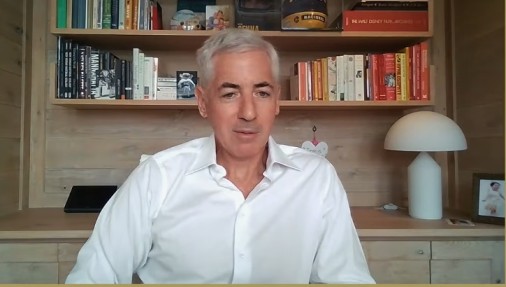
Editor’s Note: In this episode of The Holy Grail of Investing, billionaire hedge fund manager Bill Ackman of Pershing Square sits down with Tony Robbins and Christopher Zook to explain how he thinks about risk, downside protection, and long-term investing. Ackman covers his concentrated, activist approach, the launch of Pershing Square USA (PSUS), his plan to build Howard Hughes into a “Berkshire Hathaway for the next generation,” and the lessons he has learned from his biggest mistakes. Whether you invest in public or private markets, this conversation offers practical insight into contrarian thinking, market psychology, and building lasting wealth. This interview was premiered on September 8, 2026.
TRANSCRIPT:
Introduction
TONY ROBBINS: (00:00:00 – 00:00:06) Hey everyone, welcome to the Holy Grail of Investing Podcast. I’m Tony Robbins, along here with my partner and co-host Christopher Zook.
TONY ROBBINS: (00:01:21 – 00:02:07) Bill’s known for his willingness to take on the contrarian view, maintain his conviction when consensus disagrees, and really make concentrated investments based on an extraordinary depth of research and understanding. And his investment returns, as you’ll learn, have been extraordinary.
Today, we’re going to discuss how Bill thinks about risk and downside, the importance of long-term investing, active ownership, and the evolution of public and private markets, and what investors can learn from someone who’s really willing to think a bit independently. So, Bill, first of all, you’re a legend in the business and it’s just a pleasure to meet you. Thanks for joining us on the podcast.
BILL ACKMAN: (00:02:07 – 00:02:08) Yeah, delighted to be here.
Bill Ackman’s Origin Story
TONY ROBBINS: (00:02:09 – 00:02:54) Thank you. Listen, your investment philosophy has always been something that people have stood out for, your ability to stand out from the crowd. But before we get into that and the way you evaluate risk and so forth, we’d like to start out with a little background. Everybody knows someone’s background, kind of their origin story, so to speak.
And I remember reading a story about you where they said you bet your father, I think your bar mitzvah money, for a couple thousand dollars of the money that you would get a perfect 800 score on the SAT. So it sounds like you’ve had some confidence early in life. Tell us a little bit, if you would, about that story, but also what really started you out in the financial business almost 34 years ago. What pulled you to it? Was it numbers? Was it people you knew? We’re curious to know how you kind of started out to move in the direction of the path where you are today?
BILL ACKMAN: (00:02:55 – 00:03:07) Sure. So the first on the story, I was a pretty cocky kid. And then I had pre— they— was the year before I did the SAT, they released a couple of SATs. So I had taken them. So I had a pretty good idea how I was going to do.
TONY ROBBINS: (00:03:08 – 00:03:08) Okay.
BILL ACKMAN: (00:03:08 – 00:03:35) And I bet my dad— but I would consistently do perfect on the verbal and I’d somehow miss a few questions on the math. So I bet my dad that I get 800 on the verbal because that I thought was kind of a lock. And I had $2,000, which was my kind of life savings, more from odd jobs than from bar mitzvah money, I would say. But the Friday before the Saturday of the test, my dad canceled the bet.
TONY ROBBINS: (00:03:36 – 00:03:36) Oh wow.
BILL ACKMAN: (00:03:37 – 00:03:38) Yeah. And I—
TONY ROBBINS: (00:03:38 – 00:03:42) was that a mercy? Was that a mercy decision, or—
BILL ACKMAN: (00:03:42 – 00:04:05) I think he was worried he was going to lose, and $2,000 was real money, and he had— my dad was a successful guy, but he was an entrepreneur in the mortgage brokerage business, and he had a couple years we didn’t make any money. And ’87, which is when I took that test, was a bad year. No, it wasn’t ’87, it would have been ’83.
TONY ROBBINS: (00:04:05 – 00:04:05) Okay.
From Real Estate to Value Investing
BILL ACKMAN: (00:04:05 – 00:06:32) It was not a good year in the real estate business. And he, I think he didn’t want to lose $2,000. And anyway, I ended up getting one question wrong, so I was actually very happy that he— That’s that story.
In terms of investing, so I actually, after college, I went to work for my dad, and his kind of real estate little boutique. And I was selling office buildings, arranging financing, things such as this. And it seemed to me that the people having more fun were the people making the investments as opposed to the people providing the service, if you will, the kind of investment banker type. At one point, I said to my dad, I said, look, I’d really like to learn how to be an investor. Who’s a good investor in your friend group? He recommended a guy by the name of Leonard Marks, who he said was a fantastic stock market investor.
I went to see this guy. He recommended I read a book, a famous book, Ben Graham’s “The Intelligent Investor.” I read it and I was like, wow, this is pretty cool. The next thing I read was a Berkshire Hathaway, Warren Buffett annual letter. And the Buffett stuff is obviously very compelling, and it kind of draws you in. And I started getting obsessed with it.
I would— McGraw-Hill had a bookstore on 50-something and 6th Avenue. It was the best business bookstore in New York. This is obviously pre-Amazon. And I’d go over there. And during lunch, from 12:00 to 1:00, I would just read books. Yeah. And anything I could find on investing. And that’s how I got captured by it.
And then I went to Harvard Business School for the purpose about learning how to be an investor.
Starting a Hedge Fund After Harvard
TONY ROBBINS: (00:06:33 – 00:06:45) And did you start right after that leaving your father? Did you go straight into it after that? I thought I read someplace you invested with a former Harvard business classmate.
BILL ACKMAN: (00:06:45 – 00:07:49) So at business school, my next step was going back to the dorm room and reading 10-Ks and 10-Qs by yourself is a pretty antisocial thing to do. And there was a very smart guy in my class by the name of David Berkowitz. And he lived in— it was I guess what they called Soldiers Field Park. It was sort of these apartments on campus. And he was one floor away. So I’m like, hey, what if we have this? There was no investment club at Harvard, believe it or not.
So we start— they had one Bloomberg machine, it was in the library. And the guys who would hang out by the Bloomberg machine, such as Tim Barakett, Chris Hohn, who’s become a very famous investor, a guy named Bob Jaffe, all these guys ended up going into the hedge fund business, the guys that hung around the Bloomberg machine, which was a very old version of what is today’s Bloomberg machine. Yeah, that’s how I learned. And I had a little 2-person investment club.
I started a hedge fund September of ’92, which is 3 months after I graduated from business school. And raising money without any experience or track record is a pretty interesting thing. And my dad had no interest.
TONY ROBBINS: (00:07:50 – 00:07:56) So it sounds like your dad had a different idea about risk than you’ve taken in your life, for sure.
BILL ACKMAN: (00:07:56 – 00:08:13) Oh yeah, yeah. He never felt comfortable with risk, but after you raised money from real people. 4 of the original 6 investors were in the Forbes 400 magazine, wealthiest people in the country. And my dad sort of last minute said, okay, well, maybe I’ll put some money in.
TONY ROBBINS: (00:08:13 – 00:08:15) So that’s awesome.
Evaluating Worst-Case Scenarios and Downside Risk
TONY ROBBINS: (00:09:02 – 00:09:55) Well, look, one of the things that we focus on, all of our investors at CAZ, it’s fundamental. I know you know it, you live it, is this whole idea that if you’re going to look at an opportunity, the first thing you got to look at is the worst-case scenario. And as you know, if you can live with that, you can do well. The upside takes care of itself.
And I want to acknowledge really Christopher, because over the last 25-year history, we make about 2,000 evaluations a year and I usually invest in about 10, to give you an idea, about 20 or 30 now, now that we’ve got a registered fund. But still, in the 25-year history, that philosophy rigorously, disciplinably applied with him has caused us to have 96% of our private investments are profitable, either realized or unrealized. It’s pretty amazing. And I know that’s been your fundamental philosophy. Tell us, if you would, how do you evaluate worst-case scenario? How you look about that before you make an investment? And how important is that discipline to being an effective long-term investor?
BILL ACKMAN: (00:09:56 – 00:11:49) As a general matter, to your point, investing is about not losing money for the most part. Now, there’s a portion of what we do, a very small portion of what we do, we take the risk of a permanent, almost entire loss, as long as the potential upside is much, much larger, almost venture capital-like. We do this when we purchase these hedges.
But the core of our business, we look for these very robust, durable growth companies, businesses that, as Warren Buffett would say, have a moat around them, where the moats are getting filled in with lots of dirt these days, right? Because AI is this incredibly disruptive technology. And I would say it’s the hardest thing to do as an investor is understand the risk of disruption to a business. So I think it’s become harder.
But the kind of company we typically like completely dominates its place in the universe. The business model is generally relatively asset light. We love royalty streams, royalty collecting companies. We’re okay if a business has to invest capital, but we want the business to earn a very high return on that capital. And we have to be confident that 2 Stanford recent people who left after freshman year aren’t going to be able to put together something in a garage and disrupt us, or of course, an even more well-capitalized competitor.
But if you think about the atmosphere we’re in now, I actually yesterday— I’m an investor in a venture capital fund, and this guy does seed stage investments. And what he told me is he goes to the Harvard campus now in the 3rd week of freshman year to start getting to know who all the students are. And because he says the best people are going to leave 6 months into freshman year, we got to get these guys early.
TONY ROBBINS: (00:11:50 – 00:11:50) Wow.
BILL ACKMAN: (00:11:50 – 00:12:52) So today a 19-year-old can raise effectively an unlimited amount of capital, get access to an unlimited amount of bandwidth, recruit super talented people. So it’s a world where I would say the downside risk is greater because of disruption. But the way you mitigate it is finding a business where the business model is such where it’s very difficult to disrupt, where the company’s balance sheet uses very low leverage. That’s another way. You can have the greatest business in the world, you apply too much financial leverage to it, you can get obviously knocked out.
And then, of course, it matters who’s running it. In our case, the nature of the way we invest, we don’t like who’s running it, we can play a role in replacing that person. But you can have great business, good balance sheet, really bad person, and they can take away a lot of the value. But yes, protecting your downside, and a good way to do that, of course, is price, which we haven’t discussed. So you get all those things right and overpay, and you can also lose a lot of money. But your 96% record on private investments is about the best I’ve heard. So congrats.
Pershing Square USA and the Public Offering
CHRISTOPHER ZOOK: (00:12:52 – 00:14:13) Thank you very much, Bill. And we are very proud of it. Obviously, it’s a team effort, and it’s something that we’ve stayed with for 25 years, just being consistent and focusing on what’s that worst case, because the upside will take care of itself. And it’s funny because of the fact that for years and years and years, when I would talk to people about our investing in GP stakes and private asset management businesses, I would always have to say it like this, owning a private asset management firm is the very, very second best business model in the world because nothing really beats enterprise software. Well, I don’t have to say that anymore because now enterprise software is obviously under the gun.
But when we talk about private asset management, we can lead directly to your company, which is Pershing Square. You recently did a very unique offering where you took a closed-end fund public in the United States, ticker symbol is PSUS for those that are watching. And then you also at the same time took your management company, which is Pershing Square, ticker symbol PS, public at the same time. And you actually gave people who bought into the closed-end fund a piece at the IPO, a piece of the management company. So it was a very unique offering. What was your inspiration for doing that? Obviously the stock’s been trading now for a couple of months, both of them have. What have you learned as a result of that? And what do you anticipate of what the market’s going to think about those assets collectively over time?
BILL ACKMAN: (00:14:14 – 00:18:45) That’s a great question. And to your point, I think asset management is an amazing industry. But there’s a whole spectrum of businesses in asset management. What’s interesting about ours is our capital base is comprised of these public vehicles, where the capital is basically forever. And what that allows us to do is to be a long-term investor. You’re, in some sense, only as good as the investors you raise capital from. If you’re a long-term investor and your investors can pull your money in 3 months, you’re not going to succeed. We set up our business model in a way where the liabilities match the assets, which is a key success factor.
Where was the inspiration? Well, you’re an investor in private GPs, the general partners of various funds. You understand the economics of that business. It’s really attractive. My guess is your investors are principally very sophisticated, high net worth, or institutional type investors. That opportunity hasn’t really been afforded to the public market, that kind of retail type investor. But you often see in that private asset management context, you might have an anchor investor, for example, in a new fund being launched, and the anchor gets a piece of the GP as kind of a gift for leading that round. And we took that sort of inspiration and we put it to work in the public markets. And so basically, for investing in this new fund, for signing up for Pershing Square USA, you got a gift of the GP. And the bigger the offering, the more valuable the gift is because asset management, obviously, the more AUM you have, the more fees you generate. And so it was aligning the interests of the public market investors.
So I think we did the largest closed-end investment raise in history with a $5 billion IPO. It was actually one of the largest. I think it’s in the top 20 IPOs ever, believe it or not. So we accomplished our objective of a large IPO. We’ve raised this pool of capital. The management company is trading at about a $14 billion market cap, which is, as a percentage of our fee-paying assets, the highest valuation of any alternative asset management firm in the world. So we like that.
My only complaint is that PSUS has traded to a wide discount very, very quickly. And so the opportunity for your viewers here is you can buy our portfolio today at basically $0.79 on the dollar. As of this second, it’s trading at about a 21% discount to the value of a liquid portfolio of some of the best businesses in the world. And I think part of that is we have not yet provided detailed disclosure on what the portfolio is. It’s also a pretty volatile time in the market.
One of my takeaways from the IPO, why did the discount emerge so quickly, is I thought I was doing retail a favor, but in the offering, we had well more than the demand we needed to sell the whole offering. How do we allocate it? What you typically do is you give the institutions a better allocation and you cut back the retail. That’s the typical approach. This whole vehicle was about democratization, access to— this is the only really publicly traded hedge fund. And it’s the only opportunity to get a free piece of the GP, we thought that should go to retail. So we gave retail a full allocation, we cut back the institutions.
Apparently, as I did not appreciate, retail’s not expecting a full allocation. So you had a whole bunch of people put in for, let’s say, whatever, 10,000 shares, they only wanted 1,000, and then they got 10,000 in their account. They’re like, holy shit, I got to pay for this by Monday. And the stock opened, because they had to open both at the same time, took them to 2 o’clock. So, on Friday at 2 o’clock, someone gets allocated with 10,000 shares of something where they only really wanted 1,000. And one-day settlement, on Monday, they had to pay for the stock. So, they sold it immediately, both PS and PSUS, over the last 2 hours of the day.
And retail was about $850 million of the— we had anchors who were about $2.8 billion. I invested $250 million, the rest of the team. Of the public float, they were almost half the public float. I think we’re still suffering from that retail overhang, which I think will go away. The opportunity, again, my free gift with purchase here is you can buy a dollar of assets for 79 cents, and it’s liquid, high-quality businesses, which we’re going to talk about in a month.
CHRISTOPHER ZOOK: (00:18:45 – 00:20:04) Well, no, and it’s a very interesting dynamic because a lot of times assets move for reasons that have nothing to do with economics. They have everything to do with emotion or fear, or in this case, an overallocation like, oh, I actually didn’t think I was going to get filled, and then they don’t have a choice. But that created a huge opportunity in particularly the PS stock, the management company. As that traded down, you bought a bunch of stock. We also were very aggressive buying stock at that point in time. And then of course the stock just completely ripped higher and went up something like 60-70% over the course of the next couple of weeks.
The old saying in the asset management business is long-term capital is ideal, but permanent capital is a whole lot better. And so I commend you for building a fantastic business that is really, really unique. When you think about the opportunity set for a vehicle like this, a closed-end fund, and the democratization of basically having this publicly traded hedge fund now in the United States, what is it that you think really differentiates what you’re doing in PSUS compared to a lot of the other things that they can invest in? Why would somebody say this is better than just buying Nvidia, which obviously everybody wants to do almost every given day except for the last couple of days? But what specifically would you tell them is the value proposition of this offering?
What Differentiates Pershing Square: Concentration, Activism and Black Swan Hedges
BILL ACKMAN: (00:20:05 – 00:24:23) If you look at our record over the last 22 years, we’ve compounded at 19% per annum and the S&P has compounded at 10% per annum. And you understand the power of compounding. It’s something such as you’ve made whatever, 7 or 8 times your money in the S&P, and you’ve made 26 times investing in Pershing Square. So the power of compounding, obviously, the excess return that we’ve been able to generate over time.
And where that’s come from is, one, concentration. We concentrate the portfolio in 12 to 15 names. Two, it comes from being a very influential investor. We started out very much as a shareholder activist. Buy into a company that was mismanaged. We have to go public with our thesis, put pressure on the company. Sometimes we join boards. And that led to a lot of value creation because we could buy into a story like Chipotle. Think back, a bit like what’s going on with salads and this new bacteria that people are responding to, unfortunately, from a GI perspective. But Chipotle had a food safety crisis, and the stock got crushed, and management didn’t handle it well. So we bought 10% of the company. They welcomed us on the board of directors. We recruited a new CEO. They fixed it. And we made 7 or 8x times our investment.
We can invest in situations that don’t exist to the average investor on the street. Chipotle was trading at the right price under the what was then existing management team and governance structure. And they were heading in a bad place. We could buy from people selling, knowing that we’d be able to make the changes necessary to make the business more valuable. And so that’s been a big driver of value for us over time. What happened 20 years in, or maybe 15 years in— actually, it’s been a decade since we’ve had to make an activist investment. Now every CEO in America knows who I am. They know the firm. So today we buy into a business that has some potential that’s being unrealized. And we get invited into the boardroom to either give advice, or just deal with the CEO directly or otherwise, we can create value. One, there’s an ability to create value beyond just a passive purchase of an existing company.
Second thing we do that’s less well-known, but been a big driver of our returns, is we try to hedge what we call black swan risk. Beginning in circa 2007, I became concerned, which actually even a couple of years earlier, about these AAA-rated companies that were taking on subprime credit risk. And so we built a large hedge that in ’08 and ’09 became enormously valuable. We spent 1.5% of our capital. It turned into 20% of our capital. We took that capital, and we bought stocks when the market blew up in ’08 and ’09.
And then in February 2020, I started getting concerned from a health perspective about COVID in January of 2020. And then by February, I said, this is going to have very severe economic effects. We’re going to have to shut the global economy. I built a very large hedge in the CDS market. And we used that when literally 2 weeks later, the world blows up. We have a hedge. We can turn $27 million into $2.6 billion. We take that capital, and we buy stocks in March of 2020.
And then the next one was really the Fed raising rates aggressively as inflation spiked. We saw President Trump spent $7 trillion basically bailing us out for COVID. We had Biden committing to spend trillions more. We had interest rates at zero. So we had the most aggressive fiscal policy ever. We had the most aggressive Federal Reserve policy with 0% interest rates. And then you had the animal spirits of people who had been locked up for almost 2 years starting to spend money again. I said, look, this is going to lead to massive inflation. And you could buy an instrument, a so-called interest rate swap option, betting that rates would rise. And we made a couple billion dollars there, almost $3 billion. We took the money and bought stock.
So the opportunity for an investor to buy— that strategy is not one that’s available to a typical mutual fund investor or a public markets investor. It’s available really to high net worth people who invest in hedge funds. What’s unique about PSUS is it’s literally the first publicly traded hedge fund that has the same hedging strategy, the same active investment strategy. It owns a portfolio that is the same as we managed private funds that charge a 20% promote. This is a public entity, and we can’t charge a promote. It’s a very low-cost version of Pershing Square.
Business Quality and Active Ownership
TONY ROBBINS: (00:24:23 – 00:25:08) It’s interesting that the structures you’ve created, again, for permanent capital give you that capacity because I remember, if I remember right, I think 2002, 2003, you had your thesis, but people weren’t paying attention to it. It looked like it wasn’t working well, but ’06, ’07, ’08, all of a sudden, you make $2.5 billion. That’s why you get these extraordinary returns.
I’m curious, obviously most people think about just diversification. You’re much more concentrated, obviously, and you’ve been willing to be that active participant to engage with the management company, the management, influence the capital allocation, influence the strategy, push for real maximization. What kind of key business conditions have to exist for you before you’re willing to become that active investor in the type of investments you make?
BILL ACKMAN: (00:25:09 – 00:26:10) The answer is it’s all about business quality. If it’s a business that we like, we can predict with a high degree of confidence, and it doesn’t have exposure to what we call extrinsic factors we can’t control. So we don’t like to invest in businesses that have a high degree of commodity exposure. Why? Because we can’t control the price of oil. We don’t like businesses that are very sensitive to interest rates because, again, macro factors can change that. We like businesses that are inherently low volatility. And they’re insulated from the big macro factors. And they’ve got long-term secular growth trends.
So if the under— and the business has a good balance sheet, got a very strong financial position, and it’s mismanaged, that’s a huge, huge opportunity. Because the typical investor will say, I don’t like management. They miss their numbers. They’re not doing the right thing. Expenses are out of control. So I’m going to find something else to invest in. We see a situation like that. We say, look, we can buy from people selling because they believe the situation will never change. And then we can effectuate change. And that’s a huge kind of arbitrage.
Management Incentives and Alignment
TONY ROBBINS: (00:26:11 – 00:26:28) And then I know you’re very focused on the alignment of management. When you evaluate a business, how important is the management incentives? What do you look for in terms of leadership having a genuine alignment with long-term investors? What kind of criteria do you look at in that area? Am I correct? That’s been one of your evaluation points.
BILL ACKMAN: (00:26:29 – 00:27:39) I mean, I would like to say incentives drive all human behavior. And if you want to understand why management is doing something, just look at the proxy and see how they’re being compensated. I think unfortunately, there’s this— I would describe the compensation consultants that boards hire all have the same sort of— there’s a base salary, there’s a bonus salary, there’s a long-term incentive plan, and it gets complicated. Really, what you need to do is sit down with the CEO and understand. There’s certain kinds of CEOs don’t respond well to all these complicated incentives.
Generally, in our view, we want them focused on the share price and a few of the key metrics that matter for the business’s long-term performance. And that’s how you want to incentivize the key people. And you want to incentivize people based on things they can control. So the CEO should be based on the overall company. But punishing people further down in the organization for things outside their control and not giving them compensation based on things where they can have an input, you’re not going to have a— not going to get a good outcome. So yeah, the older you get, the more you realize how important incentives are in every aspect of your life, everyone you’re dealing with.
Howard Hughes and the “Berkshire Hathaway for the Next Generation”
CHRISTOPHER ZOOK: (00:27:39 – 00:28:14) No question. And you made the comment earlier about Buffett and his influence, and obviously Charlie Munger and what they did at Berkshire Hathaway. Something you said just a minute ago talking about Chipotle, Buffett’s famous quote of loves it when a business that’s a fantastic business has a one-time but fixable problem, whether it be Coke or American Express or obviously Chipotle or several others. You’ve obviously been influenced by that in a significant way. One of the things you’ve done recently with Howard Hughes is kind of talked about it as being a Berkshire Hathaway for the next generation, if you will.
TONY ROBBINS: (00:28:15 – 00:28:15) What—
CHRISTOPHER ZOOK: (00:28:15 – 00:28:24) walk us through your thought process there and what your plans are with that company that you now have a very significant influence over?
BILL ACKMAN: (00:28:25 – 00:34:37) Sure. If you look at what Buffett, in his travels, if you will, came across this textile company that was trading at a discount to basically its working capital. In the early days of Buffett, he would buy just really cheap stocks, and he didn’t care much about business quality. Obviously, Berkshire certainly qualified because it was a textile business at a time where that business was moving to lower cost, to China basically. And that caused the stock to be really cheap. And he bought half the company. He found himself in control of a dying company.
And what he did basically is over time he liquidated the textile company and he took the capital and he invested in much higher quality businesses. And he started really with insurance. And insurance, property casualty insurance and reinsurance have been the core driver of Berkshire’s value over time. And when people think about Berkshire Hathaway, they think about Coca-Cola, they think about See’s Candy, they think about the various businesses he’s purchased. But many of those certainly common stock investments, Apple, etc., were really just part of an insurance company portfolio. And what’s unique about Berkshire is there are some very talented insurance operators, but they tend not to be great investors. And there’s some great investors, but they tend not to go into the insurance business. Buffett really had both qualities. And that’s really what’s been the driver of Berkshire. I would estimate 70%, 80% of the value came from the insurance operations of Berkshire.
So Howard Hughes is a company we got into by accident. We bought a stake in a company called General Growth. This was during ’08. The stock had declined 99.5%, from a $20 billion market cap to a $100 million market cap. They had $27 billion worth of debt. And they owned the best shopping malls in the country. So great underlying assets. But the debt got them into trouble. The CMBS market shut. They couldn’t refinance their debt. They’re going to go bankrupt. Stock goes to zero. We bought 25% of the stock. All our friends in distressed credit were buying the debt, which was trading at $0.30 on the dollar. We thought the stock was a more interesting, if you will, fulcrum security. And we bought for $60 million 25% of the company. So at $250 million market cap, $27 billion of the debt. So that’s the kind of leverage— certainly can get you in trouble, but it creates an asymmetry where you can make a fortune. And $60 million was about 1.5% of our capital at the time. So in the worst-case scenario, we lose 1.5%. In the best case, we can make a fortune. And we ultimately made a fortune. $60 million became almost $3 billion over about 5, 6 years.
But part of that strategy was General Growth was in the Class A mall business but had a lot of other stuff that investors didn’t like. They owned huge land holdings. They had a business they called the master-planned community business, which is a very, very long-duration business of basically developing lots, selling them to homebuilders, and then eventually building vertically. Businesses that the stock market doesn’t like. Well, we took all of those businesses, all the development assets that were not Class A malls, we stuck them in a new subsidiary, and we spun them off to shareholders. And we called it the Howard Hughes Company because this company, General Growth, had purchased a company called Rouse, which had purchased Howard Hughes’s real estate interests in Las Vegas. I thought Howard Hughes was kind of a cool name. But the fortune was made on the mall company. This was just a way to make the mall company more attractive.
And so, for 14 years, we kind of refined this portfolio. But no one ever cared on Wall Street because it had development. It owned a lot of land. It didn’t pay a dividend. It was a real estate company. It was not a REIT. It was complicated to analyze. It was a bit like Buffett. We found ourselves with this company. We own 47% of it. The market didn’t care. I said, look, the market assigns too high of a cost of capital to this business than we can earn in this business. Let’s go the Berkshire Hathaway route.
What we’ve done is in June, a month ago, we closed the purchase of a company called Vantage Group Holdings, which is a property casualty specialty insurer and reinsurance company. And actually, literally yesterday, we made a big announcement, which I’m sure you missed because no one’s paying attention to this company. But we recruited Marc Grandisson, who was the CEO of Arch Capital Group, which over the last 25 years is probably the best-performing insurance company in the country. He was the CEO for the last 8 years, 23% IRR during his tenure as CEO. And he is now the executive chair of Vantage. Then his number 2, a guy named David Gansberg, we recruited to become CEO of Vantage.
We inherit from Vantage a very good platform that’s been built over the last 5 years by a very good team. We’re putting into Vantage, I would say, the best senior leadership team in the insurance industry. Now, we have the team to build out a very profitable insurance company. And Pershing Square is going to manage the assets of Vantage for free. So, we’re going to bring what Buffett brought to Berkshire from an asset management perspective. And then the Ajit Jain, who is this famous guy who’s been running his insurance business, where our equivalent is Marc Grandisson. And Marc Grandisson actually trained under Ajit at Berkshire before going to Arch Capital. And so, the plan is to build a compounding machine over time.
You can buy the stock today for $72. We bought in a private transaction with the company an extra 15% of the company about a year ago. We paid $100 a share when the stock was $66 as part of this overall arrangement. Why do we pay $100? Because the company has something in order of $110, $120 of underlying real estate assets. So today, you buy the stock for $72, you get $110-ish of real estate assets, plus now an interest in Vantage, where we just put in place a superstar senior leadership team. So, I think it’s going to turn into an interesting story. But right now, it doesn’t have semiconductors, memory chips. It’s not an AI company. It’s definitely in the unsexy part of the world right now, real estate and insurance. But I do think you’re going to be happy you own this a decade from now.
CHRISTOPHER ZOOK: (00:34:37 – 00:34:41) You can make a lot of money from things that are not sexy and not AI. That’s still the case.
BILL ACKMAN: (00:34:42 – 00:34:42) Yes.
Public Persona, Social Media and Speaking Out
TONY ROBBINS: (00:34:43 – 00:35:32) Yeah. I’d love to touch base on your public persona a little bit. You’ve kind of stepped beyond just the traditional boundaries of investing and because of the success of your business and your following, obviously on X and other social media pieces, you’ve kind of changed people’s perceptions. And I’m wondering, do you think social media has changed what people expect of business leaders today? And do leaders feel pressure or responsibility to participate in the public conversations about what’s happening in the world?
I personally appreciated your speaking up about the antisemitism that was being tolerated by these universities, which is insane to me. But I’m just curious how you think about that along with your business. Is that an advantage, a disadvantage? Is it responsibility? How do you look at it today? And how do you think other people do who are now leaders in business?
BILL ACKMAN: (00:35:33 – 00:37:16) Yeah, so I would say vast majority of leaders in the business stay far away from cultural reversal topics such as DEI, Iran War, universities, antisemitism— places where I feel very comfortable going. But what I would say is I feel like you’re a successful person. We’re in a country where free speech is one of the most important— free speech is something obviously I spent time talking about as well. But I think with success comes responsibility. And there were a lot of things that were just— people were just not— would discuss privately but not talk about publicly. And I think you’ve got to bring those things publicly. I would say most business leaders today shy away from that, and I think it’s unfortunate.
There are a handful of people who speak out about important issues politically from a business perspective. I understand why they do it. You’re always at risk. I think the nature of our business, if we sold a product— look at Elon. People were boycotting Teslas for some period of time. You could argue it’s hurt his Tesla sales, his very outwardly facing perspective. So, there is some risk there. But I think, if anything, it’s been helpful to our business and the nature of our— If someone doesn’t like what I have to say, I guess they can sell the stock, but it doesn’t affect our ability to be a successful investor. I don’t think you need to worry if you’re an investor with us that some public statement I make is going to lead to a boycott that’s somehow going to harm us. I think the vast majority of our investors are aligned with us on the views that I’ve shared publicly.
How Social Media and Market Structure Have Changed Investing
CHRISTOPHER ZOOK: (00:37:17 – 00:38:19) Interesting. Well, there’s no question that having perpetual capital provides an interesting platform to be able to do that without having to worry about a run on the bank or something that other types of businesses might be concerned about. And it’s really refreshing where somebody who’s in the public eye can be very candid about what they believe and put out some extremely well-reasoned material, which goes back to your strength in the SAT and verbal. Your writing is very good, it’s very supported, it’s not just emotion, it’s actually very, very based on logic and facts. And I think it’s really made an impact well beyond the investment world and a lot of the things you’ve gotten involved in.
But thinking about that platform, obviously you are one of the most followed folks from the financial markets when it comes to X, etc. How’s the market changed? The speed of information is so fast. Do you think it’s changed investor psychology? Do you think it’s changed the way that they go about making decisions? Talk about what you think the impact is of this big growth in social media and information flow?
BILL ACKMAN: (00:38:20 – 00:41:44) Yeah, I think it’s led to more and more— well, it’s led to 2 things, more and more short-termism. There’s so much more data that people can respond to. Some of the more successful strategies in the hedge fund world today are people who are taking in tons of quantitative data and making very short-term bets on, is the company going to make earnings, miss earnings, that kind of thing? You think of the Millenniums and Citadels of the world, a lot of their capital is concentrated in these pods. Where people are given very levered incentives. As I say, incentives drive all human behavior and very tight risk tolerances.
And that has led to— the 2 big forces in markets that I think have changed fundamentally, I compare 10, even 20, more so obviously 20 years ago. One is indexation, right? More and more people kind of thrown in the towel. I’m just going to index. It’s worked out very well. The query is, does it work out forever? As index funds are now— a quarter of every American business plus or minus is owned by some combination of Vanguard, State Street, and Northern Trust. So that’s really taking float out of the market, right? When you shrink the float of a public company, the marginal buyer and seller is going to have more impact on the stock price. Marginal buyer and seller today is a Citadel or a Millennium, because they’re very big market participants. They operate with a large amount of leverage. They have very, very large gross books of capital. And they’re increasingly short-term.
The other big player, of course, is retail. A huge player. And retail, with these kind of one-day options, has become— it’s gone even more sort of speculative. So I think that those forces lead to huge volatility. IBM disappoints people and the stock drops 25%. That’s a big move for a relatively large company. That was a very, very rare event. I can only think of one example where a big company stock dropped by something such as that when I first entered the business. And Philip Morris, when they lost their first big litigation on tobacco, that stock dropped 20%. But that was a really extraordinary event. I would say every quarter there’s some relatively large company where the stock price moves enormously.
And I think what that does is it creates the opportunity for an investor that can have a long-term view. Because every once in a while, a really high-quality business disappoints or whatever. And yes, that affects the quarter. But it doesn’t have a long— as long as you believe it’s not going to change the long-term trajectory of the business, that creates an interesting opportunity to buy a stake in what is becoming increasingly— the markets are more liquid. But there’s more discontinuity, where a stock can drop 25% overnight. And there’s no liquidity between $100 and $75 a share. And that’s why having a stable long-term capital basis is important. And you can buy without regard to where the stock’s going to be at 12/31.
And most investors today are very short-term focused because they get compensated that way, or they have risk management that way, or they get paid, quote unquote, at the end of the year. So they won’t invest in a company unless they’re confident the stock price can be higher on December 31st, which interestingly creates opportunities. Envision a business where you know it’s going to be worth twice as much the following December 31st, but you can’t own it this year because it’s going to be down for a bunch of reasons. That creates a pretty interesting opportunity for an investor who doesn’t have to play by those same rules.
The “Hell Is Coming” CNBC Moment
TONY ROBBINS: (00:41:45 – 00:42:19) That’s cool. You made a very famous comment right as COVID was evolving on CNBC. I know you remember the “hell is coming” comment. It took a more complex message you really offered and it became the headline everywhere. I’m curious, looking back on it now, what did that teach you about the experience of market psychology today and communicating during uncertainty and how quickly a narrative can form? And I know you might mention, share with the audience if you would, about how you use that insight with the right vehicle to do very well by your investors.
BILL ACKMAN: (00:42:20 – 00:42:27) Well, here’s actually what actually happened. And I’ve had to put out the transcript and the recording and everything else.
TONY ROBBINS: (00:42:27 – 00:42:29) That’s what I’m saying, it just got twisted into something really simple.
BILL ACKMAN: (00:42:30 – 00:44:13) It was a 28-minute segment. I was explaining to Scott Wapner a month earlier, the conversation I was having with CEOs. I was telling him, I say, look, here’s what’s going to happen. We’re going to have a shutdown of the global economy. This is not something you’ve experienced. I called Chris Nassetta at Hilton. Hilton’s going to have a complete shutdown. So draw your credit lines, put cash in the bank, think about deferring CapEx, because “hell is coming.”
And my segment was 28 minutes, but they took a 12-second thing on my describing my conversation with Chris Nassetta, and they replayed it for weeks. And I was accused of effectively market manipulation. Meanwhile, I went on TV to say we’re buying stocks. We’re buying Hilton at $55 a share. We’re buying Lowe’s, the home improvement company, at $70 a share. We’re buying every stock in our portfolio. Why? Because I believe we’re going to shut down the global economy. But we’re just going to do this temporarily.
My advice to the president was we go on a 30-day— instead of a 2-week spring break, we go on a 30-day spring break. We let the virus— keep everyone in their homes. And then reopen the country, wear masks. And if the president follows that policy, this is an incredible time to buy stocks. That was my message. I was literally buying, not selling, but on the “hell is coming” thing. The market was down 6% when I went on CNBC, and it was down 10% by the time I got off. So I was credited with causing the market to go down that much, but it was mostly CNBC taking the most dramatic part of my conversation and replaying it.
TONY ROBBINS: (00:44:13 – 00:44:23) What did you pull from that for future discussions, if anything? Or is it really out of your control because anybody can lift some piece of your conversation and use it to produce fear?
BILL ACKMAN: (00:44:24 – 00:44:40) Well, actually, Warren Buffett has a kind of a rule with CNBC. If you notice, they’re not allowed to excerpt him. So Buffett, he only goes live, he never does recorded. So he can’t be spliced and diced, and they have to play the whole segment. So he’s very—
CHRISTOPHER ZOOK: (00:44:40 – 00:44:41) that’s very interesting.
BILL ACKMAN: (00:44:41 – 00:45:11) Actually the smartest public relations person, CEO, guy in the country. He’s very careful with his image, obviously. And yes, I’m sure all of us have learned the lesson of what— I mean, “60 Minutes” is the classic example of this. They record the segment and they very carefully edited it and they’ve gotten themselves in some trouble with the election and Kamala, the president, and litigation, I think for good reason.
TONY ROBBINS: (00:45:11 – 00:45:12) Yeah.
Learning From Mistakes
CHRISTOPHER ZOOK: (00:45:12 – 00:45:44) It’s fascinating the way that has changed over time. I want to go back to something that I know the audience would really, really benefit from, which is we’ve talked a lot about success. We’ve talked a lot about things going well and being right, but obviously, anybody who’s making investments is not always going to be right. We typically learn as much, if not more, from what we do wrong than what we do right. What is something in the past that really was a framing situation for Bill Ackman on what it was that he learned from a mistake that he grew from, and he got better because of it?
BILL ACKMAN: (00:45:45 – 00:48:31) Sure. One of the things we do at Pershing Square is we like to say we treasure mistakes. I think they are more valuable than successes. But I don’t know if you ever saw Roger Federer’s Dartmouth speech, where he talks about how he only won 54% of his points. He’s one of the greatest players of all time and he only got 54%. He said, look, on the losers, you just have to brush it off and move forward. A little bit different in the investment world. You shouldn’t just brush it off. You actually have to study it and figure out what you did wrong. It’s okay. We’re going to make mistakes in our industry, in our business. You just don’t want to make them twice, right? The only thing that would upset me is to make the same mistake all over again. So a big part of it is that.
The history of our firm, the nature of our strategy, very concentrated, a lot of due diligence, our batting average is actually quite high. But we’re concentrated. I would say our batting average historically is something such as 90% for public market investing, which is kind of crazy in terms of investments that have been profitable. But the ones that we get wrong are going to be massive. Because everything we do is massive. So, the dollar amounts lost are going to get headlines. And so, almost every profile ever written about me talks about the 4 big mistakes we made. And 22 years later, they’re still talking about Herbalife and JCPenney and Valeant Pharmaceuticals and Borders Group or whatever they were, or more recently, Netflix, something that we sold with a loss.
But I would say the key learnings for me on a big scale, not just some stock market mistake, but things that were threatening to the business, and something I mentioned before we got on camera here that I have a daughter who is coming back from a major health incident, and I’m giving her the same advice that I gave myself as I worked my way through some challenging business times, is that the key onto all of these really difficult moments is just to make a little success every day, make a little progress every day, and don’t look back to where you were. If my daughter thinks about, she had a hemorrhage, she’s in near death, now she’s learning to speak, learning to see, learning to walk again. If she keeps thinking about where she was and how far she’s fallen, she’ll be depressed, she’ll never get there. But if she compares where she is now versus where she was 5 months ago, she is well on her way to recovering to a full recovery, which will probably take a couple of years. And business is the same. Every successful person I know— and I’m sure I can dig into your histories— you had at least one, and I’m sure more, near-death moments from a business perspective.
TONY ROBBINS: (00:48:31 – 00:48:31) Yes.
BILL ACKMAN: (00:48:32 – 00:50:19) Where every successful person I know had at least one of those moments, and it’s how they dealt with that challenging period that enabled their ultimate success. And that builds the confidence to know, you know what, I’m going to have something else come hit me in the head. I don’t know exactly what it’s going to be, but you can kind of work through it.
And the beauty of the investment business is you don’t need to be— neurosurgery, you get it wrong, you can’t go back, right? The beauty of our business is we had— we exited— we had, I would say, a reasonably successful investment in a company called Universal Music. We sold, I would say, 2/3 of our investment at a very good price. We kept the tail. And disappointed with management execution. But ultimately, we just exited at a much tinier profit, disappointing profit on the last little piece, because we knew we could redeploy the capital into something more interesting. And the beauty of our business is you don’t need to make it back the same way you lost it. And very often, the right thing to do is take the loss. There’s some tax benefits usually associated with that. And redeploy the capital with a team you have more confidence in and higher quality business. And the stock market is going to offer you a lot more opportunities for that.
But from a business perspective, from a life perspective, the biggest lesson I’ve always had is you find yourself in a deep, dark place. Don’t look back at the mountain where you were. Just look at the next step. Get to the next step and the next step and the next step. And progress compounds like money. You don’t see much in the beginning. But everyone here knows the curves of compounding. It doesn’t take long before they start to accelerate and you’re back in a better place again. A lot of it is just dealing with the psychology, the emotion of all that stuff. Investing is something where I’m very dispassionate and unemotional about investing, even though I’m a passionate and emotional person in the rest of my life.
Human Behavior and Market Psychology
TONY ROBBINS: (00:50:20 – 00:51:06) Well, first of all, prayers for your daughter and hope she continues to get better. It sounds like she’s made giant leaps forward. I think the perspective you’re describing is so critical. Without a compelling future. We can all deal with a difficult today if we have a compelling tomorrow. But many people in our society don’t create a compelling tomorrow.
And that kind of leads me to just looking at human behavior and how we look at markets today because there’s so much technology, there’s so much real-time information, there’s quantitative data, there’s algorithms, there’s artificial intelligence, right? So, markets today, they can move faster. The scale of them might be different, but human emotion still seems to be the core of it. I’m curious from your perspective, how does human behavior remain maybe the biggest driver of markets? And are we beginning to see that show up in people’s changing views of artificial intelligence?
BILL ACKMAN: (00:51:06 – 00:52:18) Yes, emotion is one of the biggest drivers of markets, 100%. And that’s combined with margin leverage. Combination of emotion and leverage leads to huge movements. But if you think about it, we’re fundamentally animals. The fight or flight instinct is still inherent in our genome. When a whole bunch of animals were running this way, you probably should be running that way also because there’s probably a bear coming. In the stock market, people operate the same way. When a whole bunch of people running this way, okay, maybe I should be running this way.
Now, what’s interesting about investing is very often, if everyone’s running that way, maybe the best path is this way. But it’s so counter to, I would say, fundamental human psychology. And you have to— Buffett was always very— if you read some of the biographies about him, he’s sort of criticized for being kind of unemotional in his personal life. And I think you don’t want to be unemotional in your personal life, but in investing, you have to be— you don’t want to be a lemming. Okay, the best opportunities generally reside where everyone else is not looking. Yeah.
TONY ROBBINS: (00:52:19 – 00:52:41) How have you divided that? Just as an aside, because your personality, which we all appreciate, at least that the two of us certainly do, is you have a strong emotion and passion. It’s part of what makes you attractive and gets you to get the energy in it. And yet you still have managed to stay rational in your investing. Is there something you do within yourself to make that switch, or is it just a muscle you’ve developed over time?
BILL ACKMAN: (00:52:41 – 00:52:56) I think it’s a muscle you develop over time. The muscle gets stronger because it gets rewarded with successful outcome. It’s like you go to the gym, you build muscle, okay, you see a positive outcome, you keep going to the gym. It’s more of the same thing. Mark Risco.
Building the Culture at Pershing Square
CHRISTOPHER ZOOK: (00:52:56 – 00:53:27) Well, and building a great investment firm is more than just obviously making great investments. You got to build a great team. And I know you have a fantastic team at Pershing Square. How have you gone about balancing real strong accountability with embracing, as you said, treasures, which are mistakes that people make? How have you blended those 2 together to make sure that you have a culture that really is all about success, but at the same time is willing to be self-aware enough to think for themselves and also to be able to go out and take risk?
BILL ACKMAN: (00:53:28 – 00:58:09) It’s an important question, and I think the answer, as you say, is culture, but it begins with the people you recruit. I interview everyone who joins Pershing Square, whether you’re the woman who cleans the space, the ladies at the front desk, obviously all the investment team members. But we are a very unusual firm. So one, we have almost zero turnover. In our industry, there is huge people being poached from one firm to another firm. The investment team has really not changed in the last almost 9 years. Same team. And the same thing for the accounting team hasn’t changed. The legal team, we’ve had to add some additions, but the core people have kind of remained at the firm.
And a part of that is, one, most— I don’t care how talented you are, but I won’t hire someone unless I believe they’re fundamentally a good human being. You bring an asshole into an organization and it can destroy an organization. So this is an industry that has some very talented people, and some of them are assholes. Okay, we don’t hire them. We also grow talent as opposed to hire talent laterally. The investment team has been built by people we hired basically 4 to 5 years after they graduated from college, after they spent 3 or 4 years in private equity, maybe a year or 2 before that in investment banking. We get them pretty young.
Incentives, the vast majority of our firms in our industry are eat what you kill. You get paid on incentives based on ideas you put in the book and how they do. In our case, no, we have one portfolio. No one is compensated with an individual P&L. We all succeed based on the overall success or not of the portfolio. So the typical dynamic in a hedge fund is you have a bunch of analysts trying to come up with ideas they pitch to a portfolio manager so they can get capital allocated to their idea. And if they get capital allocated to their idea, they get a piece of the profit on that idea. The problem with that dynamic is you sort of have a call option, right? You’re trying to create call options by getting capital invested in your idea. If the call doesn’t work, you go get a job someplace else.
At Pershing, typically, an investigating idea will be 2 team members will do independent deep due diligence, plus Ryan, who’s our CIO. Plus me. And then there’ll be 4 or 5 members of the team that won’t have done any work on the idea, but will have judgment based on other experiences. So, you have 2 people who are— one of the other problems with investing, if a couple of people do a ton of work, there’s always an incentive to want to do something, to want to put the capital to work. We separate the people, so the whole team kind of ultimately makes the decision. We have people who haven’t done any work, people who’ve gone really deep, people who’ve done enough work to be dangerous, and everyone’s incentivized to optimize the portfolio. If we’re fully invested, means we have to sell something we own to make room for something new. And very common for someone who’s led an investment to say, look, I like this better than this, we should sell the idea I’ve done the work on to buy this. You would never see that at a firm where it’s about getting your capital invested in your names.
So I think the incentives we’ve designed, the culture, we treat people really well. One of the things I’ve always said, one other way to judge a firm, look at our reception desk. We have 2 women, Mercedes and Megan, who work at the reception desk. They’ve been at the firm for 8 years. The average life of an employee at a reception desk of a hedge fund is 90 days. That’s it. Our firm is not successful unless from the moment you walk into the firm, you have a good experience. By the way, they do more than just answer the phone and greet people at the door, but my point is, they really care about the firm. And when we took Pershing Square public, each of them got millions of dollars of equity that they earned over time. The woman that cleans the space, she got a few million dollars of equity in Pershing Square because she’s been working at Pershing Square for a decade.
And we want everyone— space doesn’t look beautiful. Our glass— I don’t know if, Chris, last time you were out of space— we don’t have fingerprints on the glass. The place is beautiful. It’s in great shape. All of that stuff matters. I think of it like a watch. If any part breaks, it doesn’t work. There are different levels of compensation, obviously, depending on who you are in the organization, but everyone’s treated fairly, given the right incentives, and the result is a family-like culture where we care about each other.
Most people think we manage today, it’s probably $36 billion of capital, of assets that we manage. How many people do you think we have, Tony?
TONY ROBBINS: (00:58:10 – 00:58:12) Well, after you said that, it makes me reevaluate.
BILL ACKMAN: (00:58:13 – 00:58:13) I know.
TONY ROBBINS: (00:58:13 – 00:58:16) 35, 40.
BILL ACKMAN: (00:58:16 – 00:58:21) I mean, we have 48 people, and that includes 2 people at reception, a woman who cleans the space.
TONY ROBBINS: (00:58:22 – 00:58:24) I would never think that except the way you framed the question.
BILL ACKMAN: (00:58:24 – 00:58:38) Yeah. And by the way, I met a guy from Sequoia, I wanted their former head of Sequoia China, and we were talking, and he was, how big is your firm, Bill? I said, well, how big do you think it is? I mean, I would guess you have 700 employees or something.
TONY ROBBINS: (00:58:39 – 00:58:39) Yeah.
BILL ACKMAN: (00:58:39 – 00:59:13) And he’s shocked because most companies— by the way, we also do the accounting for multiple public companies, right? We have, I don’t know, let’s see, 4 entities that we have to file regulatory filings in multiple jurisdictions. Most firms might have 40 people doing that, right? We’re able to do that. So you get force multipliers. And of course, economically, the value of the firm is shared among a much smaller group of people. So economically, it’s probably the most attractive place to work in our industry.
Advice for Building Wealth
TONY ROBBINS: (00:59:14 – 00:59:48) I love how simple that is, and I love how congruent it is with this way you look at businesses, the incentives that you’re looking for in the businesses and also creating the family environment. Listen, I know we have to go. One last simple question. It’s a pretty big question, but you spent 3 decades, right, studying businesses, asset allocations, navigating successes and some challenging times. You’ve seen markets ups and downs. If you were going to give 1 or 2 pieces of advice to someone who’s really trying to build wealth that you thought were sacrosanct, that they really need to never forget and always remember to guide them, what would they be?
BILL ACKMAN: (00:59:49 – 01:00:55) It would be don’t get attracted to where there’s always a super exciting place in the market where someone seems to be making a lot of money, and there’s this FOMO thing about, I want to be there, I want to be in chip memory chips because that’s where all the money is being made. Instead, think about a business that you can envision a world in which that business is not doing— it’s not bigger and more profitable 10, 20, 30 years from now. Buy that company and own it. And that’s the highest probability way of— my father-in-law never thought of himself much as an investor, but he would do exactly that. And he would buy a Boeing, a Philip Morris, whatever the stocks he bought 30, 40 years ago, and he would never sell them.
And when he passed away, he had an incredible collection of companies. He wasn’t a particularly economically successful guy, but his had a remarkable long-term track record because he just took a very long-term view. He got the benefit of deferring paying taxes and he bought these iconic dominant large-cap companies. It’s a pretty good way to make money.
Closing
TONY ROBBINS: (01:00:56 – 01:01:14) You’ve been so gracious and generous with your time and just wonderful to finally meet you in person. You have such an incredible sincerity about you. It’s very obvious why you succeeded both from the disciplines you practice, but who you are as a human being. We send prayers for your daughter and best of continued success for you. And thank you for joining us. We really appreciate it.
BILL ACKMAN: (01:01:14 – 01:01:20) Very kind of you. And I had some fun, actually more interesting conversation than I’ve had in a long time on one of these podcasts.
CHRISTOPHER ZOOK: (01:01:20 – 01:01:23) That’s great. Well, Bill, thank you so much. We appreciate it.
BILL ACKMAN: (01:01:24 – 01:01:24) Thank you, guys.
TONY ROBBINS: (01:01:25 – 01:01:25) Take care.
CHRISTOPHER ZOOK: (01:01:27 – 01:01:50) Ladies and gentlemen, thank you for being with us. And we invite you to listen to more conversations with some of the world’s best investors. The way to do that is to go to holygrailofinvesting.com. That’s holygrailofinvesting.com. And then you can listen to all of our prior episodes. You can also get lots of resources there, including information about the book that Tony and I wrote together. So we look forward to seeing you next time on The Holy Grail of Investing. All our very best.
Related Posts
- Transcript: AMD Acquires Fei-Fei Li’s World Labs for $8.2 Billion
- Transcript of FO568 Raj Shamani: w/ Sumant Sinha
- Transcript of Moonshots #297: ft. Ben Lamm on Wet Lab, Artificial Wombs and Gene Editing
- Transcript of Bill Ackman Interview: All-In Liquidity 2026
- Transcript of Vivian Tu Interview on The Money Reset – The Mel Robbins Podcast