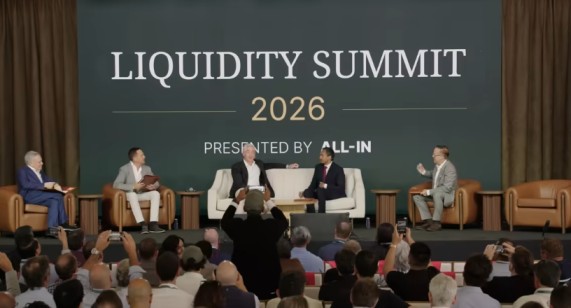
Editor’s Note: Bill Ackman joins the All-In hosts at Liquidity 2026 to discuss how his investment philosophy has shifted toward durable, long-term business quality. He shares his views on AI disruption, the “SaaSpocalypse,” SpaceX and venture-style underwriting, and his plan to turn Howard Hughes into the next Berkshire Hathaway. He also explains the three ways to invest alongside Pershing Square. This interview was premiered June 2, 2026.
TRANSCRIPT:
Evolution of Ackman’s Investment Philosophy
DAVID FRIEDBERG: (00:00:52 – 00:01:27) I wanted to kick this off. So thank you so much for being here. We’ve tried a number of times to get you to All-In, and it’s great to finally have you. You obviously are a legend that doesn’t need much of an introduction. Lately, in the last number of, call it years or months or quarters or what have you, it seems your investment philosophy may be changing. Your model where you’ve been activist and you’ve entered positions and exited positions, and lately you’ve talked a lot about more kind of permanent long-term holdings. Would love to hear a little bit about if that is actually a change and how your evolution and your investment model has changed over time.
BILL ACKMAN: (00:01:28 – 00:03:46) Sure. So I would say the biggest change over time is an appreciation for the importance of what we call business quality— long-term, durable, protected, non-disruptible growth. I would say early days, you’re a smaller, more liquid investor. You don’t have to think as long-term. As you become a bigger concentrated investor. And over time, you learn the importance of durable kind of growth. That’s the most important factor. I would say I’m as activist as I’ve ever been, but more of it’s on Twitter than in the corporate context.
And the reason for that is when I started in Pershing Square, no one sort of knew who we were. And so I actually— one of our first investments was Wendy’s International. Wendy’s owned Tim Hortons, the Canadian coffee and doughnut chain, and the value of Tim Hortons was more than the entire value of Wendy’s. So we had this very simple idea: buy Wendy’s, spin off Tim Hortons, double our money. And we bought 10% of the company, and I called the CEO, and he didn’t return my call. And I called him again, he didn’t return my call. I literally couldn’t get a return phone call. That was the beginning.
So we actually called a friend who worked at Blackstone, and Steve Schwarzman agreed to write a fairness opinion on what Wendy’s would be worth if we spun off Tim Hortons. We kind of mailed it in and filed it publicly, and 6 weeks later they spun off to importance. And then the CEO finally called me back and he thanked me. And he had gotten fired, but he thanked me because he had a huge exit package and he was very happy. But so in the beginning, we couldn’t get a return phone call, so we had to— and we were small, so we had to go to a conference and we had to do presentations and go on CNBC.
What happens over time is you join boards of directors, you become known as an investor. We’re kind of a constructive shareholder. I know pretty much every CEO in the S&P 500, either directly or one person removed. And maybe I age— I’ve aged a bit, but you build kind of a reputation. And today we buy a stake in a company, sometimes they’ll put out a tweet saying, “We welcome Pershing Square as a shareholder,” but they open the door for us. In the beginning, we had to bang down the door.
And today— so we get very deeply involved in our companies if it’s needed. Other companies we own, there’s nothing for us to do, just be there, just clap.
DAVID FRIEDBERG: (00:03:47 – 00:03:49) So you are considered a value-add investor.
BILL ACKMAN: (00:03:49 – 00:03:57) Yeah, but we only want to add value. The conversation last night was kind of an interesting one. The best investments are ones where you don’t need to join the board and do anything.
DAVID FRIEDBERG: (00:03:57 – 00:04:00) Well, that may be in a startup, but in a mature business, it may be—
BILL ACKMAN: (00:04:00 – 00:04:38) No, I think in the public company context, one of the valuable things we can do. The problem of being a public company today is kind of the very short-term nature of markets, analysts, etc. And obviously to run a business— a business is a good one is a forever thing. And you want to make decisions in the context of decades sometimes, or certainly 3, 5 years. And how can you do that when someone’s asking about the tax rate in the second quarter?
And having a big shareholder on the board where you can kind of test ideas out with the big shareholder before you expose them to the public. Where the big shareholder can say, “I’m supportive of this initiative even though it’s going to hurt earnings in the next few quarters,” is a helpful thing.
AI, Business Model Quality, and Disruption Risk
CHAMATH PALIHAPITIYA: (00:04:38 – 00:04:51) I just want to connect this last conversation with Sarah to this. Are you an investor in the AI complex and how do you underwrite business model quality from what you see on the outside in the entire complex?
BILL ACKMAN: (00:04:52 – 00:05:08) I mean, yes, effectively we’re an investor. We’re actually— today we own Microsoft, we own Meta, we own Amazon. Actually, I think either directly or indirectly, you’re invested in AI, or it’s a threat. So you have to understand it. How do I think about AI in a business model context?
CHAMATH PALIHAPITIYA: (00:05:08 – 00:05:09) Business model quality.
BILL ACKMAN: (00:05:10 – 00:05:50) Look, when you’re a concentrated investor or investor generally and you’re a long-term investor, the most important and most challenging thing to do is determine what’s the risk of disruption?
What’s the risk of 2 guys, 2 women from Stanford in a garage coming up with something? That risk, I think, has gone up dramatically. This is the greatest era in history just to build a business, right? There’s unlimited access to compute, certainly for a startup, unlimited access to capital, and a lot of incredible talent, which means that the probability of your being disrupted has gone up enormously. So the hardest thing you have to do as an investor is understand, and that’s really where we spend most of our time.
CHAMATH PALIHAPITIYA: (00:05:50 – 00:06:00) What’s your tendency in a moment like this then? Do you swing towards the chaos, or do you reposition to things that are maybe more durable and defensible from AI where the disruptibility is less?
BILL ACKMAN: (00:06:01 – 00:06:44) What’s interesting about markets is people always bring their eye to the new, new thing. And the new, new thing is sort of chips and semiconductors and energy. And that’s where the shorter-term capital is going. What tends to happen is really high-quality things get left behind. And the same thing really happened. I was there in 2000, in that sort of bubble. This is different. I’m not saying this is— but there’s some analogies. And the analogies are people got excited about internet stocks and Berkshire Hathaway traded at the lowest valuation I think it ever traded at in its history as people said, “Okay, that’s all old stuff.” I think a similar thing is happening today in a sense to Amazon and Meta. Microsoft.
JASON CALACANIS: (00:06:45 – 00:06:46) Those are the ones that—
BILL ACKMAN: (00:06:46 – 00:06:50) These are old-fashioned companies in kind of this, the OpenAI.
JASON CALACANIS: (00:06:50 – 00:06:52) So they’re undervalued in your mind?
DAVID FRIEDBERG: (00:06:52 – 00:06:53) Yes.
JASON CALACANIS: (00:06:53 – 00:06:54) What else is undervalued?
DAVID FRIEDBERG: (00:06:54 – 00:06:57) What about the SaaSpocalypse? So is it oversold at this point?
BILL ACKMAN: (00:06:57 – 00:07:37) Again, I think it’s a careful analysis. I worry more about a Salesforce than I do about your kind of— I think you got to do the work. I think it’s one company at a time. But I think if you’re a software company today, you have to be as AI-enabled as you can. I think there have been sort of monopolistic type profit taking off of customers when someone had a kind of a niche software product they’re charging $30,000 a year or something like this. I think those companies are really at risk. Microsoft, when the average customer is paying, I don’t know, $50 a seat or some small number, that platform is worth a lot more and is less at risk.
Calling the Market: COVID and Cheap Stocks
CHAMATH PALIHAPITIYA: (00:07:37 – 00:08:34) I want to go back to COVID, because you had an incredibly viral moment where you were on CNBC at that moment and you pounded the table and you said, “This is what’s going to happen.” And literally the market just ripped. And you were— well, first it traded massively down. You were right on that side of the trade. And then you were on the right side of the trade when it ripped back up. And then I think it was maybe a month or two ago, I think publicly you basically pounded the table and said, “This market’s going way higher.”
Can you just put us in your head? Where does that desire to be so active come from? It gives you so much room to be wrong, but then when you’re right, it does add to the lore of Bill Ackman, of which you have a lot. So how do you balance that? Where does it come from? Why in these moments do you just get so convicted that the conviction just has to spill out and then you’re just so out there?
BILL ACKMAN: (00:08:34 – 00:08:40) So I’ve always been— my high school yearbook epithet was “most verbose.”
DAVID FRIEDBERG: (00:08:41 – 00:08:42) Me too.
BILL ACKMAN: (00:08:42 – 00:10:20) And actually, my friend actually lives around here. His quote that he put next to my name in my yearbook, it says, “A closed mouth gathers no foot.” That was his. And so that’s kind of what I’ve lived by. I’ve always had this sort of desire to speak the truth about things. And I was just talking with Jake, actually. We had breakfast this morning and we’re talking about my Ronda post. Yeah, remember that one? So there’s just certain things that need to be shared and discussed.
But with respect to markets, actually what happened was I was concerned about the country because I felt we needed to have basically a 2-week pause. This is March of— or February, I guess it was March. 2020, and I assumed we were going to just do a short-term shutdown, let the virus cool down as hospitals were kind of getting overwhelmed. And the president hadn’t done that yet. I was kind of surprised by this. And that was what inspired me to go on TV as a way to reach President Trump and say, “Look, we need to shut down the country just for 2 weeks.”
And I said, “Look, you do this, okay, the virus will blow over. Stocks are at an incredibly cheap valuation. If we handle this correctly, you’re going to make a ton of money, and we’re buying.” Valuation is like a tether on the market, right? When it gets too high, it’s like this rubber band that’s stretching, and inevitably it bounces back. But it works the other way as well. When stocks get too cheap, the rubber band’s actually pulling valuations up. And so there are certain moments where it gets to that place, and sometimes actually if you call that out, it causes people to have kind of a psychological reset.
CHAMATH PALIHAPITIYA: (00:10:20 – 00:10:22) What happened recently that caused you to call that out?
BILL ACKMAN: (00:10:23 – 00:10:29) Stocks just got crazy cheap, just incredibly cheap, of really high-quality companies, right? I don’t know.
JASON CALACANIS: (00:10:29 – 00:10:32) I find extremely cheap in fundamentals.
BILL ACKMAN: (00:10:32 – 00:10:41) Fundamentals based on, what’s the value of a financial asset? It’s the present value of the cash it generates over its life. On that basis, stocks of really high-quality companies are really cheap.
Underwriting SpaceX, Anthropic, OpenAI, and Palantir
JASON CALACANIS: (00:10:41 – 00:11:18) Is there any way to underrate— and I don’t want to pick on specific companies, but we have the 3 that are going public, and then you have a Palantir, let’s say. And these things have become very popular in pop culture, in retard maxing on subreddits, in the public’s consciousness, high net worth individuals wanting to buy into SPVs that are double loaded and then getting wiped off the cap tables. Is there any way to underwrite 100 times revenue, 50 times revenue, 150 times revenue in these companies? Or are these just tremendously overvalued because of the demand side?
BILL ACKMAN: (00:11:19 – 00:11:24) I think you underwrite a SpaceX the way you underwrite a venture capital investment.
JASON CALACANIS: (00:11:24 – 00:11:26) Interesting. Explain that. Unpack it.
BILL ACKMAN: (00:11:26 – 00:11:32) So everyone here invests in venture, right? You bet on who’s running it, right? The talent is enormous.
JASON CALACANIS: (00:11:34 – 00:11:35) It’s people.
BILL ACKMAN: (00:11:35 – 00:12:30) What they taught me— I had a professor at business school, he said “people, opportunity, context, deal.” So on people, SpaceX, one of one. Yeah. Opportunity, one of one. Context, incredible. And actually, feel bad for Blue Origin, but not harmful to SpaceX. The fact that they’re way behind. Then you get to deal. Okay. That’s the more complicated question for SpaceX. Again, we don’t know what the valuation is going to be, but if it’s 1 trillion dollars, 750 billion dollars, then you say, “Okay, well, let’s think 5 years out. What does this company look like? What is Starlink? What’s the trajectory of Starlink?”
SpaceX is near monopoly in terms of low-cost space launch. That’s going to become increasingly important. And even Amazon is going to have to become an even bigger customer because they’re not— Blue Origin’s, and time, I would say, has become increasingly valuable in the AI era.
JASON CALACANIS: (00:12:31 – 00:12:31) Right.
BILL ACKMAN: (00:12:31 – 00:13:02) You delay a model. We were talking— David and I were talking about the administration and his kind of stepping in for the president not to sign that executive order, just kind of slow us down. Allegedly, you lose a month, you lose a couple of months today and it means a lot. So I think the only question I have, and I haven’t done the math, I actually invested in X, I invested in xAI. I’m in an SPV. Ron Baron said, “Bill, you got to invest in SpaceX.” So I’m in. So now I have— so obviously I’m rooting for kind of a good outcome. It just doesn’t— I haven’t done the— yeah, you have to.
JASON CALACANIS: (00:13:02 – 00:13:04) What about Anthropic, OpenAI, and Palantir?
BILL ACKMAN: (00:13:05 – 00:13:05) Okay, sorry.
JASON CALACANIS: (00:13:06 – 00:13:13) Anthropic, OpenAI, Palantir also fall into this category. Do you underwrite those as venture investments as well? And have you done the work on those?
BILL ACKMAN: (00:13:13 – 00:13:52) They’re venture investments that do— what’s helpful is they’re not seed or Series A, right? They’re D or E, but they’re still like venture investments. These companies have proven they can generate a lot of revenues. And actually, I was just saying on Sarah, I thought she had a very, very thoughtful explanation on how they think about committing capital. Right. And that’s the thing I haven’t heard on OpenAI, which is why if I were OpenAI, I would be getting that message out.
Because from the outside, you’re like, it’s a pretty interesting business model. You get a company that’s spending, making capital commitments that are massively in excess of revenues. And how do you do that and get— it’s a degree of difficulty, I would say, is hard.
How CEOs Are Adopting AI
DAVID SACKS: (00:13:52 – 00:14:16) Your perch on the boards of, let’s call it, these more traditional Fortune 500 type businesses and your conversations with those CEOs, how are they thinking about AI? Is it something that they’re tipping into with pilots? Are they doing transformation initiatives? Do they think this doesn’t really apply to us, we’ll deal with it later? What’s your sense of how they’re adopting or embracing it?
BILL ACKMAN: (00:14:16 – 00:14:46) I would say every CEO in America today is like, how do I use AI? How does it apply to my business? How is it a threat? They’ve got to find an internal champion. They maybe have to recruit someone from the outside. I would say on the hierarchy of things they worry about, it’s probably number one. As both an opportunity and a threat. So if you’re not paying attention to it, your board is going to be asking you the first question every meeting about, “How are we dealing with the AI threat? How are we dealing with the opportunity?” So it’s absolutely top of mind.
DAVID SACKS: (00:14:46 – 00:15:31) Are you seeing much early success? Through your visibility into these companies? There’s a lot of mixed signals that we get. McKinsey did a study and said that 95% of enterprise initiatives actually fail. Chamath, you’ve made this point around 80/20, that a lot of these enterprises don’t really know how to deploy AI. The fanciest title in Silicon Valley these days is a forward-deployed engineer, which is basically an IT consultant who can close the gap between the promise of AI and the ROI of it. And I think people are just trying to figure out how do we use this thing? Have you seen much actual success? Is this the question right now? Is this how do we bridge this gap?
BILL ACKMAN: (00:15:31 – 00:15:53) So I haven’t seen much success other than— I’ll give you the Pershing Square story. We’re a tiny little company. How are we using AI today? The first use case is really on the legal side. And almost— almost we call it compliance back office type functionality. I think we’re still super, super early in terms of big companies using AI effectively.
Founder-Led Companies vs. Professional CEOs
DAVID FRIEDBERG: (00:15:54 – 00:16:50) Can I ask, or test a thesis with you? The venture underwriting model where you think about people, you’re underwriting a founder and their capacity to lead and redirect the organization in a changing environment, in technology environment, market environment, and whatnot. And we have seen repeatedly similar success at scale if the company is still founder-led, where the founder feels like they have the authority to make all the radical decisions needed to make sure that that company persists and changes as needed in a changing environment.
Have you looked at founder-led companies versus non-founder-led companies where perhaps the founders really do have an inherent advantage in being able to navigate the changing environment and actually generate outsized returns over time? And I ask this particularly as it relates to the SaaSpocalypse. And if you take a look at the companies that are founder-led today versus not, if you’re not founder-led, you have an incentive to not make a mistake and get fired. If you’re founder-led, you don’t give a shit. Your job is to make sure the company—
BILL ACKMAN: (00:16:50 – 00:18:03) Yeah, I think the answer is exactly what you said. I think the problem is that the average life of an S&P 500 CEO is probably, I don’t know, 4 years or 3 years, 3 and a half years or something like this. And you’re focused on kind of shorter-term compensation. You don’t generally have a big economic stake in the business. You’re a founder. This is your entire life. It’s your entire reputation. It’s not like you’re going to go get another job. You got to kind of make it work.
And also, when you’re in the boardroom, you have the authority of either being a major voting voice or a— you’ve got a huge economic stake in the company. And when we join the board of a company, we’re often the largest or the largest non-index fund type shareholder. That kind of gives us a little bit of a disproportionate voice in the boardroom. Imagine if you have that and you’re CEO of the company, right? So I think that does give you— and also if you’ve gotten to be a successful founder over time, guaranteed that you’ve made a number of very challenging calls over time that turned out to be right. Otherwise you wouldn’t be there.
And so you look at Mark Zuckerberg, right, when he bought, I don’t know, Instagram, everyone’s like shocked at the price paid, or WhatsApp. They seemed like sort of outside the company, only had whatever, 19 employees or something when he paid a billion something. But you make enough of those calls and you can make the other challenging calls.
Ben Graham, Buffett, and the Insurance Flywheel
DAVID FRIEDBERG: (00:18:04 – 00:18:11) Is this antithetical to a Ben Graham investing model? Do you have to have a different set of skills as an investor to identify this talent?
BILL ACKMAN: (00:18:11 – 00:18:56) Yeah. I mean, Ben Graham is a really important voice for investors in that he said, “Look, you got to think about a business. A stock certificate is an interest in a business as opposed to just this piece of paper.” That’s probably one of his most important kind of aphorisms. But he was investing for the most part in liquidations. In the days of Ben Graham there’s no EDGAR system, and in order to get a 10-K filing, you had to go to the headquarter of the company. There were a lot of stocks trading at basically the cash on the balance sheet. And his business model was buying these things at stupidly cheap prices. And eventually— but Ben Graham made most of his money investing in, I don’t know, GEICO or something, not a little bit about, there’s this sort of activist and significant shareholder, but then there’s Howard Hughes.
Howard Hughes Corporation: Building the Next Berkshire Hathaway
JASON CALACANIS: (00:18:57 – 00:19:04) And you’ve talked a little bit about Berkshire Hathaway 2.0 or just being inspired by that. Chamath, you were inspired by it for a long time.
CHAMATH PALIHAPITIYA: (00:19:04 – 00:19:06) Bill just took Pershing Square public.
JASON CALACANIS: (00:19:06 – 00:19:13) Yeah, but with the Howard Hughes Corporation specifically, tell us about that effort because you’re operating that business.
BILL ACKMAN: (00:19:13 – 00:21:50) There’s a book, I think it’s called The Financial History of Berkshire Hathaway, and it’s for geeks. Basically, this guy went back and read every 10-Q, whatever. He actually went through the filings, looked at every deal that Buffett ever did, and you follow him over a 60-year period of time. The vast majority of the value he created at Berkshire was through it. Actually the ownership of insurance operation. And what’s interesting about insurance is that running an insurance company, you have 2 jobs. One is you write business, right? You take risk, you collect premiums in exchange for the obligation to pay future claims, and then you get that— you get money upfront and your responsibility is to invest that money.
The vast majority of insurance companies focus only on the liability side of the balance sheet. Buffett was really the first to do, but focus on actually more on the asset side of the balance sheet than on the liability side. And over time, on the liability side, if you manage the assets of an insurance company well and the liabilities well, you can build this enormously profitable, compounding, tax-efficient machine over time. And the question is, why haven’t other people done this? And the answer is, if you’re really good at investing, you go work for a hedge fund, you go work for Fidelity, you go work for Wellington. But you don’t go work for an insurance company. So the insurance company’s ability to recruit investment talent is very limited. Buffett owned half the company. He was really good at investing, which is why it worked.
So what we’re doing is— Buffett started with a crappy textile company, effectively liquidated it over time, reinvested in insurance, and then invested the assets well. Howard Hughes is actually a really interesting company, but it’s a business that Wall Street has not cared about for a long period of time. We created it out of the bankruptcy of General Growth. It was a spinoff of all the other assets. And it’s a company that owns these small cities. So I bet a lot of people here have heard of Summerlin because a lot of the tech community has moved from California to Las Vegas. But we own this small city, 26,000 acres of land. We own all the commercial land. We own all the residential land. We sell lots to homebuilders. We build a downtown. We build buildings. It’s a bit like the Irvine Company. Don Bren created probably 100 billion dollars of personal wealth managing a small city.
So super cool company, but the timeframe is decades as opposed to quarters. So Wall Street’s never cared, it’s always traded at a huge discount. So Buffett bought into a textile business at a discount to liquidation value. At $63 a share, you’re owning Howard Hughes at a discount to liquidation value. What we’re doing is instead of reinvesting all the cash the business generates into real estate, we’re going to reinvest all the cash into insurance. We’re going to—
CHAMATH PALIHAPITIYA: (00:21:50 – 00:21:54) Next, within the next week or so, you’re in the business of building this flywheel.
BILL ACKMAN: (00:21:54 – 00:22:07) We’re going to build this into a compounding machine over the next 50 years. It’s something I’ve always wanted to do. We have the benefit of understanding both the insurance side of the business and we can manage the assets well and we can buy it at, whatever, $0.60 on the dollar.
CHAMATH PALIHAPITIYA: (00:22:08 – 00:22:10) How do you think about investing the assets of this insurance company?
BILL ACKMAN: (00:22:10 – 00:22:43) So what Buffett did is he took 100% of the insurance float and put the money in short-term Treasuries. So he took no risk on kind of policyholder funds, and he took 100% of the surplus of the insurer, the equity, and invested in common stocks. And that’s what we’re going to do. And I think we can build a really profitable insurance company. We’re starting at a very small scale. The company’s got a 4 billion dollar market cap, and the goal is to build it into a trillion-dollar thing over time, compounding. The other thing Buffett did well is that he didn’t issue any stock, or not for a very long time. So they started with 1 million shares and today is effectively 1.5 million.
CHAMATH PALIHAPITIYA: (00:22:43 – 00:22:51) Is this the future for very talented managers like yourself versus the traditional long-short fund? Or do you think they sit side by side?
BILL ACKMAN: (00:22:51 – 00:23:02) I think it’s hard to do this because you need control of a public company and you have to be not in a get-rich-quick mindset. And if you’re in the get-rich-quick, it’s easy to go to Citadel or Millennium or one of these.
DAVID FRIEDBERG: (00:23:03 – 00:23:04) Why does it have to be public?
BILL ACKMAN: (00:23:04 – 00:23:07) Why does it have to be public? It doesn’t. It doesn’t have to be public.
DAVID FRIEDBERG: (00:23:07 – 00:23:10) Why did you choose to take it?
BILL ACKMAN: (00:23:10 – 00:24:40) We got here by accident, right? So the most successful equity investment we’ve ever made is we bought this company called General Growth. We bought the stock of a company going bankrupt, sort of the most contrarian investment you can make. Stock went from 20 billion dollars market cap to 100 million dollars. And we bought basically a third of the company or 27% of the company at 200 million dollars market cap. And there was 27 billion dollars of debt. And the bankruptcy emerged. And the strategy, we said, is, “Look, the assets are worth more than liabilities. We’re going to do the first restructuring where the equity gets to keep their investment in the company.”
2 years later, we emerged from Chapter 11. The stock went from $0.34 to $34. But part of the restructuring was spinning off this thing called Howard Hughes. It was really all of the junk that didn’t belong in the company that the analysts hated. And so we did it as sort of an inadvertent investment. And 15 years later, we haven’t really created much value with it. So we said, “Look, we’ve got to—” the market doesn’t like this thing. A company has to earn a return in excess of its cost of capital in order for a stock to go up. And Elon’s done an amazing job keeping the cost of capital of his companies really low. SpaceX goes public at 1.75 trillion dollars, probably be the lowest cost of capital, equity capital transaction in the history of the world.
The problem with this company, because it’s real estate, because it’s development, because it’s land ownership, the market says the cost of capital is really high and you can only earn a certain return in real estate. So what we’re doing is we’re repurposing the real estate assets and we’re transforming the company into a much higher returning kind of business.
Fame, Social Media, and Market Influence
CHAMATH PALIHAPITIYA: (00:24:40 – 00:25:09) The last few years you’ve become incredibly famous. Just to kind of put a fine point on the word, how does that change and influence the way that markets work? Your voice gets amplified now. You also have other places where other voices get heard. Many people whose names you don’t even know. You go into WallStreetBets, it’s every random Tom, Dick, and Harry with an opinion. Tell us the way the markets have changed with notoriety, fame, social media influence, not just yours, but in general.
BILL ACKMAN: (00:25:09 – 00:25:19) Yeah, I don’t think markets have changed as a result of anything that’s happened with me or follower growth on Twitter. I think the Ryan Cohen guy, the GameStop guy.
CHAMATH PALIHAPITIYA: (00:25:20 – 00:25:20) Yeah.
BILL ACKMAN: (00:25:20 – 00:25:32) That is a change in markets. When a stock can trade at a valuation well above its value simply on the personality and the ability to—
JASON CALACANIS: (00:25:33 – 00:25:34) Vibes, vibes—
BILL ACKMAN: (00:25:34 – 00:26:21) To gather up armies of followers. The fascinating thing about liquidity and valuation is the higher a stock price goes— and it’s going to sound sort of intuitive, but it’s not— the more valuable the company becomes. There’s actually the increase in value of the company increases the value of the company, right? Because it lowers the cost of capital, it gives you more flexibility, gives you the ability to issue stock, raise capital, acquire other businesses. And so getting back to the Elon example, it’s really his— I would say he’s a better example of this. We’ve not taken advantage of this at all. Maybe we should. But he builds an army of believers and followers that enabled Tesla to be built.
Three Ways to Invest With Pershing Square
CHAMATH PALIHAPITIYA: (00:26:23 – 00:26:41) Let me maybe end as we wrap up with somewhat of a pointed question. You’re an incredible investor. If we want to be maximally aligned with Bill Ackman, is the best way to be an LP in Pershing Square, or is it best to go into the market and buy? So we have 2—
BILL ACKMAN: (00:26:42 – 00:27:42) I think there are 3 ways you can invest with us that are all different and will achieve different things. One is something called Pershing Square, which is the management company of Pershing Square. I think it’s one of the most interesting kind of intellectually businesses because it’s the entity that receives fees on these 3 permanent capital vehicles we manage. It’s a royalty on the compounding of investments in these entities. And there’s no CapEx in the business. So we’re going to pay out basically all of our profits, and we’re going to grow as quickly as the underlying assets compound.
So if you invested $1 in Pershing Square 22 years ago, that became 20— I should know this number. It’s like 27 or 28 times net of all fees over 22 years. Had we charged the fees of this public vehicle, that number would have been 37 times. I’m sorry, no, more than something in the mid-40s.
CHAMATH PALIHAPITIYA: (00:27:42 – 00:27:42) Okay.
BILL ACKMAN: (00:27:42 – 00:28:20) What this means is we now have a public vehicle that charges only a 2% fee. We’ve got one in London that charges an incentive fee. If we compounded the rates we have historically, we’ll have 35 times the assets under management in 22 years. So we’ll go from 25 billion dollars of assets to something approaching a trillion. We don’t have to hire another person, and we don’t have to spend another dollar on overhead. That’s a pretty interesting business. I like that one. Pershing Square.
If you want to invest with us as an investor, invest in something called PSUS. You own a portfolio of our best ideas, and it’s trading at an 18% discount to cash. You want to believe that we can build the next Berkshire Hathaway, you own Howard Hughes. We got 3 different ways.
Going Direct and Writing Long Tweets
JASON CALACANIS: (00:28:20 – 00:28:45) Yeah, I bought some Howard Hughes. I think following you on Twitter and the going direct movement does allow you to communicate directly your vision. And that actually makes it much easier to place the bet. And so I do think it has a profound impact because prior to your extremely long tweets that have been parodied now, there’s an incredible meme of a Bill Ackman tweet coming in, which is—
CHAMATH PALIHAPITIYA: (00:28:46 – 00:28:46) You did that—
JASON CALACANIS: (00:28:46 – 00:28:48) An extended iPhone that was tall.
BILL ACKMAN: (00:28:48 – 00:28:51) No, that was my Halloween costume. Yes.
JASON CALACANIS: (00:28:53 – 00:28:55) You would have written something shorter, you just didn’t have the time.
BILL ACKMAN: (00:28:55 – 00:29:02) Yeah, yeah, I guess. I don’t let other people read. Do you have— I write all my own stuff.
CHAMATH PALIHAPITIYA: (00:29:03 – 00:29:04) Anybody read it?
BILL ACKMAN: (00:29:04 – 00:29:16) On the Ronda tweet, which had some legal implications, I did have my communications guy and a lawyer, a friend who’s a lawyer, read it. But I only gave him a few minutes because I was so excited. Once I write something I really like, I just—
CHAMATH PALIHAPITIYA: (00:29:16 – 00:29:20) Yeah, I agree. I agree. And the torpedoes.
DAVID FRIEDBERG: (00:29:21 – 00:29:26) I think everybody does this too. He starts getting a little bit frantic when he’s writing something and then he’s like, “Fuck it. I just hit send.”
CHAMATH PALIHAPITIYA: (00:29:26 – 00:29:27) I just hit send.
BILL ACKMAN: (00:29:27 – 00:29:35) By the way, it’s a very powerful thing to be able to share your view and push a button and reach 2.2 million people. So I’ll have to— why don’t we just take a picture on stage and I’ll send it out?
CHAMATH PALIHAPITIYA: (00:29:35 – 00:29:36) Yeah, that’s great.
DAVID FRIEDBERG: (00:29:36 – 00:29:37) Let’s do it.
Related Posts