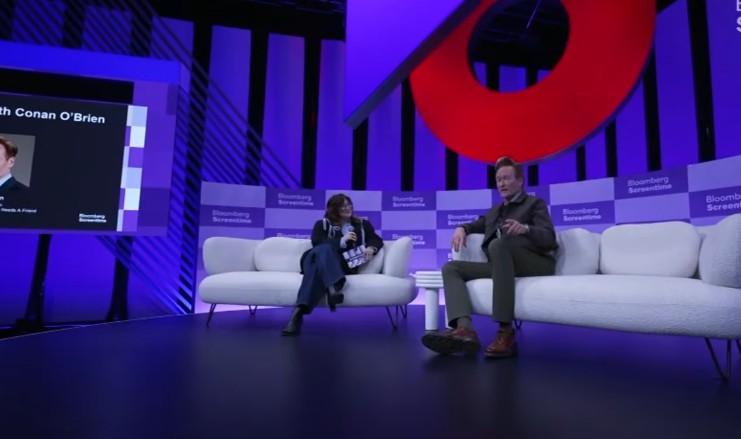
At Bloomberg Screentime 2026, Conan O’Brien sits down with Bloomberg’s Ashley Carman to talk about how his podcast “Conan O’Brien Needs a Friend” became one of the top shows in the US, why he reads ads in his own voice, and what led him to sell Team Coco to SiriusXM. He also shares his candid take on the economics and future of late-night television, competing with the internet, and why fewer writers’ rooms are a real problem for the next generation of comedians. Read the full transcript of the interview below:
Starting the Conversation
ASHLEY CARMAN: (00:00:00 – 00:00:01) So you started your podcast in 2018.
CONAN O’BRIEN: (00:00:02 – 00:00:02) Yes.
ASHLEY CARMAN: (00:00:02 – 00:00:06) It’s a top podcast in the US. This is how you spend a lot of your time now.
CONAN O’BRIEN: (00:00:07 – 00:00:07) Yeah.
ASHLEY CARMAN: (00:00:07 – 00:00:13) Did you anticipate this when you started the podcast? How has it differed from what you expected when you entered podcasting?
CONAN O’BRIEN: (00:00:13 – 00:03:18) None of this was anticipated. I wrapped up— well, I was— I knew I wanted to wrap up my late night gig soon. I had done about 28 years of between NBC, Turner, and I decided— some people were kind of thinking, “Well, if you can go to an even 30,” and I thought, I think it’s— I just, I’ve loved it, but you can kind of see which way things were going. And so in true sort of Irish tradition, I wanted to leave the party before I was asked to leave. So I said, “I know you want me to stay, but I better go.” And the— yes, it’s dramatic. They— what was interesting was, so it’s about a year and a half before I leave the show.
And someone who worked with us, Adam Sachs, he’s a very bright guy, just sort of suggested “You should do a podcast.” And my initial response was, “Why would I do that?” I have the TV show. I’ve been doing that for a long time. And he said, “You might have fun.” So we said, “Let’s do a test.” And I was at the Warner Brothers lot. We went downstairs into a small room. And I interviewed one of my writers. And I just had a blast.
I’d, for years, 6-minute, 7-minute interview with people who have hours of things to say. I’m on this side. You’re the guest. I see the wrap sign, say something funny, get the laugh. “Thank you, Ashley. We’ll take a break. We’ll be right back.” Music. Next person. And I loved it for a long time. It was the joy of my life.
But I realized that this format, which I’d been playing with a little bit beforehand with longer format interviews on a show called Serious Jibber-Jabber that we did, where I would talk to Mel Brooks for an hour. And basically, I said, “I want to do what Charlie Rose is doing, but with better lighting.”
And so we did it, and then Adam, Jeff Ross, came to me and said, “The only issue is, for this to really work, you need to read ads. And you probably aren’t going to want to do that,” because I don’t do a lot of ads. And I said, “Do I get to read them as myself?” And they said yes, so I would go to town on these ads, and then it turned out advertisers really liked it.
So we started out doing Fracture prints. “We’ll make your print out of— give us a photograph, and we’ll give you one made of glass.” Fracture print, and I would just go to town on— “The other day, someone gave me a photograph of my grandparents, and it was on paper, and I shoved it down their throat. It wasn’t on glass.” And the people I do the podcast with, my assistants Sona and Matt Gourley, they’re great yes-anders. That’s terrible.
ASHLEY CARMAN: (00:03:18 – 00:03:18) I know.
CONAN O’BRIEN: (00:03:19 – 00:03:46) Fracture. And so I would have more fun with the ads than anything else. And then they found out that people are listening to the ads. So today I’m doing ads for BMW and just monster brands left and right because people listen to They don’t skip the ads because I do them as me. I sometimes make fun of the ad copy. We’ve never had anyone push back.
Reading Ads in His Own Voice
ASHLEY CARMAN: (00:03:46 – 00:03:47) Do you still like reading ads?
CONAN O’BRIEN: (00:03:48 – 00:03:48) I do.
ASHLEY CARMAN: (00:03:48 – 00:03:49) It’s been a lot of years of ads.
CONAN O’BRIEN: (00:03:49 – 00:03:49) What’s that?
ASHLEY CARMAN: (00:03:49 – 00:03:51) It’s been a lot of years of ads.
CONAN O’BRIEN: (00:03:51 – 00:04:21) Yeah, but they’re kind of— they’re the secret, or the secret to my success other than being crazily lucky is that I rigidly always maintain my persona, my personality, and I try to make it funny in my voice. So if there’s ever a situation where I have to say, “Dove soap, it really, really has made a difference,” and be sincere, it’s not going to work.
ASHLEY CARMAN: (00:04:22 – 00:04:22) Any—
CONAN O’BRIEN: (00:04:22 – 00:04:52) first of all, it’s not a good soap. I have no idea. I’m sorry, massive corporation in the back. But you know what you did. It’s more drawing than— anyway, the— if I do something like that and commit to it and become not myself, no one’s going to want to— they’re going to be unhappy with me and they’re going to be unhappy with that company. So it doesn’t work for anybody.
Selling Team Coco to SiriusXM
ASHLEY CARMAN: (00:04:53 – 00:05:05) You ultimately ended up selling Team Coco and your podcast to SiriusXM for a reported $150 million. Yeah. After your history with networks and all of that, why did you sell versus owning it?
CONAN O’BRIEN: (00:05:06 – 00:06:51) Greed.
Thank you. Thank you. Paired with gambling debts. Those guys wanted their money.
We had an opportunity, which was sell the podcast or keep going it alone. My experience in my career has been— I like— yes, I’ve had my ups and downs. But things ended badly with NBC. But there were a lot of years there where I was very aware that being attached to a much larger entity, if I could maintain my creative voice, and there’s a larger entity involved that gives us a lot of support, and gives us a lot of different opportunities and is somewhat protective, that’s a good thing.
And so, I think when Sirius approached, we did a lot of thinking about it and thought, no, this— the opportunity to have a channel on Sirius, and of course, have the advantage of It’s a very large machine, and if you’re— as long as you don’t lose your way, it can be an asset. So for me at that time, it felt like the right thing to do.
Right now, I would like to have all the IP back, but keep the money they gave me up front, and then have a lot more money than that. But that’s just a crazy dream, and that’s just me making things up. I’m very happy with how it all worked out.
ASHLEY CARMAN: (00:06:52 – 00:06:59) Well, SiriusXM said in their press release that you were signed with them till 2027. Would you care to tell us if you’re going to renew?
CONAN O’BRIEN: (00:07:00 – 00:07:34) Well, that’s not a question that anyone ran by me when we did the pre-interview for this. I haven’t even thought about it yet. 2027 is so far off. What is it like? It’s like 2023 right now. So I’m not worried about that. We’ll get to that when the time comes. But I assure you, all will be well.
What is this place, by the way? Where are we? This is like where they shot Joe Pesci in Goodfellas, you know?
Long-Form Conversations in a 90-Second Clip World
ASHLEY CARMAN: (00:07:36 – 00:07:44) So you mentioned that for you, 6 and 7 minute interviews on your late night show was abbreviated, and now you’re having longer conversations.
CONAN O’BRIEN: (00:07:44 – 00:07:44) Yes.
ASHLEY CARMAN: (00:07:44 – 00:07:47) And now everyone consumes podcasts in 90-second clips.
CONAN O’BRIEN: (00:07:48 – 00:07:48) Yeah.
ASHLEY CARMAN: (00:07:48 – 00:07:53) How has that changed how you think about the show, and how do you feel about that fascinating progression? I—
CONAN O’BRIEN: (00:07:53 – 00:11:57) you— for years I did a show where I would come out, there’s a late night band, I come out, there’s a live audience, I connect with the audience, sit down, Do kind of fun stuff to keep them going. Come up, bring a guest out, talk to them, and then maybe play a number with the band at the end.
Then I went to podcasting, and I thought, “This is great. This is new. I did that other thing for a long time. Enough already.” And then Sirius said, “We would really like you to do some live podcasts with a studio audience, and sometimes you can do them in a—” and that turned into, “Oh, these are good. Do them in a theater.” So we started booking a theater and doing some live podcasts in the theater.
And someone said, “We’re doing these in the theater. We should probably have some shtick that you could do to kind of fill it out a little bit.” And I said, “Okay.” So we worked up some shtick. I asked some writers to help me. Then they said, “We got these people here in the transition. It would be nice if some music played.” So we got some musicians in, and one day I’m doing it there, and I’m like, “All right, we’ll take a break. We’ll be right back.” And I thought. There’s a giant organism in the universe that demands that this is what it is. I didn’t try to make it that. I didn’t want to make it that. We’ve mostly avoided making it that. We do that from time to time.
But yes, they are now— I was talking to— I did that show Subway Takes a couple days ago. It hasn’t come out yet. But I was talking to the host beforehand, and I said, “Have you had the victim of your success thing?” And he went, “I think I know what you’re talking about.” And I said, “It’s when you start out doing this thing where you’re just going to talk to the artist, and there’s— it’s very pure, and it’s just very, very, I don’t know, copper-on-copper connection, just fantastic.”
But then when these become part of the promotional machine, which they have, it starts to turn into, this is when they want to do it, but it has to air at this time, it has to drop at this time, because that lines up with their project. This is what they will talk about, this is what they won’t talk about. And you start to see it calcify, because that’s what happens to things.
So I’m not complaining because you can push back against it. I think we have. And I have some of the best conversations of my career. There are a lot of people who feel safe doing a podcast who never showed up on the late night show, because they’re intimidated by that. And they think they have to pull a rabbit out of the hat in front of a live crowd, and everything has to hit.
But now I talk to people, just Al Pacino will sit there and talk to me about everything for an hour and a half. Dustin Hoffman, Paul McCartney, Mick Jagger. It’s absolutely incredible. And if you connect with them in the moment and lock eyes with them, you never know what they’re going to say. There’s no pre-interview.
And talking to Mick Jagger just very recently in London, and he started I said, “Did you ever meet Elvis?” And he was like, “No, I never met Elvis. John.” He’s talking about John Lennon. He starts doing a John impression. “You don’t want to meet Elvis, trust me, Mick.” Why didn’t I meet Elvis? Because John told me not to. And then I was asking him a lot about the new album.
But if you create that sort of symbiotic, we’re in a flow, we talk about everything. Maybe in a different uptight environment, it would have had to be presented to him. “Conan wants to ask you about John Lennon.” “We’re not really doing the ’60s. We’re doing a new album.” But this way, it’s— he was tricked.
Podcasting vs. the Late Night Format
ASHLEY CARMAN: (00:11:59 – 00:12:05) So even though your podcast is now on video, you don’t feel this pull to have to recreate that late-night atmosphere or energy?
CONAN O’BRIEN: (00:12:05 – 00:13:37) No, it’s such a difference that There’s not an audience. An audience changes things. I, because I was on camera for thousands and thousands and thousands of hours, I don’t get self-conscious. And you can get a tone, a very conversational tone, and you can let things sit. And we don’t do a lot of editing.
And so I find some people say, “Well, do you prefer this?” And I think I prefer this now. I think I was in— I was very fortunate to have that format when that format was the thing to have. And I did it for a long time, and I loved it. But now, at this stage of my life and my career, having these kinds of conversations with people and not obsessing about what I’m wearing, not having makeup on. It just feels like this is an appropriate place to be.
And none of this— I’d love to be someone who’s up here telling you I know things other people don’t know. I don’t, I don’t know anything. I’ve been very fortunate to have smart people around me. And I try things. And if something feels right, I think I have good instincts for does this match what I have to offer? And if it does, maybe we could have fun with this. And it’s really clicked. And that’s been a joy. Really a joy for me to get to do that at this point.
The State of Late Night TV
ASHLEY CARMAN: (00:13:38 – 00:13:50) Let’s talk about the state of late night for a second here. The networks are saying late night doesn’t make sense economically. Do you buy that excuse?
CONAN O’BRIEN: (00:13:51 – 00:18:01) Well, I think if you look at what was late night, why did late night— when people talk about late night, they often don’t think about the bigger issue is why did it exist in the first place? So, network TV comes along in the late 1940s. And then in the very late ’40s, someone realizes we all go off the air at 10:30. And then an American flag comes up and music plays, which is what happened. And I don’t know if anyone here is old enough to remember that. But stations would go off the air. And maybe we could do something with that space.
And my analogy has always been, you own a nice house, kind of like It’s a Wonderful Life house, you fix it up, your kids live there, it’s a nice old drafty Victorian, and then you realize, “Hey, there’s an attic.” And what you do is you go up there and you just put down some basic flooring and put some beds in there, and suddenly you have all this room you didn’t know you had. That’s what networks did. They found room that was not being used.
NBC in particular capitalized on it. You have an early show, then you have Steve Allen, then you have Jack Paar, then you have Johnny Carson, and you’re off and running. And it’s a monopoly. All them, and then more and more people stay up late. It becomes a thing, and it’s a giant machine that fires out cash.
I got to be in— I got in in ’93, and that’s still happening. And then I saw over my 17 years with NBC, I saw it 18 years, whatever, I started to see, oh, this is really changing. This is really changing, though. They’re asking us to be much more cost conscious. And it was for a good reason, which is that HBO, Cinemax, these other things are coming up. There’s more networks. Instead of one late-night show, The Tonight Show, there’s now Tonight Show, and there’s David Letterman Show. Then there are other shows.
And so it’s a little like Detroit and automobiles. The things just started to change, and you can get really upset about it, but then streamers come along. And then, if you’re doing— and then I’m not even mentioning the internet. For years, we were working really hard to do something innovative and creative at night. Now you’re competing with how many people in America are posting videos every day, or worldwide? Hundreds and hundreds and hundreds of millions of people are making funny videos. If you do the math, 9 of them are going to be one of the funniest things you’ve ever seen. Those come out every day. That’s what you’re competing against. And so it just became very different.
I do think the economics have changed, which is why I’m much more comfortable in my situation now. I have a building on Larchmont. It’s a really nice building. It’s not that big. Everybody works very hard, but there’s not a ton of us. And we make something and the margins are fantastic. So it feels like everyone has got a crucial role. Everyone’s making something. It’s creative.
We have a lot of offshoots. We turned one of my talking to people around the world into an HBO travel show. Again, that’s not too big. We try to keep that very lean. HBO has been amazing, by the way. And then we have, we can make shorts. We can, we use that, we have a great social media team. When I do the Oscars, they get behind that. So they’re, so everything is kind of feeding back in on itself and supporting the other thing that we’re doing. And it’s really lovely.
And I’m not having to justify, I have a massive space in 30 Rock that I’ve got to maintain and an orchestra and so many people. And it’s, That’s a lot of pressure.
Competing With the Entire Internet
ASHLEY CARMAN: (00:18:02 – 00:18:06) Does the idea of competing against the entire world and internet ever overwhelm you?
CONAN O’BRIEN: (00:18:08 – 00:18:58) No, it doesn’t. Because again, I always just double down on what is it that I do? Do that as well as I can do. When people don’t want it anymore, I’m good. I really am good. I’ve got a great family, great wife. I’m really good. Try to just keep finding other ways to be creative and to do it in my voice. And if I feel like I’m starting to drift from that, pull it back or don’t do it anymore.
But I’m not— I mean, I’m overwhelmed by how much creativity there is in young comics today. I’m not threatened by them. I wish them the best. There’s comedians out there that I think are 1,000 times funnier than I’ll ever be, and I just think, God bless them.
Writers’ Rooms and the Future of Comedy
ASHLEY CARMAN: (00:19:01 – 00:19:24) Keeping with modern comedy and sort of the state of Hollywood, as networks and studios have tightened their budgets and reduced the number of shows they’re making and the resources those shows get, like writers’ rooms where you really came up in your career, yeah, I’m just curious, Do you think comedians are losing something by having fewer opportunities to be in that writers’ room?
CONAN O’BRIEN: (00:19:24 – 00:22:01) Definitely. Yeah, it’s a real problem. When I first was put into a writers’ room when I was 22, I really did feel like a fish that had been living in the desert for a long time, and then I suddenly was put into my environment. And it’s my happy place. And I don’t know what the answer is. Things are changing.
I always— the way I see it is that it’s like the discussions about AI, there will be amazing benefits. And then there will be some horrible unintended consequences. And that is the case with anything that’s new, anything. “And automobile is going to be the greatest thing ever.” “We just ran over Mrs. O’Leary.” And you have— that’s what— that’s always what happens.
And so this is going to morph and change the old days of a writers’ room running from August to April or May, and everyone being paid handsomely, and you can order food. And it’s— I mean, in the early days of my late night show, my writers, when it was doing well, and we were making money, hand over fist for the network, my writers’ meals were paid for. And they used to order lobster and champagne. And you’re like, “What the—” I would come in, I’d be mad. I’d be like, “They said we could have whatever we wanted.” And they have bibs on, you know? That’s not coming back. Shouldn’t come back. And damn those writers.
But it will change. Creative people will find a way to be creative. And they will find a way to get together and congregate and make great things. And that is— I am a 53% optimist. I really believe that it’s going to just keep changing. And it’s not going to be what I knew.
I knew a Simpsons writers’ room. And we all got paid so much money in our 20s to write the— just have this joyous experience, or Saturday Night Live. It might not be that, and I’m glad that I got to have it, but it will change and it will morph, and there’ll be ways that people get together and make things, and really talented people will profit from it.
Related Posts