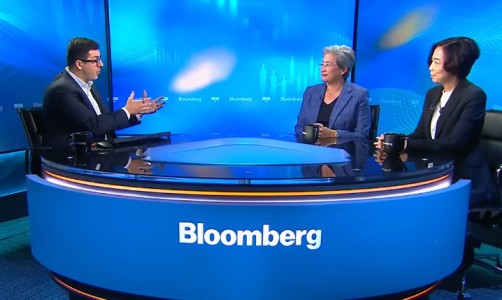
AMD CEO Lisa Su and World Labs founder and CEO Fei-Fei Li sit down with Ed Ludlow to discuss AMD’s $8.2 billion all-stock acquisition of World Labs, the spatial intelligence and world models startup behind Marble and Atlas. They explain why the co-evolution of AI hardware and software drove the deal, Fei-Fei Li’s new role as AMD’s executive vice president and chief scientist, and their shared views on open ecosystems, physical AI, robotics and AI safety. Read the full transcript of the conversation below:
Why AMD Is Acquiring World Labs
ED LUDLOW: (00:00:00 – 00:00:04): AMD is acquiring World Labs. Congratulations to you both.
LISA SU: (00:00:05 – 00:00:05): Thank you.
ED LUDLOW: (00:00:05 – 00:00:07): Lisa, I think a pretty obvious place to start is why?
LISA SU: (00:00:08 – 00:00:08): Absolutely.
ED LUDLOW: (00:00:08 – 00:00:10): Why is AMD acquiring World Labs?
LISA SU: (00:00:11 – 00:01:06): Well, first, Ed, thanks for having us. And today is a super exciting day. I can tell you that we are super excited to be acquiring World Labs. I have known Fei-Fei for a long time. I’ve had tremendous respect for her as a researcher and as a visionary.
And if you think about where AI is today, I mean, we are— I’ve said often, Ed, that we’re still in the very early innings of AI. And I truly believe that. And what’s becoming more and more clear is that the interaction between the hardware and the software and the systems and the model layer are such that the more you understand end to end, the better system you’re going to build.
And so that’s why we’re acquiring World Labs, really, is to have access to the world-class talent that Fei-Fei has brought together and really bring it together with AMD’s complete capabilities around hardware, software and systems and build the future of AI.
How the Deal Came About
ED LUDLOW: (00:01:06 – 00:01:16): I think we should get to the backstory with both of you. But would you talk a little bit, Lisa, how it came about, the catalyst for doing the actual transaction?
LISA SU: (00:01:16 – 00:01:36): Well, as I said, I’ve had tremendous respect for Fei-Fei. I mean, everyone knows just how much she has contributed to AI over the last actually couple of decades. And from our personal relationship, we’ve always had that both mutual respect and trust. But what we saw is AMD was an early investor in World Labs.
FEI-FEI LI: (00:01:36 – 00:01:36): Yes.
LISA SU: (00:01:36 – 00:02:03): So we saw Fei-Fei build when there were only just a very few researchers and really building to the team with Marble and then with now the release of Atlas. And what we see is just a tremendous nucleus of capability that would be a huge addition to already our very talented AMD workforce. So I was thrilled that Fei-Fei and her founders were excited about joining AMD.
ED LUDLOW: (00:02:04 – 00:02:21): And Fei-Fei, reflect on that. I mean, you and I have spoken very recently. This, of course, did not come up. But I suppose a good starting point other than how this came together is what opportunity did you see for your work and the team at World Labs work to be a part of AMD?
FEI-FEI LI: (00:02:22 – 00:03:31): Yes. So just to echo Lisa, this relationship has been going for many, many years. It started with mutual respect and really a genuine friendship at the personal and professional level. We’re very grateful when AMD was an early believer and supporter of World Labs. But really what’s most fundamental and important and exciting about this merger is the shared vision for the future of AI.
World Labs has been a frontier model building company. We have been running as fast as we can to build the next generation multimodal, omnimodal for spatial and physical intelligence. And as our company grows, so is our ambition, so is our need for compute.
And at this point, if we can join force with AMD, we really are giving ourselves and AMD and the ecosystem an opportunity to accelerate this flywheel between software and hardware development, which is critical for today’s AI development.
The Hardware and Models Opportunity
ED LUDLOW: (00:03:31 – 00:03:59): Lisa, I think let’s get into how that would work in practice. This is an $8.2 billion all-stock transaction, but I kind of see 2 distinct things that AMD is acquiring. There is the insight into the development of models and what the future of AI looks like that helps you inform future generations of hardware separate from just getting a great team of researchers who can also then offer models. Let’s start with the hardware piece. What was your thinking there?
LISA SU: (00:03:59 – 00:05:20): Yeah, well, I think if you take a step back and just look at what we’re trying to achieve across this ecosystem, I mean, it’s a tremendous opportunity. A lot of the focus today has been on large language models, really the large foundational model labs. We have a very deep and special relationship with folks like OpenAI and Anthropic and Meta.
And then you have labs like what Fei-Fei has built with World Labs, which is actually pushing the envelope on sort of the next big thing around world models and physical intelligence. We think that’s extremely important as well. So the foundational work that Fei-Fei and her team have done in this area are things that we will continue.
But I also see it as a nucleus for, as you know, for the size and scope of our ambition at AMD, having a world-class research team and Fei-Fei’s team will be the nucleus of our AI models team, I think is absolutely critical when we think about all of the innovation that is to be done over the next decade.
I think we want to do it really with innovation across the entire stack.
And so I view this as both a big vote of confidence for just the work that’s already been done. But even more importantly, what we will do together across the entire ecosystem.
Where World Labs Is Today
ED LUDLOW: (00:05:20 – 00:05:40): A lot of people would not have seen this coming. Fei-Fei, I actually think there’s a lot of value in saying where did World Labs get to to date, from founding to present day? You’ve been through some of your own M&A activity to grow the team. So where do we sit today with World Labs? What is the specialism and the work you’re focused on?
FEI-FEI LI: (00:05:40 – 00:05:51): So World Labs is a frontier model company specializing in spatial and physical intelligence. I was just here talking about our latest model called Atlas.
ED LUDLOW: (00:05:51 – 00:05:51): Yes.
FEI-FEI LI: (00:05:51 – 00:06:12): Which is a first of its kind multimodal, omnimodal that can generate beautiful pixels, but also have the incredible 3D, 4D consistency and allows cameras and agents to interact within these worlds. So we were founded in 2020— 2024.
ED LUDLOW: (00:06:12 – 00:06:12): Yeah.
FEI-FEI LI: (00:06:12 – 00:08:06): So we’re a little more than 2 years old with really the founding principle that AI is a civilizational technology. We really believe in the positive impact of AI and want to push the envelope beyond just the language modeling and going into spatial and physical because we’re seeing the needs for human creators, designers, for education, healthcare, but also the imminent revolution of robotics. So all this is the foundation of world models.
Over the past 2 years, we have built models and we have built team. We built— we started with the kernel of computer vision, deep learning, large models, as you said. We also have rolled out a couple of generations of models by now, Marble first and Atlas.
And we also expanded our team with robotics talents. We recently acquired SceniX, where the technologists there have built a first-of-its-kind robotic simulation workflow and cutting-edge robotic policy training models.
So World Labs is a very— still a startup, small team, very ambitious. Like Lisa said, we are focusing on building the next generation technology and we cannot be more thrilled to join force with AMD because as I said, I really believe that the future of AI is this co-evolution of AI software and AI hardware.
Models will gain so much by using the most cutting-edge hardware to accelerate the training, the inference, the servicing. But in the meantime, hardware would benefit so much from the insight and the peek into the future of the workflows and needs of hardware.
AMD as a Platform and Solutions Company
ED LUDLOW: (00:08:06 – 00:08:15): Lisa, is it as simple as AMD taking that work and selling models, offering software as a product?
LISA SU: (00:08:15 – 00:09:39): Can I first say, please, “ditto” to everything that she just said, because I think she described perfectly both the tremendous work and the opportunity. But look, from our standpoint, AMD continues to be a platform and solutions company. It’s hardware. We have software as an enabling capability. We have systems work. We’re bringing that all together. We work very, very closely with our customers who are some of the leading model labs out there.
So I wouldn’t necessarily say that we’re changing our model to be selling software. I really view this as, first of all, a tremendous foundation that World Labs has built. I think we’ve always said we believe in the open ecosystem, and I continue to believe that that’s one of the foundations. Of the AI innovation race going forward is you’re going to have both open as well as proprietary models. AMD has been a contributor there. I think we are going to expand that contribution with World Labs as part of the equation.
And the ultimate goal is with World Labs, we build better AI. I mean, that is AMD’s goal, right? Our goal is— our ambition is really to define the future of AI compute and be the best partner to the largest consumers out there. And I think AI World Labs will make us much, much better at that because of the insights and the opportunity to offer tremendous innovation across the stack.
Fei-Fei Li’s Role as AMD Chief Scientist
ED LUDLOW: (00:09:40 – 00:09:54): This deal is expected to close by the end of the year, which isn’t too far away, subject to regulatory approvals. How is Dr. Li going to be integrated into the AMD team? What will her role be that you And what did you pitch her on?
LISA SU: (00:09:55 – 00:11:02): Well, I pitched her on “join the most exciting AI company in the world.” That’s what I pitched her on. But look, Fei-Fei, in addition to the World Labs team, I think Fei-Fei has a tremendous portfolio and ability to add across AMD. So I’m very happy to say that she will be AMD’s chief scientist. So executive vice president and chief scientist reporting to me. And we will really want and welcome the contributions of Fei-Fei and the World Labs team across the AMD roadmap.
And if you think about everything that we do, and one of the things I’ve always said is there’s no one size fits all when it comes to AI, right? I mean, we talk a lot about the big cloud compute and what we’re doing in terms of CPUs and GPUs, but the physical AI world, the opportunity in robotics, the end-to-end AI capability across cloud, edge, and client.
Those continue to be places where I believe we’re going to grow a lot over the next 3, 5, 10 years. And those are all places that the World Labs expertise is really in our sweet spot.
Why World Labs Chose AMD
ED LUDLOW: (00:11:03 – 00:11:17): I do need to ask that World Labs had raised significant money earlier in the year. You have had a lot of momentum. What options did you have? Was it always a path towards joining AMD? What did you consider?
FEI-FEI LI: (00:11:18 – 00:12:14): I think from the get-go, we built a company to really stick to our mission. We’re very mission-driven and our mission is really to make a positive impact with the technology that we believe in. So it’s not a matter of option, it’s a matter of belief.
And having taken this journey with AMD since the beginning, them being our investor as well as chip provider and then gradually talking to Lisa about our shared vision. It truly is the merging of the shared vision and mission. So it’s not about option, it’s about what we can do in the future.
And I genuinely believe this is going to be 1 plus 1 bigger than 2. Well, to be fair, you’re bigger than 1 compared to World Labs, but it’s really going to be a very, very exciting journey together in that shared vision.
The Case for an Open AI Ecosystem
ED LUDLOW: (00:12:16 – 00:12:43): Clearly, emphasis on open source and is a non-negotiable in the direction of travel for AI. Let’s speak a little bit more about that, Lisa. I mean, why is it important for AMD from the company’s perspective to advocate for an open source market and environment, but also some of the models that the World Labs have worked on have been open, some have been closed or proprietary, and how you balance that going forward.
LISA SU: (00:12:43 – 00:12:59): Yeah, I think the key is what they said. It is about shared vision for what we’re trying to accomplish. And we are trying to be a very big contributor to the expansion, the acceleration, the innovation in the ecosystem.
ED LUDLOW: (00:12:59 – 00:12:59): Yes.
LISA SU: (00:13:00 – 00:14:03): And to do that, I think you’re going to have open models, you’re going to have proprietary models, you’re going to have large models, you’re going to have small models. They’re going to run on different hardware. And that’s been a premise for AMD in our entire high-performance computing and AI roadmap going forward.
So I think what you’re going to see is more emphasis on having optionality. Enterprises want optionality. When I talk to enterprise CEOs and CIOs, nobody wants to be locked into either one hardware ecosystem or one software ecosystem. People want to be able to choose what’s best at a given time. And we also want to enable all of these entrepreneurs and new companies out there that are coming up with great ideas.
So you’re going to see us continue to lean into open ecosystems as a key way of enabling the entire ecosystem. And with that, I do think part of what Fei-Fei and I have talked about is how to leverage some of the great work that World Labs has already done to actually accelerate some of the open ecosystem going forward.
FEI-FEI LI: (00:14:04 – 00:14:21): Please, can I add? So the history of modern AI cannot be possible without open ecosystem, from the open sharing of neural network algorithms through scientific community analogies to my own work, ImageNet, right?
ED LUDLOW: (00:14:21 – 00:14:21): Yes.
FEI-FEI LI: (00:14:21 – 00:14:48): ImageNet was the first open source dataset that was part of the driving force for modern AI revolution. So I think just to add on to what Lisa said, we need optionality. And it’s so important that an open ecosystem help to cross-pollinate discovery, innovation, entrepreneurship, business opportunities. This is the meaning and impact of an open ecosystem.
Expanding Beyond Spatial Intelligence
ED LUDLOW: (00:14:48 – 00:15:18): I think a lot of people will say, Fei-Fei, World Labs has focused on what we’ve called spatial intelligence, a focus on physical AI, but other areas of the market where a world model is more appropriate than text and large language model. Do you now go broader in your work within AMD? And have not such a narrow— is a strange way to put it, but yes, a broader field of work across model types.
FEI-FEI LI: (00:15:19 – 00:15:41): Yeah, look, we have a lot to look forward to in the future, Lisa, and I barely got time to talk about all the plans. Obviously, this is going to accelerate and expand our roadmap, right? We are going to have a lot of conversations. We’re definitely going to keep doing some of the most exciting work that World Labs is already doing. But I do envision that we will be expanding and accelerating.
AI Safety as a Shared Responsibility
ED LUDLOW: (00:15:42 – 00:16:07): Lisa, this is the first opportunity I’ve had to speak to you in the era of debate around AI safety. It’s hard to make it succinct, but the argument that the capabilities of models are advancing at a pace greater than safety and alignment are advancing to keep up with that development. What is AMD in your position on how best to address all of the concerns that are out in the world at the moment?
LISA SU: (00:16:08 – 00:17:36): Yes, Ed, this is an extremely important point. So I’m actually glad you brought it up because it is one that we have to be super clear about as an industry. I mean, there is no optionality in this. This is— we must have great technology and it must be safe. And that’s just unequivocal.
And when I look at just history of how we develop technologies, it is one of those things where safety has to become a first-class citizen when you’re doing development. And we’ve seen that in our own work when we think about all of the security and the confidentiality things that you have to do around the highest performing processors. I think we’re going to have to bring that into the AI ecosystem. And I know that that’s front and center in the conversation.
I am actually an AI optimist. I believe that we will put the right procedures, processes, guardrails. I think an industry-wide effort where we actually share best practices, and that’s one of the things that we do on the hardware side today, for example, around security. Those are all important aspects of it.
But I think we need to be unequivocal to those who are the users of AI. Absolutely are going to deliver great technology that is safe, that is aligned with its purposes. And it requires a tremendous amount of work. So it’s not going to be easy, but it is definitely something that we are committed to as an industry and we must work together to make that happen.
ED LUDLOW: (00:17:36 – 00:17:58): When we spoke last week, Fei-Fei, I listed to you regulation, third-party evaluation, the frontier labs taking responsibility, and your response was “all of the above.” But how do you see your work within AMD on this issue of AI safety? Also bearing in mind your long history with this industry and this field of research?
FEI-FEI LI: (00:17:58 – 00:18:50): Yeah, first of all, totally agree with Lisa. And like I said, this entire happening is because of the shared vision and shared mission. So safety is shared responsibility. AI is a civilizational technology. And like all civilizational technologies, we start with the intention of making human lives and work better. But along the way, we learn that we have to use it, develop it, and deploy it responsibly because every technology is a double-edged sword.
So I do think whether it was at World Labs or Stanford or now joining AMD, I really want to work with Lisa, her team, and the rest of the ecosystem to see how we can bring out this shared responsibility at individual level, individual company level, industry level, as well as societal level.
The Responsibility of Compute Platform Providers
ED LUDLOW: (00:18:50 – 00:19:26): I find this fascinating because I want to go back to, okay, AMD is acquiring World Labs. That gives deep insight into the development of industry and the models. The capabilities of the models and training runs improve also because the compute, it’s capabilities is improving generation to generation.
I guess the root of the question is what responsibility then the compute platform providers take for how that training is conducted safely. And then on the inference side, the running of those models, that they are aligned, they behave as we intended them to do.
LISA SU: (00:19:26 – 00:20:45): Well, it’s a great point. And I think every one of us in the ecosystem has a responsibility. And we are accountable for our actions. So from us as a hardware platform, we need to make sure that our hardware is secure, that it does what it’s meant to do, that when models run on it, that the data is secure. That is something that is very much front and center in what we do. We need to work with the model companies in terms of how the hardware and software interact.
I think Fei-Fei’s point here is the thought leadership aspect of it is we must step up as an industry. And I do think this is an industry-led thing in terms of we have the accountability to put out safe technology. But there are ways for us to work more cohesively across the industry because this is kind of new. And whenever you have something that’s kind of new, you’re actually learning. Each party might be learning at a different pace.
And so what I really welcome is the opportunity for more industry collaboration as well as some third-party evaluation to ensure that every part of the stack is working together towards this objective of phenomenal technology that is safe and aligned to its objectives.
What’s Next for AMD
ED LUDLOW: (00:20:45 – 00:21:13): Lisa, this is a massive moment for AMD. Actually, it’s a moment after some sustained momentum. $1 trillion of market cap, a big moment for the company. You have been very visible alongside the president of the United States, a leader in industry. What happens next for AMD? I appreciate that World Labs is still to close, but what you see is AMD in the future.
LISA SU: (00:21:14 – 00:22:09): Well, first, I’d like to say, Ed, I love this industry. I love what we’re able to do. I love the comments that Fei-Fei made about first and foremost, we’re here to make technology better for society, better for people. And that’s what I get excited about every day.
So the fact that our execution has been strong, that we’ve continued to really work with the leaders of the industry, both large companies as well as we’ve done a number of acquisitions that have made a large difference to AMD, and World Labs will be the next and an extremely strategic and important one.
I think this is all part of recognizing that technology is such an important part of society today, whether you’re talking about the economy or you’re talking about national security. And AMD has a chance to truly influence and direct where the future of computing is going. So no better place to be.
Fei-Fei Li on the Future of AI
ED LUDLOW: (00:22:10 – 00:22:22): And Fei-Fei, to finish our conversation with you, what happens next? You and I have discussed this in various mediums, the idea that you’re the “godmother of AI.”
LISA SU: (00:22:23 – 00:22:24): I’m going to keep her very busy.
ED LUDLOW: (00:22:26 – 00:22:48): You have been researching in the space for a long time now. This is the next space for World Labs as part of AMD. But I want that sort of crystal ball of what you think will the next major development in AI will be something that you stay up late thinking about, that you’re writing about, that you pitch Lisa back on saying, “I think this is what’s going to happen.”
FEI-FEI LI: (00:22:48 – 00:23:07): What happened next is Lisa and I, AMD and World Labs, will build the future together. And I believe so strongly this future has to be benevolent to the human society and human lives. And this is our shared responsibility and it’s what makes us so excited.
ED LUDLOW: (00:23:09 – 00:23:22): AMD CEO Lisa Su, World Labs founder, CEO Fei-Fei Li, soon to be chief scientist of AMD and a part of the models teams at AMD, among other things. Thank you both very much.
LISA SU: (00:23:23 – 00:23:23): Thank you.
ED LUDLOW: (00:23:23 – 00:23:24): Congratulations.
LISA SU: (00:23:24 – 00:23:25): Thank you.
ED LUDLOW: (00:23:25 – 00:23:25): Thank you.
Related Posts