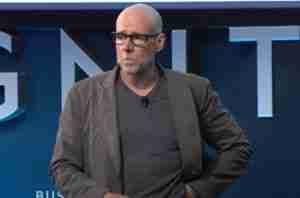
Here is the full transcript of Professor Scott Galloway’s Presentation on Amazon, Apple, Facebook, And Google Should Be Broken Up at IGNITION 2017 conference.
Introducing Speaker: Without further ado, Professor Galloway!
Scott Galloway – Founder, L2; Professor of Marketing, NYU
My name is Scott Galloway, I teach at NYU, and I appreciate your time.
I have 118 slides and 1800 seconds, 17 seconds per slide. So let’s light this candle.
I have two presentations, one is five minutes, it’s a summary of the presentation I was going to give, and then a 25 minute presentation on content, that I have never presented before. The reason I highlight that, it starts with my friend Henry Blodget has plausible deniability for what I’m about to say. This is the first and the last slide, every one of my 6200 students has seen in the grand strategy course I teach at NYU.
You can’t build a company with hundreds of millions of users, and billions in shareholder value, without appealing directly to a core instinct organ. So, let’s start with the big four, the brain.
Since we have come out of caves, we’ve taken advantage of our competitive advantage as a species, and that is we have very big brains. So big, that our bodies need to be expelled, from our mothers, because your brain becomes too big.
We’re born premature, and our brain is sophisticated enough to ask very complex questions, but not sophisticated enough to answer them. Will my kid be all right? We’ve all sent a prayer up into the universe. What is a prayer, a query, assuming there’s going to be some sort of divine intervention, that sees everything and send back the answer, will my kid be all right, symptoms and treatment of croup, think of everything you have typed into the Google query box, and you’re going to recognize you trust Google more than any priest, scholar, rabbi, coach, mentor, boss.
Google knows if you’re about to get married. It knows if you’re about to get divorced. It knows what diseases you have. It knows what diseases you have exposed yourself to. Google knows more about you than any entity in your history past or present.
Let’s move further down the torso. Facebook is tapping into our need to love. One of the wonderful things about our species is that we not only need to be loved, kids with poor nutrition, and decent amounts of affection have better outcomes than kids with good affection, excuse me, with poor affection and good nutrition, but we need to love others.
When you decide to let your parents move in with you, your life expectancy goes up two to three years, new mothers do not die. The physical and mental nuance of caregiving is the most important thing for our species, in such that it literally releases a hormone, that clears out the bad cholesterol, and you get to stick around longer. The strongest signal of whether you’ll join the fastest growing demographic group, centenarians is how many people in your life simply put: do you love, moving further down the torso, more, more is built into us.
Again, since we emerged from caves too little was a terrible death of starvation. So, open your cupboards, open your closets, 10 to 100 times what you need. You rationally know, you have 10 to 100 times what you need, and the next feeling you have I need more, because the penalty for more is gluttony, maybe lethargy, maybe diabetes with a 20 or 30 year lag, but more for less is the original gangster business strategy, and typically the most valuable company in the world is the one that offers more for less. It’s the strategy of China. It was the strategy of Walmart, and now it’s Amazon, who is going to be the most valuable company in the world.
Apple, after survival, our strongest instinct is pro-creation. The men in here are not wearing watches, they’re wearing $11,000 amalgams of plastic steel and leather, that effectively communicate to the other sex, or ineffectively in most cases. If you mate with me, your kids are more likely to survive, than if you mate with someone wearing a Swatch watch.
For the first time, we now have a tech device, that communicates that you are part of the innovation class. You live in a city. You appreciate the arts. You probably make a good living. You’re interesting, you’re groovy. You have better genes. Just as waving an Android phone, paying with a Discover card, or having Ad supported Pandora is like a prophylactic saying don’t have sex with me. There companies have literally disarticulated who we are, and reassembled them in the form of for profit companies, and created more shareholder value and influence than any other entities with the exception of the US and China, 2008, they had the GDP of Niger, in terms of the market cap.
As of today, they have the GDP of India. They’ve blown past Canada, they’ve blown past Russia, and I would argue they have more influence than any entities, maybe with the exception of Russia or China. If you look at where the most value has accreted it’s changed dramatically, just in the last 11 years, petroleum companies, conglomerates, now, it’s all tech companies, including the big four, and arguably, if I was going to write another book called the five, you would have to include Microsoft .
So, that’s a summary of my talk, that I usually give about my book, The Four, but what is the chapter I didn’t write? I’m coming out of the closet as somebody, who after studying these companies pretty intensely, for two years and working in, and around them for the last ten I believe, actually, I know, these companies should be broken up.
So, why? Let’s start off, is it because they’re evil? Well, okay. There are some evil things going on, the majority, I watched the livestream yesterday, saying we want to give, we want to give voice to people, that’s what I keep hearing, that’s Latin for we don’t want to own up to the responsibilities of a media company, we don’t want to take responsibility, for the terrible things that happen, when we don’t monitor when our platforms are weaponized.
So, effectively, you have the majority of fake news, being sponsored by social media, who legitimizes fake media, by putting legitimate news next to it on their platforms, and I signed a code of conduct every year at NYU, saying I won’t curse, I won’t be sexist, I won’t talk about politics.
So, I am absolutely not going to say here, that Zuckerberg has become Putin’s bitch. I’m just not going to say it.
The initial response is not a crisis, that does the damage, it’s the response to the crisis, that does the damage to a company. So, the initial response, that the Facebook platform had been weaponized was this notion is crazy. Then it graduated to okay, a few million people saw these impressions. Now we’re at hundreds of millions of people have seen content, whose sole purpose was to sell chaos. And what was the incredible artificial intelligence to save us through this, it’s somehow missed that these ads were paid for with a credit card, and in rubles, which give you a sense of the amount of resources being devoted to ensure these platforms are not weaponized. We’re not a media company. We’re a technology company. We’re allergic, we love the celebrity, the influence, and the margins of a media company, but we’re allergic to the responsibilities. We’re a platform.
So, query me this: If McDonald’s said all right, we’ve been serving 80% of our beef as fake, and you’re angry at us, because people are getting encephalitis, and making really bad decisions, and you say hey McDonald’s, I’m pissed off, 80% of your beef is fake, and you’re not taking responsibility. Would we accept McDonald’s saying well hold up, hold up, we’re not a fast food restaurant, we’re a fast food platform. We wouldn’t accept it. We wouldn’t accept it from McDonald’s, nor should we accept it from Facebook.
Facebook says they’re not a media company, the definition, the literal definition of a media company is a firm that uses a medium for reach and influence. There is no other entity in the history of mankind, that is more media-ish, than Facebook is right now.
Some quick definitions, as you go into this conference for the second day, to help you sort through what people are saying on stage. When people say platform, what they really mean is we’re a media company, but want to operate in another land of unprecedented multiples and no accountability. When people say things like impossible, or first amendment, or we can’t be harbored as a truth, what they’re really saying is we’re not going to do anything that’s unprofitable, Facebook could absolutely stop all this negative behavior.
If the New York Times can save us from being weaponized by Russia, with a 100 million and free cash flow, then Facebook can do it, with 20 billion in free cash flow. We’re not talking about the realm of the possible here, we’re talking about the realm of the profitable.
So, when Google and Facebook say this would be impossible, what they’re saying is it would dent our profits, which in our mind is unthinkable and impossible. Innovation, at conferences like this, typically means elegant theft, a way to leverage other people’s cars, other people’s capital expenditure, your data. We need to do better, hear that a lot lately. What does that mean? We know we’re wrong, and have no intention of doing anything about it.
These companies wrap themselves in a progressive neon blue pink rainbow blanket to create the ultimist illusionist trick. Hey, aren’t we nice, because we progressives are largely seen as nice but weak, we’re Alan Alda not a threat to anybody. Whereas conservatives are seen as smart but mean.
So, the perfect illusionist trick is to have very overt progressive values these companies pimp, because it creates sheep around what is effectively companies that during the business day are more like the Darth, excuse me, the spawn of Darth Vader or Ann Raynd. So, the ultimate cover, hey everybody, lean in, if Sheryl Sandberg was for gun rights or pro life, would Facebook be flying her around the world to talk about her political views?
I’m not doubting their actual principles, and their political views, but it’s convenient that it foots to this illusionist trick, that we’re nice and cuddly. So, you don’t need to worry about our rapacious behavior during the day. Mark Zuckerberg wants to give voice to 14 billion Chinese. Now, I’m a bit of a cynic, I think he wants to give more advertising to Chobani to an emerging market of disposable income, but we’ve given voice, or Facebook has given voice, to about 350 million people in southeast Asia.
There’s a lot of very negative things happening on that platform, yet there doesn’t seem to be much of a reaction, or responsibility for the voice, that has been given to folks in southeast Asia. And what are some of the outcomes around that I want to acknowledge upfront, there’s a ton of great stuff happening on these platforms, whether it’s parents with kids with unique diseases, or the Arab Spring, but until about three months ago, that is literally all we talked about. And we have to have an adult conversation, about both the upsides and the downsides.
And I feel like for the first time we’re having a serious conversation. So, whose fault is this? Whose fault is it? What’s gone wrong? It’s our fault. We have elected leaders, that effectively don’t hold these companies accountable. When Google lies to the EU, and uses their influence to pimp their downstream businesses, and send traffic to their own properties, which they’re not supposed to do, the EU fines them $27 billion, which is equivalent to 3% of their cash.
When Facebook lies to the EU commissioner, trying to get the WhatsApp, WhatsApp approval merger approved, they say it would be impossible, quote impossible, for them to share the data between their core platform, and the what and WhatsApp. The merger is approved, spoiler alert, three months later, they figure it out. The EU says we feel lied to. So, we’re going to fine you $122 million, which is equivalent to 6% of the $19 billion acquisition price.
If Mark Zuckerberg could buy an insurance policy for 6% called lying, that the acquisition would go through, wouldn’t that be a good insurance policy? To purchase, these VR elected officials. We’re a democracy. We have basically told these companies, that the smart thing to do, the shareholder thing to do is to lie to us, and to break the law. We are issuing 25 cent parking tickets, on a meter that costs $100 every 15 minutes, what would you do? Why are we so angry?
I did this for a friend last night. It’s like no, why are you so angry? And I reminded him, that I hate my life less and less everyday. Anyway, so I think we have for whatever reason, we personify these brands. We feel that we’re in a relationship with them, and we’ve also come to believe that technology is ultimately a weapon of betterment for humanity. So, let’s review that.
In 1942, 100,000 very smart Americans got together in the southwest, with literally the objective of saving the world. They were using swing shot like technology, and they came together, and said, we’re in a foot race with Hitler, if we don’t get there first, it’s the end of the world, and we literally did save the world.
My mother in 1944 was a four year-old Jew living in London. A strip of ocean, the brains, brawn and blood, of the British, the US and Russian soldiers, combined with technology saved her life. I would not be here if it wasn’t for technology. 25 years later 40,000 British, Canadian, and Americans, and some former Nazi rocket engineers, using more sophisticated, but still fairly rudimentary technology, did the impossible, and put a man on the moon, which given the technology at the time is still likely the most impressive accomplishment we as a species have pulled off.
Now, we have 700,000 of the best and brightest from the four corners of the earth. They are literally playing with the lasers, compared to the squirt guns, and the slingshots and the NASA, and Manhattan projects, and what is the greatest collection of humanity, of IQ, and a financial capital been brought together to accomplish to solve world hunger, it’s a great, greater comity of man, to perhaps get us to communicate more thoughtfully, about how we lift ourselves up.
How we communicate before conflict, I don’t think so. I generally think I know why these companies have come together. I know their singular mission, of the greatest concentration of IQ capital, and technology and history, and simply put, it’s just selling at a fucking Nissan, and I think we are really disappointed; I think we got spoiled.
I think we’re used to technology being 99% the betterment of humanity, 1% the pursuit of shareholder value, and slowly but surely since 1970, it’s entirely flipped. And now technology is 99% about shareholder value, and 1% about the betterment of humanity. Should we break them up, because they avoid taxes? We not only comply with the laws, but we comply with the spirit of the laws. No, not really. Not really.
This is Apple’s Headquarters. Apple licenses their IP to their international unit, in Jersey, which is as far as I know, a small island somewhere in Europe, and then the international unit, charges their high tax domains, US, tens of billions of dollars in licensing fees, suppressing the profits, in high def tax domains, increasing the profits in low tax domains. So, this is the headquarters for Apple International, that’s the sign out front in Jersey, as a result, they have 250 billion, or a quarter of a trillion dollars of the GPD of Denmark, held overseas, and has created a narrative but let us bring it back. It shouldn’t have been there to begin with.
We’re talking about giving him a tax holiday. Here’s an idea, tax him 1% a month, for all profits that have been held overseas, because of gymnastics in tax avoidance. They’re effectively paying a 4% tax rate on these profits held overseas. What is your tax rate? Apple’s not alone here. Amazon has paid 14 billion in taxes since the Great Recession. Walmart has paid 64 billion. What does it mean when the most successful companies in the world don’t pay taxes? It means our firefighters, our soldiers and our roads got to be paid by companies, that are less successful. Our tax system has basically become a regressive structural economic system, that holds back the small and medium sized businesses.
Alexa, is this a good thing? This is despite the fact, that Amazon has added the market cap of Walmart in the last 19 months, but it’s paid 14 billion in taxes versus Walmart at 64 billion. However, everybody in this room tries to avoid taxes. General Electric tries to avoid taxes. They’re doing what they’re supposed to be doing. Again, we have elected the people, it’s our fault to hold these companies to the same scrutiny and standards we hold other citizens, and other companies to. It’s our fault.
We’re letting them do this, it’s legal. Should we break them up, because they destroy jobs? This year Google and Facebook will add $23 billion in income in order to service that income, they need to hire another 14,000 people. This, by the way, is a zero business advertising. So, every person or every dollar they take, someone else is losing it.
Traditional media companies in order to service, the $22 billion, that they’re going to lose, need 150,000 people, or put another way, this is going to be out of 140,000 people, from the communications and media industry, globally, who are going to decide to spend more family, more time with their family this year. That’s 2 1/2 Yankee stadiums filled with copyrighters, strategy planners and account executives, who every year on January one are going to get their pink slips courtesy of Facebook and Google.
Australia’s a pretty good proxy, for what happens when big tech shows up. Traditional media in Australia has gone from — in 2010 from 12 billion to 65 billion, just in 10 years, whereas tech’s gone from 15 billion to 10 billion. So, do we break them up because they destroy jobs? Again, that’s a hard rational.
Manufacturing destroyed a ton of jobs in farming. Service is destroying jobs in manufacturing, and now tech is destroying jobs in services. We need job destroyers. It’s kind of a synonym for innovators. So, alone, it’s really not a reason to break them up.
So, why do we break up these guys? Why do I believe we should break them up, and my belief is that we go in, and we break these guys up, because full stop, we’re capitalists, and what does it mean to be a capitalistic? I believe that capitalism is the worst system of its kind, except for all the rest, and I’m stealing from Winston Churchill, who said the same thing about democracy, but effectively for capitalism, you need private property, wage labor, voluntary exchange, price system, and most importantly, you need competitive full body contact marketplaces. And what I’m here today to tell you is that I believe the markets have failed.
Now, some examples of how they’ve failed. Google can’t resist, and over time the shade in telling you that this isn’t us, this is a paid ad, has slowly gone away. Google used to say, we’ll take you to the best place on the home screen. Now, slowly but surely, because they have to increase their earnings every quarter, they’re no longer taking you to the best place. They’re taking you to their place, where they can monetize more of the screen through PLA’s and such. So, they are effectively restraining competition, by using their massive gateway to curb people, into the things that they own.
[The company says it’s investing for the future. Skeptics say it would have to sell every book being sold in the world today, to justify its stock price – I think my generation grew up with Sears, and Amazon is worth 20% more than Sears is worth in market capitalization – I think if you’ve heard that phenomenon, that Amazon today is worth more than SEARS – Investors are focusing…]
Well, let’s look at that phenomenon. Today, SEARS is worth $5 billion, Amazon is worth 570. Does this look like a healthy retail ecosystem to you? Retail is probably the second or third largest business in America. This is the ecosystem right now. These are the largest retailers, and their performance. Jeff Bezos announces in early January of this year, we’ve had our best holiday ever. What happens the next day? Amazon stock goes up, and every other retail stock goes down. The markets are failing in the consumer world. Because consumer stocks now move for three reasons.
One, the underlying performance of the stock, two, the macro environment, and then three, what Amazon is, or isn’t doing in that sector. Key to robust markets is that no one player or individual had too much influence, and now I can tell you as someone who’s in somewhere between 40 and 50 consumer board meetings a year, all we’re doing is allocating capital, around what we think Amazon is or isn’t going to do, the markets are failing. Amazon acquires Whole Foods. So, this is me boasting Amazon will make a transformative brick and mortar acquisition, in the next 12 months.
In sum, I predicted, I got lucky, I predicted that Amazon would acquire Whole Foods, the week before it happened. I still believe they’re going to buy a Macy’s. And by the way, I want to acknowledge, that seeing me, a video of me on top of me is like shavings of shit on a shit salad, so I apologize, and people say, well, how did you know this, this is how I knew that Amazon was about to acquire whole foods. We bark at Amazon Alexa all the time.
Alexa, buy whole milk
I couldn’t find anything for whole milk. So, I’ve added whole milk to your shopping list
And then I barked Alexa, buy organic foods.
The top search result for organic food is Plum Organic’s baby food, banana and pumpkin, 12 pack of 4 ounces each. It’s $15 total. Would you like to buy it?
And then as often happens, more frequently at my age, I bark the following accidentally, Alexa, buy Whole foods.
I have purchased the Outstanding stock of Whole Foods Incorporated, at $42 per share. I have shared 137 billion to your American Express card.
I thought that’d be funnier. Amazon announces they’re acquiring Whole Foods, their stock price, their market cap goes up, by almost the acquisition price, and the value of their competitors goes down, by more than the acquisition price. Amazon can now acquire other companies, on someone else’s credit card, markets are failing.
Since they’ve purchases it, they’ve Whole Foods, they’ve cut the price of kale 13%, salmon 33%, and in between the time they purchased, announced the purchase of Whole Foods and closed it, the price, the value, of the largest peer play grocer in America, Kroger, declined by 33%, and this is a company that is 11 times the size of Whole Foods. Every company now seems to go down based on what Amazon does or doesn’t do, including manufacturers brands. Nike announces that they’re going to be in distributing on Amazon, they go up, every other footwear company goes down, in one day, they add the value of Federal Express, or 400 of the S&P’s valuation combined.
Our democracy is breaking down, because these companies have become too powerful, the HQ2 thing is out of control. My favorite one is Chicago is offering to return employed payroll taxes to Amazon, and put another way, they’ve given Amazon permission to tax their own employees, keep those taxes, then decide, how those coffers, or how that money, that used to go into municipal coffers should be spent. I think our government has basically folded, and said we acknowledge you’re more powerful than us. I think that’s markets failing.
People say well, if he, as long as they’re good for the consumer, and they’re low prices. We shouldn’t break them up. That’s kind of University of Chicago, and Bork basic trust theory for antitrusts. If it’s good for the consumer leave them alone, and these are low prices, but tell me this, if at some point, there’s going to be Monopoly prices, if at some point we wake up, and there’s really not very many retailers around, no cloud providers except for one, they will have monopoly like power, and be able to extract monopoly rents, and people say well, that’s not really true, that’s conjecture.
And I say well, let’s look at the ultimate arbiter, of what is probably going to happen, and I would argue that’s the markets. What is the market telling us? The market puts a multiple on eVita of Macy’s of 53, target 61, Walmart 11, Walmart’s having its best year ever, trades in multiple eVita, and the market has decided that Amazon gets a multiple of 47. So, isn’t the market telling us, that at some point soon, Amazon is going to have so much power, it’s going to be able to charge monopoly like rents.
Now, the narrative Amazon puts forward is wait, hold on, we’re only 4% of retail; how can you break us up, and regulate us, we’re only 4% of retail? Yeah, sort of, they’re also 24% of all retail growth, in the largest economy in the world, they’re also a third of all cloud revenue, the fastest growing most profitable business in technology. They’re also 44% of all US e-commerce sales. They’re, can you back up one slide? They’re 55% of all black Friday sales. They are 62%, of US households in the form of Prime, more people have cable pipe of stuff in their house called Prime than voted in the US election, or have landline phone in three to five years, of trans continue, more people are going to have a cable pipe of stuff called Prime coming into their household than cable television. Oh, and that they have 70% share, of the most important technology of the next ten years, voice, 4%, I don’t think so.
They’re not the only ones. Google has a 90+% share of a market search, and now by dollar volume is a bigger market, than any advertising market, of any nation with the exception of the US. If hotels, railroads, airlines, advertising, if any of these industries, petroleum had a 90+% share in the US wouldn’t we be talking constantly about breaking them up, digital marketing, that’s the future, that’s where the growth is, that’s what’s going to create all of our jobs, for all our young people.
But guess what, two companies own a 103% of the growth, meaning if you’re digital marketing, and not Facebook or Google, you join newspapers, you join magazines, and then your business is in structural decline. Snap, more, great, supposed to be a third player, Snap is going away, Snap is the walking dead. Their last quarter, which was a horrible quarter is going to look like an amazing quarter, when their next quarter comes around, and then the next quarter. This stock will die below ten bucks a share, and Mark Zuckerberg’s hatred for this company, and he has unbelievable weapons to put him out of business is going to drive Evan into the arms of Google. We’re all hoping Snap would be the Facebook of video, the Facebook of video is Facebook, specifically Instagram, and Facebook can use its monopoly like power six of the top ten apps to put any company in the app business out of business.
The markets are failing. This is the scariest thing I’ve heard this year – Don’t let nation states disrupt our future, and you’re the front line of defense for – This is the president, this is the chair of the central intelligence committee, telling Google, Facebook and Twitter, they’re our front lines – Yeah, fuck that. These are my front lines. The notion that we don’t have our marines, people like John McCain, and Tammy Duckworth as our front lines, that’s not our front lines. The Zuck is our front lines, the markets are failing, quick side bar, Time Warner and AT&T – AT&T is buying Time Warner and thus CNN, a deal we will not approve in my administration, because it’s too much concentration of power, in the hands of too few – Okay, so let’s look at that.
Content times distribution is the axion we’re worried about. Too much content in the hands of a distributor. They can pull it from people, extract unfair rents, too much power around distribution, you can unfairly spread your content So, let’s look at it, they have some fantastic content, 140 million AT&T subscribers, 25 Direct TV subscribers in terms of distribution.
But let’s look at the peanut butter, and content distribution of the four: Google has unbelievable amount of YouTube content, 12 trillion searches a year, that inform their content, and they have distribution on 2 billion captive Android phones.
Apple has 34 million songs, 2 million apps, 22 million apps, a billion dollars committed to original content, and they’re installed in distribution called a billion IOS devices.
Amazon is committed to $45 billion in original television content, second only to Netflix; they have 70% share of voice, 62% distribution through the US, 62% of households, no cable company is in 62% of households, and they have unlimited capital. Oh, but wait. We need Time Warner to sell Adult Swim.
So, one thing is happening here, either Time Warner trying to block Timer Warner from acquiring, excuse me AT&T, blocking AT&T from acquiring Time Warner is either just insane, or we should have blocked and broken up Google, Facebook, Amazon and Google five years ago. It makes no sense.
Okay, we so we need to get rid of mantra test time. If Paul doesn’t — gone over, I’ll go two minutes, then I’m done. There’s a certain fear, people like me, that we come across as wimps, when we start talking about regulation, because the narrative being fomented by these companies is that regulation equals European, which somehow, someway became an insult in America, and then even worse socialism. I go on Fox News, every week, because I keep my friends close, and my enemies closer, and this is how they introduce me now, when I suggested Amazon should be broken up.
He’s a socialist, but we’ll have him on the show – Are you a social, you are a socialist, are you not? I’m full throated capitalist. Okay, so, let me ask you this. If the Department of Justice hadn’t moved on Microsoft, after they killed Netscape, would Google have ever made it out of the crib, regulation creates unbelievable shareholder value, when it’s done adjointly. We have $700 billion company called Google, because the Department of Justice stepped in on Microsoft, and said stop killing nascent companies.
Some final words, I believe the purpose of an economy and companies is to create a middle class. Two metrics, how many girls go to college, and how robust is your middle class, and I’ll show you the freedoms and prosperity of any society based on those two metrics. And our middle class has gone sideways for 30 years, in what is the greatest experiment in mankind called the US. It won’t be easy to break these guys up. Why? Because this individual has aggregated a great deal of power, and is smarter than the rest of us, 77 full time lobbyists in Washington.
The ultimate prophylactic, the New York Times, if a liberal paper is saying don’t break these guys up, then we’re safe. Oh wait, the New York Times can’t be bought, has a trusted five to six cousins, it’s a effectively a suicide pact, you can’t buy it. What’s the second best thing they could buy to put sheep’s clothing over the wolf that they are, here’s an idea, or let’s make an investment in this cool new media company. Awkward.
My last slide. Try and put aside your political feelings, your economic concerns, and the gag reflex, reflex we have as Americans around regulation, and just do a Darth. I think every business problem can be solved, with a scene or a saying from Star Wars, and I’m going to ask you to take the advice of Darth Vader – Search your feelings you know it to be true – Search your feelings you know it to be true.
Imagine an ecosystem with these four companies, which ecosystem has more job creation, which ecosystem has a broader tax base, which ecosystem has thousands and ten thousands of millionaires, maybe not as many billionaires, but tens and hundreds of thousands of millionaires, which system has more venture backed companies, more M&A, more robust deal activity, and more capitalism, and more full throated, full body contact competition.
This ecosystem, or this ecosystem. We don’t break these guys up, because they’re evil, that’s bullshit, they’re no less or more evil than us. We don’t break them up, because they avoid taxes. We need to hold all companies accountable, that’s our own fault. We don’t break them up, because they destroy jobs. We need innovators to destroy jobs. We break these guys up, because we are capitalists.
My name is Scott Galloway, I teach at NYU, and I appreciate your time.