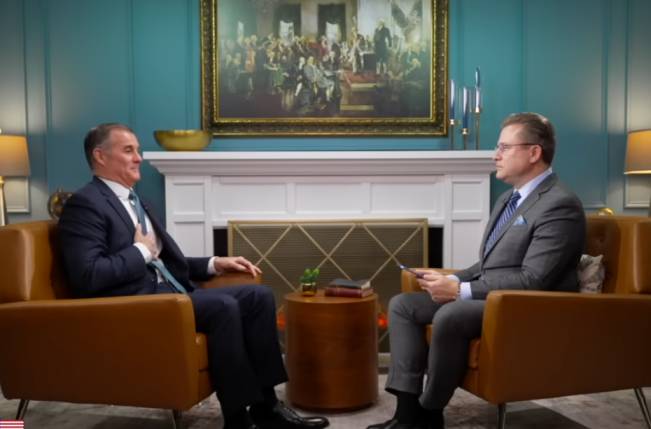
Here is the full transcript of former US Army Pacific Chief Gen. Charles Flynn’s interview on American Thought Leaders podcast with host Jan Jekielek, premiered December 14, 2025.
Brief Notes: Recently retired four-star General Charles Flynn, former commander of U.S. Army Pacific, breaks down what truly keeps him up at night: the prospect that China could mobilize, load, and land a massive PLA invasion force across the Taiwan Strait in as little as 96 hours. He explains why Beijing’s anti-access/area-denial arsenal is optimized to blunt U.S. air, sea, space, and cyber power, but far less capable against distributed, networked land forces embedded across the Indo-Pacific.
Flynn argues that the real “center of gravity” in any Taiwan contingency will be PLA ground troops, and that Washington must urgently build a “strategic land power network” with Asian partner armies to deter that threat before it materializes. Along the way, he warns that China has been waging a form of unrestricted warfare—economic, informational, and legal—for more than a decade, and calls for a faster, forward defense strategy that matches U.S. rhetoric about a Pacific pivot with concrete action on the ground.
—
Opening Remarks
JAN JEKIELEK: This is American Thought Leaders and I’m Jan Jekielek. General Charles Flynn, such a pleasure to have you on American Thought Leaders.
GENERAL CHARLES FLYNN: Thanks, I appreciate you having me and very grateful to Epoch Times for the opportunity.
Japan’s Rising Tensions with China
JAN JEKIELEK: So let’s talk about this headline from the Indo Pacific. Japan threatening US militarily, China tells German Foreign Minister. That’s Reuters. What’s your reaction?
GENERAL CHARLES FLYNN: Well, I look at the two recent incidents of the rhetoric going back and forth between China and Japan. And then just 48 hours ago, aircraft from China basically locking radars on Japanese jets.
I think Japan is beginning to take seriously the threats that China has imposed upon them and the penetrations of their air exclusion zone, maritime exclusion zone. And so it’s important that Japan step up and take these actions to protect their own people and their own national sovereignty. But also signal to the United States through our treaty and through our alliance that they’re not going to put up with this kind of behavior, irresponsible behavior by the Chinese.
JAN JEKIELEK: How important from the military perspective is China for the United States?
China: The Most Dangerous Threat
GENERAL CHARLES FLYNN: It is the most important. I think by way of threats, it opposes the most dangerous one to the United States. I’ll start back a little bit. In 2012, President Xi obviously took over the presidency of the Communist Chinese Party. And I’m going to say this right up front: I’m not against the Chinese people, but I am against the Communist Chinese Party.
If you just jump forward to about the 2014, 2015 timeframe, what was happening was their economy was moving at a pace that was unprecedented. Their modernization efforts had caught up with their training, training reformations, and some of their reorganizations of their military formations.
So around the 2015 timeframe, they had a modernization of their military that was kicking into a second gear. They had an organizational change that was going on across their forces, and then they were fielding new capabilities. And of course, their industrial strength was just kicking into that next gear.
So when you match up the modernization of their military equipment, the organizational changes that they were undergoing, and then the training reforms that they were putting in place, well, here we are in 2025. So that’s a decade ago. And as I’ve said publicly before, if we don’t slow their trajectory down, that is a very, very dangerous outcome for the United States and arguably for the globe.
JAN JEKIELEK: And they, of course, say, “Well, we’re just doing this to protect ourselves.”
Understanding China’s Anti-Access/Area Denial Arsenal
GENERAL CHARLES FLYNN: Well, maybe so. On the other hand, I think that the arsenal that they’ve created, the A2AD arsenal that they’ve created, which has a serious amount of reach in all of their forces from hypersonic and—
JAN JEKIELEK: Just explain what that is.
GENERAL CHARLES FLYNN: This A2AD arsenal, which is anti-access area denial force, is primarily designed to defeat the strengths of the United States military. And the strengths are our air power and our maritime power, primarily. Secondarily, it’s designed to degrade, deny and disrupt our capabilities in space and cyber.
One thing it is not designed to do: it’s not designed to find, fix and finish distributed, mobile, reloadable, networked land forces inside the Indo Pacific. And the land force network and the land power network that I’m talking about is built around the United States Army, the United States Marine Corps, United States Special Operations Forces, and then the fourth component, which is a really important component, which is the land forces inside of Asia.
So when I look at the map, I see people, I see terrain, I see borders, and I see sovereignty. When others look at the map, and traditionally, I think this has been part of our challenge in the United States, we look at the map and we see blue, we see an ocean, and we see air. And we say we can solve this problem with more ships, more subs, more airplanes, more jets, more precision guided munitions, more satellites.
Look, I’m not against a large U.S. Navy and a large U.S. Air Force and all the other capabilities that have to come with things, platforms. In fact, we need them.
JAN JEKIELEK: Why?
The Case for Strategic Land Power Networks
GENERAL CHARLES FLYNN: Because they do only what the United States can do, which is keep the Global Commons open. What I’m saying is that region is a joint and it’s a multinational problem. It’s a joint and multinational theater. And it can only be solved by joint and multinational applications in all domains. That includes the land forces.
The predominant force in Asia is its armies. I’ll go through a couple of facts. India, 80% of its military is its army.
The point I’m making is there’s a natural partnering and a persistent state of connection between land forces in the region. And we cannot discount those forces in the region that are land based. What do they do? They protect their territorial integrity and they defend their national sovereignty.
And some of those forces are beginning to step up in ways that we never saw before. And that’s one of the things I’m very proud of, of my time over the last 10 years out in the region, is really trying to tie together a strategic land power network as a counterweight to what the Chinese are doing.
I’ll go on a little bit here and also say that some experts, and I’ll leave that open, often refer to the Chinese navy as its center of gravity. And I say, no, it’s not its center of gravity. Why? Because the military definition is that which you need in order to achieve your objective.
My view is you can’t invade Taiwan with the Chinese navy and the Chinese air force. You actually have to deliver an invasion force, and that is its Chinese army. That’s the PLA, of which there are many of them. And my point is that we have a way of increasing the indications and warnings to our national command authority by watching the army.
JAN JEKIELEK: Why?
The 96-Hour Nightmare Scenario
GENERAL CHARLES FLYNN: Because the army actually has to mobilize, move combat, configure combat load, and then get across the Taiwan Strait in order to seize, hold and subjugate the people of Taiwan. Now, the last time we did something like that successfully was the Incheon landing. It is a highly, highly complex operation.
And the point I’m making here is the naval incursions and the air incursions are happening every day at alarming rates. And that keeps the U.S. Air Force and the U.S. Navy really engaged every day, not to mention Japanese, Korean, and of course Taiwan and others.
But my point here is that if we get command and control, we get intelligence collection forward along with sustainment, along with protection, and we tie together the synergy between the forces in the region on the land, then we can impose dilemmas on the Chinese that heretofore we’ve not put on them.
If you want to understand if they’re going to mobilize that PLA army, then you’ve got to watch the PLA army because it will take time for them to actually move from their garrisons to the coast, load those vessels and get across. You’re not going to see and have that kind of time with air power and naval power from the Chinese. There’ll be some indicators. But when they start moving that army, then there’s a problem. Things need to stop very quickly.
So what keeps me up at night, what keeps me up at night is their ability to actually pull that off in 96 hours. That’s what keeps me up at night. So anything that we can do to slow down that timeline, feed doubt, sow paranoia and introduce new dilemmas to the Chinese leadership, then we are on a stronger footing by way of deterrence and denying them the ability to think that they could pull that off.
U.S. Commitment to Taiwan
JAN JEKIELEK: General Flynn, we’re going to take a quick break right now and folks, we’re going to be right back. And we’re back with the former Commander of the U.S. Army Pacific, General Charles Flynn. One of the things that was clear to me, and I’d love to get your perspective, I believe is abundantly clear in the new national security strategy for the US is that the US is going to protect Taiwan. And it sort of feels unequivocal to me from what I read. What’s your take?
GENERAL CHARLES FLYNN: Well, I think it states in there that our current policy of status quo is going to remain. Now, I would also tell you that we need to continue to do what we have been doing for years with Taiwan, really since 1979, which is we have foreign military sales, we have foreign military financing, we have training exchanges that go on.
And so, as far back as when I was a Division Commander in 2014, when we sold them Apaches, when we sold them M1 tanks, we send trainers from the army over there to do that training. All of the services do that.
JAN JEKIELEK: Why?
GENERAL CHARLES FLYNN: Because there’s this interoperability leg of the stool by way of capability exchanges and sales that go on with Taiwan. So when we give them platform, then we have to send trainers and industry to help them understand what those capabilities really mean.
So when I look at what is going on today with additional funding that Taiwan is putting on the table and that the US military and the capabilities that we have and how important they are to the defense of Taiwan, then I think that is a good place to be—the United States and Taiwan in being able to assist them and enable them in defending their independence, their freedoms and prosperity, and basically their territorial integrity and national sovereignty.
These two points are inexplicably tied. I mean, the countries in the region are looking to defend their borders, defend their wealth, defend their people and maintain their territorial integrity, not unlike what the national security strategy says about our own United States of America and being able to protect our borders and our territorial integrity and our national sovereignty.
Forward Defense: Not Intervention, But Protection
JAN JEKIELEK: It sounds like you’re saying that the US should put more military assets in these countries in partnership with those militaries. And that’s been described even by some people that are friendly to this administration and so forth as being almost like intervention or almost could even be like an occupying force or some sort of nation building or perhaps empire even. How do you respond to that kind of criticism that this is not, that this would be somehow away from an America First vision?
GENERAL CHARLES FLYNN: What you’re describing, I actually think it’s part of that, but I’ll say it a different way. So first of all, and to remind folks, America’s day starts in the second island chain. Those are US citizens, and that is part of our defensive perimeter all the way out to Guam in the Northern Marianas, the Marshall Islands and Sienna.
So we already are a Pacific nation. We have four of our five treaty allies out there: Korea, Japan, Australia and Thailand. And obviously, I say that this century is going to be defined by the relationship between the United States and China, like last century was defined by the relationship between the United States and Europe.
What I’m ascribing to is that there’s no better defense than a forward defense. So for years we have sailed—
JAN JEKIELEK: You—
The Need for Forward Presence Without Expansion
GENERAL CHARLES FLYNN: You know, in the commons, we have flown in the commons and we have basically protected the global commons to maintain the freedom of navigation through those commons, primarily for commerce and for protecting the territorial integrity of our allies and partners in the region.
Really what I’m saying is that we already have a sizable US Military in Korea and Japan. I’m not looking to do more bases. What I’m really looking to do is have more faces in more places with less bases. Okay, so what that means is dynamic rotational and an increase in multinational and joint exercises that are out in the region.
Look, when I was in uniform as the US army commander in the Pacific, we had over 40 army to army and joint exercises that the army alone had in the region. So my point is we need to be in those regions and in those areas and in those countries to increase the confidence of those partners and allies in the region that the United States will help them defend what they need to do.
But I also take a look at the national security strategy and I think about the remarks of Secretary Hegseth at Reagan and I’ll sum up, I think the foreign policy of that strategy as this administration is going to help those that help themselves. It’s also said another way, I would say that in order to have some say they’re going to want you to pay, they’re going to want you to put some money on the table.
JAN JEKIELEK: Why?
GENERAL CHARLES FLYNN: Because it’s an investment in your own defense and protecting your own territorial integrity and national sovereignty. And a large part of their security umbrella in the region are their land forces, just like China. China’s army and the people’s police force is enormous.
So you know, I think that we are downplaying in sort of a high risk way the role of land forces in the region. And I’ve had these conversations with number of people. I’ve been saying it for at least four or five years as a four star and retired four star, but I really was talking about it even as a three star and a two star in my time out there.
And I just think that, you know, we’re 10 years from that window of modernization, organizational change, and the technology injects into the military in China. And I think that we cannot wait anymore. We cannot wait. I mean, speed is our biggest problem right now. We have to have a greater sense of urgency to counter what the Chinese are doing in the region.
I’ll remind folks that their goal is regional hegemony and then global dominance. Okay? So that’s stated plainly by their leaders. So if they can gain that regional hegemony, that gives them a step to their global aspirations. We have to prevent that regional hegemony from going on.
De-Risking Critical Sectors
Now, I am for, I think Secretary Bessant has said, you know, we don’t want to decouple, we want to de-risk. I understand that, but I think we need to look at the certain sectors to say, well, how much risk is in, say, the critical mineral and rare earth element area? Very, very high risk. How much risk is in the pharmaceutical sector? Very. A significant amount of risk.
So I guess within those sectors, we’re going to have to decide which ones are we going to actually go further in de-risking and maybe even delinking, you know, our connection to China. We didn’t have this problem with the Soviet Union during the Cold War. This is a problem primarily that’s been created by our policies towards them since their entry into the WTO.
And that free trade nation status allowed them to be woven into all the regions across the globe and into every sector. And they deliberately made decisions to check us or box us or prevent us in certain sectors. And now look at the position that we find ourselves in. It’s very dangerous.
Unrestricted Warfare and the Challenge of Recognition
JAN JEKIELEK: Well, so. And this all has been part of their unrestricted warfare strategy. This has been, you know, you could call it military strategy, you could call it industrial policy. From their perspective, these are all kind of interlinked, interwoven things, right?
And so let’s touch on this right now. One of the complaints is that in the US and probably in the west, writ large, right, when someone’s waging war against you, you kind of like, you kind of wait until someone says, “I’m waging war against you.” But if they do it without saying so and with plausible deniability, it’s almost like you don’t notice and you behave, I mean, to great detriment.
So, you know, I think again, by looking at what their own leaders have said and what their propaganda organs have said and what they’ve actually done, they’ve been waging war for 10 years, you know, if you want to talk about that window that you just described. Right, so you would agree with that?
I would, yeah. So, and, but somehow it’s been very hard for us to notice. And I don’t even know is the US Military able to recognize all of that activity as military activity?
GENERAL CHARLES FLYNN: Well, what I would say is I think the military has recognized it. But let me give a couple of points here. First of all, sometimes we need an event and I’ll, you know, just draw a historical analogy because it’s the 9th of December.
The war, the Second World War, did not start on the 7th of December 1941. It actually started in 1931, 10 years prior with the Japanese invading Manchuria. And then you have Spanish Civil War in Europe, you have the Italians in Ethiopia. There were a series of regional wars that were going on across the globe. It was World War Two, not just one war.
And then if you, you know, go forward to like 1937 through 1939, the things that were happening in Europe, in your own home country, that what was happening when the Japanese then went into Southeast Asia. December 7, 1941, was the end of a decade of regional wars that had exploded into now what was a world war.
Well, where do we find ourselves today? We’ve got a regional war going on in Europe with Ukraine and Russia and NATO is, you know, tangled up in it. We’ve got the Israeli, Iran, Gaza war going on across the Middle East. You could argue there are other spots of war going on in Africa and even Southeast Asia.
And so the last thing that we actually need is another regional war in the Indo Pacific. Because in my view that’s a global war that would be akin to what we, what I just outlined from 1931 to 1941. And look what that rendered. You know, 85 million people by some estimates were killed.
Okay, so if I just take the clock back on my own watch, because I went back out there in my second assignment in 2014 as a two star division commander and then I was a two star deputy commander in US Army Pacific. And I think about what was going on during that period of time. This is why I say that China has been on an incremental, insidious and irresponsible path to create conditions where they gain regional hegemony because they have global aspirations.
And so, yes, they have been conducting war. I’m going to say that primarily this has been going on in the information domain and in the legal domain.
JAN JEKIELEK: Okay, what about financial?
GENERAL CHARLES FLYNN: Let me just look at that. Well, I mean, I, you know, you’re…
JAN JEKIELEK: Including that in the trade?
Economic, Information, and Legal Warfare
GENERAL CHARLES FLYNN: I guess I am, yeah. And in the previous, you know, question, we talked about those sectors that they had gone in and dominated. And now look, we find ourselves with 90% of the processing of rare earth elements and critical minerals has been done by China.
So, you know, we shouldn’t find ourselves, you know, surprised by the fact that we’re going to have difficulty making batteries, we’re going to have difficulty making magnets, we’re going to have difficulty making semiconductors and protecting them. I’m not saying we don’t need, you know, technology and we need AI. We need those big companies to do that. But it’s going to be a long, hard slog to regain control of our end to end supply chains.
So that’s the economic lever that we’ve already talked about. But information, you know, I’ll just draw one example, a story and you hear about it. In the country, of course, there’s land being purchased. All of a sudden it’s a, you know, it’s a thing that lands being purchased around military bases inside the United States or farmland, or they’ll use the excuse of a farmland. Okay, just park that for a minute.
I’m going to give you a couple of stories of two countries that I won’t name, but in both of them are in Southeast Asia. So here’s the playbook. China buys land. They buy those land near locations where we primarily train at. They own, you know, 90% of a telecommunications company. They put towers on the land, so you automatically know what they’re doing with those towers nearby, proximity wise to where we train at.
Then they own large parts of media companies, and then they build bot farms to spew misinformation, disinformation about the west and about the United States. This is happening throughout the Indo Pacific. It’s happening all over Asia. I would argue it’s happening all across the globe to include inside of our own country. And so these are the kinds of things that we have to counter because that’s an example of the information warfare path that they have been on.
The lawfare is very clear. I mean, they’re out, you know, sensing, collecting ramming boats, firing flares, and then, you know, making a case to say, “Well, it’s, you know, it’s the South China Sea, it’s named after China. Like, what’s the problem?” Well, the problem is it’s the global commons. And there’s of course, arguments in courts about who owns what.
But the fact of the matter is all of those countries that surround the South China Sea are concerned about the violations of their territorial integrity and their national sovereignty. Again, when I see the South China Sea and I think back to my time from 2014, we told them not to build islands. They built islands. We told them not to militarize the arm, the islands. They militarized them. We told them to not, you know, position forces on those islands. They did that.
So we asked them to do it three times, and every single time they violated. Now I look at, I look at the South China Sea again, I’m a land guy. So I see these land features being made and I see terrain being created. Why? Yeah, to choke off the superhighway through the South China Sea. But that’s also, you know, the fishing rights for about 125 million people. I mean, that’s a lot of commerce that’s at stake there, at risk there.
So these are examples of where this information warfare and lawfare coupled with the economic warfare that they are conducting tied to the military buildup that they’ve had going on. I’m talking about a decade, but it’s been going on for more than that. And so these things all come together.
And of course, it is the Communist Chinese Party that’s in charge of this, and they’re calling the shots. Again, this is not against the Chinese people, but this is against the Chinese Communist Party. And we have to be very, very clear eyed about that being an adversary. The enemy are not the people, but that party is an enemy and it is an adversary.
And we need to take stock in the fact that they’ve been at this for a number of years. And to your point earlier, it’s, we have to wake up, we have to get a sense of urgency, and we have to come up with a strategy and a plan to counter what they’ve been doing.
JAN JEKIELEK: How much do you think that this national security strategy that we just saw drop, how much do you think that that addresses exactly what you talked about?
The Forward Defense Strategy
GENERAL CHARLES FLYNN: I think it squarely addresses almost all of it. Now, you know, I know there’s a debate out there about, well, the Western hemisphere is first. Well, I mean, I think that our homeland has always been, you know, at least from military terms, defend the homeland. First you have to protect, you know, your families, your freedoms, your independence, our prosperity.
But, you know, and then after that, it’s China as an adversary. Now, what I would say is I think the best defense is a forward defense. And I’m not talking about stationing permanently more forces in the region. What I’m talking about is a combination of permanency, which we have already—Korea, Japan, there’s forces in Singapore—and then rotationally. In other words, doing that with the known exercises and the known training periods that we have to rehearse the very functions that we need to do in the event that conflict or crisis emerged out there.
The other way to do this is dynamically—surprise experiments and surprise exercises that we have to conduct in the region. And this is where I think industry and the Department of War can do a much, much better job of being able to get things into the region and test certain capabilities out in that region. Everything from electronic warfare to new munitions, to sensors, to collection platforms, to artificial intelligence, machine learning, robotics.
If we are going to test something, we need to put it in the hands of our soldier, sailor, airmen, marines and guardians and put it in an operational force forward. Why? Because it’s important for our force to be able to get hands-on applications of those new capabilities and new technologies. It forces us to change organizations. That’s the best feedback to industry.
But maybe this is the most important part: it is a signal of deterrence to our adversaries out there because we are doing new things with new capabilities and they didn’t see it before. And again, that slows down their trajectory.
Deterrence vs. Saber Rattling
JAN JEKIELEK: So this is interesting, right, because going back to the headline that I mentioned at the beginning, right, the way they will portray that—I’m talking about the Chinese Communist Party—is that this is the US and these other countries saber rattling. This is Japan saying we’re going to protect ourselves, or Japan saying Taiwan is important to us or something. You know, I’m being a little bit paraphrasing here, but basically that’s actually saber rattling. And there’s even people in America, and not a small number, that would say that kind of sounds like saber rattling to me. So explain this. This is deterrence. This is not saber rattling. Explain this to me.
GENERAL CHARLES FLYNN: Okay, so let’s talk about deterrence. So the essence of deterrence is winning without fighting.
JAN JEKIELEK: Okay?
GENERAL CHARLES FLYNN: So I could argue that the two regional wars that we have ongoing today is because our deterrence faltered. Okay? So we can’t afford to have our deterrence questioned in the Indo-Pacific. Because back to my earlier comments, you’re going to take two regional wars, add a third, you’ve got a global war on your hands. Okay?
So my point is that in order to place capabilities out there like command and control, protection, collection, sustainment, and disperse those, you’re actually reinforcing confidence with our allies and partners in the region. At the same time, you’re creating a deterrent effect on the adversary because again, we want to be in places that surprise their ability to actually operate.
Okay, I’ll give you an example. In early 2024, we placed a mid-range capable battery, a new capability in the multi-domain task force in the Philippines. It was up on the northern tip of the island of Luzon. This mid-range capable is a combination Tomahawk and SM-6 missile land-based with deep range. As soon as that landed and offloaded and we set it up—and we landed in the middle of the night and we offloaded within 24 hours—the Chinese came out with a statement that basically said, “Philippines, be careful of becoming the cat’s claw for the United States.”
So this is the intimidation, this is the coercion effect that the Chinese have in the region. And of course, what did the Philippines say?
JAN JEKIELEK: Good on the field?
GENERAL CHARLES FLYNN: They countered right away by saying, “We will train, we will project, and we will protect our people any way that we choose.” They were basically making a comment about their sovereignty. And that is a really good example of the region stepping up and saying, we are not putting up with your insidious, irresponsible and incremental approach to draining our resources and sapping our will.
And this is where I think the United States plays an important role in being able to demonstrate new capabilities, new organizations, and introduce new technologies and new concepts with our allies and partners in the region to again slow down the trajectory of the Chinese military and the way that they’re employing their military forces and their application of those forces in the region against our treaty allies and partners.
Leadership Changes in the Chinese Military
JAN JEKIELEK: I want to talk about the Chinese military for a moment. So we’ve of course been tracking these massive changes actually in the leadership of the military, purges of certain generals, like top, top leaders. You know, over the course of the last, let’s say about a year, it’s been very clear from our analysis that Xi Jinping has a lot less control of the military than he did before. Okay, that’s our analysis. I’m open to being countered here, just to be clear. Right.
And over this time period, basically every single leader of region and also, you know, type of military, whether it’s army or air force, has been replaced. I think there’s two, by our count, roughly, that are either not in big trouble in some way or have been removed altogether. And we can’t entirely tell if this is Xi Jinping removing people he’s figured out are not loyal to him, which he appointed all of them. Or this is the military leaders, you know, basically asserting more control themselves, which we believe they do actually have a lot more control than before when he was sort of the top, top, top guy.
But anyway, what does that do to a military when almost every single leader has been removed and of course they’ve been replaced and everything. But you could understand this at a level that I think few people could.
GENERAL CHARLES FLYNN: Well, a couple things. One, we need to be careful about mirror imaging how we would feel versus how they see this. Okay, so I’ll state that up front. You said the last year, I will tell you that this has been going on for about three years. There’s been a rash of removals over the last three-plus years. That’s one component of it.
There’s another component of this. He’s also done reorganizations. Rocket forces, command and control, army, navy, the police forces. They’ve had some command and control adjustments over time. The STRATCOM commander previously talked about a nuclear breakout. They’ve had some because they’re growing their nuclear forces.
So, you know, I guess I’ll point to two things here. One, it’s been going on for longer than a year. And two, there are reorganizations going on inside the military that are generating some of these changes. Now, one argument is Xi’s putting in loyalists. Another argument is that he may not be putting in loyalists, but he’s rooting out corruption. You can look at it both ways. You know, he’s clearly going to put people in there that he trusts. But why is he taking them out? It may be for incompetence. It may be because of the reorganization, maybe for corruption. It’s probably a combination of all three.
JAN JEKIELEK: There is a final option. The final option is that they don’t trust him enough and he doesn’t have as much power as they would like to portray to the rest of the world. Because of course, they always want to have this sort of unified picture. So, well, yeah, maybe.
GENERAL CHARLES FLYNN: But again, I, you know, what people may not realize is the police force inside of China is equal to the size of the army. It’s about 1.3 million people throughout that entire country. And that police force is an internal security force to maintain control of the people for the Communist Chinese Party.
So these changes in the military, I view them as, you know, the President is putting people in that he trusts. They’re loyalists. But I can’t accept, at least as a military leader, we can’t just say, well, they’re disoriented and they’re not as experienced and competent as the previous one. I think we have to assume that they know what they’re doing, they’re loyal to the party and they’re loyal to the President and therefore they will execute the orders that they are given.
So my view on this is that we have to take it on face value and say, listen, that military instrument is so big that every day when we wake up out in the Indo-Pacific, we have to be thinking and acting and behaving in a way that counters that military instrument.
I mean, this is the one thing about the US Military that I found to be so important is that at least for me, out in the Pacific over the last decade, every day I woke up, I woke up and thought about the Chinese threat, secondarily I thought about the North Korean threat, and tangentially I thought about the Russian threat. And that gives a military great focus.
The Pacific Pivot: Rhetoric vs. Reality
Now my trouble with it is that we’ve said we’ve pivoted to the Pacific for more than a decade and in actual behavior and actions, that’s not accurate. I’m going to give you an example and a story.
So in April of 2022, I was in an ASEAN country and I was at a meeting with the Chief of Defense, the Chief of Army and their Minister of Defense. And an announcement had been made that evening that a $33 billion support package was going to Ukraine because the war had just started in February of 2022. And the chief of army and the Chief of Defense stood there with me next to the Minister of Defense and they asked me this, they really made a comment to me and they said, “Are you serious? $33 billion to Ukraine? You’ve been talking about pivoting to the Pacific for more than a decade. What is going to happen now? Are you going to be here?”
And I think that that really struck me at that particular point. And I thought, boy, if we don’t signal and message our will to our treaty allies and partners in the region, we’re going to create a lack of confidence in the United States in the Indo-Pacific at a time when we can ill afford to have that.
And that story rang true with me throughout the rest of my time in uniform out there because I tried to hustle the best I could to pull together the army leaders in the region. And again, I think the army leaders in the region, not only did they leave the army and go into political positions, they also go into important business positions, and they’re influential in all of these countries.
So I was, you know, making heavy investments in my time in the region to pull together those countries, because I honestly believe the greatest counterweight that we have to China is the network of allies and partners that we have across the region. We need to maintain the United States being the security partner of choice, even though China may be the economic partner of necessity in the region.
And I think the best way to keep that security architecture bound together is by applying all domain, all forces, joint and multinational in the region, and that includes the land power network that is actually central to maintaining security in the region.
And again, I’m making this point because I run afoul or at odds sometimes when I hear, well, I mean, just this morning before I came over here, I hear “the theater is an air and maritime theater.” And it’s not. It’s a joint theater. It’s a multinational theater. It’s got joint and multinational problems. It’s only going to be solved by the joint force and multinational forces.
And so we have to do that with our allies and partners. Clearly, there’s an economic component to this. Clearly there’s an information component. Clearly there’s a diplomatic component to it. But make no doubt about it, the Chinese military and the military instrument that they have created in the last 15 to 20 years is a very, very dangerous arsenal. And we have to find a way to counter that.
The Unique Role of Land Forces
JAN JEKIELEK: Something you said to me a while back when we were speaking struck me as really interesting. Namely that it’s the land forces that really have, I guess, the direct access. I don’t know, it’s not exactly intelligence, but they’re communicating with the people on the ground in a way that the air and sea forces cannot. Can you flesh this out a little bit more?
The Importance of Ground Presence in the Indo-Pacific
GENERAL CHARLES FLYNN: So I think what I said to you was, you know, we do freedom of navigation, we do Taiwan Strait transits, we do bomber task force flyovers, we do a lot of operations that are in those two domains. Obviously, there’s a lot of stuff going on in space and cyber.
But my point in making that comment to you was this: that if you want to really get a fingertip feel of the security situation inside of these countries, then you have to get into the interior of these countries, and you get into the interior of these countries for extended periods of time by being on the land with the people.
Again, I believe when I look at the map, it’s about terrain, people, borders, and sovereignty. It’s exactly what’s happening in Europe and in the Middle East. It is about borders, it is about people, it is about resources, it is about sovereignty.
Well, the same thing is happening in Asia, but traditionally, we look at the map and we see a lot of blue. And we think we’re going to solve this problem because it’s an air and maritime theater. And what I’m saying is we have to have the people in the region confident that the United States is going to be there.
And that what’s important here is the application of all the domains. And on the ground, on the land, with the people, where humans live, is where you’re going to actually find out what the security situation is in the interior of the country. You get out there with tribes, you get out there with the people, you get out there in the communities. You talk to the leaders, and you will find out what they’re feeling, how they’re feeling about the security situation.
And so I think the best way to do that, in my experience, has been to get into the interiors. And that’s—you do that through the combination of the United States Army, United States Marine Corps, the United States Special Operations Forces, and the huge armies that exist inside that region.
My point is that we cannot discount, cannot discount the ability to actually get on the land and figure out what’s actually going on in these countries. I’m passionate about it because I’ve seen it with my own eyes.
From Humble Beginnings to Military Leadership
JAN JEKIELEK: I want to shift gears for a moment here. You know, I’m just as you’re talking to me with this passion, I’m remembering reading your brother General Michael Flynn’s book about—and basically his childhood, which is, of course, your childhood, and kind of shenanigans on the beach. And maybe if you could give me a picture of your trajectory from living on a coast in a little shacky home to commanding, to being actually the COO of the US Army with over 2 million people that you’re responsible for or plus.
GENERAL CHARLES FLYNN: Well, I think, first of all, I’m the 8th of 9. So I was pretty low on the pecking order there. But I will say that my mother and father were wonderful role models of care, respect, family, faith. Yeah, we didn’t have a lot, but we had each other.
I remember my father saying, “Well, we can field a baseball team. We can put almost two basketball teams out.” But I think bigger than that, they were always like, “Hey, give back to the community. Give back to your country. Work hard and learn, grow. Be a good person, first look after your family.” And so I’m thankful for the way they role modeled the behavior for us.
I mean, just very quickly, I remember my father when I was getting ready to leave high school, he says, “Well, you’ve got three options, son. You can go in the army and you won’t live here. You can go to university, take out loans, and you might want to think about ROTC or the military, or you can leave and go get a job.” And so I chose to go to university, take out loans, and next thing I know is ROTC.
And I’ll tell you, I think the story of my mother, it’s not kind of outlined in that book, but my mother finished her graduate degree at the age of 60. She went to law school at 64. She passed her boards at 65. You know, I’m 62 years old. I mean, and then she went on to work as a lawyer for the state, and then she went and got her real estate license. I mean, the woman was just full of energy until her 90s. And so those are really good examples of my parents.
JAN JEKIELEK: You got a new career future here, right? Or is that what you’re suggesting?
GENERAL CHARLES FLYNN: Well, I mean, I think just seeing them and then reflecting on the way they treated us, the way they treated others, and the way they instilled a work ethic in us. I remember my father like the day before I got commissioned. He said, “Son, you’re not going to be the smartest, you’re not going to be the fastest, you’re not going to be the best looking, you’re not going to be the best, but nobody should outwork you.”
And I think that I took that that day and I reflect on that, and again, I wasn’t any of those things, but I worked hard. And so I’m thankful for that. I’m also thankful to my wife being next to me for 37 years and creating the same kind of conditions in our family that my mom and dad created for us.
Two Brothers, Two Generals
JAN JEKIELEK: So it’s very rare to have two brothers become multiple star generals in the US Army or I guess the whole kind of upper echelon of this US Security. Have you thought about this?
GENERAL CHARLES FLYNN: A little bit. I mean, I think that Mike and I were in uniform for a long time, and while we were in separate paths, there were points where we touched in our career more. So actually, as you know, he became a colonel and then a one star, and I was lieutenant colonel and colonel. But I think that I’m an infantryman by branch and he’s an intelligence officer by branch.
I mean, I think that we had a very good dialogue back and forth with one another on the importance of operations and intelligence and intelligence and operations. And so I learned a ton from him, and I hope he took some things away from me.
I’ll give you one story. I remember in 2014, I took command of the 25th Infantry Division in Hawaii in April of 2014. Right after Christmas, it was January, might have been early February 2014, it was announced that I was going to go to the 25th Division. And so he said, “Hey, Charlie, you should come up to DIA and spend a couple days with our analysts.” And I did.
And he gave me just a full on, just an overwhelming wave of information about what was happening in the Indo-Pacific through his team there at DIA. And I remember leaving Bolling Air Force Base, I was driving back to Fort Bragg, and I got stuck in traffic on a Friday in Springfield, and I was kind of sitting flat in traffic, and I thought to myself, “Wow, for 14 years”—because this was 2014 and 2001, 13 years—”I knew everything about Kabul and Kandahar and Kunduz and Baghdad, but I really had not been paying any attention at all to China and the Indo-Pacific.”
And it hit me as I was stuck in traffic on my drive back to Fort Bragg, that I’ve got a lot of studying to do. I’ve got a lot of understanding to do. And so that drove me from the day I arrived out there to understand what was actually happening with the threats in the region.
And here I find myself in 2025, almost 2026, a decade plus later. And it’s been a central part about what I’ve been doing. And it was really because I went up there and I thought to myself, “I really haven’t been paying attention to this, and I need to pay stark attention to the warning lights that were going off from those briefings.”
So I’m thankful for Michael in many ways, but I’m thankful for him inviting me up there and throwing the kitchen sink at me for that, because it really accelerated and propelled me to understanding the threats that we face in that region. And I think that we still need to define those clearly, because I do think it can be confusing when we’re not clear about what the threats are.
The Pivot to Asia: Strategy Versus Action
JAN JEKIELEK: Well, so going back to what we were discussing earlier, does this new national security strategy actually enact this finally, this pivot to Asia that’s been promised for a long time?
GENERAL CHARLES FLYNN: So, yes, I think it does. Now, like all strategies, there’s got to be actions behind it. You know, it’s like the story I told you earlier of the leaders in the southeastern country saying, “Are you serious?”
So yes, I think it outlines that, but I think it has to be followed up by the ways in which we’re doing these things. So again, I’m going to kind of go back to my time out there. I remember arguing with my own service and with the combatant commands and with the Department of Defense at the time—now Department of War—like, “Hey, Europe has base dollars. They have a European supplemental. And then they had this European Defense Initiative.” I mean, they had three pots of money to be able to pull from and conduct operations in Europe.
Meanwhile, in the Pacific, all I had was my base budget. So that’s just one glimpse of, like, we say we pivot, but if we don’t pivot with actions and we don’t pivot with the means, with dollars to achieve the ends so that the military leaders can come up with the various ways to do it, then it’s just another document.
And so we really do have to figure out how we’re going to match our means with the ends of protecting the homeland and defending and how we defend forward by describing the ways that we’re going to do that. And I think that it’s important that this combination between the military leadership and the civilian leadership determine what are those ways, what are the specific ways that we’re going to do that. Otherwise it will be a paper pivot, and we can’t afford that right now.
A Global Realignment of Priorities
JAN JEKIELEK: And this is my, let’s call it somewhat glib view of the national security strategy. I see, and there’s been a lot of chagrin and questions about this, but I see the US saying, “Europe, you need to really pull your own weight.” Okay, I see the Middle East, you know, if you guys can take care of the peace—this is very glib, right? There’s going to be a lot of money to support you if you don’t.
Presumably the idea is not so it seems to me like they’re saying, “We really want you guys to take care of business over there.” And then we have this new Monroe Doctrine. We have a lot of Chinese, Iran influence in the region. We have these massive narco terror organizations, bigger than countries that we’re dealing with. But that’s also, to me, that’s also kind of a China nexus that they’re trying to solve and protect. So to me, it does feel like the pivot, I guess. How do you see this?
The Need to Prioritize the Indo-Pacific
GENERAL CHARLES FLYNN: Well, I mean, I think that in previous documents, in previous administrations, there was always this “we’re going to prioritize and we’re going to prioritize the Indo-Pacific.” But you know, things happen and we got distracted. And I’m going to say it’s a distraction because there was a lot of proxy fighting going on both in Europe and in the Middle East.
This century is going to be defined by the relationship between the United States and China, period, full stop. We have to prioritize our actions because we have limited resources. We’re a country with a $36 to $37 trillion debt. So we don’t have the luxury of being able to be everywhere. And when you’re everywhere, you’re nowhere because you can get distracted.
And so it is time to prioritize. And I think what the strategy at least illuminates to me is that there’s this prioritization of defending the homeland and prioritizing the Indo-Pacific and China specifically. Now it will be a matter of are we going to match the means, the resources to do the things that we need to do in the ways we need to do them to counter them.
I’m glad to see the effort that we’re putting into critical minerals and rare earth elements. However, we don’t do the physical separation and physical beneficiation of those critical minerals in the United States. We’re going to have to reshore that if we think we’re going to build batteries, magnets, semiconductor chips, steel houses at the rate that we need to do that. And I could go on and on.
So I think what’s important now is to take the strategy, match the means against the ends, and say, “Okay, what are the ways that we’re going to do this?” Turn to the military, turn to diplomacy, turn to our information arm, turn to our will, our posture to determine how we’re going to do that. And I think the military plays a really important role in doing that.
Building a Training Center in the Pacific
You know, what I was describing to you earlier was there’s an element of military diplomacy that military leaders have to do in the region that keeps that region together, that gives confidence that we’re going to be there. We built a training center in the Pacific. We had a training center in Europe. We had two training centers in the continental United States. We did not have a training center out in the Pacific.
Well, we built one out there. We built one in Hawaii and Alaska, or Alaska and Hawaii, two campuses, and it has an exportable version that goes into the region. Why? Because the region was asking for training. And so that’s a way that we need to go about our business in the Indo-Pacific by enabling, helping, and allowing our partners to create opportunities for interoperability with people, with capabilities, with technologies, and bring those to bear for those countries so they can protect their own territorial integrity and national sovereignty.
They want to do it. Sometimes our biggest problem in the Indo-Pacific is we don’t listen, we don’t pay attention to what they’re saying to us, that we come in with our ideas and our way, and “this is where we’re going to do it.” But if you listen to the partners, if you listen to the region and you pay attention to their needs, they’re going to help you, and they’re going to help you help themselves.
And so that’s what I do like about the strategy, is that, again, if I were to sum up the foreign policy of the Trump administration and national security strategies, he intends to help those that help themselves. So I think that’s a useful path globally, but I definitely think it’s a useful path in the Indo-Pacific because those countries want to protect their people. They want to take care of themselves. They don’t want to be beholden to the security umbrella of the United States. They want to be able to be enabled by it, and they want confidence in it in the event that there’s a problem. But they really do want to partner with us.
The Military as Bureaucracy
JAN JEKIELEK: So you said something that made me think about doing things. We want to come in, we want to do things our way. It actually made me think a little bit about, you know, there’s been a bunch of criticism from this administration to the, let’s call it the unelected bureaucracy. And a number of people have pointed out to me that actually the military is a rather significant part of that and might actually have its own ideas as a bureaucracy. I’m curious how you view that having been kind of in the thick of it and now being outside, looking in from the outside.
GENERAL CHARLES FLYNN: Well, I mean, I’ll use the recent reforms with acquisition as an indicator. Certainly the layers of the Department of War and the US Government are thick. And so working your way through all of that can be treacherous. And, you know, I just had a call two days ago with some folks in industry and they really don’t know how to navigate to all the different pressure points inside the Department of War and the US Military.
And so I think we have to make that easier for industry to find out who to engage, how to engage and open things up for them to get business done. They want to get business done. And I think sometimes the US Government and the Department of War, we put so many layers of bureaucracy in the way, and that’s not just people, that’s also paperwork and approvals and waivers and all these just enormous obstacles and hurdles for industry to have to navigate through.
And I think that’s where I applaud what is going on in the administration today to try to strip away some of those things so you can deliver capabilities faster. We are not going to solve the problems that we have in the US Military without a much, much steeper and longer public-private partnership to be able to solve these things. You know, shipbuilding, advanced electronics, electronic warfare, artificial intelligence, robotics, machine learning, quantum computing.
There is no way we’re going to be able to get forward in these areas unless industry is given, you know, some doorways and some avenues to approach and be able to deliver those capabilities quite fast. There’s risk on that side, there’s also risk on the military side. And so I’m encouraged by what they’re doing. But again, you know, we’re early into this and I think we need to see the results of that. The outcomes will be really important.
Leading the Army as Chief Operating Officer
JAN JEKIELEK: You know, I mentioned that prior to you taking command of the US Army Pacific, you were, you know, in effect—I forget the name of the title always—but you’re in effect the COO for the Army. That’s a massive organization, that’s over 2 million people. What is it like to do a job like that?
GENERAL CHARLES FLYNN: Yeah, so the title, the formal title is G-3/5/7, but it’s effectively in civilian terms would be like the Chief Operating Officer for the Army. What it was like, it’s almost inhumane. I mean, you can’t get it done. It’s impossible for one person to do that.
I had a great deputy Major General, had a great civilian deputy, and then I had a great group of about seven one-star and two-star generals that ran a number of the directorates from strategy and policy to training to current operations to aviation to special activities, classified, all the classified elements.
It was an incredible experience. And I would also tell you that it made me a better four-star commander by a wide margin because I knew things about my bureaucracy and the bureaucracy inside the Pentagon in that particular job. And it certainly was a firestorm every day that I would have, absent that job, I just wouldn’t have been as effective as a four-star commander because I really didn’t have to worry about my service. I knew where to reach into my service. I had to worry about other things.
And that allowed me, I guess, more bandwidth to be able to pay attention to things that were, that were I thought needed to be addressed. For example, I thought the allies and partners in the region needed my attention. So, you know, I could make calls back to Washington, D.C. into my own service and press certain buttons because I knew who to reach.
JAN JEKIELEK: Because you already saw where those buttons were before. It was kind of a bit opaque.
GENERAL CHARLES FLYNN: That’s right, that’s right. And so that allowed me time and space to be more in the region with my counterparts in the region so that I could, you know, again, cement and be an epoxy, if you will, for the land, the strategic land power network that I was trying to build out in the Indo-Pacific because of the criticality and the centrality of army forces in the region.
So that’s one example. It was great experience for me. I learned a ton about the army and I was thankful for the experience. And so, yeah, I guess, you know, when I first took the job as the deputy, a very smart friend of mine said, “Find the money.” So that’s what I did as the deputy. And then I went into the G-3 job and it helped me understand again, back to matching your means against your ends.
JAN JEKIELEK: Just what do you mean by “find the money” exactly?
GENERAL CHARLES FLYNN: Like find how the money was being spent inside the army for organizations and operations and maintenance and acquisition and R&D, research and development and test and evaluation. So it was a very important part of my job as the Chief Operating Officer to understand, well, what were the financials like, where were we actually placing our money?
And so that helped me when I was a four-star commander because I would say, “Hey, listen, I know we’re prioritizing this and we say we’re prioritizing this, but we’re actually not putting any of the resources against it. So what exactly are we doing?”
The Central Role of Land Forces in the Indo-Pacific
And so I think I was successful in making an argument that the army plays a central role out in the Indo-Pacific when, you know, from members of Congress to staff to people in the Pentagon, you know, to think tanks, academia, like “you don’t have a role in the army” or “you don’t have a role in the Indo-Pacific as land forces.”
And I counter that strongly with it plays a central role in what we’re doing. I mean, the interdependencies of the joint force, they come together on the land. Everything has to return to the land. Humans live on land, decisions are made on land. So, you know, land forces play a central role there. And so that was my argument. And actually, sometimes the hardest place to argue that was right back here in Washington, D.C.
The New Monroe Doctrine and Western Hemisphere Security
JAN JEKIELEK: Jumping back to this new Monroe Doctrine. This is really a new focus. I mean, there really hasn’t been much of a focus, I think—right, please correct me if I’m wrong—of the US national security strategy in the south at all, or at least a lot less than what is being explained in this document.
GENERAL CHARLES FLYNN: Well, my thoughts are, you know, to articulate clearly that protection of the homeland vis-à-vis the Western Hemisphere, I think is an important way of describing what that security strategy portends. Now, I would tell you that defending the homeland was always job one. So I really don’t see this as a—I think the big change I see in it is the fact that they’re pointing out the Western Hemisphere versus just the homeland.
But, you know, job one was always, while I was in uniform, defend the homeland. And that includes defense support to civil authority. So that is a role of the US Military. We do defense support to civil authority in order to prevent war in the United States or to respond to a crisis, hurricane, fires, you name it.
And so I think that this notion of protecting the Western Hemisphere because our neighbors are in the Western Hemisphere and those neighbors are also being—their territorial integrity and national sovereignty are also being disrupted by the Chinese and other threats. I think that’s an important articulation within the new national security strategy that is important.
US Contribution to Canadian Security
JAN JEKIELEK: You know, I’m going to put my Canadian hat on for a moment here. And you did mention Canada and the Arctic. From the perspective of Canadians, right, or for Canadians, how important is the US contribution to the security of Canada?
GENERAL CHARLES FLYNN: Well, I think it’s enormous with NORAD. I mean, that’s a given. And of course, the relationship that we have with them to be able to protect, I would say again, the Western Hemisphere or the continental United States and continental Canada.
I’m going to jump up to the Arctic for a minute because I am passionate about it, because I did have forces that were in the Arctic, in Alaska. And also back to earlier comments. When I was the Chief Operating Officer for the army, we actually published the first Arctic strategy well before the Department of Defense or Department of War and other services had one.
JAN JEKIELEK: Why?
GENERAL CHARLES FLYNN: Because of the importance of the Arctic. I’ll describe it this way. Russia is inside the Arctic Circle looking out. China is outside the Arctic Circle looking in.
JAN JEKIELEK: But—
The Arctic Challenge and Strategic Partnerships
GENERAL CHARLES FLYNN: They are doing research and they are probing and they are exchanging technologies in order to operate in the Arctic. And the United States often has a foot astride the Arctic Circle. We’re sort of in it and then we’re out of it. This is where I think that we have a special relationship with our European allies in the Arctic and with Canada.
And so, you know, if you can cut down 18 to 21 days of transit time over the top of the globe, you open up all kinds of markets in ways that we had not seen before. And the resources, from rare earths to fuel deposits in the Arctic are enormous. And so I think that we need to do a much better job of regaining our proficiency and our skills of operating in the Arctic.
And we have the great state of Alaska. We have forces in Alaska. The Air Force has put more forces in Alaska in the last three to four years. So has the Army designated an 11th Airborne Division up there. And I think that our operations in the Arctic through our positioning in Alaska is vitally important. And I think the Navy operating up there in the Bering Strait and up in the Arctic is incredibly important.
And again, another reason why we have to keep these global commons open and why I think the United States Air Force and US Navy are so important, again, to keep those commons open and keep them open for free trade, free commerce, and not criminal and other activity that goes on in those regions.
JAN JEKIELEK: So, you know, again, sort of wearing the Canadian hat for a moment here. Of course, you know, you were talking about these multinational partnerships with different armies. Of course, the US Army has a partnership with the Canadian military. And we’re kind of in a situation right now where Canadians are quite unhappy writ large. I mean, I have relatives that don’t want to travel to the U.S., they’re that unhappy. Right. But how important is the U.S. contribution to that partnership, that military partnership?
GENERAL CHARLES FLYNN: Yeah, well, I think it’s vital. I mean, I think the—well, first of all, we learn a lot from the Canadians operating in the Arctic. I know my forces did up Alaska. And so the exchange of equipment, technologies that can actually function in those conditions is really important. I think the research and development, the test and experimentation, the collection capabilities, the ability to put sustainment up there—again, these are really, really important exchanges between the United States and Canada.
Our forces operating up there with missile defense, air forces operating up there and naval forces operating up there—again, I think it’s imperative that that relationship continue. Let me say this though, you know, what’s happening diplomatically and with energy, et cetera, et cetera, that’s one matter. But you know, I think the military to military relationships, and I would say this globally, are such that, you know, they remain strong even when the politics and the diplomacy might be running astray.
My relationships with countries across the Indo-Pacific were always solid, uniform to uniform. The mil to mil, I’ll say, relationships are actually a port in the storm when diplomats and political leaders have difficulty. And so I think that straightforward, wise, mil to mil, there’s still an important relationship between the United States military and the Canadian military. And it should be that way because we should stay out of, you know, the debate that goes on in the politics and the diplomacy over information, over energy, over economics. You know, ours is to work together to create opportunities and to maintain that military alliance that’s so important.
Military Engagement with the PLA
JAN JEKIELEK: Something just struck me. There’s been examples of US allied countries doing joint military operations with the People’s Liberation Army.
GENERAL CHARLES FLYNN: Right.
JAN JEKIELEK: And what do you make of that?
GENERAL CHARLES FLYNN: Yeah, actually you bring up an interesting example. When I was a two-star in the Indo-Pacific, we actually did two exchanges with—one was in Australia and one with the Chinese military. One was in Australia with the Australians, Chinese and US, and another rotated between China and the United States. And it was a, I’ll just say it was a crisis response, disaster relief type of exercise. And then it stopped and we tried to start it back up again.
JAN JEKIELEK: So you wanted to do this knowing that this is, you know, the greatest adversary enemy.
GENERAL CHARLES FLYNN: So just to give an example, the example, it was called a DRI disaster relief exercise. And basically one year was in the United States and one year was in China. And this was a US-Chinese agreed upon, I’ll call it exercise. And it was probably about as much as we were going to have, but the fact that we canceled it, and I may be off on the timing here, but when I went back in 2021, it was no longer happening. So we didn’t have it. And so we lost the ability to talk and to understand one another.
And I used to say, and I’ll say it again here on this interview, if you’re not talking, you’re fighting. And so we need to be talking to one another. And I actually think it’s really important that these diplomatic channels of discussion are going on because again, if you’re not talking, you’re fighting. And I think that’s a problem.
And mil to mil wise, again, when politics go into one area of rhetoric and diplomacy gets, you know, thorny, the mil to mil discussions are what can, you know, be a port in that storm. It can buff things out when it’s not going well. And so I think that it’s important to have that. And I, again, during the time that I was in command, we, I think we asked every year and were told no. And I didn’t agree with it, but that was an order and I executed it.
JAN JEKIELEK: So this might be the thinking. So tell me what you think. You know, we have decades of reporting at the Epoch Times. On the surface, the CCP organized something that looks positive, reaching out a hand, but really there being bad faith beneath that’s realized a little bit later, sometimes instantly. I can give you countless examples of this.
So, you know, when I hear about this kind of exercise, I immediately think to myself, they’re looking to collect intelligence. Their entire purpose is to try to subvert the U.S. military or, you know, keep developing. Like you mentioned, right, their military is designed to defeat the US military, in fact. Right. So I’m not—I also completely agree with you that if you’re not talking, you’re fighting, this is obvious. Right. But when, you know, clearly you’re going into this with good faith. Right. But if you’re dealing with someone that just simply isn’t, it feels like it’s a different equation or, you know, unpack this for me.
The Value of Engagement Despite Collection Risks
GENERAL CHARLES FLYNN: Well, so that should not prevent us from engaging. And so I don’t believe that we should stand off because we can say, well, they’re collecting on us. I mean, of course they are, but you know, we’re gaining insights and we’re creating opportunities when we engage.
You know, let me give you an example. I won’t name the country again. Individual comes here and he comes for an assignment and he goes to one of our schools and he brings his family. He later tells me the way your country is, the freedoms that you have, you know, changed me forever, changed my family forever. Like we don’t experience that in our own country.
So again, I’ll go back to my comments about it’s not the people of China that we’re against, it’s the Communist Party that we’re against. And so I believe that if you’re creating those opportunities, you have a chance to create something that is helpful in generating a commonality versus a separation. And so I don’t think that we should steer away from those. I think we should turn into them, even though they might be a little challenging and the fact that they’re going to come over here and collect anyway.
So on that point, I mean, look at the—I think the number that I saw last was somewhere between 260,000 and 300,000, you know, research graduate students and fellows in this country from China. Now, even if 10% are collecting, and it’s much higher than that, that’s an enormous amount of collection that’s going on in this country.
JAN JEKIELEK: Correct.
GENERAL CHARLES FLYNN: So we’re open to that and we should do something about it because it’s really contributing to our loss of intellectual capital and the loss of just our, again, our own sovereignty. And so, I mean, I think that in that regard, we do need to do a better job of creating a bit of a counterintelligence buffer between what the Chinese are doing in the United States and what they’re doing globally to counter what we stand for.
JAN JEKIELEK: Well, no, it’s very interesting. I think what you’re telling me here is that the engagement is absolutely necessary, but it needs to be done with eyes wide open and not a blank check to do whatever you want.
GENERAL CHARLES FLYNN: It must be. But we can’t—I guess the point I’m saying is we should not avoid that. We should be there to participate in it so we both understand what’s actually—
JAN JEKIELEK: But on our terms.
GENERAL CHARLES FLYNN: But on our terms, of course. I mean, you know, this can’t be solely on theirs. In fact, in many ways they’ve been dictating the terms and we need to then, you know, turn the script on it and go, hey, listen, here are our terms. If you’re going to have your students in here, you can’t be collecting and sending your research property back to the Communist Chinese Party. So if you’re going to be here, you need to be here on good terms.
Critical Vulnerabilities and Supply Chain Independence
JAN JEKIELEK: So as we finish up, there’s a big question that’s been on my mind, which is you describe this massive military buildup that the CCP has been involved with. And I just want to mention, for those that might not be familiar, the People’s Liberation Army is the Chinese Communist Party’s army, despite it being called the People’s Liberation Army, not the country’s. Curious.
There’s been this massive military buildup which leaves a number of vulnerabilities that you’ve started talking about. Where do you see those biggest vulnerabilities? Where should the energy go to create that maximum deterrence that we’ve been discussing this whole time?
GENERAL CHARLES FLYNN: So we must regain control of our supply chains in order to build out our organic industrial base in support of our defense industrial base. If we can’t reshore, and I’ll start with, you know, critical minerals and rare earth elements back into the United States to manufacture and produce things, we are going to be in trouble. We’re going to continue to be in trouble and continue to be on a glide path that is not advantageous for the United States.
So I believe that the work that Interior is doing, Commerce is doing, Treasury is doing, Energy is doing, Department of War is doing is important right now because we have to reshore that up. You know, 90% of that processing is done overseas. I think there are two or three companies in the country that actually make machines to do physical separation and physical beneficiation. There’s almost very little technology through machine learning and artificial intelligence in this sector. It’s quite proprietary and there’s non-disclosure agreements that are signed between the mines and the production of certain minerals.
I’ll give you one story. I went to see recently a company that makes magnets and they had five mason jars on a table and in the fifth jar was a magnet. And he said, “That’s what we make.” And I said to him, “Where in those five mason jars do you own?” And he went to the third one and said, “Well, probably half of that and that’s all downstream to the production of the magnet.” The other two and a half mason jars were from outside this country to include the machines that actually make them.
JAN JEKIELEK: This was kind of like different levels of processing.
Rebuilding America’s Supply Chain and Workforce
GENERAL CHARLES FLYNN: That’s right. This was basically, if you take the steps to create a magnet—and this is not a magnet that you put on your refrigerator, okay. This is a magnet that you put in F-35 or you put into a precision munition or you put into a supercomputer, you know, et cetera, et cetera.
So it became very real to me that if we don’t regain control of the far end of that supply chain, then that is an incredible vulnerability for the United States of America. And we have to do that inside the United States and we have to do that in other regions: South America, Central America, Southeast Asia, the Indo-Pacific, Europe, Central Asia.
That to me is probably the most dangerous thing. Because if we think that we can produce magnets, batteries, semiconductors, steel, aluminum, and all the raw materials that we need in order to make things and build them back in the United States, we’re going to have to regain control of all five of those mason jars, not just the third one.
And right now I see there’s investments being made, but we have to act very quickly to create those trades and those skills back in the United States. One of the things that I think we ought to do academically is we have to invest in trades.
So one statistic I read in the mining industry was that 50, 60% of the folks in the mining industry in this country are going to be at retirement age by 2030. So not only do we have an end-to-end supply chain processing problem, we actually have a skill and trade problem. We need to invest in young people to regain the skills to actually do that work.
Enabled by artificial intelligence, enabled by robotics and machine learning. And we have the technology to do it. We just have to focus and act and stop talking about it. I’m encouraged by what I see, but just hanging the money bag off a tree isn’t going to solve that problem.
We’re going to have to have a multi-pronged approach. One of them is to regain control and rebuild our workforce. One of them is to insert technology into that sector and another is to just get dirty and build those processing plants back and be able to create conditions so that we can actually create the manufacturing and production inside the United States.
Innovation and Incentive Structures
JAN JEKIELEK: Well, and another piece—and I’m very excited about this part because there’s something that the U.S. has always been the best at. And it’s part of, I think in a way, the identity of the U.S., at least the way I view it, which is innovation, setting up the incentive structure. So people want to figure out the problems and put effort into that and have some kind of basically financial incentive to do that.
And there’s an example. I just recently interviewed a chemist and materials scientist who has a technology that will help reclaim all of these rare earths and critical minerals from electronic waste. What a great idea. Something that can be explored, maybe there’s even enough for a considerable time and it can be done faster.
Anyway, there’s probably a whole bunch of innovation of this nature that’s out there, some of it already being worked on and some maybe just going to start it as soon as people realize, hey, there’s money in it, because this is the U.S., right?
Leveraging Military Veterans for the Trades
GENERAL CHARLES FLYNN: And you’re talking about the builder part of our DNA, the innovator part of our DNA in the United States. And I’m going to jump to my time in uniform. I mean, I think there’s a massive cohort of soldiers that go into the military—sailors, airmen, marines, guardians—and then they do their time in uniform for three, five, six years and then they depart.
Well, they have leadership skills, they’re educated. So why don’t we grab that group and say, “Hey, we’re going to give you—we’re going to pay 90% of your academic bill to get into the trades: plumbers, welders, miners, physical beneficiation and physical separation technicians to regain control of this supply chain.”
I mean, there is a very capable workforce that is coming out of the military that has these skills. And I think if we incentivize them to go into those trades, we can get out of the rut we’re in right now, because as I said, by 2030, 60% of that workforce is going to be at retirement age.
We’re going to have to find a way to create an education and training pipeline to bring these people into those trades because AI and robotics are going to solve a lot of things. But you’re still going to need a plumber, you’re still going to need an electrician, you’re still going to need somebody to actually go in the mine and work the equipment.
The equipment may be advanced, the technology may be advanced, but you’re still going to need people to do certain things in mechanical ways that only people can do. Not to mention, you want the mental agility of the human to be able to innovate, create and then build things that are new, creative, and look for opportunities that you may not see otherwise.
Closing Thoughts
JAN JEKIELEK: Well, General Flynn, this has been an absolutely fascinating conversation for me. A final thought as we finish.
GENERAL CHARLES FLYNN: Well, thanks for the opportunity to share my thoughts here with you. I think that your style and Epoch Times’ focus on China and national security events here has been very helpful. And I just appreciate you asking to sit down and talk with me for a little bit. I hope in some ways my views are helpful for both you and your audience. So thank you.
JAN JEKIELEK: Thank you all for joining General Charles Flynn and me on this episode of American Thought Leaders. I’m your host, Jan Jekielek.
Related Posts
- Bondi, Baal, and the Dow @ The Tim Dillon Show #483 (Transcript)
- You’ve Been Lied To About Masculinity – Scott Galloway @ TRIGGERnometry (Transcript)
- Joe Rogan Podcast #2454: w/ Robert Malone (Transcript)
- Nicolai Petro: Europe at a Crossroads at Munich Security Conference (Transcript)
- Tucker Carlson: Epstein Files, NATO, Iran & China’s Rise (Transcript)