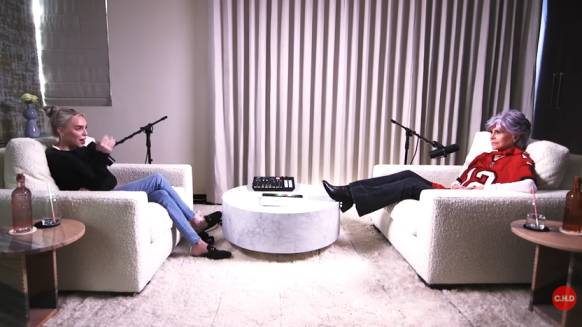
Editor’s Notes: In this episode of Call Her Daddy, Alex Cooper sits down with the legendary two-time Academy Award-winning actress and activist Jane Fonda to discuss her storied life and career. Fonda offers profound insights into the importance of intentional female friendships, sharing personal anecdotes about her long-standing bonds with stars like Lily Tomlin and Sally Field. The conversation also delves into deeper territory, including Fonda’s journey through activism during the Vietnam War, her struggles with eating disorders, and the evolving nature of her relationships over the decades. It is a powerful exploration of vulnerability, resilience, and what it truly means to be a “GOAT” in both Hollywood and life. (Feb 1, 2026)
TRANSCRIPT:
Welcome and Introduction
ALEX COOPER: Jane Fonda, welcome to Call Her Daddy.
JANE FONDA: Thank you very much. I’m happy to be here.
ALEX COOPER: I’m so happy that you’re here, Daddy Gang. Jane is a two-time Academy Award-winning actress and her meaningful work in activism has spanned decades. Jane, I am completely honored to be sitting across from you today.
JANE FONDA: Thank you very much.
ALEX COOPER: Truly, truly. I need you to know that Grace and Frankie has been my comfort show for the past few years. I’m obsessed, it’s charming, it’s hilarious. And you are good friends with your co-star, Lily Tomlin. You guys have been friends for almost 40 some years.
JANE FONDA: Yes.
The Art of Maintaining Friendships
ALEX COOPER: Can you give some advice on how to maintain friendships? Even if someone is going through, let’s say, a situation that’s very different from their friend and they’re not completely on the same pages? How are we maintaining friendships?
JANE FONDA: That’s a good question. Especially as you get older and your life gets busy and everything. If you want to maintain a friendship, you have to be intentional. You really have to work at it, you know? For example, last night I had dinner with a young Canadian film director, TV director. She directed a couple of Grace and Frankie episodes. And when she finished her last episode on Grace and Frankie, we said, let’s maintain our friendship, let’s work at it, let’s be intentional.
ALEX COOPER: Yeah, I agree with that. I do think there’s something about it. It’s hard sometimes if one person’s putting in more work than the other. And maybe I think sometimes we get confused if that means it’s for a lack of trying on the other person’s side. But I don’t know if you’ve had this experience, but sometimes it really just means that person’s going through something and sometimes it has to be uneven. Sometimes one person’s going to put in a little bit more work, sometimes the other friend’s going to put in more work, right?
JANE FONDA: Yeah, well, that’s the case with my friendship with Sally Field. Sally, you wouldn’t know this in real life, but she tends to be a bit reclusive. She’s not one to really want to go out a lot. So, you know, especially when I lived in Atlanta, I would have to really coax her out to come to dinner with me or get together or whatever. But see, I understand her. I know that’s how she is. I don’t take it personally. But I go after her. I love it.
ALEX COOPER: Yeah, I think that’s a great lesson too of like, there’s different personalities and friendships and if you can be the one that’s going at your friend more and you know their personality, you’re not taking it to heart. Of like, they don’t want to hang out with me. Hopefully they’d let you know if they don’t want to hang out with you. But sometimes you just have to go with personality and lean in so you’re the one that’s going after your friends. I love that.
What was the hardest challenge that you personally faced, that a friendship helped you through?
Learning to Accept Help
JANE FONDA: You know, I’m hesitating because most of the hardships that I’ve gone through in my life happened earlier in my life. And earlier in my life, I never reached out for help. I considered it a big weakness. I wanted to be like a guy, you know, I don’t need anybody kind of thing.
But I remember I had my first hip replacement surgery. I was living in Atlanta, and it didn’t go well, and I was in real pain and kind of hazy from anesthetics and stuff like that. And I felt somebody at my feet. It felt really good. And I looked down in my darkened bedroom, and it was Eve Ensler, the playwright Vagina Monologues, who’s my friend and who had flown down from New York to massage my feet and make me feel better.
I said, “Why are you here?” And she said, “Because I love you.” We have to do that for our friends. But she’s really extraordinary, a very generous, giving person. And I was just beginning to learn to accept help and comfort.
ALEX COOPER: I appreciate you sharing that. I think that’s very relatable. Sometimes I think, especially being women, there’s been a narrative that we’re emotional and we can’t handle it. So sometimes you try to combat that with coming off as strong, when really, the way that we survive is through human connection. And so I’m wondering if there was ever a turning point that you remember being like, I’m not ashamed now to ask for help, or did that just come through life experience?
JANE FONDA: It was a gradual process. I’m 85 now, and I would say that it began to happen in my 40s. You see, earlier in my life, and I’m talking 30s, 40s, 50s, 60s, the mark of maturity was independence. I don’t need anybody. I’ve grown up now. There was no recognition of interdependence. And of course, that was especially true for men.
So if you were a woman who identified with men, I don’t want to be like a woman.
I want to be strong. I want to be a winner like my dad. That became my motto. I’m going to grow up and be an independent, and I don’t need anybody kind of a person. And that was part of the culture.
But that began to change. So my change also corresponded to a broader societal change, which I’m afraid is kind of going back to the way it used to be. Rugged individualism. You know, I’m only going to think about me and my family. And this is a time if ever there was one, where we have to understand we have to work together and that we are interdependent.
ALEX COOPER: Yeah, I agree with you. I think it’s interesting. I feel like we kind of saw that with the recent overturn of Roe v. Wade, and then everything that happened with the elections. I felt as though we were all, we’ve all recently been made to feel like we have no choice. This is how it is. But if we all gather together as a collective, go vote, and then look what can happen. So it is kind of like a mind game that the systems play with us, but if we unite, there’s nothing stronger.
JANE FONDA: That’s right.
Becoming an Activist
ALEX COOPER: You know, I mentioned you have two Academy Awards, but in reading your bios, it’s so fascinating because the word activist often precedes the word actor. And I’m curious, when and why did you begin speaking out about causes that you believe in?
JANE FONDA: I was not an activist at all until I met soldiers who’d been fighting in Vietnam, who opened my eyes to what the Vietnam War really was. And I was just, I was horrified. I couldn’t believe it. I really grew up believing, boy, if our flag is flying, if our troops are fighting, we’re on the side of the angels. And so when I heard from soldiers what was really happening, I just felt so betrayed. And everything in my life changed. I worked with active duty soldiers and sailors and Marines.
ALEX COOPER: Which is so admirable because I, no matter, obviously you’re well known, right? And you are a famous actress at the time. But in order to speak on something that everyone loves to put women in boxes, like, no, you’re the pretty actress, stay over there. How did you find it within yourself to speak out on something that could be considered controversial?
JANE FONDA: I didn’t even think about that. I just, what I heard, and they gave me a book to read that just absolutely transformed me. And it was my heart that was opened up, and everything I believed was shattered. And so I had to look for new realities.
I wasn’t even thinking about it. It’s controversial. It could affect my career. All I knew was, this is really wrong. And there are a lot of people in my country that are standing up and trying to do something about it. I want to be with them. I don’t want anymore to be a hedonistic, uninvolved. And I was not happy. You know, it was like, why am I here?
People need to understand why they’re on Earth. Why am I alive? What am I supposed to do with this wonderful, fragile life I have? And so it was a great turning for me. I went from not very happy, meaningless, aimless woman to somebody who knew why I was on earth and what I was going to do.
Finding Purpose and Taking Risks
ALEX COOPER: I really, I mean, I have such respect for you, and I, obviously, not that what I was trying to do is comparable, but I have started this show, and I was talking about sex and relationships, and I was kind of telling you before, it was really an attempt to have a conversation that historically men have been allowed to have. There’s no repercussions when they talk about sex in relationships, of anything. It’s glamorized. But when a woman has the same exact conversation, there’s name calling and there’s judgment.
And so when Roe v. Wade was overturned, I ended up doing a docu-series for my podcast where I flew to Charlotte, North Carolina, and I met with these women that were running a preferred women’s health center and was helping women get abortions and watching firsthand all the women coming from the south, because the abortion desert, that was the first location they could go to.
I was really nervous to put out the episode, honestly, because I had never gotten my toes in the political water, which, to me, I was like, this isn’t, I mean, it is political, but it’s also just human rights. And I was really nervous. But I feel like people like you have allowed someone like me to feel like, you know what? I have to take a chance with my career that may backfire. But then what am I doing this for?
I have so many young women listening, and I just felt like, you’re such a great example. I just, I have chills just being in the same room with you because you have carved such a path for someone like me to be able to sit here and to take a chance like that.
Activism and Celebrity: Finding Purpose on the Ground
JANE FONDA: You know, thank you very much. Of course, the thing that was unusual or is unusual about my activism is that I didn’t just give money. I was on the ground. Whether it was with outside military bases, with soldiers, on reservations, with tribes, indigenous tribes, I was there on the ground.
My celebrity would sometimes create a distance between me and the people that I was working with. For example, the first time I was ever arrested, I was marching with tribes up in the Seattle region of Washington state who were claiming Fort Lawton as a cultural center, an indigenous cultural center. And we climbed over a wall and went onto the fort, and we were all arrested. They were beaten. I wasn’t.
There was a young woman who had her young child in her arms, and she said, “Well, you have a young daughter. Where’s your daughter?” My daughter was at home with a governess. It made me more and more uncomfortable. My celebrity and my privilege separating me from the people I wanted to work with.
And I had a friend in Detroit. He was the founder of an organization called Revolutionary Black. His name was Ken Cockrell. And I said, “Ken, I think I’m going to quit being an actor and become a full time organizer.” And he said, “Fonda, don’t you dare.” He said, “The movement has many organizers. We don’t have movie stars. The movement needs you. Not only should you not quit, take your career seriously, be more intentional about what you do. Make your movies reflect your values. Stick with that.”
So I did. I began to, you know, I made Coming Home and Nine to Five and a number of films.
ALEX COOPER: It’s interesting to hear you grappling with the dichotomy of Jane Fonda the movie star, and Jane Fonda the person that wants to be on the ground helping people. And I think that what you just said is actually relatable in a different way for people of, like, use whatever privilege you have and maximize on that. Rather than trying to pretend it’s not there or wanting it to not be there, use it because you’re right, people are going to listen to you.
It’s really admirable how you were able to pivot your mindset of, like, I got good advice. Like, it wasn’t my idea. I was going to ask, like, before your work in activism, what was a belief you held that you eventually learned went against feminism?
Unlearning Harmful Patterns
JANE FONDA: Oh, to do whatever will please the man that I’m with, even if it’s despite my own well being. I would fall in love. What’s wrong with that sentence? Fall. No. To have a good relationship, an authentic relationship, both people have to be standing on their feet and meet as full human beings. But it, you know, it took me into my 60s to know that.
ALEX COOPER: You were often cast as the girl next door. I’m interested to know, like, did you feel like the girl next door? Like, how did that role affect how you viewed yourself?
JANE FONDA: I was miserable. I didn’t enjoy it. I kept wanting to quit. I never felt like the girl next door. But I know that I kind of looked like the girl next door, but also I was suffering with an eating disorder. And, you know, I mention that because you mentioned that you have young women as your audience. So, you know, this continues to be a problem with young women. I was bulimic, anorexic, and so, you know, suddenly I’m becoming a starlet and there’s so much emphasis on how you look. And it was a trigger, constant, constant trigger for me.
ALEX COOPER: Yeah, there’s already such an objectification on women everywhere about their looks. But for your job to be specifically predicated on your looks, it’s a recipe for disaster. Especially for your mental health, which back then mental health wasn’t even a word that people used. Right. You grew up in Los Angeles and your father was a famous actor. How did your father and your relationship with him affect who you are now?
The Father Wound
JANE FONDA: Well, I’ve overcome the effects that it had on me. I’ve worked most of my life to overcome the judgmental, the objectification and judgmentalism and the unconsciously making me feel that I’m not lovable, you know, if I’m not really thin, things like that. It was a generational problem for a lot of men my father’s age, the objectification of women and took me a long time to get over that.
ALEX COOPER: Yeah, I would say so having it from your father, that must have been difficult to feel objectified when really all you want is love and support.
JANE FONDA: Right.
ALEX COOPER: Do you think that your relationship with your father influenced your then romantic relationships?
JANE FONDA: Oh, sure. I was determined that I was going to marry somebody that was the opposite of my father. I married three times. On the surface they all looked the opposite of my father, but where it mattered, the ability to become intimate. Really? What does that mean, intimate? It means this is who I really am, authentically, warts and all. I’m going to be authentic with you. And I think that I chose men who weren’t that way and weren’t going to demand that of me. And I think that’s because of my father, you know, and my relationship with him.
ALEX COOPER: Yeah. Do you see, if you look back, do you see like patterns in your romantic relationships?
JANE FONDA: I mean, I stayed in them all longer than I should have.
ALEX COOPER: Relatable.
JANE FONDA: That’s very, you know, didn’t have the guts to. Yeah. Also not really talking things out enough. You know, if you have issues on the level of relationships, they’re going to keep playing themselves out.
Breaking Patterns
ALEX COOPER: That’s so interesting. I feel like I, I mean I know I have more to go, but like the relationships I’ve had in my past, I feel like because I wasn’t fully formed as an individual and knew what I really wanted, I was looking for it in men. And the pattern kept arising that the relationships were pretty toxic, that I eventually worked on myself and then I’m now in one that’s not unhealthy.
But it took me, like, taking responsibility for myself to be like, I got to wake up at some point or it’s just going to keep happening. Like, we don’t need to say the definition of insanity, Jane. But, like, you know what I mean? Like, you all of a sudden, you got to wake up one day and be like, huh? If this keeps happening, I have to look at myself. How old are you?
ALEX COOPER: I’m 28.
JANE FONDA: Holy mother God, you’re a genius.
ALEX COOPER: What?
JANE FONDA: 28? I wasn’t even thinking about these things. Oh, my Lord, you’re so much more evolved than me. I wish I didn’t start to get it till I was in my 60s and even then. I mean, talk about stumbling and falling on your face.
ALEX COOPER: But I, but don’t you feel like, which I’m grateful for is it’s because of the generation after generation. We all learn and we pick off of what we want to.
JANE FONDA: If you’re smart, if you’re resilient, you know you are then a resilient person, you can pick up on what’s going on and you can metabolize that. And not everybody can do that.
ALEX COOPER: But even like, you, like, don’t you feel like it would be impossible for you to be where I’m at right now because you had, your father had different values, like all. Like, my parents had parents that had such a different generation in view. And so it’s like the trickle down effect of it gets a little better each time. Where your generation pushed against your parents generation, and now I’m pushing against my parents generation. So we’re all kind of helping each other. Taking a little bit longer than we want, but, like, it’s happening. It’s happening.
JANE FONDA: Well, you’re like, supercharged. My God, you’re going to end, you’re going to be president.
ALEX COOPER: I’m going to start crying because coming from you.
JANE FONDA: 28, I mean, you look, it’s not that you look older, but you’re so evolved for 20 f*ing 8. Thank you. Oh, my God.
Advice for Young People: The Climate Crisis
ALEX COOPER: I did. Listen, I think a lot of my listeners, yeah, I said, are in their 20s. What advice would you give them in trying to figure out what they believe in and what causes they care about?
JANE FONDA: Yeah, yeah. It’s hard. Well, yeah. One thing that I always want to say to young people, it is so hard to be young. Don’t let anybody fool you. It gets easier when you get older, believe it or not. I mean, assuming a modicum of good health, but it’s really hard to be young. It’s like, what am I supposed to do? Who am I supposed to know? What am I supposed to become? What am I supposed to be interested in? All these things. Huge questions that will determine the whole rest of your life.
As you get older, it’s like, I know what I need. I know what I can let go of. I’ve been there before, didn’t kill me. I’m going to survive. You know, it’s, you know, you don’t make mountains out of molehills and it’s just, it’s just easier.
So, well, I mean, it seems to me that young people should care about is there going to be a future that is going to be livable or are we going to go from one climate extreme that is life threatening even to people who are wealthy and privileged, although it’s going to hit the unprivileged and not white people worse. It’s your future that’s at stake.
There is a climate crisis and the window to do something about it is closing. We don’t have a lot of time, but there’s ample reason to remain hopeful. The scientists who all agree that there’s a crisis and that it’s caused by fossil fuels and that people have to act, they’re unanimous and they’re telling us time is running out, but you still have time to reverse this and do something about it.
So the first, I would advise young people just to find out about the climate crisis and then I’m sure that you want to do something about it. And that means not individually. You know, I mean, it’s good to do individual things because it makes you feel good and makes you feel like that you’re not a hypocrite. But we have to change systems. We have to change who we elect to government.
We have people in the government that are Democrats as well as Republicans who take money from the fossil fuel industry and vote against bills that can save your lives in the future. So we have to get rid of those people. And they’re not all guys, but they’re mostly guys and they’re mostly white. Yeah. So we have to pay attention to who we vote for. We have to vote, but become familiar with the climate crisis and join with others in some organization to do something about it.
In your town, in your city, in your school, in your university, there’s all different levels that you can work on. And I think that it feels good. And the young people that I’ve met doing this kind of work are so wonderful. You’ll make new friends.
The Work of Becoming
ALEX COOPER: I appreciate you sharing so much about, you know, you being like, oh, in my 60s, I figured it out. Like, when people look at Jane Fonda, it’s like, this is who I want to be. Like, I aspire to have such intellect and grace and drive.
JANE FONDA: Well, man, I have worked at it for 50 years.
ALEX COOPER: And I think that’s why I really respect you being open about that, because I’m interested to know, like, young women in their 20s right now that are listening. What is the biggest lesson you learned in your 20s, and how did you learn it?
JANE FONDA: Oh, in my 20s, I was starting to be a movie actor. I suffered from bulimia. Very, very bad. I led a secret life. I was very, very unhappy. I assumed I wouldn’t live past 30. I’m 85. I don’t understand. Well, I do. I worked hard. I didn’t go out. I didn’t hardly date. I hardly, because I was unhappy. And I had this eating disorder. And then I was also making movies that I didn’t very much like. And then the Vietnam War got me and changed my life.
ALEX COOPER: When you say you were living a secret life, are you talking about the eating disorder?
JANE FONDA: Yes.
ALEX COOPER: Do you mind just sharing a little bit of insight of anything you have for. I know so many women write into me that struggle with an eating disorder and how you personally overcame that.
On Bulimia and Eating Disorders
JANE FONDA: Well, first of all, you’ve got to understand. It seems so innocent in the beginning, so innocuous. Why can’t I have this ice cream and cake and then I’ll just throw it up. What you don’t realize is it becomes a terrible addiction that takes over your life and it harms the way you look. You end up looking tired.
It becomes impossible to have an authentic relationship when you’re doing this secretly. Your day becomes organized around getting food and then eating it, which requires that you’re by yourself and that no one knows what you’re doing. It’s a very lonely thing. And you’re addicted. I mean, you can’t. If you put any food in you, you want to get rid of it.
And it happens when your life is inauthentic, when what you should be doing and who you should be or who you really are, those things are being betrayed. Maybe in a false relationship where you’re faking it, you know that it’s wrong, but you keep going. That kind of thing. Inauthenticity can cause it. Also being told that you’re fat. And it can start with that, but then it takes over your life.
So as I got older, you can think you can get away with it when you’re young because your body is so young. As you get older, the toll that it takes on you becomes worse and worse. It takes days and then at least a week to get over one single binge. And it’s not just the fatigue, it’s you become angry, you become hostile. All the trouble that I got in was because of that anger and that hostility.
And then it got to a point in my 40s when I just thought, if I keep on like this, I’m going to die. I certainly will not. I was living a very full life. I had children, I had a husband. I’d had two husbands by then. I was doing political work, I was doing all these things and my life was important. But I was becoming less and less able to continue it.
So I went cold. I didn’t realize that there were groups that you could join. I didn’t know anything about that yet. And nobody talked about it. I didn’t even know there was a word for it. And so I just went cold turkey. And it was really hard. But the fact is that the more distance you can put between you and the last binge, then the better it is. It becomes easier and easier.
Now they say you can never get cured. That’s not true. But I did need Prozac. That was the drug that helped me because a lot of the cause of it was anxiety driven. And Prozac helped me deal with anxiety. And so, and then gradually I just stopped doing it.
Social Media and Body Image
ALEX COOPER: Thank you for sharing that because I’m interested to know the effects that social media, every generation has. Right? The way that women were objectified in the 90s. It’s the glossy magazines and the tabloids. Now social media is, it’s exacerbating it again. Almost when you see what’s the impact for young women with what’s happening on social media, how does that make you feel?
JANE FONDA: I’m scared for them. It’s much, much worse. There was no social media when I was younger. I think it makes it much worse and it’s really hard and I don’t know what the cure is. It’s bigger than I can.
ALEX COOPER: If someone’s going to fix it, it could be Jane Fonda though. I’m curious, what advice can you give to women around distancing themselves from the pressures to look, feel and act a certain way because we have a vagina?
JANE FONDA: I think the old consciousness raising group is good. We can’t do it by ourselves as individuals. I think getting together with other young people, whoever is listening, whatever age you are, you may not be young, but with other females to talk about it. And when you recognize the shared challenge that you’re all facing, it helps to say, “Well, f* this, I’m not going to do this anymore.” And then you start to become a feminist. But yeah, I think talking about it is good. Knowing that you’re not alone and that you can work up courage by dealing with it together as a group.
I’m going to teach you a little history. In the 1970s, a huge change happened to psychology, to psychologists and therapists. The thinking in psychology was that what Freud said was incest against women is maybe one in a million. It’s a fantasy that women have for various reasons, but it’s one in a million. Freud, one in a million. And that was the thinking coming into the 70s.
So these feminist therapists began to meet regularly in various places in New England. And they began to talk about the experiences that they were having with their clients. And one said, “You know, she was incested.” And another would say, “I have a client that was incested.” And they started to discover that this was not one and a. This was epidemic. What is going on here?
They began to reach out to other therapists around the country who began to meet and they all found out. They discovered that this is extremely common. And the kind of therapy that they developed was very different than Freud, where you lie on your back and look at the ceiling while the Freudian therapist sits behind you. These women created relational therapy. And it’s the difference between men’s friendship and women’s friendship. Men sit side by side, women sit facing each other and relate emotionally.
So therapists would be able to look into their clients’ eyes, would cry with them, would show empathy and emotion with them. And the women began to heal. They discovered that what happens when you’re abused, especially incested, is your ability to trust and relate is ruptured. And recreating trust and the ability to relate through relational therapy could help heal these women. And so again, it’s an. The reason I told that story was because it’s such a great. When you get together in groups, you learn new things and it changes everything.
On Friendship and 80 for Brady
ALEX COOPER: You’re in a new movie, 80 for Brady. The movie is centered around a friend group of four women.
JANE FONDA: Yeah.
ALEX COOPER: What similarities did the women in the movie have to your real life friend group?
JANE FONDA: Well, two of them are my real life friend group. Sally and Lily. I mean, Sally and I identify with each other quite a lot. And we talk a lot. We get down and we talk about these kinds of things. And I’ve always identified with her. You know, we’re quite, in many ways, very close.
Lily is a completely different person from me, and I’m fascinated by her. Absolutely fascinated. We’ll be sitting side by side and someone will come up and say something serious, and Lily will find a way to respond that is a laugh. I mean, she’s just. I can’t do that. I’m just in awe of it.
ALEX COOPER: Is it fun to work with your friend?
JANE FONDA: Yeah, very much.
ALEX COOPER: Right. That’s why I keep doing it.
JANE FONDA: Yeah. Yeah.
ALEX COOPER: I mean, you guys are.
JANE FONDA: We’ve made two movies since we stopped Grace and Frankie.
ALEX COOPER: It’s like you guys can’t get away from each other, but let me be clear. We don’t want you guys to get away from each other because you’re magnetic on screen. It’s amazing.
JANE FONDA: Thank you.
ALEX COOPER: What is the most rewarding benefit of having a strong group of girlfriends?
JANE FONDA: Your health. You know, there was a study done by Harvard Medical School that said that not having women friends is as bad for your health as smoking. And, you know, men sit side by side, looking outward at cars, at women. “Oh, wow, look at that one.” Sports. Women look into each other’s eyes and they ask for help. They show their vulnerability. That’s so important. That’s important for health.
I think it’s one reason why women, on average, live five years, seven years longer than men do. Also, when women laugh. I don’t know about you, but when I’m with my women friends and we laugh, I mean, you gotta cross your legs. Yeah. It comes from the belly. I don’t laugh like that with men. And I know that there are men that I could, but they haven’t come my way.
ALEX COOPER: There’s a lot of women that always write into me asking, you know, “I’m in a new relationship, I have a boyfriend, and I feel like I’m distancing myself from my girlfriend.” And I love you comparing it to. It’s bad. It’s as bad as smoking if you don’t have your girlfriends around you, because it is a different dynamic.
JANE FONDA: It’s a real problem to. But it’s one that I’ve been guilty of. When you fall in love and everything is so intense that you don’t have time for your girlfriends anymore. But what that does, especially if it’s a relationship that’s ongoing, is it accustoms the guy. If you’re heterosexual, the guy to you not taking time to be with girlfriends.
And if this relationship lasts and you end up getting married or staying together, you’re going to want your girlfriends, but you can’t. And then you have to re-educate your partner to accept the presence of girlfriends. So, you know, make it a part of your life. Even in the beginning, your character ends.
On Relationships and Ghosting
ALEX COOPER: Up trying to ghost her love interest. And I’m curious to know, Jane, in real life, have you ever been ghosted? Or are you usually the one doing the ghosting, not answering someone, being like, “I’m going to ignore them and disappear from their life.”
JANE FONDA: Well, I’ve mostly been married three times or had steady boyfriends in between. Up until a certain later point in my life, I thought that if I wasn’t with an alpha male, that nobody would be interested in me. So I married. I didn’t ghost.
ALEX COOPER: That’s so iconic. “I married, I didn’t ghost.”
JANE FONDA: And I don’t know if anybody’s ghosted me. I’m sure they have, but I can’t. I don’t know if they have.
ALEX COOPER: I feel like no one has ever ghosted you. And now hopefully if a guy wasn’t treating you right, you’re going to ghost them. You’re not going to marry them, right?
JANE FONDA: Jane, honey, there’s not going to be. If a guy. You know, I live in a new house. Well, I’ve been there for seven years. And when I moved in, like a lot of California houses, there was a man’s bathroom and a women’s bathroom. I said, “No, no, no, no, no, no, no. There will never be a man living in this house ever.” So they took both bathrooms for me.
ALEX COOPER: Damn right.
JANE FONDA: No, I’ve. The three’s enough. My father was married five times. I don’t want to go that way.
ALEX COOPER: You’re going to keep it at three?
JANE FONDA: Yeah.
Meeting Tom Brady
ALEX COOPER: One last question. What was it like meeting Tom Brady? I’m assuming you met him.
JANE FONDA: My niece got started to give away. I’m not kidding. He came into my trailer. Holy s*. And my knees started to buckle. I was standing next to the sink, so I held on. But no. And that’s when he signed this jersey that I’m wearing and gave it to me. He gave it to everybody. But anyway, no, it’s, you know, it’s twofold. He’s a goat. He’s the greatest of all time. When somebody is that good at what they do, he’s like magic. You have to bow down. But then on top of it. He’s so gorgeous, you know? And so I was just overwhelmed, and he was so sweet, very generous, very nice.
ALEX COOPER: You know, I view you as the goat, Jane. Okay? So I truly cannot thank you enough for sitting down with me. I know you’re a very busy woman.
JANE FONDA: Well, you are a fantastic interviewer. I mean, I’ve been at this for 60 years. You’re one of the best interviewers I’ve ever had. You’re really wonderful.
ALEX COOPER: I’m going to faint. I have to go. Jay. No. Thank you so much. I’m going to start crying.
JANE FONDA: You’re also beautiful. I mean, I don’t know. Does this go. Is this. Is this podcast visual or visual? So people know what you look like.
ALEX COOPER: And people know what you look like.
JANE FONDA: I just want your audience, you know, because sometimes they’re, you know, they’re only audio, right.
ALEX COOPER: So you want to give a disclaimer.
JANE FONDA: So you want to say to the. I want you to know audience. She’s gorgeous.
ALEX COOPER: Jane, it was an absolute honor. Pleasure. You are incredible, and I can’t thank you enough for coming on. Thank you.
JANE FONDA: Thanks for having me.
Related Posts