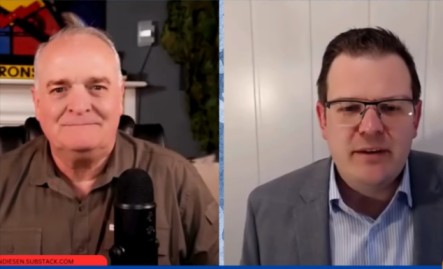
Editor’s Notes: In this analysis, Lieutenant Colonel Daniel Davis joins Glenn Diesen to dissect Donald Trump’s recent “war speech,” highlighting a perceived disconnect between political rhetoric and the tactical realities on the ground in Iran. Davis critiques the administration’s reliance on “bluster” and civilian infrastructure targeting, arguing that such actions may constitute war crimes rather than effective military strategy. The discussion further explores the potential collapse of NATO as a collective security agreement, suggesting the alliance is being treated as a personal tool for U.S. interests. Ultimately, Davis warns that a ground operation would be a “suicide mission,” potentially pushing the conflict toward a desperate and dangerous nuclear escalation. (April 3, 2026)
TRANSCRIPT:
A Conversation with Lieutenant Colonel Daniel Davis
GLENN DIESEN: Welcome back. We are joined today by Lieutenant Colonel Daniel Davis, a 4-time combat veteran and host of the Daniel Davis Deep Dive YouTube show. And as always, I will leave a link in the description. So thank you very much for coming back on the program.
DANIEL DAVIS: It’s always my pleasure to be here. Thank you very much for having me.
Trump’s Address to the Nation: Mixed Messages and Bluster
GLENN DIESEN: Well, we see that Donald Trump just gave his address to the nation, or war speech, in which we got a lot of, I guess, different messages. That is, on one hand, Iran was defeated, but also if they don’t capitulate, we will bomb them back to the Stone Age. NATO, you know, they don’t want help, but also we don’t need them. The Strait of Hormuz, I mean, it has to be opened, but also it’s not our problem. Other people should open it.
I mean, there’s a lot of, it’s a bit all over the place, but overall, it indicates a lot of uncertainties, covered up with a lot of bluster, I guess. How did you make sense of this speech? Because it was announced in advance. And again, did you hear anything new or what did you make of it?
DANIEL DAVIS: Well, I certainly didn’t hear anything new because, I mean, he’d been kind of talking about this the previous afternoon, like 5 p.m. He talked about it, it’s going to be roughly 2 to 3 weeks before this war was over and it was kind of wrapping down. And at the time when it was announced about a few hours after that conversation that he had, when he announced that he was going to have an address to the nation, then the assumption was, well, he’s probably not going to say that since he just said it, so it must be something new. But then when he actually ended up speaking, he really didn’t say anything new.
He just kind of reiterated the same thing about the 2 to 3 week period, reiterated the same thing that we’re talking with them, but if they don’t do what they’re supposed to, then we’re going to just walk away basically, or at least from the Strait, and saying that it’s going to be somebody else’s problem to deal with. “We’ve done the hard work. Why don’t you guys get some courage?” He repeated some of those phrases from some of his Truth Socials earlier just the day before.
The Reality on the Ground: Iran’s Untouched Capabilities
DANIEL DAVIS: So we didn’t hear anything new. But what we did hear though is, to me anyway, continued statements that he is still disconnected from reality and does not realize the desperately bad situation that the United States has been plunged into by his war of choice.
The strait is not going to open up. It is not easy and it cannot be opened up by force of arms, whether from us, whether from the entire NATO Navy joined us. It wouldn’t make any difference because that’s not the issue. The issue isn’t sailing warships through the strait and somehow that’s going to open it up. All that would do is make a shooting gallery for those warships, which is why no nation has sent any, which is why our own Navy has not done it already because we know the cost to it.
Nevertheless, the strait remains closed. And now then you see oil continued to go higher and higher. Unlike some of his previous comments when he made statements, the market was calmed and the price of oil went down, the stock market went up. This time the opposite happened. The stock market went down and the price of oil spiked immediately because people now around the world recognize, all right, what you’re saying has no relevance in relation to any kind of reality and the war is not winding down.
2 or 3 weeks, what does that even mean? Because you’ve been unable in 5 weeks to be able to do anything of any substance. The Iranian government, even though you assassinated a lot of their leaders, it’s still firmly in place. Their missiles still retain full capabilities as they showed yesterday and today, to reiterate, in Israel. Their navy is still primarily untouched, at least the navy that matters, which is these speedboats, the drone boats, and their submarine forces. Those have largely been untouched. So whatever you hit on the surface doesn’t even hardly matter because what matters is what is still underneath these tunnels that are everywhere.
Some estimates prior to this war estimated there was as many as 3,000 of those boats that are available to go into action should they need it. So now obviously they’re not going to come out unless they’re needed because then they will be targeted. But then also the issue of the proxies, not only have they not been quelled, they’ve now joined the fight. Kata’ib Hezbollah in Iraq, Lebanese Hezbollah, the Houthis, I mean, they’re all now at one direction or another, one level or another, participating.
So they have stepped it up and there’s nothing we can do.
Bombing Civilian Infrastructure: A War Crime?
DANIEL DAVIS: And for President Trump to say, “I’m going to bomb them into the Stone Age,” just exposes his lack of understanding of two major, major things.
Number one, we don’t have enough ammunition to bomb a country that’s four times larger than the country of Iran with 93 million people and is spread out as large as it is. And then a lot of it in terrain that makes it very, very difficult to get at. You’re simply not going to be able to — we don’t have enough ammunition to do that in any case. And to even make the attempt is just going to solidify and steel the resolve of the Iranian people.
And we see that, by the way. About an hour and a half ago, President Trump posted a Truth Social where he says, “The biggest bridge in Iran to come tumbling down, never to be used again. Much more of it to follow. It is time for Iran to make a deal before it’s too late and there is nothing left of what could become a great country.” And in it, he has a video of this large span, this bridge, this civilian bridge in Tehran that has no relation to any military capabilities, which makes it by definition a war crime, or at least likely.
We’ll wait and see what the people do, some analysis on it. But what it looks like on the surface of this is making good from what he said last night, that we’re going to bomb them into the Stone Age. And then here’s his first example, and he’s bragging about it, which could definitely put him in legal jeopardy going forward, him along with the Secretary of War, Pete Hegseth.
But all that’s going to do is make people — and I’ve talked to some since that happened. So just a few minutes ago, I talked to a good friend of mine who is an Iranian expat in this country that has been absolutely against the regime from the beginning and has been always looking for ways to maybe help get a change of government in his country, something that the people would give them freedom and allow him and some of his family to go back. So he is totally opposed to them. And yet he is incensed and said this is nothing but a war crime as he sees it, because he obviously knows Tehran quite well. Another one of my friends who knows the area well says the same thing.
So if Trump thinks this is going to cow the Iranian people, if he thinks this is militarily going to accomplish anything, the exact opposite is likely. And it’s going to firm up that grasp that the Iranians have on the Strait of Hormuz, and it’s going to continue to make those prices go up and the stock market go down, and it’s going to cause problems all over the world. Other than that, it was a great speech.
Iran’s Existential Threat and Trump’s Dwindling Options
GLENN DIESEN: Other than that, well, this is the interesting part. That is, I think Trump realizes that, you know, he’s got his back against the corner and there’s not much he can do at this moment. He said himself that he’s running out of military targets. So it seems like the only strategy now is bring a lot of pain to Iran in terms of destroying civilian infrastructure, hoping that this would encourage Iran to sit down and make a deal.
But again, I think what is often neglected is when a country faces an existential threat, and I think Iran quite reasonably considers this to be an existential threat, they can’t simply give away, or accept some poor deal which would just make the threat even worse in the future. But I think this is the only plan so far of Trump, that is, he doesn’t have any other cards to play.
Well, that kind of is why I wanted to ask you, on one hand, he keeps making this point that, you know, we’re close to ending the war, maybe 2, 3 more weeks. On the other hand, he’s also indicating there will be mass escalation. Do you see it in the same context, just being, we’ll end the war soon by forcing the Iranians to make a deal, or is there any other plan to accomplish what he suggests?
The Ground Invasion Gamble: Playing Low Cards Against a Strong Hand
DANIEL DAVIS: You said that he doesn’t have any more cards to play. There are some cards to play, and that is on the ground because the air hasn’t worked, the Navy hasn’t worked, the bombs and missiles and drones haven’t worked. So maybe he thinks doing something on the ground could.
And we have seen the significant escalation here in just the last week or so of A-10 ground attack jets, which are for close air support for ground troops, Apache helicopters, which are close air support for ground troops, 82nd Airborne, several different Marine Expeditionary units on the way, other Army Special Forces, Rangers, quite a number of different troops. Others have been alerted to be deployed. So somewhere around 20,000 ground troops of various types have already been either deployed, have been on location, or are coming on very soon, which implies that he may be thinking he’s going to play those cards. Well, the other ones haven’t worked. Maybe this one will.
But I’ll tell you, that’s like playing a high-stakes poker game with an experienced player who’s playing on his home turf and thinking, I’m going to play these cards here and get him. But then if you look over his shoulder, you realize those are like not even a pair, but a 2 and a 6. And you’re about ready to play this against somebody who’s got a lot of face cards on the other side.
Because if we do that, I don’t think it’s empty rhetoric that many — I think Abbas Araghchi being one of them, Ghalibaf, the speaker of the Iranian parliament, and the IRGC folks, have basically been saying, “Bring it on.” In fact, Ghalibaf in a tweet or an X post literally said that, “Bring it on,” because we have mobilized a lot of our reserves. We have a lot of people who volunteered to serve and they know this terrain very well and they know that any attempt to use our troops would just be suicide.
So if President Trump thinks he’s going to win something — and I mean, it’s kind of like that poker game where you’re like betting the farm on not even two of a kind, just two low cards against somebody else that you can see over his shoulder with a mirror that he’s got high cards, and still you’re going to play them. That’s how crazy this is. The chance of this succeeding tactically, much less operationally, and definitely not strategically, is just almost off the charts impossible.
I mean, I could lay out all the details of why even tactically this is near a suicide mission, but it seems like that’s what he’s really going to do. Because other than that, I don’t know what he’s going to do with those troops, why they’ve sent so many over. And if he doesn’t use them, then what? I mean, are you going to just walk away? Literally just walk away?
I think he should. That’s what I would advise right now. No matter what he’s done, don’t sacrifice a bunch of Americans to pointless deaths that will worsen the situation. It’ll be worse by trying and failing than it is to not try. You know, hit to your image, you may think. But that’s what I fear is about to happen.
The Death of NATO and Escalation Risks
GLENN DIESEN: You know, that’s what I was thinking as well. Sending in 10 or 20,000 soldiers, I mean, you can’t dismiss the possibility that it might work, but the likelihood of this going wrong — everything from supply and support — even if they’re able to land there, I’m not sure what they would do if they’re not. I mean, there’s so many things that can go wrong. If all of these soldiers would die, or be captured, it would just be an unmitigated disaster. And again, it’s very difficult to swallow such a defeat, and it would have to be some even reckless escalation on some level.
Anyways, it’s very strange that one is prepared to play this card, given that the outcome is so uncertain. But in Trump’s speech though, he made some other comments. Then he went through the list of all the people who had disappointed him, you know, sharing the blame a little bit or passing it on. But the Europeans, as always, stick out. And he was making the point that NATO hasn’t really done that much for us. We asked them to do something for us, they didn’t follow through.
On some level, this is not — of course, we were not what NATO was supposed to do. He didn’t even tell the Europeans that he was going to do this. But on another level, I can also understand where it’s coming from. The US has been providing security for the Europeans for decades. And now they’re closing off the airspace, don’t let him use their bases. Poland refused to send the Patriot batteries to help. So I can understand, a little bit from both sides, where the frustration comes from. But what do you think this means for NATO? I mean, is NATO dead by now, or is this just one more nail in the coffin?
DANIEL DAVIS: To me, I might slightly differ with you on this one point, because I don’t think that the NATO side has any valid point on this one — I mean the United States against NATO. Because I think that up till February 2022, I was a strong advocate that NATO needed to wind itself down and to do so in a coherent, logical, rational way, because there was no need to keep on expanding to the east. We should have never advanced beyond the original one.
I mean, just think how irrational it is militarily that this nation — I forget what it was, 16 maybe members in 1991 at the end of the Cold War — they had resolutely stood against the entire Warsaw Pact, the Soviet Union, all of its tens of thousands of tanks and thousands of aircraft and all that kind of stuff, the millions of troops. But then after those disintegrate, that somehow you need to expand it. It was always irrational and illogical, and it could only be viewed in an antagonistic way by the surviving Russian state. I mean, it couldn’t be anywhere else. It was purely kind of like, “I’m going to poke a stick in your eye,” and it was unnecessary and it was unnecessarily provocative.
And it was always clear that as weak and disheveled as Russia was in 1992, that that was going to be a temporary condition and that later on things would change, which of course Putin famously put down that first marker at the Munich Security Conference in 2007, I think it was. And we have where we are here. And so we keep making more and more problems.
But then once we started this mess here in Russia, the United States was leading that charge too. So the Europeans were only too happy to join in with that until Trump comes in and he wants to try to change it up. And now that he wants a new kind of situation — you can tell by his comments in just the last few days alone — he does not view NATO as like a collective security agreement that has an Article 5, where an attack on one is considered an attack on all. No, he says NATO is our plaything. “You will pay a lot more money, and when I want you to go into action, you will. Even if we make a war of choice that you didn’t vote for, you weren’t consulted on, it doesn’t matter to me. I said I want you to come in and join us. And even if you think the war is stupid, you will come in and you will send your combat troops, especially your Navy and Air Force, to join us, or I’m going to be angry and then I may consider walking away.”
Is NATO Dead?
And to me, no matter what happens here, to answer your direct question, I think yes, I think NATO is dead. I think it is done. I don’t think it survives this. Even if the war in Iran somehow comes to a miraculous end real quick and there’s no further damage done, I think that the damage done by the Trump administration — in making it clear that he views NATO as an extension of his own armed forces that he can just give orders to and that they’re expected to take action against their own national interests — I think that there’s no reason for them to think anything else than, “We’re going to have to figure something else out.”
I don’t think it’ll happen overnight, but I think that the pieces have been put in motion that that day is coming, and I think it’s ordained now. I don’t see it going back. It should have happened a long time ago in a coherent way. I think now it could happen in a rupture, which would be kind of the worst of all circumstances.
Obviously, it’s going to be catastrophic for Ukraine. The boy, I bet they’re really wishing they had taken that deal in Istanbul in 2022 now, or any of the other ones that were offered on the table, because they’ll never get those terms again. And now they may just suffer an outright military defeat. As you know, there’s almost nothing coming in from the United States anymore. Even the European states like Poland is saying, “Yeah, I ain’t giving up any of my stuff because I might need it here.” And especially as they see that the Patriots don’t perform anywhere near as good as claimed on paper. So they want to keep as many of those interceptors as they can get their hands on.
So it’s kind of like everybody kind of for themselves right now. And meanwhile, the biggest victor of the Iran war so far is Russia. I mean, they’re flush with cash. We’ve relieved some of the sanctions on them. And now Putin is coming out looking like a really reasonable guy. He released a statement, I think it was this morning, where he’s saying, “Hey, for all this chaos in the energy sector here in the Middle East, we provide some stability here and we’re willing to do something that makes sense for everybody, and we’re not going to do what the United States is going to do.” And that’s now an attractive alternative. And we could talk about China as well, but that’s the big winner so far. So yeah, I think NATO’s done.
GLENN DIESEN: Yeah, no, I used to be of a similar opinion. That is, I prefer gradual reforms rather than very disruptive changes because it destabilizes the international system. So I thought NATO could reform itself because it has the ability to accommodate both the United States in Europe but also find a way of bringing in Russia. But you know, this stuff happens.
DANIEL DAVIS: So I was for that.
GLENN DIESEN: Yeah, I’m kind of on the same opinion now. It’s this — it can’t be reformed. This is like the Soviet Union. It just has to go, essentially. But I did see some interesting other comments on Trump’s war speech, or that is from Lindsey Graham, of all people. You know, he started to suggest in a tweet that the war objectives could have been met and even encouraging that we might wind this war down. I never heard Lindsey Graham ever call for winding any wars down. Do you read anything more into this, or do you think the panic is starting to set in?
Lindsey Graham’s Reversal and the Search for an Off-Ramp
DANIEL DAVIS: Yeah, that was — at least I saw it in The Hill newspaper on the 30th. So that was 2 days before President Trump’s comments. And then after President Trump’s comments, he’s back to the normal Lindsey Graham that you expect. And he was absolutely cheerleading all of this on and said, “Yes, we should continue going on. The Iranians can’t survive as a result of this. We’ve got to get them,” etc. “Go President Trump.” So it seems that he went completely back on what he was saying.
I thought, and I interpreted at the time, because I’d also seen a report in the Times of Israel that Benjamin Netanyahu around that same time had said, “You know what, based on what’s happened so far, we don’t really see Iran as being a threat to us right now.” And so I thought maybe those were signs that, okay, reality is starting to hit into everybody, and now they’re looking to find a way to wind this down and trying to find any kind of off-ramp.
But then it seemed to go right back up on the 1st. And now I think it’s looking increasingly likely there’s going to be some ground operation of some sort, some kind of a raid. You saw the Israelis assassinated, or at least attempted to assassinate, another diplomat, ended up killing his wife instead. Anybody who might be talking to the United States that might be willing to have a moderate view seems to amazingly die. Anything that looks like it’s moving towards a negotiated settlement, something gets blown up.
And then now President Trump seems to have jumped back on board. You have that attack in Tehran just now. More things are continuing to blow up. And of course, he threatens them with being bombed back into the Stone Age, completely eliminating any theoretical idea for diplomacy — even though with the same breath he still says if they make a deal. And of course the only deal is abject surrender: walk away and do nothing and let us come in and insert our person, whatever, like with Maduro in Venezuela.
I still think that there’s some fantastical hope and this just unbased and unhinged thought that we can still twist this into a Venezuela 2 operation, where we can have control of their oil like we do in Venezuela and everything will be great. I don’t know why they would think that, but I think that’s what they do. And therefore, I think that the chances that we’re going to continue to ramp this up will come pretty high.
And based on what you just said, I certainly agree that any military operation on the ground is going to be a bloody failure. And then that’s going to send markets and the price of oil through the roof, and it’s going to send prices of everything else through the roof. It’s going to further damage our reputation as a military power and definitely as a political entity that people should follow.
The Nuclear Threat
And then — and I think I’ve said this before — my worry is that if it starts to look like it’s going to be an abject military failure and that even 100,000 or 500,000 troops won’t rescue it, that President Trump will consider, or Netanyahu, one of them will consider the application of a so-called tactical nuclear weapon, which just means a small nuclear weapon. It’s nuclear. There’s no actual difference between a tactical and otherwise. You still have a mushroom cloud and you have all the fallout that would come with it. So that’s my bigger worry, even in the medium term.
GLENN DIESEN: A nuclear strike. Yeah, no, we could be heading towards that. I want to listen to some of Trump’s rhetoric — bomb them back to the Stone Age. He made previous references, they shouldn’t be able to recover as a nation. Pete Hegseth just tweeted out, just back to the Stone Age. But when you kind of hear this language, it’s so over the top and vile. And you mentioned before that Putin comes off as being the reasonable one. I also hear the speeches by the foreign minister of Iran, and he’s kind of making the point, “We don’t have any problems with the American people. You have a political leadership which keeps attacking us.” It sounds very civilized and reasonable.
I feel like the information war is being lost when one goes so over the top into this very aggressive rhetoric. It seems to backfire. But on the nuclear war issue though, do you see that simply being Trump trying to push it further up the escalation ladder, hoping that Iran won’t be able to follow? Because Iran has nuclear material. I’m not sure how the know-how is in terms of producing a nuclear weapon. I spoke to Ted Postol, who was making the point that if they could put together like a makeshift nuclear device strapped on a missile, if it was required — but again, there’s a lot of uncertainties around this. But what do you think is the wider Iranian strategy? Because they must know that if the Israelis or the United States is faced with a humiliating defeat, that they could do something foolish and desperate.
Israel’s Position and the Path Forward
DANIEL DAVIS: Yeah, I mean, it can’t not be part of their calculation, which is why I think they’re saying, listen, we’re willing to stop this. Foreign Minister Arakchi said, I’m sorry, no, it was Pezeshkian said the path to peace is open. We still desire that. And so they’re leaving the door for negotiations to be open, but on their terms, because I think they would not have any premature withdrawals from their current position here.
And I think they’re saying, yeah, we’ll open the Strait of Hormuz. And by the way, it is already open. There’s no mines. It hasn’t been blocked per se, we’re just in control of who goes out of it. We’ll continue to give thoroughfare to everybody else as long as you abide by our rules, as long as we get some kind of security guarantees. So they’re leaving a path that we can get out, but it is one that would require a profound amount of humility to be observed and eaten by the United States, which we’ve never shown in the last several decades to have any potential for. So I worry about that.
To answer your previous question, I don’t think that President Trump is frankly thinking this through and saying, here’s my strategy. I want to ramp this up and see if I can out-escalate the Iran. That would imply he has forethought and that he’s actually thinking things through like a chess, like 2 and 3 moves down the road. I don’t think he’s thinking anything beyond the end of his nose. I mean, I’m just being honest here.
I think he’s action-reaction kind of a guy. We’ll throw something on the wall, see if it sticks. If it doesn’t, we’ll try something else. No thought to what would follow through. No thought to the ramifications. No thought to what the other side might do given your actions at all. He’s kind of doing this mirror image kind of thing. Well, if it was me and somebody did this to me and I was in the weaker position, I would probably do something like this. And I think he’s ascribing that to the Iranians. I think he’s ascribing to the Iranians what the Venezuelans did, thinking that they’re one in the same. And so it worked over here, why can’t it work here?
He mentioned Venezuela in his speech last night, which tells me that it is still on the fore of his mind. And that’s a really dangerous place for that to be. But yeah, I worry a lot about this. And frankly, with a lot of the people he’s got around him providing evidence and suggestions, doesn’t give me a lot of hope that this is about to be wound down.
GLENN DIESEN: Yeah, I spoke to Joe Kent who said something similar, that the victory in Venezuela, that it could have fueled some hubris in the White House to have influenced some of the decision-making done towards Iran. But just as a last question, Israel, if Trump wants to now put an end to it or escalate or whatever he decides to do, what is Israel’s interest being at this moment? Because they, yes, they have a lot of censorship. We don’t know exactly the kind of hits they’re taking, but do we know anything at all? I mean, what kind of situation they are in and how does that translate into policy? I mean, do they want to put an end to this soon or they still want to wait this out and see if they can break the Iranians?
Israel’s Calculus: Attrition or Acknowledgment of Reality?
DANIEL DAVIS: I don’t see any evidence that the Israeli leadership has any thoughts at all. I don’t think they’re wavering in the slightest. I think that the punishment and the pain they have, they calculated it in ahead of time. Whatever you may think of their morality, very intelligent, very smart people. And certainly they knew what happened in the 2025 12-day war. They knew that by starting this one here that they were going to take a lot in the teeth and it was going to cause lots of damage. And I just think they factor that in.
And I think that they just keep saying, no, we can outlast the Iranians. We can put more pain and more pressure on them than they can do on us, which is kind of irrational to me. I mean, on the one hand, give them credit for being smart, but on the other hand, I’m going, seriously, a country of 93 million people with obviously a lot of protected facilities for missiles and you can’t knock them down. Now that according to some Israeli press, it’s as many as 8 out of 10 missiles are getting through. You’re this tiny little country of 6 million. Do you really want to get into a war of attrition with the Iranians? So it seems kind of irrational to me, but I don’t see rational reactions so far from the Israeli side.
I think they’re still saying, no, we can go through it. The fact that we just barely over a month, I just don’t think that they’re willing to acknowledge reality or accede to it. So I suspect that they’re going to continue going on, and therefore they’re going to continue putting pressure on Trump to do anything he can to not end this, because otherwise they’ll say the sacrifice has been for nothing. And no, this is our chance, we’ve got to press harder.
And I think that’s why there’s a very good chance that you’re going to see some kind of ground operation on unsubstantiated theory and hope that, well, that will put pressure on and then the Iranians will make a deal, et cetera. I mean, I don’t see any evidence of it, but I think that that’s what they’re thinking.
GLENN DIESEN: Sounds a bit like our strategy with Russia, that is a strategy based on hope. Not a good strategy, but well, thank you for taking the time and sharing your insights.
DANIEL DAVIS: Always my pleasure, Glenn. Thanks for having me on.
Related Posts