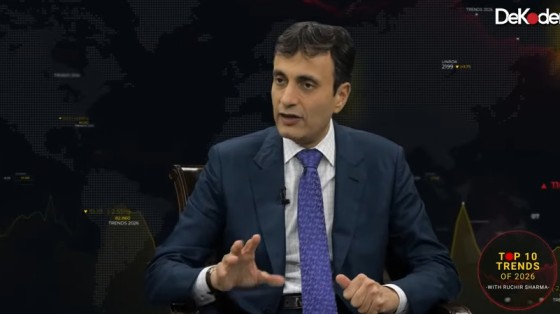
Here is the full transcript of author and investor Ruchir Sharma’s interview on DeKoder with host Prannoy Roy, streamed live on January 9, 2026.
Brief Notes: Each January, Ruchir Sharma’s conversation with Dr. Prannoy Roy has become a must-watch guide to the forces quietly reshaping the world. In this DeKoder special on the Top 10 Global Trends of 2026, they cut through market noise and media hype to focus on the structural shifts that really matter for economies, investors, and citizens alike.
From global growth and capital flows to power politics and technology, the discussion looks beyond short-term forecasts to map the deeper currents likely to define 2026 and the years ahead. Whether you are an investor, policymaker, entrepreneur, or simply trying to make sense of a rapidly changing world, this episode offers a sharp, accessible framework for understanding the year to come.
Introduction
PRANNOY ROY: Hello and welcome to DeKoder. Today we present to you one of our most important shows of the year in which we decode what will happen to the world and India’s economy in the 12 months ahead. For those who want to plan ahead and understand whether to invest or not, do listen closely to the amazing investor and writer, the brilliant Ruchir Sharma and his top 10 trends of 2026.
Ruchir Sharma is a contributing editor of the Financial Times and the author of several books, including his latest “What Went Wrong with Capitalism.” He’s the founder of Breakout Capital and the chairperson of Rockefeller International.
Today’s program is in two parts. Part two is looking ahead at 2026. But first we will also have a look at how accurate Ruchir’s forecasts were last year. I’d like to make it clear once again right at the start that the research and insights are all done by Ruchir and his brilliant team.
By the way, please click on subscribe and follow DeKoder to get regular and different insights into events across the world and India this year. But first, Ruchir, thanks very much for joining us again. Really good to have you in your hectic life. It’s great that you spared the time for once.
RUCHIR SHARMA: Well, this is my favorite show of the year and happy to be here Prannoy. Thank you.
PRANNOY ROY: And we’re going to be very tough on your forecast for last year.
RUCHIR SHARMA: I’m used to that. I’ve been on the hot seat in that regard for over a decade now.
Reviewing 2025 Forecasts: Hits and Misses
PRANNOY ROY: Okay, let’s begin with a look at the forecast that you made last year versus what actually happened. First you said there would be a reversal in recent pattern of American dominance. What actually happened was exactly that. International outperformed US by two times, twice. Look at that. Europe 35% return on the stock market. America 18%, even emerging markets 34%, US 18%. All these, China, Japan, whole world except India. India was slightly less, just 3%. And this is in dollar terms you mentioned?
RUCHIR SHARMA: Yes. So I think that at this time last year Prannoy, the universal consensus was that the only place worth investing in in the world was America. So if you looked at America’s share in the global equity benchmark, it was 66% or so. Like everyone was convinced the only place you can put money into is America.
And to its credit, the American economy and the American stock market did have a relatively good year last year. 18% is well above the long term average return of 10%. And even the US economy did well as we will see. On a relative basis though, the rest of the world way outperformed America, in fact, possibly by the widest margin in 15 years.
So I think that this marks the start of a trend. We’ll see whether this is just a one off like it happened in 2017, or this is part of a longer term trend. But my feeling is that 2025 was a major inflection point and the rest of the world’s stock markets over the next few years will keep outperforming.
PRANNOY ROY: I mean, I was actually shocked when you made that forecast because America, as you said, was doing so well and you suddenly said, well, I’m going to reverse relatively. What signal? I mean, how did you see that?
RUCHIR SHARMA: Well, some of it is, you know, when there’s such a universal consensus where everybody has the same view, then the question you ask yourself is who is left to buy that if everyone is already bullish about one country, then surely they’ve already put all the capital there. And so I think that’s it, that America will always remain the world’s preeminent stock market and its biggest economy.
PRANNOY ROY: Even in size.
RUCHIR SHARMA: In size. But you know, these things reverse in terms of that over the last hundred years. That’s always been the case. But you’ve gone through enough spells, even decades when the rest of the world has done better.
PRANNOY ROY: That was an amazing forecast. And as I’ve been advising the clients of the wealth management firm 360 that they really need to think beyond just investing in America.
America’s Fiscal Deficit Challenge
PRANNOY ROY: Secondly, you said that US has made a fatal flaw. A fiscal deficit is in a league of its own. What actually happened was tariffs eased fiscal concerns and the 10 year yields declined. But look at the fiscal deficit as a percentage of GDP. America 6.9 down to 6, but still 6% compared to Europe at half that 3%, India even much less. In America 4.8. And emerging markets as a whole, 4.8. So still very high, but declined a bit.
RUCHIR SHARMA: Yeah. So I think that this was somewhat of a surprise to me and this didn’t quite play out the way I was expecting because I think that in America the incentive to reduce the budget deficit is very little. And politicians, until they face a crisis, the habit is just to spend more and to cut taxes wherever possible because they just want to give the money back in a way or they just want to spend other people’s money.
PRANNOY ROY: Right.
RUCHIR SHARMA: So that’s what politicians do.
So I think that America, you know, 6% is high. 6% is still very high. And I still believe that this is a fundamental flaw with the American economic model that they used to run a budget deficit of about 3% of GDP for much of the last decade, like in the 2010s. Now the average seems to be 6%, seems to be like the new normal.
PRANNOY ROY: That’s a huge change.
RUCHIR SHARMA: Yeah. And I think, as we’ll discuss in the show later, I suspect the 6% is likely to widen back in 2026. But at least in 2025, the bond yields did not increase that much. And so you manage to get some relief because of the budget deficit not increasing.
The End of American Exceptionalism
PRANNOY ROY: Right. Your third forecast last year was that America will look less exceptional. What actually happened was America US growth slowed despite a huge AI boost. And we all know about how much money was spent on AI. Look at what happened in America. The real GDP growth dropped from 2.8 to 2.1%. While global IT remains stationed. India, it went up, but America dropped.
RUCHIR SHARMA: No, but I still feel it’s relatively impressive that America was able to even grow at 2.1% because it’s a huge base. It’s a huge base. But the fact of the matter is that in the years before this, the American economy was growing in some years even faster, especially in nominal terms, compared to the rest of the world. Last year, that trend even eased itself because the rest.
So I think that the big story which was there in the first trend and even in the third trend is not that America had a bad year. The American economy held up, albeit it was held up a lot because of the fact that it’s become one big bet on AI. But the big story of 2025 was that the rest of the world, both in terms of stock market and economic growth, did much better than what people had anticipated. So that was really the big story of 2025, that American exceptionalism came to an end.
PRANNOY ROY: Rest of the world and India 7.2.
RUCHIR SHARMA: Yeah. But now India’s GDP data, we can discuss that. Some of it is technical because the inflation data in the GDP deflator is possibly overstating the real GDP growth. But in general, you know, like India too, and the rest of the emerging markets, economic growth did better, especially compared to expectations versus America.
India’s Growth Challenge
PRANNOY ROY: Well, I must say one of my favorite themes we discussed earlier, 7.2 is great. But I went to China every year for 25 years and I saw Deng Xiaoping and they were growing at 12%, 14%. So 7.2 much better than earlier and should be. Well, not much better, but a pretty good rate. But until we hit 12, 14, we will not be another Asian miracle.
RUCHIR SHARMA: As you say, only happy when we get to 12 or 14%. I seriously believe that.
PRANNOY ROY: Yes. But there’s a lot more we need to do for that and we will talk about it as the show gets on, that if India wants to grow much faster, even sustain these growth rates.
RUCHIR SHARMA: Because it’s a low base also.
PRANNOY ROY: Yeah, apart from the low base, there’s some technical issues which is why the growth rate looks closer to 8% rather than possibly the true 6% which we could see in the coming year or so. And the reason for that is that apart from the GDP deflator causing some issues, without getting too technical about this, the fundamental issue is this which shows up in the Indian stock market performance we spoke about, which also shows up in other data that we will speak about, that India needs a lot more foreign capital and needs to export a lot less people.
But instead what we’re seeing in India is that virtually foreign capital is not showing up in this country.
RUCHIR SHARMA: In fact, it’s flowing out of India.
PRANNOY ROY: Yeah.
RUCHIR SHARMA: This year that was very worrying actually.
PRANNOY ROY: Yes. And the other one of the great things, I mean major reasons for China’s 12 was money coming in, especially foreign direct investment.
RUCHIR SHARMA: Foreign direct. They were getting, you know, 3 to 4% of GDP foreign direct investment during the go go years. Whereas India’s net FDI is close to zero and even the gross FDI is close to 1% of GDP. So I think that the fundamental issue that India needs to deal with is how do we get more foreign capital? Because we need that. Because the private, especially direct investment.
PRANNOY ROY: In industries and etc.
RUCHIR SHARMA: That helps with technology transfers as well. And also as we will speak about that, how do you also export less people which are. There are lots of people leaving India, especially at a mass level now that I think that in the last year or so close to 700,000 people left India. That number used to be closer to 300,000 last decade and close to balance two decades ago. So why are we seeing an accelerated trend here where people are leaving the country? I think that those are two things that I think we need to address.
Emerging Markets: New Stars Rising
PRANNOY ROY: This is very interesting, this increase. I think you talk about it later. Despite all the visa restrictions and all the kind of anti-immigration. Anyway, we’ll talk about that later. The fourth prediction you made was there will be new stars that will emerge. And in fact, what happened in 2025, the number of emerging markets growing faster than US spiked. In 2024, there were 52% of emerging markets with faster per capita GDP growth than the US, 52. Last year it went up to 76. Now, how did you see that happening?
RUCHIR SHARMA: Well, because I think that firstly from a low base, many emerging markets should grow faster than the U.S. but from 52 to 70. Yes, and that’s what used to be the case, like in the 2000s when all emerging markets were booming. But emerging markets have had a very difficult last 10 years or so.
So my point was that they’ve carried out enough economic reforms, they’ve cleaned up their house, and now that they’re in a position to grow better. That was my basic feeling as I surveyed the emerging markets. And it’s playing itself out. And I think that this is going to accelerate.
So you’ve got some countries, whether it was because the AI boost, like Taiwan and stuff, you know, growing at very fast. Yeah. Like a huge success story. And then even other countries in Eastern Europe and other places where growth accelerated. So I think that this is good news for emerging markets that after a period where growth versus the US in many countries was falling, now growth is accelerating versus the US. So that should mean much more stock market outperformance, much more capital flows to emerging markets and new stars emerging.
PRANNOY ROY: Quite a big change that you saw once you got it right.
China: The Comeback Story
PRANNOY ROY: Okay. The fifth forecast you made was China will be investable again. Now, you were for many years slightly negative about China. And then I saw this forecast and I said, that’s a big change that you suddenly saw a twist. What actually happened? China stocks returned more than 2x United States. China’s stock market returns were 31% and US was 18%. What a change.
China’s AI-Driven Market Recovery
RUCHIR SHARMA: Yeah. So I think that what I was sensing was that too many people have become pessimistic on China, which is that, yes, China has lots of problems from its debt to demographics, the population is shrinking. But I think that what happened was that China, the foreign investor community and all, were all calling China uninvestable. We can’t invest in China.
And then I think that they rediscovered that, no, when it comes to things like AI and technology, China is still a very good bet. And so I think that powered by the AI boom, which is happening worldwide, and the fact that China has such capabilities in AI, the Chinese stock market was able to stage a big comeback led by its companies like Alibaba, Tencent, you know, and some of the other companies which have developed very competitive LLM models.
So the Chinese stock market did relatively well and became investable again, which is that after being shunned for many years.
PRANNOY ROY: Including by you for many years, and then this changed and it turned out to be correct.
RUCHIR SHARMA: Yeah, I think so.
India’s Small Cap Correction
PRANNOY ROY: The other, actually the sixth forecast you made was really amazing. You said, India, small caps will no longer be beautiful. And that was after years of small caps doing much better than mid caps and large caps. In fact, what happened, small caps performed the worst. Large caps went up 10.5%, mid cap 6.2% and small caps went down minus 5.3%. Now that total change from many years where small caps was the thing to invest in and last year, other way around.
RUCHIR SHARMA: Yeah. And these are all numbers in rupee terms. So of course in dollar terms it’s even a bit more, but relatively it’ll be there. But the point here is this, that the valuations, this is like we forget, we get caught up in all these frenzies and we forget that there’s something called valuations, which is the valuation of the small cap stocks have become very expensive.
And also that the expectations of small cap stocks in terms of their earnings and all were very high. But now in fact what we’re seeing, and this is a bit concerning in general, is that the overall market, the revenue growth of the overall market over the last year has been just 4%. A big disconnect with what’s happened to GDP growth. Right, because we’re talking about 8% type GDP growth. And yet the revenue growth of the overall stock market is 4%. And the small caps, the revenue and the profit growth has in fact been—
PRANNOY ROY: Negative even overall?
RUCHIR SHARMA: Right. So I think that that’s really what’s driving it down, that you’ve got a big valuation increase in some of these small cap stocks because as you said, after years of outperformance, and then in the last year or so we have seen that the revenue growth, the profit growth of small caps in particular has turned negative. On the overall market, it’s slowed down, but for them it’s turned negative.
So I think that’s a real drag. And again, this tells you that despite all the headline optimism that we have here on the GDP growth and stuff, the stock market is telling a slightly different story because small cap stocks—
PRANNOY ROY: The stock market is where people put their money where their mouth is and it is realistic, actually. Yeah.
RUCHIR SHARMA: Because I think it’s also because of the fact that these small cap stocks tend to be much more economically sensitive. So there’s much more pain that they are feeling. Obviously some sort of slowdown is happening somewhere for negative revenue and profit growth.
The Magnificent Seven and AI Spending
PRANNOY ROY: Right. The seventh out of the 10 forecasts you made last year was there’ll be overspending on AI, which will hurt big tech. And you have this Magnificent Seven, or what is known as Mag Seven. They continue to lead the US market. Mag Seven, 23% up in terms of US returns and Standard and Poor index up only 18%. So Mag Seven did much better than other stocks.
RUCHIR SHARMA: Yeah. So I think that this didn’t quite play out as I expected because, you know, like, I’m a big believer in the power of AI and the fact that AI is going to have a huge productivity effect. But I’m really concerned about the amount of money that some of these companies are spending and how are they going to get a return on this capital? That’s, I think, been my concern and I thought that in 2025 investors would become much more concerned about this.
PRANNOY ROY: Right.
RUCHIR SHARMA: And now as the next graph shows—
PRANNOY ROY: Yeah, here we are. Yeah, overspending is going to hurt it. But Magnificent Seven, the Mag Seven, they splintered and Google, 66% and they were a little bit of a late starter on AI. And Microsoft, which only grew 16% was one of the originators. So an Amazon 5%. So what a difference, 66% to 5%. Why that splinter?
RUCHIR SHARMA: Yeah, but I think that this is also telling the story. So as I said that I expected that there’d be concerns that investors would start asking that, okay, where is all this money going? And I think what we saw instead was that overall it doesn’t show up as if concerns were there because the overall returns were very good.
But if you look beneath the hood, those concerns are coming. The reason why Amazon underperformed, Meta also didn’t do that well, was because these companies are spending a lot more and in fact starting to take debt for the first time to finance their AI investments. Whereas Google and Nvidia, they still remain cash cows. They’re not taking any debt because they’re generating lots of cash.
And Google and their performance in particular has been very good. Alphabet, as it’s known in the market, because of the fact that they’re firing on all cylinders. So they were able to make serious advances on the chips front, on the AI models that they have. And now the fact that they have search engines such as Google and YouTube.
PRANNOY ROY: YouTube is doing just going through the roof.
RUCHIR SHARMA: Yeah. Even in India, those numbers are off the charts in terms of it’s become the go-to TV station, so to speak, for the average person with more than 600 million people tuning in every day, I’m told. So I think that that’s really what’s happening. They’re firing on all cylinders.
And so therefore Google is doing well. And unlike some of these other AI companies which are taking on lots of debt now to finance their investments in AI, Google, Nvidia are still flush with cash. So I think that differential is showing up.
PRANNOY ROY: I want a little side comment that when I used to travel in Silicon Valley three, four years ago, people were very skeptical about Sundar Pichai, the head of Google. But look at what Sundar Pichai has done. He’s ahead of the rest, 66%.
RUCHIR SHARMA: That’s like last year at least.
PRANNOY ROY: Yeah, yeah, last year.
RUCHIR SHARMA: Yeah.
PRANNOY ROY: But so I hope the view of him has changed because I mean, he really has—
RUCHIR SHARMA: Remarkable year for Alphabet. Google has had. Yes. Right, right.
Global Trade Without America
PRANNOY ROY: Okay. Your eighth out of your 10 forecasts was trade grows across the world without America. In fact, trade fell in America and increased outside America. Now, America imposed tariffs, but look at the export growth rates. The world, excluding US trade went up from 5% to 6.4% growth rate.
RUCHIR SHARMA: Terrific.
PRANNOY ROY: And in America, that is exactly the opposite of what Trump would have liked. It went down from 4.6% to 4.1%. Why has that happened?
RUCHIR SHARMA: Yeah, I think that, so, you know, the two things playing out here. One, that Trump decided to obviously escalate the trade war by imposing tariffs. The rest of the world, very interestingly did not retaliate.
PRANNOY ROY: Right.
RUCHIR SHARMA: So that was one which contained the damage from the trade war.
PRANNOY ROY: They didn’t say, we’ll also increase. Yeah, yeah.
RUCHIR SHARMA: In fact, they say, you know, we will negotiate. And that damage, the effect of the trade war. But secondly, which is possibly the more interesting trend which I spoke about last year, it’s playing out, is that many countries are saying, okay, America is doing this to us. Let us figure out how to trade much more with each other. We still believe in the benefits of free trade.
And that’s true for India too, which is that if you look at India, one of the things we spoke about in the past was that India was a bit too protectionist. But now we’re seeing of late that India is beginning to strike more trade deals with other countries. And in very quick time, I think they did one with New Zealand in quick time. And now in the Middle East, like they’ve done with Oman, a broader comprehensive economic partnership. So I think that this is it, which is that—
PRANNOY ROY: And India reacts best when there’s a crisis. That’s what it’s doing right now, as you said, quicker.
RUCHIR SHARMA: Absolutely. Whether it’s trade, it’s deregulation, as we’ll speak about some of the changes in laws. So I think that they sense that they are under siege a bit.
PRANNOY ROY: Reacting.
RUCHIR SHARMA: And so they’re reacting, particularly on the trade front. I think we have seen a major shift in India’s attitude in striking trade deals with other countries. And this is true in other regions, too. If you look at Europe and Latin America, all these places, they’re trading much more with each other, and that’s what the data shows.
PRANNOY ROY: And one thing, I really liked what you said, that you’re not sure whether Trump will make America great again, but he’s making the world great again.
RUCHIR SHARMA: Well, it’s showing up in the market.
PRANNOY ROY: Exactly.
RUCHIR SHARMA: It’s a reaction to that market performance.
PRANNOY ROY: Exports. He’s making the world greater because he’s—
RUCHIR SHARMA: Sort of incentivizing the world to get their act together that, listen, if we have to compete in this hostile world, we better get our act together or better have stronger relations with other countries. So that’s what’s playing out here.
PRANNOY ROY: So making the Earth great again. MEGA. Okay. Yeah, that’s a lovely one.
Private Markets Under Pressure
Your ninth out of 10 was that private funding to slow down globally. And what actually happened was flows to private credit fell and firms are under pressure. The S&P went up by 18% last year, but key private equity firms fell by 12%. Now, you have to explain this a little bit more clearly. What do you mean by key private equity firms, and why did this happen?
RUCHIR SHARMA: Yeah, so as you know that these are firms which typically, historically used to be private equity firms, but they’ve become much bigger now. They do also private credit, which is, you know, rather than bank lending, these are private credit deals which are done, which is what these people are able to finance. So these are the private credit behemoths as they have become.
And this is where finance has been moving a lot, which is that the private markets have been growing very rapidly over the last decade or so. But I think that what happened in the last year is that people began to ask questions, which is that the public markets are doing so well. Do I need to lock so much money of mine into private markets? Because the exit there is much more difficult.
So I think that that’s what was happening. And so on the private equity front, we found in places like the US and even in Europe that the exits people saw are much more difficult. That fine, these private equity companies invested three, four, five years ago at pretty high valuations, but how do we exit? So the exits become more of an issue.
And even on private credit, people began to ask the question that because there were a couple of high profile troubles which took place in the private credit markets, are we extending all these loans here? But these companies don’t have much of a lending or borrowing history. So how do we know that we’re going to get that capital back? Unlike in the public markets which are much more tested. So I think that sort of—
PRANNOY ROY: Yeah, what a change actually.
RUCHIR SHARMA: Yeah, so I think that’s something which we’re seeing in the market.
The Obesity Drug Phenomenon
PRANNOY ROY: And your 10th out of all 10 was as usual, something a little tangential. Obesity. There’s no magic solutions. All these drugs and injections, etc. What actually happened was anti-obesity drugs still a sensation, but there were high sales, but sales slowed sharply. I mean they were growing by 27%, 43%, 64% in 2024 and it dropped to 26%, still not bad, 26%. But why are people worried about it or—
RUCHIR SHARMA: Well, why not? You know, like this is a higher base because the growth had already exploded, very important. So I think that it’s still something which is popular. The growth rates have slowed down. So I’m not quite sure. But I have to be honest when it comes to this that my bias talks here because I’m a bit of a naturalist. And so—
PRANNOY ROY: And the worst part is you don’t need it.
RUCHIR SHARMA: So I think that there are more visible side effects. I think there are more visible side effects. And so therefore some of the growth rates may have slowed down, but some of this may have had to do with the base effect. But in all fairness they still remain overall quite popular out there.
Of course, the stock price performance now is diverging a lot that the ones which have new breakthroughs or like Eli Lilly in America did very well, whereas Novo Nordisk in Europe didn’t do that well. So you’re seeing more divergence, maybe some more maturing of the market. So I don’t think this fad has gone. It’s still very much in play. But the fact of the matter is that the growth rate has shown it.
PRANNOY ROY: That is still a fad. Okay, let’s do a quick summary of what your scorecard. I give you 8 out of 10. Which is bloody good actually. First you said a reversal in recent pattern of American dominance. Spot on. Second, you said the US fatal flaw, the fiscal deficit is a league of its own. You were not right on that.
RUCHIR SHARMA: Right.
PRANNOY ROY: America will look less exceptional. Spot on. You said new stars will emerge. Spot on. China investor will again. Which is unusual for you to say, but you changed and you got it right on. Huge increase in their stock market in India. This was astounding that small caps will no longer be beautiful after so many years of being the most well performing asset class. You were right there. Then you said overspending on AI will hurt big tech. There were. You are not quite right.
RUCHIR SHARMA: They’re still doing very well. Doing very well. I think the stock prices of most of them are still doing decently.
PRANNOY ROY: Doing decent. Yeah. Then you said trade grows, will grow globally without America pour on and making the earth greater again by Trump. Spot on. Private funding will slow down globally. And we just discussed that. It has. And then obesity. No magic solutions. It’s not a magic solution. But people are still 26% growth on a large base. It’s still. But I would say okay, just about.
RUCHIR SHARMA: Give you a borderline or borderline.
PRANNOY ROY: We’ll give it to you otherwise a 7.5 out of 10. Okay, now let’s move on to what are Ruchir’s forecasts for 2026 and if you want to know what to do with your funds, where do you want to travel, what do you want to do? Listen to each of these 10 trends. First, you said AI is a bubble. It is a bubble and you have four O’s that shape a bubble. Any bubble. Overvaluation, over ownership, over investment and over leverage. Explain what you mean by that.
AI Is a Bubble: The Four O’s Framework
RUCHIR SHARMA: You know I’ve studied bubbles a lot. It’s one of my favorite topics that I’ve researched over my whatever 30 year investing career.
PRANNOY ROY: Since 1500, you’ve been looking at bubbles.
RUCHIR SHARMA: Yeah, bubbles. You know the history of bubbles, right? And there’s no standard definition of bubbles. Right? Because people, in fact today people say there’s almost a bubble and bubble talk. Right. Because there’s so many people are using the B word very sort of carelessly almost. So I have a framework which is that there are four ways that you can measure whether something is a bubble or not. Right.
So one is overvaluation, which is straight up that what is the valuation. So if you look at the American stock market and look at the AI sector in particular, what the valuations are, it’s ridiculous. And it’s very high. I mean some people say it can be even higher like it was in 1999, 2000. But if you look at some of the price trends as well, and you know we have a graph on that. Sorry to interrupt. The price trends.
PRANNOY ROY: Sorry, you said 99, 2000. You know what happened after that?
RUCHIR SHARMA: That’s right. Okay, yeah, but you know, but before the bubble peaked, you got another 50, 100% increase from where we are today by some measures, but you know, that’s debatable. But generally valuations in the American market, AI stocks in particular are quite expensive. And the price trends are also very extended. If you look at the next graph that if you look at bubbles historically, typically prices tend to go up about 10 times after adjusting for inflation. Time horizon.
PRANNOY ROY: That is an amazing statistic. You found that AI bubbles inflates until interest rates change. But also on top of that there’s overvaluation. Major bubbles. The prices rise 10x in 10 years.
RUCHIR SHARMA: Yeah.
PRANNOY ROY: And you see that year after.
RUCHIR SHARMA: I mean decade of the major bubbles that I’ve shown here in post war history, that’s been the common trend. So I’d say that.
PRANNOY ROY: And you’ve got last thing, US tech right now, 10 years and it’s 10.
RUCHIR SHARMA: Times, just over 10 years. But I think that the whole issue is. So I have four O’s that I look at, as I said, of analyzing where something is a bubble. So this is the overvaluation part. Then you have to look at over investment. And as I said, and there’s a lot of investment that’s happening there. In fact, tech investment as a share of GDP in America today is 6% and it’s very large compared to what it used to be in the last few years.
Then the third trend, you know, I find is the third O, rather not the trend is the fact that today, and this for me is a stunning statistic, more Americans today own stocks than they own property.
Over Ownership: Americans Own More Stocks Than Property
PRANNOY ROY: That is amazing. Look at that. Over ownership only. Americans own more wealth in stocks than property. I mean that is amazing.
RUCHIR SHARMA: This is the first time this has happened.
PRANNOY ROY: Oh, okay, right. And the world, rest of the world, nothing like it.
RUCHIR SHARMA: Nothing like it.
PRANNOY ROY: In America, property is owned by 30% stocks, by 32% China 55 and 11.
RUCHIR SHARMA: Yeah. This is the amount of your, of your. How much is in the stock market and how much is in property. Now typically we’re used to seeing that most of your net worth tends to be in the house you stay and the property you have. But now in America, what we see is that people have more in the stock market, their net worth than they have in the property market. And places like India, China, everywhere. The data is very different, as you know, that most of the investments are still in property, as it should be, because that’s your primary use.
PRANNOY ROY: So, I mean, just explain that in a little more detail that in China, Europe and India, more than 50% of people’s wealth are in property.
RUCHIR SHARMA: Yes.
PRANNOY ROY: And only 11, 16 and 7% are in stocks. In America, 30% in property and 32% in stocks. Just explain that. Why?
RUCHIR SHARMA: Yeah, because I think in America, a lot of people love trading. There’s so much retail trading which happens in America, if you look at even trading volumes, very significant part of it nowadays about retail investors. So you have a whole army of people there who spend their whole day just trading stocks.
PRANNOY ROY: So is this again about AI at all?
RUCHIR SHARMA: A lot of it is AI because what they are buying essentially are some of these Mag 7 stocks, or they’re buying other AI thematic stocks where it’s Palantir or other stocks that they’re buying. And those are trading at all sorts of crazy valuations when it comes to price to earnings, price to sales, even higher. So I think that that’s what’s going on.
PRANNOY ROY: Very, very big difference in America and the rest of the world.
RUCHIR SHARMA: Yeah. This is a sociological sign of excess for me that why should you be spending so much your time, of your time trading in stocks? And I think a lot of young people in America have almost given up buying a home. And they’re saying, you know, because it’s too expensive, we’ll just spend whatever we can get in terms of trading in the stock market.
PRANNOY ROY: My God. And the other point you made, which is again, going back, you’ve done so much research on that, the bubbles burst when interest rates.
Over Leverage and When Bubbles Burst
RUCHIR SHARMA: If I can just sort of say here, one point.
PRANNOY ROY: Yeah, sorry.
RUCHIR SHARMA: Which is that. So we did the four O’s here. So let’s say. Yeah. So we’ve spoken about how, you know, it checks off here, which is that you have overvaluation.
PRANNOY ROY: Yes.
RUCHIR SHARMA: You have over investment, over ownership. We just showed.
PRANNOY ROY: Right.
RUCHIR SHARMA: About what’s going on. And the last is in terms of over leverage, you know, by too much debt.
PRANNOY ROY: Yes.
RUCHIR SHARMA: Now here, in all fairness, these companies have not taken on too much debt as yet. But that picture is changing very quickly, which is that they’re beginning to take a lot more debt for the first time.
PRANNOY ROY: That’s what you said. Some of the ones that haven’t grown that fast have taken on a lot of debt.
RUCHIR SHARMA: Are beginning to take debt to catch up on the race because you know, they’re saying, okay, we need to borrow a lot more to spend on building out these AI models. And so we’re going to take a lot more debt. So it’s not worrisome as yet if I do an objective read. But on the over leveraged front, although in America you can argue the government’s over leveraged, but if you look at the other 3 O’s, it is pretty extended.
So that’s why I think that America is in the advanced stage of some sort of a AI bubble because that’s what’s really driving the stock market also in America. In fact, even last year, overdriving it. 70 to 80% of the returns in the American stock market last year came from.
India’s Missed Opportunity in AI
PRANNOY ROY: I just wanted to ask you one thing about India that China has done so well in AI. America’s done well, Taiwan has done well. India, we have the brains, we have the software geniuses, we have everything here. But we really didn’t get on the AI trend. Why? Is it too late or.
RUCHIR SHARMA: Well, I think that what India is trying to do now is to attract much more investment for the data centers. So that’s what we’re trying to do. But I guess that’s the point.
PRANNOY ROY: But the softer side is like, I know Tata has just had a huge $2 billion investment in AI, but everybody should be doing it, we should be leading it.
RUCHIR SHARMA: I know, but it’s because that’s been a historical problem that Indian companies or the government even, we don’t invest much in research and development if you look at R&D spending. So sure, we could pick on isolated examples about, you know, brilliance in innovation and stuff, but we are not a nation of innovators in a big way. We are a nation of optimizers. We’re a nation of doing what we can to get by. But if you look at R&D spend as a share of GDP, India is still very low, very low. Especially compared to all these other countries. Private sector especially. Yeah, exactly.
PRANNOY ROY: Whatever there is in R&D is government mainly and not private sector, which is a big worry for India.
RUCHIR SHARMA: Yeah. So I think this is not on the AI front.
PRANNOY ROY: Yeah. And we really could have been leaders in AI.
RUCHIR SHARMA: And that’s also one reason why the Indian stock market underperformed the other markets last year because AI was such a big theme. And we don’t have anything on AI, if at all. The foreign investors think of India as a possible loser because of the fact that they feel that the jobs could be lost, outsourcing could come under threat. So I think that’s what’s happened.
When Bubbles Burst: The Interest Rate Connection
PRANNOY ROY: Now, coming back to the bubble again, you’ve done a lot of research of when the bubbles happen. When interest rates are raised, that 10 year hits a 10 year point and the governments raise interest rates. Look at that, 1929. Yes, they raised interest rate. These are all the bubbles. 73, 80, 89, 94. Every time it was about 10 years, the stock price had hit 10 times and the interest rate was raised. What a combination to actually discover.
RUCHIR SHARMA: Yeah, I think that the point is.
PRANNOY ROY: Well done for the second time in your life.
The AI Bubble and Interest Rates
RUCHIR SHARMA: No, I think that the people here keep asking the question that when will the bubble burst? Because there’s no end to it, there’s no science to it.
PRANNOY ROY: Yeah, right.
RUCHIR SHARMA: Because as I said that today the valuations are very extended. But what prevents this bubble from inflating further? Why can’t Nvidia or some of these other AI stocks go up much more from here?
And the historical research I did was that the only way of knowing when a bubble bursts is when interest rates begin to rise. That has been the death knell of every single bubble. So until interest rates rise, it’s possible the bubble can inflate further.
PRANNOY ROY: Just to divert a little bit in the midst of all this. What about gold? It’s just going through the roof.
Gold: Entering Bubble Territory?
RUCHIR SHARMA: Yeah, but I think this is the issue which is that we’ve spoken on your show before. I’ve always been, not always, at least this decade, been quite bullish on gold and always thought that gold and bitcoin are good anti-dollar plays, which is that I’ve been a bit pessimistic on the dollar and thought that gold and bitcoin could be the two beneficiaries of that.
I’m a bit concerned now. And in fact I wrote a piece about this a few months ago, last October, which is the fact that gold today is also not behaving like a safe haven. It’s behaving almost as if it’s also entering some sort of bubble territory because people are putting so much money into gold.
I like gold because of its safe characteristics. It’s a steady asset. It rises steadily over time, protects value. But now I think what’s happening is, and this is a function of the fact there’s so much liquidity out there, so much money sloshing around the system. And also because most people feel that if something happens, the government will bail us out. So we can just speculate a lot.
And I think that’s what’s going on, that so many assets are rising simultaneously. Because this has never happened before. By the way, gold and stocks have never partied together this way. Historically, what happens is that one or the other acts as a hedge, that if stocks go up a lot, then gold typically underperforms. If gold goes up a lot, it’s usually in bad times. Right. Because people—
PRANNOY ROY: Stocks have gone down.
RUCHIR SHARMA: Stocks have gone down and that’s it. This time what’s very unusual is that gold and stocks are partying together. And so it means to me that if and when interest rates rise, it could also be negative for gold. But for now, as long as the two are behaving together, everybody feels happy.
PRANNOY ROY: But this is pretty good news for India because we have a lot of gold, both in households and in the country as a whole. So gold prices going up has really made our wealth base higher.
RUCHIR SHARMA: Well, it’s mixed because we import a lot of it also.
PRANNOY ROY: So we have to buy that.
RUCHIR SHARMA: Yeah. Because we import a lot of it. And people don’t do anything really to monetize the gold. Right. Because how do you get a positive wealth effect? You get a positive wealth effect if you do something to monetize it. But in India, we hold the gold. And in fact, most people in India are sentimental and they still buy new gold for weddings and stuff.
So most people are not that happy. If you’re a consumer of gold, you’re not happy. If you’re speculating in gold and silver, other things, you’re happy. But for users, it’s not been that great.
PRANNOY ROY: So the way it’s been shooting up, many people would say that, okay, good time to invest in gold. But you do say that it could be entering a bit of a bubble situation. Overpriced and interest rates will affect that also.
RUCHIR SHARMA: Yes. This time this is going to be like a bit of a concern, which is that when—if interest rates go up and stocks go down, it could also hurt gold, is my fear, even though I’ve been very bullish on this for a long time.
PRANNOY ROY: But you see that it’s reaching a kind of perhaps a peak.
RUCHIR SHARMA: Yeah. In terms of the fact that it’s entering into dangerous territory where at least I feel concerned about at least putting fresh money to it, even if I already have some capital invested in it.
PRANNOY ROY: You have enough gold anyway.
The Affordability Crisis in America
Okay, your second forecast is what is called the affordability crisis in America. And that forces interest rates to go higher even though Trump doesn’t want it. And we’ll go into that. The US people now pay 30% more for food than they did five years ago. Affordability, consumer prices hold up only 22%. But food prices and housing prices, which is what they actually spend their lives on—affordability, 30%.
RUCHIR SHARMA: Yeah. So I think that this has been the real issue in America, which is that the number one issue, which is responsible, in fact, for taking down Trump’s approval ratings, is the fact that inflation in America for many people is still too high.
So the basic stuff that they’re buying, groceries, food is high. In fact, electricity prices are up even 40% over this time period, partly because of AI, and especially because they’re consuming much more electricity in some areas, particularly in areas like Virginia and all where lots of data centers have come up.
So I think that’s the real concern, which is that food prices, other prices are still up a lot. And so therefore, those prices have started to moderate in terms of their increase over the last year. But the inflation in America is still close to 3%. And America has not lived with this kind of high inflation in a very long period of time.
PRANNOY ROY: 3% is just a norm, but food and housing is double that almost.
RUCHIR SHARMA: Yeah. In terms of—that’s what’s happened in the last five years. Annual inflation has been 3% in America and 2% used to be the target. Now America has missed that target of 2% for 55 months in a row.
So that begins to compound over time that you keep having higher and higher inflation. And so therefore, lots of people are concerned about it and are not feeling that good about their well-being because of the fact that inflation is still relatively sticky, even if it has come off the peak. And that’s also hurting Trump’s approval rating.
PRANNOY ROY: Yeah. And he’s now distributing more money. So it’s obviously making a very negative reaction to the government.
RUCHIR SHARMA: Yeah. And I think that that’s the issue that I feel, which is that there’s a risk, in fact, that he wants interest rates to come down.
PRANNOY ROY: He wants it to come down.
RUCHIR SHARMA: But my fear is that if he spends more money to try and please people, interest rates in America, particularly the ones he doesn’t control, could go up. He’s trying to put friendly people at the Fed and try and push interest rates down. But long-term interest rates may start to go up if they begin to lose credibility in the Fed and what happens in America.
So that’s one of the concerns and very interestingly that in the rest of the world, in fact, interest rates, particularly long-term interest rates have been rising.
PRANNOY ROY: In fact this affordability crisis, prices going up basically—there’s excess money in the market. So the Fed or the Reserve Banks want to raise interest rates and it’s happening all over the world, as you just mentioned. Japan up considerably. Korea, Germany, France, interest rates have been going up. America, he wants to bring it down despite this 30% increase in food.
RUCHIR SHARMA: Yes, that’s right. So I think that I just feel that he’s got this ideological thing coming, maybe from his developer background that he wants—he believes in lowering the cost of financing.
PRANNOY ROY: Right.
RUCHIR SHARMA: But the issue is that for many people inflation is hurting. And a very important country to watch is going to be Japan because I feel the fact that Japan used to be a country which suffered from deflation for years. Now in Japan interest rates are going up because inflation there has come back in some way and the central bank has been dragging its feet to raise interest rates too much and they have a lot of debt.
So if in Japan you end up getting a situation where interest rates go up a lot, I think it could end up being problematic because it would have a global impact of lifting interest rates, including in America.
So I think those are my first two trends, which is that the AI bubble is being supported by a lot of liquidity still and it will keep inflating, but keep an eye for the fact that interest rates could rise, especially by the end of the year because this inflation persists. And this is something which I think could hurt the bubble as well.
PRANNOY ROY: Exactly. For another reason. The interest rates could go up, which could burst the bubble.
RUCHIR SHARMA: Yes, eventually.
PRANNOY ROY: That connection is very important.
RUCHIR SHARMA: Yeah.
International Markets Will Outperform the US
PRANNOY ROY: Now your third forecast for 2026, that international other countries will outperform the United States, that the US has become reliant on hot money, and it’s more reliant than ever. If we look at how much foreign money is coming into America, it’s gone up to 1.7 trillion. And it’s really shot up recently, but its current account deficit has plummeted down to 1.3 trillion. So it’s just been covered up by the deficit being covered up by hot money.
RUCHIR SHARMA: Exactly. And this is a very classic problem in emerging markets that we would see, which is that you consume much more than you can produce. So you have a current account deficit. That’s what a current account deficit is, that you’re ending up consuming a lot more than how much you’re producing at home.
So you have to import a lot. But the fact that you’re financing that—America has a current account deficit around 3 to 4% of GDP. You’re financing a lot of that by people investing in your stock market. And hot money flows coming in there now, tomorrow. For some reason, if these foreigners stop being this ebullient about America and because the AI boom wanes a bit, because a lot of this is going into AI investments, I think then the concern will be what happens to this current account deficit. So that’s my understanding.
PRANNOY ROY: Hot money. Yeah. It can go in and out and out of your control. So you also—the world will outperform the United States, that international markets are still much cheaper than the US for example. World markets, international markets much cheaper in terms of percentage than America. Emerging markets, even less. Nearly 40% cheaper. India, not so much. Only about 5% cheaper or even less than the American market. But world markets are so much cheaper than America.
RUCHIR SHARMA: Yeah. So I think the point I’m making here is that the American deficit is being financed by hot money flows. And if something changes there a bit, the dollar could weaken a lot. Because if that mismatch happens, and generally when the dollar weakens, international markets tend to outperform. That’s been the historical trend.
In fact, the international outperformance already happened this year in 2025 or last year, rather, because of the fact that the dollar was weakening. The dollar weakness could accelerate if there’s a problem out here. And the point here is that the international markets still are trading much cheaper than the US. So they have a lot of scope to go up compared to the US. So I think those are the two points together.
PRANNOY ROY: What’s interesting for India is there’s only 2% cheaper than America.
RUCHIR SHARMA: Yeah.
PRANNOY ROY: Other countries are 30%, 40%. So we are much more expensive than world markets.
RUCHIR SHARMA: And that’s why foreign investors are much more shy about putting money into India.
PRANNOY ROY: Because we’re not more expensive than the rest of the world. Yeah. Except America, where we’re only 2% cheaper.
RUCHIR SHARMA: Yeah. So I think that India needs to get much more earnings growth and other things come back. The fundamentals for us to attract more foreign capital and justify the valuations we have. America’s valuations are being justified today because of the AI boom. But a lot of other countries have just become a lot more attractive. Look at Europe, even Japan. But a lot of emerging markets.
PRANNOY ROY: Emerging markets, yeah.
RUCHIR SHARMA: As we discussed, Latin America and stuff are doing quite well, at least from a stock market perspective. Right.
PRANNOY ROY: Relative to America, they’re much more attractive suddenly. Yeah. Yeah.
Quality Stocks Will Shine Again
Okay, then your fourth prediction out of 10 is that quality will shine again. 2025 was a bad year for quality stocks. Relative returns 9.6% negative quality stocks, which are meant to be doing better than anybody else. But what happened?
RUCHIR SHARMA: Yeah. So over time, if you look at it, quality stocks generally do much better than the rest of the market. Now, what are quality stocks?
PRANNOY ROY: Yeah, what are they?
Quality Stocks Set to Shine Again
RUCHIR SHARMA: That’s a very important point. Of all the stocks in the world, about one in five stocks are defined as quality stocks. These are global benchmarks, mainly on three criteria. One is on their profitability. Quality stocks generally tend to be more profitable as measured by return on equity and other metrics.
PRANNOY ROY: Give me an example of a quality stock.
RUCHIR SHARMA: Well, for example, you know, like in terms of even some of the Magnificent Seven.
PRANNOY ROY: Okay, right.
RUCHIR SHARMA: I mean, like most of those are considered as quality stocks there. But apart from that, like in, you know, there are some defense companies, Lockheed Martin.
PRANNOY ROY: Historically that.
RUCHIR SHARMA: Historically, quality stocks tend to be much more profitable. That’s one criteria. The second criteria tend to be that they tend to have lower debt. And third, they tend to be more stable. Their earnings, their volatility tend to be more stable.
Now, what happened last year was in 2025, that despite some of these Magnificent Seven stocks doing relatively okay, broadly, the lower quality stocks, which are higher on debt, higher on leverage, higher as we speak, mainly because of the AI boom. Some of these unprofitable tech companies, they did very well, which is why quality stocks did quite poorly. And especially outside of the tech sector, the quality stocks did quite poorly in 2025.
PRANNOY ROY: That’s amazing.
RUCHIR SHARMA: Yeah. So I think that you. And again, this goes back to my point. These are all classic signs that we’re in some sort of a bubble where people are saying that, no, we don’t care too much about quality. We just want the excitement of new growth, we don’t care about profitability. It’ll all work out in the future.
PRANNOY ROY: Is it all because of people like you? Gen Z? No Gen Z. Right.
RUCHIR SHARMA: Anyways, so I think that that’s the issue.
PRANNOY ROY: But you’re saying quality will shine again. It’s not a bad year. Look, after 30 years of quality stock shining, they’ve done basically twice as well as other stocks. They’ve gone in the last 30 years, over 2000% while other stocks.
RUCHIR SHARMA: Yeah.
PRANNOY ROY: 1200.
RUCHIR SHARMA: Half that. Yeah.
PRANNOY ROY: Double. My God.
RUCHIR SHARMA: Yeah. So quality over time tends to do well. This compounds over time.
PRANNOY ROY: But it’s been a setback.
RUCHIR SHARMA: It’s been a setback here. Historically, whenever we have had such setback years, typically in the following year, quality has staged some sort of a comeback. And particularly if you buy cheap quality stocks. Right. Which is outside of the tech sector.
If you buy some of these cheap quality stocks, it’s in some of the consumer staples stocks, discretionary stocks, some pharma stocks, I think that you’re likely to do pretty well in the next few years. So that’s really the call that I’m making here that quality shines. Particularly some of the cheaper quality stocks outside of the tech sector.
PRANNOY ROY: It’s pretty brave to say. RAFSA, it’s down 9.6%. It’s going to reverse all that.
RUCHIR SHARMA: Yeah. Let’s see how that works out.
PRANNOY ROY: As they say, only time will tell. Your fifth out of the ten is about China.
China’s Economy: Fragile Behind Two Masks
RUCHIR SHARMA: Yeah.
PRANNOY ROY: And that is a favorite topic with me and mostly with you that you’re saying China’s economy will remain fragile and hidden by two masks. First one, technology outside tech. China’s earnings growth has been negative. So overall the growth has been terrific. But tech stocks are 13% up. All firms are 4% but non-technology minus 4. What a difference. That means there is a bit of trouble in the economy.
RUCHIR SHARMA: Yeah. So my view last year, as you know with China is investable again because people have become too pessimistic on China. But fundamental problems in China still remain, which is that the domestic economy in China is not doing well. The property market which was such a big driver of growth in China has gone bust. So property prices in China are collapsing in fact and that pace accelerated in.
PRANNOY ROY: The last few months and very difficult to rectify that.
RUCHIR SHARMA: Yeah. Because there’s so much debt behind it. How to clean up the whole debt mess in China. Yes. And the other fundamental problem China has is that its population is shrinking. Right. So with a shrinking population, very difficult for countries to grow.
PRANNOY ROY: We have seen that you’ve said that before. Also that the shrinking population worldwide is causing a major problem.
RUCHIR SHARMA: Demographic. Yeah, demographics is such a big drag for growth as far as China is concerned. Debt, debt and demographics, they have are like have been pulling domestic economy down. Now last year what happened was that because people re-evaluated China mainly through the prism of AI that they.
PRANNOY ROY: Said on technology and missed the two hidden masks.
RUCHIR SHARMA: Yeah. The fact is that China’s prowess in AI is masking the fact that the domestic economy in general, the old school economy, is in trouble. Wow. And so I think that that will become more apparent in 2026. Is my sort of call that. Yeah, the AI stuff will continue as long as the AI hype remains around the world. But the rest of the Chinese economy, I think that will continue to teeter and that will become more apparent in 2026.
PRANNOY ROY: In fact, China’s economy remains fragile, hidden by the two masks. The second mask is exports. They’re boosting the Chinese economy. It’s not internal, it’s exporting. It’s gone up from. It went up 16%, now up 29%. Export increase.
RUCHIR SHARMA: Yeah.
PRANNOY ROY: That’s net exports minus imports.
RUCHIR SHARMA: That’s huge. Yeah. That’s the contribution to growth, which is that they’re contributing nearly a third of all economic growth. So. Which is that China is just exporting like crazy. And because its domestic economy is weak, its import growth isn’t doing that well. So it’s exporting like crazy. And that’s holding up economic growth in China because as I said, the domestic economy outside of AI is quite weak.
PRANNOY ROY: Yes.
RUCHIR SHARMA: So I’d say. But the export machine is what’s really sort of driving the Chinese economy. And as we’ll come to our next point, that’s causing a major global problem.
China’s Dumping Will Trigger a Global Backlash
PRANNOY ROY: Very interesting. Because of dumping. China’s dumping will trigger a backlash. You said Chinese export prices are much lower and China’s export volume much higher. So China’s prices are down 20%, export prices and the volume growth is up 45%. Because they are literally just cutting their prices. Dumping.
RUCHIR SHARMA: Yeah. So China has always been known for being an export prowess. We know that. But last decade, if you look at it, China, you know, their export volume was growing at about 17% a year or so. And the prices were also going up. They were raising prices, you know, like, as is the norm over time, that you raise the prices of the goods you export and stuff.
What’s happened in the last few years is that China, their export volume growth has nearly doubled. Right. And it’s now close to 40%.
PRANNOY ROY: Yeah.
RUCHIR SHARMA: And they’ve done that by dramatically cutting prices. So prices are down 20% a year now and your export volume has surged. This is causing major problems for the world because everywhere you go and we travel, like in places like Indonesia or even Mexico, other places, they’re being flooded with cheap Chinese goods. And at one level, good for the. Good for the people.
PRANNOY ROY: Yeah. But for the economy.
RUCHIR SHARMA: But for the economy and particularly the manufacturing sector, which tends to be the lifeblood of many of these economies, it’s really hurting them.
PRANNOY ROY: They can’t sell at that price. So in fact, it’ll trigger a backlash. And you said dumping is hollowing out manufacturing worldwide. If you look at the drop in manufacturing in many countries from 2018-24, as a share of GDP, developed countries is down 1%, ASEAN down 1.4%, India down 2.3%. The manufacturing down and Eastern Europe down 2.8%. Instead of manufacturing growing, dumping is causing it to contract, go down.
RUCHIR SHARMA: Yes, that’s been like a key trend which is one of de-industrialization. Now what’s happened is that this hasn’t been spoken about that much, although noises are being made about it increasingly. Even the French President Macron spoke about this. But this hasn’t been focused on that much because the world has been so busy fighting the trade war that America started, or the trade battle.
But the real thing, which may be even bigger than what’s the shock coming out of America from the trade war is this shock which has happened, the China shock.
PRANNOY ROY: Yeah.
RUCHIR SHARMA: You know, which is going on.
PRANNOY ROY: That’s true.
RUCHIR SHARMA: And I think that now that Trump seems to have, you know, like gone off the tariff crusade, realizing that price increases are happening, it’s exacerbating the.
PRANNOY ROY: Affordability, making other countries work with each other.
RUCHIR SHARMA: Yeah. So I think that he’s sort of backing off the trade front, it seems to me a bit. I mean, he’s done what he had to do. But I think that the focus now will turn to this because as that dumping is sorted, people get to fighting what the possibly even bigger battle is that this massive price cuts that China is doing to export its huge surplus.
PRANNOY ROY: How is China affording this dropping prices by so much? How? It just has to do it because of its internal demand is down.
RUCHIR SHARMA: It’s so weak and it’s just overproducing. So I think that, you know, like people go on about this and it’s one of my topics which really irritates me that people go on how China needs to increase consumption. Consumption as a share of GDP is so low, the real problem in China, that it’s producing too much. That is the fundamental problem.
It’s over-investing and over-producing. And that’s why consumption as a share of GDP is low, because the other things are growing so much more quickly. And that I think is the real problem here.
PRANNOY ROY: So you think tariffs against Chinese goods may go up around the world?
RUCHIR SHARMA: Well, I think that a lot more action is going to be taken and countries are beginning to do that, save their manufacturing. To save the manufacturing sector. Because we know that. I think that in 2026 that trend accelerates.
South America’s Rightward Political Shift
PRANNOY ROY: Right now your seventh point, which is really quite topical and you did this research well before what’s recently happened. South America will continue to turn right politically. In fact, five countries in yellow there have turned right since 2023, two more likely to turn right in 2026 in red. And Brazil is uncertain. It’s a wild card. Elections are this year. And of course you haven’t put Venezuela.
RUCHIR SHARMA: Yeah, we don’t know which column to put that, but I think it’s very interesting, which is, you know, like the former Chilean President Piñera, he had once told this to me that “in good times Latin America turns left. In bad times, Latin America turns right.” And there’s a reason for that.
And here the right, if I can qualify that, this is much more the classic right from an economic perspective, which is the right in Latin America. Yes, some of them are anti-immigration and stuff, but it’s predominantly about free market reforms that the right believes much more economically in, like in having an economic right wing like it used to be. Now in the west, the right and left labels have all got in a bit.
PRANNOY ROY: Actually you can’t include Venezuela. It’s part of America now. It’s Trump, isn’t it?
RUCHIR SHARMA: Trumpezuela, if you want to call it that. But I’d say that most countries in Latin America, in fact in the last few years had left wing governments in power. It was called the pink tide. Right. Because of that. Yes. Now the problem is that the economic performance or on other fronts, things like crime, corruption, they’re scoring quite poorly.
So now the people are saying. So it’s an anti-incumbency wave. Incumbency that it’s not about anything else. It’s about that they were predominantly left wing governments. Now people are fed up with what was in power because of three main issues, inflation, corruption and crime. And so now they are saying that let’s go for the other side. So in bad times, any option.
PRANNOY ROY: But better than this?
RUCHIR SHARMA: Yeah, better than this.
PRANNOY ROY: So called FOBO, fear of a better option. Okay. Instead of FOMO.
Latin America’s Anti-Incumbency Wave
RUCHIR SHARMA: Right. So that’s what’s happening in Latin America, that we’re seeing a lot of people, the anti-incumbency wave. In fact, as you know, globally, we have an anti-incumbency wave happening a lot of the Western world, not in the emerging markets. And in India, as we have discussed, we have a bit of a pro-incumbent type of phase going on in the last few years.
But in Latin America there’s an anti-incumbency wave left incumbents in power. And so now they are turning right. And the really big election in 2026, possibly the biggest election in 2026 if I can say so in the world, is going to be in Brazil because Brazil is one of the world’s largest countries and economies. And in Brazil I think we will—
PRANNOY ROY: Simple question, what’s your forecast?
RUCHIR SHARMA: I think that broadly because of this anti-incumbency wave, more countries are likely to break right, just because the left wing governments are in power.
PRANNOY ROY: Right. But one other thing you mentioned that stock market much more under right wing governments. That’s across all Latin American countries, a percentage gain in stock markets. Left wing governments 16%, right wing governments more than double that, 37% increase in stock market. But that’s because they help the rich.
RUCHIR SHARMA: Well, you can say that, which is the fact that—
PRANNOY ROY: Does it really help the poor also?
Economic Performance: Right vs. Left Wing Governments
RUCHIR SHARMA: Yeah, this is another issue. But I also had a look at other data. So we looked at the last 30 years.
PRANNOY ROY: Right.
RUCHIR SHARMA: And we said okay, stock market is a very easy way of looking at it. Right. That okay, what’s the performance being? And you can see a huge gap here.
PRANNOY ROY: It’s a very clear thing.
RUCHIR SHARMA: Yeah, very clear that in dollar terms the stock markets do much better under right wing governments than left wing governments. You can say that’s explained by the fact that right wing governments tend to be more pro-capital. Fine.
But also had a look at like what happens to economic growth, inflation, fiscal deficit. On economic growth, the difference isn’t much between right wing and left wing governments in fact from pure economic growth. But on inflation in particular, what we find is that under right wing governments in Latin America the inflation performance is markedly better. I think 3.9% versus 5.1% annual inflation, which is a pretty big difference.
PRANNOY ROY: Significant difference.
RUCHIR SHARMA: And the root cause of that could be that it shows up in another metric, the fiscal deficit, that generally right wing governments tend to be a bit more fiscally responsible and the left wing governments tend to be a bit more fiscally spendthrift. So I think that that’s a reason which ties into inflation as well.
PRANNOY ROY: Right.
RUCHIR SHARMA: So that’s the reason why that hurts people.
PRANNOY ROY: So again the anti-incumbency, another reason for anti-incumbency.
RUCHIR SHARMA: Yes.
Trend 8: The Deregulation Wave
PRANNOY ROY: So your 8th out of your 10 forecast is that deregulation, no licensing and regulating, that momentum which is on right now will continue. There has been a steep fall in regulations that are economically significant regulations.
RUCHIR SHARMA: Yes.
PRANNOY ROY: The regulations per year in the last 20 years versus 2025 in America has gone down sharply. In fact, even in Europe has gone down. It was always less in Europe, but it’s gone down. Mainly the trend has gone down. And you feel that trend will continue this year.
RUCHIR SHARMA: Deregulation. Yeah. You know, one of the big themes that I’ve had like in my last book also in “What Went Wrong with Capitalism” was one of the things which was undermining the capitalist spirit in many economies was that the raft of new regulation coming and regulation by definition tends to be pro-incumbent and it helps big businesses and it hurts small and mid-sized businesses. Right.
Because the small and mid-sized businesses, they have to pay a lot more to comply with these regulations. The big businesses, it’s a smaller cost of their overall profitability and also the fact that they’re able to influence regulations a lot more.
So what happened was the fact that Trump in particular, you know, like in terms of, spoke a lot about deregulation. Now the rest of the world decided, okay, we need to also deregulate a lot to be able to compete with America. This is also an extension of the theme we spoke about, Prannoy, that Trump may or may not make America great again, but he’s making the rest of the world great again.
PRANNOY ROY: MEGA. Making Earth great.
RUCHIR SHARMA: Making Earth great again. That’s a great slogan. But I think that that’s what’s happening here as well. Deregulation. We’re seeing other countries, particularly Europe. Europe was always known to put on a lot of regulatory burden and businesses would complain about that a lot.
And what Europe is doing, and this was like a Draghi report had come out on this, is that they are also focusing, okay, how do we reduce the regulatory burden? Now it’s not about totally withdrawing regulation, but slowing down the pace of increase. So Europe, people should joke about Europe, that this is the Silicon Valley of regulation.
PRANNOY ROY: Okay.
RUCHIR SHARMA: Yeah. And even in other countries in emerging markets, as we see. Yeah.
Deregulation in Emerging Markets
PRANNOY ROY: In fact, we just showed America and Europe, yeah, deregulation going down. But it’s happening in emerging markets as well.
RUCHIR SHARMA: Yeah.
PRANNOY ROY: In Chile, they’re reducing the time required for investment permits by 30% to 70%. That’s very important.
RUCHIR SHARMA: Yeah.
PRANNOY ROY: Vietnam, they’re really deregulating. They are cutting or modifying nearly 60 licenses.
RUCHIR SHARMA: Yes.
PRANNOY ROY: Argentina, scrapping rental control, which has increased the supply. Malaysia lowered customs clearance times from days to minutes. Saudi Arabia allowing foreigners to buy real estate and may lift a 49% cap on foreign ownership of stocks. And India government has set up a deregulation commission.
RUCHIR SHARMA: Finally.
PRANNOY ROY: Yeah, finally. You have to see how much it works. But the trend is there.
RUCHIR SHARMA: Yes, I think so. I think this is what I said that, you know, like Elon Musk, when he sort of spoke about DOGE, it was a very like unpopular concept in many parts of America about cutting down government and deregulation. And he went about it in his own, you know, like somewhat crazy chainsaw way.
But I was surprised at places like India and other places as you know, who have dealt with government. They almost sort of were secretly hoping which we had a DOGE to reduce the involvement of government in our lives. And I think that we are getting the message here that yes, there is something to easing the regulatory burden on the average person.
As I said, that I am very against putting too much regulation, but I think it hurts small and mid-sized businesses. Large businesses are fine with regulation and they are able to also influence how the regulations are done. So I think that this is a good global trend and something which could help global growth if the momentum continues, which I think it will.
Deregulation and Corruption in India
PRANNOY ROY: And what’s very important for India, getting back to the focus on regulation in India, so much as you said, government involvement, people want less because also leads to corruption.
RUCHIR SHARMA: Yes.
PRANNOY ROY: That you want this, you pay everywhere. Right down to so much government everywhere.
RUCHIR SHARMA: Yeah.
PRANNOY ROY: It leads to more and more corruption. Deregulation in India may reduce corruption as well.
RUCHIR SHARMA: Absolutely. I think that that’s the universal finding. So I’m hoping that we follow through on this.
Trend 9: The Anti-Immigration Sentiment
PRANNOY ROY: Okay, your ninth out of ten, and this is the opposite of deregulation is regulating immigration. Anti-immigration is now a sentiment in the West. Immigration will keep dropping, led by the United States. Net immigration is down worldwide in 2025 versus the peak year.
And if you look 2023, hugely down in America, hugely down in Europe and down in England as well. It’s the same sentiments. Is this a kind of reaction as they overdid it or is it a bit of racism? What is it?
RUCHIR SHARMA: Well, I think so. The very important finding here is that there’s so much focus on America. Right. And how America has turned much more anti. He didn’t build a wall. Yeah, but—
PRANNOY ROY: But he’s doing all kinds of other things.
RUCHIR SHARMA: Yeah, but the key finding here is that it’s not just America. It’s so many Western nations who are following exactly the same example in their own quiet way. Including Ukraine.
PRANNOY ROY: Yes.
RUCHIR SHARMA: Right. And a lot of this is because partly, as you said, it’s a reaction because in the first few years we saw this massive influx of immigration which took place. And some of it is the fact that, you know, for good or for bad, people sort of feel very protective about this issue of ethnic identity.
You know, like the idea that you don’t want too many people to come here and spoil what they think is their ethnic identity now, despite the benefits that some of this may bring economically. So these are some of—
PRANNOY ROY: Exactly.
RUCHIR SHARMA: Yeah. So I think that’s the whole point, that what is good economics, that tend to be bad politics. And I think that that’s the issue here with immigration. But the key point here is that this is happening not just in America, but across the Western world. Very few nations, maybe some Nordic nations, Spain, are still generally pro-immigration, but immigration rates are down across the Anglo-Saxon world. Across the world.
PRANNOY ROY: Not just America.
RUCHIR SHARMA: Not just America.
Global Immigration Restrictions
PRANNOY ROY: And as you said in other countries, Canada, they’ve cut new permanent resident permits by 20%. Faster removal of failed asylum claimants. In other countries, Australia, increased fees for international students, added rules to restrict visa hopping. Everybody’s cutting back.
Japan, non-zero illegal immigrants plan tightened security of permanent residence. I mean, these are all the research you’ve done and it shows that every country, not just America, is just cutting back.
RUCHIR SHARMA: Yeah, but I think, you know, and in India we have the opposite problem, as you know, which is the fact that as far as India is concerned, the number of people leaving this country has surged. Right.
So, you know, like about nearly a decade ago I had done this study to show that there was a very sharp acceleration in the number of millionaires leaving India. And you know, like I’ve spoken about that now, that trend in fact has subsided a bit, which is the number of millionaires leaving India, especially as a share of the total millionaires has stabilized, in fact gone down a bit, which I think is good news.
But the problem now we are facing is that the overall, the mass immigration which is happening out of India has accelerated sharply. That, you know, like in the 80s and 90s it was virtually imbalanced. But then it accelerated last decade to a trend of about 300,000 on a net basis. Yeah, you’ve got actually a graphic on that.
India’s Brain Drain Challenge
PRANNOY ROY: But before coming to that, just a question that you raised about economically it may hurt them. I mean, it helps politically, you know, keep these foreigners out, et cetera. But in America, Indians are really boosting their economy. The Indian community of Indian origin have the highest per capita average income of any community in America by far. We are ahead of all the big, you know, Google, Microsoft, YouTube, everywhere.
RUCHIR SHARMA: Yeah. So as I said, the economic case, it doesn’t matter. Unequivocal. And not just America, even other places which have become big magnets, like for example, where are the Indians migrating? Increasingly, America remains the largest place, but it’s also places such as the Middle East where they want Indian workers and they want Indian workers across the board out there.
But the issue for us is the fact that why do we want so many people to leave our country? We should want more and more people to remain in our country. And I think that’s what happened.
PRANNOY ROY: You know, IIT graduates who get really subsidized education, the minute they qualify the three letters IIT just gets you any job in the world.
RUCHIR SHARMA: Yeah, but I think that’s what India. What we’ve seen is that the immigration, the outward immigration in India has accelerated significantly at a mass level over the last few years. So now we have nearly 700,000 people a year leaving the country, which used to be an average of 300,000 in the last few years.
PRANNOY ROY: Yeah, you’ve exactly what you said. We’ve got data to show what you’re saying that immigration keep dropping in developed countries, but India has more people leaving than coming in. A few years ago, 300,000 net amount leaving.
RUCHIR SHARMA: Yeah.
PRANNOY ROY: To now 670,000. That’s more than double the amount of people leaving this country. And many of them are very qualified.
RUCHIR SHARMA: Yeah. So this is accelerated significantly. A lot of it is going to places like the Middle East. And the only countries which have a larger net immigration going out are Pakistan and Bangladesh. Right. The population sizes are smaller, but like India and China used to roughly have the same amount of immigrants leaving the country a year, about 300,000.
China stabilized around that level. You know, with a similar population. Ours has accelerated significantly. And as I said that.
PRANNOY ROY: So China, the immigration, not immigration not gone up much.
RUCHIR SHARMA: It’s about 300,000 a year. It seems to have stabilized around there. But in India’s case it has accelerated to over 600. Close to 700,000.
PRANNOY ROY: Yeah.
RUCHIR SHARMA: And as I said, Pakistan, Bangladesh are the only countries which. Bangladesh is almost similar. Pakistan’s higher for obvious reasons. And then Ukraine also saw. But that’s like a one off because.
So I think that what we need to do and this is what like it comes back to the start of our discussion. India in general, if I were to say, needs to focus on how do we import more capital and how do we export less people and less workers. I think that needs to be very, very like a big policy framework for us because both of those are very helpful that we want to keep as many people at home as possible and for the government to look at.
Why are so many people renouncing the citizenship? Why are they leaving this country? We want those people here because a lot of people leaving, as you said, do very well when they go abroad.
PRANNOY ROY: Right, right, yeah. Because Indians DNA is better than anybody else in the world. That’s why.
RUCHIR SHARMA: Great, great nationalist life.
Peak Alcohol: A Global Trend India Hasn’t Caught
PRANNOY ROY: Sorry. Some people that are doing very well after leaving India. I won’t mention any names of anybody here but you know, doing very well indeed, especially in your research.
Now this is just terrible news. I want to censor this. Your tenth forecast is that we’ve hit peak alcohol. Americans are drinking alcohol, lowest level ever. The percentage of Americans who self report that they’re drinking has plummeted from 66 down to 54. This has not happened.
RUCHIR SHARMA: Yeah. This is the lowest since Gallup started asking this question back in the 1930s. Right. So that the number of Americans and this is not. Again, this is not just happening in America. Alcohol consumption, if you look at it, number of drinks like in a day in UK has hit a new low in places like Russia too, which is known as, you know, for their massive alcohol consumption. That’s gone down.
And there’s a lot of self awareness here which is that a lot of people now think that even drinking in moderation, because it’s being backed by science, even drinking in moderation is not healthy.
PRANNOY ROY: Yeah. They used to say one drink a day is fine, but that’s now been proved wrong. Any drinking is unhealthy.
RUCHIR SHARMA: That’s right. So it’s been peer reviewed, as you would like to say, that kind of research. Plus the fact of the matter that some of it of course is that they’ve in the western country they’ve shifted a bit to things like cannabis which they think will give them a high. But the health side effects are less compared to alcohol. I’m not sure about that, but that’s what some people.
But predominantly this is a much greater health awareness because the same trend we’ve seen for cigarettes as well, but of course cigarettes is well known now. But now the trend which seems to be accelerating is on alcohol and we can see that in the stock price movement as well.
PRANNOY ROY: That’s what your data on the stock prices over the last six, seven years is that alcohol stocks are now plummeting. The normal stocks have gone up by 158 by 60% this decade. Yeah, 60%. 58 was 60%. Yeah, yeah. And alcohol down 30 or 35% down 65.
RUCHIR SHARMA: And these include wineries, distillery. So the fact is that people are consuming less alcohol and the market is pricing that in.
PRANNOY ROY: So normal stocks are up 58%. Alcohol stocks are down 35%.
RUCHIR SHARMA: Yes. The overall market is up that much globally.
PRANNOY ROY: My gosh.
RUCHIR SHARMA: So I think this is quite a.
PRANNOY ROY: That is an indication that things are changing.
RUCHIR SHARMA: Things are changing. I suspect that’s going to accelerate because of the awareness now, interestingly, India is an exception on both alcohol and cigarettes. Earlier I spoke about, but especially on alcohol, maybe because it’s dark in.
PRANNOY ROY: You said India has bucked the trend on this alcohol. Alcohol consumption is actually up in India, in China is down 5%. Germany 2%. Everywhere is down. In India up 2.5%. Actually that is not good news.
RUCHIR SHARMA: Yeah. So I think that that’s the point that of course I, given my biases, you know, last year I spoke about the fact that I’m not a fan of obesity, anti obesity drugs because I’m a naturalist. This year I’d say that I’m pleased to see this given my aversion to alcohol.
PRANNOY ROY: So these are biased statistics.
RUCHIR SHARMA: Well, this is data. If anybody wants to check these, they’re welcome to.
Recapping the Top 10 Trends of 2026
PRANNOY ROY: Believe you. So that’s 10 so far. Let’s quickly go through all of them. First, is that AI is a bubble.
RUCHIR SHARMA: Yes.
PRANNOY ROY: Anything you want to add? Just.
RUCHIR SHARMA: No, as I said that I think that, you know, like in terms of that is to recognize that AI is a bubble but that it can keep inflating. There’s no science to when it ends.
PRANNOY ROY: Right. But I like the point about the 10 years and it’s reached the 10 times.
RUCHIR SHARMA: Yeah. This is an objective way of looking at it.
PRANNOY ROY: Interest rates may go.
RUCHIR SHARMA: There are four O’s you look at.
PRANNOY ROY: Yeah.
RUCHIR SHARMA: Where are we on the bubble meter? That’s what I’ve tried to do.
PRANNOY ROY: We’re pretty high on that and we’re.
RUCHIR SHARMA: Pretty advanced on that, but there’s no science to it. But the second trend is the fact that when interest rates rise, bubbles do deflate and given the affordability crisis, interest.
PRANNOY ROY: Rates could go up.
RUCHIR SHARMA: Interest rates could go up.
PRANNOY ROY: That connection is very important.
RUCHIR SHARMA: Yes. And I think that that’s because inflation is a big issue still and it could become a bigger issue with more handouts and other, you know, sort of checks being done, given out in America.
PRANNOY ROY: And then you said world will outperform the United States.
RUCHIR SHARMA: Yes. The rest of the world.
PRANNOY ROY: The rest of the world will outperform them in the economy and especially the.
RUCHIR SHARMA: Stock market and the Dollar could be a key reason for that. That could get a weaker dollar which helps the rest of the world outperform.
PRANNOY ROY: Is that part of your. What does it mega. Make Earth greater?
RUCHIR SHARMA: Yes.
PRANNOY ROY: Make the Trump in fact making everybody else grow faster.
RUCHIR SHARMA: Yeah. Make the rest of the world great again.
PRANNOY ROY: Yes. And you’re saying quality stocks will shine again. It went down nearly 10% this year.
RUCHIR SHARMA: On a relative basis?
PRANNOY ROY: On a relative basis it’s going to shine again.
RUCHIR SHARMA: Yeah, because normally when we see this kind of underperformance, because quality is what you should be owning over time, that quality tends to do well and stage a comeback. So that’s the call that we have here.
PRANNOY ROY: So you had said that China was investable again last time and it was investable. The stock market went up. But now you’re saying China’s economy will remain fragile and is hidden by two masks. Those were very interesting, the two masks.
RUCHIR SHARMA: Yeah, but the two masks I said that the AI. So I think that if you want to own something in China, you do it for AI. Outside of AI, the domestic economy in China remains in not good shape. So AI is one mask propping up the stock market or at least hiding the ills of the economy there because otherwise the earnings growth is negative outside of the tech sector.
The second is the export behemoth that in China continues to roll on.
PRANNOY ROY: That’s boosting the. Yeah, I mean the figures.
RUCHIR SHARMA: Yeah, that’s boosting the figures. But that’s, you know, the reason why I think that there’ll be a bigger global backlash.
PRANNOY ROY: Now you’re saying the backlash there will be also because of Chinese dumping. The exports are going up mainly because they’re just prices slashing prices. Yeah, by 20%.
RUCHIR SHARMA: Yes.
PRANNOY ROY: How are they affording it still?
RUCHIR SHARMA: I know, but you know, in terms of attention will turn much more to this because how much of the rest of the world going to be able to absorb this pain?
PRANNOY ROY: And your seventh point was before even Venezuela Trumpella happened, South America, you said, will turn continue to turn more and more right wing.
RUCHIR SHARMA: Yeah, there’s just a natural reaction. An anti incumbency wave is going through Latin America. They used to be like all ruled by left wing governments. The economic performance, crime, corruption have been problematic and so now it’s turning the other way.
But the big election to watch which will determine whether this trend really works out or not is possibly going to be Brazil in October of this year.
PRANNOY ROY: Your eighth one was really interesting because of suddenly realization that regulation harms the economy. So deregulation momentum will continue not only in the west, but also in emerging markets, including India. Could be.
RUCHIR SHARMA: Yeah, I think that this has become a buzzword now in many countries that they want to see that how much is government really, you know, like having a negative effect on our lives. And I think that this momentum of deregulating because of the way small and mid sized businesses are suffering from too much regulation could pick up.
PRANNOY ROY: Then the kind of hatred the immigration anti immigrants and that immigration to all these western countries has been dropping and will continue to drop even faster.
RUCHIR SHARMA: Yeah, because I think that there’s no going back on this, you know, because I think there’s too much of that, you know, like there’s too much bad blood now on this front. So I think that that trend only accelerates because every time there’s a negative incident, if you notice the moment it’s caused by any immigrant, it gets much more amplified than if it’s caused.
So this whole ethnic issue has just become a big political issue now in the western countries.
PRANNOY ROY: And it’s working for the politicians and they carry it on. And then your final point, which you love and I feel is totally biased, but the data fortunately agrees with you. There’s peak alcohol all across the west and emerging markets. Alcohol consumption has fallen only in India. The bad news is it’s still rising.
RUCHIR SHARMA: Yeah, but generally the trend is down and I see that accelerating mainly due to much more awareness about the health consequences of it. Some of it has been cannibalized by cannabis, but I think that this is the main trend and so I love that.
PRANNOY ROY: Cannibalized by cannabis alcohol consumption. And why is it rising in India?
RUCHIR SHARMA: I think that maybe it’s just the fact that, you know, some of it is just formalization, you know, which other forms of alcohol were not captured in terms of it. But generally awareness is much less maybe of the health consequences because even on cigarettes, you know, we’re sort of bucking the global trend.
So I think that the awareness is a bit of an issue here and some of it is the formalization versus informal consumption.
Closing Thoughts
PRANNOY ROY: Well, Ruchir, thank you very much for this. I really learned a lot and this is one of your best. Really sorry, do I say that every year. But it gets better and better and it’s fascinating your observations all backed by data and solid research. Thank you very much for all this.
RUCHIR SHARMA: Thanks Prannoy. Always a delight to do this.
PRANNOY ROY: Great. It was great, informative and I learned a lot. I think everybody would have it. Thank you.
Related Posts
- Michael Saylor Responds to Bitcoin Critics @ Coin Stories (Transcript)
- Why Multilingual Human Support Still Matters in Digital Banking
- To Buy Or Not To Buy Cryptocurrency? That’s The Question On Everyone’s Mind
- Ajay Banga on India, Migration and a Youth Jobs Time Bomb (Transcript)
- A Global Monetary Crisis Is Coming & AI Could Make It Worse – James Rickards (Transcript)