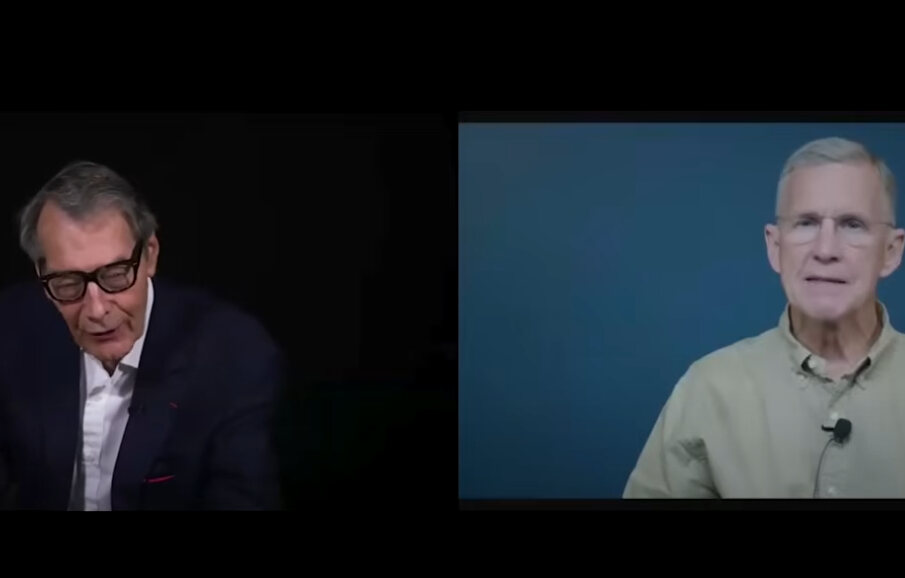
Read the full transcript of General Stanley McChrystal in conversation with Charlie Rose on “Warrior Character, AI, and US Leadership”, – A Charlie Rose Global Conversation, October 8, 2025.
CHARLIE ROSE: General Stanley McChrystal’s story begins as a son of a general and continues through a military career that saw him make important stops as he rose through the ranks, leading a Ranger battalion, serving with the 82nd Airborne, overseeing US counterterrorism in Iraq as head of JSOC, the Joint Special Operations Command, and ultimately rising to his final post as commander of all U.S. and coalition troops in Afghanistan.
This is, as you know, an important moment in the United States. The government is on strike. Troops are in American cities, there is hope for the release of hostages in Gaza, and Donald Trump may be rethinking Ukraine. I want to talk about big ideas. The US role in the world as America approaches its 250th birthday on July 4, 2026. The changing world order, US competition with China, Russia, North Korea and Iran, the rise of populism and the challenge to liberal democracy.
The internal risk to American institutions from autocracy, active wars in Ukraine, Gaza and Sudan, and the risk posed by a government shutdown, the roundup of immigrants by ICE and troops patrolling cities. We’ll also look at the lessons of war from World War II to Korea, Vietnam, the Balkans, the Middle East, and especially Iraq and Afghanistan where General McChrystal served in command positions.
I want to begin with his focus since retiring as a four star general, teaching leadership at Yale and forming the McChrystal Group to take lessons from the battlefield to the boardroom as described in his masterclass. That brings us to two critical ideas at the center of his message: leadership and character.
GENERAL STANLEY MCCHRYSTAL: Well, it’s an honor to be with you, my friend. Thanks for having me.
Defining Character
CHARLIE ROSE: Talk about character first, what is it? How do you define this idea of character?
GENERAL STANLEY MCCHRYSTAL: Yeah, thanks. I think first, we don’t all have the same definition of it and that’s problematic because if I talk about character and we have a different vision of what it is, there’s a chance we’re talking past each other.
In my mind, character is the essence of who we are. The famous Tom Paine quote that says “reputation is what people think of us. Character is what gods and angels know of us.” So it defines who we are. But the most important thing about it is it’s measured or reflected in what we do, not in what we say or what we write or what we advertise.
At the end of the day, it’s revealed by those things we do or fail to do. And so I think it’s the most important metric in any life. And at this point in my life, I’ve realized, I’ve always thought it’s important, but I realized its centrality.
CHARLIE ROSE: Where does it come from? How do we acquire it?
GENERAL STANLEY MCCHRYSTAL: I don’t think we’re born with it. I think it’s entirely learned. I think that it comes from examples. In my case, I had these two wonderful parents who I never saw do anything wrong in my life, never took a parking place they shouldn’t have or anything. They may have done it, but I never saw it. They never preached to me about character, but they lived it.
CHARLIE ROSE: The same thing for my parents. And I don’t want this moment to go by. They’re both deceased without paying that tribute to them. They certainly, by their life, showed me what a good life could be.
GENERAL STANLEY MCCHRYSTAL: Boy, that is so true. And then I went through places that made a very concerted effort, like West Point. They have statues and pictures and barracks named after American leaders and heroes with the hope that you will take the good from those people. And they weren’t perfect, but you’ll take the good from those and use them as guideposts going forward.
And then I think just through life, we learn character. We make mistakes. We have times in our lives when we do something or don’t do something, and we look at it and we realize we got it wrong. And if we’re mature enough, we admit it to ourselves, and then we use that to redouble our efforts.
So I don’t think no one I’ve met has perfect character. But if it’s constantly improving, if it’s constantly going in a good direction, I think that’s about as good as we can do.
When Character Is Tested
CHARLIE ROSE: Where has character served you? When it was tested and you were tested?
GENERAL STANLEY MCCHRYSTAL: Yeah, there were times in my military career where you make very difficult decisions that could involve life and limb. And you make decisions that you believe to be right simply because they are the right answer, not because you’re trying to get credit or avoid responsibility. And all of us have versions of that.
Of course, my character was probably most tested when I resigned after 34 years in service. A magazine article came out, Rolling Stone magazine, that was reflective of my command team, and the title “Runaway General” was not a good one, and it created a political firestorm.
Now, in my world, it was a huge firestorm in the grand scheme of things. You know, it gets contextualized because our lives, we tend to put up front and center. But it caused me to offer my resignation to President Obama, and he accepted it.
CHARLIE ROSE: But Bob Gates once said to me, he wanted you to stay and he wanted you to explain, and he wanted you, in a sense, to give the President a means to keep you.
GENERAL STANLEY MCCHRYSTAL: It didn’t actually happen quite like that. I did walk into the Oval Office with my resignation in my pocket, expecting he would accept it. And he asked me what had happened, and it was so soon after the article, I frankly didn’t know the details.
And so the way I responded, and he was very businesslike and cordial. I said, I don’t know, but I will. I brought my resignation. If you want to accept it, I’m okay with that. If you want me to go back in command, I’m okay with that. Whatever’s best for the mission.
And I meant that because my responsibility was to that mission. My responsibility was not to get the best outcome for myself. And I wish he’d made a bit of different decision, I do. But I had been involved in a news story that caused him a problem as president, a political problem. And that’s not what general officers are supposed to do.
So whether it was fair doesn’t matter. It was my responsibility to offer it, and I’m entirely at peace with that decision.
CHARLIE ROSE: With your decision or with his decision, or both?
GENERAL STANLEY MCCHRYSTAL: Entirely at peace with my decision. I regret his decision, but I don’t hold it against him in any way. In his position, I may have made the same decision. So, you know, people have got to accept responsibility.
And whether I was guilty or not is less important. I was responsible. I was a commander. And inherent in command is responsibility. And I think that we all have to understand we have to accept that responsibility because we accepted all the other things that came with the position, and we have to accept the responsibility that goes along with it.
CHARLIE ROSE: You have to own what you have done.
GENERAL STANLEY MCCHRYSTAL: Yes, sir.
Moving Forward After Loss
CHARLIE ROSE: But there is also this: life is a learning process as well. You were the commander of troops in Afghanistan. You had a brilliant career ahead of you. You know, what did you call on that gave you the strength to move forward after the loss of such an incredible future?
GENERAL STANLEY MCCHRYSTAL: It’s interesting because you’re right. The second the president accepted my resignation, I was no longer a commander. I was no longer a general. I was even no longer a soldier. And I’d been a soldier since age 17.
The thing that gave me the initial strength, because I drove out of the White House grounds back to where we headquarters at Fort McNair across Washington D.C. and my wife Annie, who was back home while I was in Afghanistan. I’d flown all night back home to meet with the President. And I walked in the house and I told her we’d been married 33 years at that point. I said, it’s over. The President accepted my resignation. We’re out.
And she goes, “Good, good. We’ve always been happy and we all will be happy.” And I think you know Annie well and she is instinctively strong and she made a decision that helped guide me in that moment, that said, we’re not going to wallow in self pity. We’re not going to relitigate this. We’re not going to be the aggrieved party. We are going to move forward and live our lives in a way that we hope will validate the faith people have had in us in the past.
And you know, I joke with people that Annie lives life like she drives, with no use for the rearview mirror. And it’s true. And she does it without worrying about it. She just, the right answers come to her.
And so with a partner like that, the last 15 years, they haven’t been easy at first because, you know, there was embarrassment, there was hurt, there was all the things that go with that. But it got easier every day. And I became more confident all the time that that was the right answer. And now 15 years gone, it’s never completely gone. I will always have some pain around that. But my life has been wonderful.
CHARLIE ROSE: The military will always be inside of you.
GENERAL STANLEY MCCHRYSTAL: That’s right. And I will always miss being a soldier.
The Meaning of Being a Soldier
CHARLIE ROSE: And what did that mean to you to be a soldier?
GENERAL STANLEY MCCHRYSTAL: It’s a great question because my father, as you mentioned in the introduction, was a general. But of course, he’d gone through a whole career, ended up as a general. But as he got older, even after this, he had told me he thought I was a good soldier.
Now if he said, “I think you’re a good general,” that would have been nice. But when he said, “I think you’re a good soldier,” that’s more elemental, that’s more around values, that’s more around those kinds of qualities that a servant of the nation has.
If you ask most military members what they are, if they say “I’m a colonel” or “I’m a general,” it’s not as powerful as they look you in the eye and say, “I’m a soldier” that has some responsibilities to the nation that are deeper, they’re more connected to citizenship. And so that’s what it meant to me. And it still does.
Teaching Leadership at Yale
CHARLIE ROSE: The one thing you knew was leadership. You had served leadership, you had served in positions of leadership. You went to Yale to teach it. What did you want to tell the world about leadership?
GENERAL STANLEY MCCHRYSTAL: When I first started, Charlie, I’m not sure I knew what I wanted to tell. I’d never been to Yale before I retired from the military, and a friend of mine called me and asked, “Do you want to come up and teach?” And I sort of reflexively goes, “Yeah, I’ll try that.”
CHARLIE ROSE: I’m looking for something to do.
GENERAL STANLEY MCCHRYSTAL: Exactly. And so it was funny, for my first class, I get this call that says, we are going to have a police escort to take you to the class because there’s going to be a protest against you. And so I was frustrated and angry with that. I didn’t think I deserved that. This is a couple months after I resigned.
And then I got there and that night, and there were only eight protesters. And I was angry that I couldn’t draw a bigger crowd than that.
But teaching leadership at Yale was this extraordinary experience because I got to explore for myself what I really meant. I started the first year teaching them techniques, how to be a leader, how to do certain things. And through the 12 years I taught, the course followed this arc, and it became more basic.
We went back to philosophy, we went to Sun Tzu, we went to Marcus Aurelius. Because I thought it was important we start with those things that define us as people. Because if you can’t understand yourself, I think you’ll never be complete as a leader. You can learn little behavioral tricks, “10 habits of highly successful people” kind of stuff, but if you don’t really know why you do things and what’s important, I think it’s more difficult to influence other people in a good way.
CHARLIE ROSE: They need to know you’re speaking with authenticity. They need to know that it’s coming from a place deep inside of you so that they can identify with what you say.
GENERAL STANLEY MCCHRYSTAL: I think that’s so key. And most of them had never met a former soldier, much less a former general, much less someone who, for a brief period had been, you know, this notorious person on the news. And they were curious.
And then their curiosity would go first to sort of that, and then it would go to, “Oh, wait a minute, you had 34 years in this organization where you learned leadership, and you got to practice and try it. What did you learn?” And they were endlessly fascinated by how they could develop themselves.
CHARLIE ROSE: Well, the most obvious example of the difference between, say, corporate leadership, athletic leadership as a coach might observe in practice is that it’s a question often with a soldier, between life and death, not just of yourself, but of people that are depending on you to make the right decisions, to do the right thing, and to act wisely.
GENERAL STANLEY MCCHRYSTAL: That’s absolutely true. When we talk about physical courage, a lot of people have it, and in the moment, it’s typically not that hard to conjure. I don’t want to minimize it, but still, it comes from flexibly the moral courage to make decisions that are very difficult and that carry responsibility.
It’s not just legal responsibility. You know that if people are killed or badly wounded based upon your instructions or orders, then you bear some part of the responsibility for that. And that’s difficult for a lot of people. I think over time you can contextualize that and you realize that’s what your job is. But it takes some thought, and it takes the willingness to accept that responsibility to be an effective commander.
The Wars in Iraq and Afghanistan
CHARLIE ROSE: I want to look also at this war in Iraq and also in Afghanistan, the longest war I think, that US has been involved in. When you look back on it, was it a wise move for us to go into Iraq?
GENERAL STANLEY MCCHRYSTAL: Yeah, let me start with Afghanistan, because we went there first. I think it was almost inevitable to go to Afghanistan because I’ve told people before, if I could rewind history and had control on 12 September 2001, I would have suggested that we wait a year before we do anything like go into Afghanistan.
I would have spent the time going around the world building up a coalition, getting more intelligence, teaching young Americans how to speak Pashtu and Dari and Urdu, the region’s languages. So that when we went in, we went in better informed. But the political reality of the moment, I think there was just an absolute requirement to go into Afghanistan. And we did it imperfectly, for sure, but I think we did it with good intentions.
CHARLIE ROSE: We did it well at the beginning.
GENERAL STANLEY MCCHRYSTAL: We did, but it was simple. At the beginning, all we were doing was knocking over the Taliban government and trying to find Al Qaeda members to include Osama bin Laden. Then you talk about rebuilding a country that at that point had been through 20 years of conflict, 10 with the Russians, and then 10 of internal civil war. And so it was in tatters when we got there.
And I think there were incomplete decisions made by the world, the west particularly, in what we were going to do to try to help Afghanistan get back on its feet. And so that was sort of the storyline for the next 20 years. I think we tried to do something and we never were as serious or as effective about it as we might have been. Despite the work of a lot of good people trying to get it right, Iraq was different.
My personal opinion was Iraq was a mistake to invade Iraq. I felt it at the time. Not because I thought Saddam Hussein was a good man. He was not. But I thought he was like rotten fruit. He was going to fall off the tree at some point. And the effect of us invading was an unnecessary act that I think over time could have been shaped without that kind of a challenge.
And of course, once we went in and upset things in Iraq, took the keystone out of the arch, then the entire region started to fall down. And of course, Iran was given a big advantage because of proximity to do the things they did.
CHARLIE ROSE: And Saddam Hussein had been a big enemy of Iran.
GENERAL STANLEY MCCHRYSTAL: That’s right. So it caused a lot of things that we didn’t think clearly enough about. I think the assumptions that were underpinning the decision to go into Iraq were…
CHARLIE ROSE: Just incomplete and based on faulty intelligence.
GENERAL STANLEY MCCHRYSTAL: Yes. When you get intelligence that confirms what you want to believe, what your preconception is, there’s a tendency to accept it. And I think that that was the case there.
CHARLIE ROSE: What did we not understand about Iran, about Iraq?
GENERAL STANLEY MCCHRYSTAL: We didn’t understand much, but interestingly enough, all of the data was there. All the information was there. We knew about the relationships between the Sunni, Shia, the Kurds, the challenges of tribes. There was nothing that was not knowable.
And I think that we got so focused on the tactical challenge of defeating Saddam Hussein’s army and occupying the nation. And then the concept was we were going to overthrow the government, take the keys from them, give it to a new government and drive out, which was, of course, unrealistic.
CHARLIE ROSE: And we had fired so many of the people that had been part of the government but were not necessarily supporters of the government.
GENERAL STANLEY MCCHRYSTAL: Yeah, I think we made a series of maybe well intentioned, but bad decisions. Disbanding the army, putting people out of work from the military. And that’s a problem. Disbanding government because of the Ba’athist limitations. If you really think about trying to establish stability, we undercut many of the things that we were trying to do.
Leadership and Adaptation in Modern Warfare
CHARLIE ROSE: I want to go back to leadership, though, because you, I assume, learned a lot because you had a critical command in Iraq as head of JSOC. Tell me about leadership. Because you were not happy or satisfied with traditional hierarchical leadership. You knew that the demands of change required something else.
GENERAL STANLEY MCCHRYSTAL: Yeah, that’s correct. I already had a lot of concerns about how our military forces were commanding themselves. And in the counterterrorist world, JSOC, which I had grown up in, so I was familiar with, and I took command in October 2003. We were a marvelous unit, best counterterrorist force ever created in the world, by a lot.
But the problem was the environment had changed. And the environment, not just our enemy, Al Qaeda in Iraq, which was this terrorist group that emerged in 2003 under Abu Musab al Zarqawi. But the environment which we operated, it was now propelled by information technology.
If we go back to Al Qaeda, which came out, formed in 1988 in Pakistan, that was before anybody had cell phones or access to the Internet. And they were a traditional terrorist group. And what’s left of them still is. Al Qaeda in Iraq, 15 years later, comes upon the scene. Everybody’s got at least one cell phone access to the Internet. They function differently, they communicate with the world differently. And they do.
CHARLIE ROSE: And they have learned, as you suggest, they had learned all of the modern communication tools to recruit new members.
GENERAL STANLEY MCCHRYSTAL: They would do a terrorist attack in Baghdad and they would film it. They were typically three vehicles to a vehicle borne attack. The first vehicle led the convoy. The second vehicle was the explosive vehicle and the third was the camera vehicle. And it was the most important.
And they would film the entire attack. And then they would do really professional production. And within about 12 hours, that film was hung on the web and it was hung to music. And it suddenly changed. A terrorist attack, if you think back 20 years before that, a terrorist attack would scare the people who were near it. The people who saw the carnage, heard it. Everybody else might see a grainy picture on a newspaper later, but it wasn’t terrifying.
Suddenly this video for the people they wanted to terrify is high definition right in their face online. And for people they wanted to recruit, it was, “Look what we are doing, look how good we are.” And they understood that in a way that modern marketing executives have to admire.
Lessons Learned and Cultural Understanding
CHARLIE ROSE: I want to bring this to today. Have we learned the lessons that we saw in Iraq and in Afghanistan?
GENERAL STANLEY MCCHRYSTAL: I’m doubtful that we have. We didn’t learn the lessons of Vietnam. In fact, many of the mistakes we made in Vietnam, Bob Komer’s famous paper, 1970. We had not been in Vietnam for 10 years. We’ve been there one year, 10 times.
And I think that it’s hard to learn those lessons of something like Afghanistan and Iraq because the lessons are very elemental. We might say we’ve learned the lessons that we can use this tactic or this piece of technology, and certainly we’ve learned those. What we didn’t do in Afghanistan or Iraq is understand the problem.
We didn’t create a cadre of people who spoke the language. During World War II, we created more than 5,200 fluent Japanese speakers. After Pearl Harbor, we started training people in Afghanistan and Iraq. We probably trained a handful in all the years.
CHARLIE ROSE: Why not?
GENERAL STANLEY MCCHRYSTAL: I don’t think we respected the fact that when you are fighting in an environment, if you don’t understand the environment, which is the people too, it is that entire ecosystem in which you’re operating. If you don’t understand it, you are blind, deaf and dumb.
When you have to operate through a translator, there’s always a filter, even if they don’t mean to. There’s a filter when you don’t understand how things operate. I remember I had to report a friendly fire killing that we did when I was commanding in Afghanistan. And I went to President Karzai with a laptop and I showed him this video from a helicopter where like 2 in the morning, we shot a missile and killed a man who was digging on a road outside of Kandahar.
And it turned out that we killed a farmer. And as soon as I showed President Karzai the video, he goes, “Oh, that’s a farmer who is going to change the irrigation connection.” Because in those neighborhoods, what they do is they get blocks of time. And if your time starts at 2 in the morning, you’ve got to go out there and you’ve got to change it by doing some digging, closing off at one way and moving it into another trench.
And he instantly said that’s what he was doing, which was true. And I said, “We didn’t know.” And he looked at me and he goes, “That’s the point. You have to know or you can’t be effective in an area like this.”
And so maybe it’s arrogance, maybe it’s laziness, maybe it’s the American way, but we didn’t develop the expertise and the cultural acuity to be able to deal in those areas as effectively as we needed to be.
Al Qaeda Today
CHARLIE ROSE: How about Al Qaeda today? You fought against them. Other people fought against them. We killed the leader of Al Qaeda. How strong are they today and where are they?
GENERAL STANLEY MCCHRYSTAL: Yeah, I am not focused on that 24/7 anymore. So probably…
CHARLIE ROSE: But you know people who know, yeah.
GENERAL STANLEY MCCHRYSTAL: They are strong as an idea. And whenever the idea is strong, then the ability to be operationally strong follows soon after that, or it goes with it. They may not be extraordinarily active. But they have, particularly in North Africa and parts of the Horn of Africa, they have a very effective network of people who feel very strongly about the same cause.
And much of that is built about outrage. Al Qaeda’s strongest argument was the one around the word “humiliation.” They would describe that what happened to the entire Islamic world for the last hundred years is they’ve been humiliated by the west, and then it’s been made worse by the autocratic leaders who run some of their countries, who are of the same religion and background, but oppress the people.
And so this sense of humiliation creates an outrage, which creates a mobilization to action. And so I think as long as those basic dynamics are strong, then an organization like Al Qaeda, ISIS, and then related organizations, they have the opportunity to be operationally effective.
And they will go up and down because you’ll have periods when operationally they get strong, and then they’ll be attacked, and a number of leaders will be killed and they’ll be set back. But then you go about a half a generation, wait eight or 10 years, and a new generation of leaders matures up. And then suddenly, as long as the reasons are there, the argument for it is there, there will be a new rise to it.
So nowadays they’re empowered with more technology, so they’re far more dangerous than they would have been even 20 years ago, because between cyber attacks, potentially weapons of mass destruction, unmanned aerial vehicles and whatnot, they have the ability to leverage openly available technology in ways they couldn’t do before.
The Afghanistan Withdrawal
CHARLIE ROSE: What did you think of the leaving of Afghanistan during the Biden administration?
GENERAL STANLEY MCCHRYSTAL: Yeah. Unfortunate. But let me give some context. We need to remember this. The American people were tired of the forever war. And we need to look in the mirror and admit we sort of all were where the average person was some…
CHARLIE ROSE: 30 years, I guess.
Afghanistan Withdrawal and the Doha Accords
GENERAL STANLEY MCCHRYSTAL: Yeah. And so President Trump had the team that negotiated the Doha Accords. And once the Doha Accords were negotiated, it sealed the fate of Afghanistan because the Americans agreed to leave on date certain. And the quid pro quo from the Taliban was not to kill Americans in the interim.
And so they had no—for the next 18 months, they had no incentive to kill Americans because it might slow our departure. So we were going to leave, period.
When President Biden took over, he wasn’t going to change that policy because he’d been opposed to the war in Afghanistan for a long time, and he would have had to abrogate a treaty that the United States had made. So when there were recommendations to leave a residual force, I think there was very little likelihood that President Biden, given his opinion about it, was going to change a policy that his predecessor had negotiated.
CHARLIE ROSE: Nor was it a new opinion by President Biden. He had long held that position, that it was the wrong war for the United States.
GENERAL STANLEY MCCHRYSTAL: That’s right. Now I wish that we had left a force. I think we could have left a residual force of several thousand people at Bagram, and I think it would have had an extraordinarily steadying effect on the government of Afghanistan.
So I was very sad to see the way the outcome went. I think the United States lost an extraordinary amount of credibility in the process, because just the images of the aircraft taking off with people running alongside are something that every other ally around the world says “that could be us and the US could be flying away.” And I think we need to understand we pay a price for those kinds of decisions and images.
CHARLIE ROSE: And your friends or people you knew actually fled.
GENERAL STANLEY MCCHRYSTAL: They did. And then there were many who couldn’t. And so I still meet routinely with Afghan members of their special operation forces in government who were wonderful partners and I respected deeply and they did great things. But they get put in the position of being a refugee from their own country.
The Impact on Global Perceptions
CHARLIE ROSE: Do you think it was an incentive for Vladimir Putin to attack Ukraine?
GENERAL STANLEY MCCHRYSTAL: I think it was a reinforcing dynamic because I think it gave him the impression that the United States was likely not to be firm. And, you know, he certainly wanted to go into Ukraine anyway. But once he got the reinforcement of seeing the United States not be strong in a place where we’ve been committed for so long, I think it’s natural that he would conclude that this indicates an opportunity and weakness.
CHARLIE ROSE: To use a word that you have used in this conversation, humiliation. There was a humiliation on his part for what happened to the Soviet Union.
GENERAL STANLEY MCCHRYSTAL: I think we cannot underestimate how powerful that emotion is. Lieutenant Colonel Vladimir Putin sees what happens to the Soviet Union.
CHARLIE ROSE: Lieutenant Colonel in the KGB, right.
GENERAL STANLEY MCCHRYSTAL: And some of the verbiage at the time, I remember one leader, I heard American leader said, “the Soviet Union is not a world power anymore. And I’m the person to tell them.” And whether that was true or not, we had a period where we were very self-satisfied that the Soviet Union was in a new place.
And if you think about it, there was also that period, Russian oligarchs started to—there were Russian women down in different parts of the world. And that just signals that’s a country that is being forced to do things, unnatural acts for a country that thinks of itself still as a world power. And Putin, he both embodies that, and he acts on that motivation. And I think we see it in almost everything he does.
CHARLIE ROSE: And do you think that Xi Jinping looks at what’s happened in Afghanistan and in Ukraine and makes decisions or contributes to decisions as to his timing regarding Taiwan?
GENERAL STANLEY MCCHRYSTAL: Well, he’s clearly a rational leader, and that’s what a rational leader would do. And so I think he’s having a little bit of a difficult period trying to figure this out because we’re sending such mixed signals on Ukraine. So we probably got him confused, although I don’t think that was the intent.
CHARLIE ROSE: Because the President of the United States, Donald Trump, has changed his mind, or at least his emphasis.
GENERAL STANLEY MCCHRYSTAL: Changed his rhetoric. And you can see the Ukrainians, you can see the members of NATO, you can see the American public are all trying to figure out, okay, which direction are we going to go here?
And in some ways, you could say that’s brilliant strategic ambiguity. I don’t think that’s what’s behind it, but some of the effect is to leave people confused. Now, I think the danger there is you don’t want your allies confused. You don’t want to be ambiguous with your relationships around the world because you want them to make decisions based upon relationships.
Doubts About American Commitment
CHARLIE ROSE: Do you therefore think that they are uncertain as to whether the United States would come to their defense? You travel around the world, you have an international reputation because of positions you’ve served. You have friends around the world in different countries. You know how the world thinks about America.
GENERAL STANLEY MCCHRYSTAL: What I see and hear is they want to have faith in us. They want to believe that what they’re hearing doesn’t really reflect American policy. But it’s under great doubt right now.
And I think the longer and more decisively we move toward “America First” rhetoric, the more often we say that we won’t support countries that don’t do certain things we want, we continue to cut away at it. And younger generations, particularly, who didn’t grow up with the years when NATO was trusted and important for the defense of Europe, they have to doubt because they don’t have that experience to say, “yeah, America is a good, solid ally.” All they know is what they see now. And I think there’s great doubt in their minds.
CHARLIE ROSE: Is this therefore a time in which the world order may be changing, in which people are thinking about alliances they might not have thought about in the past?
GENERAL STANLEY MCCHRYSTAL: I think it’s certainly changing. And as we see the economics of the world, as they always evolve and we’re seeing, you know, after the Second World War, the United States was 46% of the world’s gross national product cumulatively. I mean, we were just massively rich and powerful. And then we had military power and political power.
And of course that naturally has rebalanced to where we’re much less dominant than we were. So that’s part of it. And then markets move and we’ve done a lot to reduce globalization recently. But I think the world order follows with it because people start to develop new relationships, new dependencies. They see risks in different things and that’s concerning.
CHARLIE ROSE: And China is often for many countries, their biggest market.
GENERAL STANLEY MCCHRYSTAL: Not only their biggest market, but in many cases a big investor in developing countries. And so China, in my experience, people don’t have a deep love of China. They don’t want to immigrate to China, they don’t want to be Chinese.
But they do want to sell stuff in China, they do want to get investment from China. And they don’t want to be on China’s bad side unless they’ve got someone who can help protect them. So all of those dynamics give China the opportunity to get more influence than they would have had just a few years ago.
The AI Race Between the US and China
CHARLIE ROSE: One of the great questions of the 21st century is the race between China and the United States. Certainly in technology, AI and other technologies. That’s a race that is undecided at the moment, correct?
GENERAL STANLEY MCCHRYSTAL: It is now. I think that in the near term, any country with an authoritarian government, centralized, can go in specific directions faster than a democracy on capitalism. So they can shift direction, they can put investment in certain things, they can create high-speed rail and whatnot. And a messy democratic capitalist country has a more difficult time.
In the long run, I think, however, the autocracy has a brittleness that is very, very dangerous. And that’s one of the reasons why they tend to be personality based. And so they tend to do things faster and more decisively because that 71-year-old autocrat running wants to do things while they’re still living. And that’s a great danger.
So I think that there’s an advantage. AI puts a new spin on this because arguably AI is almost a winner-take-all technology. You know, after the Second World War, when we developed atomic weapons, there was a short period before the Soviet Union developed nuclear weapons where we had the dominance, we could have used them to great effect.
If somebody gets AGI, which is going to be the breakthrough in AI, it’s potentially decisive because that country will have the ability to then improve faster at a faster rate than anyone else. And it could be decisive militarily, economically and everything else. We just don’t know yet. We postulate that.
But so we have this arms race in AI development now where we’re pouring money into the development of AI, into power sources. And there are really only two players, United States and China.
CHARLIE ROSE: And some have made the argument, Tom Friedman, among others, in his column for the New York Times, that this cries out for some kind of cooperation.
GENERAL STANLEY MCCHRYSTAL: Which—
CHARLIE ROSE: We don’t see any evidence of so far.
The London War Game on AGI
GENERAL STANLEY MCCHRYSTAL: About 15 months ago, I was the leader of the United States team in a war game in London and they had a United States team, a Chinese team, a European team.
CHARLIE ROSE: Oh, wow, I’d love to be in there.
GENERAL STANLEY MCCHRYSTAL: And the whole idea was, are we going to strike a deal? Right.
CHARLIE ROSE: You know, on technology issues or on a broader—
GENERAL STANLEY MCCHRYSTAL: It’s all around AI and ultimately it gets to—you’re just at the point where AGI is being developed. A breakthrough.
CHARLIE ROSE: Explain what AGI is, because it’s important.
GENERAL STANLEY MCCHRYSTAL: Yeah. It is the ability for computers to teach themselves to learn. And so once you’ve got a technological ability to have the machines teach themselves, theoretically, people aren’t having to do the machine learning part. And the machines just go on at this theoretically exponential unlimited ability and of course bypass humans or pass up humans.
CHARLIE ROSE: And could therefore, under certain circumstances, destroy the human race.
GENERAL STANLEY MCCHRYSTAL: I mean, there was an argument made by some of the technologists in the war game. They said, “the machines are going to decide we’re not necessary.” And I looked at this guy and I said, “really?” He goes, “really.” And this is a guy, this is what he does.
But the war game was fascinating because we hit this point where we’re about to get AGI and so we have a negotiation between us, the Chinese, the Europeans, and we cut a deal to do a temporary halt on all development until we could put some safeguards, put some rules in, put some world governance in.
And in the after-action review, the critique of the war game, and because I was the leader of the US team and I agreed to the deal, they said, “well, you did the right thing, but you didn’t do the realistic thing.” Because in the game the United States got the breakthrough. He said, “yes, it was right of you to cut the deal and to put these safeguards in. But it wasn’t realistic because if we get it first, we won’t do that. We will leverage our advantage.”
That may or may not be true, but it’s a pretty dark way to look at it.
CHARLIE ROSE: But so would the Chinese and so would anyone else.
GENERAL STANLEY MCCHRYSTAL: That’s the argument they said anyone who gets it first is not going to surrender that advantage. And that’s a view, and I hope it’s incorrect, but it’s hard to argue.
CHARLIE ROSE: We can’t expect the world to behave the way the US did with respect to nuclear power.
GENERAL STANLEY MCCHRYSTAL: That’s correct.
CHARLIE ROSE: Even though it was exercised in World War II in Japan.
GENERAL STANLEY MCCHRYSTAL: No, I think that’s right. I don’t think there’s an expectation that same restraint would come again.
Leadership on AI Governance
CHARLIE ROSE: And where’s the leadership on this coming from? I mean, you had a group that met there in London. But in terms of who’s going to push governments to make the right decision, does it come from the people? Does it come from the tech community?
GENERAL STANLEY MCCHRYSTAL: Charlie, I think it’s going to come from the tech community. I don’t think it will come from government leaders because most are not familiar enough to be comfortable. I don’t think it’ll come from people because the same reason.
I think the tech community, which has right now outsized political influence through money and other things, will have outsized influence on that decision. I’d like to believe that they will be far-thinking and mature, but they’ve never convened to do that before. There’s just no track record that says this is a community like maybe the medical research community that takes a very mature view of how we’re developing drugs and capabilities. Maybe it’s too new. Maybe I’ll be surprised.
CHARLIE ROSE: And we know that some of the leaders of the tech community, as they gathered at the inauguration of President Trump, supported President Trump in the 2024 election.
The Influence of Tech Leaders
GENERAL STANLEY MCCHRYSTAL: Yeah, that was something I don’t think we would have predicted 10 or 20 years before that. And we saw it. There was one argument that says they’re not tech leaders anymore. They’re rich people who are supporting a candidate who they think is best for rich people. I don’t know whether that’s true or not, but it’s an interesting view.
CHARLIE ROSE: Do you think it’s true?
GENERAL STANLEY MCCHRYSTAL: I think it probably is, but certainly wouldn’t judge each individual the same. I just don’t know them well enough to do that. But it’s disturbing to me because the level at which that kind of influence can be so powerful. If you look at the power that Elon Musk has gotten through, not just his wealth, but through the ability to influence elections and media and whatnot.
CHARLIE ROSE: Well, and how much power does he have in Ukraine? I mean, they need Starlink, his technology, right?
GENERAL STANLEY MCCHRYSTAL: And so we’re in an era where we’ve got a group of people. Now, maybe you could go back eras when maybe bankers in one age or industrialists in another age were disproportionately powerful. But I think we’ve got some tech leaders now who have a level of influence that is unique.
The Greatest Threats Facing America
CHARLIE ROSE: Some have speculated that the four big threats to America and to the world, the four big risks, are nuclear, climate, biology, and tech. There may be others. But do you agree with that? And of those, what should we worry the most about?
GENERAL STANLEY MCCHRYSTAL: I don’t agree with that. I think those are all threats. I think the greatest threat to the world and to our nation is ourselves.
CHARLIE ROSE: Wow.
GENERAL STANLEY MCCHRYSTAL: We know that human beings are by nature malleable and they are emotional. And we found where effective demagogues can leverage the magic of information technology to be far more effective at great speed than ever before.
And so I think the greatest danger is that we will, as Abraham Lincoln said in 1838, the United States will die by national suicide. We will tear ourselves apart. And I don’t think we’re the only country facing that challenge.
CHARLIE ROSE: Are we doing that at this moment, in 2025, in October?
GENERAL STANLEY MCCHRYSTAL: I think—
CHARLIE ROSE: Are we tearing ourselves apart?
GENERAL STANLEY MCCHRYSTAL: I think we are. I don’t think most people believe we are. I think most of the people who are most vitriolic out on media or social media or what they’re doing, they are arguing some position. They may be very emotional about it, very strident about it. And if you said, “You’re destroying the nation,” they’d say, “No, no, I’m fighting for the values that are so important to our nation.” And that’s true on both ends of the spectrum.
But we have incentivized people to be as extreme as they can because that gets you media time, that gets you contributions, that gets you votes, that gets you social media likes, that gets you all the things that give you influence and power.
And so we are, by individual incentives and opportunism, we are literally tearing apart the thing we need, which is the vibrancy of our nation. The fact that we are a democratic republic, the fact that we have working elections, the fact that we have rule of law—all of the things that protect us are the things which we are putting at risk.
CHARLIE ROSE: They are at risk as we speak.
GENERAL STANLEY MCCHRYSTAL: They’re at risk right now.
On Presidential Character and Leadership
CHARLIE ROSE: It’s publicly known that you supported Kamala Harris in 2024, Joe Biden in 2020, and you supported Hillary Clinton. What worries you about Donald Trump as president?
GENERAL STANLEY MCCHRYSTAL: The candidates I’ve supported historically—I voted for Democrats and Republicans. And so I think of myself as pretty much based upon the person. And the reason I do that is because I don’t think you can predict what challenges a president will face. And so you’ve really got to vote on character. Who’s going to deal with the unexpected, the difficult, the morally ambiguous most effectively?
CHARLIE ROSE: As someone once said, “Character’s destiny.”
GENERAL STANLEY MCCHRYSTAL: That’s right, yeah, Heraclitus. But the reality is I’ve never seen a perfect candidate. I’ve never gone into a voting booth saying, “Wahoo, I am just excited as I can be to vote for this person,” because I often don’t agree with many of their policies or politics. But I vote on character.
And the reason that I did not vote for President Trump is I have had questions and concerns about his character. And I base that, having never met him, on seeing what he says, the actions he’s taken, the social media, all of the things about his performance that do not build confidence in me, in his character. And so those are the things that I focus on.
CHARLIE ROSE: Is your concern so significant that you feel obligated to speak out?
GENERAL STANLEY MCCHRYSTAL: There’s a great tradition that retired military are very careful about what they talk about.
CHARLIE ROSE: They are indeed.
GENERAL STANLEY MCCHRYSTAL: Yes, I do believe that if silence can be construed as assent, as agreement, then I think it’s desperate, it’s dangerous to be too silent. And so I have spoken out. I haven’t been highly partisan or I haven’t been on the ramparts, but I think it’s important people know that I just am not comfortable in the direction we’re going.
CHARLIE ROSE: And tell me what’s uncomfortable about it.
GENERAL STANLEY MCCHRYSTAL: I think that there are aspects of the use of the Department of Justice, aspects of use of uniformed military on American streets, aspects of undermining relationships around the world. All of those are things—some of those are policies and politics, some of those are not, some of those are different.
Some of those are attacking political foes, using organs of government. Those are things that I don’t consider normal politics. I consider violations of the way our nation has to function to be vibrant, the respect for the Constitution.
And so those are the things that I think are sacred. We can argue about all the politics we want, no matter how emotional the issue, but we have to play by certain rules. As soon as we don’t play by those rules, we break apart the system we rely on. And I think there’s a danger that people will confuse political victory with something that can be long-term damaging or ultimately lethal to the vibrancy of our democracy.
The Need for Leaders with Character
CHARLIE ROSE: Could you argue, thinking about two of our themes in this conversation—character and leadership—that what’s essential is leaders with character? But leaders need to step forward. People need to define where we are as a nation as we look at the 250th birthday on July 4, 2026.
GENERAL STANLEY MCCHRYSTAL: And there are many leaders in our country, from business leaders to political leaders to others who have serious concerns. And often we rationalize that we will remain silent because we have a fiduciary duty to our shareholders, or we have some other requirement why we can’t step up and be counted.
And we leave that to the people who will take the public stage. In many cases, those are the very extremists that get people more excited, not thinking in the center. So that’s what I worry about. I think leaders have got to accept a certain responsibility to stand up and be counted.
CHARLIE ROSE: From George Washington to Ulysses Grant, this country has turned to presidential leadership, to the military and people with military experience. Would you consider running for public office?
GENERAL STANLEY MCCHRYSTAL: It’s not right for me. I’m too old. I think there are young people who should run, and I think a new generation has got to lead our nation. But I would like to see people who lead first with character. And if they are willing to show the kind of character and live with it, then that’s the kind of people I’d love to support.
Starting a National Conversation on Character
CHARLIE ROSE: As we conclude this wonderful conversation about America, tell me what your priorities are for the country.
GENERAL STANLEY MCCHRYSTAL: I’m trying to start a national conversation on character. And I don’t think it should happen in the halls of Congress, although at some point they need to. I think it should happen in schools, in churches, around dinner tables, on teams, down at the place where we actually live our lives.
And what we ought to do is step up and say, “Character is very important. I’m going to demand it of myself and I’m going to demand it of the people around me. I am going to help reinforce norms.” We’ve never been perfect, we never will be perfect at this. But we are going to try to bring back the idea that if you don’t exhibit character, you don’t have the right to lead.
And so if we can raise that bar, make that one of the standards, then I think the meaning of leadership, the meaning of citizenship and respect for others all get strengthened. Will it come right back? It won’t. Can it come back? Absolutely.
CHARLIE ROSE: Absolutely. And I would just add to that, it has to happen in communities across America. It has to happen in terms of places and institutions in which those questions exist that have to do with wishing and acting—acting and having the discipline to believe there’s a better way.
GENERAL STANLEY MCCHRYSTAL: Absolutely. We’re all Americans. The first thing to realize is nobody’s the enemy. And if you think about the words that Abraham Lincoln said in his second inaugural address, “With charity for all and malice towards none,” he said that after 650,000 Americans had been killed or wounded trying to destroy each other. And the war wasn’t even over. And yet he said those soaring words. We need to hear those from our leaders now.
CHARLIE ROSE: General McChrystal, thank you so much. It’s a pleasure to have you for this conversation. Your book is called “On Character.” It’s a pleasure to see you again. Thank you.
GENERAL STANLEY MCCHRYSTAL: It’s my honor, Charlie. Thank you.
Related Posts
- Joe Rogan Experience: #2429 with Tom Segura (Transcript)
- This Past Weekend: #630 with Stephen Wilson Jr. (Transcript)
- Shawn Ryan Show: SRS #264 with Hunter Biden (Transcript)
- Tucker Carlson Show: Matt Gaetz on ADL, Israel Policy, and Identity Politics (Transcript)
- TRIGGERnometry: Christina P on Woke Culture, Feminism, and More (Transcript)