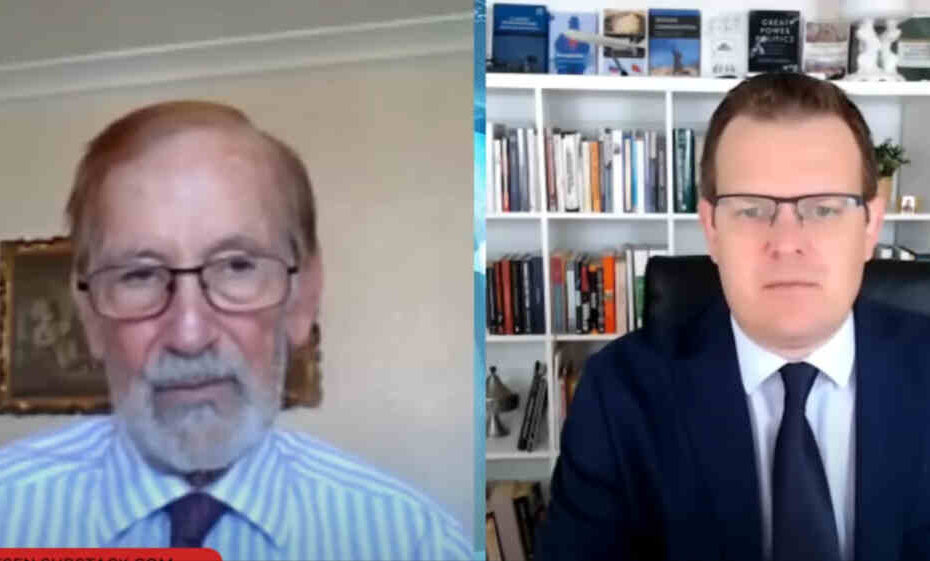
Read the full transcript of international affairs analyst Gilbert Doctorow in conversation with Norwegian academic and politician Prof. Glenn Diesen on “The Hidden Trump-Putin Agreements in Alaska”, August 17, 2025.
Opening Remarks
GLENN DIESEN: Hi, everyone, and welcome back. We are joined today by Gilbert Doctorow, historian, international affairs analyst and author of books such as “War Diaries: The Russia-Ukraine War.” Thank you for coming back on the program.
GILBERT DOCTOROW: My pleasure.
The Trump-Putin Summit: Initial Reactions
GLENN DIESEN: The big news, obviously, is the Trump and Putin meeting in Alaska. After three and a half years since Russia launched its special military operation, most of this time the West boycotted diplomacy in an effort to isolate Russia. We now had a meeting between the Russian and the American president.
The immediate reactions, of course, have ranged from extreme optimism to utter panic, especially in Europe. The media especially is hostile to their diplomatic efforts. There have been these efforts to portray Trump as weak unless he is tough on Russia, which is usually what we demand of all politicians. This effectively translates into prolonging the war, I think.
It’s an important summit and I wanted to ask you: what are your main takeaways from this summit?
Key Agreements Revealed
GILBERT DOCTOROW: Well, if we had this discussion 24 hours ago, I would be lost to say something that my peers have not already said because everybody had a microphone in front of them in the minutes following the closing of the conversation. But since we are speaking today, a lot of fresh news has come in, which I hope we can go through because it answers the question that immediately came up following the press briefings.
I think it was 12 or 15 minutes – very short – that took place immediately following the summit talks in Anchorage.
All of that has come out both by intent and by a subversive release to the press by people – I’m sure, like Macron – he couldn’t possibly resist the temptation to call reporters in to show how much he knew that was of interest to them.
# Territorial Agreements
What I’m saying is that the basic agreements that Trump and Putin made have come out in the last 24 hours. The first shoe to drop was soon afterwards. The most important information only came out, I would guess, in the middle of the night or early this morning.
The last very important information I read extensively reported in the Financial Times online edition this morning, talking about the territorial issue. Specifically saying that Putin had proposed that Russia would receive or should receive all of the territory of Donbas – that is, of the two oblasts of Donetsk and Lugansk – and that it would compromise on the other two oblasts which form the new Russia. These are Zaporozhye and Kherson.
In those two last oblasts or regions, Russia would agree to a freeze at the line of confrontation. In the first two – that is, strictly speaking, Donbas of Donetsk and Lugansk – it would insist that Ukraine withdraw completely from those territories so that Russia would receive territory that it had not conquered.
# Media Misrepresentation
Our lying press has said, “Ah yes, the Russians only hold about 50% of the territory they’re now demanding be turned over.” First of all, out of the two oblasts, the Russians have 98%, maybe 99% of Lugansk. Lugansk was the easiest for them to recapture from the very first days of the special military operation.
With respect to Donetsk, before this summer offensive got underway, the Russians had about 50% of that. Now they have 70%. So from the get-go, what CNN and BBC are telling us is fabricated.
The concession is one of time and lives. Because it is apparent to anybody with military knowledge that the Russians will take the whole of Donbas in a matter of weeks.
# Ukrainian Propaganda Exposed
The story coming out of Kiev is that by giving up Slavyansk and Kramatorsk – these are fortified towns between the present line of confrontation around Pokrovsk to the east and the Dnieper River – Ukraine would be giving up its ability to resist a further Russian onslaught across the Dnieper into West Ukraine.
Well, this is the same lies and fabrication that have been behind the Ukrainian story which was repeated endlessly by the United States and the European allies over the last three years. I think most of us who have our brains screwed in right understand that Russia would never willingly take any Ukrainian territory in West Ukraine because that would be really an occupation and governance matter, and they would expect a lot of difficulty ruling that area.
So the whole story of what the Russians want is now clear.
Trump’s Strategic Shift
The other smaller issue which came out – which is the first shoe to drop – was that Mr. Trump announced he had switched his view. Essentially he’s aligned with Vladimir Putin on what sort of an agreement is now before us.
He had previously been aligned with the Europeans and with Kiev saying we must have immediate unconditional ceasefire and that was about to be imposed on Russia. This summit was supposed to end in the signing off by Putin of such a ceasefire.
What we have now is Trump aligned with Putin and saying that is senseless – that is only provisional, it can be reversed. What we need is a genuine peace treaty. The difference is very great.
# Peace Treaty vs. Ceasefire
The Ukrainians are doing their best to confuse the general public about what the difference is, and to suggest that genuine peace is only setting the stage for further Russian offensive against them. The Europeans are trying to rope in Trump to the notion that when we have this peace signed, we need to have peacekeepers to enforce the peace.
These are absolute propaganda and lies. The point of Mr. Putin is we have to resolve the underlying issues behind this war and we have to remove the issues that separate us and have caused conflict. If you have that enshrined in a peace treaty, there’s no need for peacekeepers because there’s no conflict to break out again.
So this is where we are today, with Europe digging in their heels, finding any logic, however impossible and possibly irrational. It is like what I just described – that a peace treaty is only setting the stage for the next war. Well, this is a very interesting interpretation of what peace treaties are about.
I guess when you have peace treaties that are disastrous, like Versailles, that’s true. But if you have peace treaties designed with people of intelligence and compromise and diplomacy and goodwill, then a peace treaty is a peace treaty, and you don’t have to confuse it with a truce.
Living in the Dark Ages
This has happened in the last 24 hours, and it is illuminating. If I can just go one step further – I don’t want this to be a lengthy lecture – I want to say that we really, Glenn, we’re living in the Dark Ages. It’s very sad to say, but I listened to your interview yesterday with the minister, the Member of Parliament, the German former UN Official, talking about lack of respect, lack of diplomacy.
Let me just change the term for this: we’re living in the Dark Ages. This is a period of hate, a period of vile propaganda, a period of impunity, where those who have committed crimes, including high crimes and treason, walk away without ever being brought to court and with no fear that their crimes will be fully exposed and that they will pay for them.
This is where we are today, and it is terrible. I take it back in the United States to Mr. Obama, who never did anything about those who were guilty for the invasion of Iraq, though they all were sitting there. Mr. Cheney was out there.
# Media Response to Diplomatic Warmth
My last comment is on the first response of the British press and also some of the US Press. How do they respond to the warmth and cordiality of Mr. Trump’s reception of Putin? Well, either that Mr. Trump is being played by Putin, which is peculiar since the warmth and cordiality preceded the talks.
What do they do? They remind us, “Hey, they’re meeting in Alaska because there are not too many places where Mr. Putin and Trump can meet. Because, hey, remember that Mr. Putin is a war criminal and he has been condemned by the International Court of Justice.”
Well, they pulled that one out of the hat in case any of us forgot that complete miscarriage of justice over the supposed kidnapping of thousands – or maybe it was several dozen – Ukrainian children who were in the middle of the war zone without parents or custodians.
Anyway, that’s my lengthy introduction to where we are today.
The Death of Diplomatic Respect
GLENN DIESEN: Well, you’re right on the hate part. The hate part is quite interesting because during the Cold War, when we were speaking to Stalin or Khrushchev or anyone from the other side, there would nonetheless be some respect. You would address them properly, would have diplomacy, would be able to discuss what are their real security concerns, how might we be intensifying them, how may we alleviate them?
None of this exists today. Instead, I get the sentiment that you’re obliged to hate. The hate becomes a source of – it displays our morality. So how can you meet a war criminal? How can I even have people from the military ask me, “How can you have diplomacy when someone has attacked another one?” This is when you have diplomacy.
These are people who are in leadership positions and they talk this excessive moralism which makes it impossible to actually do any good in the world by talking to the other side.
Addressing Root Causes vs. Superficial Solutions
But in terms of what seems as a key achievement for peace, would be that Trump moved away, as you said, from the ceasefire, which doesn’t mean peace, and moved towards addressing the root causes.
For me, this is interesting because in Europe since the 1990s, we decided, “Let’s create a new Europe organized around the EU and NATO. Everyone should be part of it except for Russia. Also, Russia shouldn’t have a veto or say over what we do because they’re not part of NATO.”
So essentially, we created institutionalized Russia’s exclusion from Europe and we kind of wished Russia away. But in reality, all you do when you deny Russia any voice in international institutions to defend and represent its security interests, the only thing you do is leave the military option as the only one.
By now creating the conditions for only a ceasefire, then we put peacekeepers, or whatever you might call them there – it’s not going to work. It makes common sense. If you want to end the military conflict, you have to open up a political one – institutions where the Russians can also sit at the table and say, “Listen, you can’t put your missiles on our borders. We can’t put them in Mexico, you can’t put them there,” and then find a common agreement.
This used to be common sense, but again it used to be common sense to talk to each other with basic respect, not criminalize diplomacy. But it does appear to be a bygone thing.
The Focus on Bilateralism
Accepting the Russian premise that we have to address the root causes is quite interesting. We kind of got that confirmed by all the Europeans who are now in full panic.
But what I thought was interesting is this appeared to be also a heavy focus on bilateralism. That is, Russia and the US aren’t simply hostages to what happens in Europe. I was wondering how you read into this – the focus on bilateral relations.
The Decline of Western Political Culture
GILBERT DOCTOROW: Well, I guess if I had in one moment. But I want to go back to the hate issue and to the issue of respect, lack of respect that you’ve touched upon. Some time ago, when I was in regular correspondence with Professor Steven Cohen, he insisted to me when I was about to write something regarding George Soros’ visit to Brussels and his inability to remember anything on stage. I was about to mention the senility in one of my articles and he cautioned me—this was 10 years ago, the man is still alive. He cautioned me that ad hominem argumentation is really unacceptable in academic discourse.
I disagreed and I continue to disagree. Russians, as you probably notice since we spent good time there, they don’t believe in phrenology anymore. They don’t take the shape of somebody’s skull as meaning very much. I mean the top part for example, or the back part where there’s a bump. But they do take physiognomy very seriously. They take facial expression very seriously and Americans pretend it doesn’t exist.
Anybody who was following Dick Cheney must have understood the man was mentally ill just by his crooked smile. But you couldn’t really speak about it because that’s an ad hominem remark. But his smile, you know, it’s not like his nose or his ears. The smile is something you make and it tells you something about what’s behind the face.
Merkel became mentally ill in service. She became—you could see in her face the tension and she lost concentration. She wasn’t up to the job. All right, I’m getting off track. I made my point.
What can you say about the descent of political culture in the West? We know about the United States’ descent. It never rose very high, with a few exceptions. But even from that medium bar it’s descended since the 1990s. In Europe it’s collapse—an intellectual collapse.
When I was growing up in the States, people would say, “Oh, the British, oh, they speak so well. They always have really upper crust people running the government.” You can’t say that now. They’ve had a succession of idiots which they themselves, which the City of London called out when they threw out Liz Truss. I forget—she lasted like six weeks, lasted less time than an iceberg lettuce because she was intellectually incompetent.
What can you say about Kallas? She’s a laughingstock in Russia. What can you say about Annalena Baerbock? That Germany would have in its cabinet a moron like that? I mean, she’s a moron—it’s unthinkable. And so how can you look for respect, diplomacy and the rest of it from people who are savages, uneducated, with no knowledge of anything, people who speak about a “360 degree change” of opinion? This is beneath contempt.
I think we have to look at the democratic processes that are putting these morons in power before we can start saying, “Well, they see this or they don’t see that.” This has to be re-examined.
Here in Belgium we have very good political scientists who spent a lot of time working, talking about electoral processes because we have to. We had this crazy situation of two nations under one roof, the Flemings and the Francophones. And so they try to find very inventive progressive solutions to these problems. That kind of creativity has to be used more within Europe to find solutions to bring competent people to the fore. They are not there.
And under those circumstances, you have the crazy reaction to yesterday’s summit that we see on the front pages of the European newspapers. They are simply not up to the challenge you have addressed in some of your recent programs. This question about Europe becoming geopolitically irrelevant—well, because of the low level of political culture in present day Europe, there are no great people.
There are some brave people like Orbán and Fico, but there are no great people. I don’t mean to say that great people are always wise people or likable people, but their intellectual capacities, their ability to look at big picture issues—it’s not here today. So I’m sorry, now that I’ve gone off on this tangent, I’ve lost the line of your question. Could you just remind me?
European Despair and Criticism
GLENN DIESEN: Oh, no, I wanted to move on and ask about the focus on bilateralism, but if I can just make a quick comment on the interview I did with Mikhail van der Schulenberg yesterday. And he’s not just a member of the EU Parliament, but as Assistant Secretary General of the United Nations, he spent 34 years in conflict zones. And he didn’t live in Germany and fly out. He resided there. He had houses. He lived in the conflict zones for 34 years.
And to now see him—you know, he saw hope in all of those areas. But in Europe now, he just seems gutted, like dismayed. There’s no—he doesn’t see any solutions because there’s no one addressing the problems. And I got that impression in this country as well.
If you criticize—because I’ve been told I criticize Europe a lot, but yeah, I do. I think you criticize for course correction. But if you didn’t like it, then you shouldn’t live here anymore. I mean, this is the mentality. If you like Europe, then you have to support all the policies of Kallas, von der Leyen and the rest of this insane asylum.
Or also, if you care about Ukraine, then you’re just going to pump in more weapons, keep the war going. Even though I know that this is just going to lead to the destruction of that nation. They’re never going to be able to rebuild. They’re not going to have the territory, the people, the infrastructure. I mean, that makes no sense. But this is the mentality in Europe now. Just do as you’re told and support any insane policies. Otherwise you’re on their enemy’s side.
The whole reason has shut down, I think. Anyway, yeah, the bilateralism was the direction I was going.
The Limits of US-Russia Bilateralism
GILBERT DOCTOROW: Well, this has been in the past, going back to the fall of the Soviet Union, the bright new era that opened up in the 90s. I had colleagues who were so enthusiastic about the opportunity for American-Russian friendship, cooperation, strategic cooperation in all domains. By the end of the 90s, they were still saying that. And I was saying, “My goodness, we’re just lucky we’re not at one another’s throats at this moment. And you want to be strategic allies?” It just is unreasonable.
But going back to what underpins such strategic cooperation—business is usually part of it and trade is part of it. When Mr. Nixon did his détente with the Soviet Union, he was actively encouraging American business executives to go there and do business, to trade and to invest in manufacturing capacity there.
In the case of my understanding though, this basis for bilateralism really doesn’t exist between the United States and Russia. Their economies have never been complementary in the same way as Russian-European relations were. The amount of trade done between the two countries never was very big. It’s not that it fell from great heights—it never reached any heights, not because of lack of will, but because the economics didn’t push people together the way they pushed Germans and Russians together, for example, in energy supply and raw material supply, which was something that Mr. Macron held out when he was still thinking about Russia in positive terms.
So that very strong foundation for genuine bilateralism doesn’t exist. And those who are calling out the project of a train tunnel bridge across the Bering Strait—these are toys. This is not serious. That is not going to build a foundation for genuine bilateralism.
The US and Russians have interests in world governance which should be enough to justify decent relations and cooperation in many areas of security, global security. But to build it out, to have cultural relations, to have economic ties of great magnitude is unreasonable. Looking at the basic conditions for who produces what and who buys what—it’s not there.
Still, as I said, the geopolitical common interests should be sufficient for bilateralism. As for the rest of the world, well, bilateralism does not exclude their both participating in regional societies of trade and other interests, including technological interests. It’s not an exclusive thing. Certainly Russia is not going to turn and close the door on BRICS for the sake of warm relations with the United States. As for Mr. Trump, he’s busy closing the door on the world so that question for him doesn’t exist.
Have I covered that? I mean, in the way that you expected or have I not answered the question in the manner you looked for?
Russia’s Balancing Act and Upcoming Trump-Zelensky Meeting
GLENN DIESEN: No, well, I think there are of course limits to the economic participation, but as you said there, the geopolitical, the arms control—there’s a lot of other things to do. But even within the economic sphere, I don’t think Russia’s going to shift away from BRICS. I think this Greater Eurasia initiative they’re pursuing now, which replaced their goal of a Greater Europe which included Russia, I think it’s very much permanent.
But the Russians do want, I guess, more of a balance of dependence. So you don’t want excessive dependence on an actor like China, which is more powerful than you. Given that Russia will always be more dependent on China than China is on Russia—they can’t be equal economies. But this asymmetry can be offset if they just diversify, have more partners, don’t put all eggs in one basket.
And I think from this perspective it would be in their interest to have better trade relations with the US also—more predictability, I would say, which would be good for both sides. But no, if the ambitions of Trump is for Russia to turn its back on China, you know, I think it’s fantasy—it’s not going to happen.
But in terms of what can be learned from the summit in Alaska, I guess one of the reasons why more can be learned now, as opposed to 24 hours ago, is that a meeting is going to be set up between Trump and Zelensky on Monday already, if I’m not mistaken. Yeah, which is a few hours from now. But based on what we’re going to discuss, do you know what this will be all about and does it tell you anything about how the meeting went between Putin and Trump?
The European Miscalculation and Trump’s Strategy
GILBERT DOCTOROW: Well, the Europeans are counting on their preparing Zelensky for the meeting with Trump on the assumption that if he’s properly programmed, he can avoid crossing sensitive points with Trump, kind of avoid the kind of blow up that happened six months ago when they met in the Oval Office, and that he can turn Trump around.
After all, we all know that Putin played Trump, that Trump was talking ceasefire would give an end to the summit and he’s talking peace treaty when he left the summit so well, I could turn him again. I think they’re missing the point.
What? Trump has only let out false information, misleading information to keep his opponents off balance, to keep the press on balance without his being turned by anybody. He’s only very gradually putting into place what he surely had in mind before.
This brings up the whole questions, what does he know? I mean, so many of my peers assume that he is lightweight, that he has no concentration, that he changes his opinion from day to day, and that he’s ill informed when he repeats that the Russians, “I’ve lost a million men” or “they’re losing 30,000 a month,” they saying, “oh, you see, he’s being fed bad information by his assistance.”
I really am stunned by the lack of imagination of former CIA analysts. It is depressing. Well, maybe it’s good news. It tells you the CIA doesn’t really have much analytic talent at any given moment, which is. I don’t mean to say that the whole institution is that way, but I look at some of the analysts remarks, I’m stunned.
The think that Trump would know less than they know is very peculiar. I’m sure he knows it all. When he said “Russia is a war machine,” that tells you the whole story. He doesn’t have to go into the figures, the kill figures. He was repeating the rubbish that the press is talking about again to keep them off balance, to let them think that he’s. That he thinks the way they do when it is most improbable that he thinks the way they do or that he has accepted any of the rubbish reports on what the battlefield really looks like.
So I think he is well informed. I think he has his own course how this will go. And that takes us into the question that you just raised, what’s going to happen tomorrow?
Trump’s Real Position on Ukraine
I think that he will repeat what he has told Zelensky on the phone, that he has adopted the position of the Russians with respect to how this war should end and in what timing. And that part of the war ending is Ukraine conceding once and for all, not temporarily, probably de jure, that it has lost the Donbas and parts of the other two regions that I mentioned, the part of New Russia that is Zaporizhzhye Kherson, and that it will not have an army above a certain force and that it will not be part of, enter NATO.
When you look at the comments coming from Europe as recently as yesterday that, “oh, it’s just temporarily, they can’t enter NATO.” They’re not listening. They’re not listening to Trump. He has made it clear never.
Then you’ve got the whole question of the, the coalition, of the, of the willing readiness to put troops, boots on the ground in Ukraine for the sake of protecting Ukraine from further Russian aggression. I think that the news that the Europeans have put out that Trump is on board, though they don’t know to what extent the United States will participate, I think that is fake news.
I think they are trying to, again, to entrap him by putting in his mouth words that he never spoke, or if he spoke them, words that he never intended to implement because his way of dealing with his enemies is not, generally speaking, not to contradict them directly, but to say what they want to hear and then go off and do what he wants to do so.
The meeting tomorrow, I think, will be very tough for Mr. Zelensky. I think the Europeans will not get any satisfaction out of it. And I imagine the seats that Trump is setting up the case for turning his back on Ukraine and Europeans when they show that they are putting a monkey wrench into the works, as Mr. Putin is just a wrench into the works, as Mr. Putin said in his press briefing after the summit.
GLENN DIESEN: Yeah, well, there’s, I guess, two different hypotheses in terms of, yeah, Trump’s rhetoric, which is often shifting. And as you said, the first one, which I hear, I guess most often is, you know, he’s uninformed, doesn’t know what he’s saying, or he’s just stupid.
But alternatively, as you suggest it is, one also have to recognize the reality that he is in a difficult spot, though, because he has to navigate between two positions which seemingly can’t be bridged. On one side, you have not just hostile allies in Europe, Zelensky, and indeed the Washington political establishment, which wants none of this at all, what he’s trying to do. And on the other side, you have Russia with fairly high demands in terms of what it wants in this peace agreement, given that this has been going on unresolved now for 30 years.
The Gradual Diplomatic Shift
And. Well, it did remind me a bit about. I did an interview with Fyodor Lukianov. He’s got actually several positions. We used to work together in same department in Moscow. And, well, every year at the Valdai Discussion Club, he’s the one sitting next to Putin interviewing him.
And he was making the point because I asked him, what do you make of Trump’s rhetoric shifting back and forth? And he had a good point, though, which is, well, you have to see at what point he starts, because the Europeans, of course, they boycott all diplomacy. They don’t want to talk to Russia. Zelensky, he ruled out talking to Russia. He wants no negotiations, no diplomacy, just more weapons. Anything else is unacceptable.
But he was making a point. Well, just look at the gradual steps. And now, two months down the road, you have in France, they’re now discussing whether or not they should reopen diplomacy with Russia. You’re having Zelensky, while he’s sending his team, they’re meeting with the Russians, talking. They’re looking for a way to resolve this. So there has to be a step by step.
So it’s, I mean, maybe it’s a bit of both, maybe just some of the information Trump isn’t really on top of. But I think ignoring, as you Say, ignoring this difficult positions between demanding Russians and very unflexible and demanding Europeans and Zelensky that he has to navigate the space, I’m not sure.
But I also had another theory which I also see as probable that the United States is necessarily that eager to give up all containment of Russia, but they rather want to outsource it to the Europeans. I was wondering what you thought about this.
Trump’s Mixed Foreign Policy Record
GILBERT DOCTOROW: Well, this would have been certainly a good interpretation before Mr. Trump and his associates gutted the CIA, gutted the National Foundation Democracy, before they took all the bad guys that they could find out of the federal government. I don’t know who is continuing this type of intervention, neocon intervention. Maybe it’s just the Soros foundation or similar organizations. Certainly the Brits are deep in this. Probably much more responsible for any of these nefarious developments than the Americans are.
The problem with Trump, and which puts me in an awkward position, is the sharp contrast between what he’s doing as a peacemaker in, in Ukraine and what he’s doing as a, as an enabler of genocide in Gaza. When I listened, I think it was Politico, it was being interview this morning on the BBC about Mr. Trump as a peacemaker and how it pains him to hear about people being killed in war. What can I say that is that is not the Trump that I am an apologist for, so to speak.
I am in favor of what he’s doing in Ukraine. I believe it is well planned that he has very able assistance in Steve Witkoff to keep him in line, to keep his thinking solid. But of course he is working with the same Witkoff doing this very, very nasty cooperation with Netanyahu’s government in genocide. So it’s a mixed picture, a very mixed picture.
But to think that he shifts from day to day. No, I can’t abide that. There is clearly a very heavy commitment without man to find a peace in Ukraine, not because he loves peace and is worried about people being killed, but because of much bigger things, how he wants to reshape the global geopolitics. And yes, of course you’re right. The idea of separating Russia from China is an ide fix of many people in his circle, starting with Rubio, his Secretary of State. So that is certainly guiding his attention to Russia and his attempts to deal diplomatically and cordially with Mr. Putin.
Russia’s Pivot to Asia
GLENN DIESEN: Yeah, no, I think this could have. Russia would have been more vulnerable to be swayed by this earlier because, you know, in from 94 when they established the OSCE, they thought, “okay, now finally we have an inclusive Europe.” And then came 99 with the NATO expansion and then they always try to final agreement under Medvedev.
In 2008 they had this proposal for a new European security architecture. 2010 Putin pushed forward this idea of a EU Russia Union and all the way up to 2014. But 2014, I think this is when things began to break and they began to shift towards from Greater Europe to greater Eurasia. However yeah, in 2022, I think that sealed the deal for certain.
But if this would have been back in 2008, 2007. 8 When. 7. When Putin made that speech at Munich, I think that was kind of the last chance to accept including Russia into this Europe tour building. I think it’s is just too late at this point.
Also they don’t see a future in Europe, although this is the important thing as well is not only do they see Europe as hostile and stagnant, but they just. But also the Russians have less historical baggage in Asia and there’s more giants there. They’re not feared or hated as much and economies are better. It’s just hard to argue against know if you take the point of departure what is in Russia’s interest. It kind of makes sense why they not really looking to Europe anymore.
Germany’s Role in the Lost Opportunity
GILBERT DOCTOROW: Let’s, let’s not speak about Europe. Let’s speak about who runs Europe. Who runs Europe is Germany. And the responsibility for this lost opportunity put directly at the door along with America.
In 2008. You have mentioned the Medev Medvedev initiative. I followed that very closely. When it was made, it was very badly prepared by the Russians. Mr. Lavrov made an attempt to revive that after it was crucially dismissed by Merkel to breathe some life into it. Because the text that Medvedev released, and I think he released it on, on social media, he was trying to be very, very, very with it, very up to date. America still had public diplomacy as a flag they were flying and he used that anyway. It was, it was badly done.
Nonetheless, she dismissed it out of hand. “We have security done. It’s called NATO, don’t bother us.” And that was a disastrous lost opportunity because Mr. Medvedev say he was the stand in for Putin’s savior, but he was the president and he didn’t have stand in here across his chest. He could do something and sign something and negotiate something.
And everyone said, “oh Merkel, she speaks Russian, she gets on with them, she is the intercessor with the Russians and so on.” She hated the Russians from her childhood obviously. And she was dismissive of them in the most crude way when in 2012 she ended all talk about visa free travel saying they just were not going to let us crooks into our country. As if every Russian was a oligarch and those thieving the oligarchs all got into the country anyway. But normal citizens were not able to.
She was the point of departure for where we are today. I say that because she had control of the appointment of the president of the Commission. Juncker was put in at her suggestion because he was manageable in the usual sense. That’s to say they had the goods on him. So he was under her control. The, the Parliament, European Parliament was under her control effectively because the European People’s Party then, even back then and certainly 2015 had complete control of the, of the European problem and, and she missed the opportunity.
Germany’s Economic Pivot Away from Russia
The German why it wasn’t an accident because Germany had on switch. Germany was no longer interested in the East. Germany was interested in mittle rope. Germany had found very good colonies in Poland and Czech Republic for very cheap labor to facilitate its export industry of manufactured goods. They never put in to the particularly in Poland complete cycle production. They put in bits and parts production. So the Poles had nothing. The Germans had everything. They had all the profit coming from the exports.
And given that the economic interests of Germany, the number of Germans employed thanks to Mittel Europa no doubt many times exceeded the 400,000 Germans in 2015 who were said to owe their jobs to the Russian trade. Germany economically decided, the Mittelstand decided that the mittle the friends within the former Soviet bloc were more valuable to them than good relations with Russia.
And it so happened that those countries, Poland and the Baltics, they’re Russian hating and Germany joined the Russian hating gang. So say we can talk about Europe’s mistakes but I think we’re missing the point. We’re missing the point today considering where Mr. Merz is. He didn’t come from nowhere. He’s a direct line of this German turn against Russia. He’s an aggravated case, he’s an ugly case. But it’s the same line that you can find in 2008. It’s still better in 2014 with the, with the Minsk accords to which she was a party, they were, she was anti Russian and she and Germany controlled the European institutions.
The 2008 European Security Architecture Proposal
GLENN DIESEN: Yeah, just as we said, the 2008 proposal by Medvedev for new European security architecture didn’t actually call for replacing NATO or disbanding NATO. It recognized solely that we need a wider pan-European umbrella over this because NATO is a military bloc, it has zero-sum security. It does not subscribe to indivisible security.
So in order not to end up in a situation where the borderline states, be it Ukraine, Moldova, Georgia, have to choose between east and west and we rip up the society and pull them in each different direction, that we have some common security architecture so we don’t end up. Everything is zero-sum. This was it. And they poured cold water on it.
GILBERT DOCTOROW: They poured cold water on him and this was a terrible mistake. They didn’t have good Russian knowledge. They should have understood that this is the most optimistic, sunny-natured Russian leader for, I don’t know, 200 years. There was no one like Medvedev. He was very well disposed to the West. He was a very outgoing person.
And to confuse him with the Medvedev today is a tremendous mistake. He was a potential good friend of Europe and they spurned him, they humiliated him.
GLENN DIESEN: Yeah. Now I remember then when I lived in Russia, the way they talked about him – “he’s weak,” blah, blah, blah. You know, he put himself out there and they humiliated him. So again, it’s indistinguishable from the Medvedev you see today, though, who has become, I guess, learned from his past and become very hawkish.
The Symbolism of the Alaska Meeting
My last question, though, was just a smaller question. What do you make sense of the meeting which took place in Alaska? Is this, as some have suggested, just to get as far away from Europe as possible, unburdened by this conflict?
GILBERT DOCTOROW: No, I think that Trump was advised. I don’t think that he initiated this, but certainly had very clever advisors who did for symbolism. So many elements of symbolism in taking Alaska. Some of them have been called out, including by Putin at the press briefing after the summit, but others which have not been called out.
Generally, as I said, the first thing that I wanted to call out is that it was bought and it could be a model for how to end the Ukraine war if somebody would like to take it up. It seems like nobody does.
And the other thing is that despite its having been outside of Russian control since 1867, I think that was the year of the purchase, there is a lively Russian community there, including the metropolitan whom Putin met yesterday to give him two icons from Moscow. And how many communities there are Orthodox church communities in Alaska with mostly Eskimos in there as congregants, Inuits, properly speaking.
Strategic and Practical Considerations
And the physical proximity to remind everyone that Russia and the United States are not separated by oceans, but are separated by 4km of sea. The two islands that they both hold in the middle of the Bering Strait. This is important.
It also would be as it is on American soil. The possibilities of wiretapping – wiretapping is an old-fashioned term simply of snooping on the exchanges. If it were taking place in the United Arab Emirates or Saudi Arabia, let’s not kid ourselves, they must be bugged like hell. And if they wanted to have complete confidentiality until of course, they passed the word to Macron, what they decided when confidentiality ended was nonetheless, if they wanted to have a few moments of confidentiality, it was best to show them that states.
It also gave Mr. Trump the opportunity to have a B-2 fly over them just to remind Putin in case they forgot that Americans do have a little bit of military technology out there. So in many respects it was very convenient.
Also the issue of flight rights. If it were to be in some places, it would be difficult for the Russians to get the flight passage authorization. Here there was no issue of the sort – they just flew over their own territory till they flew into American airspace.
These were reasons, of course, the opportunity for Putin to pay his respects to the nine Soviet Russian airmen whose tombs are just near that base and whom he visited after the summit. All of these are very important symbolically and to separate it from all other meetings that have been had and will be had as the negotiation and the war continues.
Shared Heritage and Historical Connections
GLENN DIESEN: Whenever the Russians want to reach out to the Americans, they usually point out the shared war effort in the Second World War. But I guess this could be also a positive one that they have this shared cultural heritage found in Alaska.
The fact that it was also purchased in 1867 after the Civil War, as opposed to taken by force, it makes it easier to celebrate a common heritage there as opposed to if it would have shifted hands in a more brutal manner. But yeah, no, I don’t know. I thought it did take me as a surprise. I had my money on United Arab Emirates or Saudi Arabia. So yeah, I was mistaken on this.
But anyways, Gilbert Doctorow, thank you so much for your time.
GILBERT DOCTOROW: Thanks for inviting me.
Related Posts
- Transcript: Vice President JD Vance Remarks At TPUSA’s AmericaFest 2025
- AmericaFest 2025: Tucker Carlson on America First Movement (Transcript)
- Prof. John Mearsheimer: Unintended Consequences of a Meaningless War (Transcript)
- “It’s Really Not About Drugs” – Max Blumenthal on Mario Nawfal Podcast (Transcript)
- Erika Kirk’s Interview on Honestly with Bari Weiss (Transcript)