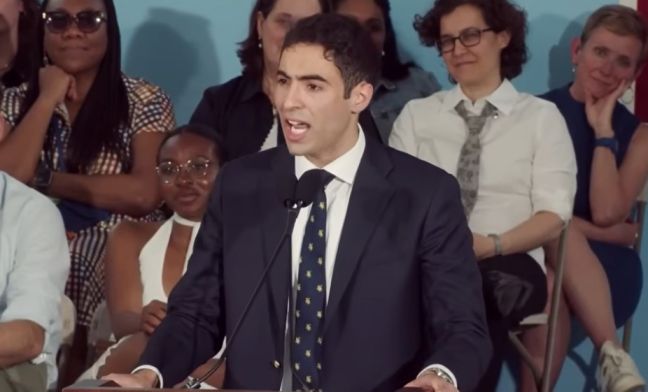
Editor’s Note: In this humorous and spirited Ivy Oration, Harvard Class of 2026 graduate Hamza Masoud reflects on his four years on campus with a satirical look at the university’s unique culture and traditions. From navigating the complexities of academic life to poking fun at the student experience, Masoud delivers a memorable farewell that balances wit with a genuine reflection on the bonds formed during his time at the institution.
TRANSCRIPT:
The Ivy Oration Begins
HAMZA MASOUD: Hello classmates, professors, families, and ICE agents who saw the name Hamza Masoud on the program and figured they’d score an easy arrest.
Please rise for a recitation from the Holy Quran.
A Night of Unfinished Business
Last night, I was having trouble falling asleep. At first, I thought it was because of the noise, since my bed is located in the middle of the Elliott construction site. But then I realized that I’ve slept through much worse, like the entirety of CS50.
No, it was not noise keeping me up, but a nagging feeling of unfinished business. Suddenly, it hit me. I had spent four years at Harvard, and yet had not completed a single one of its sacred traditions.
And so, like Amanda Claybaugh after seeing too many smiling econ concentrators, I decided that something had to change. I tore off my covers, leapt out of bed, and proceeded in record time to complete the holy trinity of Harvard traditions. I jumped into the Widener Stacks, peed in the Charles River, and made tender love to the John Harvard statue.
Alas, not even the loving caresses of John Harvard could shake me out of my funk. I realized then that my sleeplessness was due to something deeper, a profound sense of regret for all the things I could have done at Harvard, but didn’t.
The Things We Missed
I am sure many of you feel the same way. There is so much to do here that, at any given moment, it is impossible not to miss out on something cool. And, at the end of four years, the list of things you missed out on is longer than the list of lazy teaching fellows who haven’t yet submitted our grades because they’re on strike.
You could have gotten brownies at Lowell T, or you could have gotten pink eye at Mather Lather. You could have gone camping with the Outing Club, or you could have gone camping with the Palestine Solidarity Committee. You could have walked on to the football team, or you could have walked on to a team that actually won something.
And then there were the wondrous educational offerings. You could have studied physics if you wanted to unlock the secrets of the universe. You could have studied computer science if you wanted to be replaced by Claude Code. Or you could have studied folklore and mythology if you wanted to have cool stories to tell the computer science guy while you’re both waiting in the unemployment line.
At Harvard, you could have sought the answer to every question that ever crossed your mind. If you were confused about what a novel is, you could have taken a class called, “What is a Novel?” And if you were still confused, you could have taken a different class called, “What is a Book?” These are both real courses. Parents, if that isn’t worth $86,000 a year, then what is?
Don’t even get me started on all the learning opportunities that were waiting for us outside the classroom. Psychology concentrators could have studied Stockholm Syndrome by talking to people who insisted they loved the quad. Biology concentrators could have observed natural selection up close by watching the Crimson Key comp. And classics concentrators could have understood the pain, the lived experience of Sisyphus by trying to fit a lid on a Hud’s coffee cup.
The Big Questions
So much to do, so little time. Thus, this feeling of regret, of loss, of opportunities forgone and roads not taken is one that we’re used to by now. For me, it started in freshman year. I was constantly worried about missing out and about losing things. Do I have my lanyard, keys, wallet, virginity? Phew, they’re all there. To this day, I have not lost one.
So as I lay in my twin XL bed, staring at the stars, feeling regret for all the things I didn’t do at Harvard, I began to ask myself the big questions. Is there a God? Is his name Kit Kettle? Why would they put grapes on pizza? What is a book? And perhaps the biggest question of all, what is the point of Harvard?
The answer, of course, is to get a job at Goldman Sachs. But for those of us who never went to Exeter, Andover, or drop-in advising hours at the Mignone Center for Career Success, there is also a secondary, less important purpose to our time here. Some of you might think it’s to get on the side-chat leaderboard. Wrong. Others might think it’s to get on the face-mash leaderboard. Closer, but also wrong.
Veritas: The Truth We Avoided
If you paid close attention, you would know that Harvard told us its purpose from the beginning. Veritones. Sorry, I’m reading from the spring a cappella jam schedule. I mean Veritas. Truth.
Despite Veritas being Harvard’s motto, we spend a good part of our time here avoiding it. To be a Harvard student is to tell a lot of lies. We lied to our section TFs about doing the readings. We lied to our weird freshman year roommate that there wasn’t any space left in our five-person blocking group. And if you were that weird roommate, you lied and said, “I actually do have a blocking group. They just go to a different school.”
Why then, at a place dedicated to finding the truth, did we so often try to hide from it? I think that in a lot of cases, we hid from the truth because, much like the chairs you’re sitting on now, it was uncomfortable.
Sometimes the uncomfortable truth was that we were not as advanced as our peers.