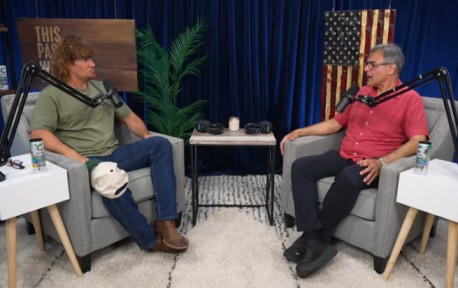
Editor’s Note: In this episode of This Past Weekend, Theo Von sits down with former CIA officer and whistleblower John Kiriakou for a fascinating conversation about his career in intelligence and his life after the agency. Kiriakou shares gripping stories from his time serving in the CIA, ranging from his experience as a leadership analyst to the intensity of his field operations. (June 5, 2026)
TRANSCRIPT:
Introduction
THEO VON: Today’s guest is an author, he’s a speaker, he’s a former CIA officer who’s also known for being a whistleblower in the CIA’s use of torture. He has a new book coming out called The Ultimate Guide to CIA Skills, Tactics, and Techniques. Today’s guest is Mr. John Kiriakou.
Presidential Pardon and Tulsi Gabbard
JOHN KIRIAKOU: Yeah, I applied for a presidential pardon.
THEO VON: You applied for a presidential pardon?
JOHN KIRIAKOU: Yeah. Yeah. In fact, I brought a couple of letters. I hope you don’t—
THEO VON: As long as you don’t meet me. If I sign them, it’s not going to help anything.
JOHN KIRIAKOU: I’m telling you that. Oh, okay. I was going to ask if you thought it would be helpful. I got—
THEO VON: Did you really?
JOHN KIRIAKOU: Oh yeah.
THEO VON: Oh, okay. Dang, I was joking.
JOHN KIRIAKOU: Oh no, no, no. I’m talking to Tulsi Gabbard on Friday. Did I tell you that?
THEO VON: Oh nice. Her husband just went into surgery today, I saw. Yeah. I messaged with her yesterday.
JOHN KIRIAKOU: She’s great.
THEO VON: Yeah, Tulsi Gabbard, she seems— there’s just something about her that seems genuine to me.
JOHN KIRIAKOU: And that’s why they tried to destroy her.
THEO VON: Is that what you think is going on with her right now?
JOHN KIRIAKOU: That’s why the Democrats tried to destroy her. I really do.
THEO VON: But even right now, I mean, she’s just taken a leave. I know it’s for her husband’s health.
JOHN KIRIAKOU: Yeah. Oh yeah. Headed into surgery this morning.
THEO VON: Oh, is that what it says?
JOHN KIRIAKOU: Yeah, she tweeted or she Instagrammed it.
THEO VON: Yeah. Yeah. Do you think— because she’s kind of like— and she just took a break. She took a complete break from politics.
JOHN KIRIAKOU: Yeah. You remember when she was running as a Democrat, every time she would inch up in the polls, the DNC would change the rules for participating in the next debate. So they would do it just 1 or 2 percentage points out of her reach every single time. Because they were threatened by her message. She just wouldn’t get with their program.
THEO VON: She’s always seemed very— like she has her own—
JOHN KIRIAKOU: Oh, she was definitely independent.
THEO VON: Independent. That’s what it is. She’s always seemed very independent. Well, they did the same thing with Bernie Sanders.
JOHN KIRIAKOU: They did exactly the same thing with Bernie Sanders.
Superdelegates and the Democratic Party
THEO VON: So I guess what my question would be— and I probably— I don’t know, I can’t remember if I asked Bernie this or not, but why would you stay in a party that you know at a certain point is not— that’s cheating you?
JOHN KIRIAKOU: Yes. And the Democrats did something after the 1972 election, which I think people don’t pay anywhere near enough attention to. Nobody at the DNC wanted George McGovern to be the 1972 nominee. He was the most popular at the time, especially among young people. But he was the weakest nationwide, and he ended up losing 49 states. But it’s a party of the people, right? If the people want George McGovern as the nominee, then George McGovern should be the nominee.
THEO VON: And they didn’t let him become the nominee.
JOHN KIRIAKOU: They let him become the nominee, and then as soon as he lost the race, they instituted this thing called superdelegates. So if you are a member of the House, member of the Senate, a governor, a lieutenant governor, a state party director, state committee chairman, you’re automatically made a delegate to the convention. Well, there are like 1,500 of them. And so you end up with situations like West Virginia and Wyoming where Bernie Sanders beats Hillary Clinton in both states, and Hillary Clinton wins literally every delegate from those states. Like, how’s that fair?
THEO VON: So wait, explain that to me a little bit better, ’cause I want to get on this. George McGovern was a major reason Democrats later created superdelegates. After McGovern’s 1972 nomination and landslide general election loss, party leaders wanted a way to give more influence to experienced officials and reduce the chance that a highly activist primary electorate would produce another nominee they saw as too extreme. So you’re saying the people believed in this guy? Oh yeah. Even though he lost, the people believed in him, but the party and whoever that is didn’t want it to be like just a populist vote. They didn’t want just the people to have the choice.
JOHN KIRIAKOU: They wanted to go back to the days with the smoke-filled back rooms, with the party bosses choosing who’s going to be the nominee.
THEO VON: And if they put more on the shoulders of just the delegates, the superdelegates, then they could control fewer. It was fewer people they had to control.
JOHN KIRIAKOU: Exactly.
George McGovern’s 1984 Campaign Announcement
THEO VON: Wow. Exactly.
JOHN KIRIAKOU: I am proud to say, in 1983, I was a sophomore in college. I was the speakers committee chairman. I was the whole committee of the George Washington University College Democrats in the days when I was a Democrat. And I saw a little blurb in the Washington Post saying, “Hey, remember George McGovern? He’s thinking of running for president again.” So I wrote him a letter.
My phone rings a few days later, wakes me up, and it’s George McGovern. Yeah. And he says, “Can I see that theater?” I said, “Of course.” So he comes over to school, and we walk over to the theater, nobody recognized him. And he said, “Yeah, the theater’s perfect.” And there’s like a cutout for cameras and it was perfect. So he says, “Don’t tell anybody, but I am going to run for president again.” And this is after the ’72 loss. Yeah, this is 11 years after the ’72 loss. Reagan is president.
So we put out a press release, major announcement by Senator George McGovern on such and such a date, George Washington University in the Marvin Theater. And packed the place, and it was on the news. Here’s what a sweet guy he was. He did the announcement and brought important people with him, like Mo Udall. Remember Mo Udall? He ran for president in ’76. He was a congressman from Arizona. And Cliff Robertson, the Academy Award-winning actor, and his wife, Dina Merrill. Yeah, they both came.
THEO VON: So he brought some—
JOHN KIRIAKOU: He brought his own A-listers.
THEO VON: He brought his own influencers.
JOHN KIRIAKOU: Yeah, and Frank Mankiewicz, who had been Robert Kennedy Sr.’s press secretary, was Senator McGovern’s press secretary.
THEO VON: You must have been geeked, huh?
JOHN KIRIAKOU: Oh, I was. I mean, it was incredible. And then he makes the announcement, he shakes everybody’s hand, and he invites me back to his apartment, and his wife made tuna sandwiches. Nice. Just the loveliest people. He ended up, crazy as it sounds, coming in third. Walter Mondale won, Gary Hart came in second, and McGovern came in third.
THEO VON: And that was for the Democratic Party?
JOHN KIRIAKOU: Yeah. Wow. And they kept saying, “Drop out, George. Drop out, George. Drop out, George,” because he was pulling young people.
Jesse Jackson and the Democratic Establishment
THEO VON: I remember Jesse Jackson when he ran, he was very close, right? Wasn’t he the populist choice, kind of?
JOHN KIRIAKOU: Yes, he was the populist choice, 1984 and 1988.
THEO VON: He was.
JOHN KIRIAKOU: Very much so.
THEO VON: And ’cause I remember we had, I think we had a sign for him, like, our family was always pretty liberal and hopeful and new ideas, right?
JOHN KIRIAKOU: That’s how mine was.
THEO VON: Yeah. But not like ethereal at the same time. Not unrealistic, right? Not unrealistic, but we were hopeful. But yeah, didn’t Jesse Jackson— and did they just not service him, or what happened with Jesse Jackson?
JOHN KIRIAKOU: Yeah, they let him kind of self-destruct. See, it says here he won 11 contests. He did very, very well in ’88, but he was never a Democratic Party insider. Got it. The insiders were not going to let him have that nomination. That’s what they do. And the Republicans don’t have such a system.
THEO VON: You don’t think so?
JOHN KIRIAKOU: No, they don’t have superdelegates, which means then an insurgent candidate like a Donald Trump can win a nomination.
THEO VON: I see, but it’s less likely to happen in the Democratic Party?
JOHN KIRIAKOU: Much less likely to happen.
THEO VON: Because of superdelegates? Wow, I didn’t realize that only one party had those.
JOHN KIRIAKOU: Al Franken—
THEO VON: Because— hold on, before we move forward on Al Franken, so, but didn’t Jesse Jackson win a few in a row? Like he was—
JOHN KIRIAKOU: Yeah, he was on a roll.
THEO VON: He was building momentum.
JOHN KIRIAKOU: Uh-huh, and they were like, yeah, we’re going to put the brakes on this.
THEO VON: And when they say we are going to put the brakes on this, who is the “we”? Is it just—
JOHN KIRIAKOU: It’s the state committee chairmen who make up the Democratic National Committee.
THEO VON: Got it. But it’s just the insiders. It’s the money talking, whoever those— like, it’s the smoky back room.
JOHN KIRIAKOU: This congresswoman from Florida, her name escapes me, three names, but anyway— Debbie Wasserman Schultz. Thank you very much. Debbie Wasserman Schultz gave Hillary Clinton’s campaign all the debate questions before the debate.
THEO VON: I remember that. But Bernie didn’t get the questions.
JOHN KIRIAKOU: Crazy. It’s crazy. It’s fixed.
THEO VON: Yeah, I think we all know what happened at this point.
JOHN KIRIAKOU: Yeah, the fix was in.
The Loss of Hope in American Politics
THEO VON: But the fix was in. But it’s just, it starts to make you feel like, okay, that the regular person— like what you really want, even the idea of that, it used to feel real. Yes. And it doesn’t feel real anymore.
JOHN KIRIAKOU: Yes.
THEO VON: And I think that is one of the scariest things happening in America right now. Yes, I agree. It used to feel hopeful, and now it feels— it’s not— will we survive? It feels— there’s something else. It’s not a hope. I don’t even know if it’s somewhat of a fear, but it’s more of an uncertainty.
But America used to feel like this hopeful thing, like we’re building this thing that’s going to— yeah, that means something that we’re going to pass on to our children, and that could possibly stand the test of time. And when something like that— when you believe in something like that, it makes your day-to-day interactions and your interaction with your country, it makes that all more meaningful to you. So you show up for it differently.
We’re sitting here with John Kiriakou. Kiriakou, thank you so much for coming in.
JOHN KIRIAKOU: Thank you for the invitation. I love the show.
Memory as a CIA Skill
THEO VON: I’ve seen so many clips of you recalling stories from your time in the CIA. Yeah. Is having a good memory a requirement for the job? Oh yeah. Is it really?
JOHN KIRIAKOU: Oh my gosh, yes.
THEO VON: Is it a requirement?
JOHN KIRIAKOU: It’s actively encouraged. I had a station chief one time who gave me the biggest compliment.
THEO VON: You had a what one time?
JOHN KIRIAKOU: A station chief. Okay. So I was doing an operation in the Middle East, but I was doing it from headquarters. The station chief called me, we were friends from our training days, and he said, “Listen, we recruited a double agent out here. He’s insisting on meeting with the chief, but it’s just too dangerous for me to meet with him ’cause he doesn’t know that we know he’s working for the bad guys.” Got it. “Can you come out here every month and meet with him and pretend to be me?” And I said, “Sure.” So I did.
To make a long story short, I would do the meeting and then go straight to the airport and fly back to Washington. There was a midnight flight. And I would write the cable, the reporting cable, from headquarters instead of writing it from the station and then sending it to headquarters. I’d write it from headquarters, send it to the station.
And the great compliment he gave me was, he said, “Your memory is so good, you remember so many details that when I read the cables, I feel like I’m in the room watching it go down.” And I said, “That is exactly what I’m going for.” Yeah, I’ve always been proud of being able to do that.
Joining the CIA: The Recruitment Process
THEO VON: But it wasn’t a requirement when you— I guess I don’t know if you audition for the CIA, but how do you—
JOHN KIRIAKOU: Yeah, you kind of do. Yeah.
THEO VON: What’s that process like?
JOHN KIRIAKOU: Extensive. It’s changed from when I joined. When I joined, I was in graduate school at George Washington University, and I was taking a class called The Psychology of Leadership. And the class was about why foreign leaders make the decisions that they make. One of the examples that sticks in my mind is the Yalta Conference at the end of World War II. Why was it in Yalta of all places?
THEO VON: I’m not familiar with it. Bring it up. Yalta Conference.
JOHN KIRIAKOU: Mm-hmm.
THEO VON: The World War II— The Yalta Conference was a World War II meeting of the heads of government of the United States, UK, and the Soviet Union to discuss the postwar reorganization of Germany and Europe. Okay.
JOHN KIRIAKOU: Yeah. So Roosevelt, Churchill, and Stalin.
THEO VON: They all met in Yalta.
JOHN KIRIAKOU: They all met in Yalta, which is really, really hard to get to. And you can’t just get in a plane and fly over the war. The war’s still going on. So Roosevelt took a train to Norfolk, Virginia, then took a boat to Malta, which took like a week, right? Back in those days.
THEO VON: Which is obviously a psyop ’cause it rhymes with Yalta.
JOHN KIRIAKOU: And then he had to go to Cairo and then Iran, and then from Iran to Yalta. He was sick. He died a month later.
THEO VON: Wow.
JOHN KIRIAKOU: So the reason why it was in Yalta is because Stalin had a spy in the White House, and the spy told him, “Roosevelt is sick.” And so Stalin wanted him to be as weak as possible. When they arrived, or when the American side arrived, Roosevelt was exhausted and he wanted to go to sleep, but Stalin insisted that the talks begin immediately. And so just to be able to go to bed, Roosevelt gave up Poland.
THEO VON: Look, I’ll throw in Poland, let’s talk tomorrow.
JOHN KIRIAKOU: Exactly.
THEO VON: Oh yeah, dude, look, sometimes, yeah, sometimes, bro, you show up and you’re like, yeah, you just can’t do it. Yeah. Or you just say, look, yes, take that, that’s fine. You know what I’m saying? I gotta brush my teeth and lay down for a few minutes. It’s crazy the things you will give up when you first get somewhere just to get to your room and unpack.
JOHN KIRIAKOU: Amen.
THEO VON: To urinate. Oh, so I’m in this class— and just to be clear, so they made him go all that way just because they knew it would weaken him.
JOHN KIRIAKOU: Yeah, there it is.
THEO VON: So they created a path that would just like— yeah, that would add to him because they had a spy in the White House. Yeah. President Franklin D. Roosevelt died of a massive cerebral hemorrhage on April 12th, 1945, at Warm Springs, Georgia, just 2 months after the Yalta Conference.
JOHN KIRIAKOU: Wow.
THEO VON: The grueling 7,000-mile trip to the Soviet Union, combined with his severe underlying cardiovascular conditions, took a significant toll on his already failing health.
JOHN KIRIAKOU: Wow. You see what a well-placed spy can do for you?
THEO VON: That’s strategy right there.
JOHN KIRIAKOU: That is strategy. That’s the big leagues right there.
THEO VON: That’s the big leagues.
The Professor Who Was a CIA Officer
JOHN KIRIAKOU: So I’m in this class, and the professor, Dr. Gerald Post, eminent psychiatrist, tells us to shadow our bosses for a week, just watch our bosses, spend each day with them, and then do a psychological profile on our bosses.
THEO VON: And this is when you’re at George Washington University, you’re a student, right?
JOHN KIRIAKOU: He’s in grad school. There’s Jerry. And what a great man he was. He died of COVID, the poor guy.
THEO VON: So he was murdered, right? Right.
JOHN KIRIAKOU: Carry on. I’m working at the United Food and Commercial Workers Union at the time. And I work for this guy who was a mean, angry, old-school union organizer, right? I was a little bit afraid of him, to tell you the truth. Big, strong, mean guy. And halfway through the week, we got into an argument and I called him a racist, which he was. Yeah. And he got so mad, he set a stance and he put up his fist like this. And I put up my hands thinking, dang it, I went too far this time. And he goes, “My penis is bigger than yours.” And I said, “What?” And he goes, “My penis is bigger than yours.” I said, “You know what? You’re nuts.” And I quit and I walked out.
So I went back and I banged out my paper. I said he was a sociopath with psychopathic and possibly violent tendencies. And I footnoted the whole thing. It wasn’t just Jon venting on him.
THEO VON: But with a possibly decent wiener on him.
JOHN KIRIAKOU: You’re right, apparently.
THEO VON: You gotta put that in there.
JOHN KIRIAKOU: Apparently. And so I get the paper back a week later. Dr. Post gave me an A, and then in the margin he wrote, “Please see me after class.” So I go up to him. I said, “Dr. Post, you wanted to see me?” He says, “Come to my office.” The classroom was like on the 6th floor and the office was on the 4th, so I went down there. He closed the door and he says, “Look, I’m not really a professor here. I’m a CIA officer undercover as a professor here. I’m looking for people who would fit into the CIA’s culture. I think you would fit in. Would you like to join the CIA?” And I said, “Oh, yes, I would.”
So the rest though is up to you. It was kind of a long story, I’ll skip it, but he made a couple of calls that got me deep into the process.
THEO VON: So Mr. Post was your professor. Yes. And you also had this job where you were— where the guy was the racist guy.
JOHN KIRIAKOU: Yeah, that was at a union. So I was using that union job to put myself through grad school. Got it. And then I quit and I walked out. I said, the guy’s dangerous. And I guess the way I wrote the paper made him think that the analysis was concise, it was to the point, and I backed it up with the facts. So I go through these weird— he sent me across the river to Roslyn, Virginia, Arlington, Virginia. It’s a little neighborhood right across the Potomac from Washington. Hold one second.
THEO VON: So he was a CIA operative, this professor?
JOHN KIRIAKOU: Yes.
THEO VON: Now, when someone’s a CIA operative but also a professor, are they an actual professor that then gets hired?
JOHN KIRIAKOU: That’s a great question.
THEO VON: Like, which is first?
JOHN KIRIAKOU: That’s a great question. It’s usually that they’re a CIA operative first and then they get hired as a professor. What he did is illegal today.
THEO VON: Got it.
JOHN KIRIAKOU: So in 1993, Congress passed the Equal Employment Opportunity Act, the EEOC, which made this illegal. Now it’s very not sexy. You just go to www.cia.gov and click apply, right? It’s different.
THEO VON: It’s a little easier.
JOHN KIRIAKOU: Back then it was, you know, all white guys from Ivy League schools for the most part, and now it’s different.
THEO VON: It was exciting.
JOHN KIRIAKOU: It was exciting.
THEO VON: I bet it was. I bet it was one of the most exciting things.
Pride and Purpose: Walking Into the CIA
JOHN KIRIAKOU: I used to park my car out in the North 40 and then take like 20 minutes to walk all the way around the compound so I could walk in the main door across the giant seal and see the Wall of Honor and the flags. And I felt like I wanted to cry. I was so proud to be there.
THEO VON: Yeah. Felt like you were part of something.
JOHN KIRIAKOU: I really did.
THEO VON: I can imagine that you feel like you’re part of something. Like, what did you feel like you were part of?
JOHN KIRIAKOU: Well, you know, I came from this very liberal household, and I remember my mom and dad getting into an argument one time. It was the Pennsylvania primary of 1976. And my dad voted for Frank Church, who had created the Church Committee that completely reorganized the CIA and stripped it of its power to carry out assassinations and things like that. And my mom voted for Birch Bayh, who was a senator from Indiana. And my dad said, “Birch Bayh? Why’d you vote for him?” And she said, “He’s so good looking.” And my dad’s like, “What? Church is the guy doing all the work.” And I remember being fascinated by this argument that they were having.
So when Dr. Post approached me, I called a friend of mine that I was in class with who was married to a guy at the CIA. And I said, “Listen, I’m not a naif. I know the CIA’s history, it’s pretty ugly. Do I want to be involved in an organization like this? I want to go into public service. I want to see the world.” She said, let’s have dinner. So the three of us get together for dinner and he’s like, “The bad old days of the CIA are gone.”
THEO VON: The bad old days, he said.
JOHN KIRIAKOU: Yeah, the bad old days of the CIA are gone. He said ’75 with the Church Committee in the Senate, the Pike Committee in the House changed everything. No more assassinations, no more overthrowing governments, which was true for a little while. Because 4 years later, Ronald Reagan becomes president. The next thing you know, we’re doing Iran-Contra and we’re bombing different countries and everything just went back to the way it was.
But there was like this golden period. My friends are going to yell at me for saying that, but there was this period where the CIA was a really awesome place to work. Got it.
THEO VON: And so when you’re walking into that, when you’re taking me back to that moment where you’re walking in, did you feel like I’m a part of something that’s important to America, or I’m a part of just an intriguing life and this is exciting? Did you feel like I’m like Clark Kent? And there’s no wrong answer. This is all just curiosity.
Analyst on Iraq: “Nothing Ever Happens There”
JOHN KIRIAKOU: Oh, sure. The first 7 and a half years that I was there, I was an analyst, actually in the office that Dr. Post had founded, the Political Psychology Division. And I really felt like I was a part of something big, you know?
I was only on the job 8 months, and it was just as I started to feel like I really knew what I was doing. I was the leadership analyst, the psychological analyst on Iraq. And the reason I was given Iraq was because, not my words, these were the words of my leadership, “Nothing ever happens there. It’s the same cabinet since the 1968 revolution.” Nothing ever happens. So learn the writing style, learn the tradecraft, and you can move on to something interesting like Romania, they told me. I said, “Great.” So I’m—
THEO VON: My friend just played ball in Romania, actually.
JOHN KIRIAKOU: It’s a great place, Romania.
THEO VON: I love it.
JOHN KIRIAKOU: Oh yeah, it’s great.
THEO VON: I gotta get over there. My buddy Patrick McCafferty, he just finished playing ball over there. Anyway, carry on.
Briefing the President on Iraq’s Invasion of Kuwait
JOHN KIRIAKOU: I love it. So just as I get to the point where I really feel like I know what I’m doing, Iraq invades Kuwait. August 2nd, 1990. I walk into the office early, like before 7:00, and my boss says, “Yeah, shit’s popping now. You gotta show up.” Yeah, yeah, I couldn’t wait to get into the office that day. My boss says, “Don’t take your jacket off. We’re going to go to the White House.” I’d never been in the White House before.
And so we go to the White House. There’s this Marine standing there. He walks us into the West Wing, and we go into the anteroom of the Oval Office, and then the secretary takes us in, and here’s the president, the vice president, the national security advisor, and the CIA director. And so you just kind of stand there, you wait to be told what to do. There are two nice chairs like this. The president’s in that one, the vice president’s in this one. There’s a couch here. My boss and I sat on that. There are two, like, more uncomfortable chairs over here for the CIA director and the national security advisor.
And we sit down and the president goes, “Well, now what do we do?” And then everybody turns and looks at me, and I’m looking at them, and then it took me a second, and I’m like, “Oh, well, as you know, Mr. President, Iraqi troops crossed the border at 4 o’clock this morning, and the Kuwaiti royal family, ruling family, fled to Saudi Arabia, blah blah blah blah.” But I remember thinking my friends would never believe in a million years what I was doing right now. They would never believe it. And I was 25 years old.
THEO VON: And it happened overnight that you were kind of suddenly having an influence, like you right there. They’re like, they’re looking to me for information.
JOHN KIRIAKOU: That actually was kind of a recurring theme in my career. I was just very, very lucky. A lot of times.
The CIA Before and After 9/11
THEO VON: So when you’re walking into the building, when you take that long way and you pass like the flags and walk over the seal, it’s just like, I’m a part of something. Yeah, you really feel it. Do you think that’s the same CIA that we have today?
JOHN KIRIAKOU: No, no. 9/11 changed everything and it changed it permanently in a bunch of different ways. Not just— have you ever heard of Executive Order 12333?
THEO VON: I haven’t.
JOHN KIRIAKOU: 12333 was signed by Gerald Ford and it came in the aftermath of the Church and Pike committees. And yeah, it established responsibilities and guidelines for the US intelligence community.
THEO VON: Okay, Executive Order 12333 establishes the goals, responsibilities, and guidelines for the US intelligence community.
JOHN KIRIAKOU: Got it. Number one, you can’t kill people anymore, right?
THEO VON: Well, this was after the Church Commission, right?
JOHN KIRIAKOU: Exactly. You gotta stop killing people. And we had these, like, we’re putting explosives in Fidel Castro’s cigar and putting poison on the steering wheel of his car and stupid stuff. And so 12333, real Tom and Jerry shit. Yeah, exactly. You can’t do that stuff anymore. And then it’s been amended over the years.
Well, after 9/11, Bush is just like, just kill everybody you want. And so we set up these offices, one whole office called the Special Activities Division. And then there’s, in the Counterterrorism Center where I was working, there was one called the Special Activities Group. And their job, very simply, was just to send teams around the world, kill people, come back, get the list for the next week, go out there, kill them, come back, get another list, kill those guys. Nobody’s trying to collect intelligence anymore.
THEO VON: Things changed overnight.
JOHN KIRIAKOU: Overnight.
9/11 Conspiracy Theories
THEO VON: Do you think— there’s a lot of like conspiracies about 9/11, right?
JOHN KIRIAKOU: And I take a lot of shit about the conspiracies.
THEO VON: Yeah, you do?
JOHN KIRIAKOU: I do. I take a lot of shit because I don’t believe in them.
THEO VON: You don’t? So from your experience, because you were there when it happened, you were in the CIA when it occurred. To where we are now. Has your point of view changed at all since then?
JOHN KIRIAKOU: Yeah, my point of view actually has changed, so I don’t think I deserve a lot of the criticism that I get. I’m going to start on July 6th, 2001. Okay, so—
THEO VON: And I’m not familiar with the criticism either.
JOHN KIRIAKOU: Okay, I’m glad. I’ll explain it to you then, because I get all the time, “The Jews did it,” “The Saudis did it,” literally the space aliens did it, the Israeli government did it, the Bush family did it. You know, it’s like, come on, people. Nano thermite paint? There’s no such thing as nano thermite paint that they painted in 1972 to make the buildings blow up.
THEO VON: Come on, you guys. That to me sounds very— that sounds ridiculous.
JOHN KIRIAKOU: Yes, ridiculous.
THEO VON: But what doesn’t sound ridiculous is somebody having long-term strategy, like you were saying a little while ago, that people play a longer game, right?
JOHN KIRIAKOU: And we’re not good at that generally.
THEO VON: Oh yeah, I don’t think that we are. We’re like a country that wants everything now, and we’re kind of a newer country as well. So it’s like, and we got everything fast anyway. And when you get something fast, you don’t really have a ton of respect for it in some ways.
JOHN KIRIAKOU: That’s right, that’s right.
THEO VON: And it’s tough for me to say that because we all just live like one life term, but I think some of that could be infectious over like a society over time. I never even thought about it before that it’s like, yeah, when you get something easy, you kind of get used to something coming easy. That’s it. And so I do believe that other countries could have strategy against us.
JOHN KIRIAKOU: And also, I believe that there were.
How 9/11 Changed America
THEO VON: And what it changed for us as a people, like, what it changed for how we look out of our own eyes, for how we walk out of— like, I remember on 9/11, I walked out of a building. I was staying with some friends. I walked outside, and there was just some construction going on, and it’d been going on for a while, and they were redoing these, like, this stone walkway. I was in Charleston, South Carolina, and they had these bulldozers and stuff out there. And people had been excited about the construction. Like, it was like, because the streets are cobblestone, it’s really beautiful.
And suddenly that day, everybody was like, are these— like, are they demolishing something? Like, suddenly this had a whole different energy of like, oh, like, this is the rubble. Like, there was a connection with what you just seen on television to suddenly something that was being done that was positive. Structurally, it was now suddenly looked at like there was a lot of fear around it. And I know that’s a ridiculous small thing, but that’s normal.
JOHN KIRIAKOU: That happened at the time, right?
THEO VON: And it’s just how much of a small thing in your head, like, okay, I just seen this and now everything is scary. That’s what I’m trying to say, right? Everything is scary.
JOHN KIRIAKOU: That’s exactly right. The whole country was traumatized. It was our Pearl Harbor, the Pearl Harbor of our generation.
THEO VON: And it changed how you would operate. It changed just like every— it adjusted so many things. Go on though.
The Warning Before 9/11: Cofer Black’s Briefing
JOHN KIRIAKOU: So July 6th, 2001, I’m hosting a group of intelligence officers from a Middle Eastern country. This is something we did literally every single day, usually multiple times a day. And what we do is we set up a day of briefings. They get a photo op with the director, shaking hands. We exchange gifts and we take them out to a fancy dinner at night. So these guys, they were all mid-level, like majors and lieutenant colonels.
THEO VON: So it’s a lot of bullshit.
JOHN KIRIAKOU: Yeah, a lot of it, yes. So I set up a day of briefings and I went to see this kid, young guy, 20s, that was covering Al Qaeda. And I said, “Can you come and just talk to these guys about Al Qaeda for an hour?” He said yes. So it came time for his briefing, but instead of him coming, the director of counterterrorism comes, Cofer Black. Later Ambassador Cofer Black.
THEO VON: And he comes from which country?
JOHN KIRIAKOU: The—
THEO VON: Oh, from the US.
JOHN KIRIAKOU: Yeah, yeah, he was our director.
THEO VON: So he showed up.
JOHN KIRIAKOU: Cofer shows up with the director of operations from the Osama bin Laden unit. And I jumped up. I was like, “Oh, gentlemen,” I said, “This is Cofer Black. He’s the director of counterterrorism for the entire American intelligence community.”
THEO VON: And you were working in counterterrorism?
JOHN KIRIAKOU: Yeah. Got it.
And so he came in and sat down, and he was very, very serious. He said, “Something terrible is going to happen. We don’t know exactly when or exactly where, but we know it’s going to be an attack on a scale that we’ve never seen before.” He said, “We’re picking up chatter from the Al Qaeda training camps where camp commanders are on the phone with their students, and they’re crying and telling them, ‘I’ll see you in paradise.'”
We’re hearing code words for a massive attack. “The honey salesman is coming with vast quantities of honey,” “there’s going to be a huge wedding,” or “a huge football game.” And he said, we know that they’re planning an enormous attack. We just don’t know when or where. And he said, I’m begging you, if you have any sources inside Al Qaeda, please help us. They just sat there and looked at him. Nothing.
So at the end of the day— I was not working on Al Qaeda at the time, weeks later became the chief of counterintelligence in the Osama bin Laden unit— I went to his office at the end of the day before I took those guys to dinner, and I said, “Cofer, I gotta tell you, you shocked me with that briefing today. Was that just for them, or were you serious?” He said, “Oh, I was deadly serious. Something terrible is going to happen.”
And then on September 11th, there it was. He and I were supposed to go to the White House that morning. We had a meeting with Condoleezza Rice, who was the National Security Advisor at the time, on an issue that’s so stupid now, I’m almost embarrassed to tell you what it is. It was about a book that was being printed by the Government Printing Office, this minor governmental agency called Greece, Turkey, Cyprus. No, no, it was called Foreign Affairs of the United States, Greece, Turkey, Cyprus, 1949 to 1967. Literally nobody’s going to read this book.
The 9/11 Attacks and Their Aftermath
THEO VON: Nobody, I was going to tell you that, nobody’s going to read it.
JOHN KIRIAKOU: Literally nobody. Yeah. And it’s like 1,000 pages long.
THEO VON: That’s money laundering.
JOHN KIRIAKOU: And it had the names of 3 CIA sources who were still alive. And we’ve got this obscure law in the United States that if the government outs a CIA source, we have to offer the source citizenship. These guys are like 100, 98, and 97 years old. They’re not going to— they don’t care. Right. Nobody’s going to read the book anyway.
So we were going to go down there and ask her, just pull those pages out of the book. Nobody’s going to miss it. Nobody’s going to read it anyhow. Just pull the pages out or redact the names or whatever.
But I went up to tell him that the car was ready and the secretary’s got a little TV on her desk and the World Trade Center’s on fire. I said, what happened to the World Trade Center? She said, a plane flew into it. And I go, ’cause I’m a genius, I said, you know, that happened once before in 1930. A bomber flew into the Empire State Building, but it was like pouring rain and fog. I said, it’s so crystal clear today, how can you not see that you’re flying into the World Trade Center? And just as I spoke the words, the second plane hit. And then she turned and she said, “Did you see that, or did I imagine it?” And it’s like, oh, everything’s going to go to shit now.
THEO VON: And at this point, you’re already working in counterterrorism, yeah?
JOHN KIRIAKOU: Well, I was already in counterterrorism, but I was working on a group. See, again, I’m embarrassed to even say I was working in a group that was targeting European communist terrorists like Carlos the Jackal, who nobody remembers now. He was the Osama bin Laden of the ’70s. Nobody remembers who in the world he was. Really? Yeah, Carlos the Jackal.
THEO VON: Bring him up. There he is. Whoa, he looks suave, huh?
JOHN KIRIAKOU: He was Venezuelan, Ilich Ramírez Sánchez. Hmm. Listen to the balls this guy had. OPEC had an oil ministers’ meeting. Right? So the ministers—
THEO VON: For those who don’t know what OPEC is, it’s the Organization of Petroleum Exporting Countries. So it’s basically like your oil kind of commission monopoly, right? Yeah, yeah, monopoly.
Carlos the Jackal and the OPEC Raid
JOHN KIRIAKOU: The cartel. It’s an oil cartel. So he and his gang of terrorists raided the OPEC oil ministers meeting in Vienna, Austria, and kidnapped every single minister of oil. They killed 3 people. He demanded a plane, flew everybody to Libya, took his billion dollar ransom that they gave him, and then let everybody go. Wow.
THEO VON: So he was just trying to get a bag, really, huh?
JOHN KIRIAKOU: Oh yeah, and he was good at it. And then he was so good at it, he set up terrorist training camps in Libya and Lebanon, and he trained the IRA, the Irish Republican Army. He trained Greece’s revolutionary organization, 17 November, the Red Brigades, the Action Directe.
THEO VON: Why did he feel so convicted to do this sort of behavior?
JOHN KIRIAKOU: He was a true believing communist and he just wanted to bring down the West.
THEO VON: Uh-huh. Interesting. Yeah. But take me back. So it’s like you guys hear that something’s going to happen.
JOHN KIRIAKOU: Something terrible is going to happen.
THEO VON: But what do you do at that point?
Chasing Al-Qaeda: The Hunt for Abu Zubaydah
JOHN KIRIAKOU: Well, see, that’s the key. What do you do? We didn’t know what to do. So we’re going to the Jordanians, the Egyptians, the Saudis, the this one, then that one. And they’re like, we don’t know what’s going on. Well, as it turned out, that wasn’t true. Almost all the hijackers, was it 16 or 17 of the hijackers came from Saudi Arabia, right? And we know that the Saudi ambassador to the United States at the time, Prince Bandar bin Sultan Al Saud, his wife transferred $50,000 from her personal bank account to the hijackers. What are we supposed to make of that?
THEO VON: Yeah, sometimes you gotta get your girl to Venmo if you gotta, you know what I’m saying?
JOHN KIRIAKOU: Seriously, the only time I ever saw George Tenet, who was the CIA director at the time, the only time I ever saw George completely lose his shit was in a meeting with Prince Bandar. He said, “If we don’t start getting help from the Saudi government on this case, we’re going to start killing people, a lot of people, and some of them are going to be named Al Saud.”
I go out to Pakistan as the chief of counterterrorism operations there in January of ’02. So it’s still fresh, we’re bombing Tora Bora, all these Al Qaeda people are trying to get out of Afghanistan, cross into Pakistan, and my job was then to catch them when they came into Pakistan.
THEO VON: But we’re bombing what? We’re bombing which country? Afghanistan. Bombing Afghanistan, right? But there was— why were we looking for al-Qaeda in Afghanistan?
JOHN KIRIAKOU: That’s where they were living, all of them. They launched 9/11 from Afghanistan. Got it. At least theoretically, the ideas came when they were in Afghanistan.
THEO VON: Because in the American population, it always felt like we never went after Saudi Arabia. That’s what it felt like.
JOHN KIRIAKOU: Yeah, and we should have.
THEO VON: But if you didn’t—
JOHN KIRIAKOU: We did not. We suspected, but we didn’t have— there was no smoking gun. So that’s what I’m getting to. We catch Abu Zubaydah, Zayn al-Abideen Muhammad Hussein. Abu Zubaydah, who we believed at the time—
THEO VON: I thought you were having a stroke for a second.
JOHN KIRIAKOU: No, no, that’s his name.
THEO VON: No, I’m just joking. That was a joke.
JOHN KIRIAKOU: The profession. I know the profession of faith. La ilaha illallah Muhammadur Rasulullah.
THEO VON: I’ve been around people that are stroking out, and if you don’t tap in with them, they’ll just keep going, and they never buy a vowel. And then they just f*ing tap out.
JOHN KIRIAKOU: Oh, that’s terrible.
THEO VON: So you guys were doing this guy.
JOHN KIRIAKOU: So we’re looking for him. And we catch him.
THEO VON: This dude is a f*ing mumble rapper, I think. Go on.
JOHN KIRIAKOU: We were on him for 6 weeks. We chased him. Some days we’d bust down the door and there’s like a warm meal and a half-lit cigarette still on the table. We’re like, dang it, with 15 minutes we could have gotten him. Some days we were a day or 2 behind. So he knew we were after him. He knew we were chasing him all over the country.
And we catch him in late March 2002 in Faisalabad, Pakistan. So we also confiscated his diary. This led to a huge fight between the FBI and the CIA. Huge. And the CIA was right and the FBI was wrong. But the fight was— well, we’d captured his diary. So I’m sitting there—
THEO VON: Dude, that sounds so suspect that he has a diary.
JOHN KIRIAKOU: It was more than a diary though.
THEO VON: But even though, you know what I’m saying, like as a regular person—
JOHN KIRIAKOU: Oh no, it didn’t have terrorism stuff in it.
THEO VON: Right, but even then, first of all, who the f* has a— See, but look, he does have an iPad though.
JOHN KIRIAKOU: Yeah.
THEO VON: Oh, he drew a lot as well.
JOHN KIRIAKOU: It’s all drawings.
THEO VON: All of it. Oh, okay.
JOHN KIRIAKOU: Yeah, all of it’s drawings. And most of them are classified top secret. The CIA wouldn’t allow them to be released. Got it. ‘Cause they were mostly about the torture that was done to him.
THEO VON: Understood.
The Saudi Connection: Three Dead Princes
JOHN KIRIAKOU: So anyway, we catch the diary and I call headquarters and I said, listen, we got his diary and there’s some fascinating shit in here. Like what? And I said, well, for one, there are the cell phone numbers of 3 Saudi princes. Like, what’s up with that? So they were like, put it in writing. So I write this cable back and I was like, we found these 3 princes, here are their cell phone numbers.
George calls in the Saudi ambassador, the president calls the king, “What kind of country you running over there?” So we said, we want those 3 princes. We want them, like, right now.
Next thing you know, one goes into the hospital for bariatric surgery because they’re all fat, and he dies on the operating table. The other one is driving from Riyadh to Jeddah on the Riyadh to Jeddah highway. He’s in a one-car accident and is killed in the accident. The third one goes camping in the desert, which is a very popular pastime. And dies of thirst. Yeah, so we couldn’t interrogate any of them.
THEO VON: Who do you think was— you think that Saudi Arabia did that?
JOHN KIRIAKOU: 100%, right?
THEO VON: Do you think we ever got to the bottom of 9/11?
JOHN KIRIAKOU: No.
THEO VON: You don’t?
Israel, 9/11, and the Dancing Israelis
JOHN KIRIAKOU: No. And I’m going to say something that’s very unpopular. I think that the Israelis, while not involved in 9/11, absolutely, positively had advance warning of 9/11. They had sources inside of al-Qaeda, and they purposely did not tell us the details because they knew what was going to happen. They knew that we would attack Afghanistan and we would attack Iraq and we would kill 2 million Muslims. And these dancing Israelis, they’ve never answered for this. I’m still mad about the dancing Israelis.
THEO VON: I’ve heard about the dancing Israelis. Bring it up. So you’re saying that you believe that they knew?
JOHN KIRIAKOU: I think they knew in advance and didn’t warn us.
THEO VON: But they didn’t warn us because we would then—
JOHN KIRIAKOU: We would do their dirty work for them.
THEO VON: We would take out issues with their surrounding guys.
JOHN KIRIAKOU: You know, there are videos making the rounds now of Benjamin Netanyahu over the years, over the last 20-plus years, testifying before Congress and saying, “You know, if we just took out Saddam Hussein, we would have peace in the Middle East.” “If we just took out Muammar Gaddafi, there would be— I guarantee you,” he says, “there would be peace in the Middle East.” And we do it all. “We take out Iran and we’re going to have peace in the Middle East.” It’s starting to get a little sus. Yeah.
So the Iraqis have electrical towers like we have everywhere, but ours have 4 legs and the Iraqis have 3 legs. So just a few days before we attacked Iraq, at that time I’m the executive assistant to the deputy director for operations at the CIA. So it’s the most serious job I ever had in my life.
THEO VON: So you have access to a lot, literally everything.
JOHN KIRIAKOU: Wow. And the Israelis come to us and they said, “Listen, you guys are going to attack Iraq in a couple days, we want in.” We said absolutely not. We put this coalition together with all these Arab countries. As soon as you guys jump in, all the Arabs are going to drop out. Just let us do it.
Next thing you know, every one of these electrical towers just begins to topple over, like 150 miles worth in the Western Desert, because somebody put explosives on just one of the three legs. And I remember my boss saying, “These damn Israelis, they just can’t leave well enough alone. They just don’t ever do as they’re told.”
Let me look at this, the dancing Israelis.
THEO VON: And we’re talking about the Israeli government. We’re not talking about Israeli people.
JOHN KIRIAKOU: I’m far less worried about the dancing Israelis than I am about the Israelis who were arrested on 9/11. Okay, it was— there was a—
THEO VON: But just so I can say the claim, because I don’t know, I’ve never even spoken about this. The dancing Israelis is a 9/11-related conspiracy trope based on the arrest of 5 Israeli men in New Jersey on September 11, 2001. And this is according to Perplexity. And it was some guys, I think they were on a building top, and they were kind of dancing around, high-fiving each other. Yeah, a bread truck or something, as you can see the towers in the distance.
A New Jersey woman reported 5 men near a van overlooking Manhattan who appeared to be celebrating and taking photos as the Twin Towers burned. Police later stopped a suspicious van and detained 5 Israeli citizens. They had items like box cutters and multiple passports, which conspiracy theorists later fixated on, but box cutters are normal tools for a moving delivery job.
JOHN KIRIAKOU: They were happy because they knew exactly what was going to happen, that we would have to enter the war, we would attack Afghanistan, we probably then take a permanent position in the region, which is exactly what happened. That’s why they were dancing. They were happy. 9/11 is a good thing for Israel. It got us militarily engaged over the long term.
THEO VON: But you don’t think that they were involved in the setting up of it?
JOHN KIRIAKOU: I don’t. No, no, no. There’s never been any evidence to suggest that they were involved in any way.
THEO VON: I have no idea.
JOHN KIRIAKOU: No, but there was another thing too, and this is a bigger issue. It’s that the Israelis spy on the United States. They’ve always spied on the United States.
THEO VON: Do we spy on them also?
JOHN KIRIAKOU: No. And that’s written in stone at the CIA. We do not spy on Israel, but they openly spy on us. They’re all over the country stealing defense secrets.
THEO VON: Do we spy on other countries?
JOHN KIRIAKOU: Yeah, we spy on almost every—
THEO VON: Why can’t we spy on them?
JOHN KIRIAKOU: It’s a political decision that’s been made. Yeah, a political decision in the White House, on Capitol Hill.
Israeli Influence in American Politics
THEO VON: Sometimes it just feels like our country is just kind of owned by Israel and they just don’t say that. Do you think that that’s true or do you think that’s fictional?
JOHN KIRIAKOU: Well, I don’t think it’s so clear-cut. I think the truth is that the Israelis have inordinate political influence in the United States, especially in our elections.
THEO VON: Well, they just had that election with Thomas Massie that—
JOHN KIRIAKOU: Exactly. That’s the best example.
THEO VON: That got overtaken. What happened with that election? Let’s bring it up. I mean, I know that Thomas lost, but it was the largest—
JOHN KIRIAKOU: Yeah, $35 million was spent.
THEO VON: The American Israel Public Affairs Committee, or AIPAC, and other pro-Israel interest groups have uncorked over $9 million in a bid to unseat Republican Representative Thomas Massie on Tuesday, which they did in a competitive primary that has shattered spending records. Prominent pro-Israel GOP donors have funneled millions more into a super PAC stood up by President Donald Trump’s political operation that has spent nearly $7 million on the race. Overall ad spending has topped $32 million, making it the most expensive House primary on record per tracking firm AdImpact.
JOHN KIRIAKOU: Wow. For a job that pays $180,000 a year.
THEO VON: So what are the long-term benefits of them getting this position, or was it just about getting Massie out?
JOHN KIRIAKOU: It was getting Massie out. The thing about AIPAC is if you are not 100% pro-Israel, they will primary you. They’ll primary you with somebody who is 100% pro-Israel. And sometimes the perfect is the enemy of the good.
What does that mean? Where you’ve got, for example, there was an incumbent Democrat in New Jersey who voted pro-Israel 90% of the time. They ran a primary opponent against him who was 100% pro-Israel, and he lost, but so did she. And the one that won was the one that’s pro-Palestinian.
THEO VON: Ah, I see. So sometimes by taking out— by aiming for one, you might let another through.
JOHN KIRIAKOU: You end up hurting your own cause.
THEO VON: Got it. Yeah, yeah. Well, I think I can understand people’s angst with this sort of thing. I mean, the biggest thing is just like, if Israel is involved in a genocide, right, they’re genociding people, right? It’s almost like, why would you let Nazi Germany invest in your people who are going to be running congressmen or senators in your country? It’s crazy.
I don’t see how there’s not a law. Like, why isn’t there a law if there’s some— if a country’s doing like a Holocaust or like a genocide, that they’re not allowed to invest in, that they’re not allowed to have a lobby in our elections? Was there ever a law about that?
JOHN KIRIAKOU: No. And they would lose their shit over the use of the word genocide. You used it. I use it. It’s a genocide.
THEO VON: We’ve been using it on here for years.
JOHN KIRIAKOU: Oh yeah, it meets all the international legal requirements of a genocide.
THEO VON: Yeah, well, I think the UN has voted that it is. I don’t know if the vote passed because I think there was maybe some groups that were— that wouldn’t agree to it.
JOHN KIRIAKOU: Well, it didn’t pass the Security Council, but it passed by 90-something percent in the General Assembly.
THEO VON: Yeah, but I just don’t understand why that seems fair. And also, I’m amazed that— I don’t understand why people that made movies and wrote books about the Holocaust, why they don’t speak up and say, “Hey, yeah, this is the same thing that I wrote about.” You know what I’m saying? You can show picture to picture that makes it exactly—
JOHN KIRIAKOU: Killing is wrong. It’s wrong no matter who’s doing the killing or who’s being killed. It’s just wrong.
THEO VON: But I don’t see why some of those people don’t speak up.
JOHN KIRIAKOU: I know. Well, there is an increasingly large number of Jewish Americans who are speaking out. There’s a big group called Jewish Voices for Peace. The Orthodox Jewish community in New York has been very vocal. Just this week, there was a protest going on, wasn’t there? The annual Israel Day parade. And a lot of the Orthodox Jews from Brooklyn showed up with Palestinian and Iranian flags. And it caused violence.
Israeli Intelligence Operations Inside the CIA
THEO VON: Yeah. I guess I just don’t understand— like, what is America afraid of? Like, what have you seen in the CIA? Because it does— you hear a lot that the Israeli influence has taken over our CIA and our FBI. Do you think that that’s true or not?
JOHN KIRIAKOU: Well, I can’t speak to the FBI, and my CIA information is dated. I left the CIA more than 20 years ago, but when I was there, we kept the Israelis at arm’s length, like seriously so.
The very first intelligence liaison briefing I ever gave was to the Israelis. I had been only on the job 6 weeks and my boss said, “Listen, you’re going to give a liaison briefing. It’s going to be a whole big group of people. So you’re going to be the last one to talk because you’re the most junior. But you need to know some of the ground rules.”
He said, “We do not meet with the Israelis in the building. We used to, but every time they’d come, they’d bring us gifts, and the gifts were always packed with listening devices and batteries.”
THEO VON: Is that true?
JOHN KIRIAKOU: Yes, 100% true.
THEO VON: Would you guys find them? How do you even know that that’s true?
JOHN KIRIAKOU: Because you have to x-ray everything that comes into the building. You can’t just wantonly walk in off the street with boxes of gifts and say, “Here, this is for you.”
THEO VON: So that happened during your time. Was that with other countries too? I’m sure there’s other countries that, like—
JOHN KIRIAKOU: Oh, there are other countries we don’t even have liaison with.
THEO VON: Got it.
JOHN KIRIAKOU: But with the Israelis, we had to rent a place and we would meet with them in the place.
On my very first day at the CIA, you meet in the auditorium called the Bubble, and the head of HR comes out and the director comes and says, “Welcome to the CIA.” And then the head of security. It’s just a parade of important people come to welcome you.
So the head of security said a couple things. One was funny. He said, “The gravest threat facing America today is the threat of Soviet communism.” And I said to the guy next to me, “Does this guy not read the papers? There is no Soviet Union anymore.”
Anyway, he went on to say that the Israelis have two declared intelligence officers in the United States, one Mossad and one Shin Bet, so CIA and FBI equivalents. They’re at the Israeli Embassy in Washington. But the FBI has identified 187 additional undeclared Israeli intelligence officers spread out all over America stealing secrets from defense contractors.
So the lesson was, don’t ever talk about work outside the building, don’t ever eat at the restaurants in McLean, Virginia, because they’re all Russian KGB — and back then it was the KGB — and Israeli Mossad agents eating there to hear what the CIA people are saying after work.
THEO VON: Wow.
JOHN KIRIAKOU: Yeah.
THEO VON: It sounds exciting though, at least like—
JOHN KIRIAKOU: It was kind of exciting.
THEO VON: I bet it was like a real whodunit back then.
After 9/11: A Culture of “Kill Them All”
JOHN KIRIAKOU: I loved it, I really did. I loved it until I didn’t love it. After 9/11, everybody went nuts and just wanted to kill everyone. I was getting ready to go to Pakistan. And so I stopped by the office on my way to the airport just to say goodbye. Cofer Black said on 9/11, he stood up on his desk.
THEO VON: Cofer Black, you said?
JOHN KIRIAKOU: Cofer Black, yeah. He stood up on his desk and he said, “Today we’re at war. All of us are going to have to do our part. Not all of us are going to be able to come home.” So he said, “If you want to walk now, walk, and nobody will think less of you.” Nobody budged.
So I stopped by the office because I wanted to say goodbye. I don’t know, am I going to get shot? Am I going to get blown up? Am I going to get killed? I didn’t know, so I just wanted to say goodbye.
THEO VON: Say goodbye to Cofer?
JOHN KIRIAKOU: No, to my boss, excuse me, and to the people I was working with.
THEO VON: But why would you have gotten shot?
JOHN KIRIAKOU: I was the chief of counterterrorism operations. That’s the job I’m going out to. I’m busting down doors 3 nights a week. And I worked for this guy. Lovely, lovely guy. Nice suits. Just a really, very professorial. And he gives me a hug and he leans in and he says, “Kill them all.”
And I said, “Really? Have we gotten there already?” And he says, “Kill them all.” And then I went to the airport. I was like, “Am I the only guy who thinks we should do this by the book?” Apparently I was.
THEO VON: That’s crazy, man.
JOHN KIRIAKOU: It was ugly. You should see some of the pictures I have on my phone. Those make your hair stand up.
THEO VON: So when you get involved, like, how bad did it get after 9/11 where the rules of interrogating and that sort of thing changed?
Interrogation Without Training
JOHN KIRIAKOU: Ah, that’s a good question. The dirty little secret was literally not one single CIA officer was trained in interrogation techniques. So as soon as we started catching these guys, I mean, I’d only been there about a week, we started catching them, and my boss is like, “Interrogate them.” I’m like, “I don’t know how to interrogate people. I can interview them.”
THEO VON: And would you even wear sneakers? What do you even put on to do something like that?
JOHN KIRIAKOU: Yeah, I wore sneakers most days, polo shirt, jeans.
THEO VON: You can’t interrogate somebody in a polo shirt.
JOHN KIRIAKOU: That’s all I brought with me, that and sweatshirts, because it was cold when I arrived.
THEO VON: You got to put on a Chicago Bears jersey or something.
JOHN KIRIAKOU: Oh my God, it was so weird. In one of the early raids, we had also confiscated the Al-Qaeda training manual.
THEO VON: Do you still have one of those?
JOHN KIRIAKOU: No, no, no, I turned everything in. But it might be online. It might be out there now. So I spoke and read Arabic, and we’re going through the training manual and I’m translating it to the guys in my branch as I’m reading it. Well, everything that was in the manual, these prisoners would do as we would catch them. So I say, “What’s your name?” The guy goes, “Oh, oh,” like he’s having a ruptured appendix. “Oh, what’s your name?” And he pretends to faint and falls off the chair, and then he just kind of opens one eye to look at you. I’m like, “Get the f* up and get back in the chair. What’s your name?” And then, do you hit him? Do you not hit him? Do you grab him by the shirt and shake? I mean, I don’t know what the rules were, so there were no rules.
The Mosaic Concept
THEO VON: And so what kind of environment— I mean, what did you end up having to do? Like, what do you do in those sort of situations? Are you responsible to garner information? Do you even feel like the people you’re catching have real information? The shit sounds kind of vague.
JOHN KIRIAKOU: Everybody has something. It’s called the mosaic concept, where everybody’s got a little tile in his brain, and if you collect enough tiles, you can put the whole picture together. Some of it sounds comical now. I would say to the Pakistani lieutenant colonel that I was working with on a daily basis, “You want to be the good cop today? I’ll be the bad cop. Or you want to be the bad cop again? I’ll be the good cop.” And then we decide in advance.
Then I go in, we start talking to these guys. The first guy we captured, he was Jordanian, and they bring him in. He’s shackled at the ankles, shackled at the waist, and then they undo the waist shackle and they chain him to an eye bolt in the table. So you have to know the answers to all the questions that you’re asking. I’m like, “What’s your name?” He tells me his name. “Where did you come from?” “I came from Tora Bora.” “And what happened in Tora Bora?” “The Americans began bombing us.” “And then where did you go?” He said, “I tried to escape, so I went into a cave, and then the Americans bombed the cave,” and the guy had blood squirted out of his ears, and he had brain damage, and finally made it across the border.
I lay out a map. “Tell me exactly how you got across the border.” We knew what the rat lines were. And he told the truth. “This is the way we came, through this pass.” Everything he told me was true. And so he said, “What’s going to happen to me?” And I said, “Honestly, I don’t know. You’re probably going to spend some time in jail here, and then we’re going to send you to Jordan. And I don’t know what the Jordanians are going to do to you.” Because he was Jordanian.
THEO VON: Yeah.
JOHN KIRIAKOU: So I said to him, “But let me ask you something. I know that what you told me was true. Why did you tell me the truth?” And he goes, “I’m your prisoner. What good would it do me to lie to you? I know how these things work. I know that you knew the answers to these questions. It doesn’t help me in any way to lie to you.” And then I said, “Okay, thank you.” And then he says, “Let me ask you something now.” He said, “I assume you’re Christian.” And I said, “Yes.” And he says, “I would like to invite you into the embrace of Islam, and I’ll be your godfather.” I said, well, thank you very much.
THEO VON: And what is that? It’s almost like the Boy Scouts or something— there’s a scout leader, kind of like he’ll be like your sponsor.
JOHN KIRIAKOU: Yeah, like my sponsor. He’s going to convert me to Islam, and I’m going to say Muslim.
THEO VON: Yeah, yeah, yeah.
Filling the Rawalpindi Jail
JOHN KIRIAKOU: I said, yeah, thanks, but no thanks, and I wish you the best. And I remember saying to a colleague of mine, “My God, if everyone goes like that, it’s going to be incredible.”
The next raid we did, we bust down the door, 2 o’clock in the morning, and it’s two kids, they’re 19 years old from Tunisia, and they both just burst into tears. So we cuff them, and one kid is just heaving, sobbing, and the other one is begging me to let him call his mother. And I’m like, “No, I’m sorry, you can’t call your mother.” They were Arabs without passports or visas in an Al-Qaeda safe house, and that was good enough for me.
So we got to the point where we had literally filled the Rawalpindi Jail in Rawalpindi, Pakistan. It’s this gigantic city that’s kind of attached to Islamabad. Islamabad’s the capital, but it’s very, very small. Rawalpindi is where the military is located, and it’s like 5, 6, 7 million people there. So Rawalpindi Jail, there it is. My God, I haven’t been to the Rawalpindi Jail in 24 years. I’ll tell you what, I don’t remember it looking that good either.
THEO VON: I’ve never been.
JOHN KIRIAKOU: Well, yeah, thank your lucky stars.
THEO VON: Really?
JOHN KIRIAKOU: Yeah, it’s not good. So the PAX called me and they said, “Look, we’ve literally filled the jail. You got to do something with these guys.” I said, okay. So I call headquarters. I said, “The PAX are telling me that the jail’s full. What do you want to do with them?” They said, “Put them on a C-12 and send them to Guantanamo.” “Guantanamo, Cuba? Why would we send them to Cuba?” And they said, “We came up with this idea. We’re going to send everybody to Cuba, and then we’re going to divide them up after we figure out what federal district court to charge them with.”
Because 9/11 was an open criminal investigation at the time, and the crimes were committed in the Eastern District of Massachusetts hijacking, the Western District of Pennsylvania hijacking, the Eastern District of Virginia, the Pentagon, and the Southern District of New York. I said, “That’s a great idea.” So we just started loading these guys on an endless parade of C-12 transport planes and sending them to Guantanamo.
And then somebody in Dick Cheney’s office, probably David Addington, although he’s never admitted it, somebody said, “You know what? These guys don’t have any rights in Cuba. Why don’t we just leave them there, like forever?” And here we are, 24 years later.
Guantanamo
THEO VON: Some of them are still there?
JOHN KIRIAKOU: And they’re still there.
THEO VON: Most of them, you think?
JOHN KIRIAKOU: 34 of them. At the height, we had like 770, I think, when it was at its most full.
THEO VON: I went there one time to perform as a comedian. Went down there and was performing for some of the troops there and stuff. And you got to see some of it, just the way you would fly in. You could see it in the distance. When you’d fly in at night, they would fly in like this kind of crazy pattern.
JOHN KIRIAKOU: Yeah, they do.
THEO VON: And it was lit up. It almost looked like a big wedding ring in the distance because they had just these bright, bright lights on the fences surrounding the base. And so you come in at this crazy kind of pattern, and you kind of had to go around.
JOHN KIRIAKOU: You can’t cross Cuban airspace. I think we have to go around and come up from the south.
THEO VON: We went from somewhere in Florida and went around. Yeah, it was pretty intense. It was definitely interesting. And then we got to go right up by the detainee centers, and I think we even saw some guys playing volleyball and stuff. But were there tortures where people lost their lives that you were involved in?
JOHN KIRIAKOU: Not that I was involved in, thank God.
THEO VON: There were, but like, at what point do you call one office getting out of hand? Have you been in one that was getting out of hand?
The Torture Program
JOHN KIRIAKOU: No, because when we were catching guys, we had not yet implemented the torture program. The torture program was conceived and approved in October of 2001. I got to Pakistan in January of 2002. And we’re like, “What do we do with these guys?” The FBI’s there with us. They’re like, “You can’t hit them or do anything to them. If they don’t talk, then okay, we just send them to Guantanamo.”
THEO VON: And because you ended up coming out and talking, speaking out about torture that was happening— but how would they let you do that if you weren’t aware of it firsthand though?
JOHN KIRIAKOU: Well, because remember, I became the executive assistant to the deputy director.
THEO VON: So you would see the reports coming back, you’d see all the cables coming back in.
JOHN KIRIAKOU: Yeah, exactly.
THEO VON: Huh. Was some of it pretty intense, do you feel like?
JOHN KIRIAKOU: Oh, it was bad. Most of the news outlets that I talk to make the biggest deal out of waterboarding. I think that there were techniques that were worse than waterboarding. Sleep deprivation is one. And in terms of causing death, the cold cell. Sensory deprivation, that was also a terrible one.
THEO VON: What is that like?
JOHN KIRIAKOU: Sensory deprivation, they put you in like an isolation tank and you’re surrounded by water. And you literally go crazy from the silence.
THEO VON: So you’re in like one of those places you can go pay to do, and it’s quiet in there?
JOHN KIRIAKOU: But instead of being in there for an hour or 2 hours, you’re in there for 3 weeks.
THEO VON: Are they playing music or?
JOHN KIRIAKOU: No, it’s complete silence and darkness. Complete and total, like you’re dead.
THEO VON: I think Aaron Rodgers does that.
JOHN KIRIAKOU: Yeah, I think that’s nuts. But there were a couple that were worse than waterboarding. The cold cell — we strip the prisoner naked. You chain him to an eyebolt in the ceiling so he can’t lay or sit or get comfortable.
THEO VON: And you keep your underpants on?
JOHN KIRIAKOU: No, no, no, no. Because the idea is to humiliate them. Remember, in their religion, nakedness is shameful. And nakedness in front of a woman. We would have women interrogators strip them naked, just to humiliate them. And then there’s rectal feeding—
THEO VON: Rectal feeding?
JOHN KIRIAKOU: Yeah, what we did is we forced tubes up their asses and then with a pump pumped hummus up there just to insult their culture.
THEO VON: No way! Who was coming up with these ideas?
JOHN KIRIAKOU: There were two contract psychologists at the CIA, James Mitchell and Bruce Jessen.
THEO VON: Is that true? They came up with these plans?
JOHN KIRIAKOU: Yeah, and we paid them $108 million of the taxpayers’ money for it.
THEO VON: Wow. But when you look at it, were these people criminals? This is what’s—
JOHN KIRIAKOU: That’s the thing, Theo. They’ve never been charged with a crime. So charge them. If these guys are as bad as we say they are, charge them with a crime. If they’re as bad as we say they are, find them guilty, sentence them to death, and execute them.
THEO VON: We won’t even charge people in our country who are committing a crime with a crime.
JOHN KIRIAKOU: No.
The September 11th Detainees and Guantánamo
THEO VON: So I think that’s a problem that’s been across the board — what is the crime? Charge somebody with a crime. It’s not happening in our own country, but this is so wild to hear about because it’s really interesting, just as a person. You’re like, okay, did these guys do something really bad to kill people in our country? Were they doing really harmful stuff?
JOHN KIRIAKOU: And they were, right? But they confessed through torture. So none of it’s admissible. None of it.
THEO VON: Okay. So how do you solve something like that? With more crime?
JOHN KIRIAKOU: Well, there was a deal that was made during the Biden administration. The top 3 or 4 — Khalid Sheikh Mohammed, Omar al-Baluch, Ramzi bin Hashib, and somebody else — they agreed to plead guilty to terrorism, and what they got in exchange was life without parole and a promise not to send them to supermax in Colorado because they said they couldn’t deal with the cold. They wanted to stay in Cuba because it’s warm. So life without parole. And Biden’s Secretary of Defense vacated the deal. He said, “You can’t make a deal like that. I have to make that deal because I’m the Secretary of Defense.” And it went through the courts. And then the Biden administration — there it is right there.
THEO VON: The Biden administration Department of Defense. And who were these four guys? They were the men accused of plotting —
JOHN KIRIAKOU: Khalid Sheikh Mohammed, Walid bin Hattash, Mustafa Hawassawi.
THEO VON: They were accused of plotting the September 11th terrorist attacks, right? The Biden administration Department of Defense reached plea agreements with 3 prominent al-Qaeda figures, whom you just mentioned, accused of plotting the September 11th terrorist attacks. However, following intense political and public backlash, the administration moved to block the agreement, and the courts later threw it out. So what happened to the guys? They’re just still in —
JOHN KIRIAKOU: They’re just still there. You see right there, the terms. They agreed to plead guilty to murdering 2,976 people in exchange for life without parole. So the deal was thrown out. Now what do they have?
THEO VON: Why is it —
JOHN KIRIAKOU: They have life without parole. That’s the deal, right?
THEO VON: Same thing.
JOHN KIRIAKOU: It’s the same thing. They’re never going to be released.
THEO VON: But why didn’t we — what was the reason why? Oh, because the reaction from people.
JOHN KIRIAKOU: It was really a reaction from the Biden administration, from the Biden Defense Department.
THEO VON: Well, it says 9/11 families too, I guess.
JOHN KIRIAKOU: The 9/11 families just want to chop everybody’s head off, and I understand. I get it. I really do. It makes sense. But that’s never going to happen. It’s never going to happen. We’re a country of laws. We can’t just pretend that we’re a country of laws except when the laws aren’t convenient for us.
THEO VON: But if you kill enough people, it seems like you would face the death penalty.
JOHN KIRIAKOU: Yes, but you have to blame the CIA for that. If the CIA hadn’t tortured these guys, they would all be —
THEO VON: Oh, I see — it was inadmissible.
JOHN KIRIAKOU: It’s all inadmissible. They confessed to everything.
THEO VON: Understood.
JOHN KIRIAKOU: But it was all under torture. So you can’t do anything with them. Now there’s no evidence against them. None.
THEO VON: I can’t even imagine what it’s like to be some of those families, and just the drawn-out nature of all of that.
JOHN KIRIAKOU: It’s just been 24 years — 25 years in September.
The Gaza Flotilla and the Death of Shireen Abu Akleh
THEO VON: Let’s get a little bit more current. Did you see that they just had those flotillas going to Gaza? Did you see that the Prime Minister of Ireland’s sister was on one of them?
JOHN KIRIAKOU: The Irish hate the Israelis and the Israelis hate the Irish.
THEO VON: Has that always been the case, you think?
JOHN KIRIAKOU: No, only in the last 8 or 10 years.
THEO VON: Let me see this. “Gaza aid flotilla activists home after torture ship nightmare.” Irish activists have claimed they were kidnapped and beaten by Israeli forces after their aid flotilla to Gaza was intercepted in international waters. Margaret Connolly, the sister of President Connolly, was among the emotional arrivals at Dublin Airport on Saturday. “They wanted us to suffer,” she said. “None of them could look us in the eye. What a dehumanizing thing to do to men and women aged from 22 to 75.” It’s just wild. Imagine if Obama’s sister —
JOHN KIRIAKOU: Can you imagine?
THEO VON: I can’t even imagine. I want to interview Greta Thunberg.
JOHN KIRIAKOU: That would be fun.
THEO VON: It’d be cool, huh? I just would like to see what she’s like. You just see bits and clips of people. It’d be pretty fascinating. The Irish detainees were among hundreds of participants from other countries who were also detained when the latest iteration of the global Samud flotilla was stopped by Israeli forces in international waters. A lot of these groups were trying to get there to bring aid to the people in Gaza, and also I think to just document what was going on there.
JOHN KIRIAKOU: Yes.
THEO VON: They’ve had the largest killing of journalists in the history of time.
JOHN KIRIAKOU: Yeah, of the world.
THEO VON: In the history of the world.
JOHN KIRIAKOU: How are people not outraged? Have you heard of Shireen Abu Akleh?
THEO VON: No, I couldn’t even — I don’t even know how to — I couldn’t do it if I —
JOHN KIRIAKOU: Shireen Abu Akleh was an American citizen, and she was the top journalist on Al Jazeera. Bring her up. So again, American citizen. She goes to Israel and she’s covering the fighting between the Israelis and Palestinians — I think it was in the West Bank. There she is. Yeah, in the West Bank. She’s wearing a bulletproof vest that says “press” and she’s wearing a helmet that says “press,” and she’s taking cover behind a tree, and an Israeli sniper shot her in the face and killed her. Killed her instantly.
Her funeral was held a couple of days later in a Greek Orthodox church in the West Bank. The IDF raids the church, beats the pallbearers, and they drop the coffin.
THEO VON: You’re lying.
JOHN KIRIAKOU: Isn’t that awful?
THEO VON: Let me see. “The manner of her death and the subsequent violent disruption of her funeral drew widespread international condemnation of Israel. During her funeral procession, the Israeli police attacked the pallbearers at St. Joseph’s Hospital in East Jerusalem with batons and stun grenades. The hospital itself was also stormed by Israeli police officers who assaulted patients and threw stun grenades.”
JOHN KIRIAKOU: An American citizen — unbelievable. And we didn’t say anything.
THEO VON: We didn’t say anything. Well, most of our media won’t say a lot of stuff about this. What do you think’s going on? It almost feels like The Twilight Zone. Does that make any sense to you?
JOHN KIRIAKOU: Yes, very much.
Israel, the IDF, and the Merging of Militaries
THEO VON: Well, as someone who’s seen a lot of psyops and things that go on, what’s going on here? Does Israel have an end goal? I have a lot of Jewish friends that are great people and stuff like that, right?
JOHN KIRIAKOU: One of my best friends is an IDF Special Forces veteran. No way. Yeah.
THEO VON: How does he feel about this sort of thing?
JOHN KIRIAKOU: He’s ashamed. He’s like, “We didn’t used to be like this.”
THEO VON: I just don’t understand — is there some bigger goal of Israel, do you think?
JOHN KIRIAKOU: Well, the goal might be in the 2027 National Defense Authorization Act. It integrates for the first time ever the Israeli and American militaries. So they become like one military. Who thought of that?
THEO VON: My friend Ro Khanna is actually putting together — he’s trying to put together a bill, I think, to challenge this. I’m not sure of the right term. I’m more of an emotional guy than I am a technical one.
JOHN KIRIAKOU: I like and respect Ro Khanna. I hope he runs for president.
THEO VON: He’s a neat guy. We had him on here, and it was cool. I think he’s a really interesting guy. I think he’s brave. I like the stuff that he’s brave enough to do.
JOHN KIRIAKOU: And I say the same thing about Tucker Carlson.
THEO VON: Oh yeah.
JOHN KIRIAKOU: The Tucker that you see on the screen — that’s Tucker in real life. He’s the sweetest guy. He means exactly what he says. He doesn’t hold anything back. Totally honest.
THEO VON: Well, I think it’s like you’re just a human being who lives in a country, and you’re supposed to have these things that mean something. And then you start to see all this stuff and you’re like, well, this goes against everything that I’ve learned. This goes against — especially growing up, you see every other book at the airport is about the Holocaust for my entire life. So every time you get on a plane, you’re grabbing one and you’re learning about it, and you see these things that are wrong. And then you see this thing happening and you’re like, how is this? And then if you mention it, people act like — I don’t know, it’s almost like you feel like you’re being gaslit, and then your media won’t cover a lot of it.
JOHN KIRIAKOU: That’s right.
THEO VON: I don’t know what’s going on.
JOHN KIRIAKOU: I was on the Piers Morgan Show not too long ago. I go on every couple of months.
THEO VON: What’s that guy like?
JOHN KIRIAKOU: He’s a good guy too.
THEO VON: I wonder if he’s tall or not.
JOHN KIRIAKOU: I haven’t met him in person actually, only on Zoom.
THEO VON: I always wondered how tall he was. Somebody said he was like 5’5″, dude.
JOHN KIRIAKOU: What? 6’1″? 6’1″! Okay, that makes more sense.
THEO VON: Maybe the exchange rate on him or something.
JOHN KIRIAKOU: Yeah, it’s the exchange rate. So I was on his show and I was with Scott Horton, who’s one of the most brilliant people I’ve ever met, and Alan Dershowitz and Danny Ayalon — General Danny Ayalon, former Israeli general. There we are. When you’re on with Dershowitz, Dershowitz never shuts his mouth.
THEO VON: That’s what I was going to say. Let me see. “Former CIA agent John Kiriakou believes Jeffrey Epstein —”
JOHN KIRIAKOU: Oh no, that wasn’t it. That’s Jeffrey Epstein. No, it was about Hamas in Gaza. He asked me — because I had said the least on this episode — “Do you believe that Hamas is a terrorist organization?” And I said, “Yes. If the point on October 7th was to attack civilians, the definition of terrorism is the act of using violence to instill terror in a civilian population. So that’s the definition of terrorism. Yes, Hamas is a terrorist organization.” He said, “Do you believe October 7th was a terrorist attack?” And I said, “Yes.” He said, “Then what are you doing on this show?”
I was supposed to be in the anti-Israel camp, I guess. And I said, “Piers, you can’t have as a policy just kill everybody — women, children, the elderly — wipe out every hospital, every school, every apartment block. That’s genocide.” Somebody’s got to say it.
THEO VON: Yeah, it’s scary. And then to think — how would our country be okay right now with us joining military forces with a group that’s doing that?
AIPAC, Foreign Influence, and Political Courage
JOHN KIRIAKOU: I’m sure not. Okay, and then you have to ask, what about these people like Ted Cruz and Lindsey Graham? Lindsey Graham said the other day, a week ago, that until I breathe my last breath, I will stand with Israel. Why?
THEO VON: Why? Oh, that dude’s just a Knute Rockne of f*ing bullshit.
JOHN KIRIAKOU: Oh my God. And Cruz is just as bad. And these clowns from Florida that wear IDF uniforms onto the floor of the House. They should be arrested.
THEO VON: I didn’t even see that.
JOHN KIRIAKOU: It was Congressman Fine.
THEO VON: But you’re like an 8, you’re supposed to have like a read on these types of things. Like, what do you think’s going on?
JOHN KIRIAKOU: I think it’s AIPAC’s money. I think it’s two things. It’s AIPAC’s money, millions upon millions and millions of dollars in American politics. So they have an inordinate influence on our political system, and AIPAC is the only group of its kind that does not have to register as a foreign agent.
You know, I’ve made a point on a couple of podcasts. Back in 2008, I got a very small contract, just, I don’t know, $5,000, $6,000 to write 4 op-eds in support of the Abu Dhabi Chamber of Commerce. So I wrote these op-eds — “oh, you should do business in Abu Dhabi, it’s really business friendly. They love Americans. Everybody makes money.” All right, send. I had to register as a foreign agent because I was publishing in support of a foreign entity. Interesting. What the heck is AIPAC doing 24/7? How come they don’t have to register as foreign agents?
THEO VON: Yeah, and I think it seems like our government officials are afraid to stand up to them. I don’t know why.
JOHN KIRIAKOU: They’re very afraid. And then you have these morons like Chuck Schumer.
THEO VON: Why do you think they’re afraid? But why do you think they’re afraid to be primaried? Like, even if you get primaried, but like, you would eventually — somebody will win, right?
JOHN KIRIAKOU: Yes, but who among them has the courage to be the first? I mean, Massey stood up. Massey took it. I saw him about a week before the election.
THEO VON: But he can’t be the only person in there.
JOHN KIRIAKOU: Well, Marjorie Taylor Greene, but she didn’t have the guts. She quit. She quit halfway through.
THEO VON: What do you think they’re compromising these people with? Like, what are they saying to them? Are they saying like something bad is going to happen—
JOHN KIRIAKOU: Like, what do you suggest? “You will never work in politics ever again. We will hound you.” What do you have for the rest of your career then?
THEO VON: If you lose, then what do you have?
JOHN KIRIAKOU: Anything?
THEO VON: You have nothing to lose then.
JOHN KIRIAKOU: That’s what you and I say. You and I would stand up.
The National Defense Authorization Act and US-Israel Defense Cooperation
THEO VON: Yeah, bring up the thing about the — just the government, just like the government’s being interacted — those two are that, right? The House Armed Services Committee has unveiled its proposed 2027 National Defense Authorization Act, which would see a record-shattering $1.15 trillion spent on the U.S. military over the next fiscal year.
Among the bill’s many provisions is Section 224, entitled the United States-Israel Defense Technology Cooperation Initiative. The provision would bring the U.S. and Israel into an unprecedented partnership covering technology sharing, the co-production of weapon systems, and bilateral research and development across multiple domains of warfare, including biotech, autonomous systems, AI, cyber warfare, and more.
Well, this could just mean that we are employing technology that they have, right? Is there any more specifics about this?
JOHN KIRIAKOU: Closer than that.
THEO VON: I’ll tell you what, if — and I’m not saying it isn’t — look, it definitely scares me. I mean, I don’t want to be involved with a country that’s doing something like that, and I don’t think that’s crazy for me to say that either.
JOHN KIRIAKOU: Even if it’s just this, that means they’re not going to have to steal the 2% of defense technology that we don’t give them. I’ll give you an example.
When I was still there, we were developing the F-35. So they came to us and they said, “We want the F-35. We want to be the first ones to have the F-35.” We said, “Great, we’re going to give you the F-35. We’re going to call it the F-35i for Israel. And it’s going to have just a barely slightly degraded avionics system, just in case, God forbid, it gets shot down and then the Chinese and the Russians get it and they can steal the avionics.” They said, no, not good enough. We want the F-35, the same one that you guys fly.
In the meantime, the Emirates came to us and they said, “We want the F-35.” We said, “Great, we’re going to give you the F-35E — we’re going to call it that for Emirates — and it’s going to have just a slightly degraded avionics package, same thing we’re giving the Israelis.” They said, “Fine, we’ll take it.”
The Israelis then tasked their spies with stealing whatever the downgrade was in the avionics so that they could re-upgrade it once they took delivery of the F-35. Well, now we’re just going to share everything with them. We’ll just give them the F-35.
THEO VON: But can you, like, can you fault a country? Like, it’s kind of interesting because I think if you think that we’re playing like that, though, I guess I always felt like we were out of the colonization era.
JOHN KIRIAKOU: I know, I’m with you, and I know what you’re getting at.
THEO VON: And so it’s like you can’t fault a country really for just trying to survive. I don’t, I don’t, right? And I’m not saying you are. I’m thinking out loud. Let me finish this sentence real quick. Sure, sure. Sorry, John. No, no, I agree. But yeah, you can’t fault, like, if a country’s just trying to survive and they’re good at it and better at it than others, then it’s like, that has to be respected in some senses for sure. Agreed.
Jonathan Pollard and US-Israel Political Dynamics
JOHN KIRIAKOU: I don’t fault the Israelis for doing this. If I were the Prime Minister of Israel, I would do the same thing when it comes to acquiring defense technology. I fault the US government, and it makes not one whit of difference if there’s a Democrat in the White House or a Republican in the White House — we don’t stand up to the Israelis.
You know, I will say Reagan did, in the so-called Year of the Spy when Jonathan Pollard was — no, actually it wasn’t Reagan by then. It was Clinton, wasn’t it? Clinton stood up and said, “We’re going to prosecute this guy Pollard.” He got 30 years and he did every single day of the 30 years. Peaked in ’84. Jonathan Pollard. So when was he arrested? ’85. Okay, so it was Reagan. It was Reagan. He did every single day of the 30 years.
And then when he got out of prison, Sheldon Adelson — the king of Las Vegas — sent his private jet. The jet took Pollard to Israel. Netanyahu met him at the airport. He kissed the ground, and in an interview, he urged American Jews to take up arms against the American government. And then Huckabee meets with him and welcomes him into the American embassy. I would have shot him if he had come to the American Embassy and I were the ambassador. I just don’t understand.
THEO VON: I think it makes it like, I don’t know, I think a lot of people are looking for guidance right now.
JOHN KIRIAKOU: I think you’re right.
THEO VON: If you’re a regular person who — we’re just trying to get through the week, we want to believe in our country, we get scared that our taxes are going towards violent things and evil things. That’s the thing, it starts to feel like there’s something evil going on.
JOHN KIRIAKOU: Yeah, and it’s not like we’re right and everybody else in the rest of the world is wrong. You know, you look at these votes —
THEO VON: I don’t know if I’m right about anything.
JOHN KIRIAKOU: You look at these votes at the UN General Assembly and it’s everybody in the world voting yes, and voting no is the United States. I’m serious about this because I served at the UN. It’s the United States, Israel, Costa Rica, and Palau, a little island with 30,000 people in the Pacific. That’s it. And the whole rest of the world is voting the other way.
Counterterrorism, Corporate Greed, and the American Psyop Question
THEO VON: You’ve talked a lot — you’ve worked in counterterrorism. Terrorism’s such an interesting term because it’s like at a certain point it feels like we’re chasing the tail of the dog we let loose, kind of. Does that make any sense even?
JOHN KIRIAKOU: Yeah, I like that. I might steal that.
THEO VON: Steal it. I don’t even know exactly what it means, but you know, they just had a — I saw something the other day. It was like a $300 billion to rebuild parts of — I don’t think it’s Iran, but I think it’s Libya. Can you look that up? $300 billion to rebuild parts of Libya that we just blew up.
Yeah, right here it says a truce, $300 billion investment plan in Hormuz. “What’s in the deal draft that can end US-Iran war? US and Iran mediators are now engaged in high-stakes negotiations aimed at ending the conflict despite a fragile ceasefire in place and months of turmoil in the Middle East. The possible truce plan includes key bargaining points between the two sides, including a $300 billion investment package and the crucial Strait of Hormuz issue, making the agreement extremely closely watched for. However, one of the biggest developments emerging from the discussions is a proposed multi-billion dollar reconstruction and investment package that could fundamentally reshape Iran’s economy if a final deal is reached.”
So it’s just — why? It’s like we just went there and got involved in this. I don’t know if this is a taxpayer thing. God, I hope not. But just the whole thing is like, I don’t know, you start to feel so defeated sometimes. And you start to feel like your vote isn’t going to do anything. And then part of this feels like a long-term psyop, like it’s a slow weakening of the values — like, okay, let’s put things in this society over time that’ll tear apart the American family and poison people.
Do you think there are big psyops like that going on? Like, let’s put COVID out there so that people are separate from each other and people can’t go to meetings and meet up, and so you start to deteriorate the value of human connection. And let’s make food so that it’s just poisoning people and it’s going to make people sicker. Let’s make healthcare so there’s no real way, besides extreme stress, that you have to go through if you even have to make a claim.
Do you think that some of that is just corporate greed and stuff, or do you think some of that’s a longer-term psyop by bigger powers out there?
JOHN KIRIAKOU: I don’t think it’s part of a bigger psyop. But I do believe firmly that it’s mostly corporate greed.
You just reminded me of something I saw recently, and it was this experiment that somebody did. I saw it on YouTube where they put a homemade hamburger on the ground and they put a McDonald’s Quarter Pounder on the ground, and then they photographed it over the course of days and then weeks and then months. Bugs come, ants come. They go to the hamburger, they tear the bun down. Mostly they went for the meat, but they end up — a week later, it’s just a spot on the sidewalk. Even bugs won’t touch a McDonald’s hamburger. And then months later, it looks like it just came out of the package.
And Europeans can’t understand how we eat like that. Their laws are different. McDonald’s can’t do that in European countries.
McDonald’s Ingredients: US vs. Europe
THEO VON: Yeah, let’s look at the ingredients right here. The difference between McDonald’s Europe and McDonald’s America: 10+ ingredients versus 4 ingredients. Wow, so the US has 10+ ingredients and Europe has 4 ingredients.
In the US: potatoes, vegetable oil, hydrogenated soybean oil, natural beef flavor, wheat and milk derivatives, dextrose, sodium acid pyrophosphate, and salt.
And then Europe has potatoes, non-hydrogenated oil — rapeseed or sunflower — and dextrose.
JOHN KIRIAKOU: And look below that: contains hydrogenated oils, beef flavoring, and TBHQ, which are banned/restricted in the EU. These are for the French fries.
Foreign Agents, Surveillance, and the CIA
THEO VON: It says contains hydrogenated oils, beef flavoring, TBHQ, and then it says for Europe that those are — those exact things are banned and restricted in the EU. What about the burger? Yeah, what does it say? The US beef is 100% pure beef. The additives — several hundred additives. Several hundred additives prohibited in EU. And let me see. Europe says 100% beef from British-Irish farmers, no hormone-treated beef, and then the additives are stricter quality control and fewer additives.
JOHN KIRIAKOU: Look at that Big Mac sauce. The special sauce on the Big Mac contains HFCS, xanthan gum, propylene glycol, alginate, and caramel color.
THEO VON: What the f*? Why? I just like it. So at some point you have to be like, well, what happened? And while the Europe Big Mac sauce contains simpler ingredients list, and 40 fewer calories, it says the differences are EU food regulations are much stricter, customer preferences and local supply chains vary, and the U.S. fries would likely be illegal to sell in Europe due to ingredient restrictions.
JOHN KIRIAKOU: Have you ever seen what’s in the McRib? I tell you what, I loved those McRibs.
THEO VON: Well, the Black community goes bonkers when they come back. I know that.
JOHN KIRIAKOU: Rush to McDonald’s for McRib. But then when you see what’s in it, you’re like, oh my God. Well, yeah, dude.
THEO VON: Anybody thinking it has anything to do with a f*ing animal, the McRib? But at a certain point, we are also guilty. Yeah, we are.
JOHN KIRIAKOU: It’s like, yeah, yeah, it’s our own laziness. It is. And we give in and we just go do it.
THEO VON: That’s a big part of it. So that’s what’s interesting too right now. It’s like there’s a real test of like, what do I — how much do I want to stand up for myself? But then also, how much can I? Some people are trapped financially by certain abilities and restrictions. Yeah. So it’s just kind of interesting and it’s tough. I don’t want to get all super dour. Do you feel like there are a lot of foreign agents in America right now?
Foreign Intelligence Officers in Washington, D.C.
JOHN KIRIAKOU: Oh yeah, in fact there’s an advertisement that you see on the sides of buses around Washington saying that — and it’s — the advertisement is to visit the Spy Museum — that there are between 10,000 and 15,000 foreign intelligence officers in Washington, D.C. In Washington, D.C.? More than anywhere else on the planet.
THEO VON: Wow. Do you think that’s real?
JOHN KIRIAKOU: There’s a spy on this bus.
THEO VON: Oh, that’s what that advertisement says?
JOHN KIRIAKOU: That’s part of the — thank you, Edward Snowden. Hidden. It’s part of the advertising campaign.
THEO VON: Yeah. And is the campaign to, to what, to hire more of them?
JOHN KIRIAKOU: No, no, to get people to go to the Spy Museum.
THEO VON: Oh, it’s to get them to go to the Spy Museum. Dude, I’ve been in the Spy Museum before. It’s awesome. It’s great. Spy Museum is so good.
JOHN KIRIAKOU: Yeah, it’s really great.
THEO VON: Times were different back in the day when it was like you’d be like using a secret pen or like you’d have a homing pigeon with like a little backpack on. Now it’s all crazy sophisticated.
Spy Cats, Pigeons, and Cold War Espionage
JOHN KIRIAKOU: I was just telling somebody the other day about the CIA trained cats to wander onto the Soviet embassy compound with collars that had listening devices on just to see what the Russians were saying when they come out of the embassy. But that didn’t work because you can’t train the cats, so they trained pigeons and they put little listening devices around their little pigeon feet. And they would land on the windowsills. But the thing is that the Russians had double-pane glass and they were piping music in between the two panes of glass so the pigeons couldn’t hear anything.
THEO VON: No way! What a game of espionage, huh? Oh, so much fun. That’s so — see, that kind of stuff is so exciting. Now it feels like, I don’t know, it feels like we’re entering something like a surveillance state or —
JOHN KIRIAKOU: We are, we are. It’s not like the old days. One of the best recruitment investments I ever made, Theo — I was doing surveillance on this guy for a week. I thought, this guy would be an interesting target. He doesn’t make much money.
THEO VON: Oh, you were doing surveillance on a guy? And what does that mean, you’re doing surveillance? You’re like, you’re wandering around in the distance?
The Dog Walk Recruitment
JOHN KIRIAKOU: Yes, that’s exactly what it means. Yeah, you’re just wandering around in the distance, watch him every day, see where he goes, what he does, where he hangs out, who he talks to. His wife had left him. But I noticed he walked his dog every morning at 6:30. Every morning he’d leave the house at 6:30 and he would walk across the park, the dog would do his business, and then he’d walk back.
So I asked in the office, I said, “Hey, does anybody have a dog?” And one of the women said, “Yeah, I have a dog.” I said, “Can I borrow your dog for a week?” She says, “For what?” I said, “I want to accidentally bump into this guy, and while he’s walking his dog, I want to walk your dog, and then I meet him and I’m going to say hello, and then the next day I’m going to say hello again, then the third day I’m going to invite him to lunch and whatever.”
It was the best recruitment I ever made in my entire career, and we bonded over the dogs. And it wasn’t even my dog. At the end of the week, I just gave her the dog back.
THEO VON: And did you learn something from the guy?
JOHN KIRIAKOU: Oh my God, this guy was like every case officer’s dream recruitment.
THEO VON: And what recruitment means, somebody that you’re just — you’re get —
JOHN KIRIAKOU: Trying to gain intel from the person. You pitch him. You say, “Look, I’m with the CIA.” Oh, you told him that? Oh, yeah. “I’m with the CIA. I know who you are. I know what you do, and I’m willing to pay you very handsomely to give it to me.” And he’s like, “How handsomely is handsome?” And I gave him a number.
THEO VON: What’s that number? Ballpark?
JOHN KIRIAKOU: Well, this is 25 years ago, and then it was $5,000 a month. It would probably be $20,000 a month now. Good money. And he wanted all of his expenses. I said, “What expenses do you think you’re going to have?” Dog shots for the dog. I know, right? So he nickel and dimed me on the expenses. And my boss would always say, “Just give it to him, just give it to him,” because the information was so great.
So we had information about what? His country. Oh, he worked in the embassy. Got it. Of his country. And I gave him a disposable cell phone, and back then you had to buy these little cards at the convenience store and you scratch them off and you put the number in your phone and it gives you units. And the phone was only supposed to be used to call me. He used it for everything. He’d give me like $800 phone bills at the end of the month, and I’m like, “Come on, man, come on.” That’s awesome. $5,000 already.
THEO VON: That dude’s a freaking snake. I love that.
JOHN KIRIAKOU: Yeah. My boss said, “Just pay it. Just pay it.” Acoustic Kitty. Oh my gosh. Oh, it’s an —
Acoustic Kitty: The CIA’s $20 Million Cat Spy
THEO VON: Oh, Acoustic Kitty was a Central Intelligence Agency project launched by the Directorate of Science and Technology in the 1960s. It was intended to use cats to spy on the Kremlin and Soviet embassies. In an hour-long procedure, a veterinary surgeon implanted a microphone in the cat’s ear canal, a small radio transmitter at the base of its skull — dear God — and a thin wire into its fur. This would allow the cat to innocuously record and transmit sound from its surroundings. Due to problems with distraction, the cat’s sense of hunger —
JOHN KIRIAKOU: It sees a bird —
THEO VON: Had to be addressed in another operation. $20 million. $20 million, dude. And that’s your Somali fraud right there. The first Acoustic Kitty mission was to eavesdrop on two men in a park outside the Soviet Embassy in Washington, DC. The cat was released nearby but was hit and allegedly killed by a taxi almost immediately. However, this was disputed. The equipment was taken out of the cat. The cat was resewn for a second time and lived a long and happy life afterwards.
That sounds like a cover-up. Nothing to see here, folks. Just a cat that has call waiting. That’s f*ing insane, dude.
JOHN KIRIAKOU: I worked with this one guy who was going to a denied area. A denied area is a place where CIA people just can’t go, right? But he looked kind of ethnic, and he could fit into the culture. And so I said, “Buddy, aren’t you afraid of, like, being kidnapped, and then we just never see you again?” And he said, “Yeah, they offered to implant a chip, a beacon, a ping in my butt crack,” he says. And I said, “Nah, leave my butt crack alone.”
THEO VON: Yeah, that’s fair. I think that should be our national anthem.
Data Centers and Mass Surveillance
THEO VON: How wary do people have to be of being spied upon today, do you think? Like, there’s a lot of these new data center projects and stuff like that going on. First let’s talk real quick about the data centers. What do you think is really going on? Because if you look at the size of these places — like, we don’t need that much data. Like, we’re already using our phones, we already have televisions. There’s already a lot of stuff being stored on servers. How are we jumping to a level where we need that? That’s what I want to know.
JOHN KIRIAKOU: Oh, I have to agree. And besides the fact that they use massive amounts of water, and oddly enough, they’re located in a lot of states that don’t have a ton of water, like Texas. Yeah, or you go out to Loudoun County, Virginia. Okay, we have enough water, but Loudoun County, Virginia, you drive for miles and miles and they’re just these never-ending gigantic complexes of data centers.
THEO VON: The proposed Stratos project in Utah is a massive 40,000 — there’s no water in Utah — a 40,000-acre AI data center campus, 2.5 times larger than Manhattan.
JOHN KIRIAKOU: Yeah. I wonder how long the actual data — and just the data center requires more than double the current energy consumption of the entire state of Utah. Yeah, come on.
THEO VON: I mean, that’s unbelievable. What do you think’s really going on there? Do you have any intel about it?
JOHN KIRIAKOU: You have to assume that this is intel related because look at the companies that are involved. We’re talking about Palantir and Nvidia and Abraxis and all these big companies that either took CIA investments to get started as seed money or are staffed by retired senior CIA officers. They’re not doing it for their health.
THEO VON: Why is this? So is the CIA now spying on our own people?
JOHN KIRIAKOU: Oh yeah, that’s what Ed Snowden warned us about. Yeah, without Ed Snowden’s revelations, we wouldn’t have any idea that NSA and CIA were spying on Americans. Which is not just illegal, it’s a part of NSA’s charter that it may not spy on Americans.
And this place in Utah — he and Julian Assange told us about Utah. This new compound in Utah that NSA has built has enough memory storage space for every phone call, every email, and every text message from every American for the next 500 years. Wow. Why?
THEO VON: Just that building?
JOHN KIRIAKOU: Uh-huh. Then why do they need all these buildings? Yeah, why? They’re everywhere. What are they collecting? I’m not sure.
THEO VON: And that’s the thing, it’s like — it must be — it’s got to be all of our information. What would you do right now? Is there any way that people can protect themselves?
Protecting Yourself from the Data State
JOHN KIRIAKOU: Do you know? It’s almost impossible now. I wrote a series of books during COVID for Skyhorse Publishing, the CIA Insider’s Guides to surveillance and surveillance detection, lying and lie detection, and disappearing and living off the grid. They put them together and they’re republishing them in the next month, I guess, as one volume, CIA Skills, Tactics, and— The Ultimate Guide to CIA Skills, Tactics, and Techniques. There we go.
But when it comes to protecting yourself from the data state, you got to go Eric Rudolph. Or Unabomber and just own no technology at all. It’s the only way to protect yourself, otherwise you’re going to be scooped up in all this.
Now, the odd thing is, according to Ed Snowden, NSA, CIA, other governmental organizations are scooping up all this data and they’re just holding it. Why? Why are they holding it?
Now, time was really until the immediate post-9/11 period, where if the government wanted your information, they had to go to a federal judge and say, we want Theo Von’s information and this is the reason we want it. And the judge had to say, okay, that’s a legitimate reason, I’ll sign the warrant. Now they just write something called a national security letter, they give it to your provider, and they say, give us everything you have on Theo Von, and they just turn it over. Or they go to these new data centers and just put your name in, your information, and everything pops up. You don’t have any legal protections. They just take whatever they want.
THEO VON: And that’s legal now? They can do that? How’d that become legal?
The National Defense Authorization Act of 2016
JOHN KIRIAKOU: In the National Defense Authorization Act of 2016. Wow. Yeah, which also— this is a pet peeve of mine that nobody knows about. It also, for the first time in American history, allowed the American government to propagandize the American people. It was always illegal for our government to propagandize us.
What does it mean? Well, for example, the Voice of America, that’s our government’s propaganda news outlet. And we beam it overseas so everybody gets the official US point of view. Okay, back in the ’80s, the Reagan administration came up with these two broadcasters called Radio Martí and TV Martí to beam at Cuba. The Cubans try to jam them all the time, but what they mostly are used for is to broadcast baseball games in Spanish, which the Cubans love.
I flew down to Cuba to do a study for the Senate Foreign Relations Committee when I was the chief investigator there. Nobody watches TV Martí. You can only actually get it in the waiting room of the US consulate. So if you’re there to apply for a visa, you can watch a soap opera in Spanish that’s American propaganda. Nobody cares. Radio, people like listening to baseball.
So Dish Network, when it began selling services in Florida, found that there was this just narrow swath along the shore on the west coast of Florida where you could pick up TV Martí. That’s illegal. You can’t propagandize the American people. As Americans, we’re not allowed to watch our own government’s propaganda.
So instead of telling Dish Network, well, you’re going to have to move your satellite or do something, or pixelate it or whatever, they said, “No, no, no, we’ll change the law.” And so in the National Defense Authorization Act of 2016, the Obama administration said, “No, we can propagandize Americans now.” Wow. And so now radio, TV are no problem. Yeah.
THEO VON: But I mean, we’re always propagandized. I mean, people put out propaganda all the time.
The Yemen Psyop
JOHN KIRIAKOU: Yeah. I went to Yemen in 2011 when I was with the Senate Foreign Relations Committee, my fifth trip to Yemen. Every time I’d go to Yemen, it’s worse than the previous time. So I have a meeting with the defense attaché, and he was so proud of this thing that he was doing, this psyop. I hate that word, psyop. I said, “Sure, what’s your psyop?” And he goes, “We’re funding a radio station here modeled on NPR, and it plays American jazz, and then it has a call-in show,” so young Yemeni guys can call in and talk about the jazz.
I’m like, what the f* are you talking about? That’s a terrible idea. Nobody’s going to listen to that. And nobody did, and they shut it down after a year. But that’s what we’re doing?
THEO VON: But what was the goal of it even?
JOHN KIRIAKOU: To make people pro-American, because they would be like, oh, Americans have jazz. Oh, I see. So I’m going to be pro-American now. It’s like, what are you thinking?
THEO VON: That sounds like money laundering. Yeah, seriously. That’s what it sounds like. How do I know I can believe you about anything? People ask you that all the time? Because who would believe anybody that is ex-CIA?
Once CIA, Always CIA?
JOHN KIRIAKOU: Oh, that’s such a thing with me. Generally I don’t read the chats anywhere, right? Everybody I talk to at your level, you, Tucker Carlson, Patrick Bet-David, Rogan, whomever, they never read the chats. Sometimes I can’t help it and I’ll scan them. The only time I ever respond is when people say, “Once CIA, always CIA.”
Moron, you thought all of that all up on your own, huh? So I said to one guy, I said, “You know what, let me call Ed Snowden and the sons of Philip Agee and Ray McGovern and tell them that you think they’re all still in the CIA.”
I went to prison for telling the truth. I would do it again in a heartbeat. In a heartbeat. Nobody else has gone to prison for ratting out the CIA and its illegal programs. I was proud to do it.
THEO VON: That’s a good answer. Thank you. It’s a really good answer. If you really went to jail and everything, then it’s a great answer. I believe you, I believe you. But also there’s a little part of me that’s like, if he didn’t, then that’s f*ing even colder that he’s making it up and living it. That’s the most CIA shit.
JOHN KIRIAKOU: That would be pretty intense.
THEO VON: But that’s what I’m saying.
JOHN KIRIAKOU: Yeah, yeah. No, nobody in the world hates me as much as my ex-wife does.
THEO VON: From spending all that time in the CIA or in jail? At least jail you have a good excuse.
JOHN KIRIAKOU: But she came every month with the kids and visited me in jail. For 2 years. Yeah. And so why does she hate you then? Oh no, that’s all— yeah, post story, post. Yeah, I’m actually prohibited by court order from answering that question.
THEO VON: I think that’s amazing that she did that and brought your kids to do it.
JOHN KIRIAKOU: She was great.
THEO VON: She was great. A lot of wives— I mean, I think that’s— I can’t even imagine. It’s a tough thing for families, especially if you had young children. Kudos to her for that. Yeah. Was being in prison kind of fun?
JOHN KIRIAKOU: Fun? No, I wouldn’t say fun.
THEO VON: Like, what was kind of cool about it? I’ve always wanted to go to jail.
Life Inside Prison
JOHN KIRIAKOU: You know, there’s this old saying that you don’t go to jail to make friends, and I made some lifelong friends in jail, mostly named Gambino, Lucchese, Bonanno, Genovese. So a lot of good storytellers in there, I bet. Oh, listen, those guys were so honorable. I learned so much from those guys in just 23 months. Wow. Lessons I’ll carry with me forever. Real honor.
It’s funny, the Italians were the smallest— they call them gangs in prison. The Italians weren’t a gang. I’ll use the word gang just for the purpose of this response. They were the smallest gang in the prison, yet commanded the highest level of respect.
THEO VON: More than the Blacks and the Latinos?
JOHN KIRIAKOU: The Blacks and the Latinos were always at each other’s throats. Like, for example, it was Crips and Bloods. And there was this uneasy peace between them, just because it’s not worth upsetting the apple cart. And everybody goes to solitary and then gets spread out all over the country.
For the Latinos, it was far more complicated. Because it was Burachos, Norteños, Latin Kings, MS-13, Mexican Mafia, and then the individual cartels. So overall, there’s one gigantic Hispanic prison gang called Pisces, and then within Pisces are all the different divisions. Yeah. And if you were Hispanic, you were automatically in Pisces whether you liked it or not, and you had to work out every single day. Oh, that’s pretty good for the coming race war with the Blacks, right? And the whites are like, we have nothing to do with this.
THEO VON: Yeah, I would just want to do it just to get in shape. Yeah, sometimes you need motivation.
JOHN KIRIAKOU: We had Aryan Brotherhood. What’s that?
THEO VON: What are they doing? What are they up to?
JOHN KIRIAKOU: You know, Aryan Brotherhood of Texas is far more violent than Aryan Brotherhood, and they’re not connected. I never met anybody from the Aryan Brotherhood of Texas. Aryan Brotherhood at a low-security prison just wants to sort of go along to get along. You stay out of my way, I’ll stay out of yours.
My very first day in prison, my very first hour in prison, when the guard dropped me off in my cell, the only thing he said to me the whole time I was checking in and getting processed, was if somebody comes into your cell uninvited, that’s an act of aggression. And I said, great, thank you. I’ve been here 40 minutes. I’m going to get my ass kicked now.
Sure enough, as soon as he left, these two guys walked into my cell, just walked right in. One of them had a swastika that took up his entire neck and then came up onto his face. And the other one had “F* you” tattooed on his eyelids.
THEO VON: Oh, yeah. That checked. I mean, that’s—
JOHN KIRIAKOU: Yeah. And so I jump up, I go, “What do you want?” Because I thought, if I’m going down, I’m taking one of them down with me at least. “What do you want?” And the one with the swastika, he says, “You the new guy?” I go, “Yeah, so?”
THEO VON: This sounds like a story from like the 1940s. Isn’t that awful?
JOHN KIRIAKOU: I said in my second book, prison is a combination of 7th grade, The Lord of the Flies, and a mental institution. And it’s set in the 1950s.
THEO VON: That’s hilarious.
JOHN KIRIAKOU: So I go, what do you want? He goes, you the new guy? I said, yeah, so? And he goes— I’m standing there like this— he goes, “You a f?” And I go, “No, I’m not a f.” They were bummed out. “You a rat?” No, no gays allowed. “You a rat?” I said, no, I’m not a rat. “You a chomo?” I go, I don’t know what that word means. He goes, chomo, child molester. I said, no, I’m not a child molester. That’s good.
And then he says, “You can sit with the Aryans in the cafeteria.” And I was like, oh, well, yeah, I guess I’m with the Aryans now.
But then a couple of months later, I was across the hall from a captain in the Bonanno family. And he said to me one day, he goes, “Let me ask you a question. Why do you sit with those Nazi retards every day?” And I said, I don’t know. I said, my first day here, they just told me sit with them. And he goes, “From today, you are with the Italians.” I said, “It’s about time.” That was it. You got drafted. Yeah, but they were the best.
THEO VON: Yeah, but a lot of good stories, dude. Any good story come to mind from somebody you like? A good story you heard in prison?
The Serial Killer in the Housing Unit
JOHN KIRIAKOU: Yeah, there’s one. I’m actually— you’re going to think less of me, and I don’t care.
THEO VON: That’s fine. I could tell you some stuff. That would probably make it even.
JOHN KIRIAKOU: There was a guy in my housing unit who was a serial killer. He was called Truck because he drove long-distance trucks from the East Coast to the West Coast, and he would pick up prostitutes at truck stops, and he would rape them and murder them, drive them a couple of hundred miles down the highway, and then dump the bodies out. So the cops estimated that he killed 14. It was probably more than that. But he strangled one and she survived, and she was able to give the cops the license number. Now, this was in the days before DNA testing. So this guy—
THEO VON: Before DNA testing? Yeah, this was in the ’70s. Oh, he’d been in for a long time.
JOHN KIRIAKOU: He was doing life. Got it. So, for reasons that were never clear to me, this guy constantly sought my approval. He was full of shit. He would come up— he had the worst breath because he had just these blackened rotten nubs where that used to be his teeth.
THEO VON: And he was saying, f*ing dick soft.
JOHN KIRIAKOU: It was awful, awful. He goes, “You CIA?” And I said, “Yeah, I used to be.” He goes, “I did work for the CIA. I ran a shrimp boat full of weapons to Angola.” I go, “Get the f out of here.” I didn’t know he was a serial killer. I go, “Get the f out of here. Shrimp boat to Angola? Have you ever been on a shrimp boat?” And I walked away. People are looking at me like, “Are you crazy? Do you know who that is?” Well, I didn’t know who it was.
So instead of making him mad, it just made him more actively seek my approval. So I’m a big Pittsburgh Steelers fan. Oh yeah. And he would say, “Hey, Jon, the Steelers are the featured game of the week. I saved you a seat in the TV room.” I’m like, “Ah, thanks, Truck.” Like, “Okay.” “Jon, I know you listen to classic rock. There’s a new classic rock station, 1600 AM. You should check it out.” I’m like, “Okay, thanks, Truck.”
In the meantime, there’s this guy we called Cat in the Hat because he had this oddly elongated head, like a birth defect, kind of giant Cat in the Hat head. And he comes up to me one day and he said, “Hey, I heard you had an empty bunk in your cell. I want to move into your cell. I heard it’s a good cell.” And I said, “Well, not so fast, buddy. We don’t allow any pedophiles in our cell. And no rats. What’s your crime?” He goes, “Murder for hire.” And no f*s. I don’t even care about that.
THEO VON: Yeah, but the other guy—
JOHN KIRIAKOU: I can’t speak for the other guys. Yeah, I was trying to be a part of the group, but go on, go on. So he says murder for hire. I said, “I don’t think I like that any better than the pedophiles or the rats. What were the circumstances?” And he said, “I owed the mob a lot of money. $100,000 in gambling. I couldn’t pay it, so I took out a life insurance policy on my business partner, and I hired a hitman to kill him. And the hitman got caught.”
I said, “Let me think about it.” Well, think about it. I went straight to the law library, and I looked up his case, and that wasn’t it at all. It was true. He owed the mob $100,000. He took out the life insurance policy. He hired the hitman. He got caught because, of course, he’s going to get caught. Where’s the first place the cops are going to go? Where the money went. And he ratted out the hitman so that he wouldn’t get the federal death penalty. Instead, he got 20 years. So I said no rats in the room. So he was mad at me.
Cat in the Hat Gets a Lesson
Anyway, one day Jake Tapper comes up to the prison to interview me, and I get called down to the lieutenant’s office. Normally, if you’re called down to the lieutenant’s office, it’s to go to solitary. If you come back, usually it’s because you ratted somebody out. Well, I went down there to sign the waiver so I could give Jake Tapper the interview.
So I’m sitting in the TV room next to Truck. Truck was very, very sensitive about being called a chomo because that girl that he strangled was 16, which technically made him a chomo. Right? So Truck’s sitting here, I’m sitting here. Right here is Cat in the Hat with his back toward me. He’s on the computer. There’s like this internal— not internet, internal email system. He doesn’t see me. I’m sitting 18 inches away from him. And then he says to the guy next to him, “Do you hear? Kiriakou got called down to the lieutenant’s office.” He goes, “That guy’s a f*ing rat. He went down there to rat us out.”
And I just sat there watching the game. And then Truck says, “That f*ing guy just called you a rat.” And I said, “An hour ago, I heard him call you a chomo.” Which was a total lie. I just made it up. He didn’t say a single word. He just stood up, walked over here, and beat this guy almost to death. They had to land a helicopter in the yard to life flight Cat in the Hat to Pittsburgh.
THEO VON: They gave Truck 5 more years and Cat Scan in the Hat, huh?
JOHN KIRIAKOU: Yeah, it’s Cat Scan in the Hat. See, how come I didn’t think of that? Because I’m not a comedian. I should have put that in my book.
THEO VON: Is there any real value in me thinking of that? That’s a good question.
JOHN KIRIAKOU: 6 weeks later, Cat in the Hat is finally released from the hospital. He comes, he’s all f*ed up still, and he’s like this. Somebody had told him what had happened. He goes, “I wanted to say I’m sorry for calling you a rat. I should never have said that.” And everybody stops to look to see what I’m going to say. Well, what am I going to say? Ah, forget it. It’s all water under the bridge.
I go, “Listen, look at me. Look at me.” And he lifts his head up. And I said, “So help me God, if I ever hear my name cross your lips ever again, you’re dead. And they won’t even find you.” “Oh, I’m sorry, I’m sorry.” So everybody’s like, “Ah, the CIA guy’s tough after all.”
But I said in the book, one of my rules that I learned at the CIA: let others do your dirty work.
Admit Nothing, Deny Everything
And then I get called down to the lieutenant’s office again. Because as he’s beating him, I sat back down. I’m watching the game. Everybody else runs. As soon as there’s a fight, everybody just runs like cockroaches.
THEO VON: That’s insane though, man.
JOHN KIRIAKOU: Right? So I’m watching the game. “Kiriakou! Lieutenant’s office immediately!” They always do it the same way. It’s like they’re caricatures of themselves. So I go down there and one of the lieutenants— there are two of them— and he says, “So tell us about this fight.” I go, “What fight?” “What fight? You going to be a smart guy now?” I said, “I don’t know what the f you’re talking about.” “The fight. We had 4 cameras showing you saying something to that crazy person, and then he got up and beat the other guy.” I said, “I was watching the Steelers game. I don’t know what you’re talking about.” “Oh, you’re not going to tell us about the fight?” I said, “You know what, maybe I will tell you about the fight. Maybe it was you that started the fight. Did you ever think of that? Maybe it wasn’t me. I was an innocent bystander. Maybe you put them up to fight each other. I think I might make a complaint against you.” He goes, “Get the f out of my office!”
And I wrote in my book, rule number 1: Admit nothing, deny everything, make counteraccusations. And as I was walking out, I just said, “Exactly.”
THEO VON: Dang, bro. I don’t even know what to think anymore. Sometimes that’s where you get people to that point. You’re like this, you know—
The CIA’s Intervention in Sentencing
JOHN KIRIAKOU: They pushed me and pushed me and pushed me. And at sentencing, the judge sentenced me to a minimum security work camp, and the CIA was furious that I got such a light sentence and I was going to a minimum security camp. So the CIA intervened to send me to a low security prison, which is an actual prison with the double walls.
THEO VON: They were furious. The CIA was? When I was first charged, I mean, this is a potential death penalty case. 3 counts of espionage for talking to ABC News and the New York Times.
THEO VON: Because you were talking to them about torture, right? What cases specifically were you talking to them about? Abu Zubaydah.
JOHN KIRIAKOU: And they were furious because nobody had ever confirmed that there was a torture program. And I said it was illegal. Besides being immoral and unethical, it’s illegal. You want to torture people, God bless, but you’ve got to change the law first. We’re a nation of laws.
Torture Programs Around the World
THEO VON: Which countries do you think had the toughest torture programs over the years? Or do you even know?
JOHN KIRIAKOU: Over the years, let’s go back 100 years. The Chinese, the Vietnamese, and the Belgians. The Belgians, if you can imagine the horrors that they perpetrated in Congo of epic proportions. Yeah, the Russians, the Iranians, the Israelis, the United States.
THEO VON: Is it weird, because we talk about the term terrorism now, but it definitely feels like— when we talked about it a little bit earlier— it feels sometimes like, how much is America like a terrorist state in the world? And I hate to say that because this is the country that we live in. But it’s like, I think at a certain point, if you use it— I don’t know— you know, it’s got to be hard to figure that out. But it’s like, when do you use fear tactics and that sort of thing to make sure that everything’s okay? Do you— here’s my question: do you think it’s possible for America to get to a place where we’re an actual peacekeeper, or do you think it’s possible to keep peace without terror? Does that make any sense or not? Yeah, that’s a hard question.
JOHN KIRIAKOU: Good. And I think my answer has changed over the years. I believed for a very long time that we were the good guys. I was a true believer. That’s why I worked there. We were the good guys. And we still, I think as people, we still are.
THEO VON: As people, we still are.
America: The Good Guys?
JOHN KIRIAKOU: As citizens, we still are. Agreed. We still are. Somebody commented on a Facebook post that I made the other day, like, “I heard you say that the United States is the best country in the world. You should be ashamed of yourself.” It’s like, I believe that the United States is the best country in the world. That’s why I live here. I could go live in some other country if I wanted to, but this is the best country in the world. We have problems. Every country has problems.
But the reason why I’m as active and as vocal as I am is because I want to change the things that I disagree with. I don’t think we should be a nation that tortures people or murders people without trial. If somebody is a clear and present danger— which is the language that’s used in the amendment to 12333— okay, clear and present danger, they’re getting ready to deliver the dirty bomb, or whatever, okay. Sometimes we have to work in the shadows. Awful, but it’s a fact of life.
But if you just send teams around the world to kill people whose politics you don’t like, people who have never been charged with a crime, then shame on us. That’s not what the founding fathers gave us. So if you want to torture people, you’ve got to change the law. Ronald Reagan said, “We were a shining city on a hill,” right? We’re a beacon of hope for human rights and civil rights and civil liberties. That’s the country I want to be.
THEO VON: Same. That’s what most people want to be.
JOHN KIRIAKOU: Exactly.
THEO VON: Do you think we can get back to that place, or what do you think?
JOHN KIRIAKOU: I think it’s possible.
THEO VON: You do?
JOHN KIRIAKOU: I think it’s going to take a very long time, but I think it’s possible. And I think we have to start by trying to snap out of this mindset that we have to be the world’s policeman. Like, why? I have relatives in Greece and friends all over Europe, and they ask me the same question all the time. “Why are you guys doing this?” Like, did we really need to overthrow Gaddafi, rather—
THEO VON: In Libya? Of course, a lot of people don’t know what’s going on. They just want their families to be okay. They don’t want data centers. A lot of people do not want AI. They don’t give a shit about it. It’s not going to benefit them.
JOHN KIRIAKOU: Genuinely frightened.
THEO VON: Oh, the Pope is frightened. I’m trying to get the Pope to come in, and I offered that I would go to the Vatican and talk with the Pope. I just want to— wonderful— I want to learn about what he thinks. Yeah.
JOHN KIRIAKOU: The Archbishop of the Greek Orthodox Church just issued an encyclical 100% supporting everything the Pope said on this. Wow.
THEO VON: Yeah, I mean, it would be a blessing to get to talk with him and just learn. I just want to be able to share a message, be a part of— like, not me share, but just be like, you know, just part of the telephone game of helping or being a part of the message getting out if I can. Yeah. Because I do think it’s important. We don’t want that. Nobody wants it. 30 people want it. 100 people want it with a lot of power.
JOHN KIRIAKOU: Exactly.
THEO VON: We don’t want it. Nobody wants it. Nobody wants it.
Closing Thoughts and John’s New Podcast
JOHN KIRIAKOU: Yeah. There it is right now. Nobody wants it. This encyclical. Yeah.
THEO VON: I read about this. I’ve read part of the Pope’s, but I haven’t seen this new one. This is from Orthodox Church.
JOHN KIRIAKOU: Yeah, the Greek Orthodox Archbishop, it’s Elpidophoros is his name, endorsing everything the Pope said about AI.
THEO VON: You have a new podcast. Thanks, Sean, for hanging out. Sorry if I haven’t had the best questions at certain points.
JOHN KIRIAKOU: No, your questions were great and they cut right to the heart of things.
THEO VON: Trying to get my brain back on track a little bit. It’s just been like a long month. But before you do leave, I know you have a podcast that you’re starting your own finally. Thank you. Finally. Thank you. You’ve been on all of them, so you have to start your own.
JOHN KIRIAKOU: And it’s called The Briefing Room. Yeah. John Kiriakou’s Briefing Room.
THEO VON: John Kiriakou’s Briefing Room.
JOHN KIRIAKOU: We’re going to launch it in about 4 weeks. If you go to Real John Kiriakou on YouTube, it’ll pop up saying coming soon. Please, please, please subscribe. And I have another one too called John Kiriakou’s Dead Drop that’s on Apple Podcasts and Spotify. It’s just story after story after story, and it’s been actually very popular. Been very lucky. We’ve gone up to number 5 in the history category worldwide.
THEO VON: Oh, it’s exciting. Really?
JOHN KIRIAKOU: Yeah, very exciting. Yeah, it’s an exciting time.
THEO VON: I mean, that’s one thing that we also have to remember is, sure, things seem this way and that way, but also it is an exciting time. If you can see excitement as being of all things and not just things that seem positive, but things that could seem to be decided, then there is a lot of excitement. And so that’s like a nice way to think about things.
JOHN KIRIAKOU: Agreed.
Surveillance in Pakistan: A Story from the Book
THEO VON: And you did this— your book, The Ultimate Guide to CIA Skills, Tactics, and Techniques. Is there a basic one you can give us out of the book, man, that’s just something that you can notice about people?
JOHN KIRIAKOU: Yeah, the part that I’m proudest of in this book is the section on surveillance and surveillance detection. I took it so seriously that I actually became a surveillance instructor at the CIA for the last 2 years that I was at headquarters.
I’ll tell you something that happened to me when I was in Pakistan. I was always very, very, very careful about my own personal security, and I noticed one day I was staying at a guest house, a little 14-room guest house. And I noticed one day there’s a guy on a motorcycle. He’s trying really hard to stay in my blind spot. And the only reason I even noticed him was he had a red motorcycle helmet on, and nobody in Pakistan wore motorcycle helmets. I don’t even know where you would buy a motorcycle helmet. So I was like, huh, that’s funny. I speed up, he speeds up. I slow down, he slows down. I change lanes, he changes lanes. I’m like, this isn’t good.
I get to the entrance to the diplomatic quarter, which was the part of town where all the embassies were, and he breaks off. Well, I work like 14, 15, 16 hours every single day. I get to work when it’s dark, I leave work when it’s dark. And so I pull out of the diplomatic quarter and the guy’s on me again. And I was like, oh, this is definitely not good. I was worried about it all night.
So the next morning I get up at 5 o’clock in the morning and I’m taking a different route to work every day. I’m leaving at a different time every day. My routes to work don’t make any sense, just to make sure I’m not being followed. And now, twice, I am being followed.
There’s a definition of surveillance at the CIA. It’s multiple sightings at time and distance. So you see the person more than once, at different times of the day, and at different places. So we have a database. So I put in the database when I first arrived, “I think I’m under surveillance. It’s a motorcycle. Here’s the license number. This is a description of the guy. He’s wearing a red helmet.”
Next day, I get up at 5 o’clock in the morning. I just open the door a crack. I look up and down the street. I don’t see anybody. So they had assigned us these poles, these retracting poles with a mirror on the bottom. So I look under my car. I don’t see any explosives or tracking devices or anything. So you got to be careful, you know?
So I get in the car, I go like 2 blocks, and the guy’s on me again. So I finally get to the office, and I waited for the security officer to come in, and I said, “Listen, I’m under surveillance. I’m 100% sure I’m under surveillance.” I told him about the 3 sightings. He’s like, “Ooh, this isn’t good.” I said, “I know.” He said, “We have to wait until the chief comes in.”
So finally the chief comes in around 7:00, and I said, “I’m under surveillance, 100% certain.” So I explained to him the 3 different sightings. And he’s like, “Well, you know what you have to do.” And I said, “I know.” He goes, “You never popped your cherry that way, did you?”
THEO VON: What, shoot somebody?
JOHN KIRIAKOU: And I said, “Nope, never needed to.” He’s like, “Well, we’re going to have teams out there. Don’t worry. We’re going to have guys all around you. You’re not going to be alone.” I’m like, “Okay, all right.” I was very worried.
So I get back to my office. My office, it was me. I was the only staff officer and 6 retirees who had all been in the senior intelligence service. Every one of the 6 had either been the chief or deputy chief of Near Eastern operations. One had been the assistant deputy director of the CIA, but they all came back after 9/11 for patriotic reasons. But if you’re a contractor, you can’t be the chief. So they all worked for me, right? And word got around, they’re like, “Don’t worry, buddy, we’re all going to be out there, don’t worry about a thing.” I’m like, “I’m very worried.”
That afternoon, I have a meeting at a safe house that we shared with the Pakistani intelligence service. We interrogated a prisoner. And I get up to leave and I don’t know what possessed me to stop. And I turned and I said, “General Mohammed, are you following me?” And he says, “No, why?” I said, “Because I’m under surveillance. I’m 100% sure that I’m under surveillance and I’m going to kill the guy this afternoon.” And he’s like, “No, it’s not us.” I never saw him again.
So weeks later, we heard that a bunch of them were sitting around the table and one of them said, “The new guy, Kiriakou, he’s a nice guy.” And everybody’s like, “Yeah, he’s a very nice guy.” And then one of them said, “You know what? Nobody’s that nice. He’s probably being nice just to trick us into a sense of complacency. We don’t know what he’s doing when he’s not here. He’s probably spying on us.”
I wasn’t. But they put the worst surveillance officer in the entire Pakistani intelligence service on me. So instead of 2 blocks back, he’s right there in my blind spot. And it was only because I stopped before I got to the door that afternoon and asked General Mohammed if they were following me. That’s the only reason that guy’s not in the ground today. I was going to kill him that afternoon.
THEO VON: Were you?
JOHN KIRIAKOU: Oh yes, I was.
THEO VON: Dang, John about to pop off, bruh.
JOHN KIRIAKOU: Because I was convinced he was going to kill me.
On Fear, PTSD, and the Psychology of a CIA Officer
THEO VON: That’s crazy, bro. Dang, dude. I think everybody wants to shoot somebody, but they don’t let you.
JOHN KIRIAKOU: I worked with a guy, great friend, go to the same church, we’re in the same men’s group. And he’s a psychiatrist. He said to me, “I find it fascinating that you don’t have PTSD.” And I said, “Is that good or bad?” He said, “From a psychiatric point of view.” And I said, “Yeah.” He goes, “Not good.” I said, “I wasn’t afraid of those people, Steve. I was not afraid of them.”
THEO VON: Yeah, it is interesting, man. The things that we hold, what’s going on inside of us. How it comes out, what gets figured out. You just never know.
JOHN KIRIAKOU: You never know what’s going to bother you. You never know what’s going to stick in your mind and bother you and fester for years. It happens.
THEO VON: Yeah, the stories, man. And about just making a story, I mean, you seem like the kind of guy that likes to make a story.
JOHN KIRIAKOU: I like telling these stories. And living a story though. Oh yeah, yeah. Oh, listen, I’m an adrenaline junkie. I don’t know what I would do if I didn’t have these stories in my past. I’d be like, oh my God. My first wife, she’s like, “I want to move back to Ohio and I want you to sell car insurance with my cousin Dean.” I said, “I would rather cut my throat than move to Ohio and sell insurance with your cousin.”
THEO VON: I’d rather join the Aryan Brotherhood in prison.
JOHN KIRIAKOU: Seriously? Seriously. And you did.
THEO VON: But I did. So I take a look— insurance next time. Yeah, next life. No, don’t tell your— I said what’s up that you mentioned on the way in. Thank you, Max. Max, tell him I said what’s up.
JOHN KIRIAKOU: And, is Kiriakou— is it Greek?
THEO VON: Greek. I was thinking about that. You have the new book, you have the new podcast. Thank you so much for your time, brother.
JOHN KIRIAKOU: Thank you. Thanks for the invitation. It’s great to meet you.
THEO VON: You too, man. It’s a pleasure. Thank you.
JOHN KIRIAKOU: Thanks.
Related Posts
- Transcript: World’s First AI Actress Interview on Piers Morgan Show: ft. Tom Conti, Tom Bilyeu & Prof Jiang
- In Vivo Podcast: w/ Cathy Tie and Prof. Jiang on Editing Embryos (Transcript)
- Transcript of Evy Poumpouras Interview: Read People, Spot Lies & More – FO563 Raj Shamani
- DOAC AI Emergency Debate: ft. Ed Zitron, Andrew McAfee, Nate Soares & Roman Yampolskiy (Transcript)
- Transcript of Norman Finkelstein Interview: Tucker Carlson Show