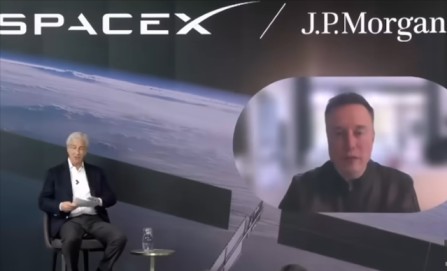
Editor’s Note: In this exclusive interview, Elon Musk joins JP Morgan’s Jamie Dimon at the firm’s New York headquarters to discuss the future of American innovation and the strategic vision behind SpaceX. Musk shares insights on his ambitious goals, including the expansion of the Starlink satellite network, the push to make humanity a multi-planetary species, and his commitment to American industrial growth. (June 4, 2026)
TRANSCRIPT:
Welcome and Introduction
JAMIE DIMON: So let me, Elon, welcome you. It’s a really privilege to have you here on this momentous occasion. It is new for us. But it’s an important thing, the trajectory of American innovation. We’re here live, 3,500 people, our top individual investors around the world. In 100 branches, there are 350 people here, 3,500 around the country.
This is a very unique thing, by the way, because Elon has spoken to me about democratizing finance. This is part of it, treating individual investors the same way institutions are treated and hedge funds and all those things. My view is it’s a wonderful thing to do. Elon, very brave by the way, because I would never let my mother speak publicly when I was in the room. God knows what she would have said.
ELON MUSK: I had no idea she was there, actually.
JAMIE DIMON: Elon is the Edison of our time. I remember visiting Elon in Tesla like 15 years ago. A whole new way of building cars, vertical integration, which had not been anything remote what our car companies are doing. Now you have SpaceX. I visited the SpaceX factory in California, and it’s exceptional to have more than 650 rockets. And you told me one today putting satellites in space. You have 9,000, almost 10,000 Starlink satellites up there. Starlink 3 is coming, which is a whole new generation, which hopefully will replace some of these undersea cables.
It’s been an extraordinary 24 years watching Elon grow over time and now making a massive leap into the future. So welcome and coming here. Elon, I have 10 questions for you, so I want to make sure I get to each one. Some of them came from folks here. They’re all important, but one just to start is why SpaceX public now? Because you had choices, you didn’t have to. Why now?
Why Take SpaceX Public Now?
ELON MUSK: I’ve been asked for many years about taking SpaceX public, so it’s probably been almost 10 years that people have been suggesting to me that I should take SpaceX public. We’ve been positive cash flow for quite a long time, I think since around 2014, 2015, and we’ve been self-funding. In fact, in our private equity rounds, they actually have not been fundraising rounds, they’ve been liquidity rounds for investors and employees because we give everyone at the company stock. And SpaceX has actually bought back stock in most of our sort of funding events.
So what’s different about now is that it’s a number of things, but we are embarking on a significant growth phase, like a capital growth phase, where we are going to put in orbit probably 100,000 satellites, or probably over 100,000 satellites just for communications. And these will be the Version 3 and beyond versus Version 2 and Version 1 that are currently in orbit. Version 3 is, depending on how you count it, 10 to 20 times more capable than the Version 2 satellite. And there were 3 chips that the SpaceX chip design team taped out that are specific to this, that are far beyond state of the art, which means it’s 100 times more bandwidth than the SpaceX Starlink system currently offers, and also half the latency because the altitude will be about half altitude.
I think it will actually be the highest bandwidth, lowest latency means of communicating, and the future with AI and robots is actually going to require a lot more bandwidth than we currently use. Because you can imagine what’s the bandwidth of a human? The peak bandwidth of a human is a few hundred bits per second, but bandwidth of a computer can be a trillion bits a second. So the appetite for bandwidth of AI and compute, AI and robots is going to be enormous.
And then we’re also doing the AI data centers in space, which is another massive capital endeavor. But I think it’ll be the primary means by which AI can be expanded. It’s increasingly difficult to build power plants on the ground. There are very few people who want a power plant in their backyard. So if you want to, say, double the electricity usage of the United States, which is on average about 500 gigawatts, we would have to build about twice as many power plants, which I don’t think most communities are super excited about.
But actually, if we go to space, we can go far beyond the electricity generation of Earth. In fact, this is going to sound crazy, but you could actually increase harnessed energy by a factor of a million and still be using much less than a millionth of the Sun’s energy. Current human civilization uses much less than a trillionth of the Sun’s energy output. It’s just humbling to think about. We’re really a tiny — when you see the true size of Earth relative to the Sun, we’re a tiny dust mote in a vast darkness. And the Sun is enormous. The Sun is 99.8% of all mass in the solar system, and most of the remaining 0.2% is Jupiter.
Sometimes people ask me — and I’m maybe going a little wide-ranging in this answer, but because they just asked me why are you doing public now, and I’m talking about the Sun’s power output. A bit of a long-winded answer. But it is important. Some of these things are important because people sometimes wonder what’s the future of energy generation. And I can say that it is absolutely solar power, or maybe a better word for solar power is star power.
It’s the power of a star.
And the crazy thing is that if you burnt all mass in the solar system that was not the Sun, the amount of energy produced by the Sun would still round up to 100%. Because the Sun is 99.8% of the mass of the solar system. Even if you somehow teleported 2 more Jupiters from another solar system and burnt them too, the Sun would round up to 100%. It’s very much the Sun. And you can scale to a million times Earth’s economy in space in terms of harnessed power, which is a good proxy for economic output, and still be much less than a millionth of the Sun’s energy, which is humbling, really, to think about how tiny we are. And this is just one star among many.
So the TL;DR would be we’re embarking on a massive new growth phase and we need capital for that.
Another thing is the revenue. I also feel pretty good about the revenue projections. Before, revenue was a little unstable, but now I feel like the revenue is much more predictable.
From Earth to the Moon to Mars
JAMIE DIMON: I always learn listening to you, I guarantee you. So when people hear about multi-planetary species, travel to space, one of the most exciting ideas in human history, can you explain the bridge that you speak about? I’ve heard you talk about from the Earth to the Moon to Mars.
ELON MUSK: Yeah, so you don’t necessarily have to go through the Moon to get to Mars. I just think that we can build a self-growing city on the Moon faster than we could do so on Mars. And there’s also the potential, if you say you want to scale far beyond what you can do from Earth, is that because the Moon has no atmosphere and about 1/6th Earth’s gravity, you can use an electromagnetic accelerator, a railgun or mass driver. Basically, you don’t need to use rockets to do AI data centers into deep space from the Moon. You can literally just shoot them like a railgun type of thing. And you can manufacture the solar and the radiators, solar-powered radiators on the Moon from Moon materials. That would allow scaling potentially to beyond 1,000 terawatts a year, which is a truly staggering number. I think we can do probably somewhere around 1 terawatt per year of AI space compute from Earth, but we can do 1,000 terawatts or more from the Moon.
And I think it would be pretty cool if you could vacation on the Moon. That would be the most epic vacation. Not everybody wants to go to the Moon, but I think a lot of people do. I think it would be pretty amazing, obviously provided you could do so safely and come back safely. But I think that will be possible in the future.
And then Mars is another step beyond that. Mars is a whole planet, with gravity much closer to that of Earth’s, and it has an atmosphere. And if you warm up Mars, you could one day make Mars like Earth, meaning with liquid oceans and life, and where you could walk outside without a spacesuit. So Mars — I call Mars a fixer-upper of a planet, but it’s got a lot of potential.
JAMIE DIMON: I mean, let me go to number 3, but I never ever thought you’d be in the hospitality business.
ELON MUSK: Yeah, absolutely. We should have Moon hotels, don’t you think?
JAMIE DIMON: Yeah, Musk hotels.
ELON MUSK: Actually, you think of us more like we’re kind of like the Union Pacific. When they built Union Pacific back in the day, people thought they were crazy because, why are you trying to carry all this cargo and people to California? No one’s there. But now California is the biggest state in the country.
JAMIE DIMON: Yeah, not for long, but yeah. Admittedly, it’s self-defeating. Yes.
Starship: The Breakthroughs
JAMIE DIMON: So Starship, you built it. Unbelievable ship. I think it’s already had 12 flights, I read. But obviously, technically, it’s just hard to do. What are some of the breakthroughs you had that people should know about that they don’t know about?
ELON MUSK: Our webcasts are very good. So I recommend anyone who wants to learn about Starship, the SpaceX website or any of the Starship livecasts are a great way to learn about it. But the fundamental breakthrough of Starship is that it will be the first orbital rocket that is fully reusable. This might sound like an obvious thing, but in every other mode of transport, whether that’s aircraft, cars, bicycles, horses, ships — these are all things we take for granted as reusable. An aircraft journey would be very expensive if you had to throw the plane away every time. And that’s how rockets have been in the past.
But it’s very difficult from a technology standpoint to achieve full reusability for a rocket. We’ve got part of the way there with Falcon 9, but we’ll get all the way there with Starship. And once you achieve full reusability, then the cost of access to orbit is simply the cost of propellant, because now you can reuse all aspects of the vehicle. And the propellant we use for Starship is liquid oxygen and liquid methane, which is the cheapest propellant you could possibly get. We can literally get oxygen from the air and methane from natural gas. So the cost of propellant for Starship will be less than the cost of jet aviation fuel, which means that you should be able to actually send cargo to space for less than the cost of cargo on an airplane going on a transoceanic trip.
Starlink V3 and V4: The Future of Global Communications
JAMIE DIMON: Starlink, another thing that has been amazing — global communications. We already mentioned Ukraine. You had mentioned to me that V3 would maybe be able to replace some of these cyber cables, which by the way is a huge security risk for all of us because several have already been cut in the Baltic Sea. So what’s the next view for Starlink, both V3 and maybe V4?
ELON MUSK: Yeah, so the V3 satellite is a giant, and you can look it up on the internet. As I said, it’s 10 to 20 times more capable than V2. It’s a very big satellite. In fact, it can only be launched on Starship. It’s too big to be launched on any other rocket on Earth. Starship has a 30-foot diameter cargo bay, and the V3 satellites are about 7 meters, so about 22, 23 feet wide. Very big, like the size of a small bus essentially.
There are a bunch of technical details — we have much bigger phased array antennas, we’ve got more ground links, we’ve got more of our lasers. Our satellites communicate with each other with lasers that we developed and manufacture. So it’s got a lot more lasers and more advanced lasers. It’s also got W-band and E-band. These are technical details, but it’s like a crazy orbiting radio station.
JAMIE DIMON: Doesn’t Starship do 12 of them or 15 at once?
ELON MUSK: It should be able to do 50.
JAMIE DIMON: 50?
ELON MUSK: Yeah, because Starship V3 is aiming to do 100 tons to orbit with full reusability. And then Starship V4, we’re aiming for over 200 tons per mission and then being able to launch every hour.
Data Centers in Space
JAMIE DIMON: You’ve been talking about data centers in space. Other people have mentioned it, but obviously it has different technical capabilities. It’s colder up there, it’s less vibration, but you also got to get the data back to the Earth by some method. I think you mentioned lasers in good weather and bad. So how hard is it to do now that you’ve looked at it for a while?
Building for the Future: Patriotism, Culture, and Leadership
ELON MUSK: We don’t think this is a particularly difficult thing to do. In fact, we think it’s easier than our communication satellites, quite a bit easier than our communication satellites. The Starlink V3 communication satellite is an incredibly complex machine. The AI data center would be much simpler by comparison because it’s really just solar power plus radiator, some basic equipment for operating the satellite, and then the laser links which would connect to the Starlink communications constellation, and then back, and then to the ground.
And it would — the connection would happen no matter what the weather is, because once you connect via lasers to the Starlink communication constellation, the Starlink communicates to the ground with frequencies that are cloud-penetrating. So they, in fact, even roof-penetrating to some degree. So you would always be able to close link with the data centers.
The TeraFab and Reindustrialization of America
JAMIE DIMON: Talking about America, one of the big things here, we’ve been talking about the reindustrialization of America for a long time, bringing back advanced manufacturing. And now you’re talking about building the TeraFab, building chip fabs in New York. What compelled you to do that now with all the other things you’re working on?
ELON MUSK: We try to — so what’s the limiting factor? And the limiting factor, what we see as limiting factor, is being able to make chips, both logic, memory, and packaging. It’s worth noting that there’s not a single high-volume computer memory fab in America right now. Zero. There’s one being built in Idaho by Micron, but that will not reach volume production until, I believe, 2028. And there’s something built in New York, but they are in, I think, ’29 and ’30. And this is a tiny fraction of the memory that’s needed.
And in fact, even if you take the best-case assumptions of the memory makers and the logic makers, it is not enough to meet the demand that is anticipated, which is why you’re seeing stocks of Micron go to, I think, $1.2 trillion or some quite high number. So there’s just clearly a need for AI logic, memory, and packaging — AI computers essentially — that is far beyond what even the best-case assumptions of the existing fabricators can do. And that’s why we need to do the TeraFab. Yeah, it seems like essential, otherwise there will not be enough chips.
AI Strategy and the SpaceX AI Satellites
JAMIE DIMON: So I’m going to do one more on some of the stuff you’re building and then a little bit more on other issues. AI strategy — you’ve also took Grok inside into SpaceX. How does that fit into this platform you’re building?
ELON MUSK: Yeah, so we do intend with our SpaceX AI satellites, to allow people to put whatever GPU or TPU they want. So NVIDIA GPUs can be put on it, Google TPUs can be put on it, Amazon Trainiums or any other chips that people want to put on can be put on. We will also offer our chips in the future, and I think we also want to offer our software, our AI software as well in the future. But it will be such that you can run anyone’s AI hardware or software on the SpaceX AI satellites.
Patriotism and Service to America
JAMIE DIMON: Yeah. So the next three are completely different. I’m going to mention each one and ask you each one. One’s about your view of patriotism, your service to this country. One’s about culture and bench — how do you actually build these wonderful companies? Because a lot of people here have those issues. And then kind of leadership, and I have a very specific question about that. But first I’ll start with patriotism. You’ve served this country. I know you’re a patriot. We’ve spoken about it. How do you view your role of being an American patriot, helping the United States?
ELON MUSK: Yeah, I’m incredibly pro-American. And frankly, always have been. SpaceX does do a lot of work for what used to be called the Department of Defense, the Department of War these days. We have a division called Starshield, which provides military communications. And there’s some other stuff that’s kind of classified — can’t talk about that, but we are helping the Department of War and Intel, part of the government, a vital element of that. So yeah, I’m just super pro-America, always have been. Thank you.
Building a Culture and Bench of Talent
JAMIE DIMON: Culture and bench — we’ve been with you for 15, 20 years. I know you’ve built a huge bench in SpaceX. How do you keep it going? What’s important to you? How do you make sure you keep the best talent?
ELON MUSK: Yeah, Gwynne was, I think, around the 7th person to join the company, and that was 2002. So it’s been like 24 years. And generally the senior executives at the company have a very long tenure. I think Bret Johnsen’s been CFO for 15 years. And yeah, I think because people really believe in the mission, they want to stay and they want to keep building it.
We want to make humanity a spacefaring civilization. We want to take humanity to Mars and the moon and ultimately beyond. We want to make — it’s like science fiction — make it real. Go to places that have never been explored before. Make Star Trek real. That was one of my favorite shows.
Leadership Lessons and Personal Growth
JAMIE DIMON: Yeah. Excellent. And then last one — you’ve built multiple companies. How have you changed from maybe 20 years ago? How have you changed from when you started to today? Lessons you’ve learned, how you’ve changed both as a leader and as a person.
ELON MUSK: I think I’m probably more chill than I used to be. I’m way more laid back than I used to be — which I’m still not that laid back, but more than I used to be for sure. And one of the things that I found — I’ve mentioned this before — is that in terms of recruiting people to the company or having people work at the company, their individual abilities and their intellectual capabilities matter a lot, but it also matters if they have a good heart. It’s not just about whether somebody has a certain IQ or whatever, but just are they a good person? That matters a lot.
I don’t know. I guess I’ve learned a lot. Although I feel like I still have a lot to learn and make a lot of mistakes. But I think maybe the future AI will say, “Not bad for a human.”
Closing Remarks
JAMIE DIMON: Listen, before we thank Elon for coming, I just want to thank him. Just watching him build companies — and I can’t wait to watch the next 10 or 15 years about what you accomplish and what you dream of, and getting to Mars and building new businesses and being creative. So Elon, I want to thank you on behalf of everybody for coming here, sharing your ideas. There are brochures out there about the whole SpaceX thing. But Elon, thank you.
ELON MUSK: Thank you. Thanks for having me. I will say that we are exactly one month away from the Fourth of July.
Related Posts