Share & Care!
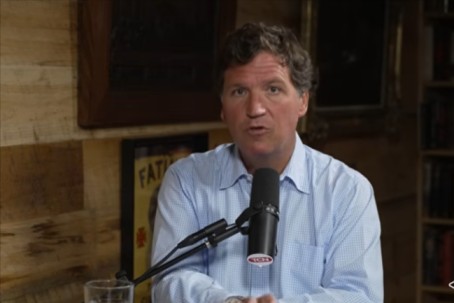
Editor’s Notes: In this episode of the Tucker Carlson Show, Tucker analyzes the global fallout following a major presidential speech regarding the conflict in Iran. He argues that we are witnessing a “pivot in history” and the definitive end of the unipolar American empire as the U.S. acknowledges its inability to unilaterally restore order in the Strait of Hormuz. Beyond geopolitics, Carlson reflects on the spiritual state of the country during Holy Week, questioning the moral direction of modern American religious and political leadership. (AprIl 2, 2026)
TRANSCRIPT:
Trump’s Three Headlines: No Ground Troops, Withdrawal by April, No Regime Change
So the three headlines from the president’s speech last night, at least in the short term, are no ground troops. Didn’t mention ground troops. Yes, we are getting out in some number of weeks by the end of April, and there’s not going to be regime change. Regime change, as he said explicitly, is not our goal.
So are those true? Well, of course, you can’t tell. You can’t know at this point, as Trump himself said. This has been a very short engagement relative to, say, the First or Second World War or Vietnam. But all of those wars began with similar promises. “This won’t last long, back by fall” — all the kind of famous slogans that we chuckle about, ironically, decades later. They had no idea what they were getting into. And that is true, again, for every conflict.
The second people start dying, you really don’t know where it’s going to end. And that goes for this conflict, too. And all kinds of things could happen between right now and resolution. And some of them are awful.
The Gap Between What Politicians Say and What They Plan to Do
There are also, by the way, signs that there is, as there always is, quite a distance between what politicians tell us and what they’re actually planning to do or what they may do. So, for example, in the question of ground troops, the president didn’t mention them last night, but they are apparently on the way. American troops are on the way to the Persian Gulf, including portions of the Nevada National Guard for some reason.
So, either that’s a statement of intent — the administration does plan to put boots on the ground — or it’s an option they want to keep open. But either way, that very much could happen, particularly if the US decides we need actual regime change, we need to subdue the country completely, change its leadership, demand unconditional surrender. None of those things can be achieved, it is pretty much believed, by air power alone.
So, that could happen, and it could accelerate in other ways, too, probably too horrible even to think about, including the use of non-conventional weapons, nuclear weapons of some kind. The effects of that would be what we don’t know, because those weapons have never been used. The kind of nuclear weapons that modern nations possess are not even that closely related to the only ones that have ever been used 80 years ago in Japan. So, what would happen next? Again, we can only guess, but it would be awful.
This Is Not Just a War in Iran — It’s a Pivot in History
So, those questions were partly answered last night, but they’re not really the right questions that we should be asking, because this is not just a war in Iran. It is, really, a pivot in history. What we’re watching is a change of power globally, and so the questions we really should be thinking about — and that we’re going to get the answer to fairly soon — would include: Who runs the world? Who’s in charge of the world? Where are the real power centers? What is the nature of power? What does it mean to have power? How do you know if a country’s powerful? Where does our power derive? Why is the United States a power, exactly?
And finally, what is the United States? Who are we? How do we understand ourselves? What do we stand for? What’s our national character? Is there one? What are we defending when we go to war?
So, those are the questions that, whether we want to ask or not — and they’re almost never discussed in public for some reason — we’re going to get the answers to very soon, because conflict forces an answer to these questions, and this conflict in particular.
This is a world war, which is to say the world — every nation in the world, while not obviously directly engaged in it — has a stake in the outcome, and the future of every country will be determined in part by what happens in Iran.
So, to answer, or try to answer the first question: Who controls the world? Well, how do you know?
Well, you know, because in terms of this specific conflict, the nation that controls the world will be the one that opens the Strait of Hormuz.
## What Is the Strait of Hormuz?
Now, what is the Strait of Hormuz? Well, it’s the choke point at the eastern end of the Persian Gulf, which is the source of a fifth of the world’s energy, probably 30 percent of the world’s fertilizer, a whole bunch of other vital elements that the world needs to run, that the global economy needs to operate. And you can’t get any of those out of that region except through that strait. It’s about 100 miles long, it’s 25 odd miles wide at its shortest width.
## Iran’s Real Source of Power
It is basically the source of Iran’s power. It turns out one of the things we’ve learned is that Iran is not a military power. The president and many other leaders bragged about destroying its navy and its air force and reducing its capacity to build missiles and ending its nuclear program.
Iran is powerful because of its geography, and that’s true for all countries. Geography is the single most important fact of a country. Where are you on the globe and what does that mean? And in Iran’s case, its power is inherent because it is on the other side, the northern side, of the Strait of Hormuz.
So if you want the global economy to function — and it is globalized, every country is connected to every other country by commerce — you have to be able to get through that strait, and Iran is in charge of that decision, which is to say Iran can stop you from doing that.
And for many decades now, Iran has threatened to do that. This is not the first time we’ve had a debate over the Strait of Hormuz, or it’s been in the news, because in every single conflict with Iran — open conflict, diplomatic conflict, beginning with the hostage crisis in 1979, extending through the war between Iran and Iraq, in which we took sides — Iran has said, “Hey, we will close the strait.” And American policymakers have understood that is ultimately why Iran is a nation that you have to reckon with, that you have to take seriously, whether you like them or not, even if you hate them, maybe especially if you hate them.
So Iran is not a military power, fundamentally. Iran is an economic power, and previous leaders have understood that. Our current leadership doesn’t really seem to understand that, or has not said that in public. But Iran’s power derives from its ability to shut down, or at least gravely damage, the global economy.
## Can the Strait Be Reopened by Force?
So the only question that matters long term is who reopens that strait. And it seems obvious at this point that the United States went into the conflict with the mistaken belief that it could — we could, somebody could — reopen that strait by force. It’s hard to understand how anyone who thought about it for 10 minutes, five minutes, two minutes, could have reached that conclusion.
How do you open it by force? Well, you could just blow up Iran. You could end its regime. You could kill its ayatollah. You could take out its leadership. But does that open the strait?
Think about what it takes to close the strait. Not much. In fact, almost nothing. Mines, the threat of mines, boats with explosives on them, drones. It’s extremely easy to prevent commerce. It’s very difficult to assure it. It’s asymmetrical.
And so it’s impossible to imagine how an outside power could keep the strait open without the consent not just of the Iranian government, which you could destroy — conceivably, you could just nuke it — but without the consent of the people who live in Iran. Another way to put it is game it out. You blow up Iran, or you destroy any controlling authority within Iran, and Iran collapses. Does that open the strait? Well, of course not.
Why There’s No Military Solution
It allows any armed group to control the strait and then to collect taxes, levies, tolls for all shipping that goes through. It allows pirates to take control of the strait. And that doesn’t necessarily make commerce impossible, but it massively increases the cost, and it discourages normal flows of energy.
Because who’s going to do that? Who’s going to insure a ship when no government can protect it or assure its protection as it passes through? So, again, even if you reduced Iran to the state of permanent civil war, it’s not going to be able to do that.
Even in a state of war, ethnic conflict, even if you killed 90% of the people in Iran, or 99% or 100%, you would still be unable to promise shipping companies and oil producers and oil buyers that their oil or their liquefied natural gas or their fertilizer or their sulfur or anything else they need from the Persian Gulf would actually be able to go through that strait into the Indian Ocean and out to the rest of the world.
So that’s not a solution. There’s no military solution. That’s not a peacenik position — war is bad. That’s a practical observation that reflects reality. You cannot bomb your way to an open strait.
So if you’re thinking about how to resolve this through war, you have to somehow use force, killing, bombing, to convince the Iranian government — you have to weaken it to the point where you convince them it’s in their interest to keep the strait open. But you can’t bomb them to the point they collapse, because then there will be no controlling authority to keep it open.
So you need a government, but the government has to be weak enough to agree to your demands, but strong enough to keep control over its territory and that waterway. Pretty delicate operation. And at the end of it, you need consent.
What Power Really Is
And this sort of explains what power really is. Power is not the ability to destroy. Destroying is easy, killing is easy. You can take life very simply. It’s not hard at all. Dumb people do it all the time. Creating life is impossible. No human being can do that. That’s the difference between man and God. Man can destroy, but he cannot create.
So in human terms, power is the ability not to create chaos or destruction, but to restore order. Power is the ability to restore order. The most powerful person, the most powerful force is the one that restores conditions to order.
And you see that in your life. Your kids get in a fight. That’s easy. They’re kids. They can beat each other up. But who’s in charge? Well, the parent who restores order. Dad comes home — “knock it off.” Dad’s in charge. We know that because he got the fighting to stop.
And that’s true of nations as well. The nation that restores order is the nation in charge. The nation that forces the peace is the nation in charge. And in global terms, the country that forces order on the Persian Gulf, that opens the Strait of Hormuz, is the nation that runs the world by definition.
The Day the World Realized America Could Not Restore Order
So for decades, certainly since the Second World War, the rest of the world has assumed that that country is the United States. And again and again, as noted, various Iranian leaders have threatened to close the strait. And in every single case, the rest of the region has looked to the United States to make sure that doesn’t happen.
And the assumption that if there was ever a problem, the U.S. could fix it has remained — up until February 28th, when this war began. And that was the day that the rest of the world realized that the United States was unable to restore order. And this was a shock, particularly for the six Gulf states, who along with Iran and Iraq are the energy producing states around the Persian Gulf.
But those six states, the GCC, the Gulf monarchies, our closest allies in the region, our most important allies in the world, had lived for many years with the assumption that if there was ever a problem, the United States could fix it. And they found out in very short order that that was untrue. And they found out the hard way when hours after this war started, Iran started attacking them. And the United States either wouldn’t or couldn’t stop that destruction.
The Destruction Is Profound
And the destruction is profound, profound. UAE, United Arab Emirates, location of Dubai and Abu Dhabi, two of the most famous cities in the world, two of the nicest cities in the world, by the way, one of the richest countries in the world, has taken over 2,000 missiles and drone attacks in the past month. 2,000, both against energy infrastructure, economic targets, but also against hotels in downtown Dubai, the airports, the busiest, most important airports in the region, maybe in the world, Dubai and Abu Dhabi, the nicest airports in the world, attacked. And the United States couldn’t or wouldn’t defend them. Qatar, same thing. Saudi, to some extent, same thing.
The Collapse of the Defense Guarantee
Now these are countries that partly in exchange for the defense guarantee they thought they had have been the largest, and especially in recent years, investors in the United States. So their sovereign wealth funds, some of the biggest in the world, have poured trillions of foreign direct investment into the U.S., literally trillions of dollars. And the effects going forward are unknown, but it looks like, I mean, someone’s going to have to rebuild these countries. They’re going to have to pay for it themselves, most likely.
And so it looks like some of that investment, maybe a lot of that investment, will either stop and maybe some of it, under force majeure, will be pulled back. So it’s a massive loss for them. It’s a huge loss for the United States. But more than anything, it’s a reshuffling of expectations, and yes, of power.
Reopening the Strait: The Only Priority
Now all of those countries are focused single-mindedly on reopening the strait, because that’s the key to their economies, and of course they live directly across the border from Iran. And all of them have an interest in the United States doing that. And some of them are pushing the United States to do that, probably every bit as enthusiastically as the Israeli government has, to be totally honest. And you can understand that. It’s not an attack on them. From their perspective, just make it stop. Open the strait.
And there are a lot of practical reasons why that needs to happen. One of them is oil and gas come out of the ground, and you have to put it somewhere. And if it’s not going on ships, you have to put it in some sort of storage facility, and those are limited in size. And if you don’t have a place to put the oil and gas, then you have to shut down the well. And that’s a big operation, and it can take a long time to restart it. You basically shut down your entire economy.
So there’s a clock ticking for these countries. You’ve got to get the energy out of the region, onto ships and out, and you need the revenue from selling it. So they want the United States to stop this immediately, and by stop it, it means open that strait.
The Iran Problem: A Nightmare Scenario
And their view is, well, you just crushed the Iranian regime. It’s understandable why they feel that way. It’s hard in practical terms to understand how you do that. You really can’t. You need someone in Iran to agree to this, someone who has the power to control the country. And for the Gulf states, and for a lot of countries around the world, that is a nightmare scenario because that leaves the Iranians in control. So you go to all the trouble to have this war, and you have some version of the same regime still in charge.
Iran’s Future and the Question of Who’s in Charge
And from the perspective of our allies in the Middle East, that is the last thing they want because these are their enemies. Literally the Iranians are bombing their countries. They don’t want Iran in charge when all of this is over.
But last night, the president seemed to indicate — in fact, didn’t seem to, he just said — Iran’s going to be in charge at the end. He said that when he made the point that, well, the strait’s going to reopen because Iran’s going to need the money from oil sales. That’s another way of saying some kind of Iranian regime that we didn’t choose is going to be in power when this is all over.
So that statement alone is hugely significant for the rest of the world. The president of the United States just said, we’re not going to be in charge of who runs Iran when this war ends.
The Strait of Hormuz: Who Opens It?
But the most significant thing the president said was about the strait and who opens it. And again, before we play this clip, keep in mind that the rest of the world, including our adversaries, but especially our allies, always assumed it would be the United States who, if it ever came to it, would reopen that critical waterway — that key to the globalized economy, which it is.
If there’s any one geographic spot on the globe that’s the key to a global economy, to an interconnected economy, it’s the Strait of Hormuz. Here’s what the president said last night.
“The countries of the world that do receive oil through the Hormuz Strait must take care of that passage. They must cherish it. They must grab it and cherish it. They can do it easily. We will be helpful, but they should take the lead in protecting the oil that they so desperately depend on.
So, to those countries that can’t get fuel, many of which refuse to get involved in the decapitation of Iran — we had to do it ourselves. I have a suggestion. Number one, buy oil from the United States of America. We have plenty. We have so much. And number two, build up some delayed courage. Should have done it before. Should have done it with us, as we asked. Go to the strait and just take it. Protect it. Use it for yourselves. Iran has been essentially decimated. The hard part is done, so it should be easy. You want the strait open? Do it yourselves.”
What Does This Actually Mean?
So, what does this mean? Well, there are many levels on which you could analyze this. The first is the literal. So, we have enough oil. We don’t need the oil there. If you need the oil, you do it.
To which a lot of people have noted, well, actually oil is priced on the international market, and unless you shut down American oil exports and in some basic sense nationalize the oil companies — control them, use the government to control who they can sell to — then what happens in the strait affects us here in gas prices and oil prices because we don’t control those. So, there’s that.
But bigger picture, what the president is saying is we can’t open the strait, and if it’s so important to you — because we could nationalize the oil companies actually — if it’s so important to you, you do it.
Europe in the Crosshairs
So, who’s he talking to exactly? Well, this administration and previous administrations have expressed increasing, accelerating hostility toward Europe, and of course, Europe is who they may be talking to — they seem to be talking to. Europe needs Qatari LNG, which they definitely do. Since the United States blew up their pipeline from Russia, they’re ever more dependent on Gulf oil and particularly Gulf gas, natural gas. So Europe, you do it.
And we asked our European allies to get in at the very beginning, and we’re going to leave NATO because they’re not backing us up in Iran. It’s not really a real conversation. Our European allies don’t really have militaries, and they don’t have militaries because their countries have been occupied to one degree or another by the U.S.
Who Has the Power to Open the Strait?
Military since 1945 at the end of the Second World War. So, they’ve had not just a defense guarantee through NATO, they’ve had an actual physical defense against whom? Russia, for a lot of the time. And so, they don’t have the capacity to open the strait by force, and of course, no one really does have that capacity. There’s no force that can open the strait, only consent.
But even if you believe there were some military answer to this, France and Great Britain and Germany are going to provide that answer? Spain, Portugal, Belgium? It’s absurd. It’s absurd. Of course, Trump is not speaking to Europe. Nobody expects that Europe could, or is any interest in, sending troops to the Persian Gulf to open the strait.
So, who’s he speaking to? Well, practically speaking, there’s really only one country on earth with the power — not necessarily the military power, but maybe the power to open the Gulf, to open the strait at the eastern end of the Gulf, let all that oil and gas out — and that, of course, is China. China is who the president is speaking to.
And by the way, the U.S. president was supposed to be in China this month, April, meeting with the Chinese president, Xi, and that’s been delayed until next month. And we’ll see if that actually happens. But at the center of the conversation will be this question.
China’s Leverage: Economic Power Over Military Might
So, how exactly would China open the Strait of Hormuz? Well, probably not with aircraft carriers. In fact, you have to wonder how many aircraft carriers will be built after this conflict, because our aircraft carriers can’t get very close to Iran because of the threat of drones and missiles. So, is it even useful to have aircraft carriers? In this moment, we’ll have to assess that. It doesn’t seem it.
But it’s not its military that gives China the power to do this, it’s its economic relationships, of course. So, China is the largest trading partner with every Gulf country and with Iran. In fact, China is one of the only countries that has any kind of meaningful relationship with Iran at this point — China and Russia, but particularly China. So, China could conceivably bankrupt Iran if it wanted, but China is also dependent on Gulf energy.
All of Asia is dependent on Gulf energy. They need it. So, Asia, for example, uses about half the world’s electricity, mostly for manufacturing. Asia produces about 2% of the world’s natural gas, which is in most places the energy source used to make electricity. So, Asia, while an economic power, of course, is woefully short of energy, and a lot of that comes from the Gulf.
China’s Strategic Calculations
So, China needs the Gulf, wants the Gulf. Now, China has very deep energy storage. They’ve saved a lot of oil in their own strategic petroleum reserve, but at a certain point, China’s going to want to open that up. And Trump seems to be saying, that’s inevitable, we don’t need to worry about it. The question, though, is when?
So, from the Chinese perspective, what’s the hurry? China will be hurt economically by this closure if it continues, but so will the United States. But maybe more critically, so will American allies in Asia.
So, if you’re China, you’re very focused on the countries right around you that aren’t fully under your control. Why wouldn’t you be? Every great power is concerned, first and foremost, about its region. Can I control the countries right around me? And in China’s case, you have Taiwan, you also have Japan, you have South Korea, and you have the Philippines. So, you’ve got four big countries that are not directly controlled by China, but they’re in Asia, and they were all, to one extent or another, closely allied with the United States, and benefit from some kind of defense guarantee, mostly implied.
China’s Strategic Advantage in a Weakening American Order
And so, if you weaken those countries, all of whom are totally dependent on Middle Eastern energy, and you weaken the United States by refusing to come to its aid, the Gulf stays closed, energy prices in the United States spike, food prices spike, political unrest deepens, the US gets weaker, more chaotic. It hurts you, but it also sends a very clear message to all those other countries in Asia you would like in your sphere of influence that, hey, the United States is probably not going to come to our rescue if we have some kind of conflict with China, maybe we better come to terms with China.
So, this is not obvious to a lot of the geniuses who run our country, because they think in terms purely of military force. How big’s your army? How many nukes do you have? What’s your navy look like? But from a Chinese perspective, which is longitudinal, they tend to think in terms of years, not just quarterly reporting periods, this is greatly to your advantage, greatly to your advantage.
Taiwan and the Illusion of American Protection
Why would you want to stage a military invasion of, say, Taiwan, the one every think tank in Washington is always telling us is coming any minute, when you could just send a really clear message to the Taiwanese government that reunification with China is inevitable and let’s do this the easy way, the non-messy way. Let’s do here what we did in Hong Kong. Let’s just bring all the provinces home without having to kill anybody.
And by the way, you have no choice because the country you thought was going to protect you clearly isn’t, can’t even protect Qatar, can’t protect downtown Dubai. Is it really going to protect you? Does the U.S. have the physical ability to project power in the South China Sea when it can’t even keep the drug cartels in Tijuana under control? Probably not. So stop with the pretense and let’s come to terms favorable to us.
Well, of course China thinks that way and of course that’s in their interest. All these dumb fantasies about a showdown in East Asia between the U.S. and China — there are nobody’s interests, but only China seems to understand that. So if you’re China, maybe you don’t come to the rescue right away. Maybe you let the pain continue for a while just to make it really clear who’s in charge.
And once again, you’ll know who’s in charge by who settles the conflict. The person or nation that restores order is dad. That’s who’s in charge. That’s the head of household. That’s the head of the world. So that’s what’s at stake. Who runs the world?
The End of the Unipolar Moment
Now is this good or bad from an American perspective? Well, that’s a more complicated question. Short-term, of course it’s bad. There’s a humiliation coming at some point. You hope it’s not too profound. You hope it’s not ten times worse than the fall of Saigon in 1975 or the retreat from Kabul just a few years ago. You hope not because it’s dispiriting and people will die and it’s just awful in every way.
But at some point it will become clear that the United States couldn’t do the thing that great powers do, which is keep commerce going. And so it doesn’t mean the United States is not a great power. It just means it’s not as great as maybe some people imagined it was. It’s not as powerful as our leaders told us it was and in some cases actually thought it was.
And what that really means is the unipolar moment is over. Now it’s been over for a while, but in the minds of your average US senator from Nebraska, we’re in charge of everything and everyone will just accept our terms. And that’s not true, hasn’t been true for at least 15 years. It’s definitely not true now and no one will be able to deny it. So that’s going to be hard for some people to accept. It could be dispiriting to us as a nation, but it reflects reality and it’s not the end of American power or prosperity.
It might in fact be the beginning of actual power and more durable prosperity, the kind rooted in resources and production, the kind that’s not necessarily dependent on finance. So it doesn’t need to be a disaster, but it’s definitely going to be a global reshuffling.
Power, Prosperity, and the Resource Question
And it revolves around the question of resources. It revolves around what President Trump, to his credit, understands, which is ultimately power derived from prosperity. Rich countries are powerful. Rich countries get to build powerful militaries to express and, in rare occasions, exert their power. But wealth comes from resources.
And what are resources? Resources are food, water, and energy. The three things necessary for life, for growth, for civilization. Food, water, energy. Food, by and large, comes from energy, by the way. A huge percentage of fertilizer comes from natural gas, but it takes energy to make food, of course. But a country’s resources, its physical resources, the things it finds in the ground, are essential to that country’s prosperity.
So physical reality matters, and that’s harder and harder to keep in mind when our day-to-day realities are determined by things that are not real. Electrical impulses, ones and zeros, the digital world. But the digital world has limits, and those limits arrive at, say, lunchtime when you’re hungry. You can’t eat Instagram. You have to eat food, and that’s produced by people, grown in the ground, watered with water.
So physical reality intrudes, and Trump, because he is, in the best way, at his best, a primitive person, understands the primitive reality, which is we need these things.
Asia’s Resource Vulnerability and the Lessons of History
So if you look at the world that way, what are the rich countries? What are the rich hemispheres? Well, again, Asia has, relatively speaking, very little energy. A lot of highly productive countries, starting with Japan and China, are totally dependent on other countries for resources.
And of course, if you paid any attention to what happened in the last century, you know Imperial Japan became Imperial because it didn’t have enough resources, and that’s why it went into China, and that’s why it invaded a bunch of its neighbors, and that’s how we wound up in a war with it. So this question doesn’t go away.
The Western Hemisphere’s Strategic Advantage
And if you look at the world through that lens, you see that we’re in a pretty good spot, because the United States, as the president never tires of saying, has deep resources. Land, water, and lots of energy.
Now, in the specific question of oil, it’s a little bit more complicated than you have heard. The US does actually import quite a bit of oil. What we have is a massive abundance of natural gas, which 25 years ago was considered kind of marginally significant. Now it’s understood to be a critical resource from which all kinds of different products that you use every day — pharmaceuticals, and as noted, fertilizer and electricity — all come.
The United States has huge reserves of natural gas, but our region — North America, South America, the Caribbean, the Western Hemisphere — has massive reserves of energy, has huge amounts of fresh water, which matters, and has the world’s best farmland. So we are in a very rich hemisphere, and we haven’t really internalized that.
So actually, if the world cleaves in two, if China fully controls the East, mostly controls the East, and we mostly control the West, that’s probably something we could live with. Probably not a terrible thing for the United States, but it would require a totally different way of thinking. It would require the US government, the Pentagon, the State Department, the White House, all the academics that feed information and deep thoughts about what the Empire should be — it would require all of them to change the way they think about the United States and its place in the world.
So all of a sudden, what happens in Brazil, which has massive reserves of fresh water, farmland, and energy, would be way more important than what happens in Saudi Arabia. And that’s not a bad thing, because we have a lot in common with Brazil.
America’s Neglected Hemisphere: Brazil, Canada, and Mexico
It’s a Christian country with a romance language in our hemisphere right there directly beneath us. It’s a country almost the size of the continental United States. It’s a huge country. It’s a beautiful country, by the way. And Saudi Arabia is on the other side of the world. So why wouldn’t you spend a lot more time thinking about what happens in Brazil, trying to improve Brazil, make it more stable, make it more pro-American, not roll in and steal its oil, its resources, but bring it into your sphere of influence?
Well, a country that was thinking clearly would do that and would have been doing that for like the past 200 years. And not just in a Marshall-Monroe doctrine way — “we’re not going to tolerate this, tolerate that” — but actually try to integrate your economies a little bit more. Again, have positive influence, some sway over Brazil.
Canada: America’s Most Important — and Most Ignored — Relationship
And then you think, well, if Brazil’s important, what about Canada and Mexico, which are literally on our borders, which are huge energy producers. Canada has far more oil than the United States, far more freshwater than the United States. Canada has the fourth biggest oil reserves in the world. How much do Americans know about Canada?
Well, Canada happens to be falling apart as a nation, completely falling apart. It’s in a state of domestic chaos. It’s become a police state under the influence of China. Canada, the country with which we share the longest border, our most critical ally on the globe, is the country we ignore. How many Americans know what its capital is or how to pronounce it? Probably under half.
Canada is the single most important relationship that we have. It has always been our largest trading partner. But going forward, as American influence recedes to our hemisphere, what happens in Canada matters more than anything else. Maybe we should think about that. Maybe we should try to exert some influence on Canada — not necessarily by force, though by force if necessary.
You could certainly make a regime change argument about Canada. Talk about a country that’s oppressing its own citizens, killed almost a hundred thousand of them through its state-sponsored killing program, MAID. You could make a human rights case to invade Canada — not that we should — but if ever there was a people that needed liberation from a government that hates them, it’s the Canadians, of course.
But you could make a case based on self-interest and regional interest, even on decency, to have a lot more positive influence on the internal affairs of Canada than we currently do. Canada is not a sovereign country. It never has been, ever. It’s part of the British Commonwealth. Now it’s some sort of colony of India and China. It’s never been sovereign and there’s no reason that it should be. It should be decent and well-run for the benefit of its own citizens.
Mexico: Benefits, Problems, and the Path Forward
And you can say the same for Mexico. Mexico has brought benefits to the United States. A lot of decent people have come from Mexico. There’s a lot of American manufacturing in Mexico, a lot of great vacation spots in Mexico, a lot of great Mexicans. But overall, Mexico has been a massive problem for the United States — both because of mass migration from Mexico and because of the ongoing drug war in Mexico, which has now moved into the United States.
There’s massive cartel influence in the United States. There are politicians in the United States taking money from the cartels. America is, with every passing day, becoming more like Mexico, and not in a good way. Mexico has harmed the United States in a lot of ways — real ways, measurable ways. The migrant crisis, all those illegals Biden let in, they all mostly came through Mexico, with the knowledge, and in some cases the cooperation, of the Mexican government. That’s the behavior of an enemy nation.
They don’t need to be an enemy, but fixing that will require paying some attention to what happens in Mexico. That’s not bad, that’s good. That’ll be good for Mexico, and it’s necessary for the United States.
The End of American Empire
So why is all this relevant now? Because what’s happening in Iran is the end of American empire as we understand it. And that’s sad, boo-hoo, empire’s dying. But it’s not the end of the United States, it’s not the end of our influence on other nations, hopefully positive influence, it’s not the end of our economy, it’s the beginning of a very rough time in our economy, of course, but it’s hardly the end of it.
What we’ve been doing for likely your lifetime if you’re under 80 is, well, it’s not working anymore. It hasn’t actually helped the United States long-term. Your grandkids at this point don’t have the promise of a better life than you had, so it’s not actually a successful experiment. And now it’s ending because we’ve reached the limits of our demonstrated power. We can’t open the Straits of Hormuz. The President of the United States said that last night. “Someone else do it.” So we’re done.
That’s okay. It was always going to end. Hopefully we can get out without a nuclear exchange, but now it is ending. And there’s going to be a lot of suffering and sadness as a result of that end, but there will also be, there is, an awful lot of promise. Promise that the United States can act in its own interest, that it can be reasonable, that it will not be governed by deranged people, seized by hubris, or get way out over their skis and get a ton of people killed.
You don’t have to occupy countries you’ve never been to, can’t identify on a map. What we’re doing doesn’t work, whether you approve of it morally or not, and we’re going to do something else, and that something else is starting right now. So the only point is, you could, with wise leadership, turn this to the advantage of the United States and the Western Hemisphere very, very easily.
A Clarifying Moment
And there’s one other advantage to this moment, which is that it has been clarifying. All of a sudden we know what everybody in authority thinks because they’ve been saying it, because under pressure people confess. The pressure, of course, is this war, which a lot of people in our commentariat, a lot of people in our government, certainly in our Congress, a lot of people in Israel wanted. They all wanted this, and it didn’t work the way they said it would, and even now it could go really, really wrong, and lots of Americans could die.
Relatively speaking, a lot have died. “Oh, the casualty numbers are so low, okay.” How about if that was your son? Would you feel they were low? Americans have died for this at the instigation of Israel to no material benefit to our country, and everyone knows that. There’s no denying it. That’s not a conspiracy theory, it’s just a fact, and now it’s completely out in the open.
So those ideas — neoconservatism, the preservation of empire, the idea that you take orders from a tiny country far away — all of those things have risen right to the surface, no longer whispered about. We can just say it openly because no one’s hiding it anymore, and we can all say they’re destructive, stupid, and bad for the United States. So those debates are over. We now know what’s going on, and now we can change it.
The Corruption of Protestant Christianity in America
The other thing we’ve learned is that huge parts of Protestant Christianity in the United States, the leadership, totally corrupt, and not just corrupt on an obvious level like, oh, the preacher’s having an affair, or they’re taking money from whomever, they’re shaking down the congregation for 20% tithe. No, corrupt on the level that matters most, which is spiritually corrupt. They’re not preaching Christianity, not just because of their fealty to Israel, which is bizarre and kind of hard to understand, but on an even deeper level than that.
There are many Protestant American church leaders who are preaching a religion that bears no resemblance to Christianity. So that’s the core problem right there. Who knows what this is? It’s not Christianity.
Franklin Graham at the White House
It’s not what the Gospels describe. Yesterday at the White House they all show up, middle of Christian Holy Week, four days before Easter, and not just the fringe Christian Zionist John Hagee or these strange people, but the big guys. Franklin Graham, son of Billy Graham, shows up at the White House yesterday to pray over the president so he will have wisdom and restraint. No! To endorse the murder of civilians, which is a war crime, but more important, it’s a moral crime. You can’t kill people who have committed no crime, who did nothing wrong. You can’t murder the innocent. You can’t kill kids and women. And yet Franklin Graham is up there, standing at the podium, praying for that.
The Book of Esther
Now how do you do that? Well, by quoting something called the Book of Esther, which is in the Christian Old Testament, a controversial book for a long time. Martin Luther thought it shouldn’t have been there, but it is there. And it’s the story, among other things, of a genocide of Persians. Oh yeah, 75,000 Persians. Not just people who committed crimes, but people who were Persian, and that’s why they were killed. And it’s in the Book of Esther, which you should read because it’s interesting.
It also happens to be, maybe not coincidentally, the only book in the Christian Bible, Old and New Testaments, that doesn’t mention God. There’s no mention of God in the Book of Esther. Now there are all kinds of theologians, and this has been a debate for 2,000 years, and there are people who argue that the Book of Esther implies the presence of God, God’s plan unfolds in the Book of Esther. Fine. Hardly a theologian not going to debate it. But if you are a Christian clergyman, or call yourself one, and you’re giving spiritual counsel to a head of state, it really matters. And there’s no reference whatsoever to Jesus. You’re not preaching the gospel. You’re not speaking actual truth to actual power. You’re doing something else.
Why Jesus Cannot Be Mentioned
Now why is there no mention of Jesus? Why would Franklin Graham refer to the Book of Esther, the only book in the Bible that doesn’t mention God, when he talks about Christianity with the President of the United States? Because you can’t mention Jesus. That’s why. Because there’s no evidence that Jesus was for genocide, killing civilians, murdering the innocent, murder at all.
This is God come to earth, the Christian Messiah who allows himself to be tortured to death by pagans. He knows it’s coming. That’s the story of Holy Week. Jesus enters Jerusalem on a donkey, not on a stallion. He’s not coming to overthrow the oppressor by force. He’s coming in in total humility and accepting degradation and mocking and physical torture, getting spit in the face by soldiers, whipped. He’s allowing this to happen because he’s saying the real victory is bigger than any victory achieved by killing people. It’s a victory over death itself. That’s the Christian message.
That’s the opposite of the message you heard from Christian leaders at the White House on the eve of the President’s speech about the war yesterday. What does that tell you? The point is not that they’re bad or silly or practicing another religion other than Christianity. Oh, that’s true. But the point is not to beat up on poor Franklin Graham. The point is that it’s the end of something. Whatever that religion is, is not going to continue. It just won’t, because it’s a lie. And so it will end, as all lies do. It will be revealed as a lie, as all lies are.
The End of American Protestant Christianity
And so you’re watching the end of the global American empire, the unipolar world, that was great, by the way, while it lasted, but it’s over. And you’re watching the end of whatever American Protestant Christianity, one of the greatest and most positive forces in the history of this world, whatever it became after the Second World War, which is something unrecognizable. The people who built National Cathedral on the highest point in Washington, D.C., one of the most beautiful buildings in the United States, were Episcopalians.
They built that cathedral. And it was the nation’s cathedral. It was also, above all, a tribute to God. And you can tell by its beauty that it was. And now it’s populated by people who share almost nothing in common with the people who built it.
And that’s the story of all human institutions and all human schemes. They all come to an end, of course, because they’re devised by people who are silly and venal and lack foresight, and they’re just limited because we all are, much more than we imagine.
The Death of Great Institutions — and the Promise of Rebirth
And so all of that dies at some point, and we just happen to have the misfortune or the great luck to be living in the middle of the moment where these great institutions and the expectations that come along with them are dying right in front of us, right now.
And that’s sad, it’s hard to watch, it’ll affect your sleep if you think about it too much, but it’s also a prerequisite — it is a necessary step, and this is something that all Christians are thinking about at Holy Week — to rebirth. The seed doesn’t produce the tree until it dies.
And so the death of the unipolar moment and of the institutions within the evangelical movement, American Protestant Christianity, are going away, but they will be replaced by something better and purer, more true to itself, constructive, unifying, healing — institutions that build and don’t just destroy.
That’s going to happen, and God willing, we will live to see it. So rejoice in that, as sad as this is, and Happy Easter.
The Truth Is Being Hidden — Stand Up for the First Amendment
So if you’re following the war with Iran, you’ve probably noticed something strange — the coverage is everywhere, but the facts are hard to find. They aren’t actually telling you anything. How many people have been killed? What are the actual stakes for this country, your country, our country, the United States?
The basic questions are the ones that matter. You can’t actually find out because this is a censored moment. You’re not learning the truth, and that’s not accidental.
If you want to learn the truth, you need to stand up for the First Amendment, which is your birthright as an American. We’ve set up our company, TC on the Tucker Carlson Network, to make it possible for you to participate in the long American tradition of freedom, and the core of freedom is the right to know the truth and say the truth. It’s a God-given right. God gave that to you.
We’re free to do that because we are totally independent. We have zero investors, no corporate owners. We are supported by our members, the people who watch. So we hope you’ll consider joining us. Visit TuckerCarlson.com or go to our website at www.tuckercarlson.com.
Related Posts
- Transcript: Jonathan Swan’s Dive into Trump’s Reality: The Weekly Show
- Transcript: President Trump Remarks in Dublin, Ireland – Sep 12, 2026
- Transcript: President Trump Remarks at the Republican Midterm Convention – Sept 9, 2026
- Transcript: President Trump Signs Executive Orders, Sep. 4, 2026
- Transcript of Senator Ted Cruz Interview: PBD Podcast #851