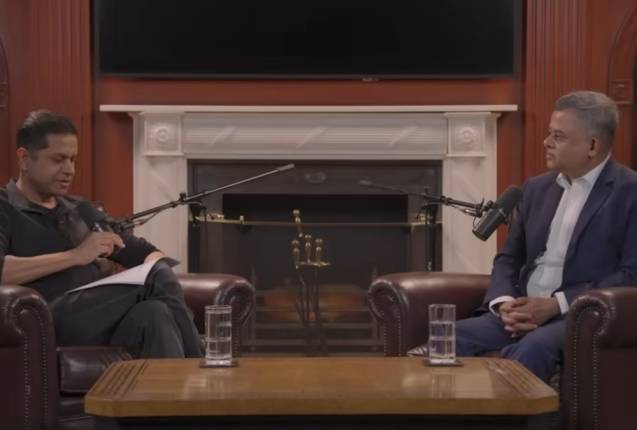
Here is the full transcript of economist and policy thinker Neelkanth Mishra’s interview: ‘The Golden Age of Indian Entrepreneurship’, on SparX by Mukesh Bansal, November 29, 2025.
Brief Notes: Mukesh Bansal sits down with economist and policy advisor Neelkanth Mishra to explain why 2026 could mark the beginning of a true golden age for Indian entrepreneurship and jobs. Mishra argues that a sharply lower cost of debt and equity, a well-capitalised banking system, and massive domestic equity flows via SIPs, EPFO and insurance are unleashing unprecedented risk capital for founders and businesses. They also explore how GST simplification, decriminalisation, Aadhaar 2.0 and India’s digital public infrastructure are easing doing business and enabling new waves of opportunity in fintech, precision manufacturing, semiconductors, data centers and AI despite big-tech dominance and US–China tensions.
Introduction
MUKESH BANSAL: All right Neelkanth, welcome back to another episode. So you’ve been talking about, in fact you have a talk later today where you’re going to present the case of why you believe this is the golden age for Indian entrepreneurship.
I’ll be very curious to hear how you are processing it. On one hand I obviously wholeheartedly believe that as well. But I’m also very acutely aware of all the low hanging fruit has been taken. $10 billion IPOs are happening, routine things, and it’s very hard to find the jugaad type opportunities or optimization efficiency driven. And it seems like you need to really innovate, build unique IP etc. And that ecosystem is very fledgling. So given that, what convinces you that this is the start of golden era for Indian entrepreneurship?
NEELKANTH MISHRA: Thank you for having me again and always a pleasure just doing bulla with you.
See, entrepreneurship is about solving business problems. Now as we have discussed in our earlier podcast, the path you take from low middle income to middle income is different from the path from middle income to upper income.
So the way you frame the problem that the easy pickings are gone is absolutely right. We are a $3,000 per capita economy. We would like to be a $10,000 per capita economy in a decade or so, or maybe 15 years. But we have solved the easy problems and now the hard problems will come.
For the hard problems to get solved, you need massive amounts of risk capital. Because remember, for an entrepreneur to function you need large amounts of risk capital because just ideas will not solve the problem.
The Cost of Capital Revolution
So when you think about cost of capital and the availability of capital, on both fronts there has been substantial progress. The risk free rate, the long term risk free rate of capital in India or in any country, is the 10 year bond yield of the government at about 6.5%. And while many people contest that, I think in a year’s time it’ll be below 6%.
This is the lowest outside of crisis times. It was lower than this for a small period in 2003. Because at that time the economy had slowed and anyway lots of things, but that was exceptional.
MUKESH BANSAL: And just to be clear, this 6.5% inflation adjusted is more like 3 to 4%.
NEELKANTH MISHRA: Yes. And I do think, and I think the market is still expecting next year’s inflation to be 4%, it’s more like 2.5% risk adjusted. But the real rates are of course important, but I think the nominal rates themselves are actually very important.
Look at it from this perspective: there was a time when the 10 year US bond yield was at 2%, the Indian bond yield was 8%. So there was a 6% gap. Today the US bond yield is 4.12%, the Indian is at 6.5%. So the 2.5% gap, I think in a year’s time this could be a 1% gap.
Many large economies, in fact if you go back in history, one of the reasons that the Dutch were ahead of Britain in the 17th century was that they were known to be big savers and they managed to bring down their cost of capital.
When your cost of capital is low, your ability to take risk goes up because then it’s a classic discount rate problem. So then you can think about capital returns coming five years later and then you can solve bigger problems.
What has also happened is that this is the risk free rate which is government cannot default and it’s a 10 year yield, so long term as well. Now if you are a triple A borrower or a double A borrower or an A borrower, because the riskier borrowers of course the cost is higher.
What you have in India is an exceptionally well capitalized banking system and the non banking financial system. So what you have today is that this is the first upturn. Now the RBI has been cutting rates. Now monetary easing has happened, economy is now starting to take off.
Well-Capitalized Banking System
This is the first up cycle where the public sector undertaking banks, the PSU banks, are not with impaired balance sheets. So the last two times it happened, 2004 to 2006 and 2014 to 2016, it was primarily because they had lent badly in the previous cycle. They had broken balance sheets. They couldn’t.
This time they are so aggressive because on everything that is low risk like salaried mortgages, you must have seen the newspaper reports that PSU banks are gaining share in salaried mortgages because they’re the safest asset that you can find and they’re pricing out all the rest.
I am aware of PSU banks lending to other PSUs one year loans at 5.46%. So this is, and I was presenting at this forum of an alternatives platform. This firm got 15 year funds at 7.5%.
So it’s absolutely remarkable how the cost of debt capital has come down. And as the competition in the financial system, the non banking finance companies are well capitalized. The banks are well capitalized. The PSU banks are still competitive.
There is this development finance institution called NABFID, National Bank for Financing Infrastructure and Development, which in 3 to 4 years time has developed a 60,000 crore balance sheet.
So if you are a private bank or an NBFC you really have to innovate and work hard to build a business. And which means, while it’s a challenge for banks like ours and we are of course completely up to it, from the borrower’s perspective, things couldn’t have been any better.
This is debt capital. But an equally important part is equity, just about the fact that venture capital exists now. You have everything from angel investing clubs in 30, 40, 50 cities to pre series A, series A, so on, so forth to buyout funds.
Today there are funds that can actually buy out a billion dollar company. This was not possible 10 years back.
The SIP Revolution
And this is being sustained by this remarkable change in the stock markets. So just to give you a flavor of how remarkable the systematic investment plans are.
When you are trying to grow at three times the pace at which the developed markets did when they were going through this phase, there’s no way you can increase labor input at 3x the pace. You can draw productivity at 3x the pace which we are doing, and I’ll come to that as the third leg of the argument.
But the capital formation needs to accelerate. Now if you only do debt capital then it won’t work because it becomes very risky because then one downturn and the whole business goes to dust. So you need some amount of risk capital, some amount of equity capital.
At this level of per capita income and per capita wealth it is unthinkable that we are generating so much of risk capital. So just to give you the numbers, today there is $3.5 billion of SIP money coming into mutual fund equity, mutual funds every month which is $42 billion a year, which is give or take 1% of India’s GDP.
MUKESH BANSAL: And that’s probably fair to say growing at least 10% annually.
NEELKANTH MISHRA: It is growing faster than that. But whenever, see for the last five years as this has kept growing, people like me have said let’s assume it doesn’t grow. But it is still growing.
And in addition there is EPFO. So the Provident Fund organization which is now contributing I think $7 to $8 billion a year in equity. There is also insurance. As insurance penetration grows, a certain amount of the premiums are to be allocated into equities.
So some people think it’s $80, $90 billion. I think that’s too high. I think $60 to $70 billion from insurance alone combined. So SIP plus EPFO plus insurance plus there is also some discretionary. See it’s not that Indians were never investing in equity.
So if you put that together, let’s take on a sustained basis $70, $80 billion. So that’s a massive amount of risk capital that is being generated now. Even if it is, as some people fear, missold, that some of these SIP buyers are equating it to fixed deposits, which they are not. It is a risky asset.
If the stock market takes a deep dive and there are a lot of people will get burned. But till the time that this is coming in, it is like sunlight and fertilizer and a fertile soil and a whole new ecosystem is emerging.
MUKESH BANSAL: And this whole thing has just emerged in last, even maybe max, 10 years.
NEELKANTH MISHRA: 10 years, right. This is post demonetization. So during demonetization, as a lot of black money was forced into the system, many of these savers who were holding cash had to find better ways to deploy it.
And so that’s where, and then AMFI, the Association of Mutual Funds of India launched this mutual fund Sahi Hai scheme and that did some education. And the SIPs have actually spread through word of mouth. Meaning that he earned so much, he earned so much.
Now someone can say this is almost like a Ponzi scheme. The stock markets have been going up because more and more people are joining the scheme. But at the same time it is not really a Ponzi scheme because, while PE multiples are high, it is backed by very strong nominal growth in GDP and also high single digit to double digit growth in earnings.
The Virtuous Cycle of Risk Capital
So there is overvaluation from the investor’s perspective. But if you think about it from the entrepreneur’s perspective, this is very, very good. So you have low cost of equity capital and because public markets cannot fund early stage entrepreneurs.
So suppose you need, you’re not going to go to the stock market for 50 crores, 100 crores, but for the VC who is giving the entrepreneur that money, the fact that there are exits down the road which can be enabled by this flow of money is a very important factor.
So this feedback loop is very important. And the more people who get exits, so just like what you were talking about, the more the likelihood that we see then raises money and deploys it in India. Because he’s going to get an exit here.
And more entrepreneurs then get excited that look, that guy made so much money that day. So I can also take risk. And this is exactly what is needed for us to not get stuck in the middle income trap, to create an ecosystem.
See, middle income trap, we have to solve dozens of problems. We have to create an R&D ecosystem which we don’t have. And there are different problems there. But an integral part of that system that we need to build is a system of risk capital where people jump in knowing that they may fail.
And that’s where you solve the hard problems. So the more of this capital that goes in, the better and the cheaper the risk capital becomes.
MUKESH BANSAL: Okay, understood. So this part of the story, what you are saying is first of all, as a country we have reached a critical mass of economic development. $3,000 per capita, nearly $4.5 trillion for the overall GDP size.
Second, because of digital public infrastructure, and we’ll talk more about that, the friction from the system has gone out. It’s become easier for people to participate in equity markets which have also done well.
And now I’ve got this $60, $70 billion of capital coming in and net, net of all of that is cost of debt capital is low, cost of equity capital is low. So that can encourage a lot of risk taking. But that is one pillar.
NEELKANTH MISHRA: Yes.
MUKESH BANSAL: What are the other enablers for this golden age?
Ease of Doing Business
NEELKANTH MISHRA: Exactly. So I was, so that was the third one which is ease of doing business. Now again, ease of doing business is not improving as fast as you would like it. And frankly, because it’s a large and complex ecosystem, there’ll always be people on both sides of the spectrum.
But what is remarkable is how rapidly regulations are being eased. Just this year, seven states, I’m just giving an example, seven states have allowed women, amended their labor laws, allowing women to work the night shift.
The Evolution of Business Regulations in India
NEELKANTH MISHRA: Now what is surprising of course to many people is that women were not allowed to work the night shift. But yeah, there were restrictions and many of them are amendments to the Shops and Establishments Act.
So basically as modern trade, as some of these shops, hair salons, all of these start opening up and they need women to be up and about till about 10, 11 pm you need the labor laws to be amended. And so these things are trying to happen. Yeah. State governments are creating white lists that if you belong to this industry, you don’t need to get environmental clearance, you don’t need to get XYZ clearance.
And therefore the process of starting a company, the process of expanding a company is becoming simpler. It is still nightmarishly complex. Tax, I think needs significant amount of simplification. I think the tax authorities, I think their behavior towards taxpayers.
MUKESH BANSAL: What were recent GST reforms?
NEELKANTH MISHRA: Did it help? It is huge. It is huge. I think the simplification, the fact that there are only three rates, you know, just to give you a very clear example of how powerful this is. So when the Honorable Prime Minister announced on 15th of August that there will be, you know, GST reforms.
We had to decide what will be the impact. Because see, I mean, of course the government came up with an assessment a few weeks later, but in the markets you have to be ahead of the curve. Now we were doing the math that if 28 and 12 are taken out, how much revenue loss will there be?
But then you had to first figure out which category will be mapped to which rate. So the moment you start thinking about, okay, small cars, are they going to 40 or are they going to 18? It is straightforward. Yeah, right, yeah, 18. Right. So. And whereas if you are 5, 12, 18, 28, it is tricky. So the fact that these are very clear distinct rates.
For food processing, the rates have been 0 to 5. Now there are experts, and I’m not an expert on agriculture by any stretch of imagination, but there are experts in food processing, agriculture, who say that in five years time a large part of India’s food industry will get formalized, because now there is no disadvantage in staying outside the system or no advantages being outside the system.
You think about how this shows the government’s attitude towards consumption. You read the history of Maruti and I’ve read multiple versions of that history. It was considered a luxury good. But with 18%, the government is now finally disclosing that it does not consider cars to be a luxury good.
The fact that branded cosmetics does not need to be at 18% is also a realization that we are a $3,000 per capita economy. So I think the GST changes are of course very, very important. But at the same time, there are changes happening in the like decriminalization.
I mean, it is only when you read the clauses in various states that have been decriminalized, did you know that if you built your own house and there was no provision for municipal piping, water piping, you could be sent to jail. Really? Yeah.
Decriminalization and Regulatory Reform
NEELKANTH MISHRA: So because some of these were just archaic and what has been fascinating, and this is where, you know, the society grows because we all learn from each other. You have to first solve the meta level problem. Meaning everyone said we have to deregulate, we have to decriminalize. But what do you deregulate? What do you decriminalize?
So then there’s this company team, Lease Regtech. Now Rishi and his team have compiled this list of compliances. Now you can go to the ministry and talk to the secretary and say, these are the clauses under your ministry which have a criminal penalty. You’ll be surprised. Many of the secretaries didn’t know. Now that they know, they say, oh, this is ridiculous. Remove it.
Yeah, so this is how. And you know, and many of these were just misused. It’s not that you won’t believe it. In one of the states, someone threatened an office that the name of your office is in, not the right font size. So I’m going to put you in jail. Yeah, that was the real thing.
And so this guy phoned up the headquarters and the headquarter guys who said, oh, I know this is not fair. This is completely wrong. I will sue them. Say, sir, he’s only asking for 500 rupees. I’m going to give him 500. So this is how it was misused and harassed and it was used for harassment.
So this is also happening. So while I think the time taken to start a business, the time taken to wind down a business to get approvals is still massively higher than what it is in, say Malaysia, Thailand.
MUKESH BANSAL: There must be, I mean, see, everyone’s aware of this. We’ve been, you know, I’m sure since you’ve been, you know, been talking about, you know, policy and thinking about economic development and the ease of doing business, I don’t think anyone disagrees, including I’m sure pretty much anyone who is as any say in policy, what is the, what’s holding things back and what will accelerate this aspect of making easy for entrepreneurs?
NEELKANTH MISHRA: So one is external pressure.
MUKESH BANSAL: External pressure will make it easy or.
NEELKANTH MISHRA: Will make it easy. So I’ll give you an example or a story. So the leader of one country, so we had a president. He was meeting five, six of us economist types and he said, you know, India’s tragedy is its large size and its glorious history.
Now while all of us could see the large size and glorious history, we couldn’t understand how this was tragic. And he said, this is why you don’t change, because there’s never an existential risk.
Now you think about why is it that shrimp exports now there were headlines two days back that shrimp exports to Europe are now going to stamp up. All that has happened is that there were non tariff barriers there, some regulatory issues which the commerce ministry, because the shrimp, that 50% duty to us meant that Indian shrimp exports couldn’t go there. So they worked on it. In a few weeks it resolved.
So it had to wait for the US to put a 50% tariff where before people woke up and said, oh, this is easy to do.
Aadhaar 2.0: The Next Generation
NEELKANTH MISHRA: What is also happening I think is like for example, take Aadhaar. You know, Aadhaar was cutting edge when it was designed. But when it was designed, iPhone was two years old. There was effectively no Android. Today there are, you know, 852 million smartphones in India.
So when I joined Aadhaar my first question was why aren’t we using an Aadhaar app? So we had M Aadhaar app. And it was, yeah, I mean it was effectively a replica of the website and you know, PVC card or the PVC cardinal. I said look, this is a huge tool for engaging with users directly. And believe me, there was no resistance. So someone had to give an idea and someone had to push it through.
MUKESH BANSAL: So where are we with that app?
NEELKANTH MISHRA: So that app is actually, it has been soft launched. So there are now already, I’ve seen some reels and all of that and how easy to use it is and all that. And so we are now signing up on use cases where you go to a hotel and just like you scan a QR code to make a payment. You scan a QR code and you share the details that you need to. You don’t have to give your Aadhaar and then someone takes a photocopy and don’t know what happens.
MUKESH BANSAL: That’s outstanding. So is that those are going to be real use cases.
NEELKANTH MISHRA: This is what you tell you.
MUKESH BANSAL: Yes, yes, yes, mentioned my Aadhaar and.
NEELKANTH MISHRA: No, you just scan your Aadhaar and you’re in your app and you say, I want to share whatever is required. Right. So name and address.
MUKESH BANSAL: Right.
NEELKANTH MISHRA: And that’s it. You can do age gating. So you can, if you are say going to a concert, you just have to scan it and say, okay, I will just share my age or year of my age.
MUKESH BANSAL: So you don’t need your physical ID in most places then?
NEELKANTH MISHRA: You don’t. So this is what I told the team that look, it is embarrassing that you know, you go to an airport and you show your boarding pass on your phone and then you take out your Aadhaar card. Then you shoot.
MUKESH BANSAL: We just, you know.
NEELKANTH MISHRA: Exactly. Or you go to many government offices and they say ID and you show fake views. Correct. So but you, if you make it digital and you can see it’s all privacy protected. So it’s not that just because there is the, you can actually do offline so long as it is authenticated.
So there is so much more that the Aadhaar app can exist. So the example I’m giving, or take the example of say the Aadhaar Sevakin. Now we were all aware that there is a massive amount of overcharging here that you know, on Twitter I get marked. There are lots of emails that we get that mobile phone update cost 50 rupees. They charge me 150 rupees. There was this guy in my village.
Who for his two kids had to paid 2,000 rupees each. And I was talking to my father on my weekly Sunday call and he said, oh, you know Viander’s son, our kids, they took 2,000 rupees yesterday. So I asked the Aadhaar folks, since when did we start charging for Aadhaar for kids. I said, oh no, shouldn’t happen. You give me his number.
So gave his number. He said, that was right through the overcharging. We suspended the operator, said, okay, great job. Now what happens? So they will appoint a new operator. New operator there. Who will you appoint the new operator? So the state government. The state government’s run this.
So I said, really? Because I’m not even a bureaucrat. You really think that that overcharging was going into the operator’s pocket? Yeah. So how do we solve this? And the team then decided that we should increase supply. Yeah, the economic solution is to increase supply.
So what we have done now, just like TCS runs the passport office, private sector intervention. So we have now. So we had our own, what, 80 odd Aadhaar Seva. Now we have one in every district. Okay. So it’s starting off in November. So we’ve identified there was a RFP. It took its own time in, you know, structuring it. You know, what is the right level of compensation as a bidding, how much cost it will incur.
But now, so what I’m saying is that for a while this was not happening, but now you will see that. Or, or, or, you know, just one, one, one. Another fascinating example. And this is something which is not in production, but let’s see if we can get. Take it there.
You know, Google has a very unique problem in India. So there are a billion smartphones, there are three and a half billion Gmail IDs. And their understanding is that most of these Gmail IDs are. Because when someone buys this Android phone, the shopkeeper just generates a random Gmail id, sets it up and gives it to them.
They’ve lost all their previous data and the old Gmail ID is never going to be used. And this one is of course the new and all of the things have to be reset. What if its primary purpose, and you should see that in the name of the law, the act as well, it was to uniquely identify beneficiaries of government subsidy. But today it is doing more things than it was supposed to do.
MUKESH BANSAL: This is the kind of most credible.
NEELKANTH MISHRA: Identity that everybody has. Exactly. And therefore it is starting to take on roles which it was not designed for. So, for example, it is used as proof of date of birth. It is used as proof of address. But we are not, I mean, we are not the first proof of date of birth.
And I can tell you that there are people. I mean, the first legal notice I got in my life was when someone sent a notice to the Aadhaar chairman that I think she was not being allowed to change his date of birth more than twice. There are people who change it 10 times. And all the times we check the date of birth with a proper, like there’s a birth certificate.
MUKESH BANSAL: What is the incentive to change the date of birth?
The Credibility and Evolution of Aadhaar
NEELKANTH MISHRA: There’s massive incentive. So there are sports people who, to meet certain age criteria, they can keep changing and they’ll say, “My coach told me to.” And there are established systems. Like I said, we insist now on QR codes on birth certificates so that we can go to the source of origin and validate that is not a fraud. They’re generating 10 genuine dates of birth certificates. Right. So there’s clearly fraud happening somewhere. But it’s not with us.
But we cannot be, because we are not the primary source of database. We are not the primary proof of address. But like a friend of ours, I mean you know him as well, he said that, you know, everyone must be complaining to you about Aadhaar. “This didn’t happen. That didn’t happen,” and is absolutely correct. I only get to know the bad cases. But he said, “I must tell you that how happy I am that I just changed my Aadhaar address.” He had changed his house and in one click of a button all my bank addresses got updated. I said, “Yeah, great job.”
We are not proof of address, but the banks do use us as a proof of address. So this is exactly what you’re saying, because this is the most credible proof of identity. So it is starting to take on additional roles which it is currently not authorized.
MUKESH BANSAL: I mean Aadhaar is obviously very useful. I think it’s great if more and more use cases are being enabled. And as you’re saying, we are also bringing in the updating, the technology and bringing it up par with what’s the latest, greatest. But what is the big picture here? What does cutting edge in Aadhaar enable for the country or for the individual?
NEELKANTH MISHRA: So one, I think you should be able to trust that if Aadhaar has said this person is the person, then you don’t need to doubt it.
MUKESH BANSAL: Does it link back to ease of doing business? I’m just trying to see what is the larger…
NEELKANTH MISHRA: It is. It is. Establishing trust is such an integral part of… Okay, so how is it that India is such an outlier in terms of, you know, the penetration or the ability to collect equity capital and mutual fund inflows and the number of people who invest in mutual funds versus this per capita? We’re an outlier.
I was talking to this person who kind of runs the data body for the US Manufacturer Mutual Funds Association. He was saying, you know, $30 a month. So you know, SIPs is about 2,600 rupees, around 700 rupees a month, 11 crore folios. That cost, it’s not possible. Yeah, you only can do that because you are able to do KYC at a fraction of the cost. And that you, if you can’t trust the KYC, you won’t be able to do it.
So it is Aadhaar, as the name says, is the right platform. Right. So, okay, this is just one example. But you know, coming back to the ease of doing business, I think regulators are at it. They’re questioning. In fact, there was a remarkable statement from the RBI governor recently, actually part of the policy document that came out that, you know, the allocation of business between entities of a financial conglomerate will be left to the wisdom of the boards.
Now compared to where regulators would try to prescribe that if there’s a financial conglomerate and there are these 10 different groups, then, okay, only one entity will do one business.
MUKESH BANSAL: Right.
NEELKANTH MISHRA: He’s saying that, look, you decide. Now that’s very important for even competition to exist within groups between entities of the same group. So I think these changes are progressively happening, I think, starting to happen across regulators.
The Regulatory Easing Cycle
NEELKANTH MISHRA: At this stage we are in late 2025, we are at an easing stage. There’s this very hard to understand risk cycle or risk perception at a population level which I doubt anyone understands. I don’t know if you’ve read any books and if you have, very happy to point out that how is it that the split between males and females in a population is in such a narrow band. Right? Because you would think that if it is completely random, then it could be swinging large numbers.
It applies to cities, applies to states, applies to countries. They’re all in that 95 to 50 band, right? Males to females. So at a population level there are lots of things that happen that we don’t understand. So same with risk appetite for regulation.
Till two years back, for some reason it was a time for tightening regulations. So every regulator was trying to tighten things. Now we are in a stage where every large regulator seems to be easing regulations. And very famously government has two committees. Every state has a Jan Vishwas bill where they are decriminalizing things like that, which is great.
So coming back to the first point, I think if your cost of capital, debt and equity, availability of capital, various types of capital, geographies of capital, because you know, which city you’re located in and all that, access to infrastructure, you know, Indian port efficiency now is now comparable to that of Singapore. It’s actually better than that. We have very efficient air travel, you know, very affordable air travel. So the road infrastructure is improving.
So there is significant amount of progress in terms of the environment for entrepreneurship. We can still complain and we should try to keep, maybe, you know, maybe…
MUKESH BANSAL: I am looking at entrepreneurship from very narrow band of, you know, whatever starting Internet company or some technology innovation. But I think you mean entrepreneurship in a much more broader sense.
NEELKANTH MISHRA: Oh yeah, yeah. So I mean that, you know, if you’re, if you’re say if you were doing precision manufacturing for an aircraft component and you want to transition from that to doing that for a mobile phone or an electric vehicle and you’re setting up a new factory, the raising of capital for that, the permissions for that, the approvals for that, getting the land for that is now a lot easier than it used to be.
MUKESH BANSAL: But most of that entrepreneurship, which I presume is probably a much larger chunk of entrepreneurship in the country, is outside of this whole VC public market exit ecosystem. This is a very different type of…
Innovation in Fintech and Manufacturing
NEELKANTH MISHRA: You know, actually you’ll be surprised. So when you… Okay, so very large part of the innovation is actually happening in the financial ecosystem. So a lot of the fintechs in India today are really cutting edge and perhaps many years ahead of their peers in other markets because of the digital public infrastructure we have.
But at the same time, and so they are real world businesses. These are not just Internet.com kind of businesses. Even in manufacturing. So hardware manufacturing is where there is so much excitement now. Precision manufacturing or even, you know, you want to set up a data center, the pace at which you get approvals, the amount of land you need, the energy you need. So state governments have figured out, for example, that if you can’t compete on the cost of energy, the people will not come to you.
And so while the hard task is to do distribution reform, stop subsidies, reduce subsidies, and so on and so forth, what they’re saying is that we will solve that. But for now let me give explicit fiscal subsidy and say I’ll give you power at 2 rupees, 3 rupees a kilowatt hour. So those things are starting to happen.
And I believe I see so many of these VCs. Like we discussed semiconductors. In the last two years there have been so many Indian VCs which have now started focusing on building capabilities on Indian chip design companies. So I was speaking at the annual day of one of these venture capital firms and I met three entrepreneurs who were actually solving really hard problems.
MUKESH BANSAL: Got it, got it.
Sectoral and Geographic Opportunities
MUKESH BANSAL: And there, you know, just going back to where we started this whole golden age of entrepreneurship. Is there a sectoral view to this or type of opportunity or perhaps even geographical view to it? Big cities or small cities? Like what are the other lenses from which to process? What is this opportunity about, who it is accessible to?
NEELKANTH MISHRA: Yeah, so I think… See some of the sectors are naturally about large pools of capital. So as we discussed, if you want to set up a steel plant today, you need 4, 5 billion dollars. Only a few groups have that. We want to set up a large power plant. So those are things which only the established guys can do. Large refinery, big airports.
But the moment it comes to say the hardware tech ecosystem, the kind of momentum I see because Apple has decided to partner with, just like they did with China, they wanted to do that in India. Or 80% of the capital stock in terms of housing and infrastructure that we will have in 2050 has not been built yet. So there will be many such businesses which will actually have to get created. There will be consolidation, there will be formalization.
As I said, food processing. You know, the luxury to have brands is dependent on your income. So when you just want to have, I mean I’m sure you remember that, you know, there was a time when people used to buy edible oil, there was a big container and they would just dig it out and put it in some container, right? So from that to branded and whatever fortified and this and that, I doubt there’s much value add but at least the brands are there. So to be able to afford a brand. So I think branded consumption will go up a lot across sectors.
And even in the financial ecosystem, I think the hard problems are likely to get solved by some of the startups because in order to… And this is something we have addressed in your earlier podcast as well, that in order to make our growth as equitable as possible, because in a democracy it is not sustainable to have growing inequality beyond a point, you need to be able to distribute capital at lower ticket sizes.
So just like we’ve now learned to gather $30 of risk capital every month from 11 crore folios, we need to be able to deliver 50,000, 30,000 rupee ticket loans at scale without creating 10, 12, 15% NPAs, non-performing assets. So therefore I think a lot of this innovation will, it is already and a lot of people will happen in the…
Geopolitics and the Entrepreneurial Ecosystem
MUKESH BANSAL: And how does this whole evolution of entrepreneur ecosystem change in the new geopolitical situation which has also been evolving very, very rapidly. And this has been a pretty strange year to say the least. And somewhere, you know, there are the global geopolitics now has to think about energy, has to think about rare earth, you know, from the semiconductor context, have to really think about data centers and GPUs and, you know, where is the, what AI we are using? So how does that change the whole lean entrepreneur?
NEELKANTH MISHRA: Yeah, so see, it is these pressures. I was perhaps being a bit facile and just attributing it to India, that India doesn’t change till there is external pressure. You know, most of the highly innovative times globally in history have been around war. So I’m hoping and praying, and I’m certainly not expecting anything to happen in the next couple of years, but these stress points drive a lot of innovation.
So for example, when we were thinking of a startup ecosystem around Aadhaar, see, we have 1.4 billion biometric IDs. No one else in the world has it, but at the same time, and we need partners to build solutions around it. So because our core job is to make sure that identity is sure, trusted, clean data and all of that, and then you build layers on top of that.
So we said, look, let’s have a sandbox approach. We opened it up for startups and we are also creating a fund where we can support or at least give funding to some startups which are building solutions early stage. You know, the example given to us, “Use iDEX as a template.” This is the defense ministry. In 2018, they started this operation. Sindhu was a shining example of the success of that.
So within the government, and so we are starting to see these innovations which would not have happened if the environment wasn’t changing this way.
The Rise of Big Tech and India’s Strategic Position
NEELKANTH MISHRA: And you must have noticed you interact with these folks a lot more. But all the people I know in the US who’ve done startups in enterprise software, almost everyone’s first customer was Department of Defense. So it is these entities which then provide the necessary sort of testing rounds and some initial revenue. And so I don’t think we’re there yet where we would like to be. I don’t think we’ll ever get there. But we are starting to move in the right direction. And it is these complicated times that create the incentive for change.
And they create opportunities. Like in the semiconductor discussion we had, it was because China and the US are splitting up and the US does not want advanced testing machines and advanced manufacturing machines and EDA tools to be sold in China that these guys want a new market and they want that revenue to be able to fight the Chinese when they come to hit them five years later.
So all of these are opportunities. But at the same time, I think there are lots of risks. I think our exports are falling now because whatever China was dumping in the US, now it’s dumping elsewhere and therefore eating up our markets. Hopefully this is a short term phenomenon, but it will force our manufacturers to become more competitive. But anyways there will be challenges, but also opens up opportunities.
MUKESH BANSAL: Other big change of last few years is just rise of big tech. I think, almost like East India companies of the past. And these companies are kind of nation state equivalent in terms of the market capitalization they have, how much cash they’re generating.
How much control of the entire technology stack of the world do they have. So from that and looks like it’s just going to get, I don’t know, should I say worse and worse or better and better for them. But it seems to be heading in one direction. How does that change the whole policy making? Because it’s very difficult to do anything or compete in hope of competing with these companies. So that’s for policymakers must be a very big consideration.
NEELKANTH MISHRA: It is, it is a huge challenge.
Especially given that in the rise of the intangible economy basically that, as we, that book says that tangible assets have finite capacity, intangibles have infinite capacity. So if you have a successful product, you can just keep copy pasting as many times as you want. And that automatically drives consolidation.
But at the same time, remember that there are new threats. So Tesla is seeing a lot of threats coming out of China.
MUKESH BANSAL: Everyone was thinking about a threat coming out of China.
NEELKANTH MISHRA: I know and I was going to give another thread which is even the, I was reading today that the use of AI models even in the Bay Area people are becoming fans of DeepSeek and Qwen. And so there is a, so there will be more competition and, and so each of these firms has to keep running.
So you will see that if Apple stops innovating, of course it can last for a couple of years without a big feature change and all that. But if it doesn’t, it falls behind.
MUKESH BANSAL: Look, and somehow US and China will define where does this leave India. Looks like right now this whole mostly geopolitical war, especially around big tech is between China and US. But we are in some ways a bit of a bystander. But how does, how do we play this?
India’s Internal Opportunities and the Path to $20 Trillion
NEELKANTH MISHRA: See, at $4 trillion GDP and $3,000 per capita GDP we have so many internal opportunities that we, I mean of course we have to be careful because we are all users of big tech. I mean we can, if tomorrow Gmail was to shut down, it’d be a huge problem for all of India. In fact, there was this Twitter, you…
MUKESH BANSAL: You are enabling 3.5 billion Gmail accounts using Aadhaar.
NEELKANTH MISHRA: I know, maybe 1 billion use. But point is that yes, there is a huge issue. Someone was tweeting today about how if YouTube was to be shut down. So the revenue loss for content generators will be only 12,000 crores. But the social instability will be massive. Right. So all the people who are kind of keeping themselves busy watching YouTube videos will suddenly have time and they start…
MUKESH BANSAL: Thinking will have, finally will have. The workforce will be unleashed. Actual kam karna ka time.
NEELKANTH MISHRA: Yeah, but I think there are risks. But at the same time, I’ll go back to the point I keep making that as we go from $4 trillion to $20 trillion in GDP at some point. Of the extra $16 trillion, 15 will come from India. So the opportunities are all, are mostly in India. Export competitiveness helps.
From the perspective of productivity, the channel of transmission. So if you’re able to export means that you are competitive.
MUKESH BANSAL: But with that look, that 15, the dependence of that on big tech, is that a significant consideration. Doesn’t matter whether as long as we are producing here, consuming here, it’s fine.
NEELKANTH MISHRA: See so long as, see, because what also happens is that many of these people are, see if the business opportunity is there, someone will create a solution. So and I know that some of these products, okay, so in AI, maybe the engines may not be as sophisticated and they’ll be slightly less efficient. But so many of these models are open source.
Secondly, if say a Gmail copy has to be created already, you may lose access to a lot of data, but hopefully Google is not going to go down that path. But the data localization, etc. will make sure that at least there is some protection.
So there are risks, but I think the opportunities are all in bringing down unit costs. It was because the unit cost of a financial transaction was brought down that we have digital public infrastructure, financial inclusion, which is well ahead of what our per capita GDP shows. Or mutual fund or risk capital generation way ahead of what our per capita GDP shows.
If we can use some of these tools to solve the same problems in education and health like, Bihar and UP spend more as a percentage of GSDP on education than Kerala. I didn’t know this, but the per student spend in Kerala is five times that of Bihar and UP. So it’s one of those classic economic vicious cycle problems. Because you don’t have income, you can’t spend. And because you can’t spend, you can’t get income.
The way to break through this is to bring down the unit cost. And so how can we do that and how can we solve some of these problems? So there’s enough for us to do. I think world seems scary, but believe me, we’ve been through scarier times. And if you really go through like the granular history of the last 30, 40, 50, 60, 100 years, I can’t think of any time which we didn’t have. There was no scare.
Navigating Global Geopolitics with Optimism
MUKESH BANSAL: Basically what you’re saying, is there enough and more to do within India? There is a lot of momentum and all the data that you’re quoting speaks for itself. And if we just somehow we maintain that momentum, we can watch this unfolding of global geopolitics, part of its entertainment, part of it. Maybe we need to do something strategic, but probably not overblow it also and give too much credence to our entire fate is linked to how this geopolitics shakes up.
NEELKANTH MISHRA: Exactly. And the real world does not move at the whims and fancies of individuals or an individual.
And we are seeing that. So in the first Trump administration there were adults around him which stopped all the, let’s say a large part of the immature stuff from coming out today that’s not happening. But if the immature starts coming out, it will get rebuffed by the real world.
So we are already seeing tariff pullbacks. Supreme Court is now already questioning the constitutional legitimacy of reciprocal tariff. So all of these things, this book “Fear,” which Bob Woodward wrote about the first Trump administration is called fear because Trump thinks that power is exercised through fear. So if you know that all he’s trying to do is incite fear so he can wield power over you, first thing to do is not feel afraid.
And it’s not just false bravado. That’s how the world runs.
MUKESH BANSAL: Cool. I think that’s a pretty good note of optimism. Neelkanth, I think you continue to have keep yourself apprised of what’s happening. You are I think now playing very active policy shaping role through a variety of roles across semiconductor mission and UIDAI.
Yeah, mouthful, but I think the overall kind of driving the next phase of evolution and a lot of innovation around that. I think you have a way of explaining the complex world, what it means for us, how we can navigate. So it’s always very helpful to talk to you. Thanks for leaving the time.
NEELKANTH MISHRA: Thanks for having me.
Related Posts
- Michael Saylor Responds to Bitcoin Critics @ Coin Stories (Transcript)
- Why Multilingual Human Support Still Matters in Digital Banking
- To Buy Or Not To Buy Cryptocurrency? That’s The Question On Everyone’s Mind
- Ajay Banga on India, Migration and a Youth Jobs Time Bomb (Transcript)
- A Global Monetary Crisis Is Coming & AI Could Make It Worse – James Rickards (Transcript)