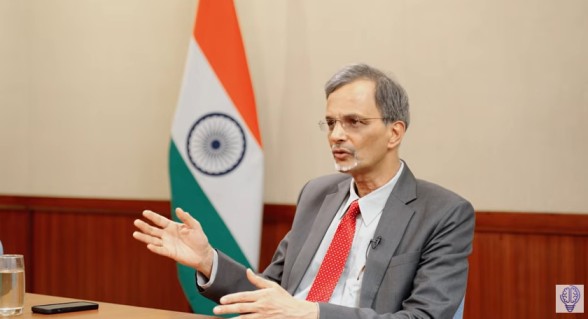
Editor’s Notes: In this insightful episode of the Indian Business Podcast, India’s Chief Economic Adviser (CEA) provides a deep dive into the nation’s financial landscape amidst a volatile global environment. The discussion covers a wide range of critical topics, from the factors influencing the Indian rupee’s value and the complexities of managing inflation to the strategic shift toward strengthening India’s manufacturing and agricultural sectors. By addressing the challenges of education, healthcare, and infrastructure, the CEA offers a nuanced perspective on what it will take for India to achieve its ambitious goal of becoming a $30 trillion economy by 2047. (Jan 30, 2026)
TRANSCRIPT:
India’s Economic Position in a Volatile Global Landscape
GANESHPRASAD SRIDHARAN: Hi sir, welcome to the Indian Business podcast. Sir, it is a pleasure to be sitting over here because now I’m going to get a lecture from the Chief Economic Advisor of India himself. So today I come to you as a curious lad because a lot is happening in the world. When I asked you, sir, how’s it going? You said, that’s a good question. Now I want to go a little deeper into it.
So today we are the fourth largest economy and we are growing at an unprecedented pace. Whereas on the other side, Trump is pushing the world at the brink of war. On one side we are aiming to be a $30 trillion economy by 2047, whereas on the other side, tariffs are crippling our exports. On one side, while we’re trying to uplift 500 million people out of poverty, on the other side the rupee’s depreciating because of which the common man feels like he’s not able to get the value for his money.
And you are the perfect vantage point because a lot is happening in the world right now and you are able to see all of it from the bird’s eye view today. China wants to take Taiwan, Russia wants Ukraine, US wants Greenland, and Iran is burning right now. So firstly sir, I just want to understand what is happening in this world and where are we heading.
DR. V. ANANTHA NAGESWARAN: First of all, thank you for having me on your show and I’m happy to be here with you. First thing, I don’t think the American president is taking the world to the brink of war. If anything, whatever happened in Davos last week, they pulled back and there is some kind of a framework, as they say on Greenland, etc. So that’s one point of view.
And the second thing I want to say is we are not yet the fourth largest economy. It will happen in the course of 2026-27. And a lot depends on how the Indian rupee behaves, and a lot depends on how the Japanese yen behaves against the dollar.
You also touched upon a lot of other issues, the domestic household and common man’s purchasing power. The rupee is weakening, by the way, as long as the common man is spending the rupee in India, the exchange rate does not matter to him directly. Of course, you might say it matters to him indirectly because whatever India imports, he will end up paying more, right? And then it will feed through into stuff that he buys or she buys.
So you might say, yes, a weaker rupee indirectly affects the common man’s or common woman’s purchasing power, but not really so, because in the current environment, inflation is well behaved. Indian domestic food prices, which is what matters to a lot of people because roughly 40% of what they spend every month goes into food. And luckily those prices are actually declining, not rising.
So in that sense, right now this is probably a great time to have a rupee weakness. Because if you have a rupee weakness when global prices of crude oil are rising, then what you say is correct, we’ll have a problem because then the crude oil will be very costly to buy and then you have to think about raising the price of petrol and diesel and the common person will be disappointed and unhappy about it.
So given the state of the world, if there is a time to have a weaker rupee, probably this is as good a time as any. So it doesn’t really affect their purchasing power at this point in a meaningful way. Although it does make us feel a little bit uncomfortable about the fact that when you read newspaper headlines every day, “rupee at historic low, rupee at historic low,” etc. It kind of makes you feel uncomfortable. Are we doing something wrong? Is a question that ordinary people will tend to ask.
But the truth is there are times when currencies don’t reflect what’s happening in the economy. Economy may be doing very well. The currency may be weakening as it is happening for India, or there could be a time temporarily when some economy, we think is not doing very well. Take Japan for example. It’s been having economic problem for the last 30 years. But the currency has become very strong, has become very weak. It goes through all these periods of weakness and strength and the economy has been weak.
This kind of divergence between the two will always happen. And right now we are at a phase where we are actually doing quite well in terms of economy, in terms of growth etc, but the currency is not reflecting it. I think it will be a temporary situation.
Understanding the Rupee’s Value Against the Dollar
GANESHPRASAD SRIDHARAN: Understood, sir. So now let me step back and talk to you about the rupee. Can you help a common man understand what exactly results into the appreciation or depreciation of the rupee against the dollar?
DR. V. ANANTHA NAGESWARAN: Ultimately a currency’s value depends on your country’s inflation. How much the prices are rising in your country versus how much the prices are rising in the other country, in this case the United States. Because you are comparing the rupee exchange rate against the dollar.
Okay, so effectively the rupee you can say early 90s or 80s, eight rupees to a dollar and today you’re looking at 92 or 91 point something to the dollar.
Then whichever country, whichever country has a higher inflation over time, that currency, that country’s currency will become weak. That’s a simple logic. So ultimately the answer to making your currency strong is to have low unstable inflation. But the good news is we are getting there. That is why I said eventually the fundamentals will assert themselves and the Indian rupee will reflect the good fundamentals of the Indian economy.
But the problem is currency markets can go here and there in the meantime. This is like as they say in cricket, form and class. Form can fluctuate but the class will eventually show through.
GANESHPRASAD SRIDHARAN: Right?
DR. V. ANANTHA NAGESWARAN: But given one or two matches you may do, for example, Surya Kumar Yadav scored a very nice 76 or 80 in the second T20 match against New Zealand. But this was his first score of about 50 after some 23 months or 73 matches or whatever. But you know that Surya Kumar Yadav has class. But there could be a period of one to two years when he doesn’t score a 50 for over 20 matches. So that is what we call by form and substance.
So currency markets can also make you behave like cricket players. A form can desert you, but the class will show eventually. Okay, so similarly, fundamentals will show eventually in the currency. And that fundamental, if at all, you want to forget everything else. The only fundamental that matters in the long run is your country’s inflation versus the other country’s inflation. The difference between the two will determine whether your currency becomes stronger or weaker over time.
And in the last 40 years or so, in general, India has had a higher inflation rate compared to America. Okay, roughly of the order of magnitude of 3% difference. Like for example, our inflation rate on average was 7%. America was 3%, ours is 6 to 7, theirs was 3 to 3 and a half percent. And if you look at it, the Indian rupee has weakened exactly on average by three to three and a half percent every year. That is the inflation difference.
So now over time, if the Indian inflation becomes 2% or 3% or 4% as it is happening right now, and their inflation remains the same 3, 2, then the gap between the two is only 1% or it may even become zero, then that sets the stage for your currency not to weaken going forward.
Controlling Inflation: The Challenge of Oil Prices
GANESHPRASAD SRIDHARAN: So when it comes to inflation, I am just curious to understand how many controllables do we have because we can’t control the price of oil? The price of oil keeps on fluctuating here and there. We don’t have access to oil. US is one of the largest producers of oil in the world and now they also have Venezuela. So if US has access to oil, they can control the price. They can control the price and they can buy oil at a cheaper rate.
Whereas for us we are dependent on oil countries. And if Russia wages the war against Ukraine, the oil prices spike and we become the victim of inflation. So how do we control inflation as a country when the oil price is not in our control?
DR. V. ANANTHA NAGESWARAN: Sir, look, it’s a good question, but I will take it in two parts. First, first of all, the oil price is not going up. You know, in spite of what happened in Venezuela, in spite of what’s been happening in Russia and Ukraine in the last three plus years, almost four years now. And also the potential for what might have happened in Iran, etc. The oil prices have remained very stable. That’s, I just want to put that fact out that oil prices have remained stable.
And they are, that is why I said at the, in response to your earlier question, if there is a time for the rupee to weaken, this is as good a time as any is what I said. Because precisely because oil prices have remained stable and low by historical comparison. In historical comparison.
Now your question is we don’t control the oil price and therefore how do we control the inflation day? Oil is only one component. I told you, food is 40%, oil. Food, health, education, lot of components go into your consumer price. You don’t consume oil every day. I mean, you take your own situation or any family situation. You have a monthly budget, you have an income. You don’t spend everything on oil.
I mean, you buy petrol and diesel for your vehicle. That probably constitutes 10% or 5% of your monthly budget. And by the way, as you become more and more prosperous and as your income goes up, you get promotion, you get a new job, you keep rising, then what happens is the amount of money you spend on food will more or less remain the same. Slightly, it may go up, you may eat some more rich food, you may eat out more or eat some rich calorie or protein rich foods or whatever. But in general, your food expenses will not rise proportionately.
As your income grows, then as a part of you, as a part of your salary, it will come down. Similarly with petrol and diesel, yes, you may drive a bit longer, you may go on a long ride, weekend ride with your family, but it’s not going to go up proportionately. So ultimately what you’re looking at is your entire consumption basket of which oil and food are a part. They’re not the big parts. So in other words, yes, oil prices will influence, but that is not the full story of your inflation versus other countries inflation.
Import Dependency and Commodity Prices
GANESHPRASAD SRIDHARAN: Okay, sir, how many other commodities do we have to take into consideration? Because every commodity that I can possibly think of which are critical to India are not in our control. For example, lithium comes from China. Cobalt comes from Congo, which again is controlled by China. Palm oil comes from Malaysia and Indonesia. Sunflower oil comes from Russia and Ukraine. So all these commodities that I can possibly think of, we’re importing them. And I’m just curious to understand which are the most important commodities that directly dictate inflation in the life of a common man. And how many do we actually control?
DR. V. ANANTHA NAGESWARAN: Whether you import them or produce them at home, that doesn’t directly matter to inflation. Because ultimately, even if you are producing at home, if international prices are rising, then your producers also will want to enjoy the same price. Okay, unless you ban exports. But then at some point if you ban them, then if they can’t export it and take advantage of global prices. What they will do, they will stop producing.
So whether you import or you produce at home beyond a certain point does not directly go to influence inflation for a long period. International prices will overall matter. But your point about importing many of the important things that matter to us, whether it is your lithium or palm oil or whatever, all that thing that you mentioned, that is where a different question arises given today’s geopolitical context.
That is if their supply becomes disrupted or is stopped by somebody deliberately or disruptions happen, you know, sea lanes are disrupted or blocked, etc. Then you will have a problem with your growth. So the fact that you are importing them doesn’t necessarily make it a problem for inflation. It’s about the prices that matters.
Education and Healthcare Challenges
GANESHPRASAD SRIDHARAN: I was thinking of the Indus Valley Report. Indus Valley report segregates India into three categories. India 1, India 2 and India 3. India 1 has a per capita GDP of $15,000. Whereas India 3 is the bottom billion which makes less than $1,000 per capita.
Now sir, at the bottom of the pyramid, if you look at health, education, food and fuel, the inequality is increasing to an extent where it is becoming more and more difficult for them to stay out of poverty. And I have a few pointers and you can just help me understand what you think about it.
Firstly, in 1962, the top 1% earned 12.6% of all income and the bottom 50% owned 21% of all income. But in 2022 the top 1% owned 22.6% of all income whereas the bottom 50% only earned 15% of the income.
Secondly, I have a helper at home. His name is Raju and he has three children. His wife was just about to undergo an operation and the only thing that he was scared of was taking debt. The operation was about to cost 30,000 rupees and he couldn’t afford it. So he was worried that he’ll have to take up debt and pay a 2% interest per month which will drag his family into poverty.
And then when I actually started speaking to all the house helps in my community, I realized that they all have the exact same problem. They are just one illness away from poverty. As far as education is concerned, they don’t have access to great education at all.
And I was looking at stats as well that the government spending in education is about 2.2 to 3% of our GDP. In health, we are spending 3% of our GDP and we are nowhere close to the developed nations when it comes to education and health both. In fact when it comes to the Ayushman Bharat card, several hospitals have rejected patients.
So going back to that inflation question, apart from fuel, there are two more vulnerabilities that we have. Education and health. Unless the family gets educated, the child will not have a better life as compared to the father. Just like you mentioned. Number two, if the father becomes ill and the family goes into poverty, there is no shot that the son will have to uplift the family out of poverty. Then how do we deal with this situation, sir?
The Power of Anecdotes vs. Statistics
DR. V. ANANTHA NAGESWARAN: In a country of 145 crore people, there will be always human and human situations that are heartrending or that are troubling. Such stories have a disproportionate influence on how we view a macro problem. That is why it’s often said that stories are much more powerful than statistics.
I remember Professor Daniel Kahneman who passed away recently said, “All it takes is one cockroach to spoil a bowl of cherries.” If the entire bowl could have 99 cherries and just one cockroach, you are not going to touch the remaining 99 cherries. Not think about the fact that there are 99 cherries that will go away.
So I think I’m just stating just to say that yes, anecdotes have such an important role to play in how we understand policy or macro narratives. But unfortunately we should also remember that doesn’t necessarily constitute the full picture. That’s why I said what matters, what your starting point was and where you are going.
And at any given point in time, in absolute terms, you might say they still have a long way to go. But it’s equally true that they have come a long way and you need to keep both those things in mind.
So first of all, let me talk about education and health. You said we are spending only 2% plus, but actually it’s not true. If you take education, which is a concurrent subject, if you look at both union and state governments, we are spending close to what developed countries are spending. If you take both union and states.
GANESHPRASAD SRIDHARAN: Put together as a percentage of GDP.
DR. V. ANANTHA NAGESWARAN: As a percentage of GDP, and we have covered it in the economic surveys and we will continue to cover them in the economic survey.
At the same time, as a developing country, which we spoke a lot about the changing global dynamics, we also need to provide for infrastructure. Ultimately, how do you serve the people? By giving them the opportunity to lift themselves up. And that opportunity comes if you give them connectivity, if you give them education, if you give them health, you must also give them connectivity, physical, digital, etcetera.
So you have to invest in infrastructure and you have to take care of your security environment also. Without that you cannot pursue economic activity. So naturally a government which we all call the state—state means not the state government in India, I’m saying the state means compared to the private sector.
Therefore a state has a lot of competing demands and responsibilities which it has to provide for from security to infrastructure to welfare, everything. And it’s a question of therefore not just looking at GDP as a percentage, you should also look at what is. Because if GDP rises much faster then the proportion of that will come down. But it’s equally important to see whether education health allocations have been going up year after year. That is one.
And the second thing you also need to look at is, is it always the case that outlays translate into outcomes? Outcomes matter, not just the outlay. Because a lot of times we have said, oh, this is inefficient, this is not being done well, if only the money was. So it’s important to make sure that you don’t measure a government’s commitment to these issues through the outlay. But what outcomes are they achieving?
Progress in Education Enrollment
And there, if you look at the issue on education, 20 years ago we were concerned about the fact that those who completed primary education were not moving into secondary. Those who moved into secondary were not moving into tertiary, which means college education, etcetera.
Today, if you look at majority of Indian youth are completing their 12 years of schooling. So enrollment is no longer the challenge, which was 20 years ago. So the quality and the nature of the problems in the country is also changing for the better.
And then now, therefore we are focused on outcomes. Are they learning at the right levels of numeracy and literacy skills for their level of education? Is a fifth standard student able to read third standard English and do third standard? So we are focusing on outcomes. So the quality and nature of the problem keeps shifting and that’s a sign of progress of the government’s efforts.
And you spoke about the fact that, yeah, some hospitals are denying the claims lodged under Ayushman Bharat. Some claims are getting delayed. Of course. In any system there will be such cases which we have to address. And that is why, you know, we have various redressal mechanisms and those mechanisms need to be available to the people, disclosed to the people and there should be channels wherein they can communicate all of this.
So I take that feedback very seriously, what you said, but it’s equally important. That’s why I said, I go back to what I told about the Kahneman’s example that we should not lose perspective that compared to where they were.
These schemes are, for example the out of pocket expenses that Indian households were spending on medicines have come down. We have done Aushadhi which gives them medicine, important medicines at affordable prices and we have Ayushman Bharat and we are providing now for 800 million people, you know, PDS food, X kilograms of rice and Y kilograms of wheat etcetera for free.
And we are also making sure that the right to education gives them education up to 12 years of schooling almost for free in government schools, etcetera. So at the same time the state also is making sure that the outcomes are being addressed.
So when you plug leakages and you are able—if somebody was spending one rupee on a problem but only 15 paise was going to the underlying beneficiary and I decide to do something to plug that leakage and today I spend 40 paise on the problem, not one rupee as somebody else was spending earlier. But out of that 40 paise I ensure that 35 paise or 36 paise goes to the beneficiary. I have actually increased the quantum of money going to the beneficiary by more than 2x.
The Employability Challenge
GANESHPRASAD SRIDHARAN: Got it, sir. I look deeper into the outcomes as well to understand because in the UK or the US everything is far more expensive as compared to India. So I thought maybe we are just building such an efficient system that we are able to educate people at scale and achieve the outcomes.
And the economic Survey says only 45.6% of the students actually got retained from Class 1 to Class 12. Which means more than 50% of the students actually dropped out before going to Class 12. And not just that, out of the ones who actually survived and graduated, the economic survey of 2024-25 says that only 51.25% of the graduates are considered employable.
DR. V. ANANTHA NAGESWARAN: That’s right.
GANESHPRASAD SRIDHARAN: So if 100 students are getting into Class 1 by Class 12, 50% of them have been eliminated. Out of the 50 who actually happen to graduate, 25 of them are not employable at all. So out of all, out of every set of hundred students who get into class one, only 25 of them are employable.
In fact, sir, again speaking of anecdotes, the UP state secretariat advertised for 368 peon posts. Total applications 2.3 million. So 6,250 people were competing for a single seat which included 255 PhD holders, 25,000 postgraduates and 1.5 lakh graduates.
DR. V. ANANTHA NAGESWARAN: Right.
GANESHPRASAD SRIDHARAN: So if we want to be a developed economy. And we have 75 out of 100 students either not graduating or unemployable. How do we achieve the status of Viksit Bharat?
DR. V. ANANTHA NAGESWARAN: So, for example, you gave the Statistic of Employability 51.25, 51.3% of those who graduate were employable. But the same test which was, which started in 2014, at that time, the people, the number of students who were graduating or about to graduate who are employable was 33% of those who took the test. Today, it is 51.3% within 11 years.
So from one in three to we have become one in two. And that is important. And you are comparing today’s developed countries, which have taken 200 to 250 years to get where they are, with a country which is only about 75 years old since its independence.
So that’s why I’m saying for every one of the world, British economists, who apparently was the PhD thesis advisor to Nobel laureate Mr. Amartya Sen, she, Ms. Joan Robinson, there is a quote attributed to her. We don’t know if it is true or not. She apparently has said, “Whatever you say about India, the opposite is equally true.”
GANESHPRASAD SRIDHARAN: Okay.
Two Sides of the Same Coin
DR. V. ANANTHA NAGESWARAN: So you can reel out 10 negative statistics that will be true. I can read out 10 positive statistics that will be true, and together they complete the full picture. Neither what you say nor what I say is a complete picture. That is why I said the task that remains to be done is true. It’s equally important to understand the task that we have completed or the path we have crossed. Our progress is equally important.
So yes, one in two have to be. Those who graduate have to be employed. Then you spoke about the fact that from school to college there is a dropout in terms of the ratios. Yes. The tertiary education enrollment, which is university education enrollment, was barely 6% at the turn of the millennium. Now it is 30%.
That’s why I said 20 years ago enrollment in secondary and high secondary schools was a problem. Now there’s not a problem anymore. So it is equally possible at any given situation in India to list out things that are still not working. Yes, but 20 years ago or 30 years ago, your parents or my parents would have had a problem getting a license to own a radio or a scooter or a booking a train ticket or being able to deposit money into your bank account or to withdraw money.
You do it. See, the human nature is as things. As things happen and meet your expectations, your aspirations keep rising. And you compare the achievement against your aspiration, not against the status quo. That was there before you got what you wanted. That becomes history. Now we tend to forget it. We move on. So I think it’s very important to retain that perspective, sir.
The Demographic Opportunity
GANESHPRASAD SRIDHARAN: I’ll tell you where this perspective is coming from. We are looking at a massive opportunity. Like today, we have the highest number of young people in the country. And there is this sense that we might actually miss this bus if we stick with this stat for too long. Because with each passing year, if we have more and more unemployable people in this country, will that not cause a crisis?
The Role of Chance and External Circumstances in National Progress
But I look at what we have been able to achieve in the last 75 years compared to how long it took for developed countries in a completely different situation. Now, ultimately, whether we make it or not make it is something neither you nor I have control over. But what you and I is, what is it that we do today as a government, as a people, as a private sector. So that is what we should focus on.
I mean, it may sound like Lord Krishna’s philosophy, but that exactly what it is you focus on, what is it that you can do? And in fact, by the very nature of doing so, you may even change the probability of the outcomes happening. Okay, so we need to focus on all the priorities and all the action that we need to take. And sometimes it requires not only that kind of a perseverance and focus. You may also have to benefit from external circumstances turning in your favor. You need luck.
I mean, for example, did we really. Yes, we did a few things right, but we didn’t really expect sitting in 1980 that information technology sector will be our most important driver of growth over the following 30 years. To some extent, we planned it. Yes. What was done in the 1950s and 60s in creating a bunch of educational institutions and public sector engineering companies in Bangalore contributed, but when they were situated there, there was no anticipation that that is what it would lead to some 40 years down the road.
So both in public policy and in individual lives, there is also this matter of chance, and there is a matter of external circumstances coming together in your favor. For example, when President Lyndon Johnson had so much of issues sending wheat imports to India, that became the father of your green revolution. That was a catalyst. Okay, so there are a lot of things that may be happening today which you may see as a headwind may actually end up becoming the impetus for you to make the progress that you are looking for. So we need to have these perspectives.
Education: A Collective Responsibility
GANESHPRASAD SRIDHARAN: So speaking of call to action. Like you said, we need to think about what should the government, the private sector and we as citizens have to do so that we make progress. So when it comes to education, sir, how do we participate together and ensure that every child in India gets world class education?
DR. V. ANANTHA NAGESWARAN: No, first of all, I think the state is doing what it is doing. The national education policy and then the speed with which we are now revising the curriculums to include even vocational skills, and making sure that we are also introducing and blending technology to make sure that there is access to education even in areas where physical teachers cannot be presented. Those are all the initiatives that the states are.
And mind you, again I tell you, education is a concurrent subject, okay? It includes both union and state governments and even local governments in terms of delivery. Now what is it that academic institutions can do, whether it is secondary school or high secondary school. They on their part need to make sure that we pay our teachers well and also ensure that the teachers themselves are kept abreast of all the new developments, new technology, new pedagogy that is their part, the school managements and more importantly, citizens and parents.
Unless they invest in their own children’s education, things will not happen, right? You have to show interest, you have to sit with them, you have to do your homework, make sure they do the homework. And more importantly, screen time. Today much of our youngsters are. The amount of time they spend on screens is the biggest challenge to educational outcomes. Forget about the amount of money allotted. Okay, so. And do we have the ability to read a book or do we only read 150 characters? What are we doing about it?
So each one of us has to, therefore, that’s why I said each one of us have to look in terms of what is our responsibility and what is our role in this. No society that became progress, that became developed in today’s world did so purely or only on account of what their governments did. Their private sector did their part, their citizens did their part. And that is the question that we all need to ask ourselves.
Learning from Global Examples: The East Asian Model
GANESHPRASAD SRIDHARAN: So can you give me an example of a country? Because you mentioned something very important. You said that citizens should not just hope for the system to come and fix their problem. They have to actively work towards the solution along with the system, so that collectively they can solve the problem for themselves as well as the nation. Can you give me an example of a nation that has done that so that citizens can actually relate to it and then aspire to, then work with the system to fit.
DR. V. ANANTHA NAGESWARAN: For example, you take East Asian countries like Korea, Japan. It is not just the government, it is the private sector that did their part in building the industrial base that they had. Yes, government. But more importantly, governments did not simply provide support. They also help people help their enterprises to performance standards.
So more than citizens, I can think of of examples where post World War II America, or post World War II Germany, and more recently 60s to 90s East Asian, Northeast Asian countries like Korea, Taiwan, and to some extent in Southeast Asia, Singapore. Where the government and the private sector combined in terms of advancing the national priorities.
More immediate example is what happened at a macro level is in Northeast Asia, including Japan post World War II. That is where I think private sector said, okay, we will need these things from you, but in return, we will deliver these things. We will become globally competitive and you can hold us accountable, accountable if we don’t deliver. So it’s about asking for certain privileges, but promising performance in return.
So the mindset of each one, therefore each player, and I’m not excluding the government, government, governments, bureaucracy, private sector, as in the business sector, and citizens, each one of us simply have to ask ourselves, am I doing what is it that is within my remit and my power to be able to do so? Then only you actually, you can even ask with clarity and confidence the other side to deliver. So it is a compact, we call it, not a contract. It’s a compact. So you need a compact between all these stakeholders. And the most approximate example, as I told you, is the case of Northeast Asia.
GANESHPRASAD SRIDHARAN: So in Japan, I remember because they were so dependent on energy, they actually launched something called the Cool Biz Campaign, where citizens were actually asked to wear summer clothes to office so that they can actually increase the temperature of the AC.
DR. V. ANANTHA NAGESWARAN: That’s right.
GANESHPRASAD SRIDHARAN: And the citizens participated together. And then they launched something called the Super Cool Biz Campaign to save even more electricity. And at least the case study says that even today, Japanese citizens are extremely careful about using electricity because they understand that the nation is dependent on this. And if we consume too much of it, energy could be the reason why Japan could be crippled, which is such a beautiful thing when that is spread all across the nation where the citizens consider it to be their own responsibility to work with the government and don’t see government as either an enemy or God to be able to come and change their circumstances.
DR. V. ANANTHA NAGESWARAN: I think, first of all, thank you for that. It’s a very, very, very fascinating example that you gave but again, in our own country there are examples, you know, how our citizens contributed during the 1962 China War, and for example, more recently, when the honorable Prime Minister asked a lot of people to give up their LPG subsidy, how many people came forward to give it up.
The bank for International Settlements says that what India did in eight years in achieving financial inclusion by normal standards should have taken 47 years. Yeah, it’s recorded by the bank for International Settlement in 2019 that India’s progress in moving X number of people to financial inclusion from a small 20% to 80% within the space of eight years is something that under normal circumstances, based on previous experience of other countries and for a country of this per capita income and technological development, should have taken 47 years.
And then look at the Aadhaar enrollment itself, which we did. That’s why I said sometimes we tend to take our achievements for granted because you are in it. You don’t have the outsider’s perspective on these things. We are part of it.
Manufacturing vs. Agriculture: A False Choice
GANESHPRASAD SRIDHARAN: Understood, sir. Very beautifully said, sir. Now I want to throw light on perhaps the most important thing that India is looking forward to right now, which is manufacturing. First, sir, just to set context, could you help us understand between agriculture and manufacturing, which sector is better? And why does India. Why is India so bullish about manufacturing and not about agriculture?
DR. V. ANANTHA NAGESWARAN: No, it’s like my answer has to start with a very cliched expression. You are asking me between right eye and left eye. Both are important. So I. So absolutely, agriculture is very important. And because not only from a essential perspective, you still have 1.45 billion or 145 crore people to feed. It also becomes a matter of strategic leverage in today’s world when climate change may affect some landlocked countries or other countries much more, and we have the land and the technology and the resources to produce more food, becomes an important commodity and takes on meaning far beyond just meeting the needs of people.
In 2324 economic survey, which came out on July 24th in chapter five, which is the medium term outlook, we have dedicated a lot of space to agriculture. And even now I believe whatever we are able to achieve outside of the cereals, rice and wheat, if we are able to replicate it in rice and wheat, we will be producing a lot more. And look at agricultural exports. We were barely exporting some 17 or 20 billion in the 2010-20s and then we hit $50 billion of exports. But in the last three, four years we have sort of remained between 50 and $52 billion, there is huge potential. So agriculture is something that you produce.
In fact, if you ask me, between services and agriculture and manufacturing, we should be concentrating a lot more on these two.
GANESHPRASAD SRIDHARAN: Agriculture and manufacturing, yes, services.
DR. V. ANANTHA NAGESWARAN: We have reached a certain critical takeoff stage. The private sector can take care of itself. It is strong, it can run by itself. And these two can still do with a lot of smart state support. Manufacturing again, no country has become rich, powerful and stable without making things.
GANESHPRASAD SRIDHARAN: Why? Sir, that’s the reality.
DR. V. ANANTHA NAGESWARAN: You have to make things. You can’t only make things out of paper. Finance is only paper. It’s like money. You know, last 40 years globally became money over matter. Matter was given to somebody else to produce. Then I think I make money. So money over matter. Now the next 30 years it will be matter over money.
Matter Over Money: The Future of Global Economics
GANESHPRASAD SRIDHARAN: Can you explain this, sir?
DR. V. ANANTHA NAGESWARAN: Basically what I’m saying is what did the best do? Let somebody else make things. I’ll import it and I will concentrate on financial services. But now we are realizing that you need stuff. You need a small magnet for your cars to be produced and driven. And without making pharmaceutical ingredients or what I call early. There’s an acronym for it in pharma. So these kinds of base material, you should be able to make paracetamol on your own.
So we are realizing that as the world changes, then you realize I have to make certain things myself. So making stuff matters. Then you look at, you also spoke, we discussed currency a lot. Look at countries which have a great track record for having strong and stable currencies. What will come to your mind? Let me now turn the tables. I’ll be the person to ask the question.
GANESHPRASAD SRIDHARAN: Sir, the US Dollar, when you talk.
DR. V. ANANTHA NAGESWARAN: Of strong currencies, you think of Swiss franc, you talk of the old German mark, Japanese yen, Singapore dollar. They all are good at making stuff. Switzerland, you think of chocolates, cheese, watches, precision equipment, chemicals, Pharma and the old days. You are right. US and UK not now. They also are making stuff. If you know that until end of 60s US and UK had a trade surplus, okay, so they made stuff.
So only when you make stuff you will be able to export. And only when you export, you will be able to import. So we as I. And again I told you, you are a developing country and you will be importing a lot. That’s by definition. And we have a large consumption base. And as people income rises, they tend to consume more. You will import more. You have to pay for it. To pay for it, you have to either export, otherwise you have to borrow foreign money. So it’s far better to export than to borrow foreign money. And for that you should produce.
So import substitution or strategic resilience and export and currency strength, all are interrelated. Okay? So that is why making stuff matters.
The Cost of Regulation and Ease of Doing Business
GANESHPRASAD SRIDHARAN: So now I want to go to the second layer of questions. You speak of something called cost of regulation, sir. And you know, here’s where some of our friends, they happen to be entrepreneurs and one of our friends actually released a watch and his first preference for manufacturing the watch was China. Because in India it was very difficult to get hold of manufacturers with that kind of skill, with that kind of mold and produce it at that scale.
So he went, he chose China and the other friend of mine, he made a ring and he also had to go to China because they didn’t have the manufacturing capabilities here in India. And when we spoke to a few manufacturers, they often mentioned regulation is a big issue, licenses are a big issue. Although it has gotten far better as compared to the license Raj, it is still very difficult to do business in India. So can you throw some light on what do they exactly mean in simple words and how are we trying to fix it?
DR. V. ANANTHA NAGESWARAN: So I think by and large that’s the one area where we should do a lot more. And we are doing it by the way. And as you put it, we have come a long way in our ease of doing business. But again, there is a lot that remains to be done and both are equally true. We have done a lot and there’s a lot that remains to be done. Both are true.
We arrived at the situation historically because at that time the private sector didn’t have capabilities and we didn’t have resources. So the state felt I should decide where resources go to because it’s all shortage. So it comes from that post-independence mindset because colonial regime had basically taken all your resources away. And after 200, 250 years of colonial occupation, we were no longer the kind of economy we were by 1820.
So you start with a situation where you were short on resources. Then somebody decides I have to allocate how the resources are allocated and therefore I need to have a control over which sectors produce what, etc. And then you created, if you have to produce, I must approve it, etc. That’s how your licensing regime came up. Fine. So it had a certain logic to it at a certain point in time, but those conditions have changed and we are delicensing.
That is why 1991 was an important watershed moment. Although it did start when Mrs. Indira Gandhi returned to power in 1980s itself. And then institutions like World Bank etc got into the act and produced the ease of doing business for us to focus on specific metrics. So the thing is I think if it’s all about trust also, it’s all about trusting the citizens, the businesses and so on to do the right thing.
So it takes two to tango. Similarly, it takes two people to have a trustful relationship. One I have to trust and the other person has to reciprocate the trust. And there I can tell you that the Indian private sector also has a lot of catching up to do. So when the state trusts, that trust has to be repaid or vindicated. If the private sector takes advantage of it rather than reciprocating that trust then the state will end up going back to what it knows best, which is to control, which is to impose inspection, compliances and licensing.
So that I think if we want more and more delicensing and more simplification, consolidation or elimination of processes, the private sector has to respond in good faith. We are realizing that giving regulations have basically ended up keeping our small and medium enterprises small. They have not, we have not removed the fear of growth.
GANESHPRASAD SRIDHARAN: Can you give me an example, sir?
DR. V. ANANTHA NAGESWARAN: No, I mean everything that we do in terms of, if I say if you are below a particular size of turnover or asset then you are eligible for these things, then what happens? If I am saying that below five crore turnover you get interest concessions, you get some preferences in government procurement, then you don’t have to pay this. Your electricity tariff will be free for X number of units per month. But if you cross that then I decide as a business person, I decide maybe I should not grow. If I grow I will lose all this.
Which is a paradoxical thinking. The idea is if you grow, your growth should be big enough to be able to take care of the extra cost that you will incur. But then our mindset that immediately thinks I will lose these concessions. That is why I said it takes two to tango. So I think we also should need to get rid of the fear of growth sometimes if we think we are content with this level of activity.
At my level as an entrepreneur I am happy to do with only 50 lakh turnover per annum and I am happy with my life then of course nobody can question them. But it does have its implications for society. So the state therefore has to make it easier for people to pursue economic activity legitimately. And if you are doing rules and regulations in a different era, you have to constantly check whether they are still valid. And three, you have to make sure that we remove the fear of growth.
Because one important thing in public policy is that there is always a law of unintended consequences. Because one iron law of public policy is the road to hell is paved with good intentions. We start with good intentions, but given how people respond, it can actually achieve something very different from what you anticipated. So we have to be very mindful of that in terms of how we keep a leash on economic activity and we are moving in the right direction.
And every single anecdotal example that comes on social media or directly to us, we take it very seriously. We are responsible, responding, especially in the Ministry of Finance. If you look at the kind of changes that have been happening in the last several years in terms of faceless assessment, in terms of being able to change, go back and change your tax return for the last four years, etc, so all of this is in the direction of putting more trust and faith on the citizens, on the businesses.
Understanding Foreign Direct Investment
GANESHPRASAD SRIDHARAN: Sir, why is foreign direct investment so important for a country?
DR. V. ANANTHA NAGESWARAN: As a growing country, as a low income country, becoming lower middle income and middle income and so on, consumption grows, incomes grow, imports will grow. So I said either you pay for it through higher exports or you have to pay for it through importing capital. And with capital comes technology. And with external exposure comes competition. And therefore you produce good quality stuff which is also good for your own people.
So FDI matters for capital, FDI matters for technology, and FDI matters for paying for your imports. So that is why for any developing country, FDI does matter. It also gives your own businesses an opportunity and a responsibility to benchmark themselves. Because in India, I know many times we say this is export quality, but why should it be different for domestic quality? It should be the same. So you should be able to produce the same for both. So that kind of mindset shift also will happen if you’re exposed to foreign capital.
GANESHPRASAD SRIDHARAN: Okay, understood. So what is the difference between FDI and FPI?
DR. V. ANANTHA NAGESWARAN: FDI comes into real direct businesses. It is giving you putting plant and machinery and equipment and technology on the ground and you are producing stuff. And usually it is for a much longer horizon. Portfolio investors can invest in stocks. They are not directly investing in the businesses, somebody has already invested. You just acquire these securities in the financial market, whether it’s a stock or a bond, and that’s FPI. And you can also be extremely short term. You can come in for one month, two months, three months, you can go back, etc. And so on.
So that is more a long term commitment that brings with it technology skills, know how, etc. And longer duration. This one is relatively shorter duration. This is secondary. That is primary. These are all the main differences.
GANESHPRASAD SRIDHARAN: And so if FDI is decreasing in the country or if foreign direct investment is going out of the country, is that a good thing or a bad thing?
DR. V. ANANTHA NAGESWARAN: No. First of all, it’s not going out, it’s not decreasing. If you look at the data, this is where I think, as Mark Twain said, there are three kinds of lies: lies, damn lies and statistics. So I think we shouldn’t be focusing on some headlines and then say FDI is going out. No, FDI at the gross level is coming in and it’s increasing compared to, for example in 2025-26 you have data until about November and compared to the April to November data of 2024-25, it has gone up by 10% or 11%.
The money coming in equally what happens is two things are happening. Because past investments have become very profitable. In India, people who put money in the 1960s, 70s and 80s now feel they can take some profits. And remember the global context. Everybody now wants to produce matter over money. So governments around the world, Europe, North America, etc. say come back and invest in our own country. I need to make stuff. Earlier I used to outsource it. I need to make stuff. So they are making it more difficult also to be located outside. They say, come back, come back and produce here. I’ll give you incentives.
And then the other thing that happened between 2010 and 2020, interest rates were zero in dollar in euro. So you could borrow and invest everywhere. Now the interest rates have become 4%, 5% there. So some businessmen think it’s okay to keep my money there. I get some enough interest rates there. Why put money there? And the world has become more dangerous and difficult. So a lot of things are playing their part in making people take their money out. But equally money is coming in.
The other dimension that is contributing to this feeling that FDI is not coming in is Indian business also are forced to respond to global circumstances, right? If you want to sell in some market, those countries are saying, you must produce in my country, I’m not going to let you sell from your country. Come to my country, establish a factory or create jobs or whatever. So all these geopolitical dimensions are changing. That is why in these circumstances attracting FDI becomes more difficult.
But we have the fundamentals to be able to attract that money. Post Covid, no other country has grown at this rate as we have grown. So in that sense we have the ingredients, we are deregulating, we are making it easier to do business. So we have all the building blocks in place. If some extent the global circumstances, geopolitical circumstances shift in our favor, then you will see that on a net basis also, not just the inflow basis, on a net basis also you will see the FDI numbers increase.
GANESHPRASAD SRIDHARAN: Understood. Sir, my question was actually coming from the stat that you just mentioned. In fact, the CARE report says that the net foreign direct investment has crashed from $44 billion in FY22 to $0.5 billion in the first seven months of FY25 last year.
DR. V. ANANTHA NAGESWARAN: FY25. Now we are in FY26.
GANESHPRASAD SRIDHARAN: Yeah. So you’re saying that people who invested their money in the 1960s and 70s are now taking out the money because of global circumstances.
DR. V. ANANTHA NAGESWARAN: That’s the thing. No, see, when you look at a data for one particular year, you are looking at the inflows coming in that year. You’re looking and that see what comes in pertains to that year. But important to remember that what goes out is not of that year but something that might have happened 50 years earlier, 40 years earlier. I have made a killing on my investment in India. And now my circumstances are becoming difficult there. And my government wants me to bring in money there. So let me take the profits.
In fact, the same CARE study shows that in terms of return on FDI, India is one of the top countries that gave a very high return on FDI. So that is why gross inflows are still not tapering off. See, I will be very concerned if people are not putting money in. People are putting money. It is just that earlier investments are being also now withdrawn. And Indian businesses also are, we call it ODI. FDI is what comes in. ODI is overseas direct investment by Indian businesses that is also increasing because of again change geopolitical circumstances.
So all these factors are contributing. And I mentioned about interest rates, I mentioned about other factors which is what is now making the net figure look smaller.
GANESHPRASAD SRIDHARAN: So right now, considering the global circumstances, are we in a sweet spot or a bitter spot?
India’s Economic Sweet Spot: Growth, Fiscal Discipline, and Infrastructure
DR. V. ANANTHA NAGESWARAN: I would err more on the side of saying we are in a sweet spot. Between the two, I would lean more towards the sweet spot. Look at the data. Again, you need not take my word for it. Post COVID sustained growth of more around 7% or more. We are the only country to have achieved that, number one.
Number two, look at fiscal deficit in 2020-21 during COVID. 9.2% was our budget deficit, Union government. You add the state, it became 13.2%. Today, five years later, this combined deficit of 13.2 has become 7.2%. Union government, our finance minister said 9.2% of GDP. Investors are worried. I will reduce it by half in five years. And today by end of March 2026 we would have achieved 4.4%, which is more than half of what the deduction is.
Which is why in the course of 2025-26, three credit rating agencies in the world gave us upgrades. S&P in US, R&I in Japan and one more, Morningstar DBRS in the US. All these three credit rating agencies gave us an upgrade because we delivered on what we said in 2021. That is the third important thing.
And the fourth important thing is we have brought down this fiscal deficit even as we increased our investment in infrastructure. We spoke about number of airports. You can talk about the length of highways we have built. The metro rail network having gone from very nothing to more than 2,000 km countrywide network length. You can name any number of statistics.
And look at the turnaround time we have in Indian ports, which used to be very high. Now we are mostly in East Asian standards in terms of turnaround time. So all these things, we have increased public investment and at the same time brought down the fiscal deficit and our inflation rate.
In 2022-23, when every country in the world saw inflation go up to double digits, even European countries, US, etc., our peak was between 7 and 8%. So that just goes back to our earlier discussion about currencies and inflation. We are moving from a high inflation era to a low inflation era, which means a combination of investments, infrastructure, digital infrastructure, which we didn’t talk about much, and continued sustained growth and a fiscal deficit that is becoming lower and lower gives us the stable platform to sustain this growth rate.
So what India in the last 65-70 years couldn’t achieve was sustained growth with moderate inflation. And that is the sweet spot. And that is what we are in. Of course, geopolitics has changed. It has made it more challenging for us. Certain ingredients depend on others. We need to find ways to ensure them. So challenges will never be short for a country of our aspirations and given the changed geopolitical circumstances. But all things considered, yes, we are in a sweet spot.
IPOs: Exit Vehicles vs. Investment Instruments
GANESHPRASAD SRIDHARAN: Sir, you also mentioned something about IPOs being exit vehicles and not as investment instruments. What do you exactly mean by that?
DR. V. ANANTHA NAGESWARAN: In general, you use capital markets to raise more money to scale. So the idea of a capital market exists is to pool the savings of large number of people and those who want to put that capital to use, come there and float an IPO, raise money and put up a new plant or expand their capacity, etc.
But exit is also important. That is, if I’m a private equity or a venture capital investor who took the risk in early days and now the company has grown and now it raises money, it should raise money to grow and some portion of it I should be able to use to take my profit also so that I can put that money elsewhere in a new business. It’s fine, it’s all about the proportions.
But if a startup or a young company comes to the capital market, raises money only to give an exit to investors, early investors, that is not the most ideal situation from the country’s perspective. That is what I meant.
GANESHPRASAD SRIDHARAN: Are we doing something to change that?
DR. V. ANANTHA NAGESWARAN: Sir, this is where I think I told you earlier. There are only certain things that government should be able to do. Sometimes more things that the government tries to fix, it will actually become problematic. It is that certain things are responsibility of the individuals or the system or the private sector. Each one has to have an awareness of their roles and responsibilities and their horizon.
So if people are going to be somewhat short term in nature, then there is only that much policy can do. So the answer is not so much in immediately trying to regulate it. Then again you will go back and say government is over regulating. So I think you can’t win either way.
Healthcare and Insurance: The Economic Growth Solution
GANESHPRASAD SRIDHARAN: Sir, I was actually speaking to a friend of mine. He runs this company called Ditto. It is by far one of the most trusted advisors when it comes to insurance in India. And he spoke to me about the dilemma that India is facing right now. India wants to give insurance to everyone and it wants to ensure that we give everything from medicines to paying the cost of hospitalization, to blood tests to everything.
But right now, in the Ayushman Bharat scheme, we are able to cover only for hospitalization. And that’s primarily because of the number of people that we have, the sheer size of the population that we have. So now what is the solution? Sir, if we don’t solve for that, like I said before, a major chunk of a population will be one illness away from poverty. But if we try and fix that and we give insurance of that quality to everyone, which we very well intend to, then we will have to spend a lot of money. So how do we fix this problem?
DR. V. ANANTHA NAGESWARAN: So I think that sometimes the answer is not directly related to the health alone. Ultimately, the answer to many of these issues is putting more money in the hands of people, right? Which is where investment, employment and income growth comes into play. So the answer is not direct. The answer is indirect. So economic, that is why it is important.
That is why Professor, I think, if not mistaken, Benjamin Friedman, I think. I mean, I don’t remember the name. Anyway, the book is called “Moral Consequences of Economic Growth,” the book’s title. So economic growth is a moral objective in and of itself precisely because it answers questions such as this.
You said correctly that one illness can make a difference between below poverty and above poverty, which is why the government said we will cover major illnesses. So yes, policy has trade-offs. That is the first thing you learn as a student of economics. Everything you do has a trade-off. If I put more money in this area, then I have less money in some other areas equally critical, then the same public would say, why didn’t you take care of security? Which is more important, right?
So I mean, there are no end to all these conversations. So a policymaker has an unenviable task of choosing between all equally competing, all equally valid demands on their resources. So that is why we said, okay, we’ll cover all the major expenses that can tilt you from being above poverty line to below poverty line. And then you’re not asking the question, you still are unable to pay for all the medicines, etc.
So the ultimate answer to many of these issues is putting more disposable income in the hands of people. So if the state does what it does in terms of deregulating and enabling economic activity, investments, employment and income generation, then these questions will not necessarily arise. So that is the final answer.
GANESHPRASAD SRIDHARAN: Which means we need to get in more FDI, focus on manufacturing, domestic investment.
DR. V. ANANTHA NAGESWARAN: As you said, as you correctly asked, agriculture, productivity. So all these things and we should do. That’s why, you know, this country has this challenge which other countries did not face, is that we are trying to do all of this in a geopolitical environment that is becoming much, much more tougher.
And we are doing it when, you know, climate change is a factor. Other countries when they were growing, didn’t face this problem and you have a different difficult security environment and you are trying to lift hundreds of millions of people out of poverty and we have to have resources to take care of all this. And you also need to deregulate.
And so therefore the kind of transition that India has been able to achieve within a democratic framework is actually unprecedented and unparalleled. So that is why the Indian journey is the most exciting one.
Land Acquisition: A Key Challenge for Infrastructure Development
GANESHPRASAD SRIDHARAN: Sir, when you speak about infrastructure development, the one obstacle that everybody speaks about is land acquisition. We want to build roads faster, but when we go to acquire land, the cost of land goes up. People demand more money as a result. Either we are not able to build that road or it gets delayed to a large extent.
DR. V. ANANTHA NAGESWARAN: Land is a state subject and states are doing it. And yes, it is an important area. I agree it is a fixed cost and it is a scarce resource in India given the population. The good news is that many states have now started looking at it very seriously.
And I think if I remember correctly, Andhra Pradesh actually made land use conversion almost automatically in many areas. Instead of having to go to the government for approval, it’s almost deemed approval. They announced it a couple of months ago or three months ago. You should check it out. And I’m sure that will sort of create a lot of follow-on emulation by other states as well. So yes, I agree with you that land acquisition and land use conversion are two important areas that will contribute to industrialization and manufacturing growth.
GANESHPRASAD SRIDHARAN: So is there a particular country that has solved this problem?
DR. V. ANANTHA NAGESWARAN: It’s difficult to go back and see, because many of them were growing in a different era and other countries have plenty of land in the west and far lower population. So in that sense it is not easily comparable. And yes, developing countries in general have this problem because they want to basically ensure that the scarce resource is properly distributed. And that is what gives rise to, as I said earlier, a different context, oversight and controls, etc.
But I think the good news is that the states are realizing that it is a binding constraint and they need to address it.
The Limitless Possibilities Ahead for India
GANESHPRASAD SRIDHARAN: Sir, my last question to you is in the next five to 10 years, what are the three things that we as citizens can look forward to which will be absolutely exciting and life changing for India?
DR. V. ANANTHA NAGESWARAN: The problem is in reducing it to three things. Because as a low middle income country, everything that is happening in India is exciting. Whether it is what we are doing on the semiconductor side and the kind of improvements we are seeing in applying AI to solving India’s problems in health and education or what we are doing with respect to even, we discussed agriculture and being able to produce capital goods that we need.
So I think the possibilities are still limitless for a country. Or you take medical tourism for example. So in many of these areas, India actually has the potential to become the trendsetter. So reducing the three most exciting things to say space, semiconductors, artificial intelligence or this is actually limiting our imagination.
I think anything and almost any sector, whether it is agriculture or manufacturing or services, India offers plenty of scope. That is why either it is for an investor or for students or for policy, you know, research, college, etc. There is no place more exciting on earth than India.
GANESHPRASAD SRIDHARAN: Got it sir. Thank you so much. This was amazing. Thank you so much for your time. You were wonderful in terms of explaining things. Sir, thank you so much.
DR. V. ANANTHA NAGESWARAN: Most welcome.
Related Posts
- Michael Saylor Responds to Bitcoin Critics @ Coin Stories (Transcript)
- Why Multilingual Human Support Still Matters in Digital Banking
- To Buy Or Not To Buy Cryptocurrency? That’s The Question On Everyone’s Mind
- Ajay Banga on India, Migration and a Youth Jobs Time Bomb (Transcript)
- A Global Monetary Crisis Is Coming & AI Could Make It Worse – James Rickards (Transcript)