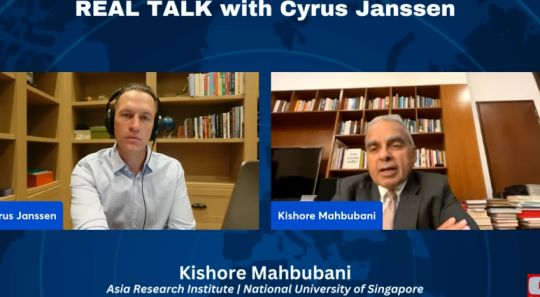
Editor’s Notes: The balance of global power is shifting, and Singapore’s top diplomat Kishore Mahbubani explains why the West can no longer dominate a world increasingly shaped by China and India. In this episode, Cyrus Janssen and Mahbubani break down how Trump’s tariff wars backfired, why middle powers are “increasing their options,” and what Davos 2026 revealed about the new global order. You’ll learn why China’s rise, a resilient global trading system, and deals like India–EU trade are redefining leadership in the 21st century. Stay tuned to hear his surprising take on the future of US–China relations, Taiwan, and whether the world will split into rival spheres of influence—or find a way to coexist. (Jan 30, 2026)
TRANSCRIPT:
Welcome and Introduction
CYRUS JANSSEN: Well, everyone, I’m very honored to welcome into the studio Professor Kishore Mahbubani, established diplomat from the country of Singapore and the former president of the United Nations Security Council. Professor, welcome back to the show.
KISHORE MAHBUBANI: My pleasure.
Davos 2026 and the Shifting Global Order
CYRUS JANSSEN: Professor Mahbubani, we saw last week a very interesting development in Davos 2026. We saw, you know, going into that event, a lot of momentum with Donald Trump. The talk was Greenland, it was Europe. But I think it was Canadian Prime Minister Mark Carney who really gave a speech that stirred the entire world in a different direction and really started to set up what looks like is becoming a very big fragmentation in the West.
The middle powers, as he said, are going to have to adapt or else they’re going to be on the menu. I’d like to get your thoughts on everything that happened last week in Davos and where we are in terms of geopolitics in the world right now.
KISHORE MAHBUBANI: Well, for a start, Cyrus, thank you very much for having me back. Pleasure to be on your show. But you’re absolutely right. If there was one speech from Davos that was heard around the world, it was, of course, a speech by Prime Minister Carney. And he’s absolutely right when he said that there has been a rupture, because clearly, when the world’s leading trading power for a long time actually is now the number two trading power in the United States started raising tariffs on over 100 countries. Of course, it was going to be disruptive, and there was a rupture.
But actually, the big story of 2025 is that there were two words that captured it. The first was rupture, and the second was resilience. What was remarkable about 2025 was that the global trading system should have collapsed when the United States increased tariffs on over 100 countries. You know, the United States is still the number one economic power in the world, and the global economy, therefore, should have slowed down, global trade should have gone down.
But amazingly, the global economy kept growing, and equally importantly, global trade kept growing. And it showed that, you know, in the UN there are 193 countries. One, the United States, decided to increase its tariffs. 192 countries decided not to increase their tariffs.
CYRUS JANSSEN: Right.
KISHORE MAHBUBANI: And this is very unusual because until now, the United States has in many ways provided leadership for the global order. And whatever the United States did, people say, “Hey, this must be the right thing. Follow.” But not one country followed the United States. Instead, by the way, amazingly, countries decided, “Hey, no, no, we still believe in free trade.” And they began to, in fact, sign more free trade agreements to in some ways compensate for the loss of trade with the United States.
And as you know, we are speaking on the 27th of January. Just today, it was announced that India and the European Union, which by the way, had been at loggerheads for much of 2025 because the European Union kept criticizing India for buying Russian oil and so on, so forth. They were not bosom buddies. But today they claimed they had signed the mother of all trade deals, which is amazing because, you know, India is not known to be inclined to sign many free trade deals. It’s sort of allergic to free trade deals.
But the fact that India decided to do so was clearly a reaction to the tariffs that had been imposed on India. And India said, “Okay, I will now increase my options.” So countries around the world are all increasing their options, are all increasing the trade flows with each other. And so in that sense, in some ways, the rupture that was created may actually result in greater resilience in the world.
New Trade Deals and Global Realignment
CYRUS JANSSEN: I really like that. And you know, just to add to your point, professor, we also saw last week a new trade deal between the European Union and four very important countries in South America, including Brazil, Argentina, I think it’s Uruguay and Paraguay, which, you know, in total I think is around 700 million would be involved in that trade deal. So it’s one of the largest ones in history.
And I think that’s the theme that we’re seeing right now. A lot of countries are looking for other options, certainly in the times of global instability. And you know, Professor, I’ve got a question here. You often talk about the global majority, you know, or what we call the Global South. And you know, we kind of versus the Western world. We’re looking at BRICS and how it’s expanding the global south diplomacy, these new trade deals, the declining Western world, you know, the morality in the West.
Do you think that the West is really lost right now? I mean, is there a chance for them to reverse this and be able to be the leader again? Or have times changed and we are just looking at a new world?
All Civilizations Are Equal
KISHORE MAHBUBANI: Well, you know, I just published an article in the Fletcher Forum, which is published by the Fletcher School of Tufts University in Boston.
And the title of the article is “All Civilizations are Equal.” And the reason why I published that article is that I wanted to tell the 12% of the world’s population, 12% of the world’s population that lives in the West: Please get off your moral high horse and start treating other civilizations as your peers. Please don’t look down on them anymore.
That era of Western domination of world history is over. The West can no longer dictate terms to the rest of the world. And if you let me just give you two statistics that drive this home. In the year 2000, when the 21st century opened, the combined economy of the European Union was eight times bigger than China, eight times bigger. Today, both are about the same size. And by 2050, the European Union will be half the size of China.
But, you know, when European leaders, you know, like von der Leyen and Kaja Kallas speak, they still think they’re eight times bigger than China. But psychologically, they should be preparing for becoming half the size of China. That’s what’s coming in 2050.
And then if you compare two other countries, which is worth comparing, because remember, 100 years ago, in 1926, 100,000 Englishmen could effortlessly rule over 300 million Indians. My Indian ancestors. Amazing, right?
CYRUS JANSSEN: Right.
KISHORE MAHBUBANI: But again, as recently as the year 2000, the British economy was 3.5 times bigger than the Indian economy. But today the Indian economy is bigger. And by 2050, India will be four times bigger than the United Kingdom. So just imagine that in the year 2000, when the 21st century opens, UK is 3.5 times bigger. By the middle of the century, India is four times bigger.
Now, these are the sort of fundamental structural shifts that are happening in the world as a result of the re-emergence of China and India. And the West hasn’t woken up to this new reality. And I actually, in some ways, I’m the best friend the West can have because, you know, I can see that the West is heading in the wrong direction by continuing to deny that there are fundamental changes, continuing to refuse to adapt to this new world. And I’m saying it’s in the interest of the West to now treat other civilizations as their equals.
The Return to Historical Norms
CYRUS JANSSEN: Absolutely. That is a very powerful statistic that you said. And, you know, it’s incredible, the shift. I mean, this is why we study geopolitics, because we do know the 21st century is certainly Asia’s century, with the emergence of China and India. And certainly I think it’s almost going back to what it used to be, because China certainly was the biggest economy in the world, you know, several hundred years ago, and then it went down, and now it’s the revitalization of China.
Let’s get into talking about China and specifically the US-China relationship. I’d love to get your thoughts on what are some of the biggest misunderstandings that you see from Washington, from policymakers in regards to China, and how do you see this rivalry between the US and China playing out in 2026?
China’s Ability to Push Back
KISHORE MAHBUBANI: Well, by the way, you’re right about your statistics also about China and India, because from the year one through the year 1820, for 1,800 of the last 2,000 years, the two largest economies of the world were always those of China and India. So by the middle of the century, we are going back to the historical norm. So it’s not unnatural, it’s a natural development.
But of course, now we have a third power in the world, which is the United States, and certainly the United States—one must never, never underestimate the United States. It has a formidable economy and even today still has the world’s largest economy. So one must always treat the United States with great respect.
But at the same time, you know, 2025 produced many geopolitical surprises. But probably the biggest surprise was that China—and in the case of China, as you know, China has gone through hell the last 200 years, and it suffered a century of humiliation from the First Opium War of 1842 to 1949 when the PRC was established. So after 200 years, essentially of being bullied around, pushed around, finally in 2025, China was finally able to push back against a peer power, the United States, and say, “If you can hurt me, I can hurt you.”
So China’s decision to cut off a supply of rare earths and magnets could have really done enormous damage to the American economy. And that’s why, surprisingly, even though the year began, as you know, remember the tariffs in April and May, with that on China went up to 145%. By the end of the year, both sides had reached a truce.
And I can tell you, as someone who’s written a book on US-China relations, and it’s right behind me, “Has China Won?”, I did not expect this at all. I didn’t expect that China would now be strong enough to push back. So paradoxically, at a time when the rest of the world is going to experience turbulence for sure, but on the China-US front, you might actually have a relatively stable year because President Donald Trump, surprisingly, is a realist.
When he hits a wall, he doesn’t keep knocking his head against the wall. He understands that China today is in a position to push back. And so, as he said, you know, after the last meeting in South Korea, that he’s going to visit China in April.
CYRUS JANSSEN: Correct.
KISHORE MAHBUBANI: And so you might actually see some stability in the US-China front.
China’s Strategic Response to Tariffs
CYRUS JANSSEN: I really like that answer because, you know, that’s an interesting analysis that we’ve done as well, is, you know, last year when the tariff war started, all countries were hit with tariffs, and there’s not, you know, many countries aren’t able to push back. For example, my wife’s from Canada. You know, Canada doesn’t have that leverage against the United States. They just can’t fight back.
But we did see China actually stand tall. China actually responded with retaliatory tariffs. So when it went to 100, China said 100. When it went to 150, China replied with 150 until it really escalated. And then Trump had to reverse it because the US and China, they naturally have to work together. So it’s a really important message that you said is that Trump is a realist. He realized that, “Hey, China does have some cards. They do have a lot of leverage over us.” And it was great to see.
KISHORE MAHBUBANI: By the way, just for the record, China didn’t just respond with tariffs. As I mentioned, actually stopped raising it above 100% because it said, frankly, above 100%, it doesn’t matter. So they didn’t try to match 145, but they reacted with the cutting of the supplies of rare earths and magnets. And that really, really hurt.
Spheres of Influence in the 21st Century
CYRUS JANSSEN: Yes, that was a very big one. Professor, I want to talk about the United States and its foreign policy, because last year we saw something very interesting happen. We saw the United States actually release a new national security strategy where it said that it was going to be retreating from Asia. It now does not consider Russia and China a primary threat.
And of course, we’ve seen the United States now focus more on its own sphere of influence. It’s certainly looking like it’s going to have a lot more power in the Western Hemisphere. We saw, obviously, the United States go after Maduro in Venezuela. We’ve seen Donald Trump make threats to Colombia, to Cuba, even Mexico, and certainly the annexation of Greenland, which he has threatened, although that seems to be a deal now in place with Denmark that satisfies the President.
Do you see the world splitting into these different spheres of influence? For example, China is going to have the sphere of Asia. United States is going to primarily stay on its side of the world. Do you see the world fragmenting like that for the future?
KISHORE MAHBUBANI: Well, I think, you know, the world of spheres of influence is very much like a 19th century world, which I don’t think you can recreate in the 21st century because countries in general have a lot more agency and countries in the world don’t want to be trapped in spheres of influence.
So for example, let’s take South America, where there’s an effort to revive the Monroe Doctrine. Certainly the United States will remain militarily the strongest power in South America. No question, no question. But every country in South America, including the good friend of United States, Argentina, does more trade with China today than it does with the US, and you cannot ask countries to sacrifice their income and well-being just for sphere of influence reasons.
CYRUS JANSSEN: Right.
The Shifting Global Order: Trade, Influence, and Middle Powers
KISHORE MAHBUBANI: And similarly, if you look south of China, in Southeast Asia, where I live, the ASEAN countries certainly have increased their trade with China significantly. In fact, last year, by the way, China-ASEAN trade exceeded $1 trillion, possibly making it the world’s largest trading relationship, $1 trillion.
But at the same time, Southeast Asia has far more American investment than Chinese investment. In fact, the United States has invested more in the 10, now 11, ASEAN countries than it has in China, Japan, South Korea and India combined. So clearly the United States too has a very strong economic and political footprint in Southeast Asia.
So just as South America is not going to easily become a sphere of influence of the United States of America, I don’t see Southeast Asia becoming a sphere of influence of China either. So countries will always try to keep all their options open. And I want to emphasize one word that many in the West don’t seem to understand: that the world of tomorrow is a very complex world. Far more actors in the world, and the Global South, by the way, who make up 88% of the world’s population, are not going to happily join any spheres of influence. They want to keep their options open and be friends with everybody.
CYRUS JANSSEN: I think it’s a good policy because, you know, we live in this global economy. I think it’s good for all countries to do business. For example, I always say, you know, we would want to do business with China and the United States. They’re the top two economies in the world.
KISHORE MAHBUBANI: Right.
CYRUS JANSSEN: If you’re a smaller nation, one of these middle powers, as the Canadian Prime Minister said, your option is always going to be the best to work with both and, you know, try to find a way to work together, to coexist.
China’s Economic Trajectory: Trade Surplus and Future Growth
CYRUS JANSSEN: Professor, let’s talk about China specifically. A big headline coming in right now is that last year the trade surplus is over $1 trillion, $1.2 trillion, I believe. Do you believe that this is a problem for China? Do you think that, you know, I want to get your expectations for the Chinese economy and kind of how China’s moving forward in 2026. What are your thoughts on China specifically?
KISHORE MAHBUBANI: Well, the story of the Chinese economy is a mixed one. Certainly domestically, the Chinese economy is growing, but not growing very fast. You know, consumer sentiment is down. The real estate bubble hasn’t been fixed. So on the domestic front, the economy has slowed down significantly.
But on the external front, the Chinese economy has clearly become far more competitive and therefore, as you know, held a record trade surplus of over a trillion dollars. But I think the Chinese leaders are sophisticated enough to understand that if China just keeps exporting a lot without importing a lot, that will create a political backlash against China. Right. Countries will say, “Excuse me, I have to protect my jobs too.”
So therefore, it is in China’s national interest to try to actually import more goods from the rest of the world. And they have taken, to be fair to them, they have taken some concrete steps. So at a time when the United States removed all the tariff concessions given to the African countries, China gave all the African countries zero tariffs and also to the least developing countries, zero tariffs.
And I was in Shanghai two months ago and I discovered that China is the only country in the world that organizes something called the China International Import Exposition. So they have an exposition that invites countries to come and say, “Come and tell us what you want to sell and we’ll import it.”
Now I do believe that this Chinese domestic economy will bounce back, that consumer sentiment, positive consumer sentiment will come back. And I do believe that China will eventually have the world’s largest consumer market. And if the world’s largest consumer market also starts to import far more goods from the rest of the world, then that will be good for China and that will be good for the rest of the world.
So right now, what we are seeing in this massive trade surplus, I think is an aberration because there’s a limit to what other countries can accept in terms of having a massive bilateral deficit with China.
CYRUS JANSSEN: Yes, I think that’s good. And professor, we’ve actually seen China respond to this. Even at Davos, for example, the Chinese leader who gave a speech said, you know, we want to make sure that we are going to be the world’s factory, but we also want to be the world’s market. And we do want to welcome, you know, more goods and services from other countries. And that’s a very interesting point, the International Import Exposition, that China is the only country that actually has that, focusing on that. I think it’s a good thing for China.
Taiwan: The Most Dangerous Issue in US-China Relations
CYRUS JANSSEN: I want to get your thoughts on, let’s talk about, I would say the biggest issue would certainly be Taiwan and how you, I’d like to get your thoughts on the China-Taiwan situation. It does seem that a lot of the rhetoric that started at the beginning of the year was if Donald Trump makes a move on Venezuela or if he takes Greenland, you know, what signal does that send to China? Is Taiwan at risk? I’d like to get your thoughts on the most crucial aspect of the US-China relationship, which is, of course, the island of Taiwan.
KISHORE MAHBUBANI: Well, I would say that much of the Western commentary on Taiwan is either simplistic or ignorant, sadly. I mean, it’s amazing that you can have some very sophisticated international newspapers like the New York Times or The Economist, and they engage in very facile thinking when they discuss an issue like China and Taiwan.
It must be emphasized that there’s no question that Taiwan is by far the most dangerous issue in US-China relations, because if Taiwan declares independence, China will declare war. Taiwan, by the way, is the last living symbol of the century of humiliation, because Taiwan was separated from China when China lost, first separated from China when China lost the Sino-Japanese War in 1895. So having the goal of reunification is absolute. China will never falter in that goal.
But at the same time, the Chinese have clearly the most sophisticated geopolitical minds in the world. So if you see a ripe fruit on a tree and if it’s about to fall off, why go all out to go and look for a long sword to cut it off? It’s going to fall into your lap. And over time, the Chinese believe that time is on their side.
And if China becomes the world’s biggest market, as you and I mentioned earlier, if you ask countries around the world to choose, “Hey, do you want to support China? Do you want to support Taiwan?” Of course they’ll support, “I want to support China.” Who’s going to support Taiwan?
In fact, when I was in Taiwan last year, I spoke to the Taiwanese. I said, “Listen, you’re very lucky you have a passport called Republic of China, because if you throw away the Republic of China passport, which gives you access to 180 countries, and you replace it with the Republic of Taiwan passport, you’ll be lucky if you get access to five to 10 countries. Nobody’s going to recognize Republic of Taiwan passport.”
So time is therefore on China’s side. So there’s no reason for China to rush the process. But at the same time, the Chinese also want to send a clear message to Taiwanese because the current president of Taiwan is known to be someone who’s pro-independence. He knows the population of Taiwan is not for independence, but he’s pro-independence.
But to send a message to him, the Chinese conduct very powerful military exercises around Taiwan to say, “Don’t even think about it.” And in some ways, those massive Chinese military exercises are actually very useful as a reminder to everybody, to the Taiwanese and to the Americans, because there are some Americans, frankly, who are trying to, you know, behind the scenes push for more independence of Taiwan and so on and so forth. They have to think twice whether it’s in their interest to do so. So overall, I remain confident that there’ll be no war over Taiwan.
CYRUS JANSSEN: Very good. Very good. I agree with that assessment entirely. That’s fantastic.
The Russia-Ukraine War: Europe’s Lack of Wisdom
CYRUS JANSSEN: Professor, I want to switch continents here. I want to go over back to Europe, and I want to talk about this conflict between Russia and Ukraine and certainly the European Union that’s involved. I mean, this war has been going on for many years. It goes in cycles sometimes. Zelensky is in the White House. The headlines are all about Ukraine. Obviously, in the last few weeks, start of 2026, there’s been so many geopolitical stories: Venezuela, Greenland, Davos. We’ve got China. But I’d like to get back to, you know, one of the most important geopolitical questions right now. How do you see the Russia-Ukraine war going on and continuing? Do you see a conclusion to that in 2026? And what are your thoughts as Europe is still dealing with this problem with Russia?
KISHORE MAHBUBANI: Well, I think everybody’s surprised how long the Ukraine war has dragged out. And here you have, you know, to give credit where it’s due, it’s very clear that there are lots of brave Ukrainians fighting very hard against the Russians, against great odds, by the way. And I know that the people in Kiev are suffering bitter cold now, but they’re showing real resolve.
But, you know, in geopolitics, you don’t just need courage, you need wisdom. And sadly, the Ukrainians have been encouraged by their fellow Europeans to engage in an unnecessary contest against Russia. Because, you know, when the Europeans in 2008 agreed to put a sentence in the NATO communique saying that Ukraine and Georgia could become members of NATO, they were crossing a red line. Right.
And prior, Doxity was a former director of CIA. When he was ambassador to Moscow, he said Ukraine is the reddest of all red lines. So all the warnings were there. And so it’s very foolish of the Europeans to agree to the expansion of NATO.
And I can tell you, I know that the Europeans are terrified of the prospect of President Trump reaching an agreement with President Putin. And so they’ve been trying to thwart that all the way. And that, again, shows a lack of wisdom, because when President Trump decided to meet President Putin in Alaska in 2025, the Europeans, instead of trying to block that meeting, should have welcomed that meeting.
And if they were sophisticated geopolitically, they should have all got on the plane and said, “President Putin, we’re coming to talk to you too.” Right. Because at the end of the day, the Europeans have to accept the fact that they have to live with Russia, not just for the next hundred years, for the next 1,000 years.
And the idea that you can humiliate Russia and force it to accept terms that undermine Russia’s national interests is just not possible. And in one way or another, there has to be a compromise over Ukraine. And, you know, one of the pieces I published in Foreign Policy magazine early in 2024 was called “Europe: Time to Think the Unthinkable.” And that was one of the top 10 read pieces in Foreign Policy in 2025, in which I argued that Europe must think the unthinkable and frankly, start talking to Russia. And as you know, they haven’t talked to Russia since the war began.
CYRUS JANSSEN: Yes, I think I love your words there, professor, about wisdom. We have to have wisdom in geopolitics. We have to understand the situation. I agree with you. The red flags were there all along. And I love your statement, though, that when Putin and Trump met in Alaska, the European leaders should have been there. They should have absolutely been there. Because at some point, diplomacy and a negotiation, a new deal has to be made. We’re going to hopefully see that in 2026.
The West Must Treat the Rest with Respect
CYRUS JANSSEN: But I’ve got an interesting question for you. If you were advising Western leaders privately, what major global shock do you think that they are underestimating or ignoring entirely over the next decade?
KISHORE MAHBUBANI: Well, I think the most fundamental transition that the Western leaders have to make is to treat the rest of the world with greater respect. The Western civilization clearly outperformed every other civilization in the world for the past 200 years. But that was an aberration. We are now going back to the normal where there are many other successful civilizations.
And certainly by the middle of the century, the power and influence of the West will be much less than what it is today. The trends are unstoppable. Okay. And I gave you the statistics already, so it’d be wiser for the West to treat the rest of the world with greater respect and try to forge partnerships, new partnerships based on equality rather than based on domination of one by the other.
And I think this provides an opportunity for Europe especially. You know, by the way, I’m glad that Europe signed the deal with India. And that, I think, is an important breakthrough because the European Union, at the end of the day, believes in multilateralism. Right. And we know that the United States under President Trump doesn’t.
So if European leaders could come together and support the key multilateral institutions of the world, I mean, like the United Nations or the World Trade Organization or the World Health Organization, and say, “No, even if the United States walks away from these multilateral institutions, we will reaffirm our support and strengthen our support for these multilateral institutions.” And I can guarantee you that if the European Union does that and strengthens multilateral institutions, their standing in the Global South will go up dramatically.
Looking Ahead: Professor Mahbubani’s Plans for 2026
CYRUS JANSSEN: Very powerful there. I love that. Well, Professor, we’re coming to the end here. I just want to say thank you so much for this amazing conversation. It is always such a pleasure to get your insights and your wisdom. I really, really, really thank you for your time.
I’ll leave you with the final word. But do you have any big plans for 2026, potentially a new book on the way, more travel around the world? Let us know what your plans are.
KISHORE MAHBUBANI: Well, I definitely plan to write another book this year, and it will build on the essay which I wrote for the Fletcher Forum called “All Civilizations Are Equal.” Because I do think that the West does not understand that it now has to make fundamental strategic adjustments and accept a world that it can no longer dominate.
It has now got to learn to treat the rest of the world as equals, speak to them as equals and not speak to them condescendingly. And understand that if you cooperate with the rest of the world that will, in fact, create a better world, not just for the rest, but also for the West.
CYRUS JANSSEN: I love that. I love that. Well, Professor, I’m looking forward to reading that book. Of course, you have many books. We’re going to put the links to your website, also the books that you’ve published down in the description below. And I want to just say thank you so much for coming on our podcast and really appreciate your time today, Professor.
KISHORE MAHBUBANI: Thank you for having me.
Related Posts