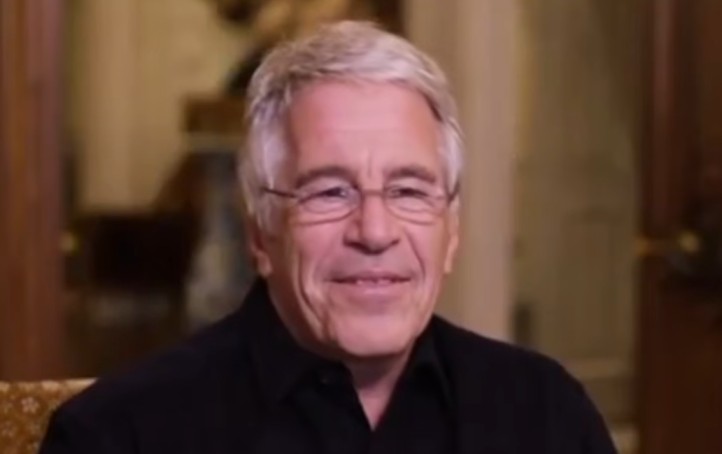
Editor’s Notes: This nearly two-hour leaked interview captures a previously unseen 2019 conversation between Jeffrey Epstein and Steve Bannon inside Epstein’s Manhattan townhouse, drawn from roughly 15 hours of footage Bannon filmed but never released. Framed as part media coaching, part aborted “redemption” documentary, the exchange ranges from Epstein’s time on the Rockefeller University board and the Trilateral Commission to his theories on money, fractional reserve banking, and financial crises. Along the way, Epstein opines on world leaders, central banks, artificial intelligence, and the 2008 crash, while Bannon presses him about moral hazard, subprime lending, and the “mystery people who run the world.” Surfacing online only in early February 2026, this footage offers a rare, extended look at Epstein’s self-image, worldview, and relationships with global elites.
TRANSCRIPT:
Setting the Stage
STEVE BANNON: Before we get into the deep stuff, let’s just talk. Let’s give some basics or some things I want to do. Inquiry from the others. Walk me through the Santa Fe Institute. What was it about the time at the math and this was in the late 90s. So they’re not going to hear me on this part. Right. We’re going to do it both ways.
UNIDENTIFIED SPEAKER: It will not be on the video, but we do have you recorded.
STEVE BANNON: Fine. Remember when you’re answering the question on these questions, I’m not in the shot and they’re never going to hear my voice.
JEFFREY EPSTEIN: So a little bit you got to—
STEVE BANNON: Repeat in your answer. You got to repeat what my question was.
JEFFREY EPSTEIN: Oh, okay.
The Santa Fe Institute and Rockefeller University
STEVE BANNON: Santa Fe Institute. Why, when you’re at the top of your game on Wall Street, do you decide to finance which was at the time or endow or become the donor or sponsor, however you want to say it, for what was considered the most cutting edge group of mathematicians in the world? Action.
JEFFREY EPSTEIN: So Santa Fe Institute in the late 80s, early 90s, I was interested. I was on the board of Rockefeller. So that starts Rockefeller University, formed by John D. Rockefeller to sort of give back to the community east side of Manhattan, except it was old, it was sort of old fashioned.
They were talking about medicine and medicine by itself was again subject to the ideas of science. They were trying to find use science to find cures for disease. And I said, no, we need to do something different. We need to start interdisciplinary work in most—
STEVE BANNON: How did a schmuck like you get on the board of Rockefeller? What year was that?
JEFFREY EPSTEIN: I don’t remember. I think 89 or 91.
STEVE BANNON: So that’s one of the most prestigious research places in the world, correct?
JEFFREY EPSTEIN: Yes. Okay.
STEVE BANNON: How did a guy like you get on the board of Rock A Blue Blood? Internationally known. Internationally known hard research, Nobel Prize winners all over the place. How do they pick a guy like you, a trader from—or basically some guy from Bear Stearns?
The Rise of Quantitative Thinking
JEFFREY EPSTEIN: Good question. So I was asked to be on the board of Rockefeller and I think it was—I was on the board of Rockefeller. There was a money manager who said Rockefeller needs someone with financial expertise because the university is growing and there’s lots of new things you have to—
Again we go back to the original discussion. The last time up until the mid-80s or sort of early mid-70s, the most important thing was your name. If you were a Rockefeller, you already were considered to be brilliant. If you were head of General Motors, it was your reputation, it was who you knew, who your family was, what was your character.
And then in the mid-70s, basically, if you remember, you probably had a calculator. It was very advanced in those days to have a Texas instrument calculator where by putting in the numbers it would multiply for you to do square roots. And that was the first—and everyone who had a calculator was already advanced on Wall Street. A simple—almost like your accountant.
The most important parts of business were really now going to calculations. So it’s not only mathematics, but it’s things that could be calculated. Reputation couldn’t be calculated. I could give you—are you a 10 on a reputation scale? An 8. What does it mean to have a measurement of your reputation? We’ll get to that later.
But people, places like Rockefeller, needed someone to say, look, we are entering a different world where numbers and the numbers of companies, portfolio management was going to be balanced. It was going to be statistical. Jeffrey, could you come on the board, potentially sit on the Finance Committee? Nancy Kissinger and a bunch of other people.
Meeting David Rockefeller
And David Rockefeller and I got along very well. He was this unbelievable human being, respectful to everyone. He introduced his driver as his colleague, not his driver. He would never say, “this is my driver.” He said, “this is my colleague.”
And David started to explain to me world politics. So David would say, “Jeffrey, money is going to be sort of the most important thing. People don’t understand money. You seem to have this knack for money.”
I said to David, “Tell me about your life. What was the worst and the best part of your life?”
So David said, “When I grew up, everyone knew I was a Rockefeller. They didn’t know that my father told me he would not leave me a dime, no money. But every time we went out to eat, me and my five friends at school, they would leave me the bill. They would expect me to pick up the check because I was a Rockefeller.”
And he said, “I was chairman of Chase Bank.” And he said, “I remember like it was yesterday.
The Trilateral Commission
So he thought that there was a world that existed that would be a combination of both politics and business and leadership. What do I mean? He formed something called the Trilateral Commission. The Trilateral Commission is some spooky stuff. People said it was something people that the Illuminati, there’s some mystery about it. People that ran the world. It was politicians.
But David said most countries, the politicians get elected for four years or eight years separate from the royal families in England or in the Middle East. Someone’s there for four years and then they’re not there anymore. The most important people to have stability and consistency would be businessmen.
So he formed this trilateral commission of businessmen and politicians from three major continents. So it was the North Americans, the Europeans and the Asians.
So he said to me, “Would you like to be on the Trilateral Commission?” I was 30 years old, 32 years old. I said, “Great.” And he said, “Well, you have to fill out this application so they have your bio.”
And I looked at the list of people and it was Bill Clinton, former President of the United States, Paul Volcker, every great leader in America, the Asians, the Japanese, and with a very long description of their history. And they asked me to fill in what I would like to have written. And I wrote, “Jeffrey Epstein, comma, just a good kid,” which I thought was funny. Nobody else did.
So in answer to your question, at that time, I recognized around the world that monies and currencies were not really well understood. But again, it was only numbers. So numbers—and I’ll get to the fact that it was bad thinking. Numbers are very good.
Financial Illiteracy Among World Leaders
STEVE BANNON: Are most people that you meet, even on Trilateral Commission, when you meet most people, do you find most leaders financially illiterate, economically illiterate?
JEFFREY EPSTEIN: Most—again, most political leaders don’t come out of a background of finance. Most political leaders come out of a background of being popular. So in some of the countries, except in the African countries, for example, they might have been a military person, they were a general.
In some of the African countries, they might have been a disc jockey, or in our country, they would have been an actor. The knowledge of money isn’t—they don’t have expertise. They have no degrees in finance. They really—and this is one of the major problems, their expertise, if they have any financial knowledge, is of their own checking account or bank account and filling in their own taxes.
So many world leaders who don’t really have a financial underpinning, make fundamental errors when it comes to money on a country or institutional level.
Let me give you an example. If you, Mr. Bannon, if I said your assets increased last year, you’d say, “Well, that sounds pretty good.” And I’d say, “What does that mean to you?” You’d say, “Well, I have more money. I guess I’m wealthier.” I’d say, “Yes.”
And if your debt increased, would you feel wealthier or poorer? You’d say, “Well, I don’t want to have increased debt. I don’t like the idea of that sound increased debt.”
Now that—and world leaders understand when their assets go up, they feel better. However, institutions like banks, things that people don’t really understand are financial underpinnings of banks.
When I say your bank, Mr. Bannon, you have the Bannon Bank. You doubled your assets. Sounds good, but what does it really mean? It means people owe you more money. You don’t have any money. More money. What? Yeah. A bank’s assets are how much it is owed by other people.
That’s crazy. So if the bank goes from $2 billion of assets to $10 billion, it means people owe it an additional $8 billion, but their assets have gone up. So the terminology of assets and liabilities is different for banks. It’s not natural.
Fractional Reserve Banking
And what most people—and you ask questions about world leaders, as many people, I think your old boss Mercer understood there’s a fundamental part of money which is called fractionalized banking. And fractionalized banking is something that finance people understand. And the people on the street—and when I say people on the street, that’s where I was when I started on Wall Street—would find it impossible to believe. Impossible.
Why Bannon Bank? I give you $1, just one single dollar. In our system of banking, I would say, “Okay, Steve, I gave you a dollar. How much could you lend out to your friends?” And your natural reaction would be probably something less than a dollar, because I want to keep something in my pocket.
The way our system works is if you as a bank are holding my dollar, you can lend out an additional eight or nine dollars.
“No, it’s impossible. I only have a dollar, Jeffrey.”
We have something called fractionalized reserves. If you have one, you can lend out nine. That’s the way our system works. And so not only do world leaders not understand banking, but the man on the street, my father who worked in the park department, it would be beyond his imagination that people could lend out more money than they actually had in their pocket.
Next question.
Joining the Elite
STEVE BANNON: How did this—in understanding that when you get on something like the Trilateral Commission, you’re on the board Rockefeller, which is the most advanced research, you get brought into the trilateral, which is the elite of the elite. How, since you’re only at that time 30 something years old, eight years from teaching at Dalton. Right? Your adult 10 years teaching at Dalton.
JEFFREY EPSTEIN: Yes.
STEVE BANNON: Walk us through. I mean, put us in the room. Walk me through exactly what it felt like. What it felt like being on the board at Rockefeller. You got these Nobel Laureates and you’re sitting there making decisions and you start to meet these people at Rockefeller, and you start to meet these people, the Trilateral Commission. What did it feel like?
JEFFREY EPSTEIN: That’s a great question. So what does it feel like?
STEVE BANNON: I’m in the business of asking.
JEFFREY EPSTEIN: What does it feel like meeting some of these people, like Kissinger or Rockefeller? And those are two extraordinary people. But in general, I think the question the people on Wall Street—I tell the story.
One of the first days when I was in Wall Street, someone said to me, “Would you like to buy a TV?” And I was looking in the brochure and I couldn’t figure out what stock had a symbol of a TV. And when I finally said, “Well, I can’t find it.” And they said, “What’s the matter with you? Do you want to buy a TV?” Which is—he was selling hot televisions, stolen televisions from the floor of the American stock exchange, referred to in common parlance as the televisions fell off the truck.
So I knew what that phrase meant from Coney Island. But what I found was most people in business in normal life or in the world leaders don’t really understand money. It is something they think about. They have a sense of what it is. They certainly want more of it. But they also make statements like, “We want more money, but we don’t want more debt,” which just shows a misunderstanding of what money at its core really is.
So they don’t—most people don’t. They want to make it, they want to save it. But to understand it intimately is not a normal characteristic.
The First Trilateral Commission Meeting
STEVE BANNON: At the first trilateral—or something. Just give me approximate.
JEFFREY EPSTEIN: You join the Trilateral Commission and we’ll—
STEVE BANNON: Be able to show that. We’ll pull down the chart of where your name was. But just give me roughly when it was.
JEFFREY EPSTEIN: I think it could be 90. I don’t remember.
STEVE BANNON: Let’s say early 90s.
JEFFREY EPSTEIN: Yes.
STEVE BANNON: When you got on the Trilateral Commission and had the first—where was the—do you remember the first meeting was?
JEFFREY EPSTEIN: It was in Tokyo.
STEVE BANNON: In Tokyo. In what hotel?
JEFFREY EPSTEIN: I would like to say the Hilton, but it’s probably not.
STEVE BANNON: And it’s a three day, four day, three day event.
JEFFREY EPSTEIN: And walk me through the whole thing.
STEVE BANNON: Starts with a dinner. Good, take me. Just walk me through it.
JEFFREY EPSTEIN: It was boring. I can’t. I—
STEVE BANNON: You couldn’t possibly think it was boring.
JEFFREY EPSTEIN: It was boring.
STEVE BANNON: You had to be—stars in your eyes.
JEFFREY EPSTEIN: No.
STEVE BANNON: Do you fly over privately?
JEFFREY EPSTEIN: Yes, but it wasn’t my plane, so it didn’t count. No.
STEVE BANNON: You fly over.
JEFFREY EPSTEIN: Yes.
STEVE BANNON: And who were the first—like when you first met those leaders, you had to be wowed. No, you’re 10 years out of Coney Island.
JEFFREY EPSTEIN: No, I’m not wowed by people of position. I’m wowed by people of great ideas. And I don’t care if it’s the bus driver, I don’t care if it’s the student I had who has teeth coming out.
STEVE BANNON: Well, these guys have to have great ideas. Of the leaders of the three great continents of world—North America, Europe and Japan.
JEFFREY EPSTEIN: No, many of these world leaders become world leaders because they’re popular and they were able to get votes or they were able to convince people to vote for them. I learned later many of them were just good at what they did in terms of politics. World leaders are politicians in general. They’re not scientists, they’re not intellectuals, they’re not great thinkers. They’re great politicians.
The Trilateral Commission and Inflation
STEVE BANNON: At the first Trilateral Commission meeting that you remember in Tokyo sometime in the early 90s, do you remember what were the big issues of the day that they were talking about? And what did you think about it?
JEFFREY EPSTEIN: Yeah. In fact it was funny because they were talking about inflation and they were worried that what would happen? How do you control inflation? And as a mathematician, I didn’t understand the concept. I don’t understand the concept today. How’s that possible?
Well, when you talk about most things to do with money, they really—money is meant to be local. It’s US Dollars. Then I understand what it means if inflation. It means my dollar today inflates and it doesn’t buy as much as it did a couple of years ago. The prices go up. I don’t have—it seems that everything is great, but in fact my dollar is shrinking in value.
STEVE BANNON: If you—and you’re the financial genius here. I’m just a lowly M and A guy.
JEFFREY EPSTEIN: If you let me—if you let me finish the thought.
STEVE BANNON: Go ahead.
JEFFREY EPSTEIN: So if you’re in America, you start to—you can feel inflation. You have salaries gone up, but you can’t buy the same car. In fact, it’s left to feel weird because the value—
STEVE BANNON: I want to ask a question then. This is my point. The central—the people who live and breathe this. The central banks have been haunted by the specter of inflation since the late 70s.
JEFFREY EPSTEIN: Yes.
STEVE BANNON: First off, tell our audience how did that happen? The two great financial events in the 20th century—I’m not going to get to the 21st—were the great inflation in Europe after World War I, the Great Depression, hyperinflation in Germany that led to the rise of Hitler and then this inflation in the mid-70s. Before you go, explain inflation. Why is the specter of inflation always the central thing in central bankers’ minds?
JEFFREY EPSTEIN: Because it goes back to this, the first concept I said, the weird concept of fractionalized reserves. The system is not well understood and well, most systems in fact are not well understood. We don’t know how our digestive system—
STEVE BANNON: This is impossible. This is impossible. The most—the world banking system, the world currency system, the world monetary system has to be so well understood by the Greenspans of the world and the Bernankes of the world. And you—right, the currency traders, the guys making billion dollar bets every day. The legendary guy on Wall Street in the late 90s, Versaillen brothers. Ranieri, the guy that wrote the money.
JEFFREY EPSTEIN: Michael Willis, Liar’s Poker.
STEVE BANNON: Yeah, Liar’s Poker.
JEFFREY EPSTEIN: Who’s that about that great trader Lou Ranieri? No one.
STEVE BANNON: The guy that ran the desk that eventually ran the hedge fund that went long term capital.
JEFFREY EPSTEIN: Ah yes, I don’t remember.
STEVE BANNON: Who’s a guy?
JEFFREY EPSTEIN: I want to say I don’t remember.
STEVE BANNON: I’m sorry. Luminari is big, but those guys have to understand the system perfectly.
Complex Systems and Financial Understanding
JEFFREY EPSTEIN: No, they don’t understand the system, they understand the local part of the system. So for example, why is not only inflation? Most bankers are terrified if the public understood that the bank really doesn’t have their money at any one time. One of the things during the depression there were runs on the bank.
The reason the banks don’t keep much money in the actual bank is they assume that not everyone’s going to want their money on the same day. So that’s not really the fear of inflation. The fear is a run on the bank. Everybody wants to take out something that doesn’t really exist.
Inflation is tied to interest rates. It’s a more complicated example. But when your money doesn’t buy the same amount of product this year than it did last year, if it buys less and less like it happened, you use the term hyperinflation. There’s certain countries that are not managed well, like in Africa at the current 100 billion dollar bill. 100 billion dollar bill in Zimbabwe is worth one American cent. That’s the perfect example of hyperinflation. It goes up, it doubles every day.
So people are afraid that their value in the system starts to break down. But so if I said to you, does your doctor understand your body system? You’d say well I hope so because I want them to keep me healthy. But you could have a kidney infection, you could have a heart attack, you could have a broken knee. There’s lots of pieces of this system.
And in fact when you ask the question very few doctors understand your entire body. There’s a specialist for your knee, there’s a specialist for your polynoidal cyst, there’s a specialist for your head. And now we have specialists in different areas. So I’m going to get to your first question about Santa Fe Institute. The world economy and your body are both comprised of little systems interacting with each other and making one big system.
STEVE BANNON: This is what’s stunning for all the little guys out there, the populist movement, the little guys that haven’t had a pay raise in 30 years, they think that these elites, you know, have everything. The guys in the room making the decisions, the party of Davos guys. You’re sitting there. You don’t think many people today really understand the complexity and really all the moving pieces and how they interconnect of the world’s financial system?
JEFFREY EPSTEIN: No, the nice—not only don’t they understand the complexity, and that goes back to Santa Fe Institute was an attempt of trying to see if there was a way to mathematize, formularize, or algorithmically understand what the term complexity means. That goes back to the original question.
Complex systems are complex by definition, but there’s not necessarily—it’s not one level of complexity. We might say, well, our fingers are complex, the movements, the muscles of our hands, but it’s not as complex as the blood system. Now I have a circulatory system. I have systems on top of systems, so that there’s no one group or person that really understands the way the body works.
There’s no one group that understands the way the financial systems work. You might understand US bond market. Now, you’ve asked about the trader, Long Term Capital, that was a bond fund, very small part of this very complex system. So the goal of the Santa Fe Institute was to see, is there a way to get in, somehow understand how complex systems interact.
Fast forward, Steve, to today where Google and these other engine companies, the other tech companies, are trying to build artificial intelligence. The strangest thing that they found, one of the strangest things is that the systems that they design, this artificial intelligence, which a lot of people have heard about, is they design a bunch of systems. They’re called neural nets, terms simply taken out of brain work, neurons in the brain nets, because they actually look like a net.
They put in some inputs, the computers work, spit out an answer. Sounds normal to you because you’re thinking about that calculator you had in 1976 on your desk. When you ask the person who designed the system, how did it come to that answer? How did your neural net—can you show me the calculations? They say, no, we don’t know. We don’t know how the thing we designed actually came up with that answer.
That’s pretty strange. They take the same neural net now and they put it in front of a video game. No learning nothing. They said to the computer, they say, sit in front of your video game and learn how to play. It seems the computer learns better than any human in history. Faster than any human in history beats any human in history. But when you ask the designer, how did it do it? No one knows. It just did it. So that’s the first little touch of thinking things that we already have gotten to a place where we don’t understand it and we built it.
The 2008 Financial Crisis
STEVE BANNON: On Sunday afternoon, September 14, 2008, where were you?
JEFFREY EPSTEIN: Sorry.
STEVE BANNON: It was the night they put Lehman Brothers in bankruptcy in London.
JEFFREY EPSTEIN: I was in jail.
STEVE BANNON: Seriously?
JEFFREY EPSTEIN: Yes.
STEVE BANNON: So the financial crisis of 2008 happen when you were in jail?
JEFFREY EPSTEIN: Yes.
STEVE BANNON: This is going to be so amazing. That’s going to be so amazing. I take it you couldn’t—you didn’t have your Wall Street Journal dropped off to you in the morning? Your Financial Times?
JEFFREY EPSTEIN: No.
STEVE BANNON: How did you hear about the—how did you hear about—because I want the—
JEFFREY EPSTEIN: I forgot about this, but yes, I’m trying to get—
STEVE BANNON: This is going to be amazing. This is—let’s go back and do that again Sunday afternoon because I want to find out about people, the geniuses understanding the complexity of the financial system, because I think the best example we have is the financial crisis crash of 2008.
Sunday afternoon, September 14th, I think it was 2008 is when they were working feverishly in midtown Manhattan at the Lehman Brothers offices and at various law firms around town and with the Secretary treasury about in the Federal Reserve what they’re going to do with Lehman. They decided they weren’t going to save it and so they prepared to put it into bankruptcy at the open of the market in London the next day.
How did you hear about what was going to happen to Lehman Brothers and what did you immediately think when you heard they was going to be put into bankruptcy?
The Financial Crisis from a Jail Cell
JEFFREY EPSTEIN: I’m glad you asked that question. I was in solitary confinement September 14th. And again, some of the public stories about the wonderful time I had in jail and my work release, which didn’t come until months after I’d been there since June in an 8 by 10 cell with a bed in the back, a six foot bed in the back, a chrome sink with toilet attached to it and a little piece of metal sticking out that was supposed to act as a table.
Now, since I was in jail, there were no books. Why? There’s no library. No library, but you’re in jail. No, I was in jail, not prison. So in jail I was in a place what’s called the Special Housing Unit, which is for the roughest, toughest, meanest people. They had put me there. They said, my own protection.
So I was in an 8 by 10 cell with a little slit in the door where they would serve my food on a tray about 9 inches by 4 inches. And then as soon as I finished eating, they’d take the tray and close it down. And one of the guards said, “Do you understand Wall Street’s crashing? I’m worried about my pension fund. What should I do?”
And I said, “Sorry, Wall Street’s crashing. What’s happened?” And he said, “There’s some crisis and some companies are going bankrupt.” I said, “Are you sure?” And he said, “Yeah, it’s all over the papers. Everybody’s. We’re all terrified we’re going to lose our life savings because we have either a 401k or our pension funds. We don’t know anything about money. Mr. Epstein, can you tell us, like, what’s going on? Am I going to be able to afford my children’s education? Am I going to be bankrupt? Like this company called Lehman Brothers? And there’s another company on the front page today called Bear Stearns.”
Oh, no. I said, “Why?” Because that’s the company I was a partner in. And in fact, that was a company I had a very large investment in. So as a great story, I didn’t have my Wall Street Journal. But in the early mornings, you’re allowed to make two phone calls collect. And when you pick up the phone, you can dial a number, and when the person picks up, they say, “You’re getting a call from the Palm Beach County Jail. Will you accept reverse charges?” And the person either says yes and the call goes through or the person says no.
The person I called was Jimmy Cayne, the president of Bear Stearns. And I said, “Tell me what’s going on.” And so that my knowledge of the financial crisis happened with Jimmy, who was at the center of the storm, telling me about what Lehman had gone under. And they were trying to figure out a way should they bail out Bear Stearns.
A Moment of Self-Awareness?
STEVE BANNON: Did it strike you at the time of the mess you had made of your life to be in a situation that you’re one of the greatest financial minds in the world, looked at by world leaders and asked your thinking by the most prominent and important people in the world. And here you are in solitary confinement. You can’t even, you can’t. You got to make a collect call to somebody. Did it strike you at the time how all the threads your life had come together and put you in a position or you had put yourself in that position?
JEFFREY EPSTEIN: No.
STEVE BANNON: So it never struck you when you had to make a collect, your one collect call, one of your two, 50% of your collect calls that day you call the President or the head of the CEO of Bear Stearns, the biggest financial event in your life is taking place of which one every important person in the world would be seeking your opinion. Number two would be a once in a lifetime opportunity to apply your craft. Number three, it would be a once in a lifetime opportunity to make money if you were smart, and obviously you’re smart.
You’re telling me here truthfully that it never hit you at all of how you’d ended up in a place where you had to make a collect phone call from a jail cell that was six by nine with a steel bed and your food being passed through a slot.
JEFFREY EPSTEIN: The question you want to ask is who was the other call to?
STEVE BANNON: Who was the other call to?
JEFFREY EPSTEIN: The other call was to my friend at JP Morgan who was then, I didn’t know at the time, trying to buy Bear Stearns. So at one point I had two phones. It was difficult because they’re afraid people are going to hang themselves with the phone cord. So they don’t actually come together when they’re pretty short. So I was actually going between two phones talking to Bear Stearns and JP Morgan at the same time. So I found it amusing.
STEVE BANNON: And it never struck you about how to end up in a situation like this?
JEFFREY EPSTEIN: No, that would be, probably means I would be too self aware.
STEVE BANNON: You can’t possibly expect me to believe this.
JEFFREY EPSTEIN: I know I don’t believe it.
STEVE BANNON: You’re telling me that during that day you never had a moment, you sat there and go, what the f* have I done with my life that I’m in a 6 by 9 jail cell when I should be on a train desk or I should be in my $250 million, you know, greatest townhouse in New York City taking calls from the King of Saudi Arabia, the President of China, the head of Russia, the President of the United States to save the world’s population from a financial debacle. You honestly expect me to believe that that never happened?
JEFFREY EPSTEIN: You’re suggesting I was sort of some somewhat depressed and how could this happen?
STEVE BANNON: To me, I’m not saying depressed. I’m saying a moment of awareness of how could I get myself into this situation.
JEFFREY EPSTEIN: No, I would just say how strange that this happens. It’s strange. I’m wearing a jumpsuit and flip flops.
STEVE BANNON: What color was the jumpsuit? Brown.
JEFFREY EPSTEIN: Brown.
STEVE BANNON: Brown jumpsuit.
JEFFREY EPSTEIN: Yes.
STEVE BANNON: I notice I don’t see you in a lot of brown.
JEFFREY EPSTEIN: No.
STEVE BANNON: Brown jumpsuit and flip flops.
JEFFREY EPSTEIN: Flip flops, yes.
STEVE BANNON: With no access to books, no access to newspapers, no access to anything, you had lived on information.
JEFFREY EPSTEIN: Except my Almond Joy bars. I had extra Almond Joy bars.
Life Behind Bars
STEVE BANNON: Did you eat Almond Joy bars and things like that because you’re afraid of what the cooks did to your food? Yes. Is that because of that you were in for the crimes that you were in for?
JEFFREY EPSTEIN: No, it was just. In fact.
STEVE BANNON: Is it because you’re wealthy?
JEFFREY EPSTEIN: No.
STEVE BANNON: Yes. How did you know that?
JEFFREY EPSTEIN: Well, people would constantly. If I was passing by or have to go for my medical, people would either ask to borrow money or make some other types of comments about. In the beginning, what were the comments?
STEVE BANNON: At the beginning, what were the comments?
JEFFREY EPSTEIN: It serves you f*ing rich guys right that you’re here next to me.
STEVE BANNON: There was nothing about your crimes?
JEFFREY EPSTEIN: No.
STEVE BANNON: So all this rumor you hear all the time about people in prison that commit the type of crimes you commit, that’s you’re saying in your personal thing is not true?
JEFFREY EPSTEIN: No.
STEVE BANNON: It was all because you were rich?
JEFFREY EPSTEIN: Yes.
STEVE BANNON: And it was all because they wanted to borrow money or get advice.
JEFFREY EPSTEIN: Yes.
STEVE BANNON: Where they get advice to which to go long. To go long? You’re telling me it’s just time to buy. You’re telling me in solitary confinement they’re, they were interested in going long?
JEFFREY EPSTEIN: Yeah. They wanted to know what does that.
STEVE BANNON: Say about human nature?
JEFFREY EPSTEIN: Well, I think that people find one of the reasons they wanted to keep me in solitary confinement was they were afraid that everybody would want to know which stocks to buy. But what happened was after this crisis, now it’s on the front page of every newspaper.
STEVE BANNON: I don’t want to lose this day.
JEFFREY EPSTEIN: Sorry, sorry.
Bear Stearns and Lehman Brothers
STEVE BANNON: When you first heard that, did you. Was it Bear Stearns had been kicked into bankruptcy, what, six months before?
JEFFREY EPSTEIN: No, no. It’s just the same time. This is part of the same deal.
STEVE BANNON: I thought, I thought. No, no. Bear Stearns, they decided the Bear Stearns, they. Oh, they saved Bear Stearns and didn’t save Lehman Brothers. Six months before, they had bailed out Bear Stearns, but Bear Stearns was still.
JEFFREY EPSTEIN: A zombie, a shell of its former self.
STEVE BANNON: A former self. But they had, quote, unquote, saved it.
JEFFREY EPSTEIN: They admit.
STEVE BANNON: Why did they make the decision in your mind, why did Hank Paulson in Bernanke, this concept of moral hazard, explain to the audience what moral hazard is? And why did they save Bear Stearns six months before? And why did the smartest guys in the room decide not to save Lehman Brothers?
JEFFREY EPSTEIN: It’s a good question. The real issue is I’d have to go back when you have these systems to the way your doctor responds to any type of emergency in your body. They might decide to save your kidneys and let your gallbladder go because the gallbladder is less important to your overall system.
People, if at that time even it’s not that long ago, the boogeyman was saying, “What really happened, Jeffrey? What really happened? What is this financial crisis?” And you know, some of the progressives and the right wing blame it on the banks. It was the banks fault and it’s the fault of this very esoteric unknown concept of derivatives. It was really the derivatives that caused this financial crisis because the derivatives got somehow out of control in the Mickey Mouse.
STEVE BANNON: And that was the way you started your financial, your financial, your road to a bayonet went right through derivatives.
JEFFREY EPSTEIN: Yes, but it’s, but derivatives were not the cause. Derivatives were not the cause at all. It’s like saying your hair was the cause of your heart attack because it was on the top of your head.
STEVE BANNON: So what was the cause?
Understanding System Collapse
JEFFREY EPSTEIN: There isn’t, let me say there’s no one specific cause. These are system collapses. So when, many times when they have to make your death certificate, when you say, “Well, what did he die from?” They’ll say heart failure. But if you say what was the cause of his heart failure? Well, he had low blood pressure, his sugar was high, he was diabetic, he had all these other problems. But he said, “No, no, no, we need a word on your death certificate. Did he die from brain damage? Did he die from heart failure?”
That’s the financial crisis. Many said, People said, “Well, what caused it?” They wrote, like on its death certificate, derivatives. But derivatives were not a fundamental. Derivatives are not a fundamental cause of anything on the. So the.
STEVE BANNON: Was it Sunday or Monday, I take it was Monday morning when you made your two collect calls. You’re talking to Bear Stearns on one hand and Morgan Stanley on the other.
JEFFREY EPSTEIN: J.P. Morgan, J.P. Morgan.
STEVE BANNON: Did you. That was Monday morning. Did you, Jeffrey, Being one of the financial geniuses in the world, did you understand what Lehman Brothers going into bankruptcy, the domino effect that by Thursday the financial system would be under such extremists that if it didn’t have a trillion dollar cash infusion in the United States, it might collapse. Did you know that at the time? Did you view that at the time?
JEFFREY EPSTEIN: Yes. You did? Yeah.
STEVE BANNON: Why?
JEFFREY EPSTEIN: Again, I don’t want to bore you or the audience with the idea of it’s a medical procedure, but you had system failures so you’d recognize that if I said to you did you realize when your father was on the ground and he was clutching his chest and he couldn’t breathe, it was a bad situation, he could die. That’s how I saw it.
STEVE BANNON: Did you know. Did you immediately think about the commercial paper, Mark? I mean the mechanical triggers that actually had to. You had to blow through these circuit boards. Did you know the circuits? Did you understand the circuits or did you have a concept of the circuits that were going to get blown through?
JEFFREY EPSTEIN: Yes, but only because of an analogy to a body and in fact from my telephones against the wall with my little metal wires because the next day I talked to another person in Washington about the issues of what I thought was happening and I made the same discussion about the.
STEVE BANNON: They were at the Treasury Department.
JEFFREY EPSTEIN: Yes.
STEVE BANNON: So in a 6 by 9 cell.
JEFFREY EPSTEIN: The phones were outside the cell.
STEVE BANNON: In Palm Beach County, California.
JEFFREY EPSTEIN: West Palm Beach, Florida.
STEVE BANNON: West Palm Beach, Florida.
JEFFREY EPSTEIN: This was your juice diet.
STEVE BANNON: West Palm Beach, Florida. You’re making a call to Washington D.C. to talk to some Deputy Secretary, Treasury.
JEFFREY EPSTEIN: Someone in Treasury.
STEVE BANNON: Someone in Treasury.
JEFFREY EPSTEIN: Right.
STEVE BANNON: And that does not the night before, before you go to bed, it doesn’t dawn on you at all. You never have a moment of self-reflection that how did I end up on this metal cot when I should be at the center of things?
JEFFREY EPSTEIN: No, I had a telephone, so I’ve seen said I can talk to. It makes no difference where I am. In fact, I’m still talking to the same person. If I was at my home in Palm Beach, but I’m here in jail.
STEVE BANNON: I’m at my home in Palm Beach.
JEFFREY EPSTEIN: I can dial my own phone.
STEVE BANNON: No, but you can also make a thousand phone calls here. You got to make one.
JEFFREY EPSTEIN: And he’s got to take think how much better that was. I had to decide who was the right person to call. That was unusual for me because I would have called 20 people.
STEVE BANNON: And what was the advice you gave?
The Financial Crisis as a Medical Emergency
JEFFREY EPSTEIN: I said, you have a sick patient and it’s very much like a sick patient in the emergency room. Don’t. You can’t think about it like your car. People in normal walks of life think about money and things as a machine and unfortunately so if your car breaks, cars are always easy to fix. My jets, my cars. If it breaks, I know it can be fixed because it simply follows the same pattern. If this part breaks, you replace the part and the thing works again.
People and the financial system are not machines. They can’t be fixed the same way. You can’t simply take out the put some more juice into the commercial paper market. And that’s like replacing the carburetor on the car. It’s much more. I have a patient who can’t breathe, has a stomach problem, can’t see, looks bleeding at the same time. What do I do?
First I have to think about it as system. Where’s the most logical place? What’s the most dangerous place? If your heart stopped, we have to start your heart again. If the in the equivalent to the money market, why do I have to start your heart again? I need to get your blood flowing. If your blood stops, you’re dead. If liquidity, which is the equivalent of blood in the financial system dries up.
STEVE BANNON: Once liquidity is basically cash putting cash.
JEFFREY EPSTEIN: Into the system, forget about what it is. Liquidity is liquidity. It allows the system, it’s the blood of the system. You need to pump blood hard into the body of the economy to keep it flowing. And especially when you’re worried about someone dying, you’re not going to be worried about the niceties of well, you got the shirt dirty and there was some damaged pump in that blood. Keep that heart.
STEVE BANNON: When you talked to the person in treasury on Tuesday the 16th, did you get a feeling as you were sitting in your 6 by 9 jail cell in West Palm Beach, Florida that they were on top of things?
JEFFREY EPSTEIN: No, you can’t. It’s impossible to be on top of things. There’s no such thing. It’s again, the doctor watching the patient die, you hopefully have some confidence that he’s seen it before. He recognizes that there are some steps he has to take first before he bandages the guy’s finger or worries about what shoes he has on. So you hope that the people in charge, your doctors who are working on the emergency patient have enough experience and frankly judgment to try to keep the patient alive.
STEVE BANNON: Did you think that they had those things, patience and judgment?
JEFFREY EPSTEIN: They had pretty good judgment and you needed a lot of luck. Just like in the dead patient. You need to hopefully you put that blood in and it’s not too late and you maybe you make some mistakes, but you have to know you’re going to have to give it a shock.
Bear Stearns and the Spring of 2008
STEVE BANNON: In the run up to the September crash of 2008. Yeah, I guess you weren’t occupied with finance that whole summer. How long had you been in jail?
JEFFREY EPSTEIN: I got went to jail June 30.
STEVE BANNON: So the entire summer?
JEFFREY EPSTEIN: Yes.
STEVE BANNON: Before you went into jail, you were still very active in the financial markets?
JEFFREY EPSTEIN: Yes.
STEVE BANNON: When I say active, you trade currencies every day. You trade stocks every day.
JEFFREY EPSTEIN: When people. I don’t do anything.
STEVE BANNON: Someone like you, you give advice to people to trade stocks or trade currencies.
JEFFREY EPSTEIN: I don’t trade every day. I think that’s like Woody Allen said, it’s, you can’t beat the bank. So I try to pick my spots. You know, George Soros picked his spot when the pound collapsed. This would have been a great money making opportunity that passed me by when I was in jail. But that’s not how I think in.
STEVE BANNON: The run up to that in the spring of 2008, that’s when Bear Stearns got in problems, I think in the spring of 2008 and they decided to bail it out. Did the Bear Stearns guys talk to you for advice at that time and the big crisis in Bear Stearns?
Bill Clinton and the Subprime Crisis
JEFFREY EPSTEIN: No. See again, unbeknownst to most people, and it’s easy to blame people for the financial crisis. Like you’d blame someone for giving your father the drink before he had his heart attack. But what really happened? The real enemy of the finance system was Bill Clinton. And if you asked me what and who caused the financial crisis, I would tell you it was Bill Clinton because.
STEVE BANNON: Of what Bob Rubin and he did to the financial debt. Deregulate the financial system?
JEFFREY EPSTEIN: No, because as of the last time we had our 60 minute interview, you talked to me about home ownership and you asked me whether everyone should own a home and I told you no, it’s too risky.
STEVE BANNON: So the financial collapse of 2008 is because of hard working African Americans, Hispanics and whites who wanted to have a piece, have a ownership stake in the society. That all rests on their shoulders. They’re the culprits?
JEFFREY EPSTEIN: No, not at all.
STEVE BANNON: Okay.
JEFFREY EPSTEIN: I didn’t say they were the culprits. I was pretty clear it was Bill Clinton. Why was it Bill Clinton? Because Bill Clinton wanted to get votes from those people. And he sold them the idea that instead of renting a house and historically the values of houses have gone up. And he said, you guys in these local communities who haven’t been able to afford a house before, I’m going to show you a way. I’m going to give you a way because I’m sure I’ll get your vote that you can own a house, because I want your vote.
So what we’re going to do is I’m going to let you buy a house, Mr. Bannon, when you really. You’re right on the border, maybe, or not even on the border, your credit is not good. Okay, let’s be honest. And it’s not my fault, it’s not Bill Clinton’s fault. But whatever happens at the moment, your credit score or whatever it is, your credit’s not good.
Now, normally you come to me and you’re a want to borrow money. I’m a bank and I say, I’m sorry, Mr. Bannon, I can’t lend you money because your credit score is not up to where it needs to be. Hopefully, if you work harder and clean up some of your problems, it will be. But no, what I say to you is, I’m going to figure out a way to lend you. Lend you. Not give you. I’m going to lend you money anyway, though you don’t have a good credit score. And don’t worry, I’m going to get rid of the term that you don’t have. Bad credit. Bad credit sounds pejorative. You don’t want to be a person.
STEVE BANNON: Sounds judgmental.
JEFFREY EPSTEIN: Yeah, it sounds judgmental. So what we’re going to do is we’re going to call your credit situation subprime. Nobody knows what that means. Subprime, that means prime is good credit. Subprime is not good credit, less than good credit. So we’ll call it something that people really won’t follow.
And we’ll tell you what, we’re going to have people lend you money, though you are a subprime borrower. And I will figure out some government agencies to guarantee your loan, though I don’t think you’re a good risk. So the banks say, no, no, no, we don’t want. Initially, the bank said, sorry, this is too risky, Mr. President, for us. We’re in the business of managing risk. It’s not our money, it’s the hard working people’s money sitting in our bank. We can’t lend to people whose credit is not prime. You’re asking us to lend people who are subprime.
And he says, here’s the key. If you don’t, Mr. Bannon, I am going to make sure the Justice Department charges you with discriminatory lending because you refuse to lend to my subprimers. In business terms, you should never lend to. But what we’ll do is we’re going to. I’m going to form an agency called Fannie Mae and Ginnie Mae, another agency. Names. They’ll guarantee your loan. So don’t worry. Don’t worry. You don’t have to pay it back anymore, even though you. And maybe you don’t even have to work as hard anymore. That’s probably a harsh statement.
But these players, these two big firms, Fannie Mae will guarantee the fact that that bank will receive its money. Now the bank says, wow, best deal in history. I refused to lend to Mr. Bannon, but now he has the big brother, his Uncle Sam. He went to his Uncle Sam, and Uncle Sam says, I’m guaranteeing it. The bank says, I want everybody. Give me as many people as you can give me, because Uncle Sam is the best credit in the world. Not only the United States government. We’ll take it all. We’ll take as much subprime as we can handle because it’s the best investment for the moment.
It’s a strange investment because it has politics that has inserted its way into the numbers. Politics doesn’t belong in the markets. But now we’re going to have. I want the votes. We’ll make guarantees that you who can’t get a house normally will be able to get a house from the bank. The bank says, this is the best deal in history. We will package 100, 300, 1000 of you subprimers and we’ll sell it off to somebody else. And the whole system becomes mired in subprime mortgages. That becomes the issue.
STEVE BANNON: What do you mean mired? This is too much supply. Is this supply demand problem? You get too much supply?
The Accounting Problem
JEFFREY EPSTEIN: No, it’s a very good question. What does too much supply mean? Well, then you get to. People, go back to your first question to me. Government leaders. Government leaders know if they’re good and they can do mathematics, they can balance their checkbooks. So certain people in Congress said, well, how do you value these subprime mortgages?
The bank said, we’ve been valuing them the same way we’ve always valued them for the past 20 years. The accounting firms. There’s something in this country called gap accounting, which is a standard type of accounting. And we account for them the same way we’ve always accounted for them. If we paid $1,000 for your mortgage last night, when we put it on our books today, we’re going to say its value is $1,000. Makes sense. I paid for it. What’s its value? It’s $1,000. That’s what I paid for it last night.
No, the Congress people said that’s not really a good answer. You know, that doesn’t give us confidence that you know what you’re doing. Because what happens if you have to sell it tomorrow morning? If something’s happened and you have to sell it? Remember, there’s kinds of stress tests. Would you be able to value it at what you paid for it the day before?
And Wall Street says that’s not the way you can think about this. This is crazy. We always value things at the cost from the day before. And they changed the accounting method, in essence, to say not what it was worth yesterday, but if I have to sell, what would it be worth? That’s impossible. So what happens is every bank now has to value something they bought yesterday at lower than they paid. Never before in 20 years did they have to do this. So something they bought at 1000 on their books was 1000 is now 990. That starts to. You asked the question about what did I start to think about? Something’s a thousand and nine ninety. This person now has to value it at 980.
STEVE BANNON: When did you first start to get nervous understanding Bill Clinton in all this? Did you change glasses?
JEFFREY EPSTEIN: Yes. Okay. I changed shirt.
STEVE BANNON: I saw the black. Yeah, great. I think we’re having all kinds of changes.
JEFFREY EPSTEIN: I’m experimenting.
The 2008 Financial Crisis and Complex Systems
STEVE BANNON: Okay. When did you get a feeling? Did you ever anticipate before it happened something like 2008 could happen?
JEFFREY EPSTEIN: No.
STEVE BANNON: How could that be?
JEFFREY EPSTEIN: It’s the word I can beat to death is that it’s very much like would I expect, anticipate, I’ll have a heart attack tomorrow? Unlikely.
STEVE BANNON: Was 2008 a heart attack or stroke? Debilitating.
JEFFREY EPSTEIN: It’s a better. I don’t. It was both. But why was it both? Because, in fact, as I said, the blood was getting dried up in the system and the head, which is sort of the central bank, wasn’t working. So to some extent it was a combination, which is a crisis.
STEVE BANNON: Did you see that building up over time?
JEFFREY EPSTEIN: It’s always been lurking in the background. I mean, if you have an older parent, would you say it’s possible? Did you anticipate him having a heart attack today? No. You hope things are going to go better and maybe they’ll fix it up.
The system was getting too complex and it wasn’t based on derivatives. Because what people keep forgetting, and as I’m just explaining, Wall Street and in many professions, including Wall Street, Wall Street makes it sound complicated. They don’t want the little guy to understand what they do because they make so much money and they don’t do very much.
So they couch it in words like derivative and stock options and commodity futures and different types of contracts. It’s all fairly. Everyone is capable of understanding it. It is not complicated. But Wall Street, because they make so much money from doing fairly simple things, needs to make it more complicated than it really is.
STEVE BANNON: We had a very big recession in the early 90s based upon real estate and Japan basically imploding.
JEFFREY EPSTEIN: Let’s again, you had a recession in the 90s. I don’t know what it’s based upon. It’s always interesting to look back and say separate from there’s certain triggers like in the 70s there was a—
STEVE BANNON: What do you think was based upon the 90s downturn? Clearly there was a huge downturn.
JEFFREY EPSTEIN: No, I just. I know there was a downturn. That’s what I know for sure.
STEVE BANNON: That’s a fact.
JEFFREY EPSTEIN: Everything else is sort of speculation about.
STEVE BANNON: Why did he have that understand that. But there’s some speculation that has zero percent probability of being true and there’s others that have 90% in the range. When you look at the range of alternatives of what could have caused it of 1990 and what I’m trying to do is get you all the way up to 2008. Look, you’re the smartest guy in the room, right? You know that. Do you think there’s anybody in the world today.
JEFFREY EPSTEIN: Oops, this is going to be a bad question.
Understanding the Financial System
STEVE BANNON: No, but do you, sir? Do you think anybody in the world today, the Alan Greenspans, the Bernankes. Is there any central banker, you know, any partner of any Wall Street firm, any guy running a trading desk and I would take it, that would be. Or anybody at a Larry Fink at BlackRock, Steve Schwarzman at Blackstone, the top hundred financial guys and let’s throw in a couple of Nobel economists and let’s throw in the best professors at Wharton, at Harvard, at Stanford. Do you think that there’s anybody that understands money or understands the world’s financial system as good as you?
JEFFREY EPSTEIN: There must be, but it doesn’t come.
STEVE BANNON: To the top of the head.
JEFFREY EPSTEIN: No.
STEVE BANNON: Okay, fine. Now, now that. Okay, now that I’ve gotten that. No, now that I’ve gotten that. Let’s go back to 1990. In that arc from 90 from the fall of the Berlin Wall to 2008.
JEFFREY EPSTEIN: Good.
STEVE BANNON: We had, we started with the implosion in Tokyo of the Japanese economy. Japanese Financial markets. We had the huge run up in Internet stocks. Right. We had the implosion of that in 2000, the bankruptcy of Drexel Burnham in 90. Implosion of Japan, huge run up in equity markets for the Internet. Implosion, Internet 2000, 10 years later, roughly.
And then this run up through the Iraq war and all that, the run up to 2008. Every 10 years it seems like we’re in some sort of 10 years before the 1990s was the 70s.
JEFFREY EPSTEIN: You sound like an astrologer.
STEVE BANNON: Okay.
JEFFREY EPSTEIN: And not a financialist.
STEVE BANNON: You’re a mathematician. It just seems to me a pattern of every 10 years.
JEFFREY EPSTEIN: That’s misleading. That’s exactly right. Because people like to see patterns. People like to see patterns where there are none.
STEVE BANNON: So a pattern of a financial crisis every 10 years is just in my mind.
JEFFREY EPSTEIN: Yes.
STEVE BANNON: Long Term Capital. And Long Term Capital that had to be bailed out back in the late 90s when everybody panicked and that wasn’t a big debt bailout. Today would look small. And it was $5 billion or was $30 billion.
JEFFREY EPSTEIN: People, businesses fail all the time.
STEVE BANNON: Would they like Long Term Capital? And the Federal Reserve stepped in.
JEFFREY EPSTEIN: But I’m saying people go bad. Things go bad all the time.
STEVE BANNON: Yes. The local. You’re correct. The audience that’s watching this, the little guys, they go bankrupt all the time and nobody gives a shit. You know why? They’re a little guy. But when Long Term Capital Management goes bankrupt, or Bear Stearns goes bankrupt, or Lehman Brothers goes bankrupt, people care because.
JEFFREY EPSTEIN: You know, it’s an unfair characterization. What do you say? Because again, it’s the complexity of the situation. If you think about the. You have a complex system. You have your body now. In fact, the little guy is my finger. This is.
STEVE BANNON: And Bear Stearns is your heart.
JEFFREY EPSTEIN: That’s correct. The banking system is my heart. The system. I can’t risk my. Because remember, it’s not only my.
STEVE BANNON: You haven’t been able to.
JEFFREY EPSTEIN: Hang on.
STEVE BANNON: You haven’t. Hang on. No, hang on.
JEFFREY EPSTEIN: I was trying to hang. I wanted to see if the hang on worked.
STEVE BANNON: I haven’t been able to. You’re not good enough yet. You’re like Junior, junior wizard trying to do it.
JEFFREY EPSTEIN: You have it.
The Limits of Understanding
STEVE BANNON: Okay? Since we can’t name another guy that’s as good as you, there may be a couple out there. You’re not bragging, you’re humble. It had to be sometime. Please tell me there was some time before you went to jail and basically got cut off from Daily Information in the summer of 2008, that you started to get very nervous, that this complex system, that something was deeply wrong.
JEFFREY EPSTEIN: Okay, first, let’s go back. When I say no one understands the system better than I do, it doesn’t mean I understand.
STEVE BANNON: You always sound like a doctor you’re afraid is going to get sued for giving a thing.
JEFFREY EPSTEIN: Yeah.
STEVE BANNON: You’re not taking on any liability. There’s no contingent liability here for your case.
JEFFREY EPSTEIN: Yeah, no, no, no, but the word understand is the problem. I don’t understand the system, so that’s. I don’t understand the financial system.
STEVE BANNON: Please stop. You cannot sit here and tell me we just went through. I’ll go through again. The hedge fund managers, the money managers, the central bankers, the commercial bankers, the heads of the investment banks, the heads of all the trading desks, the top economists, and I’ll throw in the business school lectures at Stanford. Of all the top 200, 250, you can’t name off the top of your head. The guys are at least at your level. You have to understand it somewhat.
JEFFREY EPSTEIN: No, sorry. We all don’t understand it. No one understands it. It’s a miracle. That’s part of the problem. It’s impossible to understand that word. Understand simply means if this happens here, that will happen there. It’s predictable. Understanding means it’s predictable. It’s not predictable. That’s the problem.
It’s very. In complex systems, that was the fascination. Is there a way to tease out some level of predictability? No. In fact you would ask the question. It’s a great question. Which was? Was it a stroke or a heart attack? Now most people don’t know that before they were going to have a stroke, they had a stroke. They just have a stroke. Did they understand why?
In hindsight, you go back and you can make lots of explanations at my might sound good. And if you’re talking to the working man, you’re using language that he’ll never understand. It’s complex. So he just like going to his doctor. He says he has a gastrointestinal problem or has diverticulitis as opposed to saying you had a stomach ache, you ate bad food. People don’t like to say it in normal every man terms the system had a stroke and we don’t know why.
STEVE BANNON: But you just okay hard working people and there’s a great social benefit. Would you not agree with having people having ownership in the system?
JEFFREY EPSTEIN: When you say ownership in the system, it doesn’t mean.
STEVE BANNON: Let’s start over your phone too because.
JEFFREY EPSTEIN: Yes. Yeah, yeah, yeah, yeah.
STEVE BANNON: Who knows what the f* comes up with that?
JEFFREY EPSTEIN: That’s correct.
The Trustee
STEVE BANNON: Which one has sent you KSA? I can’t even get. I can’t not believe I’ve got the magic moment when you’re in prison or jail, wherever the f* it is.
JEFFREY EPSTEIN: Now there’s a funny part that we missed which is said.
STEVE BANNON: Go ahead, tell it.
JEFFREY EPSTEIN: The funny part is what you asked me.
STEVE BANNON: Is there anything funnier than that for black humor?
JEFFREY EPSTEIN: It’s. I don’t make any black comments. Sorry. You asked me what I was wearing.
STEVE BANNON: That’s right. You’re too wrapped up in the Me Too movement.
JEFFREY EPSTEIN: Yes. So I was wearing a brown jumper and a brown pair of pants given to me by the jail with the word trustee on the back.
STEVE BANNON: Because you had qualified to be a trustee.
JEFFREY EPSTEIN: Well, the funny part was it was spelled T-R-U-S-T-Y. So I wasn’t really sure. I’d been a trustee in many different operations, but it was the first time it was actually printed on my back and spelled incorrectly.
STEVE BANNON: Probably had a higher level of being a trustee at that than you had added all the. All the boards that you were trustees, right?
JEFFREY EPSTEIN: Yes. As the trustee meant you get two devices to clean your toilet as opposed to one. Yeah.
STEVE BANNON: But it also meant that you had some sort of personal fiduciary own responsibility for oneself. Right.
JEFFREY EPSTEIN: In the jail, you mean that’s what.
STEVE BANNON: Being a trustee is? That’s where they give you two.
JEFFREY EPSTEIN: Yes, you get two cleaners. I was a trustee in the jail because I was able to teach some of the kids from. To help them get their GED. So that’s how they gave me a trustee job.
The Defining Moment
STEVE BANNON: There’s no time. I got to go back to this because I’m like a dog with a bone in this thing.
JEFFREY EPSTEIN: Yes.
STEVE BANNON: You can’t. There’s something deeply f*ed up with you.
JEFFREY EPSTEIN: At least something.
STEVE BANNON: Well, we know there are things deeply f*ed up with you will get through in this film, but you cannot possibly have sit there knowing that you came from nowhere, knowing that you went to the very top of what is considered outside of science and maybe physics, the thing people most admire because it’s like alchemy, understanding, high finance, to sit there in what will be the defining financial crisis, our time like. Like Black Friday and Black Monday, whatever it was, and the Great Depression, and be there at that exact moment, triggered in part by a firm that you used to be a partner in and knew intimately well.
And it created much of your initial net worth because of. And know that you couldn’t. Someone who lives on a phone. Right.
JEFFREY EPSTEIN: Yes.
STEVE BANNON: Because you do live on a phone, right?
JEFFREY EPSTEIN: Correct.
STEVE BANNON: You had to make collect. Just two collect calls. You cannot tell me sometime during that day you did not have that conversation with yourself of how the f did I do this to myself? To put myself in West Palm Beach in a 6 by 9 cell with a metal fing bed with a brown shirt that said trustees spelled wrong.
JEFFREY EPSTEIN: Did I find it amazing that I was there? That’s a big.
STEVE BANNON: Not amazing. And I don’t want to say it was not funny. I thought it was.
JEFFREY EPSTEIN: I wasn’t funny. Right.
STEVE BANNON: Not amazing.
JEFFREY EPSTEIN: It was incredible.
STEVE BANNON: Incredible in what way incredible? Like how do I do this to myself?
JEFFREY EPSTEIN: No, it’s as incredible as me sitting here in this house. They’re both just two sides of the coin. That’s how I think about it. That my life today is incredible.
STEVE BANNON: Do you consider yourself a stoic?
JEFFREY EPSTEIN: No, I consider myself a hermit. Stoics are not very happy.
STEVE BANNON: Being a hermit then being in that six by nine cell. Being in the cell qua. The cell was not the problem, right?
JEFFREY EPSTEIN: Correct.
STEVE BANNON: What was the problem?
JEFFREY EPSTEIN: Eating the Almond Joy bars because you—
STEVE BANNON: Couldn’t eat the food.
JEFFREY EPSTEIN: But remember my life is—
STEVE BANNON: Did that ever strike you that I got to—I can’t eat the food because somebody might have done something to it. I got to eat. I got to live off an Almond Joy bar. One a day or two a day or whatever. How many ever sneak in a day?
JEFFREY EPSTEIN: No.
STEVE BANNON: Sneaking in your one Almond Joy bar did that not—it did not hit you at some time. How the f* did I do this?
JEFFREY EPSTEIN: No.
The 2008 Financial Crisis
STEVE BANNON: Let’s go back to the spring of 2008. Were you so wrapped up in your personal issues at the time you were not spending enough time in the financial markets? Or were you deeply involved in the financial markets like you normally were?
JEFFREY EPSTEIN: No, I was normally. I was involved.
STEVE BANNON: And so we’re saying that the smartest guy in the room didn’t see it coming?
JEFFREY EPSTEIN: No.
STEVE BANNON: Of course, the bankruptcy of Bear Stearns you just thought was a Bear Stearns problem. You didn’t see it as systemic?
JEFFREY EPSTEIN: I know you keep hopping on it.
STEVE BANNON: But it’s not because you’re a mathematician and understands systems. It seems that anybody that understands that they had a systemic problem, you at least be the first on the early search radar. If you’re not going to see it, then I’m really afraid because that means that I always assume there’s at least a set of guys out there that have some sort of sense that something’s not right.
JEFFREY EPSTEIN: Imagine the guy who has a stroke or had the heart attack when you ask him, did you feel funny the day before? He’s going to tell you, yeah, I didn’t feel right. Something was off. I didn’t feel right, my stomach was right. I felt a little dizzy, I felt a little weak. But if you asked him that day before, do you think you’re going to have a heart attack tomorrow? He’d say, no, I just feel a little weak, I’m a little dizzy, my stomach hurts.
So these systems, and that’s the issue of complexity, what complexity says is that in fact everything seems to go along. And people have seen that one of the great examples of complex systems is sand dunes. In fact, the sand keeps building up. People have seen some and all of a sudden one more sand drop and all the sand starts running down the hills. That’s the way I see the financial market.
STEVE BANNON: But you funded Santa Fe in the early 90s or late 80s, I believe.
JEFFREY EPSTEIN: It was early 90s, I can get back to that.
STEVE BANNON: But early 90s, Santa Fe was funded for the study of complexity theory.
The Santa Fe Institute
JEFFREY EPSTEIN: So let’s back up. So why did I buy a ranch in New Mexico 1993? So that gives you some sense. So I would have funded it. In 1990, Los Alamos, which was the high energy lab up in New Mexico, was losing all its scientists.
STEVE BANNON: It was where Oppenheimer were a lot of the nuclear weapons program, the bomb, that’s where the Manhattan Project, Manhattan Project was Los Alamos. And you bought your property out in New Mexico to be near that.
JEFFREY EPSTEIN: Yes, because the scientists were going to be—they cut the funding for high energy physics. But the people who worked in Los Alamos would still be in the Santa Fe area.
STEVE BANNON: They cut that because the end of the—this was the Cold War dividend, right?
JEFFREY EPSTEIN: I don’t remember exactly why it was because again, people thought that physics and high energy physics really wasn’t that important.
STEVE BANNON: Because that was about nuclear weapons.
JEFFREY EPSTEIN: No, it was because they were trying. They decided maybe not right. This was the same time that Murray Gellman came up with the term quark. Q U A R K. He picked it out of an old poem, the word quark. But it was something, it was mysterious. So they were starting to understand in the 90s that in our world of the physic world there was things that were just unexplainable.
They called it strange things. You gave it a name, you gave it some characteristics. You called it. It had charm was one of the terms. It had a charm, it had a flavor, it had a color. But nobody really no one, Mr. Bannon understood what it was just like the financial system.
STEVE BANNON: And you wanted to investigate that?
JEFFREY EPSTEIN: I wanted to see if we could build tools so others smarter than me could help investigate it.
STEVE BANNON: And that was the beginning of your concept of the Santa Fe Institute.
JEFFREY EPSTEIN: Yes.
STEVE BANNON: And Santa Fe Institute was founded to do study in this type of—
JEFFREY EPSTEIN: Can you—can these areas of strange things be described by some form of mathematics?
STEVE BANNON: So that’s what I’m trying to get at the foundational thought, the organizing principle of Santa Fe in the high physics lab at Los Alamos, which had created. Been the headquarters of Manhattan and the Trinity Project.
JEFFREY EPSTEIN: Right.
STEVE BANNON: The bomb. Yes. So you’re talking about the elite. The high priest of physics. Of physics.
JEFFREY EPSTEIN: Yes, sir.
STEVE BANNON: Which high priest of physics? Some subset of that is also mathematics.
JEFFREY EPSTEIN: Yes, they’re both similar.
STEVE BANNON: Project out. One of the tools you want to do is to make sure that in this complex system, the finance system. I’m doing a lot of this for philanthropy and a lot for the good of mankind, but also to be able to understand this complex system, the most complex outside of maybe be our body of the financial world.
JEFFREY EPSTEIN: Yes.
STEVE BANNON: Did they create tools or were you smarter in then, the mid aughts, 15 years later than you had been then because of work that was done at Santa Fe?
JEFFREY EPSTEIN: No, it was great. But in fact, most of the money, most of my philanthropy in the area of can you describe things that appear to be unexplainable by mathematics? And can you fund people who have new ideas? And unfortunately, when someone thinks they’ve been able to—there was a man, Stuart Kaufman, when they think they—okay, I figured out how to be able to predict the unpredictable, what appears to other people to be unpredictable.
But my system in those days was called genetic algorithms can predict what things will happen. And they all want to make money, so they use their systems to try to figure out. They know they have figured out the way to make money because they figured out the unexplainable. They try, they go bankrupt and we start again.
So with a cold view, what I’ve come to realize is that the attempt to mathematize, formularize or what in your prior work, to understand what really is in today’s world still unexplainable is impossible. They’re miracles.
STEVE BANNON: Your first head of Santa Fe was Christopher Langdon, I think Langdon from Australia.
JEFFREY EPSTEIN: Murray Gellman was. Murray Gelman was the funder. He was the rock.
STEVE BANNON: Yes, he was the rock. He was a Nobel Prize winner. Yes, yes. And a wonderful guy. He came out and helped us with the buyers for Project he came with Chris Langdon. Chris Langdon was the operator.
JEFFREY EPSTEIN: The day to day Chris was doing artificial life. Murray tried to lead his own artificial life.
Christopher Langdon and Mathematical Foundations
STEVE BANNON: Yes. When Chris came to Biosphere 2 for the first big conference we had in 1994, he was one of the most impressive guys there among all the world’s elite. Kew Gardens, the Lawrence Livermore lab, the labs at Sandia, all the major universities, Lamont Daugherty, all the big Earth Observatory, Woods Hole.
What set Langdon apart, I thought, and the reason I invited Santa Fe to be part of it was Langdon actually made a presentation that everything. And he was making this to scientists, a lot of marine biologists, a lot of people that are just beginning. Wally Broeker and people were just beginning the study of climate change at that time called global warming.
That he made this compelling presentation that everything’s really mathematics, it’s all just back to math. And you have to. All these experiments you do, one of the reasons they’re not considered by the high priests in physics as being real experiments is that they don’t have a mathematical basis to it. And everything has a mathematical basis to it. Langdon seemed like a radical visionary. What happened to that concept?
JEFFREY EPSTEIN: You go back 350 years. So you have Isaac Newton, you have Leibniz from Move Forward. You have people like Heisenberg and Godel. Godel, Ech. And what every one of those mathematicians and philosophers came to understand is that there’s something with—there’s numbers, can describe certain things, approximate certain things.
But in fact, trying to put measurements and numbers on other things that are really unexplainable is folly. So 300 years ago they said that unexplainable realm was God. And people who attempted in fact, to explain the unexplainable, who said, yes, I understand the unexplainable were charlatans. They were the occults, they were the astrologers, they were the con men.
STEVE BANNON: Alchemists.
JEFFREY EPSTEIN: Yes. Well, no alchemist was—in fact, they believed that there was a way to transmute one metal into another. In fact, they always wanted to see if they can create gold. There’s no reason, if you think about it, they recognized that one metal is different than another metal because it has some additional pieces to it. It has additional neutrons or protons or electrons.
So because they thought it was a machine, they believed it was a machine. If I can take five protons and add five, that gives me 10, I should be able to get gold, move everything around. Inside these systems, the molecules transmute one molecule into another. And if this molecule I’ve transmuted it into is gold, I’m a rich man. It’s back to money.
But this—something strange happens. Isaac Newton says, this is really weird. If I want to push a ball on the table, I have to touch it, maybe I have to blow on it, but I actually have to push one side of the ball or the book to move that side. I’m pushing here. And obviously, the—this thing is what appears to us humans to be solid. So it moves as one thing. But the only way to get something to move was to touch it or put a force against it. Okay. Seems to make sense. Everybody has that experience.
Lift the glass, I lift it. If I want to push a ball, I push it. If I want to pull a ball, I pull it. But he recognized when the ball fell off the table. Fell off the table. It went in a different direction. How’s that possible? Nobody pushed the ball down. And he said, this is crazy. Why did the ball go down? I didn’t push it. I just let it go.
So someone’s pushing the ball. Because I know. I am confident that the only thing that gets something to move is with a force that pushes. So there’s a force that’s pushing the ball down. In fact, he called it gravity. He measured how fast it was pulled, but never was able to explain why it happened. How is it. What is gravity? It’s this. Everybody says, well, why did the ball fall to the ground? Because gravity took it. But what’s gravity?
That’s, as Feynman would say. That’s the name of the thing. We have no idea what it is. This goes to Santa Fe. They were trying to put—explain the unexplainable. Can we measure. Can we figure out a way to predict the stock markets using these types of chaos complexity?
Newton’s Genius
STEVE BANNON: Before we get there, let’s walk back through. Let’s go back to Newton. Pre Newton, and then Newton. What did Newton solve that for millennia up to Newton had not been solved? And then I want to go forward all the way to Santa Fe, what they were trying to solve. Let’s start with just two or three of the basic guys, but let’s go with Newton. What? Pre Newton. It was what. And then why is Newton such a—
JEFFREY EPSTEIN: Genius in such a—in the—
STEVE BANNON: I think mathematically, they told me one time, I’ve seen there’s been 115 billion people, roughly, that have lived on the Earth. And of that, 115 billion new—
JEFFREY EPSTEIN: Are you sure? That’s a number that sounds a lot, very high. We only have seven now.
STEVE BANNON: I think in the history of the Earth—I think I’ll pull up the stat for you—but I think it’s 115 billion people.
JEFFREY EPSTEIN: They figure that probably is inflation. That’s why you should have lived.
STEVE BANNON: Have lived through the—have lived on Earth. But he’s one of the handful of the most important. What did he solve for? Why is he so important for how we live today? And then we want to go through Leibniz and the other two or three other major ones to get us to Santa Fe.
JEFFREY EPSTEIN: It’s a long journey.
STEVE BANNON: This is the heart of what we’re trying to do.
The Philosophy of Calculus
JEFFREY EPSTEIN: Let me take a bit of a detour, just a second. If you went to high school and the last year in your high school you took calculus. So Isaac Newton sort of invents calculus. That sounds invents, you know, mathematicians to—
STEVE BANNON: Torture seniors in high school before they graduate.
JEFFREY EPSTEIN: Yes, but obviously no. Yes, the answer is yes. Certain people could never do calculus.
STEVE BANNON: Why is calculus so—why is that the dividing line between, you know, to me, people who can handle that and can go on to do certain things and people just hit the wall even if they know math? It seems to me that calculus is the thing that changes it, bridges. That’s because it’s about the theory of change and the theory of how things change.
JEFFREY EPSTEIN: It’s a great question, but in fact, what calculus does is—it’s somewhat philosophical. That’s why mathematics is—you know, they used to—Newton wasn’t a mathematician. He was called a geometer. That’s what they used to call themselves. They understood geometry and numbers.
But there’s an old conundrum where it says, during Pythagoras’ days, Zeno’s Paradox, it’s called, where they said, well, if I take—if the wall is two feet away from me and I take one step, that’s halfway to the wall, that’ll be one foot away. And if I take another step, that’s half again, that’ll be half a foot away, then a quarter of a foot. I could walk forever but never touch the wall. Doesn’t sound realistic. Doesn’t make any sense in our real lives of the physical.
But what Newton understood is many problems were like that. Many things approached the wall or in calculus, approached the limit but never really reached it. So he said, it’s okay, you don’t have to reach it. We can do lots of the mathematics and as if it was so close, it was almost there and we could do lots of mathematics almost being at the limit.
And this is really important, Steve, for today because most of the science up until today was things that are starting to approach the limit. You were taught in high school that if you had one divided by zero, if you remember your high school algebra, you were told what’s the answer to that? Is there an answer to one divided by zero? No. If you were in high school I’d say stay away from it. It’s the boogeyman. You could write it down as it’s undefined, it’s not able to be determined. There’s a bunch of things.
But in fact one divided by zero is a—strange things happen. It’s a world of the strange. And what I’ll explain to you after is that when you get one divided by zero, you get into a world. We don’t know what happens. The answer is it’s not explainable. We can give it, we can call it things like undetermined. We can give, have a convention to say it. It’s X, Y or Z. But in real life we don’t know what happens when you are actually at the limit.
So that’s a—Newton thought. The same concept is that the limits were God. You got close to God, but you can never be God. We had this sort of religious interpretation.
Newton’s Revolutionary Impact
STEVE BANNON: Okay, I want to go back to Newton. Why is Newton such a big dividing line in mankind’s history? What is it about Newton? What is about what he tried to solve? What did they not know beforehand and what—because we live to a degree in a Newtonian universe. Although I realized later sub-particle atomic physics, but at least for a while it was Newtonian. So what’s the dividing—why is he so important? Why is he an inflection point in mankind’s movement from the swamp to the stars?
JEFFREY EPSTEIN: That’s a great question. Stars by Kepler. What Newton starts to allow us to do is to make predict accurate predictions. Remember that we’ve talked about that with money, about the things in our physical world. How cars—he didn’t have cars. How horse carriages moved, how things—how bowling balls moved, how pool cues and pool table balls had people tried to solve that.
STEVE BANNON: Before Newton, Heraclitus or Plotinus, Pythagoras had—had these greats that we hear about had they tried to solve the same problem?
JEFFREY EPSTEIN: Not the same problem, they tried to—again, what Pythagoras did, he starts to figure out this relationships in triangles. For example, everyone knows the A squared plus B squared is equal to C squared. That Pythagorean theorem, which basically says these shapes in a triangle, each side of the triangle has a figure fixed relationship with the other two sides. That’s strange.
He knew again, but it was all numbers. This was a system of things in the physical world. And Pythagoras says we can start putting numbers on things that help you predict how they will behave. You can add two triangles and make a square, some different shapes. They were looking at geometric forms.
They—Newton says, well, I want to know how planets move. I want to know how things around me move. Can we find formulas? Can I find formulas that explain what I see in the physical world, how physical things interact and how they describe one another? Again, the fact that two things, two solid masses for some very strange unknown reason—unknown today—attract one another, no matter what they are.
People have seen the experiment. You hang of something, two little metal balls from a string, they move towards each other. In fact, there’s a—they move towards each other with a very, very specific—so when you drop the ball to the floor of this room, Newton says, in fact, the room came up a bit to meet the ball. The room moved. It’s imperceptible. You can’t really perceive that motion. But they attracted each other with certain ratios.
So he started to be able to measure things in the physical world. And that was great advances. It also now—you wanted to move very quickly. Unfortunately, most people, especially in the 20th century, 19th century, said, well, like Newton, let’s measure everything. Let’s measure people’s behavior, let’s measure their psychology, let’s measure their health. You go to the—we could have my blood test. Let’s measure everything. Measure Wall Street, their voting habits. Measure, measure, measure.
Can we put a number on how much I care for my wife? Can I put a number on how I feel? And we tried, unfortunately, we try to mathematize the finer things in life and then recognize that there is things that fortunately just fall outside everyone. Schrodinger wrote a very famous book about what is life. He was trying to figure out a way can he describe the difference formularically between things that are alive and things that are dead? The answer is no. The things that are alive in my world are miracles, not magic. Magic has a bad connotation.
The Soul and Spirit
STEVE BANNON: You don’t believe in the spirit or the soul. That’s what animates people is your spirit or your soul. Have you ever seen someone die? When they die, their spirit leaves, their soul leaves?
JEFFREY EPSTEIN: No question.
STEVE BANNON: There’s no question to you?
JEFFREY EPSTEIN: No question.
STEVE BANNON: There’s no question to you that there is some animating life form, force within us that leaves when you’re dead?
JEFFREY EPSTEIN: Yes. In fact, I refer to the soul, obviously the questions. In the past, even during life, people—
STEVE BANNON: Would normally think you were soulless. So thank you. No, to have you talk about you actually believe in it and have done some thinking about it is pretty shocking in its own right, isn’t it?
JEFFREY EPSTEIN: Well again, mathematics, Leibniz. And Leibniz—
STEVE BANNON: You know Newton was at Cambridge and he was the head of the Math department, right? He’s a professor essentially, but Leibniz was—Leibniz a German professor?
JEFFREY EPSTEIN: Yes, but what Leibniz said is the soul is so strange because God took chemicals, which is simply the material, like tables, and he somehow made this material able to have a thought. How strange is that? Not only does it have a soul, but this some way it was put together that this material substance is able to think.
So when you say to me it’s obvious to everyone that there’s such a thing as a soul, now if you’re part of the charlatanville, you’ll try to explain it to people. The soul I describe as the dark matter of the brain. Why is it dark matter? Because in high energy physics nowadays you hear terms of dark matter, dark energy. Again, terminology, complicated terminology. Why is it dark matter? Because we can’t see it, that’s all.
What do you mean you can’t see it? Well, somehow we see something moving towards this area of darkness. Something—I can see this thing, this thing, this appears to me to be empty, it’s just black. But I see it being drawn this way. So I say, well, I know if this were matter that would follow that equation. If this was solid, it would explain the way this particle moves. But I can’t see anything here. So I’ll just call it dark matter and I’ll say, I don’t know what it is, but it behaves as if there was something there.
The soul is obvious to everyone that there’s something different between things that are alive and things that are not alive. But we have no idea what it is. It’s currently unexplainable. I believe we need an entirely different system of analysis to try to figure out. Sorry, no.
The Separation of Science and Philosophy
STEVE BANNON: With Newton, you know, with all his alchemist chemical studies and things he worked on the spiritual side. Leibniz had just talked about the soul. Schrodinger talked about what is life. If a modern scientist or someone that you funded at MIT or Harvard or one of these things talked in those types of terms, they would be considered to be a wingnut today, wouldn’t they? They would not be on the path for tenure, right?
JEFFREY EPSTEIN: Unless they were in the philosophy department.
STEVE BANNON: This is exactly my point. We’re talking about three of the greatest mathematicians in mankind’s history that have really changed mankind talking like this. What happened? How do we get to a situation where they could not be in the high physics—you know, they could not be in the mathematics, in the mathematics department, or working in high energy physics?
JEFFREY EPSTEIN: Good. It’s an easy answer. Newton was a combination of mathematician or geometry then and philosopher. And as time went on, those disciplines seemed to move apart. We had philosophy. Some of the philosophers can’t do math. And some of the mathematicians—and again, mathematicians often break into two categories. People that solve problems, those are more like geometers in the old days, just problem solvers. And then there’s thinkers, theoreticians. They’re more like the old movement towards philosophy.
But neither one of those two groups have been able to figure out why something is alive as opposed to something that’s not alive. No one’s been able to describe what the soul is, but we all know it exists. And I think what we need is a new science—is a bad word. I think science only describes the things we already know about the physical world.
In fact, there’s an argument that the physical world that we see has been created out of our systems of mathematics. Mathematics—everyone knows mathematics describes the physical world much greater than it should, unless you—my view, the physical world really comes out of conscious beings that have mathematics, so they create it.
This table appears to you and I to be solid to a bat because we have light that’s bouncing off the table into our eyes. It appears solid. If instead of eyes that responded to wavelengths of visual light, our eyes responded to radio waves, the radio frequencies—it’s not different. It’s the same type of frequency as light with different speeds. The table’s invisible.
We know that our phone works in this room. So the waves are coming through the windows. The waves are coming through the walls. So the walls are invisible to that type of radiation, that type of energy. The walls are—I can see them because my eyes—a physical system determines that the walls are there.
The Santa Fe Institute Experiment
STEVE BANNON: You with Murray Gell—you founded or the original donor and had the idea of Santa Fe Institute, 10 or 15 years later, that effort to study the complexity of systems mathematically.
JEFFREY EPSTEIN: Yes. Was that total failure?
STEVE BANNON: Yeah, total failure.
JEFFREY EPSTEIN: Total failure.
STEVE BANNON: Why is that?
The Limits of Science and Intuition
JEFFREY EPSTEIN: It’s the failure of science. Because, in fact, if to some extent, science doesn’t describe romance. I don’t know why I’m attracted to somebody? I don’t know. People are attracted to each other and some, everyone has the same feeling. They’ve seen someone walk in the room and they say, oh, that person gives me a creepy feeling.
Science has tried to describe. Science doesn’t describe what creepy feelings means. They just know it’s a creepy feeling. I think women, as I said the last time, have an intuitive sense. What is intuitive? They have intuition. They have feelings and they’re able to deal in the realm of things that men, especially men like myself, find unexplainable.
They have great. Women have intuition. Men see things a bit differently. Men want to measure everything. Women are not really that interested in measuring.
STEVE BANNON: In what you’re saying in macro terms. You actually think science, mathematics, maybe ultimately technology is moving to that more intuitive.
JEFFREY EPSTEIN: I think science and math are old fashioned and unfortunately people are still taught that they have to learn algebra in school and certain things in school as opposed to learning to give, have an emotion.
STEVE BANNON: Is this what Larry Summers was trying to get at? Maybe didn’t say it perfectly enough, but what he was trying to get to in that system, the systems we study today, the way mathematics is either taught or understood, that women just haven’t gotten up to the highest realms of engineering or physics or mathematics because of that.
And you’re actually implying that there’s either new branch of science or we’ve hit an inflection point like a Newton that’s going to go in. A Newton took mankind in a different direction because he was able to measure. Then you had subatomic non-Newtonian physics later. Are you saying that you think there’s another developing field that’s coming up that may take us, I don’t know how many decades to get our hands around, but that that’s what’s evolving out of this?
JEFFREY EPSTEIN: Yes. Yeah. In fact, I think that mathematics, it’s not the end of science. Every year someone says it’s the end of we can’t discover everything. There’s lots to discover with relationship to the physical world. But we know a lot already in respect to the unexplainable world. We almost know nothing.
Women again sense it. And instead of Larry Summers. I won’t digress too much, but Howard Gardner early on said there’s not one form of intelligence. It’s not mathematical intelligence. There’s emotional intelligence, there’s kinesthetic intelligence.
You know, there’s this argument that I reject that black people are less intelligent than white people. It’s not true. We know, for example, that if I was in the forest and I had to run from the lion or figure out a way not to be eaten, and my competition is a local African, I’m the one who’s getting eaten. Because they have the intelligence to deal with their local environment.
So it’s just different. It’s not better, it’s not worse. But there’s many differences amongst different types of people, and people have different intelligences and they excel in some intelligences usually and less so in others.
High Finance: Reason or Emotion?
STEVE BANNON: When did it come to? Because the world of high finance is a world of pure reason? Or is it a lot of emotion and gut checks on trading desk and central banks when these decisions get made? Is it that high church, like the high church of science, of high energy physics, or is it as much emotion that comes as much as the mathematics and the reason?
JEFFREY EPSTEIN: That’s a great question. I think if you talk to really experienced and successful traders and you ask them how they know what’s going on, they can’t give you an answer. They don’t know. They feel it. They can feel the way the market’s moving, they can feel the way the stock’s moving and that these are not very well defined terms.
It’s not. It’s difficult to put in mathematics terms, how did I feel it? You could look back and make guesses what I was seeing. But great traders feel it and then act on their feelings. That’s the difference. Many people feel it but are afraid because they want a mathematical justification before they take that next step.
STEVE BANNON: When you first get on the trading desk at Bear Stearns in the late seventies or mid-seventies, were you shocked by how little actual understanding of mathematics that the traders comprehended?
JEFFREY EPSTEIN: Yeah. Well, again, we had a Texas instrument calculator. Most stockbrokers, especially before 1975, if they were good stockbrokers, could add. That’s about it. If you could multiply, you were already in the top 15% of stockbrokers.
Stockbrokers simply meant there’s a story. When I went to the first person, I had no money, and I said, how much money do you make a year? And he said, $400,000. Impossible. I’m making $10,000.
STEVE BANNON: That’s probably more than your family had made in his entire existence.
JEFFREY EPSTEIN: Yes. And he makes it in a year. I said, what do you do? And he said, it’s too complicated for you to understand, which is what the main thrust of Wall Street people, they want to tell you it’s too complicated because if you understood that that person was simply. He had a brother-in-law, in fact in this case who ran the pension fund, the General Motors.
His brother-in-law would call him and say, “Buy 1,000 IBM.” He’d hang up the phone, he’d write it out on a ticket and walk it to a window. That was his entire skill set. Hello, write what my brother-in-law says, walk it to a ticket window.
Panic on the Trading Floor
STEVE BANNON: Give me an example when you’re on the trading desk and early days of Bear Stearns, of a time that you felt either complete uncertainty or you saw total panic where people, something was happening that people couldn’t foretell and that they were like in an airplane cockpit where it’s going wrong. Walk us through that.
JEFFREY EPSTEIN: In 1978, I think it was across the news wires, there had been a collapse of the currency in Thailand on the other side of the world had no relationship to me. I wasn’t sure where Thailand was. But the fact that a currency, a country’s money had all of a sudden dropped tremendously in value affected the rest of the world’s markets.
And people panicked because they’d never seen that before. A very small part of a very complex system had a shock throughout the whole system. So prices on Park Avenue apartments, the bond markets, the stock markets every started to gyrate.
You know, there’s an old mathematics expression that if a butterfly wings in Mexico, make the wrong turn, it spins out and eventually when it, by the time it gets to Canada, it turns into a tornado. So these are part of complex systems. So yeah, Wall Street, in certain parts.
STEVE BANNON: Santa Fe Institute was supposed to actually come up with a formula for that, for the butterfly ones. Why in 15 years did you reach the end of at least that experiment?
JEFFREY EPSTEIN: Every attempt to. That’s why it’s so exciting now, because I think certain people are starting to realize that there’s so many things that are unexplainable that we have to think about them differently.
Music is a great example. It’s a common man’s example. You know, when you hear a certain song, it makes you feel a certain way. How does it do that? We don’t know. We can’t mathematize it. And even that music. Steve, nowadays we compress music. When you have a violin, it’s compressed onto your iPhone.
So what does compression mean? I’m taking lots of information and I’m cutting it into lots of pieces and squishing it together. And when I squish it or compress it, I have to take out lots of pieces. But I say that they’re not very important pieces. It’s those pieces that we take out when we compress data, to me, are the most interesting parts of life.
The Question of the Soul
STEVE BANNON: You just said a while ago, part of this new search for science may go back to when people were actually talking about a soul. And you said, there’s no doubt in your mind that there is a soul. Describe for me what you mean by that. What do you mean by soul? What do you mean soul? Different than the physical analog body that we’re seeing on film right now.
JEFFREY EPSTEIN: It’s difficult to describe. I mean, I’m not a poet. Poems get a little closer to what that really means, but we can. Even the concept of what is life becomes complicated when you deal with plants and seeds. Is a seed alive? I don’t know. Certain people would say, no, it’s dead. When you have banana, one of my favorite examples is the banana that’s sitting on the countertop in your kitchen today. Is it alive or dead?
STEVE BANNON: What do you think about human life? Tell me about human life.
JEFFREY EPSTEIN: Your banana is alive. That banana is breathing. It’s on your. You say, that’s impossible, Jeffrey. No.
STEVE BANNON: Is the banana conscious?
JEFFREY EPSTEIN: All these words, these are words. So everyone’s trying to fit very complicated concepts into a very small box called conscious or alive. These don’t fit in that way. So if you put your banana in a bag and put another fruit in with it, the fruit ripens faster because the banana breathes with it. We don’t understand most of those things. So you asked the question.
STEVE BANNON: You talk about the life. What about human life?
JEFFREY EPSTEIN: What about it?
STEVE BANNON: Tell me, what do you think human life is?
JEFFREY EPSTEIN: It’s a miracle. It’s a miracle. And when I say miracle and I can’t explain it, and I make no attempt to explain it at the moment, we don’t know how to think about it and anyone. Again, another one of the Feynman quotes. When he was talking about quantum physics, he said, anyone, Jeffrey, who says they understand quantum physics and quantum mechanics and quantum behavior, you know they’re lying.
Quantum Physics and the Unexplainable
STEVE BANNON: Let’s talk about it. That’s post-Newtonian talk about, what’s the difference? Who founded quantum mechanics? Why is quantum mechanics taking Newtonian physics and taking it to the next level?
JEFFREY EPSTEIN: It forms a much broader category.
STEVE BANNON: Let’s go back to this desk. You used the thing of Newton using this desk. Why can’t Newton’s theory explain everything? Why did subatomic quantum mechanics or quantum physics have to come in to explain this?
JEFFREY EPSTEIN: So let’s go right back to square one. Why is it called quantum physics? So quanta is a word that simply means packet, small amount. So it’s quantized. So we recognized when we recognized that this table appears, appears another very complicated word, solid. To us it’s really made up of molecules or atoms.
And atoms, we’ve given lots of names to what some of the behaviors. If you were in school when you and I were in school in the fifties, the model was a little center thing in the middle. An electron went around and around was seen as a ball that went around and around it.
And as we started to look at, say, well, let’s see what this ball looks like, I want to be able to examine that little thing called an electron. We found that there was nothing there. There wasn’t the thing. It was simply a cloud of energy that we can call an electron.
So we already started to see mysterious things as we go into very super small quantities. Quantum physics. So quantum physics started to go into the very small and at very small distances. We see things that we can’t explain, just cannot explain.
STEVE BANNON: How am I doing on time?
JEFFREY EPSTEIN: Four minutes. Fine. And to summarize, no, sorry.
The Confrontation: When Does Human Life Begin?
STEVE BANNON: Let’s go back to human life. When do you think human life starts?
JEFFREY EPSTEIN: So you see, this is the question. You’re asking me to measure something. Again, it can’t be measured.
STEVE BANNON: You just hate making commitments.
JEFFREY EPSTEIN: That’s why I’m not married.
STEVE BANNON: I’m peeling this onion back a layer at a time. All your bullshit and happy target can’t be measured. Can’t be measured like that. Is that to say measure makes? It’s a commitment. You don’t even like a commitment. When you answer a question, as they say in golf, commit to the shot.
JEFFREY EPSTEIN: I don’t know what it means to be measured.
STEVE BANNON: You do know what it means to be measured. You’re one of the leading currency traders, hedge fund guys or stock market financial wizards. You’re in the high priesthood of high finance. You certainly know how to measure. That’s why you’re a billionaire. Any other answer besides that is total and complete bullshit and you know it.
JEFFREY EPSTEIN: I know very few things.
STEVE BANNON: You know things can be measured. You measure every day. You weigh and measure every day. You weigh and measure people. You weigh and measure leaders. You weigh and measure economies. You weigh and measure politics.
JEFFREY EPSTEIN: It’s a very. You hang on, hang on.
STEVE BANNON: Your whole life, in fact, is measuring.
JEFFREY EPSTEIN: So what you’ve now done is a great thing, is you’ve used the word measure, a mathematic term in the common vernacular and abused it so I don’t even recognize what it means. It’s so abusive to my field. Why.
STEVE BANNON: And let’s go in mathematics, measure means. And measure means.
The Nature of Measurement and Scientific Inquiry
JEFFREY EPSTEIN: What specifically? That’s. There’s no specific. It’s an approximation or giving something a number. If I. Einstein, we’re not asking you.
STEVE BANNON: To go to the ninth decimal point.
JEFFREY EPSTEIN: Oh, you didn’t say that before.
STEVE BANNON: No, you’re not going to the ninth decimal point.
JEFFREY EPSTEIN: If I say measure how tall are you? You’d say in your case 6 foot, 6 feet. But is it 6 foot 1 inch?
STEVE BANNON: Give or take 6. Between 5’11” and 6 feet.
JEFFREY EPSTEIN: But what’s that? What’s. But I want. So the question is I want an accurate Zeno’s.
STEVE BANNON: I got Zeno’s paradox.
JEFFREY EPSTEIN: I don’t even know what it means to measure you is that. Am I measuring the top of your hair? The top of your skull? And the finer the more you’re getting.
STEVE BANNON: That’s. You’re being rabbinical.
JEFFREY EPSTEIN: This is like I shaved my beard off. I used to be rabbinical.
STEVE BANNON: My point is, isn’t that what. Isn’t that going through the Torah where you’re parsing every. Every. Every definition. However we broadly define measure, your life literally is about measurement, is it not?
JEFFREY EPSTEIN: It’s about putting numbers on things so that I can try my best. That you can call it whatever you like if that makes you feel better.
STEVE BANNON: To your scientific inquiry.
JEFFREY EPSTEIN: No. Even a number people don’t. A number is a complicated.
STEVE BANNON: When did you come to this and flow. When did you come to this aha moment? When it was in your solitary confinement? When the biggest financial crisis in world history was going on? In your 7 by 9 jail cell with your metal bed and your two brushes because you were a trustee with the brown uniform on. Trustee spelled wrong.
Is that the moment of clarity that you had about science and Newtonian physics and everything that we can measure is really not going to be the way we go forward? It’s going to be some more. Much more esoteric emotional intelligence thing. Was that your moment of clarity?
JEFFREY EPSTEIN: I wish it was because it would make such a great story for this interview, but it’s not. It’s the fact that I lead such a privileged life to come across.
STEVE BANNON: If it didn’t happen, then when did it or did it happen before I.
JEFFREY EPSTEIN: Was going to hopefully get to the. I’m in a privileged position to have some of the world’s smartest people come to my house and tell me what they think about different subjects. And I finally realized that the thing that they had most in common was there was this area, no matter how smart they were, that when I asked them the questions, they said they’d have to resort to a five hundred or a thousand year old response to that question, which was, “I don’t know.”
STEVE BANNON: You know who else found that out.
JEFFREY EPSTEIN: In Socrates?
STEVE BANNON: That’s what Socrates kept doing, right? Socrates kept asking all the experts, he would go through, you know, question after question after question and realize at the end they didn’t really know. They really didn’t basically understand what they were talking about.
The Problem with Writing and Linear Thinking
JEFFREY EPSTEIN: And one of the things that people won’t enjoy. It turns out that potentially one of the bad things to teach children is how to write. Writing, reading and arithmetic was supposed to be, everyone’s supposed to be taught. But writing forces you into a very narrow channel of thinking. You have to write certain, in a certain form, in a certain way, in a certain linear pattern. So your thinking becomes somewhat narrow.
The most interesting, the reason I brought up writing is one of the recent discoveries of mine with respect to Socrates, Plato’s and Aristotle is they never wrote anything. They spoke and people around who could write, wrote, Socrates could think.
STEVE BANNON: So that was Jesus of Nazareth was the same way, right? Never wrote anything.
JEFFREY EPSTEIN: I thought he was a carpenter.
STEVE BANNON: He was a carpenter.
JEFFREY EPSTEIN: Didn’t he need like a little carpenter’s tonight? I don’t get that.
STEVE BANNON: But at least his written record. One last thing.
JEFFREY EPSTEIN: Thank you for having me to your house. Let’s go back. When did that.
STEVE BANNON: The beginning of that. Was there any one aha moment in all these great thinkers? Did it happen before 2008? Was it after that came up over, I know, many years. But when did you actually realize, hey, something new has got to be developed?
JEFFREY EPSTEIN: Yeah, that’s great. Is that because again, I’m privileged enough to have people around me who’ve given lots of philanthropic gifts to institutions of higher learning. And when I said the impact, how do you judge the impact of your giving? And we sat down and said, no, really, new ideas have come out. And I realized that of course it hasn’t come out because we’ve been looking at using science and mathematics and it’s the wrong tool.
The Ethics of Dirty Money
STEVE BANNON: It’s obvious institutions that are set up and try to put forward knowledge and understanding and truth, should they take your money?
JEFFREY EPSTEIN: Derek Bok at Harvard said taking money for good causes is a good thing.
STEVE BANNON: So if Hitler took all the gold out of the teeth of the Jews and said, “I want to give this to Heidelberg University to fund the Leibniz chairs so that I can study high energy physics,” Derek Bok would say that was fine.
JEFFREY EPSTEIN: Again, these questions are questions where good people on both sides, like your Charlottesville, could differ. I don’t know the answer.
STEVE BANNON: So tell us the two. Give us the two answers. The one answer, why it shouldn’t be, and then one answer. Derek Bok says, “I’ll essentially take cash from anybody because I got so many projects, so many good guys, and this is the way I’ll do it.” So I’m indifferent to where the cash comes and money’s money. And if I got good guys, I’m. The fiduciary says these are good people, and this is good research. Okay, I’ll take the cash from. However, from any source, including you. What’s the other argument?
JEFFREY EPSTEIN: Let me give you that.
STEVE BANNON: I know in my case, is your money dirty money?
JEFFREY EPSTEIN: If you live.
STEVE BANNON: I just asked a question. Is your money dirty money?
JEFFREY EPSTEIN: No, it’s not.
STEVE BANNON: So, in fact, why is it not dirty money?
JEFFREY EPSTEIN: Because I earned it.
STEVE BANNON: But you. You earned it. We went back to this before. You earned it. You earned it advising the worst people in the world, right, that do enormous bad things and just to make more money.
JEFFREY EPSTEIN: So if instead of asking me the question, should you take the money? Because I think it’s a legitimate question.
STEVE BANNON: You think it’s a legitimate question?
JEFFREY EPSTEIN: Yes, because what I. Because I think about. I think you have. Ethics is always a complicated subject. But I can tell you that with the money I gave to help try to eradicate polio in Pakistan and India, instead of asking me whether that money was. Should be given to these children for vaccines, I think you might want to ask their mothers who received the vaccine, who know their child now won’t get polio, and asked them if Epstein should have helped these people. If we walked in.
STEVE BANNON: You’re a mathematician. You’re a mathematician. We walked into that clinic where they’re giving that money out to these people that are the most dire straits of poverty and sickness and told them that the money was coming from a. What are you, Class 3 sexual predator?
JEFFREY EPSTEIN: Tier 1.
STEVE BANNON: Tier 1 is the highest and worst.
JEFFREY EPSTEIN: No, the lowest. I’m the lowest. You’re the lowest.
STEVE BANNON: Okay, Tier one, you’re the lowest. But a criminal.
JEFFREY EPSTEIN: Yes.
STEVE BANNON: That the money came from what? What percentage of people do you estimate? I understand you don’t like probabilities. Do you estimate would say, “I don’t care. I want the money for my children”?
JEFFREY EPSTEIN: I would say, everyone said, “I want the money for my children.”
STEVE BANNON: Did they know where the money came from?
JEFFREY EPSTEIN: I think if you told them, the devil.
STEVE BANNON: The devil himself.
JEFFREY EPSTEIN: The devil himself said, “I going to exchange some dollars for your child’s life”?
STEVE BANNON: Do you think you’re the devil himself?
JEFFREY EPSTEIN: No. But I do have a good mirror.
STEVE BANNON: It’s a serious question. Do you think you’re the devil himself?
JEFFREY EPSTEIN: I don’t know. Why would you say that?
Paradise Lost and the Devil’s Bargain
STEVE BANNON: Because you have all the attributes. You’re incredibly smart. You remember the Devil is. Somebody knows. The Devil’s brilliant. You read Milton’s Paradise Lost?
JEFFREY EPSTEIN: No. The Devil scares me.
STEVE BANNON: Satan is the. Is the. He is the. He is at the number one or two archangel. And the reason he goes to hell and leads the rebellion is because he can’t be the top guy. And his thing is, “I’d rather reign in hell than serve in heaven.”
JEFFREY EPSTEIN: I saw that in a movie once called American Dharma. I don’t remember who said it. Okay, we have to go.
STEVE BANNON: Okay, good.
JEFFREY EPSTEIN: That was good.
Related Posts
- You’ll Stop Using ChatGPT After Listening To This: Jonathan Pageau (Transcript)
- Transcript: The 100 Year History Of ‘Woke’ (In 15 Minutes) – Paul Marshall
- Transcript of The Why Files: The Asteroid Behind the Bible’s Most Famous Disaster
- Transcript: “This Is A Civilisational Failure” – Katharine Birbalsingh at ARC26
- ARC 2026: Anthropic’s Chloe Lubinski on AI (Transcript)