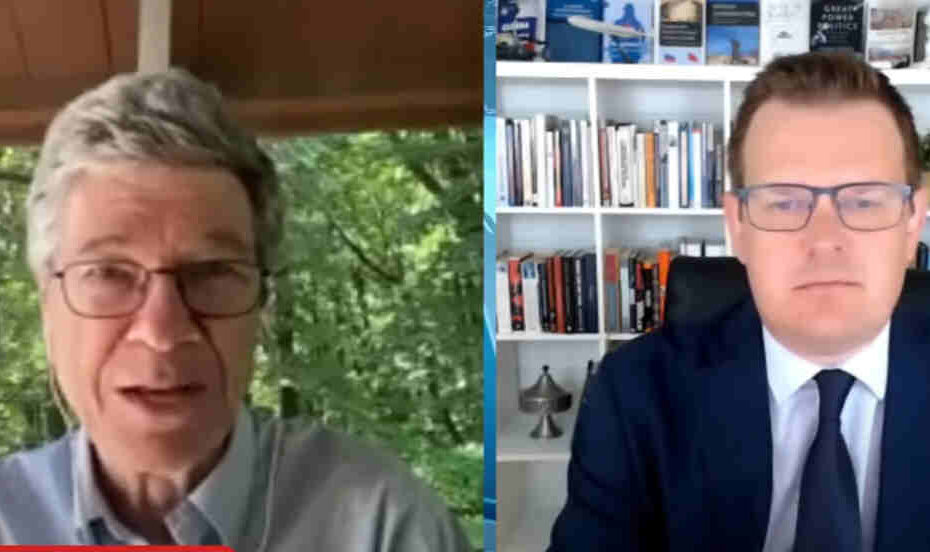
Read the full transcript of world-renowned economics professor and public policy analyst Prof. Jeffrey Sachs in conversation with Norwegian writer and political activist Prof. Glenn Diesen on “Death of Democracy & Prelude to World War 3”, July 29, 2025.
INTRODUCTION
PROF. GLENN DIESEN: Hi everyone, and welcome back. We are joined again today by Professor Jeffrey Sachs. So it’s great to have you back on the program.
PROF. JEFFREY SACHS: Glenn, great to be with you as always. Thank you.
The Current Global Crisis Landscape
PROF. GLENN DIESEN: Well, we have one crisis after the other now, all of which are escalating wars from Europe to the Middle East. It’s become common to casually speak of war against China. We have this doomsday clock for nuclear war which keeps moving in the wrong direction, so economic wars, social upheaval, I would say a crisis of political legitimacy, especially in Europe, and an absence of genuine diplomacy to find solutions to all of these problems which only continue to mount.
And I couldn’t help but notice that we got some people, including Steve Bannon, arguing that World War III has already begun in terms of all these conflicts coming together. How are you reading all of this combined? What are the core drivers pushing the world towards this crisis?
The Dangerous Transformation of Global Order
PROF. JEFFREY SACHS: Yes, this is indeed a very dangerous time as I think everyone on the planet understands. The world is disrupted in fundamental ways. In other words, the world is changing dramatically. In some ways potentially for the better because technology, the possibilities of making positive breakthroughs are very real. In some ways positive because poor countries are catching up, improving living standards in many places, especially in Asia.
But also disrupted extraordinarily dangerously, obviously by the spread of nuclear weapons, by the changing geopolitics. Because as the world has gone from first a so-called bipolar world of the US and the Soviet Union between 1945 and 1991 to a supposedly or allegedly unipolar world, at least as declared by the United States after 1991, we clearly are in a multipolar world today.
The United States, China, Russia and arguably other countries, India another, and I would say Europe, if it could ever get its act together, but it does not currently have its act together, would be another now compete for power, but without norms, without a shared vision. And indeed I would say in a world in which the west, meaning the US-led world, is rather desperately trying to keep its primacy or its hold on power over China, Russia and the BRICS countries more generally. So that’s a lot of disruption.
Add in the fact that we have climate disasters everywhere, an inconvenient point that is brushed aside by many, for example by Trump and others, because it just doesn’t fit other narratives but is extraordinarily real. Even China in Beijing experienced a massive loss of life in recent days from extreme flooding. The events in Los Angeles of massive forest fires earlier this year are among the largest measured catastrophes in terms of damages and losses that we’ve ever seen. This is happening all over the world.
The Crisis of Western Leadership
So the world is filled with disruption and at the same time the quality of leadership in the west is dismal. Donald Trump is an unstable, unpredictable, not merely transactional, but I would say person without any longer term perspective leading the United States right now. Europe is clearly without any leadership whatsoever. It’s in a state progressively of open collapse politically. Ursula van der Leyen is a disgrace.
And we saw this with the most recent so-called trade negotiations between Europe and the United States, where Europe just basically accepted US dictates. And so with the Western leadership terrible, with Donald Trump filled with the delusions of US power, with the rapid disruptions in technology, environment, in geopolitics, in economics, all over the world, with the spread of nuclear weapons, with the local, but not so local, I should say, absolute disasters such as Israel’s genocide in Gaza, aided and abetted by the United States and Europe.
All of this adds up to extraordinary instability and extraordinary danger. You mentioned the Doomsday Clock. I refer to it very often because it is our most clear and dramatic graphic of the world state of affairs. It purports or aims to measure how close we are to complete global disasters such as nuclear war or nuclear Armageddon.
And the clock hand is put by these experts at the Bulletin of Atomic Scientists at a mere 89 seconds to midnight, the closest to midnight or to disaster that the clock has been depicted since it was unveiled in 1947. In other words, we’ve arrived at this age of AI and advanced technologies and space technology and all this weaponry closer to global suicide than ever before.
Europe’s Dangerous Direction
PROF. GLENN DIESEN: Yeah, well, a good example of this though would be Europe in terms of lacking direction and leadership. I often point to Germany as a fascinating example because they’re now very casually discussing banning their opposition party about acquiring nuclear weapons. Something openly being discussed. Their goal for prosperity appears to be military Keynesianism. There’s now open support for genocide in Palestine and they’re speaking of war with Russia getting more involved.
And nobody speaks of peace anymore, so all is not well. Do you see something unique about Europe’s lack of direction, or is this a similar problem as the United States faces?
Europe’s Lost Independence: From Promise to Vassalage
PROF. JEFFREY SACHS: Well, first I would say that it’s a retrogression in Europe. It’s not that Europe has always been so awful in its politics in recent decades after World War II, which of course was one of the greatest calamities of history. Europe seemed to take note within Europe, not imposed from the outside, but within Europe that a different way was needed.
And the way would be peace, cooperation and creating a community, a European Community, that eventually became a European Union.
And Europe stood back up and not simply as a vassal of the United States. There were leaders in Europe certainly who spoke up and said the US is on the wrong track or the right track. The US was broadly an ally under NATO, but Europe was not subservient. There was independent politics.
And Germany is a case in point because Willy Brandt, for example, was a very independent and bold chancellor of West Germany who said we need a different approach to the east, the Ostpolitik. We need to have a cooperative arrangement with the Soviet Union not to see ourselves as doomed to war in Europe. And that opened up a new kind of politics that helped to give rise to Mikhail Gorbachev’s politics.
And I, as a young economist at the time, came to be part of the advisory groups to Mikhail Gorbachev and to Boris Yeltsin and to Leonid Kuchma of Ukraine when it gained its independence in the early 1990s. I visited German leaders in the early 1990s. It seemed that Europe was building a peaceful European home, as Gorbachev had said, “from Rotterdam to Vladivostok.”
In other words, the idea that the old divisions of the Cold War period would end and Europe and Russia and the former Soviet Union would find peace, would find collective security, and find economic shared prosperity through trade and investment seemed to be taking shape. I believed it in the early 1990s. I certainly did my best to help it come about. I advised many governments in Eastern Europe and my main idea there was that they would join this new union, but that the union wasn’t to just move the Berlin Wall a few hundred kilometers to the east and exclude Russia, but that this would build a true European home.
That was the idea, perfectly possible. Many European leaders were in favor of it. So it raises the question, Glenn, what went wrong?
The Neoconservative Takeover
And in my view, one major thing went wrong, and that is the United States leadership became completely delusional and arrogant, drunk on power, believing its own press releases that the US was now the sole superpower, the most powerful country that ever strode the planet, the new Rome, except surpassing Rome, the country that could do anything that it wants to do and conjoined with that Europe fell into line.
So those are the two things, in my view, that proved absolutely disastrous from the promise of the early 1990s in the United States. The neocons took power. And the neocons basically was a philosophy of the CIA, the deep state and some pseudo intellectuals, let me call them that, who said now the US runs the show. And they proudly took on the idea that yes, the US is the world’s policeman. In those words. Actually that used to be a derogatory idea. “Oh, the US pretends to be the world’s policeman.” But they said yes of course the US is the world’s policeman. We are the sole superpower.
For a while many in Europe said no, no, no, no, we don’t join you, for example, in the war in Iraq. The US war in Iraq, which was a war of arrogance, a war together with Israel to overthrow a regime for no real reason. But it was phonied up as a war against Saddam Hussein’s weapons of mass destruction. It was a disaster in destabilization, in loss of life and creating chaos in the world, in breaking apart the European common home.
But even then in 2003, there were voices in Europe that said no, this is not a good idea. Germany and France said no, we don’t side with the United States in this war. That was the last independence of Europe, however, because the neocons, George Bush Jr. who was president then, put the foot down and said Europe, get into line.
The 2008 Turning Point
By 2008, Europe was subservient to the United States, most dramatically at the Bucharest NATO summit that year in 2008, when NATO said that NATO would expand to Ukraine and to Georgia, which was the predicate, the setup for the war in Ukraine today. And Europe even in the memoirs of Chancellor Angela Merkel for one day tried to object. And then after the first day of the Bucharest summit, Europe folded its hand and it hasn’t been independent ever since.
Merkel said okay, we’ll go along with this. NATO enlargement was committed. Europe has lost its voice ever since that day. Actually German chancellors are one more pathetic than the next. Merz is now an open warmonger, completely unpopular, plummeting popularity because the public does not want this.
Parties like AfD, which are called extremist right wing parties are actually parties that say we don’t want World War III. This is all through Europe. The so-called extreme right is not the militarist right. It’s the opposite. The mainstream is the militarist faction now because it fell into line with the US neocons and lost its independence.
European Union leaders became vassals of the United States after 2008. Who does Ursula von der Leyen work for? Clearly the United States, not for Europe. She just exposed this again and this unbelievably ridiculous so-called trade agreement where Europe gave everything to the United States, even though Europe is a bigger region, 450 million people compared to 335 million in the United States. But Europe said, “We hold no cards, we can’t negotiate, we fold our hand, we give everything to the United States.” And that’s van der Leyen.
The Rise of Russophobia
So all of this is to say, Glenn, that Europe lost its way, it lost its independence, it lost its clarity. And one of the things that happened, just to add, is that Europe became in its rhetoric, partly guided by the US deep state, insanely Russophobic. Insanely Russophobic to the point that it cannot think straight honestly for one moment about how we came to this war in Ukraine, how we could get out of it.
If you try to say something honest about it, such as NATO enlargement, such as the west dissing and dumping the Minsk agreements, such as the US refusing to limit its deployment of anti ballistic missile systems on Russia’s borders. If you say anything like that, “Oh, you’re a Putin apologist.” Because that became the rhetoric of European vassal politics to the US deep state.
It’s very sad. But Europe lost its independence. And the trade agreement is the most vivid display of that. This is not an agreement between two major powers. This is an agreement between the United States and a vassal region.
The Warmongering Center
PROF. GLENN DIESEN: Well, I think it’s interesting what you said about the left and right because only on the, what we call far right or far left do they actually talk about peace. Instead, we now have the radical center, it seems. But this does appear to be the problem.
PROF. JEFFREY SACHS: The warmongering center. Yeah, yeah. If you aren’t warmongering, you’re deemed to be an extremist. It’s unbelievable and it’s so wrong headed. And now Europe has backed itself into the worst corner. Complete dependence, embarrassing humiliation to the United States on the one side and in the same week having a dismal regression of relations with China the same way.
So Europe is basically isolating itself, raising the fever pitch, completely lost. And this is terrible. We need Europe, we need a healthy Europe. It’s the opposite of what we have right now.
The Liberal Hegemony Trap
PROF. GLENN DIESEN: I think just the Europeans got too committed to the idea of liberal hegemony after the Cold War. That is, it created the assumption that the world would be a much more peaceful place if the liberal democracies of the west would simply dominate. And this created, I think, no political imagination for anything other than hegemony, which is problematic when the world shifts towards multipolarity, which is why you see this panic, I think, and the complete subservience to the US as evident by von der Leyen’s capitulation.
And it’s kind of strange to see the same people who called for cutting off economic ties with Russia, China now complaining that they had to fold and capitulate completely to Trump, but when America’s the only game in town because they severed all other relations, they don’t seem to see any connection there. But do you see it’s right?
The Arrogance of Power and Europe’s Predicament
PROF. JEFFREY SACHS: Glenn, it’s so interesting for me, you know, when I said earlier this year, and in fact, in a speech in the European Parliament, “Get your act together. The US is a threat to you. Understand this. Your Russophobia is backing you into a corner.” Oh, Mr. Sachs, this is propaganda. This is ridiculous. It plays out exactly that way. And they don’t seem to understand this.
And one of the things about diplomacy, it’s a very basic point. It’s diplomacy 101, or even before that, you talk to the other side to understand it, to try to even understand your own situation. Europe doesn’t talk to Russia, doesn’t talk, doesn’t have the most basic diplomacy stirs Russophobia. If you talk to Russia, you’re an appeaser. It’s ridiculous.
And this just backs Europe more and more into this pathetic state of affairs where it’s fearful of everybody and its great ally, the United States is coming and grab every piece it can and demand you buy our gas six times more expensive than Russia’s. “We’re going to take Greenland from you.” Just wait. Let’s see Ursula van der Leyen say, “Yeah, they only took Greenland, they didn’t take all of Denmark. It was the best deal we could get.” You can already imagine the words from Ursula van der Leyen in this way.
Advising Trump on Ukraine
PROF. GLENN DIESEN: Well, you advised governments around the world and Trump previously posted a speech of yours on social media related to the Middle East. But what would you advise Trump today to get out of this mess, for example, in Ukraine, because for some reason now he talks about only a ceasefire and Putin is not a nice guy anymore. I mean, this is the kind of language. So if you could advise him, what would you say?
PROF. JEFFREY SACHS: Well, first, the United States cannot dictate terms, period. So there’s an incredible arrogance of power that has been true of the United States for a long time. It was especially put into overdrive by the end of the Soviet Union in 1991. Trump said he is opposed to the neocons, but the arrogance continues. So Trump doesn’t like this. Trump doesn’t like that. “I give you 10 days. I give you 12 days. I give you 50 days.” Whatever it is, Trump’s idea is that he can demand the outcome. No.
Second, Trump said informally, privately, in discussions that his envoy, Witkoff had in Russia, supposedly, “Yes, we understand NATO was a provocation, NATO enlargement was a provocation.” But Trump is too weak to stand up and explain to the American people in Europe that NATO enlargement was a bad idea to Ukraine, a hopelessly bad idea. Dangerous, provocative, against promises that were made in 1990 against the premise of Ukraine’s permanent neutrality, which was the basis of its independence in 1991.
If Trump were a normal but strong leader, he would explain what’s going on. He doesn’t. I think privately there were glimmers that he knew that J.D. Vance knew, that his envoy knew, and so forth. And these were reported as private discussions. But when it comes to diplomacy, you have to state the case. It’s not all secret. It has to be with public backing. It has to be able to tell the warmongers like Lindsey Graham or Richard Blumenthal, the two senators who are big warmongers in the US and big recipients of funds from the military industrial complex, back off, because this is the real point.
The Ceasefire vs. Peace Distinction
Trump needs to say publicly, “Yes, NATO will not enlarge. That’s the basis for peace in Ukraine. Yes, the west should not have dissed the Minsk2 agreement and so forth.” And you build the political base for a real peace, as I think many people know that. Watch this. But probably not enough are aware. All the talk about ceasefire as opposed to a peace agreement is a misdirection.
Ceasefire means we stop, the fighting stops, but there’s no peace. So it can start up on our terms when we want it to start up again. What Russia has rightly been saying, correctly been saying is, “Let’s get to the root causes of this conflict and the root causes of conflict find a path to collective security so the fighting won’t resume.” That’s what a real leader in the United States would accept.
We’ve had real leaders that understand points like this. We had Franklin Roosevelt who understood points like this. John F. Kennedy understood points like this. Richard Nixon was able to make strategic decisions correctly. There have been others. But Trump unfortunately seems incapable of doing this. And partly it’s the continuing delusion, “I can announce sanctions against Russia in 12 days.” Come on. This is not even Hollywood movie material. But this is the way that bad movie. I mean, this is the way that the US is behaving right now, it is not only not conducive to peace, it’s conducive to spreading chaos, making demands rather than having diplomacy settles nothing.
Israel’s Criminal Actions and US Complicity
When it comes to the Middle East, this is the most painful and obvious situation. Israel is a rogue, criminal state, period. It is committing genocide. It’s murdering people before our eyes, it is starving children to death. None of this is complicated. What is tragic, of course, is the hold of the Zionist lobby in the United States. Exactly where that hold comes from, whether it’s money of donors, whether it’s Protestant evangelical voters, or whether it’s blackmail by Mossad on the Epstein list, who knows, it’s very hard to figure out.
But the right thing for the United States to do is obvious, which is to stand up and say Israel is committing genocide. It must stop immediately. The United States stops arming and funding Israel, period. Because there need to be two states, a state of Palestine next to a state of Israel now, period. And genocide must stop.
Well, I could probably give that advice forever. I don’t think Trump is listening. The hold of this madness on U.S. politics is not easy to understand. Even if you’ve been trying to figure that out for 50 years, even if you’ve been reading John Mearsheimer and Stephen Walt and others for decades. It’s not easy to understand how the US and much of Europe, including Germany, by the way, including UK effectively, are complicit in genocide today in Israel’s starvation of up to 2 million people in Gaza. Children dying before our eyes, people being killed by Israel, open fire, openly acknowledged, by the way, when they go to a feeding point. So how this hold persists and why, I can’t give you a definitive answer to it.
The Pattern of Doubling Down
PROF. GLENN DIESEN: But it does just seem that every policy is about doubling down though, because with Russia now, again, you have this 10 day ultimatum where Trump can either have to be doing a very embarrassing reversal or end up in a very direct conflict with the Russians and Gaza. There’s either lay down your weapons or otherwise we will have to continue the destruction of the Palestinians. You hear the same rhetoric with Iran as well. That is Trump pointing out that Iran’s still talking about enrichment, which means that they perhaps have to go bomb again. There’s no one speaking, there’s no genuine diplomacy. It’s quite depressing.
The Multipolar Reality
PROF. JEFFREY SACHS: And at the basis of this again is arrogance. The overriding arrogance of the U.S. now it’s embodied by Trump. But what Trump represents is, as I’ve said, a bit ambiguous, whereas the power that drives this, definitely. The CIA, Mossad relations go back many decades and are very, very strong. The deep state in the United States is absolutely real.
But the point is this arrogance that the United States will settle the terms in the Middle East, it will settle the terms with Iran, it will settle the terms with Russia, it will settle the terms with China. And this is dangerous and delusional because we are in a multipolar world. By the way, simply the fact of nine nuclear armed countries means a multipolar world, because we’re not in a world where conventional arms dictate our future, but where a nuclear war could end everything. And it could come from anywhere. It could come from any one of these nine countries.
We need diplomacy, and we need to be speaking honestly, directly and on a basis of some measure of standards and mutual respect among major powers so that we avoid disaster. Trump, I don’t think he has it in him, unfortunately. Which means that it’s going to be the harrowing fact that Trump will make demands and they won’t lead to results. That will be our reality for a period to come.
Of course, when Europe capitulates to Trump, it feeds this craziness that we have right now. It feeds this arrogance that’s very, very dangerous. If Europe acted like Europe and said, “Mr. Trump, for Europe, you’re the United States. If you want to do something mutual and bilateral, let’s discuss this. But we don’t unilaterally fold to your demand.” It would have made the world a lot safer. It would have made Europe a lot safer.
Are We in World War III?
PROF. GLENN DIESEN: So do you agree with Bannon’s sentiment that this could be a. We could either be in it, or at least a prelude to World War III. Or is it hyperbolic?
PROF. JEFFREY SACHS: Well, let me say in a strange way, because these are almost opposites in some sense. But Pope Francis used to say, years before Bannon has said it, that we’re already in World War III. Pope Francis was the world’s greatest person of peace, and he said already a decade ago that he felt we were in World War III.
Certainly the circumstances we have right now, you could imagine a wonderful historian such as yourself, or IR specialist such as yourself, writing in the aftermath of war. “Well, look, here are all the pieces. We could see it happening. We could see it spreading.” It feels in this sense like the 1930s. Of course, not to make glib comparisons, because history does not repeat itself, but it does rhyme, as has been said many times.
But the point is whether we’re in World War Three or in a period that could lead to such disaster. It’s undoubted the dangers that we’re in right now. We need diplomacy. Diplomacy means that great powers say we respect each other. We don’t make ultimatums. Remember, it was the ultimatum of the Hapsburg empire to its opponents after the assassination of the Archduke that was the prelude to and an ultimatum pushed ultimately by the German military high command. That was the prelude pushed on Serbia. That was the prelude to World War I.
Don’t make ultimatums, period. That’s an ultimatum. Please don’t make ultimatums. That’s the way you get to war. Don’t put on Truth Social “Russia has 10 days.” My God. My God. This is absolutely the opposite of what should be done right now in this world.
The Crisis of Our Time
PROF. GLENN DIESEN: Well, Professor Sachs, as always, thank you so much for your time and yeah, hopefully there will be some changes and make better choices. It feels a bit like the 1930s. I often think about Antonio Gramsci writing in the late 20s or early 30s, that he wrote, “The current crisis derives from the old world is dying and the new world cannot be born. And it’s within this intragnum that these morbid symptoms appear.” And it does feel like.
PROF. JEFFREY SACHS: Indeed, but it feels like it. But a new world based on multilateralism can be born. And that’s what we need to help to midwife.
PROF. GLENN DIESEN: Yeah, it looks like a very dangerous birth. So hopefully, yeah, could be a better time.
PROF. JEFFREY SACHS: So let’s talk soon and hope for some good news.
PROF. GLENN DIESEN: Thank you.
Related Posts