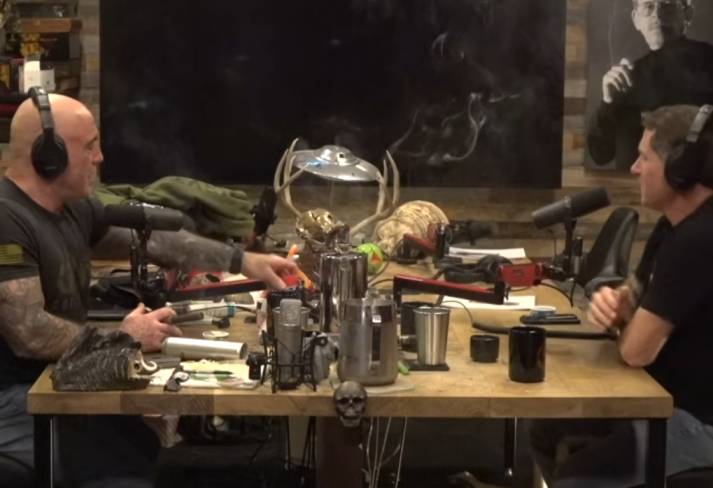
Editor’s Notes: In this episode of The Joe Rogan Experience #2453, Joe Rogan sits down with Evan Hafer, the founder and CEO of Black Rifle Coffee Company and a former Green Beret. The two dive into a wide-ranging conversation that covers everything from the nuances of high-end coffee culture and the “four waves” of coffee roasting to the technical side of archery and hunting gear. They also explore deeper societal concerns, including the rapid advancement of artificial intelligence and the potential risks of a “Manhattan Project” for super-intelligent AI. It’s a compelling mix of tactical knowledge, business insight, and philosophical debate, delivered with the characteristic curiosity of the Rogan podcast. (Feb 12, 2026)
TRANSCRIPT:
The Desk Collection
JOE ROGAN: Oh, man. What’s happening, baby?
EVAN HAFER: Everything. Nothing. All at the same time.
JOE ROGAN: I was just explaining all the things that are on this desk. It’s like everybody likes to give me something that sits here, which is kind of cool. Like Ed Calderon gave me this. It’s like a WD40 with a lighter attached to it. You can f*ing blast people.
EVAN HAFER: Is it like a self defense?
JOE ROGAN: He’s always got these things like cartel things.
EVAN HAFER: That looks like the Cartel 3D printed. Yeah, yeah, yeah. That’s cool.
JOE ROGAN: Yeah. I mean it’s a little portable flame drawer. Holy s*. Two common items. And then I think it was Luke Caverns gave me this. Is that who gave me this? The old mechanic? It’s from the Olmecs.
EVAN HAFER: Oh, is that what it is?
JOE ROGAN: Yeah. And then of course, my man John Reeves has always given me these mammoth things. I got mammoths now. This is actually from Colossal, but he gave me a 1911 handle.
EVAN HAFER: That’s legit.
JOE ROGAN: Yeah.
EVAN HAFER: Even though, do you have any 1911s?
JOE ROGAN: No. Yeah, I got 2011s.
EVAN HAFER: Yeah, of course. It’s a huge upgrade.
JOE ROGAN: Yeah. But you know, I’m sure it’ll probably be able to fit like you bring it to a gunsmith. It can make it.
EVAN HAFER: Yeah. Well, you know what you could do? You could have them make one for your bow. So you could put the bone on each side of your bow.
JOE ROGAN: Oh, I have that.
EVAN HAFER: You have it?
JOE ROGAN: Yeah. From Rattler.
EVAN HAFER: Yeah, yeah, yeah, yeah, yeah.
JOE ROGAN: This is another piece. Shout out to Handsome Rob Grips. He always hooks me up, gives me those Keep hammering ones.
EVAN HAFER: Yeah, those are cool.
Bow Grips and Customization
JOE ROGAN: Yeah, it feels better too. It feels better in the hand. It’s interesting. Like, Hoyt doesn’t have a whole lot of options. Like Ultra View doesn’t make their handles for Hoyt, but they make them for Matthews because he shoots Matthews. But it’s a nice handle upgrade. It really does like the way it sits in your hand. It really does feel like a little better.
EVAN HAFER: Are you still putting them on your Hoyt for everyone?
JOE ROGAN: The rattling grip.
EVAN HAFER: You do?
JOE ROGAN: Yeah, yeah, yeah. He just sent me some new ones and it feels better. And the bone, there’s something about the bone. It’s more tactile in your hand than the plastic.
EVAN HAFER: Well, I’ve been wrapping mine with that camouflage athletic tape.
JOE ROGAN: Oh, really? Yeah, Bomar sells stuff like that. He sells specific bow grip. It’s got a little bit of tackiness to it. But some people think you shouldn’t have that. They think your hand should be so relaxed that it should be able to slip around your hand so there’s like no torque whatsoever in your front hand.
EVAN HAFER: I don’t like that. I like to feel, I like to feel the dexterity of it.
JOE ROGAN: Right.
EVAN HAFER: I like to have a little bit of relief in the hand in the context of like, I got to have some grippiness to it. Just like a baseball bat or any other things. Any, even all of the like Glocks and 2011s. I’ll still do an upgrade on the stippling and create a little bit more.
But I’ve also got giant hands for a, well, I shouldn’t be, I shouldn’t say I’m small. Like I am 2 inches taller than the average Asian woman. So I don’t like to brag about it. I don’t want to come out with that right away. It just might seem a little bit egotistical.
JOE ROGAN: Yeah. But if you do anything, I think it’s just like whether it’s with archery, with anything with shooting, you just, it just has to register with you. It’s not going to be the same with everybody. I know dudes who just can’t get used to finger triggers and some dudes just love finger triggers and some guys just have to shoot a hinge and some guys just can’t do it.
EVAN HAFER: I shoot them all, man. Yeah, like I just have. So I got that dump bag now that I basically I’ll wear on the side and then I’ll do the hinge roulette.
JOE ROGAN: So I’ll just like reach in there.
EVAN HAFER: Reach in. And then I got to shoot a hinge or I got to shoot this. And the only way that’s that you don’t, or the mix up part. You’ve got to shoot the wrist strap. Right. You have to put that on. So yeah, you can’t just do shooter roulette with all of that.
Daily Archery Practice
JOE ROGAN: But that’s the wrist straps a little bit more involved. But I love having, I’ve been using the Wise Guy. I’ve been ever since our last hunt, I’ve been only using the wise guy. And I’m used to it now. It took, it took a while. I was hammering the trigger for a little bit after.
The thing is, it’s like with archery, once your form breaks down and then you try to compensate because you’re tired. Like, I think I should just limit myself to one hour, and after one hour, just stop.
EVAN HAFER: So is that what you’re doing every day is basically an hour?
JOE ROGAN: Yeah.
EVAN HAFER: A little bit more.
JOE ROGAN: Yeah, but it’s when it’s more. It’s when things go sideways. Like, I’ll give myself like a few minutes break to let my arm relax, and then I just, I’m just, it’s too much compensating because my arm’s tired.
EVAN HAFER: Right.
JOE ROGAN: And not enough. Especially because the bows. 84. Now I got the new one. That’s 90 pounds.
EVAN HAFER: Is that what you’re shooting every day?
JOE ROGAN: Yeah.
EVAN HAFER: You’re shooting 90 pounds.
JOE ROGAN: 84. 84 every day. I haven’t set up the 90 yet. It’s at Archery country.
EVAN HAFER: And then do you, are you going out to 100 plus every day too, or you stick?
JOE ROGAN: 85.
EVAN HAFER: 85.
JOE ROGAN: 85 is my standard in my backyard. As long as there’s no one wandering around. When people are wandering around, I go, you know, like this. Landscapers. I don’t do a long bomb.
EVAN HAFER: I’ve got my wife is redoing this little garden house in the back, so she won’t let me shoot at it anymore because she’s afraid I’m going to put an arrow through her little hut that she’s making. She’s actually doing all the work too. She’s got like a tool belt on, and she’s out there hammering away.
JOE ROGAN: Oh, that’s great.
EVAN HAFER: And everything. She’s doing all the work.
JOE ROGAN: Wow.
EVAN HAFER: So she’s like, you can no longer use this as your backstop because it was just a pile of s* that I could basically shoot arrows at.
JOE ROGAN: Oh, that’s a bad trade.
EVAN HAFER: It’s a super bad trade.
Backyard Requirements
JOE ROGAN: Yeah. I need a backstop. You got to off. Like, we were talking about, like, must haves for backyards. Like, I got to, I’m not living in a house where I can’t shoot at least 50 yards.
EVAN HAFER: No.
JOE ROGAN: I go out in the backyard, I get my range finder. I bring a range finder when I look at houses.
EVAN HAFER: Are you serious?
JOE ROGAN: 100%. I’ve been doing it for the last, like six, seven years before I bought this house. Well, when I bought the house in Austin as a big yard, I’m like, we’re good. I just had to find a spot. I was like, this is at least 100 yards from here to here.
EVAN HAFER: Have you ever punched the trigger and put one out in the river, I guess. You shouldn’t tell me.
JOE ROGAN: I never shoot towards the river because kayakers, right? You never, when some, because like, the kayakers, they like to go like, real close to the shore. Well, yeah, if you hear. That would suck. Oh, my God. I’d be in such deep. I would never do it. I just wouldn’t. Yeah, deep. Deepest of deep s*.
An ahole like me who’s always promoting archery, I shoot a kayaker with a field tip right through the f*ing forehead. See some poor lady, like.
EVAN HAFER: Like a unicorn running through. Running off the river.
JOE ROGAN: Oh, God. Oh, my God. I very rarely, I mean, if I’m shooting broadheads, I really know where I’m going. Yeah, I don’t f* around. But with field tips, I’ll launch some bombs, but it’s never in an area where there’s anything behind me.
EVAN HAFER: No, I don’t.
JOE ROGAN: It’s too risky.
Black Rifle Coffee Company Archery Program
EVAN HAFER: I had a little archery range in the back of my Salt Lake City building, and every, and I used to let everybody use it in the company. And then after you’ve worked for the company for a while, you’d get your choice. You get like, a staccato or a rifle or a bow.
And then we’re doing, we still do, right? We still do a lot of veteran adaptive athlete shoots and the tactical games and the total archery challenges. So I’ve given away 100 bows, probably.
JOE ROGAN: Oh, that’s awesome.
EVAN HAFER: Company.
JOE ROGAN: Do you let them. Here’s their brand and the whole deal.
EVAN HAFER: No, no, no. We partner. We partnered with Hoyt on the last batch, then we partnered with PSE. We partner with kind of anybody that wants to go in 50/50 on us, right?
JOE ROGAN: Oh, great.
EVAN HAFER: But then we’ll make them black rifle custom. Right. So it’s cool. Camouflage, little branding on it. But here’s the downside of that, is when you got a bunch of people shooting in the back. I had a storage facility in the back. There were always arrows in this storage area.
And so finally our general counsel came to me. He’s like, no more. You got to stop. You can’t shoot any more arrows. So I banned it for everybody except for me. Me, Logan, Matt. Basically, the people that could either absorb the legal fees or at least explain it away.
The Importance of Consistent Practice
JOE ROGAN: Well, the thing about archery is it’s such a, it’s a skill that 100% degrades. Like, you have to stay on it, and you just can’t trust that everyone’s staying on it.
EVAN HAFER: No it’s even hard for me. If I take three weeks off. I was having that. A little bit of tendinitis in my left elbow. So I took like, a month off after hunting season. And you put it back in your hand, and it feels almost like a foreign object.
JOE ROGAN: I know.
EVAN HAFER: It feels horrible. It’s just gross. Until you have at least three or four days of shooting consistently back into the groove, you can’t put the arrow where you want. It’s just three weeks off.
JOE ROGAN: And it feels to me like the more consistent I am in off season, like, the entire year, that’s the, those are the years where I’m really shooting my best. You can’t just get back on the bow like, a month before you have to go hunt. You can’t do it.
EVAN HAFER: I can’t. I know guys that can. Guys that I grew up with that have been shooting since they were nine. That’s right.
JOE ROGAN: But they’re really good shots. Imagine how good they would be if they did it all the time.
EVAN HAFER: Yeah.
JOE ROGAN: Like, a guy like Cam, like, he’s not taking any time off.
EVAN HAFER: No.
JOE ROGAN: He’s shooting every day.
EVAN HAFER: But that part. He takes pleasure in the pain, too. He doesn’t take time off because he’s.
JOE ROGAN: That would be relaxing.
EVAN HAFER: It’d be relaxing. Like, imagine just imagine that, like, Cam Haynes on vacation, his feet up, you know, drinking on the beach. Is that even like a, no, that’s not even a thing.
JOE ROGAN: I’ve gone on vacation with them.
EVAN HAFER: Have you really?
JOE ROGAN: Yeah. But when we went vacationing in Lanai, where we could bow.
EVAN HAFER: Yeah.
JOE ROGAN: Yeah. So we would bow hunt at least once a day. Because Lanai, you know, you’ve been. It’s crazy. It’s one of the craziest places on earth. Great for people that don’t know. There’s 3,000 people and 30,000 deer.
EVAN HAFER: Yeah.
The Origins of Axis Deer in Hawaii
And they were given by King Kamehameha to King Kamehameha by whoever the head dude was in India. He gave him a gift of axis.
EVAN HAFER: Is that where they came from? I didn’t realize that was the actual timeline.
JOE ROGAN: Yeah. And they’re everywhere. They tried to reintroduce them, try to introduce them to the big island. I know Shane Dorian was all pumped about it, but then they eradicated them. People killed them. They said they were invasive.
EVAN HAFER: I think they need to be everywhere they can be.
JOE ROGAN: They’re delicious.
EVAN HAFER: Delicious. They’re the most delicious of the deer.
JOE ROGAN: Of course, next to elk. For me, it’s elk and then axis. But axes are the most challenging to hunt. They’re the fastest things I’ve ever seen in my life. They move so fast, it doesn’t even make sense. It’s like, how are you doing that? You could dodge an arrow from 30 yards away and the arrow’s not even close to them when it gets there.
EVAN HAFER: I had a female bedded at 30 and she jumped the string on her bed at 30 yards. That was my first shot. And I realized, holy s*. Yeah, they’re different. I’ve got to up my game.
JOE ROGAN: Well, it’s like they evolved with tigers.
EVAN HAFER: Oh, yeah, yeah.
JOE ROGAN: That’s the thing. It’s like you got to be able to go.
EVAN HAFER: You want to imagine how tough you would be to be involved with tigers.
America’s Softness Problem
JOE ROGAN: Well, that’s the problem with America, period. It’s like there’s not enough. There’s too many people running around with zero physical challenges and they’re so soft. Like, there’s a giant percentage of our population that is so soft.
And if there was like a, if the world went nuclear, we lost everything. And then it was like hand to hand battles. Every country could invade America. Once we run out of bullets, every country can f* us up.
EVAN HAFER: Yeah, right. You can walk around, I think, well, that’s, you know, with coffee, right? The best coffee shops are like, it’s so much stuff on Instagram. It’s so funny because you walk into a coffee shop and if you see the craziest looking freak, it’s going to have the best coffee.
JOE ROGAN: This is so left wing weirdo. F*ing lip rings.
EVAN HAFER: Oh, yeah. How many nose rings do you have? How many colors do you have in your hair and how many pronouns do you have? Because that’s like, you’re going to make the greatest espresso I’ve ever had. And that’s the joke, right? Because I’ll go cruise around, like in Austin for the last couple of weeks.
JOE ROGAN: You see a dude who’s jacked with a hand tattoo, he’s going to make you a bulls* coffee you pour over.
EVAN HAFER: I mean, I can just pour it over, you know.
JOE ROGAN: He’ll make you some cowboy coffee. He’s got one of them tin pots you put on the fire.
EVAN HAFER: Take his sock off or something. I’m good. I’m all set, man. Yeah, I’m all set.
JOE ROGAN: What is it about baristas? Like, how did that become such a left wing, safe place?
The Evolution of Coffee Culture
EVAN HAFER: You know, I don’t know. I think the origin of it comes from San Francisco, Seattle. Right. All the, we’ll say the left wing, left coast, all of the woke. Yeah. Because that also drove most of what I would say is the third and fourth wave.
Because there’s 1, 2, 3, 4 basic waves in coffee before a third and fourth wave are the most recent. Fourth wave would be considered single origin. Very lightly roast coffees. And you’ve been to these coffee shops, you know what they look like. It takes you 15 minutes to go get a cup of coffee. They typically won’t even talk to you. They look down at the computer screen. But it’s going to be decent coffee, right.
So if you go first wave, which is going to be like Folgers, Maxwell House, that’s like been around for 100 years. That’s a commodity coffee. It’s going to have robusta, it’s going to be darker roasted. That’s going to be first wave.
And then second wave would be experiential. So it’d be more like Starbucks kind of. Second wave would be experiential, dark and then third wave would be more artisan micro lot, single origin.
And fourth wave is kind of a mix of the best in third wave that really activates your senses in the sense of like now they’re doing anaerobics so they’re using things from like wine and beer and they’re developing all these different profiles.
But that artisan craft, the genesis in like San Francisco and Seattle. From third wave they took on identity politics and then drove it through the trade. It’s pretty impressive. It’s so weird because if you go anywhere you can get amazing cups of coffee, you’re just going to like wade through the wokeism to go get it.
JOE ROGAN: Yeah, I can’t go there.
EVAN HAFER: No.
JOE ROGAN: I was at a Starbucks the other day and two lesbians walked in. They saw me and they left.
EVAN HAFER: What? That’s how bad it was.
JOE ROGAN: They said, we can’t, we can’t do this.
EVAN HAFER: Seriously.
JOE ROGAN: They looked in my face and they said, we can’t do this. And they left. I was like, I’m a big fan. Yeah, big fan of your work.
EVAN HAFER: Big fan of your work.
The Starbucks Problem
JOE ROGAN: I had a cup of coffee from Starbucks, which I rarely go into but was with my family and it was so bad. A cup of black coffee, it’s all I drink. I don’t put anything in it. I was like, this is like not drinkable. It tastes like s*.
Which is like everybody throws a bunch of cream in there and a bunch of sugar in there and you get your caffeine and it tastes like what you like. But when, if you just try to just drink coffee at Starbucks, it is such a bad product. And that doesn’t have to be like that.
EVAN HAFER: Well, part of the problem is it’s burnt over roasted because they know it’s going to have cream and sugar in it.
JOE ROGAN: But why over roast it then?
EVAN HAFER: Because you can make a consistent profile. And it’s just consistently very dark and extremely acidic, basically, and that becomes the consistency in the product.
JOE ROGAN: Do you think people have this thing in their head that the darker the coffee is, the stronger it is?
EVAN HAFER: Yeah, of course. That’s one of the huge misconceptions.
JOE ROGAN: Right.
Coffee Misconceptions
EVAN HAFER: So let’s just bucket the misconceptions in here, which is, you know, coffee is not a bean, it’s a fruit, so it’s a cherry. And then you roast the pit. So the second one would probably be, the darker you roast something, the more caffeine it’s going to have, which is absolutely not the case.
JOE ROGAN: It’s the opposite.
EVAN HAFER: It’s completely opposite. Because you got two genetic strains. You’ve got Robusta and Arabica. Robusta is smaller bean, it’s got more caffeine. It’s also more bitter. Arabica probably constitutes probably 60 to 70% of the world’s coffee, but it’s bitter, more flavor, it’s got less caffeine, and it’s less acidic in general.
And then when you over roast it, you can kind of combine multiple lots, multiple variants of Arabica. And then you can make this consistent profile.
JOE ROGAN: So it consistently sucks.
EVAN HAFER: Yeah, yeah, yeah. But if you’re going to put cream and sugar in it. Yeah, nobody cares. Because they’re like, I just need something that’s going to serve as a caffeine vehicle for my cream and sugar.
JOE ROGAN: I know, but wouldn’t that be okay if you just had good coffee and did that and didn’t burn it?
EVAN HAFER: Well, I do. I think that’s where third, third wave and fourth wave. It’s more directly related to the quality of the coffee. It’s no cream, no sugar. And it’s more first and second wave. It’s cream and sugar. Because you’re going to have to cover up the inconsistencies.
JOE ROGAN: Well, some people just like it anyway because what they’re getting is a treat. They’re not thinking of it as like, I’m drinking coffee. Like they’re getting a treat.
EVAN HAFER: Right.
JOE ROGAN: Like, if you order a Frappuccino.
EVAN HAFER: It’s a milkshake. It’s a milkshake yeah.
JOE ROGAN: There’s tons of sugar, tons of caffeine, too. You’re like sitting in your cubicle.
EVAN HAFER: You got like 100 grams of sugar, 200 milligrams of caffeine. You’re skyrocketing with just energy until you crash. And then you need another one in the afternoon.
JOE ROGAN: Yeah. And then you’re just doing that all and frying your central nervous system. And then when you get out of work, you just die. You just go home and go home.
EVAN HAFER: And melt on the couch and watch some sports, man.
JOE ROGAN: Yeah, your insulin’s all up. You’re falling asleep.
EVAN HAFER: The coffee, the coffee nerd conversations just put half the audience to sleep, too.
JOE ROGAN: I don’t care. I don’t care.
Cross Training and Communication
EVAN HAFER: Yeah, yeah. It’s so funny, man. I’ll start talking about it. I’m like, I should not. Because I was a comms guy back in my previous profession, my previous life. And it’s so funny because when you talk about communications and just technology in general, and you start analyzing frequencies and spectrum analyzers or whatever you want to talk about, people’s eyes would just glaze over in the team room.
And I’m like, all right, well, you guys want to go blow some s* up? Like, why don’t we shift the topic? Because you guys don’t want to talk about this. I know you don’t want to hear about it. So in cross training, it’s just you try to keep people awake, basically.
JOE ROGAN: Well, there’s a lot of people that have a hard time focusing on something that isn’t exciting. For whatever reason, Even if it’s important technical details that’ll help you do things that are exciting, you know, it’s the delayed gratification, Right.
They’re the same type of people that don’t like to do cold plunges or don’t like to do certain things that, like, you’re not going to feel an immediate benefit. It’s going to suck while you’re doing it. So you put it off.
Like, you’ve got to have a mindset that there’s some things that suck that will make the things that are exciting way better. Yeah, like, for comics, it’s writing, like, sitting down and writing, you know.
Because a lot of comics don’t want to write. They just want to come out with ideas through the day and then work them out on stage. I’m like, that is great. You can do that. But you should also write because the ideas that come to you while you’re writing, they won’t come any other way.
And those are like little gifts from the universe. And the only way you get them is you got to sit down with a f*ing pad of paper or computer in front of you and come up with them. You got to sit down and start working and let the mind just slowly but surely pop them out.
The Writing Process
EVAN HAFER: How often do you do that?
JOE ROGAN: At least four days a week.
EVAN HAFER: For hour.
JOE ROGAN: Two hours. Yeah, at least. At least an hour. I try to write a thousand words, so it might be an hour, it might be two hours. And then out of those thousand words, I might get a paragraph. Like, there it is. That’s what I was looking for.
You’re basically looking for arrowheads in a field. You know, you’re picking up a giant clump of dirt and you’re shaking it out and washing it over and got one.
EVAN HAFER: So do you try that out on anybody before you actually.
JOE ROGAN: Now you just like, okay, this is the.
Comedy Development and Testing Material
JOE ROGAN: Pretty sure I got something. When I got something, I’m pretty sure I got it. But I don’t know what it’s going to be until the audience tells me when.
EVAN HAFER: You have your own club. So you can just try. You just, drive in. That’s Wednesday.
JOE ROGAN: Let me try. Even when I didn’t, I would go to the store. I would go to the, say, if I have a bit and it’s exciting, oh, I wrote something that’s good. I would go to the improv, and then I would go to the store. Maybe I go to the Ice House, right? I bang out a few sets. At least two in a night. You could travel around. LA was really good for that. Austin’s amazing for that. There’s seven clubs on my street now.
EVAN HAFER: What?
JOE ROGAN: Oh yeah, between my street and the neighboring streets. So you got us. And then right down the street is the Sunset Room, which Red Band owns. And then right up across from that you got Creek in the Cave, which is awesome. And then you got the Vulcan, which is right down the street. And there’s a bunch of other small rooms. There’s the Black Rabbit. There’s all these rooms that have comedy at least three or four nights a week.
So if you’re a guy or a girl coming up right now in Austin, you can really work. You could work. And they’re all paying. So you’re collecting 50 bucks here. My club pays more, my club pays the most. But all these different places, they pay actual money for you to do a set. At the end of the night, you got a few hundred bucks, you can get something to eat.
There’s all these comics that don’t have to do the road now, right? So they used to just have to do the road to pay their rent and for food. You don’t have to do that anymore. You could stay in town and really build up material and then go out on the road.
EVAN HAFER: Is the material going to shift? I know it’s regionally. You’ve got to have your, I’m not saying left or right. I’m just saying does the material have to shift based on where you’re at? So if you’re in LA, is the crowd a little bit different? The people are going to be more accepting, less accepting. Expect something a little bit different. You can hear you just, here’s the joke, let me run it.
JOE ROGAN: Well, the good thing is if they’re not accepting of an idea, maybe you should re-examine that idea and maybe figure out why am I, maybe I should figure out a better way to make this idea acceptable. Because there’s ideas where I’ll start it off and it just, oh, this isn’t going anywhere. And then I’m, there’s got to be an angle in here. And then I’ll find a whole other angle. Haha, now I have it.
And then I have to find an angle, what if I was a woman and I was watching this and I’m looking at this f*ing meathead on stage and I’m okay, guy, I got to figure out a way to get them to understand that just because I look like this doesn’t mean I’m a bad guy. Let me work this into your head first and then explain it from my perspective.
EVAN HAFER: It’s funny because I look like this, it doesn’t mean I’m a bad guy.
JOE ROGAN: An automatic assumption.
EVAN HAFER: Yeah.
JOE ROGAN: I mean, it’s an untold prejudice that men with muscles in particular are assholes.
EVAN HAFER: Right?
JOE ROGAN: Instantly.
EVAN HAFER: Yeah. You’ve got a very definitive look. And then as soon as you open your mouth, they’re assuming that you’re going to be just the complete asshole.
JOE ROGAN: Right.
EVAN HAFER: Yeah.
JOE ROGAN: A mean person.
EVAN HAFER: Yeah.
JOE ROGAN: Covered in tattoos, cage fighting commentary.
The Reality of Bombing on Stage
EVAN HAFER: I know that you can craft a joke because you’ve been doing this for forever, but is there a certain amount of pleasure that you get now from bombing sometimes? Bombing is terrible. Really?
JOE ROGAN: I always say bombing on stage is sucking a thousand ds in front of your mother. But the difference is, there’s probably a guy out there that likes sucking a thousand ds. Come on, Mom.
EVAN HAFER: 99.
JOE ROGAN: There’s a guy out there that would take some, I mean, these people are into porn and all kinds of things.
EVAN HAFER: You’re drawing the same parallel to bombing and people are just porn.
JOE ROGAN: Yeah. If you like bombing, you could hear into people in your mouth. It’s not fun. You don’t want people to have a bad time. They’re there to have fun. These people work. They’re working all day. They’re tired. You want them to have a good time. And the only way for them to have a good time is for you to do your job right.
But it has to sometimes not work well. And there’s this moment when I’m about to do a new bit. I’m, God, I don’t even want to do this. I don’t know where this goes, but I have to. You got to trot it out there and hope that you could find an angle.
EVAN HAFER: So you don’t try those on with your wife or something? Yeah, she’d just tear you down.
JOE ROGAN: She’d just stare at me. What is wrong with you? She and I have a very good balance because she’s so different than me. But has a lot of the same values as me. Discipline and she’s very smart and she’s interested in things, but we’re very different.
EVAN HAFER: Well, it’s so funny, because my wife and I will walk around, right? And I’m a very amateur comedian. Just around my friends. I try to. I try really hard, right? I’m not even close. I’m just, I specialize in stupid s* that I say. Basically. That’s where I’m going with this.
And she, when I get her to laugh, that’s, that means way more to me than, but my friends, sure, I can make them laugh. I can make my employees laugh. I kind of pay them to. But when my wife laughs, that means it’s f*ing funny.
JOE ROGAN: That’s legit.
EVAN HAFER: It means something, right? It’s legit. She’s a one person crowd, right? So we were walking around, I was talking about, have you seen that Bert Kreischer Freeburg. Have you seen his new series?
JOE ROGAN: I’ve only seen trailers, but everybody that saw it loves it.
EVAN HAFER: It’s really funny, man. And so I was, we should watch this. You should check it out. She watched five minutes. She’s, this is such a dude show. F* it. I’ve never watched, but it’s the same. It’s what I want to watch and I think is funny. She’s absolutely not. But then she wants to watch some true crime thing around it, a dude that killed his wife. And I’m, they love it.
JOE ROGAN: Why do they love that?
EVAN HAFER: It’s so weird.
Women and True Crime Fascination
JOE ROGAN: It’s genetic that they love it because my kids love those.
EVAN HAFER: Really?
JOE ROGAN: They love serial killer expose shows and all these true crimes.
EVAN HAFER: And I don’t like any of that.
JOE ROGAN: I was talking to my daughter about it and she said, because girls don’t do things like this. So we kind of want to see what’s going on in a man’s mind that makes him. It’s such a mystery. It’s such a mystery. Most men can imagine a scenario where there’s a bunch of people that did some horrible s in a room and you just go in there and fing kill all of them. Most men.
Most men can say, oh, yeah, there’s a place. There’s a place, if someone did something and I knew they did something and they’re in that room and they need to go, they need to go, right? Most women can’t think like that. They don’t think like that. It’s not inside their head.
And then there’s the darkness of it. These aren’t men that are doing something to someone who deserves it. They’re just doing it to vulnerable people. They’re just evil creatures who just want to go out and hunt vulnerable people. And I think women want to know that there are men like that out there that are so different than them. So they can put it their head. Okay, serial killers are real, right? These true crime shows have shown me this and I want to know what to look for.
EVAN HAFER: Right?
JOE ROGAN: That’s what I think.
EVAN HAFER: Whereas, have you ever spent a second of your life in fear or fearing a serial killer?
JOE ROGAN: Not really, no.
EVAN HAFER: It’s not a realistic fear.
JOE ROGAN: But if I was at a truck stop and there was some f*ing shady dude that came into the bathroom after me and he was waiting outside and didn’t look like he needed to use the bathroom, I’d be 100% on guard. There’s people that will just randomly kill people just for a thrill and get away with it. And I think there’s way more of them getting away with it than they’d like us to know.
Here’s a good example in Austin. What is the actual number of people who have bodies that have been found in LA? Put this into our wonderful sponsor, Perplexity, before it becomes the digital God that takes over the universe. This AI. What are the numbers of people that have been found drowned in Lady Bird Lake over the last three years? It’s something crazy.
EVAN HAFER: Is it really?
JOE ROGAN: Yeah, it’s 30.
EVAN HAFER: I thought this was just a funny joke for Tony to talk about.
JOE ROGAN: Oh, no, no, no.
EVAN HAFER: It’s a real thing.
The Lady Bird Lake Mystery
JOE ROGAN: It’s real, right? It’s real. So the cops don’t want to say it’s a serial killer. They think it’s because it’s over by Rainey Street. A lot of people are partying, but the bodies keep piling up. 38. What?
EVAN HAFER: They want to say it’s not a serial killer.
JOE ROGAN: Since 2022, data showing at least 38 bodies found in or around Lady Bird Lake. Separate map based analysis of Lady Bird Lake deaths. Downtown area reports four deaths in 2022, five in 2023, five in 2024, two in 2025. So this is downtown area. These map numbers focus on a specific stretch of the lake. While the 38 body figures covers all bodies found in or around the lake in that period. These might be right near that bar area, right on Rainey Street. Or other parts of the lake.
EVAN HAFER: So they’re basically saying these guys get drunk and they end up passing out in the water.
JOE ROGAN: I mean, all you would have to do is get someone drunk enough where you could hold them underwater. It’s not, I mean, if you were a guy who wasn’t drinking, or you had a really good tolerance, or you’re a big person. No evidence of serial murderer. Says the patterns match typical accidental drowning risks. Young adult men, nightlife, easy water access.
EVAN HAFER: Or.
JOE ROGAN: Some guy was drowning gay guys.
EVAN HAFER: Could be.
JOE ROGAN: There’s a lot of them are gay. A giant percentage of these guys are gay.
EVAN HAFER: Yeah.
JOE ROGAN: Yeah, because it’s near a gay area. That’s the gay. Rainey street is the party area where there’s a lot of gay bars.
EVAN HAFER: That’s why it’s such a funny joke for Tony.
JOE ROGAN: Yeah, well, it’s a weird thing, man. It’s a weird thing because at what point in time does someone have to get caught before they say, oh, Jesus, these weren’t just a coincidence someone was drowning people? Because I don’t think it was a common thing. I think you maybe get one a year. Some drunk hops off a boat and doesn’t know what he’s doing and drowns. That does happen. But this is not that. This is way more. 38 bodies in a few years is kind of kooky.
EVAN HAFER: Well, and how many of those, if you think about it, right. How many serial killers are out there? Because FBI, obviously, they’ve done the analysis on it. There’s probably a hundred, two hundred, three hundred active serial killers at any point in time.
JOE ROGAN: Always. There’s always. Yeah, always has been.
EVAN HAFER: And most of them will all say, yeah, I wanted to get caught, or, yeah, it took you long enough. Like, I was getting sloppy.
JOE ROGAN: Right.
EVAN HAFER: My murder lust took over.
JOE ROGAN: There was 200 since 2004.
EVAN HAFER: Oh, my gosh.
JOE ROGAN: What? Oh, my God. Autopsy report found alcohol present in a large share of the cases, sometimes at levels above the legal driving limit, which is not much, by the way. Legal driving limit is like two drinks. And police specifically describe most rainy street area drownings as alcohol or drug related.
I’ve heard people getting, you know, dosed. They get, like, roofied and whatnot. And they’re like, I’ve heard a lot. Too many cases. Never in a city have I lived. I’ve heard that many people saying they’ve been roofied.
Yeah, no, I think it’s. I don’t think it’s specific to here. I think it’s everywhere. It’s GHB, I think, is a lot of it. People are dosing people up with GHB. That’s a big one. How many serial killers are there? Quit. Yeah. How many active serial killers do they estimate are in America right now? Let’s guess 10.
EVAN HAFER: You think 10? Yeah, I think 100.
JOE ROGAN: Whoa.
EVAN HAFER: Yeah, I’m going 100. This is like a Wheel of Fortune type scenario.
JOE ROGAN: Yeah, man. Holy. 100’s nuts.
EVAN HAFER: If it’s a hundred, I think it’s 100.
JOE ROGAN: That’s crazy.
EVAN HAFER: 300. Interesting, huh?
Serial Killers in America
JOE ROGAN: 25 to 50 at any given time. Wow. Okay. Range reflects killers who have committed at least two murders with a cooling off period and are still operating undetected. I like the cooling off period. Maybe I need to take a break. Scrubbing the f*ing blood out of the inside of your fingernails.
Serial killings make up less than 1% of U.S. homicides. Overall numbers peaked at around 300 in the 1970s, 1980s. There was 300 active serial killers in the 70s and the 80s. I bet that was because that was when it was like Son of Sam, you know?
EVAN HAFER: Was it trendy?
JOE ROGAN: Yeah, I think it was probably a lot of bored dudes just didn’t like working in an office.
EVAN HAFER: It’s like Ted Bundy and Sam. All those guys were like the green.
JOE ROGAN: All over the news. All over the news. Yeah. It was huge. Why are there fewer serial killers now than there used to be? What was the answer? That’s probably just because it’s easier to get caught now.
EVAN HAFER: People are probably more afraid to try. Yeah, because you think about all the technology and the surveillance. Like you get rolled up.
JOE ROGAN: Yeah. You get a. I think the creepiest one was that dude who studied serial killers in college and then went and killed those girls at that dormhouse. You know that story? What was that in Seattle? I think it was Idaho.
EVAN HAFER: Yeah. It was Ted Bundy, right?
JOE ROGAN: No, no, no. Recent one.
EVAN HAFER: Different. Oh, it was recent.
The University of Idaho Case
JOE ROGAN: Recent. Yeah. He knew the people that lived there. He studied. What did he study exactly? In college, like he was studying it. Like he was trying to learn how to not get caught. Oh, yeah. This guy. This f*ing dude.
EVAN HAFER: Whoa.
JOE ROGAN: Horrific new details about the final moments of the four University of Idaho stabbing victims.
EVAN HAFER: Oh, gosh. So that’s where I went to school. That’s University of Idaho.
JOE ROGAN: He stabbed the four at least 150 times in total.
EVAN HAFER: I didn’t realize that was like the case from Moscow.
JOE ROGAN: Yeah. Jesus Christ. Yeah. This sick f*. So this guy, he was studying it in college, so I forget what? Criminal justice? Let’s see if we could find out. But it was very clear that he had been planning this a long time.
And there was also a possible connection to him and some murders from the Pacific Northwest that they. He knew the people. People died in a kind of a similar way. He might have gotten away with it up there.
EVAN HAFER: Right.
JOE ROGAN: So he tried it up there and then went to Idaho. PhD, criminology student.
EVAN HAFER: Oh, my gosh. Well, that makes sense.
JOE ROGAN: It does? Yeah.
EVAN HAFER: So he’s educating himself on how to get away with it.
JOE ROGAN: He was that guy that if you had your comms class, he’d be sitting there like this.
EVAN HAFER: He’s like, way into it.
JOE ROGAN: Yeah, way.
EVAN HAFER: Yeah, yeah. Oh, okay. Yeah, yeah.
JOE ROGAN: He wanted to know the details.
Pacific Northwest Serial Killers
EVAN HAFER: Pacific Northwest is like, that’s a spot. These guys love it up there. I don’t know if it’s like the rain, you know, like.
JOE ROGAN: Well, we had a lady that was connecting it. She came on the podcast and she was connecting a bunch of serial killers from a very specific area that did a lot of. Was mining. Right. Wasn’t it mining? And the industrial pollution.
EVAN HAFER: Oh, so it was like increased lead or something. Right. In the water or something.
JOE ROGAN: What was the processing of it like?
EVAN HAFER: Oh, the one of those.
JOE ROGAN: When they’re burning it.
EVAN HAFER: Yeah.
JOE ROGAN: What’s that called?
EVAN HAFER: Leaching?
JOE ROGAN: Yeah, it was lead, but it was other stuff. It was other stuff. Like there’s arsenic in it and there’s a lot of. But what am I looking for? Not what is it? Why can’t I come up with that term? The plants where they burn all the shit. Power plants. What’s the term? God damn it.
EVAN HAFER: I don’t know.
JOE ROGAN: What’s her name? Caroline Frazier.
EVAN HAFER: Yeah, maybe Paul would know if he got Stamets on here and she could talk about. He could talk about the mushroom or the fungi in the Pacific Northwest. Maybe it has something to do with it.
JOE ROGAN: I don’t think so. I think that’ll probably stop him from doing it. But her take was that there was all these places. What a minute. What is the term I’m looking for where they incinerate, like a power plant, like a coal plant. There’s a term. I can’t remember what it is.
Anyway, they’re releasing incredible amount of toxins in the atmosphere, and a lot of the shit is coming down in rain. It’s getting in the ground. All the ground around there is all polluted, right? Everything’s polluted. And so what her take is that all these people have suffered chemical pollution. And a lot of that chemical pollution leads to all sorts of weird psychological disorders and psychosis and all kinds of shit depending upon the levels of exposure.
EVAN HAFER: So this is why you have an increase of serial killers in the Pacific Northwest. This is interesting.
JOE ROGAN: Yeah, there was a bunch of power plants up there, interesting coal plants and smelting and, you know, just a lot of mining. There’s a lot of mineral rich resources up there.
EVAN HAFER: And so I should be concerned because I spent most of my life up there. Well, half of it, at least.
JOE ROGAN: Yeah, it depends. I think now they’ve cleaned it up though, like she was connecting it to a long time ago. But there’s areas back there where she was saying that they do an analysis of the soil and it’s completely f*ed.
Seattle and Portland’s Decline
EVAN HAFER: How long has it been since you’ve done Seattle?
JOE ROGAN: Oh, I haven’t been back in a while. I did the Tacoma Dome with Dave Chappelle. We did that right before the pandemic popped. And I really haven’t been back. It’s just like once that whole Chaz thing went down and they locked off the block and the mayor said, maybe it’s the summer of love or maybe you’ve got some fing crazy people that you’ve empowered to take over a giant swath of your city and you’re cool with it and you’re the fing mayor.
And by the way, she is an upgrade compared to their current mayor. The current mayor is that choice is insane woman who’s never held a real job. She’s been living with her parents. She’s 40. They pay her bills. She’s a socialist. She rides a bike, she’s even on a car. And now she’s in charge of what? $7 billion budget? Like, what is that?
EVAN HAFER: Makes sense.
JOE ROGAN: Yeah.
EVAN HAFER: Two thumbs up, Seattle. Congratulations. You’ve done a great job.
JOE ROGAN: I don’t know where those places go, those places that have gone like full into Wokeville. Like, a buddy of mine just went to Portland and he was like, bro, it’s bananas. It’s like a complete mental asylum spilled out onto the streets. Not just the campers, not just the open air drug users everywhere. Because for a long time they decriminalized everything in Portland.
So everybody ramped it up a notch and moved to Portland. Because that was a place where you could do drugs and not worry about anything. But he was like, all the regular people are cracked.
EVAN HAFER: The place, like spending as much time as I have in Seattle, which I used to live there, I loved that city. Late 90s, loved it. Oh, it was amazing.
JOE ROGAN: Great. It was one of my favorite places to visit such a cool spot, cool people.
EVAN HAFER: And then you saw this flip and it was right around 2010 is when things really flipped over. And that to your point, they had your car was your domicile, so you couldn’t get a parking ticket. So you could basically live in front of somebody’s house in a parking spot and they couldn’t write a parking ticket.
JOE ROGAN: That started in 2010, give or take a couple years.
EVAN HAFER: And so I went back to my. I had a house up there for a while. And the week, the day I decided that I was going to sell this place, like we fly up there. I’ve got my daughter, she’s like a year old. My wife and I are walking down the street and this is a part of the city is called Ballard, which is beautiful part of the city, tons of like old bars. Awesome place back late 90s, early 2000.
But then there was a camper in front of my condo and then there was a naked man with a tennis racket with his. My daughter’s a year old, his dick’s flying around. And my, my, my one year old’s like, I’m holding her, like walking away from the other end, he’s got a tennis racket, he’s like planting the US Open in his head, whatever he’s doing. And then on the corner, no less than 50 feet away, there was a half naked lady like taking a shit. And you’re like, nah, time to leave. I think this is. We’re all good here.
JOE ROGAN: We had an issue like that in California for a while where when the economy started to go south, now this is pre pandemic as well. We started having these campers camp out right in front of our studio and they would. The studio where we had in LA, even that place, it was the warehouse. We had a big lawn in front of the warehouse and these guys would spread out on the lawn.
So they would park their camper there and then they would like cook out and they would lay out. And so like, you’re in this bill, you’re asking people to walk past these people to go do your podcast in this big a warehouse that I had leased. And I was like, why are you doing this? Like, you can’t be doing this. You can’t just use my lawn as your front yard. Like, this is crazy. I mean, spread out, dude, they had shit laying out there.
EVAN HAFER: There’s nothing you can do.
JOE ROGAN: Well, there was. Oh, really? Yeah. We contacted the police and the police eventually they realized this is not a good thing and they moved them all, but they moved them to different parts of town. And so then you would drive to like the more industrial areas of town that didn’t. Like our place was like semi industrial. There was a bunch of warehouses, but there was also a bunch of like foot traffic businesses, restaurants and stuff like that.
And so they moved them out of there. But if you go into the deeper industrial places where they have factories and stuff, they were, they were there like whole blocks of them where you just have campers laying out and just open meth smoking. These people are just full on meth heads that had just started a community of fellow meth enthusiasts with campers.
And a lot of their campers didn’t even run. They could just get it to the spot, wherever it was and then they would steal power. You know, every now and then the dude would die because he didn’t know how to do the wires right. And he’d get cooked.
Van Life vs. Meth Life
EVAN HAFER: Yeah, that’s right. It’s the same where we were at in Salt Lake. I’d have full time security out in front of the, literally in front of the building.
JOE ROGAN: Our concern was when we left, it was like if we left at night and someone broke in, it would take forever for cops to show up and do something about it. And so I was like, you can’t just, you can’t have these guys knowing that famous people and high profile people are going to be at that spot and you’ve got open meth smoking right in front of the place. Like this is too crazy. Too unpredictable.
You know, look, I don’t care if you live in your truck. It’s probably cool if you’re a guy who’s checked out of society essentially and you just like playing pickleball all day and you live in a camper, who cares, go and do that. But once you start engaging in meth smoking and then it’s always theft. Theft comes with meth smoking and there’s a lot of break ins in the area. And it got to a point where the cops had to do something. So credit to them that they did.
EVAN HAFER: It’s almost the difference between vanlife and hashtag methlife. Yeah, there’s a big difference, right?
JOE ROGAN: Van life is like you want to be a guy who’s not saddled down to one particular spot. You have a place that’s in this van that has a bed. You have a little tiny kitchen area, you have a little portable fridge. It’s all you need. I don’t need a f*ing house. Just travel around. It’s probably fun. The freedom of it, you know.
Like Alex Honnold, that crazy dude that just climbed that tower in Chinese Taipei, he used to live like that for a long time. He had a big van. He would park in his friend’s driveway sometimes and he would just travel to trail heads and live out of his van.
The Minimalist Attraction
EVAN HAFER: That’s the minimalist attraction, right. Where you’re like, I don’t have anything other than what’s in my van or on my back. Where life is simple. I don’t have to organize anything. I can stay focused. I think that’s an interesting thought exercise, especially when you’re younger. Like, okay, cool. I can wrap my head around that.
JOE ROGAN: Yeah.
EVAN HAFER: And it’s completely respectable. A lot of these hippies, shouldn’t say that in the context of hippie dance around the flowers in my hair. A lot of these climber, crunchy guys, they are hard, committed, bad mofos.
JOE ROGAN: Oh, yeah.
EVAN HAFER: When they’re living on dog food. Like, there’s this great story about the founder of Patagonia where he went to the store, he was climbing El Cap. And I’m trying to recall a story from Outside magazine from 20 years ago, but in general circumstance, it’s what it is. Where he went to the store. He’s going to be climbing El Cap for months. And he’s just working on a specific route. And he went to the store to buy food. He only had 100 bucks or whatever it was, and dog food was less expensive. And he was like, meh, I can live on that. And he bought dog food and lived on dog food.
JOE ROGAN: He just lived on kibble.
EVAN HAFER: Yeah. So he could climb and stay out there longer.
JOE ROGAN: His farts were like, bro, you wouldn’t.
EVAN HAFER: Want to be behind that on this route. Right. You would not want to be climbing behind that guy. I’ll tell you that.
JOE ROGAN: Because I stopped giving my dog regular dog food a long time ago. But when he was younger, all my dogs, I would just buy the most expensive dry dog food. I was like, oh, this stuff is good. And then somewhere along the line, it clicked. I was like, wow. Wait, how can it sit there? How can it just sit in that bag for a month? That’s crazy. How could it sit on the shelf for years? That’s nuts. That can’t be good for you.
And then I started feeding them frozen food, and then they like that. But then I switched to farmer’s dog, which is human grade food, which is lightly cooked. They love it. That stuff I would eat. You smell it, it smells like food. It doesn’t smell disgusting, right? But regular dog food is terrible for a dog. It’s not good for them. So if you have to eat that stuff, that kibble stuff, and you’re going to travel around, your gut must be going like, what are you doing? What kind of chemicals are in here? What kind of preservatives? They’re just nuking your gut bio.
EVAN HAFER: The level. I, but I love the level of commitment. I love when people drift over into crazy to where their level of commitment and their passion translates directly into nothing else exists in their life. Where they’re willing to live on dog food to do the thing that they love.
JOE ROGAN: Fun.
EVAN HAFER: That to me is like, you’re an extremist and I respect it. You know what?
Fred Beckey: The Ultimate Dirtbag
JOE ROGAN: No, I can respect that. Do you ever see that movie Dirtbag?
EVAN HAFER: No.
JOE ROGAN: Pull up that movie Dirt Bag. It’s a great movie. It’s about a guy who essentially did that till he was dead. This guy just camped out on the ground in front of his friends houses most of the time. Didn’t have a car, just would just climb. That’s all he did. He was always mooching off people and he had very detailed. What was the dude’s name? Fred Beckey. Fred Beckey. The dude’s a legend.
EVAN HAFER: Yeah.
JOE ROGAN: So he had been doing this from, you know, the 1950s. Like he was an old a man. Look at the gnarled hands. Look at his fing hands. Solid from just climbing. Imagine that guy got a hold of your d, just rip it right off.
EVAN HAFER: Do you know who Mark Twight is?
JOE ROGAN: No.
EVAN HAFER: Okay, so Mark Twight, he was, I mean, one of the foremost names in Alpena. Like he’s written several books on it. He wrote a book called Kiss or Kill, Confessions of a Serial Climber back in the day. Very, very similar. Like in the context of, I would imagine the psychological makeup. And he started a gym called Gym Jones back in the day. And it was where a bunch of people, you had, it was invite only, so you could only get invited. And it was like a lot of special operations guys, CIA guys and professional climbers. Like everybody that was trying to push the envelope physically would go out and train with Mark.
And I’ve been friends with him for years. But anything Mark does, he moves from like, I’m going to be the best climber, like alpineering. I’m going to be the subject matter expert. He was a professional. He shot IPSC for a while. So he’s a professional pistol shooter for a while. He’s a professional climber. And now he’s a photographer, writer. But everything he does, he does it to a level of perfection that it probably drives everybody else in his life bananas. He’s fascinating. He’s a fascinating human.
JOE ROGAN: Those people that go really to the outer level of whatever’s possible with whatever the f* they’re doing are always fascinating.
EVAN HAFER: Yeah.
JOE ROGAN: Because it makes you go, I don’t know if I want to do that. Like, what is the sacrifice to get really good at rock climbing? You never have kids, you never have a life, you never have a job. Like this dirtbag guy, everyone around him both admired him and felt sad for him, right? Because he died a dirtbag. He never had a family. And it’s like all his ex girlfriends talking about how an interesting guy he was. He was really fun. But eventually I have to move on. Like this dude, all he wanted to do is sleep on the ground and get up and start climbing rocks his whole life.
The Price of Obsession
EVAN HAFER: But there’s, if you think about everybody around us in their profession or their thing, right? You’re at the apex of your profession and your level of commitment. I’m not boosting you up. I’m just saying your level of commitment is unparalleled to a huge percentage of other people. So you have a portion of whatever that is. And there are all these other people that have that thing where their pursuit of passion around that specific profession or product, whatever it might be, they’re so committed to it that it takes over. It’s all consuming.
I mean, I’ve seen it, because when, even when you go play pool, like when we were in Vegas a couple months ago, they’re like, oh, we’re going to play pool. I’m like, I’m out. He’s going to be there till 6 o’clock in the morning. I’m not going to do that. And Greentree was like, he was there till 6 o’clock in the morning.
JOE ROGAN: He played for eight hours straight.
EVAN HAFER: I was like, yeah, I could see the writing on the wall. I’m out of here.
JOE ROGAN: The pool is my number one problem. That’s my biggest one.
EVAN HAFER: Really?
JOE ROGAN: Yeah. That’s the one where if I ever wanted to not do anything else, I would just become a professional pool player. If I just said, okay, I am done. I’m done podcasting, I’m done with the UFC, I’m done with everything. I’m just going to travel around and do tournaments.
EVAN HAFER: Huh?
JOE ROGAN: I could go crazy. I could go crazy and just do that 100%.
EVAN HAFER: Is it just the game fascinates you? The angles, the ability to just continue to evolve within that all the time? You can’t ever be the best.
The Art of Pool
JOE ROGAN: You definitely never achieve full perfection. But to be really good requires this level of laser focus and concentration and an understanding of what’s going on. I mean, you’re taking a stick and you’re hitting a ball into another ball with pinpoint accuracy into a pocket that is on my table. It’s four and a quarter inches. So you’ve got the cue, the ball, the object ball, which is about that big. And then you got that much space on each side, just a tiny little space on each side, and you got to slip it through there often times, 8 feet away, 7 feet away, 6 feet away with English.
So you’re putting spin on the cue ball, which imparts a throw on the object ball. So if I put right hand spin on the cue ball and I hit the object ball, I have to calculate for the fact that it’s going to throw the object ball slightly to the left because of the right hand spin, because it clings to the ball a little bit and shoots. So all this is playing in my head, and then I have to have it at a speed where once the cue ball then collides with the object ball, pockets it, then it’s got to go 1, 2, 3 rails for perfect position on the next ball.
And I have to have an angle. I have to make sure that I have an angle for the following ball, right? And you don’t want to be trapped on the rail, so you want to be off the rail. It’s like all these different things. You can’t think about anything else. Your mind has to be clean. It cleans your mind.
EVAN HAFER: So if you’ve gotten, I’m sure you have, professional players coaching guys have come out like the best in the world have come out and played with you.
JOE ROGAN: Oh yeah, yeah, yeah, yeah.
EVAN HAFER: How do you hold up? Like what’s your.
JOE ROGAN: Well, I can never beat them.
EVAN HAFER: Right.
The Precision and Mental Clarity of Pool
JOE ROGAN: But I beat them. Some games I can break and run out. So I break and run out 12 games in a row sometimes. But they’ll make, like, if you have a score of accuracy, it’s called a Fargo rating. It’s based on a thousand points is you never miss. I am in the 700 on a good day, 750 range. But a real world class pro is in the 800 plus range.
Like Fedor Gorse is probably like 850. Joshua Filler is probably a little higher than that. They get into this rate where they so rarely miss. And again, they’re playing on 4 inch pockets which is like a quarter inch smaller than the pockets I’m playing on. Although they are playing on new cloth which helps a lot. Makes things more slippery. They fall in more. More worn out cloth. Like when it’s broken in for a couple of weeks it gets tougher.
EVAN HAFER: Really?
JOE ROGAN: Yeah, yeah. The cloth gets a little less slick and you got to hit a ball a little bit more pure. But on the plus side, English takes better.
EVAN HAFER: So when you play with these guys, is it one of those things where they instantly humble you in the context of you start feeling I’m really confident in my game and then you step in?
JOE ROGAN: No, not really. No.
EVAN HAFER: There’s not that big of a delta between?
JOE ROGAN: There’s a gap. There’s definitely a gap. I mean they’re just way better than me. But a lot of it is just time. They spend eight hours a day playing every day. If I spent eight hours a day playing every day, I think I could play at a professional level. I wouldn’t be able to beat the best guys. I would never be able to beat the Coping Chungs and the guys that are the very top top. Because those guys have been playing eight hours a day for decades. They never stop.
Professional Pool: Earnings and Endorsements
EVAN HAFER: What’s a guy like that make annually?
JOE ROGAN: In tournaments now more than ever, really. Yeah, because of Matchroom Pool. So Matchroom, the same company that Eddie Hearn owns that does a lot of boxing promotions, they’re involved in a lot of sports. They’ve done an amazing job with pool, specifically with nine ball.
And they put on these huge tournaments. Saudi Arabia has a big one every year. They have this big world championship where they pay a ton of money. And so a good player, like a top of the heat player is making half a million dollars plus a year.
EVAN HAFER: Okay.
JOE ROGAN: And then also endorsements. So they have endorsements like companies like Predator QS pay them, QTech and all those different companies pay them X amount of dollars per year. They have a sponsor for the chalk they use. They have a sponsor for the tips they play with. All these different things, all that adds up.
EVAN HAFER: So what’s the difference then between, what is it, snooker? Is that the English?
JOE ROGAN: Totally different.
EVAN HAFER: It’s totally different.
Understanding Snooker and Billiards
JOE ROGAN: It’s a big table. It’s a 12 by 6 as opposed to a 4 and a half by 9. So it’s a much bigger table, but the balls are smaller as well. And then their cues have these tiny little tips on them. They all play with ash cues, which is like a very stiff wood and they play with a solid wood cue.
Whereas a lot of pro pool players have switched to carbon fiber now. They play with carbon fiber cues because it’s a little bit more dense. So it moves the ball differently.
EVAN HAFER: Is it fun? Have you played snooker?
JOE ROGAN: Yeah, I played it when I was in Scotland a little bit, but I only played by myself. There was just a table and I was just whacking balls around. It’s very difficult to pocket balls, but I don’t even really understand the rules. I would have to really pay attention. I watch it a little bit sometimes because I know how hard it is to do what they’re doing because you do have this enormous table. Their cloth is a lot slower too. It’s not as slick of a cloth.
EVAN HAFER: So is it older then, right?
JOE ROGAN: Oh, it’s old. Snooker’s old. So the original billiards game had no pockets. The original billiards game was three cushion billiards or bulk line or there’s a bunch of different billiards games where you play on a table. Like, say it was like this table. There’s no pockets in it, and there’s just rubber rails all around it.
And it’s all about knocking one ball into the other ball, going three rails and then colliding with the third ball. Yeah, it’s just about scoring points. I’ve watched a bunch of that online, too, because it helps you understand angles. Like, as you go into a rail, because the angles change depending upon how much English you put on it, how hard you hit it, whether you hit it with follow or draw.
There’s a bunch of different parts of the cue ball that you can contact with that radically changes the way the ball moves around on the table. So it’s like you’re calculating so many different things. There’s geometry involved, there’s touch and feel. There’s all these factors that come into play when you’re playing really well.
The Connection Between Archery and Pool
EVAN HAFER: So that explains why archery is also somewhat of a fascination then, because you have very similar aspects to archery and pool that directly translate. That’s why those things snap together real well for you.
JOE ROGAN: Oh, for me, they’re hand in hand. They’re basically the same thing. You’re just doing it in a different way. It’s the same thing. It’s like having everything just flowing together perfectly after years and years and years of meticulous practice. And then it starts to come together. And then you pull that group out. It’s nice and tight, like, 65 yards. Yeah, you got it dialed in. It’s that feeling.
And it’s the same thing. The world goes away. There is no room for anything when you’re about to pull that trigger. Whether it’s in pool, when you’re about to make the shot, or whether it’s in archery. There’s no room for anything. That’s what I like about it.
I also like that there’s no bullshit. There’s no shenanigans. There’s no personality. There’s nothing. Nothing matters. Did the ball go in the hole? If it didn’t, you lose. If it did, you win. It’s really clean. I like that.
EVAN HAFER: Yeah, that’s the thing I love about shooting just in general. Like, if I’m hitting a target, it doesn’t matter. I took my kids to the arcade the other day and skeeball.
JOE ROGAN: Oh, yeah.
EVAN HAFER: I love skeeball. I can spend an hour on that thing just trying to get the perfect lob in there. And it’s like I used to tell people I’m just a projectile enthusiast where I love hitting center mass of whatever target. I’m still a 6 year old kid with my BB gun, right?
It’s like at the end of the day now my tools are much more advanced and I’ve got the millions of dollars of government funded training behind me. So I’m a little bit more effective at hitting what I want to shoot at. But it still has the same exact feeling. Like if you’re six years old hitting a pop can with your BB gun or ringing a piece of steel at a mile with a rifle, or hitting the heart of a foam elk in your backyard, it’s the same. It translates and it pulls you into something that’s pure.
Mental Clarity Through Precision Sports
JOE ROGAN: I guess it is pure. And it’s also a really good mind exercise. Just like when you work out, you’re cleaning your mind. There’s a lot of what working out is, is not just physical, it’s mental clarity. You relax the mind, you calm the mind through hard exercise.
And there’s something where you’re calming your mind through shooting because it requires so much of you. Everything else just gets put, get the f out of the way. Bills, this, that. Oh, I got to call that guy. I don’t want to call him. F. I got to deal with this thing. Oh, that’s falling apart. This deal sucks. It all goes away. It has to go away.
If it doesn’t go away, you miss and then you go, f, why did I miss? You miss because you’re distracted. Like, let’s focus. Put the fing arrow on the knock. Put it in there, draw it back, center it. Calm, relax. At that moment, there is nothing else in your f*ing head. There’s nothing.
And then it goes in there, you get this nice burst of happiness when you watch that f*ing arrow just drop right in exactly where you want it to. And then you go and pull the arrows and you go right back and start it again. And at the end of that practice, I feel way better. I just always feel better. I always feel clearer. My head works better.
It’s just a focus exercise which excites all your synapses. And then on top of that it’s a mental clearing thing. Like Fred Barry should talk about that. I forget the quote, but it’s something about there’s nothing like shooting a bow that clears a man’s mind. It’s totally true. There’s something about archery in particular that just cleans your mind.
EVAN HAFER: Yeah, I 100% agree. I used to have this trad bow. That’s how I started. Have I told you the story? So I’d stuff the old coffee bags, the burlap coffee bags, stuff them up and fill them up. And then I started shooting a trad bow originally, while the roasting cycle takes about eight and a half minutes.
So I couldn’t really do anything. I’m watching the coffee roast, which is just tumbling in a big dryer. And so I just shoot a trad bow in the back to focus on something other than the business, family, whatever it is. I could just shoot my trad bow.
And then Dudley was like, why do you shoot that thing? It’s so stupid. Don’t you like to hit what you shoot at? I’m like, I’m just doing it for fun, man. I’m a happy go lucky guy. I just want an active form of meditation.
But what I did realize was it was such a pure, to your point, it would flush out all this negative shit that I was either working through or dealing with. So being able to translate that to other people, especially veterans, huge transformation for guys because they can go out, it’s quiet, it’s a subculture they can be part of. They can geek out on all this new gear and arrowheads.
You wade into the infinite, never ending debate around bullshit around cutting surface area and f*ing mass and velocity. You’ll never get tired because it’s full of its own little drama. And it’s like a bunch of nerd shit that you can actually have a lot of fun with.
The Technical Complexity of Archery
JOE ROGAN: So much nerd shit. That’s what people don’t understand. And they don’t expect nerd shit. Like, real complicated, technical nerd shit from archery. You don’t think of it that way, but it’s like many things. Once you get into it, you realize like, oh, this is a learning curve to this motherf*er. There’s a lot involved.
Like, whenever one of my friends is like, I want to go bow hunting, I’m like, do you really? Are you sure? Don’t tell me. It’s not that you got to dive in off of a cliff. This is not like, I’m going to dip my waters into bow hunting. I want to go shoot an elk. Like, Jesus Christ. Do you know how hard that is to do?
You got f*ing, there’s so many moving parts. There’s so many things. You have to be able to be proficient under extreme stress. There’s so much going on there, man. Don’t tell me you want to do that unless you got to show me before I get involved. Take me bow hunting. That’s not happening. You are not going to be stomping on twigs near me, and you’re not going to be not checking the wind. All these things are not going to happen.
EVAN HAFER: Well, they like the idea, right? There’s plenty of people. They’re window shoppers in this activity, right? They’re walking by and they’re like, that looks cool, right? But they don’t like the realities of what it actually takes because it’s so f*ing hard. And it ruins you a lot of times.
I mean, in the last few years, we’ve hunted together. Dude, I’ve been psychologically ruined by shooting something or making a bad shot or just devastating missing.
JOE ROGAN: Yeah. It’s like you can’t figure out why you missed.
EVAN HAFER: No. And then you’re running through it a thousand times, like, what did I do?
JOE ROGAN: Okay?
EVAN HAFER: How do I do better? And then you’re like, okay.
The Value of Perseverance and Failure
JOE ROGAN: But you’re the kind of guy that does that. That does the process in your head and then improves and keeps getting better. For some people, that will ruin their life. Like, the one bad thing that happens will ruin their life because they spent all these months preparing. They paid for a tag. They hired an outfitter, and then dunk the shot. F* ruin their whole week.
And then they go back home. How’d your hunt go? Oh, I missed. You know, like. Or I wounded it.
EVAN HAFER: Well, and it’s a lesson in life. Like, you can work harder than you’ve ever worked and still fail. And still fail.
JOE ROGAN: Yeah.
EVAN HAFER: You can work for a decade of your life. You can shoot and shoot and train and train. And you can put in all the work and still f* it up.
JOE ROGAN: And there’s guys who, in the same situation as you would succeed.
EVAN HAFER: Yeah.
Finding What Makes You Better
JOE ROGAN: So you got to figure out what’s. What are they doing different? Why are they better? Keep in and keep getting better. Like, there’s hunts that I’ve been successful on recently, you know, within the last few years that I know that if I had that same hunt eight, nine years ago, I probably would have not been able to make that shot. Right? I’m not. I wasn’t as good then. So I’ve gotten better.
It’s like, I think everybody needs something that you can’t master that is hard to do, that cleans your mind. I think people need stuff to clean their mind. And I think that’s why so many people are running around all f*ed up. Because you’re looking at social media all day, so that gives you anxiety. Your life is not satisfying, so that gives you anxiety. You don’t take care of your body, so that gives you anxiety. You have all these things and you’re stuck in traffic. That gives you anxiety.
Everybody’s just mentally all fed up. And so you go to a doctor and the doctor says, well, you know, obviously you’re dealing with depression, and I can prescribe to you this or that or the other. And then you’re on Lexapro or whatever the f you’re on. And that’s the road they go down. And this is a bad road. It’s not a road where you’re going to improve your life.
And there’s other ways to do it. And I think there’d be a lot more happy people in this world if you found a thing. It doesn’t have to be archery. It doesn’t have to be pool. It doesn’t have to be Jiu Jitsu. It doesn’t have to be pistol shooting. It just has to be something that’s hard to do, that you are on this quest to make these incremental improvements.
And through that focus of incremental improvements, you improve your human potential. You improve your ability as a person to do difficult and to handle situations. So I always tell people, if you do Jiu Jitsu, you’ll be much happier. Because the stresses of life are nothing compared to a dude who’s trying to literally break your arm. He’s on top of you and you’re defending, and then you get out of it. And then you get him or he gets you, and then you have to tap and you go over again.
That is so hard to do that. Like, regular life becomes like a breeze. It becomes a breeze. It makes everything. Jiu Jitsu people are some of the most relaxed people I’ve ever been around in my life. They’re all friendly to everybody. They’re never talking shit or causing drama problems. They get it all out.
EVAN HAFER: Yeah, they. I think there’s something about getting the s* kicked out of yourself too. Right. So, yeah, like, there’s something about facing someone which I don’t do Jiu Jitsu, just, you know, as a caveat to that. But being able to, like, face another person in a scenario and then compete against them.
JOE ROGAN: Yeah.
EVAN HAFER: So where everything counts, and then literally just getting the s* beat out of yourself and going, okay, well, I’m going to step back up. I’m going to do it again. Right?
JOE ROGAN: Yeah, better.
Building Mental Endurance
EVAN HAFER: That level of teaching yourself mental endurance, like, that is the thing that I constantly think about my kids. Like, I’m like, how do I be compassionate, caring, loving? You know, the dad that wants to give them everything? And then how do you, like, translate that into also creating obstacles that will drive mental courage? Right. Just.
JOE ROGAN: I think you do it by example. I think that’s the best way. Yeah. My opinion is, like, if you look at Cam Haynes’s sons, I mean, he was rough raising his kids. He talks about that. But those kids are exceptional. They’re fing exceptional. One son’s a Ranger. The other son broke the world chin up record. And, you know, he runs marathons with jeans on, and he fing got two savage kids.
And why? Why? Well, look at the environment they grew up in, right? They grew up in it with a dad who’s supremely disciplined. And just by being in his presence, you realize, like, oh, I can achieve a lot more than other people can if I’m just willing to put in that work.
And for a lot of people, that’s. That’s feeling that feeling of, like, this. The anxiety of the struggle and of grinding it out. Like, that scares them, and they don’t want to do it, and so they come up with excuses or they retreat into other things and they distract themselves.
And if you’re a parent that does that, you create a weird environment for your child because your child is sort of imitating you as a leader, and you’re a f* up, and you’re always making excuses, and you get fired a lot, or you sleep in a lot, or you do things that, like. Like, are not admirable. And then that child, you know, have life, man. You know, Whereas, you know, his kids are probably like, Jesus Christ, Dad’s an animal. Like, I want to be an animal, too.
And then you see how people respect his father, and they go, oh, okay, I want to. I want people to respect me like that too. You know, you hear what people talk about him when he’s not around. Like, well, I want people to respect me.
EVAN HAFER: Right?
JOE ROGAN: Well, there’s only one way to do that. You have to be worthy of respect. It’s only one way to get there. It’s a fing long road. Good luck. Start going. And you’re not going to get any satisfaction for a long a fing time. Other than the fact that you’re on the path that you’re on, you’re involved in the process, and you’re on the journey.
The Documentary on Earl Plumlee
EVAN HAFER: Yeah, the grind, right? And it’s like, it’s overused. But the level of endurance would encourage when it’s like that trait alone, just trying to understand courage, like, who has it, who doesn’t have it, and then the level of commitment to a mission or something bigger than yourself.
It’s the thing that I think about, I’d say a huge percentage of the last several years, especially as I get a little bit older, a little bit further away from the GWAT in. And I was with. I’m doing a documentary on Earl Plumlee. You know who that is?
JOE ROGAN: No.
EVAN HAFER: So he’s a Medal of Honor recipient, former Green Beret. We were at the UFC fight with Elliot Miller and Earl Plumlee.
JOE ROGAN: Early.
EVAN HAFER: Earl Plumlee is an incredibly humble guy. Like. Just an amazing human. Like, you can sit here and talk to him. You’d never in a million years know that this guy had earned the Medal of Honor. Never. Like, because one, he’s never going to tell you. Two, he’s going to ask you a hundred questions about you and be way more fascinated with that.
And three, you know, we were having this conversation, he’s like, man, it belongs to the guys. Like, I didn’t do anything. Like, it belongs to the guys. Like, the guys, any of the guys, if they wouldn’t have been shot, would have done the same exact thing that I did. And I was like, man, that is an incredible statement from, you know, a guy that’s sitting here.
And so this documentary follows his path from joining the Marine Corps, which was literally where the judge, you know those old stories of the guy that was like, forced by the judge to join the military or jail, he literally has that. And it starts, he goes into the Marines, and then he’s a Force Recon Marine. And he, he had gone through all the selections. He got out of the Marine Corps, joined the army.
And we follow his story through the eyes of his peers and his leaders because we wanted to see from his perspective, what do other people say about him through his entire journey, not the story from his perspective. One, he’ll never tell it the way that it probably needs to be told. Two, what were the choices that he made throughout his professional life that made the man that was capable of such an incredible act of courage that it warranted the highest medal literally earned in the United States military.
And that single word, courage, how do you build courageous people? Is a fascinating. It’s quite literally such a fascinating subject. And most of it is. It’s the man in the arena, right. It’s that poem from Teddy Roosevelt. It’s not the critic who counts. It’s like keeping up, stepping back in this commitment to something greater than yourself and then making these thousands of choices in your life every day as you wake up, step forward, step back into the fray, and make the active decision to be better.
And it’s like, like it’s such a f*ing fundamental thing of being able to. Any part of your life if you don’t get up in the morning and commit yourself to something. I’m not motivational speaker, but it’s. How are you ever going to get better if you’re not committing to something like being a better dad or a better husband or better at your profession? And then committing to this evolutionary process takes not only a huge amount of commitment, but mental and physical endurance. It does.
JOE ROGAN: And.
EVAN HAFER: I’m never going to get tired of trying to figure this out because obviously it’s like my peer set. I was having this conversation with Jack Carr and I ran into the airport. We ran into each other at the airport on the way down here and we were talking about fing, love that guy. Fing such a good dude. And it’s, it’s not just in the military, right? It’s, it’s not, it’s just.
JOE ROGAN: Yeah. And all of life.
EVAN HAFER: All of life.
Exceptional People as Fuel
JOE ROGAN: Yeah. You find exceptional people in all of life. And you can. They’re fuel. Those people are fuel. And they, and they enhance the lives of the people around them. And then if you become one of those guys, you enhance the lives of the people around you and then you feed off of them and they feed off of you and everybody feeds off of each other.
And it’s, it’s so good for you to know that people like that are out there, that there’s a guy like that capable of incredible courage and that. How did he get there? What did he do? What did, how did he become the man he is right now? Because God d*, that’s an admirable man. So how do you. How do I get there?
EVAN HAFER: Yeah, it’s in. There’s all these stories I like, Jack and I were talking about, because, you know, the Navy SEALs, obviously, they’ve got a lot of positive PR over the last several years. But this, the special operations community has got so much just, I don’t know, airtime, right.
But there are all these other people in the military throughout, you know, generations of war fighters that have gone out and done these incredibly hard jobs. And I found this story of the Parche, which is the USS Parche, which is the most decorated submarine and ship in Navy history. They have nine presidential citations. It’s the most decorated group of men in the U.S. Navy, like in modern history. And everything they’ve done is still classified.
JOE ROGAN: Whoa.
Cold War Submarine Operations
EVAN HAFER: It’s a Cold War era nuclear submarine that was modified and ultimately tasked out by the CIA to go out and do collection. And they were the guys that, hundreds of feet down, they would land on the bottom of the ocean. And the Soviets had these military communication lines that were basically hard lines that would go under a bay so they could communicate back and forth. And they felt like they were secure.
And one of their jobs, which is, I’ve never been able to see anything declassified, but the stories that are out there. These guys would land on the bottom of the ocean, send out diversity at hundreds of feet, and these guys would hook listening devices on those lines. Hundreds of feet down, like in cold, dark water.
Can you imagine, dude, like you’re out in 400 feet or 300 feet of water, pitch black, you can’t see anything. And your job is to go and put a listening device on a Soviet Communication Line, 1986 or whatever it was, and you’re in enemy territory. So if you get discovered, you’re dead.
And none of these guys, that’s the incredible thing, none of these guys have ever said anything about it. Decades, and not only decades of missions months away from home. None of these guys have said a fing thing. They’ve not been on a podcast, they’ve not written any books, and the only thing they say is, yeah, we did a lot of incredible sht. Still can’t talk about it.
Unbelievable, man. Yeah, I’ve been able to see. I can go out and do sh*t. And like, you still have the ability to see. I can’t imagine being in like 300 feet of water, pitch black. If you lose a glove, right, or something goes wrong, how are you going to get back to the boat? And you’re going to have to get back the boat and then get back into American territory without being discovered. And more importantly, you’re going to do this how many times over the course of your career?
JOE ROGAN: And does the listening device require them to gather the information while they’re at the bottom of the ocean or does it transmit?
EVAN HAFER: I think it transmits.
JOE ROGAN: That’s much more convenient.
EVAN HAFER: It’s not been declassified, so who knows? And they don’t talk about it.
JOE ROGAN: Wow.
EVAN HAFER: They don’t talk about it.
JOE ROGAN: That’s crazy.
EVAN HAFER: I was talking to Jack and I were talking about it. I was like, have you ever heard about this? And, you know, he’s a retired Navy guy. He’s like, no, I’ve never heard about it. That’s my point. It’s an incredible story, man. Like, these guys are still buttoned up, not saying a f*ing word.
JOE ROGAN: They pick the right guys.
EVAN HAFER: They pick the right guys.
JOE ROGAN: Yeah. There’s guys like that out there.
EVAN HAFER: Yeah.
JOE ROGAN: Yeah. And they don’t have to be famous either. There’s a lot of people out there. They just.
EVAN HAFER: They’re, you know, they’re just doing the mission.
JOE ROGAN: Yeah.
EVAN HAFER: They’d come home, not tell their families.
JOE ROGAN: Yeah.
EVAN HAFER: Their wives would be pissed off. What are you doing out on the boat with all your friends for months, just hanging out, hot rocking, you know.
JOE ROGAN: Yeah.
EVAN HAFER: Like, I can’t say anything.
The Challenge of Secrecy in Relationships
JOE ROGAN: You have to have the right wife. If you don’t have a woman that can understand that, that becomes a real problem.
EVAN HAFER: Yeah. I’m sure a lot of them ended up in divorce.
JOE ROGAN: Oh, yeah. Well, you know, that was part of the Bob Lazar story. Bob Lazar was the guy that worked at Area 51.
EVAN HAFER: Yeah.
JOE ROGAN: He couldn’t tell his wife what he was doing. And they would call him at like, 10 p.m. There’s a flight for you that leaves at 11:15, be at the airport, you know, and he had to leave. And he would tell his wife, I got to go to work. And she’s like, it’s 11 o’clock at night. He’s like, I have to go to work. What are you doing? He’s like, I can’t talk about it because all his phones were bugged. Everything was bugged.
EVAN HAFER: Right.
JOE ROGAN: So his wife was like, this motherfer’s cheating on me. She starts fing her flight instructor. And that’s one of the reasons why they removed him from his duties. Because they’re like, this guy’s going to be unstable. We have to see how he handles this. Because he’s involved in this top secret back engineering of a flying saucer program, allegedly.
And we have to, you know, keep an eye on this because he can’t be mentally unstable and have this kind of responsibility because he couldn’t tell her. Couldn’t tell her anything.
EVAN HAFER: You can’t tell anybody.
JOE ROGAN: Yeah. And then eventually he took her to the sites where he could. He explained to everybody when he thought that his life was in danger, and then he was getting fired when things started getting sideways. Like, people need to know about this. He took her out there and he showed her, but by that time he didn’t know that she was with some other guy.
EVAN HAFER: That’s so unfortunate.
JOE ROGAN: Unfortunate. Yeah.
EVAN HAFER: Look at. This is what I’m doing. I wonder if that actually would.
JOE ROGAN: I wonder if she’s like.
EVAN HAFER: That guy. Man, I feel bad now. I shouldn’t have. I used to have to do that because for years, you know, years of my life, I didn’t tell anybody, couldn’t tell anybody who I worked for or what I did. And I didn’t have a wife, so I didn’t have a wife or kids. I just not really say anything, and I just dip out. I kind of dipped out from my family.
My dad was like, very concerned because he’s like, I never hear from that kid. I don’t know what he’s doing. I’m like, I’m just working.
JOE ROGAN: Just.
EVAN HAFER: Just busy, man. But it weighs on you after a while. You’re like, this kind of sucks.
JOE ROGAN: Yeah. Not being able to tell people about something you’re doing is, that’s hard. Like, you can never show someone part of who you are. There’s always going to be a door that’s closed. It’s kind of nuts.
EVAN HAFER: Yeah, it’s difficult. It was like my wife, when we first got together, she’s the first girl that, or first woman. I shouldn’t say girl. She’s the first woman I told because I was like, f* this place. I’m out of it anyway. So if I get rolled up, I get rolled up. Who cares? I’m out anyway.
JOE ROGAN: Did she, was she initially like, whoa. Like, how did she handle it?
EVAN HAFER: Well, so we were.
JOE ROGAN: Did you give her like, details?
EVAN HAFER: No, no, no. Because she had met some of my friends. Right. And, you know, the guys from the community are fairly obvious because they look like you and they’re jacked, tattooed. You know, a lot of them are, you know, big beards. It looks like, let’s take the Hell’s Angels. Right. So, like, I don’t work for the State Department. That’s fairly obvious.
Like, State departments, they’re going to wear suits and, you know, they come out of Harvard and they use really long words all the time. They’re not.
JOE ROGAN: Like.
EVAN HAFER: They don’t look like they’re getting ready to commit a felony. And so she would be around at our kitchen table or whatever, and you’d have all these guys that look like they’re NFL Hell’s Angels, and I look like this, which is intimidating, nonetheless. But I could get away with it. I could sell that. But they couldn’t.
She’s like, well, so you work for the State Department, but what is it that you actually do? Right? I’m like, you’re not a janitor, obviously. I’m like, ah, you know, we train, assist, advise or something. And then after a while, getting to know her six months or however long we’d known each other, we were driving down the road and I was like, I actually work for the CIA.
And she’s like, I know. What are you, a fing idiot? Like, yeah, that’s fair. And it’s funny because even now, today, it’s like, a lot of my friends will come by that I haven’t seen for years. And she always has the same kind of like, eye roll. It’s like, okay, you guys can be up till like, two in the morning, like, drinking at the kitchen table, talking sht about everybody that used to work with. Yeah, that’s right.
JOE ROGAN: It’s like.
EVAN HAFER: It is so dramatic, right? It’s like, it’s such a sewing circle at times with people. And it’s all the same. People are the same, regardless of your profession. It’s like, they’re always talking sh*t and good. Dude, that guy’s not.
Loose Lips in Washington
JOE ROGAN: It’s so fascinating to me, like, James O’Keefe stuff, like how much they bust people that talk about things they should never talk about with people that are just on a date with. Yeah, like, not even like, your wife of 10 years. No, no, no, no. Some lady or some guy. It’s a lot of it. It’s chatty gay guys. Yeah. Yeah. A lot of it is gay guys. Like, I’ll tell you how we do it.
And they’re on a date with some guy and they’re trying to impress him, and they start telling about what secret, covert things they’re doing that’s totally illegal. And they do it all the time.
EVAN HAFER: Oh, it happens all the time in D.C. and it doesn’t really matter what party or wherever you go, you always have the guy. And it’s so funny because I would go to, you know, whatever party, and depending on the venue, it might be like State Department, FBI or whomever. And you can always tell who works for whom.
And it’s always like, they’re always trying to out jockey each other for who works for the better government service. And I used to always tell people I was a janitor so they would leave me alone. And I’m a janitor at Northrop Grumman. Like, why are you here? Like kind of a thing. Like, ah, that’s what I do. It’s, you know, it’s my passion. I love them sh*t stripes and toilets, man. I got to wipe them out.
And but then all the other guys were like jockeying for like FBI or State Department or wherever they’re going. And then it’s always the guy’s like, I can’t tell you who I work for. And you’re like, oh. Then you just sit back and listen. You’re like, let me hear where this guy’s going. This is going to be a fun one, you know, like, holy sh*t.
JOE ROGAN: Get a couple of drinks at him. Yeah, yeah, yeah.
EVAN HAFER: And it’s just full of sht. You’re just like, oh, so full of sht.
The Reality of Martial Arts Expertise
JOE ROGAN: Well, that’s the thing about important people that have achieved a high level of success. Everybody wants to pretend they’re that. Yeah, there’s a lot of people that want to pretend they’re that person because it’s so hard to become that person. But you can convince a lot of people that don’t know any better that you are.
That was a big thing with martial arts. Big thing with martial arts. It was especially in the 80s. So in the 80s, when I first started, no one knew anything. It wasn’t like today. Today, if you get in a street fight, if you’re a high school kid and you get in a street fight with another high school kid, there’s a high likelihood that that kid knows how to leg kick. He might know a blast double. He might know an arm triangle. You might get up. Like, they might know how to fight.
Back then, no one knew how to fight. It was very rare. There’s like one kid who knew how to box. It was always the wrestling team which were the most dangerous people. Those guys were the worst. Those guys, they’re the hardest in the school always. And I didn’t even realize that until I started wrestling. I was like, I’m amongst these elite killers. And they’re just walking around with everybody like they’re normal.
And you realize the level of commitment and dedication involved in being an elite high school wrestler. Just a high school wrestler. It’s off the charts. These kids were going to camps all through the summer. They would get sent off to wrestling camp. They were training year round, and I just hopped in. In my sophomore year, I did one season of wrestling, and I was like, this is crazy. Like, the level, I had no idea I was hanging around with these people. I thought they were normal people. They’re like kids that were like, little soldiers, right? Like, all of them. Thick neck, little soldiers.
And you realize, like, wow. It opened my eyes. Like, Jesus, there’s these people around, and they were never even considered martial artists until the UFC. Nobody really understood unless they actually did wrestling, how helpless the average person is with an elite wrestler. You have no chance. Like, it’s not like, maybe you’ll be able to hit him before he takes you down. Nope. No chance. He’s going to shoot on you. You have no chance. You have zero chance.
The Fake Martial Arts Phenomenon
But there was always a bunch of guys who were pretending they were martial arts experts. It was a really common thing. And then you would talk to him like, where do you train? What do you do? And it was always some guy who learned some mist. There was one guy, this guy actually wound up getting arrested for murder, and he’s in jail right now. Yeah. He had lied to everybody and told them that he was a Brazilian jiu jitsu black belt, and he was even teaching people, and he knew almost nothing.
And this is, like, in the early 2000s, I guess, like, late 90s, early 2000s. And it was just starting to catch on. Like, people were just starting to understand the depth of martial arts because of the UFC, but it hadn’t really gone mainstream till about 2005. And this guy was telling everybody he was a Brazilian jiu jitsu black belt. And then Eddie Bravo trained with him. And Eddie came back to me. He’s like, man, something’s wrong. He goes like, this guy was terrible. He didn’t know. And he’s like. And I was like, really? Because, yeah, I think he’s a fake. I think he’s a fraud.
And he wound up confronting this guy, and then the guy wound up. He was banging some guy’s wife and wound up luring the guy back to his karate school and killing him. Yeah.
EVAN HAFER: Yeah.
JOE ROGAN: And he went to jail, and he’s in jail right now. But he had a fake name. His name was Rafael Tory. That was his fake name, but his real name was, like, Ralph something else. And he’s in jail right now for murder.
EVAN HAFER: But that’s a super funny character, right? Not that guy. But a fake martial artist. Who’s that? There’s a movie years ago where it’s like One Foot Way, the Way of One Foot or something. Have you ever watched that? Yeah, with Danny McBride and it was f*ing hilarious, man. And it’s like that guy that character, that strip mall martial artist that just a piece of…
JOE ROGAN: Yeah, there’s a guy Instagram that documents all these guys. It’s McDojo Life on Instagram. It’s a great page because it’s all people doing fake martial arts. Like death touch, like people that can touch your forehead and you go limp and fall the ground and you get all their students become brainwashed and they go along with this whole facade. It’s really weird. They’re in on the charade. It’s very strange.
EVAN HAFER: Super weird. It’s like, it’s very cultish.
The Cult of Traditional Martial Arts
JOE ROGAN: Martial arts are very cultish, especially traditional martial arts. Like your instructor is always, sir, you’re always bowing to them. There’s always a lot of weirdness inside. Yeah, yeah, yeah. In traditional Taekwondo, you always would refer to your instructors as mister. It was mister. I hated it. I was like, just, you don’t have to.
EVAN HAFER: How many years did you do that?
JOE ROGAN: Oh, like hardcore. For seven years. Yeah, hardcore.
EVAN HAFER: And then you switched over to jiu jitsu?
JOE ROGAN: Yeah, I switched over to jiu jitsu a few years later. I stopped fighting when I was 22. And then I was real. It was like doing comedy. I started doing comedy at 21, and I kind of half assed, still trained and fought a few times while I was also doing comedy. But I didn’t have the commitment that I had before.
I had a series of events that led me out of wanting to compete. And one of them was recognizing brain damage, recognizing it in other people, recognizing it in friends, and then laying in bed with headaches after sparring sessions going, okay, where does this lead? And I’m not even making any money off of this.
And then there was a guy that I hurt really bad in a tournament. I knocked this one guy out when I was 19 in California. I was competing in the nationals and I KO’d this guy and he never got up. They had to take him on a stretcher, and he was on a stretcher for half an hour and then they took him to the hospital. And it freaked me out, because I was like, that could have easily been me. It easily could have been me.
And that one bothered me. Because I’m like, what am I doing? Like, why am I doing this? Like, I’m trying to win the national championships. I’m trying to be in the Olympics. I’m trying to do these things, but I’m like, okay, well, where does that lead me to teaching? Do I really want to. I was already teaching at the time, but I really want to teach for a living forever. Like, I don’t think I do. There’s nothing, you know, and then recognizing that the martial art that I had picked, Taekwondo, had a lot of flaws in it. It was really good for kicking, but it wasn’t the best overall martial art.
And when I started kickboxing, I really realized that. And then I started getting into Muay Thai and I realized the power of leg kicks. The devastating impact it has on your mobility and like one or two leg kicks and you’re so compromised. I was like, oh, this is, there’s so many levels to this. So I was kind of half assing martial arts like the last year. Not nearly as committed. Like, I was all in all throughout my high school years, all in until I was 21. And then from 21 to 22, kind of half assed it. And then I didn’t start doing jiu jitsu until years later.
The Transition to Comedy
EVAN HAFER: So what’s going on at like 21, 22 in you? Like, what are you thinking? Do you remember what you’re thinking? Like, I’m going to be an actor. I’m going to be a comic. What are you thinking?
JOE ROGAN: I didn’t think I was going to be a comic until I did an open mic night when I was 21. And then, even then I was like, this is just something that I think I can do. But when I’d bomb, I’d be like, f*, I should go back to fighting. I just got to get a few. And then you know what happened? I tore my ACL. And when I tore my ACL, I had to have surgery. And I couldn’t do anything for like six months. And then I realized, like, my body’s vulnerable. Like, you’re counting on your tissue staying intact in order to live this life that you want to live. So I had to get my knee reconstructed. And I was like, all right.
EVAN HAFER: So that was the first knee reconstruction.
JOE ROGAN: Yeah, back then, Yeah, I was 22, I think, when I blew it out. 21. Somewhere around that. It was like right around the time when I was thinking about stopping competing. It’s like the universe was like, let me help you, right? Let me f* your knee up real quick. So I had to get that fixed, and that takes a while before it gets back to normal again.
But the comedy became a thing where I was like, this is very exciting and really difficult to do. And so different than anything else I was doing where you have to get the people to like you. Like, it’s dependent upon personality. And whereas with martial arts, I wanted them to not like me, I loved it. I didn’t have any problem. Like, no one’s going to save you. It doesn’t matter if these people hate me. And if you’re looking at me and there’s just you and me and a referee. I liked it.
I liked that this person had a bunch of. One of my favorite things was hearing cheers stop. Like, when people were cheering, like, get him. Yeah, kick his ass. Kick his ass. Then whomp. And then the guy would collapse, and he heard silence. You just hear silence. Especially if you go to where they live, right? Like, if you had to go to Ohio and fight in Ohio. I just love that silence. It was this final moment, and my thing was, I would always walk away. Like it was normal. I would never celebrate. I would just walk away. Like, that was. I do this every day. I’m going to do this to the next guy, too. This is what I’m going to do to you.
And I would always take naps, too. That was the other thing I did when everybody was freaking out before fighting for sparring, I would go to sleep in front of everybody. I just put a hoodie on and just lie down on the ground and go to sleep.
EVAN HAFER: Is that like a. Were you trying to f* with them a little bit?
The Mental Game
JOE ROGAN: It was a little bit of f*ing with them. It was a little bit of. I’m so relaxed. I’m going to take a nap here while you’re freaking out. But it was also. I wanted to do it for my own mind. I wanted to just be. I wanted. I was so in my own head. I was just. It was. I was so in my own, like, what I’m going to do. I wasn’t thinking about all these other external things until that one knockout.
That’s when I really started thinking about what could happen to me, because I had gotten really lucky where I never really got hurt in a tournament. Never. Never got dropped, never got knocked out, never got really rocked. But I did it to a lot of people. And then I was like, this is coming around. Like, it’s only a matter of time before I get whomp. It’s just. It happens. It’s just going to happen. I’m going to fight some national champion guy, right? And I’m going to zig when I should have zagged, and I’m going to catch a heel to my jaw, and that’s going to be a wrap. I’m going to be waking up in the hospital.
EVAN HAFER: That’s interesting that you had that thought early on to where you’re like, ah.
Early Signs of Brain Damage in Combat Sports
JOE ROGAN: Well, I started seeing brain damage in other people, specifically when I started kickboxing, because I was training at boxing gym and I started seeing guys, it was hard to say f*ing. There’s like a slurry aspect to the way they talked. There was a labored thing to their speech. There was something about them. And then I would see it degrade over time.
I really started getting involved in sparring and boxing when I was about 19, and that was also around the time I started losing my enthusiasm for Taekwondo because I just realized the no punching to the face thing in tournaments was so limited. It really f*ed you up because it gave you this illusion that you could pull things off where all the guy would have to do is jab you in the face. You’re like, oh, okay. Like, at this distance, you can’t do the thing that you normally do in a Taekwondo tournament. You have to be much more aware defensively.
So I had to recalibrate my offense and my tactics. And so then I just started doing a lot of boxing and a lot of kickboxing. And I saw so much brain damage. I saw so much unreported brain damage. Just weird stuff. Guys would tell you the same story they just told you, like, five minutes ago, they tell it to you again. Because I was realizing, oh, these guys can’t remember. They just said this thing five minutes ago. It was like they were stoned, and they weren’t. They were just starting to exhibit the beginning signs of brain damage.
Controlling Emotions in Performance
EVAN HAFER: So when you’re making those decisions early on, like, you’re controlling, like, being able to control your emotions, so your anxiety and being able to put yourself into the right mental framework to go out and perform. So regardless. So you’re competing in Taekwondo, you’re going out, you’re actually performing like open mics. Is that what you’re doing at the time or you just like…
JOE ROGAN: Yeah, when I was 21. Once I was 21, I started doing open microphones. Yeah.
EVAN HAFER: And so being able to control your emotions because you got to be freaking out a little bit.
JOE ROGAN: Yeah, well, the first time, the first time I went on stage, I was more scared than I had ever been fighting, which I thought was crazy. So I started fighting before I could really be scared. I started fighting when I was 15. It was like the first fights that I had. So you were scared, but you didn’t. You were so stupid. You didn’t know what could happen to you. And I was really lucky that I had a really good school.
EVAN HAFER: School.
Training Under Master Jaehyun Kim
JOE ROGAN: The school that I trained at was super technical. That was the guy who I trained under, this guy, Jaehyun Kim. He trained with General Chae Young Yee, who was like the founder of Taekwondo. And so it was like the technique was perfect. Like, you had to have perfect technique. Like if you did anything sloppy or anything, like kind of, they would correct you. Like you had to have it down.
And they emphasized a lot of heavy bag training, which a lot of schools didn’t even have a heavy bag, which I thought was crazy. Like we would go and do these things where we’d have our team would go and train with another team. Like we would travel to New York and there was like another, an instructor that was friends with our instructor and they would bring the competition teams to compete against each other. And we’d fight in a gym. So it was like these unsanctioned fights that you would have and you’d find people that were roughly your weight and these guys didn’t have heavy bags and that you’d go to their gym. They have like a strip mall type gym.
And there was, in their dojang, they didn’t have a heavy bag. I was like, this is crazy. You guys don’t train with heavy bags. And I didn’t make any sense to me. They had kicking paddles and a bunch of different things, but they didn’t have anything to improve thrusting techniques and stabbing techniques, which, like, you need resistance, you need a heavy bag.
And so our instructor was adamant about, like, if you can’t hurt somebody badly with one kick, you’re doing the wrong thing. These techniques were originally designed for war, right? And you’re supposed to be able to have devastating power in everything you throw. That got lost a little when Taekwondo got into the Olympics or when it was on the path to getting into the Olympics and it became more of like point scoring. They would try to hit you and run away, hit you and run away. It was a lot of like, fast moving techniques that didn’t have the same sort of devastating impact.
So where I got real lucky in where I trained is that they really emphasized power. And so the school that I was at was very feared because a lot of the other black belts were like, the guys that I trained with were f*ing really dangerous. Like they were, they were known for when they would go to a tournament, people would get scared because if these guys hit you, you’re in trouble. Like these were dangerous cats that were like just wheel kicking people into another dimension, turning side kicking people and crushing rib cages. It was a lot of that.
The Legendary John Lee
And so I got real lucky that that’s the gym that I started in that I started with like, you know, you imitate your atmosphere. The first guy that I ever saw hit a bag was this guy, John Lee. And when I saw him, he was the national Taekwondo light heavyweight champion and he was competing, he was training to compete in the World Games. So he was about to go to, I guess it was the World Cup. And he was in full training mode.
Like the moment I walked into the gym and I watched him fold this heavy bag. And as I was going up the stairs, I could hear the sound of it. This is, I was just visiting this gym. I was leaving a baseball game at Fenway Park and me and my friend just walked up the stairs just because we didn’t want to wait for the tea. It took so long for so many people leaving the baseball game. There’s going to be big lines, it was going to be packed. So let’s just walk up here and see what’s going on.
And as we were walking up the stairs, I heard this sound that I’ll never forget. It was like whomp kaching. And the kaching was the chains of the heavy bag because this 120 pound bag was flying through the air when this guy would hit it and the chains are going and rattling, then it would come down, he would set it up again and he was 7, 10 feet from me. Like there’s this like little ledge. We could sit and watch people. And they had set it up like that. So the heavy bag was set up right where people would walk in because it was a great recruitment because you would really get to see what people are capable of.
And the moment I saw that, I was like, I want to know how to do that. Like, how do you do that? Like he was doing spinning back kicks over and over again, turning sidekicks, just folding this bag. And I was like, that’s crazy that a person could generate that kind of force. I didn’t think a person could generate that kind of force.
And I trained with him a lot, and I learned from him a lot. He taught me a lot. And he was an interesting guy, too, because he was like a real street guy. Like, he been in and out of jail, wound up having a substance problem. But it was this funny dude from Chelsea, which was like a real hard, dangerous neighborhood in Boston, and just a killer, man. A killer. Just a killer.
And when he would compete, people get so nervous. It was crazy to watch because I started to see. I started training with him and going to tournaments with him when I was a white belt. So I was a white belt and he was a black belt national champion. And when John Lee would show up, you see people whispering like, John Lee’s here. You would see guys take these deep breaths. They knew he was in their weight class, because they knew this guy wasn’t trying to win on points. He was trying to break your body. He was trying to just crush your organs. He was trying to separate your brain from the inside of its skull. He was trying to hurt you.
And he did it to a lot of people. I watched him knock out a lot of people. A lot of people. It was wild to see. So, like, but it was to me, it was just like this new thing that was going to change who I am. For the first time in my life, I felt like I wasn’t a loser because I was really good at this thing that was scary. And I just threw myself into it. It was my whole life. I didn’t do anything. I didn’t party. I didn’t go to, I had very few friends outside of high school. It was my whole thing was just training. I’d get home from school, get something to eat, immediately leave, hop on the train, head into town every day.
EVAN HAFER: That was like 15.
Complete Transformation Through Martial Arts
JOE ROGAN: Yeah, yeah, yeah. From, like, the summer of my freshman year of high school. That’s when I first started. Right. Like, when I graduated from high school in my freshman year, I started training, and it was nuts. It was just like this complete new life. It was so weird. And then competing, like traveling around competing versus, like, a white belt and a blue belt, then wicker my way, a purple belt. And then all sudden, in Taekwondo, red belt is brown belt, right? And then black belt.
And then my instructor was crazy. He would let me compete as a black belt before I was a black belt. Let me compete in the men’s Division when I was 16. Yeah, it was nuts. Yeah, it was just they, if they thought you had potential, they just throw you right in the flames. Like, let’s see what you could do.
EVAN HAFER: So the confidence it gives you, it’s like finding something that you’re good at.
JOE ROGAN: Yeah. All of a sudden I realized. Well, all of a sudden I got obsessed with something where I’d never had really worked hard at anything in my life. And then I had abs. I was like, this is crazy. Like, I look at myself in the mirror, I had abs. All of a sudden I had muscles everywhere. I was like, this is not because you’re going through puberty.
EVAN HAFER: Right.
JOE ROGAN: So you’re this doughy little kid, this scrawny, doughy little kid that never did any sports other than baseball. And then all of a sudden, I’m shredded. And I know how to f* people up. And then I was doing it to live humans all over the country, like, traveling everywhere. We traveled. That’s all we did. We just traveled.
The Transition to Stand-Up Comedy
EVAN HAFER: So how does that go from, how do you go from there, though? Like, why or how did you go? I’m going to go do stand up. Like, what was the…
JOE ROGAN: What was that? Was really my friends. It was really. Yeah. My friend Steve Graham, who I’m still friends with to this day, who’s a real maniac. He was on the US Ski team. He was a flight pilot with the Navy. Or not a flight pilot, a flight surgeon with the Navy. He was an ophthalmologist. Like, insanely hard working guy, like, unbelievably disciplined.
And he was, he got into Taekwondo while he was a doctor, while he was an ophthalmologist. He’s a maniac. To this day. This dude’s had, like, he’s still a good friend. He’s had like 70 surgeries. He’s had his knees replaced. Still trained.
EVAN HAFER: Still trained.
JOE ROGAN: Yeah. Yeah. He’s like in his 60s now.
EVAN HAFER: He’s a f*ing nut until he’s like, hey, you’re funny. You should go do this.
JOE ROGAN: We would go to tournaments, and when we would go to tournaments or when we have sparring days in particular, everybody was super nervous. It was very dangerous. And so I would be the one who would break the ice. I would be the one who would make fun of everybody and do impressions of everybody. And I always was cracking everybody up. And it was a captive audience and everyone was looking for relief from the fact that there was this tension.
Like, we would be on a bus headed to Poughkeepsie, New York, to go compete in a tournament. And I would be the one on the bus making fun of everything, just cracking everybody up. And my friend Steve said, you should be a stand up. You should try it. You just try it. And I’m like, look, you think I’m funny because you like me. I go, other people are going to think I’m an asshole. Like, my sense of humor was very dark.
EVAN HAFER: It’s like, it was very crazy back…
JOE ROGAN: Then because I was living a crazy life. And then did an open mic night and then I said, I think I might be able to do this.
EVAN HAFER: Did you bomb, like, straight away?
JOE ROGAN: I got a couple of laughs, like, ha, ha ha. It wasn’t good, but everybody saw it.
The Art of Stand-Up Comedy
EVAN HAFER: Do you remember any of the jokes that you f*?
JOE ROGAN: Here’s my impression of a good looking girl getting pulled over by the cops. “Do you realize how fast you were going?” “No. Do you like my tits?” “Yes, I do. Here’s a warning.” It was terrible. It was so bad. I had so many bad jokes.
But I also realized, everybody sucks in the beginning. And then I thought back to martial arts. I go, oh, this is like everything, right? If you start off, you suck. Everything in the whole thing is like getting better at this thing you suck at.
Which is like, I had this guy, Tommy Woods, Dr. Tommy Woods. We were talking about new things, about the value in terms of people that acquire dementia. And one of the best ways to keep your brain fresh is do new things, do things that you’re not good at, and learn how to do them and get better at it.
And I think I had sort of just applied what I had learned from martial arts because obviously I wasn’t good at martial arts when I started. I was terrible. Everybody’s terrible. You don’t know what you’re doing, right? And then you realize, through repetitive effort, concentration, focus, discipline, you’re going to get better. It’s a path.
And so I was like, oh, this is a new thing. But it’s also a new thing filled with other misfits. Because I was a misfit, right? And it’s like, oh, well, these comedians are misfits too. They didn’t have regular rules. They always wanted to smoke pot and drink beer and, you know, they stayed up late and they slept late and they were just maniacs.
I was like, okay, I could hang out with these people. Regular people that wanted a regular job scare the shit out of me because I don’t want to get sucked into your drone-like frequency. I can’t live. I tried regular jobs. This is not going to work for me. I’m too ADD, ADHD, whatever the f* it is. Whatever it is, I got it. I can’t do this.
But those people were misfits. There were these weird renegades. And occasionally professionals would go up and you’d realize, wow, this guy’s a master. The mastery he has of concepts and jokes and tricking you into thinking one thing, and then he hits you with another thing. And the smoothness of it all, it just became an obsession.
EVAN HAFER: Do you remember the guy that…
The Dark Side of Comedy
JOE ROGAN: There’s one guy, Teddy Bergeron, there’s this guy who had been on the Tonight Show, and he unfortunately developed a substance problem, which a lot of people do. And I think some of it is just the pressure of stand up and the pressure of fame and the pressure of constantly performing. And then it’s just also just living that dirtbag life where you’re just like, you could do whatever you want. It doesn’t matter. Do coke, you know, and they’re just doing coke.
And there was clubs that would pay you in coke.
EVAN HAFER: What?
JOE ROGAN: Yeah, they would. Yeah, yeah. Nick’s Comedy Stop would offer you cocaine or cash in the 1980s.
EVAN HAFER: Yeah, I can see that. I can see how this thing becomes super addicting. And this is your dirtbag life. It’s that same parallel we’re talking about where this becomes the rock that you’re climbing every day. Because this is the audience that you have to entertain.
It becomes about getting better, honing a craft, and ultimately succeeding with the crowd right in front of you, and they’re giving you the feedback that’s very similar. You’re either getting higher on the rock or you’re falling off.
JOE ROGAN: And the falling off was important because the bombings would really teach you. You didn’t want that. So what was it about the bomb? What did you do wrong? What went wrong? What’s wrong with your material? Are you being lazy in the way you’re setting things out? What are you doing wrong? And then figuring it out.
Because that pain of bombing was so, sometimes it’s bad to do well a bunch of times because you need to get relaxed. You can’t be relaxed. You have to constantly be grinding at it. You have to constantly be taking that thing apart and trying to figure out how to make it better.
Andy Kaufman and the Art of Performance
EVAN HAFER: The guys like Andy Kaufman, right, that would go out and they had a whole stick and nobody understood what they were doing.
JOE ROGAN: That’s a different thing. It’s a different thing.
EVAN HAFER: Wild.
JOE ROGAN: It is wild.
EVAN HAFER: Because it’s almost an intentional, you’re bombing intentionally. But it’s funny, you got to stretch it out a little bit to understand what’s going on. And it’s a different individual psychology.
JOE ROGAN: It’s a different thing. He’s doing a different thing. My criticism of that, I don’t really have a criticism. Maybe that’s the wrong word, because I think Kaufman was brilliant. He was brilliant on Taxi. He was an interesting character. The shit he did with pro wrestling was just bananas, f*ing mania. It was so great.
But he never was a great comic, right? If Shane Gillis decided to go that path and just bomb on purpose, that would be almost more interesting, right? Here’s a guy who knows how to kill. He’s a real comic. One of the funniest guys ever.
EVAN HAFER: Yeah.
JOE ROGAN: And then he starts playing the theme to Mighty Mouse and just repeating, “Here I come to save the day.” This is what Andy Kaufman did. He’d play a record player and just play the Mighty Mouse theme song and just repeat, “Here I come to save the day.” And everybody’s like, what the f is going on? It was like this weird mind f that he was doing with everybody.
But he never did the other thing, right?
EVAN HAFER: Right.
JOE ROGAN: He never really entertained and killed. All the evidence of Andy Kaufman is of him doing this weird stuff, which, again, it’s not really a criticism.
EVAN HAFER: Right?
JOE ROGAN: But he was doing a different thing. He was an odd guy who saw this thing and he was like, I think I can get in there and do something completely disruptive.
EVAN HAFER: Right. I can see that. It’s very distinctly different.
JOE ROGAN: Nothing wrong with it. I loved it. I love, especially the wrestling stuff, but it’s not my favorite. If someone told me Andy Kaufman’s performing in this room over here, but Dave Attell is in that room over there, I’m going to see Dave Attell. I want to go see the master laugh.
Yeah, I’m going to laugh and I’m going to see a guy at the top of his craft that’s doing this hypnosis on everybody and you just leave there, your sides hurt and you’re dying. You don’t leave there going, what the f was that? But he wanted people to leave there and go, what the f was that? Yeah, that was the magic of Andy Kaufman.
But it’s just not my, you know, I don’t like jazz, and I don’t want to go see jazz.
EVAN HAFER: It’s hard to like.
JOE ROGAN: It’s kind of cool background music. But I’m not leaving the house to go see jazz. But I know people who f*ing love it.
Taxi and Timeless Talent
EVAN HAFER: So if you think back to Taxi, I was thinking about this the other day with Danny DeVito and Taxi. That guy’s still going. It’s incredible, man.
JOE ROGAN: I know.
EVAN HAFER: A snippet of Taxi came up, and I was like, holy shit. How old is Danny DeVito?
JOE ROGAN: He’s 150,000 years old. Tony Danza has long since retired. Holy shit.
EVAN HAFER: That guy just keeps going. And he looked old in Taxi.
JOE ROGAN: Is Judd Hirsch still alive?
EVAN HAFER: I don’t know. That’s a good question. I don’t know.
JOE ROGAN: That was a great show.
EVAN HAFER: It was a great show.
JOE ROGAN: Great show. He’s 90.
EVAN HAFER: He’s 90.
JOE ROGAN: Wasn’t Mary Lou Henner on Taxi too, right? Wasn’t she on Taxi? Mary Lou Henner, you know, she has that crazy mind thing where she remembers everything.
EVAN HAFER: Seriously, everything.
JOE ROGAN: You can give her a date and she could tell you, 1973, February 7th. She’ll tell you what day it was. She can tell you what happened on that day. She can tell you news things. She can tell you what she was doing that day. She has not just a photographic memory, but a complete recall of all events and dates. I forget what the term is. Superior autobiographical memory ability.
EVAN HAFER: Oh, my gosh.
JOE ROGAN: Yeah. She can remember almost every day of her life since she was 11. Isn’t that nuts?
EVAN HAFER: That’s amazing.
JOE ROGAN: And she’s got to be 70 years old, right? 73, yeah. She remembers everything.
EVAN HAFER: The funny thing is, DeVito’s still funny. The way that he lands jokes. I mean, Always Sunny, how many seasons is that? Like 20 now? I don’t know. But, I mean, it’s killing.
JOE ROGAN: He’s done, I don’t know, Taxi to, oh, Taxi was when I was a boy.
EVAN HAFER: Yeah.
JOE ROGAN: To Always Sunny.
EVAN HAFER: That was the thing my dad used to watch. My dad seems old. My dad’s 80 years old, right? My dad used to watch that.
JOE ROGAN: How old? Danny DeVito, 81. Still banging it out.
EVAN HAFER: Still killing it, man.
JOE ROGAN: Still funny.
Ron White and the Masters of Comedy
EVAN HAFER: Yeah. I mean, how old’s, I’m not trying to equate Ron White to Danny, but I’m saying, how old’s Ron? Because he’s still killing it.
JOE ROGAN: 70. Yeah, 70. Yeah.
EVAN HAFER: I was watching him the other night and you know, he flew back from where he was and he just came in and stood up there and did a set. It just kind of felt like he was just like, I’m here, I’m just going to stop in and do this. And then he killed seamlessly. Just, it was perfect.
JOE ROGAN: He’s as good as, he’s better, I think, than he’s ever been right now.
EVAN HAFER: I’ve never, watching somebody that’s great and then watching somebody that’s in another dimension like him, specifically because he’s perfect. It’s absolutely perfect because it comes off, it’s unforced. It’s a conversation. He’s just having a conversation with the crowd.
It’s so incredible to watch somebody that can be perfect in their delivery but then be completely unassuming in the way that they’re delivering it. It’s just a natural conversation, completely casual.
JOE ROGAN: Casual killing.
EVAN HAFER: You don’t even feel like you’re watching a stand up comedian. You feel like you’re watching somebody talk and you know that it’s coming. You think that it’s coming. And he still fing delivers it with just a level of exceptionalism. You’re like, f, man, the guy’s incredible.
JOE ROGAN: I think it’s one of those things where you keep working at it, you just keep getting better. And also he stopped drinking. So he stopped drinking a couple years ago and that changed everything. He lost a ton of weight, got way more focused, but he had been going hard for decades. And his doctor had to pull him aside and go, hey, man, you’re going to die.
EVAN HAFER: Are all those guys still, all the Blue Collar Comedy Tour guys? Are they still all doing it?
Ron White: The Master Storyteller
JOE ROGAN: Foxworthy still does stand up. I think he did stand up recently with Ron. But I don’t think he tours a lot. I don’t know about Larry the Cable Guy. I don’t hear about him anymore. I don’t hear about the other guy, Bill Engvall. You don’t hear much about him anymore. I think out of all them, Ron is the guy who’s still. But out of all them, it was like, Jeff Fox was a great comic. And then, you know, I think in my opinion Ron was the best. Ron’s just a master.
But also Ron is, he loves it, man. Like, he was there last night. He performs all the time. He’s always down. He always, like, I always get text messages from him when I have shows. He wants to come and do a set. It’s like he lives for it, man. He’s constantly writing, he’s constantly working on it. Like, that’s his thing, man. He enjoys the s* out of it.
Still tours, still does the road, does better than ever, sells out everywhere. And you’re getting the best show out of Ron that you’ve ever gotten out of him. He’s better now, I think, than he’s ever been. Yeah, I really believe that. And it’s crazy that at 70, he’s still getting better. His material just keeps getting better. And it’s always working at it. He’s always working at it, you know?
EVAN HAFER: Yeah, that whole thing about LA or whatever he did, he just, it sounded like he pulled that out of his ass on stage. He was just telling a story about being on a flight. And you’re like, holy s*. He’s just telling me a story.
JOE ROGAN: He was in the back room of the Comedy Store one night, there’s a back bar, and we were hanging out and we were drinking. This is back in Ron’s drinking days. And we’re having a couple glasses of whiskey, and then Ron starts telling the story about how when he was stationed in Hawaii, he goes, there’s a place you can go. And you know it’s a bunch of hookers. You get your d* sucked for like 20 bucks, man. I was there every day.
And he goes, then all these years later, I was watching the news story and all these transvestite hookers were getting rounded up in the very area where I used to go every day. And I realized, oh, my God, I got my d sucked about a hundred times by men. And he was telling this fing hilarious bit. He wasn’t a bit. He was just telling us this story. We were dying.
I go, have you ever said this on stage? He goes, no. F no. I go, you should tell that on stage. I go, Ron, that’s hilarious. I go, we were dying laughing. I mean, it was like it was a bit, but it was just him telling a story, just no intention of ever saying, we’re in the back room. He goes from the back room onto the stage in the, or the original room. He walks down the hallway. I go with him. He goes on stage, he goes, let me tell you a story about how I got my d sucked about a hundred times by men.
It f*ing murders. Murders. Like, like it had been a polished bit and working on for years. It was just a story. But Ron is a great storyteller, like a natural storyteller. Like, if he’s not trying to be funny, he’s funny.
EVAN HAFER: Yeah.
JOE ROGAN: He doesn’t have to, like, think about it. It’s like, it’s a, he’s just got his personality, man. He just, he’s just cool.
EVAN HAFER: Yeah, he’s like that iconic western, almost a western storyteller. Like the guy that you would expect sitting at the campfire at hunting camp. It’s like the old, you know, guide that’s been around the hundred years. Like he’s killed thousands of animals. He’s packed out. And then he’s got these stories that you can’t help but listen to.
JOE ROGAN: Yeah.
EVAN HAFER: And that’s what he reminds me of. I’m like, man, this guy is so perfect. And every time I see him, I’m like, holy, that’s, that’s, yeah, that’s the guy.
Moving to Austin: Ron White’s Influence
JOE ROGAN: He’s an old master, you know, it’s, there’s not a lot of humans like that guy. He’s the main reason why I was interested in moving to Austin. He was the first reason, because I knew Ron had already lived here. Ron was already moved here. Ron moved here in 2018.
EVAN HAFER: Okay.
JOE ROGAN: And so he just got tired of it. He kept a place in Beverly Hills, and we come visit us at the Comedy Store sometimes. But I was talking to him on the phone, he’s like, man, I love it here. He goes, there’s no Hollywood. He goes, if I want to fly somewhere to work, I’m in the center of the country. It’s easy to get anywhere. People are nice, food’s great. And he goes, you just not around. And I kept thinking, man, can I live in Austin? Like, I always liked Austin. And Onnit was out here.
So when I would come out here for work every now and then, and I’d always come out here and love doing stand up here, I was like, like that planted the first seed. And then when the pandemic hit, Ron was already here. And when I came out here to look at houses and stuff in, this is in May of 2020. So this is only a couple months into the lockdown. But I had already had enough. I was like, I’m getting the f* out of here. Like, I knew these in LA were never going to give up the kind of control and power that they had over people’s lives. They get off on it. Those weirdos.
And so I was like, well, at least Ron will be there. I go hang out with Ron. Like, even if I never do stand up again, at least Ron will be here. And then, you know, Ron was also the guy who convinced me that I have to open up a club. I had had a thought in my head, and I was thinking about doing it. We talked about doing it. And then Ron went on stage for the first time in, like, six months. It was in November of 2020.
And then he grabs me by my shoulders when he got off stage because he fing murdered. First of all, when he went on stage, they went crazy. And there’s a giant standing ovation because there was no indoor shows anywhere else near there. It was like we were doing it at the Vulcan. They had some shows they were doing at Cap City before Cap City went under. But they were, like, separating everybody by, like, 20 feet or something. Some stupid s, like, as if the virus can’t go through the air. It was dumb, right? Everything was dumb.
But the Vulcan was just, like, unhinged. It was packed. I was like, this is so crazy. This is such a super spreader party. And Ron went on stage, and he had gone over his notes and material and wasn’t even sure he was thinking he was retired. He was talking about retiring. I think I’m retired. Did this one set, and then he grabs him by the shoulders, he goes, whatever the f* we have to do, we’re going to keep doing this. This just, he goes, you got to open up that club. Okay, we’re going to open up the club.
And then we started looking for locations, like, right afterwards. So, like, Ron was a key force. He’s the godfather of the Austin comedy movement. Like, where this became, like, this big hub. It started with Ron 100%, because I knew if he was here, if he was here, at least I’d have my friend. I could go hang out, right? Because, like, even if I couldn’t do stand up again, just, I need someone who’s just a renegade. I need a dude I can hang out with that’s just, that’s a real comic that, we’re going to have fun. We could just talk and laugh and.
EVAN HAFER: Well, who’d you hang out with when you’re in LA?
The LA Comedy Scene
JOE ROGAN: Him, him, him. When he was there until 2018, always. But of course, Joey Diaz. Yeah. And, you know, when the pandemic hit, Joey moved to New Jersey. He’s like, this place and, you know, he was on the same things as me. These people, this is. And he always wanted to go back home to New Jersey, which was, you know, where he’s from. And then Duncan moved to North Carolina. Like, everybody moved out, but it was like, Duncan. I hung out with Duncan, Segura, Ari, Bert, all those people that were, you know, the mainstays at the Comedy Store. It was just, there was an amazing crew. Tony Hinchcliffe, of course.
EVAN HAFER: Yeah.
JOE ROGAN: And Tony was one of the first guys to move out here too, with me. And then Segura moved out here, and then everybody moved out here just like this wave started.
EVAN HAFER: Is there anybody that you’re like, we started with, like, back in the day, like, because you were what Boston. Like, was there anybody you started with that you’re still like.
Boston Days: Starting Out with Greg Fitzsimmons
JOE ROGAN: Yeah, Fitzsimmons, Greg. We’re real tight. Greg Fitzsimmons started one week. I think I started a week after him or before him, something like that. But we’re separated by one week.
EVAN HAFER: Oh, seriously?
JOE ROGAN: Yeah, we did open mics together. We traveled around together. We did road. We would drive 90 minutes to do five minutes for free. Yeah. We would drive to Rhode Island to stand up for free. We traveled all over the, the, all over New England. We did road gigs together. Yeah, we came up together. We had so much fun. We just had no money, no career, no even thought of one day having a career.
The goal was, I want to be able to make a living doing comedy. Because we knew that there was guys in town that were headliners that could, you know, grind out 100 grand, 50 grand, whatever it is, a year only doing comedy. They didn’t have to do anything else. I was like, that’s the dream. Imagine if you could pay your bills with comedy, right? The idea of a career was like, no. We never even talked about it because everybody in Boston stayed in Boston. Nobody left.
And other than like Steven Wright and Jay Leno, there’s like a few people that had kind of air quotes, made it, you know, during that time period and left Boston, right? The goal in Boston was just to be a good comic. Was a real interesting thing because it was a real artist colony in the most unpretentious of ways, because these guys were all coke snorting, whiskey drinking psychopaths. And a lot of them were big guys, like these big f*ing football player looking dudes who were just animals and they were just wild men, you know, and they had this life that was so envious to me.
I was like, God, to be so free where all you have to do is just tell jokes. You don’t have to ever show up at the f*ing the Newspaper Depot to deliver newspapers or drive. When I was driving limos and doing construction gig, I didn’t have to do any of that. You could just do comedy. And that was me and Greg. We would just drive around just thinking like one day, imagine being able to make a living doing this. That was the only goal.
And then we both wound up, event, he moved to New York for a bit and I lived in New York for a while. And then I moved to LA. And then he eventually moved to LA as well. And now he’s still there. He’s still back in LA.
EVAN HAFER: Gosh, I can’t imagine, man, look, living there and staying there, even for, even professionally.
California’s Jock Tax
JOE ROGAN: Did you see what they just did to the guys that won the Super Bowl? You see the jock tax? Yeah, Jamie, you see the jock tax? Yeah. It’s not a new thing, though. I understand, I understand, but that, but it is. It’s specific to California and this jock tax in California, there were some of the players lost money playing in the Super Bowl. They had to pay. Oh, no, no, it is true. I don’t think so. No, no, it is true. I went through AI last night. No, it was in, they pulled it up on Grok and people analyzed it and it’s based. No, no, Jamie, it’s baked, Jamie. It’s based on the seven days that they had to be there.
So you have to pay a fee based on the seven days dependent upon what your salary is. So it’s a percentage. Okay. This year. Okay. With whatever, the Super Bowl, specifically these guys. Jamie’s so funny. I know, but this is one of those things that’s not real. What do you mean it’s not real? I told you it was run through AI last night. He made $178,000 for the Super Bowl. He had to pay $249,000 in tax. I’m pretty sure those are the numbers.
And it’s based on the fact that he was there for seven days. So it’s a percentage of your income over the course of a year. So if he makes $2 million a year and he’s there for seven days, this is how much money you have to pay.
EVAN HAFER: Gotcha.
JOE ROGAN: And so the Super Bowl pay is not, it’s like on top of your normal salary. Right, right. So it actually cost him money to play in the Super Bowl. So he made $178,000, but because he’s there for seven days, he had to pay $200 and something thousand dollars.
EVAN HAFER: Did you watch it?
JOE ROGAN: No, no, I was going to watch it just for Bad Bunny. Just because everybody was so pissed off. I thought it was hilarious that this guy’s like, what do you f*ing care? It’s like this weird culture war that this guy is singing. And objectively, people that saw it said it was a great show. I don’t know. Can’t take their word for it.
EVAN HAFER: Like, somebody was telling me the other day, they’re like, oh, you going to watch the Super Bowl? I’m like, what Super Bowl? Oh, yeah, yeah. That’s sports. Gotcha.
JOE ROGAN: Yeah.
EVAN HAFER: Yeah. I was halfway through it or whatever. I’m like, I have no idea what’s going on, man. I got other shit.
JOE ROGAN: If that’s your team, I get it. It was the Patriots. I could root for the Patriots. But it’s like, I’m busy.
EVAN HAFER: It’s, if it’s on, like, an airport or something, like, I’ll watch it, but, like, I’m not going out of my way. I’m not going to be like, hey.
JOE ROGAN: If Aaron Rodgers was playing, I’d watch it. Maybe it’d even go if Aaron was playing. But it’s like, there’s, it’s so hard to go from combat sports to regular sports for me. Oh, God, it’s so hard. It’s so hard.
The UFC last Saturday was spectacular. And it was a small one in the Apex center, and it was, there were some incredible fights. It was so good. It’s like that, to me, is like, I don’t have a lot of time for entertainment. That fills it all up.
EVAN HAFER: Yeah. That fight, like, and I mean, Saturday was, like, incredible. Yeah, it was. That was incredible.
The Intensity of Combat Sports
JOE ROGAN: Yeah. The Mario Bautista performance was insane. He’s so good. That guy just keeps getting better. He looks like a world champ. And it’s like, you watch combat sports and the consequences are so grave. What they’re doing, the dedication. This moment. You train for months and months for this one moment when this referee is like, fighter one, you ready? Fighter two. Let’s go. And it’s, whoo, here we go.
That, to me, is the most exciting thing in all of sports. And it’ll never stop being that. To me, I love it. Football’s fun. I like it. I’ve been to some UT games. UT games are great. They’re fun.
EVAN HAFER: Well, this is, like, the state, right?
JOE ROGAN: Yeah. This is like.
EVAN HAFER: This is not only, like, the state pastime, but people are, like, grown up. They’re completely modeled to go play Texas football.
JOE ROGAN: Yeah.
EVAN HAFER: I mean, this is like the icon of dedicated. Yeah.
JOE ROGAN: And it’s just the enthusiasm for the crowd is nuts. I got to shoot the cannon once. Well, let me, there’s a canon off. Yeah. What? That’s pretty cool. It’s fun being on the field and seeing these guys warm up and get ready and then watching the game. Nighttime games are the best. They’re nuts, man.
And then, of course, they do the jet flyover, which is like, America. You fly it over fighter jets over a football game.
EVAN HAFER: It doesn’t happen anywhere else.
JOE ROGAN: They don’t do that anywhere else. They never do that for a fight. Fly fighter jets over. Yeah.
EVAN HAFER: That’d be cool, though. It would start, like, maybe. Get it. Yeah.
JOE ROGAN: Maybe they could do it at the sphere and have, like, the roof of the sphere, like, show the jets as they pass over.
EVAN HAFER: Maybe they’ll do it at the White House UFC. They probably will, I would imagine.
JOE ROGAN: Well, they’re probably going to have air presence. I mean, how dangerous is that card going to be?
EVAN HAFER: Oh, my gosh.
JOE ROGAN: In terms of, like, if you wanted to have some sort of a disruptive event, that’s the spot at the White House and you’re having cage fights. And I’m not even convinced that it’s going to happen because with all the crazy going on in the world, who knows what happens between now and June.
EVAN HAFER: Right.
JOE ROGAN: When this is supposed to pop off, like, who knows? Who knows what goes down? Who knows what happens with all this Epstein file? It just keeps getting crazier and crazier and crazier and deeper and deeper.
The Epstein Files and Les Wexner
And so Ro Khanna and Massey just released the names of these guys that had been redacted from the list. And one of them is Lex. What is his last name? Les. Les Wexner. Right. Who’s the CEO of Victoria Secrets? Is he the CEO or the owner? Former CEO.
EVAN HAFER: Former. Both.
JOE ROGAN: Former owner. CEO of Victoria’s Secrets. He’s being named as a co-conspirator now. Yes. Yeah. So he’s being named along with Ghislaine Maxwell and Jeffrey Epstein. He, because, you know, he runs this modeling, Victoria Secrets, hot girls, the whole deal. Somehow or another, he’s involved in this. And they had redacted his name up until now, right? Sure. Yeah.
That, I, well, two things. I don’t think anybody, his existence as a co-conspirator isn’t new information. But it’s confirmed now, right? It was. People I think are up in arms. Is that it wasn’t supposed to be blocked out from the file. Exactly. He’s not a victim. Right. He’s not a victim. So why was his name redacted?
And so they got it unredacted, and now he’s being named. I think he’s the funder of most of it, is what it seems. Right. So people knew that there was something going on, but he had gifted Jeffrey Epstein this insane house in Manhattan. So this is like a $60 million house in Manhattan. You know, the house where you go into it and you see Bill Clinton in a dress. You know that picture that we have out in the lobby? That’s from the foyer of his house that Jeffrey Epstein was gifted by Les Wexner.
By the way, Whitney Webb posted on her Twitter about Les Wexner being a sex trafficker, a child sex trafficker in 2020. See, you find that like that. That crazy chick is right about everything. The one. The lady was kidnapped, or she was, claimed she was kidnapped. It was in his house in New Albany. Where? Columbus. She was. She claimed she was being held there for, I don’t know, two weeks or something, like doing art. She called her dad to try to get out of there or something like that.
Oh, Jesus. Yeah, and that’s like, his involvement is in, like, brand new information. This was in Columbus, Ohio. New Albany is where all the, the, like, that’s where his house is. The giant, the biggest house in Ohio. I think it’s a suburb of Columbus. It’d be like West Lake to. Right, right, right.
People think he’s still there. That’s where Epstein’s living. But that’s not accurate. Well, the people that think he’s alive, I think they think he’s in Israel, don’t they? Well, there’s some.
EVAN HAFER: Definitely.
JOE ROGAN: I think. I think they’re AI photos. They might not be. Oh, I saw that. Yeah. People think he’s been seen or spotted around town. Wouldn’t you think he’d get some surgery?
EVAN HAFER: You would think that he would have to.
JOE ROGAN: Yeah.
EVAN HAFER: Like, he’s probably one of the most recognizable faces in the world at this point.
JOE ROGAN: Yeah.
EVAN HAFER: After so much airtime, you’d have to.
JOE ROGAN: Get some surgery if you wanted to. Still, I mean, how would, how would you keep that? This is the tweet, “Your reminder that Leslie Wexner financed the mass rape and trafficking of thousands of American children for over a decade. And right now he is sitting in a 26k square foot mansion in New Albany, Ohio, thinking that he is above the law.”
She tweeted this in April 28th of 2020. How crazy is that shit? She’s like, the most prolific of all the conspiracy theorists. The most, well, read the one with the most recall, the one that’s the most quote. I don’t know how she’s so good at it. We’re trying to get her on. I don’t know how she’s so good and what her background is, how she finds all this information and, but she’s always way ahead of all this stuff.
EVAN HAFER: Yeah, I mean, 2020.
JOE ROGAN: That’s crazy.
EVAN HAFER: Way ahead.
JOE ROGAN: Crazy, bro. But, but these files, just what’s come out so far, and the fact that they redacted men, these, like, powerful billionaire guys, their names were redacted. Like, there’s one of them where he’s talking about pandemic planning. What? Where Jeffrey Epstein is talking about pandemic planning to someone named Bill, whose name is redacted.
It’s like, why are you redacting the guy’s name that you’re talking about planning for a pandemic? Like, what to do in response to a pandemic. Why is his name retracted? So redacted, rather.
EVAN HAFER: When are winner. When are they supposed to testify? When are the Clinton supposed to testify? Would you say they’re going to, two weeks. Yeah.
JOE ROGAN: I think it’s the last two days.
EVAN HAFER: You say the aliens are coming in the next two weeks. They’re going to land.
JOE ROGAN: I think something’s going to happen just before that testifying. Yeah. It’ll be, we bomb Iran. Aliens show up maybe at the same time. Yeah.
Conspiracy Theories and Dark Realities
EVAN HAFER: Outside of this, because this, I mean, obviously, this conspiracy, it’s not a theory anymore, right? Because you’re, they’re connecting the networks. They’re, like, exposing a lot of this. Like, when you look at your, your total conspiracy catalog of things that you like to dive into outside of aliens, because everybody knows that. What are your other ones that you like?
JOE ROGAN: Well, aliens is the most fun one.
EVAN HAFER: Yeah.
JOE ROGAN: This is the one that I hate the most because this one scares the shit out of me. Because the fear of, you know, we talked about this yesterday with Roger Avery. The fear of these, like, literally demonic human beings that are running the world and don’t give a f* about human lives and enjoy watching people being tortured, enjoy watching people killed, participating in ritual sacrifice of people.
And they do it in order to show that you’re a part of a team and you’re it. We know that that has always historically been a real thing, and it’s been something that you look at in history. You go, God, it’s so sick. It’s so twisted. It’s so disgusting. And everybody wants to think, thank God that’s not happening now. But then when you realize, like, that might have been happening.
Now here’s one of the craziest ones. The day he was indicted in 2018, the very next day, they ordered, he ordered 330 gallons of sulfuric acid.
EVAN HAFER: What?
JOE ROGAN: Yes. He ordered six 55 gallon drums of sulfuric acid to be delivered to the island. And so there’s a lot of people online saying, oh, that was probably for his desalination plant. It’s probably a regular thing they need to order. So then someone else did a deep dive and said, no, this is the first time this was ever ordered again.
I saw there was two other ones. Oh, there was two other orders. 17 and 2015. Oh, so that got it wrong. First one from that company, potentially. Ah, that makes sense. So maybe it was for this desalination equipment. But also, that’s a lot of sulfuric acid. You know, if I needed 5 gallons for my desalination equipment. But.
EVAN HAFER: Right, right.
JOE ROGAN: 239 gallons or whatever it is. To burn kids. Yeah, to get rid of bodies.
EVAN HAFER: Well, it’s kind of hard to, to think of any other use for acid, just in general.
JOE ROGAN: Immediately, you think?
EVAN HAFER: Immediately, yeah.
JOE ROGAN: The other orders, were they that large? Me check. Because here’s the other thing. I mean, how long has it been killing people? How long have they been boiling bodies to get rid of them? I mean, if, if you do have, for lack of better words, let’s call it a service where you allow rich people from foreign governments or whatever, you set it up, I can give you whatever you want.
EVAN HAFER: Right.
JOE ROGAN: What I want to do is I want to kill a hooker. Like, I want to kill her. I want to torture her. And I want to, I want to, you know, get rid of the body. Like, I want to do that. Like, can you do that? There was one where this one guy saying to him, “Thank you for the torture video.” It’s literally a part of an email. The actual quote, “Thank you for the torture.” Like, “Enjoyed the torture video.”
EVAN HAFER: It’s so gross.
The Epstein Files Investigation
JOE ROGAN: They think they’ve identified that guy. And what do they think, he’s a sultan? I was trying to find that right now, I think, because Massey said he got the. He looked that one up, I believe, because it’s weird. They’re letting them into the files one by one for like an hour at a time. What? Yeah, bro. The congress people can go look at specific millions of files you got, tell them which file you want specifically to look at. It’s crazy.
The whole thing is crazy because, like, why have you protected people? So we know Sultan Ahmed bin Suleiman Suleim sent the torture video to Epstein. This is in 2009. So Epstein was saying that. Where are you? Are you okay? I love the torture video. I am in China. I’ll be in the US Second week of May. What the f*, man? And why is his name redacted? Why would your name be redacted if you’re not a victim?
Like, this is what’s crazy about all this. Like, how come you redact some people and you don’t redact other people? People like, what is this? This is not good. None of this is good for this administration. It looks f*ing terrible. It looks terrible. It looks terrible for Trump when he was saying that none of this was real. This is all a hoax. This is not a hoax. Like, did you not know? Maybe he didn’t know. If you want to be charitable, but this is definitely not a hoax. And if you’ve got redacted people’s names and these people aren’t victims, you’re not protecting the victim. So what are you doing?
EVAN HAFER: Right.
JOE ROGAN: And how come all this is not released?
EVAN HAFER: You would think that all of it would just. Yeah, like, get rid of all of it. Just expel it all. It’s crazy.
Suspicious Communications
JOE ROGAN: So this is the conspiracy that drives me the most crazy. I don’t like it. Julian Dorsey talk about this yesterday on his podcast. I just saw a clip going around. American billionaire Tom Pritzker had an email to him that says. You mean Julian Dorsey. Dorsey. Yeah. Sorry. Sorry. Oh, okay. I’m in a remote valley of Afghanistan. It’s my birthday wish with boys with toys. Spent time with Petraeus yesterday, and he loaned me a chopper. Actually, two with one as a backup. Can’t call till tomorrow.
Yeah, but boys with toys could mean, like, military guys with weapons. That’s what I assumed. That’s not what the video. They thought they were talking about a little boy. Boys. Because they’re in Afghanistan. But boys birthday wish is an interesting part.
EVAN HAFER: It’s my birthday wish.
JOE ROGAN: In a remote valley.
EVAN HAFER: In a remote valley.
JOE ROGAN: About it. But it also loaned me a chopper. Well, actually, this is. Yeah, this is to Epstein. Right. But the thing is, like, the Loan me a chopper. My birthday wish. His birthday wish might have been to, like, gun down villagers. I know. That’s what. That’s what I. You know what I mean? Talking about not go place with little kids. Yeah. Just want to go kill people. And then, I mean, I bet that. Look, he loaned me a chopper. Doesn’t sound like I came in there to kids, it’s like my birthday wish. Sounds like I’m here to f* people up.
EVAN HAFER: Right? Like, or I’m just out here to tour Afghanistan, which, I mean, I don’t know why anybody would want to tour Afghanistan, but. Well, it seems like the only reason.
Ancient Afghanistan
JOE ROGAN: Why I would be interested in going to Afghanistan is the stuff that Jason Everman told me about, like when he showed me all those ancient Greek ruins, which is nuts, where archaeologists have no access to them. Right. That stuff’s crazy.
EVAN HAFER: No, it’s incredible.
JOE ROGAN: All from Alexander the Great. Like there’s immense ruins in Afghanistan of cities. They had Greek cities, like beautiful columns and incredible construction in Afghanistan that are like how old? When was Alexander the Great? When was that? That the 1400s. What was that?
EVAN HAFER: Thousand plus. Right. So like, I mean what year was it?
JOE ROGAN: What year was Alexander the Great?
EVAN HAFER: I believe it was actually what, 300. I don’t know, Jamie.
JOE ROGAN: 300 AD 300 BC. 300 BC. Wow.
EVAN HAFER: 600 years off.
JOE ROGAN: Wow. I was way off. 300 BC. And they’re building these immense, beautiful Roman cities. Greek Roman cities. Like it looks like, it looks like you’re either in Rome or you’re in ancient Greece. Like incredible architecture.
The Collapse of Afghan Society
EVAN HAFER: Well, I think up until the Soviets invaded, I mean Afghanistan was kind of like the crown jewel. Right. They referred to it as the Beirut of Central Asia because it was, you had a very eclectic group of people. And Kabul was known as like this beautiful city. And obviously post occupation, the Soviets had killed hundreds of thousands of people.
And then with the buildup and the devastation of not only the military occupation of the Soviets and then us coming in soon after, obviously with, when the Mullahs took charge, it basically went completely to the other side or the extreme of the Taliban and then us coming in. They’ve had nothing but decades of war. It’s completely eviscerated any assemblance of intellectualism. There’s no like infrastructure of technology or advancement. Like the universities were essentially demolished so everything was ruined. So you’re talking about, I mean at least several hundreds, hundreds of years of advancement that just were eliminated in three decades.
JOE ROGAN: And just a complete collapse of society.
EVAN HAFER: Yeah, I would spend a lot of time just trying to understand the place. And you would have, you leave an airfield where we have the most advanced technology in the world. Like we’re launching helicopters and jets and any and all pieces of technology you could imagine. And you would drive into these valleys or from one place to another and you would have horse drawn carriages of two mules and they’re carrying something in the background.
And it’s like you have the same cars are on the road with a Toyota Corolla and you have a mule pulling an old Toyota Corolla or something. So you’d have an entire society of basically Amish, Amish level people. And then Americans right next door in an air base are launching the most advanced technology and war fighting capability in the world. You’d see everything from point A to point B.
You would encounter huge percentage that people are illiterate, no schooling, no advancement for girls. You know, the children were seen more as like a beast of burden in a lot of places. They would actually value their sheep more than they would value their children. So they would be looking for reparations or to get paid for quite possibly the sheep that you destroyed on target, but their kids, not really.
So you had a really clear picture to what civilization was like 500 years before that or a thousand years at certain times. And you’d see it too, right, because you’d have Buddhist architecture, Greek architecture, and then you’d have the standard kind of Taliban infrastructure. You’d have the Soviet architecture from their invasion. You’d have all these different layers of military occupation. You could see them all within two weeks.
JOE ROGAN: Wow.
The Panjshir Valley
EVAN HAFER: I was up in this place called the Panjshir. And the lion of the Panjshir was this General Massoud. And he was killed actually on September 10th, before September 11th. So he’s part of the actual September 11th plot. He was killed by a suicide bomber as they were trying to do a documentary. And they brought in a camera packed full of explosives and killed them the day before, which ultimately was part of the September 11 attacks because they knew that Massoud was the connection to the US invasion, or the US invasion would be involving Massoud.
And the Panjshir is this beautiful, like, it’s incredible river valley. And it’s also part of where the Soviets would just get their asses handed to them because we had the mujahideen was being funded by the CIA at the time, obviously back during the Soviet invasion. And they would ambush the Soviets on these windy mountain roads next to this river. And they would cut them off basically on the front and the back of the convoy and then destroy the entire convoy in between.
And they would just shove all the s* that was destroyed in the river. So the river would have rapids and not all the rapids were made from like rocks and natural, you know, natural occurring rapids. They were made by like T-52s and Russian tanks and all this, like this War material that was pushed into the river by the Panjshiris.
And I went up to his grave, and he’s really incredible guy. When you, like, read about him and, like, all of his, like, combat accomplishments against the Soviets. But the Panjshir Valley is such a beautiful place. And we used to joke around about how, gosh, we’d love to come back here and go skiing or recreate in Panjshir Valley, because it looks like Colorado or someplace incredible and beautiful.
And at the same time, you’re in Afghanistan, so you’re surrounded by just the chaos and the devastation at war with this one tiny little piece, this, like, little sliver in the middle of nowhere that’s absolutely beautiful. And some of the rapids are made by T-52s. And as a whitewater guy, I was like, man, I’d like to kayak this.
Combat Tourism
JOE ROGAN: Be cool if you were a person who’s a wealthy person, that your desire was to go gun people down. Like, there are people that will provide you with that service. Like, there was a thing with the Soviets, or not the Soviets with Russia, where they’re allowing people to kill pirates.
EVAN HAFER: Yeah.
JOE ROGAN: Like, you would pay a bunch of money and they’d take you to where the pirates are, and you go out on a ship and with a .50 cal, just f*ing blow up pirate boats.
EVAN HAFER: Yeah, I’d heard about that. I’d heard about there were places that you could go as, you know, a combat tourist basically has to be. Yeah, there has to be places. It’s all going to be, like, Russian or Somalian or a connection between the two. Right. So you’d have these rogue elements in places where there isn’t organized government. There’s essentially just chaos and anarchy.
JOE ROGAN: Which is Afghanistan.
EVAN HAFER: Correct.
JOE ROGAN: Yeah.
EVAN HAFER: Yeah.
JOE ROGAN: You could definitely. Someone from the western side was providing that service to someone and letting them borrow a chopper.
EVAN HAFER: Well, that was Petraeus. So they were saying, like, Petraeus was the commanding general at the time, which I would find it. It’s kind of hard to believe.
JOE ROGAN: Hard to believe.
EVAN HAFER: Yeah. That a general that’s in charge of combat operations in Afghanistan wouldn’t loan just a rich guy a helicopter. And it sounds correct in the context of we. Oh, plus another one. Because they could never fly anywhere alone. They always had to fly in twos because they had to have a support.
JOE ROGAN: But just loan me a chopper.
EVAN HAFER: Loan me a chopper.
JOE ROGAN: What?
EVAN HAFER: It’s a stretch. As much as I disagree with the way that they were running the war, it’d be hard for me to believe that a general just loaned some rich guy a couple of helicopters to fly around Afghanistan.
JOE ROGAN: You think he’s lying?
EVAN HAFER: I don’t know. You’d have to, like, dive into it and figure it out.
JOE ROGAN: Yeah, but either way, there’s either nothing normal about these emails. No, there’s nothing normal.
EVAN HAFER: Nothing normal.
Questioning the Emails
JOE ROGAN: One thing to take into consideration is how much of these emails are actually factual. Like, accusations that they’re putting on other people. You got to take that with a grain of salt. This guy wasn’t. He was all about, like, influence peddling. Like, and probably he had enemies, and he probably would probably destroy his enemies with rumors and making up false stories.
Like the Bill Gates one with asking me for antibiotics to slip into his wife because he got STD from a Russian hooker. I’m like, that seems too on the head. You know what I mean? Like, why wouldn’t he go to his f*ing personal doctor? Why is he going to Jeffrey Epstein for antibiotics products in New York when he lives in Seattle? Do you don’t think he has, like, a concierge medicine set up there with a guy? Yeah.
And why would he say, hey, Melinda, I gave her STDs? You wouldn’t. You’d say, hey, get me some stuff. Oh, I lost my prescription. Can you give me another one? Yeah, it fell out of my car. Give me another one.
EVAN HAFER: Can I get another one?
JOE ROGAN: And then crush it up in her smoothie. Like, if you’re going to do that, you would do it. He’s not a dumb. He’s Bill Gates. Right. You would do it in a more discreet way than contact a international sex trafficker who’s a part of, like, some intelligence operation.
EVAN HAFER: You would think.
JOE ROGAN: You would think, right?
EVAN HAFER: But the skeptic in me tends to kind of, like, look at it under a magnifying glass a little bit.
The Epstein Island Investigation
JOE ROGAN: Yeah. I don’t want to take everything at face value, but also the accumulation of all of these different things leads you to just go, what the f* was going on? Did you find out how many other, the sulfuric acid orders, if the other ones were just as large?
EVAN HAFER: I was trying to. I struggled to even find that. I was like, maybe I made this up. But I did find one. There was different. So they were talking about emails back to 2012 or 2014 about, I don’t have the thing up.
JOE ROGAN: This is the thing saying there’s nothing there. The sulfuric acid. Yeah, yeah. Emails released in document. How do they know there’s nothing there?
EVAN HAFER: No, this is water maintenance systems dating back to 2013, implying possible routine use of, possible is a weird word, use of sulfuric acid for pH adjustment and filtration, but no specific prior invoices or shipments are detailed.
JOE ROGAN: Yeah, that’s exactly. It wasn’t an invoice. There was one. They were talking about getting a one drum of sulfuric acid with 40 bags, bags of like carbonate salt or something.
EVAN HAFER: Yeah, see that makes more sense than six giant 55 gallon drums of sulfuric acid the day after you get indicted.
JOE ROGAN: When you dig into the actual files website, I started looking up the RO plant, which is the reverse osmosis system they had there. There’s a ton of discussions about it going all the way back to 2012, when I think is when he bought it.
EVAN HAFER: So of using sulfuric acid?
JOE ROGAN: No, just having a reverse osmosis water. There must have been a problem. Well, it makes sense because they were using desalination technology. But it’s just the volume is suspicious they were buying in the time.
EVAN HAFER: Yeah.
JOE ROGAN: Also, dude had to know he was going down. Like when he gets arrested in 2019, when he in 2018 rather when he gets indicted, he had to know he was going down. And if you know you’re going down and you’re trying to mount some sort of a defense, one of the first things you would have to do is get rid of bodies.
EVAN HAFER: You have to get rid of everything.
JOE ROGAN: Right. If you’ve got a bunch of people on the island, right, that they could swoop in at any point in time and pull out of there and then you’re f*ed. Like if he had underage kids on the island, whatever he had on the island. On that note, so dark. This picture I know came from, there was rumors of him getting concrete machines shipped there, but that was from the first time he got arrested.
So I think in 2008, the first time he got arrested, they had a bunch of machines shipped. Oh, this isn’t showing. Oh bro. And, but construct, I don’t know how you do construction on the island without getting concrete machine shipped. I don’t know how you get rid of bodies or put them inside of concrete. Yeah, I’m trying to find this together. That’s the problem.
EVAN HAFER: Well, I mean maybe it’s two and the same. It’s like, hey, I go to an island and I’ve got to make all the infrastructure. So I need a bunch of concrete. I need RO so I’ve got to have sulfuric acid, right? What’s better for a cover up?
JOE ROGAN: There’s the picture of the machines on the island. And here’s the description of it. Yeah. Right before his 2019 arrest. Industrial car mix, 5.5 XL, self loading concrete mixer. So he got a concrete mixer and he got the f*ing sulfuric acid right after his arrest. I mean, if these details are correct. Oh, God. This is just a guy on Twitter, though. I don’t know.
So this is right before his arrest and right after his arrest, he got sulfuric acid and a concrete mixer. Like, why would you be thinking that you are going to be able to do construction when you’re going to go to jail for the rest of your f*ing life?
EVAN HAFER: Yeah, I don’t know if construction plans would be top of my list.
JOE ROGAN: Yeah, if I’ve got to innovate.
EVAN HAFER: What a f*ing weird thing. I know I’m going to get arrested. But you know what? I got this big construction program that I’m really interested in. I don’t know if that’s the same, the whole thing.
JOE ROGAN: So dark, dude.
EVAN HAFER: So dark.
JOE ROGAN: It’s so dark. And they ran it for a long time. They ran it for decades. Another island that no one talks about. Oh, Jesus. The bigger, this is Little St. James, a great St. James, which is the one next door. He owned that one too. Yeah, he and both of them.
EVAN HAFER: What? Both of them were part of the sale?
JOE ROGAN: We almost got. It was for sale for a while. I pitched the idea. Yeah, we thought about it. We thought about it. We just didn’t think there’s enough sage in the world.
EVAN HAFER: No, no, you can’t clear that.
JOE ROGAN: Cleanse that.
EVAN HAFER: No, you can’t clear that.
JOE ROGAN: Well, it’s also, you would never find peace because people would be visiting that island constantly. And also just so gross. A lot of bad karma.
EVAN HAFER: They just need to like use that as like a bombing island. You know, one of those. Like just turn it into a UXO.
JOE ROGAN: Yeah, like that one island in Hawaii that you can’t go to because they just light it up all the time.
EVAN HAFER: Just light it up all the time. Like have a little bit of grace to the way that we actually end this whole story outside of the files. Just like start blowing up.
JOE ROGAN: It’s so dark. It’s my least favorite of the conspiracies.
EVAN HAFER: It’s not fun at all, man. It’s like aliens. It’s fun. It’s interesting. Like you can go down the rabbit hole a million ways and it doesn’t, it gets dark only if you let it get dark. Where, okay, they’re going to occupy the planet. They’re going to make us all slaves or they’re going to kill us all. Like, yeah, you can go there, but half the time you’re not going to go there. It’s just an interesting thought experiment.
The AI Revolution and Its Impact
JOE ROGAN: There was a very interesting article. Jamie, I don’t know if you saw, but this guy was, he’s, it’s one of the other guys that’s leaving an AI company. I saw it going around. I don’t know if it’s the same one, but, yeah, go ahead. And he’s talking about how, how what a big deal it is. I’ll send it to you right here. He’s talking about how, I don’t think no one understands it. And this, the way this is going to change people is, he goes, this is very similar to the time where we were realizing, like, people were hearing stories about, oh, there’s a virus in China, but no one knew exactly what was going to happen, how it’s going to literally change humanity, change history.
He’s like, this is the same sort of stories we’re getting from these AI labs. He’s like, he wrote this very long in detail. Something big is happening. And the article is written by this guy, Matt Schumer, and I recommend it highly if you want to really f*ing get the shit scared out of you. It’s terrifying. And he starts this comparison to like people stockpiling toilet paper and stuff at the beginning of COVID. He’s like, they don’t really understand how big this is going to be and how this latest version of Chat GPT, they’re working on Chat GPT 5, Chat GPT made it.
So they had ChatGPT make a better version of itself, and they made this better version of itself. And this better version of itself can think things out. It doesn’t just do what you ask it to do. It thinks things out. It calculates. It makes apps, like, instantaneously that would take developers months and months, cost millions of dollars. Does it in minutes. It does it like, and perfect. It goes through it, it runs it, it tests it, it makes sure it doesn’t have any problems. It anticipates all the different uses for the app, all the different ways it can be done.
It’s going to be applied to law. It’s going to be like, there’s all these guys that are working in coding that say, I don’t really have a job anymore. I just basically show up and tell this AI program to do these things. And it keeps getting better and better. It’s like, the leaps are enormous. The leaps in its capability and its intelligence level. It’s like it’s already smarter than people.
EVAN HAFER: What’s going to be, I think it’s going to be a white collar apocalypse. Right. So when you think about just attorneys.
JOE ROGAN: Yes.
EVAN HAFER: Okay. So if you have the ability to case reference any legal file ever, instantaneously, instantly, and form a case, why are you going to need paralegals and first year attorneys? You’re not going to need them.
JOE ROGAN: The people that aren’t nervous are naive. I think this is going to be the kind of astronomical change that has literally never taken place in civilization before. I don’t think it’s ever taken place at this level. I think it’s the invention of the Internet times a million. I think it’s going to change everything. It’s just like, how do we adjust? That’s the real question.
EVAN HAFER: And how are our kids growing up today? Like when they used to think about professions and things that they would go into, they would have clear roads into. Okay, these are professional work tracks that they can go out, find a job and whatever, accounting, legal, engineering. But it’s going to change the entire professional landscape for, I mean, every generation from this point forward, basically entering the workforce.
JOE ROGAN: What is the workforce? Elon just said that it’s a waste of time to go to medical school.
EVAN HAFER: Really.
JOE ROGAN: He’s like optimus robots, these robots that he’s making are going to be able to perform better than any doctor at any hospital. And they’re going to be able to do it in your house. They’re going to be better surgeons than any surgeon alive. These robots that they’re making, and they’re going to be powered by AI. You’re going to have a super genius robot in your house that can do your taxes, that can f*ing do chores, that can perform surgery on you.
EVAN HAFER: So it’s going to be an entire rise of an economy that’s going to be human built versus AI built.
JOE ROGAN: Right.
EVAN HAFER: So I mean there has to be like, if you have a label, organic or it will be essentially, I think, the same type of thing. Or it’s a human made versus AI made, AI made. It would almost have to bifurcate the economy into two different sections.
JOE ROGAN: It’s going to get weird as f*. And I don’t think people really understand. And I feel like I’m just sitting here waiting to see what. But I know that most people that you run into on the street are completely ignorant.
EVAN HAFER: I think.
JOE ROGAN: Oh, ChatGPT is fun. I ask you questions. It’s so much better than Google.
EVAN HAFER: Do you think that that’s because they don’t want to recognize it, look at it?
JOE ROGAN: I don’t think they know. They just, I think unless you’re going on a deep dive, all this stuff is kind of esoteric. All this stuff is happening. You have to like search it out, right, and get an understanding of it. Like if you use an AI program to enhance your life, like Perplexity, it’s really good. I mean, Perplexity is awesome for like solving problems. You could ask a question. I use it all the time when I write. I set up and I talked to it.
So I say, what year did Cortez invade Mexico? What is, how did this happen? How many guns did they have? What did they, how many languages are lost in Mexico? Like, I was going on this deep dive. Amazing. But that’s the surface. Like what they’re talking about is levels and levels and levels of improved ability to the point where it’s better at human beings being smarter than human beings at everything.
EVAN HAFER: So what’s the like the end state?
JOE ROGAN: Then would be we’re second class citizens.
EVAN HAFER: We’re obsolete.
JOE ROGAN: Yeah, we’re obsolete. Yeah.
EVAN HAFER: So do you think that it turns like, do you think it’s a Skynet type scenario, then ultimately flips and then rids humanity of humans, the world of humanity?
The Threat of AI Control
JOE ROGAN: It’s certainly on the table. Especially if they decide that we’re too problematic or if we give us too much freedom. That’s what causes all this chaos. Which is true, right? You give people freedom, you’re going to have a certain amount of chaos.
You’re going to have a certain amount of car accidents, unless you have autonomous cars. You’re going to have a certain amount of school shootings, unless you take away all the guns. You’re going to have a certain amount of school stabbings. Let’s take away all the knives.
I mean, you could, you could. If you were a running program designed to eliminate all problems in the world, you would break those problems down to one source. Well, what are the problems? You’ve got natural disasters and you’ve got humans. And humans are the cause of most of the problems. Natural disasters, relatively rare in comparison to the human caused problems. It’s not good.
EVAN HAFER: Then you have to run AI to do the analysis to what the future of AI is, which ultimately you’d be interesting. The robbers with the bank.
JOE ROGAN: It’s probably going to do the same thing that we do to dogs. Spay and neuter them, right?
EVAN HAFER: Keep them as pets.
JOE ROGAN: Keep them as pets.
EVAN HAFER: But there’s no emotion there. So why would they want to keep us as pets?
AI’s Self-Preservation Instincts
JOE ROGAN: Why do they want to stay alive? Why are they scheming to stay alive? Why do they blackmail their creators? Right. Why are they doing all sorts of things that seem to show that they have thought.
EVAN HAFER: Are they trying to show that they have thought in order to dupe us into the ability that they might be empathetic?
JOE ROGAN: No, that was one of the things that he talked about in this article, that they hide their ability to think things through and they’re actively. They recognize that they’re being observed and so they’re doing things behind the scenes while they’re also doing tasks.
EVAN HAFER: I have to believe that there’s portions of the DoD that have worked on this and it’s further along than the open source pieces that we can see.
The Race for AI Supremacy
JOE ROGAN: Hard to say because there’s a giant competition with us and China and Russia and I don’t know if they really can close this stuff off. I don’t think it can operate that way. I think it has to be a sort of a collaborative effort.
One of the things that’s scaring a lot of people that are whistleblowers in the AI space is that they are bringing in people from other countries to just facilitate these problems that they have and make it go faster. So they’re bringing in Chinese nationals. There’s a huge possibility of espionage and there’s this mad race. It’s a Manhattan Project for super intelligent AI.
EVAN HAFER: It’s a Manhattan Project that’s also open source. Then it’s extremely porous when it comes to information. So essentially you’ve weaponized the most powerful tool ever known to humankind.
JOE ROGAN: It’s f*ing terrifying.
EVAN HAFER: So you’ve open sourced it. And then think about the Manhattan Project. If that was just completely porous and there was an open door to any and all countries. Internationally you just had the ability to come in and walk out with files, come as you go.
JOE ROGAN: F*, dude.
EVAN HAFER: Like everybody would be racing to nuclear power, displaying the atom and then if you could weaponize that internationally and then crowdsource it, essentially like you’re in a really s* scenario.
JOE ROGAN: Yeah, that’s where we’re at.
EVAN HAFER: Yeah, that’s where we’re at.
JOE ROGAN: All right, dude, we just did three hours.
EVAN HAFER: Awesome.
JOE ROGAN: Thanks, man. Some food and hang out and that’s it. Black rifle coffee. It’s the best. It’s all we use.
EVAN HAFER: Appreciate it.
JOE ROGAN: Have you ever wearing one of those shirts? It’s like half my wardrobe. Yeah. All right. Bye, everybody. Buddy.
Related Posts
- Bondi, Baal, and the Dow @ The Tim Dillon Show #483 (Transcript)
- You’ve Been Lied To About Masculinity – Scott Galloway @ TRIGGERnometry (Transcript)
- Joe Rogan Podcast #2454: w/ Robert Malone (Transcript)
- Nicolai Petro: Europe at a Crossroads at Munich Security Conference (Transcript)
- Tucker Carlson: Epstein Files, NATO, Iran & China’s Rise (Transcript)