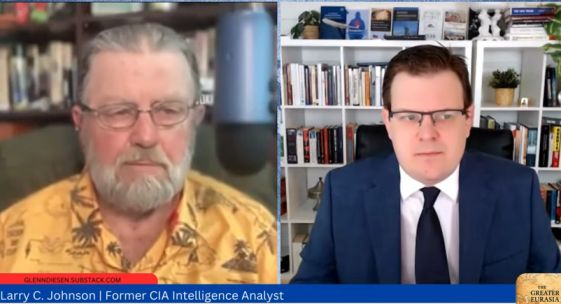
Editor’s Notes: In this interview, former CIA analyst Larry Johnson joins Glenn Diesen to analyze the escalating conflict between the U.S. and Iran following the recent attack on Kharg Island. Johnson warns that targeting Iran’s energy infrastructure is a dangerous strategic misstep that could trigger a global economic catastrophe by forcing the closure of the Strait of Hormuz. The conversation also explores the internal political pressures within the U.S. government and how this conflict is accelerating a global shift toward a multipolar world. Ultimately, Johnson argues that military force will fail to achieve regime change and instead risks plunging the world into a deep depression. (Mar 15, 2026)
TRANSCRIPT:
Introduction
GLENN DIESEN: Welcome back. We are joined by Larry Johnson, a former CIA analyst, to discuss the very dramatic developments taking place in the war against Iran. So, yeah, first, let me thank you for coming back on the program. It’s good to see you again.
LARRY JOHNSON: Hey, always appreciate the invite, Glenn.
The Attack on Kharg Island
GLENN DIESEN: So I wanted to, well, at least start by focusing on this Kharg Island, because this handles 90% of Iran’s oil exports. So many commentators have been asking, if this is really what can break the back of Iran’s economy, why isn’t Trump going after this?
Well, it appeared that we have reached this point now as we continue up this escalation ladder. Trump, of course, well, the United States has now bombed Kharg Island. Trump claims to have totally obliterated, as his words, the military facilities there. He did not touch the energy facilities, I guess, for good reasons. But he is threatening now that the oil installations are next unless Iran folds, that is, by opening up the Strait of Hormuz.
How are you assessing this situation? Because, on one hand, if it’s a bluff, Iran can’t capitulate. On the other hand, if Trump goes through with this, this is like the nuclear option of the energy war. So what does all of this mean?
LARRY JOHNSON: I guess Donald Trump reminds me of a casino’s favorite client. The one that keeps coming in and spending lots of money and losing. That’s Donald Trump.
This attack on Kharg Island just makes zero sense no matter how you look at it. They did not attack the oil terminal. That’s the good news. Iran reportedly has five oil terminals, so this is actually only one of them. So although it may pump the most oil or provide the most oil to a tanker to sell out through the strait, this is not, if they destroyed this, this wouldn’t be Iran’s only source of potential revenue.
But they bombed the runway of the major airport. So you say, “Oh good, that’ll keep Iran from using it.” Except Iran really doesn’t have an air force. There’s also talk of the United States invading, trying to occupy Kharg Island. Well, one of the ways you do that is you’d fly in troops, or once the troops are parachuted in, you’ve got to resupply them somehow. So you’d need to land on the runway. Except this runway is, like I said, 5,000, almost 6,000ft. And the way they bombed means that it’s only good for 3,000ft. Well, a C-17 requires at least 3,500ft to land. So scratch the C-17, and that leaves you with a slow flying C-130.
So, I mean, just, it’s like if you’re planning a military operation on the island, you’ve now screwed yourself from the U.S. standpoint.
Iran’s Threatened Retaliation and the Strait of Hormuz
Iran has made it very clear that if you attack our actual oil terminals and resources, we will attack those of our other Gulf neighbors. And there are at least 13 different targets that they’ve already identified.
So Iran didn’t react immediately or angrily last night when this happened. It happened early Saturday morning in Iran time. It was late Friday, East Coast time. So this is just lashing out. It’s not part of a strategic picture, because you’ve got to sit back and say, what is Trump trying to accomplish?
Well, what has been accomplished as a result of this attack on Iran is shutting down the Strait of Hormuz. And in doing that, you’ve now closed off 20% of the world’s oil supply, 25% of the world’s liquid natural gas, and 35% of the world’s urea, which is needed for fertilizer. About 75% of the arable land in the world is above the equator, so that means we’re now in planting season. And the 35% drop in the fertilizer is huge. That means there are some crops that aren’t going to get planted or aren’t going to grow. And then when it comes harvest time, that means food’s not going to be harvested and there’s going to be a drop in the food supply — the global food supply — so this literally can affect billions of people.
Rising Gas Prices and Economic Impact
On the gas front, the prices now are rising very rapidly, even here in the United States. I’ve been monitoring my local gas station. A week ago on Sunday, I paid 50 cents more than I had the previous five days. So last Sunday it was $3.04. On Wednesday the price went up to $3.19. And then on Thursday it was $3.24. And then yesterday it was $3.32. So it’s essentially come up almost 80 cents in a little over a week.
I’m fortunate. I’m in a financial situation where having to pay that amount of money increase — okay, I prefer not to do it, but I can do it. But an estimated 60% of Americans live paycheck to paycheck, which means they don’t have a lot of spare cash. And so this is going to impact not only their bottom line, but then the real killer is on the diesel front, where the price has gone up over $1.50 and it’s approaching $2.
Well, every truck that holds supplies for grocery stores, supplies for the hardware stores, for Walmart, for Price Club, for any of these major vendors — their prices are going to go up.
So the strategy comes back to: you’re trying to heighten inflation around the world and in the course of doing that, also put in place a recession. Because what we know from history is every time this has happened in terms of spiking oil prices, there has been a recession. The length and the depth of it has varied. But we’ve never had a situation where the entire Persian Gulf has been closed off as it is, and the shutdown of operations in three or four critical countries there — apart from Iran. When you look at Iraq, Saudi Arabia, Kuwait, and then Qatar and the United Arab Emirates, we’re in uncharted territory as far as history goes. You have nothing to point back to and say, “Oh yeah, this is what happened that time.” So the potential of this to create actually a global economic catastrophe is high.
Can the U.S. Militarily Defeat Iran?
And so Trump’s response now is to double down militarily. Except they are in a situation where the U.S. cannot militarily defeat Iran. You can’t do it from the air. Air power has never won a war. And there was an Air Force general that testified in the United States a couple of weeks back that admitted that. History clearly shows it.
So you say, well, what about ground troops? The age in which, 23 years ago, the United States could assemble soldiers over the course of nine months at bases in Saudi Arabia — they were quite safe. They weren’t facing drone strikes, they weren’t facing missile strikes. Not today. You could not assemble an army that would be required to take on Iran.
Number one, you couldn’t do it. Number two, the United States doesn’t have that size of army. Total current military strength is 445,000 U.S. Army and about 180,000 Marines. Good luck — 600,000 against a million-man army in Iran. That just doesn’t work.
There are, though, valid reports that they’re deploying, with two different numbers: a 2,200 Marine Amphibious Unit and then a 500 or 5,000. I don’t care whether it’s 2,200 or 5,000. Again, what are they going to do?
The notion that this is going to be like World War II, where the Marines are in their watercraft and they’re charging towards the shore and the ramp is going to come down and they’re going to storm into fire — that’s not going to happen. Those craft would not even get close to Iran. They’d be blown out of the water.
So it’s unclear how they’re going to try to employ these Marines. They could try to parachute them in someplace. But again, once you parachute them in, how do you resupply them? They’re going to be through whatever ammunition and food and water they carry within a day. And so if you can’t resupply them, they’re dead.
Plus, these American planners apparently have not watched the war in Ukraine. There’s a real reason why you don’t see mass movements of troops on either side, because with drones combined with artillery, it’s impossible for soldiers to move in large units. They’ll be decimated.
The Threat to Gulf States’ Energy Infrastructure
GLENN DIESEN: Taking the Iranian oil off the market is one thing. But I’m just thinking that this mass Iranian retaliation — I think there’s a reason why the Iranians haven’t attacked the Gulf states’ energy facilities to such an extent, because then it will be open season on the Iranians. But if the Americans go after this, why would Iran be restrained in any way? Then it should just essentially burn it all down, and the Gulf states would essentially cease to exist, at least the smaller ones.
So it is a very crazy threat to even make. And once making these threats, it’s often very difficult to climb down, especially when you turn on the TV. I think Keith Kellogg was also coming out saying we should just take it over. But one thing is if the objective is to invade it, but the alternative is, of course, just bombing it, destroying it all. But then every energy facility in the Middle East would be on fire within the next few days. So yes, it just seems like an insane escalation.
LARRY JOHNSON: But —
GLENN DIESEN: But Trump is under great pressure to do something, though, because now he’s been committing himself to this rhetoric that you can open the Strait of Hormuz, ships should just go through, it’s not a big problem. But how would you assess this — how can the U.S. reopen the Strait of Hormuz?
Reopening the Strait of Hormuz: An Impossible Task
LARRY JOHNSON: It can’t be done. No, cannot be done. Well, it cannot be done with acceptable losses. You can militarily probably do it, maybe accomplish it, but the cost — actual physical cost and manpower losses — would be horrific. And they can’t do it just from the air.
There are caves and tunnels all along the side of that coast. Alistair Crooke has been there and seen it. Iran’s been preparing for this contingency for 30 years. They’re not just a bunch of guys who built a wooden deck out on the side of a cliff with a machine gun. That’s nonsense.
Dissent Within the Trump Administration
If you’ve not had a chance to watch the interview that Danny Davis did yesterday with Robert Barnes — Robert is an attorney, but he’s well plugged into the Trump administration through J.D. Vance — what he said is that Trump has now pushed away anybody like Tulsi Gabbard and J.D. Vance who have tried to counsel against the war with Iran. He’s only listening to those who are egging him on: “Yeah, you can do this. Yeah, we’re winning. Yeah, keep going.” People who aren’t giving him an honest assessment.
We now know that the battle is underway inside of D.C. between, let’s call it, the anti-war crowd and the “let’s go all the way to Tehran” crowd.
The first indicator was when Daniel Cain, the general in charge as chairman of the Joint Chiefs of Staff — when the word got out that he had told Trump, “This is not going to go the way you think it is, there are major obstacles, major problems,” Trump ignored that.
The next was the leak from the National Intelligence Council of their report, their assessment that had been delivered to Trump a week before this, saying you’re not going to get regime change no matter what you do out of this.
So then when the leaks started coming out that Trump is pushing people away — it wasn’t just Robert Barnes — and that the losses the U.S. is sustaining are greater than are being reported, that information started to get into the press. So this shows that there’s real disagreement within the government. They’re not all pulling in the same direction on this.
The Pentagon’s Lies: The KC-135 Shootdown
The Pentagon’s lies are also beginning to be exposed. The KC-135 that was shot down — let me emphasize, it was shot down. It did not crash. The Pentagon claimed that it crashed. So you have to step back and say, “Okay, explain to me, how did it crash?”
Planes can crash on takeoff because of an engine failure or they’re too heavily loaded. Or they can crash while landing because of heavy crosswinds, or again, too much weight on board, or some mechanical failure while coming in for a final approach. But planes flying along at 25,000ft just don’t crash, particularly if there’s not bad weather. They just don’t fall out of the sky. Well, this one got shot down.
So they’re lying about that. They are desperate to try to have a military solution. Trump has got it in his mind that he can win this, and anybody that comes and tries to tell him different is getting shut out.
So this is a King Lear situation — the madness of King Lear, to go back to Shakespeare.
Trump’s Rhetoric and Iranian Sleeper Cell Narrative
GLENN DIESEN: Yeah, the rhetoric from Trump is getting a bit wild again. He already declared victory, which is — if you’re threatening to attack Kharg Island and you know what the retaliation will be, that is all energy facilities in the Gulf states will burn and energy markets and the global economy goes down the toilet — you would make these threats only if you already won, essentially. This is immense escalation.
But there’s also other rhetoric, though. We heard that he tweeted out that Iran was about to try to take over all of the Middle East unless the US had to attack, which seems like a desperate attempt to make the war seem defensive or even legal. Because I think people look into these things. They don’t necessarily look into it if there’s a great success, but once there’s a failure, people will look into these things.
But also one of the changes or interesting talking points now has been these Iranian sleeper cells and the possible surprise attack on California. I guess this is to brand Iran properly as a terrorist state that could also engage in terrorism against the United States. So, you know, why not link them to September 11th if you’re going to go —
LARRY JOHNSON: Yeah, yeah.
GLENN DIESEN: How do you make sense of this, though? Especially the sleeper cells and the possible attack on California?
Iranian Sleeper Cells: Fact or Fiction?
LARRY JOHNSON: Yeah, well, let’s deal with the attack on California. How are the drones going to get there? I mean, where are those drones going to be launched from — off the coast, you know, one of the non-existent boats in the Iranian navy that have — you know, the Iranian navy’s been destroyed, per Trump. So they no longer have a ship that could carry drones and sit off the coast of California and fire them into California.
This is all reminiscent of the Japanese attacking the west coast of the United States in World War II, claiming, “Oh, well, we were prepared for that, it wasn’t going to happen,” but nonetheless prepared for it.
Now, they’ve trotted out this scare story about Iranian sleeper cells so many times. And all you got to do is go back and look at — we’ve got 46 years of data in terms of Iranian support for terrorism, and it just doesn’t support the US narrative. Iran has not been going out of its way to try to engage and attack the United States.
In fact, I would say all of the attacks that are attributed to Iran or Iranian proxies on the United States were in retaliation for things the US did, such as the bombing of the Marine barracks in 1983. That was in response to the US battleships — back then we still had the New Jersey — they were offshore lobbing shells into the Bekaa Valley, killing Shia. And that actually wasn’t carried out by an Iranian proxy. It was carried out by Amal, which was a longtime Shia group in Lebanon and had been there. They formed in 1972, seven years before the Iranian Islamic Republic came into existence.
We have not had a single terrorist attack in the United States in the last 46 years since Iran has come into existence that could be pinpointed to Iran or an Iranian proxy. Not one. But we always trot it out there to justify why we’ve got to make Iran an enemy.
And at the same time, the actual Islamic radicals that have carried out or tried to carry out terrorist attacks are linked to ISIS, which is a Sunni outfit. The Shia version of Islam is not big on suicide bombers. It’s not big on that kind of fanatical sacrifice. Whereas the Takfiri version of Sunni Islam, the Wahhabi version, it is. We just saw this — they had that attempted bombing the other day, two guys in New York City, ISIS, not Iran, ISIS.
They did point to this one guy down in Texas that showed up and shot up a bar, killed 14 people, I believe, or at least four people. Again, he was not acting on orders from Iran at all, because that’s just not how Iran has operated.
And when you look at which country has been carrying out terrorist attacks against the other country, it’s the United States. We’ve funded and rehabilitated the MEK, and MEK has been carrying out terrorist attacks regularly inside Iran, well over the last 30 years. So it’s just political manipulation. It’s designed to manipulate public opinion to reinforce the narrative against Iran without allowing Americans to step back and take an objective look at what this is all about.
Iran’s Strategic Targeting and Military Objectives
GLENN DIESEN: Yeah, I thought that was strange when Iran had to be sold as the number one sponsor of terrorism in the world. They have to flesh out the argument then, referring to roadside bombs in Iraq against the US occupation forces and then going back to Lebanon in 1982 and Hezbollah, I think, that did the bombing. It’s not very convincing in terms of listing it as the world’s sponsor of terrorism.
But how about the targets that the Iranians are going after? Because it does seem that they’re systematically going after key targets — i.e., the radars, which are quite important. So they took out the one at the US Embassy in Baghdad as well. Again, it’s more difficult to intercept Iranian drones and missiles. We see the military bases, embassies — all of this kind of fits within the wider objective of expelling the United States from the region.
But we also saw this report about an attack on five refuelers in Saudi Arabia. I think they were the KC-135s.
LARRY JOHNSON: Yeah.
GLENN DIESEN: Trump went out and called this fake news. But again, he says a lot of things. So —
LARRY JOHNSON: No, that’s absolutely — I knew about that before it was reported. And they weren’t just damaged, they were destroyed. And the reality now is the air defense system at Prince Sultan Air Base is no longer intact. It doesn’t work. So Prince Sultan Air Base is basically quite open and vulnerable to Iranian attacks. And the US is having to withdraw its troops from there — the Air Force personnel — because they’re not protected, they’re in tents, and so they’re very vulnerable to an attack.
So the loss of those five tankers is just another example that Iran had a battle plan in mind. They were going to do two things. One, they were going to weaken and try to drive out the US military from the Persian Gulf, and to do that by destroying the bases. Two, they were going to take out the radar systems that are critical for detecting launches out of Iran and monitoring both threats in the air and on the sea — maritime threats. They did that. They did that within the first four days. And despite the claims that we had these robust air defense systems around the bases, one of the radars was taken out by a Shahed drone, not exactly a high-speed missile.
Their third objective was to degrade Israel economically and militarily, and destroy their infrastructure. I think it’s worth noting that Iran, despite massive missile strikes in Israel, has not been trying to inflict massive civilian casualties so far. Because somebody said, “Well, that’s just because Israel is censoring that information.” No — if Iran was really targeting schools with children, for example, and killing them, Israel would make that public. In fact, I’m surprised they haven’t even fabricated that story as well, to try to build further public opinion against Iran. So Iran’s been quite careful in that regard.
But then also their eye-for-an-eye strategy: if you hit our oil, we’re going to hit your oil. If you hit our bank, we’re going to hit your bank. And so they just, in Dubai, took out a Citibank building — or at least hit it. It didn’t destroy the building, but it was one of those big skyscrapers and it suffered quite a blast.
The one area, curiously, that the Iranians did not respond to with a counterpunch was when their desalination plant was hit. It only accounts for about 8% of the water in Iran, so it’s not a critical resource. But they declined so far to go after the desalination plants in Saudi Arabia, Qatar, United Arab Emirates, Bahrain, and Kuwait, recognizing that that could actually jeopardize and put at risk millions of people and really create a human catastrophe. So I think Iran is being thoughtful about this. They’re recognizing that there’s a political consequence to some of their actions and so they’re keeping it within those bounds.
But as was admitted in the Wall Street Journal — and this is one of those other signs that the support for Trump is fading — they said the US grossly underestimated. They didn’t even take into account the possibility that Iran could close the Strait of Hormuz. The Iranians have far more ballistic missiles than was assumed. That kind of thing.
The Gulf States’ Security Dilemma
GLENN DIESEN: Well, of course Iran can escalate the targeting of the Gulf states, but Iran doesn’t have to destroy all the US bases in the Gulf states. All they have to do — I mean, they don’t have to destroy these countries. All they have to do is incentivize them to decouple from the United States.
And you’ve seen some of this with the rhetoric that they will only target countries which host American bases and, of course, the bases themselves. But that’s why, for Iran, the presence of these refuelers in Saudi Arabia kind of confirms that the Saudis are then assisting in what was a surprise attack on Iran.
But there’s another thing that came out. There is a suggestion — now, I haven’t seen if it’s been confirmed, but it came from some Iranian commentators — that Iran might consider allowing ships through the Strait of Hormuz who are paying in Chinese yuan as opposed to dollars. This would be, if confirmed, another form of the decoupling.
Do you see any pathway forward? Do you think the Gulf states would accept something like this? Because on the one hand, the US does make them more vulnerable to attacks. On the other hand, they don’t have any militaries of their own. So how would they defend themselves without the US? It seems like a bit of a security dilemma — if you accept the help, then you’ll have war. If you don’t accept it, you could be overrun.
The Petrodollar and the Realignment of the International Financial System
LARRY JOHNSON: So, yeah, I think there’s, at least in the Saudi case, there’s a reassessment underway. Recognizing that they made a deal with the devil, the United States, back in the 1970s, where the US went off the gold standard. We convinced the Saudis to go along with using the dollar as the primary means for purchasing oil. And so the effect, the petrodollar, as it’s come to be known, reigns supreme. And then that fostered this relationship between the Saudis and the United States. We guarantee their security against threats that we claim to exist or we’d create for them.
But I think now Russia and China are playing this quite smartly. They’re in a position now to create an alternative to the United States. And I see it could be more attractive to the Gulf Arabs, at least it’d be less of a subservient position. Those countries don’t normally come in and tell you what to do and boss you around like some servant.
So it’s, I think we’re looking, this is part of the realignment of the international financial system, too, because in the past, the price of oil goes up and well, people were paying in dollars. The Chinese had paying dollars. And then, you know what they do with all their dollars? They’d buy US Treasuries. Well, they’re not doing that anymore.
One of the other ironic outcomes of this war is, before the United States, now let’s remember the United States and Israel started this. And you’d think that the United States would have stepped back and looked at it broadly. What’s your overall objective strategically in the world? But no, they didn’t. So as a consequence of this war, whereas five weeks ago, Scott Bessent, the Secretary of the Treasury, was insisting that India stop buying oil from the Russians. And, “We’re going to punish any country that’s buying Russian oil.” Today, “Hey, India, we think it’s a great idea, buy as much of that Russian oil as possible.”
And Russia, which previously was selling its oil as low as $55 a barrel to India, is now well over $80 and maybe closer to $90 a barrel. So they are raking in an additional $150 million a day, which is roughly $4.5 to $5 billion a month. So all the Western analysts were predicting the implosion of the Russian economy or that it was in trouble.
Here’s Putin, and that’s just the oil. They’ve also got an advantage. They’ve got liquid natural gas. “Hey, anybody need any liquid natural gas? Russia’s got some.” And fertilizer. Who’s the other largest producer of fertilizer in the world? Oh, that’d be Russia. So literally from February 28th to here we are at March 14th, in 15 days, they have shored up the foundation of the Russian economy in a way that nobody could have predicted a year ago.
How Does This War End?
So this again goes along with the changing picture, because when this war ends with Iran, it’s not going to end with US troops marching through the streets of Tehran. It’s not going to be a victory march of Israelis and US soldiers waving their flags as the Iranians submit. No, it’s going to be the United States and Israel. They’re going to have to figure out how to back out, how to get a victory.
I did raise the possibility that Trump, with his wild rhetoric about, “Oh man, we devastated Kharg Island, therefore we’ve accomplished our objectives, mission accomplished, we win. So we’re going to pull out and we’re going to stop all these attacks on Iran because they’re devastated. There’s nothing left of their leadership. There’s nothing left of their air force. We win.” That’s Trump’s only way to get out of this mess.
GLENN DIESEN: Well, yeah, but that’s the problem. He doesn’t have escalation dominance. He doesn’t get to decide when the war ends, and if the Strait of Hormuz remains closed for hostile countries and for the Gulf states until they paid reparations for the damage done to Iran. It’s very hard to sell this as a victory no matter how many parades you might organize.
LARRY JOHNSON: Well, yeah, I agree with you fully. That’s where they could get, they did that with the Houthis. They could get away with that with the Houthis because the Houthis weren’t sitting there continuing to bomb US military bases. They stopped launching missiles into Israel, but they continued to stop ships from going into an Israeli port. Nobody was keeping tabs on the ships. They weren’t easy to see.
But this, how does he, he can declare victory, but the very next day, Iran’s going to continue launching missiles, attacking US military bases, any that remain, and hitting Israel over and over and over and over until the Israelis are going to beg for it to stop.
Russia, Retaliation, and Restoring Deterrence
GLENN DIESEN: I’m glad you brought up the Russians, because I saw from the British media that apparently one of the state media commentators in Russia, Kornilov, he linked the British attacks on Russia with the Storm Shadows with Iran’s attack on British targets in the Middle East, saying more or less that, “Well, this shouldn’t surprise the British now. They’ll get it in return.”
Again, I didn’t watch the original clips and I have my skepticism towards British media. But it seems, I’m not sure if that commentary is correct, if it’s actually based on reality. I don’t know the substance, but it wouldn’t surprise me. And I kind of made the comment myself, I think like two or three years ago, that in the NATO countries, we tend to fight a lot of wars and at some point the Russians will be in a position to do what we do in Ukraine, that is, we’re setting up a firing position where we can shoot at the Russians but they can’t fire back at us. And I’m wondering if you see that the Russians might go for something like this. Again, pure vengeance, I’m not sure. But certainly to restore deterrence, that is to show that it will have to come with a cost, for anyone who essentially attacks Russia.
LARRY JOHNSON: Well, first, I did hear Alexander Mercouris discussing the possibility that the British supported this launch of Storm Shadows into Bryansk that killed six people, and that was retaliation for Russian support for Ukrainian attacks on British troops in the region. So we can’t rule that out.
What I found amusing is the West is all in a huff that, “My God, Russia is supplying support to Iran. How dare they.” It’s like the pot calling the kettle black. Here’s the United States and the NATO countries, for more than four years, not only providing weapons, they provided intelligence, surveillance, reconnaissance data, ISR data. They’ve planned attacks against Russia.
I think, candidly, Russia has been far, far too passive in reacting to these. I think the time has come that Russia needs to put the United States and NATO countries on notice that any reconnaissance aircraft, even if it’s in international airspace, but in a position where it can collect data on Russia and provide it to Ukraine, will be shot down. These are now targets. An effective state of war exists between Russia and the West. To back them off, they’ve got to understand they can’t run away with this cost free.
Iran’s Strategic Importance and Diplomatic Maturity
Russia’s motives in helping Iran are not out of vengeance or to seek revenge against the West for what it’s done to them in Ukraine. Just the opposite. Iran exists as a strategic site, a critical node in the multi-nodal world, or what they want to call multipolar. But I think multi-nodal is a better way to express it, because Iran sits at the crossroads both of the new Silk Road coming out of China, as well as the North-South Economic Corridor coming out of Russia, as well as its strategic positioning in the Persian Gulf and the Indian Ocean. So both Russia and China have recognized that Iran is critically important strategically, which is their main reason to support Iran.
What I’m fascinated by, let’s call it the maturity and restraint of Iran’s diplomacy. And how they’ve dealt with India is a case in point. Prime Minister Modi was in Israel two days before the attack on Iran by the United States and Israel. And it was obscene. If there was a way that you could watch something on television and get diabetes, this would have done it. It was that sweet and sickly. He was just obsequious, doing everything but giving Bibi Netanyahu a back rub, and came out claiming to have a strategic alliance with Israel.
Well, two days later, Israel hits Iran and kills Iranian leadership, kills children. And then when Iran shuts down the Strait of Hormuz, all of a sudden you heard this loud puckering factor going on in India. Because 80% of their oil comes out of the Persian Gulf. What were they going to do?
I really thought that Iran, because here’s the thing, India is one of the founders of BRICS. And yet by siding with Israel in such a public way, it was really undermining its other BRICS partner, Iran. But instead, Iran played it pretty maturely. They came back and said, “No, no, if it’s an Indian flag vessel, if it’s a vessel carrying oil to India, that’ll be allowed to pass.” And that may have had something to do with it. India obviously is going to have to pay full freight. They don’t get it cheap like they did before.
But it shows that the Islamic Republic of Iran is not this vicious terrorist beast that the West is portraying it as. They didn’t go after the desalination plants, and they’ve been relatively limited in their strikes. They have tried to avoid hitting purely civilian targets in all of the Gulf countries.
The Gulf States and the Price of Siding Against Iran
Now, the US toady in Bahrain, reports are the king has fled. The Bahraini government continues to take a very adversarial stance towards Iran. The United Arab Emirates reportedly were involved with the attack on Kharg Island last night. So they’re going to pay a price, a heavy price.
But I think Iran is still looking down the road. “We ultimately want to repair the relations with these countries, but we’re going to get the United States out. The United States is going to have to leave that region as part of any settlement to this war.” And until that war is settled, the Strait of Hormuz is going to remain closed. And I believe we’re going to be facing a global depression. Not just a recession.
India’s Miscalculations
GLENN DIESEN: Well, these kinds of demands are understandable, but at the same time they can’t be met by the US. So this is kind of like a recipe for a long war.
But I also agree with your sentiments on India, because they played some of the cards wrong. They allowed themselves to bend to US pressure on scaling back on Russian oil purchases. But now of course the Americans say, “Oh wait, maybe you should do that after all.” But their discount oil is now premium-priced oil, so that might not have been a great move.
And also the Indians, with Modi visiting Israel, there’s not good optics. And also, after even inviting Iran to participate in a naval exercise, the US sank its warship on the way home, and the Indians, as far as I know, couldn’t muster a condemnation. I mean, Iran was invited by them and their ship was sunk on the way home in international waters. It just
LARRY JOHNSON: looks like they
GLENN DIESEN: played some of the cards a bit unwisely here. But there’s a last question. What do we know about the destruction in Israel? Because they keep very tight control over their media, and I think journalists in the West are quite obedient and loyal to these restrictions on revealing losses or destruction within Israel. But what do we know so far?
Iran’s Nuclear Deterrence and the Logic of Escalation
LARRY JOHNSON: Well, we know through what we’re not seeing. Let me explain — if I’m telling you, “Oh, everything’s fine,” but you can’t come take pictures, you can’t come look, that tells you everything’s not fine. They’ve turned off the satellite — the public satellites that are capable of taking real time images out of Israel. They’ve been turned off, they’re not providing that product anymore.
Now you saw that CNN was allowed to go into Iran and report, and they did. CNN was not faced with saying, “Oh, you can’t report here, you can’t report, turn the camera off.” No, they were allowed — it appeared pretty wide access. So this tells me, and having watched, there are a few images that get out — you know, every day you’ve had, I guess we’re up to 42 waves of missile attacks into Israel since February 28th. You know that that’s huge. So that’s roughly three waves of missile attacks per day. And these are now where they’re carrying 2,000 pound warheads or upwards of 3,000 pounds. So this is definitely causing damage in Tel Aviv, in Haifa. The port has been hit, the oil refinery reportedly has been hit. There were images that emerged last night of Nevatim, the air force base down in the Negev desert.
Israel cannot take this kind of pounding. And people say, “Well, why do you — what about Iran?” Iran is, what, 15 times bigger than Israel. Israel’s got 55% of its population in just two cities now. Tehran is as big as, what, 10 to 12 million people, and some say with the metropolitan area it gets up to 15 million. They’ve got 15 million, but they still got another 75 million people throughout the country in different cities and towns. And the next nine largest cities in Iran, they’re all about 1 million, 2 million. So there are not these huge metropolitan areas. They’re actually relatively dispersed.
So the point being, if Iran and Israel are firing the same amount of munitions at each other every day, Israel is going to degrade quicker and faster than Iran, and Israel is going to be in a position that they will not be able to sustain this. Which then raises the issue of will they want to use a nuke? And there’s that possibility.
I wrote an article on the game theory behind this, and basically the game theory solution is: if Israel is threatening to use a nuke, the only thing — the best solution for Iran — is to immediately produce a nuclear weapon. If they’ve got a demonstrated nuclear capability, it’s going to force the US and Israel to change their calculations. Israel in particular can’t risk launching a nuclear strike on a nuclear armed Iran, because Iran can then come back and literally destroy Israel. An Israeli strike on Iran would cause terrible loss of life, terrible damage, but it would not destroy Iran. Israel would be destroyed.
GLENN DIESEN: Well, I think the Iranian territory should be about 75 times that of Israel or something. It’s really huge. So yeah, it does require also the population, of course, with 90 million people. So it does require a whole lot more firepower.
LARRY JOHNSON: Yeah.
The Escalation Trap: Ultimatums Iran Cannot Accept
GLENN DIESEN: This is the big thing that just perplexes me — that they keep making these demands, ultimatums, bluffs, which essentially demand that Iran capitulates. Same as giving up the ballistic missiles. And then they’re left with the option of what Iran predictably won’t and can’t accept. Then they either have to allow their credibility to falter or they must go up the escalation ladder, which will just make matters much worse. You can see the destructive path we’re going on, yet no one is doing anything serious to put an end to this. And again, given that what Iran wants — an end to US presence in the region and compensation — it will be difficult.
LARRY JOHNSON: And elimination of sanctions. Yeah. And look, I think we’re seeing again something we’ve never seen in history, where one country can choke off and close off a critical economic lifeline and has control of it, and the rest of the world — or the parties that are most affected — really can’t do anything to reverse it without incurring a terrible cost that they’re not willing to pay. And that cost would be loss of life and loss of ships. It would be very devastating for the United States, for Japan.
And the other really interesting thing that’s playing out now is what’s happening with Taiwan. Taiwan’s going to run out of power in 10 days. What do they do? So all this chip production that’s there — that’s going to stop. They don’t have the energy, or they’ve got to come up with an alternative source. What source might that be? China, Russia. So China has now acquired increased leverage over Taiwan.
This is 5D chess that’s going on here — the cascading effects across the board. In fact, it never entered my mind when I heard they closed the strait. I thought, “Oh boy, that’s going to be bad for oil.” And then when I started looking into it and ran across that export of urea, I had no idea — 35% of the world supply. Good Lord, that is significant.
So all of a sudden you begin to see that Iran is in a place now that it’s going to be able to dictate terms of surrender. Because despite US tough talk and all that, the economic pain is going to become such for so many countries that are aligned with the United States. The countries that are aligned with Russia and China, they’re going to be okay, because Russia is an alternative source to the Persian Gulf. And it’s going to strengthen them further in terms of economic power and political power. The countries that are relying upon Russia to supply gas, oil, fertilizer — that buys Russia more goodwill.
And what’s the United States done? The United States has kicked off a war that’s caused all these countries pain. So when we come knocking on their door, they’re not going to answer.
A Defeat in Iran Would Be Catastrophic for US Credibility
GLENN DIESEN: Also, if Iran was the only adversary, then the US could perhaps invest more resources — both blood and treasure — into this. But Trump never finished the US participation in the war against Russia, the proxy war through Ukraine, and also never put an end to the economic war and the military threats or buildup in the competition with China. So it’s going after all three of these at the same time. This defeat in Iran will be so much worse.
Even America’s worst enemies wouldn’t want to see too much of a humiliating defeat, because this is not a source of stability. So I’m worried about what is coming. But yes, as always, my friend, thank you very much for taking time. Do you have any final thoughts?
Iran Is Not the World’s Top Sponsor of Terrorism
LARRY JOHNSON: Yeah, I just want to go back to the terrorism thing. I pulled up the statistics for 2017, just to put an exclamation point on this notion that Iran’s the number one sponsor of terrorism in the world. And these are the stats actually for 2016 and 2017.
Number one: the Islamic State of Iraq and Syria, ISIS. And these stats did not include branches of ISIS like Al Nusra, Hayat Tahrir al-Sham. This was just straight up ISIS. Total deaths in 2017: 4,350. In 2016: 9,180. So right there you’re looking at over 13,500 dead. ISIS was number one.
Number two were the Taliban. They ran about 7,200 deaths in those two years. Number three was Al Shabaab — again Sunni, not Shia. They killed over 2,100 people in those two years. They list the Maoist Communist Party of India, the CPI Marxists — they actually were the fourth highest for 2016 and 2017. And bringing up number five was Boko Haram, another ISIS affiliate.
Not a single Iranian group in there, not a single Iranian backed group. And that’s been the case every year. Except the statistics did show for 2023, they lumped in October 7th, and Hamas now appears in the top 10 for that year. But this argument — the demonization of Iran as a terrorist state — is a damnable lie.
And one final point. We go back and look at what happened when Iraq used chemical weapons against Iran — those chemical weapons that were provided by the United States and built by Iraq, used against Iran. That started in August of 1983, continued through August of 1988. Over 20 chemical weapon attacks — weapons of mass destruction. Iran never developed a chemical weapon and never used a chemical weapon on the battlefield. Why? Because it was a sin against God to do that.
So I think the world underestimates the role of religious conviction in Iran’s policies — that they’re not this “we hate the Christians, we’re going to kill all the Christians and Jews.” Nonsense. Just the opposite. The Iranians, over the course of actual war, have shown far more decency than has the United States in all of its wars, in my judgment.
GLENN DIESEN: Reading from the media, the talk about Iran is, you know, they talk about burkas and suicide bombers. But first of all, there are no more burkas in Iran. And second, the suicide bombers — those extremist organizations — have tended to be on the Sunni side, not the Shiite. So there’s a lot of — well, propaganda. There’s no other word for it. But as always, thank you very much for taking time out of your day. I know you’re busy, so thank you.
LARRY JOHNSON: Well, you’re busy too, and you’re doing great work. Keep it up, Glenn.
Related Posts
- Transcript of Elizabeth Lane Interview on Propaganda Network: Tucker Carlson Show
- Transcript of Justice Ketanji Brown Jackson Interview: IMO Podcast
- Transcript: Mary Talley Bowden Interview on Tony Fauci’s Diary @ Tucker Carlson Show
- Transcript of CIA Whistleblower Jim Erdman Interview: Tucker Carlson Show
- Transcript of Shawn Ryan Interview: Trump’s Betrayal – Tucker Carlson Show