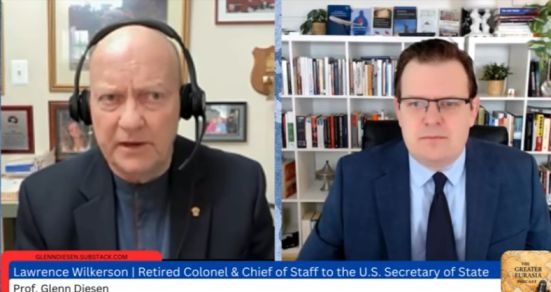
Editor’s Notes: In this insightful discussion, Professor Glenn Diesen sits down with Colonel Lawrence Wilkerson, former chief of staff to the U.S. Secretary of State, to analyze the severe geopolitical consequences of a potential U.S. strategic defeat in Iran. Colonel Wilkerson offers a candid critique of American military readiness and warns that a protracted conflict in the region could trigger a massive global economic crisis and a permanent shift in power toward Eurasian land powers like China and Russia. From the complexities of regional alliances to the strategic challenges of land-based trade routes, this interview provides a sobering look at how current foreign policy decisions may be reshaping the world order for decades to come. (Mar 18, 2026)
TRANSCRIPT:
GLENN DIESEN: Welcome back. We are joined today by Colonel Lawrence Wilkerson, former Chief of Staff to the US Secretary of State. Thank you very much. As always, it’s great to see you.
COL. LAWRENCE WILKERSON: Pleasure to see you too, Glenn, and to see you’re not in jail yet.
Trump’s Strategic Dilemma: Escalate or Withdraw
GLENN DIESEN: Yes. Good news. Well, Trump, it’s no secret now he wanted and expected a short war. However, he now seems to be locked in a position of all or nothing — either he can escalate and try to knock out America’s main rival in the Middle East, which is Iran, or he risks being expelled from the region. Not him, but the United States military, if all these bases will be destroyed and Gulf State nations would begin to grow concerned about the military presence being a source of insecurity instead of a source of security.
So where do you see Trump going from here on? We hear talks about the Marines coming into the region and boots on the ground. Is this a realistic option in your war planning? How would you assess this?
Ground Troops: A Non-Starter
COL. LAWRENCE WILKERSON: Ground troops are not realistic at all. But let me back up just a little bit. Haaretz had an interesting — the only newspaper I’ll read, and sometimes I don’t even like it because Netanyahu owns all the rest of them virtually. But Haaretz had a really interesting sub-headline yesterday. It said, “To win, Iran needs only not to lose. To win, Bibi and Donald need a spectacular victory.” That sums it up. They ain’t going to get it.
So what’s the business here? Whether you use Marines on Kharg Island, or Khark Island, as many Persians say it — the Forbidden Isle. Think about the old Ulysses and the Odyssey, and that’s the kind of thing this is. It’s such deep water around there, you can load 10 supertankers at one time simultaneously. 10 supertankers. 10. So it’s essential to Iran, to its oil industry, and in many respects, it’s essential to countries like India and others that get oil from there. That would be a disaster. But that’s the only prospective landing place that I could see that would be strategically important. And you might just be able to get a few Marines there. Any other place, you destroy them — they die. I mean, there’s no question in my mind about it.
And we’ve war-gamed this. Someone asked me for the war game title and everything. I’m looking for it right now because it was back there a ways. But Lt. Gen. Van Riper, who was my boss at the time, did it, and he did the first iteration, and we lost so badly, they demanded SecDef and others he’d do it again. He did it again and we lost again. And that was 20 years ago before Iran had developed what it has developed right now.
What do I mean by that? Do you know that they took out 5 of the multimillion dollar — two of them were a half billion apiece — radars in other countries that have left us blind. And we can’t replace them. And guess why we can’t replace them? Because we can’t get the rare earth metals from China in order to replace them even if we could build them that fast. So this has been very, very fine-tuned by Iran, even more so than they were in that war game I was talking about, or the two iterations of it.
Ground forces would be tantamount to saying we are losing — and we’re losing in an Afghanistan-style and Iraq second war-style, or worse. In other words, a trillion dollars of cost over a 10-year conflict that we would wind up having to have conscription and all that went along with full mobilization to put enough forces in Iran to make a difference and hold it afterwards. Not going to do it. You’re not going to do it. The American people are not going to allow it. It’s as simple as that. If Donald Trump wants to unwind his presidency significantly prematurely, if you will, not do it now. I don’t say that lightly because all those men and women will die.
China, Rare Earth Metals, and Strategic Contradictions
GLENN DIESEN: Well, regarding those radars, it’s gallium, I think, the rare earth mineral they need. And apparently China has about 98%.
COL. LAWRENCE WILKERSON: Yeah.
GLENN DIESEN: Well, it’s not extracting, at least refining. So overall, the control is — if the US wants to go to war with China, it’s going to have to ask China for permission.
COL. LAWRENCE WILKERSON: And he just canceled a visit. Picture this, will you? The number one strategic interest we have in a foreign state is China. The last interest we have in a foreign state — other than what BB sells us — is Iran. And we’re canceling a meeting with the man in charge of the first so we can be the advocate for war with the second. This is nonsense. This shows how warped our thinking is.
GLENN DIESEN: I think the plan was for Trump to meet with Xi Jinping in April and essentially have the Iran war finished already — like a little trophy on the mantle, standing there with Venezuela before they met.
COL. LAWRENCE WILKERSON: Venezuela’s not a peaceful thing right now either. So Trump just wreaks havoc wherever he goes.
The Strait of Hormuz: Can It Be Forced Open?
GLENN DIESEN: Well, there’s also this talk now. Trump first said we need allies to help us open up the Strait of Hormuz. And then he said, well, actually, we don’t need anyone. We’re the United States of America. We can do it ourselves. Interestingly, he said it like 30 seconds in between. So he changed his mind quickly. But nonetheless, it is an interesting question. And you, participating in war planning, how likely is it? What are the main challenges in opening up the Strait of Hormuz by military force? What would that actually entail? Would you have to invade Iranian territory, or is this simply escorts? Because escort sounds less permanent.
COL. LAWRENCE WILKERSON: Escort is the principal means. We tried when I was doing war planning in Pacific Command and was very much involved in it. The situation is somewhat different today, but the principles are basically the same.
What we tried to do under what we called Operation Earnest Will — we weren’t quite so pedantic then — and then following with Operation Praying Mantis, that went back to the pedantry, was we tried to reflag Kuwaiti tankers so that, one, there would be some violation of international law when they went after them, and two, so that the Kuwaiti tankers could feel safe, the insurers could feel safe, the shippers could feel safe, the world could feel safe, and so forth.
It went afoul immediately because Bridgerton, I think, was the name of the MV — a very large motor vessel — that hit a mine. The skipper was furious with us. He was in the channel, as I recall. The channel — really the north channel and the south channel for these big ships — is not very wide. It’s only a couple of miles wide. Each of the channels, and one channel, I think it’s the north channel, is very close to the Iraqi shore, where it could be interdicted really easily. You could put the mines in the water from the shore. You don’t even need a boat. That’s what happened. And Bridgerton hit one.
And then the next thing was, I think it was Samuel B. Roberts — one of our destroyers or destroyer escorts — hit a mine. She had to limp her way all the way back at a few knots or so to Norfolk for repairs. And then, of course, Saddam Hussein put two Exocet missiles into another one. So it wasn’t a good time.
We wound up ultimately being successful in getting the tankers through the strait. But as I said, that was a very different time and a different Iran with different capabilities. We also had to sink one destroyer — an old World War II holdover destroyer, probably given to the Shah. We sunk her — Iranian. And then we put a bomb down the stack of a second one. And Ronald Reagan, actually the President himself, through General Vessey, the Chairman, called us off because he felt that to sink another warship would be too much.
Iran’s Military Capabilities and America’s Atrophied Forces
All to say that it’s not easy, it’s difficult. And it was difficult even at that time when we had overwhelming superiority in every realm of watercraft, if you will, and every realm really of the military. And Iran was not possessed of this incredible inventory of ballistic missiles it has, which I’m told they haven’t even revealed — the most sophisticated of those that move at three, four, even five times Mach. That’s so fast you can’t bring them down with anything. Think Arisnik and Putin unleashing the Oreshnik on Ukraine, times maybe one or two. Because these would come in with fully fleshed warheads — for whatever, whether they were going after Lincoln or going after Ford or whatever — they would sink them outright.
So this is fraught with problems, and significant problems that have grown over the last 20 years while we’ve atrophied. Glenn, we do not have the military that we had in the first Gulf War. That was the peak of the United States military. Maybe not in terms of technological sophistication, but I would say even in that regard, it’s a wash — some are better, some are worse. The F-35 being a case in point.
We’re looking right now at 30 hours of maintenance time for every hour the F-35A, B, and C models are flying. We’re also looking at elongated times in many cases because Lockheed has not given up its proprietary maintenance approach to that aircraft. We’re also looking at not fully mission-capable F-35s flying, even though they aren’t FMC, because it’s combat. The Marines are the sturdiest at doing that — they’ll fly it if it gets off the ground. But that means our ability to use some of the most technologically sophisticated weapon systems we have — that can link all manner of things on the battlefield, which is what the F-35 is supposed to do — isn’t happening.
So all the strikes we’re making in many cases are not that accurate. They’re not that pinpoint like we’re saying they are.
Bombing Civilians and the Resolve of the Iranian People
All that said, we’re bombing the Jesus out of civilians. We have learned from Bibi Netanyahu what he’s doing in Lebanon — we’re doing to a large extent in Iran. Not just hospitals and little girls in school, but civilians from one end to the other of our bombing campaigns. This isn’t doing anything but what the four-star Air Force general testified to Congress last week it does do — it’s fusing them, it’s making them tight, it’s making them angry, it’s making them resolute. And though their situation is in many cases dire in terms of getting the things they need to live daily, they still are going to fight us to the bitter death, I think. And we don’t understand that.
And Trump saying that this is going to be over in a short time — someone is really giving him some bad advice. If that is what’s causing him to make these statements, if it’s just his usual “I pulled it out of my rear end and said it,” then that’s a different thing. But if the Chairman of the Joint Chiefs and the Joint Staff in general, and the unified command commander — who I think is a flaming idiot, that’s a sad thing to say, but I think he is — and others in the military are giving this sort of advice that all he’s got to do is persevere, they should be taken out in court martial. This is not the case.
This is at best a year-long conflict with no resolution at the end of that year, and all manner of perturbation of global economies. And I’m not just talking oil — I’m talking fertilizer and foodstuffs, urea in particular. This is just a real briar patch that Trump has willingly thrown himself into along with his buddy Bibi.
The Nuclear Threat: Israel’s Potential Last Resort
And I haven’t even talked about the prospect — as I think is becoming quite apparent from the language I’m hearing and from others with whom I’m discussing this — fraught with the possibility of Israel using not one nuclear weapon, but several nuclear weapons. Because one would not — we’ve done the analysis. It depends on where you drop it, of course, but anywhere in Iran virtually, it’s not going to do much. Oh yeah, it’s going to vaporize and weld together some rock, and it’s going to make a big mushroom cloud. And radioactivity is going to be a problem. If it’s an air burst, it’s a ground burst — it’ll be a problem too, but not quite as long or far-reaching. Think Chernobyl, if you will.
But you could drop 10, and I don’t want to say it’s like dropping a straight pin in the Pacific Ocean, but it’s like dropping a straight pin in the Pacific Ocean in a country that big — as big as Western Europe. We used to talk about this to fool the gap, where we’re going to concentrate 10, 20, 30, even 100 nuclear weapons on the group of Soviet forces in Germany. The Germans didn’t like it because it did do a lot of damage to Germany. But in essence, the explosive value of that is contained in a certain parameter. And wow, have you got a huge parameter in Iran.
So you’re looking at him having to shoot 10, 12, 20 nukes even to make a difference. And he’s got them — and he’s got them on submarines and he’s got them elsewhere. He’s got a lot of free-flying bombs, I’m told somewhere between 200 and 300.
So I don’t want to be the Grim Reaper here, but I’m telling you, this has got all kinds of potential ramifications that nobody in this administration is thinking about.
The Limits of U.S. Military Power and the Risk of Escalation
GLENN DIESEN: Well, when I hear Israel making statements such as “Iran will never stop before Israel is exterminated,” this kind of language, it’s the kind of language you would expect before that nuclear option was taken. So, yeah, I’m a bit concerned about that rhetoric. But in terms of Israel reaching for its nuclear weapons, the Samson option, what would be the restraints on Israel though? What would happen within the United States if Israel would start engaging in nuclear war?
COL. LAWRENCE WILKERSON: First of all, in ’73, the only really vivid example I have, and I have it from my own experience as well as from that reporter who went in to talk — a BBC reporter who went in to talk to Golda Meir. Actually, he didn’t get an appointment with her. He always did. She liked him. He brought her two dozen red roses and really wooed her and she liked him. But she said she was too hard pressed to give him an on-site in-her-home interview, but she would give him one on the phone.
And when he asked her the question, “Would you use, will you use a nuclear weapon?” she said, without batting an eye — he said he didn’t know how he knew that over the telephone — but yes. Now you can say she said that for public consumption because she knew the Soviets and we were listening, and she knew the Soviets and we were going to deal with Egypt if necessary, should it become critical, and she wouldn’t have to drop the bomb. I think that’s probably a fair assessment of why she said it.
But it appeared in a London newspaper the next day, quoted as her saying that. Now no one pays any attention to that today. No one probably even knows anything about it except esoteric professors like you and I.
So would it happen today, and not have the Russians and the US and the tension between the two, and therefore the caution and prudence brought about by that tension — not having that to bear on it — would it go ahead and happen? Yes. I don’t even think he would tell Trump. I think he would just do it. And he has a chain of command and he has people close to him and in the military who would keep the secret until the mushroom clouds floated up.
So it’s not like ’73. It’s not like these two superpowers have an interest in no nuclear genie being let out of the bottle and bringing massive pressure from both Moscow and Washington on — at that time, Tel Aviv. It doesn’t exist anymore. Bibi’s on his own and he knows it.
Can the U.S. Sustain a Prolonged War?
GLENN DIESEN: You said the war could last up to a year, and I agree with you. I think this Trump talking about the war soon coming to an end — to be honest, I just assumed he was trying to talk down the oil prices. But unless there’s a nuclear war, it certainly could drag on for a whole year.
But does the US have supplies, though? What do we know about the weapons? Again, Trump made the statements the US has unlimited amount of ammunition, but we kind of know that’s not the case. So how long do you think the United States could go on like this? And also, how much more pain could be absorbed?
Because I saw only last night the — the embassy of the United States in Baghdad was attacked quite fiercely. And then in the morning hours, you saw an Iraqi — a couple of Iraqi resistance flying a drone over the embassy. And it just — no one was able to take it down. It just flew around and essentially monitored the area.
And it just looks like if the bases would be weakened to an extreme degree, the US runs out of weapons, the global economy goes into tailspin — this is not like the usual forever wars which are kind of contained and isolated from the world. This is going to pull in the great powers. It’s going to bring down the world economy. The US bases in the region will undermine the regional alliance system. It just looks like — if it goes on for a year, this is not going to be one stable year such as the invasion of Iraq. This is going to spill all over the place.
COL. LAWRENCE WILKERSON: You pretty much said it all. The only advantage accruing to the empire — the United States — of an extended war beyond a year even, is that all the things Donald Trump has been lying about in terms of having, would be at least in low-rate initial production, if not in full production, because it’s going to take that long.
So he’s lying through his teeth when he says, “I’ve had all the people at Mar-a-Lago — RTX, Lockheed, Boeing, Garmin — and they all agree.” Of course they agree, you grifting idiot. They know they’re going to make money out their yin yang. But if you think they’re going to gear up to make all this sophisticated gear in a short period of time — try thinking for Tomahawks, for example, maybe a year or two. Try thinking for THAAD, maybe even longer than that. Try thinking for a lot of these systems, at least a year, maybe two, maybe three, before you’re online with full-rate production.
So yeah, in that sense it would help us. But by that time, Glenn, we’re going to be dead — politically. Trump will be removed from office. I make that promise to the American people, to the Europeans you’re advertising to and I’m talking to. Trump will be impeached, he’ll be out on his ear, whatever. Because this war is not supported by the American people.
You want to get them fully aroused about it? Start a draft, start conscription. You’d have to do that. You’d have to fully mobilize. If we try to put the selective service system we have right now — broken as it is — into effect, we just did a study on this. It would cost you probably $100 million over the six-month period to get it even up again and working. Even if you work double shifts or triple shifts, eight hours every 24 in each shift like we did before in World War II, you would never be able to get the system working within nine to ten months, and then have your first draftees come in. And at nine to ten months, half of those 18 to 24 year olds are going to disappear. And I wouldn’t blame them a bit. Canada, Mexico — you want a little increase in your population with some young people? You’re going to get it.
This is just nonsense, Glenn. There’s no way this country could gear up in a period of time that would allow Trump to withstand impeachment successfully and then be poised to go to a war that ultimately, by that time, probably other countries would be involved in too. I’m thinking really hard about Turkey, Baghdad, for example, maybe even that pusillanimous little king known as Jordan, maybe even Egypt, maybe others in the area, once they see what Netanyahu is really intending to do and will do to Lebanon.
This is fraught with potential for much bigger than us being in it. It could be the entire world before we’re through, and that’s not a good prospect — although it is a very, and I put on my historian hat here, a very predictable thing, given this inexorable shift of power that’s taking place in the world that the empire is disputing and putting every element that it can up — however incoherently and inexpertly and stupidly, because we have such bad leadership right now — fused into all the rest of this and causing a global conflict. Easy to see it happening.
Look at Zelensky right now, talking about going to help in the fight against Iran. And that’s not an insignificant statement when you consider the productive capacity he’s generated for drones, and the talent with which he’s making the drones, and the talent he has around him for using those drones in this new kind of asymmetric warfare. Transmit that to whomever. But he’s talking about transmitting it to the US and its allies in the Gulf, such as they are, by the way.
You know, there was an individual who said — I think it was Churchill, he said everything, didn’t he, at one time or another — “The only thing worse than having allies is not having them.” Look at how fast Trump is shedding our allies. I mean, our meaningful allies. He’s shedding them. He’s already shed — prima facie — he shed those in the Gulf. They don’t want anything to do with us. And as soon as we’re beaten, they’re going to get rid of us, if Iran hadn’t done it beforehand.
Look at Europe. Look at what Europe is saying. Spain sort of started it in a very ethical and moral way, in my view. But it’s coming on for realpolitik reasons now, and payback-to-Trump reasons too. “We’re not going to be with you. We’re not with you.” So what, are you going to go to the Gulf with Donald? You’re going to go to the Gulf with the United States Navy and maybe that vassal state — Israel, or not Israel, but Britain, I put them in the same category now — whose navy is so formidable I could beat it with my sandbox navy?
So this is really, really stupid. I can’t say it any better than that. I don’t know why we’re doing it, except that Trump is trapped by Netanyahu and his and Miriam’s money. And he is absolutely focused on getting the American people’s attention off the Epstein files. That’s the only thing I can figure.
Diplomatic Options and the Netanyahu Obstacle
GLENN DIESEN: Well, if you would, I guess, get back in — not necessarily with the war planning, but the diplomacy — what are the possibilities for the United States? Because this is my main concern: when great powers who face great risks see that the options are becoming more and more limited, one often sees desperation, and one doesn’t want to see this when you deal with nuclear powers like the United States and Israel. Of course, Israel is more of a loose cannon.
But what are the options for the United States? What could it actually do at this point? Because Trump can declare victory and go home. But the Iranians, they’re talking about a permanent political settlement. That means get the troops out of the region. They want reparations, which could be achieved by taxing countries using the Strait of Hormuz, or even demanding that countries sell their oil in Chinese yuan if they want to pass through. I mean, there’s a lot of things they can do to achieve their war objectives. So what is it that the US can do now?
COL. LAWRENCE WILKERSON: The impediment to all the things you just said — and it’s not the only impediment, of course, the Iranians are the principal impediment too — Araqchi has been very explicit about that. “How can we trust you ever again?” Even saying — one of the Iranians, I don’t remember if it was Larijani or who — he supposedly killed now. This is Bibi’s favorite tactic, is going to kill individuals, as if that’s going to change anything.
But they have said, “If you replace your president, we’ll talk.” I don’t blame them. I don’t blame them. Would you want to go talk to this guy again? Would Putin want to talk to this guy again, other than to get him to lift sanctions, which apparently happened a little bit at least the other day?
I can just imagine that phone call. “Vladimir, you’ve got to help me. You’ve got to help me manage global oil prices.” “Yeah, right. Okay. What are you going to give me?” “Well, I’ll leave some sanctions off here.” “Okay, I’ll help you.” Now, he’s known to go out and probably not help him at all. But that’s Trump. He’s getting Trump’s own strategic approach to negotiating back on him. He’s put these people in the catbird seat with regard to negotiating.
But to your point, I think the impediment in anything that might happen diplomatically — however frayed that term is with him — is Netanyahu. Because Trump has got to give Israel a direct order to cease and desist to make anything work diplomatically. They will not. Netanyahu is going to his own and his state’s death before he quits. That’s a reality, I think. So Trump is trapped by that. He’s trapped by the fact that that’s Bibi’s posture and he ain’t going to change.
How does Trump change if Bibi refuses to quit? And I’m not just talking about there. I’m talking about in Lebanon too. He’s hell-bent for leather. Two more states joined the court case at the ICC. Two more states joined, and they cited one of the reasons they joined as his treatment of Lebanon right now — certainly the other reasons that South Africa made the proposition, or the application, in the first place. But you’re going to — I would dare say you’re probably going to have 50 states signed up to that case before Israel is over, especially if this war continues in the way it is right now, if Israel is even a state at that time.
So that’s the impediment. Bibi is the impediment to having meaningful negotiations. Not that their audience would trust Trump, but you might be able to do something, especially using the good offices of Oman, which are always so good. But not with Bibi. Bibi will not negotiate.
The Rationality of Iran’s Strategy
GLENN DIESEN: Again, I keep going back to how this could have been done, because if you go through a lot of the literature, especially the one around 2012-13 when there was a lot of, at least in academic literature, discussions about invading Iran, what one sees is that more or less always the conclusions were the same — that this will just pull us in. It will spread, it will be uncontrollable. It will be the ultimate long war. So a disaster.
But how is it that again, with all the problems, most of them should have been predictable and predicted, but I heard Trump make the statement that, well, no one, none of the experts could have predicted that Iran would attack all these US bases across the region.
COL. LAWRENCE WILKERSON: And that’s a flat-out lie.
GLENN DIESEN: No, it should have been the most predictable thing. I mean, if they listen to you—
Military Dissent and the Chain of Command
COL. LAWRENCE WILKERSON: Yeah, I don’t know that General Cain walked in. You know, not five Americans know this, Glenn. Maybe five know it. I only know it because I was there when the act was created and when Powell implemented it.
The Chairman of the Joint Chiefs of Staff is now the equal of the Secretary of Defense when it comes to advising the National Security Council, his own boss, the Secretary of Defense, and the President. Importantly, Powell did this twice in implementing this new procedure. Twice he had a dissenting chief on the Joint Chiefs. He went straight to the President, put that dissent to the President, and the President in both cases decided for the Chairman. So he had to go back and tell the chief and the Secretary of Defense, who sided with the chief one time, “You lost.”
That’s the power of the Chairman. Now he can talk to the President on his own. Most smart ones, including Powell, would go up and tell the Secretary, “I’m going to see the President because I don’t agree with you, Mr. Secretary.” Maybe they don’t even have to do that really, but that’s just good behavior. You know, you have to live with the Secretary anyway. He’s your boss.
Otherwise, that’s a new provision. Cain could go at any moment, and I’m told he did. I don’t know how powerfully he did, but I’m told he did. And one of the people that got fired because of that was the three-star Navy admiral who was one of the most important members on the Joint Staff — the Director of the Joint Staff. He’s the J3, if you will. He’s the operational guy on the Joint Staff. They fired him. Hegseth said he sent him back to the fleet because he dissented or something. I don’t know what he dissented on. Hegseth didn’t express it.
So that, and Cain having said what he said, I think at least pushed back a little bit. Trump ignored it, completely ignored it. So the man he pulled out of obscurity and retirement, moved from being a three-star to a four-star and put in the Chairman’s seat, locked into Trump — you would think — dissented to a certain extent, and Trump paid no attention to it whatsoever. That tells you that no dissent from the military, regardless of how it was couched, would probably be accepted by Trump.
MAGA Voices and the Culture of Deception
He’s got plenty of people to tell him otherwise, including like Laura Loomer and people who really know military operations, including like his chief of staff who just got — I’m going to sound like a hardcore idiot saying this — but she just got breast cancer at a most propitious moment to bring sympathy on the White House. I’d love to see that X-ray. I’d love to know. You can’t. You know, how could I ever say anything like that? Because these people are liars, because they’re cheats, because they make Bibi Netanyahu look decent when it comes to propaganda and when it comes to lies coming out of their mouths. They do anything to hold on to power, anything to grift more money.
Did you see that report about how much money they potentially have gotten for their family so far? Over $200 billion, with Jared Kushner being the leading figure in it. He’s become such a leading figure in it that I’m told Trump has actually chastised him for making it so visible what he’s doing while supposedly a special envoy for President Trump. They’re amassing a fortune for themselves, and we’re just watching it.
But you can’t get to Trump. You can’t get to him with the right kind of advice. I don’t think I fault the military enough for not being in his face more constantly and more courageously. But look at this guy that just resigned from the National Counterterrorism Center — I think he was the director, or whatever. Look at that guy’s rep. He was a pure MAGA guy. He was, “Let’s throw them all to the wolves and get them out of the country,” and all this kind of stuff. And now all of a sudden he’s written this nice little letter and he’s resigned, principally, he says in the letter, because of the Iran war. “It’s a stupid war.” And in the penultimate paragraph, he talks about his wife dying. And it’s a poignant letter.
But we forget — just as we did with Charlie Kirk — we forget what kind of rep that guy had before he saw the light about Israel. He was venomous. He had a poisonous mouth talking about things. And that’s so true of many of these MAGA spokespersons who’ve now turned over, because this is a stupid war, or because other things have happened, like this incredible affection we have for the state of Israel.
Religion, Armageddon, and the War’s Ideological Framing
And the latest development, too, is penetrating their minds — finally — that some of these people are in it for end times, including the Secretary of Defense himself. For God’s sake, he’s having a meeting today on St. Patrick’s Day. He’s having a meeting in the White House or in the Pentagon. It’s not compulsory, but the Secretary of Defense invites you to this Christian prayer service. You can’t make this stuff up. This is horrible.
Your version of Christ — we’re going after Armageddon, we’re going after end times. We’ve intercepted — we haven’t intercepted — they’ve been voluntarily sent to us, these messages. Got one this morning, a really articulate message from a contractor in the Middle East who is really irritated by the fact that he has to go to these meetings where they talk about this campaign being for God and Jesus.
GLENN DIESEN: It doesn’t look good when you’re arguing the purpose of the war is to remove their theocracy. And yeah, these are the arguments.
COL. LAWRENCE WILKERSON: Replace it with Armageddon.
GLENN DIESEN: Yes. I would have hoped that, if the argument is the other side are religious nutcases, then you would hope for some rational arguments to counter it. But no. I don’t know — the Iranians seem like their arguments, their defense, their behavior, it all seems rational. I haven’t seen this irrational act which we keep being told that they are — that they are these irrational mullahs just wanting to destroy the world.
Iran’s Military Rationality
COL. LAWRENCE WILKERSON: It seems extremely rational to me. From a military perspective, what they’re doing is quintessential rationality. The targets they’re selecting, the precision with which they’re hitting them, the apologies that they render to a fellow Gulf member when they hit something that isn’t quite what they thought they were going to hit — it’s not that easy to do this sort of thing. It’s difficult to do it, and yet they’re doing it and they’re making an effort to do it. Unlike Israel, which just kills anything that gets in the way. “Oh, if you’re a leader, please come over. We want to assassinate you.”
GLENN DIESEN: Yeah, so in an interview with the Iranian president as well — an American interview where the news anchor was asking, “Well, why would you attack our bases?” — he sat there a bit perplexed, like, “Well, what are you talking about? You attacked us. We have to defend ourselves.” And they kind of wanted him to apologize or something. I don’t know, it was very bizarre to watch.
And it kind of starts to also make you wonder — where is the self-reflection here? Where’s the rationality? Same as now, these reports that perhaps the Russians — well, I’m assuming so, perhaps — shared intelligence with the Iranians on American targets. “How dare they?” I mean, after four years contributing to the killing of tens of thousands of Russians, offering the weapons, the intelligence, the logistics, the ammunition, the war planning — everything — and now we hear a rumor about them sharing intelligence, and this is somehow unacceptable. It’s just strange.
The Interconnected Conflicts: Ukraine, the Levant, and Energy
COL. LAWRENCE WILKERSON: Just maybe three weeks ago, one of my otherwise sympathetic, empathetic colleagues was saying, “How can you say that you could connect Ukraine and the Levant?” And I said, “Just wait. Just wait. Zelensky will take the opportunity.”
A lot of this business of spread is just about that — that these people whom we have cultivated, more or less in Europe in particular, decide that they’re going to take advantage of this or that opening, and they take advantage of it, and before they know it, they’ve got a real problem on their hands.
Look at the EU in this business of Russian Arctic LNG. They passed that rule, that law, whatever, back around 2022, that would go into effect after five years — they wouldn’t buy any more of this really superior Arctic LNG that they move on their own bottoms, so they can move it down to Bremerhaven or Le Havre or wherever. They move it on their own bottom, so it’s a really sweet deal. Putin gets cash up front and they get everything on their ships and the LNG they need.
Do you really think in January of 2027 they’re going to stop doing that? But that’s what the law says. They just bought the biggest load they’ve ever bought — every cubic foot of Arctic LNG for Europe. Don’t blame them. I mean, their economies are going to be ruined if they don’t have this energy.
So this is the complicated kind of thing that they’re doing to each other and don’t really understand how all these things are connected. And they’re going to understand big time how they’re connected when West Texas Intermediate Brent crude is up around $200. I’ve seen it there — I’ve seen its equivalency when we had the Arab oil embargo and I couldn’t even drive to Washington from Fort Monroe, Virginia. The lines at the filling stations were too long, and if you got in the back of the line, you knew when you got to the pump it would be empty. We’re looking at prospects for that again.
How Will This War End?
GLENN DIESEN: Well, just as a last question — how do you predict this war to develop from here on? I know there are too many unknown variables, too many things can happen and go wrong. But what is it realistic for Iran to achieve, and for the American and Israeli side? I mean, there’s no going back, at least to the way things were before the war. So where do you think this is heading, whether or not it lasts for a month or a year? How will this end?
COL. LAWRENCE WILKERSON: I could see — not very clearly and not very realistically, and I’m not expecting it — but I could see Trump suddenly having an epiphany, one like he had, for example, with regard to Ukraine, apparently, at least during the campaign. I mean, I was listening to him consistently, and he kept on message that he was going to stop that war and he was going to do it forthwith. I think he really was genuinely committed to that. And then he hit reality.
But if he had a moment like that and he persevered, and he just said, “We’ve won, I’m out of here, that’s it,” and turned to Bibi and said, “Over to you” — Bibi would have to quit, or he would have to go full monty. And if he went full monty, he’d be alone, completely and utterly alone, I think, even divorced from the American President at that point. So it might be bad for Iran in that moment, but it would be good for them and good for the region, I think, in the long term, as long as we could contain the aftermath.
So if Trump were to suddenly decide that he doesn’t have any future as a grifter, as President, or as anything unless he gets out of this mess he’s got himself in — and the tendency for him there is to declare victory and leave — that could happen.
GLENN DIESEN: Well, hopefully the Iranians let him.
COL. LAWRENCE WILKERSON: Yeah, I don’t think they would keep it up. I really don’t. They might keep up pounding Israel, maybe, but I don’t think they would keep up the global part of it.
GLENN DIESEN: No. Well, it’s hard to say at the moment, but of course, I don’t think if this war goes on for months and months, it’s going to be anything other than very devastating.
COL. LAWRENCE WILKERSON: Money makes it harder to get out.
Geography, Trade Routes, and the Eurasian Challenge
GLENN DIESEN: Yeah, yeah, because I keep making a point. Iranians can’t afford simply to have the US and Israel come back again a few months. But I think after this, if it keeps going for a few weeks or two, three months, I think this will be a… I don’t think anyone’s going to come back for them in the future. This is it. Unless some miracle weapons are created to open up the Strait of Hormuz or otherwise. No, I think the deterrent doesn’t require victory. I think it’s simply not by denial, but simply by elevating the cost. I think that would suffice. Here again, maybe I’m…
COL. LAWRENCE WILKERSON: It’s interesting what you just said keyed me to this. I hadn’t thought about it except inadvertently or at an angle. I got all my maps out on the living room floor here. Huge array of maps, especially of that region. I used to go into my seminars and I’d tell my students when they present their case studies and they got the message after about two or three seminars, don’t ever come in here to brief me or brief the rest of the seminar on a case study without a map or maps, plural, because you can’t do it without a map. Geography is important.
All to say what you just mentioned keyed me to — you know, there are some things that are almost immutable, like geography of straits and choke points and terrain in general. You can’t hardly do away with them as long as we’re still doing business the way we’re doing it in the world, which is a huge component of this conflict. Glenn, we do not want that route. That is China’s Southern Belt and Road Initiative Route and will be very, very much on land, not on the water at all. Doesn’t require any water. We don’t want that. And we don’t want the others that go across the heart of Russia and the heart of Central Asia because it takes us out of our domain. We are a maritime nation. We go out of our domain if most of the world’s commerce travels over land. It’s also cheaper to go over land. So these realities of geography are coming back to haunt us.
Mackinder’s Nightmare: Land Power vs. Maritime Power
GLENN DIESEN: Well, geopolitics though, it’s the study of how geography influences politics. And what you’re referring to though was the fear expressed in the beginning of the 20th century by Halford Mackinder, the British, as they observed the Russians building these intercontinental railways. The concern was because in the past railways would just feed ocean-going traffic, so it would just go out to the coastline and then go on ships. But they said, oh, suddenly the transcontinental railroads, now they could replace maritime power.
So while the British had been focused on — as long as we’re the dominant maritime power, that is how we’ll stay dominant. But suddenly the Russians threatened to turn this on its head by essentially giving competitive advantage to land powers. This kind of influenced in a big way both British and American policy ever since, in terms of preventing these Eurasian powers from coming together. But that’s what I’m thinking with Iran.
COL. LAWRENCE WILKERSON: Now, if you’ve read Peter Frankopan’s The New Silk Roads: A New History of the World, you understand how empires were actually stopped in their tracks, virtually, because of the economic power created in a relative empire or competitive empire, by changing the trade route to overland rather than sea. You had a maritime power that was made — like the Portuguese, making lots of money and charging rates that sea travel demanded, sometimes a little more than that. And then all of a sudden you get this internal empire, as it were.
And the Persians played in this a lot, too, in what was probably the most powerful empire the world’s ever seen. Not Rome east or west, but Persian. They played with it, with land routes, and put them out of business — put the seafarers out of business. That’s what China’s doing now. It’s a repetition the other way.
The Greater Eurasian Partnership and BRICS
GLENN DIESEN: That’s the Greater Eurasian Partnership initiative, though — this connecting the Eurasian land powers also by land. That is China’s Belt and Road Initiative. You have the Russian, Iranian, Indian International North-South Transportation Corridor. Of course, Russia wanting to be an east-west bridge, a north-south bridge. This is BRICS facilitating as well. It is geopolitics being essentially reimagined. Halford Mackinder’s worst nightmare, essentially.
COL. LAWRENCE WILKERSON: Yeah.
GLENN DIESEN: However, I would be optimistic.
COL. LAWRENCE WILKERSON: There’s another dimension to it, too, I think. They don’t want — the powers that be, the Rothschilds of the present world — they don’t want this to be exclusive of the Western Hemisphere, particularly Europe. They could do without the 340 million in the US. They’d like to have Brazil and Canada, but they could do without them. And this bothers me, really bothers me. We don’t get this. They could create — not autarky, but they could create a meaningful economy without us. Yeah, they could, because that’s where most of the world is. That’s where 70% of the world is. Throw Europe into it, it’s more like about 75% of the world. Throw Brazil into it and Canada into it, you’ve kicked it up to 76 or 77%, and to hell with the rest of it. We’ve got what we want.
They don’t want to do that — they being principally, I think, the Chinese architects. But they don’t ultimately need us. Right now, they do. And that’s why Xi Jinping is very circumspect about what he’s doing. I think he must have thought very long and hard about that latest pronouncement where he now is going to replace Bretton Woods, he’s going to replace SWIFT, he’s going to replace all of that, and he’s going to dare the world with the renminbi being the replacement for the dollar.
That’s a real step for them because I know their Central Party school warned against it. It’s an empire destroyer. It’s a great power destroyer. When you have that kind of financial power, it cheats you, it robs you of your good sense, it makes you live on others’ hard work — they buy your debt, in other words, and let you go ahead with your profligate ways. And Xi didn’t want that. But he’s bit the bullet now.
No Eurasian Hegemon: A Multipolar Balance
GLENN DIESEN: Yeah, well, I thought it’s not a bad development. I think the reason why there’s an instinct going against the Eurasian land powers creating this non-maritime connectivity is because in the 19th century it was the Russian empire, and it could become a hegemony in Eurasia — that’s a threat to the British. In the 20th century it’s a Soviet empire — they could form a Soviet hegemony in Eurasia. But now in the 21st century there is no hegemon. China can’t dominate on its own, Russia can’t, Iran can’t, India can’t. Because it’s not one central power. There will naturally be some soft balancing between them. So the US wouldn’t face a Eurasian empire which would come after the US if it pulls back. They would contain themselves, balance each other a little bit. But of course I don’t think they…
COL. LAWRENCE WILKERSON: …want to do what I just described. If they have to, they will. They’ll ostracize us. Imagine that. Benign neighbors to our north and south — the advantages we’ve had for 200-some odd years, both as a nascent country, a colony of Britain, and then a national entity — all those advantages wiped out in a second because everyone around us is antagonistic to our existence. Economically and philosophically antagonistic to our very existence.
An Unintended Consequence: Rivals Brought Together
GLENN DIESEN: Yes. On that note, Trump could be seen as a man of peace though, because of the way the US has brought Russia and China together, overcome historical suspicion towards each other, how Russia and Iran with all their centuries of antagonism are now closer together.
COL. LAWRENCE WILKERSON: Took us to do it. Yeah, it took us. We changed a thousand years of history. Yeah.
GLENN DIESEN: It’s trust building now. So not what was intended, but maybe something good can kind of come out of all these horror stories we’re seeing these days.
COL. LAWRENCE WILKERSON: So we need better leadership. We need better leadership and we need it fast.
GLENN DIESEN: Very much agree, in Europe as well. Anyways, I know you have places to run, so we’ll leave it there. And thank you very much for coming on.
COL. LAWRENCE WILKERSON: Thanks for having me. Take care.
Related Posts
- Transcript: World’s First AI Actress Interview on Piers Morgan Show: ft. Tom Conti, Tom Bilyeu & Prof Jiang
- In Vivo Podcast: w/ Cathy Tie and Prof. Jiang on Editing Embryos (Transcript)
- Transcript of Evy Poumpouras Interview: Read People, Spot Lies & More – FO563 Raj Shamani
- DOAC AI Emergency Debate: ft. Ed Zitron, Andrew McAfee, Nate Soares & Roman Yampolskiy (Transcript)
- Transcript of Norman Finkelstein Interview: Tucker Carlson Show