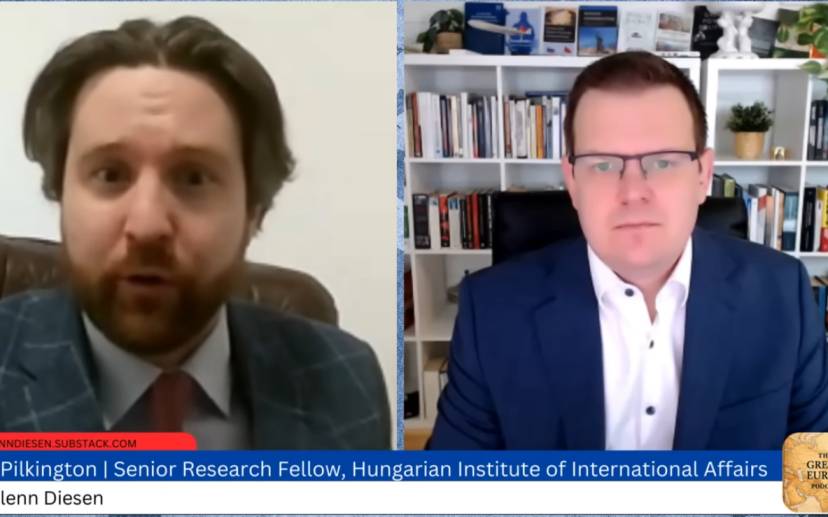
Editor’s Notes: In this Greater Eurasia Podcast, Glenn Diesen is joined by researcher Philip Pilkington to discuss his book, The Collapse of Global Liberalism, and the profound geopolitical shifts currently dismantling the post-Cold War world order. They explore why the “End of History” narrative has failed, leading to the erosion of Western hegemony and the emergence of a multipolar system led by civilizational states like China and Russia. The conversation also dives into the domestic consequences of hyper-liberalism, analyzing how financialization and social fragmentation are contributing to the internal decline of the West. It is a compelling look at the transition from a unipolar liberal era to a future defined by national sovereignty and cultural roots. (Feb 1, 2026)
TRANSCRIPT:
The End of History Thesis and Its Critics
GLENN DIESEN: Welcome back. We are joined today by Philip Pilkington, senior researcher at the Hungarian Institute for Foreign Affairs, to discuss his most recent book, The Collapse of Global Liberalism. So thank you for coming on.
PHILIP PILKINGTON: Thanks for having me, Glenn.
GLENN DIESEN: So at the end of the Cold War, we had, everyone knows, Francis Fukuyama’s contribution. That is, he argued in 1989 with this article that we had reached the end of history. So with the end of the Cold War, liberal democracy combined with free market capitalism had no viable ideological rivals for this reason. Well, it represented the final form of human government.
So all this competition for different forms of governments were now over, and history was, he understood, as his struggle between competing political systems had effectively ended. So it was an optimistic note of universalism.
However, the counterargument presented by people like Samuel Huntington was that there were alternatives, and it was unlikely that this would actually represent the end of history. But many also argued that liberalism, in order to thrive, had to be balanced by, for example, by nationalism. And in victory, without any counterbalance, liberalism would die due to its own excesses.
Now, we heard this from also people like Alexis de Tocqueville and other thinkers all the way back to the 19th century. Now, in your book, though, you also outline a dark future for global liberalism as free markets, globalization, and liberal democracy are collapsing. I was wondering if you could, I guess, flesh out the thesis and arguments in your book.
Liberalism as a Positive Project
PHILIP PILKINGTON: Yeah. So good start on Fukuyama. I really think Fukuyama needs a second look, actually. I just did an essay with co-author David Dusenberry called “The Era of Recivilization” in American Affairs, where we extensively engage with Fukuyama.
I think Fukuyama sometimes gets a little bit of an unfair rap. He has quite an interesting vision, and I think he’s much more honest about liberalism. So just very quickly, in the 20th century, and especially after 1945, liberalism has become associated in universities with kind of Isaiah Berlin’s Negative Liberty, where the state just kind of takes the hand of the state away and you can do what you want.
And I think Fukuyama is much more honest in that. He says, basically, liberalism is a positive project. It is a project that needs to be spread. And this is how Hegel saw it, via Napoleon and Kojève saw it. They were the sources of Fukuyama. So I think the first thing to say is that I agree with Fukuyama and I don’t agree with Isaiah Berlin in that liberalism is a positive project.
And we saw the beginning of an attempt to spread positive liberalism in the bombing of Serbia. We saw it again in 2003 in the Iraq war, very, very nakedly. And I think the Ukraine war is in part an attempt to spread liberalism eastward because Russia has stubbornly proved illiberal.
But to go back to your question, I think basically you have to kind of go back to the beginning. What is liberalism? On my account, it arises about half a millennia ago and there’s two, there’s a key event and there’s a key book.
And the key event is the English Civil War, which is a misnomer. The English Civil War was not a civil war, it was a revolution. It was a republican revolution by Cromwell against the monarch. Charles lost his head. When a king loses his head, you’re not dealing with a civil war, you’re dealing with a revolution.
And there was a brief period where England was a republic, so it was 100% a revolution. And the only reason we say it’s a civil war is because the English, until recently, because the country’s kind of collapsing now, has been obsessed with constitutional continuity. And it doesn’t have constitutional continuity.
On this reading, the book is John Locke’s Two Treatises on Government. And in that I don’t think I’m saying anything that you wouldn’t hear in a Liberalism 101 class. John Locke actually writes that book during the Restoration period after the fall of the English Republic. And he writes it anonymously because he doesn’t want it to be associated with his epistemological work, the Treatise on Human Nature, that’s Hume’s book, but whatever the equivalent was for Locke.
And he does so because he knows that the authorities will see it as a Cromwellian text or harking back to the, what I call the English Revolution. So that’s basically where liberalism comes from.
And on my reading it kind of, it has an enormous impact on the intellectual classes, on the political and intellectual classes, from the English Civil War through the French Revolution, the American Revolution, 19th century British governance, especially through the British imperial system, and then it’s handed off to the Americans in 1945.
But despite having a very strong impact on the intellectual classes, that and Marxism, liberalism never really got tested in its full bore because to my mind it’s quite an unnatural ideology. And actually what we ended up seeing in most places, in most times is what you said at the beginning, a kind of Tocqueville hybrid liberal system or something like that.
And what I argue in the book is basically that since the end of the Cold War, liberalism’s been allowed to take the gloves off.
My reading, basically liberalism peaks in the second Obama administration and the cultural extremes and so on that we saw then. And the Ukraine war is probably its tombstone. But I think the Ukraine war in retrospect will be read as an overextension of a sort of a dying ideology. But I think now 2026 we’re pretty much, you know, a few years into the collapse of global liberalism.
And by that I mean both global, a global order based on liberalism or that as far as to be based on liberalism. And I also mean domestically. I think liberalism is collapsing domestically.
Free Markets and Liberal Democracy: Reinforcement or Conflict?
GLENN DIESEN: Well, you write that in the post-Cold War era we had this belief that free markets and liberal democracy, they naturally reinforce each other. Again a key theme of Fukuyama as well. However, if you look at scholars such as Professor Dani Rodrik, you know, he makes the point that if you want to look at democracy, national sovereignty and globalization, you can’t have all three.
And this is kind of the ideology of post-Cold War era, is that they all reinforce each other. But for example, if you have free markets, then at some point he makes the example of Mexico, that it matters less who you vote for in Mexico if you’re Mexican, as opposed to who runs America, because this is where the economics comes in. How do you see the free markets and liberal democracy? When do they reinforce each other and when are they in conflict?
PHILIP PILKINGTON: Well, I’d be a little bit more radical on that. So first of all, the term liberal democracy to my mind is an odd fusion. It comes about in the post-1945 era. Liberal democracy is the ideology of America or the American Empire, or the post-Cold War or the post-war settlement or whatever you want to call it.
But prior to that, liberalism has never really been a democratic, has never really been a democratic aspiration at all. It just never has been. I mean again, to go back to Fukuyama, he’s drawing on Kojève, he’s drawing on Hegel. And Hegel believes that actually the end of history begins with Napoleon’s march through Europe.
Because Napoleon goes and sets up these liberal regimes, or at least semi-liberal regimes based on Napoleonic Code and so on, spreading the French Revolution as it were. And Napoleon of course is anything but a democrat. He’s a self-crowned emperor. I mean he literally crowns himself Emperor of France in a very unusual move. And his nephew, I think, is his nephew. Napoleon III tries again to rule as an emperor in France, as a liberal emperor again.
So I don’t think liberalism and democracy have much to do with each other. As I said, liberalism goes back about half a millennia. Democracy is a system that goes right back to ancient Greece. I mean, it’s a very, very old concept in human history. So I don’t think liberalism and democracy have that much to do with each other.
First of all, it’s a contingent formation after 1945, because the form of democracy that the United States decided to undertake was a liberal democracy. And then on top of that, of course, as you say, you have to layer in the free market or the globalized free market ideas.
Again, I think you can have a kind of a soft Tocquevillian liberalism or something like that without free markets. I don’t think that trade was particularly free, or not trade, but global financial markets, for example, were particularly free between 1945 and 1973. But I don’t think anyone would argue that was the beginning of the liberal moment in a sense, after 1945.
But it definitely does seem that as liberalism gets more radical, there’s this tendency to want globalized free markets. And the way I discuss that in the book is that things in a liberalized globalist kind of world that we got after the 1990s, they’re not judged by normal criteria.
So for example, in the more what I’d call soft liberal period of 1945 to, I don’t know, the end of the Cold War, maybe you could say up to 1979 or something like that. But whatever the periodization, things were basically judged. Economic policies in the west, even in the liberal west, were judged based on the outcomes that they produced. High inflation, low inflation, high unemployment, low unemployment, you know, and they were generally tended to be relatively people-focused.
They weren’t as obsessed on metrics like GDP back in the 1960s, for example, they were much more focused on employment and wage growth. And there were a variety of metrics that were looked at. And in the Scandinavian countries, of course, that was even more so.
And what basically I think happened in the 1990s is people started, as we went into kind of hyper-liberalism, as I call it, people started to judge the outcomes not in terms of whether they were good for people or not, but whether the globalized market more so came to resemble an economic model. That’s basically what they were looking for.
So if you said this globalization isn’t, you know, in the 90s, for example, if Pat Buchanan or Ross Perot said in the United States this model is not working for American workers, we’re losing manufacturing jobs and so on, the response from the liberals would be, of course that’s true, but in a global sense the economy is becoming more efficient or more Pareto Optimal is the technical term.
And so they started to judge things in this highly abstract way, which to my mind is a real hallmark of ideology. It’s very similar to when socialists or communists try and judge the society not based on whether it’s delivering for people, but based on whether it’s getting closer to the communist ideal, if you see what I mean.
The Unnatural Market and Social Dislocation
GLENN DIESEN: But it makes me think about the work people like Karl Polanyi though, where they criticize the old excesses or unconstrained free markets as an unnatural thing because essentially society itself just becomes an appendage to the free market. So wherever the market goes, society will have to adjust.
And I can see why this was put into the, in its extreme before, well after the 80s, that is the beginning of the 90s, because you saw a lot of the trade agreements were organized around the idea of a new international division of labor. So by liberalizing trade while at the same time strengthening intellectual property rights and such, what one did was for example in the United States, concentrate the high-tech industries, finance, while outsourcing the traditional labor.
So if you just look at the numbers, it was a pretty good deal for the United States. They locked in a leading position where they could saturate international markets with this high revenue, high dependence activities in the international economy. And meanwhile they kind of pride themselves that well, we transitioned from industrial state to a service economy.
But behind all of this, of course there’s numbers. It’s not just numbers, it’s people. Which means that while the west coast and east coast thrived, what you alluded to before, the whole worker class, they got just purged. They went from high income, high skilled labor to low skilled and low income labor.
So you created this massive split within the nation where the economy essentially didn’t work as well for everyone, creating winners and losers. But you see a similar problem on the global scale though. I mean, why? The assumption, I guess was there was just an adjustment period. But is this, why would this run into a brick wall at some point?
PHILIP PILKINGTON: Well, because you’re correct on what happens. The way I’d phrase it is that the American worker was turned into a consumer. And of course, I’m not saying that they stopped working. They worked in these kind of low end—I mean more and more so services jobs.
Now, manufacturing was never truly destroyed in the United States. If you’ve ever lived in or been to the United States for a period, you realize just how protectionist an economy it is. It has completely different products to Europe. They’re much lower quality, in my opinion. They wouldn’t compete against European products or Chinese products in a fair market. And so they have a kind of a protectionist wall, in a sense, built around the NAFTA system that they’ve built there.
But the deindustrialization was real. It wasn’t as bad as it was, for example, in the United Kingdom, but it was real. And what they did basically was they replaced productive workers with consumption service workers, in a sense. And so the consumption rates actually went up in this period. I mean, relative to overall economic activity, it was more so driven by consumption.
So how do you do that? How do you consume that much without producing enough? Well, of course, you run trade deficits, right? You import more than you export. Now, how do you run trade deficits? Well, the only way to run a trade deficit is to get somebody else to hold your assets right in your currency. So you need, in the case of the United States, you need to get somebody to hold dollars or dollar assets. So mainly US government bonds, corporate bonds, too, or stocks. Those are basically your options. You can also offset it by FDI, but that’s never large enough to run large trade deficits like the United States have since, well, really since the 1980s.
And so the whole model that you’re talking about was based on the capacity of the rest of the world to lend to the United States. And by lend I just mean hold US assets. And basically what you’re describing there is the Wall Street model. I mean, that’s effectively what the Wall Street model is, and that’s how the system functions.
So the system works—to the extent that it works, I don’t think it produces a good society. I don’t think it produces particularly happy people. I think it produces a lot of income inequality and a lot of issues. It also creates financial bubbles, necessarily because your economy becomes more and more financialized. But it still works as long as foreigners are willing to hold dollars or dollar assets.
The issue now is that since the seizure of the reserve assets in 2022, the Russian reserves, people are moving away from the dollar. Foreigners are moving away from the dollar that began in 2022, quietly. And everybody was looking to Russia to see if it would work. It did work. So quietly, they were moving away from dollars. But it really sped up in the run up to Liberation Day last April. You see a large run on reserves and a huge selling down of reserves.
And then what happened recently, only in the last 10 days or so, is that the Americans seem to have annoyed the Europeans sufficiently that they are now considering dumping dollar assets. We saw the initial phase of that. A Danish pension fund said that they were derating US debt and turning off balance sheets. That terrified the US Treasury Secretary so much that he called up Deutsche Bank and was asking about some of the research notes that they were putting out. The Deutsche Bank executive said it’s not the official position from the Deutsche Bank, but of course this is a classic political diplomatic game, isn’t it? You send out a flare and then you deny it.
So everybody now knows, I think everybody who needs to know knows that there’s going to be a gradual dissolution of holdings of dollar assets from now on by Europe as well, probably. And what that means is that the United States will have to go back to, as economists call it, its equilibrium living standards of the amount that it’s produced. And so all that’s—and I think they’re going to see a substantial decline in living standards.
And that could be quite scary for the country because it’s quite politically unstable and it’s heavily reliant on cheap credit and consumption to keep the social model going in a way that, by the way, Europe is not. And so I think that they’ve got themselves into an awful lot of trouble. What they were doing with the economy that you just described is that they were running a credit economy. And you can’t run a credit economy forever. I actually think it’s amazing that they convinced themselves that they could run a credit economy from here to Kingdom Come. It was a complete fantasy.
But now the chickens are coming home to roost, I think. And by the end of 2026, I think we’re going to have seen the US dollar hegemonic system really go through the wringer. And I’m a little bit nervous about what’s going to happen in the United States, actually.
GLENN DIESEN: I remember in the early 2000s there were American politicians who were arguing that they shouldn’t worry that much about debt. If anything, the massive debt they were accruing was a sign of America’s strength. It showed that the rest of the world was willing to lend them money because they knew the creditworthiness and enduring strength of America. So it is a perverse way of looking at their economy then.
But you mentioned just now the financialization of the West as well as the deindustrialization. Now what is interesting though is many of the market liberals themselves argued for economic policies in the 19th century that would limit rent seeking. Because once you fuel these oligarchies, you will become—they actually do not respond to the markets that well. They extract wealth from the production process, essentially reward people who haven’t contributed to the production process, not just from their own population, but also from the world.
I think that’s why the dollar is such an interesting instrument because you can—government can tax people through taxation or they can just print new money. But the dollar is really interesting because the whole world holds dollars. So every time they print new dollars, you acquire new money while diminishing the value of the existing. So it’s a form of taxing the whole world and it’s a great privilege to have to print this reserve currency. But once you do this excessively and also on top of it begin to weaponize your currency, yeah, the predictable result is that it will begin to die.
But how are you reading the financialization though linked into the death of liberalism? Is this just what happens when an economy runs wild? Everyone does exactly what they want in the hope that somehow we’ll all benefit at the end?
The Rise of Rent Extraction and the Financialized Economy
PHILIP PILKINGTON: Well, I think thinking of it in terms of extractive rent seeking is correct and you’re absolutely correct. Right. Even the early liberal economists saw a difference—the pre-neoclassical, if you want to be technical about it, the classical economists, from David Ricardo, Adam Smith up through John Stuart Mill and all this really only began to change around the 1870s, if you want to know the history of it. But even a neoclassical economist like Alfred Marshall would recognize the existence of rents. And they saw them as a fundamentally different thing than profit.
Now of course they had a very simple division model because they were dealing with the 19th century. And the urban city factory environment obviously generated profit which required production and so on. Whereas the rural agricultural society was mainly a rent factor. It was rent on land—at least that’s how the landlords derived their income. The farmers had to produce goods. But productivity, until productivity was interesting in a sense, but it was quite separate to the amount of rent that they paid.
Now I think basically what happened was after we got away from the very obvious division of labor between agriculture and manufacturing, economists, as they are wont to do and as liberals are wont to do, wanted to become more and more abstract and they folded the notion of rent under the general notion of profit. And I think we’re coming to regret that now because it is related to the financialized economy.
And the financialized economy is certainly related to the need to run trade deficits and so on, but it’s the domestic face of that. So if the dollarized global economy of massive trade deficits for the United States is the international face of rentier or Wall Street capitalism, the American post-1990 model, then the domestic face of it is increasing rent extraction.
And I think what’s happening there is basically that America’s kind of hit a growth wall, right? I mean, imagine if you’re running an economy where you’re not actually investing in the productive side of the economy that much like for example, China’s doing. Okay, well what do you invest in then? I mean, I’m an investor on Wall Street or I’m a pension fund or a private equity manager. What do I invest in? Well, I can’t invest in another factory because we’ve structured the global economy in such a way that it’s not profitable to do it here. I won’t be able to compete with a Chinese or a Mexican factory.
So what do I invest in? Well, you generally tend to invest in services, and that’s what they did for a very long time. But my assumption is that at a certain point you’ve satiated the demand for services. There’s only so many services that people can want, if you see what I mean. And at that point you start to move into an economy of rent extraction, which I think we’ve been in the United States now for nearly 10 years. It’s not quite as bad in Europe, although there are some aspects of it creeping into Europe which I think we should pay a lot more attention to.
So what does this look like? Well, I mean, it can take a number of different forms. I mean, one of them is basically that you asset strip companies. This is what private equity does in a lot of instances. You go in, you buy up relatively functional, slightly boring companies, you engage in massive balance sheet leverage and then you strip the assets of the companies. You basically destroy the companies to extract short term profits. So that’s the kind of vulture capital model. It exists. It’s not as prevalent as some people want to make out for political reasons, but it is there.
I think the real rent economy aspect is coming through different channels. So the first that I’d highlight is these funds buying up property everywhere and then turning them into rental property. In America, this is particularly bad. They go in, they buy single family homes, they outbid families, and then they rent them to the same families. What you’re creating is a new landlord class in effect there. And who’s the landlord? Well, I guess it’s the private equity mogul. But who owns the assets? The pension funds. Older people. That’s who owns the asset. Rich people and pension funds, older people and rich people. And this plays into our aging society as well.
Sadly, the other aspect of the spread of the rentier economy is I think basically in vice. What we used to call vice—gambling is exploding in the United States. I think they always understood in the US that they had to have tight regulations on gambling because America is such a commercial society and it doesn’t have the same social restraints as you might have in Europe. So if you let people go wild with certain products, they will really push them to the limit.
And they did this, for example, with opiates in the US. They tried to market opiates for a while and destroyed much of the social fabric through that. And now they’re doing it through gambling, mainly through gamification and so on. But I think that’s basically an attempt to find consumption levers or levers to extract money out of people that you couldn’t do otherwise. And of course it’s the most classic old wisdom you could find in Aristotle that the best way to rob a man is to appeal to his vices.
But it appeals to everything. Some of the more strange apps, pornography apps and so on. All of it is just spreading through the sinews and increasingly to my mind, an attempt to commercialize human relationships. I think that’s where things are going with the spread of the rentier economy. But it’s not sustainable because ultimately this is an extractive economy. It’s based on credit forms of usury, frankly, what we used to call usury, proliferation of vice. That’ll probably have really socially deleterious effects and so on.
So I think it’ll probably go out the window with the rest of the kind of international financialized import model. But it’s causing a lot of social disruptions at the moment. And some of these things are blowing—these winds are blowing over to Europe too.
The Hedonistic Turn in Modern Liberalism
GLENN DIESEN: This hedonism is an interesting aspect of liberalism though, because if you look through history, most religions and in most societies, often you see moral codes organized around the idea that you need to have some self restraint. Indeed, if you look at people like Alexis de Tocqueville, he thought that liberalism and freedom worked in the United States because it was balanced by the spirit of religion that demanded some restraint.
Again, the whole idea that you do exactly what you want when you want it, just any pleasure you want at all times, that this is seen as something corrupting the human soul. But in the modern liberal society, this is almost, not almost, it is celebrated as a virtue. This do exactly what you want when you want it. And it’s, yeah, it can be seen as corrupting.
Liberal Empire: An Oxymoron or a Necessity?
I do want to ask you about the hegemonic aspect because you did refer to it before and in the 19th century we did have, well, the British when they referred to their empire. This is when you saw that the liberals were kind of split. You had some liberals who believed that empire contradicted their principle of liberalism. So in other words, liberal empire was an oxymoron because liberalism entailed countries to have their own self determination to rule themselves.
On the other hand, you had a different group of liberals who then said, no, well, liberalism is spread through the British. So the liberal empire is required to spread the liberalism. So you can have that. The contradiction was always dealt with.
Well, it seems that in our times we have the same. But instead of liberal imperialism, we refer to it as liberal hegemony. And some would argue that the efforts to rule over other peoples, that this contradicts liberalism. Others argue that we’re essentially spreading liberalism to the world. But often the consequences though is just regular imperialism, but with liberal justification.
So allegedly we occupied Afghanistan for 20 years because we wanted little girls to go to school. Iraq, when it wasn’t in weapons of mass destruction, the fallback idea was, well, we’re there to promote democracy. Libya was about human rights even as it resulted in slave markets in Syria, also about human rights, even though we had to ally up with an ISIS leader. And of course in Ukraine it’s all about freedom, democracy and sovereignty, which is allegedly the motivation by NATO. And you saw similar efforts way of legitimizing what was done to Venezuela.
But what is the wider, how do you see the wider context? Is this about universalism that is built into liberalism that rejects state sovereignty? Or what is it about liberalism that seems to have gone, you know, hand in glove with empire?
Liberalism as an Inherently Imperialist Ideology
PHILIP PILKINGTON: Well, again, so the kind of, at a meta level, I’d go back to the comments I made earlier about Fukuyama, that he’s correct, liberalism is an inherently ideological project. After the French Revolution it spreads outwards with Napoleon. If you’d gone to the Grand Armée and talked to any of the leaders and said, what are you doing? You guys are Republicans and liberals. How could you go and spread, you know, this via the barrel of a gun, they’d laugh at you. And they’d said, that’s the whole idea.
So the notion just historically, it’s just historically illiterate to think that this isn’t an imperialist ideology. Anytime liberalism gained a foothold politically, it would spread imperially. I mean, take the example of Cromwell. He then marches into Ireland, right, to try and eliminate the Catholic element there, right after he establishes a republic in Britain.
But the other aspect of this is that what you describe, and I think having watched your show quite a few times, which I like, I think your listeners will be well aware of the fact that the United States has used these kind of nostrums to justify its hegemonic rule, especially since the 1990s, really. I think actually since the bombing of Belgrade. I think that was the really pivotal moment. I actually think that initial Gulf War could be seen as a real politic intervention, which was kind of honest in a sense, but definitely since the bombing of Belgrade, we’ve been using these nostrums to spread liberalism.
The British Invention of Humanitarian Imperialism
And it’s hypocritical, of course, but the thing is, it didn’t start then. That game was invented. I mean, it really was, in the modern sense, invented by the British. I have a chapter on diplomacy in the book and it discusses this. Readers will probably be aware of kind of photographs, old photographs from the Belgian Congo of people who were basically indentured servants or slaves and they had their limbs cut off, you know, by the Belgian imperialists there, and all that happened.
What I’m about to say is not to justify the Belgian intervention and the Belgian imperialism in the Congo. But in fact, those photographs, they were not neutral. They were funded by the British Foreign Office. And in fact they were, I’m not sure if they were taken, but they were certainly publicized in Britain by Roger Casement, who was working for the Foreign Office or the Imperial Office.
Casement, of course, became an Irish revolutionary and was executed for his attempt to bring German arms to the Irish Republican Brotherhood. In fact, that happened, as I say in the book, because Casement believed too much in the liberal principles and he became an anti-imperialist. So that’s a very interesting dialectic that you see over and over again in liberalism.
But the point is that even that those photos that we’re aware of, everyone’s vaguely aware of the Belgian Congo, that was a Foreign Office operation and the goal was to knock the Belgians out of the Imperial project. There was a scramble for Africa at the time, in the 1890s. And the British were looking for opportunities to knock out rivals. And the Belgians were particularly weak because it was mainly the Belgian king who was trying to spread liberalism in the Congo.
And so they knew that if they could stir up a scandal and make the Belgians look really bad in the Congo, that they probably pull back. They succeeded, by the way, through this operation. But the point is again not to justify what the Belgians did in the Congo, but at the same time you found people being tortured in the British in British India for not paying taxes, for example.
The British imperial system in India was pretty cruel. I mean, you can read George Orwell on it if you want. Even as far up as the 1930s, it’s quite cruel. In the 1920s, back in the late 19th century, it was even more brutal. So the point is imperialism, that sort of imperialism, old style 19th century imperialism is always very cruel.
And even at that time there were these attempts to justify liberal hegemony and empire based on these kind of atrocity porn, if you want to call it that, in effect. So it’s not actually a new phenomenon at all. And again, I think it speaks to something very deep at the heart of liberalism. It is an expansionist ideology and it’s a self-justifying ideology. So it not just says that we should expand, but once we expand, things will get better.
Now the empirical record is things often do not get better, but it’s an ideological project. So to my mind, the empirics don’t really matter as much as the ideological justification.
The Future of Free Markets and Democracy
GLENN DIESEN: Well, I guess this is it. If you believe that you’re serving a universal principle that should go across or violate sovereignty, it’s not just a right to rule over others or breach sovereignty, it becomes a responsibility as well. And this is very much built in of course in the language.
But for this reason though, in the near foreseeable future, do you see free market capitalism going under? The free trade at least not capitalism probably still continue, but the free markets. Is democracy itself at risk? And I guess is globalization finished? What does collapse mean? I guess is what I’m getting at.
The Future of Economic Models and the Collapse of Liberal Globalism
PHILIP PILKINGTON: Well, there’s the collapse of liberal globalism in a sense, which I think is happening just definitively. That does not mean that everything, the world economy collapses or anything like that. Although there could be a lot of turmoil.
I think the future of the economic model is probably going to be something like China, which at a microeconomic level, at a kind of firm level, has a lot of competition in a sense. I don’t really like the term free market because it has all these ideological connotations. But China has a very competitive, very hyper competitive system at a firm level. But resources and capital especially is effectively allocated by the state. Not exclusively, but it’s a dirigiste system as we used to call it in Europe. And it’s the pinnacle of that. It hasn’t really been bested. And I think that’s probably the future of functional economies.
There’s a big debate going on in Russia right now that’s not really widely understood in the West of whether—I don’t think the Russians understand it in these terms—but ultimately what they’re arguing is should they move more toward the Chinese system or should they maintain the kind of central bank focused system of the West? And that debate is ongoing at the moment in Russia, even if they don’t understand on those terms.
Then there’s the question of what happens to the liberal West. And that’s where I think there is kind of only two parts. Either the liberal West does actually collapse. And by collapse I really mean collapse. I mean like fall of the Roman Empire. It wouldn’t necessarily mean a reversion into kind of conflict or war or anything like that, but just a gradual receding of civilization.
You know, you can think of it like even at times where the Roman Empire still nominally existed in the first few centuries A.D., you could go out to provinces of the old Roman Empire and talk to somebody and they’d point to a derelict old aqueduct and they wouldn’t even know what it did. They wouldn’t know how to use it, they wouldn’t know anything. There’d just be an aqueduct sitting there. It was used at one time and they’d forgotten how to use it. A real process of decivilization as Dusenberry and I call it in the essay. And I think that is a serious risk in the West.
The Post-Liberal Path and Return to Civilizational Roots
The other alternative is that the West—and I think actually we need to stop talking about the West because it looks like Europe and the United States are going their own way—but Europe or, and or the United States pursue some sort of post-liberal path. And again, it’s not so much in the book, but what Dusenberry and I are highlighting in our essay on recivilization is that what this would look like is actually probably pretty clear at this point.
The global powers that are coming about right now are returning to their civilizational roots. It’s really obvious. So in the case of Russia, it’s just manifest. You see the photos of Orthodox priests blessing Sarmat missiles. I’m not saying that there’s been a huge wave of Orthodox Christian revival in Russia. It’s a mixed bag, actually, and it has become more popular among the elite. We’ll see what happens. The point is the aesthetics of the state have gone back to their civilizational norm.
The same is happening in China. I spend—I was in China twice last year discussing this and they are actually moving to a post-Marxist system where they’re much more interested in old Confucian notions of government. Because actually the Communist Party of China really resembles the old Chinese imperial bureaucracy. It’s a meritocracy. It’s ruled by effectively the smartest people. They’ve got strenuous civil servant exams, very difficult to get into, and then they’ve got a very market, commercial society underneath that. Well, you’re just pretty much talking about China as it’s always historically been. That’s always how China’s looked, except through the very nasty period they went through in the century of humiliation, which was the result mainly of British imperialism in the region.
India, of course, is reverting to Hindu nationalism, which again will be a kind of a civilizationally normal state. And what we’re seeing, what I think is the most interesting thing that’s been happening in the past few weeks is the establishment of a sort of Sunni NATO in the Middle East, which increasingly looks like the Middle East is returning to its pre-1914 form, which would be basically a Sunni bloc, which used to be called the Ottoman Empire. I’m not saying it’ll be ruled by Turkey, but I think Turkey will be the main player. And a Shia bloc, what used to be Persia, and I think basically the Middle East is returning to that.
Now, once again, we’re talking about civilizational systems here. Sunni mainly, kind of Turkic Islam with variants in Saudi Arabia and Pakistan and so on, and Shia Islam in old Persia. Now, of course that’s slightly different than old Persia, but there are many of the similarities.
So I think to my mind, if the West, or if we want to stop using the term the West, maybe we will. But if Old Europe and New Europe, which is America and Canada and so on and Latin America too, want to kind of get by in the post-liberal world, I think they’ll probably have to return to their civilizational roots. That’s my sense.
Now the question is, will they or will they continue to collapse into these sort of highly dysfunctional societies that we’re starting to see emerge right now? I think that’s anyone’s guess. I actually don’t think we know. Obviously, I hope that—I’m a European—I hope that we can get our act together. But we’ve made an awful lot of mistakes in the last five years. Like really severe mistakes. The war in Ukraine was the biggest geopolitical mistake of Europe since 1940. Probably since 1914 actually, to be honest, and picking fights with everybody else, China, the United States and so on. And just a very poor leadership class. I think I hardly have to say this to your listeners, but the leadership class in Europe are, I would say purposely poor if people want to read something into that. But they are definitely very poor. So we don’t know where it’s going to go. But I think we need to kind of go back to basics in Europe, to be honest.
The Rise of Civilizational States
GLENN DIESEN: Yeah, this rise of these civilizational states are quite interesting because as I began in the beginning, I said that Francis Fukuyama kind of laid the foundation of the discussions after the Cold War. But again his main opposition came then from Samuel Huntington, who had his counter thesis, which was this clash of civilizations. And the thesis was quite, the foundation of it is quite reasonable, that is that human beings always organize in tribe. You can’t have a clear in-group if there’s not a clear out-group. And people would find a new way of organizing who we are and who the other are. So the largest tribe would be the civilization.
So he expected therefore you would have the rise of civilizations who would be competing. And I guess after these 30 years, you see many countries for various reasons are going down this path. I think the Russians, they were always almost destined to move away from this liberal project because the whole future for Russia was they had the option of being this permanent student of the liberal West who would never graduate by the way, as an equal in which would be a sovereign equal. So it was never appealing.
And for the Chinese, of course, as they go through this massive industrialization and society has changed in such a profound manner. When you’re blowing this powerfully around you, it’s good to have a 5,000 year old culture to dig into. So functioning as an anchor. So I think the Hungarians, they’re thinking a bit the same way. Once the world changes this much around you, you have to dig deep roots going into your own tradition. So I think that’s quite wise. Maybe it’s just my conservative connections, but it is interesting that this is the direction countries are going, identifying and organizing according to civilizations.
Just as a last question. What do you see replacing this? Because if global liberalism is dead and every day there seems to be more evidence supporting this thesis, what would actually replace it? What would be their post-liberal system? Is the multipolar system going to be able to replace this? Because usually in the 19th century or the 20th century, we saw that the liberal economic system only really emerged under the British hegemon and then an American hegemon. Do you see—well, I guess, what is it that you see following this decline?
The Multipolar World and the Future of Conflict
PHILIP PILKINGTON: Well, of course, our podcast is called Multipolarity of the podcast, which you came on a few months ago. So we definitely are saying that the multipolar system is going to emerge. We’re glad to have the trademark on it as well, now that everyone’s caught up. Of course, you were always aware and some other people on YouTube were, but it took a long time for us to get that message over the line.
I’m sure the multipolar world is already here. I mean, it’s like the collapse of liberalism. It’s already happened. Everyone was just sleepwalking through it except a few kind of commentators who were independent or open-minded enough to see what was going on.
The nice thing, I think, about the new world order, and this is contra Samuel Huntington, I think, is that I don’t think there’s actually that much potential for enormous conflict, or I should phrase it differently, it’s a binary. Either we’re not going to have that much conflict or we’re all going to die in nuclear war. Right. So it really is one or the other. There’s no in between.
The issue is that when Samuel Huntington is talking about clash of civilizations and so on, he’s basically drawing his model from probably from the 19th century or something like that. And in the 19th century, war was very different. There was no total war. In a sense, the closest thing that we got to total war was the American Civil War. And that in itself was so deadly because of new weapons developments, the new ammunition that was being used in those rifles mainly.
And so we’re in a position now where the weapon systems have built up sufficiently that we can’t really have large scale wars. We can have border skirmishes, but the largest war that we can actually have is what’s going on in Ukraine. And I don’t want to diminish that. I think over a million people are dead in Europe and nobody will admit it in Europe. And when you say that number to people and not with—even without getting into the question of who took the casualties, obviously it was Ukraine, but people won’t admit that. But even if you just say a million dead, unspecifically, I’ve been in Brussels and so on, and you say that and people’s eyes just almost fall out of their head. They know it’s true, but they don’t want to admit it. And it’s going to be very difficult for them to admit.
But all that said, that is the biggest war you can possibly have. Any escalation past what’s going on in Ukraine is nuclear war. It’s nuclear or it’s one step or two steps to nuclear war. So that’s the largest possible war that we can have. I think I’d expect a lot of kind of skirmishes and minor wars and so on as we go into the multipolar period, but I think they’re going to be quite small.
Again, I just go back to the Middle East, the Middle East geography, or not geography specifically, but the geopolitical environment in the Middle East, the alliance structures and so on, has changed dramatically in the last six months. And you’d barely know the wars that have taken place there with UAE and Somaliland and Yemen and some fighting in Syria have actually not been that intense, especially by liberal period, Middle Eastern standards. If you compare what’s happened in the past six months to what happened during the Syrian civil war, it’s day and night. The Syrian civil war was brutal. What’s happened right now has actually been quite quick. I wouldn’t say bloodless, but it’s been a lot more bloodless than your average Middle Eastern conflict.
So I think if we can actually avoid a real lunatic getting their finger on the nuclear button or really crazy people in America as the country declines in global importance, pick a fight with, say, China over Taiwan and end up with a sunk aircraft carrier where they need to determine whether to push the nuclear button or not. If we can avoid those issues, I’m actually pretty optimistic that the age of mass violence might be coming to an end with the collapse of global liberalism.
Now, will Europeans remain civilized enough to understand what’s going on, or will we sort of return to the electronic device version of being illiterate and wearing furs? I don’t know. But I definitely think that the development of modern weapons technology, nuclear weapons especially. But I also mean a lot of these new missile developments, developments of air defense, what we’ve just seen deployed in Iran, development of electronic warfare capability that can prevent civil disruptions. I think all of that really militates on the side of a lot less death, which is nice, I think.
GLENN DIESEN: I think that was, well, not to go back again to Fukuyama, but that was a key flaw, the assumption that now that, well, there was only one form of government. And he also made a point that the US was the undisputed leader. So every country would align themselves under US leadership and liberal democratic values.
If you look towards the political realists like Stephen Walt, they were much more concerned because countries need a balance because states do not tend to constrain themselves. So in the unipolar world, in this argument, the main problem for the United States was how would it try to restrain itself? Because I think he compared it to a 500 pound gorilla who didn’t have to put limits on itself.
So his concern was that the US that is from the 90s would just begin to expand in every direction, pick fights wars and over time just exhaust itself. And again, if you forward 30 years now, it seems like this is a good description of what happened. The military blocks expanding east and west, you have wars happening perpetually and you have a population which has been exhausted, militarized, economy has been drained, social structure has been weakened and the political system is polarized.
So obviously this hasn’t been a great time for the west either. The idea that the liberal hegemony would serve us well and we would guide the rest of the world to more peaceful international system, it didn’t play out as many had assumed. Anyways, any final thoughts before we wrap up?
PHILIP PILKINGTON: No, not really. I think we kind of covered it. I would encourage people to read the book. It’s not just about the geopolitical landscape, although that is an important component. It’s also about the history of liberalism, why it developed the way it has, and why it’s caused a lot of the contemporary, especially domestic, social problems that we see today.
GLENN DIESEN: Well, I’ll leave a link in the description and thank you very much for taking time.
PHILIP PILKINGTON: Thanks Glenn. Thanks for having me.
Related Posts
- Seyed M. Marandi: Israel & U.S. Launch Surprise Attack on Iran (Transcript)
- Joe Rogan Podcast: #2461 w/ Robert F. Kennedy, Jr. (Transcript)
- Tucker Carlson Show: w/ Catherine Fitts on Control Grid, Banks’ Role in War (Transcript)
- Megyn Kelly Show: w/ Tucker Carlson on Epstein, Iran, America’s Gender Divide (Transcript)
- This Past Weekend: #642 with James Li (Transcript)