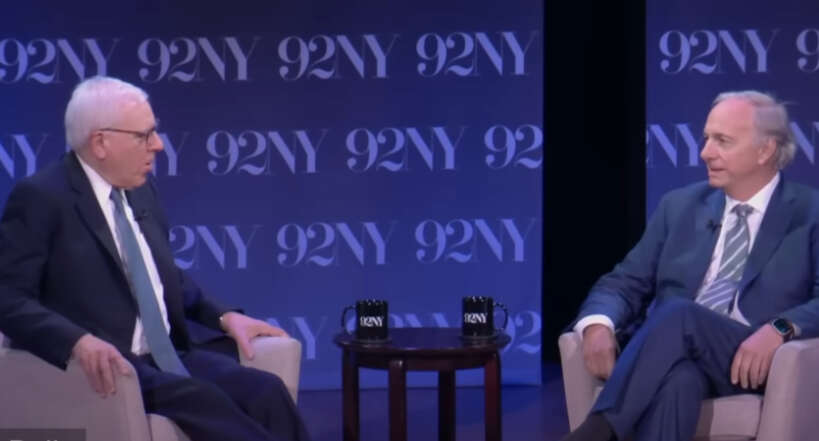
Read the full transcript of co-founder and co-chairman of the Carlyle Group David Rubenstein in conversation with Join Bridgewater founder Ray Dalio on “How Countries Go Broke”, on June 26, 2025, at The 92nd Street Y, New York.
The Mechanics of National Debt: A Conversation with Ray Dalio
DAVID RUBENSTEIN: So thank you very much for doing this. How long did it take you to write this book? How many books have you now written?
RAY DALIO: Four.
DAVID RUBENSTEIN: Four. Okay. And how long does it take to write a book like this?
RAY DALIO: This is research that I’ve done over a long period of time. So putting it together and getting it out, I would say on a part-time basis, maybe over a year.
DAVID RUBENSTEIN: So you built the biggest hedge fund in the world. What’s the relative pleasure of building the biggest hedge fund in the world versus writing a book that’s a bestseller?
RAY DALIO: You know, as you would know, probably it’s a stage in life thing. There’s a stage in life where you compete and you build something, and then there’s a stage in life where you’re passing things along. So at this stage in life, you in your way, me in my way, it’s a great joy to be able to pass along what I’ve learned. So I’m loving it.
The Purpose Behind the Book
DAVID RUBENSTEIN: Okay, so this book is designed to make people feel good or to scare people?
RAY DALIO: Neither. I wanted to convey the mechanics, the cause-effect relationships, so that people can understand what’s going on and then navigate it. I think it’s a book that will make people worry. But I have a principle which is: if you worry, you don’t have to worry. And if you don’t worry, you need to worry. Because if you worry about something, then maybe you’ll prevent what you’re worrying about.
DAVID RUBENSTEIN: So when did you decide to become a writer as opposed to just an investor? I mean, a lot of great hedge fund investors just keep sitting in front of screens and so forth. When did you say, “I want to do more than sit in front of screens?” Was that a couple years before you decided to exit Bridgewater?
RAY DALIO: No, it was maybe 35, 40 years ago. What I learned was that whenever I was making decisions, if I would pause and reflect and write down the criteria that I used to make that decision, it would make me think more deeply about it. And then I learned that I could put those into code and then back-test them so I would know how my decision-making would work.
And so right from then, 35 years ago, that’s how I really built Bridgewater. What are the criteria? Test the criteria over a period of time and then form a game plan. So I’d say 35 years ago, I’ve written down—I call these things principles—I’ve written down probably a thousand of them or something.
The Making of an Investor
DAVID RUBENSTEIN: For those who haven’t followed the hedge fund world, you’re from Long Island, you went to Long Island University. You would say you were not a superstar in high school, on the contrary. But you did very well at Long Island University. And eventually you got into Harvard Business School and you started your career. And your career almost went south when you punched your boss in the mouth, right?
RAY DALIO: No, that was when my opportunities began. I got fired. When I got fired, then I started.
DAVID RUBENSTEIN: So you got fired, you started your own firm, and you borrowed some money at some point from your father because the firm hadn’t done that well. Did you ever think that maybe you weren’t going to make it?
RAY DALIO: So yeah, let me tell you about that incident because it was one of the worst cases and one of the best cases for me. So this is 1980-81. And I had calculated that the United States lent more money to countries than they were going to be able to pay back and that there would be a big debt crisis.
And then in 1982, Mexico defaults on its debt. And I got a lot of attention because I anticipated this and I thought I was right, and I couldn’t have been more wrong. I thought we were going to have a big economic crisis because of this. And what happened instead was the stock market went up, they eased monetary policy, and I made a terrible mistake. And it cost me money.
I was so broke that I had to borrow $4,000 from my dad in order to pay for family bills. And this was painful. And that changed my approach to everything in two ways. First, it made me think, “How do I know I’m right?” It gave me the humility I needed to balance with my audacity. And it let me understand how to play this game going forward.
And I understood the power of diversification and how diversification could reduce risk by up to 80% without reducing returns. And that was then the foundation of Bridgewater. And then from then on it was straight up because of the lesson I learned—writing down these things and experiencing and making the most out of mistakes as learning experiences.
The Power of Diversification
DAVID RUBENSTEIN: As an investor, you always have ups and downs. Nobody does everything perfectly, not even Warren Buffett, right?
RAY DALIO: But you know what changed from that point? The returns in my 30-some-odd years since doing that—since that point—were about 11.8% return with no year down significantly other than 2020 during COVID, and that was down 13%. But the other years were down like 2% because I learned the power of diversification.
One of the things about diversification is that you can reduce the risks without reducing the return. My mantra is “15 good uncorrelated return streams.” Because if they’re engineered to have about the same expected return and you have that kind of diversification, you will lower the risk by about 80%, which raises the return-to-risk ratio by a factor of five.
DAVID RUBENSTEIN: Did your father ever say that he should have taken the $4,000 you paid him back and invested with you? He would have been a lot better off, right?
RAY DALIO: My dad—we didn’t go there. It worked out.
How Countries Go Broke
DAVID RUBENSTEIN: Okay, so let’s talk about debt. So your new book talks about countries going broke. Do countries really go broke? Companies go broke, people go broke. But do countries really ever go broke?
RAY DALIO: Countries’ debt and their dynamics about debt are the same as individuals and companies, except for two important differences: they can print money and they can take your money through taxes. So what happens is—think of it as the same. They print money. When faced with the choice, they print money. And so the way they go broke is not that they default; it’s that they devalue.
If I could explain the mechanics in the book, just for a minute: Think of the credit system as being like the circulatory system of the blood in our system. And it brings nutrients, and those nutrients are credit—that’s buying power. And if people use that credit, which creates debt, but they earn enough money to pay back the debt, we have prosperity and we have a healthy system.
But what you can see is that as incomes rise for countries—largely because of the way people are and politicians want to make people happy—debt rises relative to their incomes. And you could see that it’s like plaque. Debt service is like plaque building up in the arteries. So you could see interest rates and debt service payments starting to squeeze out other consumption. We can see that in our numbers.
And then there are three main things—and this is the punch line, this is what I’m trying to convey: You see that squeeze out, and also you see a supply-demand problem. In other words, like for example, in the United States now we have to sell about $12 trillion in the next year. We have $1 trillion that we have to pay in interest. We have $9 trillion in debt service in terms of principal. And then we have to sell another $2 trillion because we are going to have a deficit. So that $12 trillion has to be sold.
And then you could look at who are the buyers of that money. And when you have a supply-demand imbalance, that’s a problem. But the way that governments deal with that is ultimately—if you have that supply-demand imbalance, then you have interest rates rising and it causes asset prices to go down, curtails economic activity and so on. But central banks don’t want to let that happen. So what they do is they print the money.
And when you get to the point where we are, which is very close, where you start to have to borrow money to pay the debt, then that is the problem. We have $7 trillion—here’s the numbers of the country: The government spends $7 trillion a year. They take in $5 trillion. So they’re overspending by 40%. And they can’t cut the expenses because the expenses are not adequate. The expenses can’t be cut. They’re relatively fixed and they’re going to grow and compound. So we’re at that spot.
America’s Debt History
DAVID RUBENSTEIN: Let’s go back to the history. When this country was started, we had debt at the beginning to pay for the Revolutionary War and the famous compromise. Alexander Hamilton wanted to have the Southern states agree to pay the Northern debt—$70 million, with the Southern states having already paid their debt. The Southern states didn’t want to do that.
They had a compromise, a famous dinner on Wall Street with James Madison, Thomas Jefferson, and Alexander Hamilton. The agreement was the debt would be taken over by the federal government in return for moving the capital from New York to Washington or somewhere in the South. And it was Washington. So we’ve had debt from the beginning—$70 million. Have we ever had a time when the United States government doesn’t have debt?
RAY DALIO: Oh, no, no, no.
DAVID RUBENSTEIN: I think hardly ever.
RAY DALIO: It’s the amount of debt.
DAVID RUBENSTEIN: Andrew Jackson—he hated debt. He got rid of the Bank of the United States. But that’s about the only time. But in recent years, let’s take post-World War II. Post-World War II, we’ve run deficits most every year. Is that right? Pretty much.
RAY DALIO: Yes, that’s right.
DAVID RUBENSTEIN: The only time since World War II that we more or less balanced the budget and actually had a modest surplus—well, there was a deal in the early 1990s. Bill Clinton and Newt Gingrich came up with a deal and we actually had something called a budget surplus, which is when you have more money coming in than going out, which is very rare.
RAY DALIO: In 1998.
DAVID RUBENSTEIN: We don’t have that problem anymore.
The 3-3-3 Solution
RAY DALIO: No, but you can do that though. Right now, in order to stabilize the debt relative to the income, you have to cut the budget deficit to about 3% of GDP, and it’s now six and a half or seven percent. So that’s 4%. Cut it by 5%.
And if you go to many cases across the world, there have been major decreases of more than 5%. The way that they did it was—there are three things that affect the budget deficits: there’s spending, there’s taxes (tax revenues, not just tax rates, but tax revenues), and then there’s interest rates. And it’s what I call a “3-3-3 solution.”
What they have to do is get the budget deficit down to 3%. So that would be a significant decrease. But they have to do it like they did it in that period of time, which was through a combination of tax revenue, cutting spending, and interest rate cuts.
And if we change the deficit—if we change the tax rates, tax revenue by 4% and you cut the spending by 4%—these are not huge numbers that naturally will improve the budget deficit so that interest rates will go down. Interest rates would go down by about 1%. That would lower the budget deficit to about 3% of GDP because of the improvement in the supply-demand balance. That lowers the interest rates.
That has also the effect of causing asset prices to go up. And it also has the effect of being beneficial for the economy, which produces tax revenue. So we are at a point right now that if we do something like that—what I call the “3-3-3 solution”—that is a possibility for dealing with this issue.
If we don’t do this and we pass this point and we then add to the debt and create the squeeze and we’ll have the supply-demand problem, we stand the risk of having a recession at the same time as we have a debt problem. If we do that, then you’re going to have the deficit go up because of the recessionary effects on the deficit, and you’re going to have political impossibility of either raising taxes or cutting spending.
DAVID RUBENSTEIN: The 3-3-3 solution. As I understand it, you want to get the deficit down to 3% of GDP.
RAY DALIO: Yeah.
The Political Reality of Fiscal Reform
DAVID RUBENSTEIN: You want to do it three ways. Cut the interest rates, cut spending and increase taxes each by modest amounts. Right. And do it over three years, something like that. Three, three, three. Okay. What’s the chance of that happening?
RAY DALIO: 5%.
DAVID RUBENSTEIN: All right. You’ve been in Washington.
RAY DALIO: I was in Washington the other day, okay.
DAVID RUBENSTEIN: And members of Congress tell you this is a brilliant idea. We wish we had thought of it and we’re going to do this.
RAY DALIO: I’ll tell you what members of Congress tell me, which is very interesting. Both sides. Nobody disagrees with what I just said. It’s very interesting. They all agree that has to go to 3%. They all agree it has to come from those three things and so on. And then they say. But I can’t say that. I can’t say that because they all say this.
I can’t say that because we’re now in an absolutist political environment in which if I say they want the public, my electorate wants me to say, “I will take a pledge of no new taxes” or “I will take a pledge not to cut your benefits.” And so because of that absolute. If you don’t take a pledge, then it’s like this with the constituents.
The constituents say something like, “Are you telling me that you’re going to compromise with those people and you’re going to raise my taxes or I’m going to compromise with those people and I’m going to cut your benefits.” Okay, no way. I don’t want you in government. And so they won’t convey what they truly believe.
DAVID RUBENSTEIN: Say people in Washington are not saying what they really believe, I don’t believe that.
RAY DALIO: And it’s interesting because they say, “Please help create the meme that you’re irresponsible if you don’t have a 3% budget deficit so that my public will pressure me to do these things.”
Understanding America’s Total Debt
DAVID RUBENSTEIN: Let’s talk about, make sure everybody understands. Let’s deal with the total indebtedness. How much debt does the United States really have?
RAY DALIO: It has about 36 trillion. If you’re taking the total debt. If you take net debt, it’s probably about 30 trillion.
DAVID RUBENSTEIN: 30. Net debt is. In other words, we owe ourselves some money. But if you take the gross amount of debt, it’s roughly 36 trillion. But we now are actually at the debt limit. And until they pass the big beautiful bill and expand the debt limit, we’re capped at 36. But we probably really have about 38 trillion when they pass the big beautiful bill because then we’ll be able to borrow more money legally.
RAY DALIO: It’s rising fast.
DAVID RUBENSTEIN: Okay, so 36, 38. You know what difference does it make? But 36, 38 trillion. Okay. That’s how much we have. Where did it come from? Did we have it under World War II? We borrowed a lot of money, but it was still money we ultimately paid back. When did we start getting all this debt? Was it really around the beginning of 2000, this century?
RAY DALIO: Well, you’re taking really the increases. If you’re talking about that. There were increases all along, but particularly we increased them in the COVID years. And after the COVID year.
DAVID RUBENSTEIN: All right, so we began increasing it. And is it just the Democrats or just the Republicans or everybody?
RAY DALIO: Everybody, Everybody.
Breaking Down the Budget
DAVID RUBENSTEIN: Okay, so we got 36, 38 trillion. What difference does it make? It’s a lot. The deficit each year. The deficit is the annual amount that we’re spending. That’s more than we’re taking in. You said we’re spending about 2 trillion. Yeah, 2 trillion a year. We basically bring in revenues of about 5 trillion and we spend 7 trillion. Okay.
Right now, why don’t we just cut the amount of money we’re spending? What is the budget being spent for? What percentage is defense spending? What percentage is entitlements? What percentage is everything else? Interest.
RAY DALIO: I’m going to give you numbers that look at spending. What percentage of spending? But I think you should look at almost what percentage of revenue.
DAVID RUBENSTEIN: Okay.
RAY DALIO: Okay. But anyway, about 60% is based on what we call entitlements, which is Medicare.
DAVID RUBENSTEIN: Medicare, Medicare, Medicaid, Veterans benefits, Social Security.
RAY DALIO: Yeah, 60% of the budget, but about 85% of the amount we take in. Okay. Then we spend on interest payments. We spend. It’s about 20% of what we take in and about 12% of the budget.
DAVID RUBENSTEIN: Roughly a trillion a year on interest.
RAY DALIO: A trillion a year. Then we spend on defense. About. Excuse me, I think it’s 950 billion.
DAVID RUBENSTEIN: Something like that.
RAY DALIO: Yeah, something around that.
DAVID RUBENSTEIN: Okay, so you’ve got almost a trillion.
RAY DALIO: So if you take those and you add them up, which are relatively. They’re fixed payments, pretty much that’s about.
DAVID RUBENSTEIN: 85% of the budget or something.
RAY DALIO: That equals 85% of the budget and about 110% of what we take in. So we’re spending more than we’re taking in.
The Limited Options for Fiscal Solutions
DAVID RUBENSTEIN: Right. Okay, so here’s the alternatives. Okay. We’re spending a lot of money. Why don’t we cut entitlements? That’s very difficult to do. Nobody wants their Social Security benefits cut. Right. So why don’t we just not pay the interest on the debt? Well, you can’t do that. Why don’t we forget the defense? We can’t do that.
So you cut the National Endowment for Humanities and the National Endowment for the Arts, but that doesn’t add up to that much. So how are we going to solve this problem? Well, you could increase taxes, and a lot of people in Washington want to increase taxes.
RAY DALIO: They’re not going to increase.
DAVID RUBENSTEIN: You didn’t find that many of those. Right. Okay, well, the big beautiful bill that’s now being talked about, will that solve our problem or mitigate it or what will it do?
RAY DALIO: It’s not going to solve our problem.
DAVID RUBENSTEIN: Okay, so if that’s not going to solve our problem, how are we going to solve this problem?
RAY DALIO: We’re going to do it the way that we always do it, and it’s always done. When countries essentially go broke, what they do is they, through a combination of devaluing the currency, printing of money, there’s an imbalance. They print money, devalue the currency, and create an artificially low interest rate so that the person who’s holding the bonds is receiving an artificially low interest rate. That’s the way Japan has done it with their local. And that’s the way we will do it.
DAVID RUBENSTEIN: So in other words, my grandchildren and great grandchildren not yet born are going to be paying off this debt in devalued dollars, More or less.
RAY DALIO: It’s going to happen faster than that.
DAVID RUBENSTEIN: Faster than that. Oh, okay.
RAY DALIO: I think they’ll probably be beyond that.
DAVID RUBENSTEIN: All right. Do you think it’s.
RAY DALIO: So the way it works is you have that dynamic. So watch the value of the dollar, but also not just in relationship to other currencies, but look at it in relationship to gold, which, by the way, is the second largest reserve currency. First is dollars, then gold is the second largest reserve currency, then euros and then yen. Okay, it’s that currency.
But anyway, look at in there, you’ll see a depreciation in the value of the dollar, I believe, and then you’re going to see artificially low interest rates as a means of doing that. And my concern is that if you have this dynamic happening at a time when there’s a recession, which is the most likely scenario, then you’ll see budget deficits rise and you’re going to see a population at each other’s throats.
So you’re certainly not going to see in a recession that they’re going to say, “I’m going to increase my taxes or cut the benefits.” So you’re going to see a very difficult social, I think, political and economic set of circumstances.
Investment Strategies in Times of Fiscal Crisis
DAVID RUBENSTEIN: Well, before we finish this discussion, I want you to just interrupt it for a moment and say, look, you’ve scared me a bit, but I need to make money. I’m an investor. What should I do to take advantage of what you just described? It scared me. Should I go buy gold? Should I go buy dollars, buy euros? What should I do?
RAY DALIO: I think that you. First of all, I don’t want to throw out tips, but I’ll give you my thoughts from the point of view of what are safer investments.
DAVID RUBENSTEIN: Okay?
RAY DALIO: Okay.
DAVID RUBENSTEIN: Well, you’re a pretty famous investor, so I’m kind of going to listen to you.
RAY DALIO: Keep in mind that I’ve been wrong. First look at the value of your portfolio in inflation adjusted terms, not in nominal terms. Okay? And the safest investment that you can get right now is an inflation index bond because what you’ll get is it’ll be indexed and you’ll get a bit over 2% real return above inflation and whatever happens. So you start with what is a safe investment.
The next thing I think you have to do is diversify your portfolio. We talked about the powers of diversification. So I don’t want to get anybody into one bet because I’m going to be wrong. But do consider that gold is, is a form of money, and gold is that central banks are acquiring gold now as a diversifier. And so it also is negatively correlated with most of the things that you have in a time of great stress.
What you’ll find is that the gold will do well when the assets don’t. The world used to have gold as money. That was the way. And so the world would look at things differently. They would look at the prices of things in gold terms. Now because we have fiat money and we’ve become used to it, we look at the prices of things in money terms and we look at gold that way.
I think if you started to say it’s money, it’s a source of money, and you have that, that’s part of the diversified. So it would diversify your portfolio. It’s a prudent thing to have somewhere between 10 or 15% of your portfolio in gold. So if you put in some inflation index bonds and you put in gold, that will diversify your portfolio relative to the things that you have in it.
Those would be the general thoughts. I would thousands of years that would not be getting you into a riskier position, that would be getting you into a safer position. So it’s no big bet. It’s a reducing of your bet by putting you into a position to in terms of real purchasing power for your portfolio.
The Enduring Appeal of Gold
DAVID RUBENSTEIN: For thousands of years people have liked gold and people still seem to like gold. Prices of gold are going up. Why are people so interested in owning gold in a time like this?
RAY DALIO: As they say, since 1750, 80% of the world’s monies have disappeared and all of those that existed have been greatly devalued. That’s one of the reasons that gold is a store hold of wealth and has been for a long time. And there’s a saying that gold is the only asset that you can have that’s not somebody else’s liability.
And what they mean by that is that you don’t have to receive money from somebody else in the world that we’re now in and we’re seeing it internationally. There’s a worry about sanctions, there’s a worry about taking gold. Those holders, central banks around the world are concerned about the possibility that let’s say what happened to Russia could happen to them and so on.
So there’s a diversification of that and it creates a dynamic in and of itself. Because what happens is if they are switching and they are switching to, to gold away from bonds and so on, then that has the effect of not only making our supply, demand balance that we’re talking about, about the new deficit, it means that you can have the selling of gold which makes that supply, demand, balance worse.
DAVID RUBENSTEIN: Now it used to be the case that the US dollar was backed by gold and US government said if you don’t want these pieces of paper, we’ll give you gold. And ultimately we ended that. We’re never going to go back to that. Presumably. Right.
RAY DALIO: You know, probably. Presumably that’s right. But if you watch these gold, these cycles because you have the devaluation, then people feel don’t have confidence in the fiat system. Over a period of time and through history they’ve at that point, the way that works is you print all this money, then you pay the debt with the cheap money, but nobody wants to hold it.
So then they go back and link it again. It is conceivable that you can see a relinking of gold to money, but that’s way in the future.
The Dollar’s Decline and Currency Concerns
DAVID RUBENSTEIN: Since the beginning of this year, the dollar against the basket of currencies is down about 10% in value. Many people are worried that they might continue that way, devalued. Some people say it’s not a bad thing because we can buy things, we can sell things more cheaply overseas and increase our exports. But if people are worried about the dollar going down in value, what would you suggest they do? Buy other currencies or go buy things that are not dollar denominated?
RAY DALIO: I think the picture would be some version. Their concern would be some version very similar to the 70s you just talked about. I remember I was clerking on the floor of the New York Stock Exchange on August 15, 1971, and that is when Richard Nixon got on the television and he said in his polite way, this was a wonderful move, but the money that you thought you had, the gold, was money.
And what at the time people thought were real. The money that we’re used to, they would say are like checks in the checkbook. He said, “You’re not going to get your money. You can keep the checks” at that point. Then we began the 70s, and the 70s was a period in which there was both stagflation.
The thing that we have to worry about is a stagflationary environment because all the currencies went down. So when you were looking at diversification, the problems that we’re talking about are not just American problems. We have a significant problem, but they’re European problems, there are Japanese problems, there’s Chinese problems.
We’ve lived on promises to be able to take that dead asset and convert it into money. And now there’s not enough money to go around. So I would say that when you ask the question, would I devalue in relationship to other currencies? Probably, but the other currencies won’t want much of an appreciation. And so that’s why I’m saying that something like gold will be the better performing currency.
The Plaza Accords and Government Intervention
DAVID RUBENSTEIN: Some people worry about this and can tell us whether this is realistic or not. In 1985 there was something called the Plaza Accords where the United States government agreed with other governments that we were going to devalue the dollar legally, officially, and it was done in secret. Nobody knew it was coming. Is that a possibility that the government of the United States could again agree with other governments? We’re going to devalue the dollar further or you think that’s unlikely?
RAY DALIO: No, I think it’s a possibility, yes. And it’s so interesting in history, when you look at what happens when governments are in certain positions, all through history they do the same things. And that means that a move like that, or even there could be foreign exchange controls, there can be different ways that that happens.
Real Estate as a Hedge Against Currency Devaluation
DAVID RUBENSTEIN: You didn’t mention throughout history there have been two things that people have always wanted as a source of wealth. One was gold and maybe silver, you could argue too, but gold and then real estate. And what do you think about, if you’re nervous about paper currency and the valuation of it, why not just buy real estate and hold onto it? Is that not a good idea?
RAY DALIO: It’s not a good idea. No, it’s not a good idea because first of all, real estate is more interest rate sensitive than it is even inflation sensitive. So if you were to say, if this environment happens, does it go, it goes down in real terms.
It’s also an asset that is a fixed asset that is the easiest asset to tax. In other words, in any place you’re in a particular state, putting in real estate taxes means that they could always get the money. And so it doesn’t. It’s not an effective diversifier that way. And also being able to move money from one place to another, the real estate is nailed down.
Interest Rates and Federal Reserve Policy
DAVID RUBENSTEIN: So you’ve mentioned three things. Let’s talk about one we didn’t go through very carefully yet. Cutting spending is very difficult. 85% of the budget’s pretty much locked in. It’s hard to do that. Increasing taxes. Not a lot of people vote for that. Or they do. They don’t get reelected usually. But what about cutting interest rates? Why doesn’t the chairman of the Fed say, well, cutting interest rates will save us money. We’re spending a trillion dollars now on interest for our own debt. Why don’t we just lower the interest rate? Why don’t we just do that?
RAY DALIO: There is the real interest rate, and one man’s debts are another man’s assets. And so if I lower the interest rate, I will reduce my desire to hold that bond. And in my opinion, if you do that too much, you will lose the demand for those bonds.
Unlike if you do create something closer to the 4% cut in the expenditures, 4% increase in the tax revenue, improve the balance, then you’ll have a benefit. If you try to force interest rates down, you are hurting those who are holding the bonds and you will lose the demand for the bonds. And you can create that spiral.
Audience Questions: Term Limits and Political Solutions
DAVID RUBENSTEIN: All right, we have some questions from our audience. Let me read a couple of them to you. This is one I hadn’t thought of. Can deficits be solved with term limits? In other words, if you limit the members of Congress, how long they can serve, is that going to solve the deficit problem?
RAY DALIO: You mean because they’ll tell the truth and do the right thing if they don’t have to get reelected?
DAVID RUBENSTEIN: Yeah, you didn’t mention that in your book, but you probably don’t think that’s going to work.
RAY DALIO: There is something, by the way, Plato in the Republic going way back dealt with the issue of the problem of democracy. And he said that when you have a public that wants things and you have to meet those demands and includes irresponsible things that than it’s usually provided. So there is a problem related to that and I don’t know term limits, I’m not sure.
The Role of AI in Economic Solutions
DAVID RUBENSTEIN: Okay, now today everybody says the solution to all problems is AI. So if we just use AI that’s going to solve our problems. Is there anything that AI can tell us? Can we ask ChatGPT what we should do or how can AI help this problem?
RAY DALIO: I don’t know. Ask ChatGPT and see whether it gives you the good answers. AI I think is going to have a tremendously beneficial productivity impact. And the hope is that there’s great productivity improvements as a result.
I, when I do the examination of the scenarios I’ve done the assumption that it will have an impact that is in the order of twice as much of any other investments, productivity, miracle developing things like the Internet and digital technologies and all of that. And that won’t be enough.
However, it’ll also have a real question about the wealth impact. The basic problem also that we face is that there’s a great income and wealth and productivity gap. 60% of the American population has below a 6th grade reading level. So the productivity and income of that is a problem.
The top 10% of the population pays 76% of the taxes and they of course have the commensurate earnings with that. But that means that if you, let’s say in a city like New York, if you chase them away, let’s imagine you take that top 10% and then it becomes the 5%, half of them leave, then you lose something like 35% of the income. You have a problem. That’s just the mechanics of it.
So there’s only one way to get through this. I think at the end of the day, technology will help. Productivity will help. But the most important thing is the basics. If you look across countries or you look over periods of time, first educate your children well so that they can be productive and they’re civil, so that they work well together.
Come out to a civil society in which there’s productivity and that there’s a good capital markets and a good environment so that there’s good income and get the basics, the fundamentals right, meaning earn more than you spend and have more assets than liability. Again, good income statement, a good balance sheet.
If you do those basic things, most people productive and you do those basic things civil and working well, then rule of law, that’s a great thing to have those things, then we’re going to be in good shape.
Public Service and Political Leadership
DAVID RUBENSTEIN: What about yourself? Why don’t you go into government? Why? Have you thought about you being secretary of treasury, chairman of the Federal Reserve? Run for the Senate or something and solve those problems while you’re in government? Have you ever thought of that?
RAY DALIO: Scares the daylights out of me. Let me say I have the greatest appreciation and respect for those who go into public service and serve in this kind of an environment. And I think there’s a question of whether with the population, it’s not just a leadership question, it’s a can you lead question.
You can bring capable people into that job. But we’re in a situation where everybody’s fighting over every decision all the time and will tear everybody down if they’re so it’s a very difficult situation.
Bipartisan Commissions and Political Solutions
DAVID RUBENSTEIN: Now, some presidents have had commissions. They say it’s too difficult politically to do these things. So we’ll have a commission of outsiders. They’ll come up with a recommendation and Congress will just pass it or hopefully pass it. Do you think a commission like there was when President Obama, the Bowles Simpson commission or something like that could work?
RAY DALIO: When I said that there was a small chance. Here’s the way I think the small chance plays out. I don’t think it’s likely, but here’s how it plays out. You’re going to have they’ll pass the budget. Then they’re going to have a continuing resolution to continue the budget.
And then they’ll look at things and so this will be for the 26th budget. When they look at those things, they’re going to also calculate that Social Security is going to run out of the Social Security. Social Security fund will run out in 2033, which is in that window.
Everybody’s going to be staring. We’re not going to have adequate Social Security and so on. And at that time, perhaps, maybe it’s after the midterm elections in 26, there is the maybe you get a bipartisan commission.
I would hope that you can have a bipartisan commission and that they then deal with it. I worry that that’s too late. But anyway, maybe it’s not too late and maybe it’s so a bipartisan commission would be a desirable thing.
And then following the bipartisan commission, as you point out, we’ve had bipartisan commissions before, they have not been effective. And I don’t know that you’ll be able to create one, but I hope it happens.
Investment Advice for Middle-Class Americans
DAVID RUBENSTEIN: All right, here’s a question from somebody in the audience. Maybe everybody wants this answer. What do you think is the best investment vehicle for a middle class American that is risk adverse?
RAY DALIO: An inflation index bond, which is index fund tips, treasury inflation protected securities, because it will guarantee you a real return. And I don’t think that you should be speculating in the markets because there’s a zero sum game and you’ll probably be the loser.
Bond Markets and Congressional Inaction
DAVID RUBENSTEIN: Now, my perception is that people in Washington always say, well, if the situation was that bad, the bond market would collapse. And then the bond market people say, well, if it was a situation that bad, Congress wouldn’t do this. And they both kind of blame each other for not doing anything. Why hasn’t the bond market collapsed over the fact that we have all this debt over all these years?
RAY DALIO: I’ve experienced this many times. I did this analysis in 2007 and 8. I went to Congress and everybody said they asked me the same question, but we had the problem. Same thing happened in Europe. So there’s a supply, demand. There’s a saying that everything goes slowly until it happens all at once. When the problem happens, these things happen like that.
The Reserve Currency Trap
DAVID RUBENSTEIN: Now, one of your earlier books, you wrote that when you have the only reserve currency in the world, you tend to borrow a lot of money. You pointed out the Dutch did this with the guilder, the British did it with the pound, now we’re doing it with the dollar. Is it a problem that you tend to not realize that you can’t borrow forever? And so do you worry that because we have the only reserve currency, we eventually will borrow so much that we won’t be the only reserve currency in the future because people won’t want dollars? You worry about that?
RAY DALIO: Yes.
DAVID RUBENSTEIN: What are you going to do about it?
RAY DALIO: Talk about it.
Finding Optimism in Economic Uncertainty
DAVID RUBENSTEIN: Okay, all right. So today let’s give people some feeling. That’s optimism. We don’t want people to leave here depressed. So what can you say? Good about the economy or something good about our economic system? Must be something.
RAY DALIO: Well, first of all, I might be wrong.
DAVID RUBENSTEIN: Okay, well, that’s a possibility, but that’s.
RAY DALIO: That’s a possibility. And that there’s the ability, first of all, to deal with the problem. As I say, if you worry, you don’t have to worry. And if you don’t worry, you need to worry. If we can have enough worry, there’s still opportunities to deal with this. And then as an individual, you can diversify, you can do certain things to protect yourself against it.
Financial Advice for Young Adults
DAVID RUBENSTEIN: Okay, here’s a question. As a 24 year old, what is it that I can do financially by 30 to ensure that I set myself and my family for future success?
RAY DALIO: You know, being in that position, I remember I would ask myself, how long can I live if I don’t bring in any money? Do I have a savings that was going to allow me to live? Is it months, weeks, months, years and so on to be able to think in that way, in terms of creating that kind of savings so that you have that financial independence and also save into things that improve your life and improve your livelihood.
Like buying your apartment or your environment. If you can diversify, of course, that’s good too. But being able to have that forced savings. I know when I first had my house, I would think about what the improvements and I would have the forced savings along those lines. So trying to not waste money.
I give my grandchildren a gold coin every year. Every Christmas and every birthday they get a gold coin and then they see no toys.
DAVID RUBENSTEIN: Not just a gold coin, no toys, just gold coin.
RAY DALIO: They get toys and then they get the gold coin and then they compare where are the toys a few years later and where’s the gold coin? And the deal is that that accumulates over a period of time. All I’m saying is that I think that savings is a very important thing. And knowing how to then take that saving and have a lower risk, such inflation index bonds or a diversified portfolio are the fundamental things that I would encourage that person to do.
Global Perspectives on America
DAVID RUBENSTEIN: So I mentioned you grew up in Long Island, so you’re an American citizen, but you spend a fair amount of time traveling the world and now you spend some time in the Middle East and sometimes in the Far East, living there. What do people in the Far East think about what we’re doing in the United States? And what do people in the Middle East think about what we’re doing in the United States, financially?
RAY DALIO: All over the world and including in China and other places, the United States has been a place of great admiration because it’s a place that the best in the world will come and everybody can be a citizen, everybody can be welcomed. So you can bring the best talent, right? Rule of law, capitalist system and so on. But I would say all around the world they’re concerned about these things now. So greater and greater concern is the general theme.
The Path to Success
DAVID RUBENSTEIN: Now if somebody is watching, they say, “I want to be the next Ray Dalio, who builds a gigantic hedge fund, does well financially, well respected by people, writes best selling books.” What’s the secret to that? What do you do?
RAY DALIO: Well, I think make your work and your passion the same thing. And don’t forget about the money part. In other words, I didn’t work for money, but I had a passion. I fell in love with the game of investing. And I think you have to make your work and your passion the same thing. But you do have to pay attention to the money part because if you’re not earning an adequate amount of money, then that’s a problem.
And I don’t think the best life is for those who make the most amount of money. There’s a very low correlation between the level of happiness or well being past the basic level of income.
DAVID RUBENSTEIN: Really? You’re just telling me that now? Wow.
RAY DALIO: Well, we know the highest level of happiness and well being generally is a sense of community. Do you have a sense of community? Your friends in that community? But anyway, I would say don’t over exaggerate the power of money. You need to have enough and you have to pursue your passion and have enough money. And it’s never work if you’re pursuing your passion. You’re not doing it for the money.
Political Realities in Washington
DAVID RUBENSTEIN: So when you go to Washington D.C. to tell people this is what you think they should do, they’re polite and they tell you they can’t say anything publicly that will get them in political trouble. Do you come away saying that these are people that should be more public minded and should be willing to be more honest about it? Or do you recognize the pressures they’re under and you just recognize it’s a definition?
RAY DALIO: I recognize the pressure they’re under. It’s a definition of the reality of the circumstances. You know, one would hope that idealism, maybe I’m overly idealistic that they would say “I have to say this” and then they get thrown out of office. But I recognize the reality. And then the question is how do you deal with the reality? And that’s why it’s such an interesting conversation with you say that they say change the meme so that the population demands it.
The Tariff Debate
DAVID RUBENSTEIN: Now, in recent months, one of the most common things talked about is something called tariffs. What is your view on tariffs? Is it good economically, bad economically? Is it going to solve our budget problem? Because I think in the big beautiful bill, a lot of money that’s coming in comes in from tariffs and that helps reduce the deficit a bit.
RAY DALIO: Tariffs are not bad. Throughout history, tariffs were the main source of government revenue. And any form of taxes has its cost. So capital gains taxes are bad and so on. Different things have their costs. I think the question is how well executed, how big are they, how disruptive are they in terms of the process.
They can bring a significant amount of revenue. That means that there’s less that’s needed elsewhere. And we’re now in a different world. We’re in a world where the world is almost at war. There’s self sufficiency, we have to build self sufficiency. We cannot continue to borrow or depend on imports for that. And so there’s manufacturing. How do you create manufacturing in the United States?
There’s some merit to all of those arguments. The question is whether that is done really well for the whole world. Tariffs, of course, are not the ideal you would like to have. If you’re dealing what’s best for the whole world, you would like to have the least inefficiency. You’d say, wherever they produce it the best, and we have it go around. But we’re in a world now that we have to be realistic in terms of we cannot be dependent on importing a lot of things and nor can the world be dependent on the value of the bonds and the debt that we’re acquiring in order to pay for those things.
America’s Future at 250
DAVID RUBENSTEIN: So as we get ready to celebrate next year, the 250th anniversary of this country, are you optimistic about our future or is the debt problem so concerning to you? You’re not optimistic about our future?
RAY DALIO: I think it’s a time horizon we’re going to go. I think we can deal with this. I think it comes down to how we are with each other. But we will go through this and we will get to the other side.
DAVID RUBENSTEIN: And when you go meet with members of Congress or other people in government and you talk about these serious issues of debt and deficit and so forth, do they listen? And then they say, “By the way, what should I do with my own money?” They ever ask you how they should invest their money or they never ask you for investment tips?
RAY DALIO: Not typically, no.
DAVID RUBENSTEIN: What about when you go to a cocktail party, people ask you for investment ideas all the time?
RAY DALIO: Here and there, I guess. Let me reverse the question. What do they do with you?
DAVID RUBENSTEIN: Well, I’m not as good an investor as you are, so they mostly say to me, “Do you know Ray Dalio?”
RAY DALIO: Well, it worked out pretty good for me.
Closing Remarks
DAVID RUBENSTEIN: So, Ray, look, I’d like to congratulate you on your incredible success. You came from very modest means, worked your way up 50 years as an investor, built the biggest hedge fund in the world, and you’ve contributed a lot to endowments and others who’ve been your investors. So you should be very proud of what you’ve achieved.
And now I hope you can make some progress in Washington. I’ve been living there for a while. It’s not that easy to make progress, as you know, but hopefully you’ll continue. And maybe some people will say they don’t want to get reelected, they just want to do the right thing. Hopefully you’ll convince them. Thanks very much.
RAY DALIO: Thank you.
Related Posts
- Michael Saylor Responds to Bitcoin Critics @ Coin Stories (Transcript)
- Why Multilingual Human Support Still Matters in Digital Banking
- To Buy Or Not To Buy Cryptocurrency? That’s The Question On Everyone’s Mind
- Ajay Banga on India, Migration and a Youth Jobs Time Bomb (Transcript)
- A Global Monetary Crisis Is Coming & AI Could Make It Worse – James Rickards (Transcript)