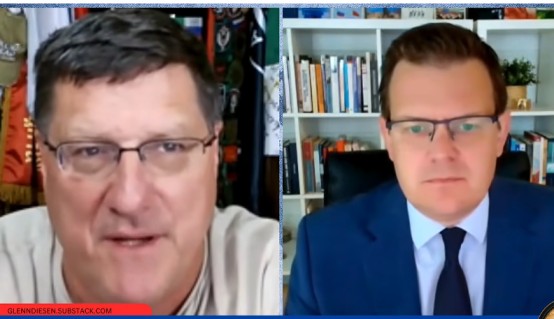
Read the full transcript of former chief weapons inspector Scott Ritter’s interview on Greater Eurasia Podcast, August 24, 2026.
EDITOR’S NOTE: In this timely discussion, Professor Glenn Diesen sits down with Scott Ritter—former U.S. Marine Corps intelligence officer, UN weapons inspector, and leading expert on arms control—to examine how NATO and Russia have repeatedly edged toward nuclear confrontation. Drawing on decades of experience, Ritter unpacks the collapse of arms-control treaties, the shift toward “usable” tactical nuclear weapons, and the dangerous escalations seen in Ukraine and beyond. The conversation offers a sobering analysis of why the risk of nuclear war remains higher than many realize—and what must be done to pull back from the brink.
Introduction
GLENN DIESEN (00:00:00 – 00:01:14): Welcome back. We are joined today by Scott Ritter, a US Marine Corps intelligence officer, also a former UN weapons inspector and a prolific author. Thank you for coming back on the program.
You’ve worked professionally in arms control and disarmament since, what, the 1980s? And unlike our political class, I think you still have a healthy fear of nuclear weapons and nuclear war.
Now, I’ve heard the rumours that there are discussions now in Washington about the possibility of using tactical nuclear weapons against Iran. Again, I have to stress rumours, but the premise here is that the conventional war is not going as planned. And well, furthermore, there’s already been attacks on Russia’s nuclear deterrent and early warning radars.
So a lot of the things we wouldn’t have done in the past is now being done, and one could expect the recklessness to only grow when panic sets in in both Ukraine and NATO. So I wanted to ask a very wide question. That is, how close are we actually to a possible nuclear war now?
The End of Arms Control
SCOTT RITTER (00:01:15 – 00:14:16): Well, let’s approach this this way. We no longer have any arms control treaties in place between the United States and Russia. There are no arms control treaties in place at all. Arms control is dead, which means there’s no break. There’s no off-ramp.
One of the key aspects of arms control was the fact that we had nations talking to each other. So there was a certain amount of confidence-building measure taking place, and there were no unknowns, especially on the strategic nature. We understood what the other side had. They understood what we had. We understood our doctrine, our respective doctrines, and we had people who were educated on these things, who understood the danger of nuclear weapons and nuclear war.
When you remove arms control, you replace it with a new mindset that doesn’t speak of containing nuclear power or eliminating nuclear power or reducing nuclear power, controlling nuclear power, but rather singularly focuses on how we can use nuclear power because we have these weapons. There’s no counter to this.
And so you see a tendency therefore for policymakers to, when they do things such as a nuclear posture review, they’re no longer constrained by arms control. In the past, for instance, the United States had to deal with the reality that we were limited to 1,550 deployed strategic nuclear weapons. And so was Russia.
There was a review that was done during the Biden administration while these caps were in place, caps that were mandated by the New START Treaty. The Biden administration had to take a look at how do we deal with a resurgent China, a China that was responding to aggressive nuclear posturing by the United States, in a manner that suggested there could be a preemptive nuclear strike against China.
China responded in a way that would make a preemptive nuclear strike almost impossible by modernizing its strategic nuclear deterrent and dispersing weapons to new silos in western China, et cetera. So the United States had to relook at its nuclear posture, how to maximize the destructive potential of a limited number of nuclear warheads.
Rearming Beyond New START
Now, this treaty no longer exists, so we’re no longer bound by that. There’s not much talk about it, but the reality is the United States is rapidly adding nuclear warheads to its arsenal. Part of the New START Treaty had seen the downsizing of, for instance, the Minuteman III missile from 3 warheads to 1 warhead. We kept a certain number of Minuteman III ready to be uploaded if needed, and now we are uploading them. So we’re increasing our numbers.
We saw the same thing with the Trident missile on the Ohio-class submarine. Had its warheads reduced to a classified number, but let’s call it 6 or 8. And now we’re seeing that some of these are going to be upgraded. You have to be careful because if you put too many warheads on, you affect the range of the weapon, which means that submarines have to get closer to their targets than operational doctrine. It’s complicated, but the point is there’s no more constraints on nuclear war planning.
And therefore, now that we’re in the business of talking about the potential of nuclear conflict, then we speak of, well, what weapons would we like to use or can we use? We know that the United States had previously developed what we call “usable nukes.” That’s a crazy term, but these are low-yield nuclear weapons.
We have the B61 bomb. It’s a gravity bomb that we have stationed in Europe as part of the NATO strategic deterrence, but they’re also part of the US strategic deterrence. And we know that some of these are being modified as we speak to give them greater penetration capability. We have the W76-2, a low-yield nuclear weapon put on the Trident missile, which again gives us a usable nuclear response.
Colby’s Push for Tactical Nuclear Weapons
And this used to be just theoretical, but now we have a situation where Mr. Colby, a senior Defense Department official, is actually redoing the American nuclear posture to include modifications of our implementation guidance so that we will use nuclear weapons or be considering the use of tactical nuclear weapons early on in any major crisis.
One of the reasons is that we found out that our conventional military deterrence is no longer sufficient to deter.
The Nuclear Annex to Every War Plan
Now to bring this to specific scenarios, what does this mean? It means that, for instance, in Iran, let me give you another reality that’s out there. In every war plan that we have, there’s a nuclear implementation annex. We don’t plan a war without a nuclear plan. The Gulf War, Desert Storm, had a nuclear annex. Everything we do has a nuclear annex.
And so when this military operation began against Iran, there was a nuclear annex, meaning that you have to what if, what if X, Y, and Z happens. But just because you have a nuclear annex doesn’t mean that you’re actually greenlit to use nuclear weapons. That’s a completely different thing. This means that if a nuclear scenario arises, where are you going to source your nuclear weapons and how would you employ your nuclear weapons based upon guidance from above.
We have been planning a nuclear war against Iran for a long time. We stepped up our plans when Iran made a decision to become a nuclear threshold state. We can go back to the debates that were held prior to this current conflict. If you remember, I strongly articulated against Iran pursuing 60% enriched uranium because it makes them a nuclear threshold state, which makes them a nuclear threat to Israel and the United States worthy of nuclear intervention. And our policy talks about the potential of preemptive intervention.
Fortunately, we didn’t do that. But now we have a situation today where the president has articulated Iran as a nuclear threat, and he has said that Iran will not be allowed to have a nuclear weapon, which means Iran cannot be allowed to exist as a nuclear threshold state. And the question is, how do we resolve this issue?
Iran’s Enriched Uranium and Isfahan
And the fear now is that Iran has moved its 60% enriched uranium into a deep underground facility that’s impervious to any conventional military intervention. Pickaxe Mountain, I believe, is the name of the target. And so there is active planning taking place right now on how to destroy Iran’s nuclear potential threshold capacity. Conventional weapons won’t do it. And so if the decision is made to destroy Iran’s nuclear potential, nuclear weapons would be used. And that’s where we’re at today.
Fortunately, the intelligence — I mean, we could just look at how insufficient the intelligence is. If you remember the failed — whether it was a pilot rescue mission or was it JSOC doing something else in Isfahan, we still don’t know. I’m leaning towards JSOC doing something else in Isfahan.
But Isfahan was singled out as the place where Iran had put its 60% enriched uranium, specifically in a series of tunnels in Isfahan that were then sealed up because the whole idea of the JSOC intervention was to get the D-Boys and the SEALs up on top. And remember, President Trump bragged about how they had special equipment to go down. Well, you don’t need that to rescue a pilot. That’s to go into the tunnel through various mechanisms that have been identified.
Well, we didn’t do that, but it means that — I’m just here to tell you that JSOC doesn’t launch raids of this nature with insufficient intelligence. Back when they were grabbing high-value targets in Bosnia, they needed to know how many steps up the stairs they had, which way the handle turned, what was the construction material. All this had to be known before they would commit to an action.
I can guarantee that they demanded a lot of information from the U.S. intelligence community before they would commit to a raid of this nature, which means that there is a high degree of confidence that the 60% enriched uranium was in Isfahan.
Why is this good news? Well, the good news is that the Isfahan tunnels haven’t been unsealed. And so anybody who’s trying to say that Pickaxe Mountain is now the location will have a hard time explaining how the enriched uranium went from Isfahan to Pickaxe Mountain, which means that the people who would execute a nuclear strike order are required under law to review this from compliance with international humanitarian law. And right now, I think it’s safe to say that this order would be rejected unless there’s new information that comes out where Iran says, “We have it, we’re getting ready to do it,” et cetera.
But there is planning going on right now about to use nuclear weapons against Iran. There’s no doubt about that, but it’s not new. This planning has been happening forever. The danger isn’t — with Colby’s planning — isn’t Iran, because we always had a nuclear annex to this place. The danger is China and Russia right now.
The Real Danger: Taiwan, Korea, and Kaliningrad
Because United States hasn’t modified its stance regarding Taiwan yet. We continue to provide Taiwan with military capabilities that are at odds with the policy objectives of China. And this could lead to a military clash. And the United States has no ability to defend itself or Taiwan in the case of a standup drag-out fight with China. We would have to use nuclear weapons early on. And this is problematic.
The same thing with Korea. We just significantly reduced our participation in a war game. But that war game had a nuclear component to it. It’s just the reality of conflict with a nuclear-armed North Korea. But now when you speak of North Korea, I think the plan would be modified. It would have to be modified to go nuclear from the start because we have no other conventional capability of sustaining resistance.
Russia — if NATO was stupid enough to, for instance, implement the plan that was leaked in German media last week, the Kaliningrad option, we would have to go nuclear early because we don’t have the ability to do any of this with conventional weapons. We have zero conventional capacity in Europe and in Asia and against Iran.
And yet we haven’t modified our posture vis-à-vis all 3 of these, so that if there is a conflict, we would either have to surrender, which I don’t think the United States is in the business of doing, or use nuclear weapons, tactical nuclear weapons, early on, which would immediately lead to a general nuclear exchange and termination of all life on the planet.
So should we be worried? Yeah, we should be scared to death. This is one of the most dangerous periods. If you were one of these people that just sat on the sidelines when I was talking about the need for arms control, get off the sidelines. It’s time to take a side, and everybody should be shouting out from the top of their lungs that there now is the time not just for arms control, but for arms reductions. We have to get rid of these nuclear weapons. They will be the end of all life on this planet if we don’t do so.
Making Nuclear Weapons “Usable”
GLENN DIESEN (00:14:19 – 00:16:24): Yeah, I find it — it’s important that — this doesn’t always start with Trump. People always point to Trump, but as you suggested, the shifts in these nuclear documents, a lot of this began also under Obama, if you saw from 2000.
And then I guess, well, when Trump makes the point now though, that he can’t accept Iran having nuclear weapons, or if Iran had nuclear weapons, they would already have used them — I mean, this is like building a case for the use of nuclear weapons. And again, all this discussion which you mentioned about making nuclear weapons more usable — again, this precedes Trump by many years. And the whole idea, we can use lower yield warheads delivery systems that make sure that we don’t have to use the big strategic nukes. All of this is introducing nuclear weapons, limited nuclear war as an option. The problem, of course, is always that once they go off, you can’t control this escalation ladder anymore.
But regarding Russia though, you mentioned Kaliningrad, which is important. I do also think that’s the most likely path to nuclear war if NATO does something foolish towards Kaliningrad, as the Russians would have — well, I guess the nuclear option would be possibly the best among worse options. But how close are we with something like this with the Russians though? Because from what I understand, we got closer, or close at least, under the end of the Biden administration. I know there were some discussions whether or not the Russians were bluffing, but how do you see this?
How do we look now? Because when Trump took over, it looks like everything died down a bit, that the Russians bought into his “end the war in 24 hours” rhetoric. And the whole thing seemed to scale back, but now it appears to be moving forward again. Are we further away from nuclear war now than we were at the end of the Biden administration, or was that bluff? How do you see this?
How Close We Came Under Biden
SCOTT RITTER (00:16:25 – 00:37:45): Well, there’s a couple things. First of all, I think we need to remind people just how close we were to nuclear war under the Biden administration. Russia in 2024 was looking for a way out of the Ukraine conflict. They weren’t married to unconditional surrender. They were open to this.
But at the time, you had people who interpreted the Russian openness towards a negotiated settlement as a sign of weakness. And so there was a lot of effort. Remember, in August of 2024, NATO invaded Russia. I just want to remind everybody that NATO sent 70,000 to 80,000 NATO-trained, NATO-equipped Ukrainians into Kursk, an invasion of Russia.
And it wasn’t a little invasion. They were trying to seize a nuclear power plant as leverage for an exchange with the Zaporizhzhia nuclear power plant. This was a big deal planned by NATO, which means that everybody agreed to it. This wasn’t the Ukrainians waking up one morning going, “Hey, let’s just go into Kursk.” This was the President of the United States, the Prime Minister of Great Britain, and the President of France all saying this is a good idea, to invade Russia.
Now, the force that invaded was, of course, Ukrainians backed up by mercenaries, but these were handpicked people who were trained and equipped with special NATO equipment. A lot of people don’t realize that NATO redid its doctrine after the failure of the 2023 summer counteroffensive, and now they’ve incorporated a whole new AI-driven operations intelligence fusion concept, where the Ukrainian tactical units were given these iPad-type devices, that would be — they would be told, go here, go there, because the intelligence was looking at the Russian force disposition, identifying gaps, and then AI would predict Russian response times, etc. And they’d pick the path of greatest opportunity, and they would direct the Ukrainians, and the Ukrainians were able to make big strides into Russia.
I mean, it took a lot of courage on the part of some airborne troops, some Marines, and the Akhmat Special Forces to come in and disrupt this. I guess the AI hadn’t factored in Apti Alaudinov’s methodology of warfare, because Akhmat came in and stopped them cold, and the Marines came in and stopped them cold, then the paratroopers came in and killed them, and then everybody else came in and slowly ground them back down. But this was a NATO intervention.
Starmer’s Briefcase and the September 13 Meeting
Why is this important? Because in September of 2024, Keir Starmer flew to Washington, DC with his big red British official documents briefcase, and he was bringing paperwork to Joe Biden. They had a meeting scheduled for September 13th where Keir Starmer was going to get Biden to sign off on allowing the Ukrainians to use the Storm Shadow missile to strike deep into the Russian strategic depth — not just striking Russian targets in the Donbas and Novorossiya or Crimea, but going deep into Russia. And the United States was going to sign off on the same thing — liberation for the ATACMS missile.
This would trigger Russia’s nuclear posture. Russia has said that if nuclear-armed nations provide non-nuclear-armed nations with the ability to strike Russia’s strategic depth, even if it uses non-nuclear weapons, Russia will treat it as a nuclear attack by the nuclear states. And this is what they wanted. And they were feeding off of what was happening in Kursk, the invasion of Russia. So you have to keep that in perspective.
This is where it gets a little personal, because on September 13th, the same day this meeting was supposed to take place, I was actually in the Russian embassy attending a concert. I had been meeting with Anatoly Antonov, the Russian ambassador, since December 2022, to talk about Russophobia and how we can get the American people inoculated against Russophobia. And one of the things we talked about was cultural events to expose an American audience to Russian culture.
This is a big thing for Anatoly Antonov. He’d been working really hard to get these concerts going against all odds, because nobody in Washington, D.C. wanted these things to happen. But he had this Rimsky-Korsakov — it was going to be a concert playing Rimsky-Korsakov’s music. And I was invited. I normally — I mean, I told this to the Russians, I’m pretty honest about it — I don’t like classical music. I’m a Bruce Springsteen, Bob Dylan kind of guy. But it was a great honor to be invited, and of course I would attend, because you have to show respect. And this is something that Anatoly Antonov had been working on. I know he was excited about it.
That night, he was not the same Anatoly Antonov. He was ashen-faced. Just something clearly had shocked him. And he cut the concert early, and he left.
Well, it turns out that that afternoon he had to make a phone call. There were people close to the White House who were asked to find out if the Russians were bluffing about nuclear weapons usage or not. And he was contacted by these people. And, according to — not from him, because he’s never talked to me about this directly, so this is still unconfirmed — but according to people who would be in a position to know, he did make the phone call. And the answer he gave was that if ATACMS or Storm Shadow strikes the Russian depth, there will be a Russian response, and Washington, D.C. will be on the target list. And there was no ifs, ands, or buts about it.
Now that caused Biden not to sign the documents. He got furious. He was screaming at people. And Starmer left. He was upset.
“Are the Russians Bluffing?”
The United States then did a review. Now, were the Russians bluffing? Because this — no president likes to be talked down by a Russian threat. So the question now that was asked is, are the Russians bluffing? This is a big deal.
In November of 2024, Rear Admiral Thomas Buchanan — I think his name is — he is the J5, the Director of Plans for Strategic Command. He does the war plans. He was speaking at CSIS, I believe, a think tank in Washington, D.C. And during the question and answer period, he was asked, “Are the Russians bluffing? What does this mean? Is the United States ready for a nuclear conflict?”
And his answer was, roughly, this: the United States is prepared right now to have a nuclear exchange with Russia that we will win. Okay, let me just make that in layman’s terms. He was saying that the United States is ready to have a nuclear war with Russia and we believe it will win.
Why is this interesting? Because in February of 2022, the same Biden administration signed a pledge with the other — with the 5 nuclear weapons states that are articulated in the Non-Proliferation Treaty. And the pledge was, along the lines of, “nuclear wars can never be won, therefore they should never be fought.” I’ll say it one more time: nuclear wars can never be won, therefore they should never be fought. That’s the official policy line of the United States, or the Biden administration, in a document.
And yet now we have the J5 saying that in November, the United States was ready to have a nuclear war with Russia and that we thought we would win. It’s curious — after he said that, he said maybe we need to be more honest with the American people about what winning means, because it doesn’t mean what you think it means. To win means the death of America. America will no longer exist. We won’t be a constitutional republic because we’ll be a military dictatorship, because we’ll have very few survivors and those survivors will be living under a strict survival regime dictated to them by the government. So to save America by using nuclear weapons, we would kill America.
But he said maybe if the American people understood this, people wouldn’t be so gung-ho about nuclear war. But he said we would do that.
A “Greater Than 50% Chance” of Nuclear War
Now, I went to Congress after that, and I met with very senior members of Congress from both parties. And they told me about — because I asked, did the CIA believe that Russia was bluffing about nuclear weapons? Because that was the take that was being published in the Washington Post and the New York Times at the time.
And the answer was, from a very senior Democrat and echoed by a very senior Republican: no, the CIA didn’t believe Russia was bluffing. The CIA believed that Russia would use nuclear weapons. But they said, but that’s not the scary part. The scary part was that in the same briefing where senior members of the Biden administration, when Congress looked to them, said, “Yeah, we’re ready to have a nuclear war with Russia right now” — the assessment was there was a greater than 50% chance of nuclear war with Russia by the end of the year. That’s 2024.
So Russia, according to the US, was ready to intervene using nuclear weapons because of the escalation that was taking place regarding Ukraine, the decision to strike Russia’s strategic depth, the invasion of Russia. People tend to have forgotten that today, that NATO invaded Russia with 70,000 to 80,000 troops, all of whom are dead today. Russia counterattacked and pushed them out, killed them all. But NATO invaded Russia. We tend to forget that. We don’t focus on that, but it did happen.
Trump’s Reversal and the Alaska Talks
Now, since that time, you’ve seen Trump initially tried to tamper this stuff down. He committed — it was very important, a decision he made in early December — to publicly commit that when he became president, he would not authorize long-range attack strikes, and that he would dissuade our allies. And this sort of put the Russians off edge. They came back and said, “Okay, we can, we can.” My — they were like, “Yeah, nuclear war.” But the Russians were like, “Okay, we’ll give you a shot.” And Trump behaved responsibly early on.
But what we saw by August 2025 is that the United States wasn’t serious about resolving this issue. We were lying to the Ukrainians, to the Russians. The Russians came to the table in Alaska and put a compromise on the table that was recommended to them by the United States. And the United States failed to act. Not only failed to act, but the United States was secretly seeking to expand the conflict.
December 2025, while President Trump was on the phone with President Putin talking about how to further Alaska, he kept Putin on the phone while he walked away while 98 Ukrainian drones guided by CIA intelligence were headed towards Putin’s residence in Valdai. You can call it what you want. That was an assassination attempt, or at least it was an effort to put pressure on Putin.
We remember in June 2025, the CIA and MI6 worked with Ukrainian intelligence to carry out Operation Spiderweb, where drones were launched from trucks against Russian strategic bombers. Again, one of those red lines to cross.
So clearly, the Trump administration was lying when they said that they weren’t going to threaten the Russians. We see Spiderweb was a direct assault against Russia’s strategic nuclear bomber force, and Trump was trying to kill Putin or intimidate Putin through drone strikes.
The “Moscow Maidan” Strategy
So here we are today, and we see NATO behaving grossly irresponsibly. We see the United States actively encouraging an expansion of the drone war against Russia in an effort to break Russia’s economy, with the objective — and the Russians have finally called it out, Vladimir Putin finally called it out. You will remember, I know, because I’ve been on your show and I’ve said that the strategy of the United States is to bring about a Moscow Maidan moment.
That’s it. That it’s to defeat Russia by collapsing their economy, exhausting their military, and collapsing the society’s will to continue to resist, so that they arrive in the streets and they bring down the Putin regime. That’s the policy of the United States. And Putin finally said, “Yeah, they’re trying to bring us down. It ain’t going to happen.” And Putin’s right.
But the point is, Russia recognizes this. Russia understands now that the United States is lying, that there is no peace process, there is nothing, and that the only way you bring this war to an end is unconditional surrender of a defeated Ukraine.
“Can NATO Do Anything?”
Now the question is, what will Russia do? There’s a growing recognition in Russia, because now it’s an interesting debate flip. Remember the debate in the United States was, is Russia bluffing about their nuclear stuff? Well, now the debate inside Russia is, can NATO do anything? And the answer is no. The answer is NATO could not do it.
Fyodor Lukyanov — he’s a senior research director of the Valdai Club — has recently come out with a series of articles and discussions. And this is important because Fyodor Lukyanov is somebody that I would say has one foot firmly in the Russian liberal elite, pro-Western liberal elite. He’s not a clone of Sergei Karaganov. He’s the opposite. And he’s always been open to the necessity of negotiating an end to this conflict. He’s never been a “rah, rah, rah, let’s go to war” kind of guy.
But he’s now basically said that Russia will have to win this war on its terms. But one of the things that factored into this is that he said that NATO has no power. In fact, he believes that NATO is going to be collapsing very soon, that it has no power.
The United States — I don’t know if a lot of people picked up on this, but Donald Trump, I think last week, was giving a presentation where he said, “I’m going to withdraw all forces from Europe.” Hey, then he said, “Is this breaking news? Did I just break some news?” Well, we’re all sort of knowing that’s the direction you’re heading in, because he feels betrayed by NATO.
So from a Russian perspective, all of this stuff that’s taking place today that many people are posturing as an escalation of the West against Russia — Russia sees through it. It’s not having any meaningful impact on Russia. Russia, on the other hand, has turned the tables. There’s not a single facet of this conflict that Russia’s not dominating, and all trajectories lead to a Russian victory.
No Fear of Nuclear War in Europe — For Now
So when it comes to Europe today and Russia, I think that actually we don’t have anything to fear in terms of Russian use of nuclear weapons, and I think there’s just a lot of empty posturing.
You know, things that would normally send the Russians spinning — and probably did send the Russians spinning — was the Northwoods Agreement. Is that the name of it? Where France and the United Kingdom got together last year and earlier this year and said, “We’re going to unify our nuclear policies and postures,” and we have a joint nuclear plan right now.
Well, on April 18th of next year, there’s an election in France, and I don’t think Macron — he’s not on the ballot, and I don’t think his people are going to win. And Marine Le Pen, who is leading right now, looks like the winner. That’s the end of the Northwoods Agreement. She will not tolerate French-British unity of nuclear posture.
You have the Finns bragging that France is ready to send Rafale fighters with French nuclear weapons forward deployed into Finland. That won’t happen once Marine Le Pen is in.
So a lot of the posturing taking place today — all the Russians have to do is wait it out. It’s just wait it out and it goes away. England is collapsing economically. Their ability to sustain their independent nuclear deterrence financially is in question — all their damn nuclear subs are in the yard because they haven’t been repaired for years.
Germany is talking big — they now have 12 billion euros for a long-range strike capacity against the Russians. But Mertz is on the way out. AfD isn’t going to buy into this stuff if they get elected. So from the Russian perspective, all you have to do is wait Europe out and Europe goes away.
Trump as “the Dangerous Child”
The biggest problem for Russia is Trump. Trump is emotionally unstable. That’s the official pronouncement of the Kremlin. And they just have to treat him like the child he is. If you don’t want the baby screaming on an airplane, maybe you have to hand him a lollipop now and then, distract him with a blanket, or do something. They’re treating Trump like a child right now — a dangerous child, but a child nonetheless.
But I don’t believe that there’s a danger of nuclear war in Europe. There’s a huge danger of nuclear war in the Pacific. This is the front that everybody’s not paying attention to right now.
North Korea’s Growing Role
A lot of people aren’t focused on what North Korea is doing. North Korea is launching a whole bunch of missile exercises right now that normally would irritate Donald Trump. But they are also sending thousands of troops into Russia who are directly participating in the conflict against Ukraine.
Now, I believe the current North Korean contingents in Voronezh, they’re launching their missiles there. So you can’t say they’re involved in the SMO directly, but there’s evidence — the Ukrainians have provided forensic evidence that North Korean missiles have been used to strike and participate in certain of these strikes.
And North Korea now looks like they’re upgrading their missile force, not just to the Iskander-M equivalent, but they are going heavier. Heavier North Korean missiles are coming in with much larger warheads, 2,500 pounds. This will be devastating when they impact. Plus, they are getting practical — to quote the Western, the American military spokesperson — North Korea is getting firsthand experience in European-style warfare that they are bringing back to upgrade their military. And this is a problem for the United States.
Now people will say, “Well, wait a minute, didn’t Trump just say nice things about Kim Jong-un?” Well, let me introduce you to Donald Trump for a second. He’s emotionally unstable. And you do know that once Trump commits to something hard, he’s fully capable within a very short period of time of doing the 180-degree turnaround. And if Trump gets the feeling that he’s being disrespected, or somehow the United States is being put in an embarrassing posture, he may double down on stupid. With tensions high, who knows what could happen with North Korea?
Taiwan and the Asian Front
Taiwan’s another one. Is Trump willing to back away from Taiwan, or are we going to continue doing these secret military programs that have been in place before Trump? We’re expanding on them. What happens if we do get in a shooting match? What happens if Japan decides that they’re going to sink a Chinese Coast Guard cutter? And now the Chinese retaliate by striking Japan, striking the mainland Japan, and Taiwan hiccups and China hits Taiwan. What’s the United States do at that point in time? And now we go back to Colby’s relook. It means we use tactical nuclear weapons early on.
That’s the one — it’s the Chinese, it’s the Asian front that scares me the most. Ukraine, Russia’s winning hands down, and they’ve matured. This isn’t 2024. Ukrainians aren’t in Kursk. They’re not threatening the strategic depth with Russia unsure of itself. Russia now recognizes the emptiness of the NATO threat, totally empty. NATO has zero capability. And they’re winning in Ukraine, so they don’t have to worry about that aspect of it. And the United States is pulling back. And as long as you manage the Americans properly, that withdrawal will be complete. But Asia is the one that scares me the most.
Russia’s Growing Confidence
GLENN DIESEN (00:37:48 – 00:39:33): One often forgets about Asia due to the horrors happening now in Europe and the Middle East. But it’s interesting — the point you made about how the mood has shifted a bit in Russia. Fyodor Lukyanov — we used to work together at the same university, and we still work for the same journal, Russia in Global Affairs.
I interview him sometimes, and when Trump first came into power, he was very — he thought, “We can recreate our relationship with the US. This is a whole new opportunity, like a century of hostility can come to an end possibly.” And I hear none of that anymore. As you said, this will — there won’t be any peaceful settlement, and there will be a lot of chaos moving forward until a new system can come in place. But it does appear that victory is seen now as the only possible outcome.
But you mentioned one of the key reasons is that Russia’s much more confident now — that is, its military position is strengthening. And of course, the NATO invasion of Kursk, the attack on Russia’s nuclear deterrent, its early warning systems — all of which obviously also with NATO assistance — this is seen as, well, not in a very distant past, but at least the Russians are more confident now.
But in terms of the military position, how do you see this changing at the moment? Because often people look at, “Oh, the front line moved a little bit here and there,” but on the other hand, if Donbas falls, if Zaporizhzhia now — I mean, what are the possible ramifications once these things begin to fall apart?
Drone Warfare Has Changed Everything
SCOTT RITTER (00:39:36 – 00:57:16): Well, what we need to understand is that drone warfare has changed a lot. There was a time when if you envisioned the collapse of Ukrainian defenses, people would automatically, including myself, start drawing big red arrows — the Ukrainian defense collapsed and here’s a big red arrow enveloping Sloviansk and Kramatorsk from the rear.
That can’t happen anymore, because even if the front collapses, Ukraine has the ability to surge 10,000 FPV drones into a zone. And if you’re trying to come in with massed forces, they’re going to kill you. Just ask the US Army heavy brigade that took on a handful of Ukrainian drone operators in an exercise recently — they all were killed.
So Russia is not going to be doing any big arrow stuff anymore. What the Russians are going to do is what they’re doing right now — a slow, methodical approach to dominating the Ukrainians tactically, operationally, strategically. And they will move forward and kill Ukrainians and keep moving forward and keep killing Ukrainians.
Ritter’s Trip to the Front
In March of this year, I was in Russia and I met with some Russian military guys, because at that time I was planning a visit in June. And I said I want to go to the SMO and I want to learn more about Russian drone warfare. I think it’s something that everybody needs to know more about. And it’s always an uphill struggle trying to convince the Russians to let a former American intelligence specialist who spied on the Soviet Union to do these things.
I was convincing enough that they took it and they ran with it and they approved it. But what was interesting is — because one of the things about being an independent journalist, you have to be very careful about being led around by the nose. I had my objectives. I had things I wanted to do. I had to make sure that I could articulate to anybody that this was my initiative, these are my objectives, this is what I’m trying to accomplish. And the Russians were very good about it. They understood that completely.
But they kept coming back saying, “Hey, it’s really, really hard right now.” When we were first talking to you, we were sort of in control of the situation. We’re not in control right now. It’s really dangerous. I remember the conversations I was having in April — they were saying it’s getting tough, really tough. In May, they were telling me that they might have to cancel the whole trip, that you just couldn’t move. Places I wanted to go to, I wasn’t allowed to go to. They just said, not because we’re worried about what you’re going to see — it’s that you’re going to die and we don’t want you to die. But the likelihood, if you went to where you wanted to go, of death is very high right now.
They let me go. And I have to tell you, from the moment I entered Luhansk till the moment I exited Zaporizhzhia, drones were a constant reality. It was there. They were everywhere. And the Russians were learning to deal with it. That’s the best I can say.
But what I can say is that there was no panic on the part of the Russians. They weren’t going, “Oh my God, the Ukrainians are dominating.” They were going, “It’s tough right now, but we know what they’re doing and we’re developing the means to respond to it. We’ve got this under control. It’s just going to be inconvenient for a period of time.”
Russia Now “in Control”
Today, the Russians have it not only under control, they’re in control. Now, drone warfare being what it is, yes, there will be leakers. Yes, are Ukrainian drones still striking targets in Zaporizhzhia, Kherson, and Crimea? Absolutely, they are. Not on the scope and scale that they were.
But the other thing that people don’t understand is Ukraine’s running out of drone operators. They’re all dying. The Russians have broken the code. I was there when they were breaking the code. I know exactly what they were doing. And the Ukrainians right now can barely launch a drone without being detected and killed almost immediately. That’s the nature of this business.
Shopping Malls as Drone Factories
The Ukrainians have used various means to try and launch without observation. I mean, one just came out — I don’t know if people saw this. The Ukrainians have been converting all of their shopping centers into drone factories. So for all you people out there that cry every time the Russians hit a Ukrainian shopping center, pound sand — they’ve been doing it for a long time.
But what they’ve done is they’ve turned the warehouse spaces below a shopping center into FP-1 and FP-2 drone assembly areas. And then the Ukrainians come in with their big white civilian trucks that supposedly send products from distribution centers to shopping malls so the innocent civilians could go buy their products. These trucks pull into the shopping mall and they get loaded with their FPV-1 and FPV-2 launchers. And then these trucks drive out and they go to places, and the Ukrainians are stupid enough to actually film the truck sides rolled up as they’re launching FPV-1 and FPV-2 drones into Russia. How do you think they launch hundreds per day? They put them in civilian trucks, they take them out there, they roll up the sides, they launch them, then the civilian trucks go back to the civilian shopping centers and get loaded up with the next round of FP-1 and FP-2 drones.
This is what the Ukrainians have been doing. Well, the Russians hit a Ukrainian assembly area with an Iskander cluster warhead and blew up a bunch of these trucks. Initially, the Ukrainians say, “See, proof, they’re killing civilians, they’re doing this.” But then the emergency services went in and took photographs, which they published — maybe they didn’t understand what was going on. And the photographs showed that inside these trucks were the FP-1 and FP-2 drones.
This is what’s happening, ladies and gentlemen. The Ukrainians are getting beat hands down. They have some capacity — it’s a big country. What is it, 8,000 kilometers? It’s a long front. It’s a big country. The idea that Russia can control every square inch — no. Ukraine is launching drones. Drones are getting through the air defense. But as Putin said yesterday, they’re working on that. They’ve got solutions.
Nothing the Ukrainians are doing is taking Russia by surprise. I’m just going to say that straight up. Nothing the Ukrainians are doing is taking Russia by surprise. Russia is aware of everything that’s happening and they have a solution for every problem. Sometimes the solution is you got to take a punch. Even when Mike Tyson was knocking people out on a regular basis, part of his plan was to go in and take a punch so you can counterpunch. And Russia is doing that. But Russia is in 100% control right now.
Beyond the Battlefield: Destroying the Economy
The game that Russia is playing, though, is beyond the battlefield. On the battlefield, there’s not a single aspect that Russia is losing. When Ukraine launches a counterattack, as they claim to do on occasion, they’re punching into the gray zone — that is, no man’s land. And they punch in and they take land that isn’t held by the Russians. And they all die from the Russian drones, which then swarm them and kill them.
Russia has more drones today than Ukraine does, and Russia uses their drones in a far more effective way. They are linked to a command and control center capability that has — everybody’s like, “Oh, the Russians can’t communicate because Elon Musk cut Starlink.” Wrong answer. The Russians communicate very well. It’s the Ukrainians that can’t communicate because Starlink doesn’t work as well as it used to, because Russia found several solutions to the Starlink problem.
So on the battlefield, Russia is doing quite well, but you’re not going to see the massive breakthroughs that everybody’s expecting, just because drone warfare being what it is. If the Russians are able to flood a zone near Sloviansk with 1,500 drones a day, the Ukrainians, if they feel the Russians are breaking through, can come in with 5,000 to 6,000 drones. And therefore, in a couple days, Russia is going to be dealing with a drone swarm. And then Russia has to adjust, kill all the Ukrainian drone operators, and then continue their slow, methodical advance. And that’s what’s happening.
But Sloviansk and Kramatorsk are going to fall. They’re going to fall soon, because Ukrainians simply don’t have the resources to hold them. They’ve lost all of their manpower in stupid counterattacks south of Sloviansk. They’ve got no reserves left, and the Russians are just moving forward very steadily, and it’s going to fall. The Donbas will fall. When that goes, Russia will turn to Dnipropetrovsk and Zaporizhzhia, and the advance will continue.
But Russia’s not going to look to win this war on the battlefield, because no matter what, that’s going to take time and it’s going to cost lives. Russia’s going to do this by destroying the Ukrainian economy. And they’re doing that right now. And Russia’s finally acting on knowledge that everybody had early on. 60% of the Ukrainian economy is agriculture. None of their products are getting to market right now. And none of them are going to get to market. Russia shut that down. That’s the death of the Ukrainian economy.
“Every Shopping Mall Is an Arms Factory”
Whatever their defense industrial base was, it isn’t anymore. It’s being destroyed every night by the Russians, picking it apart piece by piece by piece by piece. And Russia’s broken the code, because what the Ukrainians did is take a lot of their defense industry and move it into civilian areas.
I’m just here to tell people that every single shopping mall is an arms factory. Please understand this. Every single shopping mall in Ukraine is an arms factory. The Ukrainians all but admit it. They’re the ones who admit that the apartment buildings — housewives now produce drone parts. Well, that sort of makes them targets, you idiots. And all those drone parts are consolidated in the basement of the apartment building where they’re then shipped off to the shopping malls.
This is what the Ukrainians did. The Russians have known this for a long time, but because Ukraine made a decision to strike Wildberries and Ozon, the Russians have taken the gloves off and they’re hitting everything and they’re killing everything.
A Warning About Deep Strikes on Moscow
And there are other levels of escalation. Let me just give the Ukrainians a big hint. If you think you’re going to develop an FP-9 ballistic missile capability that allows you to strike Moscow with a meaningful boom, please don’t, because the Russians know that this is what you’re planning, and the Russians accept that you might get one or two of these things through, and that it could be a very ugly day for Russia — when the Bolshoi Theater goes up, or the Kremlin gets hit.
Russia’s not going to respond with nuclear weapons, but Kiev will cease to exist. Please understand what I’m saying. Please understand — when I say Lviv will cease to exist. Please understand when I say there will be no meaningful infrastructure left in Ukraine. Right now, Russia’s allowing there to be residual life.
But if Ukraine is dumb enough to take the guidance of the idiots in Europe — because what they’re trying to do is provoke Russia into attacking Europe. What can save NATO? There’s only one thing that can save NATO — a Russian attack on NATO. A Russian attack on NATO can get NATO refocused on certain things, get the United States re-engaged. That’s their only hope. It’s a desperate hope, because there’s no guarantee that NATO could get its act together and the United States will re-engage. But the only hope they have of survival, and Europe knows this, is if Russia attacks NATO.
And so NATO now is doing everything possible to get Russia to attack NATO. That’s why anybody who’s out there saying that Russia needs to attack Europe today is not a friend of Russia. And anybody who’s saying that in Russia is being politely reminded by Vladimir Putin that that is not an option. That is not the direction we’re going. What they will do is kill Ukraine.
Zelensky’s Only Hope
This seems to be a path that Zelensky understands — that the only hope he has is decisive NATO intervention. And the only way he can get that is to get Russia to intervene. And so he’s doing everything possible to create the perception of Western assistance to Ukraine that’s enabling them to strike Russia’s strategic depth.
They’ve made a big play for September 20th, which is the parliamentary elections. You follow Russian domestic politics. I would imagine — I’m not going to put words in your mouth — but I don’t think you’re confident that the Russian opposition’s going to sweep United Russia out of the parliament and that Putin’s going to find himself stripped bare of legislative support, and that the Russian people are going to rally in downtown Moscow in a Moscow Maidan moment demanding Putin’s head. That’s what Europe wants, but that’s not going to happen. It’s not even going to come close to happening.
But that’s the direction they’re heading. So Russia is aware of all this. Putin’s aware of it. Lavrov’s aware of it. Peskov’s aware of it. Fyodor Lukyanov’s aware of it. Everybody’s aware of it. And they know what needs to be done. They’re watching Ukraine commit suicide.
Faith and National Identity in the War
One last thing — people have to understand that right now we’re talking about numbers, military stuff, but the thing that drives war is the support of the people. Do the people support the national objectives? Look, you lived in Russia. Would you say that the Russian Orthodox Church plays a big factor in Russian life? I’d say yes, it does. I think faith plays a very important role, and it’s not just Christian faith — 30-plus percent of the population of Russia are Muslim, very faithful people.
I spent some time with the Grand Mufti of Chechnya, talking to him about the role of faith. I spoke to Apti Alaudinov, who is a devout Muslim, but his flag, which is behind me, has both the Islamic symbol and Christian symbols together, because Russia is a nation of faith, and people need to understand that.
So when Zelensky thinks it’s a good idea to turn to the Ukrainian parliament at the end of July and get permission to build a pantheon of heroes on the soil of — was it — Kyiv-Pechersk Lavra. Yeah, the birthplace of Eastern Orthodoxy, one of those holy places in all of Orthodoxy. Now he’s going to build a pantheon of heroes where Stepan Bandera, Shukhevych, and the other masterminds of criminality are going to be honored and buried and relocated there.
Does he think for a second that this is getting the Russian people to second-guess their leadership? Does he not understand that he just committed suicide, that he guarantees the erasure of Ukrainian national identity, as long defined in that area, from the pages of history — that Russia will never rest until that.
Dmitry Medvedev is becoming a voice that’s being listened to more and more. And he’s basically just said what I just said. And people need to pay attention to this. This is the future of Ukraine. Anybody who tries to sell Ukraine as a democracy, as this freedom-loving country, needs to understand — no, they have defined who they are by their heroes, and they’re building a pantheon of their heroes on the most sacred soil of Eastern Orthodoxy. And this is insane.
Putin’s Symbolism: Dmitry Donskoy
And now, how does this reflect? Well, nothing Vladimir Putin does is by accident. Would you agree that especially his public appearances are very well thought out? It doesn’t mean that they’re scripted — I believe there’s a lot — you know, he means what he says.
So when he visits the Kremlin, where they’re doing an archaeological dig — I guess they were renovating one of the many churches on Kremlin grounds, and I guess they found a white sarcophagus that they opened up, and lo and behold, inside is the remains of Dmitry Donskoy. Now he’s a big figure in Russian history, because he’s the guy that led the Russians against the Mongol horde in the Battle of Kulikovo, helped save Russia. And Putin is there talking about Dmitry Donskoy and talking about the need to stand up against the outside hordes.
It’s not done by accident. And he’s appealing to the Russian people who see a pantheon of heroes — the heroes being people who are ideologically linked to the Nazi German fascists who invaded the Soviet Union and killed 27 million.
In the West, we don’t understand how this resonates, but there are things happening in Russia right now. This is why I’ve always said it’s so important to go to Russia, see the reality, bring it back, and educate people. There are things happening in Russia right now that we need to be aware of, because anybody who believes that Zelensky has a chance of undertaking a Moscow Maidan and bringing Putin down, and that Europe can achieve this — they don’t understand Russia.
Russia has felt no pain in this war. I know there are people out there that claim that there’s been pain felt. Russia has felt no real pain, but Putin made it clear that Russia’s ready to feel as much pain as necessary to see this victory through, because this is existential. This is the battle of Russia. And he’s ready to go all the way. And all the way doesn’t mean nuclear weapons. All the way means that Russia is 100% committed to the total victory against Ukraine and the collective West. And this is the reality. This is where we’re at right now.
Miscalculations and Medvedev’s Rise
GLENN DIESEN (00:57:18 – 00:58:01): Yeah, when I saw those latest plans about possible drone attacks against Moscow airports in the hope that this would spark some kind of a Maidan in Moscow, I think people fail to realise that the only thing we’ll do is drive more of the population in the direction of Dmitry Medvedev, which used to be kind of like the wild dog of Putin, representing the more aggressive posture. I think that’s where most people will be heading.
So I think, yeah, there’s a lot of miscalculations, but it’s still — I’m happy to hear you say that the nuclear war, the possibility between NATO and Russia is down, but still it’s a bit too close for my comfort nonetheless. So, well, I agree.
“There Is No Such Thing as a Limited Nuclear War”
SCOTT RITTER (00:58:01 – 01:03:03): I mean, I don’t want to — I’ve been accused of fearmongering sometimes, but you have to when it comes to nuclear weapons. Guys, it’s not a joke.
I just went and saw a movie, On the Brink — I think it’s called On the Brink. It’s the Ronald Reagan, you know, Reykjavik movie. Obviously Hollywood came in and touched the script, and it’s just dumber than dirt and all that. But the one thing that comes across — at the time, and this is the time that I grew up in, this is, you know, I was doing nuclear stuff in this time — the absolute fear that existed about nuclear war. We all understood what nuclear war would do.
And this is why there’s nobody in Washington, D.C. today that was more hardline than Ronald Reagan. He was hardcore anti-communist. And yet he saw the necessity of arms — not just arms control, but arms reduction. The INF Treaty saved Europe, literally saved Europe and saved the world. But nobody understands this today, how dangerous the situation is.
When I say that I’m not as worried about nuclear war in Europe, it’s only because I compare and contrast it with the threat in Asia and the threat in the Middle East. And of the 3 threats, it’s the lowest one. But it doesn’t mean that there’s not a threat there.
As long as you have people believing that NATO could make a successful move against Kaliningrad as a way of intimidating Russia into backing down in Ukraine, they need to understand that the only result would be a general nuclear exchange that will terminate all life on the planet. People need to understand there’s no such thing as a limited nuclear war.
Colby’s Miscalculation
I don’t know why Colby has suddenly fallen in love with tactical nuclear weapons, because if he goes back in time — maybe he’s not old enough. I’m getting into the age right now where all the guys doing these nuclear negotiations were peeing in their diapers when I was doing the stuff that I was doing. So they maybe don’t recognize the threat that exists.
But there will never be a use of tactical nuclear weapons that doesn’t end in a general nuclear exchange. People need to understand that. Right now we have deterrence based upon the concept of “nuclear wars cannot be won, therefore they should never be fought.” This is what the strategic balance is. The moment one side decides that you can use nuclear weapons, you’ve just thrown away decades of control mechanism to prevent nuclear war, because now you’re saying nuclear wars can be won, therefore we will fight them. Do you understand the change in dynamic?
And that means that any other party who has nuclear weapons has to change with that. And they can’t allow one party to use nuclear weapons and get away with it. They have to reestablish equilibrium, which means they will use nuclear weapons — maybe not directly against the nuclear party, if the nuclear party, for instance, United States, struck Iran. But Russia cannot allow that. China cannot allow that to stand, because that means America now has nuclear dominance, because America is the only power now that says nuclear wars can be won and we will use them. And since you’re unwilling to use them, we dominate you.
Russia and China will have to demonstrate that they too can use nuclear weapons, and they will hit a target.
“Will the United States Trade Boston for Poznań?”
Where will Russia hit? Will it be Ukraine? I doubt it. I think they would hit Europe. Is the United States therefore now — now Sergei Karaganov’s question — will the United States trade Boston for Poznań?
Becomes a question: what happens if we strike Iran? What will China do? Will they strike a Japanese island? Will they strike part of Taiwan? I don’t think they’ll hit Taiwan, just like Russia won’t hit Ukraine. Taiwan is China. And so China’s not going to nuke China, but they sure as hell will nuke Japan in a heartbeat. And then what do we do when a Japanese city on Honshu goes up in radioactive smoke? Sit back and do nothing? Then we respond, it escalates.
Every single war game where tactical nuclear weapons were used always ended in a general nuclear exchange. This is why what Colby is doing is so fundamentally dangerous. And so even though I can sit here and say I’m not losing sleep over a European nuclear conflict the way I do over Asia, it doesn’t mean I’m not losing sleep over a nuclear conflict in Europe. It’s a threat. It’s a problem. And as long as Europe’s not talking about how to get rid of nuclear weapons, we’re in trouble.
See, Europe is talking about how they can push the nuclear threshold on Russia. I mean, when you have Finland saying it’s a good idea to have French Rafale fighters with nuclear bombs slung underneath them operating off of Finnish airfields, you understand that there’s no longer rational thinking people in power in Europe today.
Closing
GLENN DIESEN (01:03:05 – 01:03:34): The survival instinct is certainly not what it used to be. But well, thank you so much for sharing your insights. I just feel like there should be more concern among the political media establishment. Instead, it looks like they’re working very hard to brush all of this away as, well, just scaremongering, or “we shouldn’t fall victim to the nuclear blackmail,” all of this nonsense. But nonetheless, thank you so much. Well, thank you.
SCOTT RITTER (01:03:34 – 01:03:35): Thanks for having me.
Related Posts
- Scott Ritter: Trump vs. Zelensky – End of Ukraine, NATO & EU (Transcript)
- Seyed M. Marandi: Egypt Joins Saudi War – A Wider War Is Coming (Transcript)
- Joe Kent: Why the U.S. Proxy War in Ukraine Must End Now (Transcript)
- John Mearsheimer: Russia’s Existential War & the Rise of a Post-Western World (Transcript)
- Transcript: Western Dominance Ended 25 Years Ago – Jeffery Sachs