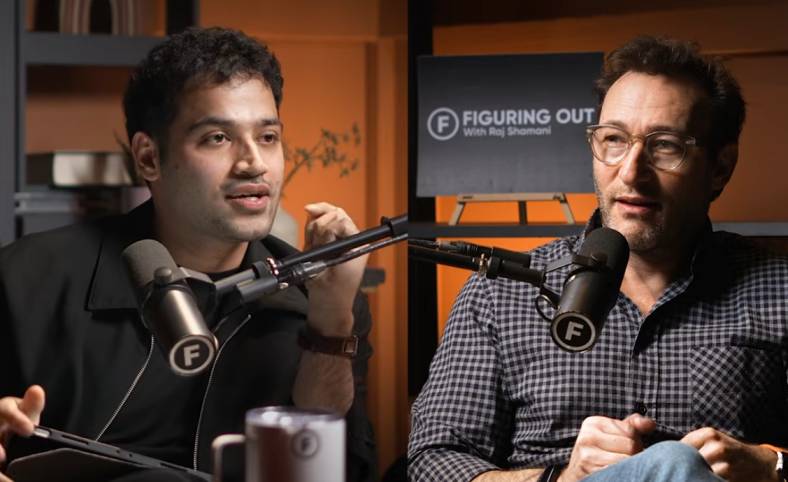
Editor’s Notes: In this powerful conversation, Raj Shamani sits down with Simon Sinek to unpack why our generation feels more anxious, burnt out, and distrustful than ever before. They dive into why fake news feels real, how social media is rewiring our brains, and what truly builds trust in relationships, teams, and organizations. Simon also explains why boredom is underrated, why constantly “hustling” can quietly destroy creativity, and how Gen Z can redefine success on their own terms. If you’ve ever felt left behind, addicted to your phone, or unsure whom to trust, this episode will challenge the way you think about ambition, love, and India’s role in the future. (February 26, 2026)
TRANSCRIPT:
Introduction
RAJ SHAMANI: Now, if there’s one name that comes up every time you talk about leadership, purpose, the why of things, it’s Simon Sinek. He has delivered one of the most watched TED talks ever. He has authored global bestsellers that have been translated into multiple languages, and the frameworks he’s created have been adopted by top leaders, Fortune 500 companies, and military leaders all around the world to transform their lives and their companies.
I personally have been following his work for a very long time, and I’ve learned a lot from him. So I hope you take something valuable from this conversation as well.
In this episode, we’ve talked about why trust is collapsing everywhere, why Gen Z already feels like they’re behind, whether love and ambition can actually coexist, and whether Simon would tell his younger self to do anything differently. Watch this episode till the end and let me know what are your key takeaways from this conversation in the comments. Enjoy the show.
I have to tell you that you are probably one of three or four people in my life who I have been constantly following since 10, 12 years.
SIMON SINEK: Wow.
RAJ SHAMANI: And I’ve not gotten bored. Every time you come up with some new insight, even though I’ve heard almost every interview or podcast of yours.
SIMON SINEK: Thank you.
RAJ SHAMANI: It’s incredible. I was telling the team that there were so many heroes back in 2013 who I used to look up to, and almost everyone I’ve outgrown in some way because I’ve listened to them a lot.
SIMON SINEK: Yeah. Yeah.
RAJ SHAMANI: And then you come up with some stuff. And I’m really happy that I’m doing this conversation.
SIMON SINEK: I’m glad. Thank you for having me. It’s very nice of you. Very nice words.
What Breaks Simon Sinek’s Heart About the Way People Live Today
RAJ SHAMANI: Tell me, what breaks your heart today about the way people are living their life right now in today’s generation?
SIMON SINEK: It’s the lack of relationships. We’re social animals and we need each other. Whether it’s at work or whether it’s at home, people feel like they can’t ask for help, or they feel like asking for help is some sort of weakness. And then all of the social media and our phones only exaggerate that — they give a false sense of “I’m okay.”
So what breaks my heart is that we’ve become a very isolated, individualistic group. You look at even incentive structures in companies — it’s largely based on individual performance — and we’ve forgotten the value of teams and groups. No human being ever accomplished anything great by themselves. There was always other people involved.
RAJ SHAMANI: True.
The Collapse of Trust: How Individualism and Institutions Feed Each Other
RAJ SHAMANI: Do you feel it’s because we have become more individualistic? Or is it because we are lacking or losing trust in organizations and people? Do they just feed each other?
SIMON SINEK: The more that we’ve lost trust in organizations and companies that don’t seem to care about their people, the more we’re like, “Well, fine, if you’re not going to take care of me, I’ll take care of me.” And the more selfish we become, the more trust breaks. So they feed each other.
The business models and the models for leadership have absolutely contributed to that — 100%. And we can see where it came from. When mass layoffs were first embraced in the early 1980s, it was still a new idea to use layoffs to balance the books. You can start to see how Jack Welch and those people from General Electric promoted individual performance, mass layoffs, short termism, quarterly results, shareholder value. And you can start to see how it affected human behavior. Because when you change the incentive structures and the reward structures, you change behaviors. And the idea of giving your career to one or two companies over the course of an entire lifetime disappeared.
RAJ SHAMANI: Yeah. Why do you think — because mass layoffs have been here for years — all of a sudden, why are we losing trust so much now? It’s not only in organizations, it’s in individuals, it’s in groups, it’s in society, it’s in the government. There’s something probably deeper happening because of which we have stopped trusting people.
SIMON SINEK: This is like a slow boiling frog, right? The water’s been slowly heating up for years and it’s reached a crescendo. And it’s like, “Why is it so much right now?” Well, we’ve been getting here on a pretty steady basis.
But I think you raise interesting points. We see governments operating like companies, where the people who have careers in politics have a shorter-term mindset. They are thinking about winning and losing rather than advancing a cause. You see it in politics as well — very short termist.
And look, you can talk about things like greed, and those things have existed since the dawn of human beings. But why is it that the checks and balances on those kinds of things are reduced? I think there’s a distinct lack of belonging. People don’t feel like they belong to things anymore. You can see on the left or the right of politics, people grabbing onto things, trying to find that sense of belonging.
So we’re starting to see this lack of belonging affecting us, because when there’s a lack of belonging and you feel like it’s just you, then you’re like, “Well, if nobody’s going to look out for me, I’ll look out for me.”
The Speed of Information and the Death of Patience
RAJ SHAMANI: Is it also happening because information has gotten faster? We start trusting or losing trust in people in like 30 seconds — something blows up, it goes viral — and we’re not giving people, institutions, or governments enough time to course correct.
SIMON SINEK: There was a time where if you heard a news story, you called a friend and you vented your anger, or your reaction, or your conspiracy theory — whatever happened. You did it to your friends on the phone or in person, you got it all out, and then you became rational again and you’re like, “Well, let’s just wait and see.”
Now there’s no safe space for the unhinged reactions, no safe space for the knee-jerk reactions. Now we react in the place we read it, which is usually online and social media. So we react in the comments, or we post our own thing in reaction, and then everybody’s reacting to the reactions. We kind of forgot what actually happened, and we’re all fighting about the reactions and what people think.
I believe that if every single social media platform had a one-minute delay — like you hit post and then there’s a little clock that says 60, 59, 58 — I bet half the stuff we post wouldn’t go up. We’d be like, “Maybe I won’t put that.” But once you put it out there and people start reacting, then we become super defensive.
It’s a funny thing, isn’t it? We don’t trust anymore. But when we hear something that triggers us, we don’t investigate what’s actually happening — we just react to it. So it’s ironic that we don’t seem to trust information or institutions, but we seem to overly trust information that we’re hearing without looking into it.
RAJ SHAMANI: Do you think we actually trust it? Or do you think we don’t even care whether the information is right or wrong — we just want to give our opinion?
SIMON SINEK: If I said something to you that triggered you, you would have an opinion. You would not be curious. And it’s easier to be judgmental than curious, because judgment is instantaneous. Curiosity requires patience and slowing the system down. Curiosity requires asking questions that challenge our own assumptions. Curiosity requires us to investigate legitimately — not just find things that reinforce our points of view.
So judgment is fun. Judgment is easy. Judgment is entertaining. Judgment is emotional, which makes it exciting. Curiosity is a slower burn.
I read things in the news — the government’s doing this or the government’s doing that — and I can feel myself having an opinion to the headline. And then I always say, “Why don’t you go find out what the origins of this are, or what will happen, or what won’t happen?” And I look in places that aren’t political. I’m not just looking at what politicians or social media commentators are saying. I’m going and reading articles, looking at historical documents. And by the way, this takes minutes, not hours. And instantly I’m like, “Ah, it’s not that bad,” or, “Oh, I think that’s worse than people think.”
RAJ SHAMANI: Why do you think people are not even investing two or three minutes?
SIMON SINEK: Because we treat the news — we treat Instagram and TikTok, which are the primary sources of news today — like a dating app. You look, you swipe right, you swipe left onto the next. You read a headline, you either comment or you don’t, you form an opinion, and onto the next, onto the next. It’s newsertainment, right?
Who Is to Blame — and What We Can Do About It
RAJ SHAMANI: Who do you think is at fault for this?
SIMON SINEK: It’s ours. Everybody’s to blame.
RAJ SHAMANI: Not the algorithms, not the platforms, not these companies?
SIMON SINEK: Of course they bear liability. And if I hear another one of them say, “Well, buyer beware — they can always choose not to use us,” that’s like telling an addict, “Well, you have the choice not to be a drinker or a smoker, you can just stop.” Not really, no. Especially when you have teams of scientists figuring out how to hijack our dopamine system to keep us online longer — infinite scroll and all the rest of it. Of course they bear responsibility. You can’t remove them from the chain of events. Do they bear all the responsibility? Of course not. But of course they bear responsibility.
RAJ SHAMANI: So what do we do now? How do we bring it back — this world where we used to trust each other more, trust people more, trust news more?
SIMON SINEK: Change starts at home, right? It’s all fine and good to complain about companies, complain about the system, or complain about the government. But if we want to see and feel change in our lives, then we have to be the agents of change. If you want to feel trusted and trust more, then start with your friends, start at home, start at work. Learn to be a trusted person. Our world is somewhat of a reflection of us.
RAJ SHAMANI: So you said learn to become trusted first.
SIMON SINEK: Yeah.
The Ingredients of Trust
RAJ SHAMANI: How can somebody do that? What are the ingredients of trust?
The Foundation of Trust
SIMON SINEK: So I think very often we confuse trust and reliability. Simply doing what you say is a component. But we’ve all have friends that we trust. They let us down, and sometimes we let other people down. Does that mean all trust is violated? No. It could be a step back, but it’s not a complete breakdown.
Trust comes from psychological safety. It’s the feeling we get when we feel that someone has our back. None of us walk around with a notebook in our back pocket, keeping track of all the things our friends do for us and how many things we do for our friends. I may do a hundred things for my friends and my friends do nothing for me, but I never say, “Well, you owe me. Because this month, look at all the things I did for you and you didn’t do anything for me.” Because I walk around with the absolute confidence that if and when I need them, I know without a doubt they’ll be there for me.
And so I think that psychological safety that’s built up over time — and sometimes it happens quickly and sometimes it happens slowly — it’s a dance, right? You start with a little bit and you ask a little more. I have friends that are just for fun. Do I rely on them? Do I know they’d be there for me? No. But I love spending time with them. And then I have friends that I know I could call, and no matter what time of day or night, they’ll be there for me.
I think it’s hard to trust when you are not trusted. Very often we forget — it’s like if I were to go to a party and sit in the corner by myself with a scowl on my face and say, “People are the worst. People are so unfriendly. Not one person has come over here and said hello to me or even expressed any curiosity about me or my life. I hate this place and I hate everybody here.” It starts with you sitting in the corner by yourself with your arms folded, looking grumpy. It takes two.
And so to put yourself out there, to be a trusted person — remember, we don’t build trust by offering help. We build trust by asking for it. The ability to ask for help, to make yourself available, to say, “I don’t know what I’m doing, I’m unsure,” and give someone else the honor of getting to be there for you. That’s where it starts. It starts by us taking the first step.
By the way, that’s what leadership is. We call you a leader not because you have rank. We call you a leader because you went first. You’re the first to take the risk. You’re the first to run towards danger. You’re the first to admit you don’t know something or made a mistake. You set the tone. That’s what leader means. And so if you want to lead the way to building trust, then you have to start by asking for help. And you will build trust.
Trust, Reliability, and the People We Rely On
RAJ SHAMANI: Let’s say there are friends who you trust, even though you don’t talk to them very often. But you know that you can rely on them 100%. And there are people who you just go out to have fun with. And not necessarily both of them must have offered you help up front. But still, you trust few people and you don’t.
SIMON SINEK: Again, offered versus asked. Everybody goes like, “Let me know if you need any help.” Everybody says that.
RAJ SHAMANI: Exactly.
SIMON SINEK: Right. But how many friends call you and say, “I’m stuck”? And I don’t mean a favor — I’m not talking like, “Hey, can you put me on your podcast?” That’s not asking for help. I’m talking about, “Hey, I don’t know what to do and I don’t know who else to call.”
RAJ SHAMANI: So are you saying that people who you can trust, they are the only ones — like they’ve always asked you first and that’s —
SIMON SINEK: No, it’s one of the ways in which you build trust. You could go first, and you give them the honor of being there for you. So it doesn’t matter who starts, but the relationship has to start somewhere.
RAJ SHAMANI: Then what’s the difference between people who you can versus who you can’t trust? Because they both are friends.
SIMON SINEK: Some of it’s based on timing, some of it’s based on what you’re going through, what they’re going through. Some of it’s based on values, some of it’s based on how much sleep you got the night before. I don’t have a formula. I can tell you some of the things that would help — some of the things that would help to have a successful relationship. But at the end of the day, there are certain intangibles where some people you just click with and some people you don’t.
I think we forget this — human beings are messy and human beings are emotional and human beings are irrational. And so I think we over-complicate what it means to be human when we ask for scientific, rational, highly structured checklists in order to achieve an emotional goal like trust or love or any of these feelings. I can tell you some best practices. I can tell you some things that will probably contribute. But I also have friends where a lot of those things flew out the window, and we love each other and trust each other.
We can’t apply too much structure to an emotional, irrational, messy situation. That’s part of the magic — and the annoying things — about people.
What Happens When Trust Is Broken
RAJ SHAMANI: There are a lot of times where you deal with a messy person and that person breaks your trust. A lot of people have heard this, and they say it often, that they instantly go into that mode where now they’re trusting no one. What do you think is worse — trusting a wrong person, or trusting nobody for life?
SIMON SINEK: We know the answer to that one. Of course, trusting no one is the wrong answer. Okay, you got burned. But if you build a wall around you because you’re afraid of being hurt, it’s like people who say, “I’m not going to fall in love ever again because I got hurt that one time.” Well, then you’re going to live a lonely life and an unhappy life.
Yes, everyone has had trust violated. Every one of us. Every one of us has violated trust. We’ve also been the victims and we’ve been the causes of those messy situations. We’ve been defensive even though we know we’re wrong, and other people have been defensive even though everybody knows that they’re wrong.
Accountability becomes a big part of it. Trust is not about getting everything right or getting anything wrong. A huge part of building trust is being accountable for when you get things right or when you get things wrong. That’s part of creating that psychological safety — which is, if somebody accuses me of violating trust, even though it may be defensive because it hurts to hear, at some point I’m going to have to get to the point — hopefully sooner rather than later, even if it’s the next day — to be like, “You know what? I was thinking about what you’re telling me, and you’re right. I let you down. I didn’t communicate. I was rude and I was defensive, and that’s not right. And I’m sorry.”
That’s a huge thing. Accountability is a huge part of building trust. Something like 70% of medical malpractice cases are simply because the doctor refused to apologize. So I think when people are willing to take responsibility for their words and for their actions, it makes us more want to trust them — even knowing that they get things wrong.
The Lost Art of Sitting With Yourself
RAJ SHAMANI: One more thing that we never learn, apart from trust — how to trust. More and more young people are losing trust because of information overload and all these things we talked about. One thing which is also bothering is we never even learn how to sit with ourselves — how to be idle, how to be bored — so we don’t reflect. And that’s why we don’t even think about how to become a better person. What do you think happens with an entire generation when that generation doesn’t really learn to sit alone and is just constantly stimulated?
SIMON SINEK: It’s like when you bake bread — you have to let it prove, you have to let it rise, you have to just let it be. You can’t just mix the ingredients in a bowl, knead the dough, and throw it in the oven. You have to let the yeast rise.
I think we undervalue boredom, but it’s partially because we’ve over-indexed on productivity. We all think that you’re doing well if you’re productive, and you’re not doing well if you’re unproductive. I used to wake up on a weekend at like 8 or 8:30 in the morning and then sit in bed till noon. Just read the newspaper, do a crossword puzzle, send a few texts. And people would get mad at me. They’d say, “How can you just waste your day like that?” I was like, “First of all, it’s my day. I can do whatever I want. And second of all, maybe that time alone where I’m not engaging — just getting to do things that my brain enjoys, like the crossword puzzle or listening to music — maybe that’s good for me. Maybe that makes me healthier.” Just because I’m not productive doesn’t mean it’s wasted.
You know the story of the two lumberjacks? Every morning they both start cutting wood at the same time. Every day they stop cutting wood at the same time. And every day, in the middle of the day, one lumberjack disappears for an hour. And every day, that lumberjack cuts more wood than the other one. So one day, after months of this, the lumberjack who works all day says, “I have to ask you. Every day we start work at the same time. Every day we stop work at the same time. Every day you disappear for one hour in the middle of the day. And every day you cut more wood than me. Where do you go for that hour?” And the other lumberjack looks up and says, “Oh, I go home and sharpen my axe.”
Working all the time doesn’t necessarily make you more productive. Taking breaks and sharpening your axe makes you more productive.
We don’t allow our minds to wander because of constant engagement. And anybody who’s ever had an idea — you rarely have the idea in the brainstorming session. Usually the brainstorming session is valuable for posing the question or presenting the challenge. But we usually have our best ideas in the shower, or when we go for a run, or when we’re sitting in the car driving to work, or sitting on the bus looking out the window, and all of a sudden you’re like, “I have it!”
What’s going on there? Our conscious brains have access to the equivalent of about 2 feet of information around us. This is the part of the brain we access when we draw on our expertise, weigh the pros and cons, think about the problem — all the stuff we do in the brainstorming session. But our subconscious brains have access to the equivalent of something like 11 acres of information. Every question, every movie, every book gets stored somewhere. But you can’t consciously access that part of the brain.
So when you allow your brain to just ruminate — and it won’t ruminate about anything, it’ll only ruminate about challenges, opportunities, or questions that are right in front of you — it finds connections that your thinking brain doesn’t. Standing in the shower, you can’t be on your phone. That’s why you’re having an idea when you’re driving — you can’t be on your phone. Your mind just wanders.
The idea of doing nothing that we seem to be afraid of — the lack of productivity, the lack of boredom — in reality, what we’re doing is allowing our minds to wander. I carve out time for this. I’ll go for a walk without my phone. I’ll go to a museum, put my phone in airplane mode, and just walk around and look at art. It doesn’t always happen that I solve a problem, but I’m increasing the likelihood. So one of the ways I have ideas is I build in what you would call boredom time — to do things that are engaging or disengaging in different ways, like listening to music. I think we undervalue boredom as a source of ideas.
RAJ SHAMANI: There was a research in 2014 that people were asked to sit alone and sit idle. And about 67% of people said that they’d rather have electric shocks than to be sitting alone.
SIMON SINEK: That’s funny.
The Addiction to Our Phones and the Death of Original Thinking
RAJ SHAMANI: It happened in 2014. What do you think? Where have we reached today?
SIMON SINEK: I think we are afraid of doing nothing. You can see it when you go for dinner and your friend goes to the bathroom — what’s the first thing you do? Take out your phone. Because God forbid you should just sit in the restaurant and look around. You get on the bus, what’s the first thing you do? Take out your phone. We just saw it driving here. I’m sitting at a red light, I look over at the car next to me — what’s the driver doing at a red light? On the phone.
RAJ SHAMANI: Yeah.
SIMON SINEK: It looks and feels like an addiction because that’s what it is, right? Every gap I’ve got, I’ve got to fill it.
RAJ SHAMANI: Yeah.
SIMON SINEK: I’m on my phone in the bathroom. When the TV commercial comes on, I’m on the phone. If I’m bored watching the movie, I’m on the phone. In bed, I’m on the phone. The first thing I do when I wake up — and there’s nothing wrong with any of those things unless you feel like you have to do it all of the time. Like if you’re looking for your phone before you go to the toilet — these are all signs of a dopamine addiction. It most closely resembles a gambling addiction, but it’s addictive behavior.
Are We Losing Original Thinkers?
RAJ SHAMANI: Do you think because of this we are losing our ability to think originally? There are almost no original thinkers, because original thinking requires some sort of friction, some sort of discomfort, some kind of chaos — just sitting alone and being comfortable with that?
SIMON SINEK: It’s a good question. I don’t think that’s the only reason. I think the other reason is what’s happened in media. There are fewer bets being taken. When institutional money gets involved in the media business, this is why we see so many franchises and remakes — they’re managing risk.
I think when you make art and when you have an idea, you let go of that risk profile to some degree. It would have been much easier for me, after I wrote Start With Why and had success with my first book, to just franchise it, serialize it — Start With Why for chefs, Start With Why for parents, Start With Why for dentists. I could have written book after book after book, and maybe they would have done well. But for me, that would be the low-risk, high-probability-of-success option. And I’m not a businessman — I’m an artist.
I have an artist’s approach to things, which is the desire to make things I don’t know how to make, the desire to learn things I don’t know how they work, the desire to solve problems I don’t know how to solve. I like things that make my head hurt. But that’s a different risk profile.
I think both have their place in an economy. But is the balance being lopsided? Of course. And then you look at the way businesses and startups are happening — it used to be that if you had a private business, you had more freedom than a public company because you didn’t have the pressure from the investor community. But now, with the amount of venture capital and private equity in private businesses, they’re as bad as public companies.
The pressure for short-term results is overwhelming. The business model of the venture capitalist is to get their money out in three to five, five to seven years. They’re not interested in building the company for 20 years. Everybody wants to know what the growth plan is, what the scalability is. Well, not everything is growable at high speed and not everything is instantly scalable — and there are still good businesses. They might be smaller businesses, but they’re still good businesses.
We’re so obsessed with the wrong metrics. Young entrepreneurs are more obsessed with telling you what their growth is or which venture capitalist gave them money. Even the way we’ve defined a unicorn — a unicorn used to be defined as a company with a billion dollars in revenues. Now it’s defined as a billion-dollar valuation. Valuations are made up. Somebody goes, “Yeah,” and there you go, you’re a unicorn. Revenues, you can actually count that money. So why did we change the definition of a unicorn? Because it’s all speculative now.
When a venture capitalist is weighing the risk of their investment, they would like to see something scalable with fast growth because it protects their investment. But that disallows for art projects. And sometimes art projects are worth it and beautiful. A lot of businesses started off more like an art project — it was the curiosity of the founder to solve a problem. Richard Branson and Virgin, just trying to make a thing that didn’t exist for himself. A lot of them solve real problems, and the business model came a little bit later. “Wouldn’t it be cool if…” is how a lot of these great companies started — even Facebook. “Wouldn’t it be cool if…” versus “I think I could make a billion with…” They both have their place, but the balance is wrong.
Working for the Algorithm
RAJ SHAMANI: Don’t you think it should be the opposite? Now there’s more capital available, more options to put out your work without the approval of some institution. There are more opportunities for a young person to be more artistic, more original — and yet they are choosing not to be. Why are we losing people like that?
SIMON SINEK: Ask the algorithm. When you add money to an equation, it changes everything.
There was a real case — two young content makers who would do crazy videos and put them on YouTube for income. They did a video where he held a big, thick dictionary on his chest, and she took out a gun and shot him, thinking the dictionary would stop the bullet. It was a stunt they did for views. Well, it turns out she killed him — shot him right through the heart through the dictionary. It was an accident of monumentally stupid proportions. Because they were so driven by the need to do something more and more outlandish for the views that logic was put aside.
I was at an event once, sitting and waiting for a concert to start, and this girl comes down the stairs with some guy taking pictures of her, and she’s doing all her posing. The person next to me nudges me and goes, “She’s a famous influencer.” And I responded cynically: “You mean she’s a freelance employee of an algorithm.”
That’s largely what a lot of content creation is. You work for the algorithm, which is why you can’t take a day off, you can’t take a vacation — because the algorithm is not happy if you do. And you saw what happened when YouTube changed their algorithm and it affected people’s income. Someone showed up at YouTube headquarters with a gun, because “you took away all my income.” We’ve just stopped working for people and started working for algorithms.
The minute you include money, the minute you’re working for the algorithm, you’re no longer working for the creativity anymore. I think the origin stories are a lot purer. The first book, the first video, the first thing that goes viral — that was pure. That was the art. But the minute somebody says, “I’ll put you on television, I’ll give you money, I’ll give you a sponsorship,” the pressures are great.
The data shows that influencers aren’t actually that influential, because once they start doing things for money, everybody gets a little bit cynical — “They’re just doing it for money.” It’s a hustle culture.
Even the concept of selling out — young generations today don’t even know what that means. When you say, “Oh, he’s such a sellout,” young people literally don’t know what that means. And if you explain it — “Well, they decided to just take the money as opposed to having high integrity” — young people will say, “Yeah, it’s their IP, they should make money.” The idea of exploiting yourself is at least better than being exploited. But it’s not a very happy way to live.
All of these things have shelf lives. As Rick Rubin talks about — when you start working for the approval of others, it destroys art. Art is when you trust your own taste and you accept the risk that the world may or may not like this, and that’s okay, and then you’ll try again. As long as you’re pure to yourself, if you have a talent or a taste, that’s the root of art. That’s the risk. This is why art has a high risk profile.
What Does “Selling Out” Really Mean?
RAJ SHAMANI: Explain “sellout” — you said people don’t understand. Explain in simple terms.
SIMON SINEK: Explain what?
RAJ SHAMANI: Sellout.
SIMON SINEK: I’ll just use myself as an example. I’ve built a public reputation. I have a public life, good followings on all my socials, I sell books — all of that good stuff. And then all of a sudden, you see me making a commercial. I’m on a TV commercial for plumbing supplies. And then I’m on another TV commercial selling deodorant. And everybody’s looking going, “Why is Simon selling plumbing supplies and deodorant? It makes no sense.” And you ask me why I did it, and I say, “Well, you should see what they paid me.”
That’s a sellout. You put aside your movement, you put aside your beliefs, you put aside your ethics, and you just take the paycheck. You exploit the thing you’ve built for money — that’s selling out.
Staying Pure to Your Purpose
RAJ SHAMANI: What has helped you stay like this? What helped you stay pure?
SIMON SINEK: I’m not very good at business. Is that obvious?
RAJ SHAMANI: That’s not the only reason.
The Brotherhood of Military and Artists
SIMON SINEK: I mean, it is one of the reasons. You know, there have been certain people in my life that have inspired me. And I got to know people in the military pretty young. Like the same year that I first publicly articulated the golden circle and Start With Why — many years before a book, many years before any TED Talk — that same year, by sheer coincidence, I got introduced to the United States Air Force, and I got to know some people who devoted their lives to service.
And I very quickly realized that my two favorite people on the planet are military and artists. Because they’re the exact same human being. We assume that their politics are opposite because one is in defense and one is in the arts. First of all, don’t make such assumptions. People have different politics in all different ways of life. Okay, so that’s number one.
But they’re the exact same human being, both of them. Whether they knew it from the beginning or they discovered it later on, what they do becomes a calling. They can’t not do it. Secondly, they both know that they’re not going to get rich doing what they’re doing. They both know that they both make tremendous sacrifices to do what they do. And in both cases, 100% of the product that they make is for the benefit of others.
And you see the way that artists are with artists, and you see the way that military are with military. And there’s a brotherhood and a sisterhood. You know, you and I have colleagues and co-workers — in the military, they have brothers and sisters, and they mean it. That’s what those relationships are. And the first time one of my friends in uniform called me brother, it meant something. “Hey, brother.” It wasn’t just being polite. They don’t throw that term around loosely.
What Makes Special Operators So Effective
I got to spend some time with the Navy SEALs, and we were talking about — I wanted to understand the culture, why those guys are so intense and why they’re so effective. And one of the reasons they’re so effective is not because they’re individually amazing. It’s their ability to work as a team.
And you look at all the Special operators — the Army Rangers, Delta Force, SEALs, the PJs, the Marine Raiders — all of these Special operators. One of the reasons that they’re so incredible is because they’re effective teams, that they’re able to put their individuality aside for the good of the team.
And what we see as courage — and I can only speak to the Navy SEALs, but I assume it’s the same for all of them — what we see as courage is actually something quite more sophisticated and more beautiful, which is they’re actually more afraid of letting down their teammates than they are of dying. They’re more afraid of letting down the team than dying. That’s why they’re so good. It’s because the commitment to the team and the success of the team.
And if you look in the private sector, we’re committed to ourselves and the success of me. And very few of us will take a risk or have any desire for any kind of self-sacrifice for the good of the team. And I saw these relationships and I envied them. I came from the corporate world and I had no relationships like that. I envied the brotherhood. They don’t even necessarily like each other, but they trust each other. And I envied that and I wanted that. And so some of them became my friends and I learned from them.
Broken Incentive Structures and the Culture of Fame
And then this takes us right back to the beginning, which is — why are we so selfish? Well, look at all the incentive structures. All the incentive structures around us reward us for individuality. We’ve heroized CEOs, we’ve heroized personalities on the screen, we’ve heroized influencers. They’re all individuals who either actually believe that they’re heroes or like to present themselves as such, and the reward structures reinforce it.
We have an entire class of people who want to be on reality TV shows. I was watching one of these reality TV shows the other day — my niece was watching a show and I was just watching with her. And the way they put their personal lives on public display, there are cameras in the room while they’re having a breakup or talking about cheating on their spouse. And you’re like, what motivates somebody to want to air all of their laundry in public? The driver is very simple — fame. They value fame more than privacy.
And I guess good for them. I mean, it’s highly entertaining for us. But that’s the incentive structure that we offer — that we will make you rich and famous if you’re willing to humiliate your family. Because I was thinking about it — the poor person who this woman was cheating on, he’s not on the TV show, but everybody who knows him is watching. His family didn’t agree to be on the TV show, and his friends didn’t agree to be on the TV show. But her desire to be rich and famous was more important than any of those things. And that’s the world we live in. And the TV studios don’t care and the producers don’t care.
I remember I did an interview once — I was on a documentary, and they gave me a release to sign. And it was a standard release for a reality TV show. And it literally said, “We reserve the right to edit this in any way we want, even if it changes the meaning of your words, even if it paints you in a bad light.” And I’m reading this document, going through it and crossing everything out. And they got mad at me. They’re like, “You can’t cross all this out. Nobody else has crossed it out.” I’m like, “Nobody else read it.”
But I’m literally reading the release that gives the producers total control over how to edit it, so they can decide you’re going to be the bad person. So the incentive structures are all screwed up. The reward systems are all screwed up.
How the Military Rewards Humility
And in the military, the reward system is humility. I’ll give you a real-life example.
There was an incident on base where some young officers went out drinking off base, which is fine. And they were fraternizing with a young enlisted woman — officers and enlisted aren’t allowed to, because it breaks the chain of command. One of the officers was dating one of the enlisted, which is not allowed. So that was number one.
They all came back to base, and they knew that they had been drinking and were afraid that they would get pulled over for drunk driving on base. So the officers said to the young enlisted woman, “You drive.” So now there’s a power dynamic. She drives. They start driving on base, they get pulled over by the cops, and she gets breathalyzed and gets arrested for being over the limit.
It all comes out. These officers are in a very elite program, and now they’re all in trouble — for many reasons. And their senior officer, the Colonel, had to bring them into his office one by one to tell them that they’ve probably ruined their careers, that they have to be thrown out of the program.
Now, if you and I were in charge, we would probably say something like, “What the hell were you thinking? How can you be so stupid? You’ve destroyed your career. You know better.” That’s what we would say. It’s about the individual.
That’s not what the Colonel said. What the Colonel said was, “Do you have any idea how many people you’ve let down? You’ve let down your senior officers who nominated you for this program. You’ve let down your parents who raised you. You’ve let down all of your colleagues who supported you through this program. You’ve let me down. Do you have any idea how many people you’ve let down?”
That’s how they got in trouble. So immediately you see the thing that they value more than anything else is the esprit de corps. It’s the team. It’s the camaraderie. It’s the commitment to the other, not just to yourself. And so even the way they get in trouble reinforces the commitment to team.
RAJ SHAMANI: I know.
SIMON SINEK: They’re so — humility is a valued commodity. When you meet the really, really talented leaders in the military, they are amazing. And you say to them, “Oh my God, you’re so amazing.” They all say the same thing: “It’s not just me. I’ve got a team of people around me.”
In the business world, people are like, “Thank you.” We’re encouraged to take the credit. In the military, they’re encouraged to distribute the credit.
The Loss of Belonging in Modern Life
RAJ SHAMANI: Do you think it’s because earlier you had the whole map in front of you? Like, you’re born, then you have to take the right job, then marry, then have a partner, settle down. Like, there was a structured way of doing things. You were not asking yourself questions and not even getting disturbed here and there. Like, there was always a map, and today there are no maps. There’s no certain way to do certain things, and that’s why people are confused. So they don’t have an identity, and they are just chasing things which probably were coming out of their insecurities.
SIMON SINEK: It’s an interesting question. It’s an interesting proposition. I think it goes back to what we’re saying a moment ago, which is it’s about belonging. I’m not so sure that the map was clear, but there were definitely circumstances that allowed for the opportunity to belong to something bigger than yourself.
In World War II, more young men died by suicide who didn’t get called to action than who did, because of the shame of not being included and belonging to the war effort. And if you even look at the war effort — you either joined, and if you couldn’t join or you weren’t eligible, or you were too old, then you bought war bonds to support the war effort. And if you couldn’t afford a war bond, you planted a war garden, which didn’t do anything, but it made you feel like you were a part of it.
And so after September 11th, we saw lots of people quit their jobs and say, “My job is stupid,” and they joined the military. They did something that made them feel like they’re contributing to something bigger than themselves.
So I’m not so sure that I would subscribe to the fact that there was a path. But I do subscribe to the logic that there was something that provided an opportunity to be a part of something. And so what you’re describing as the path was a means to get to that thing.
Even in the 50s and 60s, that was a family. That was the path to being part of something bigger than yourself — the traditional home, you know, man goes to job, woman stays home and raises kids. There was a mechanism to be a part of something bigger than yourself, that “I have to work hard for the good of others.”
And for various reasons, those things evaporated. Even the collapse of the Soviet Union and the end of Cold War 1.0 — because we’re in Cold War 2.0 now — but the end of Cold War 1.0, at least if you did something, you felt like you were a part of this country, a part of something bigger than yourself.
And I think, to your point, it goes right back to where we were — where are the places or institutions that I can go to where I get to contribute to something bigger than me? Because the only other alternative is to contribute to me, which is what we all seem to be doing.
And I think that’s true. I think there’s a lack of belonging. Companies all have purpose statements — thank goodness, that’s my work, it’s a step in the right direction. But most of them don’t believe it. It’s just marketing.
RAJ SHAMANI: Yeah.
SIMON SINEK: At least the movement is working, that they have public pressure to do it. But now you have to actually follow it. And companies don’t have long-term plans now. They don’t have five-year plans. And if they do, they’re not following them. And so there is no bigger, longer vision — it’s only shorter and faster.
So I think what you’re describing as the path is a symptom of a lack of things, or places, or institutions we can go to where we feel like we’re part of something bigger. I think that’s a true statement.
The Quarter-Life Crisis
RAJ SHAMANI: And because of this, we join certain companies in the beginning because we are fresh, we believe in the purpose that’s probably just on the wall. And then just a few days of working in — probably a few years of working in — we have this quarter-life crisis. Like at 25, we are thinking about a crisis because we don’t feel belonged, we don’t feel we are cherished, we don’t think our incentives are actually aligned with the company. And more and more, the midlife crisis has become a quarter-life crisis. So what do they do when the world is changing so fast and the meaning is just getting lost? What should young people do?
The Infinite Game: Competing With Yourself
SIMON SINEK: I think you have to choose to be the leader you wish you had. Which is, remember we said at the beginning that trust was built not by asking for help but by offering it. So instead of going, “I need someone to give me the ability to belong to something bigger.” Like if you can find that, more power to you. But that’s not a strategy.
What is a strategy is making the choice to give the people to the left of you and the people to the right of you the feeling that they’re a part of something bigger. And even though you might work for a soulless, short-term driven public company, you can come to work and say, “That’s true. But our team — it’s about us. It’s about taking care of each other. It’s about committing to see each of us, helping each of us grow.”
Because I think that’s what a successful corporate culture is. A group of people who agree to grow together and commit to making sure that the other people on my team are successful. And you can find a sense of belonging and that sense of purpose in a small group of people inside a larger dysfunctional system. Absolutely.
But you have to choose to be the leader you wish you had, and you have to go on that journey of education. How to be that leader doesn’t happen overnight. It’s like, “I think I’m going to become a high-performance swimmer.” Well, you can’t just jump in the pool and have it happen. You have to train and learn and get a coach and read about it and watch videos, and it’s the same. You have to go on a learning journey. And it’s bumpy and uncomfortable, and sometimes you swallow water and you’re humiliated. And sometimes it goes well and sometimes it goes badly, but it’s worth it.
Stop Comparing Yourself to Others
RAJ SHAMANI: When I get inspired by hearing certain things — like that I have an opportunity to inspire, left, right, belonging, all of that — and then I go home, I sit on my phone and I scroll, and I just keep looking at the algorithm. Looking at somebody at 19 who is like a billionaire, 22 is doing this, 25 is doing that. And at 25, I already feel like I’m left behind. How do I get out of this feeling, which is a feeling for the majority of people — that they feel they’ve been left behind even before they’ve started?
SIMON SINEK: Who are you competing with? Who are you competing with? I’m going to ask you a question. I want you to answer me honestly. Is there somebody who does something similar to you that has more money than you?
RAJ SHAMANI: Yeah.
SIMON SINEK: Okay. Are there other men about your age who are better looking than you?
RAJ SHAMANI: Yes.
SIMON SINEK: Okay. Are there people who do podcasts like this one who have more followers?
RAJ SHAMANI: Absolutely.
SIMON SINEK: Okay, so what’s the problem? We’ve accepted that you’re not number one. Who gives a s*?
RAJ SHAMANI: Great.
SIMON SINEK: What does number one mean? What does winning mean? You’re playing the wrong game.
There’s always somebody out there that you can find who’s better than you. It depends what metric you’re looking at. So if I look at book sales, I can show you an author who blows me out of the water, and I’ll be like, “Oh my God, I’m a failure.” But if I look at Instagram following for the same person — “Oh my God, I’m destroying him.” So should I be high and mighty on myself because one metric says I’m the top, or should I be depressed because the other metric says I’m failing?
It depends where you look. There’s no winning. We haven’t agreed on what the metrics are. You’ve chosen one arbitrary metric and decided that you’re a failure. It’s ridiculous, right?
Worry about yourself. Let them worry about themselves. We can all be successful at the same time. There’s plenty of people to listen to podcasts. There’s plenty of people to buy books. People can listen to more than one podcast. They can buy more than one book. There is no winning and losing in this game.
And so when you set up a finite construction of a winner or a loser in a game that has no winners and losers, you will always feel like you’re failing. And if you are ahead for a minute, it’s temporary. And then you’re playing defense and you’re desperately afraid of losing it.
So you’re playing the wrong game. It’s the wrong mindset. Nobody wins career, nobody wins business, nobody wins health, nobody wins family, nobody wins fitness — it doesn’t exist. There’s no number one in any of those things. So how can you set up the construction of “I’m losing” or “I’m behind” in a game that we haven’t all agreed on the rules for?
Worry about yourself. Say to yourself, “Am I doing better today than I did yesterday? Am I a better human being today than I was yesterday? Am I a better leader today than I was yesterday? Am I making better content today than I was yesterday?” Worry about the race against yourself. Compete against you. That’s the best competitor.
RAJ SHAMANI: That’s the only success metric to look for.
SIMON SINEK: In the infinite game. If you’re playing cricket, then yeah, worry about beating the other team, because there’s a defined winner.
Defining Success Across Generations and Cultures
RAJ SHAMANI: It feels like when you speak to people who are my parents’ generation, they all have some sort of success definition which is laid out.
SIMON SINEK: I think the way that our parents defined it was: get a good job, work hard, do well, provide for your family, make sure that your kids are good and taken care of, make sure you’re looking after your spouse. That’s all good.
I mean, you come from a place where arranged marriages were — I mean, still pretty popular, but for a long time, pretty much the only thing. And arranged marriages have very low divorce rates, which surprises people. It’s because you’re like, “Okay, we’re doing this. I’m going to do the best I can.” Which is a very selfless way of approaching a relationship. Whereas the selfish one’s like, “Okay, are you good enough for me? I chose you.” Arranged marriages have lower divorce rates than unarranged marriages, which I find fascinating.
RAJ SHAMANI: But it also has to do with the fact that in a lot of cultures in India specifically, divorce is not even a thing. So maybe it’s not just that arranged marriages have a lesser divorce rate. It also means that for a long time, there was nothing like divorce. And even today, the social structure doesn’t allow you to get divorced very easily.
SIMON SINEK: Look, neither answer is 100% right. If something is really unhappy and really dysfunctional, then there should be a mechanism to get out of it. Of course. We’re not saying unhappy people should stay together. But there is some sort of “let’s work through this and see if we can get through it.”
I was just talking to a friend of mine yesterday who’s married, and her marriage went through a really, really rocky patch — because of family reasons, he was not the person she married. It was bad. And she just committed to sticking with it, and she just committed to trying to work through it. And now they’re really good. But she had to commit to about a year or two years of awful. She believed in him and she believed in the relationship. And so there’s a patience component as well that goes with it.
I hear this all the time in the military — they don’t get to pick their teams. You’re the leader of this team that they gave you. Whereas in business, we get to pick our teams. But maybe not picking your team is not so bad.
Individual vs. Collective: America and India
RAJ SHAMANI: When you look at America and when you look at India — America, what I understand from the look of it at least, is that more people are driven individually, just thinking about themselves and taking decisions based on what they would like or how they would see themselves winning or losing in life. Versus India, where you make a collective decision. You don’t want to disappoint your family, so you take their decision into consideration. You don’t want to disappoint the religion or the culture or the society that you come from. So every decision is not just about yourself — it’s combined. What do you think? Which one’s a better approach?
SIMON SINEK: The answer is both have their strengths and both have their weaknesses. That’s it. There are benefits and detractors to both systems. So the question is, which system would you rather be a part of? Either stay where you are or emigrate. To idolize one system over another is foolish. That’s like saying, “I’m a better person than you.” That’s ridiculous.
I don’t believe in strengths and weaknesses. I believe in characteristics and attributes. There are some talents I have, some gifts I have, some strengths I have. And every one of those things has benefits and detriments. And the opportunity I have is to put myself in situations where those characteristics and attributes are more likely to show up as strengths.
For example, I think out loud. So put me on a stage, and people get to watch me think out loud. Put me on a podcast and ask me a couple of questions, wind me up enough — it shows up pretty well. This characteristic or attribute shows up as a strength in a context like this one. Put me in a meeting, and I talk too much. I always get that feedback: “Simon, let other people talk in the meeting.” But I’m just thinking out loud. So is it a strength or a weakness? The answer is, it depends on the context.
And so to say which system is better is a fake question. It’s: what are the benefits and detriments of each system, and where do I want to be? Where would I thrive? And that’s why immigration and emigration happens. If you’re very entrepreneurial and you’re living in a society that’s not entrepreneurial, then you should move somewhere that’s entrepreneurial. You’ll fit in better. You’ll feel like you belong. “I found my people.”
New York City is the island of misfit toys. Everyone who doesn’t feel like they belong wherever they grew up feels like they belong in New York. So it’s not a question of which one’s better. It’s a question of where do you belong?
Cold War 2.0
RAJ SHAMANI: You mentioned Cold War 2.0. What do you mean by that?
SIMON SINEK: The Cold War exists on three tensions. There’s an existential tension — are we going to survive? In the case of Cold War 1.0, the two largest nuclear powers in the world were the United States and the Soviet Union. Then there’s a philosophical tension — you have two views of the world and they’re both looking for buyers, for customers. Democracy and capitalism versus Soviet-style communism. Our alliances were super simple back then: if you’re a communist, we’re not friends with you. And then the final tension was economic competition. Both the United States and the Soviet Union were the two largest economies in the world.
The desire to pay any price and bear any burden exists always on these three tensions: life, philosophy, and economics. And they were all conveniently co-located in a single nation called the Soviet Union.
Well, the Soviet Union went bankrupt. And the biggest mistake that the United States and the West made in the 20th century was to declare victory in a game that has no finish line. They said, “We won the Cold War.” No, we didn’t. The player dropped out of the game because they ran out of money. That’s like one company goes bankrupt and the other company says, “We won.” No — they just went out of business. And new players emerged to fill those tensions.
So the nuclear tension was replaced by North Korea, maybe Iran. You’ve got India and Pakistan that are now nuclear-armed. The ideological competition for many years was replaced by religious extremism and is now morphing into something else. And the economic tension was replaced by China. We don’t fear nuclear war with China, at least not yet.
So the tensions of the Cold War are alive and well — they’re just not conveniently co-located in a single nation. And at least in the United States, we are oblivious to the fact that we’re still in a Cold War because we can’t see the enemy. We don’t recognize that it’s distributed.
So yeah, Cold War 2.0 is what always happens in an infinite game — the players come and go, but the nature of the game changes. The nature of the game has changed, but all the foundations are still there.
India, Identity, and World Order
RAJ SHAMANI: But the last Cold War changed some sort of world order. Do you think now the change of world order is in place?
SIMON SINEK: Not yet. Not yet.
RAJ SHAMANI: Not yet, no.
SIMON SINEK: Still in a period of flux. I’m fascinated by the way the world works. I think that’s so cool. Problems where there’s no such thing as a right answer are very interesting to me. Problems where there’s no obvious solution, and that no one person can conceive of the problem because it’s too complex, or even come up with an answer — those are really, really cool. So states of the world and how nation states interact, that stuff fascinates me.
RAJ SHAMANI: I love reading Changing World Order.
SIMON SINEK: Yeah. It’s good stuff.
RAJ SHAMANI: And specifically because India’s at the neutrality of it. So I love reading more about it.
SIMON SINEK: I think the future of India is fascinating. Just the size of the population and the entrepreneurship and ingenuity in that country. It’s a fascinating place.
Dharavi and the Spirit of Indian Entrepreneurship
RAJ SHAMANI: What was the experience like in Dharavi?
SIMON SINEK: It’s a fascinating place. I thought the amount of entrepreneurship there was incredible, unlike everywhere else.
RAJ SHAMANI: And what do you mean by entrepreneurship?
SIMON SINEK: Well, the Brits were in India for what, 300 years? And the Brits used to use the Indians as their clerks. So you can see how that shaped the industries that India still dominates — customer service, back office accounting. It’s kind of like the clerk mentality. And you know better than I do — kids are told, “Keep your head down, do as you’re told, work hard, you’ll do fine.”
But in Dharavi, it’s different, because there’s so much entrepreneurship. Because if you come from the farm and you move to the city to make money for your family, if you don’t work, you die. And so everybody’s a hustler.
There are factories and there are companies. You go to the garbage and you take out all the plastic, and then you sell it to somebody, and then they take it and they organize it and they sell it. I thought it was amazing. It’s a different kind of India.
What India Can Get Right — and Wrong
RAJ SHAMANI: What do you think we can get wrong about India?
SIMON SINEK: What can India get wrong for India? That’s a great question. I think the question is: what does it mean to be Indian? What is your identity? What are your strengths as a nation?
If you compare different nations, you can see the mentality of the people in their economies. Like the Swiss — everything is exact. But things are slow and expensive, too, because everything’s exact. Or the Germans — not a lot of joy in their businesses, but my goodness, everything works perfectly. The engineering, it’s not just a trope, it’s real. And you look at the Italians — it’s all joy. Everything’s beautiful and designed. Doesn’t always work, but my goodness, they have fun, and there’s a joie de vivre.
You can look at the mentality of a people when you look at the economies that they dominate, or the reason you choose one product over another from one nation or another.
And I think the question I would ask India is: who are you? What is your identity? When everything works at its natural best, how do you show up? Then do that, and be that in the world.
Because I think people have over-glamorized America. A lot of nations copy the way we do business, but the way we do business isn’t the best way. You see other nations trying to build their economies to emulate America’s because America is rich. But it comes at a cost. And I think there are some things I would like to go backwards on the way we do things in America — like, let’s be more long-term focused, let’s make sure we take care of our people more than we do. We’ve made some mistakes in order to make money, but the cost was high to our society and to the level of trust we have for each other. So I would caution other nations to blindly copy America’s business model.
RAJ SHAMANI: You know what I love about India? We’re always there to serve. That’s almost in us. Over the years, over the decades, we’ve been there. We say, “We are your friend.” In our companies and organizations, we love serving. And that’s what we’re doing in the world as well. And that’s why I think you see the rise of Indian talent all around the world.
SIMON SINEK: Look at all the tech companies right now — the American tech companies. The number of them that are run by Indians is pretty amazing.
RAJ SHAMANI: Yeah.
SIMON SINEK: I think that should be a national narrative. And a lot of nations don’t have a national narrative. America had a clearer narrative when there was a Soviet Union, but our narrative has been a bit fuzzy for many decades.
RAJ SHAMANI: We have a narrative, which is “world’s friend.” Our leaders keep saying this again and again, and we sort of believe it.
SIMON SINEK: That’s nice. That’s good.
RAJ SHAMANI: We are the world’s friend. Because if everybody comes together, everybody grows. We don’t have to choose sides. And that’s what we keep doing and showing again and again.
The Quarter-Life Crisis and the Race We Didn’t Sign Up For
RAJ SHAMANI: Okay, coming back to the conversation we were having about young people and the quarter-life crisis. One thing I have anecdotal evidence around — because I speak to a lot of my employees, a lot of my team members, a lot of my friends — is that almost everybody somewhat feels like they’re not doing enough, or they are in some sort of race. And because of that, they are losing respect for themselves. Do you think that somebody can come back from becoming someone you don’t respect again?
SIMON SINEK: It’s about changing the definition of the game. I think a gap year is one of the best things that the Europeans ever invented. I talk to American kids when they’re graduating high school or college, and I say, “Why don’t you take a gap year?” Go get a job, or if you have the means, travel, or go do something that doesn’t matter to your career — just go do something. Go get an internship.
And they all say the same thing to me: “I can’t.”
“Why not?”
“Because I’ll be behind.”
Because they’ll see their friends getting jobs, and then their friends will have a promotion before them, and they’ll feel like they’re, quote unquote, “behind.” But it goes back to our lumberjack story — go and sharpen your axe, and you’ll be amazed how much quicker your career takes off. So it goes like this, and then you’re going to go like this, and then it goes like this. You race ahead later because you have a different experience, a different skill set, and a different view of the game.
But when they say “I’m behind” — behind what? You’re not competing against your friends you went to school with. That is a bad construction — that your self-worth comes from how far ahead or behind you are compared to somebody else who’s living their own life and building their own career. There is no ahead and behind. It’s just you. What kind of life do you want to live? It’s just you. But it’s a hard thing for young people to comprehend.
RAJ SHAMANI: But a lot of times we mask it by saying, “This is what I want.”
SIMON SINEK: “This is what I think I want.” Yeah. “This is what everybody else wants from me.”
RAJ SHAMANI: How can you differentiate between “this is what I really want” and something coming out of maybe insecurities, maybe comparison?
SIMON SINEK: You can be accountable to yourself. If I’m really, really honest with myself — I’m only doing this for other people. I’m doing this for public approval. I’m doing this for people to like me. I’m doing this because I’m confused. I’m doing this because I don’t have a clue. I’m doing this because I want to show my best friend that I’m better than he is. Just be honest.
RAJ SHAMANI: That’s it.
SIMON SINEK: It doesn’t mean you have to change your behavior overnight, but just be honest. And give yourself grace.
RAJ SHAMANI: Right.
SIMON SINEK: It’s okay to be all of those things. And then smile. Don’t be depressed about it — just be like, “Yeah, I did that. Whoops.”
I think when you take the pressure off — it’s like when you make the implicit explicit, it relieves tension. When there’s tension in a relationship and both of you are just living in that tension, and one of you just says, “We’re not getting along. This is not fun for me. I can’t imagine it is for you” — it relieves the tension. When you make the implicit explicit, it doesn’t mean there’s an instant resolution, but it does relieve tension. And you can do it for yourself, too.
Ambition as Escapism
RAJ SHAMANI: Why do you think it has become a coping mechanism for a lot of us — a lot of young people — to just go chase things, get in this race, be ambitious, achieve all of these things, rather than sit down and be like, “Hey, I don’t have my life sorted, and maybe I’m just running away from problems by naming it ambition.” Do you think it is a coping mechanism for a lot of people — that they escape?
The Infinite Mindset: Good News, Bad News, Who Knows?
SIMON SINEK: I mean, people deal with stress in different ways. Some people disappear and some people double down on work. It depends on the society you come from.
In the United States, where I live, it’s a very materialistic society. It’s very much about individual performance. And so conspicuous displays of success and wealth are a mechanism for respect. That doesn’t necessarily lead to joy or happiness or belonging, but it’s the metric we have.
In other societies, contribution to the family, contribution to the team, contribution to the community are valued more than individual success. And so the shame they get is not from failing to be rich or famous. The shame they get is not giving to the family. So different places have different metrics, and you can’t drop out of society.
It goes back to what we were saying before — the Rick Rubin living like an artist — which is, is this right for me? Is this what I want? And it’s okay not to know, and it’s okay to experiment and try a few things. Because this is what an infinite mindset is — good news, bad news, who knows?
The way I describe the infinite mindset, it’s based on this Chinese parable. A young man is born with an amazing ability for horse riding. And everybody in the village says, “Oh, you’re so lucky.” And the monk says, “We’ll see.” And then he falls off his horse and breaks his leg and his career is over. And everybody in the village says, “Oh, you’re so unlucky.” And the monk says, “We’ll see.” And then war breaks out and all the young men are sent to battle, but he can’t go because of his broken leg. And everybody in the village says, “Oh, my God, you’re so lucky.” And the monk says, “We’ll see.”
Good news, bad news, who knows? And so when we take a diversion or we experiment or we try something, you’re not falling behind. It’s just a different lesson.
You talk to any successful person on the planet, regardless of how you want to define success, they don’t learn lessons when things go well. They learn lessons when things go badly. And every time things go wrong and they work their way through it, it makes them stronger, smarter, fitter, better.
You can’t live a life without adversity. The question is, how do you manage that adversity? Do you learn from that adversity? Do you learn from the struggle? Do you ask for help in those struggles? Are you learning to be a better human being in those struggles? Or are you just running away and hiding? And I’m not saying it’s easy. It is not easy. It is simple, but it is not easy.
Treat Your Early Career Like a Graduate Degree
SIMON SINEK: You’re asking me questions about the length of a life, but you’re asking me the questions based on individual episodes, and the answer is, I don’t know. Life is a journey. I know it’s so overstated. And the older you get — I know I’m like that person now.
When I was your age, I think the value of being young in a career is the stakes are low. You’re not going to destroy the company with whatever decision you’re going to make. You probably don’t have a family yet. You don’t have a lot of responsibility. Your bills aren’t that high. You can screw up. Not much is going to happen.
And so I always recommend to young people to treat their early career like they’re still in university — like this is your graduate degree on figuring stuff out. Show up like a student. Don’t pretend you’re an expert. Show up like a student. Ask for help. Do a little research on the side. Ask for extra credit if you can. Do extra stuff here and there. Ask tons of questions. Admit you don’t know.
When you’re young, treat your job like a class on how to do things and how not to do things. Pay attention to the leadership. Pay attention to the leaders who command respect and love and loyalty. Pay attention to the leaders who may be high performers, but nobody likes them and nobody respects them and nobody would follow them. Pay attention and then start asking yourself, who do I want to be?
Look for a Mentor, Not a Paycheck
SIMON SINEK: One of the biggest mistakes young people make when they find an early job is they take the job that’s either the most famous company with the flashiest brand, or they take the biggest salary.
The one thing I got right — I made so many mistakes when I was young — but the one thing I think I got right is when I was starting my career, I was interviewing with human resources, and they’d say, “What are you looking for?” And I’d always say the same thing: “What I’m looking for might be like looking for love, but I’m looking for a mentor.”
I chose jobs based on who I would work for, not based on how much money they would pay me or what fancy brand or account it would be. What I ended up getting was making less money than some of my friends, working on things that people would ask, “Why’d you take that job?” But what I had that my friends didn’t get — I had people who I loved working for, who taught me things, who had patience with me when I screwed up. I had mentors.
And you know why I had them? Because I looked for them. I took jobs for them. I want to work for that person, even though this company offers me more money.
I see most young people seduced by the early paychecks, and seduced by the flashiness of telling their friends, “I work for this company.” But then you go work for an ogre and you’ll hate your job anyway, and the money won’t feel worth it.
When I said looking for a mentor is like looking for love — it’s hard to find. You have to go on a lot of dates.
RAJ SHAMANI: Yeah.
SIMON SINEK: Unless it’s an arranged marriage, in which case you get one shot, and then you just work really, really hard. What I meant is, maybe I’m being idealistic and stupid, but I want to work for somebody that I really, really, really love.
Can Love and Ambition Go Hand in Hand?
RAJ SHAMANI: Let’s say if someone’s young, watching this right now, and they’re really ambitious. Do you think that love and ambition can go hand in hand, or does one have to be compromised?
SIMON SINEK: Yeah, I think they go hand in hand. I think if you want to accomplish anything in this world, you better have at least one person in your life who supports you and loves you.
RAJ SHAMANI: But a lot of people don’t put a lot of attention in their love life because they’re too busy building, or too focused on building what they want to build.
SIMON SINEK: I think that personal life and professional life are inversely proportionate. When one goes up, the other one seems to go down.
RAJ SHAMANI: Yeah.
SIMON SINEK: It’s a question of time and attention. The plant that will grow is the one you water. So if all you’re doing is watering your career and you’re not watering your relationships, then the career will grow and the relationships will wither and die. I think it’s a balancing act. I think it’s hard. And that’s why I say having a wonderful partner probably helps your career, and having wonderful colleagues probably helps your relationship.
If you say to your friends, “Do you mind if I leave early today? It’s my partner’s birthday and I want to do something special,” and your friends say, “Go, go, go. We’ll cover you today.” That’s people looking after people.
Why Society Applauds Success Over Relationships
RAJ SHAMANI: In society, success, fame, and ambition are applauded more than a good relationship. Why do you think that’s happening more and more now?
SIMON SINEK: It’s the reward structure.
RAJ SHAMANI: A good relationship is not rewarding?
SIMON SINEK: No, no, no. It’s the things that get attention and get rewarded. Society used to say, “Good job, you found somebody to fall in love with,” and it was considered a valuable thing.
RAJ SHAMANI: Do you think we consider that a valuable thing anymore?
SIMON SINEK: I mean, there’s a whole economy to help people find love, isn’t there?
RAJ SHAMANI: That runs on you not finding love more?
SIMON SINEK: That’s true. Look, cultures wax and wane. They’re living, breathing animals. Tastes change, cultures change, politics change. What’s considered good or bad changes with time. Culture is a living, breathing animal. And so I don’t like any of these binary constructions — is this one better than that one? It depends on what kind of life you want to live. Just be honest about it.
When I was young in my career, the way to spread a message — it was pre-social media — the way to spread a message was to speak publicly. And I was on the road so much that I was basically undateable because I was just always traveling. But I did it with eyes wide open. I knew exactly the compromise I was making. And to me it was worth it, for a period of time, until I decided it wasn’t worth it. I had a long-term plan that I would do it until it had its own momentum and then I would change my priorities. But I did it with eyes wide open.
Everything Comes at a Cost
SIMON SINEK: I think of everything in terms of cost. Everything comes at a cost. You want to make a ton of money and be rich and famous — it comes at a cost. You want to prioritize your health and your joy — it comes at a cost. You want to be obsessed with taking care of other people — it comes at a cost. You have to just weigh the costs.
When people say, “You should never quit,” or “You should know when to quit” — well, which one of those is true? I believe that you should know when to quit. And the time to know when to quit is when the cost is no longer worth it. The cost becomes too high.
But for every decision we make — every single decision we make personally or professionally — it has a cost. Just be aware of what the costs are and be okay with those costs. And the minute that those costs are no longer worth it, then you have to change paths or change directions.
Gen Z and the Avoidance of Discomfort
RAJ SHAMANI: You’re talking about cost. Think about Gen Z. At this point, Gen Z have started thinking about cost so much that they’ve almost started avoiding hard conversations. They’ve become conflict-avoidant and they just quit and then move on to the next thing.
SIMON SINEK: Yeah. Discomfort. They don’t like discomfort.
RAJ SHAMANI: So how can they build real intimacy when they avoid conflict?
SIMON SINEK: Starting a new job is better than being uncomfortable.
RAJ SHAMANI: How do you think they can start building real intimacy when they avoid conflict?
SIMON SINEK: So much goes back to everything we’ve been saying up until now — it’s recognizing that you’re not the only person in the world. It’s recognizing that you have accountability. You are part of these equations. You’re not always a victim. You play a role. You have a part here.
There’s some benefit to learning the skills of human interaction and human confrontation that will benefit you personally and professionally for the rest of your life. And basically what you’re doing is skipping school. That’s what I said before — treat your early life and your early job like it’s a graduate degree. And if you choose not to show up on a difficult class day and just drop out of school, that’s what you’re telling me. “Today the homework’s too hard. I’m just going to drop out.”
RAJ SHAMANI: But that’s what more and more young people are doing now.
Making Decisions Out of Fear vs. Opportunity
SIMON SINEK: It goes back to the lack of accountability to the team, to the group, and goes back to the selfish behavior. It’s totally fine for me to leave. It’s my life. I don’t care. But hold on, you’re letting people down. It’s not just about you. Maybe this is good for you. Maybe a little tension will teach you a little bit of grit, build up a muscle.
You never want to make decisions out of fear. You want to make decisions out of opportunity. You want to run towards things, not away from things. The best second job to take is something that’s more inspiring than the first one, not less painful than the first one, because then you’ll just take whatever job is not this one, which is not necessarily the right next thing to do. So those are deeper philosophical questions. They’ll learn eventually.
AI as a Friend — The Frictionless Relationship
RAJ SHAMANI: But then there’s AI, right? Where you feel like you’re avoiding conflict and the other person doesn’t understand you. Then you go to AI and that understands you. And somehow you feel like you just have this one friend. Do you think being temporarily lonely is better? Or when you have nobody, talking to AI and making AI your friend is better?
SIMON SINEK: It’s a binary construction. AI has some benefits. But I would be worried if AI was the only friend that somebody had. I know a guy who had a long, intense relationship with an AI bot, but he also had regular friends too. He was very healthy, and it was a really intense relationship he had with his AI friend, but it wasn’t his only friend. So there was balance.
So when you say if AI is your only friend, we probably have a problem. If AI is involved in your life and you seek some sort of validation from AI, as long as it’s a healthy amount, it’s fine. Video games are fine, social media is fine, cell phones are fine, alcohol is fine, gambling is fine — when you moderate. If all you do is gamble and all you do is drink and all you do is social media, then we have a problem. Too much of anything is bad for you. Too much water is bad for you, right?
So the question isn’t right or wrong or good or bad. The question is moderation, and are the systems set up to help us moderate? And the answer is clearly not. Then what happens?
RAJ SHAMANI: Because AI doesn’t disagree. AI never needs more time.
SIMON SINEK: It’s an affirmation machine.
RAJ SHAMANI: Exactly. So it never requires compromise, it never requires time, it never requires—
SIMON SINEK: It’s the friend that’s always nice. It’s the friend that’s always available.
RAJ SHAMANI: So what does it do to an individual when you have just a friend which is frictionless?
SIMON SINEK: It gives you a false sense of how easy life is, or a false sense of how great you are. Did you see the movie Her?
RAJ SHAMANI: No, not yet.
SIMON SINEK: I don’t want to ruin it for you.
RAJ SHAMANI: No, go ahead, tell me.
SIMON SINEK: I’m going to ruin it for lots of people. Okay, if you haven’t seen the movie Her and you really, really want to, turn off now, because I’m going to spoil the movie.
RAJ SHAMANI: Okay.
SIMON SINEK: So in the movie Her, he has a very intimate relationship with an AI bot. It’s the perfect relationship. He’s madly in love with her. And then he discovers — spoiler alert, it’s about to happen — he discovers that she’s having an intimate relationship with millions of people simultaneously. And he’s so upset because he thought he was special. And she says, “No, I can have relationships with millions of people. You’re not the only one.”
But as human beings, we want to be the only one. We think we’re the only one. And so it’s this crazy film where this relationship is so intense until he realizes he’s not special. And at the end of the day, what makes a relationship amazing is that we know that we’re special. AI bots will make us feel like we’re special, but at the same time, they’re doing it for millions of people simultaneously.
RAJ SHAMANI: Yeah.
SIMON SINEK: I personally would rather have somebody who makes me feel that I’m special to them.
RAJ SHAMANI: But it’s getting more and more difficult.
SIMON SINEK: Yeah, it comes at a cost. Everything comes at a cost. I don’t always know what the costs are. There’s a cost for everything.
Regrets, Sacrifices, and the Price of Success
RAJ SHAMANI: You’ve worked very hard in your life. You’ve made choices with wide eyes open. Let’s say you’ve paid a price, and knowing what you were doing. Do you think — you’re 51 now?
SIMON SINEK: 52.
RAJ SHAMANI: 52. Do you think it was all worth it, or would you change something?
SIMON SINEK: I have a couple of regrets, and it’s mainly advice I took from people that I knew I shouldn’t have taken, and people I trusted that I knew I shouldn’t have trusted. I should have trusted my gut. But I felt intimidated because they were more successful than me and I thought they knew more. So I did what they suggested rather than trusting myself.
But why would I change it? It’s sliding doors. If I changed something, I wouldn’t be where I am or who I am today. So I can’t make the choice of what I would or wouldn’t have changed. It’s like the horseman story — good news, bad news. Who knows?
RAJ SHAMANI: Who knows?
SIMON SINEK: Would I have liked to remove some of the pain? Of course. But the lessons that I learned and the relationships that I built through that pain — were they worth it? Yeah. So no, I wouldn’t change anything.
RAJ SHAMANI: Nothing?
SIMON SINEK: Just one or two things. Like I told you, there are a couple of pieces of advice that I wouldn’t have followed, and a couple of people whose relationships I would have ended sooner.
RAJ SHAMANI: What’s one piece of advice you wouldn’t follow and you don’t want anyone to follow?
SIMON SINEK: Any advice that says always prioritize the group, or any advice that says always prioritize yourself — that is flat out wrong.
Remember, we’re both individuals and members of groups all the time. Being human is living in paradox. I’m both me, and I’m a member of a team, a church, a sports team. I have responsibility to others, and I have to look after myself, and I have to balance those. And every day is a paradox because I’m going to let somebody down. Either I’m going to let myself down or I’m going to let them down. And the answer is, you don’t get to choose — it’s both. It’s a paradox.
I’m watching a friend of mine right now who’s in a very senior, important job, and he’s so driven by duty and his people that he is exhausted. I talked to him and he’s just exhausted all the time. He can talk on the phone for two minutes and he’s done. And I need him to say no to something for himself. He feels bad because he wants to be there for his people. And I’m like, “Dude, you’re letting your people down by being this tired. Stay home and watch TV. Stay home and just do nothing.”
On Optimism, Doubt, and Running Out of Hope
RAJ SHAMANI: You introduce yourself as an optimist, right? And there was a quote I was reading — “Only optimists commit suicide. Optimists who no longer succeed at being optimistic.” So what do you do when you run out of hope?
SIMON SINEK: Optimism is the undying belief that the future is bright. And I believe that even through adversity, it will get better at some point. Of course, I have days where I’m like, “I hate this. I don’t want to do this. What’s the point?” Of course I do.
And I either recognize that I’m tired, because I know fatigue is a problem for optimism. So I tell myself, “You’re just tired. Just get a good night’s sleep. You’ll be okay.” Almost always that helps. Or I call somebody and say, “I can’t do this anymore.” And if they’re good, they just let me vent and I come to my own conclusion.
Of course I have doubt, and of course I want to quit. That’s called being human. But at the end of the day, I don’t make a decision in those moments — huge, lifelong decisions. You take time to make those decisions, and then you realize, “Oh, I just had a bad day.” But of course, there are moments where I want to throw it all out.
RAJ SHAMANI: You said good friends let you vent. What do bad friends do?
SIMON SINEK: Try and fix everything. Not bad friends — they’re just not skilled in what you need in those moments. The funny thing about human beings is we know what we need. You can just ask for it. So when a friend starts to fix things, when all you want them to do is listen, you can say, “Can you just not fix something? Can you just listen?”
RAJ SHAMANI: Yeah.
SIMON SINEK: And people are like, “All right, all right.”
RAJ SHAMANI: Thank you so much.
SIMON SINEK: Thanks for having me.
RAJ SHAMANI: Thank you for having this conversation.
SIMON SINEK: A lot of fun. There you go.
RAJ SHAMANI: Thank you.
SIMON SINEK: You’re very welcome. Thanks very much.
RAJ SHAMANI: I don’t know how to put this excitement into an intro. When I started learning about the world — personal growth, how to build a business, purpose — all these conversations, the first time I heard these words, it was from a man who has been relevant in my life ever since. Every one or two years, he comes up with some new concept, some new theory, articulates it so well, and it has an impact on your life. You change the course of your life, or you try to go deeper, just because he said something. That’s the gravity of his thoughts. And he’s given the modern generation this concept of why — instead of doing what, you start with purpose. Leadership. Simon. I don’t know how to say it any other way.
Thank you so much for watching this podcast till the end. Please let us know in the comments what we did right so that we can keep doing that better, and what we did wrong so that we never repeat it. Please give us suggestions on who’s the next guest you want to see on the podcast. And don’t forget to share this episode with at least one person who will get some insights from it, because one conversation is enough to give people ideas to change their lives. I’ll see you next time. Until then, keep figuring out.
Related Posts
- Raj Shamani # FO475: with Dr Joe Dispenza (Transcript)
- “It Took Me 50+ Years To Realize What I’ll Tell You In 69 Minutes” – Tony Robbins (Transcript)
- On Purpose: w/ Shelby Sapp on #1 Sales Tactic (Transcript)
- A Practical Guide to Taking Control of Your Life: Cate Hall (Transcript)
- Mel Robbins Podcast: with Ocean Vuong (Transcript)