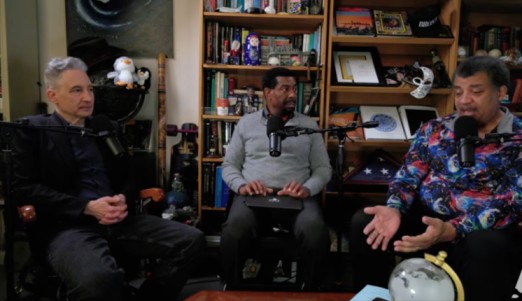
Editor’s Notes: In this special edition of StarTalk, Neil deGrasse Tyson sits down with theoretical physicist Brian Greene for an unfettered conversation about the most mind-bending concepts in the universe. They dive deep into the mysteries of the quantum realm, debating whether the “many worlds” interpretation is a literal reality or simply a mathematical artifact. From the origins of string theory to the physical barriers of reaching absolute zero, this extended discussion explores how science and math define the fabric of our culture. (April 8, 2026)
TRANSCRIPT:
Introduction
NEIL DEGRASSE TYSON: This is StarTalk. Neil deGrasse Tyson, your personal astrophysicist. Got with me Chuck Nice, baby.
CHUCK NICE: What’s up, Neil?
NEIL DEGRASSE TYSON: All right, this is a special Cosmic Queries edition.
CHUCK NICE: Okay.
NEIL DEGRASSE TYSON: Because half of it is not going to be Cosmic Queries.
CHUCK NICE: Oh, okay.
NEIL DEGRASSE TYSON: Half of it, I’m just going to be talking to my man.
CHUCK NICE: Oh, okay, for a moment, I thought you meant you were just going to talk.
NEIL DEGRASSE TYSON: Up the street.
CHUCK NICE: Yes.
NEIL DEGRASSE TYSON: Professor of mathematics and physics.
CHUCK NICE: And physics.
NEIL DEGRASSE TYSON: At Columbia University.
CHUCK NICE: That’s right.
NEIL DEGRASSE TYSON: Let it go for Brian Greene!
CHUCK NICE: And the returning champion, Brian Greene.
BRIAN GREENE: Thank you, thank you.
CHUCK NICE: Fan favorite, by the way, you know that, right?
BRIAN GREENE: Appreciate that.
CHUCK NICE: Our fans love you.
BRIAN GREENE: That’s great to hear.
Brian Greene: Theoretical Physicist and Science Communicator
NEIL DEGRASSE TYSON: We love you because you’re a theoretical physicist. And while, of course, data matter, people like just thinking in an unfettered way about what could be true or not true about the universe. And there’s so many things being bandied about lately, especially in the quantum realm, that we thought we’d bring you in for a special recording where there are no time limits on this. We’re just going to talk universe, everything cool, weird, and wacky about the universe.
CHUCK NICE: Let’s do it.
NEIL DEGRASSE TYSON: And you’re the man for it. By the way, when you’re not here, I just sort of fumble over what I know, but when you’re here, we got him.
CHUCK NICE: Yep, exactly.
NEIL DEGRASSE TYSON: Okay, so let’s remind people, your specialty, I mean historically, is particle physics specifically?
BRIAN GREENE: Yeah, I certainly came from the particle physics side, quantum mechanics, and then moving toward gravity, which of course is the other end of the spectrum. And that’s what took me to string theory, which is this attempt to put them both together.
NEIL DEGRASSE TYSON: We’ll get there. We’re totally going to get there. All right, so that means there’s no scale of physics that’s out of your reach.
CHUCK NICE: Well, I wouldn’t quite go that far, but you are kind of covering it all.
NEIL DEGRASSE TYSON: I’m just saying, the particles in the universe, what else is left?
BRIAN GREENE: Well, what’s left are the complicated things like the brain, like the mind, like consciousness, like biology. So yeah, we stay simple.
NEIL DEGRASSE TYSON: You do the easy stuff. The physics is the easy stuff. You’ve written multiple bestselling books.
CHUCK NICE: Yeah, a lot.
NEIL DEGRASSE TYSON: And the one people remember most perhaps was The Elegant Universe.
CHUCK NICE: Was that your first?
BRIAN GREENE: That was my first.
CHUCK NICE: That was your first book.
NEIL DEGRASSE TYSON: And it was a runaway bestseller. Yeah, for W.W. Norton. And your most recent book in 2020 came out just in time for COVID, Until the End of Time.
CHUCK NICE: Nice.
BRIAN GREENE: Wow. Fitting, right?
CHUCK NICE: Very fitting of you.
NEIL DEGRASSE TYSON: If you were religious, it would be The End of Days.
BRIAN GREENE: Right.
CHUCK NICE: The End of Days.
NEIL DEGRASSE TYSON: Nice. So what I like about you is you have a breezy way with communicating your complex physics thoughts, and in no small measure is that honed in books that are written for the public. And also, you’re co-founder, I think with your wife Tracy Day, former news correspondent who interviewed me many years ago, I think for NBC?
BRIAN GREENE: ABC.
NEIL DEGRASSE TYSON: ABC, yeah, yeah, yeah. And Tracy Day co-founded the World Science Festival.
CHUCK NICE: Oh, wow.
BRIAN GREENE: We did.
NEIL DEGRASSE TYSON: Yeah, now that’s just, initially it’s just being badass because it was New York.
CHUCK NICE: Which is the world, though. I’m not sure if you realize this.
NEIL DEGRASSE TYSON: So I haven’t attended as many of these as I have always wanted, but those that I attended, I thoroughly enjoyed. The juxtaposition of the science and the art and the music and just science as culture.
BRIAN GREENE: Yeah, I mean, that’s the point. I mean, much of what your work is about, the same thing. People need to see science as part of the fabric of culture as opposed to something off there on the side that you are forced to take in school and then you leave it behind.
NEIL DEGRASSE TYSON: Right, you leave it behind. And so I think World Science Festival does that brilliantly.
BRIAN GREENE: Thank you.
NEIL DEGRASSE TYSON: I just want to congratulate you on that.
BRIAN GREENE: Appreciate that, thank you.
NEIL DEGRASSE TYSON: Year in and year out, it’s still going strong.
The Multiverse and Many Worlds: Setting the Stage
NEIL DEGRASSE TYSON: So before we get to Cosmic Queries, because we poll our fan base, our donors really, the Patreon members, and they all know you, so they’re coming in with questions hot and heavy, straight in. And I worry that I might be asking some questions that they’d be asking.
CHUCK NICE: Oh well.
NEIL DEGRASSE TYSON: Is that allowed?
CHUCK NICE: So what?
NEIL DEGRASSE TYSON: Yeah. Okay, so Brian, let’s just right off the bat, we hear about the multiverse. Okay, on one side of a fence, and then you cross the other side of the fence, and then we hear about the many worlds hypothesis in quantum physics. Do these have anything to do with each other?
BRIAN GREENE: Yeah, they do. The idea of a multiverse is the umbrella concept for any variation on the theme where our world is not the entirety of reality.
NEIL DEGRASSE TYSON: Oh, so that would cover all cases?
BRIAN GREENE: All cases.
CHUCK NICE: Oh, whether it’s a multiverse or not. Yeah, so the multiverse is under Many Worlds.
BRIAN GREENE: Well, I think Many Worlds is under the Multiverse, under the Multiverse, the umbrella idea.
CHUCK NICE: Okay, so the Multiverse encompasses every single—
BRIAN GREENE: And there are something like 10 versions of Many Worlds that have emerged from radically different ideas, and quantum mechanics is simply one of those.
NEIL DEGRASSE TYSON: Okay, so I was mistaken to think that the more, dare I say, traditional multiverse descriptions. There’s one where there’s multiple bubbles within our space-time.
BRIAN GREENE: Sure, that’s the inflationary multiverse.
NEIL DEGRASSE TYSON: Yeah, you know, I’m thinking that’s the multiverse.
CHUCK NICE: I’m bringing it down, by the way. Inflation, affordability.
NEIL DEGRASSE TYSON: The universe is not really inflated.
CHUCK NICE: It’s not really inflated. It’s the best price it’s ever been. There’s never been a better price for the universe.
NEIL DEGRASSE TYSON: Anyway. And I’d learned many worlds when I first learned quantum physics, where you needed some way to get out of the conundrum that you’re observing statistical phenomena.
BRIAN GREENE: Yes, exactly.
NEIL DEGRASSE TYSON: So catch us up on many worlds specifically, and then tell us how that plugs into the multiverse.
Hugh Everett and the Many Worlds Interpretation
BRIAN GREENE: Yeah, so when people developed quantum mechanics, this is now going back to the 1920s and 1930s.
NEIL DEGRASSE TYSON: The centennial decade of quantum physics.
BRIAN GREENE: Precisely, which is why I’m writing a book on it that will be published in this decade.
NEIL DEGRASSE TYSON: Oh, you’re writing a book to catch people up on that?
BRIAN GREENE: Yeah, yeah, exactly.
NEIL DEGRASSE TYSON: Yeah, very good.
BRIAN GREENE: And the progression of the ideas beginning in the 1920s was to note that a particle, let me be specific, like an electron, it could be partly here and partly there, 50% here and 50% there. And the question was, but when you look and you measure, you always find the electron here or there. You never find it in a blended mixture being at two locations.
And people scratched their head for a long time trying to figure out how do we transition from a theory that describes a fuzzy haze of possibilities to the single definite reality when we make an observation or an experiment?
NEIL DEGRASSE TYSON: How much of that definite reality was a bias coming out of classical physics?
BRIAN GREENE: Well, you could say all of it, because our brains are big and we think they probably operate according to laws that are biased toward the classical, the big stuff.
NEIL DEGRASSE TYSON: Yeah.
BRIAN GREENE: And our experience—
NEIL DEGRASSE TYSON: Classical physics, there’s an object, it drops, there’s a thing, you move it, right? There’s just stuff that kind of makes sense.
BRIAN GREENE: Yes, exactly.
NEIL DEGRASSE TYSON: And nothing in quantum physics makes sense.
BRIAN GREENE: And nothing in experience suggests there’s anything but one single definite reality. And that was a conundrum.
NEIL DEGRASSE TYSON: Experience shows one reality, quantum mechanics speaks of many possibilities, measurements in that realm, right?
BRIAN GREENE: That’s right. So measurements, experience in the realm of the small, somehow seemed to pick out one singular definite reality. But here’s the problem: when you look at the mathematics, which comes from Erwin Schrödinger — you can’t transition from cat fame.
NEIL DEGRASSE TYSON: Yes, Schrödinger’s cat in the Broadway musical, I think, of Cats. Yeah, that would have been really cool.
BRIAN GREENE: Well, there was—
CHUCK NICE: How do you know there wasn’t?
BRIAN GREENE: And this is the point. So Schrödinger’s mathematics forbids a transition from many possibilities to the single definite outcome of experience. And so people said maybe the transition never happens.
And this is Hugh Everett, 1957 at Princeton. He looks at the equations and says we are imposing a classical bias on reality. We think there’s a single definite reality, but according to the math, if you look at that cat, there’s one universe in which the cat’s alive and you see it alive and you’re happy. There’s another universe where you see the cat dead and you’re chagrined, right? And that’s the true reality. Neither of you knows about the other version of you. Each thinks they live in a single definite reality, but the bigger picture embraces more than one world.
NEIL DEGRASSE TYSON: Was that other world always there, or was it created in the moment that they had the realization of another realization, a realization of their life?
BRIAN GREENE: It’s a really good and subtle question, and I don’t think every physicist sitting in this chair would give you the same answer. As I look at the mathematics, I would say all those worlds in a sense are there. There’s nothing really splitting, which is how we often describe it. The world splits into two. It’s more that the description of the quantum realm allows—
NEIL DEGRASSE TYSON: See his body language?
BRIAN GREENE: Let me see some of that more.
NEIL DEGRASSE TYSON: I know, I love that.
BRIAN GREENE: Give me some more of that. The mathematical description now allows us to use the language of one world or another when that language wouldn’t have been applicable before your measurement. But it’s not like the world splits and splits and splits. It’s all sitting there in some giant uber realm.
CHUCK NICE: Gotcha. So does the realization of the measurement — are you saying that there’s a possibility that you’re not measuring a definite thing at that moment, or instant, I’ll call it, in that instant? Or are you just seeing that and everything else is just still there, but like you can’t see it because you’re looking at this?
BRIAN GREENE: See, it all depends on what you mean by you. And I hate to be so specific in the wording, because if by you, you have the conventional notion of a single human being, okay, each version of me does see a single world, carries out a single measurement. It’s just that if you had a God’s eye view, which we don’t have, you would see many versions of me with many outcomes.
CHUCK NICE: Okay, that is so freaky, man.
NEIL DEGRASSE TYSON: But it sounds like you just pulled that out of your ass.
BRIAN GREENE: I didn’t, I assure you. All right, but that’s an important point. Let me just emphasize that when Hugh Everett came up with this idea, it was the most conservative interpretation of the mathematics. Yes, it seems ridiculously uneconomical to have all these worlds, but the math, if you just take it at face value, this is what it seems to say.
The Nature of Mathematics and Reality
NEIL DEGRASSE TYSON: Do you harbor questions about the universe? Some long-held bit of cosmic curiosity lingering within you? Or questions about anything? At all, you can become a Patreon supporter of StarTalk. You have access to our exclusive question line on our website. Those are where we draw our questions for our Cosmic Questions.
CHUCK NICE: Some of the most extreme objects in the universe.
NEIL DEGRASSE TYSON: StarTalk is a work in progress where we every month come up with some new way, some new idea, some new understanding of how to bring the universe down to Earth. We could not do that without your support. Thank you. And as always, keep looking up.
So let’s back up. You and I have chatted, we’ve hung out socially, and you confided in me that when you were a kid and when you were in school, if you picked a book off the shelf and there were no equations in it, you immediately put it back.
BRIAN GREENE: Yep.
CHUCK NICE: Wow.
NEIL DEGRASSE TYSON: Who does that?
CHUCK NICE: I gotta say, that’s— who does that? A math teacher’s favorite kid. That’s who does that. Every math teacher’s favorite student.
NEIL DEGRASSE TYSON: Teacher’s pet in the math class. So you have a math brain. You have a brain wiring where the math is clear and present to you more so than any words or descriptions that surround it. I don’t have a problem with that. You are also dual professor at Columbia in physics and mathematics.
What you just told me makes math the preeminent supreme account of reality because you’re saying the math forces it. And I’m asking you, math is our tool. Why should math that you invented, you, anybody, humans, force anything? Why can’t I say there’s a different idea that’s going to have different math that doesn’t lead to that conundrum?
BRIAN GREENE: So if you asked me that question 20 years ago, I would’ve given you one answer. Which would have been very combative, and I would have been defending mathematics as like the deep truth of the world. In the past 20 years, I’ve shifted closer to your perspective. I really do see math as a powerful tool for describing the external world. I don’t see it necessarily as the truth of what’s out there, which is why I don’t support the many-worlds interpretation of quantum mechanics the way some of my colleagues do. I allow for it. It could be true. It’s interesting. It blows your mind. But I do not say I say it’s true because it comes out of the equations.
NEIL DEGRASSE TYSON: Thank you. Wow.
CHUCK NICE: Okay. That’s a very, I’ll say, mature and advanced math. Yeah, well, thank you.
NEIL DEGRASSE TYSON: That’s right.
CHUCK NICE: That’s a mature stance.
NEIL DEGRASSE TYSON: You have matured in the past 4 years.
CHUCK NICE: I have.
Kepler, Platonic Solids, and the Limits of Mathematical Beauty
NEIL DEGRASSE TYSON: Because I don’t, you know, I love me some math, don’t get me wrong, not as much as you do, but when I look at Kepler, who was a mathematician fundamentally, and he knew about the Platonic solids. Do you know about the Platonic solids?
CHUCK NICE: I know that they’re friends.
NEIL DEGRASSE TYSON: The Platonic friends, yeah. So if you have polygons, which are flat shapes that have the same sides on them, so a triangle would be a polygon, a regular polygon, a triangle, a square, a hexagon, that sort of thing. So if you ask, can you make solid objects with these as its sides, there’s only 5.
CHUCK NICE: 5 poly— 5 shapes that do that.
NEIL DEGRASSE TYSON: 5 shapes.
CHUCK NICE: That do exactly that.
NEIL DEGRASSE TYSON: —where each side is the same polygon. Only 5. One of them, some of them are just— one’s a pyramid, definitely.
CHUCK NICE: One’s a soccer ball.
NEIL DEGRASSE TYSON: No, soccer ball has 2 different kinds of shapes on it. Oh, really? Yes, it does.
CHUCK NICE: Oh, so they’re not all the same?
NEIL DEGRASSE TYSON: No, they’re not, I’ll check next time. But it is a way to tile a sphere. Tile them so that you can do it. So one is a pyramid, another one is a cube.
CHUCK NICE: Cube, of course, yes.
NEIL DEGRASSE TYSON: And then there’s like 3 others given to me.
BRIAN GREENE: Yeah, dodecahedron, and I don’t even remember the rest of the names. Icosahedron. Yeah, so—
NEIL DEGRASSE TYSON: That is another one. Kepler, a mathematician, said there must be some divine reason for this. There’s 5 of them. And we have 6 planets. There was Mercury, Venus, Earth, Mars, Jupiter, and Saturn. So he said, wait a minute, if the universe is special and math is special, obviously they have to be connected. They must be connected.
So he embedded these Platonic shapes in each other, circumscribing one around the other to see if that gave him the orbital distances of those 6 planets. Because if you have 6 planets, you have 5 separations between them. He thought that was amazing connection. So he spends 10 years doing this.
CHUCK NICE: And then it was over, he was like, “I’ve wasted my life!”
NEIL DEGRASSE TYSON: Oh God, what have I done? But the math is what took him there. The beauty of the math. And so that was my lesson. That, you know, I ain’t going there.
Lemaître, Einstein, and When Math Proves Itself Right
BRIAN GREENE: But it goes the other way too, right? Because you go back to, say, Georges Lemaître. So he’s a priest, a Belgian priest.
NEIL DEGRASSE TYSON: Yeah, yeah.
BRIAN GREENE: He’s studying Einstein’s mathematics, finds that the equations, the math says that the universe should be expanding or contracting. He goes to Einstein, and Einstein says, “Your calculations are correct, but your physics is abominable. This math is not relevant to the world. It’s like the Platonic solids. You’re wasting your time.”
And yet in this case, Einstein was wrong. Einstein’s math was relevant in the way that Georges Lemaître was suggesting the universe is expanding. And it is, so you have to go—
CHUCK NICE: Einstein didn’t even know his math was relevant.
NEIL DEGRASSE TYSON: Yeah, so Lemaître, he used calculations of Einstein’s equations to force upon him a feature of the universe that not even Einstein was imagining.
BRIAN GREENE: Exactly right. So that’s math being badass.
CHUCK NICE: The math discovered that. Math discovered it.
BRIAN GREENE: So it’s all just to say that it has to be case by case. You got me.
Hilbert Space, Infinity, and the Many Worlds
NEIL DEGRASSE TYSON: You got me there. Okay, so now if everybody’s doing these quantum physics experiments all over Earth and in all alien planets, is this a countable number of worlds?
BRIAN GREENE: Yeah, that’s a tough, tough question. It’s infinite in any reckoning, but exactly which kind of infinity? We kind of understand it because we don’t want to go into the deep mathematics, but there’s a whole structure due to David Hilbert, a mathematician who actually raced Einstein to the finish line in general relativity.
NEIL DEGRASSE TYSON: Did not know he was on the track.
BRIAN GREENE: Yes, in fact, he published general relativity a little bit before Einstein did. Oh, there’s a little-known fact. Well, that must hurt.
CHUCK NICE: What’s his name again?
BRIAN GREENE: His name is David Hilbert. Damn. And the thing that—
NEIL DEGRASSE TYSON: I know Hilbert because it’s Hilbert space. Hilbert space. Tell me about that in a minute.
BRIAN GREENE: Okay, but in this particular story, Einstein had visited Hilbert in June of 1915, showed him everything that he’d worked out for 10 years. Then Hilbert took it the final step and published before him. In the end of the day, Hilbert said, “No, no, it’s your theory, it’s your theory, Albert. I’m not trying to take it from you.” That’s very cool. But he did publish a little bit before him. Yes.
NEIL DEGRASSE TYSON: Even though he would not have published had Einstein not visited him.
BRIAN GREENE: Yeah, he wouldn’t have known anything about it. But the point for quantum mechanics is that there is this thing that you made reference to, Hilbert space, which is the mathematical structure within which all these worlds live. And we understand the math of that pretty well. I know that. Yeah. Yeah.
NEIL DEGRASSE TYSON: So why does it need a mathematical structure? Yeah, well, they live—
BRIAN GREENE: Well, if you’re going to describe things with rigor mathematically, you’ve got to define things. You’ve got to have the operations. You have to be able to categorize the ingredients. And remarkably, this space that Hilbert introduced has just the right mathematical properties to be the space in which all these worlds live.
Gödel’s Incompleteness and the Limits of Proof
NEIL DEGRASSE TYSON: Does it suffer from an incompleteness feature? You know, everything—
BRIAN GREENE: Yeah, Gödel. Gödel. Yeah. So, yeah, Gödel had a very powerful result that any basically sufficiently complex mathematical structure will have true statements that can’t be proven true within the axioms of that structure itself.
NEIL DEGRASSE TYSON: So it just has to be asserted.
BRIAN GREENE: It has to be asserted, or you have to somehow intuit it or feel it, or in, you know, in the general relativity—
CHUCK NICE: Sounds a little suspect.
BRIAN GREENE: The deep question is, are there interesting physical features of the world that would be undecidable in this Gödelian sense?
NEIL DEGRASSE TYSON: That’s what I’m asking you. So, is there a feature—
BRIAN GREENE: I don’t know the answer.
NEIL DEGRASSE TYSON: —of general relativity where you part the curtains enough and then there’s just some assumption you had to make. Yeah. And everything issues forth from that, that you cannot deduce from anything that follows.
BRIAN GREENE: Yeah, I mean, there certainly are axioms within these theories, for sure. But are there then deductions that are true but can’t be proven within the structure itself? I don’t know, because when you look at Gödel’s proof, the kinds of things that are undecidable are very contrived, you know, with things like, you know, the set of all sets that are not subsets of themselves. You’re like, well, does that ever come up in the real world? You know, or the Barber of Seville, you know, nobody shaves themselves, but then like, who shaves the barber? Who’s, you know, so they’re all very self-referential and it’s not obvious that they have direct relevance to things that we could measure.
NEIL DEGRASSE TYSON: But it’s still an important discovery. Hugely important. Yeah, hugely important. And this thing about the bar— the closest I got to that barber question was I used to read brain teaser books when I was a kid. Okay. And so one of them is you come to a town, only two barbers. Yeah. And one of them’s just completely messy and the guy’s unkempt and he’s got— and his hair all— but the town looks amazing. And there’s another barber where he’s clean-shaven, everything’s neat. So which barber do you go to?
CHUCK NICE: I’m going to the messy one because he clearly does the other barber. Exactly! Exactly! Somebody cut the good. That’s the guy. That’s the closest I’ve gotten to the barber today.
Many Worlds and the Multiverse
NEIL DEGRASSE TYSON: So with the many worlds, now connect that up to a multiverse. It was just a declaration. It’s a multiverse of a kind.
BRIAN GREENE: It’s one flavor of multiverse, right, that comes directly from the math of quantum mechanics. And the natural next question is, can you prove it? Can you demonstrate it?
NEIL DEGRASSE TYSON: Feels less real to me than other multiverses I’ve read about.
BRIAN GREENE: Yeah, no, I understand that feeling because our consciousness feels singular, right? And this theory is saying there are many individuals in this larger realm that have your memories, that have your experiences, and they only differ from you that they saw the cat dead and you saw the cat alive.
NEIL DEGRASSE TYSON: In some universe that you know.
CHUCK NICE: So now let me ask you this with respect to that.
NEIL DEGRASSE TYSON: Well, how do you react to this? Give me a second to just tear up.
CHUCK NICE: See, I watch a lot of Rick and Morty, so this doesn’t bother me. It doesn’t bother me at all. I’m just like, oh, okay, of course it works that way.
NEIL DEGRASSE TYSON: Duh. But this other me, that’s me identically except we observed a different outcome of the experiment.
BRIAN GREENE: Yeah, and then from there you continue to diverge ’cause we know that little changes right now over time can turn into major deviations in your lives later on.
Fate, Free Will, and The Time Machine
NEIL DEGRASSE TYSON: ‘Cause I’ve seen in several films, but let me pick one specifically, H.G. Wells’ The Time Machine. I’m referencing, I didn’t read the novel, but I saw the movie, when is it, from the ’60s? And the guy, the main protagonist, befriends a woman who shortly after they have this encounter, she’s like hit by a truck. And he says, “Well, I have a time machine. I can go back and fix it.” So he goes back and says, “Oh, don’t exit the park this way, go the other way.” She goes the other way and something else hits her and she dies. And the safe drops on her head. Or an anvil. Even better.
And so, after 2 or 3 iterations of this, or in another one she’s mugged and killed, he concludes that it was just her time and he can’t change fate.
The Quantum Mechanical Multiverse and Many Worlds
CHUCK NICE: Can’t change the outcome.
NEIL DEGRASSE TYSON: When I saw that, I said the molecules of air that are around her are in a different place because she’s displacing these molecules relative to these. That’s a different universe. I’m not going to look at these as just this is the only thing that has to stay constant. Tell me about all the other little things that change relative to the big thing that you notice.
BRIAN GREENE: Yeah, so in that version, I think you’re right. You know, if the person could really go back in time, change things, I think you would get a different universe. I don’t know of any uber-law that says certain major events or minor events have to be preserved, but in the quantum mechanical version, it’s completely different. If you take on board this idea, you are committing to different worlds where things are radically different. In one, she would live, and the other, she would die. If they are allowed, if these outcomes are compatible with the laws of physics, then they will happen in one or more of the worlds in the quantum mechanical multiverse. All things compatible with the laws of physics are realized.
CHUCK NICE: Wow. That’s pretty wild, man.
NEIL DEGRASSE TYSON: Okay, so, but all right. I love that though. Wait, wait, stop. I love that.
CHUCK NICE: Here’s the only thing that I can’t get with that. All right, in that case, how do you reconcile infinity or an infinite number of worlds?
NEIL DEGRASSE TYSON: Let me get there. So, okay, so watch. We went from the many worlds hypothesis where it is exactly me, but I look at a dead cat instead of a live cat or vice versa. In the multiverses to which I’ve grown accustomed, there’s possibly an infinite number of them. But maybe in one of them, I am there mostly myself, except I have a goatee, or I’m Evil Neil instead of Friendly Neil. So that’s not a many-worlds Neil.
CHUCK NICE: You’re Neil who believes in tarot cards.
NEIL DEGRASSE TYSON: So that’s not a many-worlds Neil, that’s just another statistically configured Neil out of the random molecules in that universe.
BRIAN GREENE: Right, but the beautiful thing about the quantum mechanical multiverse is that when you study the possible worlds that can emerge, they embrace effectively anything that would have a nonzero chance of occurring. And that’s anything in effect that’s allowed by the laws of physics. So if the laws of physics allow you to have a goatee, then there will be a world in the many worlds where you do have a goatee.
NEIL DEGRASSE TYSON: Right. But in that world, that’s a different me looking at the cat. Because the dead cat, live cat version of me, they each have a goatee.
BRIAN GREENE: Yes, so if it’s a very minor event, like doing a single observation, usually a single observation can’t yield such a radical change immediately. It’ll be you without a goatee in one, you without a goatee in another. But then if you wait long enough and you accumulate the huge number of ways that you could’ve gone left, you could’ve gone right, you could’ve gone up, you could’ve said yes, you could’ve said no, when you put all of those possible—
NEIL DEGRASSE TYSON: You could’ve had pepperoni on your egg.
BRIAN GREENE: Yeah, now one of them results in you having a goatee because that came along for the ride in that particular world.
Finite Particles and the Question of Infinity
CHUCK NICE: So here’s what I want to know, back to the infinity. Yeah, are there a finite number of particles in this universe?
BRIAN GREENE: There are a finite number of particles in the observable universe, but the universe could go on and could go on forever.
CHUCK NICE: Okay, then that’s the question.
NEIL DEGRASSE TYSON: We don’t know.
CHUCK NICE: Yeah, because my point is then that means there’s a finite combination of all these particles that could create these worlds. And so how do you get to infinity? But if the universe goes on and on and on, then yeah. There is no end.
NEIL DEGRASSE TYSON: But even with an infinite number of universes with the same number of particles, you just configure them and keep reconfiguring.
CHUCK NICE: My point is this: can you reconfigure a finite number of particles to get to infinity?
BRIAN GREENE: You can’t, because it’s not reusing the same electron or the same proton in one world and another. It’s a realization of that particle in a different configuration, right? And that’s so there’s not like a conservation of particle numbers.
CHUCK NICE: Yeah. Wow. So I used to be into—
NEIL DEGRASSE TYSON: I used to be into big numbers, and I still am, but I haven’t stayed with it. And one of my favorite big numbers was Skew’s number. Do you know? 10 to the 10 to the 10 to the 34th power. And if you play that out, you get the total number of configurations of all the particles in the observable universe. So it’s as though if the universe were a cosmic chessboard, it’d be the total number of possible moves. Because you’re not counting objects at this point, you’re counting events, you’re counting things. Combinations.
BRIAN GREENE: I would get a different number if I was to use the entropy of the observable universe, which we can calculate from the dark energy. I would get a 10 to the 10 to the 120.
NEIL DEGRASSE TYSON: So is that much different from 10 to the 10?
BRIAN GREENE: Yeah. So I think it has to do with whether you’re only looking at material particles that—
NEIL DEGRASSE TYSON: Yeah. Yes.
BRIAN GREENE: Yes, it is. Versus the energy that—
NEIL DEGRASSE TYSON: Oh, no, of course. Yeah. The energy is all in there too. Yeah. This is just counting up the physical particles. Sure. That makes sense.
CHUCK NICE: Okay, cool. So do we actually know the amount of dark energy that’s in the universe? Well, we measure it.
BRIAN GREENE: We do measure by the rate at which distant galaxies are accelerating away from us. And it’s this ridiculously small number in the units that we typically use to measure these things. And that translates into this particular number for the entropy, the number of states that the universe can possibly be found in.
CHUCK NICE: Right, okay, that makes sense.
The Achilles Heel of Many Worlds
BRIAN GREENE: But the question you asked before, if we could return to it for a second, because it is— this issue of infinite number of worlds.
NEIL DEGRASSE TYSON: Yeah, wait, wait, just before you get there, I just want to remind people that when you say if there’s a chance something can happen, no matter how small, yeah, you multiply that very small number by infinity and you get a real number and you get many worlds.
BRIAN GREENE: You get many in which that small probability thing could happen.
NEIL DEGRASSE TYSON: Exactly. So the infinity that you’re about to go to, right, helps bring out of the depths the statistically unlikely possibilities.
BRIAN GREENE: And that to me is the Achilles heel, or a potential Achilles heel, of this approach. And again, I have to say, different people in this chair, they will say different things. But the issue that many of us have taken with the many worlds is just that if an outcome has very small probability, right, that should mean it’s very unlikely to happen. But from the analysis that you just gave, no matter how unlikely it is to happen, it will be realized in some world. So, what does it mean to say something is unlikely if you’re sure it’s going to happen in some world?
NEIL DEGRASSE TYSON: Exactly. Yeah, yeah.
CHUCK NICE: Now. It’s like having a drink, it’s 5 o’clock somewhere.
NEIL DEGRASSE TYSON: So we encounter this in astrophysics where we talk about supernovae as being an extremely rare event. Not all stars will go supernova, and even high-mass stars, some go black hole. It’s rare. However, the galaxy has 100 billion stars in it. There’s 100 billion galaxies in the universe. So when people realize, if you have enough of a sample size, you could deliver every single night supernova into your catalog.
CHUCK NICE: It’s a rare event that happens often. Yeah, exactly.
NEIL DEGRASSE TYSON: So that was initially kind of hard to explain to the public how you get that.
BRIAN GREENE: Yeah, so we have a version of that in the quantum mechanical multiverse. But it is more of an issue because you’re guaranteeing the existence of a world, a whole world filled with observers and experimenters who are guaranteed to see the most unlikely things on a regular basis. And that is an issue. Now, there are some people who work on this who say we’ve solved that. Just read our paper, read our book, and they do some interesting mathematics. I am not convinced. And that to me is where the issue is.
Levels of Infinity
NEIL DEGRASSE TYSON: Interesting. So let me ask, I think we chatted about this over lunch a few moons back. Thanks for inviting me. Oh, it’s in your inbox. Oh, I missed that. And forgive me, I might have had this conversation with Brian Cox. Sure, yeah. Forgive me, because you’re my favorite physicists out there. So do you feel bad that I have another physicist who I— A little bit, but it’s all right. So I learned this early because I said I was into big numbers when I was a kid— that there are levels of infinity. Yeah, I think they’re at least 5.
BRIAN GREENE: You can keep on going.
CHUCK NICE: You buried the lead, guys. Now you got to explain that. You can’t just say that. You weren’t at the lunch. Should I— that there are levels of infinity?
NEIL DEGRASSE TYSON: Yeah, yeah, yeah, yeah. But you weren’t at the—
CHUCK NICE: You know how counterintuitive that is?
NEIL DEGRASSE TYSON: I know you weren’t at the lunch. So should I— do I have to drag you behind us in the—
CHUCK NICE: I know, man. Listen, I’ll take a doggy bag. Okay? Because that’s crazy what you just said.
NEIL DEGRASSE TYSON: We’ll get—
CHUCK NICE: We’ll explain that in a minute. All right, go ahead.
NEIL DEGRASSE TYSON: So I kept thinking to myself that you can have an infinity of universes, and that would not be a big enough infinity to exactly reproduce me, and that you would maybe need higher levels of infinity to get all the combinations that people like to talk about in the multiverse. So does it require the higher levels of infinity?
BRIAN GREENE: You know, the most straightforward answer would be to say I don’t fully know because I don’t know that science understands you, and by you I mean life, well enough to say.
NEIL DEGRASSE TYSON: You know what he just said? He said, “I could be so simple, it’s trivial to copy me.” Science is under no obligation to understand you.
BRIAN GREENE: But if you take on board the idea that you are just a collection of particles that are governed by the quantum mechanical laws, if that is something you’re willing to accept, then there is enough room inside of Hilbert space in the quantum mechanical infinity to reproduce you and to reproduce every variation on you where some of your particles—
NEIL DEGRASSE TYSON: Every variation conceivable.
BRIAN GREENE: Yes, yes, every variation allowed by the quantum laws, which simply means—
CHUCK NICE: Is there a version of me that has a tooth cavity? Because I’ve never had a cavity.
BRIAN GREENE: If that’s compatible with the laws of physics, and I think it is, then yes.
CHUCK NICE: So non-dental plan Neil, this is the Neil with no dental plan. If that’s within the bounds of quantum mechanics, the laws of physics don’t prevent it, then we got enough— not matter, we have enough material to make sure that that happens.
NEIL DEGRASSE TYSON: I don’t need the higher levels of infinity to get there. No, I know. Okay, absolutely. Okay, so now let’s catch up, Chuck, because everyone else out there knows about multiple infinities. So please catch me up. So these are levels of infinity. I think there’s a Hebrew letter associated— Aleph. Aleph 0 is a traditional infinity. Aleph 1, 2, 3. So we don’t have to do all 5. Just get me to like the second infinity.
BRIAN GREENE: Yeah, so the simplest one is the one that comes to mind immediately. You just count the numbers, 1, 2, 3, and they just go on.
CHUCK NICE: And they just go on.
BRIAN GREENE: And that’s the simplest, straightforward infinity. But then if I ask you, how many numbers are there between 0 and 1 on the number line. Oh wow. Now you say to yourself, well, can I enumerate them? Can I put them into a correspondence with the counting numbers and just list them? Because if you cross—
CHUCK NICE: However, but am I not—
NEIL DEGRASSE TYSON: But I’m still going to—
CHUCK NICE: Wait, wait, I was going to say, aren’t I dividing then when I go in between numbers? Yes, I’m kind of dividing.
The Infinite and the Unlikely
BRIAN GREENE: You are. And you could say, well, let me put a dot in the midpoint, call that 1, and then a dot in the midpoint between it and 0 and call that 2. You won’t cover all the numbers. And there is a wonderful—
CHUCK NICE: I’ll never reach 1 because there’ll always be a place where I can once again put something in between 1 and where I am.
BRIAN GREENE: It’s another way of saying it, but Cantor had a powerful argument that’s actually pretty easy to understand. We’d need to write it out for me to show it to you. But he established that if you try to enumerate the numbers between 0 and 1, just list them, you will fail. You will always miss some. And therefore there are more than an infinity of numbers between 0 and 1. And that next level of infinity is the version that Neil was referring to. That would be Alice’s one.
CHUCK NICE: Alice, give me my bag. I’m going to need my weed.
NEIL DEGRASSE TYSON: Okay, so you just skipped by it and I want to make sure we can contemplate it briefly. The one way to know which infinity is bigger than the other is you correspond them to each other.
BRIAN GREENE: Yes, exactly.
NEIL DEGRASSE TYSON: Right, so you can say, because this is kind of a little freaky, the odd numbers is the same size infinity as all the counting numbers that include odd and even numbers. Of course. Now, how do you get that?
BRIAN GREENE: Well, you could take any given number and say multiply it by 2 and add 1 to it. And in that way, you’re certain to get an odd number. You get an odd number, and now you’ve lined up the numbers 1, 2, 3 upward, and the list that it corresponds to are all odd numbers.
CHUCK NICE: They all just go up. Damn, that’s wild. Wow. Math is kind of cool. Who knew? Okay.
Aleph Numbers and Higher Dimensions
NEIL DEGRASSE TYSON: And just to taste it, if I remember correctly, Aleph 2, does it go into another dimension? The number of lines in 3-dimensional space? Is a bigger infinity than the counting numbers on a number line.
BRIAN GREENE: Yeah, that may be a way of saying it. I’m not sure. There are many ways of expressing these infinities, and there’s actually a kind of an almost an algorithm that allows you to start to build up this set of infinities. You can look at subsets of subsets and things of that sort. Look at power sets, as it’s called. And so it’s an astoundingly strange idea, which is why mathematicians who thought about this in the early days—
NEIL DEGRASSE TYSON: You’re all in asylums right now.
CHUCK NICE: I’ll never get to 1, I’ll never get to 1, I’ll never get to 1, I’ll never get to 1.
NEIL DEGRASSE TYSON: F*, that is so rude. So, and if you go to higher dimensions, in principle, does that take you to greater infinities?
BRIAN GREENE: Not necessarily, no. I mean, if you start to look at the number of points in the plane, you know, points on a line versus points in a plane. So you have to be fairly sophisticated in how you build up these infinities. But for our purpose, there is this thing that we’ve made reference to, it’s a bit abstract, this thing called Hilbert space. And we understand it reasonably well. It’s an infinite dimensional space that David Hilbert developed, but we understand it well enough to say it does have enough room to embrace all the quantum mechanical states.
NEIL DEGRASSE TYSON: Infinite dimensions, you think it has enough room?
BRIAN GREENE: Yeah. And within that space, in principle, there is a place that describes you.
The Improbability of Existence
NEIL DEGRASSE TYSON: All right, so now, I am however improbable in the configuration of atoms and molecules, even here, in this actual reality. Okay, so have you thought much about whether or not something can exist and whether or not it does?
BRIAN GREENE: The likelihood of such things? Yeah, and it’s a mind-blowing thing. When you think about the sequence of steps by which you came to be. And I’m saying, let’s go to your childhood, to your birth, let’s keep on going further back, your grandparents, great— let’s go all the way back to the Big Bang. And if you look at the sequence of steps from the Big Bang—
CHUCK NICE: Go back to the Big Bang—
BRIAN GREENE: You do actually, we all do, right? That’s how we get here. We have collections of particles that are configured in a certain way, and they have a history. And it’s that history which resulted in them being in the configuration that’s called Neil deGrasse Tyson. And if you look at the sequence of quantum steps, each of them are incredibly unlikely, and the collection of those sequences is innumerably huge and therefore incredibly unlikely. And yet here each of us are.
NEIL DEGRASSE TYSON: So what do I do with this information?
BRIAN GREENE: Well, I think it gives you a certain special— well, if you want me to be a little bit sappy, I think it inspires a gratitude. The unlikeliness of us being here against being at all. And therefore there’s a certain kind of thankfulness that the universe turned out in a way that gave us a brief moment to stand up, look around, and appreciate everything.
Many Worlds and the Multiverse
CHUCK NICE: That’s wild. So now I’m looking at that and immediately going back to our previous conversation about the two observers. Okay. With the dead cat, live cat, and the many worlds. What you just said can negate that, meaning that also there are an infinite number of worlds where there’s just no Neil, and then there’s an infinite number of worlds where there is no cat, and then there’s an infinite number— You know, you’re absolutely right.
BRIAN GREENE: And I think that’s one of the lessons. If you take the many-worlds approach to quantum mechanics to heart, it is saying that clearly we are compatible with the laws of physics because we’re here. Existence proof, right? And if you take the many-worlds seriously, then we were guaranteed to live in some world in this grand collection of many many worlds. Now, in some sense, this world is incredibly unlikely within the panoply of possibilities, but you’re right, in that sense, we were an inevitable outcome of the quantum laws because we are allowed by those very laws of physics.
NEIL DEGRASSE TYSON: But Brian, I have a more anchored version of what you just said that I credit to Richard Dawkins. If you look at the total possible genetic combinations of atoms that will make a human being, a viable human being, it’s a stupefyingly large number, like 4 to the 3 billion or something, right?
BRIAN GREENE: Yeah, 10 to the 30th power. It’s high, right?
NEIL DEGRASSE TYSON: What matters is not even how big it is, but it’s vastly larger than the total number of people who have ever been born, right? Which, plus or minus, it’s about 100 billion. Okay, so Dawkins’ point is: we should cherish life because most people who could ever exist will never even be born.
CHUCK NICE: That’s right. Yep.
NEIL DEGRASSE TYSON: So we can be sad that you die, but he describes those people who die as the lucky ones.
CHUCK NICE: Who got to live in the first place.
NEIL DEGRASSE TYSON: Because you can only die if you got to live. And for me, that’s a little more anchored than—
BRIAN GREENE: Yeah, but to take the point we were saying before, if the multiverse version of quantum mechanics is the right way of thinking about it— then they did live if their genetic sequence was compatible with the law of physics.
CHUCK NICE: So don’t feel bad for all those little swimmers that didn’t quite make it to the egg.
NEIL DEGRASSE TYSON: The sperm you’re talking about? Yes, exactly. So Brian, I get this question often, surely you do as well. If we live in a multiverse and we’re just one of an infinitude, where are the other universes? And you’re going to cop out and say, oh, they’re in the infinite dimensional Hilbert space?
Where Are the Other Universes?
BRIAN GREENE: Well, it’s easier to answer that question for other flavors of multiverse, like the inflationary multiverse that you made reference to before, because that’s the simplest one to picture.
NEIL DEGRASSE TYSON: So those are the other places. We’re in a bubble, right? And there’s another bubble over there in the same sort of space, in the same construct.
BRIAN GREENE: Yeah, because according to inflationary cosmology, as you’re making reference to, there was an energy field that gave rise to repulsive gravity that drove our Big Bang, but the math shows that it would not have used up all of that energy in the process. Some would be left over. The leftover energy would yield another Big Bang, and it would not be fully used up, yielding another Big Bang. And so these distinct Big Bangs, as you say, would give rise to these sort of bubbles in a big cosmic bubble bath.
NEIL DEGRASSE TYSON: Okay, so that’s in one construct. But now there are other variants. Multiverses where it’s sort of separate.
BRIAN GREENE: Yeah. When you talk about the quantum mechanical multiverse, it’s much harder to think about where those other worlds are. They’re not kind of adjacent to our space. It’s a more abstract place that they inhabit. And I’m going to try to avoid using the word Hilbert space, but that’s the mathematical architecture within which we can see these worlds existing. I can’t picture where these other worlds are. If you ask me, do I have a mental image of them? Not really.
NEIL DEGRASSE TYSON: Okay, so that’s a mathematical architecture. Can I divine an experiment that would show that they exist? Can I wormhole to them? Do I even want to wormhole to them? Because quantum physics might give you slightly different laws of physics.
BRIAN GREENE: It’s unlikely the laws of physics are different, but the properties of ingredients might be different in principle if there are sufficient quantum mechanical processes that could yield worlds with those distinctions. But I don’t know of an experiment, and I don’t think anybody does, where you can say, if we could get this and this result, we would establish that the multiverse is true.
NEIL DEGRASSE TYSON: You told me that other universes, gravity can leak out of them?
Brane Worlds and String Theory
BRIAN GREENE: Yes, so that’s another variation on the multiverse that comes from string theory, which we can talk about. But just to presage what we might talk about, in this version, our universe is sort of like one piece of bread in a big cosmic loaf, and the other slices of bread would be the other universes. So they would really be hovering next to us, just displaced in an actual additional dimension of space. And then you’re right, gravity can influence, permeate that space.
CHUCK NICE: So when I was having my little ayahuasca trip, I met these beings that were in-betweeners, and they were in between dimensions. That’s where they occupied. Okay. I feel so silly, but they— we’re listening. Okay. They explained that— they talked to you. They did. They talked to me and they were two-dimensional beings that I could see in 3D. Sounds creepy, but that’s the only way I can explain it. And they explained to think of it like an infinite number, and they called them dimensions going out and going up and going out, but to think of them as a deck of cards slapped up the way we see a deck of cards. We see it as one deck of cards, but it’s not. It’s however many cards are in that deck. And until you separate them, that’s when you can see the different things. That’s how it was explained.
BRIAN GREENE: So this is almost the reverse of that. It’s as if we only see one card in the deck. That’s our world. But a God’s eye view would see the entire deck, which would have the other cards. And that’s where they see.
CHUCK NICE: I see it as the one card. And they were explaining that they see it as the deck. But anyway, I had shared that with Janna Levin and she was like, that’s pretty interesting because— and then she gave me some speak that I didn’t understand.
BRIAN GREENE: Yeah, it must be the same basic idea. Actually, we just wrote a paper on these so-called brane worlds in string theory. So this is something—
NEIL DEGRASSE TYSON: This is short for membrane.
BRIAN GREENE: Membrane. Yeah, sorry. I should have said that. Thank you. So these ideas, these are universes that are like a membrane, and there can be multiple membranes, which would be multiple worlds, right? And in principle, as Neil was mentioning, they can influence each other. Gravity from one can influence things in the other.
NEIL DEGRASSE TYSON: So I never took— I’m saddened by this— in graduate school, I’m taking astrophysics classes, but I wanted to take more physics, and a physics class I never took was field theory. A whole course on field theory.
String Theory, Extra Dimensions, and the Future of Physics
BRIAN GREENE: And you can come to my class one of these. Yeah, I’ve taught field theory a number of times. Yeah, I’ll let you know next time. Excellent.
NEIL DEGRASSE TYSON: I sit in the back. Yeah, yeah, yeah.
CHUCK NICE: Oh, that’s not intimidating. Oh, it is. Neil deGrasse Tyson. I’m going to fail. I swear to God, I’m going to fail.
NEIL DEGRASSE TYSON: No, but I would— I’m not in a position to calculate or even really know why. Gravity can escape, but not the electromagnetic force?
BRIAN GREENE: Well, I can give you a quick mnemonic, sort of, to think about that. Really? Okay. Which is, so, in string theory, gravity is communicated by a string that has no ends. It’s a closed loop. Okay. The electromagnetic force is communicated by photons, which in string theory are strings that have two open ends, and those ends are anchored to the membrane. They can’t escape the membrane, but because the gravity particle, the graviton, has no ends, just a loop, it’s not anchored. It can get off and travel between those worlds.
NEIL DEGRASSE TYSON: Is that a description that would be in the book “String Theory for Dummies?” It’s there, no doubt. Okay, so if that’s the case, why isn’t what we measure as dark matter just gravity leakage from another slice of bread?
BRIAN GREENE: People have made proposals like that. If your dark matter is meant to explain the gravity that we know is there, but we— gravity. It was dark gravity. Dark gravity, yeah. So if you can have some source of gravity that you don’t literally see, it’s a candidate. And so people have put forward, it’s hard to make this idea really work, but in terms of its general possibility, sure.
NEIL DEGRASSE TYSON: ‘Cause the betting person’s, if you’re into betting what an outcome would be, an exotic particle is sort of the betting man’s solution to, but that’s put forth by particle physicists. You know, if you’re a hammer, you’re a little bit biased, right? You’re a little bit biased, right? So I’m liking me the gravity spillage.
BRIAN GREENE: No, I like the idea. It’s in detail, it’s only when you get down to brass tacks that it’s hard to make this really work.
String Theory: The 1980s and the Promise of Unification
NEIL DEGRASSE TYSON: All right, so let’s pick up the baton here on string theory, okay? Where I’m a little older than you, but we came of age with enough overlap so that I can speak of the 1980s as a time where string theory was birthed and started taking off with some vigor. Yeah. All right. Everybody I spoke to at the time, and at the time I was at the University of Texas, which had its share of string theorists. Yes. And Steve Weinberg. Steve Weinberg, for sure. A graduate of my high school. That’s true. That’s true.
BRIAN GREENE: Not your high school. Yeah, I agree. Okay.
NEIL DEGRASSE TYSON: So Steve Weinberg, a Nobel laureate in physics, cosmologist, you know, anyhow. So I asked people, so when are you guys going to figure this out? ‘Cause you’re trying to unify quantum physics and the large and the small. And it’s, oh, we’re almost there, 5 years, in 5 years we think we’ll do it. So, you know, 10 years later, well, when are you going to do it? Oh, in 5 years. 20 years later, oh, in 5 years. The problem is hard, it’s a hard problem, but we’re on the— and so I’ve never heard convergence. Yeah. In any conversation about string theory landing where it had intended. Yeah.
A, B, could it be— and I think I’ve said this on stage to you and you didn’t jump up and try to hurt me— could it be that all of you are just too stupid to figure out the solution? And let me say that more charitably. Are we awaiting the birth of some 21st century Einstein to see the solution here that none of the rest of you are?
BRIAN GREENE: Yeah, yeah, it’s all possible. First off, I would never have said 5 years back then. It’s a very dangerous thing to make a prognostication of that. There was huge enthusiasm. But look, string theory has done miraculous things since the 1980s, and I’m happy to sort of list the achievements, but you’re right, it’s not done the one thing that ultimately matters, which is make a prediction that we can test, you know, at a particle collider and determine whether these ideas are correct.
And it could well be that we just don’t have the brainpower to get there. And it may not be that we’re awaiting the birth of the next Einstein. Maybe we’re just awaiting the next configuration of AI that may be able to do what we as individuals have not been able to do. I do think there’s a real possibility of the nature of research changing in the next 5 to 10 years.
NEIL DEGRASSE TYSON: In the next 5 years. You hear that?
CHUCK NICE: You did. I did hear that.
AI and the Future of Scientific Discovery
BRIAN GREENE: This one I’m willing to stick with though, because I can give you an example. I mentioned this paper that I wrote with Jana Levin that you make reference to.
NEIL DEGRASSE TYSON: Is this the loaf of bread paper?
BRIAN GREENE: No, it’s just we wrote a handful of papers together. This is a more recent one, and I wondered, could ChatGPT get the answer that took us a long time to get? If I treat ChatGPT— and I treated it as sort of a good graduate student. So I just gave it a few prompts the way you would to a graduate student, did not give it the answer, and it couldn’t look up the answer, we hadn’t yet published the paper. And within half an hour, it was able to reproduce the results that took us months to get.
CHUCK NICE: Oh my gosh.
BRIAN GREENE: And so it’s as if you have the greatest graduate student known to humankind, even an army of them, at your disposal.
NEIL DEGRASSE TYSON: And that’s now. This is a hologram right now.
CHUCK NICE: It’s an AI. I’m not even here.
BRIAN GREENE: So what is it going to be like in 5 years? It’s both exciting and scary at the same time.
NEIL DEGRASSE TYSON: I have a colleague who has a similar story regarding his research where he was prompting ChatGPT to think about a problem and it solved a problem that he had not been able to solve. And actually solved it? Yeah, actually solved it. Wow. In the sort of, you prompt a really good graduate student in just the way you’re describing. But catch us up just on why the whole field is called string theory.
BRIAN GREENE: Well, the basic ingredient is a filament that looks like a tiny piece of string. The idea is that it can vibrate in different patterns, and the different particles that we know and love— electrons, quarks, neutrinos, and so forth— fundamental particles would each correspond to different vibrational patterns of this new entity called the string.
NEIL DEGRASSE TYSON: So the string becomes the fundamental particle?
BRIAN GREENE: Yes, and it’s a unity because it’s one thing that can manifest as many different things depending on how it’s vibrating, which is— for people who like unity, this is a beautiful thing. It’s a beautiful thing, and it goes even further. When you look at the math of this, you find that not only does it unify all the particles, but it unifies quantum mechanics and general relativity— the laws of the small and the laws of the big.
NEIL DEGRASSE TYSON: Does it do that for free?
BRIAN GREENE: It does that for free. It just comes out. I’m telling you, you look at the math— that’s a nice fact. Let me— you look at the math, right? You stare at the equations, and out pops Einstein’s equations from general relativity. Wait, to whom does it pop?
NEIL DEGRASSE TYSON: Who do you have to be for it to pop out? So I had not fully embraced that reality of string theory, so I’m delighted to hear that. So that was part of the enthusiasm that people would have then had.
BRIAN GREENE: So then what is the heart of it all?
CHUCK NICE: The major obstacle?
BRIAN GREENE: The major obstacle is that the theory is mathematically complex, and the pathway from the fundamental equations to physics we can see in the laboratory is fraught. It’s difficult. It’s tough terrain to cover. And so we’ve been developing mathematical tools to do that for now 30 years. We’ve made progress on black holes.
NEIL DEGRASSE TYSON: The ’80s was 40 years ago.
BRIAN GREENE: I guess you’re right. Oh my God, string theory hasn’t answered that question yet. 40 years ago.
NEIL DEGRASSE TYSON: 40 years before that was the 1940s.
BRIAN GREENE: Yeah, I’m with you on that.
NEIL DEGRASSE TYSON: All right.
BRIAN GREENE: You know, so we’ve been for 40 years trying, you know, and so we’ve understood things about space and time and gravity and black holes, which I didn’t think we’d ever understand in my lifetime. Yeah. On the flip side, though, we’ve not understood the things that I thought we would have understood by now. Which would be make a prediction for what’s going to happen at the Large Hadron Collider and let’s check it. And so it’s an interesting thing that we’ve made headway in the very things I thought would be too hard, and we’ve not made headway in the things that I thought we would be able to reach by now.
Criticism of String Theory
NEIL DEGRASSE TYSON: Right, so I don’t like making arguments that other people make just for the sake of bringing the argument to you, but just let me just do that.
CHUCK NICE: But let me do it anyway.
NEIL DEGRASSE TYSON: Let me do it anyway. So string theory has not been without some criticism. As something that has consumed the ambitions of graduate students and faculty and promotions. And so it’s a field without a prediction that can be tested, yet it had such a presence on the landscape of physics departments that it might have smothered some other branches of physics that might have been a little more promising. Could you just comment on that?
CHUCK NICE: That sounds like jealousy to me.
BRIAN GREENE: It’s an interesting argument because the very graduate students and junior faculty and senior faculty who this person who’s making this argument fears may have wasted their time not looking at something more promising, you gotta assume they’re really smart people because they’re the very people you think who could have pushed the frontier of another field. And if they’re that smart, allow them to make the choice for where they think the greatest promise is. Yeah, who are you to say that they’re not going to execute? Who are you to say? As if somebody was like putting a bag over their head or, you know, putting a gun to their head. They were looking at the ideas that were out there, found the string theoretic ideas so compelling that they were willing to take a chance. And that chance may not pay off in our lifetime.
The Mystery of Extra Dimensions
NEIL DEGRASSE TYSON: And tell me about the 10 or 11 dimensions. Yeah. Because that sounded very cop-outy. Well, you know, it’s like, I can’t explain this, let me throw in a dimension. Ah, good. Let me add another dimension. But why do you think that is?
BRIAN GREENE: You need the dimensions. Good, good, good. And I think if I articulate this correctly, I think you’ll have the same epiphany that you did about gravity coming out of string theory a moment ago. Because again, you wondered, do you have to put general relativity into string theory? I said, no, no, it just comes out for free, which is a beautiful thing. How about the extra dimensions? They come out for free too. They’re forced upon you by the equations. You don’t put them in. You don’t put them in. Not at all.
Literally, this is not a joke. There’s an equation in string theory that basically looks like D, the number of dimensions, minus 10 times this complicated factor must be equal to 0 for this theory to be self-consistent. The complicated thing is never 0, therefore D minus 10 must be 0, therefore D must equal 10. That is where the extra dimensions are forced upon you by the equations.
CHUCK NICE: That’s insane. That’s pretty cool though. Yeah.
NEIL DEGRASSE TYSON: And I mean, that’s so— 10 dimensions. So we don’t experience them. Why?
BRIAN GREENE: Because we believe that they’re probably too small for us to see with the naked eye. Or small dimension means it means that if you head off in a given direction, you kind of return to your starting place so quickly. You can think about a straw, right? A straw has a long dimension that we can easily see, but it has a curled up circular dimension. And if that circle— of course we can see that with the naked eye, but if you made that circle—
NEIL DEGRASSE TYSON: liquid through it, yes.
BRIAN GREENE: But if you made that circle smaller and smaller and smaller, at some point you won’t see it at all, and you’ll think it’s just a line. You’ve hidden the extra dimension.
NEIL DEGRASSE TYSON: So all the other dimensions are hidden?
BRIAN GREENE: We think that is one explanation for why we don’t—
NEIL DEGRASSE TYSON: Can anything exist in those hidden dimensions?
String Theory: Dimensions, Membranes, and the Fabric of Space
BRIAN GREENE: I was going to call the Elegant Universe “Hidden Dimensions.” That was the title I was playing with back, you know, 25 years ago. But anyway, yes, exactly.
NEIL DEGRASSE TYSON: All right, so you’re hiding the dimensions from us.
CHUCK NICE: Yes.
BRIAN GREENE: Okay, but that is by hand. So when we look at the math, the equations don’t tell us these extra dimensions are really tiny. Instead, we’re doing what you accuse me of perhaps on other things. We’re saying, how can we make this theory compatible with what we see? Let’s envision that the extra dimensions are really small. Yeah.
NEIL DEGRASSE TYSON: Got it. Okay, and so how— so a string is 10 dimensions? A string is living in a 10-dimensional space. Okay, now why would a string be fundamental and not— because a string is one-dimensional. Yeah. And dimensions are just dimensions. Why can’t there be another reality maybe in which we’re embedded with the string is not fundamental but a plane is what’s fundamental?
BRIAN GREENE: Yes, and that’s one of the developments in string theory itself. So when we talk about these membranes, the piece of bread or the card in the deck.
NEIL DEGRASSE TYSON: String theory upped by a dimension.
BRIAN GREENE: And string theory takes you there. It’s not something, again, that you put in by hand.
NEIL DEGRASSE TYSON: He goes wherever his equations want to take him. I gotta say, it’s pretty fascinating.
BRIAN GREENE: I need to say, this is a purely mathematical undertaking. Totally. Yeah. But the beauty of it is you don’t put things in from the outside. You study the equations, and it takes decades sometimes, but you extract what the equations are trying to tell you.
The Current State of String Theory
NEIL DEGRASSE TYSON: So before I go to queries, what is the current state of string theory? Current state is—
BRIAN GREENE: Health. Yeah, it’s funny, I asked this question in a program to 3 string theorists, a World Science Festival program. I asked them, “Guys, grade string theory. How, if string theory was a student, how would you grade it?” And the grades went from B+— I think that may have been Nobel laureate David Gross, I could be getting their grades wrong— to an A+, which was Andy Strominger, who’s a string theorist at Harvard.
And if you look at its theoretical insight into black holes, the mathematical insights that it’s given started whole fields of mathematics. If you have any interest in the nature of space and time and what it might be made of, these are the kinds of insights that string theory is giving. So I’d say it’s very healthy, but it has not made a prediction allowing us to determine whether it’s correct.
NEIL DEGRASSE TYSON: Wow. And that’s almost a violation of one of the most important tenets of a viable theory. Yes.
BRIAN GREENE: And that’s why maybe you shouldn’t call it string theory. Oh, what should we call it? Yeah, maybe call it the string hypothesis. Okay. Theory really should be reserved. That’s a more humble—
NEIL DEGRASSE TYSON: Yeah.
CHUCK NICE: But the math makes it a theory. Well, no, no, no.
NEIL DEGRASSE TYSON: Theory, yeah. For a theory to be a bona fide theory, it’s got to not only account for what you see, right, or in an organized coherent way, it’s got to make predictions that you have verified, right?
CHUCK NICE: You got to be able to measure.
NEIL DEGRASSE TYSON: If it’s not predicted, then it’s only one half of what’s going on.
BRIAN GREENE: Yeah, so we’re using the word wrong, and I agree with people who are sticklers on that.
CHUCK NICE: Got it. But is that because— and I don’t want to sound like— I’m not trying to be a jackass, but what you just explained, I gotta say, Einstein had it easy. I’m serious. Einstein had it easy compared to what you’re just talking about. I agree.
BRIAN GREENE: He wrote down his equations and within a handful of years you could test it.
CHUCK NICE: Right, because it’s like, it’s here. It’s right, it’s around us, it’s everywhere. Like, you’re talking about stuff that is, I mean, how do you get to it?
NEIL DEGRASSE TYSON: Unsolved problems that have lasted much longer than these 40 years in the history of science. Okay, so it took a long time to understand heat and energy.
CHUCK NICE: That’s very funny what you just said. It took us a very long time to understand heat.
BRIAN GREENE: No, we didn’t know what it was, the fundamental basis of it. That’s hilarious.
NEIL DEGRASSE TYSON: No, no, we didn’t know. Is it some fluid?
BRIAN GREENE: Fluid? Caloric? They called it caloric that could flow. Yeah.
CHUCK NICE: And you know where we did most of the— well, no, that’s the air looking like— the air is a fluid, though. That’s not the heat.
NEIL DEGRASSE TYSON: But go ahead. One of the main centers of experiments for this were cannons, because you’d fire cannons, the metal gets hot. So as it got hotter, they weigh it to see if it had more heat, if the heat was a thing. Right, if it was like possessing heat.
CHUCK NICE: Possessing heat. Possessing heat.
NEIL DEGRASSE TYSON: So yeah, so we went decades and decades with other— so maybe I shouldn’t be so hard on string theory.
BRIAN GREENE: Yeah, this is a pretty good place to have gotten. Let’s wrap it up right here, folks.
Quantum Entanglement, Wormholes, and the Fabric of Spacetime
NEIL DEGRASSE TYSON: Thank you, good night. Okay, and one last thing. I want to hear it again, just because it was so beautiful. All right. So beautiful. Just tell me, speak to me, Brian. Because it’s sweetness to my ears when I heard you say— I think it was you— that the virtual particles in the vacuum of space coming in and out of existence, as predicted by quantum physics, they are quantum entangled with each other. And that quantum entanglement are wormholes. And those wormholes represent the literal fabric that stitches together the universe itself.
BRIAN GREENE: Yeah, we were definitely talking about this at some point.
NEIL DEGRASSE TYSON: Where are we on that?
BRIAN GREENE: Well, it’s a beautiful idea. Beautiful. It really comes from Lenny Susskind and Juan Maldacena and a whole army of string theorists who developed these ideas.
NEIL DEGRASSE TYSON: He came here, gave a talk, one of our evening talks at the planetarium.
BRIAN GREENE: Yeah, he’s wonderful. Very innovative guy. Yeah, he’s driven physics for decades. So he and Juan Maldacena realize that these quantum entangled particles— which Einstein really, in a sense, predicted in his EPR paper, Einstein, Podolsky, and Rosen, in 1935— may be connected to another Einsteinian idea which he came up with 2 months distinct from that first paper, an Einstein-Rosen paper on wormholes.
That is, 2 particles that are far apart can have a subtle quantum link, and that quantum link may be nothing but a wormhole yielding a shortcut through the fabric of space that in some sense makes them very close to each other.
NEIL DEGRASSE TYSON: And those wormholes themselves are what spacetime is comprised of. Yes.
CHUCK NICE: So the substrate of space itself would be wormholes.
BRIAN GREENE: Yes, that’s right. So Mark van Raamsdonk in British Columbia, Canadian physicist, realized that these wormholes may be the fiber stitching together the fabric of space itself, because he could show mathematically if you cut the quantum entanglement, the fabric of space pulverizes. It falls apart because you no longer have the wormholes connecting pieces of space together. That is wild.
Cosmic Queries
NEIL DEGRASSE TYSON: Okay, so I’m going to keep watching that. That’s great. It’s time for Cosmic Queries. Oh, we should have some jingle or something. That’s that, or some animation. Some animation would be good. You know, Cosmic Queries, right? Questions asked by you if you’re a Patreon member, knowing that our guest today is Brian Greene, the one and only. So we have a starter question.
CHUCK NICE: Yes, from one of our own producers. Yeah, Tamsen, our producer. Yeah, our taskmaster. Tams wants to know this, Brian. If spacetime had consciousness and could have a favorite movie, what do you think that movie would be?
BRIAN GREENE: I think it would be Planet of the Apes.
CHUCK NICE: Really?
BRIAN GREENE: Oh, that scene at the end, you know, with a half-submerged or sunken statue. “Damn you!”
CHUCK NICE: That’s it.
NEIL DEGRASSE TYSON: Wow. Wow. Yeah, because that played loosey-goosey with spacetime. Yeah, to go into the future, it’s another Earth, and it has a different evolutionary path.
BRIAN GREENE: It was the first time that time travel really meant something to me as a kid. I was like, oh man, this is crazy.
NEIL DEGRASSE TYSON: You know, yeah, that’s a good one, man.
BRIAN GREENE: Yeah, Planet of the Apes, the original, the original. Forget about the other 75,000 follow-ups, right? Exactly.
NEIL DEGRASSE TYSON: Return to the— Escape from the Planet— Bride of the Planet of the Apes, Finality of the Planet of the Apes. You know what, when I went back and saw that film, it’s actually quite deep because the different species of apes had different roles. Right, so the chimpanzees were the academic class, right? Because they’re close. Why not?
CHUCK NICE: Of course, they’re our closest cousins.
NEIL DEGRASSE TYSON: And the baboons were like the police, right? Yeah, or the gorillas. The gorillas are police.
CHUCK NICE: And the orangutans are the elders.
NEIL DEGRASSE TYSON: No, no, the orangutans were the diplomats.
CHUCK NICE: Diplomats, that’s correct. Right, so the politicians—
NEIL DEGRASSE TYSON: It wasn’t politicians, it was a caste system. Yeah, yeah, that’s right. It’s pretty wild.
CHUCK NICE: Yeah. So our first few questions have been previously asked by our Patreon supporters. But you said, I’m going to have to see what Brian says about this.
NEIL DEGRASSE TYSON: Oh, right. So they were elevated.
CHUCK NICE: So they were elevated.
NEIL DEGRASSE TYSON: Okay, it was above my pay grade right there.
CHUCK NICE: They wrote in with a question and you were like, let me get my supervisor. Okay, I went to go. So this is Brian Burke. He says, “Hey, Dr. Tyson, Lord Nice, Chuck, you should be able to nail this one. It’s Brian from Portugal. Brian, shut up. He says, can you help explain the information paradox with black holes? My understanding is that quantum mechanics and Hawking radiation are at odds about this. One says information is forever, the other says information disappears when a black hole evaporates. Are we any closer to understanding how this can be? Thanks, and please keep doing what you’re doing. We need real science to carry on. Live long and prosper.”
Oh, nice.
The Black Hole Information Paradox
NEIL DEGRASSE TYSON: Now let me preface that a little more here. Sure, please. So I was delighted to learn that the evaporation of black holes, the Hawking radiation, is the exact inventory of fundamental particles that went in, even though it’s being conjured out of the gravitational field of the black hole itself, the energy density of the field. So I said, oh, so that’s a total reckoning of ingredients. But if I went in as a DNA molecule, and I come out as the various fundamental particles, the information that I was DNA is gone. So no, there’s no preservation of information there.
BRIAN GREENE: And that’s what Stephen Hawking said. So when Stephen Hawking did his initial calculations in the 1970s, he came up with this idea that black holes could actually radiate through quantum processes— the production of particles just outside the edge of a black hole. One falls in and the other races away. And the question was, do the particles that race away have the information content about everything that fell in, or don’t they?
He said they don’t. “My calculations show it’s a thermal bath of particles, a vanilla featureless bath of particles, no information inside of it.” We particle physicists said, “Come on, quantum mechanics doesn’t allow information to be lost or destroyed. So if you’re saying that, you’re saying quantum mechanics is wrong.” Okay. And we’re not willing to go there. Yeah, quantum is so successful.
NEIL DEGRASSE TYSON: Right. That’s, you got to be ready for it.
CHUCK NICE: You got to be around somebody more than Stephen Hawking.
BRIAN GREENE: And this led Lenny Susskind again, and Gerard ‘t Hooft, who won the Nobel Prize, and various other people to spend 25 years trying to answer this question. And we believe largely from string theory that we do understand that the information does in a very subtle way come out of the black hole. Subtle quantum correlations between the particles that emerge from the black hole do carry all the information of, say, the DNA molecule that fell in. So you can recover all the information, we believe.
Now, there are still mysteries that we’re still figuring out, but just about everybody, including Hawking before he passed away, agrees that we believe the information does come out. Preservation.
NEIL DEGRASSE TYSON: He had a bet with somebody, wasn’t it? Was it with Preskill? John Preskill? Yeah, he was a postdoc when I was a graduate student at the University of Texas. Okay, yeah.
The Holographic Principle and Information in Black Holes
BRIAN GREENE: So Preskill won the bet then. So Preskill won the bet, but Kip Thorne was also part of this, and Kip Thorne was unwilling to concede.
NEIL DEGRASSE TYSON: Kip Thorne is in our archives, check him out. Yeah, absolutely. We interviewed him in his office in Pasadena.
BRIAN GREENE: So Hawking conceded the bet that John Preskill said the information does come out, and he gave him an encyclopedia of baseball. A lot of information he provided him as the way to—
NEIL DEGRASSE TYSON: Baseball already has too much information. Now you have an encyclopedia.
BRIAN GREENE: That’s right. He made good on his bet. I don’t know where Kip Thorne stands on this. I don’t know if he has conceded.
CHUCK NICE: Okay. What’s the business about the information being stored in the event horizon? Have you— yes. Oh, that’s the—
NEIL DEGRASSE TYSON: What do you call that? That’s the holographic—
BRIAN GREENE: Holographic idea. And that’s part of the solution for why we believe the information comes out. Susskind again. Susskind again. This guy is incredible. Things fall into a black hole, and we believe that they leave on the surface in some sense a copy, a residue of their information, and that’s how it can come back out.
CHUCK NICE: It never actually goes away. They never went in. The imprint was left on the event horizon. Yes. Very cool. Cool, man.
NEIL DEGRASSE TYSON: Super cool, man. Yeah, so we have an explainer on whether or not we’re living in a black hole. We could— the properties. Yeah, we could be. And if it’s big enough. Yeah, yeah, yeah. Okay.
Audience Questions: The Spinning Universe and Dark Energy
CHUCK NICE: All right, here we go. This is Rachel.
NEIL DEGRASSE TYSON: Rachel says— and we’re still in questions that I— I had to call my boss.
CHUCK NICE: Rachel says, “What’s up, Dr. T? Rachel here from Austin, Texas. I’ve been thinking about the spinning universe hypothesis, which suggests our cosmos might be rotating spinning as a whole. This idea has been proposed as a potential way to resolve the Hubble tension, but it got me wondering: if the universe is indeed spinning, could the force we attribute to dark energy, which is causing the accelerated expansion, actually be explained by a kind of cosmic centrifugal force?” So she’s saying that we’re just on a whirly, whirly bird. We’re in the whirling dervish.
BRIAN GREENE: We’re in a teacup ride. It’s hard to see how you’d make that work. When we see the evidence for dark energy, it seems to be so-called isotropic. It’s the same in every direction in which you look, whereas if the universe is spinning, there’s an axis. There’s an angular momentum that picks out some directions as different from others. That’s right. So it’s hard to see how that would work.
NEIL DEGRASSE TYSON: If you look along the axis, there’s no centrifugal force.
BRIAN GREENE: Yes, but if you look off the axis, we study the motion of distant galaxies, we look across the entire sky. And so we have sufficient data, I think, to rule that possibility out. But who knows, write a paper and we’ll see what we figure out.
CHUCK NICE: Yeah, that was— all right, what a great question. Okay, we’re going to move into regular questions now.
The Quark Catastrophe: Black Holes and the Big Rip
NEIL DEGRASSE TYSON: Wait, wait, why don’t we pull out one that was there and I forgot who asked it, and it was about whether we’d have a quark catastrophe. So we had a Patreon member write in. The questioner knew that if you have two quarks in some kind of nucleon, then you try to pull them apart, there’s a point where that snaps, but you’ve invested so much energy in it that two new quarks show up in that instant. Now you have two pairs of quarks, right? We good with that? Okay, so in a black hole, or maybe in the Big Rip, either. Let’s look at the— you’re descending to the singularity. The two-quark particle falls, tidal forces get greater and greater, and then it splits the two quarks. So now we become two pairs of quarks as they fall in. Then it becomes four pairs and then eight pairs. And it’ll just be this unlimited increase in the number of quarks as it descends to the singularity? Why doesn’t that happen?
BRIAN GREENE: Well, you do feel tidal forces as you get ever closer to the center, for sure.
NEIL DEGRASSE TYSON: But I’m not a quark.
BRIAN GREENE: And it’s a finite timescale between when you cross the event horizon and you hit the singularity, and I could well imagine that particle pairs are created in the last moments of this. But whether all of the energy gets transformed in this way, that seems unlikely. You’d have to cut the—
NEIL DEGRASSE TYSON: After I rethought about it, it occurred to me, it’s pulling that energy out of the black hole. So it would evaporate the whole black hole.
BRIAN GREENE: Oh, if they’re thinking that an infinite energy transfer, then yeah, absolutely. Everything is finite. Timescales, finite energies, and so yeah, exotic processes can certainly happen when the gravitational force is that powerful. Now of course, when you get to the singularity, we have no idea what would actually happen.
NEIL DEGRASSE TYSON: Which you string theorists haven’t figured out yet.
BRIAN GREENE: We have not, but that’s actually a real point. That’s one of the goals that we’ve not yet achieved. And the Big Rip would be the same thing.
NEIL DEGRASSE TYSON: There’s a point where the— yeah, that’s true too, yeah, the expansion.
BRIAN GREENE: Expansion of the universe. If it was sufficiently high.
NEIL DEGRASSE TYSON: Would get on the scale of nucleons and split apart the quarks. Quark-antiquark pairs, yeah. And then make another pair and just keep going.
BRIAN GREENE: Yep, yep, yep. I mean, there are many other processes that can happen in the world, so I wouldn’t just focus on this. There are all sorts of ways that energy can transfer from the Big Rip or the gravitational energy of a black hole into particle production, into various kinds of processes.
NEIL DEGRASSE TYSON: Yeah, creates a whole universe of quarks.
BRIAN GREENE: You’d have to sort of calculate the rate at which those processes happen versus other things. Maybe the entire dark energy universe inside you, but we’re still inside the black hole.
NEIL DEGRASSE TYSON: No, no, now we’re just looking at the Big Rip. Yeah, I’m just— if this keeps happening, it’s using up the energy of—
BRIAN GREENE: But then of course if that were the case, it would no longer undergo the accelerated expansion. Exactly, exactly. The halting expansion. Exactly, yeah. Okay, okay.
Is Time a Dimension or a Field?
CHUCK NICE: All right, this is Michael De La Morena who says, “Is time a dimension or a field? It seems more like a field because it can be affected by gravity.”
NEIL DEGRASSE TYSON: That was another one that I punted to Brian.
BRIAN GREENE: “Is time a dimension or a field?” Well, I’d say the deep lesson of Einstein was that space and time can be affected by their environment, and they in turn create the very environment that then back-reacts on their own shape and structure. And so we usually think about time as a coordinate, a label telling us when things happen, just like coordinates in space tell us where things happen. And the unexpected thing is that label, the amount of time between two different locations, can be influenced by the force of gravity. Right, but that doesn’t require that it be a field.
NEIL DEGRASSE TYSON: Yes, it doesn’t require it be a field to be influenced by a force.
BRIAN GREENE: But I understand the intuition, because we used to think that the labels, the locations of where and when things happen in Newtonian perspective, they’re just inert, they just sit there, they don’t do anything. Einstein elevated them to be dynamical qualities of the world, and that’s the deep lesson.
Is Life Inevitable? The Universe Experiencing Itself
CHUCK NICE: Very cool. All right, great question, Michael. All right, this is Cody Rosenberg who says, “Hello doctors and Chuck, I’m Cody Rosenberg from Eugene, Oregon. Please know that y’all are goated for us armchair astrophysics guys.” Physics enthusiast. Nice. All right, very nice. “Anyway, do you guys think that life is inevitable? Do you think it would be weird for a universe to exist that can’t be experienced or observed? Do you think we are the physical manifestations of the universe yearning to experience itself?”
BRIAN GREENE: So it’s a very John Wheeler-like way of looking at the world. Wheeler loved to say that we are the way that the universe becomes cognizant of itself. It’s a poetic picture.
NEIL DEGRASSE TYSON: You had a U. With an eyeball. Yeah, yeah, a U, a serifed U, and on one of the upwards of the U, there’s an eyeball looking at the other line of the U. Oh, very nice.
BRIAN GREENE: The universe looking at itself. So it’s narcissistic or beautiful depending on your perspective that we’re here so the universe can think about itself. I don’t know of any law that makes life inevitable. It seems it was a lot of happenstance between the Big Bang and today. But we don’t understand a lot about the world, and maybe one day we’ll find there’s this law, this inevitability of the existence of galaxies and stars and planets and people, at least on one such planet. I don’t know of any such law.
CHUCK NICE: So let me ask you both this. But if I’m thinking that—
NEIL DEGRASSE TYSON: And this is wishful thinking, not because someone has researched this— okay, that you go to a different planet, you can take a geologist there, they’ll be comfortable there because they’ll know what a rock— ’cause they see their crap everywhere. Yeah, that’s right. So the rocks and the minerals, there might be some more exotic ones, but they have a sense of what elements do when they’re heated for a certain amount of time under pressure. And that repeats depending on the planet. So there are general rules of geology that apply to all planets. So let’s go to biology. Could the DNA molecule be a natural consequence of complex chemistry operating on planetary surfaces? Could it be as natural on a planet as rocks are to the geologist?
CHUCK NICE: And that’s what I was about to ask, and both of you can chime in on this— how cheap is life? So forget if it’s inevitable, how cheap is life? I don’t know what that means.
BRIAN GREENE: Well, in the sense that it formed relatively quickly on the planet Earth. So it didn’t take an enormous amount of time.
NEIL DEGRASSE TYSON: If it took billions of years, you’d say, whoa, that was some hard stuff. Yeah, it formed in just— in fact, we used to— how long do you think it took? Half a billion, I’d say. Okay, that’s what we used to say. Ah, okay. What would you say now? Okay, we used to say that because you’d start the clock at when Earth formed, right? Right, 4.5 billion. Yeah, yeah. And then the early signs of life were like 3.8, 3.9. So you say 600 million years, we used to say. And then we said, no, no, that’s unfair. That’s unfair. When Earth formed, there was periods of heavy bombardment where the surface of the Earth could not have sustained complex chemistry. Of course. Because the energy’s so high, it breaks apart all your— Let the Earth cool, for goodness’ sake! So the cooling, let it cool at about 4 billion years, that’s half a billion years. At 4 billion years, now you start the clock. And you have life 200 million years later.
CHUCK NICE: Wow, that’s really quick. Right, right. In the grand scheme.
NEIL DEGRASSE TYSON: In the grand scheme.
CHUCK NICE: Yeah, so that’s what I’m saying, so life is pretty cheap then.
NEIL DEGRASSE TYSON: Yeah, it’s 5% of the total time Earth has been around.
BRIAN GREENE: So again, however, I think that’s likely the way to talk about it, but there are so many detailed physical chemical processes that maybe they just so happen to come together in this one planet of the trillion that are out there. So when we understand it better, that cheapness, we may explain it by a coincidence of a whole lot of factors that just happen to align. On our planet. I don’t think that’s how it’s going to turn out, but it’s a possibility.
CHUCK NICE: It’s a possibility, yeah.
NEIL DEGRASSE TYSON: Well, except that there are amino acids on meteorites.
CHUCK NICE: Yeah, we found them already. Right.
BRIAN GREENE: An interesting question though is the way that proteins are coded by amino acids is uniform across all life. It’s the same code. 3 base pairs on the genetic code give rise to a particular amino acid. That is the code that works for you, me, and all life. On another planet, if there is another form of life, the deep question will be, is it the same code, right? Or is it different?
NEIL DEGRASSE TYSON: So it doesn’t need DNA at all, right?
BRIAN GREENE: Right. And so if it’s different, that would be wonderful. That would suggest that life in a whole variety of different forms can exist. Fully explored all the ways of being alive.
NEIL DEGRASSE TYSON: Yeah, yeah, yeah.
CHUCK NICE: Wow. All right, well, great question. Way to go, Cody. All right, this is Aaron Bailey who says, “Hey, StarTalk, I am Aaron from Florida.” And we’re sorry.
NEIL DEGRASSE TYSON: Yes.
Time Travel, Dark Matter, and Gravitational Waves
CHUCK NICE: So Aaron says, long time viewer, first time subscriber. Thank you, Aaron, we appreciate that. According to Einstein’s equations, is time travel still possible if you are traveling to a black hole? And why can’t we use gravitational detectors to measure the properties of dark matter?
BRIAN GREENE: So in the first question, yeah, I mean, Einstein’s special and general relativity both embrace a certain kind of time travel, and the black hole provides the mechanism for one kind. If you go hang out near a black hole, time for you elapses more slowly compared to someone who’s far away. Famously portrayed in Interstellar.
And so if you go to the edge of a black hole and you hang out and then you come back, everyone that you meet is going to be much older. Their clock was going much faster than your clock. And that is— some people say, well, that’s not time travel. That is time travel. Certainly you’ve traveled into their future, which would have been your future if you stayed there.
NEIL DEGRASSE TYSON: Exactly. You know who they left up in the ship?
CHUCK NICE: The black dude. He came back like, oh goddamn, 23 years. Yeah, you know, I’m serious. Now, you know, I’m on Social Security. I don’t get it. You go down there, you tell me you come right back. You’re worse than my kid. You’re worse than my kid. You’re worse than my kid. I don’t get it, Matthew McConaughey.
NEIL DEGRASSE TYSON: All right, what was the second half to that question?
CHUCK NICE: What was the other half? And so the second half, he says, why can’t we use gravitational detectors to measure the properties of dark matter?
BRIAN GREENE: Well, we do. The way we know dark matter exists is by the gravitational influence that it has on its environment. What we’re unable to do is identify what the dark matter is made of. And so we have these detectors all over the planet trying to capture little particles of dark matter, if that’s the right explanation. We haven’t been able to find any yet.
NEIL DEGRASSE TYSON: You know what we’re doing now? You know, there are pulsars. They’re rapidly rotating neutron stars. In a very precise way. Extremely precise. And they’re across the galaxy. There are not all that many of them, but there’s enough to map out the galaxy. So if you precisely know and measure the pulses of these pulsars, you can track a gravitational wave moving across the galaxy. Yeah, so you’re kind of using them like buoys in the ocean.
CHUCK NICE: Oh, you’re good.
NEIL DEGRASSE TYSON: Yeah, beautiful idea. And you don’t even need LIGO for that. Yeah, you just need high-sensitive, high-precision time.
BRIAN GREENE: Yeah, for gravitational waves of a certain wavelength, this is a beautiful way of detecting their influence.
Supersymmetry and the Standard Model
CHUCK NICE: Super cool, man. Yeah. All right, let’s move on to Alex Frias who says, hey Dr. Tyson, Lord Nice, Alex here from Mexico. Oh, I should say Alex. No, Alejandro. Alejandro from Mexico. Isn’t that racist that you assume— I can be racist? I’m black, I don’t know if you realize. Okay. The world invented racism for me. Okay, okay, here we go. Did I tell you this?
NEIL DEGRASSE TYSON: I was giving a public talk and I thought I’d say something funny. I was talking about the dinosaurs and they went extinct by an asteroid that hit the Yucatan Peninsula of Mexico. And I said, “But that’s not what the dinosaurs called it.” I thought it’d be funny. Right. And then someone in the front row said, “They called it Mexico.” That’s funny too.
CHUCK NICE: Spanish for dinosaurs. Yeah. Okay, all right, go. And then you had Trumpasaurus who was just like, “Keep ’em out.” Anyway, I’ve always been intrigued and confused by the idea of supersymmetry. Ooh, nice. If the Standard Model of particle physics is one of the most successful theories we have, what is telling us that it needs doubling up? What would supersymmetry fix in our understanding of the universe, and what problems might it create? Thank you both, and greetings from your neighbors in the beautiful Upper West Side. Ooh, nice, nice. Oh, look at that. Way to go, Alex.
NEIL DEGRASSE TYSON: I’m right up the street of Manhattan. So let me sharpen that even further. So the Standard Model is quite an organizational map of our particles and our forces and the like. In its current state, now that we’ve got the Higgs— is it missing anything? Is it a closed box right now? And if we do anything to it, does it simply make it more powerful, or do we know we need things to explain other things that we don’t yet understand?
BRIAN GREENE: Good. So the main motivation for supersymmetry is to address exactly the way you frame the question, which is when we study this Higgs particle, this newest addition that we found on July 4th, 2012— at least that’s where the announcement was— when you look at the mathematics, it says that the mass of the Higgs particle should be much, much bigger than the mass that we find. And when we try to keep the mass at the value measured, we have to stand on our mathematical heads to do so. We have to tune and tune and tune.
If supersymmetry were true, the terms that would push the Higgs mass up, they cancel out from those pairings. That’s why we need the pairings. That’s why we need the doubling. And if you can cancel out the new contributions, you can rest easy. The Higgs mass will stay at a small value.
NEIL DEGRASSE TYSON: So how many more particles come along? It doubles it.
BRIAN GREENE: It really does. For every known particle, there is a partner. Electrons have supersymmetric partners. Supersymmetric words for all these particles. Yes. So the electron has the selectron. Quarks, squarks. Neutrinos, neutrinos. No, no. Yes, no. Yes. I don’t name them neutrino.
CHUCK NICE: No. You know why? Because somebody, when they found it, they’re like, ah, neutrinos, neutrinos.
BRIAN GREENE: Okay. And so the big hope, if you would have spoken to me as a graduate student in the 1980s, the big hope and the reason we believe that string theory might be 5 years away was we expected supersymmetry, which is the super in superstring theory. We thought it would be found, those particles would be found at the Large Hadron Collider, and they were not found.
CHUCK NICE: And so this will never be found?
BRIAN GREENE: Well, that’s probably true because the collider has a limited energy reach. Nothing in our theories tells us how massive the partner particles would be. If they’re sufficiently massive, they’ll be beyond the reach of the Large Hadron Collider. So there’s a natural explanation for why we didn’t find the particles, but we were certain that we would.
NEIL DEGRASSE TYSON: He wants another collider. Yeah, there you go. You’re going to need one.
CHUCK NICE: Yeah, look at that. All right, well, that is fascinating though. And does the Higgs have— so do we have a name for the other particle? Higgsino.
NEIL DEGRASSE TYSON: Higgsino. Yeah. I prefer squigs.
CHUCK NICE: You won’t go with squarks. You might as well just go with squigs.
NEIL DEGRASSE TYSON: And how about the photon? What’s the symbol? Photino.
CHUCK NICE: Really? Really. Okay.
BRIAN GREENE: And the W and Z bosons, those are harder. Zinos or winos? Winos. No, they get a little bit, yeah.
CHUCK NICE: Yeah, that’s getting a little funky.
NEIL DEGRASSE TYSON: And how about the graviton?
BRIAN GREENE: Well, you see, the supersymmetry that we’re talking about doesn’t have gravity in it when you’re just talking about the Standard Model.
NEIL DEGRASSE TYSON: Oh, Standard Model doesn’t have gravity.
BRIAN GREENE: Yeah, yeah. But if you include gravity, right, then there is a version. It’s called supergravity, and it comes out of string theory as well, and it’s the gravitino, right?
CHUCK NICE: All right, from the graviton. Yeah, right. Okay, okay. All right, all right. Well, way to go there, Alex.
NEIL DEGRASSE TYSON: We’re still looking for him.
BRIAN GREENE: Yeah, you’re still looking for him. There’s no evidence.
NEIL DEGRASSE TYSON: Okay.
CHUCK NICE: Is this just a matter of a lack of detectors? Could you build enough detectors where we could get all this, capture all this stuff?
BRIAN GREENE: Not so much detectors, it’s a matter of the energy. So how big the detector, how big the collider is. And that’s, you know, colliders are expensive and the bigger they are, the more money they cost.
The Superconducting Super Collider and the Cost of Discovery
NEIL DEGRASSE TYSON: And we had a big one going in our side of the pond, the Superconducting Super Collider in Texas, funded in the 1980s. Under Reagan, right? And dug the hole, got all ready. Waxahachie, Texas. It would be 3 times as powerful, I think.
BRIAN GREENE: Yeah, about 50 TEV, and we have 14 TEV.
NEIL DEGRASSE TYSON: Yeah, so 3 times the power of the one that was built in Switzerland. And then early ’90s, they zeroed the budget, and they said, oh, there’s cost overruns and this sort of thing.
BRIAN GREENE: But oh, some kind of defense thing. We no longer were fighting for our lives. Peace broke out in Europe.
NEIL DEGRASSE TYSON: Yeah, yeah, yeah.
CHUCK NICE: The fall of them. Yes, yes.
NEIL DEGRASSE TYSON: Peace breaks out and all of a sudden it’s like, we don’t need this. What do we need physicists for and their little toys? You never heard of cost overruns in any other particle accelerator for the whole 20th century, right?
Theoretical Particles and Their Potential Applications
CHUCK NICE: Interesting. This is Blake who says, hey, it’s Blake, greetings from warm sunny Columbia, South Carolina. Oh, way to rub it in there, Blake. He says there are quite a few theoretical particles that have been discussed on this show— the graviton, the tachyon, strings, etc.— but we don’t seem close to actually finding any of them. Are there any experiments proposed that might help us capture and learn about these elusive particles if they exist? And slightly more an engineering question: if we did find them, how might we use them for the benefit of humanity? Do they have a use if we find them?
BRIAN GREENE: I mean— well, if dark matter is actually found and it is a particle, look, it’ll deepen our confidence, our understanding. Can I imagine applying dark matter particles to build something? The whole point is they’re incredibly elusive. They only interact gravitationally.
CHUCK NICE: How do we even capture them if they don’t interact with anything?
BRIAN GREENE: Well, they do interact with themselves.
NEIL DEGRASSE TYSON: They interact with themselves, yes.
BRIAN GREENE: But anything that has energy interacts gravitationally, and these dark matter particles, through indirect quantum processes, do interact with ordinary matter. And that’s how these detectors—
CHUCK NICE: The universe is accelerating.
BRIAN GREENE: Or is that the— yeah, well, yes, you could, but that’s the dark energy. Yeah, but it’s the same basic idea. Okay. And so yes, you can detect these things, but that’s different from gathering them together and engineering with them. So I don’t see any direct benefit. There’s no bricks and mortar, right? But again, it’s the same argument we made before. The deeper your understanding, that’s step one, and then someone figures out where that goes.
Quantum Entanglement and the Wormhole Connection
CHUCK NICE: That’s going to take you someplace else, right? Okay, gotcha. All right, this is Luke Senior who says, best regards from Joliet. He says, Dr. Luke Laporta, PhD, translation scholar and sinologist. He says, could it be the entanglement phenomenon is simply a matter of absence of the time dimension at the scale of the particles, and that we see two particles interacting instantaneously at a distance in some— you know, his word— magical way in their own three-dimension-only universe? They’re just unaware that a change of state has occurred, that for them there’s no before entanglement/after entanglement. Thank you very much. It’s a very well thought out question. Does it make sense?
BRIAN GREENE: It does, and I think we can interpret it more or less along this wormhole idea that we were describing before. The wormhole notion, again, and this is still very much at the forefront, we’re still working out the details— but if it is the case that two distant particles are connected by a wormhole, if they’re entangled quantum mechanically, then it would be as if they’re right next to each other.
CHUCK NICE: To them, they don’t know the difference.
BRIAN GREENE: To them, they don’t know that they’re far apart. And so that’s a variation on the same thing. I don’t think you can say they live in a world without time, because the conundrum is, to us beings that do have time, you do something here and it instantaneously, according to us, affect something over there? And that would still be a puzzle no matter what. And one explanation would be, well, they’re actually closer together than you think by looking at them because they have this secret shortcut connection, which could be the wormhole.
Quantum Immortality, Free Electrons, and Extra Dimensions
NEIL DEGRASSE TYSON: So I think for so many years people were imagining wormholes as some kind of ride in a water park. Exactly. You know, even in the movie Contact, Jodie Foster goes through. But no, you just step through.
CHUCK NICE: No, you step through.
BRIAN GREENE: I think it depends on the nature of the wormhole. A wormhole, but yeah, there can be versions where it’s effectively stepping from one place to another.
CHUCK NICE: Star Trek did it right though. They had a portal where it looked like a doorway threshold.
BRIAN GREENE: City on the Edge of Forever. City on the Edge of Forever.
CHUCK NICE: Yeah. And that’s a wormhole. You step through it and you’re already there. There’s no ride, there’s no— you just step through it and you’re already there.
BRIAN GREENE: And that’s another one where they were going to save someone’s life and they decided not to. And they realized that— what they’re going to change the future.
NEIL DEGRASSE TYSON: Yes. In fact, I was talking with Bill, and he said that was his favorite episode. Oh, really?
BRIAN GREENE: Yeah, it’s my favorite watching as a viewer. Yeah, for sure, because it was—
NEIL DEGRASSE TYSON: It dealt with time travel in a very emotional way, emotional and unorthodox way.
CHUCK NICE: Yeah, and causality is actually addressed. All right, Zachary E says, “Hello Dr. Tyson, Lord Nice, Dr. Greene. Is it possible that through the many worlds interpretation, quantum immortality can become macroscopic? If every single possible state of every single particle in existence is equally real, I feel like the superposition of a single particle in quantum immortality theory can be expanded to incorporate the superposition of every single particle in existence.”
BRIAN GREENE: Yeah. And look, another way of saying it is we said before that the many worlds allows a world in which anything compatible with physics is realized. Us living to 100, 200, 500, 1,000. I don’t know that there’s a law of physics that prevents that can happen.
CHUCK NICE: Now, there is a law of Jesus— I’m bored— that won’t allow that. The boredom. Can you imagine living 1,000 years? Ugh, who— I’m— oh, kill me! Just thinking about it, I want to die.
NEIL DEGRASSE TYSON: So wait, here’s something that we did not raise, which was if there’s another identical me?
BRIAN GREENE: Yeah, is it me? That’s the deep question. That’s the consciousness question. And I think the answer to that is yes.
NEIL DEGRASSE TYSON: No, I think the answer is no. Why? Because we’ve already kind of done that experiment. They’re called twins.
BRIAN GREENE: No, but I’m saying that person has literally your memories, literally your sense of self, until something— until measurement happens that causes you to be different from that.
CHUCK NICE: Yeah, yeah.
BRIAN GREENE: So it’s truly you. That’s why. I mean, if I spoke to that version of you, you would adamantly claim, “Yes, I’m the same guy,” right?
CHUCK NICE: That’s me. It’s me. It’s me, damn it. That’s funny.
NEIL DEGRASSE TYSON: Yeah, I don’t know what to say.
BRIAN GREENE: I’ve never heard you say that before.
NEIL DEGRASSE TYSON: All right, so that means we are living forever. They’re reincarnations.
BRIAN GREENE: Yeah, yeah, are all over this. That’s right, right. Wow. Or at least extraordinarily long. I, you know, maybe there is some physical law about, okay, maybe the proton decays, right, right, 10 to the 38 years, you know, back then. 38? Yeah. Or 10 to the—
NEIL DEGRASSE TYSON: Call 10 to the whatever, you know, more than 10 to the 32.
CHUCK NICE: Yeah, 32. Wow. All right, this is Marcus Ruzon, and Marcus Ruzon says, “Hello, Neil and Brian. Love the show. I’ve been wondering something about time and light. If nothing can travel faster than light and the speed of light is a universal constant, could it be that time itself is actually an emergent property of light? Is it possible that what we perceive as time is actually just a consequence of us traveling through spacetime at a finite speed below the speed of light? Is that not confirmed by the fact that from the point of view of a photon, there is no time? Thanks, and keep looking up. From Singapore.” Yeah. Okay.
Time, Photons, and the Nature of Light
BRIAN GREENE: And in some poetic sense, I agree with what the questioner asked. They’re saying that if a photon had consciousness, right, from its perspective, it would not know. It would not know that time is lapsing.
Now, I think it’s really important to recognize that you’re extrapolating Einstein’s result to a particle for whom the equations don’t literally apply in the way that we’re using them. Correct. So if you apply Einstein’s ideas to any massive body, you find that they can’t travel at the speed of light, and therefore they will always have this conception of time. But if you want to push it to the absolute limit, which I call poetry, not quite mathematics, then yes, right.
CHUCK NICE: Light, because the key is the photon has no mass. Yes, that’s the key. Yes, that’s it. Yeah. So once you have mass, you can’t be a photon, and you can’t— you’ll never experience what that photon experiences. Precisely. All right, okay, well, there you go, Marcus. But thanks for the—
NEIL DEGRASSE TYSON: You know, I had nothing to add to that.
CHUCK NICE: Okay. All right. This is Patrick Dietz, and Patrick says, “Hello, Dr. Tyson, Dr. Greene, Lord Nice. Pat Dietz from Rivana, Michigan. Could the reason we cannot see dark matter also account for the expansion of the universe due to dark matter moves faster than light? Let me read that again. Could the reason we cannot see dark matter also account for the expansion of the universe due to dark matter moving faster than light?”
BRIAN GREENE: Okay, that’s a tough one to parse.
CHUCK NICE: It’s really rough, but yeah, I see what he’s saying. How can you see the thing that’s faster than the thing that allows you to see the thing, right?
BRIAN GREENE: I get this sort of collection of words, but the problem is—
CHUCK NICE: Okay, by the way, people, this is why I love scientists, because they know how to call you a dumbass without ever saying those words. The important point is that for a particle to be a particle of dark matter, it has to have mass.
BRIAN GREENE: Once it has mass, it can’t travel faster than the speed of light. So the ideas don’t meld together in a consistent way.
CHUCK NICE: There you go. All right, I like the question just for the fun of it. All right, thank you, Patrick. This is Mr. Zoot, and Mr. Zoot says, “Dear Star Talkers, Jeffrey here, pronounced Jeffrey, Chuck. Screw you, Mr. Zoot.” He says, “I understand electron orbitals are really probability clouds but still exist in discrete energy levels around the nucleus. What then happens during ionization? Do they stay as a probability cloud, just untethered from their anchor, so to speak? Do they still have discrete energy levels? Hey, what gives? And thanks.”
Electron Orbitals, Ionization, and Quantum Energy Levels
BRIAN GREENE: So it’s a great question. Somebody’s thinking. And so it certainly does stay as a probability cloud or probability wave if an electron is ionized, say, from hydrogen. But if that electron is living in a universe that is not a box, that’s infinitely big, then we don’t believe its energy levels will be quantized.
NEIL DEGRASSE TYSON: You think it’ll be continuous? Yes.
BRIAN GREENE: So if you have a particle in a box, then the energy levels are quantized, but they are dependent upon the size of the box because you’re solving the wave equation.
NEIL DEGRASSE TYSON: You’re solving the wave equation in a box. You’re expanding the— what’s it called— the harmonics.
BRIAN GREENE: The harmonics. Yeah, the wave. And the harmonics have to die inside the box. They have to fit inside the box. But if there’s no box, then they could have any wavelength at all.
NEIL DEGRASSE TYSON: What you’re saying is that the energy of a free electron is not quantized. Correct. I did not know that. That’s— I’ve never heard that before. It’s obvious that it could only be that way. That makes—
CHUCK NICE: That’s wild. Wow, that’s absolutely wild. Very cool, man. Wow, great, great question.
NEIL DEGRASSE TYSON: Just to highlight, because he said something important here. Yeah, so once you— we’ll call it a box, but let’s look at a tube. Let’s look at it like an organ tube. Okay, okay. So like a pipe organ, right?
And you can ask, what kind of wave can you set up inside that tube? And it can only hold a wave where the complete wave is there. You can’t hold like a halfway wave. So, it sets what the wavelength is, the frequency of the sound, that’s the wavelength, you get that from the wavelength, in each tube. So, different tubes have different frequencies that resonate inside of those tubes.
And so when I think of atoms, I think of, you got the nucleus with the protons, sets up a box, and so you then, you do the math and you get a set of wavelengths, I’ll call them that, that fit inside this box, and it’s unique for every atom, and that’s what gives you the spectra of each atom. So each atom has a unique spectra. It’s really cool.
CHUCK NICE: Wow, I learn stuff on this show, it’s so great.
NEIL DEGRASSE TYSON: So did I. I just never thought about free electrons and their energies.
Gravitons and the Quest to Unify Physics
CHUCK NICE: Yeah. Okay, this is Brian Nadeau who says, “Hey, Dr. Tyson, Dr. Greene, Lord Nice, Brian from upstate New York here. Would the discovery and verification of the graviton assist at all in reconciling general relativity and quantum mechanics? Isn’t it just assumed that there’s a graviton?”
BRIAN GREENE: And that assumption needs to be verified, hopefully.
NEIL DEGRASSE TYSON: And what’s the energy of a graviton relative to the waves that we just detected?
BRIAN GREENE: Well, the mass of a graviton, we believe, is zero, because gravity also travels at the speed of light. So it’s much like a photon in that particular way. And yes, if we could ever really detect a graviton, do experiments with gravitons, scatter gravitons off of each other, then yes, we would learn an enormous amount about general relativity and quantum mechanics.
NEIL DEGRASSE TYSON: Yeah, but will it help you merge them? Well, our— Because that’s a quantum expression of gravity. That’s right.
BRIAN GREENE: In fact, the very existence of a graviton would be the first evidence that gravity is quantized. And so we’re assuming that there is a graviton, but verifying it would be a huge step.
NEIL DEGRASSE TYSON: Who was the first to presume that?
BRIAN GREENE: The idea of the graviton? I don’t historically know.
NEIL DEGRASSE TYSON: So, but Einstein was the gravitational wave.
BRIAN GREENE: Yeah, well, he was a reluctant gravitational wave person. He was really uncertain in 1916 and 1918 about whether they were real.
NEIL DEGRASSE TYSON: Amazing. Yeah. So, I’m just saying, the quantum assumption is that where you have a wave, you also have a particle. And like the photon is a wave and a particle.
CHUCK NICE: Yeah. Okay. Wow. Okay, that’s super cool, man.
BRIAN GREENE: That’s a good question though. Who first introduced the very idea of a graviton? I don’t know the answer.
NEIL DEGRASSE TYSON: It feels kind of natural if you’re going to—
BRIAN GREENE: I’m going to look that one up. Quantum.
NEIL DEGRASSE TYSON: Yeah, quantum. Quantify. Yeah.
Dark Matter, Extra Dimensions, and the Large Hadron Collider
CHUCK NICE: All right, this is Tash Shaw, and Tash says, “Dear Dr. Tyson, Dr. Greene, Lord Nice, I’m Tash from Orange, Australia. I’m a longtime listener, so my boyfriend bought me a subscription to Patreon for Christmas.” Oh, nice. Very nice. What a nice boyfriend. Very nice gift. Yeah, that’s a smart man. “I have read that other dimensions could potentially be detected through gravitational and other anomalies. I was wondering how we would be able to distinguish these from any effects of dark matter. So would there be dimensional differentiations?”
BRIAN GREENE: In fact, a proposal that was made a while ago is that at a collider like the Large Hadron Collider, when you slam protons together, you can calculate and measure how much energy you have before the collision. You can measure how much energy you have after the collision. And if you have less energy after the collision, that energy must have gone somewhere. And the possibility is the energy went into the other dimensions. And so this was a missing energy signature of extra dimensions that we were again hoping we would see, but we’re not.
NEIL DEGRASSE TYSON: Why would you presume that and not as what occurred in the first neutrino experiment?
BRIAN GREENE: That’s right. So it could be some other particle, mysterious particle carrying away.
Antimatter, Absolute Zero, and Quantum Fluctuations
NEIL DEGRASSE TYSON: Right, the first neutrino, they did an experiment and there was an imbalance. Yeah, there was an imbalance. You start with this much energy and they have less. And you accounted for all the particles. So, well, maybe there’s another particle. But what’s up with that? And they said if there is a particle, it has to be neutral and it has to be very low mass. And the guy who proposed it was Italian, so little neutral one, neutrino. Like bambino, little baby. Like bambino, neutrino.
CHUCK NICE: What you got, Chuck? Let’s go to Cosmic Moss. Says, “Hello everyone, love the show and every star you’ve had on it. You guys are great. I love the way you teach. Please keep the education up. Dr. Tyson, Dr. Greene, could theoretically a frequency be matched at two points in space by a microparticle uninhibited by resistance, only to be met by its astrophysical counterpart?” Neil, I think you should take this one.
NEIL DEGRASSE TYSON: I don’t know that I understand the question.
CHUCK NICE: But kind of matter-antimatter, but the particle is already in existence, and then it’s a counterpart that impedes, I guess, the entanglement. It’s kind of like—
NEIL DEGRASSE TYSON: Read the first sentence again.
CHUCK NICE: All right, he goes, “Could theoretically a frequency—” all right, so that’s the, I guess, his version of the string— “be matched at two points in space by a microparticle?” So that’s the entanglement. Maybe uninhibited by a resistance, only to be met by its astrophysical counterpart.
NEIL DEGRASSE TYSON: The only counterpart particles are antimatter. That’s it. There’s no other. That’s what I’m saying. And there’s not much antimatter in the universe, right? In fact, well, other than the centers of stars, we probably make all the antimatter there is in the universe on Earth.
BRIAN GREENE: Would you say? I haven’t done the calculation, but I can imagine that.
NEIL DEGRASSE TYSON: I mean, just think about that, right? There’s plenty of antimatter made in the center.
BRIAN GREENE: Most antimatter in the universe will get annihilated if finding matter is—
NEIL DEGRASSE TYSON: Immediately in the centers of the sun. The cool part was in one of the Dan Brown stories, the Catholic Church had a vial of antimatter that they carried.
CHUCK NICE: That’s so funny. Dominus is spirit, oh, he’s gone. Physics jokes, people.
NEIL DEGRASSE TYSON: All right, so yeah, I don’t— I’m not quite clear. If it met its actual counterpart, it would annihilate no matter what else is going on.
Absolute Zero and the Uncertainty Principle
CHUCK NICE: Yeah. All right, so here we go. Kenny Watts says this: “Hey Dr. Tyson, Dr. Greene, what’s up, Lord Nice? Kenny from Dothan, Alabama. Is the reason why we can’t reach the absolute zero degrees in temperature because of the CMB? Is it due to the act of time using energy to move forward, creating heat, and if we were to reach absolute zero degrees, would spacetime move forward in that region?”
NEIL DEGRASSE TYSON: Yeah, so my understanding of absolute zero is that all particle motion stops, except it doesn’t because you have quantum fluctuations even at absolute zero.
BRIAN GREENE: That’s the key point right there.
NEIL DEGRASSE TYSON: Okay, that’s the real barrier. So, but why isn’t the cosmic microwave background a barrier?
BRIAN GREENE: Well, if you didn’t shield yourself from 2.7-degree photons, they would influence. But presumably, if you’re able to shield your environment—
NEIL DEGRASSE TYSON: Yeah, but the shielding would have to be temporary, because the heat transfers.
BRIAN GREENE: Yeah, sure. But an experiment takes place over a period of time, so as long as your time scales are set right—
NEIL DEGRASSE TYSON: That’s true. That’s how a thermos works. Yeah, exactly. Yeah.
BRIAN GREENE: So I think it’s really the uncertainty principle that is the true barrier against truly having particles at a definite location, not moving. That would mean position and speed were both nailed down at the same time, which is not happening. You’re not going to do that.
CHUCK NICE: Not happening. Wow. Yeah. So the wave function would cease to exist if you were ever to get to the place where you could get the particle to stay exactly frozen, like still. Definable in one point.
NEIL DEGRASSE TYSON: Okay, so what is the temperature of that state of matter?
BRIAN GREENE: Well, it depends on the details. I mean, you can calculate the quantum fluctuations of a field, and if you tell me how it interacts and its mass, you can calculate its quantum fluctuations. And indeed, that’s how you make predictions about the Casimir effect, where you have two metal plates and there’s empty space between them, evacuated completely, and yet those plates can pull together because the fluctuations of the field inside are a little bit less than the fluctuations outside. And that imbalance, you can actually calculate it and you can determine how the plates come together.
CHUCK NICE: That is so freaky, man. It’s all freaky. That is so freaky.
NEIL DEGRASSE TYSON: I love it. It’s all freaky.
CHUCK NICE: Oh my goodness. And then they attract.
Closing Remarks
NEIL DEGRASSE TYSON: Yeah, yeah, yeah. Brian, you freaky dude. So we should do this every week, what do you think? No, Brian, you have a life. Thank you, Brian.
BRIAN GREENE: My pleasure.
NEIL DEGRASSE TYSON: This was great. You’re working on a quantum physics book?
BRIAN GREENE: Yep, yep.
NEIL DEGRASSE TYSON: This is the decade, the centennial decade of the discovery of quantum physics. Exactly. We can’t have too much quantum physics out there. And this is for the general public?
BRIAN GREENE: Yeah, so we’re finishing it up now, in 2027 it should be out.
NEIL DEGRASSE TYSON: Get it out in this decade?
BRIAN GREENE: Yeah, that’s the key thing.
NEIL DEGRASSE TYSON: Okay. Right, and this year, we’re recording this in 2026, this is the centennial of Edwin Hubble discovering that the Milky Way is not the only galaxy in the universe. Wow. He discovered that Andromeda is not just a fuzzy spiral sitting within our stars. It’s a whole other island universe out there. I love that stuff. That was 100 years ago.
So, this has been a special edition because it’s an extended conversation with my friend and colleague Brian Greene, right up the street at Columbia University. And delight, thanks for spending the afternoon in my office.
BRIAN GREENE: My pleasure, it was great fun. All right, and Chuck.
CHUCK NICE: Always a pleasure.
NEIL DEGRASSE TYSON: Chuck, baby. Yes. And catching you on YouTube, were you just smart enough?
CHUCK NICE: That’s right, on the StarTalk YouTube channel.
NEIL DEGRASSE TYSON: Were you just smart enough for this conversation?
CHUCK NICE: Today I was the dumbass, and happy to be so.
NEIL DEGRASSE TYSON: All right, till next time. I’m Neil deGrasse Tyson. Keep looking up.
Related Posts
- Transcript: Why Adaptability Beats Planning in an Unpredictable World? – Mr. Sanjeev Sanyal
- Transcript of Dr. Prathosh AP Lecture: AI Is Making Intelligence Cheap
- Transcript: Stanford’s Chad Jones on The Future of Jobs in an AI World
- Jared Isaacman: A New Era for NASA and American Space Exploration (Transcript)
- Transcript of Bill Gurley: Searching for Feynman at All-In Summit 2026