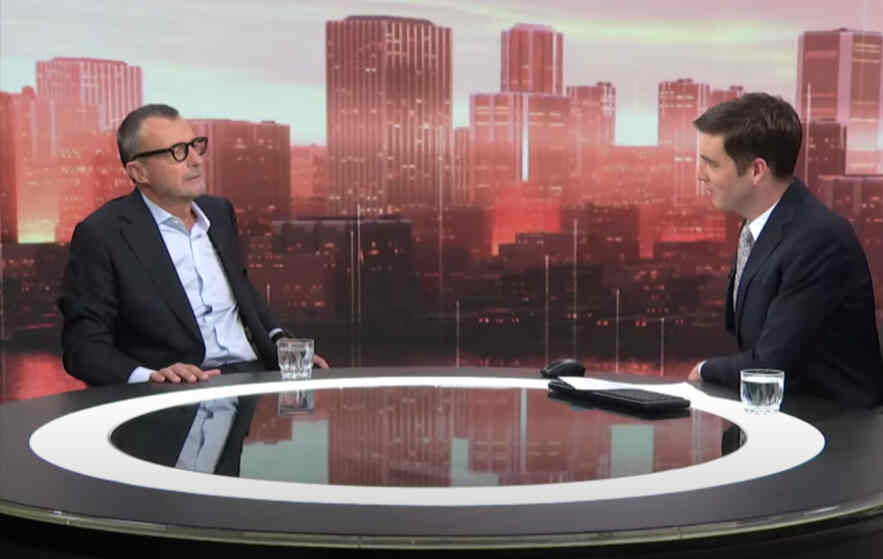
Read the full transcript of Pulitzer Prize-winning journalist Andrew Browne’s interview on Q+A with Jack Tame show titled “Tariff Wars: China ‘Completely Outplayed’ Trump On Trade”, July 20, 2025.
The Current State of US-China Relations
JACK TAME: What have you made of the US China relationship since President Trump took over the White House?
ANDREW BROWNE: Once again, it’s in a bad place and it suffers from enormous contradictions. The central contradiction is that at a high level, at a strategic level, there is an almost complete absence of trust. So each side thinks the very worst of the other side.
China thinks that the United States is out to throttle its development, kill its economy. The US thinks that China is out to expel the United States from Asia. So they’re competitors, they are rivals. In some ways, they are adversaries.
We had a Pentagon official in Australia the other day saying to the effect that we’d be lucky to get through to the 2030s without conflict with China. That’s Elbridge Colby, who is in charge of policy at the Pentagon. So that’s where we are at a strategic level.
And yet these two economies are joined at the hip. And that is what we have discovered from the two of them slugging it out in this trade war.
JACK TAME: How so?
China’s Strategic Victory in the Trade War
ANDREW BROWNE: So it starts off as a tariff war, and by the way, I think that China has completely outplayed the Trump administration on trade in this episode. It starts off with tariffs and Trump escalates. Starts off at 50% and then ratchets all the way up to 145%.
China – no country is supposed to hit back at this. You’re not supposed to take your revenge on the Trump administration. You’re supposed to suck it up. China didn’t. Went toe to toe, went up to 125%, which is more or less prohibitive. So now we have a mutual trade blockade.
And the US caved. They completely caved. So they went to Geneva, took off most of the tariffs, unwound, and we got back to roughly 30% – 20% fentanyl, 10% baseline plus legacy, 20%.
However, that wasn’t the worst of it. The worst of it was this supply chain war. And the US completely underestimated China on this one. So you had Scott Bessent, incredibly sophisticated investor, ran his own hedge fund in New York. He’s saying at the beginning of all this, “We have all the cards.” So if they export five times as much to us as we export to them, we’ve got the cards. He uses poker analogy. He said they’re sitting at the table and playing with a pair of twos.
JACK TAME: They might have all the cards, but they don’t have all the rare earths.
The Rare Earths Gambit
ANDREW BROWNE: Well, that’s exactly right. So they flip the cards, and it turns out that China’s got a couple of aces. And one of them, the most important one, is rare earths.
And so then they start hurling thunderbolts at each other. This is a war of the worlds. This is supply chain warfare. So China says, “Okay, we’re going to close down your defense sector.” And they can do that – they control the permanent magnets.
The US says, “Okay, fine, we’re going to stop the sale to China of jet engines. So we’re going to close down your entire civilian airliner program.”
China says, “Fine, we’ll close your auto industry down.” And actually, Ford had to close down a factory in Michigan because of batteries.
So this was far, far more consequential. Got to the point where both sides recoiled from this. It was going to do enormous damage both to their own economies and, of course, to the global economy, since the two of them combined are about 50% of global GDP.
That is where we are now. We are at a truce. Trump thinks he has a deal. Doesn’t have a deal at all. He has a truce.
JACK TAME: How do you see it playing out from here?
The Summit Question
ANDREW BROWNE: Well, Trump really wants a summit with Xi Jinping. He is desperate to get on a plane, go to China, sit down, man to man. He’s very deferential to these powerful global leaders – Putin in Russia, Xi Jinping. Last time around, he called Xi Jinping admiringly “the emperor of China.” So he thinks, “Okay, the two of us are going to sit down, we’re going to hash it all out.”
I don’t think this is the way the Chinese are going to play this at all. I mean, they’ve seen the video. They’ve seen the ritual humiliation of Zelensky – “You never said thank you once.” Ramaphosa from South Africa was in there. He had to suck it up – “Dim the lights. Let’s play this ludicrous video.”
Xi Jinping is not going to take that. He will not be humiliated in any way. His Sherpa is going to be out there. They’re going to have everything nailed down, buttoned down before the event. Very, very ceremonial.
But I do think we’re starting to see the beginnings of what might look like some kind of negotiated settlement. We saw part of that today with the decision to allow Nvidia chips, H20 chips, into China. The Trump administration had actually banned those chips. So there could be something to play for in terms of lifting some of the sanctions on technology in exchange for rare earths. But then again, that’s only getting back to the status quo.
The Wake-Up Call for the West
JACK TAME: If you put this in a kind of game theory context, you say that China has outplayed the US when it comes to the tariff dispute thus far. But is there an argument to be made that by playing the rare earths card and restricting the supply of rare earths, China has actually woken much of the so-called western world up to the supply chain issue you identify? So the Europeans and the Americans, for example, are saying, “Right, we have to move with immediacy to ensure that actually we aren’t reliant on the Chinese in the future for this rare earth supply.”
ANDREW BROWNE: You’re absolutely right.
And this is now kind of a warp speed moment for the United States and you’re going to see a lot of money going into the production of rare earths. You’re already starting to see rare earth magnets. But it takes time – this is not an overnight solution by any means.
The other problem that the US has is that you’re much better off if you want to go up against China doing it in a coalition with allies. And I don’t think that Trump or Bessent went into these talks understanding that Peter Navarro, who’s authored books on decoupling the economy, said that China’s industrial base is the United States plus Germany plus Japan plus South Korea and then some.
So it is literally the case that if part of the rationale for the tariffs is to reshore manufacturing to the United States, there is actually no re-industrialization of America without China. If Apple wanted to move its production of iPhones to the United States – if it was possible, which I don’t think it is – they would have to take Chinese-made equipment and machinery with them.
So it’s not just rare earths. China is a global manufacturing Goliath. America may be the financial superpower, China is the manufacturing superpower. And that gives it an incredible base on which to build the technologies of the future, where China is now running away with it in many areas.
China’s Pacific Ambitions
JACK TAME: I wonder if we can try and separate the economic and security dimensions for just a moment here. You have been observing China in one shape or another for much of your life. What do you make of China’s ambitions in the Pacific?
ANDREW BROWNE: Look, China is a maritime superpower. They have the world’s largest Navy, they have 50% of global shipbuilding capacity. I think they made 1,700 ships last year. The United States made like six, maybe it was seven.
They have gray hulls, they have white hulls, they have the militia fleet, the so-called dark fleets – these enormous deep sea trawlers. They’re steaming towards this part of the world. They’re coming for New Zealand’s backyard and they’re bringing other components of their national strength: cyber surveillance, spying, economic statecraft, diplomacy and so on. And they’re here. They want to expand their influence in this part of the world.
So to me it comes as absolutely no surprise to hear that New Zealand is going to double its defense expenditure from what really is extremely low – 1% to 2%. It wants to be a player in this. We saw it with these incidents – now they’re signaling their intentions in the Tasman Sea, firing off their guns, scattering New Zealand planes in the heavens and so on.
JACK TAME: So is New Zealand right to be concerned about Chinese ambitions in this region?
ANDREW BROWNE: Absolutely. China looks at this region and wants to control the sea lanes. It wants the minerals from the seabed, it wants the fisheries. And we’ve seen the playbook. I mean they drew a nine-dash line around the South China Sea – “It’s all ours” – in complete defiance of international maritime law, militarized the South China Sea, threw an ADIZ over the East China Sea, intimidating Taiwan with multiple sorties every day into Taiwan airspace and sea space.
And so yes, China is altering the status quo and it is completely understandable that New Zealand is standing up for itself.
The Reality of Defense Spending
JACK TAME: So what does 2% of New Zealand GDP do when it comes up against the world’s largest naval fleet? I mean, how is that possibly going to make a difference in any sort of strategic contest?
ANDREW BROWNE: Well, obviously 2% in New Zealand doesn’t, which is why it is imperative in this part of the world, as it is in Europe, to go in mob-handed. I mean, you have to have allies, you have friends and allies, but you also need to have a deterrent force.
If you look at countries in East Asia that are being most bullied by China, the Philippines is an example – it has almost no navy. It’s got a couple of old cutters, hand-me-down cutters from the US Coast Guard, a few World War II era ships. And what happens? The Chinese are building up these vast artificial islands, military installations on coral reefs that are right up against the beaches.
So yes, you need a deterrent and it’s not just for confronting the Chinese military. There’s all sorts of other aspects – disaster response, humanitarian, and so on and so forth. New Zealand needs to position itself and needs to have security, but also needs to be a security player in the region.
Balancing Trade and Security
JACK TAME: What about the balance between our economic interests and our security interests? As you well know, China is by some margin New Zealand’s largest trading partner. And how do you see the ambitions that you believe the Chinese have in this region affecting our trading relationship?
ANDREW BROWNE: I’ve never understood this trade-off. “We can’t offend China because we have a trading relationship with them.” This is the choice that China would like to impose on New Zealand and just about every other small or medium-sized country in the region.
So the deal is this: “Look, you’re our friend, and friends have benefits. We will open up our markets to your milk powder and your kiwi fruit and your beef and so on. But here’s the deal – you trade with us, you don’t get to criticize us. In fact, you don’t get to cross us in any way at all.”
And if you actually agree to that, then you have compromised your sovereignty, you’ve compromised your autonomy, you’ve sacrificed your principles – the principles that are dearest to New Zealand: democracy, respect for the rule of law, the institutions that underpin the rule of law, freedom of navigation, and so on and so forth.
So there are incredibly important principles at stake. Now, you don’t go around poking the dragon, you don’t go around deliberately provoking China. But you stand up for yourself and you do so with friends and with allies.
JACK TAME: Principles don’t feed hungry bellies.
ANDREW BROWNE: No, they don’t. But I don’t see that as a choice. China doesn’t import from New Zealand to do New Zealand a favor. China imports from New Zealand because it needs what New Zealand has to offer – good, great quality, high quality, safe food. Kiwi fruit, milk powder for the babies of China. And I think that is the way to frame this.
Now, of course, it does mean that you are in a vulnerable position and China has a lot of leverage. And we’ve seen what happened with Australia when Australia stood up against China.
Managing the Tension Going Forward
JACK TAME: So how should New Zealand think about that tension going forward? How should we try and manage that?
ANDREW BROWNE: Look, you have to play a very canny diplomatic game. You do have to be careful. But being careful doesn’t mean sacrificing cardinal principles that make you what you are.
And I think actually the smart approach that New Zealand is taking is to say, “Look, in a world that’s run amok, in a world that’s gone crazy, New Zealand stands for democracy. New Zealand is an island of stability, of tranquility.” That is how you sell yourself.
And of course, you do other things, as successive governments are trying to do. You diversify your export markets and so on. Although having said all that, there really is no escape from China. You have to deal with China.
China’s Belt and Road Initiative vs. Western Military Spending
JACK TAME: By some measures, the amount of money that China has invested in the Belt and Road initiative since the start of the century is equivalent to or even more than the amount of money that the US spent on wars in Afghanistan and Iraq. Are there things that Western observers perhaps still misunderstand about Xi Jinping’s vision for China and its place in the world?
ANDREW BROWNE: Yeah, they misunderstand this vision entirely. And look, nobody else is building bridges. I think China gets a bad rap when it comes to the Belt and Road. And this all starts with India with its analysts and he talks about debt trap diplomacy and so on and so on.
The debt trap diplomacy is actually a bit of a myth. China is supplying public goods to the world. Now in clean tech. America has just, by the way, walked out of the energy transition. If you’re in Africa, if you’re in Latin America, if you’re in the Middle East and you want clean tech, you’re going to go to China. Right?
So this is the way that China used to be in the Cold War. We were talking about war of hearts and minds. China is winning substantially that war of hearts and minds against the United States in the developing world. And it’s an important trend.
China’s Economic Vulnerabilities
JACK TAME: What makes China vulnerable? I think about the obvious economic slowdown. Youth unemployment is still putting forward some pretty eye watering figures domestically within China at the moment. Are there things that you think make China’s position in the world vulnerable going forward?
ANDREW BROWNE: Look at a macro level, China has problems. Okay, so you identified the key problems. The economy is slowing. A multi year real estate meltdown. Prices continue to drop. High quality real estate developers continue to face problems. High youth unemployment. This feeds into a real problem with consumer demand.
And this affects New Zealand. So you’re selling into the New Zealand, into the Chinese middle classes. Your core market in China is feeling a lot of economic pain, but China can take that pain. And this is another thing that the Trump administration didn’t really understand. Right.
So China is prepared to sacrifice growth, is prepared to write off whole provinces. Because its game now is focusing on technology. Xi Jinping believes that we’re at an inflection point. He calls it “an opportunity unseen in a century.” And that opportunity is to take on and win the tech war against the United States.
That is where he’s applying his resources. Whole of nation, public private partnerships, universities, bottomless supplies of state funding, enormously wasteful people focus on the waste, but also incredibly effective.
The US-China Technology Competition
JACK TAME: In trying to analyze the competition between the US and China in the tech space, I think maybe the mainstream wisdom has been that the US has dominated artificial intelligence, but that China’s well ahead when it comes to clean technologies. Is that right?
ANDREW BROWNE: Well, according to ASPI, China is ahead in 47 to 51 technologies that are going to make the 21st century. On AI, I was in China quite recently. In fact, I was there on April 2, Liberation Day, and people pretty much shrugged it off. And one of the reasons is that they’re getting their mojo back.
And part of that is DeepSeek, right? So this was a David and Goliath story, right? So all the big tech giants in Silicon Valley, they’re spending billions more on large language models. This little sort of plucky startup from Hangzhou comes along, operating out of a small apartment. They come up with a model that’s not bad. It was not quite as good as ChatGPT of the world, but gets the job done.
Everybody in America’s first reaction is, “Oh my God, they must have stolen it from us,” as per usual. But no, China has armies of engineers and they’re producing breakthroughs. And now you’ve got all these intelligent agents, these apps, and Manus is one of them. Everybody is on their phone playing with this.
The Chinese are great at adopting industry is great at adopting technology, and they’re now integrating this immediately into production. This has given them a fillip, given the markets in Hong Kong. By the way, people in China are now starting to reinvest in the Hong Kong market because they’re investing in their own tech companies that are listed there.
Press Freedom and Self-Censorship
JACK TAME: Personally speaking, how do you feel about the freedom that you might or might not have to criticize China? Do you ever feel like you have to self censor?
ANDREW BROWNE: Not really. I lived in China for many, many years. I wrote a column for the Wall Street Journal. I was pretty critical. I was critical of a lot of the things that Xi Jinping was doing. But since I’ve left that was in 2018, things have tightened up.
There are very few journalists left in China. They’re monitored, they’re surveyed. Very difficult to get information. It’s like the old days, it’s sort of back in the 80s, early 90s, you try to get an interview with a source and the source gets a call from the public security before you’ve even got the interview, and they back off.
So, yeah, it’s closing. People say that the United States is looking inward, China’s looking inward too.
Looking Ahead: The Century-Long Contest
JACK TAME: Finally, and I realize this might be a difficult ask, but can you shake the Magic 8 ball for us at the end of the century, when you think about the contest between the US and China, how do you see it sitting?
ANDREW BROWNE: So I think on the tech side, it’s all to play for. The US has deep capital markets, unmatched venture capital industry that funds a great deal of innovation. It gives the United States global power and respect. China is the manufacturing superpower, as said earlier. I think from that base, China now starts to develop technologies.
And we’ve seen in sector after sector, China is either catching up with the United States or has drawn level with the United States and in many cases is pulling away. I wouldn’t count the United States out. I wouldn’t count the innovation, the ingenuity of American tech companies. But neither would I dismiss the challenge from China.
They are very, very focused and they have a system which works extremely well for them. Everybody got that wrong. They all thought that the socialist market economy would collapse under its own contradictions, waste. So on a lot of contradictions and heaven knows there’s a lot of waste in the Chinese system, but they also have awesome capabilities.
JACK TAME: Well, thank you so much for your time. We really appreciate it. It’s great to have you in New Zealand once again.
ANDREW BROWNE: Great to be on your show. Thank you so much.
Related Posts