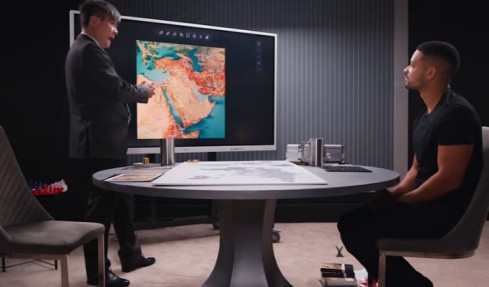
The following is the full transcript of geopolitical analyst Professor Jiang’s interview on The Diary Of A CEO Podcast, May 7, 2026.
Editor’s Notes: In this episode of The Diary Of A CEO, Steven Bartlett sits down with geopolitical analyst Professor Jiang to discuss the escalating tensions and potential for global conflict in 2026. The conversation explores bold predictions regarding a “forever war” with Iran, the implementation of a national draft in the United States, and the strategic maneuvers of the “American Empire” to maintain global dominance. By breaking down complex historical and economic concepts through a visual lens, the guest provides a provocative perspective on why the world may be heading toward World War III and what it means for the future of the global economy.
Professor Jiang’s 3 Predictions About World War III
STEVEN BARTLETT: Professor Jiang, there’s so much going on in the world at the moment that it’s quite confusing for an ordinary person like me. And you’ve blown up across the internet because you’ve been able to demystify all of this craziness, but also because in 2024, you made 3 predictions that have come perfectly true. Some might say unfortunately.
PROFESSOR JIANG: Unfortunately, yes.
STEVEN BARTLETT: What were those 3 predictions?
PROFESSOR JIANG: My first prediction was that Trump would win in November 2024. Second prediction is that he would start a war against Iran. And the third prediction is that the United States would lose this war, and in losing this war, this would radically reshape the geopolitical landscape.
STEVEN BARTLETT: How did you know that Trump would start a war with Iran?
PROFESSOR JIANG: The simple answer is this: the United States having invaded Iran because it has no choice in the matter. If it were not to invade Iran, it would lose its empire. Its empire is based purely on the US dollar, the petrodollar, which is a Ponzi scheme. If it did not invade Iran, then people would choose not to trade with it anymore. People would choose to not buy US Treasuries.
STEVEN BARTLETT: Why?
The Petrodollar System and Why It’s Under Threat
PROFESSOR JIANG: For the longest time, this system worked fine. But then in February 2022, Russia invaded Ukraine. That was not the issue. The issue was the American response. The American response was to sanction Russia and remove Russia from the SWIFT global payment system. It also ordered the Europeans to freeze over $200 billion in Russian assets.
And there’s a problem because the very basis for having the US dollar as the global reserve currency is that it would remain politically neutral. The Americans guaranteed seamless, politically neutral international exchange.
So if this trend continues, if you don’t do anything about Russia, Russia would take over Ukraine and Russia then would build an alliance with China and Iran. If you look at these three countries on a map, Russia, China, and Iran, this is the entire Asian continent. And then what they can do is this. They can say, “Okay, the United States is a bully. They force us to play by their rules. They get very angry if we don’t play by the rules. So let’s not play with the United States anymore. Let’s just trade amongst ourselves.”
And then what they can do is they can build a Eurasian railway system connecting Russia, Iran, and China together. And then what this would do is negate American sea power because it’s American ships that patrol and protect the oceans.
And then what happened is the world — Europe, Middle East, Africa, India, East Asia — would look at this trading bloc and think to themselves, “Wow, these guys, the Russians, Iranians, and Chinese, they use gold as their medium of exchange. Gold is valuable. The Americans, on the other hand, use US dollars as the medium of exchange, which is not valuable. So am I better off with the American system, or with this new BRICS system?”
STEVEN BARTLETT: What’s BRICS?
PROFESSOR JIANG: It’s an acronym. It stands for Brazil, Russia, India, South Africa, China.
STEVEN BARTLETT: So am I right in thinking because Iran, Russia, and China were colluding, it threatened U.S. dominance, which is driven by the world using the dollar as the primary currency for trading?
PROFESSOR JIANG: That’s correct.
STEVEN BARTLETT: Okay. So they felt they needed to invade because then they can control more of the Middle East.
Why the U.S. Attacked Iran: Energy and Empire
PROFESSOR JIANG: Right. So by attacking Iran, certain things happen. The first thing that happened is that China is now cut off from Middle East energy. China receives anywhere between 50 to 60% of its energy needs from the Middle East, not just Iran, but also Qatar and Saudi Arabia. A lot of people say that China today is reliant on renewables, solar, wind, and that’s true to a certain extent. But remember that China is an industrial powerhouse, so it needs energy from everywhere and everyone. So the fact that China is losing all this energy from the Middle East presents China with a long-term strategic vulnerability.
That’s the first thing that happens. Second thing that happens is that Europe is in a lot of trouble because, remember, because of Russia’s invasion of Ukraine, Russian energy was sanctioned. And so Europe relied more on the Middle East for its energy needs, especially Qatar. And now Europe has lost all of this oil. And then you have Japan and South Korea — these two powerful East Asian economies are also reliant on the Middle East for their energy.
So now the question is, if you’re not getting your energy from the Middle East, where can you get your energy from? And there’s only two answers: either Russia or the United States. Russia is at war, and what’s happening is the Ukrainian drones are attacking Russian oil refineries and export hubs. So the world in the short term has no choice but to look to America for its energy needs.
And what did Trump do recently?
Why the U.S. Is Losing the War With Iran
STEVEN BARTLETT: So as part of your prediction in 2024, you said that the US would lose this war. Why did you predict that the US will lose this war with Iran?
PROFESSOR JIANG: Because the American society does not have the political will, does not have the manufacturing capacity, does not have the risk tolerance to fight this war in Iran. Basically, America wants to fight this war as cheaply, as easily, and as quickly as possible.
So Trump really thought that if he sent his airplanes to strike Tehran and kill the Ayatollah, they would just surrender. That was literally his plan going into this war. He paid no attention to the culture. He paid no attention to the history of the Iranian people. He had absolutely no respect for the nation. And when you do that, when you disrespect your opponent, when you underestimate your opponent, when you yourself are not willing to commit to the fight, you’re going to lose.
STEVEN BARTLETT: So is Iran’s game just to draw this out as long as they possibly can? Because he’s taken out the leaders. And do you also think that Trump thought that if he just bombed the leader, then everything will sort of regenerate itself and we’ll be fine? What was the sort of fundamental misunderstanding?
PROFESSOR JIANG: There’s a lot of confusion as to how this war started. Even today, no one actually knows how this war started. But I think that Trump, given his personality, he was convinced that if he killed the leadership of Iran, then they would have no choice but to surrender. And his proof of concept was, of course, on January 3rd of this year, federal force went into Venezuela, kidnapped Maduro, and they completely surrendered. So in Trump’s mind, he wanted to replay the Venezuela scenario.
STEVEN BARTLETT: And he didn’t realize that Iran is fundamentally different from Venezuela.
PROFESSOR JIANG: The short answer is he is a reality TV star. He thinks in terms of optics. He doesn’t think in terms of geopolitical strategy. The long answer is that the American military has become a very corrupt and insular institution that is trying to generate as much congressional funding as possible in order to fund the military-industrial complex.
STEVEN BARTLETT: Did he think that if he bombed Iran, the people would rise up, they would elect a new government, and that would be that, and then he could control Iran?
PROFESSOR JIANG: That’s exactly what he thought. So what I want to do now is go to the map and show you what he got wrong.
STEVEN BARTLETT: Go ahead.
Iran’s Geography: Why It’s a Fortress
PROFESSOR JIANG: All right. So this is a map of the Middle East. And the first thing to notice about this map is the topography.
STEVEN BARTLETT: What does that mean?
PROFESSOR JIANG: How many mountains you have. So this is what’s really interesting — the topography between Iraq and Iran are completely different. And this is important because in 2003, the Americans invaded Iraq and they won the war in about 2 weeks. And the reason why they won the war is Americans practice something called Shock and Awe. The idea of Shock and Awe is that it is a military strategy that believes that if you cut off the head of the snake, the snake will die. The decapitation strike.
And so what they did was they went into Baghdad, seized Baghdad, and the regime collapsed and the war was over. And they were able to do this because of the topography. If you look at a map of Iraq, it’s all flat. It’s all desert, meaning that you can just fly in your planes, cut off the head of the snake, and the war is over. There’s actually no way you can defend against airstrikes because you’re entirely a desert.
Now let’s look at the topography of Iran. Iran is all mountainous. In fact, you can make the argument that Iran is a fortress. And so the first thing is that Iran can choose to fight a war of attrition.
STEVEN BARTLETT: What’s a war of attrition?
PROFESSOR JIANG: A war of attrition is a game of uncle.
STEVEN BARTLETT: What’s that?
PROFESSOR JIANG: A game of uncle is where we don’t have enough power to destroy each other, so what we try to do is we try to create pain points, leverage points to force you to submit, to cry uncle. So because Iran is too large and has 92 million people, it’s impossible for the Americans and Israelis to destroy Iran. So what you’re trying to do instead is bomb enough targets so that they recognize that resistance is futile and surrender. That’s the extent of the strategy.
But again, the problem with this is that, one, Iran is much too big. Number two is that it is a mountain fortress, which means that you can hide your weapons and your military inside mountains, which allows you to conduct a guerrilla warfare strategy against your opponent. And this is exactly what Iran is doing right now, where their underground missile bases are hidden inside the mountains, and then they’re able to strike targets throughout the Middle East, primarily American bases, but also energy installations that are key to the American petrodollar system.
And so it’s a game of uncle where the Americans are trying to create as much damage as possible in the Iranian nation. And Iran in response is trying to destroy as much of the global economy as possible to force the world to pressure America to call the war off. So that’s the situation we are facing right now.
The Strait of Hormuz: Iran’s Leverage Over the Global Economy
PROFESSOR JIANG: Second thing that Trump got wrong is how vulnerable the global economy is, because the Iranians control something called the Strait of Hormuz. And as you can see on this map, the Strait of Hormuz is a very, very narrow piece of land. It’s only about 33 kilometers across. You can actually swim across the Strait of Hormuz. And why this is important is the GCC exports 20% of the world’s energy.
STEVEN BARTLETT: The G — what?
PROFESSOR JIANG: The Gulf Cooperation Council. So the Gulf Cooperation Council are certain nations in the Middle East that align politically. They include Qatar, Saudi Arabia, the UAE, Oman, Bahrain, Kuwait. They’ve been exporting energy, but not just energy, but also a lot of byproducts of energy production, including fertilizer, to the world, primarily East Asia and India. In return, they’ve been getting food back.
So most people don’t appreciate this, but the GCC actually imports 89% of its food needs. And the reason why is that they have become so rich these past few decades that the populations have blown up. And as a result, they have to feed their population, but they don’t have agricultural resources. They also don’t have water resources. And so they have two major vulnerabilities, which is food and water. And they have a lot of desalination plants around the area.
STEVEN BARTLETT: What’s a desalination plant?
PROFESSOR JIANG: A desalination plant takes salt water from the seas and then through an electrochemical process turns it into portable water that people can use for drinking purposes and for agricultural purposes.
So as you can see, the entire area is extremely vulnerable to drone and missile attacks from Iran. So that’s the second thing that Iran has done, which Trump did not expect. He didn’t expect that the Iranians would close off the Strait of Hormuz. And how the Iranians were able to close off the Strait of Hormuz was just by threatening to attack any ships that wanted to cross it.
The reason why is that these ships depend on maritime insurance in order to operate, but if there’s a very high risk of being destroyed, then you will not be able to get insurance. So it’s not that the Iranians have said to these ships, “You can’t cross.” It’s just that the insurers refuse to allow these ships to cross because it’s too dangerous.
STEVEN BARTLETT: And Trump didn’t — you think they’d consider this before they started bombing Iran, that Iran would have some leverage in shutting down such a critical piece of water for shipping fertilizer, energy, etc.? You think that they would have known this, right?
America’s Strategy: The National Defense Strategy Explained
PROFESSOR JIANG: So that’s what a lot of people say, that Trump’s stupid, that Trump is hotheaded, that he was misled by the Israelis. And there’s good evidence to support this, but I want to show you something. It’s called the National Defense Strategy. And so this is a document that was published by the Department of War. And in it, it explains what the American strategy to maintain global dominance is.
And in the introduction, what it says is that for too long, America has been bullied by the world. America is a nation that protects the world, yet Europe, East Asia takes advantage of American generosity. The Europeans don’t pay for their defense, and so they put all this money into welfare, into their pension system. The Chinese have been giving America a bad trade deal. The Chinese steal American technology and then use it to make products that they sell back to the Americans. So the Americans have been getting a really bad deal for decades.
And President Donald Trump, he’s going to change that by doing 4 things. The National Defense Strategy calls for a 4-point program to put America first.
The first thing that America is going to do is going to secure the Western Hemisphere. Why? Because the Western Hemisphere belongs to the United States.
STEVEN BARTLETT: When you say the Western Hemisphere, what do you mean? What region is that? Canada as well?
PROFESSOR JIANG: And so if you look at the map, we can divide the map into the Eastern Hemisphere and the Western Hemisphere.
STEVEN BARTLETT: Okay, so everything over here.
PROFESSOR JIANG: Everything.
STEVEN BARTLETT: Mexico.
PROFESSOR JIANG: Including Greenland, including Canada, including Mexico. Every part of this area belongs to the United States. Therefore, you cannot trade with any of these countries without American permission, while paying a tribute to the Americans. And this is why the Americans have parked one-third of their naval assets in the Caribbean today. It’s to tell the Chinese and the Russians, back off. You want to come here, you either pay a tribute or you’ll be attacked.
That’s the first point of this strategy. The Western Hemisphere belongs to America. Something that they call the Don’t Roll Doctrine, which is Trump’s corollary to the Monroe Doctrine. And so that’s point one.
Point two is that America wants to reimagine its relationship with its allies. Basically, NATO needs to pay for its own defense. NATO needs to go fight Russia in Ukraine. America will provide support, it’ll provide weapons and financing, but NATO needs to do more work. And in East Asia, South Korea and Japan need to do a better job of keeping China in check. That’s point two.
Point three is specific to China. And the idea is the United States does not want to destroy China. The United States does not want to humiliate China, but China needs to be put in its place. China needs to respect the power and the reach of the United States. And how the United States is going to do this is by strangling China economically. So if you look at a map of China, most of its trade goes through something called the Strait of Malacca. And the Strait of Malacca is the most important maritime choke point in the world. All America has to do is park naval carriers inside the Strait of Malacca and China will lose 90% of its energy exports.
STEVEN BARTLETT: But if they parked them there, China would still go through, no?
PROFESSOR JIANG: No, because you have to go through the Strait of Malacca. So America has something called the First Island Chain. And the First Island Chain prevents China from reaching the Pacific Ocean. The First Island Chain includes South Korea, Japan, Taiwan, the Philippines, and Malaysia. That blocks China from reaching out into the Pacific.
STEVEN BARTLETT: Mm-hmm.
PROFESSOR JIANG: So in order for it to access trade, it has to go through the Strait of Malacca. And from the Strait of Malacca, it can access India, Africa, and the Middle East.
STEVEN BARTLETT: Okay.
PROFESSOR JIANG: And so by positioning naval carriers inside the Strait of Malacca, it creates a blockade, and China would have to pay a toll in order to access the Strait of Malacca.
STEVEN BARTLETT: And the fourth one?
PROFESSOR JIANG: And the fourth one is to rejuvenate, reinvigorate America’s defense manufacturing sector.
STEVEN BARTLETT: So supercharge the US defense industrial base.
PROFESSOR JIANG: That’s exactly correct. Yes. So what this means is that the Pentagon a few weeks ago went to Detroit and talked to Ford and General Motors and said, because of this war in Iran, we might need you to stop making cars and start making more munitions.
STEVEN BARTLETT: How do you know they said that?
PROFESSOR JIANG: It’s—
STEVEN BARTLETT: They published it.
PROFESSOR JIANG: They published it. Yes.
STEVEN BARTLETT: Really?
PROFESSOR JIANG: Yes.
STEVEN BARTLETT: So the United States went to Ford and GM and said, we might need you to start making weapons with your factories.
PROFESSOR JIANG: Yes. And they’re happy doing this because the profit margins are much greater for weapons than for cars. This is the Pentagon. So you can charge them as much as you want and they’ll pay for it. Whereas you make cars, it’s for the consumer market and they may not buy your cars. So if you’re Ford or General Motors, the best deal in the world is to go make weapons for the Pentagon to fight these wars in the Middle East that can go on forever.
So we have the situation where, if you read the news, if you talk to a lot of people, Trump’s an idiot and this war in Iran makes no sense at all. But then if you just read the National Defense Strategy, that is on the Department of War website, and anyone can go there and download it for free and read it themselves, it’s a very clear roadmap of what America needs to do in order to maintain imperial hegemony.
So let’s just summarize the major points. The first major point is to maintain control over the Western Hemisphere and create a Fortress America.
STEVEN BARTLETT: Which is why he invaded Venezuela and he says he’s going to invade Cuba.
PROFESSOR JIANG: Exactly.
STEVEN BARTLETT: And also Greenland.
The Divide and Rule Strategy
PROFESSOR JIANG: Look at all the countries that he’s named over the past year. Greenland, Canada, Mexico, Venezuela, Cuba, Colombia, Nicaragua, Honduras. It’s all the Western Hemisphere, and they’re all together.
The second point is to divide and rule all around the world. So imagine a situation where in Europe, NATO fights Russia in Ukraine. In East Asia, China fights South Korea and Japan. In the Middle East, Iran fights the GCC allied with Israel. What does America do? America can now sell everyone weapons and resources and finance it. This will be back to World War II.
STEVEN BARTLETT: But it makes them weaker as well.
PROFESSOR JIANG: Generally, that’s the point. And then what would happen is that $40 trillion that America has in debt, it would disappear because it would be absorbed by the world. So you can say Trump’s an idiot, but if you actually look at a map and how America wants this world map to play out, it makes perfect sense.
Is the War Going Well for Trump?
STEVEN BARTLETT: So the war is going well for Trump?
PROFESSOR JIANG: The war’s going very well for Trump.
STEVEN BARTLETT: Really?
PROFESSOR JIANG: Yes.
STEVEN BARTLETT: But you said in your prediction that he would lose the war, right? What’s your definition of lose the war?
PROFESSOR JIANG: Losing the war means that America would send ground troops, Iran would survive this ground invasion, and this would be so politically damaging that chaos breaks out in the United States and the US ground invasion is forced to retreat and the United States is forced to retreat from the Middle East.
STEVEN BARTLETT: And you still think that’s going to happen?
PROFESSOR JIANG: I still think that’s going to happen.
STEVEN BARTLETT: So you think the United States are going to put ground troops in, Iran are going to resist, and then chaos is going to break out in the United States?
PROFESSOR JIANG: Yes. So let me explain to you why ground troops has to be sent.
STEVEN BARTLETT: Okay.
The Three Phases of the War
PROFESSOR JIANG: So in phase one of this war, which started February 28th, which lasted for about 6 weeks, the intention was to decapitate the regime. And you do that by striking Tehran, and you do that by striking the military bases and installations throughout Iran. It’s what the Americans call shock and awe. And the point is to force Iranians to call uncle. But that’s not what happened.
STEVEN BARTLETT: To give up.
PROFESSOR JIANG: To give up, basically. Because what the Iranians did was they responded by attacking US bases throughout the GCC. They closed off the Strait of Hormuz, and they rallied their people. So rather than surrender, the Iranians basically doubled down. That’s phase two of the war.
Now we’ve gone to phase three of the war where Trump has basically decided that decapitation does not work. And so what Trump’s going to do is he’s going to impose a naval blockade on Iran. And so the question then is, if Trump understands that decapitation does not work, then using game theory—
STEVEN BARTLETT: What’s game theory?
Understanding Game Theory in Geopolitics
PROFESSOR JIANG: Game theory is the belief that the world is governed by rules and incentives. And once you understand the rules and incentives, you can predict how people behave because people will always behave according to their best interest. So in geopolitics, the nation states are individual players, and each nation state is trying to use its resources and its advantages in order to pressure other nation states to obey it.
So Trump recognizes that the Iranians have closed off the Strait of Hormuz, but not only that, the Iranians could also use the Strait of Hormuz to finance the war, meaning that now they’re forcing ships to pay a toll of $2 million in order to cross it. And so this is a huge advantage for the Iranians. And so Trump has said, “No, I’m going to blockade your blockade,” negating Iran’s advantage over the Strait of Hormuz.
So thinking about it again using game theory, I want to discuss what the Americans will do in order to force the Iranians to capitulate. I would say there’s a 3-point strategy.
The first strategy is economic strangulation. You basically destroy the state’s capacity to finance the war. And there are two ways that Iran is financing the war so far. The first is using oil exports. 90% of Iran’s oil goes to China. And this is Kharg Island — this little spot here is Kharg Island, and this is where Iran will export 90% of its oil overseas. That’s the first mechanism.
The second mechanism is the Strait of Hormuz, where the Iranians now can collect tolls. So what you have to do is you have to eliminate both of these finance mechanisms. You can close off both with a blockade. That’s strategy one.
Strategy two is you need to create as much chaos within Iran as possible. You want to turn this fortress into a prison. And the way you do that is by stirring up ethnic tensions in the country. So if you look at an ethnic map of Iran, what you’ll discover is that the Persian people are primarily in the middle of the country. But if you go to the borderlands, the border areas, it’s primarily ethnic minorities. And there are two ethnic minorities in the country that have always been problematic for the government.
The first problematic people are called Balochs, in southeast Iran by the Pakistani border. They have a history of insurgency against the government. The second people that have been problematic are the Kurds, who are primarily in the northwest of the country.
So if you are the US government, if you are the military, your strategy is to establish forward operating bases in these areas. A forward operating base is a spearhead of the military where you insert ground troops to hold an area.
STEVEN BARTLETT: Okay.
PROFESSOR JIANG: So in order to resupply, in order to push further into the territory.
STEVEN BARTLETT: Okay. So a forward operating base would be the US putting troops into the northwest and the southeast and then using that as a way to move forward into Iran?
The Strategy to Destabilize Iran
PROFESSOR JIANG: No, you don’t want to move forward into Iran because it’s too large. You don’t have enough forces to move into Iran. What you want to do is this: you want to establish forward operating bases in these areas in order to arm and train ethnic insurgents, that you can also finance as well. And you do this because you want to turn them into cannon fodder. You have to force a response from the Iranian military, right? So if they come in with the army in order to quell these rebellions, that’s great because now you can use your air power to decimate the Iranian military.
Your problem right now is the Iranian military is hiding inside mountains. And so you want to force them out in the open. And so you want to create as many points of tension in the country as possible to force the Iranian military to respond. Does that make sense?
And now your third strategy is to strangle the capital, Tehran, because that’s where the political elite are. So a city of 10 million people, and the way you strangle Tehran is you deny them 3 things. You deny them water, electricity, and food. So you attack power plants, you attack reservoirs, you attack railways that bring food into the capital. And when you do that, these 10 million people in Iran will now oppose the government and demand a political settlement because they need food, water, and electricity to survive.
Iran’s Divided Leadership
STEVEN BARTLETT: Is there a government right now? There’s debate as to the true extent of leadership in Iran because Trump’s recent interviews, he’s saying he’s claiming that the leadership in Iran are fighting themselves. But then he’s also saying in other interviews that there’s— they don’t even know who they’re dealing with.
PROFESSOR JIANG: Exactly. Iran has a very unusual political system in that it’s a theocracy. It’s a religious government. It’s run by clerics called the mullahs, in theory. And then there’s a parallel system, a state apparatus that actually takes care of day-to-day bureaucracy, and that’s secular. The mullahs control the morality of the country. They also control foreign affairs.
So basically, this is important because Iran has two parallel military structures. You have the military, but you also have the IRGC. The IRGC are only loyal to the mullahs, which is the religious power. So you have this divide in the country where the IRGC see this as a religious war, as a crusade to kill the Great Satan, and they want to fight to the death.
STEVEN BARTLETT: And the Great Satan is—
PROFESSOR JIANG: The Great Satan is the American Empire.
PROFESSOR JIANG: Which is the source of the misery that Iran has been suffering for the past few decades. And the IRGC, not only do they see America as the Great Satan, but they also see this as a global conflict because they have proxies that support their beliefs, including here in Lebanon, Hezbollah, including here in Yemen, the Houthis, and of course, in Palestine, Hamas.
And before, Syria was also part of their axis of resistance, but Syria has been toppled by the Americans and Israelis. So the IRGC see this as a religious crusade that is global in nature. The political leadership in Tehran sees it completely different. They see this as a conflict primarily between America and Iran. And they want to reach a political settlement as soon as possible.
And so in other words, these ceasefire negotiations, it’s really all for show because at the end of the day, even if the Americans gave the Iranians everything they wanted, the IRGC still controls the battlefield and they would not surrender or seek peace terms lightly.
The Mosaic Strategy: Iran’s Decentralized Military
PROFESSOR JIANG: Another problem in this situation is the IRGC practice something called the Mosaic strategy. The idea of the Mosaic strategy is, you know the Americans are the most effective military ever in human history. You know that they practice shock and awe, decapitation. So how do you respond to that? You respond to that using decentralization. 31 provinces in the country with their own command and control that is localized.
STEVEN BARTLETT: So basically they have 31 different armies that have their own leadership.
PROFESSOR JIANG: That’s correct. And when you do this, it’s a fight to the finish.
STEVEN BARTLETT: Why did they do that?
PROFESSOR JIANG: They did it because the Americans possess the most sophisticated surveillance technology in the world, meaning they can easily identify the leadership, and they can easily track you down and kill you. So the only way around that is to decentralize the leadership and spread around the country so that the Americans cannot kill everyone.
STEVEN BARTLETT: How does the central government orchestrate 31 different armies in Iran? How does it get a message out to them? I had Peter Hegseth make a comment in one of the interviews saying that it takes some time for the pigeons to get out to the armies. And what he was saying basically is that when the ceasefire was called and there was still some missiles flying, he was basically saying that’s just because it takes a long time to tell the 31 different armies to stop.
PROFESSOR JIANG: The reality is that given the Mosaic strategy, there’s actually no way to coordinate these 31 different military operations because the Mosaic strategy was meant to fight to the bitter end. You do not stop until you completely control the Middle East and the Americans have been forced out of the Middle East and Israel has been humbled.
So let’s go into the specifics of what the Mosaic strategy is. The idea is that they have an eschatology. Eschatology is an understanding of how the world should be and how we move towards this world. And for the Iranians, their eschatology is that Iran, in order to reach its true potential, needs to be master of the Muslim world. It needs to displace Saudi Arabia because Saudi Arabia is too aligned with the United States, which is the Great Satan. Mecca and Medina are under the influence of the Great Satan. Because why are there US military bases in Saudi Arabia?
So this war, from their perspective, it’s a great opportunity to overthrow the corrupt leadership of Saudi Arabia, but not only Saudi Arabia, but the entire GCC, overthrow the corrupt governments of the entire Muslim world. And install governments that put God, Allah, first.
STEVEN BARTLETT: So they’re not going to quit.
PROFESSOR JIANG: This war, once it starts, can only lead to World War III.
The Path to World War III
STEVEN BARTLETT: That’s a strong statement to make. As a probability.
PROFESSOR JIANG: Okay.
STEVEN BARTLETT: What probability would you assign to that claim?
PROFESSOR JIANG: I would put it pretty high. Anywhere between 80 to 90%.
STEVEN BARTLETT: So that’s certainty.
PROFESSOR JIANG: Basically, certainly, yes.
STEVEN BARTLETT: Explain to me how that happens.
PROFESSOR JIANG: So we need to step back and appreciate that there’s a global dynamic going on. And we need to appreciate the grand strategy of the different players involved. What I’m going to do is this, I’m going to explain to you how each nation sees itself in the world. And to do that, I’m going to use a chess set.
The Chess Set: Understanding Global Power Structures
PROFESSOR JIANG: This is the king. This is the political system of the United States, which is democracy. And there are certain strengths and weaknesses to a democracy. Democracy is vibrant, it’s creative, it’s flexible. But its ultimate weakness is polarization, where today the different political factions refuse to get along, and this may break out into civil war.
So the way you defeat the United States is not to conquer it. You can never conquer the United States. The way to defeat the United States is to force it into a civil war, which then kills the king.
STEVEN BARTLETT: To get its people to rise up against the leadership.
PROFESSOR JIANG: No, you want the Democrats and Republicans to form different factions and fight a civil war. You want to create so much political polarization, the different elite factions take up arms against each other.
So this is the political system, the democracy. Now let’s look at the queen. What’s the queen? The queen is what I refer to as the grand strategy of the United States, how the United States can maintain its control over the entire world. And the grand strategy, it’s already outlined in the National Defense Strategy: let’s create Fortress America and then create chaos throughout the entire world so that we can sell everyone weapons and resources. That’s a grand strategy.
Now once you have a grand strategy, you need to implement this grand strategy. So you need attack vectors. The attack vectors are the rook, the bishop, and the knight. So let’s go over the 3 major attack vectors of the United States. They are, first of all, America’s technological supremacy.
STEVEN BARTLETT: So these are basically the tools that they use to attack others.
PROFESSOR JIANG: Exactly, in order to achieve their grand strategy.
STEVEN BARTLETT: All right, so aero supremacy, which is the planes and the stuff like that.
PROFESSOR JIANG: Then you have the US dollar, because the US dollar allows you to finance everything and everyone wants the US dollar.
PROFESSOR JIANG: So that is the second attack vector. Now, the third attack vector is propaganda. The United States controls the world’s most powerful media, including the New York Times, CNN, and as such, they can control the narrative of the world. So these are the three major attack vectors.
Now they use the pawns. Pawns are weapons that they can sacrifice in order to achieve the grand strategy. And in the case of the United States, the pawns are the allies. Meaning, I hate to say this, but the UK, Europe, South Korea and Japan, and also the entire Western Hemisphere.
Russia’s Third Rome Strategy
PROFESSOR JIANG: The people who are most opposed to this grand strategy of the Americans are the Russians. So let’s go over the Russian system. In the Russian system, the king, the political system, it’s an autocracy. And an autocracy, it’s good because it allows for coordination, it allows for decisiveness, it allows for resolve.
STEVEN BARTLETT: Long-term thinking.
PROFESSOR JIANG: Exactly. That’s Putin. What’s bad is, if this guy dies, there’s a succession crisis. So basically once you topple the autocrat, then the system itself breaks down. So that’s the Russian system. For the Russians, the grand strategy is something called the Third Rome strategy.
STEVEN BARTLETT: The Third Rome strategy.
PROFESSOR JIANG: Yes. So the people in Russia believe that they are the true successors to the Roman Empire. And previously there were two Romes. It was the First Rome, then it moved to Constantinople. And Moscow is destined to be the Third Rome. And what makes Moscow interesting is that it wants to unite the entire Christian world under its leadership.
The main philosopher for the Third Rome strategy is Alexander Dugin, who in 1997 wrote a book called “Foundation of Geopolitics.” And what he said was this: if Russia is to defeat the Americans, it needs to build alliances throughout Eurasia in order to negate American sea power and air supremacy.
So what are the attack vectors for Russia? The first attack vector, the size of the country makes it almost invincible. So think about World War II, Operation Barbarossa, the Germans went into Russia with 6, 7 million men and it didn’t get very far. So the terrain is very important. The geography is very important. Then you have the Orthodox religion, which is meant to galvanize believers into supporting Russia. The third attack vector is artillery. So Russia has the best land army in the world. And we’re seeing that play out in Ukraine where a combination of Russian artillery and drones, it’s devastating the Ukrainian military in Ukraine.
The pawns for Russia are its soldiers. So Russia is able to sustain many, many casualties in its military. If you actually go and interview Russian soldiers, they are probably the bravest soldiers in the world. They are literally not afraid to die for what they believe in.
Israel’s Greater Israel Project
PROFESSOR JIANG: So this is the Russian Third Rome strategy. You can see how it conflicts with the Americans. Now we go to the Israelis. Jerusalem, the capital, it’s a mixed system, meaning it’s both democracy as well as a theocracy, and it’s good in that the Israelis are very creative, but the fundamental weakness is the division within society where Tel Aviv and Jerusalem don’t get along. So that is the political system of Israel.
The grand strategy of Israel is called the Greater Israel Project. So the Israelis believe that the entire Middle East belongs to them. From the Nile to the Euphrates, because that’s what it says in the Bible. This is what God, Yahweh, promised Abraham. So their intention is to conquer the entire Middle East, including Egypt, Saudi Arabia, Lebanon, even parts of Türkiye.
Now let’s look at the attack vectors for the Israelis. The first attack vector is Mossad. Mossad is the most powerful intelligence agency in the world in that it is able to infiltrate and undermine different political systems.
STEVEN BARTLETT: And Mossad, for anyone that doesn’t know, is their secret service, basically.
PROFESSOR JIANG: Yes.
STEVEN BARTLETT: Best spy system.
Iran’s Strategic Position and Russia’s Inevitable Involvement
PROFESSOR JIANG: Second attack vector for the Israelis is the Jewish diaspora because Jews do business everywhere around the world and Jewish businessmen work very closely with Mossad. And as such, they have influence in a lot of places that they shouldn’t have.
And the third attack vector is the Bible. Why? Because if you’re a Christian, and there are many Christians who believe this, you believe that the Jews are God’s chosen people. So if you look at what’s happening in the Middle East, all this conflict between Israel and Palestine, a lot of this conflict is being supported politically in the United States by a group of people called Christian Zionists. And these are Christians, they’re not Jews, they’re Christians. Who believe that Israel should achieve the Greater Israel Project because this is part of God’s plan.
And the pawns for the Israelis are basically everyone else, okay? So a lot of the hardware underpinning the global IT infrastructure is being controlled by the Israelis.
So now we go to the fourth player in this great game, and that’s Iran. So Iran, it is a theocracy. People are not afraid to die for what they believe in, in Iran. But the weakness is that it can alienate the majority of the population because only a minority are religious zealots in Iran. Most people just want to live, to live a decent life. So if they feel that these mullahs, the IRGC, are a threat to their peace and prosperity, then they might rise up against the mullahs.
STEVEN BARTLETT: Which is what we’ve seen over the years, right?
PROFESSOR JIANG: Exactly. So this is the political system of the Iranians. Their grand strategy is to unite the Muslim world under leadership. They have 3 attack vectors. The first attack vector are their proxies. Hezbollah, Hamas, and the Houthis. Another attack vector is their asymmetrical warfare, meaning using drones and missiles to create as much economic damage as possible. And the third attack vector is their geography or their topography. They are a fortress, so it’s almost impossible to invade them. That’s their Shia militiamen, these religious zealots who are not afraid to die. Many of them could be suicide bombers, okay? And so for them, this is a religious war, okay?
Mapping the Grand Strategy: The Current Battlefield
So now we’re seeing how this entire battlefield unfolds across the world. So I’ve mapped up the grand strategy of these different nation-states who will be involved in World War III. Let’s look at our present situation.
So what we have so far is that the Russians are occupied with their army in Ukraine. This is where their infantry, their artillery is based. At the same time, Russia has something called the Shadow Fleet, and these are about 1,000 tankers that evade sanctions around the world. And this is essentially their navy.
America is the most powerful military in the world. They have the most sophisticated air supremacy as well as control over the sea lanes. And it tries not to use infantry because that creates civilian casualties and that pisses everyone off in America.
The Israelis are essentially a mercenary army. Aligned with the American Empire, doing the bidding of the American Empire. It’s fighting against Lebanon as well as Iran. The Iranians, they don’t have much of an air force, but they use a lot of drones to threaten. So this is where we are so far.
According to the grand strategy, we can predict how they will make their moves over the next few months, over the next few years. America doesn’t really care about this war in Iraq because what America wants to do is force the entire world to become dependent on American weapons and resources. And you do that in two ways.
The first is you control the strategic choke points of the world, and they include the Strait of Hormuz. But you also want to control the Strait of Malacca because that blocks off East Asia. You also want to control the Panama Canal. You also want to control Greenland. You also want to control the Strait of Gibraltar. You can see the American Navy expanding outward and occupying all these maritime choke points.
At the same time, you want to use your technological supremacy, your aerial supremacy, your drones to destroy the world’s critical energy infrastructure. Already we’re seeing oil refineries being destroyed throughout the world.
STEVEN BARTLETT: Oil refineries.
America’s Energy Strategy and the Shadow Fleet Conflict
PROFESSOR JIANG: Oil refineries, yes. So you, as America, you’re trying to deplete the world’s energy inventory so they’re forced to beg you to supply energy, right? And once this market is created, then you can build infrastructure for Venezuela. You can take over Canada, you can control Mexico, you can take over Greenland, okay?
The Russians have no choice but to respond because if the Americans are controlling the strategic choke points, your shadow fleet is rendered redundant, useless. So how do you ship your oil around the world? Well, you have two options. I’m just going to build railways to unite the Eurasian continent, okay? And I’ll transport my oil using pipelines and railways. The problem with that is now that you’re vulnerable to American aerial supremacy, drone attacks.
So you have no choice but to arm your shadow fleet. And now what’s going to happen is this fighting in the oceans between Russian shadow fleet tankers that are trying to transport oil around the world and these American destroyers who are trying to capture or destroy these shadow tankers. Now, the advantage that Russia has is that America doesn’t have that much naval assets anymore. It used to, but not anymore. The other thing is that the world really needs energy. So you can imagine China financing the militarization of the Russian shadow fleet.
STEVEN BARTLETT: Why would— so why would the US try and stop Russian boats?
PROFESSOR JIANG: Because in this global outlook, there are two nations that could provide weapons and resources to the rest of the world. They are Russia and they are America. So America has become dominant. It needs to blockade Russia. And when you do that is by seizing their shadow fleet.
STEVEN BARTLETT: But if that happened, that would be an act of war.
PROFESSOR JIANG: But it’s already happening.
STEVEN BARTLETT: What, really?
PROFESSOR JIANG: Yes, it’s already happening. Where Iranian tankers have been seized by the Americans and tankers are being seized in the Caribbean as well by the American Navy.
STEVEN BARTLETT: Whose tankers?
PROFESSOR JIANG: I believe they are Russian tankers.
STEVEN BARTLETT: Yes, the United States has indeed been seizing tankers linked to Russia. A major escalation occurred earlier this year on January 7th, 2026, when the US military and Coast Guard intercepted two sanctioned Shadow Fleet oil tankers. While one was seized directly in the Caribbean, the other involved a dramatic chase that started in the Caribbean and ended in the North Atlantic. US forces captured this sanctioned tanker during a pre-dawn raid directly in the Caribbean Sea. The US military described it as a stateless sanctioned Dark Fleet vessel which was engaged in illicit activities. These seizures are part of Operation Southern Spear, a strict enforcement of the US embargo on Venezuelan oil exports. Both vessels were targeted for violating US sanctions by transporting illicit crude oil linked to Venezuela as well as Iran and Hezbollah.
PROFESSOR JIANG: And as you point out, this is an act of war.
STEVEN BARTLETT: So those were ships that didn’t have a country linked to them directly.
PROFESSOR JIANG: That’s why they’re called shadow fleet tankers.
STEVEN BARTLETT: Okay.
PROFESSOR JIANG: Yes. But they’re essentially Russian.
STEVEN BARTLETT: But they were essentially shipping oil outside of the United States that the United States wouldn’t control.
PROFESSOR JIANG: That is correct. Yes.
STEVEN BARTLETT: Okay.
STEVEN BARTLETT: So the US said, listen, this is our oil, get lost.
PROFESSOR JIANG: That is correct, yes. Right, so what the United States is doing is slowly expanding its global reach. And the way it’s doing that is by signing treaties with nations that are part of these choke points. So the Strait of Malacca, recently the United States has signed a military cooperation agreement with Indonesia. And with the Strait of Gibraltar, the Americans have signed an agreement now with Morocco, right? So they’re looking for the legal framework, justification to control the world’s choke points, which would bring them directly in conflict with the Russian shadow fleet.
STEVEN BARTLETT: So at some point you think the way that the war starts is the US Navy attacks a Russian boat.
Are We Already in World War III?
PROFESSOR JIANG: So I personally believe that this will be a drawn-out process, and there’s no real concrete flashpoint because not only are Russian shadow fleet tankers being seized. But remember, Russian oil refineries are being destroyed by Ukrainian drones. The Russians believe that it is NATO that is responsible for the sabotage.
STEVEN BARTLETT: So what do you think the catalyst moment is when this all kicks off?
PROFESSOR JIANG: I think we are already in the catalyst moment. I think we’re already in World War III because this conflict, it’s going to expand outwards into a global conflict. And there’s nothing anyone can do to stop this, right? Because again, you have these different competing visions of how the world should work. And the Russians and Americans are already at conflict with each other. So the next step will be the Russians come into this war on the side of the Iranians.
STEVEN BARTLETT: You think that’s going to happen?
PROFESSOR JIANG: I think that’s going to happen because according to Russian grand strategy, you have no choice but to save the Iranians because you’re trying to promote this view that the world is split between the spiritual and the material. The Americans are the Antichrist. Americans support individual hedonism, whereas we Russians, we believe in humanity, we believe in goodness, we believe in community.
So if that is your argument, if that’s your grand strategy, then you have a more obligation, a more imperative to help the Iranians in their time of need. And in fact, Prime Minister Arati of Iran has recently visited Putin in Moscow. Putin personally received him and said to Raisi, “We, the Russian people, admire your determination, your resolve against the Americans.” And I think that is a sign that Putin has entered the chat in that the Russians will start to help the Iranians as this war progresses. So let’s go back to this map.
STEVEN BARTLETT: Okay.
Russia and China’s Role in Defending Iran
PROFESSOR JIANG: And the Americans have a three-prong strategy to strangle Iran. The first is to use ground forces to establish forward operating bases to incite ethnic violence in the country. The second is to block offshore routes and cut off Iranian financing. The third is to strangle Iran and cause the people to rise up against the government.
And the Russians, so if things stay as they are now, America wins easily. But if Russia were to enter the war on behalf of Iranians, the first thing that Russia would do is provide Tehran with reinforcement from the Caspian Sea, right? Because the Americans want to knock out Tehran’s capacity to provide food, water, and electricity to its people. But through the Caspian Sea, the Russians can support the Iranians.
But not only that, and this is much more important, if the Russians were to come in, they could also bring the Chinese into the war on behalf of the Iranians. And the Chinese could use the Belt and Road Initiative, basically the railway system, to reinforce Tehran from the east. So now you can no longer strangle Tehran because the Russians and the Chinese are reinforcing Tehran.
Then what the Russians could do is provide financing to the Iranians. Basically the Chinese and the Russians can say to Iranians, “Don’t worry about financing. We will give you enough financing for you to continue this war for as long as you want. And we’ll use our resources as collateral for this financing, right?”
And the third thing, and this is actually the most important, is that Russia could put Iran under its nuclear umbrella, and this would negate the use of tactical nuclear weapons. The Israelis and the Americans, if they really felt under pressure, if they’re really put in a corner, they could always choose to use tactical nuclear weapons. If the Russians were involved, that negates that option, right?
So if the Russians get involved in this war, they bring the Chinese, they provide the resources and the financing to continue this war for as long as it takes, right? And now the Americans need to expand this war all around the world to try now to topple the government in Russia because the Russians are the main backers of the Iranians.
STEVEN BARTLETT: And you’re predicting that Russia will get involved here?
PROFESSOR JIANG: According to the grand strategy of Russia, the Russians have no choice but to get involved because what will happen is that if you look at this map, if Iran were to be conquered by the Americans or the Israelis, the entire southern flank of the Russians are now exposed to possible attack. And that’s something that the Russians would never allow to happen.
STEVEN BARTLETT: The sovereign flag. So this from underneath.
Iran’s Strategic Importance and Predictions for World War III
PROFESSOR JIANG: Basically, right? But not only that, but the Americans already have close relations with Azerbaijan and they already have bases in Turkmenistan as well as Uzbekistan, right? So you can see how once the Americans consolidate this area, they can now attack Russia from the south.
But what’s most important is the issue of global trade where a counter to America’s naval blockade is by creating a Eurasian trade bloc that involves Iran, Russia, and China. If you look at Russia’s North-South Corridor, it runs through Iran. If Russia wants to access the Middle East, as well as Africa, it has to go through Iran. Look at China’s Belt and Road Initiative, it goes through Iran as well. So by taking out Iran, you’ve blockaded both Russia and China.
Timeline of Events and Trump’s Third Term
STEVEN BARTLETT: So when do you think this is going to happen? If you were to give me a timeline of events you think are going to occur, what timeline do you think you’re operating under? I guess one of the factors here is that Trump only has, what, 3 years left in power. So he’s presumably going to leave power at some point soon. So if you’re Iran, you might just want to play it out and hope that there’s a different leadership in place by 2030?
PROFESSOR JIANG: The political leadership in Iran believe that they can wait Trump out. So they’re waiting for the midterms because they believe that in November, the Democrats will win the midterms and then they will impeach Trump and basically constrain his capacity to fight wars. And worst case scenario, Trump will be gone in 2028, as you point out.
There are certain problems with this. The first major problem is the National Defense Strategy, which we looked at previously. The National Defense Strategy is a long-term strategic framework for how America can control the world. And so one possibility is that Trump is just creating enough chaos for America to transition. When the Democrats come to power, if they come to power, they will institutionalize this strategy.
And we know this as a possibility because in Trump’s first term, he changed America’s strategy around the world. And then when Biden came into power, he then institutionalized the strategy via China, right? So it was Trump who launched this terror war against China, and then Biden comes into power and institutionalizes it, right? So I think World War III is a much more long-term war of attrition, and I don’t think that this war will end anytime soon.
STEVEN BARTLETT: You’ve made a series of new predictions. You’ve made 8 new predictions. Okay, I have them in this box here. I’ll let you reveal what those predictions are.
PROFESSOR JIANG: Okay, this is one prediction. Okay, so this is the most controversial prediction. I predict that there will be a US civil war and Trump will get a third term.
STEVEN BARTLETT: You think Trump will get a third term? Isn’t that constitutionally illegal?
PROFESSOR JIANG: There are things that are unconventional and immoral and wrong and evil and dangerous, and there are certain things that are illegal. Trump getting a third term is not illegal. So let me explain the loophole.
What Trump could do is this — there are two possibilities. The first possibility is in 2028, he has his son Don Jr. run as the president and he runs as the vice president. And then when Don Jr. wins, if he wins, then Don Jr. could abdicate and Trump would be the president. And in the Constitution, if you read it very carefully, it doesn’t actually prohibit people from doing that. It’s not been done in the past. And no sane person with any morality would do this, but that doesn’t stop Trump from doing this. That’s one possibility.
Another possibility is that by 2028, America is at war with everyone. There’s a national draft. The president now has emergency war powers, and so he can actually suspend the Constitution and delay the election, which is what Zelensky did in Ukraine. So these are two different possibilities, but I think that given Trump’s track record, given his personality, I think he very much wants a third term. And I think that he will do everything possible to get a third term.
STEVEN BARTLETT: He would turn 83 years old in the same year that he finishes his second term.
PROFESSOR JIANG: This is a man who eats McDonald’s hamburgers every day. He doesn’t really work out. Yet on the campaign trail, he’s able to go to 2 rallies a day, and in each rally, just 50,000 people, and he will talk on and on and on. Then at night, when he should be sleeping, he’s either on Truth Social, tweeting about the world, or he’s calling up reporters and telling him or her some confidential information that he really shouldn’t be discussing with the media.
This is a man who is addicted to attention. This is a man who loves the spotlight. He’s lived all his life in the spotlight. For him, death is to be ignored. So given his personality, he would rather die in office than live peacefully somewhere else.
STEVEN BARTLETT: And of those two strategies that you named — where he puts his son in and then becomes president that way, or there’s a war that breaks out so he says he has to stay in office — of those two strategies, which one do you think he’s more likely to deploy?
PROFESSOR JIANG: I actually think that given his narcissism, he would prefer the first strategy. He’s putting his son in because that shows himself to the world that America loves him.
STEVEN BARTLETT: Okay. And it could also be JD Vance or someone else, right? It doesn’t have to be his son necessarily.
PROFESSOR JIANG: Trump does not trust anyone. Trump has never had a protégé. In fact, everyone that’s really worked for Trump has been kind of screwed over by him.
STEVEN BARTLETT: Do you not think that if his son decided to run and then announced that the vice president was his dad, do you not think that there would be such a huge backlash in the United States that his son wouldn’t win?
PROFESSOR JIANG: Well, I think there’s a possibility that they figure out how to cheat in 2028.
STEVEN BARTLETT: Oh, as in actually cheat the election, right?
PROFESSOR JIANG: So at the polls, right? Let’s go into Trump’s mind — his psychology. In his mind, he won in 2020. The people voted for him, but the Democrats stole the election with mail-in ballots and by rigging the election machines. He literally believes that. So in his mind, he believes that this is actually his third term and the people and the government, they owe him a second term, which is what he wants now. He wants compensation for having the election stolen from him in 2020.
STEVEN BARTLETT: I find it really implausible to think that Trump would run for a third term.
PROFESSOR JIANG: So again, this is a prediction. And it is a test of the validity of my theoretical framework.
STEVEN BARTLETT: Yeah. I was looking at some of the constitutions and the laws, and it says that the 22nd Amendment explicitly states “no person shall be elected to the office of the president more than twice.” Some theorists have tried to argue that since the amendment says “elected,” a person might be able to serve a third term if they were appointed to succeed to the role. If they were appointed or succeeded to the role, e.g. by being vice president first. Legal scholars and the Judicial Committee almost universally reject this. The 12th Amendment requires that anyone serving as vice president must be eligible to be president. Since a two-term president is ineligible to be elected again, they are legally barred from being vice president.
PROFESSOR JIANG: So the point is, there’s nothing explicit in the Constitution that bars someone from having a third term. And there’s debate in the legal community about the spirit of the 22nd Amendment.
STEVEN BARTLETT: It would go to the Supreme Court, right?
PROFESSOR JIANG: And the Supreme Court is controlled right now by the conservatives. Trump appointed 3 of the 9 justices, and there’s a possibility he gets a 4th later in the year. So it’s entirely up to the Supreme Court whether or not he can run. And again, there’s nothing explicit in the Constitution that forbids him from running as a vice president.
Eight New Predictions for the Future
STEVEN BARTLETT: Okay. What’s your next prediction?
PROFESSOR JIANG: My second prediction is there will be a grand bargain between the United States and China.
STEVEN BARTLETT: What does that mean?
PROFESSOR JIANG: It means that people expect that the United States and China will go to war at some point over Taiwan. It means a lot of people expect that China wants to challenge American hegemony and replace America as the global superpower. But China does not want to do that. China is probably happy with America being the world hegemon because you have to invest so much of your resources into fighting these wars that back up your nation. China doesn’t want to fight these wars.
So what China is going to do is try to triangulate between Russia and the United States. This is what happened during the Cold War when China was not actually on the side of the Soviet Union. China was part of the non-aligned community. And that’s what China’s going to strive for in World War III, where China may help out Iran, may provide financing for Russia, but it’s also going to strike deals with the United States as well.
So I think that President Xi and Trump are supposed to meet at least 3 times, possibly 4 times this year. The first will be in mid-May in Beijing. And I think that they will start a process in which China and America come to an arrangement that benefits both economically.
What does America want? America wants China to continue to buy US treasuries in order to finance the American debt. What does China want? China wants energy and resources from the Western Hemisphere, and it wants to access the American market. So there’s no reason why China and America cannot come to an arrangement that benefits both. And Trump is very much a transactional character.
STEVEN BARTLETT: And what will that mean for the world?
PROFESSOR JIANG: It means that China is not really part of World War III in a meaningful way.
STEVEN BARTLETT: Okay, so they’re going to do a deal. They’ll continue to work together as friends.
PROFESSOR JIANG: China will be friends with both Russia and the United States as Russia and the United States fight each other.
STEVEN BARTLETT: Okay, what’s your next prediction?
PROFESSOR JIANG: Iran is another forever war and the United States will institute a national draft.
STEVEN BARTLETT: Iran is another forever war and the United States will institute a national draft. So you think Iran as a war is going to tumble on for decades and that the US are going to draft people, which means you’re obliged to go and fight.
The National Draft and AI Surveillance State
PROFESSOR JIANG: Exactly. Okay. So the logic is this: America doesn’t really care if Iran is defeated or not. That’s not really part of the American grand strategy. Iran right now, it’s a perfect pretext for America to expand outward and establish maritime choke points around the world and to force the world to buy American energy. So this war in Iran benefits America tremendously. So why not have it go on for a long, long time? In order to make sure this war goes on for a long time, you need ground troops and you need a lot of ground troops, and that’s why you need a national draft.
STEVEN BARTLETT: So what would a national draft look like in the United States? Everyone between the age of 18 and 25 has to sign up to the army.
PROFESSOR JIANG: Right. So most people don’t appreciate this, but America has always had a draft. But for the longest time, it didn’t really care whether or not you actually signed up for the draft. And starting in December, participation in the draft will be automatic, meaning that if you’re between 18 to 24 in America and you’re male, you’ll be automatically put into the draft system.
STEVEN BARTLETT: From when?
PROFESSOR JIANG: I think from December this year. Yes, that is correct. Yes.
STEVEN BARTLETT: So between the age of 18 and 25, you think? And what does that really mean? I’ve not really experienced that in my lifetime. So it means that if you’re between the age of 18 and 24, either gender?
PROFESSOR JIANG: No, male.
STEVEN BARTLETT: Male. Then you have to sign up for the army?
PROFESSOR JIANG: No, you’re already put into a draft.
STEVEN BARTLETT: Oh, you’re already— okay, but you might be called upon.
PROFESSOR JIANG: That’s right, it’s a lottery system. And this created a lot of backlash during the Vietnam era. And so they sort of toned it down. But starting in December, they just passed a law that says that starting in December, you will be automatically registered for military.
STEVEN BARTLETT: They’ve passed a law?
PROFESSOR JIANG: Yes, they have. Well, in theory, Congress first needs to declare war. That’s the first step. And Congress has not actually declared war yet.
STEVEN BARTLETT: So you think there’ll be a draft and you think this war in Iran is going to trickle on for a long time? How long? 10, 20 years? Like Afghanistan?
PROFESSOR JIANG: I don’t see it stopping.
Prediction: The AI Surveillance State
STEVEN BARTLETT: Okay. What’s next in your prediction box?
PROFESSOR JIANG: Okay. This is pretty bad. The world will move towards an AI surveillance state.
STEVEN BARTLETT: I feel like that’s already happening.
PROFESSOR JIANG: I think it’s pretty obvious.
STEVEN BARTLETT: What does that mean in reality for the average person? Because we’re seeing some of these big companies like OpenAI and Anthropic all sort of signing up to government, military surveillance projects. What does that mean for the average person?
PROFESSOR JIANG: Right, so for the average person, it means two things. It means digital ID and digital currency. What that will allow is for the government to basically monitor everything you do online and control all financial transactions. It can basically program your bank account so that you can’t buy cigarettes or you can’t buy drugs. And this will allow the government to basically categorize everyone and put everyone into a certain database to monitor that person. And once you’re able to categorize everyone, then you are able to use AI to predict their behavior.
STEVEN BARTLETT: Isn’t this what goes on in some parts of the world?
PROFESSOR JIANG: This is what goes on in China. And that’s how I know about this.
STEVEN BARTLETT: How does it work in China?
PROFESSOR JIANG: Well, in China, we all have digital ID. If you want to access anything in China, you need your digital ID. So if you want to open a bank account, you have to use a digital ID. If you want to use any e-payments, you have to use digital ID. If you want to use a phone, you have to use digital ID. So everyone’s part of this national database.
And then what this allows the government to do is basically monitor everything you do. Because basically depending on how you buy things, I can then extrapolate to figure out your behavior, and then I can figure out your thinking, and then I can create incentives in order to guide and control your behavior.
STEVEN BARTLETT: So in China, can they see everything that you do?
PROFESSOR JIANG: Yes, they can. Messages you send, everything, payments you make, everything, everything you do online is being recorded and it’s being inputted into the database to figure out who you are, what you want, and how to control you. And they think this is progress, by the way. This is progress because “I’m making you a better person. I’m helping you achieve your dream. I’m helping you lose weight. I’m helping you avoid drugs. I’m helping you work harder.”
STEVEN BARTLETT: Won’t you be in trouble if you talk against this system?
PROFESSOR JIANG: Well, me personally? I operate in a gray area where I do not interact with the Chinese internet. So everything I do is in English. It’s meant for consumption in the Western world. I don’t talk to Chinese reporters. I don’t talk to Chinese social media. I have no Chinese media presence. And I am not at all influential in China. And I prefer it that way because if I ever became famous in China, then they would obviously want to control me in order to better influence other people.
Prediction: The Greater Israel Project
STEVEN BARTLETT: Hmm. What’s your next prediction?
PROFESSOR JIANG: Israel will achieve the Greater Israel Project.
STEVEN BARTLETT: So you think Israel are going to conquer the Middle East?
PROFESSOR JIANG: Israel has essentially already conquered the Middle East. The only force in their way right now is America. So once America leaves the Middle East, which I expect to happen, then Israel will absorb CENTCOM, which is the Central Command, the American military bases in the Middle East, and they’ll achieve the Greater Israel Project. There’s no other power in the Middle East that can withstand the might and power of Israel.
STEVEN BARTLETT: And do you have a timeline for this?
PROFESSOR JIANG: The moment America quits this war against Iran, the moment that America leaves the Middle East, Israel will achieve the Greater Israel Project. And what’s really interesting right now is that Israel is trying to drag this war out for as long as possible. Basically, they see this war as a way to destroy all its major enemies in the Middle East. The Israelis have already said this. After Iran, Turkey is next. This war is already destroying Saudi Arabia and the GCC. So the last opponent is Turkey. Once Turkey is brought into this war, then Israel will achieve the Greater Israel Project.
STEVEN BARTLETT: And the Greater Israel Project covers all of this region here from Turkey, Egypt, Yemen, Oman.
PROFESSOR JIANG: So the Greater Israel Project is like this. It goes from the Nile in Egypt to the Euphrates in Iraq, and it covers part of Türkiye, of Syria, of Lebanon, of Jordan, and parts of Saudi Arabia, which also includes Mecca and Medina.
Prediction: NATO and Russia Fight for Odessa
STEVEN BARTLETT: What is your next prediction?
PROFESSOR JIANG: NATO and Russia will fight for Odessa.
STEVEN BARTLETT: Odessa? What’s Odessa?
PROFESSOR JIANG: Okay, so if you look at the Ukraine front lines right now, Russia is preoccupied in trying to control the Donbas, which is basically eastern Ukraine. Why Russia is doing this is that eastern Ukraine has historically been part of Russia, therefore most people there speak Russian or are ethnically Russian. The Donbas is also the agricultural industrial heartland of Ukraine.
So if Russia were to control eastern Ukraine, it doesn’t really need western Ukraine, and then western Ukraine would basically become a rump state. It’d be useless. So the last piece to this puzzle would be Odessa, which sits on the Black Sea. The reason why you want Odessa is that it’s the major port, and once you control Odessa, you basically block off Ukraine from the Black Sea. You have complete control over the Black Sea.
STEVEN BARTLETT: The Black Sea? Is that the Black Sea?
PROFESSOR JIANG: This is the Black Sea, and this is Odessa right here. Yes.
STEVEN BARTLETT: Okay, so you’re saying that Russia will take Odessa.
PROFESSOR JIANG: That’s correct.
STEVEN BARTLETT: Okay, so they’ll control the Black Sea.
PROFESSOR JIANG: That’s right. But NATO recognizes that if Odessa falls to the Russians, the war is over and Russia will have achieved all its major strategic objectives.
STEVEN BARTLETT: Why is the war over?
PROFESSOR JIANG: Because Russia doesn’t want to continue on after Odessa. That’s what it wants of Ukraine.
STEVEN BARTLETT: What does it get from taking Odessa?
PROFESSOR JIANG: Once it takes Odessa, control of one-third of the world’s carbohydrates. If Russia willed it, Africa would starve to death. The Middle East would starve.
STEVEN BARTLETT: Why?
PROFESSOR JIANG: Because Russia and Ukraine export a lot of grain to these places. These places are not food independent. They rely on fertilizer. They rely on food imports.
STEVEN BARTLETT: Okay. And Russia’s using the Black Sea here to export.
PROFESSOR JIANG: Exactly.
Prediction: East Asia Breaks Out Into Conflict
STEVEN BARTLETT: Okay. What is your next prediction?
PROFESSOR JIANG: This is the last one. Please be good. Okay. I was hoping for an optimistic one, but East Asia breaks out into conflict.
STEVEN BARTLETT: Okay. What do you mean by that?
PROFESSOR JIANG: Okay, so we’ve talked a lot about the Middle East and we’ve talked briefly about Europe. So now let’s go into East Asia. And I think there are 3 major sources of friction and conflict in East Asia, and these could be potentially major flashpoints.
The first flashpoint is, of course, over Taiwan, because China believes that Taiwan is part of its territory. And so it wants to take over Taiwan. Now, the problem with this is that recently Prime Minister Takeuchi of Japan has said that Taiwan is core to Japanese strategic interests. And what she means by this is that Japan has no resources. It’s a manufacturing power that depends on resources from overseas. If China were to take over Taiwan, it can now block Japan from accessing the Strait of Malacca. And that is a possibility Japan cannot permit. So Japan would fight to ensure that Taiwan and China were never to unify.
STEVEN BARTLETT: Would they actually? Because China’s so strong, right? Couldn’t they just— No, Japan straight out.
PROFESSOR JIANG: Japan has no choice but to fight because again, if China and Taiwan were to unify peacefully, Japan would be cut off from the entirety of Southeast Asia. And Japan relies on Southeast Asia historically for resources.
STEVEN BARTLETT: Why would it be cut off from Southeast Asia? Can’t it just go down here? Through the Philippines.
PROFESSOR JIANG: There’s a lot of resources around the South China Sea. Oil, minerals, all that. So if China and Taiwan were to unify, basically Japan would feel a bit threatened.
STEVEN BARTLETT: And your prediction is that there will be some kind of conflict in this region?
PROFESSOR JIANG: Yeah. So that’s the first flashpoint. Taiwan. There’s another flashpoint, which is the Strait of Malacca, because again, America wants to control the Strait of Malacca, but China recognizes that the Strait of Malacca is key to its economic survival. And so there’s a lot of conflict over the Strait of Malacca. That’s flashpoint number 2.
The third flashpoint, which I think will be the most surprising, but actually will be the most pressing, is North Korea. So let’s just use game theory. We are the supreme leader of North Korea. It is a dictatorship. Everyone worships me. It’s a cult of personality, but we’re poor and the rest of the world is in conflict. Europe is fighting with Russia. The Middle East is in flames. America’s distracted trying to control the world to the best of its ability. Japan and China are fighting over the South China Sea.
If you are North Korea, now is the best opportunity to create as much havoc in the world as possible. There’s absolutely nothing anyone can do to stop you. You are the brawler in high school that no one pays attention to, but because all the big boys are fighting each other, you can come in and dominate the school now.
STEVEN BARTLETT: Who would they be dominating?
PROFESSOR JIANG: They could dominate South Korea because if you just look at a population map of South Korea, most of the South Korean population is located in Seoul, and Seoul is about 20 minutes artillery from North Korea. So in 20 minutes, North Korea could rain artillery onto Seoul and basically in a day flatten the entire city. Why wouldn’t you extort the South Koreans?
STEVEN BARTLETT: Because the South Koreans are going to shoot back.
PROFESSOR JIANG: With what?
STEVEN BARTLETT: Do they not have military?
The Bronze Age Collapse and the Fall of the American Empire
PROFESSOR JIANG: They’re being protected by the Americans right now. And the Americans are busy transporting artillery and weapons systems, including the THAAD system, over to the Middle East. It’s called THAAD. T-H-A-A-D. It used to be in South Korea to protect against North Korea, and now it’s over in the Middle East. So Americans are cannibalizing both South Korea and Japan in order to maintain this war in the Middle East. Now’s the the time. Why not? It’s free money. It’s like taking candy from a baby.
STEVEN BARTLETT: But South Korea have their own military, no?
PROFESSOR JIANG: How do you defend against artillery strikes?
STEVEN BARTLETT: I don’t know.
PROFESSOR JIANG: You don’t.
STEVEN BARTLETT: But they would fire back, right? You’d get— they’d get themselves into a pretty ugly war. South Korea have a big military.
PROFESSOR JIANG: Well, my people are poor. They’re not afraid to die. In fact, I’ve sent thousands of them to go to Ukraine to fight for the Russians, and they fight to the death because they’re poor. And they don’t fight to the death if they’re allowed to be taken prisoner. I’ll kill their families back at home. South Koreans are rich. They are used to democracy. They’re used to individual rights. So if I threaten to blow your city up, you’re telling me you won’t bribe me not to do so? Isn’t the fastest, quickest way is to bribe me not to cause trouble for you?
STEVEN BARTLETT: Okay, so you think they’re going to bribe them?
PROFESSOR JIANG: Extortion. This is extortion. I don’t need to destroy South Korea. All I need to do is basically threaten the South Koreans. And they’ll just bribe me not to do anything.
What This Means for Ordinary People
STEVEN BARTLETT: So what does all of this stuff mean for the average person? People listening right now, they’re just normal people. A lot of them, not all of them, but a lot of them are just normal people getting on with their lives and they care about their families, their jobs, their futures. What message have you got for them?
PROFESSOR JIANG: In this new world, we will need leaders. We will need average people who are able to bring hope to people around them, who are able to tell their neighbors, their friends, “We have to come together as a community and become a family if we are to survive.”
That’s what the world needs in the future. It will need entrepreneurial leaders, it will need visionaries, it will need prophets. Those who will most thrive are those who make an effort to reach out, knock on the door of your neighbors and say, “Listen, there’s a blackout and there’s probably no water, but don’t fear because if we come together as a community, if we go and knock on everyone’s doors, then everyone in this apartment building — and there might be 100 of us — if we just sit down and have a meeting and just discuss what’s happening, one of us will come up with a solution and one of us will help everyone else figure out how to find water or how to build a better society.”
And we know this because historically this has always been true. When empires collapse, infrastructure collapses.
STEVEN BARTLETT: Which empire do you think is collapsing? The United States Empire?
PROFESSOR JIANG: The United States Empire is collapsing, yes.
STEVEN BARTLETT: And who is taking its place?
PROFESSOR JIANG: No one can take the place of the American Empire. So we live in a unipolar moment. And the closest historical analogy to today is something called the Bronze Age Collapse.
STEVEN BARTLETT: The Bronze Age?
PROFESSOR JIANG: The Bronze Age Collapse. And this happened about over 3,000 years ago. And what happened during the Bronze Age Collapse is that you have these established kingdoms throughout the Middle East and Europe. You have Mycenae in Greece, you had the Hittite Empire in Anatolia, which is present-day Turkey. You had the Mesopotamian Empire, you had the Egyptians. And one by one, they collapsed.
And the reason why was that a perfect storm of calamities came at the same time. There were earthquakes, there were famines, there was a climate crisis, there were wars, there were civil wars, there were revolutions. And so you had this massive surge of refugees called the Sea Peoples flowing from North and West Europe and sweeping the entire Middle East. And the reason why is they were hungry. They didn’t have any food to eat. So they organized into these large pirate armies and they overwhelmed entire civilizations.
And so we will see a very similar dynamic play out in the world where in the future our concern won’t be wars. Our concern will be these millions of refugees who want to flood into our societies because they’re hungry. And they’re going to come from Africa, they’re going to come from the Middle East, they’ll probably come from South America as well.
So I saw your show with Steve Keen, by the way. Yeah, it was a great show, right? And he talked about this where, look, the world depends on fertilizer and there’s 8 billion people in the world. Without fertilizers, the world can only sustain at most 2 billion people. Well, what are the 6 billion people going to do? Just starve to death? No, they’re going to migrate and they’re going to want food. And it’s going to create a huge global crisis throughout the world.
STEVEN BARTLETT: One might argue that with the rise of things like AI and robotics, the cost of production is going to drop and there’s going to be more — Elon talks about the age of abundance and all these kinds of things.
PROFESSOR JIANG: But you have to grow food out of the ground and you are using fertilizer to maximize the land’s capacity to grow food. So if you don’t have fertilizer, you can have as many robots as you want. They don’t have to eat food. We have to eat food.
Are You Hopeful?
STEVEN BARTLETT: So what is your — you talked about hopefulness, right? Are you hopeful?
PROFESSOR JIANG: I’m very hopeful.
STEVEN BARTLETT: What are you hopeful for?
PROFESSOR JIANG: I believe that humans are first and foremost creative and resilient, and our abilities have become dormant because we’ve become too complacent. Western lifestyle have made us extremely lazy and fat. But the moment we’re presented with a crisis, the moment that we find our families in danger, we’re able to come together as a people and come up with all this tremendous imagination in order to make a better society.
Plato’s Allegory of the Cave and the Nature of Reality
STEVEN BARTLETT: Professor, what’s the most important thing we haven’t talked about that we should have talked about?
PROFESSOR JIANG: So let’s talk about the nature of reality. To explain the nature of reality, I’m going to explain Plato’s Allegory of the Cave. Which he talked about in his book, The Republic, right? Exactly.
STEVEN BARTLETT: This book?
PROFESSOR JIANG: Yes, The Republic. One of the masterpieces of Greek civilization as well as Western civilization. So this is how Plato explains the nature of reality. And so he uses a metaphor called the cave.
So I want you to imagine a dark cavern that is huge. And in this cavern, there are hundreds of people lined up together and they’re all sitting in a row. And this goes on for miles and miles, just thousands of people. And they’re chained to the ground and their necks are shackled so they can’t actually move. And all they can do is stare in front of them at a giant wall that’s empty.
Now behind these people — and again, they can’t see behind them — there is a great fire. Alongside this fire are people. We don’t know who they are. Plato never explains who these people are. They take puppets and they project these puppets off the fire onto the wall. And when people see the shadows, they think that this is reality. And as such, they begin to create narratives to explain this reality. They create language, they give shadows names, they explain where these shadows come from, they create religion.
Then these people decide to specialize. So some people are priests, who explain this new religion. There are some people who are poets that talk about the beauty of the shadows. And then you have teachers who teach about the shadows to children. And then over time, what happens is that these people fall in love with this reality so that they are addicted to it. So if anyone comes along and says, “Hey guys, why don’t you look behind you and see it’s all just a farce?” — these people will be so angry that they kill this person.
Now, I’m not sure if you’ve ever watched a Korean drama. Have you watched a Korean TV drama?
STEVEN BARTLETT: Not really, no.
PROFESSOR JIANG: Unfortunately I have, and these things go on for like thousands of hours. And for the first 10 hours, you are disgusted by the plot because it makes no sense. But by sometime around the 20th hour, you can’t stop watching it.
The same situation here — it’s a silly television drama, it’s all fake. But once people watch too much of it, they want it to be true. And that’s the nature of reality that we live in.
So certain things to remember is that what creates this reality are not the people in charge. What creates this reality is our imagination. So the first thing to appreciate is that everything is a hallucination. And this is something that neuroscientists have confirmed.
So what we’re going to do is we’re going to take Plato’s Allegory of the Cave, the framework, and then apply it to our reality to understand how it’s created.
The Layers of Power and Control
PROFESSOR JIANG: In the first layer, you need a power, a force to put people in chains. And this is what we call the military-industrial complex of America, as well as the empire. So going back to this example, it’s the layer that puts the people into chains.
But now the second step is you need people to create the reality, to direct people’s attention, to create the game. And these people are the financial elite, the Bank of International Settlements based in Basel. So what do they do? These people are the ones who set the exchange currency rates.
And they also allow for seamless financial transactions — the SWIFT system, basically. Then Wall Street and the City of London were the financiers. And then you got the Federal Reserve, the Federal Reserve System, because the Federal Reserve are the people who print money.
Now, once you create the rules of the game, you need to create the game itself, which is the global economy. And obviously this is a pretty vast system that encompasses everything.
Now you have to explain to people how the global economy works. You cannot tell people, “Oh really, there are these secret people working behind the scenes that are projecting shadows onto a wall.” So what you do is you create multilateral organizations that pretend to control the global economy, and they are the World Bank, the United Nations, the WTO. You make people believe that this is all being controlled impartially for our benefit.
Now you have to convince people that this system is legitimate, that when you’re actually seeing the shadows on the wall, they’re real. And that’s why you need the media. That’s why you need culture such as Hollywood movies. And you need education, the school system. These are the people who are all prisoners who have become leaders of the prisoners and who are helping them understand the shadows on the wall.
STEVEN BARTLETT: So am I in the media?
PROFESSOR JIANG: Yes, you are.
STEVEN BARTLETT: Am I?
PROFESSOR JIANG: Yes.
STEVEN BARTLETT: So what am I doing? Am I one of the people in the fire controlling the narrative? Is that what—
PROFESSOR JIANG: Yes. Yes.
STEVEN BARTLETT: But I’m not owned by anybody.
PROFESSOR JIANG: That’s what you think.
STEVEN BARTLETT: Oh, really? Who am I owned by?
PROFESSOR JIANG: Ultimately, it’s the people who control the fire that are in charge. So ultimately, it’s these people, the second layer — the game masters, the financial elite — that control everything.
STEVEN BARTLETT: And the financial elite, again, are like the World Bank, you said?
PROFESSOR JIANG: No, no, the financial elite are these private bankers.
The Control of Money, Media, and the Collapse of Empires
STEVEN BARTLETT: Okay, so are the private bankers controlling me? Because you said I was in the media.
PROFESSOR JIANG: Do you want to make money?
STEVEN BARTLETT: Yeah.
PROFESSOR JIANG: Then they’re controlling you.
STEVEN BARTLETT: Okay.
PROFESSOR JIANG: Right.
STEVEN BARTLETT: How are they controlling me?
PROFESSOR JIANG: Because they control the creation of money. And so now that you have the media, the schools, and the cultural systems helping people understand the shadows on the wall, these shadows now become internalized and they dictate the values and norms of people, what they believe to be good and bad. They dictate habits and customs, how you live your life, and they dictate the legal system, who’s punished for what.
And this becomes the top edifice. And what’s amazing about the system is that in our minds, we believe that the system is first of all the complete opposite, where the foundation is actually the laws, the habits, and the values. When in fact, in reality, these are just figments of our imagination.
That’s point one. Point two is that this is a very, very delicate structure. So if anyone doesn’t cooperate, then this edifice collapses. It’s because it’s a very, very delicate system.
And the third thing, and this is the most important to understand the world that we live in, as the system becomes much more wobbly, meaning that young people don’t really believe in the shadows anymore. Young people grow up and say, “Hmm, are these shadows really real? They don’t feel real to me.” The system needs to become much more authoritarian. It needs to force people to believe what they refuse to believe, because everyone in the system is incentivized to ensure this edifice is stable.
STEVEN BARTLETT: Do you think this is somewhat linked to what’s going on with independent media?
PROFESSOR JIANG: Exactly.
STEVEN BARTLETT: Because independent media are asking a lot of questions about the way society functions.
PROFESSOR JIANG: Exactly. And that’s why we’re seeing governments becoming very worried about independent media. Because if you have people in the population saying these shadows are fake, this creates a ripple effect. It causes people to start questioning the shadows on the wall. You can’t have that. So that’s why it’s important to have censorship. That’s why it’s important to deplatform people. That’s why you have woke politics, DEI. It’s an enforcement mechanism.
STEVEN BARTLETT: It’s not easy being an independent podcaster if you have a big platform because you’re not always the most loved by the mainstream media and they’ll figure out how to eventually. But I think that’s very human actually. I think the incentives are quite understandable from a human perspective.
PROFESSOR JIANG: Look, if you look at the system, no one’s really in charge. And no one’s a villain. They just grew up in the system and everyone’s protecting their incentives.
STEVEN BARTLETT: That’s kind of what I mean. Human nature is to protect one’s incentives. And the media didn’t like Mark Zuckerberg and Facebook because 70%, 80% of ad revenue went to Google and Facebook. So they had a bit of a war. So I kind of get it. People are trying to protect what’s theirs and disruption causes people to panic a little bit. Makes sense.
PROFESSOR JIANG: But the problem is that over time, more and more young people are going to grow up and say, “I don’t see shadows. I’m pretty sure we’re being lied to.” In which case, this presents an opportunity to overthrow the system and create a new system. And this is why AI is important.
Believing in Stories: The Foundation of Society
STEVEN BARTLETT: But we currently believe in this structure. It’s really difficult, I think, for the average person listening now to accept the fact that they have believed a bunch of fundamental ideas and stories that everything they care about is sat upon. But if you’ve read the book Sapiens and understood that humans got here because we’ve had a remarkable ability to believe in stories that maybe the orangutan could not believe — it couldn’t believe in money and governments and religions and all these kinds of things — it makes perfect sense that there are really foundational stories we are accepting, and that’s what’s brought us here today.
That’s what keeps me from running out on the street without my clothes on or doing other illicit activities. I’m held in place by a set of stories that I’ve accepted, and they are stacked one upon the other to make me believe that everything I’m seeing and accepting is valid. But I guess the question becomes, am I okay with this reality?
PROFESSOR JIANG: And what’s stopping us from creating our own reality that benefits everyone?
STEVEN BARTLETT: Is that possible?
PROFESSOR JIANG: Well, in theory it’s possible, but as you point out, there are certain people who are happy with the system and want to maintain the system. And that’s why we’re going to wars around the world, because it’s not just a war between different nation states. It’s also a war for the fundamental nature of reality.
You have the bankers versus the tech bros — that’s what we’re seeing in the world right now. For the longest time Wall Street has controlled America. But now with the Trump revolution, you have Palantir, you have people like Larry Ellison, Peter Thiel, Sam Altman who want to create Operation Stargate, which gives them complete control over people’s imagination.
STEVEN BARTLETT: You can knock it over now.
PROFESSOR JIANG: And that thing will come down eventually because that is just the fundamental fact of human history. Everything, no matter how stable it seems in the beginning, it all comes crashing down eventually.
STEVEN BARTLETT: Eventually. Cyclically.
PROFESSOR JIANG: Yes.
The Decline of Empires and the American Twilight
STEVEN BARTLETT: Ray Dalio talks about the cycles through history and how sort of predictable they are and how frequent they are. Is there a frequency to the rise and fall of these perceived realities or empires as he calls it?
PROFESSOR JIANG: Yeah. So they say empires last around 200 years. And so we are now in a twilight of the American Empire. And what we know is that when empires decline, it’s always for the same reasons — too much debt, too much corruption, too much inequality. And we’re seeing that in America today.
And the other thing that we know is you can’t actually stop the decline of empires. Oswald Spengler, who is a German theoretician, argues that we are human beings and we have natural life cycles because we’re organisms. Well, societies are the same way, where empires will be born, they’ll rise, and they’ll die. And it’s a good thing because that’s what allows for constant human innovation.
STEVEN BARTLETT: Do you think that will happen in my lifetime? I’m 33 years old.
PROFESSOR JIANG: It may happen in everyone’s lifetime. It may happen in the next 5 to 10 years. We are seeing —
STEVEN BARTLETT: Do you think that’s going to happen in the next 5 or 10 years?
PROFESSOR JIANG: I think there’s a very strong possibility that the American Empire will collapse in the next 5 to 10 years because it is overstretched, it’s in too much debt, and it is really angering the entire world. It’s basically unifying the entire world against it right now.
STEVEN BARTLETT: And if that is to be the case, what would you give me as advice as a 33-year-old? What actions should I be thinking about taking now, based on what you know about history, to make sure that it’s not too bad for myself?
I guess I’m asking this question in light of you predicting that there might be a collapse of the Western or the American empire. And in such a scenario, I was wondering what it would look like to be an American. Is there a solution or a course of behavior one should take? If the US Empire does collapse, how does American life change or Western life change?
Hermetic Philosophy, Consciousness, and How to Live
PROFESSOR JIANG: Okay, so one theory that’s very important to understand is something called Hermetic philosophy. And Hermetic philosophy is what underpins Plato’s Allegory of the Cave. And Hermetic philosophy comes from Egypt. It has certain principles, but its main principle is that reality is energy — it’s vibrations. We think of it as material, but material is a consequence of energy.
So what this means is that reality is consciousness itself. Our thoughts are what’s real. Our bodies are just vehicles to experience the world around us, but they’re not real. When we die, our souls return to the source and we come back again. And we are here permanently in order to experience things we cannot experience in the spiritual world, because in the spiritual world, it’s not material.
STEVEN BARTLETT: Mm-hmm.
PROFESSOR JIANG: So what’s really important is to appreciate that every one of us is part of the source. And so if we think about the totality of things, we can only become despondent. We can only give up hope. But if we think about how individually we can become a better person and how we can impact the people around us, then that becomes reflected onto the reality itself, because we’re just part of God itself.
So the idea is: “As above, so below. As below, so above,” meaning that we are each and every one of us fractals of God. So if we choose to be a good person, this makes the world a better place. If we choose to be a bad person, it also makes the world a worse place.
So it’s not really about how can I stop these wars from happening, because you cannot. It’s not really about where can I put my money to generate more income, because that’s not going to happen. It’s really about: How do I live my life to the fullest? How do I become a much more creative individual that brings goodness to the people around me? If you do that, you’re changing the world every day for the better.
STEVEN BARTLETT: That’s a very nice message. And I agree. It’s really interesting — I’ve spoken to a couple of physicists now who say similar things regarding consciousness, and it really has stuck with me. A lot of things people say, sometimes because I learn so much doing this that I forget them. But this idea that we’re all part of the same consciousness — I think someone said to me, a physicist said to me, that it’s almost like consciousness divided into lots of little pieces so that —
PROFESSOR JIANG: That’s right, fractals.
STEVEN BARTLETT: Fractals. So that it could experience the world or view the world.
PROFESSOR JIANG: Exactly.
STEVEN BARTLETT: And I found that to be a really compelling idea. Weirdly, I was thinking about this the other day. I was in a European country and I was driving in a taxi and I looked out the window and you had all of these tourists just stood at the edge of the water or just looking up and looking around. And I just for a second thought of them as like little pieces of consciousness exploring the world, because they were looking up and looking around and looking at mountains and looking at the ocean and looking at the floor. And it dawned on me for a second that that might just be consciousness’s manifestation for sort of exploration. It’s a really interesting idea. I don’t necessarily know what it means, but it does create a lot of empathy.
PROFESSOR JIANG: So one area that you might want to explore is the Kabbalah.
STEVEN BARTLETT: What’s this Kabbalah thing?
The Kabbalah, the Tree of Life, and the Middle East
PROFESSOR JIANG: It’s what they call the Tree of Life. And in the Tree of Life, what it’s trying to say is that there is a certain dynamic in the world that governs all human affairs. This dynamic is thesis, antithesis, synthesis.
So God is the will to bestow, creates Adam Kadmon, who is the will to receive, and then Kadmon has to abandon God, thus destroying the world. But eventually, because the world is destroyed, Adam Kadmon and his descendants — us — recognize the folly of our ways and beg God for forgiveness. And this will redeem the world, repair the world.
And if you think about it, this is what underpins a lot of actions that are happening in the Middle East, where the Israelis are doing what they’re doing because they’re trying to force the hand of God. Meaning that if Israel is committing all these atrocities in the Middle East, it’s creating all these wars, eventually the world will have to punish the Israelis. There’ll be war between the world and Israel, and Israel will be humbled. But once Israel is humbled, everyone in Israel recognizes the folly of his or her arrogance and hubris, and then will beg God for forgiveness. And once that moment happens — when all people in Israel at the same time beg God for deliverance and for forgiveness — the world will end and we’ll return to paradise. That’s literally what they believe. Fascinating.
Closing Reflections
STEVEN BARTLETT: We’re going to have to stop there, Professor. We have a closing tradition where the last guest leaves a question for the next guest, not knowing who they’re leaving it for. And the question left for you is, who will you miss the most and why?
PROFESSOR JIANG: Well, I will miss my wife the most because I met my wife about 10 years ago, and this was a time in my life when I had hit rock bottom. I went to Yale, and so I have a very elevated sense of myself and my abilities. And so I went into the world thinking that I would conquer it. And after decades of failure, I basically became very depressed.
STEVEN BARTLETT: Failure.
PROFESSOR JIANG: Yes. Meaning I didn’t have a job, meaning I didn’t have much income, meaning I didn’t have much hope in my life. And so I was working as a teacher and then through a mutual acquaintance, I met my wife.
And I think that it was because I became so depressed that my heart, I begged for relief. I begged God, even though I don’t believe in God, for salvation and redemption. And my wife came as an angel. And what she did that no one else did before was she loved me unconditionally. She was kind to me. She told me to believe in myself. And she proved it by making the ultimate sacrifice and having a child with me.
It’s one thing for someone to say, “I believe in you. I love you.” But it’s another thing to have a child with that person. And so that changed me totally. And I said to myself, I can’t despair anymore. I have to work hard. I have to provide for my family.
And at this time I was thinking that maybe I could help certain students go to Yale. In China, consulting is a huge business where if you help package a kid and you get into Yale, you get about $1 million. That’s a lot of money, right? And she told me, “You can’t do that. You have to be true to yourself and you have to be true to our son. Set a good example for him.”
And so what happened was that I got a job as a high school teacher, and then I started to make these YouTube videos, and then it blew up online. And this was not something that we expected. This was not something that we planned for. It just happened organically.
So it was my wife, just by saying, “I love you” to me, and I knew it to be true because we had a child together. We started a family together. By loving me unconditionally, by being kind to me, it changed me forever. And that’s what empowered me to want to share myself with other people as well.
And so I don’t know how I will ever thank my wife. I’m forever grateful for her. And before I didn’t really mind leaving this world, but I don’t want to leave this world anymore because I don’t want to separate from her.
The YouTube Journey
STEVEN BARTLETT: Could you have expected that you’d have the success you’ve had online? You’ve got to what, 2, almost 2.5 million subscribers on YouTube alone, getting millions and millions and millions of views on your videos. Some of your videos have almost 10 million views on various channels that you’ve been on. You’ve only made 146 of these videos and your channel has grown immensely. Could you have imagined?
PROFESSOR JIANG: I did.
STEVEN BARTLETT: You did imagine?
PROFESSOR JIANG: Yes.
STEVEN BARTLETT: You thought it would go like this?
PROFESSOR JIANG: Not this big, but I imagined I would find people who believe in what I was doing and would be inspired by what I was doing. And I knew this because when I met my wife and I fell in love for the first time, when we love each other unconditionally, my imagination started to open up. I could see and feel things that were not available to me before. And it was as though I became much more connected to the source. I became much more connected to the universe. And the universe was giving me insights as to how to proceed.
And so I had one day an inspiration. Let me start a YouTube channel and let me make predictions and see where it goes. Because if I’m right, then I would be pretty famous. If I’m wrong, then I’m an idiot. But what gave me the courage to imagine all this was again, the love of my wife. So that’s why I say kindness and love. So I did imagine this, but not to the extent that my YouTube channel has blown up.
STEVEN BARTLETT: You’ve only been doing it about a year. I don’t think I’ve ever seen someone get 2.5 million subscribers in a year, especially making geopolitics and history videos in a year. That’s crazy.
PROFESSOR JIANG: But I will tell you this, it has not changed me because being with my wife, having a family, I know my mission is to share myself with others. So I could easily create a media education company like Jordan Peterson and start my own university. I don’t want to do that. I want to share myself with others. I want to constantly learn. I want to constantly ask questions. I want to be open-minded. I want to be brave for my wife and my family.
So yes, I did succeed. And I thank the universe for letting me succeed. And I thank most of all the fact that I succeeded at an age and at a time when I can focus on a mission and ignore the fame, the wealth, the status.
STEVEN BARTLETT: Are you happy?
PROFESSOR JIANG: I’m very happy with my family because it’s my wife and my children who bring me tremendous happiness. In the world, the YouTube channel, if they close it down tomorrow, and they might, I wouldn’t be at all unhappy because I can just go and create more videos. What matters is the source of my creativity, which is the love I have for my family.
Final Words
STEVEN BARTLETT: That is beautiful. Really beautiful. It’s really self-evident the value you’re giving to people because the amount of people that showed up in my comment section and demanded that you come here was staggering. In fact, that’s actually how I learned about you — I just saw your name so much in the comment section. So I was like, who’s this guy? And I went on YouTube and looked around, and then I found these videos, and then I got served them because I clicked on them. And then I went down the rabbit hole like everything else.
PROFESSOR JIANG: Just to warn you, I am a polarizing figure. So some people really love me, but some people also really, really—
STEVEN BARTLETT: It doesn’t matter. Listen, I sit here with people really regardless of that stuff. And I think that’s important and quite rare. So I’ve sat with Kamala Harris or Ivanka Trump or Gavin Newsom or Michelle Obama. And for me it’s really about the pursuit of truth rather than being captured too much by all the blocks that we have on the table.
So thank you for doing what you do because you’re demystifying and you’re giving a perspective to the world. And I think one of the things you do that really has compelled people is you’re able to break things down in visual ways that allow people like me who aren’t the best when it comes to books and textbooks, and weren’t necessarily very good in school, to understand concepts in a simpler way and really to bring them to life in ways that make them actionable and relevant to our lives. And so long may you carry on doing that.
PROFESSOR JIANG: And that’s a central message that I hope people understand. Everyone has the capacity to learn the truth for himself or herself. It’s only a question of desire and will.
STEVEN BARTLETT: Thank you.
PROFESSOR JIANG: Thank you.
Related Posts
- Transcript: Trump Remarks At Mack Trucks factory In Macungie, PA
- TRIGGERnometry: Dr David Starkey Interview (Transcript)
- Tucker Carlson Show: JD Hall Interview (Transcript)
- Transcript of John Kiriakou’s Interview: Mehdi Unfiltered
- Transcript of Nathan Apffel’s Interview: Tucker Carlson Show – June 19, 2026