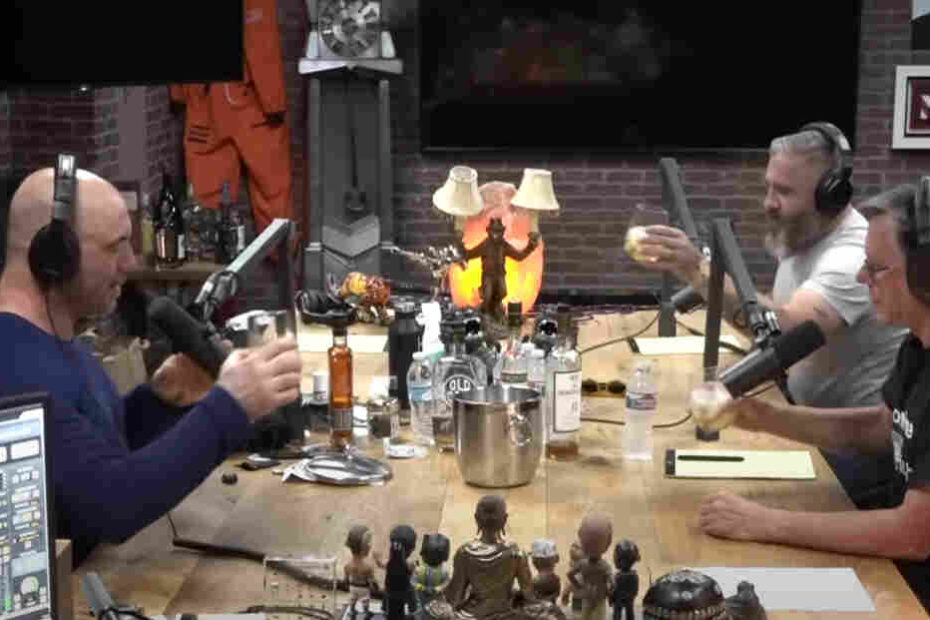
Read the full transcript of physicist Bob Lazar’s interview on Joe Rogan Experience Podcast #1315, along with contemporary artist and documentary filmmaker Jeremy Corbell, June 21, 2019.
The Interview Begins
JOE ROGAN: Two, one, boom. And we’re live. First of all, cheers, gentlemen. Let’s have a little toast. Relax.
Bob, thank you very much for doing this. I really appreciate it. I understand that you’ve told the story many, many times. You’ve been grilled many, many times, and it’s very stressful for you. So I really, really appreciate your time.
For people who don’t know the story, there is a documentary. Jeremy Corbell has a documentary out right now. It’s called Bob Area 51 in UFOs and flying saucers.
JEREMY CORBELL: Bob Lazar, Area 51 and flying saucers.
JOE ROGAN: I first heard your story decades ago. I told you last night. We went out to dinner. I’ve seen pretty much every interview you’ve ever given. I’ve followed the story incredibly closely.
But for people who don’t know the story, let’s give them the bullet points. You used to work at Area 51. In Area 51, you went like, well.
Clarifying the Location
BOB LAZAR: You know, we want to be accurate. Area S4. S4, it’s about 15 miles south of Area 51.
JOE ROGAN: Okay. You worked in. How would you describe it?
BOB LAZAR: I guess within the Area 51 compound, you can call that a subset of Area 51.
JOE ROGAN: And you got that job. Before that, you were working.
BOB LAZAR: Before that, I had worked at Los Alamos National Labs in New Mexico.
JOE ROGAN: And you were involved in what kind of work?
BOB LAZAR: Nuclear weapon development, physics. I mean, they do everything there.
The Path to Area 51
JOE ROGAN: So how do they approach you to say, hey, Bob, why don’t you come on out to the Nevada desert?
BOB LAZAR: Well, the way this went down was at that time, it was 1982. I put a jet engine in my Honda and Los Alamos put it on the front page of the paper, said, you know, Los Alamos man, physicist at the lab, you know, built this 200 mile an hour Honda jet car that I drove to work every day.
So I was known in Los Alamos, the guy with the weird car. And, you know, you could hear it from, you know, a mile away.
Anyway, the day that came out on the front page of the paper was the day Edward Teller, the father of the hydrogen bomb, was giving a lecture down there at the lab. And we didn’t have much going on that day in our group. And I asked if I could go down there.
And I went down there early, and Ed Teller was outside leaning on a brick wall there and reading the front page of the paper. Now, this is a guy out of history. So I introduced myself. Hey, I’m the guy you’re reading about. There and we talked for a little while and it was cool.
Fast forward to years later. I had moved out to Las Vegas and had left Los Alamos and went on to other things. And I wanted to get back into the scientific community. I left, start other businesses and that sort of thing.
So I sent resumes out and one of them went out to Ed Teller and referenced our meeting, you know, back in the day. And anyway, he remembered me and gave me a reference, somebody to contact at EG&G. And that’s pretty much how it started.
The Interview Process
JOE ROGAN: So you get a phone call or a letter. What do you get?
BOB LAZAR: Well, I got a. What did I get? I got a letter initially and went down for an interview probably a couple times. And it was down at EG&G Special Projects, which was at McCarran Airport at that time out in Las Vegas.
JOE ROGAN: And did they give you any sort of job description, what you were applying for?
BOB LAZAR: They said it was for. I can’t remember exactly what they did. This was a long time ago, but I think it was advanced propulsion or something like that, something relatively generic.
And they said it’s in a remote area, you know, it’s going to be some days on, some days off. And you know, it was kind of a. It was kind of not exactly a full time job, but you might have to be out there for two weeks at a time and take two weeks off. So it was kind of a. The work schedule would be kind of broken up.
JOE ROGAN: And did this seem attractive to you or did it seem weird?
BOB LAZAR: No, it really wasn’t weird because people that work at the test site, anybody that’s familiar with the area up there, you know, working at the nuclear test site or at the Tonopah test range north of there, that’s typically how things go.
JOE ROGAN: So you had known about it from the scientific community because Area 51 at that time was.
BOB LAZAR: No, they didn’t say anything about Area 51.
JOE ROGAN: Okay.
BOB LAZAR: So they, they just said it was in a, you know, in a remote location and you just know it was up at the test site.
JOE ROGAN: Right.
BOB LAZAR: So. But there was no mention of Area 51 at that time.
The Nevada Test Site
JOE ROGAN: So they’ve done hundreds of nuclear tests in Nevada. That whole area was. There’s been giant chunks of Nevada that people.
BOB LAZAR: Yeah, there’s a big piece of Nevada and it’s split up into different areas. There’s a nuclear test site, there’s Area 51, there’s the Tonopah test range north of that. There’s little sub areas, there’s areas where they test chemical weapons and things like that.
First Day on the Job
JOE ROGAN: So take me back to first day on the job. You accept a job, they take you out there.
BOB LAZAR: Yeah, it’s the first day, really. I didn’t really get to see a whole lot. The first day was essentially just paperwork. That’s when I flew into Area 51 proper and I left McCarran Airport and flew what they call the Janet flights, just, you know, a passenger plane from Las Vegas to Area 51.
And it was really just going through a mountain of paperwork that day, from security clearances to God. There was. It was like two or three hours of just solid paperwork. And that was. That was really an uneventful first day.
When Things Got Weird
JOE ROGAN: When did things get weird? When did you realize that? At what point in time did you say, hey, this is not normal work? This doesn’t even seem like it’s from this planet?
BOB LAZAR: I can’t tell you what day that occurred on because so much time has gone by, the days have kind of fused into one, and I can’t separate the days.
JOE ROGAN: Was it a slow burn or was there a moment of recognition?
BOB LAZAR: Well, the first inkling I had was when I came in. There’s this facility that is at S4. It’s in the side of a mountain. And normally we had pulled in with the bus and gone around the front through a normal double door.
This time that I went in, there were hangar doors open. I went in through the hangar door, and in the hangar door was the disk, the flying saucer that I worked on. I saw it sitting there, and we walked by it. It had a little American flag stuck on the side.
And I thought, oh, my God, this finally explains all the flying saucer stories. This is just an advanced fighter, and this is hilarious. So I went by, I slid my hand alongside it. I got reprimanded immediately for touching the thing.
And there was a guy, an armed guard that followed us in and just said, “Keep your eyes forward and your hands at your side and just walk in the door.”
So that was the first time I had seen anything that was weird.
It was sometime later that I was introduced to my lab partner, Barry. And we had some of the sub components of the craft in the lab. And Barry was very anxious to get a new lab partner. So he was very talkative and couldn’t wait to show me different things.
And it was in the demonstration of the reactor working where it caught my attention to where this is technology that doesn’t even exist. So, I mean, that was the first time I knew that this is really something different.
The Reactor Technology
JOE ROGAN: What was it about this reactor that made you think that it didn’t exist technologically?
BOB LAZAR: Well, it was the. I actually have to back up because there were some briefings that I read before that that certainly gave me the impression that this was going to be a weird job. But this was the first hands on thing.
This was a small reactor, about the size of a hemisphere, about the size of a basketball on a metal plate. And when it was running, it produced a gravitational field, a gravitational field of its own.
Now this is something that we can’t do. We can’t produce any gravity. The only way we get gravity is from large quantities of mass. But there’s no machine we can have that turns on, that makes gravity. You know, you can turn on an electromagnet and it makes a magnetic field. We can’t make a gravitational field.
Anyway, this device was producing that. And Barry said, almost like he was bragging, “Go ahead, try and touch the sphere.” And I couldn’t. It pushed my hands away just like two, like poles of a magnet.
JOE ROGAN: So like when you take two magnets and you try to press them together and they press each other.
BOB LAZAR: Yeah. Kind of cushion feeling, but you can’t get them together. The closer you put them, the more they push. And you felt that physically with my hand, yeah. Now there’s nothing, there’s nothing that does that. And that immediately caught my attention going, wow, this is something else.
JOE ROGAN: What was your thought when you felt that and you knew that there was nothing that you were aware of that could produce that?
BOB LAZAR: Then that connected me to the briefings that I read on the first day at S4 was that everything that I had read was apparently accurate.
The Briefings
JOE ROGAN: What were you reading?
BOB LAZAR: It was kind of an overview. This project was to back engineer the alien craft. And specifically it was to try and back engineer and see if we can duplicate the technology with available materials.
Now to do this, they split the project into many different pieces for several reasons. They do this on all classified projects so nobody has the complete story, but they compartmentalize everything.
Now we had the power and propulsion system. So what briefings they gave me were like a one or two page overview of some of the other projects that were going on on the craft. The only reason they do that is just in case what you’re working on is connected intimately in some way that we don’t know of to one of the other projects, you have to know their existence.
So, you know, again, everything from metallurgy to, you know, weapon potential of the craft. And these were all, you know, essentially very short briefings. But mine was just power and propulsion, and it made it very clear that what I read was accurate.
JOE ROGAN: So when you’re reading that before you actually saw the reactor, what were your thoughts on what they were describing? If you knew that something like that didn’t exist and they’re describing it in the briefings, what did you think you were going to see?
BOB LAZAR: I really. I didn’t know at the time. I mean, I was reading. I thought, is this some kind of test?
JOE ROGAN: See if you’re crazy?
BOB LAZAR: Well, not to see if I’m crazy. You know, a lot of times they’ll take in real high security jobs. I mean, they’ll intentionally insert nonsense into them. Whether it’s to confuse the fact or if someone was to leak it out, they would carry that information along and know where it came from.
So I read through the documents, but, you know, I didn’t know if this was, you know, part of some kind of test or, you know, or what, or was it potentially realistic? I mean, I really didn’t consider it being all that possible as far as being the actual thing that I was going to work on at the time.
Operating the Reactor
JOE ROGAN: How did they turn it on?
BOB LAZAR: The reactor? Yeah, the reactor can be turned on or turned off in a lot of different ways. The way Barry showed me, the hemisphere is removed. There’s a small tower in the middle. When you put the hemisphere on the reactor activates, the reactor shuts down.
It’s load sensing. So if there’s no load on the reactor at all, it shuts down. When there’s a load present on it, it starts up again. Load, meaning you can consider it an electrical load.
So although it doesn’t necessarily operate electrically, there’s no wiring that connects any of the sub components together whatsoever. They just have to be in the immediate vicinity. The stuff is borderline magic. And that’s essentially where we left it when I left the project.
Progress and Understanding
JOE ROGAN: So there was no progress made?
BOB LAZAR: There was some progress. I mean, we did identify, at least we think, some processes and had a rough idea, we think, of what was going on. But I think this is a problem that they’ve had for a long time.
You know, I was replacing somebody that Barry worked with prior to me, and I think there was some horrific accident that I didn’t have a whole lot of information on. But, you know, Barry alluded to that.
JOE ROGAN: A horrific accident, like where someone died?
BOB LAZAR: Yeah, where somebody died.
JOE ROGAN: Trying to tamper with things or figure out how something worked?
BOB LAZAR: Yeah. The reactor in particular.
JOE ROGAN: But yet he let you touch it.
BOB LAZAR: Yeah, I think what they were trying to do was cut into one. Now, they had more than one there, and that was supposedly there was an unannounced nuclear test, and that’s what it was at the time. Remember, they were still doing underground nuclear tests at the test site, but from what I understand, according to Barry, there was an attempt made.
Now, this must have been a pretty desperate attempt because it’s not a very scientific process to cut, you know, analyze something that way. But it looked like they used a plasma cutter or something like that to cut into an operating reactor.
The Nine Craft
JOE ROGAN: How many of these things did they have?
BOB LAZAR: They had nine craft altogether. I only got hands on with one of them, so I can’t really say how the others operated.
JOE ROGAN: Did you see the other ones?
BOB LAZAR: Yeah, at one time and only one time, the bay doors between the hangars were all open, and I could see all the way through.
JOE ROGAN: And were they all exactly the same?
BOB LAZAR: No, they were all different. Different shapes, yeah.
JOE ROGAN: But they were all from somewhere else.
BOB LAZAR: Yeah, absolutely.
JOE ROGAN: Now, did anyone make any attempt to explain or to tell you where they came from?
BOB LAZAR: No. No one is the least bit interested in letting everybody know all the facts. They want to give you the minimum information that’s necessary to complete your task. So you’re not getting the story of where they came from. You’re not getting the story of what, how much progress other people are making. You just focus on the small component.
JOE ROGAN: But they gave you some indication that they’ve been working on these for a while.
BOB LAZAR: Yeah.
JOE ROGAN: When do you think they acquired these?
BOB LAZAR: I really couldn’t say. I think they’ve been around for a while.
The Paradigm Shift
JOE ROGAN: So they bring you into this room, you see this reactor working. You realize this is nothing that, as far as like, the scientific community at current time has the ability to create.
BOB LAZAR: We still don’t.
JOE ROGAN: What is your life like from that moment on? Is that where everything changes? Because I would imagine the moment you actually make contact with something that’s extraterrestrial, whether it’s an object or a being, something where you can actually absolutely be certain it’s not from here, your whole paradigm, the whole world you live in, is now a different place.
BOB LAZAR: Well, this is the only time it became exciting. You know, the rest of the time, it was really an ominous feeling being at work, but at that time, it was exciting. I mean, this was now I knew we were on the absolute beyond, actually beyond the cutting edge of science. And I was so absolutely excited to be there every single time. You know, this was a fantastic opportunity.
And however, in short order, it began to concern me. We really have no idea what we’re talking about. And the excitement kind of turned to dread at some point because the amount of power we’re dealing with is astronomical. I mean, to affect gravity, to produce the effects like this equipment does, takes huge amounts of power.
And I’ve given the example before of taking a small portable nuclear reactor and putting it back into Victorian times with the scientists of the time and just dropping it in a room and they come and look at it and see that it’s producing power and wonder how it works. So they start taking it apart and as soon as they get some of the shielding off, the people are going to drop dead because of the radiation inside.
Now, people have no idea that radiation even exists back then, but anybody that comes in to check on them will also drop dead. And, you know, there’s no reason that that exact scenario couldn’t happen with what we’re dealing with. We have no idea how the physics operate within this thing. The power levels are, like I said, astronomical. It’s incredibly dangerous to tinker with something like that. And, you know, in some respects, we were guinea pigs. Just try to find out how to make this thing work.
The Succession of Scientists
JOE ROGAN: So they had had a series, as far as you surmised, they had a series of different scientists try to back engineer this thing, try to figure out what this thing was, and they would bring in new people and like, let’s throw Bob at it.
BOB LAZAR: Yeah, yeah. I don’t know how many, but I knew there was certainly one before me and I knew he died during the analysis of the reactor itself.
JOE ROGAN: And you don’t know how many have worked on it, and no one gave any information?
BOB LAZAR: This could have been there for 50 years, it could have been there for five years.
JOE ROGAN: When they’re giving you instructions, what are they saying? Like, when they’re giving you direction, they’re showing you all this stuff, like, what are they saying specifically? What are they asking of you?
BOB LAZAR: Well, essentially what they asked is what I said. We are just to gather as much information as possible, find out how it operates and see if we can duplicate it.
JOE ROGAN: But they knew, they told you where it was from. They never let you ask questions about where it’s from.
BOB LAZAR: Well, if the information I read in the briefings was accurate. Now what I do have to say is the information that pertained directly to the reactor was accurate. What I read did, I mean, did jive with reality in terms of how, in terms of how it was made, how what we saw, how it operated, the materials, how it, you know, turned on, and what was discovered about it. I’m sorry, the migraine is really making it hard for me to think here.
JOE ROGAN: Sorry. No, we talked about that before the podcast. You tell everybody Bob is getting a migraine. I know you’re very stressed out by this, which is one of the reasons why I appreciate you doing this.
BOB LAZAR: Where was I already?
JOE ROGAN: We were talking about…
Zeta Reticuli
BOB LAZAR: And so there was some paperwork that indicated that this was from the Zeta Reticuli star system. Now, yeah, now how they obtained that I haven’t the slightest idea. But it wasn’t just from the Zeta Reticuli star system. It was what they called ZR3. So it was a third planet in that star system.
So there was no other information about it other than that supposedly where the craft came from. Now, is that true? I don’t know. I have no way of verifying that. But that was printed in the same materials that referenced the reactor.
Now, I looked that stuff up when I went home, and Zeta Reticuli is a binary star, two stars that orbit one another, and it’s only visible in the southern hemisphere, and it’s about 30 some odd light years away. So that’s literally all the information I have about that. I don’t know how they found out it came from there.
JOE ROGAN: And you also probably have some suspicions that they give you some disinformation like you were talking about. Yeah, yeah. I mean, if you ever decided to talk about this, they added a bunch of nonsense to make whatever is factual look ridiculous.
BOB LAZAR: Right. Or be able to trace it down. Like, okay, this fact came out and, you know, this Lazar guy said it came from Zeta Reticuli, so they knew it was him.
JOE ROGAN: When you read Zeta Reticuli, were you like, what in the fuck is this?
BOB LAZAR: Well, reading all of this stuff, it was, what in the fuck is this?
JOE ROGAN: You’re like, why did I sign up for this?
BOB LAZAR: No, no, to me, this was cool. This was interesting. I said I was just excited to be in a secure area, you know, in the middle of the desert. I said, this is awesome.
JOE ROGAN: How old are you at the time?
BOB LAZAR: I was in my 20s.
JOE ROGAN: Yeah, so you’re probably totally geeked out.
BOB LAZAR: Oh, yeah, this was great. I mean, I was excited, so I didn’t care. I was reading through everything.
JOE ROGAN: And so you read through all the Zeta Reticuli thing. But then when you see the actual starship with the little American flag sticker on it.
BOB LAZAR: Well, that was…
JOE ROGAN: Was that later or before?
BOB LAZAR: That was before.
JOE ROGAN: So you see the thing before and you say, oh, this is…
BOB LAZAR: Wait, what’s that? Before. It’s hard. So many years.
JOE ROGAN: Yeah.
BOB LAZAR: I can’t. Either way, it doesn’t matter. The days have fused together. It’s so hard to separate what happened in each visit.
JOE ROGAN: Do you remember the thought process when you read that? It’s from Zeta Reticuli.
BOB LAZAR: Yeah. It didn’t hit me like a ton of bricks or anything. It was just like, yeah, okay.
JOE ROGAN: You think it was bullshit?
BOB LAZAR: I don’t know. I mean, because when I read it, I hadn’t verified anything and this was just a bunch of stuff I was reading and I thought maybe after this they’re just going to give me a test and see what I can remember in crazy information. But like I said, when I finally went in with Barry and had hands on experience with what they were talking about, it took on a completely different meaning.
Understanding Gravity
JOE ROGAN: So there’s a plate, there’s this thing that looks like a half a basketball. And when it’s on, you can’t come anywhere near it. You can’t touch it.
BOB LAZAR: Right.
JOE ROGAN: What is gravity about that? The concept of gravity to most people is gravity is bringing something towards it.
BOB LAZAR: Right. Well, I guess you would say it’s anti-gravity. It’s gravity shifted 180 degrees. It’s, you know, anti-gravity.
JOE ROGAN: And did they have any understanding about what could possibly create this effect? Did they have any areas where they’d like you to look into?
BOB LAZAR: No, they, well, they knew there was a fuel source in it and they were proficient at making it work. And again, my analogy to something like this is you can drop a motorcycle off in the wagon train days and just leave it with the keys parked outside, you know, somebody’s place. Everybody will come around it and they’ll poke and prod and eventually they’ll turn the key, get it to start, and become proficient at riding it.
Yeah, but they won’t be able to understand what the hell’s going on. They won’t be able to make the plastic fender, much less anything else. And I think that’s exactly the state we were at. We played around with the parts long enough before I got there where they could make the reactor operate, take the fuel out and know that it makes it work.
How exactly? What was going on in the reactor remained a mystery at the time. I think we made some progress on what was going on inside, but I don’t think anybody really knew anything. They could just watch what was going on and make note of it.
JOE ROGAN: How long were you there?
BOB LAZAR: I’d say about six months or so.
JOE ROGAN: And what progress was made while you were there?
The Reactor and Element 115
BOB LAZAR: Well, we came up with a bunch of reasonably good ideas about how the reactor worked. And one of them was the base. The square base of it was essentially like a cyclotron, which is a small particle accelerator, a circular one.
Particle accelerators, linear particle accelerators are just a long tube, essentially, and they accelerate particles with high voltage and radio frequencies till they reach high speeds. But a cyclotron does that in a small circular area.
And there’s this very heavy element, fuel, element 115, something that wasn’t on our periodic charts at the time, but it is now.
JOE ROGAN: When did it become on the periodic table now, the way the charts now?
BOB LAZAR: You know, I don’t remember. Do you remember when they—
JEREMY CORBELL: 2004. Durmstadt, Germany, I think, is where they first fabricated four atoms that lasted 220 milliseconds. With the atoms, it’s nothing, right? And then it later was discovered a couple more times. They could fabricate it then. They gave it a place then on the periodic chart after that, called it Moscovium.
JOE ROGAN: So they told you about this stuff in 1982?
BOB LAZAR: Yeah, well, we kind of—
JEREMY CORBELL: 1982.
JOE ROGAN: What year was this?
BOB LAZAR: It was 88 and 89 when I was there. 82 is when—82 was when you were in Los Alamos.
JOE ROGAN: I’m sorry.
BOB LAZAR: Yeah.
JOE ROGAN: So 88, 89. They told you about this stuff. So this was not like—
BOB LAZAR: No, they didn’t tell me about it. That’s one of the things that this group came up with, the—God, I keep losing my train of thought with this thing.
JOE ROGAN: So this one area, this element 115 was the fuel?
BOB LAZAR: Yeah, it was the fuel.
JEREMY CORBELL: The world will forgive you for having a migraine.
BOB LAZAR: It’s really hard to think through this. Give me a minute.
JOE ROGAN: Let’s give you more.
JEREMY CORBELL: I just want to say, yeah, definitely. I was going to say one thing. For the last 30 years, people have just been on the attack on Bob. Getting to know him, the personal effects on his life—it’s really hard to understand unless you meet his family and his wife. I mean, this is the last thing he wanted to do was have to talk.
JOE ROGAN: Yeah, we should explain that, Jeremy, that you and I had this conversation. I watched your documentary. We had this conversation, and I said, I have to talk to him.
The document—there was—there’s been detractors, there’s been a bunch of people that called bullshit on many of the things that you’ve said. But over time, many of the things that you talked about, even in the 80s, have proven to be true. Things that people said were not true were proven to be true. Element 115 was one of them.
Stable vs. Unstable Isotopes
BOB LAZAR: Right, right, right. Element 115, the fuel they had, was stable. In other words, it didn’t decay, it wasn’t emitting radioactivity. When they synthesized the two or three atoms of the 115, it did decay, and it was not a stable element. So they’re kind of two different things.
But this is kind of typical—elements always have, or pretty much always have stable isotopes and unstable isotopes. Like, I think cesium has like 30 unstable isotopes to it.
Well, hydrogen, for example, you’re familiar with hydrogen gas. It’s stable, it’s not radioactive. But there’s also two other types of hydrogen, deuterium and tritium. And deuterium isn’t radioactive. It’s another stable isotope of hydrogen. But tritium is radioactive now. They’re all hydrogen, but they just have different amounts of neutrons.
So it’s the same thing with other elements. Element 115, depending on the amount of neutrons it has, designates the isotope, but it’s 115. They will continue to take or experiment and try and make 115 at different isotopes. And I’m sure eventually they’ll come up with a stable version. But it’s the stable version that has the properties that we’re talking about.
JOE ROGAN: So they somehow or another had acquired a stable version. Did they say that the stable version had come with this craft?
BOB LAZAR: Yeah, it absolutely came with the craft.
JEREMY CORBELL: Yeah.
JOE ROGAN: So at the time, you having a firm knowledge of the periodic chart and knowing what was real and what wasn’t real, what was your reaction to having this stable element 115 that wasn’t even supposed to exist?
BOB LAZAR: Well, everything was impossible, right? I mean, down to the metal. I did get a chance to look inside the craft on only one occasion. And this was important because where the reactor sat might have been critical to how it operated, since everything operates without any interconnection.
So the placement of components might be critical. So they allowed me to go inside and look at it again. I forgot where the hell I am.
Inside the Craft
JOE ROGAN: So you’re going into this craft and what are you thinking when you’re inside of it? Like, what are you seeing?
BOB LAZAR: It’s a very ominous feeling because there are no—first of all, everything is one color. It’s like a dark pewter color. And there are no right angles anywhere. It’s as if somebody took—I’ve said this before—somebody took a model and fashioned it out of wax and then heated it just for a short time. So everything melted.
Everything looks like it’s fused together. Everything has a radius of curvature where two items meet. It’s a really weird looking thing. But there was almost nothing other than a small foldable hatchway that looked recognizable. Everything was really unworldly, to pick a way to describe it.
JOE ROGAN: So you get inside this thing and it’s designed for something that’s much smaller than a human being.
BOB LAZAR: Yeah, you can’t really stand up till you get to the very center of it.
JOE ROGAN: How tall are you?
BOB LAZAR: I’m 5’10”.
JOE ROGAN: And what do you think this was designed for?
BOB LAZAR: I’d say something close to half my height.
JOE ROGAN: Wow. So these little three-foot tallish creatures.
BOB LAZAR: Yeah, and the seats were small too. I mean, obviously it was made for something small. But there is no—there’s nothing else in there. There’s just seats, the reactor, and some of the sub components. There’s no control panels, there’s no bathroom. There’s no decorative components or artwork or anything that you would recognize or trim. I mean, it’s just a very bare bones thing.
JOE ROGAN: You’re not seeing any screens.
BOB LAZAR: Well, there are archways around it that are part of the superstructure and that one of the archways can become transparent. When I was in there, there was another group working on one of the archways. And you could call that a screen, more or less.
JOE ROGAN: So through that archway it would maintain the solidity, the solid, whatever metal it was.
BOB LAZAR: Yeah, but you could see. Yeah, it just became transparent. Yeah, I saw that happen once or twice before I left.
JOE ROGAN: Did you ask any questions about what the fuck?
BOB LAZAR: No, there’s no asking questions.
JEREMY CORBELL: No.
JOE ROGAN: But when you watch something become transparent and you realize it’s still there, but you could now see through it.
BOB LAZAR: Yeah, I mean, now that’s not that impressive. We do have some liquid crystal materials that are like that. Smart glass. Yeah, they call it smart glass. So this is just—and I don’t know if the craft is made of an advanced metal or a ceramic. It was cold to the touch. So, you know, I would lean more towards a metal.
The Buddy System and Security Protocols
JOE ROGAN: You’re not allowed to ask questions.
BOB LAZAR: No, they work on the buddy system. So I can only exchange ideas and talk to Barry. Now this really interferes with science because science is based on free discussion. And ideally you get a bunch of guys together, exchange ideas, work on problems, and that’s how things move forward.
But they’re so over the top concerned about security, they split everything off and everybody becomes stagnant. It just destroys any of the progress you can make, or at least makes it go so slow. I think they wind up shooting themselves in the foot.
JOE ROGAN: Which is probably why they arrived at this bottleneck that they needed to get this madman with a jet-powered Honda to come in and see what he could do.
BOB LAZAR: I think that was an act of desperation. I think they wanted someone that thinks out of the box. And let’s just give this guy a try here, because they weren’t—and they might have done this four more times since, up to the point in time today, assuming they’re still working on this thing.
The Interior Layout
JOE ROGAN: And when you see this craft and you’re inside, was there any indication that there was an area that they would use to control it, to pilot? Was there a pilot seat? Was there—
BOB LAZAR: There were three seats. They sat around—the reactor was in the dead center of it. And then equidistant around, there were three seats. And that’s all there was.
There were large—you would—they’re not consoles. They’re large rectangular objects also spaced equidistant around the center. There’s nothing on them. There’s no buttons, there’s no lights.
JOE ROGAN: And they look the same color.
BOB LAZAR: The same. Everything is the same color, just a different shape. And directly underneath them, there’s three levels in the craft. The main level is what we’re talking about. Directly under that, those are the gravity amplifiers.
The big rectangular objects underneath them are the gravity emitters that look like, for lack of a better word, a trash can hanging on a pipe. Three of those. And then the top layer—this is just my personal belief—I think that has to do with a navigation or their version of a computer with some planar panels, sensor panels around the craft that we would call portholes, but they’re not portholes, they’re just black areas.
And I think that just determines its position in space. But I physically was in the center section and I stuck my torso in the bottom section and hung upside down so I could see how the gravity amplifiers were positioned.
JOE ROGAN: What is roughly the size of this thing?
BOB LAZAR: I think it—I don’t remember from being there. But after all this stuff was over, I had John Andrews, a guy from the Testers Model Corporation. And we sat down and tried to figure out from what I saw and known sizes of things, and we came up with 52 feet in diameter. Really small. Yeah. So I think that’s a fair, reasonable guess.
The Other Crafts
JOE ROGAN: Now, you said there’s nine of them, and you got a brief glimpse at the other ones. How were they different?
BOB LAZAR: Oh, they looked completely different. One looked like—I called it a jello mold, and it looked like a classic jello mold with the rippled sides to it. One was a very flat disc, like a straw hat or something like that that was sitting up on its edge.
And the thin part of it had looked like a projectile had been fired through the edge of it. So I don’t know if they were attempting to see if the metal could be penetrated or if that’s where the thing came from. Maybe it was shot down. But that was the only one where I saw there was actual physical damage to it.
JOE ROGAN: And that one was roughly the same size.
BOB LAZAR: They’re all—they were kind of too far away to tell.
JOE ROGAN: And there were several teams that were working on the propulsion system. So there was different teams that were working on these different aircrafts.
BOB LAZAR: I don’t know. I could only assume.
JOE ROGAN: Now, when you’re sitting in this thing and you’re looking at this otherworldly craft, your goal is to try to figure out how this thing functions. Your goal is to try to figure out how this reactor. I mean, you would imagine they would give you more time than just one day to check that out.
BOB LAZAR: Oh, it wasn’t one day.
The Test Site Living Arrangements
BOB LAZAR: Yeah. I mean, this is Barry was there. I think Barry was sleeping there. I’m sure they had. Now, that isn’t weird. I mean, up at the Tonopah test range, where they work on stealth fighters, you know, you go, I think, three weeks on, one week off, and you stay up there, too. So it’s not weird to stay up at the test site. Right. So, yeah, I think he pretty much acted like he’s been up there for a long time.
JOE ROGAN: Yeah.
BOB LAZAR: But still there. Yeah. Who knows?
JOE ROGAN: Do you have contact with this guy?
BOB LAZAR: No. Oh, no, I wish I did. I kind of thought he was going to come out after I did. Right. And I think I took so much flack and it’s so much shit for what went on. I think, actually, I wound up helping Security there. And everybody became afraid of, you know, doing or saying anything after that.
Reporting Progress and Work Schedule
JOE ROGAN: So what kind of reports did you have to give? Like, so you’re not making much progress, right? You’re just trying to figure out what this thing is and it seems impossible.
BOB LAZAR: Well, we didn’t personally make them. I mean, we were always, there was never a lot of information that we gained. The guy, you would call him our supervisor, his name was Dennis Mariani and kind of a military looking guy. And he would routinely pop in during the day and “hey, what’s going on guys?” And he would essentially relay any information, anything new we came up with. I mean, he was our go between where we presented him the information and he took it to wherever they were assembling all the data from everybody.
JOE ROGAN: Now I assume you’re working normal days, like an eight hour day.
BOB LAZAR: No, no, no. It was really weird that I would be only called in on certain times and certain days and they would be weird hours too. Most of the time was later in the evening. I mean, I can get a call at 11 o’clock at night and they’ll say, you know, it’s now 11 o’clock. By 11:45 you need to be at McCarran Terminal. And you know, we’ll let you know when we have more information.
Testing the Impossible
JOE ROGAN: But what did you do while you were there? If you’re looking at this object, this reactor, and you can’t figure out what it is or how it works, other than the fact that it works on this element that we don’t even know about.
BOB LAZAR: Sure. I mean, the thing was to what you do in, you know, with anything, if you’re trying to analyze it, all you can do is perform tests. And all we did is try and come up with every kind of test we possibly could. I mean, we tested, you know, it violated a lot of what we thought was impossible to violate. I mean, one of the first laws of thermodynamics. I mean, essentially any machine, any device that operates always makes extra heat. Nothing works at 100% efficient.
Even the headphones you’re wearing, anything that takes power, some of that power is going to be converted to heat and it’s just wasted. This didn’t. I mean, we looked at back then we had infrared cameras. They’re different today. But back then you had to pour liquid nitrogen into the camera to cool the sensor down and get these infrared images you’ve seen. But it never got, no matter what the load was on the reactor, it never got above ambient temperature, which is impossible.
I mean, you’re pulling out huge amounts of power and nothing ever gets warm. We tried measuring magnetic fields and there was nothing there. So we started playing around with the emission from the emitters, the gravity wave itself, and saw what we could do with it and how it was focused. So we really spent all our time just trying to see what the stuff can do and what we can control.
JOE ROGAN: So you were seeing what it could do, but you couldn’t ever figure out how it was doing it?
BOB LAZAR: No, not really. I mean, we really could only use a come up with the best guess. Now, I can’t say we really, that I could absolutely state for certainty how anything actually worked.
Witnessing the Test Flight
JOE ROGAN: Now, how did you know at all how they were piloting it? Because some they were doing some tests where they’re having these things fly around in the sky. And this is what gets us deeper into your story.
BOB LAZAR: Right. I was out there for one test. Right. In fact, I was with Barry in the lab and Dennis came in and said, “we’re about to run a test. Why don’t you guys come out?” Or I think he said, “Barry, why don’t you, you come out here and bring Bob with you.” We went out there and the craft was already outside the hangar and was just preparing to lift off. Now, they were in communication with somebody in the craft.
JOE ROGAN: So there’s a person in the craft?
BOB LAZAR: Yeah, there was certainly a person in there. Now, it’s not a comfortable place to be in because it’s small. So the guy has to be sitting on the floor in the middle. My best guess.
JOE ROGAN: And this is the same specific craft that you worked with because you were the that was the only craft that you were in camp.
BOB LAZAR: The only one that I touched and worked on. And it quietly lifted off the ground, which was incredibly impressive to see.
JOE ROGAN: Quietly or silently?
BOB LAZAR: Well, quietly, because it did. It’s sort of a noise. It produced a little corona discharge from the bottom. A corona discharge is kind of a high voltage brush little bluish glow discharge. As it was lifting off the ground. You could hear a slight hiss sound. Now, as soon as it cleared the ground by about 5 or 10 feet, maybe even less than that, the hissing stopped and the blue glow disappeared. So it lifted off quietly and then it hovered silently, if you want to be specific.
JOE ROGAN: Wow. So then what kind of maneuvers was it doing?
The Impossible Communication
BOB LAZAR: It took off for that particular time. It took off, moved a little around to the left and right, and then sat back down. The craft itself, they communicated with it with a regular VHF radio because I saw the guy talking in a regular VHF radio to the person in the craft. And I even saw the frequency that was on the frequency counter of the communication, the transceiver there.
But what’s weird is he shouldn’t be able to communicate with the craft with a radio. The radio wave should bend around the craft. I mean, it shouldn’t be possible. Every single thing about the craft and the way they operated didn’t make any sense to us. I mean, that’s something we talked about for a while after.
JOE ROGAN: Why should the frequency bend around the craft?
BOB LAZAR: Well, you really have to look at the way the gravity wave comes out of the craft. The reactor’s in the center and there’s a waveguide that goes up to the top. There’s actually a small appendage that sticks out at the top of the craft, and it produces a heart shaped gravitational distortion around the craft.
Now, if the craft is sitting in the air and you walk underneath it and look up, you actually cannot see the craft. The light bends around it. You’re bending gravity bends light, it bends radio waves. It shouldn’t be possible to communicate with a craft that has an envelope around it that’s distorting all forms of energy. But they were apparently in contact with it.
JOE ROGAN: Somehow or another through some unexplained way that they didn’t bother explaining to you. So this thing gets up, it just does some very simple maneuvers. Left, right, left, right, goes down. And did they discuss this with you? I mean, they said they wanted you to see it.
The Test Flight Schedule
BOB LAZAR: No, they just wanted no, they didn’t discuss anything with me. It sat down, we looked around for a bit, and Barry said, “let’s go back.” We went back in the lab. All we got to do was see it.
Fast forward to some months later. I did have the test flight schedule of the craft. Now, they had times they had designated high performance tests. This obviously wasn’t one that was a high performance test. The high performance test goes above the mountain range, and they do much more radical moves with the thing.
Look, this is a prized item, and they’re not doing anything like taking it out of the atmosphere or flying around to other countries or anything like that. They just play with this thing right over the test site. But they were doing some radical moves with it. And since I had the test flight schedule, statistically, the amount of traffic in the surrounding areas on the highway was lowest on Wednesdays. And that’s why Dennis told us that all the test flights occurred only on Wednesdays, because it’d be the least chance that anyone would see what’s going on.
JOE ROGAN: And this was before the government had expanded the forbidden territory around Area 51 and Papoose Lake and all that stuff, right?
BOB LAZAR: Yeah, I think that occurred after my story came out. Then people started going up on the mountaintops and trying to look down into there, and they kind of freaked out and then did the land grab and pushed everybody back. But, yeah, that I think all that occurred long after I’m sorry that I came out.
Personal Life Complications
JOE ROGAN: So you’re working there, and while you’re working there, you’re under this crazy schedule. Forgive me for explaining your story, but you would get these phone calls. You would have to go to the airport at 11pm and your wife started thinking that you were having an affair.
BOB LAZAR: Yeah, apparently so. Now, I did give my permission to have, you know, as part of the, you know, security clearance process, I gave written permission to have the phones monitored and things of that sort. So they weren’t doing any covert stuff. They, you know, with any Q clearance or which is civilian top secret clearance or military top secret clearance, they go talk to friends and, you know, places you’ve been, make sure you’re not connected to foreign countries, but, you know, monitoring your phone is nothing unusual.
However, they insisted that, you know, you don’t even talk to your loved one, to your partner, to your wife, whatever about what’s going on. So she was essentially in the dark and didn’t know the phone was being monitored. Well, part of the security clearance is that not only do you not have any connections to foreign countries and aren’t a maniac, but you have to have a stable home life, too.
Well, she started having an affair with a flight instructor. Now, they were monitoring this on the phone and they knew it and I didn’t. So they stopped me coming in. And their attitude at the time was, “we need to see how this is going to play out and if Lazar is going to get a little weird or anything. So let’s just, you know, hold him off from coming in and, you know, see what happens.”
JOE ROGAN: And they explain this to you, what was happening?
BOB LAZAR: Well, after the fact? Yeah, because time kind of went on and there were guys that were following me around and I started getting a little concerned, going, well, are they booting me out of the project? And if so, they’re not just going to let me hang out at home and go get a new job knowing what I know.
So as time went on, I started getting a little concerned and I took my closest friends and just kind of got together and said, “hey, remember that job I told you about? This is what’s going on. And like, you don’t need to take my word for it. Wednesday night, we need to all go out here. I want to show you what’s going on.”
So I took everybody and we went out to remember, since I had the test flight schedule and went outside the base, out into the desert and so everybody could see, you know, one of the high performance tests. And, you know, it left quite an imprint on everybody, so they knew I wasn’t.
The Video Evidence
JOE ROGAN: And there’s videos of these tests, right?
BOB LAZAR: Yeah. But remember, this is in the it’s in in the dark, in the 80s with a big monster sized camcorder and you got, you know, a bright light jumping around. But yeah, I mean, we did video of it, but there’s no by today’s standards, it’s.
JOE ROGAN: But is your video specifically available, the video that you took?
BOB LAZAR: Yeah, well, George Knapp has it. Is it all I have no idea, Jeremy.
JEREMY CORBELL: Yeah, I show clips of it in my film, it’s online, and someone did a deep analysis of it. It was interesting to take a look at.
JOE ROGAN: How pull this microphone up to your face about a fist from your.
The Video Evidence and Witness Testimony
JOE ROGAN: Face, you know, to see how his video looks now. But as far as video evidence, I mean, we are talking 80s camcorder. The most important thing is the human story here. Everybody that he took up there on three separate occasions, they don’t all like each other, they don’t all talk. They all agree on one thing. They saw something that night at the exact point in time and space that Lazar said.
And remember, this is 17 miles south of Area 51. No one even knew really about Area 51. We’re talking Papoose Lake. And they all agree they saw something that night they had never seen before and they’ve never seen since, right when he said it. So that’s one of like the six things where I’m like, how did he know? You can dismiss him. I tried to dismiss it, but some things we can’t get around and there’s about five or six of them. How did he know about those?
JOE ROGAN: If Jamie wants to find that video right now, what would he look under?
JEREMY CORBELL: Bob Lazar, UFO S4, Area 51. Just kind of like that. So it’s like the S4 UFO video. Bob Lazar and the guy does an analysis. But you’re analyzing these 80s videos from the very beginning. Bob never said, “I have proof of my story and I’m going to tell the world.” He said at the very beginning, “I cannot prove my story.” That’s not why I’m telling this. George Knapp convinced him to tell people, and he lived through it. And I didn’t believe it either until I talked with George.
The Test Flight Sightings
JOE ROGAN: Okay, so you film this test flight, one test flight, and then you get caught.
BOB LAZAR: Actually it was, I think, the third time because we went out there the first time. Everybody saw it, everybody was amazed because it did some radical maneuvers and everybody had a lot to do.
JOE ROGAN: Maneuvers that I’ve seen, I’ve seen the video. It doesn’t… I don’t think there’s something we have now that does that.
BOB LAZAR: No, in terms of like a human…
JOE ROGAN: Piloted craft, I mean, I don’t know, obviously with the government.
BOB LAZAR: No, it’s impossible. Nothing can move like that. And remember, we didn’t start filming from the very beginning. We were waiting for something to happen. The craft took off and then came flying at us, stopped, turned at a right angle, flew back, and then after it did some amazing stuff, get the camera. And then we started filming. So it doesn’t have all of it on there, it just has some.
JOE ROGAN: The way I describe it to my friends and they said, “What does this look like?” I said, take a laser pointer and then have a wall and then move it around the wall. You know how it moves around the wall. It doesn’t seem like it has anything to do with inertia or physics or it’s not impeded in any way by the atmosphere. That’s what it looked like.
BOB LAZAR: You’re essentially separated from reality, as crazy as that sounds, with being encased in its own gravitational envelope. Inertia is not going to affect it. And this is how some of those recent sightings with Commander David Fravor… I’m sure you’ve heard of the Tic Tac UFO. I mean, he describes exactly the thing, operates exactly the way I was describing. That’s why he was interested to talk to me.
But we saw this and on the way home, it’s like, “Hey, we got away with it. We should try it again the next test flight day.” So this became a thing to do and I think it was on the third time that we got caught. I mean, we started becoming a little careless. I think we took a motorhome out there. I mean, it was like the stupidest thing you could possibly do. Yeah, it was ridiculous.
JOE ROGAN: And again, you’re in your 20s.
Getting Caught
BOB LAZAR: Yeah. And what was funny was we went out there and my friend Gene Huff and I were leaning on the front of a vehicle. And just for some reason, we just started talking shit like, “Well, I hope they realize that…” I don’t remember what we were saying, but something about attacking the base or something along those lines and stealing the craft or something like that.
And then about 20 feet in front of us, we see a little green light fall on the ground and roll to us. And unbeknownst to us, now it’s pitch black. You can’t see your hand in front of your face. There were a bunch of guards standing right out there, and they had a night vision scope where they were like, from here to the wall looking at us, listening to us. And the guy dropped it and the scope rolled over to us, and you could see the green screen. We turned the lights on and all these guys are there. So it was…
JOE ROGAN: Whoa.
BOB LAZAR: Yeah, yeah. So we did incredibly stupid stuff and got caught, as we should have.
The Debriefing
JOE ROGAN: So when they catch you and they bring you in, then what happens?
BOB LAZAR: Well, I went in for debriefing the following day. I went to Indian Springs Air Force Base, which is kind of a defunct base that they used to use at the nuclear test site. And this is when they brought out the transcript of the phone call with my wife. And they sat me down and said, “When we meant to keep the secret, we meant you can’t tell your friends.” Right? And they were just being sarcastic and trying to… And then they got real serious. But this is where they took the transcript out and were reading me what my wife and our friend were talking about. And it was a hard time.
JOE ROGAN: So what happens from there? What do they do with you? Why don’t they arrest you?
BOB LAZAR: I don’t know. I don’t know why. I’m not sure they exactly knew what to do, but they did let me go that night, and I went home. And this is kind of when the most stressful part started.
JOE ROGAN: Because you’re realizing you’re being monitored.
BOB LAZAR: Yeah, now I know not only am I being monitored, but now I know I’m in trouble. And it wasn’t a short time after that that I contacted… at that time, the only investigative reporter I had heard of in Las Vegas was George Knapp, and told him some of the story because I had no idea what the hell was going to happen at that point.
Going Public with George Knapp
JOE ROGAN: So George Knapp tries to dissect your story, tries to find holes in it, tells it, puts it online and makes everybody aware of it. And that’s how I found out about it.
BOB LAZAR: Yeah, to make a long story short.
JOE ROGAN: Yeah, to really make a long story short, what happens from there on? I mean, do they contact you and say, “Hey, Bob, it’s probably a good idea if you shut up?” Did they try to label you as crazy?
BOB LAZAR: There were a lot of things that happened between that point. I’m leaving out a lot of stuff to fill in the story. We’d have to go back to Los Alamos and… Well, I really don’t want to talk about that.
JOE ROGAN: Top secret weapons stuff that you were working on.
BOB LAZAR: No, I’m talking about the 115. Well, I don’t know. I have to think about how I’d…
JOE ROGAN: What is the problem with this?
BOB LAZAR: I don’t want to get myself into more trouble by admitting something, so I just have to dance around a couple…
JEREMY CORBELL: He was raided just during the filming of the movie.
The UFO Community
JOE ROGAN: People thought it was great. The movie’s great, by the way.
JEREMY CORBELL: Thanks, Joe.
JOE ROGAN: And it’s on Netflix right now. Anyone who wants to check it out. And if you’re one of those people like me, who… I’ve always loved the idea of UFOs, I became extremely weary talking to people who are UFO believers and UFO fanatics because there’s so many of them that are full of shit. And not just full of shit. They’re childishly delirious. The way they talk about things. I mean, there’s so many people that I’m in contact with, they reach me in the night and they explain to me what we’re doing to the ocean is wrong. And you’re like, okay, this is…
BOB LAZAR: One of the reasons I didn’t want to do the show. Yeah, well, it’s… I mean, it’s no joke. We’ve had people literally camp out on our front lawn. And in some ways I can relate to some of these people. Maybe some of them did really have some kind of experience or saw something and all their friends think they’re crazy. But hey, now there’s this guy I heard on the radio, and at least he knows I’m not full of shit, so I got to talk to him.
And so most of the correspondence I get are people trying to get ahold of me going, “Bob, you got to listen to me, I’m coming to talk to you.” I’m driving from Oklahoma or whatever. But some of them are just batshit crazy and they’re frightening.
JOE ROGAN: There’s a lot of schizophrenics that are involved in the conspiracy world. There’s a lot of people that have real issues.
Current Government UFO Programs
JEREMY CORBELL: Joe, it would be a disservice to your audience to not say that we have to look at what’s going on now and understand. I’ve heard on your show a bunch of stuff about what’s going on now and to not really understand what’s going on now, you can’t see Bob’s story in the correct light after 30 years. And at some point we should just touch upon that.
The biggest being that things like the Tic Tac UFO case that came out, I’ve heard people even on the show say, “Oh there’s a glitch in the radar.” That’s a data poor perspective. You just don’t know yet what’s really going on. Commander Fravor, I was able to get the interview with him, to talk with him way before it became public. I got that from him. He saw it, other pilots saw it. This is a big thing that’s going on right now.
They had more sightings on the east coast recently. Cubes with spherical orbs. These are not aerodynamic. And these are the people we trust to defend us on 9/11. Commander Fravor protected Los Angeles on 9/11. So we trust them. But they’re trained observers. Radar individuals see these things and the big one just to throw down, so we can consider a story a little differently. There’s more depth to it.
The big one is the United States government has admitted that they have been continuously studying the UFO phenomenon. That program was called AATIP, Advanced Aerospace… or sorry, was called AAWSAP. That’s the mother program. George Knapp got that out. They announced through the New York Times about AATIP. But AAWSAP, these acronyms, AAWSAP, Advanced Aerospace Weapons Systems Applications Program, who cares? That was the mother program.
So they’ve admitted we didn’t stop studying UFOs in 1969 with Project Blue Book. We don’t think it’s crazy. We actually want to reverse engineer the technology. That’s why on your other show you said, “What’s this AAV thing? It’s like they’re making up another UFO name.” Well, hold on. There’s a reason. Because in the documents, the DIA documents that George Knapp released that everybody said was fake till now, they know is real. They call them AAVs, which is Advanced Aerospace Vehicles. People are getting the acronyms wrong.
So the reason for the terminology change is so that we can mimic what we’re reading in the DIA documents. People can look for that now. So they changed the names to get people away from UFO or UAP, even like Hillary Clinton said on air.
Terminology Changes
JOE ROGAN: So what are you talking about? Hillary Clinton said…
JEREMY CORBELL: Hillary Clinton informed the public on Jimmy Kimmel. “Oh, Jimmy. We don’t call them UFOs anymore. We call them UAPs. Unidentified Aerial Phenomenon.” Right. So she kind of was giving… The Clintons are very into the UFO topic. Senator Reid, he’s done a lot for the subject, the study of it.
BOB LAZAR: Right.
JEREMY CORBELL: So she informed the public so they could look for the right terms. So these terms are important because the DIA in those documents, they’ve been calling them AAVs for quite some time now.
JOE ROGAN: And they changed the name to Anomalous.
JEREMY CORBELL: No, that’s kind of a misnomer. So they always mess around with things, but it’s actually Advanced.
BOB LAZAR: Right.
JOE ROGAN: But when they’re describing it in the news, they were calling it Anomalous Aerospace Vehicle.
Understanding the Current UFO Landscape
JEREMY CORBELL: Totally. And that’s cool. They were also saying anomalous aerospace threats. AAT. Right. Because they want the sense of a threat. So my point is, if people don’t know this now and they think this stuff is fantasy, this part of it that we’re studying it, that we take it seriously, we’re spending money on it, and that we’re getting great data from visual pilots to radar.
That’s why we know it’s aerospace. They dropped from 80,000 feet. But guess what? That’s the top scope of the Spy 1 radar is 80,000 feet. So the radar system they were using, it was coming from above that.
So my point is this. If you don’t understand that this is happening, you’re just behind the curve because you don’t have the information because of the stigma that you’re talking about. I saw you get totally upset with UFO topic. I met you first. When you get totally upset with the UFO topic, it’s the people. When you’re doing your show, you know the Joe Rogan questions, everything. I could see how frustrating it is. Trust me, I have been frustrated to hell.
Luckily, my mentor is George Knapp and he’s taught me the pitfalls as I went through it. My whole point in this rant right here is just that we have to now look at Bob’s story, but knowing the facts, not someone saying, it’s a bird, it’s a plane, it’s a glitch. They’re not. And so if you don’t know that, you just don’t have the information yet.
JOE ROGAN: Well, not just that knowing the facts as we know them in 2019, not in 1988.
JEREMY CORBELL: Absolutely. And so what has he said that has come true? He’s totally unimpressed with it. Right. What has he said that’s come true? So I was like, Bob, they’ve announced gravity as a wave. You were right, man, you’re vindicated. And he looks at me and he’s like, “Well, if you think about it, Jeremy, I had a 50/50 chance.” He was not very impressed. Right.
The Discovery of Gravitational Waves
JOE ROGAN: When did they announce gravity as a wave?
JEREMY CORBELL: So they detected, in a sense, they detected gravity waves.
JOE ROGAN: Who was they?
JEREMY CORBELL: You might know more. There’s two black holes that were colliding and that’s how they were able to detect.
BOB LAZAR: Yeah, somebody built, I don’t know which group it was or what part of the government.
JEREMY CORBELL: That’s what Google’s for.
BOB LAZAR: Yeah. But they built a gigantic gravity wave detector and pretty much detected.
JEREMY CORBELL: Did there are such things as gravity waves.
JOE ROGAN: First observation of gravitational waves. It says it was in 2016.
BOB LAZAR: Okay.
JOE ROGAN: The first observation of gravitational waves was made on 14th of September 2015, as announced by the LIGO and Virgo collaborators on 11th of February 2016. Previously, gravitational waves had only been inferred indirectly via their effect on the timing of pulsars in binary star systems.
JEREMY CORBELL: Dun, dun, dun.
JOE ROGAN: The waveform connected by both LIGO observatories matched the predictions of general relativity for gravity, for a gravitational wave emanating from the inward spiral and merger of a pair of black holes around 36 and 29 solar masses and the subsequent ring down of the single resulting black hole.
BOB LAZAR: Well, I mean, yeah, he was in the 80s. The predominant theory was gravity is produced by gravitons, theoretical particles, but they’re not, they’re waves, they’re not particles.
Understanding Gravity and Its Implications
JOE ROGAN: So the thought is that the way we experience gravity, it’s based on mass, which is why the moon, which is roughly one quarter the size of the Earth, has one sixth of the Earth’s gravity. So there’s some sort of a computation you can make based on mass.
BOB LAZAR: Right. And remember, we can observe the effects of gravity, but we have no idea what it is. All we can do is observe it and we can’t make it. The only way you can make gravity is just put more mass together and it’s just a product of gravity.
But if you have a machine that makes gravity, you can pretty much do anything. You can affect time, you can have force fields, all that stuff. That’s in science fiction becomes reality if you have a machine that can make gravity, and what we worked on in the desert was a machine that makes gravity.
JOE ROGAN: I love your analogy of dropping off a small nuclear reactor to the Victorian era. I love that analogy, because back then, that was impossible. That was magic.
What you’re talking about here, the fact that they just discovered this four years ago, that this is a wave. We’re as much as we know and as impressed as we are as we should be with how much more technologically advanced we are than every other creature on this planet, we’re still in many ways, in the adolescence of technological innovation.
BOB LAZAR: Absolutely, absolutely. If even adolescents.
JOE ROGAN: And when you’re talking about this binary star system, Zeta Reticuli, and who knows how much longer these things have been around in us? Who knows what their evolutionary cycle’s been? Who knows what. I mean, we might be talking about something that’s a million years more advanced than us.
BOB LAZAR: Yeah, yeah. It could easily be. Now, I’m not in. Believe it or not, I’m not into UFOs. I don’t follow stories or, you know.
JOE ROGAN: Even after your experiences.
Bob’s Fascination with Technology
BOB LAZAR: No, I’m fascinated with the technology. And it really irks me, every night I go to sleep that, you know, I don’t, that it was my own doing, essentially, that prevented me from continuing on in the project. I mean, to be on that cutting edge of technology is so alluring to me.
But, you know, by the same token, I don’t really care that there’s aliens or where they come from. I mean, the prize is the technology, and that’s what I’m fascinated by. But so I don’t listen to UFO stories and that sort of thing.
But George Knapp is, I mean, he’s the guy that has the context and tries to thread everything together. And what he recently told me is he found, I don’t know, it was either documentation or people that he spoke to. It’s at this, the existence of this project, the project that I was on, it’s something that they seem to take out every eight or 10 years.
The Wilson Memo Revelation
JEREMY CORBELL: So that’s a very specific memo. And this is actually, this is the first time I’ll be very clear with people about it. It’s a big topic of conversation right now. It’s called the Wilson Memo. You can look it up.
Admiral Wilson met with a scientist who actually was featured in one of my films. Everybody has been debating whether or not this document of a conversation with a sitting admiral at the time is a real document. It’s an actual conversation that happened. And this document is real.
Everybody wants to know the world is going crazy right now in the UFO world. I’ll tell you straight up, right now I’m in the position to know and it is a real document, that it is real. So the conversation you read in that, that conversation was had. I can’t attest to everything.
JOE ROGAN: You’re not being very clear. Please.
JEREMY CORBELL: No problem. So there was a document that is circulating right now that is really big. It’s going around everywhere. People are asking and wondering, what is this document? It’s called the Wilson Memo, is how you can find it online. Or the Wilson leak.
BOB LAZAR: There it is.
JOE ROGAN: Jimmy’s got it. The Wilson memorandum. Use of human voluntary.
JEREMY CORBELL: No, no, no, that’s not it. So Admiral Wilson meets with this scientist and they have this discussion, oddly enough, at special projects at EG&G. And if I remember the document is from 2001. I’m telling everybody right now it’s real. And we’ll see. My history is pretty good with saying if something’s real or not, right?
So here we go. The document comes out. They meet at EG&G Special Projects in 19. They stumble into a problem. This happens. They put the technology away and then they bring it back out and see if material science has caught up and if they can make any progress.
So this document kind of talks about this process, the big thing I get from it, and a lot of it’s vindicating to Bob. And one of the things it’s vindicating besides the EG and G thing is that private industry. So this guy’s an admiral and he says, “I found out about your SAP, your Special Access program. I need to know about it.”
And he’s going to a private part of industry and he is denied access. And he says, you know, “I should be running this program.” And they were able to deny him access. So I think the takeaway here is check it out. I’m telling you that that is an actual, correct, that is a leak. Now, everything said in that document.
JOE ROGAN: I don’t know what are you talking about? What is said in that document specifically.
JEREMY CORBELL: It’s between a scientist and an admiral that are sitting and they’re having a meeting and they’re talking about the search for the UFO subject, the search to get Special Access Program access to all of these different things, like reverse engineering programs. So in this document they talk about it.
I believe that this document, the person that went, was employed by Robert Bigelow, you know, one of the guys that has a couple orbiting satellites and all that stuff.
JOE ROGAN: Isn’t the guy who owns Skinwalker Ranch?
JEREMY CORBELL: No, he’s not. He was the guy that owned Skinwalker. Yeah, he used to own it. There’s a new owner and I interview him for my other film. But there’s a new owner. And you’ll be hearing a lot more about that soon. But there’s stuff that you’ll be hearing about Skinwalker Ranch soon because there’s a new owner.
Anyway, the whole point of this insertion here is just that that document kind of validates a lot of this idea. Bob just said that they make a little progress, then they can’t go anywhere. They tuck it away and then they bring it back out, you know, 10 years later and start working on it. What is the limiting factor? I think Bob should speak on this. But it’s the material science.
The Cyclical Nature of the Project
BOB LAZAR: Yeah, it’s really where physics is. So I can see them doing that. I mean, I didn’t have any information on that, but I think what George uncovered is probably accurate. That we try and do what we can. And once we reach a roadblock on, we really can’t figure it out. It’s just wait, put the thing away, wait for science to catch up and you know, a decade later, let’s take the project out again and see. All right, now where can we go?
JOE ROGAN: But there’s got to be someone who remains informed, right? You’ve got your scientists like you and Barry. You got your people that you compartmentalize. You got these people working on.
BOB LAZAR: Yeah, there has to be some people that know everything.
JOE ROGAN: You’ve got security. And then someone’s going to be on the outside saying, hey, we need people to guard this building. Don’t let anybody in for 10 years.
BOB LAZAR: I think a lot of that is private industry and I think that’s how they keep it. Yeah, I think that’s how they litter. Because the government is just so leaky. I think that’s kind of what they’re doing.
JEREMY CORBELL: That’s what the document kind of proves. You just articulated that, that it is in control of private industry.
JOE ROGAN: What private industry? Some aerospace company, something.
BOB LAZAR: I don’t know.
JEREMY CORBELL: Yeah, they wouldn’t, they would. The guy, the Admiral wouldn’t name it in the car, in the conversation.
JOE ROGAN: So they still have these things supposedly, I would guess.
BOB LAZAR: I mean, I don’t have any information.
The Archaeological Discovery
JOE ROGAN: Have you ever asked anyone that has any inkling of any idea of where they got them or how they got them?
BOB LAZAR: No, but something must have been said to me from Barry, but it was just too long ago. And I can’t quite remember what was said, but it just left a seed in my mind. I think at least one of them was part of an archaeological dig. So it’s old. At least one of them is old. I don’t know if it was the one I worked on, but I remember something to do with an archaeological dig. So that means it’s not just old, it’s ancient.
JOE ROGAN: That’d be a great Steven Spielberg movie, right?
BOB LAZAR: As all of it would.
JEREMY CORBELL: Yeah, that tripped me out when he said that for the first time.
JOE ROGAN: Yeah, that’s a freak out right there. A couple of dudes with some brushes looking for a Tyrannosaurus rex bone. Hit metal.
The Discovery of Multiple Crafts
JEREMY CORBELL: And when did they find it? You know that they have nine of them.
BOB LAZAR: Well, and how could we have not heard about that? What about the guys with the brushes? How could you uncover something like that?
JEREMY CORBELL: Well, Joe’s newspaper at home does. I mean, they said it on that first day.
JOE ROGAN: Oh, you mean the Roswell Billy Record.
JEREMY CORBELL: Yeah, the one you told me.
JOE ROGAN: Yeah, I have a cover. What is this here, Jamie?
BOB LAZAR: This is the document, but I had to do some digging to find.
The Admiral Wilson Document
JEREMY CORBELL: Yeah, it’s just kind of. So this is where they meet at EG&G. And this is Admiral Wilson. And there’s a lot more coming out now. I want to be clear. George didn’t put this out. He didn’t leak this out to anybody. I can tell you how I—
JOE ROGAN: He recorded this conversation.
JEREMY CORBELL: So this was an employee of at the time, Robert Bigelow.
JOE ROGAN: And this is in 2002.
JEREMY CORBELL: Right. Do you remember when he had that government contract called OSAP, the world all knows about now? And he had NIDS that studied the ranch. That 22 million, everybody is saying it was for AATIP, Advanced Aerospace Threat Identification Program. The $22 million was for OSAP. That was pushed through Congress. Three congressmen. Right. An astronaut. It was pushed through. And that’s what that $22 million. By the way, they spend more money on Viagra every year than they do studying UFOs. If it was just this program, which I think is funny.
JOE ROGAN: They probably make a lot more money from Viagra.
BOB LAZAR: They probably do.
JEREMY CORBELL: Well, you never know how it seeds into population. But anyway. But this program, this is what was the mother program. So it got the 22 million, and really it was to study Skinwalker Ranch. Oddly enough, that 22 million all was inspired by the phenomenon they were seen at Skinwalker Ranch. Because the scientists, they’re seeing vehicles come through like a space in the sky.
JOE ROGAN: Yeah, we went there. I went there with Duncan. We interviewed a bunch of people that seemed full of shit, but a couple that didn’t. Very, very interesting.
JEREMY CORBELL: Totally. And there’s. But if you look, I spent a lot of time in the area. I’m not talking about those stories. I’m saying there were scientists hired by the government right through Bigelow to study the ranch because they thought it was important. And whatever. The point is that 22 million was to study that.
Then we have ATIP, which is like an auxiliary kind of program of military settings like Commander Fravors and that sort of thing. This document is just one of those things that has now come forward that through the Bigelow studies it was government funded and then it personally funded and then government funded. It’s just one of those things that kind of shakes you because you got this military guy who can’t get access because of the private industry that’s holding these non-terrestrial materials. They can’t study it. So that’s the claim right now. Give it some time, let people dig more into this. It’s fascinating, man.
Going Public with the Story
JOE ROGAN: So you are essentially kicked out, right? You’re out of this program. You can’t work with these crafts anymore. And do they give you any threats? Do they tell you what you have to do from here on out?
BOB LAZAR: Yeah, I mean, the way it ended was I told George Knapp all this stuff and he said, “Well, let’s just get it on tape. Should something happen, at least we have a record of it.” And I don’t remember what the impetus was, but at some point George wanted to air it. And he said, “You make the call on it and look, if at any point you change your mind, we won’t air it.”
And it came down to the day where George wants to put it on the five o’clock news. He said, “This is important stuff, people have to know about it.” And I thought it was too. I thought it’s kind of a crime. I know you got to keep the technology secret, but you can’t not tell everybody that this stuff is going on, that we have actual hardware from another civilization. It’s a big fucking deal, probably the biggest one there ever was.
And George said, “Today’s the day we got to put it on the news” or something to that effect. And when it came right down to the time to air it, I changed my mind. And I said, “We’re not doing it.” And that’s what turned into the famous wrestling match between me and George trying to get the tape. But he won because he was a bigger guy.
JOE ROGAN: So you actually physically wrestled?
BOB LAZAR: Well, I think it was more of a pulling match. I don’t think we ever hit the ground. But he got the tape, put it in the player, and boom, five o’clock news was on. And then I got a call after that, and they said it was from Dennis. They said, “Do you have any idea what we’re going to do to you now?” And he hung up the phone. That was the last communication I had with him.
JOE ROGAN: And what has happened to you since then after that?
The Consequences
BOB LAZAR: A lot of people I’ve known either were audited by the IRS. People had. Anybody I know that had clearances, that worked in secure programs, had the clearances pulled. One of them, friend of mine that Jeremy knows, he’s going—
JEREMY CORBELL: He’s going on camera with me soon. He’ll tell the story now that he’s out of work up there.
BOB LAZAR: He was working up at the Tonopah test range, waiting for his clearance to come through. And they pulled that. It became. It’s like if they can’t get the person that’s involved, they just create a problem for everybody that surrounds them. And so, I mean, the way it turns out, it hurt a lot of people’s lives that I was connected to. And that’s an effective way of shutting someone up.
JOE ROGAN: Did you feel that by coming forward and going public, they couldn’t just snuff you out?
BOB LAZAR: That was. I mean, that’s what I was told. And George and everybody said that it’s public, there’s no one will touch you. And I fell for it. And I wish you didn’t. Yeah, sometimes.
JOE ROGAN: Sometimes when it’s just overstressed and people are camping on your lawn.
BOB LAZAR: Yeah, but this is going to make things worse, doing this.
JOE ROGAN: No, this is going to make things better.
JEREMY CORBELL: I was trying to tell them.
BOB LAZAR: How is this going to make things better?
The Importance of the Story
JOE ROGAN: Well, because you’re getting a real chance to explain yourself in a way that’s going to make people who not only work in the government, people that are police officers and firefighters and first responders and doctors and scientists. They’re going to empathize with what it must be like to be a person like you in your 20s, who gets thrust into this world unknowingly and confronted with one of the most, if not the most important discovery in the history of human beings.
The big question, are we alone? It’s the number one question. There’s two questions, right? What happens when we die? And are we alone? Those are the two big questions, right? And if we’re not alone and someone knows we’re not alone, and these some people who know we’re not alone, are these bungling—
BOB LAZAR: Sort of. Even if they weren’t, it’s a crime that they’re not telling the rest of us.
JOE ROGAN: But I mean, I don’t mean bungling in terms they’re incompetent. I mean, they can’t be competent. It seems to me, to what you’re describing, that no one can be competent with this technology. Like the Victorian era scholars analyzing some sort of a nuclear reactor. There’s no way.
BOB LAZAR: It’s beyond us.
Why the Secrecy?
JEREMY CORBELL: Why do you think they’re not telling us? Let’s just make an assumption that this is true right now. Why do you think that they’re not telling us that our government doesn’t tell us? What’s your best—
JOE ROGAN: Well, let me put it into what you do. If I’m the president, okay, and I get this information, what do I do with this? What do I do with this? There’s something that we don’t know. There’s something we don’t understand. There’s something that came from another world. We got it tucked away in the mountains, and I just wanted you guys to know about it. Hey, sleep tight. Hey, American Idol’s on tonight. Who do you think’s going to win? Yeah, who’s going to win?
BOB LAZAR: American Idol. That’s not going to happen.
JEREMY CORBELL: One is uncertainty, and the other one is what Bob and I have talked about a lot. Absolutely not knowing what to tell people because you don’t really understand it yourself, even though you’ve got—
JOE ROGAN: What do you say? You want to run a government. You want to get people to pay their taxes.
JEREMY CORBELL: But there’s something else. Yeah, so you have these objects flying with impunity. Right. And yet. But you have something else.
JOE ROGAN: Well, not only that. What can you say? How much do you really know?
The Technology Advantage
BOB LAZAR: I think it’s mainly the technology. They just want to keep the technology secret because whoever gets this wins. Dude, you control the world. You literally become invincible. Once you master the technology, you cannot penetrate a field like that. So I imagine that’s. I know it’s all science fiction, but science fiction turns into science fact.
If you have real force fields around aircraft and battleships, you win. You win. You can force your will upon anybody. And like I said, there’s so much more to the story. When I was first there, there were Russian scientists at S4. This was early on in the project.
JOE ROGAN: So this was before Operation Paperclip became public as well.
BOB LAZAR: Right. I would imagine. I don’t know what the dates were.
JEREMY CORBELL: When was—
JOE ROGAN: When did that. Was that—
BOB LAZAR: 98, I think.
JOE ROGAN: 98, yeah.
BOB LAZAR: Yeah. I don’t know the dates on that.
JOE ROGAN: So roughly 10 years later, Operation Paperclip becomes Freedom of Information Act.
JEREMY CORBELL: He’s talking about Russia, not Germany. He’s talking about Russian scientists.
JOE ROGAN: Yeah, but I mean, Russian scientists, a lot of them came from Germany. A lot of those rocket scientists that work with NASA, they all came from Nazi scientists.
JEREMY CORBELL: Got it.
JOE ROGAN: So some Russians got some of them.
Russian Cooperation
BOB LAZAR: I just know at some point there was intense cooperation with Russia. I mean, even exchanging some ideas on nuclear weapons and EMP tests and stuff. Things we would never have discussed with them. But at the same time, it was in the late 80s, they were involved and actually in the area at S4 with us.
JOE ROGAN: So you got to communicate with these guys or you saw them?
BOB LAZAR: No, I knew they were there. Barry would talk about the commies that were there. The commies? Yeah, the commies.
JOE ROGAN: That was back when they were the commies.
BOB LAZAR: Yeah, they were real commies. And at some point, it wasn’t our group, but at some point, there was a big discovery made. And this did not happen when I was there. It happened in between my trips to there. And after that, apparently they decided it was just too cool to share with anybody. And the Russians were never allowed back on the base after that.
JOE ROGAN: But you don’t know what that discovery was?
BOB LAZAR: No, no. I guess that it wasn’t my group. So one of the other groups really found out something. But in typical American fashion, it was, “All right, this is ours. You guys get the hell out of here.”
JOE ROGAN: Was there any inkling that any other government had something similar?
BOB LAZAR: No, nothing that I had heard.
JOE ROGAN: See, that was the thing that always freaked me out, was why, if something was so superior to human beings, it’s almost like visiting an ant colony. Why would you go to the queen? I don’t give a fuck who the queen is. I’m a human. I’m so superior to you ants. I don’t care who you have running your hive. I’m just going to study it.
Technology and Evolution
BOB LAZAR: I think it’s who got it, who got it. Look at the rocket technology in Germany.
JOE ROGAN: But they got nine of them.
BOB LAZAR: Yeah, that doesn’t make sense to me either. So they were either in the same area or one had clues to where others were. I mean, I don’t know, you have to fill that in there. But you’re right. I mean, nine of them, that’s a big dig if it was archaeological.
JOE ROGAN: Well, one of the more recent sightings and these discussions that have been coming out recently from Air Force pilots and Navy pilots, they’ve been talking about things happening in the ocean and that something literally goes into the water or something maybe below the surface of water.
The 2004 Tic Tac Nimitz Case
JEREMY CORBELL: You’re thinking about that 2004 Tic Tac Nimitz case. So that’s when George Knapp and I broke on the radio twice before the New York Times. So I know this one really well. Commander Fravor and those pilots. There was a disturbance on the surface of the water. Commander Fravor visually saw what looked like similar to a cross, some object. So it’s like as if you have some coral under the water and you’ve got it breaking over.
BOB LAZAR: Right.
JEREMY CORBELL: The Tic Tac is doing this crazy maneuver that defies. It’s a gravity propelled system.
JOE ROGAN: They saw it in the sky before they saw it in the water, right?
JEREMY CORBELL: Yeah. So there were radar that was picking these things coming down from 80,000 feet, dropping to 50 feet in less than a second.
JOE ROGAN: This is it, Jamie, what is it?
BOB LAZAR: This is actually on the news today. There was a briefing.
JEREMY CORBELL: So a lot of people get this confused.
BOB LAZAR: Not this one then either.
JEREMY CORBELL: That is called the Gimbal. So there’s three videos released by the Pentagon that are all actually.
JOE ROGAN: Keep the volume off.
The Gimbal Video
JEREMY CORBELL: I would really just pay attention to the source video. So you’ve got the Tic Tac, which is this object that Commander Fravor saw. Another pilot filmed it with a FLIR pod and it goes. But this one, you see, is really important to Bob’s story. And the gimbal craft, it’s been recently analyzed. It’s FLIR. Not only does it is definitive that it’s not a conventional anything by its movements, but there’s a pocket of cold air around a propulsion source. So this object, by the way, sat stationary for days, if not weeks.
JOE ROGAN: It sat stationary? Yeah, they found it 11 hours later. And they were saying there’s no way this thing using that kind of energy to go that fast could just hover.
JEREMY CORBELL: The amount of time. And by the way, you’re seeing a very small part of what happened that day. This object was not alone. And so hopefully that information comes out and we can. I mean, I wish we had video of it. I’m sure we’d all want to see it. But that’s called the gimbal. That was East coast, right? 2015, West Coast, 2004 was the Tic Tac, the disturbance on the water.
Commander Fravor believes there was something under that water that was causing that disturbance. When the Tic Tac was coming around and doing it with inside. The people that are studying this, they’re thinking maybe the Tic Tac system was causing the disturbance, but the USO, Unidentified Submerged Object that he visually saw. The whole interesting thing about that is, I would love Bob to describe it, is why it doesn’t matter if these craft are in space, air or water. Why doesn’t it matter? I love when he talks about this shit.
How the Craft Flies
BOB LAZAR: Well, first of all, Commander Fravor was the F-18 pilot off the Nimitz that was sent out to find out what this stuff is. And it wasn’t just. I got a chance to talk to him recently. And it wasn’t just a radar image. I mean, Commander Fravor had eyes on it for over five minutes watching this thing as four other pilots did. So this wasn’t a radar blip or anything. I mean, these guys were watching this thing.
But one of the things I think, in the gimbal video, so the way the craft that we worked on flies is it doesn’t fly like conventional aircraft does, and it doesn’t fly like a flying saucer would in a 1950s movie. It flies belly first. I mean, it may set down conventionally, but it always rotates. It does a roll maneuver, puts its belly towards the target, and then moves away.
JOE ROGAN: So it’s like a car flying with the wheels forward.
BOB LAZAR: Right. I mean, it may land on the wheels, but at some point when it wants to leave, it kind of flips up, points the wheels where it wants to go, and takes off. And the gimbal video, you can see the craft do the roll maneuver. And it’s really interesting. It behaves exactly like the craft that I worked on.
JOE ROGAN: So much like we have different shaped aircrafts and fighter jets and cars, they probably have different shapes of these objects that operate under similar principles, but they.
BOB LAZAR: All have the same power source.
JOE ROGAN: They all have the same power source.
Technological Progression
JOE ROGAN: And we’re also dealing with. If you think about the laws of technological progression, you think of Moore’s Law and you think of how things accelerate, you’ve got to think that if this civilization is who knows how many years more advanced than we are, if not even years. I mean, we’re thinking about it in terms of conventional terms, right. The way we look at the world, they might be just superior in terms of their intellect. They’ve got to be.
BOB LAZAR: Maybe.
JOE ROGAN: Maybe we don’t know.
BOB LAZAR: Right. Well, the only reason I say that is because, look, everyone doesn’t necessarily start at a steam engine and go to an internal combustion engine and then electric power, nuclear power, and go up the ladder that we. If the stuff is true about the origin and the binary star system, and they have heavier elements that we don’t have, and this element, stable element 115, is a naturally occurring material, maybe that’s the first thing they started experimenting with.
And the version of their steam engine, their first product was something that operated like this. And actually when they came to Earth to look around or whatever, they were amazed at the stuff we were doing. These guys burned stuff and squirted out the back to go forward. So who says they follow any kind of normal progression like that?
JOE ROGAN: My thought was if you went back to the 1400s and then you went from 1400 to 1500, you’re not going to see that much of a difference technologically. If you go from 2000 to 3000, I assume there’s going to be a radical change, right?
BOB LAZAR: Well, yeah, the delta, the rate of change is magnificently higher than it used to be.
JOE ROGAN: Right. So if you think about what they had in 1988 and you think about what they probably have in 2019, just logically seems like they would advance, I would think so. The only question is like, are they living? Is that a living thing in terms of like a biological thing? Or are they some sort of an artificially created creation like we are working on right now?
I mean, we’re in the middle of working on artificial reality. Artificial beings, sentient beings, artificial intelligence. There’s silicon based forms that they’re essentially trying to create. Boston Dynamics, or was it Boston Dynamics that the company robots.
BOB LAZAR: Yeah.
Synthetic Organisms
JEREMY CORBELL: You can make machines out of flesh, right. So cyborg or cybernetic organism is just that. That’s what a lot of people think those like gray things are, that people call the grays.
JOE ROGAN: Yeah.
JEREMY CORBELL: Is like they were like. They’re machines printed from flesh. So what you’re saying is like, not.
BOB LAZAR: Well, they could just be synthetic. They don’t even need to be machines.
JOE ROGAN: Well, they seem to have no sex organs the way they’re described by people that have had interactions with them. Assuming these people aren’t liars or crazy or whatever.
JEREMY CORBELL: Right.
JOE ROGAN: That they have no sex organs and that they don’t seem to have any muscle that is almost like a frame.
JEREMY CORBELL: Right.
JOE ROGAN: And they have enormous heads. I mean, if you look at Australopithecus or depictions of ancient hominids, and then you go to human beings, one of the things you see is bigger heads and weaker bodies.
BOB LAZAR: Well, you see a clear progression of evolution too, where something like that, I would lean towards a synthetic organism because it looks like it was made for a specific task. There’s no reproductive organs. So I mean, that almost kind of leaves out any kind of physical evolution.
JOE ROGAN: Right. Well, that’s also our bottleneck, right. Our bottleneck is our biological imperative. The need to breathe, emotions, fear, anxiety, all these different things that exist in order to force us into making sure we reproduce. I mean, that’s essentially what it is. There are human reward systems that aren’t necessary once they can figure out a way to make some sort of sentient artificial life, some sort of thing that doesn’t have these biological limitations that we have.
Different Craft for Different Purposes
JEREMY CORBELL: By the way, these craft, all these different kinds have been reported because it was confusing. I always thought of flying saucers when I heard Bob Lazar talk about flying saucer, right? But if you look back in history, people have always reported the weirdest shapes, like none of them are alike. You know, there are the saucers, but you got cigar shaped, you got the top hat shaped, you have orbs. Why? Maybe they’re serving different purposes. They’re doing different things. Like we’d use different tools.
And I want to be clear. The reason I know that memo is real is because I spent a lot of time with Dr. Edgar Mitchell, sixth man to walk on the moon, last guy to film him before he died. Right? That’s how I know. I don’t want any journalists thinking I got it from anywhere else. I know because of Dr. Mitchell and he said the same thing. Maybe these things are performing different tasks, and that’s not.
The Future of Human Evolution
JOE ROGAN: Well, if you think about what an alien is in terms of our, the sort of iconic image of an alien, like the Steven Spielberg Close Encounters of the Third Kind alien. They seem like what we’d assume a human being would eventually become, right? And if these things are tiny, human beings are smaller than they’ve ever been before, they’re weaker than they’ve ever been before. And there seems to be a trend in that direction.
And this trend seems to be amplified by our technological progression. Our lack of need for muscle strength and our lack of need for violence. And we’re moving in a society to try to get away from all the things that we think are abhorrent about human beings and the terrible behaviors that we have. If we one day do give birth to some sort of an artificial being like Marshall McLuhan. McLuhan’s quote, “We are the sex organs of the machine world.” You know that one day we.
BOB LAZAR: Okay, I’ll buy this.
JOE ROGAN: Yeah, McLuhan was brilliant. And that quote has always been one of my favorites because. Okay, what are we doing when we’re constantly technologically innovating? We’re constantly looking for faster cars, better computers, bigger screens, faster, more resolution, more pixels, more this, more that. Higher bandwidth. 5G, 10G. What are we doing? We’re moving into the. If you just follow it objectively, stand back, don’t attach yourself or your civilization, your culture to it, and look at what it is. We’re moving 100% towards technological innovation.
If you looked at this species from afar, and if you weren’t a part of it, you would say, what does this species do? Oh, they make things. They make things better. Every year. Beehives are the same fucking thing that you see 10 years ago. You go by, you see a beehive, it’s amazing, it’s cool. But they’re the same fucking thing. They figured out how to do it. They make a beehive. We don’t do that. We make better things constantly.
BOB LAZAR: And at some point, I think that technology is going to fuse with us and we’re going to become.
We Are Already Cyborgs
JOE ROGAN: It’s already happening. Elon Musk talked about it on my podcast that we are cyborgs. You just carry it in your pocket. It’s a phone. It answers any question you want. You can talk to it. It will give you the answers instantaneously. It navigates you. It has all your phone numbers in it. It has all your contacts. You can get a hold of people. People are listening to you through it. It’s connecting us in ways, even involuntarily.
JEREMY CORBELL: Haptics, that kind of thing.
JOE ROGAN: Yeah, it’s also getting on your wrist. How many people have iWatches, Apple Watches?
The Future of Human-Technology Integration
BOB LAZAR: Right. And that’s only because we can’t integrate them yet. But you know that point is coming 100%.
JOE ROGAN: Yeah, I didn’t joke about it last night, but I have a bit about it, but I do, about the integration between humans and technology.
JEREMY CORBELL: What would you do if you were a hyper intelligence, right? Would you do the work yourself or would you create some cool things called, like humans to do it for you? Would you create things that are cybernetic organisms to come in with machines and do it for you. If you’re a hyper intelligence that has kind of changed like you’ve described, you’d probably create workers, right?
JOE ROGAN: Well, that’s a vast conspiracy theory.
JEREMY CORBELL: I’m not talking about conspiracy, but it—
JOE ROGAN: Is a kind of a conspiracy theory. I’m asking you. Well, I mean, I don’t think it’s necessarily that. I mean, you could look at it that way, but that is the way a conspiracy theorist would look at it.
The way I would look at it is like, there’s obviously a progression going on, a biological progression. There’s some sort of an integration with technology. There’s some sort of imperative. This need for technological innovation. It’s inescapable. Everyone has it.
And I think it’s attached to materialism in some sort of a strange way because so many people work so hard to get new things. And like, God, that seems so illogical and preposterous. And it makes people unhappy. And depression’s on the rise, but nobody seems to be able to stop it.
Like, why is that? Well, maybe it’s because we are the electronic caterpillars that give birth to the butterflies. Maybe that’s what we’re doing. What our job is to do is to make some sort of a cocoon, and we don’t even know we’re doing it while we’re doing it. Do you think a caterpillar is—well, hey, caterpillar. What are you doing, man? I’m doing my thing. It’s my job. I have to make a cocoon. I’m going to come like a butterfly.
BOB LAZAR: This could be a natural part of evolution. It could be that we’re just supposed to do this and make the jump to some sort of mechanized—
JOE ROGAN: Exactly. An orangutan that is fishing with a spear. No, they’ve figured out how to fish with spears. There’s primatologists.
BOB LAZAR: Wait, without somebody showing them how to fish?
JOE ROGAN: No, they’ve imitated human beings doing it and now they do it, but they do it independently. They’re not trained orangutans. They’re wild orangutans.
BOB LAZAR: Look at that.
JOE ROGAN: There’s a wild orangutan.
BOB LAZAR: Okay, that’s impressive. Very impressive.
Primates and the Stone Age
JOE ROGAN: Well, there’s these primatologists, I guess you would call them primatologists. That’s the term. That’s a great biologist. Biologists that believe that monkeys and chimps and some of the great apes are moving into the Stone Age, that they’ve currently entered the Stone Age.
Like they’re not staying what they were 100,000 years ago or 500,000 years ago, but they’re actively using tools and they’re experimenting with different ways to use those tools. And then they’re making tools out of stone, they’re making tools out of sticks, and they’re using them.
Well, this might just be what happens. This might just be what happens. I mean, why else—why the fuck we work so hard? I mean, I was driving to LA this morning. I had a doctor’s appointment, so I was on the 405 at 8 in the morning, but Jesus Christ, this is so crazy.
When you’re on the 405 in LA at 8 o’clock in the morning, you see literally a million cars. And it’s just everywhere you go, it’s people. But—and also, I’m in a Tesla, so I have it on autopilot. So I’m there sitting. I’m listening to a podcast. I barely have my hand on the wheel. I’m not touching shit. This car is driving me along. I’m not even doing anything. I’m just hanging out.
It’s so much less stress, by the way, to do it that way. So it encourages you to innovate, it encourages you to embrace this new technology. I got this giant screen. It’s showing me the next navigation in front of me. Oh, I’ll be there five minutes early. Excellent.
And I’m listening to a podcast wirelessly. It’s Bluetooth screen streaming from my phone. And I pulled that podcast, which came out today, out of the fucking sky. And I’m listening to it, and I’m all comfortable in my nice little car, just driving, on my way to the doctor’s office.
BOB LAZAR: This is irresistible stuff. Yeah.
JOE ROGAN: Yeah.
JEREMY CORBELL: Different than your Walkman, you know, back in the day.
BOB LAZAR: It is irresistible. It’s frighteningly irresistible.
JOE ROGAN: But is it frightening? I mean, if you were a mother, right? If you were an Australopithecus, would you go, man, I don’t want to fucking be a person. Live in a house. That’s bullshit. I like just swinging around on trees. I like running from jaguars. This is life, guys. Life is running from crocodiles. It’s not living in a fucking suburban community.
BOB LAZAR: No, there’s probably some that are like that.
JOE ROGAN: Yeah, I don’t think so. I think when it comes, we’re going to embrace it. We’re going to embrace it the same way you embrace cell phones, the same way you embrace television. There’s going to be a few holdouts. I don’t even have an email address, man. There’s a few and far between the—good luck with that. Fuck face. Go move to the woods. Ted Kaczynski.
BOB LAZAR: I was just going to throw Ted Kaczynski.
The Ted Kaczynski Connection
JOE ROGAN: Ted Kaczynski was right. This is something that I think about sometimes when I get really high. That Ted Kaczynski was a part of the Harvard LSD studies. This has been proven. Ted Kaczynski. They cooked his fucking brain when he was at Harvard.
And then when he went over to Berkeley and became a professor, his goal was to make enough money so that he could implement this program and live in the woods and then write his manifesto and start killing people that were involved in propagating technology.
JEREMY CORBELL: He was expunged from the Harvard logs, by the way. This is something my friend just called me about. So there’s this private library and they used to print people’s names whenever they were part of a university. And he was one of a handful of people that were expunged from it.
I want to jump back to one thing, Joe. I want to be very careful with that word, conspiracy theorist. What I was saying to you was we terraform our Earth, right? We terraform, we change the environment, we do all this innovation. What is stopping us from thinking that that’s not being done? I’m not saying it is. I’m saying what’s stopping us from thinking that that’s being done on a much bigger level, on a cosmic level?
JOE ROGAN: You mean like aliens coming down, doing that to humans?
JEREMY CORBELL: Well, I’m telling you that there is something here. There’s a fact, there’s something—there are craft. They’re here. They’re not ours. They’re here. So the question is, what is that about? And I’m just looking at what we do with what you’re describing with technology.
JOE ROGAN: Well, I think it’s much more likely that the same way we observe chimps and we observe that they are now in the Stone Age, that they’re observing us and that they’re recognizing that there is a pattern, that there’s steps that happen. I mean, Carl Sagan talked about the different levels of civilization and that, you know, if we don’t get past certain levels, we’re never going to—
JEREMY CORBELL: Going to reach this type one civilization. We’re going to stay type zero.
JOE ROGAN: Well, we’re in this warring, polluting, pillaging, we’re awesome civilization.
JEREMY CORBELL: Humans are awesome.
JOE ROGAN: Well, we’re awesome in a lot of ways, but in that way we’re not.
The Power We Didn’t Create
JOE ROGAN: Yeah, we’re children that have immense power that we didn’t really—the other thing is you’re using the immense power that other people have created, right? I mean, even when you’re driving a car, you’re stomping on the gas like, whoo. You didn’t invent the fucking engine. You didn’t invent tires.
There’s all these things that were involved in the creation of this thing that is really outside of your grasp of understanding, but yet you have the ability to use it like a person with a gun. I’m just going to bang, bang, bang people. You don’t—you didn’t invent a gun.
So you’ve—without the intellect to craft and engineer and manifest these creations, you just have access to them because you have paper or you have Bitcoin or you have whatever the fuck you’re using—using a credit card now. You have almost no responsibility. You could just flippantly use these things.
Which is why we, you know, we were very childlike in our actions. We haven’t had to earn the responsibility. We haven’t had to earn these things that we’ve been able to have. And you’ve only been able to have them because other people have innovated and spent ungodly amounts of time and effort and focus in the lab to create these things.
And then they’ve all put them together, and then what’s the reason to put them together? To profit. Well, what’s the reason to profit? Why are you doing this? So you can buy more things? What are we doing? What are we doing? We’re making better things. That’s what we do.
BOB LAZAR: That’s all we do is make better things.
JOE ROGAN: Yeah. Why the fuck do we need oil? Why do we need oil? Why can’t we just burn wood and stay home? Why can’t we grow chickens and food in the backyard? Why can’t we do it? Well, we fucking can. We certainly can. People do do it, but we decide to make that almost impossible.
Our preferred way of living is to stuff everyone into a very small area where no one grows anything other than weed. This is what LA is. LA is 20 million people with hard surfaces. As many hard surfaces as you can. Boy, if you’ve got an acre backyard in LA—holy shit.
JEREMY CORBELL: Look at all that grainy.
JOE ROGAN: This is amazing. No, that’s the fucking Earth coming through. This weird sort of creation that we put on top of the Earth. But the goal is that, like, New York City, that’s—there’s none of it, right. You just got—you’ve got Central Park and they just got human shit. You stacked up. No one’s growing anything.
And then constant work. Everyone’s up early. Go, go, go. Innovate progress. Make that money so you can buy more things. And every year, hey, Apple, where’s this fucking new phone? As if your phone isn’t good enough. Your phone’s taking pictures and videos and people are calling you and you got applications to tell you which way the wind’s blowing. It’s not good enough.
The Temporary Nature of Human Creation
JEREMY CORBELL: Blink of an eye. It’s all gone though, that. You know, like 10,000 years and the Hoover Dam goes or whatever, you know, Mount Rushmore disintegrates. So it’s amazing because we have created that and everything’s trying to spring up through that. We keep it maintenance down, but we’re—we’re a blink man. Something hits.
JOE ROGAN: But we don’t think that way. Well, you know, you think in terms of your own life, right? You think in terms of what you want and what you need right now. You know, we are in many ways this combination of this weird primitive ape-like thing with the ability to calculate and manipulate our world and our environment that makes us wholly unique.
On top of that, with existential angst and fear. So what do you do with that? Well, fucking water it down with antidepressants. Give these fucking people some shit that keeps them moving. They’re worried about the future. They’re trying to figure out what reality is.
You’re on a goddamn convertible spaceship spinning a thousand miles an hour, hurling through infinity. There’s no meaning to this thing. Just keep making shit, keep making stuff. And then one day they’re going to be able to hit that switch and this life will be born out of innovation and thinking and progress and technology.
And more than likely, it’s probably going to be what we’re seeing that these things are. That you’re observing.
JEREMY CORBELL: I’m not observing them, but yeah.
BOB LAZAR: Are you implying that they’re us?
JOE ROGAN: I don’t think they are us, but I think they are what happens when things keep going. It’s not us. Just like we’re not monkeys, right? I’m not a chimp.
JEREMY CORBELL: Oh, that’d be cool. They’re from here is your idea.
The Uniformity of the Universe
JOE ROGAN: No, no, no. That this is what happens all over the universe. This is what happens. Look, here’s the thing. You know, I went to see Brian Cox’s. He has this amazing live show with Robin Ince where they have these LED screens, these huge screens with high resolution depictions of the cosmos and one of the most mind blowing things was he has this large scale image of the universe and it shows all the individual galaxies of the universe and it just keeps moving through all these galaxies in three dimensions.
And it’s incredible. But what’s stunning is the relative uniformity of it, even at, you know, I mean, you’re obviously looking at an incredibly small depiction of something that’s immensely large, like a galaxy of hundreds of billions of stars. You’re seeing it as this little dot, but this little dot that’s flying through space surrounded by other little dots with very similarly spaced distances.
BOB LAZAR: Yeah.
JEREMY CORBELL: Homogeneous between them.
JOE ROGAN: So, like, if we see uniformity in that form in terms of like the distance between galaxies, so many galaxies is so similar, they might vary slightly. And that slightly might be hundreds of millions of light years. Right. But there’s so much uniformity. Why would we not assume that that uniformity exists pretty much everywhere and that all these things that you’re seeing that are so similar. You do see binary star systems, you do see single star systems, like. But there’s also some speculation that Earth, that our solar system one time was a binary star system.
JEREMY CORBELL: Right.
JOE ROGAN: I mean, that’s one of the speculations about that object that they find outside the Kuiper Belt, that the thing is 10 times larger than Earth. They think it might have been at one point in time a star. But this uniformity that you see, why wouldn’t we think that has its same implications biologically, that there’s some sort of a biological uniformity and that this happens given the right sets of circumstances.
BOB LAZAR: Yeah, it could be.
Classified Projects and Time Distortion
JEREMY CORBELL: You should tell him some of the stuff that you’ve read that you don’t know is true. I mean, if the stuff was true about the propulsion stuff, I mean, anyway, he.
JOE ROGAN: Well, what have you read?
JEREMY CORBELL: Well, what you saw too.
JOE ROGAN: What are you talking about? Spill the beans, Bob.
JEREMY CORBELL: I got to poke the bear here a little bit.
JOE ROGAN: Get some more liquor in you.
BOB LAZAR: Well, I mean, again, the only thing I could verify was what I had my hands on. There were, you know, there was talk of weapon systems, that there were different projects. Project Galileo, Project Sidekick was supposed to be weapon applications of the craft. Project Looking Glass had to do with time. Any effects of time in the craft.
Now, I don’t think we’re not talking about making a time machine like in science fiction, but we’re talking about, you know, small distortions, intentional distortions of time and how that can be used, you know, as a. Not as a. Well, it was part of a weapon program.
JOE ROGAN: How are you informed in this, about this?
BOB LAZAR: These again, were just the small briefings that I read. But again, I don’t really like to talk about those because I don’t have any information on them. And it was just, you know, small briefings.
JEREMY CORBELL: But you told Commander Fravor that what he saw might have been a time dilation and not gravity.
Gravity Distortion and the Tic Tac UFO
BOB LAZAR: Well, it could be because gravity affects time. You know, space time. I’m sure you’ve heard of that. And you know what Commander Fravor saw as he was in the F-18 approaching it? He said he described it as a ping pong ball in a cup and shaking it back and forth. It was moving that fast. Now obviously if there’s anything inside there, it’s going to be battered to hell.
But, you know, my point was, was that, well, one of two things. Either there’s a gravitational envelope in there which negates any inertia effects, or you are seeing through a gravity distortion field. So, you know, just like you’re looking at a hot highway and you see, you know, an optical distortion going through there. Well, the same thing happens in gravity. And the craft may not actually be moving like that. It may just look like it because you’re seeing, you can only see it through the field. So it may be making much more gentle moves. I’m not saying that’s it, but it has to be one of the two.
JEREMY CORBELL: And the thing shows up 60 miles away. They noticed it on radar 60 seconds after it left Commander Fravor. But it was at his cap point, which is the next point he was destined to go to 60 miles away. And in 60 seconds on radar, the same object ends up there.
JOE ROGAN: So it’s going a mile a second?
JEREMY CORBELL: No, I think the radar just picked it up in 60 seconds.
BOB LAZAR: Yeah, it could have been there instantly.
JEREMY CORBELL: But yeah, we don’t know the cycle time.
BOB LAZAR: Nobody knows.
JEREMY CORBELL: That’s the whole thing.
JOE ROGAN: Oh, so it cycles, like radar cycles?
BOB LAZAR: Yeah, it doesn’t sweep, but I mean, it’s a planar array, so it just, you know, scans around it at random places.
JEREMY CORBELL: The SPY-1 does the really cool. Yeah, doesn’t do the whole loop anymore.
BOB LAZAR: Right. The point, the point is though, that the craft moved to his next location before he knew where his next location was going to be.
JOE ROGAN: Jesus.
BOB LAZAR: And that’s, I mean, that’s well documented. So that’s a pretty shocking piece of information.
Wireless Technology and the Craft’s Design
JOE ROGAN: What’s fascinating to me too is that you were discussing this, the way this reactor worked and that these things were not really connected.
BOB LAZAR: No, nothing is connected. There’s no wiring at all.
JOE ROGAN: That freaks me the fuck out.
JEREMY CORBELL: Charge your iPhone, you know.
JOE ROGAN: Well, wireless.
BOB LAZAR: Yeah, yeah. I mean, that’s the. That’s a simple electromagnetic. Yeah, I know. Again, but that’s just simple electromagnetic induction.
JOE ROGAN: Right, but I mean, Tesla, the scientist had this concept of.
JEREMY CORBELL: Right, that’s what he.
BOB LAZAR: Yeah, yeah, that’s what I’m talking.
JOE ROGAN: I mean, for other people that don’t know what you’re saying. He wanted to send wireless electricity through the sky. And Westinghouse was like, get the fuck out of here with that. Like when anybody could just pull electricity out of the sky.
BOB LAZAR: Yeah, they couldn’t. They couldn’t.
JEREMY CORBELL: We had to talk in the car right over. Trying to chill them out, you know, we’re talking about Tesla and how he couldn’t be metered and how it all went down. So it’s funny you bring it up.
JOE ROGAN: Yeah. Who knows what would have happened in terms of innovation had he been allowed to go forward with that.
Tesla’s Wireless Energy and Modern Electronics
BOB LAZAR: Well, we probably wouldn’t have computers.
JOE ROGAN: You think?
BOB LAZAR: Yeah, I’m pretty positive. I mean, forget about microelectronics. Well, this is dumping huge amounts of electromagnetic energy in the air. And yeah, we’d be able to wirelessly turn on our lights, but there’d be no radio communication. The interference would be. Something would be overwhelming. It would induce electric currents in anything with a small wire on it.
So integrated circuits, transistors would be disintegrated before they were even, you know, tested for operation. So it would destroy us up. Yeah, it would have stopped us dead. It’d be great. You could turn lighters on and heaters from all over the place with no wires, but it would stop modern electronics.
JOE ROGAN: And if we became dependent, it would almost be like our dependence on fossil fuels. Although it’s destructive, it’s very difficult for us to get off the nipple.
JEREMY CORBELL: It would have changed the course of how we developed, which is so interesting when you talk about if a civilization of the star system didn’t even start with fossil fuels. They had Element 115 naturally on their planet and they’re like, cool anti-gravity is pretty awesome.
JOE ROGAN: Well, the fact that they did.
BOB LAZAR: I think it’s important that that actually happened.
JEREMY CORBELL: Yeah.
BOB LAZAR: It might have been stopped in its tracks for a reason.
JEREMY CORBELL: Whoa.
Alternative Technological Development
JOE ROGAN: And it’s just. I think it’s incredibly difficult for us to imagine technological progression under another timeline other than the one that we’ve experienced.
BOB LAZAR: Yeah, that’s difficult.
JOE ROGAN: If we imagine what this alien race must have been like. And I mean, God, just to be able to see something like, I mean, obviously, we’ve seen it in different life forms, right? Like, we see the life of certain beetles in comparison to the life of certain fish. Very, very different existence, very different life cycles.
JEREMY CORBELL: Octopus.
BOB LAZAR: Yeah.
JOE ROGAN: Octopus, yeah. I mean, we see all these different variables in terms of biological entities on Earth, but we don’t see it in terms of technological innovation, as we’re the only one that’s intelligent, that can innovate. We have intelligent creatures, but they’re in the ocean. The only other thing that are like us are dolphins and orcas and whales, and they don’t have the ability to manipulate their environment.
And subsequently, because they don’t have the ability to manipulate their environment, we put them in fish tanks and we’re like, get in the tank, do some tricks.
BOB LAZAR: Right?
The Honeycomb Hatch
JEREMY CORBELL: You know, the only thing he saw in the craft, if we were considering Bob’s story, the only thing that he saw in the craft that he related to, that looked like a human could make was this honeycomb hatch. And I always loved that because you’re, like, obsessed with this thing that you could recognize.
BOB LAZAR: Yeah. I only focus on that because it was the one thing that I understood how it worked.
JOE ROGAN: What was it?
BOB LAZAR: And it was. It was the access to the level below, and it was. Well, you know, if you take. You have a six pack of beer and you take out the cardboard dividers, set it on the table, you can put a lot of pressure on the top, but if you push it from the sides, it collapses flat.
So it was something like that in a honeycomb shape that was essentially some sort of sheet metal. And you could walk on that in the upper layer, but if you took the corner, stuck your finger in and pushed, it collapsed and made an entryway. So I thought that was a really unique. I’d never seen that before. And it was the only thing in the craft that made absolute sense to me. I said, ah, we can make that. And all that is is a hatchway.
JOE ROGAN: Was there any discussion about the materials that were used to make the craft?
BOB LAZAR: I’m sure there was, but that was a metallurgy division, had nothing to do with it.
JOE ROGAN: So you never got a.
BOB LAZAR: Not even the slightest briefing. I don’t even know if it was metal or it was ceramic. I think there’s a fine line between the two.
Erased Records and Discrediting Efforts
JOE ROGAN: Now, one of the things that’s happened to you that has allowed people to discredit you was there’s obviously been some sort of an effort to erase your past, some sort of an effort to erase your education history, your employment history at Los Alamos. In fact, the only way your employment history was proven at Los Alamos was someone got a list, a directory of the employees from the past and read into it, and you were on that list.
So it proved that you worked there, even though people were trying to deny it, and they were trying to use that as a way to discredit you, that you never did work at Los Alamos. You weren’t really a scientist. What was that like to experience? Of course, we’re talking about the 1980s, the 1990s, when you could get away with something like that.
BOB LAZAR: Yeah. Obviously, there are a lot less records on computers at that time. It was still file cabinets and folders, but. Yeah, that was frightening. That was one of the first things. I think George Knapp was the first one that uncovered that. I mean, he saw my birth certificate disappear.
JOE ROGAN: There was no record of you being.
BOB LAZAR: Yeah, there was. There was no record of that. There was no record.
His mom tells me about that. It was frightening for her. He’s got a real family, you know, he’s a real person. It’s frightening for her.
BOB LAZAR: But the Los Alamos thing really surprised me and that they were so adamant that, no, this guy never worked here. Don’t be ridiculous. And George went back and forth, you know, for—
JEREMY CORBELL: I got the letters on the wall for months.
BOB LAZAR: I mean, it was ridiculous. But fortunately, somebody came up with a 1982 phone book directory. And also, originally, I told you so, you know, when I worked there, I was on the front page of the paper. So they were still able to archive, you know, bring that back from the archives. And, you know, “Bob Lazar, a physicist working here at Los Alamos,” so there was at least something there. But somehow George came up with the phone directory.
JEREMY CORBELL: And then Bob took George with cameras into Los Alamos.
BOB LAZAR: Oh, yeah. Yeah. So we flew out there, and I said, look, come on in. I’ll show you where I worked. We’ll go in. We’ll meet people. And George went with me and, you know—
JOE ROGAN: Navigate the place so you don’t—
BOB LAZAR: Oh, yeah. And, you know, met people and, you know.
The Hand Scanner at S4
JOE ROGAN: And Los Alamos was also the place where they had the machine that was able to read the size of your digits.
BOB LAZAR: No, no, that was S4.
JOE ROGAN: That was S4. And explain that.
BOB LAZAR: So now, this was back in the 80s.
JOE ROGAN: And this is back in the 80s where, when you discussed this, people like, “this doesn’t even exist.”
BOB LAZAR: Yeah.
JOE ROGAN: Okay. What was it?
BOB LAZAR: It was a way, you know, this is before fingerprint scanners and anything of anything, any high resolution scanner at that time. So what it was was a device that had a little picture of a hand on a glass plate with pins in it. So you could jam your hand in there. And there was a bright light above it and a sensor underneath.
And when you put your hand in there, the light would turn on and it would measure the bones in your finger because the light shone through your bones and apparently the length of the bones in your fingers are extremely unique and easy to measure. And they use that when you put your hands on there, the light would turn on and your badge would pop out.
Oh, there it is. That’s it. And I tried to describe this to people and they said that is the most ridiculous thing we’ve ever heard. And I said, hey, my badge came out of that thing, I put my hand on it, badge popped out. And that’s how I could open the doors and get into S4.
JOE ROGAN: And everybody discredited that. They said it was bullshit, it was science fiction. And Jeremy, you found this?
JEREMY CORBELL: I found it through a good friend of mine named Tyler Rogue Away and he had some good sources inside of Area 52 where they also used these for the stealth program right around that time. So now I’ve got all these people that worked within who said only if you’re in certain programs would we use this technology. It’s kind of shit. Actually. They didn’t keep it for very long. Beginning of biometrics.
So I was able to reveal it in my film. I kept my mouth shut until I showed it to Bob, you know, in the movie. The first time he saw it was how you see it in the documentary. That’s his genuine reaction. I’m getting goosebumps.
JOE ROGAN: That was a great idea the way he did it.
JEREMY CORBELL: Thank you, man. Because you know what? Guess what? I’m actually trying to see if he’s telling the truth. That’s how I started. That’s how he started. So it was really cool to see that you get to see it. His actual reaction.
JOE ROGAN: Has that been verified by other people?
JEREMY CORBELL: Yeah, to me it has. Personally, I get emails every day and people are telling me where these are used and how they’re used and the semi photos. I got a lot of photos of identimats now.
JOE ROGAN: Well, how they were used. Right.
JEREMY CORBELL: They’re not how they were used. Yeah, but the most recent one was way more recent than I thought in another country. But yeah, that technology was used. So what’s so funny is that this technology even in the area of 52 where they’d use them for Tonopah? One of the guys who will go on camera with me, he will do an interview with me. He was a technician for one of these and he hated them because they were really bad. They always broke down and never. And he was a technician for them. Now he won’t tell me where he worked at Area 52. So it was probably Tonopah. It’s very separated, even on bass.
Missing Education Records
JOE ROGAN: But yeah, so there was that. Yeah, there is your education record. That was also—what happened with that?
BOB LAZAR: Well, that disappeared also. You know that I have—I’ve never gone. I’ve never gone anywhere for education. I’ve never gone. I never attended any classes at Caltech. I never attended anything at MIT.
JOE ROGAN: You did attend classes in those places.
BOB LAZAR: I did attend classes in those places.
JOE ROGAN: Do you know anybody that you went to school with?
BOB LAZAR: Yes, I do.
JOE ROGAN: And have they verified that they went—
JEREMY CORBELL: To school with you?
BOB LAZAR: Well, I gave Jeremy some names, but yeah. The reason I don’t say these names publicly is because every single time I mention a name, somebody gets in trouble.
JEREMY CORBELL: You don’t want to be, of course.
JOE ROGAN: Yeah, yeah, of course. But what is that experience like seeing your birth certificate erased, seeing your employment?
BOB LAZAR: Well, it’s frightening. It’s absolutely frightening.
JOE ROGAN: It’s also the fuel that the debunkers use, the so called air quote “skeptics.” I don’t like the term skeptics. I’m going to say this publicly because I really have only said this privately. I think it’s a sloppy, lazy way to look at things, to just be a skeptic.
I want people to be objective and I think there’s a lot of things you should be skeptical of. I think you should look at things and look at things because from a hard line science perspective, you should be detective. But the idea of skeptics, the problem with that is you’re always looking for things to be bullshit. And I think that’s dangerous because I think some things aren’t bullshit.
JEREMY CORBELL: It’s confirmation bias on the other end. You’re just deciding to take a square thing and put it in a round hole no matter what.
JOE ROGAN: And I find a lot of them to be lazy, a lot of them to be lazy thinkers because they’re always putting it into that box instead of going, hmm. Instead of just separating their ego. They’re playing a game and the game is calling bullshit. I want to call bullshit. And I’m going to line up all these reasons why it’s bullshit. And I’m going to ignore anything that might be contrary to that definition.
BOB LAZAR: Yeah, that does.
JEREMY CORBELL: Every time I’m thinking I’m going to catch him in something, you know, all along this process, I found Dr. Krangle. He came forward and said, “I was in security briefings with Bob Lazar, the physicist at Los Alamos.” He went on the record with me. Now, the other people I talked to with, why won’t they go on the record with me? Because they’re still working there. So that’s the difference. Right. What can the public have?
BOB LAZAR: Right.
JOE ROGAN: Or even if they’re not working there, you know, they want to live their lives. I mean, obviously, people have seen what’s happened to you.
BOB LAZAR: Mike Thigpen, after 30 years, if you look at all the information concerning my accounts that’s verifiable, it can’t possibly be a bullshit story anymore. It’s really way past that point.
JOE ROGAN: Yeah, I mean, that was my—
BOB LAZAR: My Thigpen is—I mean, how could I possibly know?
The Mike Thigpen Connection
JEREMY CORBELL: So Mike Thigpen was the guy that did the security clearances to go to the base. One of the guys that was—
JOE ROGAN: And this is a guy that you worked with.
JEREMY CORBELL: He said he did.
JOE ROGAN: Right.
JEREMY CORBELL: And George Knapp, you know, George didn’t believe him. George put him through four polygraph tests. Right. He tried to see. Man, this is a big risk. It sounds interesting, but let’s see if he’s telling the truth. One of the things was Bob said there was a guy named Mike Thigpen. He did security clearances for the base. And that’s a weird name. It’s very specific.
For 30 years, George found this guy in this weird department that he didn’t even know it was Mike Thigpen. The guy wouldn’t talk to me. Ghosted him, totally ghosted him for 30 years. Used Facebook and Google image, match through his children. I was able to find him after 30 years, and I talked to him three times on the phone. He lives on the east coast. He almost went on camera with me.
Confirmed that he did security clearances for the base in 1989, confirmed he remembers Bob Lazar. And what you don’t know is there’s a handwritten note that a friend of yours has from Mike.
BOB LAZAR: What?
JEREMY CORBELL: I know. I’m going to give it to you later. I don’t. But that is real.
JOE ROGAN: That is actual a handwritten note that says, what?
JEREMY CORBELL: You know, this is new to me. So when the—when you’re—
BOB LAZAR: When they do security clearances, they go through all your friends and family, and—
JEREMY CORBELL: They go to your friends.
BOB LAZAR: Yeah. So this is to Bob.
JEREMY CORBELL: And I had people come to me for a friend of mine that’s serving, and they’re doing the security clearance for him. And even though I’m the UFO guy, they did, you know, the FBI will come and visit my house and make sure that they talk about my friend. And they lift a little card. And when my wife told him to get away because he didn’t know who they were, they left the little card.
BOB LAZAR: It’s super cute.
JEREMY CORBELL: Now, back then, it was a handwritten note, and his friend has it for him that you haven’t seen in, oh, my God, two decades. So if you’re listening, how come you’re—
BOB LAZAR: Telling me what is this card?
JEREMY CORBELL: It’s just a little handwritten note with Mike Thigpen’s signature under a card, like a—
JOE ROGAN: Like a postcard, like a piece of—
JEREMY CORBELL: Paper that he left on the door saying when Bob gets back, or whatever it says on it. So it’s just another little funny thing. I found the guy, he does the security clearances. He admitted to me he did it, and he admitted to me he was dodging George Knapp because when George said his name on the news, he dropped his fork into his steak or into his potatoes or whatever, and he’s looking at his wife. He was in trouble.
His name’s never supposed to be out there like this, just a security clearance guy. But you don’t want national attention associated with anything Bob has to say. But anyway, this unique name Bob said for 30 years, and the guy ghosted George Knapp. George could prove he existed. He actually talked to me, man. He talked to me three times. He almost went on camera with me. It’s just crazy what happens after 30 years. You just get more info.
The Importance of This Conversation
JOE ROGAN: Well, that’s one of the reasons why when you and me and Jeremy and George Knapp had that conversation on the phone, I said, I think what we can do with this podcast is important. I really do. I think it’s important for people to hear this from you in a very clear, just very concise way.
And if you examine all the information that you’ve said today, if you look at all the things the detractors have said, if you look at all of the new recent evidence that’s coming out and all these really high level people in the military and the government that are discussing this, it gives you far more credibility than you would have had in the 1980s when this came out.
JEREMY CORBELL: Fuck. Yes. You can’t ignore his story just because you don’t like it anymore.
The Personal Cost of Coming Forward
JOE ROGAN: That’s why I thought it was important that you come out and refresh the world’s memory and let people know. And like I said, I don’t want to say I’m a fan of yours, but I guess I’m a fan of yours as a human being. I’m a fan of yours, but I’ve been following you for decades. I’ve been following the story for decades.
BOB LAZAR: No kidding.
JOE ROGAN: I have VHS tapes.
JEREMY CORBELL: Bob, like a lot of the world has. It’s crazy.
JOE ROGAN: Well, anybody that has any sort of vested interest or just even just a fascination with UFOs has followed your story because there’s no one else. There’s no one else that comes forward.
There’s some guy who said, “I worked underground with the aliens and they shot my hand off.” Like, there’s a bunch of wacky dudes. They’re underground. There’s bases. They’re shooting lasers through the Earth’s crust, and they move them at light speed. There’s a lot of those guys. They seem schizophrenic. They seem crazy. They might even be disinformation. They might be people that are designed to muddy the waters, which for sure has happened.
JEREMY CORBELL: People are coming forward, though, now. It’s amazing. And by doing this, what you’re doing, you’re providing an opportunity for Bob to tell his story. Believe it or not, he can tell his story. It’s amazing because more people will come forward now that are involved with these projects. They’ll come forward to you, to me. They’re coming forward. And so what you’ve done here is provide that opportunity if they need. And it’s amazing. I just want to say, Bob, just…
BOB LAZAR: Don’t come forward to me.
JEREMY CORBELL: No, don’t come forward to Bob. Why were you freaking nauseous at the beginning of this? Like, so upset? Why did you have a migraine? Because that started off so hard. My God, I was sitting here, like, did this…
JOE ROGAN: Why are you asking him why? Obvious anxiety. The guy’s gone through 30 fucking years of being persecuted.
JEREMY CORBELL: I just erased his birth certificate. I just want to hear from… I want to hear him say, I want them to…
BOB LAZAR: Why do I have to say that?
JOE ROGAN: You don’t.
BOB LAZAR: Just said it.
JEREMY CORBELL: I step out.
JOE ROGAN: Okay, settle down. Yeah, well, I get it. It was hard for you to get them here. And I appreciate it.
Not About Money or Attention
BOB LAZAR: What really annoys me are the people that think you guys just came up with the story to make a bunch of money or get a bunch of attention. And that’s a good point.
JOE ROGAN: So please explain that.
BOB LAZAR: First of all, I don’t get any money out of this at all. I didn’t even let you guys buy plane tickets for me to come out here or anything. I mean, anytime… like when Jeremy previewed, I guess, the movie up in Michigan, I mean, it brought in like a couple thousand dollars. I made sure that $2,000 went to science programs at the local high schools there.
JEREMY CORBELL: Dirty money. I don’t want to touch it.
BOB LAZAR: I don’t take any money from this stuff. And as far as attention, I hate fucking attention. I don’t like being on shows. I just want to kind of hide in the corner and do my own thing. I got enough hugs when I was a kid, okay? I don’t need any attention. So, no. If you think somehow we came up with this thing, then you got to tell me why we did it.
JOE ROGAN: Well, you’ve done a great job of making sure you have your bases covered in that regard, that you haven’t profited off of this. And like you said, that you have donated whatever money that came your way to science programs.
I mean, it doesn’t make any sense any other way. I mean, what I’ve gotten out of here is what I thought I was going to get out of here when I watched the documentary. That what you’re saying makes sense. It doesn’t make sense that it’s bullshit.
BOB LAZAR: That happened exactly like I said it did.
Final Thoughts
JOE ROGAN: I believe you. In closing, is there anything else you’d like to say?
BOB LAZAR: No, I can’t think of anything other than really don’t come and try to visit me.
JOE ROGAN: Well, I know that you have paid a huge personal cost to get this information out. And, I mean, maybe you didn’t understand what that cost would have been when you first initially came forward with the story, but over the past 30 years, it’s been immense. It’s been great, and I just want to thank you for that. And thank you for all these people that would not have gotten this information and would not have really had this story any other way.
BOB LAZAR: Oh, thanks, Joe.
JOE ROGAN: Thank you. And thank you, Jeremy. And one more time, the documentary is available on Netflix right now.
JEREMY CORBELL: Yeah, it’s called “Bob Lazar: Area 51 and Flying Saucers.”
JOE ROGAN: All right, that’s it, folks. Good night.
Related Posts
- Transcript of Elizabeth Lane Interview on Propaganda Network: Tucker Carlson Show
- Transcript of Justice Ketanji Brown Jackson Interview: IMO Podcast
- Transcript: Mary Talley Bowden Interview on Tony Fauci’s Diary @ Tucker Carlson Show
- Transcript of CIA Whistleblower Jim Erdman Interview: Tucker Carlson Show
- Transcript of Shawn Ryan Interview: Trump’s Betrayal – Tucker Carlson Show