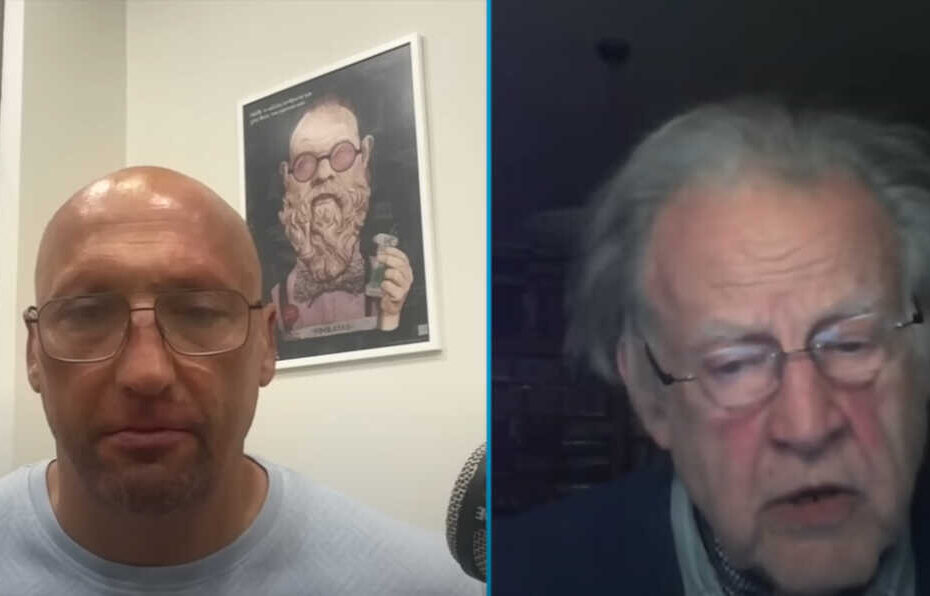
Read the full transcript of journalist John Helmer’s interview on Reason2Resist with Dimitri Lascaris podcast on “Can The World Survive Donald Trump?”, August 4, 2025.
Introduction
DIMITRI LASCARIS: This is Dimitri Lascaris coming to you from Kalamata, Greece, on August 4, 2025, for Reason to Resist. Today, we’re going to examine the latest escalation between the United States and the Russian Federation, each of which, of course, has enough nuclear weapons to destroy the world many times over.
We’re also going to examine Russia’s military cooperation with Iran and its tense relationship but ongoing relationship with Israel. But before we get into it, I’d like to take you back in time briefly to the presidential debate last year between Donald Trump and Kamala Harris, which was held in September 2024.
Trump’s Debate Promise on Ukraine
DONALD TRUMP: “I want to get the war settled. I know Zelensky very well, and I know Putin very well. I have a good relationship. And they respect your president. Okay, they respect me. They don’t respect Biden. How would you respect him? Why? For what reason? He hasn’t even made phone call in two years to Putin, hasn’t spoken to anybody. They don’t even try and get it.
That is a war that’s dying to be settled. I will get it settled before I even become president. If I win when I’m president elect, and what I’ll do is I’ll speak to one, I’ll speak to the other. I’ll get them together. That war would have never happened.
And in fact, when I saw Putin after I left, unfortunately left because our country has gone to hell. But after I left, when I saw him building up soldiers, he did it after I left, I said, oh, he must be negotiating. It must be a good, strong point of negotiation.
The Reality of Trump’s Promises
DIMITRI LASCARIS: That’s right, folks. It could lead to World War Three, which is precisely what Donald Trump is now edging us closer to. We’re often reminded of Donald Trump’s claim that if he became president again, he would end the Ukraine war within 24 hours.
Well, as you just saw, Trump actually went further than that in his debate with Kamala Harris. He said that if he won the election last year, which took place in November, he would end the war before returning to the White House.
Now, Donald Trump won the election nine months ago, returned to the White House seven months ago, and yet the Ukraine war rages on, arguably more intense now than it has ever been under Trump. The US continues to arm Ukraine. It continues to provide battlefield intelligence to Ukraine.
It’s also threatening new sanctions on countries that buy Russian oil. Those sanctions are supposed to come into effect in about three days, assuming that Russia does not agree to a ceasefire. And there is zero prospect of that happening between now and the next three days.
Now, in response to a tweet from former Russian President Dmitry Medvedev, Trump has ordered two nuclear armed submarines to unspecified regions near Russia, or at least that’s what he claims.
Now, here to discuss all of this with us is John Helmer. John is the longest continuously serving foreign correspondent in Russia and the only Western journalist to direct his own bureau independent of national or commercial ties. Born and educated in Australia, then at Harvard, John has also been a professor of political science, sociology and journalism, and an advisor to governments, including those of Greece and Australia.
He’s also published several books on military and political topics, his latest being “Long Live Novichok, the British poison which fooled the world.” Thanks for coming back onto Reason2Resist, John.
JOHN HELMER: Thank you for having me, Dimitri. Thank you for having me in Greece.
Understanding Medvedev’s “Dead Hand” Reference
DIMITRI LASCARIS: So, John, before I ask you about this latest dust up between the Donald and the government of Vladimir Putin, let’s take a closer look at what precipitated Donald Trump’s resort to nuclear armed submarines.
This is a post, or the text of a post that the former Russian president Dmitri Medvedev, I understand he put it out on Telegram and the language he employed was as follows: “As for the talk about dead economies of India and Russia and entering dangerous territory, maybe he,” I believe he’s referring there to Donald Trump, “should recall his favorite movies about the walking dead and also remember how dangerous the so dead hand which doesn’t even exist, could be.”
Now that’s rather Byzantine for those of us who don’t know the terminology, aren’t familiar with it here. John, could you explain to us what Medvedev meant by the “dead hand”? What in effect was he saying there and what precipitated his comment?
JOHN HELMER: Well, first of all, he starts with the walking dead, and that’s a reference to Trump’s brain. A Russian understanding that there’s serious cognitive damage there and psychopathic tendencies, that’s the first thing.
And Medvedev is responding to Trump’s threats against India and Russia, in which the day before he had tweeted that Russia and India were dead economies and they could go down together. That’s what he said. I recommend that if you have to, those of us are listening, you can watch and follow Trump’s tweets, almost all of them on rollcall.com that’s the best source for the sequence. And when you see things in sequence, then you understand what Trump is doing or trying to do and what Medvedev is responding to.
The “dead hand” refers very seriously. That’s why he used irony. “It doesn’t exist.” Of course it exists. It’s the system, the automatic system that would allow Russia to retaliate with massive nuclear weapons destruction against the United States or any other attacker which, in a first strike managed to kill the Russian leadership.
Were the Russian leadership, military and civilian, to be either handicapped, decapitated or unable to communicate in a nuclear warfare exchange, the dead hand is an automatic program that would fire Russia’s missile retaliation and that would destroy the United States and a good part of the rest of the world.
Trump’s Psychology of Respect Through Violence
So what Medvedev is doing, with some irony, and irony is a bit unusual in Russians, is to play on Trump’s words about the Russian dead economy, the Indian dead economy. That’s a foolish insult. And Medvedev is responding to a Hollywood, the Hollywood concept of the walking dead, which is a reference to Trump’s inability to read, his inability to see anything but movies, his inability to understand and think.
We’ll come back to that in a minute, because what you played, Dimitri, is a very interesting statement that I’ll come back to in a minute. Then Medvedev is playing on the concept of the dead by reminding there can’t be anything but all of us dead if Trump thinks he can achieve a first strike attack against Russia. Now, that’s what Medvedev meant, but it was a reaction to something Trump had already said.
Now, to go back to your very interesting clip. In retrospect, I agree with you. You look at it at its cognitive value, its truth value. He obviously was electioneering and he obviously couldn’t end the war. And it’s obviously now Trump’s war, not Biden’s war. So we’re a long way past what he said at the Kamala Harris debate.
But what he began with is very interesting and it’s psychopathic. He said, “Putin respects me.” Excuse me, what does that mean? Why say it? Why say it to the woman who’s the candidate? Is that a sort of macho, masculine assertion that Putin respects me because I’m a man and you’re a woman? That’s part of Trump’s mentality, first.
But second, Trump thinks, and he has a highly developed self image on which he depends, that without violence and cruelty, unpredictable violence, massive violence, shock and awe, or what he called after the bombing raid on Fordow and Isfahan and Natanz in Iran, “total obliteration.” What Trump’s mentality is, they don’t respect him unless he’s more violent than they can cope with. That’s what he meant.
And it’s very important to remember he said it then and he’s not absolutely sure they respect him anymore. Therefore, what’s he doing now? He actually responded to Medvedev statement as if “you don’t respect me. Well, I’m going to send two nuclear submarines.”
The Nuclear Submarine Threat
Now, I’ve seen CNN and all the folks at home can see CNN if you must read that stuff. And they say a nuclear submarine could mean a nuclear armed submarine or it could mean a nuclear powered submarine. Look, it doesn’t matter which of the two. The fact is that Trump is threatening a nuclear attack by submarine by moving a submarine closer to Russia.
As if a submarine with a US Ohio class submarines need to move closer to Russia to fire. Of course they don’t. That’s ridiculous. Anyone that understands the elementary military ranges of the missiles that the Ohio class carries understand they don’t have to move closer than they already are under the sea.
DIMITRI LASCARIS: I might interject there, John. Sorry, I just want to point out that you’re absolutely correct. But presumably if they’re much closer to Russia, they, Russia would have less response time and therefore their presence would be more provocative. Would that not be the case?
JOHN HELMER: It’s the case on the one side, you’re quite right. And thank you for pointing it out, Dmitri. At the same time, the closer they get to Russia, the more obvious they are in their location and the quicker the Russians can obliterate them. Let’s use Trump’s words, obliterate, obliterate. You come closer to us, we see you, we obliterate you the minute we feel that you’re about to. And they can see the electronic signatures, all that stuff.
Russia has a doctrine of preemptive defense from nuclear surprise attack. And there’s no question where a nuclear submarine, a Russian U.S. submarine of Ohio class, and those two combined have about, as I do the arithmetic, about 80,000 kilotons of nuclear capability to destroy Russia. 80,000 tons. You don’t need Ted Postol, who’s a brilliant analyst of all of this, to tell you that 80,000 tons worth of nuclear ordnance aimed at Russia, closer, as you say, with shorter response time, is a massive threat of what Trump likes to call “total obliteration.”
Putin’s Oreshnik Announcement
Now, why did he say that? To make himself respected in Russia? Of course not. That doesn’t make him respected in Russia. He’s misunderstanding Medvedev, as are most of the Western commentators. Medvedev says what Russians think. He’s not advocating a hawkish position. He’s not pitching to be the new successor president to President Trump. He actually says what most folks think on the street, my father in law and others. This is easy. Medvedev tells the truth. Of course, it says it in a slightly vivid way.
But why would Trump respond to him? My belief is you look at the sequence, you go to rollcall.com and you look at the sequence of Trump’s tweets, you look at the sequence on the Moscow side and what do you see? You don’t see Trump reacting to Medvedev for respect. You see him reacting to what Putin, President Vladimir Putin said that morning.
Morning, Washington time, afternoon Friday, Russian time, President Putin was in a summit meeting in the Vala monastery of northwestern Russia with the President of Belarus, President Lukashenko. And what he said while being asked, and you can imagine the question was planted because it came out of nowhere, was about the Oreshnik.
And Putin said two things. One, it’s now in serial production, which means it’s coming off the assembly line. Two, it’s not deployed with Russian troops. And I better add three, because the question asked for it, he said it will be deployed in Belarus after the positions of employment are prepared by the end of the year.
Now, that’s the Oreshnik could be nuclear, but it’s primarily at this point hypersonic conventional ordinance, which was demonstrated for one time in Dnieper Petrovsky, and we’ve talked about that before and everybody should remember the Oreshnik moment is the moment when Russia retaliates against European or other enemies with a weapon that has massive destructive capability, at conventional or nuclear capability that cannot be defended against, cannot be intercepted.
Okay? What Putin said was the Oreshnik is already deployed and ready to fire. What Trump did was “show me more respect. I’m going to send two nuclear submarines and 80,000 tons worth of nuclear ordinance closer to you.” That what Trump was doing was responding to Putin’s remark and demanding Putin show him the respect. He’s the more cruel, the more violent, the more effective in Trump’s brain. That’s what it was about.
Russian Official Response
DIMITRI LASCARIS: Now, have you seen an official response, John, to this news from the Russian Federation at a high level response? I should say not, you know, from the chattering classes to this decision. And it’s hard to say whether this is actually going to be implemented. This order, I understand that the Pentagon was asked about it and they simply referred to the person who was making the inquiry back to the White House. But in any event, let’s suppose it’s true and the Russians are taking it seriously. I imagine they are. Have you seen an official, high level response to the…
Trump’s Threats and Russian Response
JOHN HELMER: And it isn’t necessary because on the Russian side, it’s very clear what Trump’s threats amount to. It’s also clear that the Russian side expects Trump to follow through on the sanctions threat and it expects Trump now to act violently. The Russian side, therefore, officially doesn’t respond to these psychopathic threats. Why should they?
First, because the official position is, and Putin said it before he came to the Oreshnik moment, Putin said, “We see some reason for hope and optimism that the Ukrainian side is ready to go to the next stage of talks, which will be without publicity in the working groups.” The military, diplomatic and other work. Three working groups that were agreed to be set up between Russia and Ukraine at the last round of the Ukrainian meetings.
So Putin was wanting to emphasize there’s still room to negotiate and we’re waiting for the Ukrainians to come to the working group table out of public visibility and publicity. Also, the president of Russia said that it’s best not to have high expectations of public negotiations. Better to do the negotiating quietly without publicity.
Now, I better add for the folks at home that the evidence that Putin was referring to that Trump didn’t want to remind anybody about was identified by Secretary of State and National Security Advisor. The combination, the dead hand combination or the walking dead combination of Marco Rubio. When he admitted that on Monday, Tuesday last, he wasn’t clear whether it was Monday or Tuesday. He told Fox News, if I’m not mistaken, that there’d been high level negotiations between what Rubio called “the top Putin men” and the Russian side following up the Istanbul round.
And Rubio dismissed it. Dismissed it. He didn’t say what the negotiations were about. He didn’t refer to particular terms. He simply dismissed the negotiations. “Not what we wanted, not what we expected, and we’re disappointed.” And that’s a line that’s echoing the line that Trump keeps saying.
So on the one hand, Trump is maximizing the violence in order that people should respect him. Pretty much he does the same domestically. He wants the Federal Reserve chairman Powell to resign and respect him for his force to resign. He just fired. I mean, why bother telling the folks at home exactly what he’s doing? Because it’s very obvious domestically, he wants to be respected by acting violently.
The Russian side says, well, on the one hand, we’re trying to negotiate. But the US doesn’t seem to respond. The president, they don’t say this exactly, but it’s implied. President Trump doesn’t read. He can’t understand what the terms for negotiation are. When he sends people to meet Putin’s top men, as Rubio called them, there’s no basis for them to come to terms because Trump doesn’t understand or isn’t willing to come to terms himself.
Secondary Sanctions on Russian Oil
DIMITRI LASCARIS: So let’s turn to another form of Donald Trump violence, highly elevated sanctions, economic violence. As I mentioned at the outset, we’re about to see apparently the imposition of massive sanctions on buyers of Russian oil. Two of the largest, of course, are the People’s Republic of China and India.
The Chinese government has been adamant that these new sanctions, secondary sanctions, as we lawyers refer to them, will not deter it from purchasing Russian oil. As for India, Trump stated a couple of days ago that he understands that India will stop buying Russian oil. But Trump seems to be talking again out of his rather large derriere.
Official sources in India quoted by the news agency ANI said Indian oil companies had not paused Russian imports and that supply decisions were based on “price grade of crude inventories, logistics and other economic factors.” Now, John, I personally find that statement ambiguous because other economic factors could include new sanctions being imposed by the United States government.
So it’s not entirely clear to me that that statement indicates that India will proceed with business as usual, although I think probably that’s what it intends to do. What do you understand India’s position to be with respect to purchases of Russian oil? And if, in fact, you agree with this assessment that it’s going to continue with business as usual, how do you think this is likely to impact the Modi government’s attitude towards the Trump administration?
India’s Strategic Response to Economic Warfare
JOHN HELMER: Well, I’m sure we agree, but I don’t describe this as business as usual. Secondary sanctions are a serious matter. We don’t read Reuters or Bloomberg or any of these propaganda wire services to understand the impact of secondary sanctions on Russia. Nor do we use expletives to dismiss the impact of these things on either the Indian economy or the Russian economy.
What we understand is that we are now with India and with China going into a new stage of economic warfare. And when we’re in that stage, we don’t signal our punches, we don’t signal our movements. Nobody tells Reuters or Bloomberg or the shipping agencies which monitor the movement of tankers, what’s going to happen next? That’s the first point.
So the second point is that from an Indian point of view, and I’m speaking from an effort I’ve made to contact my Indian sources and listen to their guarded assessment of what’s about to happen, the issue is not going to be compliance with Trump, absolutely not. Without necessarily having Prime Minister Modi insulting Trump.
The issue is whether the Indian side and the Russian side can resolve the most serious payment problems that they have encountered, which from the Indian side is a failure. On the Russian side, principally Central bank Governor Nabiullina, the central bank of Russia is extremely sluggish in implementing the bilateral payment schemes between oil priced in an American currency, oil sold for rupees or dollars or rubles and achieve an effective exchange — transaction exchange.
This first problem and the Indian side sees it as a Russian problem to solve. And in these new warfare conditions, I’m willing to bet you the Russians will solve it because Governor Nabiullina is an opponent of the current war and cannot continue to block effective Russian waging of resistance, the economic war. So I expect the Indian Russian payment problem to be solved.
The second problem is the price. The price and therefore the discount on the shipment of crude oil in defiance of the American warfare. When you have a warfare like this going back to Napoleonic times, when you have an attempt to impose a cordon sanitaire trade bloc between England and its allies in Europe, when you attempt to break the blockade, there’s obviously a discount against the market price. Where there’s no warfare condition, it’s normal.
Second, the question of where the discount is paid, how, it’s how. In particular the UAE, Dubai, Abu Dhabi mediators or middlemen or intermediary systems for managing this discount and affecting the trade will work. Now the Americans understand this very well and they’re escalating. You can read the wire services against the UAE banking system to try to stop Russian Indian intermediation through Dubai, the Americans are attempting to crush UAE facilitation as they successfully crushed the Cyprus one some years back.
So first there has to be a solution to the rupee ruble dollar problem. The Russians have to stop requiring the denomination of oil transactions in US dollars and find the way. I believe they will find the way. Second, the intermediation that principally goes on through the UAE has to be facilitated and also has to resist US warfare.
And there’s a third dimension that’s direct warfare against Russian tankers. We’ve already seen and I believe we said it on your last program, Dimitri, that the US and the British are attacking Russian tankers in the Mediterranean or wherever the opportunity arises to plant mines and attack tankers with drones. Now, that’s direct warfare. You can call it terrorism, I call it warfare.
And one of the things that would no doubt appeal to a man of violent taste like President Trump would be the concept of sabotage of Russian tankers on their way to India outside Indian ports in the Indian Ocean. So we have three problems to solve. Russia and India have to solve the sabotage problem, they have to solve the payment problem, they have to solve the intermediation problem.
In this sort of warfare, the long standing traditional strategic relationship between India and Russia will manage to solve the problems that some foot dragging on the Russian side and some misunderstanding on the Indian side and some problematics in the UAE. There are always problematics in the UAE are slowing us up now.
So I see secondary sanctions, difficult document, but ultimately a flop. And they will not produce the respect, to use Trump’s word that you showed in your clip, they won’t produce any respect for him. They will show the way for China and India and all the rest to resist Trump’s violent economic warfare, which has now stretched even to a passive little country that sells cuckoo clocks like Switzerland.
The Cost of Economic Warfare
DIMITRI LASCARIS: But just to sort of boil it all down, would you agree, John? I don’t purport to be an expert in oil market pricing of oil, but if there’s greater risk, if India is exposed to greater risk in the purchase of Russian oil as a result of these secondary sanctions, I would expect that India is going to demand a deeper discount.
JOHN HELMER: Yes.
DIMITRI LASCARIS: In the Russian oil. Right, that’s so.
JOHN HELMER: Indeed it will. Yes.
DIMITRI LASCARIS: So even if they work through this, and I think you’re probably right about this, they probably will work through these various issues. It is going to cost Russia some oil revenue, I would imagine, this secondary sanction regime.
JOHN HELMER: Yes, it will. It’s a price of running a war. It’s a price of defending against the United States. I mean, to fight MEGA, make the empire great again, that’s not a cheap war. You have to sacrifice. And unfortunately, a lot of Russian lives are lost on the Ukraine battlefield and some money, not insignificant money, will be lost to discounting.
But this in turn creates a very substantial constituency that makes money at the intermediation. That’s Arabs, that’s the UAE, that’s on the Indian side. That’s a big constituency in favor of the Russian side winning this war. Yes.
India’s Balancing Act Between Powers
DIMITRI LASCARIS: So I’d like to go back to the second part of the question, I asked if I was unfair. I asked you a two part question. So I’ll just remind you, I also was interested in particularly what your Indian sources might have had to say about this. What you think the long term impacts are going to be on the Indian United States relationship.
My impression up until now has been that India has been trying very hard to remain on constructive terms with both the Russian Federation and the United States government. And yes, it’s in BRICS. At the same time, it’s probably of the major BRICS members, I would say it’s the one that’s worked hardest to be on good terms with the United States.
Do you think this is likely to result in a major shift away from the United States and greater integration into economic and other partnerships with the Russian Federation and the People’s Republic of China?
The BRICS Troika and Pakistan’s Strategic Realignment
JOHN HELMER: It’s a very good question, Dimitri, and it’s a question we’ll go on talking about for a while. Let’s be clear. When we talk about BRICS, we’re really talking about the troika: India, China and Russia. The second strings are Brazil and South Africa. After that, we’re talking about particular important war fronts like Iran.
So in terms of what my Indian colleagues, friends and sources tell me, first you have to understand that from an Indian point of view, they have recently defeated an attempt by Pakistan to go to war against India. And I know this is controversial on your program and a lot of Western programs. However, basically, let’s look at the facts.
The facts are that from an Indian point of view, Field Marshal Munir, the real ruler of Pakistan, had lunch with President Trump at the White House relatively recently in what Trump has called his “peacemaking Nobel peace prize effort” to solve the Indian-Pakistan problem. This is wrong. What the Pakistanis have done, from an Indian point of view, is to have resumed between the Pakistan military and the United States the old continuity between the Pakistan military and the United States government.
Pakistan is pitching to the United States to be the new Ukraine battlefield, the platform for the new and continuing US war against Iran. What Munir has proposed is increased cooperation on arms supply, on financial services. And Trump himself has announced that he has struck a deal with the Pakistan government – that’s really the military leadership, that’s really Field Marshal Munir – to provide all Pakistan oil concessions to US companies. In other words, he’s come up with a Pakistan deal comparable to the Ukraine rare minerals deal he was so keen to achieve a few weeks ago.
From an Indian point of view, this takes India back to the time when Pakistan was the platform for US war against the Soviets in Afghanistan. They don’t see this as a big shift. They’re ready for it. They’re in a much better position for it because they have just achieved what India conceives and regards as a significant military success.
Now you ask yourself, if the Pakistanis defeated the Indians so thoroughly using Chinese military expertise, fighters, air defenses, and if the Indians were defeated by that Pakistan-China combination, what on earth is the reason for Pakistan to remake its US strategy which is hostile to China and hostile to Iran? Answer: Pakistan did not achieve the victory and India sees that in its weakness. Pakistan’s military resumes its US relationship.
India-China Cooperation Against Common Threats
Now, to go back to your question, from an Indian point of view, there are a number of ways forward. None of them represent any concession to US military ambition towards Iran through Baluchistan.
Second, you asked the question, what’s the change in Indian thinking about the relationship with China? Obviously, the troika – India, China and Russia – are the dominant powers in BRICS. And obviously China and India are the principal targets, as you just said, Dimitri, of the secondary sanctions. Wouldn’t that tell you, tell us, tell our audience that it makes sense for China and India to bury as many of their hatchets as possible, to negotiate better terms along the northern front lines and to develop an increasing capability to work cooperatively against the single enemy?
Now, China is also reluctant to call Trump an enemy. And Modi has done a pretty good job at trying to mollify the Indian diaspora in the United States and mobilize it to encourage the support that some diaspora members that are inside the Trump administration can achieve in mollifying Trump’s behavior towards India.
He, on the other hand, is highly motivated to violence. He’s highly motivated to continuing the war against Iran. He’s highly motivated to have lunch with Field Marshall Munir to achieve an increased level of capacity to fight Iran and to intimidate India. India is not going to be intimidated, but it’s not going to talk tough. It’s going to do tough.
Russian-Iranian Military Cooperation and S-400 Systems
DIMITRI LASCARIS: So this raises the nice segue into my next question, which is we’ve seen indications of deepening military cooperation between the Russian Federation and Iran. There have been high level meetings between senior figures in their respective militaries and a lot of speculation that, for example, the Russians may be prepared and able to provide their most advanced or some of their most advanced air defense systems to the Islamic Republic. What do you make of these reports? Are there concrete indications, is there credible evidence that since the end of this so-called 12-day war there has been a deepening of military cooperation? And in particular, do you think the Russian Federation is going to provide S-400 air defense systems to the Islamic Republic?
JOHN HELMER: You raised a very important question. What’s the veracity, what’s the credibility of the initial reports coming out of Iran that there was within recent days an operational test of an S-400 battery in or around Isfahan? I attempted to write it down for what the evidence was worth and it came from the Iranian military.
I don’t pretend here or anywhere to be an expert commentator on internal Iranian factional politics. There remains a powerful Iranian faction that want to mollify Trump and reach a peaceful resolution of the wartime post-ceasefire negotiations over the nuclear program going forward with Iran.
There is at the same time factional differences within the Iranian military – I’m not saying anything that everybody doesn’t understand – between the Islamic Revolutionary Guard Corps, the IRGC and the regular military over the effectiveness and readiness of Iranian-made versus Russian-made missile systems for air defense and how they performed against the Israeli-American attack.
So that said, I’m admitting this is stuff that you need to understand, but I don’t know about it and I’m not prepared to speculate. This creates a big question mark over when one side, and we don’t know which it is, announces that it’s committed to Russian S-400s and is readying them operationally.
That means about 1,000 Russian technicians and senior officers coming into Iran to help plan an integrated defense system that would work better and have a longer range deterrent capability than Iran was able to show during the so-called 12-day war. That has military implications and political implications in Tehran because it implies that the forces who deployed the Iranian-made ones in preference to the foreign-made ones failed to do their job effectively.
Well, we know the Israelis used ground attack saboteurs to attack Iranian air defense systems and command control systems. We know they tried to kill off and decapitate the Iranian military leadership. We know they failed ultimately.
DIMITRI LASCARIS: You said Russian military leadership, I assume you meant Iranian.
JOHN HELMER: I meant Iranian, yes. Getting too excited, forget which side I’m on.
DIMITRI LASCARIS: So many sides to be on nowadays.
JOHN HELMER: Well, to answer your question, best to understand there are a lot of sides. A lot of sides. And so the best answer I can give you to your question about the S-400s is on the balance of probability. And folks can go back to the text that I published.
I believe the S-400 is ready for operational deployment. Second, the leak is intended to show there is a new Iranian military commitment to a Russian-based defense. Three, the Russian side, without saying so, is prepared to warn the United States and Israel that if they attempt another round of attacks by air, they will face the readiness of the Russian side and the Iranian side to press the button and fire.
Now we know that President Putin had a very odd telephone call with Prime Minister Netanyahu of Israel.
Putin’s Strategic Warning to Netanyahu
DIMITRI LASCARIS: Before you continue, John, I was about to ask you that. I’d like to pull up the readout so that our audience can see it before you talk to us about this. So this is the Kremlin readout of a July 28 call. I presume you’re talking about that call.
JOHN HELMER: That’s the one.
DIMITRI LASCARIS: And just for the benefit of those who might not be able to read what’s up on the screen there, I’m quoting: “The two leaders, namely Vladimir Putin and Netanyahu, discussed various aspects of the tense situation in the Middle East. The Russian side has reiterated its unwavering support of resolving the problems and conflicts arising in the region exclusively via peaceful means. In particular, Vladimir Putin emphasized the importance of supporting the unity, sovereignty and territorial integrity of the Syrian Arab Republic and reinforcing its internal political stability by respecting the legitimate rights and interests of all ethnic and confessional communities. In light of the recent escalation between Iran and Israel, the Russian side expressed its willingness to facilitate in every possible way the search for negotiated solutions to the Iran nuclear issue. And then finally, the two leaders agreed to continue their dialogue on pressing international and bilateral matters.”
I want to ask you, I’m going to park the question right now, but I just want to point out for present purposes there’s no reference here to Palestinians or Gaza. But we’ll come back.
JOHN HELMER: It’s a very important point.
DIMITRI LASCARIS: You want to address it in answering my question about the S-400 and so forth. Please do that. But what do you make of this readout? What do you understand was addressed in this call and what were the objectives of the Russian Federation in your view?
JOHN HELMER: I’ll be frank. That’s not a diplomatic Sergey Lavrov term. My first response to that readout is how come President Putin picked up the telephone? Because the way the Kremlin prints the readout, they always indicate when the other side initiates the call. When they say nothing, that means the Russian side initiated the call.
So let’s ask ourselves, why on July 28 did President Putin initiate a call to Netanyahu in order to not refer to the genocide, not refer to the starvation, not refer to the issue which even the European backers of Israel were complaining about, including Trump? Why was Gaza not mentioned? Answer: That’s not what the call was intended for.
In my belief, the call was intended by President Putin to tell Prime Minister Netanyahu that the Iranian leaks about the operational deployment of S-400s are true and that he should understand that he and his pal Donald Trump should not attempt to attack again because the S-400 crews have orders to fire. And that means at a range of between 300 and 500 kilometers westward to over Iraq and north across the Caspian Sea, the two directions from which the Israeli Air Force attacked Iran the last time round and the directions from which the US “Total Obliteration Raid,” as Trump called it, attacked Iranian nuclear sites.
So there was something very important to convey to Netanyahu that was more important tactically than making the Gaza genocide by starvation a point that the Kremlin wanted to put in the communique.
Second, the odd thing, the very odd thing was the way in which Netanyahu tried to cover up the telephone call. If you look at the readout on the Israeli side, first of all, you find a very brief tweet, I’m not mistaken, by Netanyahu in Hebrew. It was another 24 hours after the telephone call that he put his Hebrew into English. By then, the Israeli press were already asking the Prime Minister, “What did Putin say? What was the conversation about and why did it happen?”
Now, from a media point of view, propaganda point of view, information warfare point of view, it should have been a call about starvation and what the Russian side thought and were prepared to do to facilitate saving the Palestinians. If it wasn’t about that, what was it about? And Netanyahu finally came out with saying the telephone conversation was about Iran. That’s all.
Now, what does that mean? I’m not an expert either on Israeli politics. Netanyahu is not prepared to discuss a warning about Iran from the President of Russia. Now, what can that be?
There are some other things that President Putin could have told Netanyahu. He could have told him, “What the hell, Mr. Prime Minister, was your foreign minister doing in Kyiv a few days back? Promising to support the Ukrainians in their war against us Russia. Pardon me, Mr. Prime Minister, we don’t wish to see you support secretly while your foreign minister is in Kyiv, promising and embracing Mr. Zelensky and promising to deliver more Israeli weapons as we destroy them on the Ukrainian battlefield.”
He could have said that, but he didn’t. The conversation was about Iran. So therefore, I conclude, speculatively, yes, that the warning was Russia is now prepared to back Iranian deterrence. Don’t try to attack Iran again.
Russian Escalation Dominance Strategy
Now, that’s very important. If I’m right and if that happens. But we can’t expect the Israelis to admit it, we certainly can’t expect Trump to admit it. It would be to deny him the respect that his taste for violence demands.
But if that happened on July 28, that the Russian side put a significant level of force escalation behind deterring the Americans and the Israelis from another shot at Iran on that front. And then Putin follows three days later, four days later, in Valaam monastery by saying, “We’ve deployed a Oreshnik. We’ve deployed a Oreshnik.” That’s a second line of deterrence, a warning directly to the Americans and the British and the NATO forces on the battlefield. Don’t escalate. We have escalation control and we’re prepared to use it.
This is a very subtle, very subtle, no expletives here, no insults, very quiet, very subtle, raising the level of escalation dominance on the Russian side. And if Trump can’t understand the message and Rubio can’t understand the message, who does that leave in Washington that does understand the message?
Trump’s Nuclear Provocations and Russian Responses
DIMITRI LASCARIS: You know, if you’re correct, John, and I find it entirely plausible, your interpretation of events, it’s possible, is it not, that the order from Trump to send these nuclear submarines closer to Russia, which came three days after the call with Netanyahu, might have been motivated in part by a desire for revenge?
Namely, the Trump administration was angry that the Russians were providing these air defense systems to Iran and effectively telling the Americans and the Israelis to stay away. Could that not also have been part of the motivation for this highly provocative move on the part of Trump?
JOHN HELMER: It could be, Dimitri. I shan’t disagree with you, and I think you see it psychologically correctly. We have now a situation in Washington in which we have, unusually, an emperor of considerable cruelty who aims to make the empire great again by using force at a level he calls “total obliteration.”
Well, ask yourself, from an ancient history point of view, ancient Greek, ancient Roman point of view, what happens to emperors who specialize in cruelty? Let’s remember that Nero was forced to suicide when he was opposed by the Roman Senate and faced basically trial and crucifixion if he didn’t remove himself in 68 AD.
But think of a crueler emperor, a notoriously cruel and violent emperor like Caracalla. He thought he got respect from his violence. He didn’t and was ultimately assassinated on his toilet in 217 AD.
So we have a situation of psychological violence on the part of an empire trying to make itself great again and facing Russia, which has just said, if we’re right, “Don’t try any more attacks of total obliteration or any kind on our southern front, Iran, and don’t try them on our western front, on the Ukrainian battlefield, and don’t allow your generals to sound off about how ready they are to destroy Kaliningrad.”
We also have Indian and Chinese responses, which are different, subtle, quiet, yes. But the level of resistance to the doctrine of cruelty that Trump represents is rising. I don’t consider this optimistic to say it, because in warfare you don’t know what will happen next. And we’re at a nuclear brink as you began this program. Nuclear brink, folks, is not something to joke about. It’s not something to pass expletives about. It’s something to be deeply serious about and worry about.
The Urgent Need to End the Ukraine War
DIMITRI LASCARIS: Precisely. So many of us have been saying since the outset of this war in Ukraine that the highest priority for all sane persons should be to bring it to an end as quickly as possible. Even if you don’t care about the Ukrainians, which I happen to actually care, I don’t want to see them suffer unnecessarily as I care for the Russian people and all peoples.
But I see no end in sight to this horror show in Ukraine. And I think people need to become more engaged in bringing this conflict to an end before we all come to regret it. Not people like you and me and people who watch our show, but people who have stood aloof or have supported the NATO policy.
The Absence of Anti-War Leadership
JOHN HELMER: I wish it were true, Dimitri, but to be honest, and let those watching who disagree comment and give us thumbs down, there isn’t an effective anti-war movement in the United States. There are the audiences around you and some other podcasters who understand how damaging this is for the United States and for all of us, just as you said, Canada, Greece, Europe and so on. Yes, but there is no leadership from resistance to this war that’s going to come from the United States.
That’s regrettable. And it also reflects some of the effective counter pressure, violence, police force, ICE and the FBI that the Trump administration is deploying.
Ukraine’s Political Volatility and Post-Zelensky Scenarios
At the same time, you take a look at the Ukrainian politics in Kiev. You look at a spokesman for Ukrainian sense and survival like Alexei Arestovich, who used to be on Zelensky’s staff. Folks can watch his Telegram and Twitter stream as he talks very freely. And what he’s saying is two things: Zelensky is finished even if he survives, notwithstanding his success so far in surviving the so-called anti-corruption campaign.
Arestovich says Zelensky’s coming to his end and what there is now, and one sees it in London, one sees it in Moscow, one sees it in Kiev, attempts to find the post-Zelensky framework for figuring out: is that a total capitulation of the Russian side or is it something significantly less that would save the Ukrainian platform for the British, the Europeans and the Americans to go on with a future war against Russia?
So Arestovich is saying it from a Ukrainian point of view. There are serious alternatives now: Zaluzhny, Budanov, Denis Prokopenko, the head of the Azov movement, and the ex-president Poroshenko. These are all candidates to replace Zelensky if he makes a run for it to his money hideouts, wherever they might be, or if he faces a Ngo Dinh Diem outcome in Vietnam.
The situation in Ukraine is now more volatile and more receptive to the ultimate Russian military objective, not only of demilitarization but denazification expressed as removal of Zelensky elections. So I’m not holding out hope. I’m simply saying there’s a complicated story there.
One has to listen to the Ukrainians like Arestovich on that side or the Ukrainian opposition in Crimea led by Aksyonov. They’re vocal, they’re highly intelligent individuals. They think all day and they can tell us how they’re thinking about the future of what’s left of the Ukraine. That’s Ukraine minus the four regions, minus Crimea, minus Odessa, minus Kharkiv, a demilitarized zone all the way to Kiev and then a rump state between Kiev and the Polish border, the Hungarian border and the Romanian border.
There’s a lot of money involved in that. There’ll be a lot of people with bright ideas to spend it and put it in their own pockets.
Closing Thoughts on Hope and Survival
DIMITRI LASCARIS: Well, thank you very much, John. Always a pleasure to talk to you, and I look forward to our next conversation. Hopefully, we’ll be alive long enough to have it.
JOHN HELMER: I like being alive, but I’m an old man, and I don’t need to be alive with hope. I hope that those who are younger watching this understand how important being alive is with hope.
DIMITRI LASCARIS: And we’re signing off today. This is Dimitri Lascaris coming from Kalamata, Greece, on August 4, 2025.
JOHN HELMER: Thank you, Dimitri.
Related Posts
- Transcript: Vice President JD Vance Remarks At TPUSA’s AmericaFest 2025
- AmericaFest 2025: Tucker Carlson on America First Movement (Transcript)
- Prof. John Mearsheimer: Unintended Consequences of a Meaningless War (Transcript)
- “It’s Really Not About Drugs” – Max Blumenthal on Mario Nawfal Podcast (Transcript)
- Erika Kirk’s Interview on Honestly with Bari Weiss (Transcript)