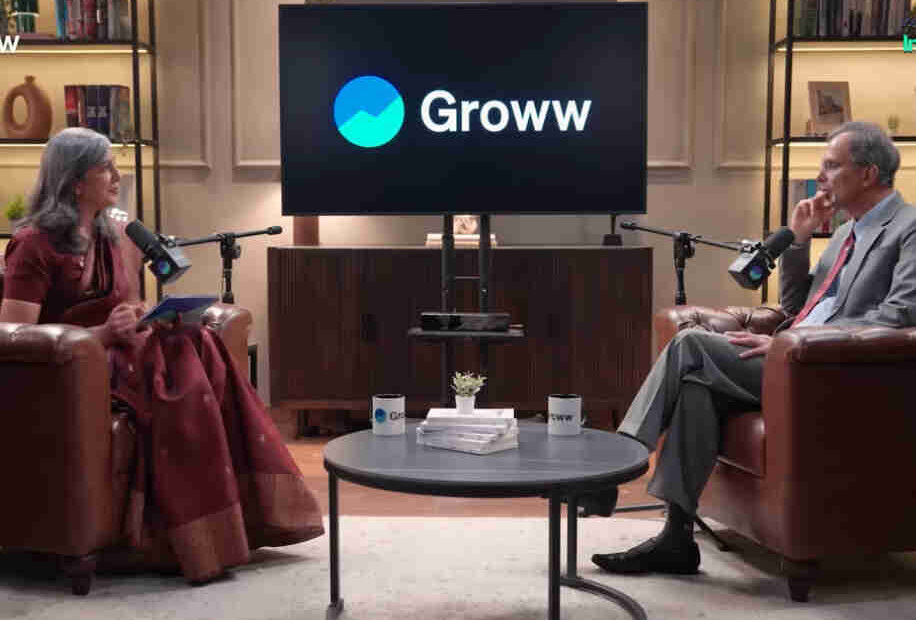
Read the full transcript of India’s Chief Economic Advisor Dr. V. Anantha Nageswaran’s interview on Growwing India Podcast with Monika Halan, November 2, 2025.
MONIKA HALAN: Welcome to the Growwing India Podcast. I am Monika Halan. I talk to thought leaders in economics, policy, geopolitics, geoeconomics, so that we can deconstruct this increasingly complicated world. The Growwing India Podcast is a joint initiative between Groww and me to talk about India’s most pressing issues.
I’m delighted to welcome India’s Chief Economic Advisor, Dr. V. Anantha Nageswaran, to talk about all things finance, policy and economics. So belt up. Thank you so much for being here, taking the time and talking to us.
DR. V. ANANTHA NAGESWARAN: You’re welcome.
The Honesty Tax: A Burden on Compliant Citizens
MONIKA HALAN: I’ve actually listened to some of your recent talks and there’s one thread which is coming up again and again and you’re saying that the government has to reduce the cost of being honest. It needs to improve the ease of being honest.
I have personally believed that some of us pay what I call the honesty tax. So there is a small sliver of population who pays income tax. There are others who could pay, but since they have bribed the government officials at a lower level, they feel justified in not disclosing their income because they say we’ve paid the tax already to the government, whether it’s in a bribe. Why would I pay it again? It’s an argument which comes again and again.
So as an income taxpayer, you feel that you have disproportionately paid and then you’re also paying higher prices for the goods which are now including the price of the bribe.
DR. V. ANANTHA NAGESWARAN: Right.
MONIKA HALAN: So the manufacturer, they are including the price of the bribe in the cost of the product. And you’re consuming products which may be substandard because compliances are not really careful because there’s been a bribe paid.
What do you mean? Is there an acceptance within the government that corruption at this level is endemic? What did you mean by saying reduce the cost of being honest? What are we doing about it?
The Regulatory Burden and Its Impact on Scale
DR. V. ANANTHA NAGESWARAN: No, first of all, the tax dimension is only one aspect. And even there I think Dr. Surjit Bhalla has been writing correctly that India’s tax to GDP ratio adjusted for its per capita income is already quite high. But I was not coming at it from the tax angle or the bribes.
See, one thing you have to be very clear is there are problems which we have inherited. And when we say government, we should remember we have government at all levels: union, state and local.
Where I was coming from is in terms of the regulatory burden. Because when you have so much of compliances, inspection and licensing, the easier tendency is to take shortcuts. And the moment you take shortcuts, then you are of course forever hostage to the discretion of the officials concerned. That is what I meant by saying we have raised the cost of being honest, which means raised the cost of being compliant.
It also naturally rubs off into peer to peer transactions in private sector transactions also. Then honesty becomes a commodity at a premium. But it is honesty that leads to trust and then to scalability.
So I was coming from this angle because as a country with 1.45 billion people, you need scale in everything we do. And this compliance burden actually therefore indirectly or directly or both, inhibits formation of economies of scale. And that was the angle I was coming at.
The Root Cause: Rent Seeking and Inspector Raj
MONIKA HALAN: Okay. But the root cause does remain the rent seeking because of the compliance burden, because of the inspector Raj, there’s an interpretation of the rule, right?
For example, the rule could say you should have a medical test of your employees. Now, unless you define that medical test, what is to say that an MRI is needed or a blood group check is needed? So the inspector can ask for anything. You can produce one paper, he will ask for something else, because what he actually wants is money.
So just pulling on that thread, as a policymaker, and I understand the difference between the center, what the center can manage, what the states can manage, I understand that the center’s remit is only so much, and then operationally, it’s really at the state and district level that things will happen.
But this is, as a policymaker, when there is a problem which is so endemic, I mean, we actually see rate cards for various things where a thousand rupees you are given the breakup of where it goes at the state level. When corruption is so endemic, what is a policy intervention? I mean, we have a culture of corruption. How would you, as a policy maker solve it?
Policy Solutions: Deregulation and Technology
DR. V. ANANTHA NAGESWARAN: So, Monika, I think I have to address this at multiple levels. Yes, obviously, when I speak of the cost of being honest necessarily, therefore people take shortcuts. And I told you in my earlier response as well that it does lead to certain discretion being exercised by the officials at the local levels. And you are forever dependent on their discretion to let you continue or not continue. And rent seeking behavior, all this is all part of the regulatory framework which we have created over the years.
And therefore the answer is in many cases is to let go of some of these regulations, which is what I wrote in the economic survey as “letting go” in January this year. And that will naturally address rent seeking.
And by the way, in many areas we have done that. Our successive governments have done that. Some of the things that we used to bribe our way through are no longer necessary. They come automatically. So we also have to take cognizance of the progress, except that the areas that need to be addressed still remain formidably large.
It is not as if we have not understood the linkage between licensing, inspection, compliance and rent seeking behavior or rent giving behavior on the part of the public.
So the answer is, that is why the government is very clearly focusing on the import. Even in tax administration, the focus on faceless assessment, or giving the taxpayers the ability to go back up to four financial years and redo their numbers if necessary in a bona fide manner, or currently the focus on multiple levels of deregulation, a task force looking at states and a high level committee looking at union ministries and two informal groups of ministers looking at various central ministries and rules and regulations.
So there is a recognition that whatever we have been doing in terms of deregulation, reliance on self certification and management by exception are all slowly whittling away the areas and domain where rent seeking is either prevalent or inevitable or necessary, or all three.
And it is necessary for us to urgently expand those areas where rent seeking can be brought down to a minimal or even eliminated fully. That is what will give us the ability to take on the strategic challenges we face.
Because ultimately the objective is to let economic activity proceed not at the discretion of the bureaucracy or the government machinery, but mostly on its own. And today we have the technology to be able to target the evaders and the wrongdoers rather than making these rules and regulations and processes omnipresent and omnibus.
And that is the direction in which we should go. Deploy technology, reduce the compliance burden on most people, use technology to isolate and target those who are not obeying the laws and also make them reasonable first before we use technology to go after the serial avoidance or evader.
This is broadly the framework with which government has to proceed. This kind of realization, I see it very clearly at the senior levels of bureaucracy and the political executive. But always as we come down to different levels, naturally there is a dilution of intent and execution and we have to keep plugging away.
As we have been doing, so many of us in the public space when we comment on these things, we always look at where we want to be and where we are and we sort of feel, oh, we have a long way to go. But it’s equally important to recognize where we were and where we are. And that progress also has to be acknowledged. And that is an important motivator even for those who want to do good in their public roles.
The “Grease” Argument: A Second Best World?
MONIKA HALAN: Two questions from this. One is that you said that it is important for economic growth, development, business, right? There is an economist view and these are respected economists who say that this is grease, which oils the way and we should look through it.
I find it personally offensive that this view is actually fairly accepted in India because the response is at least then we move ahead rather than the projects getting stalled. What would be your view?
DR. V. ANANTHA NAGESWARAN: That is more of a satisficing or what in the behavioral science literature they call it satisficing, that is you are willing to agree and accept a second best world. I am not saying that that is a philosophical answer to the question. It doesn’t, it should not stop us from aiming for the first best world, which is to…
Because in any government system, whether it is developed or developing, some of these things will always be there at some level. I don’t think there is any society you can point to and say maybe a handful have completely eliminated corruption, whether it is day to day transactions or big ticket transactions.
So given that it is a part of human life for thousands of years or whatever, it is important at the same time that we should make it possible for most ordinary citizens to go about their lives or businesses without having to think about it. I think that should be the primary goal.
Whatever residue remains will be there. And you can, that’s why I say that today you can use technology to address the residue. But I don’t think we should accept it as given and say we can’t do anything about it. Because willy nilly technology does enable us to address this issue and we have been addressing them. So we should keep at it. The end goal should not be to live in a second best world.
Technology: Solution or Bureaucratic Overreach?
MONIKA HALAN: You are saying that technology is to be used to sort of weed out the bad apples or the instances of rent seeking graft, change the behavior using technology.
There’s a situation right now where all the vehicle owning citizens are now being told to do a KYV, know your vehicle. So if you have a FASTag, you have to now do a process to upload pictures of your car. This is being done so that a few people who are misusing the tags don’t do it.
So I know it’s a very specific question and I obviously don’t expect you to sort of go into the details of it. But from a citizen point of view there is a feeling that there is a huge bureaucratic overreach in using technology to make my life very difficult when I have to do KYC every other year.
And I’m filtering out the views and telling you what people are thinking about. They’re saying large crimes go unpunished. But my 80 year old father has to go to the bank branch for his KYC again and again. And now with this whole know your vehicle, the memes are out of the park. So how do we balance this?
The Challenge of Regulatory Mindset and Trust
DR. V. ANANTHA NAGESWARAN: No, it’s a fair question, Monika. And I personally do not, I don’t have a vehicle and personally I’m not familiar with the details of this particular requirement. Although I have also come across some people forwarding some messages to me only this morning and I didn’t know about it and I therefore I don’t want to comment on the specific example that you brought up. That’s not fair.
But I hear you that in general the mindset, this exactly is what I mean by saying letting go. The mindset is still to sort of if you have a problem with a few, then you impose an omnibus requirement on everybody. And this has to change that because this is what I call the type 1 and type 2 problem in policy making.
Do you want to allow a vast majority to continue their activity unhindered and accept the possibility that some 5 to 7 or 10% will continue to evade and take shortcuts, or do you want to ensure that I will not let anybody take a shortcut or anybody evade or disobey and in the process, if I’m going to inconvenience majority from going on with their lives? This is a trade off.
This is exactly in quality control. We know that when we have learned about statistics. How do you set up your quality control process in such a way? Do you want to eliminate the risk of not even a single bad product reaching the end customer or do you want to make sure that I control my cost? And even if one or two bad products reach the customer, I don’t want to lose out on the investment that I have made in the production process.
There is a trade off and this trade off is most of the time the policy apparatus errors on the side of saying I shall not let even one person evade the rule and in the process construct a very elaborate mechanism which is what you point out, annual KYC or now it is a KYV process, etc. So that is, I think it’s a mindset shift that needs to happen. We have to be at it.
But the important point you brought up with respect to KYC is that sometimes I notice even among private sector entities this is a cultural thing. I don’t think this is a government thing. Even in private sector financial institutions, even in a situation where I have a relationship with one particular arm of the bank, I have provided all the information and I need to do, let’s say have open a credit card or some other, a locker facility. If I have a savings bank account, again they ask for the same information all over.
So this is, this seems to be the cultural ethos and that stems from what I have also argued that we are a relatively low trust society. That, you know, this goes back to the excellent book that I read during COVID times by Joseph Heinrich, “The Weirdest People in the World.” And I have referred to it on numerous occasions in my speeches where the weird word weird is an acronym and that stands for white, educated, industrialized, rich, democratic.
So we, our societies are mostly kinship group and community based societies. And within those small groups we are extremely trusting. And through word of mouth, crores and rupees are exchanged or lent and paid back, etc. But just outside those groups we become extremely low trusting where even contracts are not honored. And that is why we have so many renegotiations between government and private sector, between private sector entities themselves, etc.
That is because these kinship community based societies have evolved that way and that permeates both private and public sector behavior. So the root cause of this is the low trust. And I feel somebody has to make a start and the government is well placed to start. And that’s why I’m saying if we lower the cost of being honest or make it easier to be honest, that will then slowly permeate down to private sector transactions also. And then honesty builds trust, trust in turn builds scale. So it is both, it is a cultural phenomena as much as it is a government regulatory phenomena. Right, right.
MONIKA HALAN: But you are, you’re within the machine. You’re seeing change, you’re seeing a change in the mindset.
Progress in Deregulation and Decriminalization
DR. V. ANANTHA NAGESWARAN: Definitely. Okay, it is definitely happening. And that is the reason why there is so much emphasis on decriminalization, deregulation, and looking at it at all levels of the government, union, state and local. But given the scale of the country and given the scale of aspirations, it is also true, and I again stress, Monika, that it is human nature, that that is why many of the spiritual teachers stress gratefulness so much.
Not because humans are by definition ungrateful. It is human nature that once something that we have been looking for is done and fulfilled, we move on to the next thing. So whatever grievances we may have had against the system over the years, as and when one by one they are addressed, we don’t dwell on the fact that those have been addressed and we feel the relief and the difference. We move on to the next thing.
So that’s why I stress it’s equally important to acknowledge the progress we have made. Whether it is in a railway ticket reservation or getting some licenses, or in many areas things have been made automatic. And for example, we don’t think about how long it takes to make financial funds transfer, etc. And it is not even there in several, many other developed countries also, or the QR code based payment.
So lot of things in our daily lives, which used to be a major chore or payment of bills even government used to make it. Paying bills to the government, very difficult thing to do earlier. But now we know that it happens through your bank account almost seamlessly, instantaneously. But we don’t pause for a moment to, you know, give it a thought how much of that we used to spend standing in front of our electricity bill counter to make our monthly electricity payments, etc.
This is fair. I’m not saying we should, but I’m just saying that things are being addressed. We have come this far and I agree we have a long distance to go as well. That’s the nature of the evolution and development process.
MONIKA HALAN: That’s the human being.
DR. V. ANANTHA NAGESWARAN: Exactly. We want more.
The Tension Between Deregulation and Consumer Protection
MONIKA HALAN: Yeah, yeah, you’re speaking of deregulation. And now I will speak from the other side of my mouth and say that if I pull the deregulation thread hard enough, I come to issues of consumer protection.
DR. V. ANANTHA NAGESWARAN: Sure.
MONIKA HALAN: For many decades, like almost 15 years I’ve been working with SEBI, part of their committees.
DR. V. ANANTHA NAGESWARAN: Sure.
MONIKA HALAN: So I’ve seen the operations of especially the mutual fund industry from the inside. So I’ve seen the interpretation of the disclaimer being written in a point size which is so small that you need a magnifying glass and Mr. Bhave having to specify the point size 2009, the speed of the disclaimer on audio video had to be then prescribed. So it’s a policy question.
DR. V. ANANTHA NAGESWARAN: Again, I agree.
MONIKA HALAN: Principle based versus rule based. Logically it has to be principle based. But when I see in operation on the ground, and this is an argument I’ve had many times with people around me where because I’m inside that machine, I will justify the micromanaging of the regulator, the regulator which is micromanaging every small thing from everything because you see evidence through numbers that some of the people are actually violating and if one does, everybody else does.
DR. V. ANANTHA NAGESWARAN: No, you’re absolutely right.
MONIKA HALAN: How do you, so, so one question is policy prescription for rules based, principle based. Is there an example of a principle based regulation which we’ve seen working without prescribing point size of…
DR. V. ANANTHA NAGESWARAN: Sure.
MONIKA HALAN: Your disclaimer.
Principle-Based vs. Rule-Based Regulation
DR. V. ANANTHA NAGESWARAN: No, no, I think it’s, it’s an excellent question and excellent issue to flag here. And as you correctly said, you know, you are now speaking from the other perspective, which is fair. I think it is a trial and error process. I think in general we have to start with the principle based approach. And where it doesn’t seem to work, where a vast proportion takes, takes undue advantage of it or wrong advantage of it, then we have to become prescriptive. That is one part. So it is a trial and error process.
There is no perfect answer. Nor is it a situation where if you reach a steady state, you stay there forever. It doesn’t happen. It is in the nature of human behavior that over time we will tend to become complacent and confident. And as we become complacent and overconfident, bad behavior creeps in, whether it is in lending or financial market investing. One time it could be derivative, another time it could be private credit, another time it could. So there will always be something and these issues are never ever settled and stay there.
And my answer is, therefore it is an evolutionary process. You have to figure out what works. And the trade off between not impeding legitimate activity and commercial transaction and financial transaction and ensuring good behavior is an iterative process.
However, I’ll just make one small distinction. When it comes to finance, I have not been so wedded to the idea of principle based regulation. I have been slightly leaning in favor of rules or prescriptive regulation for the simple reason that consequences of financial wrongdoing can permeate other sectors of the economy much faster than what happens in specific non financial sector.
In non financial sector, I’m more willing to let competition do the role of the job of the regulator and where the consequences of wrongdoing or wrong behavior will be confined to the fate of that sector or that company, that industry alone. Whereas in finance is the other way around. Competition can actually breed excessive risk taking. So for the simple reason that competition doesn’t work the way textbooks tell us in finance, that does make the case for prescriptive rather than principal, relatively speaking in the financial sector.
MONIKA HALAN: Right, right. And I will come to this a little later. I’m going to like expand on exactly this just in a little while, but I want to actually segue into gold, okay, where we are importing what, seven to 800 tons of gold right now and Indian households, things like this, we are owning 25,000 tons of gold. 2015 the government started the sovereign gold bond scheme. And I remember asking somebody around your office that time that are you hedging? They said no, gold prices will not go up. So there was no hedging. Then you’ve written a book on derivatives, two books. Why has the Ministry of Finance not hedged this purchase this gold?
The Gold Question and Hedging Strategy
DR. V. ANANTHA NAGESWARAN: It’s a, a, it’s a good question. And I don’t have a state for…
MONIKA HALAN: Maybe just in 1, 2 lines. Explain to somebody who may not understand this word hedging and what it means.
DR. V. ANANTHA NAGESWARAN: So I mean, obviously if you have borrowed gold from someone and you promise to repay them in gold, which means at a future date, naturally when the price of gold rises, the quantity of gold that you are repaying is the same, the quantum of gold, but the price that you will be buying it so that you are able to repay the gold loan that you have taken, the metal will always be higher, will obviously be higher.
And therefore, unless you have earned enough return with the gold that you took in the loan, then effectively you are ending up paying a much greater value. And that is why therefore one has to hedge against the risk of price moving higher. If you are, if you are in a borrower’s position and if you are in lender’s position, you have to hedge against the risk of the price going down. So this is exactly, basically you are protecting your risk against price fluctuations.
Of course, government’s perspective is that I think to the extent that there is also gold accumulated by the central bank and it is all part of the overall government system, although gold is not gold revaluation is not taken into consideration when the central bank considers dividend payouts etc to the government, it is not as if there is a natural hedge out there.
There is a hedge in some sense because between the union government and the central bank that is also a net long position in gold which therefore the government of the system as a whole benefits. When gold prices go up and maybe the quantum of gold that has come into the system is still not considered big enough or for that matter because of the gold monetization that has happened through these schemes.
If we had brought down the fiscal deficit or the amount of borrowing we needed to do in the marketplace, that has been kept under control and that in turn has resulted in lower cost of borrowing for the government of India, which is true. Government of India’s 10 year borrowing cost has come down from 9.5% 10 years ago down to 6.5%. Then to some extent you have also gained some benefits out of this that may actually even exceed the additional cost that you are incurring by having to pay them back at a higher value at the present value of the gold, which is on the highest side all that.
These are all conceptual explanations. But since I’m not privy to this decision making framework, I don’t have an answer to your question why we are not hedging or are we thinking of hedging in a much broader term? As I explained to you just now, I don’t have the answer to that.
Gold as a Trade Settlement Mechanism
MONIKA HALAN: So why discontinue a scheme which was really popular with people who were actually buying the government bond instead of… I mean, look, this is a problem on our balance sheet. The idea when the sovereign gold bond scheme came was to reduce the pressure on the balance sheet because we import so much gold. If people were to buy the bonds instead, then we wouldn’t have to import that much. So why?
DR. V. ANANTHA NAGESWARAN: That is one part. The real purpose was also to monetize the gold that is sort of locked or frozen in people’s walls or people’s homes. You don’t have to buy that much of gold. And also the gold that you have is now coming into the formal financial system. Instead of buying gold, you are now buying the gold bond.
MONIKA HALAN: Correct.
DR. V. ANANTHA NAGESWARAN: You are lending money to the government.
MONIKA HALAN: Why discontinue it?
DR. V. ANANTHA NAGESWARAN: So that’s why I said I don’t have the answer to your question. I need to be well informed before I answer the question.
MONIKA HALAN: Okay then. And this is something which has… I’ve asked this a lot to a lot of people. I’ve thought about it for 10 years, which is that why is the import of gold on the current account and not capital account? It is an asset. You are taxing it like an asset. When I declare my net worth to the government, I’m supposed to disclose gold holdings. People do or may not do. Reserve Bank of India uses gold as its asset.
Gold Classification in National Accounts
DR. V. ANANTHA NAGESWARAN: I think it has to do with the way international bodies or multilateral institutions have defined the system of national accounts. Whether it is taken as a consumption expenditure, if it is in jewelry form, or if it is taken as an investment. In that case, should it go into the gross fixed capital formation? I think those are all probably also related to some of these accounting standards and national income accounting guidelines which are followed internationally.
It may have a lot to do with that and one needs to look into that. And it cannot be, unfortunately, a unilateral decision by one country. So that is where I think probably the answer lies to your question.
MONIKA HALAN: Yes, that I understand that this is part of the way global accounts are written.
DR. V. ANANTHA NAGESWARAN: Right?
MONIKA HALAN: These are written many, many decades ago.
DR. V. ANANTHA NAGESWARAN: That’s right.
MONIKA HALAN: We are number four going to number three in terms of GDP. The position of India on the global stage is very different today. Is there any thought that maybe we should tinker with this because our balance sheet suddenly will look very different?
DR. V. ANANTHA NAGESWARAN: We need to understand the logic behind why it was classified as a consumption expenditure and why it can’t be treated as an investment expenditure like we do in terms of real estate. I mean we form residential asset formation and it comes in the investment residential capital formation category. It doesn’t come under residential consumption spending category.
I agree with the conceptual merit in your question, but we need to think about it. But I think… I don’t think it is particularly an issue for India at this moment or for that matter in the coming years because our current account deficit is quite well behaved and well under control. Even with the current trade export restrictions or tariffs, our current account deficit will not be more than 1.2 to 1.3% of GDP, not even 2%. We used to worry about getting to 4% and 5% of GDP.
So it’s not a macro stability issue at this point at all. Therefore, we need to look at the conceptual logic as to why it was classified this way. Not so much because it is an imperative for us at the moment. It is not a macroeconomic imperative. It is more of a conceptual imperative.
MONIKA HALAN: Correct. And also maybe when it is not an imperative, it’s good to sort this before…
DR. V. ANANTHA NAGESWARAN: Absolutely.
MONIKA HALAN: Things change.
DR. V. ANANTHA NAGESWARAN: We do need to understand this and I think I would rather first figure out the logic of the current arrangement before I can sort of say why it isn’t the other way.
Tokenization and Stablecoins
MONIKA HALAN: Is there a way to digitize, to use a stablecoin on gold which monetizes the physical asset and this then also extends to real estate? Because tokenization, the way that we’ve understood it has been a speculative digital entity with no underlying. With stablecoin there’s an underlying asset now, at least after the Genius Act we have a dollar or a Treasury UST or a dollar which sort of backs the stablecoin. So you can have a stablecoin if there is an asset.
So is there… Are we anywhere near thinking about it? The pipelines are not there. I understand that we have not even accepted the fact that it’s an asset other than for taxation purposes. There are no regulations around it.
DR. V. ANANTHA NAGESWARAN: I think the definition of an asset is not whether it is backed by currency or a Treasury or a short term treasury paper. An asset has to have a certain cash flow behind it. And a crypto… A stablecoin is nothing but a crypto current asset, a crypto creation. Rather it is not even currency, it’s a crypto except that the issuer says he or she has equivalent amount of currency behind it.
At the end of the day it is just a bunch of code. So a fiat currency itself operates on the basis of the trust of the issuer, which is the sovereign. And a crypto is even one more step, purely a trust based instrument. But it doesn’t even have the backing of the executive, the sovereign. Except that the issuer, who’s a private entity, claims that they have equivalent amount of safe and riskless asset behind it. That doesn’t necessarily make it an asset.
But tokenization is a different thing and stablecoin is a different thing. I will probably continue to make the distinction between the two. Whether we should be, whether we could and we should tokenize real estate, gold holdings… I think there is a merit in what you are saying, but that is not to say that that puts stablecoins on the same footing as tokenizing immovable or semi movable assets. Both are two different propositions.
MONIKA HALAN: Okay, can you just little bit expand on that?
DR. V. ANANTHA NAGESWARAN: See, real estate has a cash flow and gold, by sheer tradition history, gold and silver are accepted as something that has value, intrinsic value in and of itself. And banks have been lending against it for collateral basis. And silver has also real life applications in mobile phones and cars and so on and so forth. So these are much more different from a stablecoin which is just a backed crypto instead of unbacked crypto.
Therefore tokenizing this so that title transfers and facilitating movement of ownership, and also giving it huge security of title and which cannot be easily…
MONIKA HALAN: What?
DR. V. ANANTHA NAGESWARAN: Shall I say, usurped. All those things are the advantages of tokenizing these real assets. But a stablecoin is a privately issued… I don’t even know what to call it, a privately issued instrument, let’s put it that way, neutrally. Except on the basis of the claim made by the issuer that they have a certain backing to it, but it has got no intrinsic merit in and of itself.
So that is… So I think one can be in favor of tokenization without necessarily having to extend that logic to say I am in favor of stablecoins as well. Both are two different things.
Cross-Border Payment Mechanisms
MONIKA HALAN: Okay, is there any thought within the BRICS or any other country grouping, non North Atlantic grouping, to use some variant of tokenization as a payment mechanism?
DR. V. ANANTHA NAGESWARAN: In India we have our own payment mechanism that’s internally…
MONIKA HALAN: No, India, Russia, India, China.
DR. V. ANANTHA NAGESWARAN: I’m not privy to any such conversation at my level for sure, I don’t know. But I think tokenization or other for that matter, cross border payment system… This is why supposed stablecoins are supposed to be helping. One alternative is CBDC and RBI is pushing CBDC because that also has all the merits of a so called privately issued stablecoin and yet the central bankers don’t control over monetary policy or monetary sovereignty.
So that is also something that is an equivalent and more legitimate alternative. It doesn’t dilute the powers of the central banks and monetary transmission mechanisms in individual countries. That’s why RBI has been batting for CBDC as a means to ensure cross border payment mechanism.
MONIKA HALAN: Yes. Also it’s interesting because recently the FM actually spoke, the Finance Minister, she said that “no nation can insulate itself from systematic, systemic change. Whether we welcome these shifts or not we must prepare to engage with them.”
DR. V. ANANTHA NAGESWARAN: Right.
MONIKA HALAN: And then soon after RBI governor said that the government should promote the use of CBDCs which is the central bank digital currency.
DR. V. ANANTHA NAGESWARAN: That’s right.
MONIKA HALAN: Rather than stablecoins. Just explain the tension. What are the two?
CBDC vs Stablecoins
DR. V. ANANTHA NAGESWARAN: I think there is no tension between the two. Conceptually she is right and practically he’s right.
MONIKA HALAN: No tension, not between FM and RBI. The tension between a CBDC and a stablecoin where a stablecoin… So a stablecoin based on gold becomes something that I can use to trade say with China or Russia. But a CBDC which is basis the rupee…
DR. V. ANANTHA NAGESWARAN: Stablecoin is… who is the issuer, the RBI?
MONIKA HALAN: Let’s say RBI.
DR. V. ANANTHA NAGESWARAN: No. Then it’s not a stablecoin. It’s a CBDC.
MONIKA HALAN: It’s a CBDC.
DR. V. ANANTHA NAGESWARAN: Yeah, it’s a CBDC. That’s what I’m saying. Then it’s a central bank. It’s a sovereign has control. I mean it’s important not to lose control over the monetary transmission because ultimately the experience of privately issued money… I think Barry Eichengreen wrote about it in New York Times few months ago.
So the whole problem arises when there is a proliferation of stablecoins because it is considered stable because it is backed by some risk free assets is that it can lead to erosion of monetary transmission. It can lead to central bank don’t know what the money supply is and whether you can influence the inflation rate and then the trust factor becomes even more important than in the case of a sovereign issued currency whether it is digital or paper.
Because the moment for example one of the issuers, and I don’t want to get into naming here, in their website they used to say every single dollar of crypto they issued was backed up, backed by short dated treasury bills. Few months later they said short dated Treasury bills and highly rated corporate securities as well.
Now the moment you do that because you are not issuing interest bearing this thing and you need to make some money, then therefore the stablecoins you issued, the dollars you collect, you invest somewhere and you earn your return. That’s what the issuer makes money. If the moment they take it sovereign securities as a backing that has a default risk, and therefore the holder of those stablecoins, the moment they start losing trust that their stablecoins at all points in time can be exchanged one to one for the fiat currency, then the system can easily have a run.
The moment that confidence erodes and then if there is a demand for currency from one stablecoin issuer then it can spread to… It can infect other stablecoin issuers and these kinds of risks will necessarily arise. They have a very good chance of arising. That is why I’m saying we need to make a very clear distinction between stablecoins and CBDCs or tokenization.
MONIKA HALAN: And a world where RBI issues a CBDC basis gold is not something that…
DR. V. ANANTHA NAGESWARAN: If a sovereign issues it, it doesn’t necessarily have to be backed by something. Then effectively you are saying we are not issuing today paper currency with any metallic standard behind it. It is being issued on the basis of the authority of the sovereign. That’s why it’s a fiat currency. A CBDC can be a digital fiat currency. Whether it has to be backed by your gold or not is not a relevant consideration at this point.
MONIKA HALAN: Yeah, the reason I’m asking it is I am unable to see the rupee ruble trade unless we have a common means of exchange which has to be the dollar. So I’m still, I’m working around this problem of saying I need to trade with you. I have rupees, you have ruble. We used to use dollar. Can we now use gold? Because otherwise how do you fix the value?
DR. V. ANANTHA NAGESWARAN: No, I suppose as I said, since I’m not privy to this conversation, it is better off. Probably you should invite the RBI deputy governor or governor for your podcast and ask them this question.
The Role of Derivatives in India
MONIKA HALAN: Definitely, definitely. I’m going to move to derivatives. You have two books on derivatives. One I have got for you to sign. So there are two views. There is the Greenspan view of risk allocation and there is the Buffet view of weapons of mass destruction.
We are not a very financially literate country. We have just got banked. Okay, 2014 Jandhan. Yeah, we’ve got millions of bank accounts open. We are a first generation banking population right now. Would you say that in India the role of derivatives has been more in terms of weapons of mass destruction rather than risk allocator?
And again you use this analogy of a scalpel that in India it’s actually been used roughly because we’ve seen the sort of uneducated rush towards the derivative trade, the FO trade on the Indian markets. And then Sebi had to step in. There was a lot of concern on what was happening. So how do you see the role of derivatives in the country?
DR. V. ANANTHA NAGESWARAN: First of all, Monika, I would say financial literacy isn’t big in almost any country in the world, whether it is advanced or developing. And India isn’t unique in that respect because I again go back to what Mr. Harry Markowitz, the man who invented the mean variance optimization and won the Nobel for it, he said “I allocate my savings 50-50 between stock and bonds.” He was not doing mean variance optimization in determining his own portfolio.
So in that sense, I think financial literacy is something that is good to talk about, but more often than not the fear of missing out. I think as Charles Kindleberger supposedly wrote, and I don’t have the exact quote, “nothing can be harmful to a man’s peace of mind than seeing his neighbor getting wealthy,” something equivalent to that Charles Kindleberger is supposed to have said.
So I think when that takes over, then I think no matter how literate you are, otherwise on paper your senses will normally take leave and you would tend to want to therefore somehow catch up. And that in turn leads to potential grief in terms of investment losses.
So I think there, it’s a matter of degree and even in the developed world I think derivatives have rarely been used for the purpose of hedging and more often than not being used for the purpose of speculation. You could name the 2008 financial crisis or any securitization based problems. Most of these problems arose because the credit default swap, which is nothing but a credit default derivatives issued, where orders of magnitude higher than the underlying security in terms of the outstanding value.
And that can happen only if so many people are speculating on the value of that security. Because if you want to hedge your holding from losing money, the amount of outstanding derivatives should exactly match the outstanding value of the underlying asset, which wasn’t the case. The derivative outstanding was orders of magnitude higher.
So I think the speculative role of derivatives has always vastly exceeded its use as a hedging instrument. And therefore the problem in India was that you are right. It is not so much the literacy level, it is the income level and therefore the ability to withstand the losses compared to a country with a much higher per capita income.
And even with respect to the speculative versus hedging role, the more, the shorter and shorter the maturity of the instrument becomes, the more and more speculative purpose that it is possible to be applied for exponentially increases. It in fact loses whatever little, even theoretical potential it has to be a hedging instrument. The moment you bring in same day maturity, half an hour maturity, or one week maturity, it loses all potentiality for being a hedging instrument.
So then it doesn’t, as in the jargon of financial literature, it doesn’t complete the market. It has got no relevance except as a being a different form of a casino.
MONIKA HALAN: Right. Which is what happened in India.
DR. V. ANANTHA NAGESWARAN: It happened actually. Again, it is not something we are original in that respect. It is also an important foreign import. These same day derivatives, same day issuances started proliferating in Wall Street and many other Anglo Saxon markets. And then we immediately, it came over here as well. So these things have the origins elsewhere and we are quick to imitate them.
MONIKA HALAN: Yeah, but to a large extent the door has been shut.
DR. V. ANANTHA NAGESWARAN: Yes, I think so. Again, as we discussed earlier with respect to your question between principles and prescriptive regulations, it’s a cat and mouse game. It always will be the case that the regulator has to be on their toes watching because the industry is always quote, unquote, more innovative than the regulator and they will find some other instrument.
And so the regulator is doing a wonderful job of putting out a warning like a statutory disclaimer on cigarette packs. “9 out of 10 trades lose money.”
MONIKA HALAN: Made no difference.
DR. V. ANANTHA NAGESWARAN: No, no. These are all hygiene things. You have to keep doing that as and when people eventually get their moment to realize, they will realize it. But that doesn’t mean that one stops doing that. It has got its own utility. So we should keep doing that.
Derivatives in Agriculture
MONIKA HALAN: One place where you would imagine there would be a huge role for derivatives is agriculture. So I found stray cases of wheat farmers using futures. Cotton farmers in Maharashtra using put options. But these are stray, they are the exception.
We don’t have crop insurance. When you think of the problem of agriculture, we think of the debt related suicides. You look at so much of distress at the individual level and you look at the financial markets and you say, but you know what? There is a product which solves this problem. How do we even bridge this gap?
DR. V. ANANTHA NAGESWARAN: No, it is true. I think there, I feel you are absolutely right, Monika. There is a huge role for derivatives. In fact the situation is tailor made because of the gap between the time you sow and then the time you harvest and take it to the market. Their forward instruments are fantastically tailor made for hedging the farmers’ risk.
So there I think we should make a distinction because it has got very specific maturity period and it’s not exactly. People will still speculate on it. Those who are not in the business of either buying farm products or selling farm products will still use them to speculate. But they will be fulfilling an important role for the farmers also. They’ll be taking the other side of the trade from the farmers.
And farmers don’t have to buy short term instruments. They can buy exactly the instrument that is required for their to coincide with their harvesting time. And we do need to use them. And because I think this is exactly a case where we cannot paint everything with one brush.
I think in the case of agriculture you are absolutely right. Crop insurance is, we have tried multiple variants but we have been somehow overly cautious about using derivatives as hedging instrument. There they have a much bigger role to play and we can and we should be using them.
Service Trade and Digital Deficits
MONIKA HALAN: Okay, I’m actually going to move to service, this import and export, the service trade. I have personally seen my digital bill creep up every service that you use. OTT platforms, a blue tick on Twitter, Dropbox subscription.
And then I looked at, so when you see something and you try and relate it to big data and I saw that 2024 India had a trade deficit of $102 million on the service side, from a surplus we’ve gone to a deficit. US now runs a $102 million service trade surplus which earlier used to be in our favor.
And this will only increase because of the AI services we are buying. This is US data 2024, $102 million. I mean look, it’s just shifted from an Indian service trade surplus. We’ve gone into a deficit just last year bilaterally.
DR. V. ANANTHA NAGESWARAN: But overall India has a huge…
MONIKA HALAN: No, no, no, no. Bilateral, just bilateral. My question is, I know service tariffs are very difficult to implement. Is this, could this be part of the bargaining table in any way? Because this bill is only going to increase. We are going to be importing far more, especially with AI agents.
DR. V. ANANTHA NAGESWARAN: Look again, it’s a very valid question and I’m not the right person to answer. Because first of all the magnitude what you mentioned is still relatively small. $100 million in a trade of overall sort of the two way trade of roughly around, what is the total trade is about, what our trade surplus with the US is considered to be about $40 billion. I think total trade is about $200, close to about somewhere between $180 and $200 billion.
So $100 million is still a very small sum and digital services tax is sort of a contentious issue and so on. And I think the one answer is we need to grow our own homegrown champions and use them. That is why there was a lot of buzz last month about the Indian equivalent of WhatsApp, Aratai.
I think the more we allow or more our own entrepreneurs are able to produce those products, whether it’s an AI app or a browser or messaging app, I think those are the ways in which you kind of do exactly what you are doing on the merchandise side. You have to indigenize the sources of products and the vendors.
And so I’m not sure that a digital tariff is an answer because that will, that has its own political economy dimensions in the global context and whether even it is possible to enforce and what will be the quid pro quo. Those are all matters of detail.
I would say the answer lies in developing our own product capability because we have all been services in service sector. We have been providing servicing capabilities in our services sector. The important thing is to develop the product capability.
MONIKA HALAN: And in hindsight China has been really ahead of the curve by just stopping all of the western digital in some sense.
DR. V. ANANTHA NAGESWARAN: You could say that. Yes. Yes. Yeah.
Weaponizing India’s Consumer Market
MONIKA HALAN: How do we, so we are in the middle of trade negotiations. We are shooting right now on the 30th of October. We don’t know whether the trade deal with the US will happen or not. China has strategic advantage. US has its bully power right now.
How do we weaponize our consumer market in international trade? What do we have? We have a market. And also again, I’m relating it to the whole macro story of poverty, decline of middle class, rising of the middle class becoming HNIs. So we are on a path of increased consumption. We cannot deny that this is undoubtedly…
DR. V. ANANTHA NAGESWARAN: Yeah, yeah.
MONIKA HALAN: Can we weaponize it?
DR. V. ANANTHA NAGESWARAN: No, I think weaponizing it is not that easy because it is amorphous and diffused as opposed to having a product to sell to the world. Because a consumer by definition can choose from any product. It could be domestic or it could be import from A rather than B. And therefore that is why it is that much more difficult to weaponize the market.
Much of the movement of manufacturing from the western world to China happened partly because of the market, but also partly largely because of their low cost of production base. So that is the sort of the hook there rather than the market alone, apart from of course the availability of skilled workforce.
So weaponize, to use your language to weaponize a market, that much more difficult to weaponize your manufacturing base. Or if you have a company that you are selling to the outside world, without which the world cannot function, that is a much easier way to weaponize it than to weaponize a market.
So because consumers can, you are not in your control, they can go anywhere, including buying their own country products and services. So I think, but nonetheless it is still not at a critical stage where you can really start weaponizing it. I mean probably to make that happen, you may have to cross a certain size threshold before that becomes a very important magnet rather than a weapon. I think we are probably not there yet in my opinion.
Growth Outlook and Economic Indicators
MONIKA HALAN: Okay, okay. So I’m going to move to miss-selling by banks. Your Economic Survey 23-24, I have page 10 where you say, quote, “Product miss-selling is too rampant to be dismissed as an aberration of a few over-enthusiastic sales personnel. The same can be said about the insurance industry as well,” unquote.
And then in June 2025, Ministry of Finance asked banks to stop offering incentives on insurance sales. And then RBI in June said that they will frame rules against mis-selling of insurance products. A small background: 2009 was the Swaroop Committee Report, Ministry of Finance 2015 Bose Committee. My disclosure is I was part of both.
The problem has been identified, nailed. The off-ramp has been suggested from 2009 within the Ministry of Finance. This was an initiative from within the Ministry and it sort of hinges on in finance. It is that incentive, right? I can get the economic agent to do the thing I want her to do by placing the incentive in a certain place. We can understand. The mutual fund industry has used this beautifully, right? That has not happened in the insurance industry.
Why has it been so difficult to change the incentive structure in especially the life insurance industry? That’s part one of the question. And I will now circle back to the earlier thing where you said that you have to be prescriptive on the regulation. And I will ask a second question which says that a buyer beware market is not possible in retail finance. It’ll have to be a seller beware market.
DR. V. ANANTHA NAGESWARAN: Sure.
MONIKA HALAN: We are not even near that. Disclosures don’t work. They are opaque.
The Challenge of Insurance Mis-Selling
DR. V. ANANTHA NAGESWARAN: I mean you said that Mr. Bhave used to spell out the font size, etc. Yes, I mean in the earlier days in SEBI, that’s what you said. Look, I think it’s the… what shall I say? We also have the target of increasing the penetration of insurance because people don’t think of insurance at all. So there are seemingly can sort of be at odds with one another.
But definitely the ministry has taken the view and as you pointed out, RBI, I think there are lots of internal guidelines that are happening and I’m not privy to them. Probably you should be posing this question either to the insurance regulator or to the Secretary, Department of Financial Services, in terms of what are the specific actions that are being taken to discourage this miss-selling of insurance products by people who don’t have any understanding of the actuarial nature of the product and to whom it should be sold and what are the downside and upside, how easy it is to follow the fine print, etc.
I think these are all very relevant questions and I am not exactly up to date on where the matter currently stands in respect of the actions taken by the government with respect to discouraging this particular miss-selling, particularly of this bank assurance products.
MONIKA HALAN: Yeah, but you are saying that this is part of the direction that the government is taking.
DR. V. ANANTHA NAGESWARAN: No, I think as you yourself read out, I think the Minister has also been very clear about it and RBI has issued these directions and the ministry also, and we flagged it in the Economic Survey because there were many instances of that coming. And it is, I think it is something that the ministry is very clear that it shouldn’t be happening.
And it also, in a way, the insurance agent industry is, given our under-penetration, it is a huge area of employment for having specialized insurance product trained people to be selling this product. And if you are allowing a typical bank official who doesn’t have any understanding of the insurance market to sell this along with several other things that they are selling, then we are also actually not making use of the specialized talent that is out there in the insurance industry to be able to sell this product on a better information basis. So I think that is where, that is the direction in which we intend to travel.
MONIKA HALAN: Okay. Because just simply according to me, it’s not who is selling.
DR. V. ANANTHA NAGESWARAN: Yeah.
MONIKA HALAN: It is why they are doing it.
The Psychology of Insurance Sales
DR. V. ANANTHA NAGESWARAN: It’s not the… in the old days also they were selling it. I mean you had insurance agents coming and talking to your parents or my parents or grandparents about the need to have a life insurance, etc. There has to be some promotion has to happen. Because human nature is to always dismiss these low probability, once in a, I mean literally once in a lifetime event as something that you don’t really insure for.
So you do have to, because buying an insurance doesn’t come to humans naturally. And if you read Daniel Kahneman, he wrote that humans always don’t have a good estimate of the probabilities of rare events. And by definition, death is a rare event. And therefore we don’t feel the need to insure on our own unless somebody comes and reminds. So selling is necessary. The only question is how. Undoubtedly, undoubtedly how it is sold.
MONIKA HALAN: Yeah, they’re not really selling insurance, they’re selling investment insurance. The pure term product is a very small, maybe 1% of the entire, I agree with you, business that is done.
DR. V. ANANTHA NAGESWARAN: Right.
MONIKA HALAN: So again anyway, this is a long…
DR. V. ANANTHA NAGESWARAN: Insurance risk and the investment risk have to be very clearly separated and distinguished because the kind of insurance value you are expected to get, if it becomes dependent on the investment return that the product makes and if the client is not made aware of it and then later on he or she feels short-changed, then that’s not exactly sale of insurance, it is sale of something else.
And in the financial markets there are no guarantees. But if you are trying to sell seemingly a guarantee product, but it is overlaid with, wrapped with the investment cover and that therefore is subject to market perturbations, it becomes complex.
Moving Toward a Seller Beware Model
MONIKA HALAN: Do you think we should move not just for insurance and banks, banks overall, retail finance, a seller beware model rather than a buyer beware? And seller beware is a suitability world where the person who’s selling really has to do the due diligence at your agent stage. Do you really need a life insurance cover? But a person in his 30s with a family to support, of course needs a life insurance cover. Or does an 80-year-old need a small cap allocation in his portfolio? Probably not, right?
So there is a suitability metric in retail finance. So do you think that India could be one of the first countries in the world to move from buyer beware, which is a very free market Chicago school sort of idea, to really a seller beware market?
DR. V. ANANTHA NAGESWARAN: No, I think it is in line with what we discussed earlier that in the financial sector, because of the ramifications it has and the sort of the snowballing effect that it is normally prone to, and secondly, competition can actually lead to excessive risk-taking on the part of the institutions. A seller beware model probably has to take precedence over buyer beware, but it should…
Buyer beware is about financial literacy in some sense, and you need to continue with that. But it is, it will always be elusive, as I, for reasons discussed earlier. So I think it has to be both. But definitely much more onus has to be placed on the sellers than on the buyer because sellers have more information and it is they who choose what information they are disclosing to the buyer.
And therefore, given that they are in possession of the information and therefore can choose to ration it, the obligation must be imposed on them not to ration it and how they communicate it. Therefore, I very much am philosophically inclined to go with your view that a seller obligation model is necessary in the financial sector.
MONIKA HALAN: Okay.
DR. V. ANANTHA NAGESWARAN: All right.
India’s Resilience Through Crises
MONIKA HALAN: Okay. So last question. Of course, on growth, we’ve been battered for a while. Black swan is now the norm. So there’s been crisis last almost last eight to ten years. Every year there’s been a new thing happening. Despite all of it, we’ve not done too badly at all.
DR. V. ANANTHA NAGESWARAN: That’s right.
MONIKA HALAN: Right. We’ve done fairly well. And we’ll take it as said that there has been political leadership. We’ll take that as said. What has really, what else has really worked?
DR. V. ANANTHA NAGESWARAN: Sure. No, first of all, the way we managed Covid. I think as we discussed in the different context, humans by nature tend to take what has been done as granted. And then we move on to the next ones that are not yet done kind of thing.
I think if you look at how many other countries, developed or developing, handled Covid, the fact that we kept our fiscal relief measures and monetary relief measures targeted and finite rather than without time or monetary limits, that’s a very important thing, which is what enabled us to bring it back from 9.2% down to 4.4% in terms of the fiscal deficit ratio.
The other thing we have done well is to get the physical infrastructure constraint removed. I wouldn’t say removed, largely alleviated or relaxed. I mean, whether you look at the highway length or number of airports or the turnaround time on average in Indian ports, all these things have also relieved the supply side constraint.
The third dimension is because of the broader adherence to fiscal stability, the cost of capital has come down and barring food prices-induced cyclical increases in inflation, inflation also has been kept unleashed. The average inflation rates over the cycles is coming down. And that has given a huge layer of macro and fiscal and financial stability, then it is easy to build the macro economy on top of that.
I would consider these three as more important, most important contributors to the fact that our growth performance compared to everywhere else, developed or developing, post-Covid and the fiscal debt and deficit levels being in control. I would attribute that to these three factors as the primary factors.
Private Investment and Demand Boost
MONIKA HALAN: We’ve got our house clean, we’ve got everything in furniture in place.
DR. V. ANANTHA NAGESWARAN: But…
MONIKA HALAN: And now there’s a huge demand boost the government has given, direct and indirect. Are we going to see that private investment come in?
DR. V. ANANTHA NAGESWARAN: So Monica, I think it’s correct to see it as a demand boost, but it is also correct to see it as a supply boost because without demand visibility, the private sector will not invest. So it is not as if the government is moving away from its last six years of public investment emphasis to demand boosting emphasis. A demand boost is actually also to facilitate private sector taking over the investment pattern.
And by the way, if you look at the 2024-25 data, which of course national income numbers will come in February next year, we will see the breakdown of how capital formation has been done by private, public sector, etc. But bottom up, corporate data tells us that 2024-25, the private sector actually probably spent more than the government on capital formation.
And post-Covid you have up to 2024-25, you have four full years of data, which means two out of those four years, 2021-22 and 2024-25, the private sector has done very well in capital formation. 2023-24 was moderate and 2022-23 was a disappointing year. And now of course 2025-26 is too early to say.
In other words, it is not as if the private sector with improved balance sheets and profitability, etc., has not been investing. It’s a mixed record, not a disappointing record and it is mixed record. It’s understandable given the state of the world and given the uncertainties that we are facing. So it is, I would say definitely a glass half full story, not a glass half empty story.
Trade, Tariffs, and Competitiveness
MONIKA HALAN: Right? Right. So you said a little earlier that you can’t force a consumer to buy certain product. The product has to meet the consumer’s requirement. Now I’m going to stitch it to the trade and tariff story that if the deal does go through, we are looking at reduced tariffs. We’ve already done a lot of reduction in our import tariffs for foreign goods. So I worry that when that happens, when the trade deal happens, and suppose we were to lower our own import tariffs, then instead of the domestic goods, what if we start importing more?
DR. V. ANANTHA NAGESWARAN: No, the good thing is the size of the market in this country is so big that as long as you are competitive and meet the quality expectations, there is a space for everybody. That’s the advantage of size. I mean, all said and done, foreign trade only constitutes a small portion of your overall consumption basket.
So even if it increases at the margin, I think we have shown that where we put our mind to it, our products can compete and we have competed and taken over and gotten market share, whether it is domestically produced automobiles or other kinds of consumer durables, etc. So I don’t think we should be worried about it because it is actually a useful prod for getting the domestic manufacturing capability, both in terms of quantum and quality, to be of international standard.
MONIKA HALAN: What are Q2 growth numbers looking like? If you look at the high frequency indicators?
DR. V. ANANTHA NAGESWARAN: I think Q2 actually might turn out to be a positive surprise. Pretty close to the kind of numbers we got for the first quarter.
MONIKA HALAN: 7.8?
DR. V. ANANTHA NAGESWARAN: I know not, I didn’t say 7.8 kind of thereabouts. I mean basically 7.8 surprises on the positive side. I’m saying that it will be of a similar nature rather than disappointing me.
MONIKA HALAN: It’ll be a positive surprise rather than the number itself.
DR. V. ANANTHA NAGESWARAN: That’s what I was indicating.
Book Recommendations
MONIKA HALAN: We’re at the end. But you know, from our viewers we get a lot of requests to ask people like you, what is it that you would recommend for them to read? And maybe not specifically in this specific area of finance, but maybe something outside.
DR. V. ANANTHA NAGESWARAN: Yeah.
MONIKA HALAN: Something you have found inspirational.
DR. V. ANANTHA NAGESWARAN: Sure, sure.
MONIKA HALAN: Or also just one basic book on finance which is not Let’s Talk Money, my book, but something else.
DR. V. ANANTHA NAGESWARAN: It’s gosh, there are plenty of books to think of here. When it comes to finance, I think “Other People’s Money” by Mr. John K. is a good book to read. And Mr. Yanis Varoufakis, the former finance minister of Greece, his book “The Global Minotaur” was definitely a good book to read.
And back in the early part of the new millennium you had Frank Partnoy’s “Fiasco” spelled as F.I.A.S.C.O. Those are the books that come to my mind initially when it comes to finance.
When it comes to non-finance, I think I have been very impressed by Michael Lewis’s “The Undoing Project” which was on the life history of Mr. Daniel Kahneman and Amos Tversky. That book and more recently, I would definitely recommend “The Material World” by Ed Conway, which looks into many of the materials and the rare earths and the minerals and materials we use from smartphones to cameras to cars and so on, how they are found, where they are found, how much of energy goes into getting them out and processed.
It’s a very fascinating book that makes you think about the trade-offs in energy transition. And very, very recently, I think I really enjoyed reading Chris Miller’s “Chip War.”
MONIKA HALAN: Okay.
DR. V. ANANTHA NAGESWARAN: Yeah. I mean I would, I think this is a pretty good reading list for one conversation.
MONIKA HALAN: Thank you. Thank you. This has been fascinating.
DR. V. ANANTHA NAGESWARAN: Thank you so much. You’re welcome.
MONIKA HALAN: It’s good to know that we are on course with a growth story. I do these conversations so that you can make up your mind, join the dots and think about what the India story looks like. Do tell me who you’d like me to invite next for these conversations.
Related Posts
- Michael Saylor Responds to Bitcoin Critics @ Coin Stories (Transcript)
- Why Multilingual Human Support Still Matters in Digital Banking
- To Buy Or Not To Buy Cryptocurrency? That’s The Question On Everyone’s Mind
- Ajay Banga on India, Migration and a Youth Jobs Time Bomb (Transcript)
- A Global Monetary Crisis Is Coming & AI Could Make It Worse – James Rickards (Transcript)