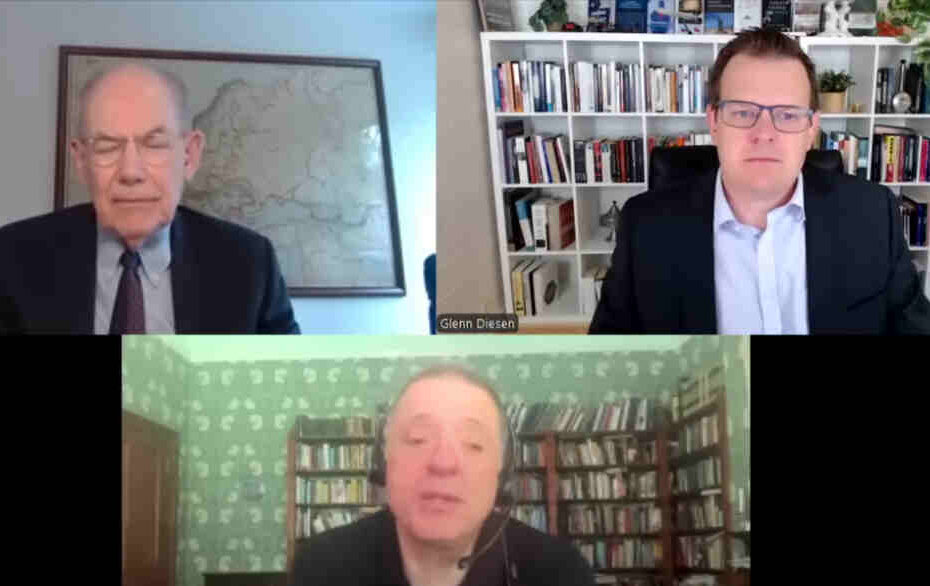
Read the full transcript of The Duran Podcast episode titled “End of the Line for Diplomacy with Ukraine” with John Mearsheimer, Alexander Mercouris & Glenn Diesen, August 21, 2025.
Introduction
GLENN DIESEN: Hi, everyone, and welcome back. My name is Glenn Diesen, and I’m joined today by John Mearsheimer and Alexander Mercouris to discuss these developments in the Ukraine proxy war. So it’s good to see you both again, and I guess there’s a lot to discuss.
Trump began his presidency by recognizing three main criteria: no NATO, accept territorial concessions, and there will be no American security guarantees, which is more or less what Russia had demanded. I guess why the three of us were a bit optimistic at the time, but then he went back to the unconditional ceasefire, which means not actually addressing any of the things that Russia demanded.
And now there’s been this sudden return or at least seemingly a return to no NATO, some territorial concessions, yet a lot of ambiguity what exactly security guarantees would entail. So I’m very interested to hear what the two of you make of this. John, why don’t you start?
The Security Guarantees Confusion
JOHN MEARSHEIMER: I’ll say this. I mean, I think that this whole idea of security guarantees came out of discussions that he had with Putin in which clearly they did discuss the security situation in Europe and in Ukraine. And this is where I’m starting to get concerned because it was then taken away from that meeting in Alaska as if the Russians had agreed to security guarantees, which I don’t think they have, at least not in the sense that they’re being talked about in Europe now and by Trump himself.
Trump sometimes gives the impression that he’s giving security guarantees to Ukraine on behalf of the United States. Then he pulls back on that. Then one moment he talks no troops on the ground, then he floats the idea of the United States playing some kind of a role in terms of air power and all of that. Then we are back to talking about sending European troops to Ukraine and the Europeans giving security guarantees, but supported in this by the United States.
ALEXANDER MERCOURIS: The Russian foreign minister Sergei Lavrov has now made quite clear over the course of an interview that the Russians are not in agreement with any of this. There were security guarantees negotiated between the Russians and the Ukrainians back in April 2022 as part of the Istanbul agreement.
I think the word “guarantee,” by the way, is altogether too strong. There were some kind of security assurances. There was going to be a collection of countries that were going to say that Ukraine should be protected within its own territory at the end of the war. One of those countries was going to be Russia. The European countries and the United States would be those countries, other countries as well.
China was going to be yet another country. And there were other countries, including, as I remember, Israel and several others that were also going to provide these security guarantees.
The Istanbul Agreement Framework
ALEXANDER MERCOURIS: The security guarantees envisaged that there would be no foreign troops on Ukrainian territory and no deployments even on a temporary basis of foreign troops on Ukrainian territory without the agreement of each of the guarantors, which would have given the Russians veto power over any deployments of any kind of foreign troops in Ukraine. All of this in the context of an agreement, which also envisaged very tight restrictions on the size of Ukraine’s armed forces.
Now I suspect this is what the Russians have in mind or had in mind when this whole idea of protecting Ukraine’s security was first brought up with them. What we’re now hearing people talking about in Europe and to some extent in the United States is something completely different, which goes far beyond what the Russians were talking about and which looks like some kind of alliance between the western powers and Ukraine even if Ukraine for a temporary period remains outside NATO.
And, of course, that for the Russians is completely unacceptable. And, as I said, Lavrov again made that, I think, fairly clear in the interview that he gave yesterday. So there is complete cross purposes about this.
Telling Each Side What They Want to Hear
ALEXANDER MERCOURIS: I’m not sure whether perhaps the Americans misunderstood the Russians, but I have to say altogether, I do wonder whether perhaps the Americans in their anxiety to get this process of negotiations going are telling every side what they think they want to hear.
So they’re telling the Russians and, again, Lavrov clearly came away with the impression from Alaska or says that he came away with the impression from Alaska that the Americans were willing to discuss the entire security architecture of Europe, which I cannot genuinely believe the Americans do. And the Europeans are being told that there’s security guarantees on the table and that the Russians are happy with that. And, again, clearly, from what the Russians are saying, they are not.
And I think that this is dangerous because if you’re telling each side what they want to hear, the risk is that when they all come together and we do actually have a meeting, if it ever happens, we will find that everybody comes into that meeting with contradictory expectations. And at that point, the whole thing could just fall apart with leaving us in an even worse position than the one we’re in now.
Who’s Driving the Security Guarantees Discussion?
JOHN MEARSHEIMER: Well, I think the big question in my mind to start with is who’s driving the train here? Where’s all this discussion about security guarantees coming from? And in my opinion, it’s coming from the Ukrainians and the Europeans. They talk relentlessly about security guarantees.
And the reason is very simple. Not only did they want to defend Ukraine moving forward, they want to keep the Americans in Europe.
But then the question you have to ask yourself is, what does this all add up to? There’s sort of three things that they’re talking about with regard to security guarantees, two of which Alexander mentioned. I actually think there’s a third one.
The Three Dimensions of Security Guarantees
JOHN MEARSHEIMER: But the first is that if there’s an attack against Ukraine, we’re going to come to Ukraine’s rescue. This is the article five guarantee or something equivalent to an article five guarantee. We’re going to be the cavalry and come in and pull their chestnuts out of the fire.
The second dimension is they’re actually talking about deploying troops in Ukraine, at least British and French troops. The third dimension is and if you look at this memo that Starmer put out, he and Macron are both talking about building up Ukraine’s ability to defend itself.
So when you talk about the whole package of security guarantees here, there are three dimensions. One, an article five guarantee. Two, we actually deploy NATO troops in Ukraine. And three, we build up Ukraine’s military capability.
And I would just note that all three of those issues are ones that are red flags or red lines for the Russians. The Russians are not going to accept an article five guarantee from the West. This is why they oppose NATO expansion into Ukraine. Secondly, it’s inconceivable to me that they would allow NATO to station forces on Ukrainian territory. And third, one of their principal demands is that Ukraine be disarmed to the point where it’s not an offensive military threat to Russia.
The Disconnect in Western Discourse
JOHN MEARSHEIMER: How does that square with the argument that Macron and Starmer are putting forward that what we want to do is build up Ukraine’s military capability? This is just not going to happen. The Russians are going to go to enormous lengths to prevent it.
We’re in the midst of a war that’s been going on for three and a half years because the Russians categorically reject the idea of Ukraine being in NATO. And then you have all these proposals that mainly the Europeans are pushing and the Ukrainians are pushing that the Russians just won’t accept, and they’ve made that clear all along. Yet we continue to have this crazy discourse in the West about security guarantees. It never takes into account what the Russians actually think. And the fact that the Russians are actually in the driver’s seat on the battlefield, and that does matter a lot here.
So it’s just all evidence of how crazy the discourse in the West is. It’s just really kind of hard to believe these debates that we have.
Trump’s Dilemma
JOHN MEARSHEIMER: My final point on this, by the way, is that I think Trump understood after meeting with Putin that meaningful security guarantees are not acceptable to the Russians. But the problem with Trump is he then engages in lengthy discussions with the Europeans and the Ukrainians and the mainstream of the foreign policy establishment in the United States. We don’t want to lose sight of the fact that inside the United States, there are lots of people who agree with the Ukrainians and agree with the Europeans.
And he talks to all these people, the Keith Kelloggs of the world, and he likes to throw them a bone. And he’s very loose with his rhetoric, and he therefore ends up sounding like he agrees with the Europeans and the Ukrainians. And this just adds more legitimacy to this whole discourse, which, again, we should take off the table because it’s not going to happen.
The European Dilemma
GLENN DIESEN: That’s what I miss a bit in the whole thing is some rational debate around the actual security guarantees. Because if the Americans do not want to be a part of it, then what can the Europeans really do? For the Europeans, it would be too difficult. They don’t have significant forces. The Russians wouldn’t actually take it serious, I think, as a tripwire.
If you put British or French troops there who have been helping to kill Russians now for three and a half years, would they really be spared if the Americans do not stand solid behind them? So the small European forces which would be there wouldn’t even be a credible tripwire.
And also why do we really want this in the west? I mean, there’s a reason why we haven’t gone to war with the Russians. If you give a security guarantee, you create immense incentives for Ukraine to restart this conflict and for good reasons. This war is coming to an end on very bad terms. This will be a humiliating and painful peace for the Ukrainians.
Now if they suddenly have this very firm security guarantee which they can then try to trigger to pull the Europeans into this war, that would be a pretty great incentive especially for the hardline grouping who seems ready to fight to the last man. Again, Ukraine isn’t that consolidated. It’s not necessarily only one voice, especially that I think would be evident after this war.
Trump’s Impossible Position
GLENN DIESEN: But I was wondering what you guys thought about the dilemma that Trump is facing because he doesn’t seem to be able to move the Russians significantly because they don’t think that they have to, given that they’re winning, but also they can’t because they say this is existential. But the only way Trump can pressure the Europeans and Zelensky is by cutting the ties. But if he cuts the military supplies, then he can be blamed for the failure.
So how is this selling weapons to the Ukrainians? Is this not to the EU? Who then give it to the Ukrainians? Is this a middle road, or how are you interpreting this strange development?
Trump as an Outlier
ALEXANDER MERCOURIS: Well, I think a lot of the answer goes back to a point that John has made in many programs, which is that Trump himself is very much of an outlier here. And he’s not only up against the Europeans who have exactly the kind of rationale that John was saying, that they don’t want the United States to leave Europe. They want to keep the United States in Europe. That’s why they’re pushing for security guarantees for Ukraine. That’s why they want if they can’t get boots on the ground in Ukraine, American Air Force patrolling the skies over Ukraine, all of those absurd things. That’s why they’re talking about this.
But he also has to contend with a very large community of people in the United States, in the foreign policy establishment, the defense establishment, the media within his own administration who are completely unreconciled to what he’s trying to do in Europe, with Russia, with his wider foreign policy.
And I think he tries to move the process forward by doing constantly what John is saying, which is throwing these people a bone, trying to split the difference with them, hoping that eventually he will get to where he wants to be before they catch up with him and try to pull him back in. I think this is a high risk approach, actually, and I’m not sure this is the correct way to do it, but I think this is how he operates. And I think this is the cause of a great deal of confusion.
European Resistance to American Strategy
ALEXANDER MERCOURIS: Can I just say, it’s a point I’ve made already in other venues, which is that when you put aside all the noise and all of the rhetoric and everything that’s been coming out over the last weeks, there has been one public agreement between the Russians and the Americans, and it is the Americans who have agreed that there will not be a ceasefire, that there will be movement towards a full negotiated solution to the conflict, and there won’t be a ceasefire in the meantime, which might very easily lead to a freezing of the conflict or at least that’s what the Russians have been afraid of.
The Russians have consistently pushed back against the idea of a ceasefire. Trump has now conceded to the Russians on this. So perhaps it’s understandable that he’s throwing out all of these words, all of this noise about security guarantees, about the Russians agreeing to freeze the front lines in some places if the European Ukrainians pull back in other places in order to keep people talking about these other things rather than the fact that he’s conceded on the point of the ceasefire, which, of course, leaves the Russians in a position of advantage because without a ceasefire, they’re able to continue advancing and winning the war in Ukraine.
JOHN MEARSHEIMER: I agree with that a hundred percent. But I would note that once you take the ceasefire off the table and you say that you have to have a final peace agreement, the whole issue of security guarantees is integrated into that final peace agreement. In other words, for security guarantees to be realized, the Russians have to agree in the final peace agreement that security guarantees that include the deployment of NATO forces on Ukrainian soil, is okay with them. And as we have said, and I think anybody with a triple digit IQ and an interest in facts and logic understands, that’s not going to happen. The Russians are not going to agree to that in a final peace agreement.
So this is not a serious issue. It’s just more of the empty debates that we have in the West all the time.
Trump’s Strategic Distancing
JOHN MEARSHEIMER: I want to talk a little bit about Trump and what’s going on here. I think Trump is, in a very subtle and clever way, trying to distance himself from this war and turn the responsibility from managing the war over to the Europeans and to the Ukrainians themselves, of course. Now, Glenn, this is picking up on a point you make.
Trump is in a situation where he has to be very careful when the Ukrainian military finally loses in a serious way that he’s not blamed. So what he wants to make sure he does is not cut off the flow of weapons and not cut off intelligence because he doesn’t want to be blamed when Ukraine finally loses. And what he has done here is he’s come up with this clever strategy where Europe buys weapons from the United States. Europe pays for those weapons, and Europe ships those weapons to Ukraine. So Trump can say the Ukrainians are still getting American weaponry.
It’s just that I’ve been clever enough to get the Europeans to pay for them and ship them to the Ukrainians. The Biden pipeline is not going to end, but it’s not going to be the Trump pipeline, at least from a public relations point of view. It’s going to be the European pipeline. It’s going to be a bigger pipeline because those American weapons are coming in. So the Ukrainians are going to continue to get weaponry from the west to include the United States.
But Trump is going to be able in a very subtle way to distance himself. Then just think about the meeting that he’s trying to set up with Zelensky and Putin. You notice he says, “I don’t want to be there for the first meeting.” This is Donald Trump who’s always the master of ceremonies, who always likes to be center stage. He’s saying, let Putin and Zelensky get together and solve this one.
Yeah. And I think the reason is that he understands he can’t solve this one. He can meet with Putin. He and Putin can agree. Alexander was getting at this before.
There’s not much daylight between Putin and Trump. The problem is that Trump can’t sell anything he agrees to with Putin to the Europeans and the Ukrainians. Okay. Then let the Ukrainians and the Europeans deal with the Russians. Let them talk to Putin.
Let Zelensky get together with Putin. And all and at the same time, everything that’s happening on the battlefield will influence how Zelensky and the Europeans deal with Putin. And Trump surely realizes that with the passage of time, Ukraine, which is already in dire straits on the battlefield, will be in an even worse situation, and there’ll be more of an incentive than ever moving forward for the Ukrainians and the Russians to cuts Ukrainians and the Europeans to cut some sort of deal with the Russians. And Trump can sit back, let them do it. And as things deteriorate on the battlefield, he can say, “I cannot be blamed for this because I did not cut off the flow of weaponry to the Ukrainians.”
So I think this is basically what’s happening here. It would be a very clever strategy, though, because, again, that’s evident that NATO has lost the war.
The European Dilemma
GLENN DIESEN: So, you know, if you’re advising Trump, this would be a good way to well, first, get your money back. That is to have the first Ukrainians hand over all some of their minerals, then, of course, getting the Europeans to accept that they will buy the American weapons to send to Ukraine. That also enables Trump to outsource the containment of Russia to Europe while he can get along with the Russians both in bilateral relations and, you know, possibly work together in Asia.
But, and also when the whole thing goes south, the Europeans get to take the fall and blame for the whole thing. So it does make a lot of sense in terms of, you know, losing a war. This is a good way of going out. But I guess my question is, what’s in it for the Europeans? Because I see the Europeans, you know, sit there like good schoolboys in the Oval Office.
But the people like Merz is still suggesting that, you know, oh, we really need this ceasefire and we commit ourselves to, you know, continuing to fight. Von der Leyen starts to speak of another sanctions package. I’m not sure if this is nineteenth or twentieth. I kind of but I’m sure this one will do the trick. But it’s how do you make sense of the European position?
Because I can understand very well that the Ukrainians will have a hard time swallowing this. I understand, you know, for them, the Russians are an existential threat. I understand the Russians. They see NATO in Ukraine as an existential threat. I get the Americans if they wanted to, you know, want to pull out of this losing war, but I just can’t make sense of the European position. It’s very, very strange to me.
ALEXANDER MERCOURIS: It is very strange, and it’s also, can I just say, an extremely undignified position? This is something that even the British media is now talking about. There’s been articles in the British media yesterday and today about what a shabby picture the leaders of Europe cut in the White House.
You know, they were all there as if they were listening to this, you know, the school teacher and that they were being given a lesson. I mean, it was unattractive. But, ultimately, it all comes back to this desire to keep the Americans in Europe. And what I think they’re doing ultimately is they’re playing for time, trying to keep the ball going, trying to keep the Americans involved, trying to the extent that they can to turn Trump against Putin again. I mean, this still seems to be part of what they’re trying to do and basically wait out Trump or hope that Trump himself ultimately loses patience with Putin and reverts to the kind of strong position that, as they would say, that Biden had.
So I think this is really what all they have, and I think that’s all they’re doing. There are voices of dissent starting to appear. There was an article in the Daily Telegraph, which is an important newspaper, by the way. It’s very, very close to the British defense and security establishment. There was an article by a man called Owen Matthews, who’s a well connected journalist here. And he said for the first time that not talking to the Russians for Europe had been a catastrophic mistake, and that the time has come to start negotiations, to start a dialogue, a European dialogue, a proper European dialogue with the Russians. Now for the moment, that’s still unusual. It’s the first article of that kind to have appeared. But, you know, a swallow might point to the coming of summer. We’ll just have to see.
The Question of Existential Threat
JOHN MEARSHEIMER: I have a question for both of you as Europeans. Do you think that the European elites, the present cast of characters who are running the European countries, except for maybe Viktor Orban and one or two others, do you think they view Russia as an existential threat? When I listen to European leaders and lots of you European commentators talk. It seems to me that they’ve convinced themselves that Russia is going to take all of Ukraine. It’s going to conquer countries in Eastern Europe, and it is a serious threat to Western Europe. And if we don’t stop them now, we’re going to pay a god awful price down the road. I mean, I think this is ludicrous, and I know you two do as well. But do you think that the governing elites in Europe seriously believe that Russia is an existential threat?
GLENN DIESEN: Well, it’s hard to mean, they it’s possible that they have convinced themselves, but I find it strange because people like Macron in her time, Merkel as well, they all recognize the dangers of trying to construct a Europe without Russia, more or less recognizing it would unavoidably become a Europe against Russia. And so it kind of contradicts with some of the former statement. But also, if Russia’s really an existential threat, why haven’t we been building proper armies? Why not join the fight with the Ukrainians? Why aren’t we trying to take Moscow if we really think we’re fighting Hitler here? I mean, this is very, very strange.
I think it’s a bit like the security guarantees. I think the main purpose the reason why you want security guarantees with the Americans is to lock in the Americans on the continent that the US won’t pull out of this transatlantic partnership. I think they see the world going in a multipolar direction. They’re doing what they can to keep the Americans there. And they’re you know, when they sign this god awful trade agreement with the EU. Even the EU officials were recognizing, well, it’s not just the trade agreement. We have to strengthen the partnership and try to elevate the role or the value of Europe for the Americans. So I have a hard time believing it.
On the other hand, you know, human beings were vulnerable a bit to the to group think or we subordinate our, you know, rationality to this group psychology and when every politician, every newspaper, every TV station says exactly the same thing, anyone who dissents or criticizes this is immediately a Putinist and, you know, that what do call it? Almost like a fifth columnist. It’s after a while, after three and a half years, think it’s just very difficult for anyone to push back. I don’t know. I at least spoken to several former diplomats in this country who, you know, who would call, say, yeah, of course, this is crazy. This is nonsense. But no one would actually speak up because, you know, you would have your head chopped off.
So it’s a I it might be some mass delusion, but I think it’s fake. But that’s my opinion now.
Regional Variations in European Attitudes
ALEXANDER MERCOURIS: Well, I think this is right. I mean, hysteria, when it is so widespread, does pull in an awful lot of people. And, a lot of this probably conceals deep doubts. I suspect that it’s different in different places. So if we’re talking about the Baltic states, which, of course, very small, but we which wield an enormous amount of influence. I suspect that there, some of the Baltic leaders probably do generally believe much of their rhetoric. They’re very close to Russia. These countries were part of the Soviet Union and then the Russian Empire.
Until very recently. They feel very vulnerable, and they’re very nervous of Russia, and they’ve got historical reasons to be. And I think this rhetoric, when it comes from them, probably has some basis and truth in it or some genuine belief behind it. If you’re talking about Spain, then they don’t believe it at all. I mean, the Spanish government not only is resisting putting up defense spending to five percent of GDP, but it’s actually passing off some of its welfare and civilian infrastructure spending as defense spending in order to massage the statistics.
Italy, by the way, is doing the same. The British government talks incessantly about an existential threat from Russia, but it’s only going to bring defense spending up to five percent of GDP if it ever does by twenty thirty five. So what is supposed to happen between now and twenty thirty five? So there is a lot of rhetoric, a lot of worry, a lot of anger, a lot of fear that the Americans are going. But I don’t think amongst the bigger states, this reality, this real fear, if you put get below the hysteria, is really there.
The Challenge of European Political Investment
What I think perhaps does play a role and which drives it to some extent is this. If the Americans were to leave and the Russians were to come out of the war appearing to be the winners, then a lot of the processes of European construction that we have seen play out over the last three decades, the way in which the European Union has been built up, the way it’s been organized, all of that would indeed be under challenge.
And, of course, with that, the political positions, not just of individual politicians and leaders in Europe, but of some of the political forces that they lead, would find themselves under challenge as well. So it may not be an existential threat from Russia in the sense of the Russians marching into Europe, taking everything over, and changing everything and subordinating it to themselves. But it could lead to a different Europe from the one we have now, and those who are invested in the existing Europe would probably be very alarmed by that prospect.
JOHN MEARSHEIMER: I was going to say Alexander took the words right out of my mouth. I think that is what’s going on. I put just a finer point on it by saying that the package of developments that you described could be defined as an existential threat. In other words, the end of NATO and America pulling out of Europe in a serious way coupled with a Russian victory in Ukraine. That whole package could be seen as an existential threat. So it’s not just Russia per se, as you were saying, that the elites are so concerned about. It’s the whole package.
Europe’s Exposed Position
GLENN DIESEN: Well, I think Russia being the new, trying to restore the Soviet Union – obviously, this is all nonsense. But that being said, you can’t really rule out that the relationship isn’t going to go back to the way it was when this war is over. It’s worth knowing that the Europeans tended to be a bit cautious.
If you remember, the Germans limited themselves to sending helmets. They didn’t want to end up provoking a military response from the Russians. Well, in this war though, we really went all in. That is, the Europeans now have become well supported and complicit in the killings of tens of thousands of Russian soldiers for three and a half years.
They talk about the strategic defeat of Russia on the battlefield, destroying its economy, isolating it in international system, putting pressure on other countries to do so. You had Kallas talking about breaking up Russia into smaller nations. You had similar comments from the Polish president. He called it a “Russia prison of nations,” two hundred nations captured in Russia.
I mean, we went really all in on this and we would never have done so if the United States didn’t stand right behind us. And now the war is lost and Americans are walking away. This is a very, very exposed position. So I do on some level understand why the Europeans now are getting a bit nervous.
But this feels like doubling down when it’s obvious that the Americans will leave. This will be the time to try to kiss and make up, I would think. This will be, from my perspective, a legitimate concern, which the Europeans should have for Russia, because there’s a lot of anger now in Moscow towards the Europeans, especially the Germans.
The Path Forward: Battlefield Realities
JOHN MEARSHEIMER: Well, the question you have to ask yourself is where does this leave us? Where are we headed? I mean, I think it’s quite clear that we all agree that you’re not going to get a meaningful peace agreement. If anything, it seems like the distrust on both sides is growing.
The mere fact that we’re even discussing whether the Europeans think Russia’s an existential threat. And you, Glenn, just said that the Russians are angry toward the Europeans for understandable reasons from their point of view and especially angry towards the Germans. And the Germans are as hardline as the French and the British.
I mean, where does this leave us? There’s, I think, no way you’re going to get a meaningful peace agreement. And as Alexander emphasized before, the ceasefire is off the table. So, again, it just seems to me it all comes down to what happens on the battlefield.
ALEXANDER MERCOURIS: Absolutely. That is what’s going to happen on the battlefield. And here, just to make an observation, which is that those who’ve been following the battlefield closely, which is all three of us have been discussing many times the importance of the fighting in Donbas and the way the Russians have come up against the last big barrier there.
One of the useful things that’s come out over the discussions of the last week is that there’s finally an admission in the media at large, at least here in Europe, about the fact that this is basically the big fortified barrier that Ukraine has been defending itself behind. And that if it is broken, then Ukraine is going to be in very difficult position indeed, not just in terms of Donbas, but in terms of its overall position.
Russian Strategic Preferences
Now I remain of the view that despite all that we’ve been hearing about the Russians, the distrust in Europe of Europe, there are continuing concerns about the US. They would still prefer a peace agreement. I think that what the Russians are probably hoping is that as they break through this last remaining big barrier, as they see their army becoming more successful on the battlefields, over the course of a negotiating process, there will be more and more pressure ultimately from the Americans upon the Ukrainians to make more and more concessions, leading to something very close to what the Russians proposed in Putin’s speech to the foreign ministry last year.
I still think the Russians don’t want to go to Western Ukraine. I’m not convinced they want to cross the river, the Dnieper. I don’t think they want to do any of those things. That would be, from a Russian point of view, the optimal outcome.
The danger is that with this animus towards them that John was talking about, the Europeans don’t see this. The Ukrainians refuse to see this. They go on fighting and continue to fight even as the Ukrainian defenses in Donbas break down. They spurn any American attempts to get the Europeans, the Ukrainians to come to terms with the Russians on the kind of terms that we’ve just been talking about.
In which case, of course, the Russians will break through to the river, and then we will have a crisis on our hands much bigger than the one we have now. Because the Russians might not want to cross the Dnieper, but they might feel that they have no choice, and we are in exactly that desolate situation that, John, you’ve warned about in many programs that we’ve done and in many places where we have an indefinite crisis in Europe with two armed forces facing off against each other.
The Russians positioned where they don’t want to be, where there’s no real agreements between either of the sides, and Europe is in a state of continuous military confrontation against Russia, which doesn’t want to be in that position either, but which also finds itself there. So that is a very real possibility, and to avoid it, it depends on a level of statesmanship from the leaders of Europe, which we have absolutely not seen up to now, and which would mean them going back on their rhetoric and doing what Owen Matthews was talking about in the Daily Telegraph, which is beginning their own contacts with Moscow, of which for the moment, it must be said they show no sign.
Ukraine’s Deteriorating Position
JOHN MEARSHEIMER: I’d just like to say a few words about the course of the war. If you sort of look at what’s going on in the battlefield, it’s quite clear that the Ukrainians are suffering enormously from the fact that they don’t have enough infantry. And you need a lot of infantry to populate the forward edge of the battle area, what we used to call when I was in the military, the FEBA. And they just don’t have enough infantry. And as time goes by, I think the infantry forces thin out even further.
So just looking at the battlefield itself, it’s just hard to see how the Ukrainians can stem the tide much less reverse it. And then you go to the home front. Public opinion in terms of support for the war has tanked. It looks like around seventy percent of Ukrainians want to settle this one. They’ve had enough of the war.
So when you put what’s happening on the battlefield together with what’s happening on the Ukrainian home front, it’s hard to see how they can sustain this war for a long period of time. And then take it even a step further, the Americans. The Ukrainians surely understand both the body politic and people on the front lines and the elites that the Americans are slowly but steadily divorcing themselves from this conflict. That can’t help but have a negative effect on Ukraine’s willingness to continue this conflict.
You just think that this can’t last that long from a Ukrainian point of view. I understand that Ukrainian nationalism is really a powerful force that allows the Ukrainian military to fight under the most adverse circumstances and to do remarkably well given the disadvantages they’ve had up to now and will have moving forward. It’s quite amazing how hard nosed and tough the Ukrainians are.
But at the same time, that was true of the Germans in World War One. And in nineteen eighteen, they had just had enough. Events on the home front brought the Germans to their knees, coupled with what was happening on the battlefield. And it’s hard to see that not happening here.
Trump’s Strategic Position
And I think when that happens, it’s going to be a devastating blow for NATO. And as we were saying before, you want to remember that what Trump is trying to do here is he’s trying to shift responsibility for the war to the Europeans and to the Ukrainians, and he’s trying to back off himself. And he wants to leave himself in a position where he’s not exposed because he’s giving weapons through the Europeans. So I think the Europeans are going to end up with egg all over their face.
And by the way, one other argument that Trump can make is, “Listen. I talked to Putin in Alaska. Putin and I were willing to settle this one, and it was the Europeans and the Ukrainians who were roadblocks. And now that things are going south, you want to blame me. Don’t blame me. If you would listen to me after Alaska, we could have solved this one then. But you wanted to continue fighting. I didn’t. Look what’s happened. We’ve lost this war.”
And, really, when you get right down to it, you, Europe, and you, Ukraine, have lost the war. So I think that’s sort of where we’re headed here. It’s hard to say for sure, but it certainly looks that way to me.
The Reality of Attrition Warfare
GLENN DIESEN: Well, we just discussed the rationality of threats analysis in terms of whether Russia’s trying to restore the Soviet Union. But I think this is also a problem with the analysis of the front lines because I keep hearing in all media reports from politicians, when they want to build up a case why we should continue this war as well. “The frontlines haven’t really moved that much. And if you look at the big Ukrainian map and it’s full, it’s only tiny slivers the Russians are able to take. So it’s this glacier speed.”
But from my perspective, this is very dishonest because this is not – again, this is a war of attrition. I made that point until I was blue in the face. That is, you don’t storm heavily fortified defensive lines and bleed out all your forces and equipment in a war of attrition. You destroy the enemy. And once they’re destroyed, they’re exhausted. And as John suggested, when they’re not able to man the front lines anymore and there’s more holes popping up, then you go for the territory.
And I feel this is the moment we’re currently in. Big places like Kupiansk is being encircled, Pokrovsk is encircled. Konstantinovka, not just encircled, semi encircled, but the Russians have now entered the city as well. If this falls, combined with the breakthrough north of Pokrovsk they can begin to encircle slowly both Kramatorsk and Slaviansk. This is going to be very problematic.
You’re going to have logistics cut off. The Russians will be able to build up more forces closer to the frontline as well as the logistics. The Ukrainians don’t have that many frontlines which are reliable. As we often see at the end of wars, the casualties begin to spike on the Ukrainian side, more desertions, people don’t want to fight anymore. You’re seeing all of these things happening now.
But when you address the analysis coming from especially the European politicians, it’s like, “Well, this war could last for another hundred years. Look how slowly the movements are forward,” but that doesn’t really mean much. When there’s no more soldiers to hold the front lines anymore, suddenly you see huge groups of soldiers being encircled, captured, killed. Things are going to go from bad to worse very soon, I think. So it just feels Trump is ready to save the day for the Europeans, and we’re fighting him to the bitter end.
The Reality of European Vulnerability
It’s very strange to watch. Well, I agree with that completely, and I would add that we don’t actually have much time in Europe to prevent the worst. Because, of course, if there is a Ukrainian collapse in the front lines, if the Russians reach the battle through to the Dnieper or something like that happens, then we’re in a very, very difficult position. Indeed.
And all of this constant rhetoric about the Russians only moving a few hundred yards or whatever it is and that the war will go on for another four years and that the Russians will lose, was it, two million men or something like that, capturing the remainder of Donbas.
All of this, all that it does is it reinforces in well, apart from being very cruel, it reinforces a dangerous complacency in Europe that we have plenty of time and that we can maybe wait this out and string the Americans along and keep the Ukrainians still fighting. And then Trump will go away, and things will be alright somehow in some kind of a way.
I don’t think we do have a infinite amount of time. I think we have very, very short amount of time. I mean, I think that what John’s analysis about the state of the conflict is absolutely correct.
But one has to get breakthrough this conceptually as well to understand that we are closer in Europe, specifically in Europe, to a much bigger crisis than we believe ourselves to be in. And that might not be that far away. It might be months away, certainly not years.
And the United States, to repeat again many point made many times, the United States is look. It’s an ocean away. It’s well protected. It’s huge. It’s rich. It can get by whatever happens. It won’t be directly affected.
But if we end up in a situation in Europe where the Russians battle through to the Dnieper and we still haven’t come to any kind of agreement with them, and we might have political chaos in Ukraine, and the Russians might feel obliged because they don’t want chaos on their borders to move beyond the deeper or something like that, then we would be in that situation of desolation that John has talked about in many programs.
And the people in Europe who are going to be affected by is us, not the Americans. The Americans can do many things. We will be in that crisis. At a time when our economies are in crisis, our financial systems are in crisis.
I was reading, recently an analysis about how we have no plans in Europe about how to increase productivity, which in Europe has been falling. We are nowhere close to where the Americans and the Chinese are in developing the new technologies. We’re fact falling further and furthered behind. And if we have this crisis on top of that, then, frankly, the outlook for Europe and its people is very bleak indeed.
Russian Military Strategy: Sophistication Over Brutality
JOHN MEARSHEIMER: Yeah. I agree with that. I want to make two more points just about the war of attrition. I believe that if you look at how the Russians have waged the war, they’ve waged it in a very sophisticated way. And the Ukrainians sometimes say that, including general Sierski.
If you compare World War one to Russian strategy in this war, it’s actually quite different. In World War one, both sides would take massive forces, get up out of the trenches, and attack head on into the teeth of well fortified defenses, and huge numbers of people would die. Think the battle of the Somme. Think you’re done, and so forth and so on. It was incredibly bloody. And in the process, the allies and the Germans, whichever side was on the offensive to start with, ended up conquering very little territory. The front lines hardly moved at all.
What the Russians have done is they have avoided, for the most part, frontal assaults, especially in more recent years. And they use clever tactics. This is not to say that they don’t suffer significant casualties because there’s no way you can fight a war of attrition and not lose lots of people. But the Russians have not lost that many people, and they have not gained much territory in large part because they’ve not focused on that.
They focused on using clever tactics to isolate the Ukrainian forces and kill more Ukrainian forces than kill Russian forces. Right? So it’s just very important that one not emphasize territory. Not that we were doing that, but many people on the outside do. Capturing territory is not the name of the game here. It’s the casualty exchange ratio. And the Russians have done, I believe, as good a job as you can, in minimizing casualties.
Historical Parallels: 1918 vs. 2025
Second point I’d make, just to go back to comparing World War one with the present war. If you look at nineteen eighteen, in the spring of nineteen eighteen, March nineteen eighteen, the Germans launched the famous Ludendorff Offensives, and it looked like the Germans might win the war in the spring of nineteen eighteen.
Remember, had knocked the Russians out of the war in October of nineteen seventeen. That’s when the communists came to power, the Soviet Union came into being, and they dropped out of the war. And all those divisions that were on the eastern front were moved to the western front. So the Germans had a significant advantage in March nineteen eighteen when they launched the famous Ludendorff offensives.
Those offensives failed. And by the summer, the Germans were in deep trouble, and, of course, the war ended in November.
Now one of the key reasons that the Germans did not win the war was that the Americans came in. The Americans declared war in April of nineteen seventeen, but they did not have substantial troops in Europe until the spring, late spring of nineteen eighteen. And it was the coming of a massive American army, this infusion of infantry, this infusion massive infusion of trigger pullers on the allied side that convinced the Germans that they could not win the war after the Lutendorf offensives failed.
Now what about the present situation in Ukraine? The Americans are going in the other direction. Yeah. The Americans are not coming in. The Americans are pulling out. Just think of our discussion of security guarantees. Just think of Alexander’s discussion of how secure the United States is, how it has that big ocean, how the United States can go cause trouble around the world, and then when things go south, just pull out, and it’s still secure.
But, anyway, to go to Ukraine, we are slowly but steadily withdrawing our support for Ukraine, unlike the situation that you saw in nineteen eighteen. And this is why I think Ukraine is doomed.
The Cauldron Strategy
GLENN DIESEN: Yeah. Well, the the Russians, they call it cauldrons when they do the semi or almost full encirclement of key strategic regions. And it’s quite clever because these key regions, which is import are important to the Ukrainians, the Russians make sure that they get the the main supply roads under fire control to make sure that there’s heavy losses as they do their supplies in and out and rotation in and out of these cities or regions.
Now what you often see then is that the Ukrainians are rushing troops into these cauldrons in order to hold them so they won’t the Russians won’t have a breakthrough. And, again, they take all these heavy losses only entering and leaving the city only to find that the Russians are not really in a rush. That they find this they create these scenarios or situations where they have very favorable attrition rates, the Ukrainians are taking massive losses.
And often they find the Russians don’t seem to be in a rush to take these territories because this is an opportunity to grind down the the Ukrainian army. So, no. I I don’t know. I just feel we watched the same thing happen over and over again, and it doesn’t seem to impact the narrative, which our politicians and media seems to push.
They saw the Russians aren’t able to take this territory. Well, they created a perfect scenario where the Ukrainians take huge casualties and the Russians have minimal. Why would they be in a rush? It’s just it’s, you know, if if we’re allowed to say something positive about Russia in the West, we could admit that in a war of attrition, this is a clever move. But, you know, every every narrative has to be that the Russians are stupid. They’re having human waves. They don’t care about lives even though it’s strategic to preserve life when you’re in a war of attrition.
Russian Military Intellectualism
ALEXANDER MERCOURIS: Yeah. I just wanted to well, unless you have other comments on I’ll just make one very quick comment about this, which is about rules of attrition. Now I’m not, as I’ve said many, many times, a person with any sort of military background or a previous interest in military things. But one thing I have learned is the extent to which the Russians have an intellectual approach to war.
I mean, this is what the general staff in Moscow is all about. It’s got vast numbers of military academies and institutions and all kinds of things. And they are the sort of people who, more than perhaps, you would find in militaries in other places, would probably look at a problem like the one that they were confronted in in u with in Ukraine initially, a country, a very large country, a sophisticated and advanced country with relatively sophisticated armed forces.
And they say to themselves, how ultimately are we going to win a war against an adversary like this? And you can imagine that they sat down and worked it out and planned it out in advance. It’s not, I think, if you know how the Russian military system functions. It’s not, I think, completely surprising that they do that.
I mean, the amount of time and resources and energy they give to thinking about war is very unlike what we see in the west. It’s the one thing they do very well.
Military Learning Curves
JOHN MEARSHEIMER: The other thing I would say, Alexander, is that all armies learn in the course of the war. So if you look at the Russian army in twenty twenty two, it was a much less effective fighting force than it is today because, again, armies learn.
You know, I’ve looked at, the Soviet performance in World War two and, the exchange ratio in terms of lost armored vehicles, in nineteen forty one. This, of course, is when Barbarossa took place from June twenty second nineteen forty one to December eight nineteen forty one, the exchange ratio in lost armored vehicles was about seven to one in the Germans’ favor. In other words, the Soviets lost. The Red Army lost seven armored vehicles for every one that the Germans lost.
By forty four, late nineteen forty four, early nineteen forty five, the ratio is about one to one, close to one to one. The Soviets have really learned how to fight those panzer divisions. They’ve gotten much more effective.
Now you say to yourself, John, well, what about the Ukrainians? Don’t they learn as well? I do think the Ukrainians have learned. And if you listen to them talk, they’ve learned for sure. But the problem is their military has been hollowed out. It’s not that they haven’t learned. It’s that the fighting forces, as we’ve talked about with regard to their infantry, have reached a crisis point. They’re not able to train forces. They recruit people and basically ship them to the front lines. This is a disastrous situation.
The Russians on the other side not only have been learning, but their forces are anything but hollowed out. They’ve raised huge numbers of forces. That rather small and not terribly effective Russian army of nineteen twenty two excuse me, of twenty twenty two is a much bigger army today and a much more effective army. And I think this explains a lot about where the war is heading these days and where it’s likely to head moving forward.
The Territorial Question and Diplomatic Prospects
GLENN DIESEN: Yeah. So well, we all seem to think this is going to end in a that we’re going to end on the battlefield or at least more pressure is going to have to be the Europeans going to have to come under greater pressure before accepting these very harsh terms of the Russians.
What I find interesting with the territorial issue, though, is the the the argument is, well, we they can’t walk out of Donbas, the territory, which the Russians do not hold yet because this is where all the great front lines are and but also all the great defensive lines. Because from what I understand, the Russians would be willing to make some freeze freeze the front lines or change the borders of Kherson and Sapporoisia. But but Donetsk, they want everything.
However, every day that passes, this will be less painful, I guess, because more territory will fall to the Russians. Not so there will be less to give up in Donetsk, but at the same time, the Russians will then begin to take more out of Saparitia, especially if they now open up this frontline, which there’s been a lot of talk about. Well, I guess to some extent they already are.
So but yeah, I want to just yeah, guess my last issue I wanted to ask the both of you was where where where do we go next in this diplomatic efforts by Trump? I’m not sure if he really believes in it or not, but again, the first step was Trump Putin. The second was Trump Zelenskyy plus his European entourage. Next one would be either Putin Zelenskyy or Putin Zelenskyy and Trump.
But do you see this moving forward? And or, again, if his main goal is to tell people what they want to hear, so he tells Europeans and the Russians two different things, won’t this all fall apart when he brings the two parties together?
JOHN MEARSHEIMER: Well, I would ask you, Glenn. What’s the deal here? I mean, what’s the compromise deal that both sides can agree to? For for Trump to bring them together assumes that you’re going to get some sort of agreement. I I don’t see any basis for an agreement. So why do you think there’s any chance of this working?
GLENN DIESEN: I agree, Glenn. No. No. I well, this is why I I do think, you know, that both of these meetings could go well. That it now would it go well?
The Reality of Failed Negotiations
ALEXANDER MERCOURIS: Because he could, as you suggest before, he could tell the Russians what they want to hear. He can tell the Europeans more or less what they wanted to hear except for the ceasefire. But I don’t think it would go well at all with meeting both Zelensky and Putin because, well, they’re too far apart. And I think no deal here, Glenn. It’s just no deal.
GLENN DIESEN: Oh, exactly. So it looks like this would blow up in his face. And the idea that they would be rushed ahead before – I mean, why would they meet if there’s not a deal in place? You know, Putin and Zelensky aren’t negotiators. It’s very strange to me that, you know, isn’t this the last step of negotiation?
You bring in the big guys to shake hands and to sign some papers, but, you know, what about the small guys, the ones who actually, you know, hatch out the deals? They seem to have skipped that whole part, which is a bit strange.
ALEXANDER MERCOURIS: Well, I don’t know that there’s going to be any serious meeting between Putin and Zelensky. I think Putin can conduct a negotiation. I think he’s the sort of person who would be very good at negotiation.
I think Zelensky is capable of conducting an effective negotiation for exactly the reasons that John basically pointed to, which is that any negotiation at this stage of the war would require Zelensky to make concessions to the Russians on core issues, at least core issues for him, which he is not capable of making.
The only way that there could be a peace agreement of any kind would be as a result of a complete change of power in Kyiv. Zelensky himself goes. Somebody completely different takes his place and negotiates an agreement very much along the lines that the Russians set out in their terms of June 14, 2024 and accepts that the Ukraine that comes out of this crisis is going to be one which to a greater or lesser extent is going to be a bit like Finland after the Second World War in the Russian sphere of influence. Now that is a very, very tall order.
The Impossibility of Diplomatic Solutions
ALEXANDER MERCOURIS: I mean, even if you could remove Zelensky from the scene, there’s no guarantee that you could control the outcome in Kyiv. So unless there is major diplomatic pressure by the Americans, by the Europeans, the Americans and the Europeans working together to control what happens in Kyiv to try and bring about a change there, trying to get somebody completely different to take over, I can’t really see the negotiation working out at all.
I think all of this talk about a trilateral meeting and a bilateral meeting between Putin and Zelensky and holding it in Rome or holding it in Geneva or holding it in some other place – Budapest, I believe, is the latest place that they’re talking about – I don’t think this remotely addresses the core problem, which is that these two men are so far apart that there just isn’t any way that they can agree even if this meeting happens. And Zelensky himself is not going to be capable of conducting a coherent negotiation.
GLENN DIESEN: Yeah. And you want to remember when we started the program, we were talking about security guarantees and all grand schemes that are being floated. Those security guarantees make it even more difficult to compromise.
JOHN MEARSHEIMER: Yes. The situation’s just getting worse, right, in terms of reaching some sort of deal. And, again, as I think we all agree, this one’s going to be settled on the battlefield, and the end result is not going to be pretty for Europe as Alexander was articulating earlier.
The Catastrophic Cost of Continued War
GLENN DIESEN: Yeah. This is the part that is so infuriating because this is – you know, for all this talk or all these years about wanting to stand with Ukraine and all this supposed empathy, this is going to destroy Ukraine, though. Not only will they take huge casualties at the last stages of this war as things begin to collapse, they will lose more territory. They will lose more infrastructure. The ability to recover at all for Ukraine to actually survive as a nation, all of this will be undermined now.
This is – there’s nothing to rebuild if you don’t put an end to this. This is going to be – I think, John, you referred to it in the past as a very ugly peace if it is finished on the battlefield. Well, if I’m not mistaken, I think this is what’s going to happen, and it’s just that the rhetoric you get here in Europe versus the actual reality of what they’re doing – it just seems like they’re oceans apart.
And the damage that’s been done to the European economies, especially the German economy. I mean, it’s not only the Ukrainians who are losers here. It’s also the Europeans.
JOHN MEARSHEIMER: Yeah. I mean, of course, the Europeans have lost nowhere near as much as the Ukrainians have, but the Europeans have lost here. This is going to do significant damage to NATO. And you have Donald Trump in the White House. Is he going to help Ukraine recover in the years ahead? Is he going to send lots of money to Ukraine to help Ukraine recover from this war? I would not bet a lot of money on this.
This is a catastrophic situation for Ukraine. And the idea that continuing this war is going to rescue the situation for them – it’s just not a serious argument. But people like us can’t sell that logic, can’t sell that set of facts to people on the outside for the most part.
GLENN DIESEN: I agree with that. I mean, I have nothing really just to add to that.
Europe’s Greatest Failure Since WWII
ALEXANDER MERCOURIS: We have experienced the greatest failure in European statesmanship since the end of the Second World War. I mean, it has been a disaster, and it’s getting worse, and one can see that all the pieces are falling into place to make that disaster happen.
To come back to the earlier points, I don’t think there is going to be a diplomatic solution to this war. As I said, it would require too much to happen in Kyiv, in Europe for that to be possible.
Any last words? John?
JOHN MEARSHEIMER: I’m out of words.
GLENN DIESEN: Yeah. Oh, no. Yeah. Well I don’t know what to say. All these shows end on such a depressing note, but I think, you know, if you’re operating in a reality-based world, it’s hard not to be pessimistic in the extreme.
A Glimmer of Hope in US-Russia Relations
GLENN DIESEN: Yes. But, you know, one little positive out there would be Trump’s efforts to normalize the bilateral relations with Russia. Again, I don’t exclude some deception here. That is that he still would like to outsource a lot of the hostility to the Europeans. So if he sells the weapons, you know, Americans will still provide the intelligence, logistics, targeting. So it’s not as if they’re divorced, but the efforts nonetheless to have improved relations between the United States and Russia, I think this is great news for everyone.
If you have the world’s two largest nuclear powers, two of the three major great powers in the world now being able to sit down and talk to each other, which apparently wasn’t possible for three years, you know, I think the world is a much safer place. So, you know, that’s at least something, you know, if we’re looking desperately for some ending on a good note.
So, anyways, thank you both. I always look forward to this. So, yeah, thank you for your time.
JOHN MEARSHEIMER: Yeah. Thank you.
ALEXANDER MERCOURIS: Thank you, Glenn. Thank you, Alexander. Thank you.
Related Posts
- President Trump Remarks to Fort Bragg Military Families (Transcript)
- China’s Foreign Minister Wang Yi Remarks @ MSC 2026 (Transcript)
- Barack Obama on Trump’s Ape Video, Bad Bunny, And 2028 Election (Transcript)
- Transcript: Marco Rubio Remarks at MSC 2026
- Prof. John Mearsheimer: Political Pressure and Trump’s Peace Options (Transcript)