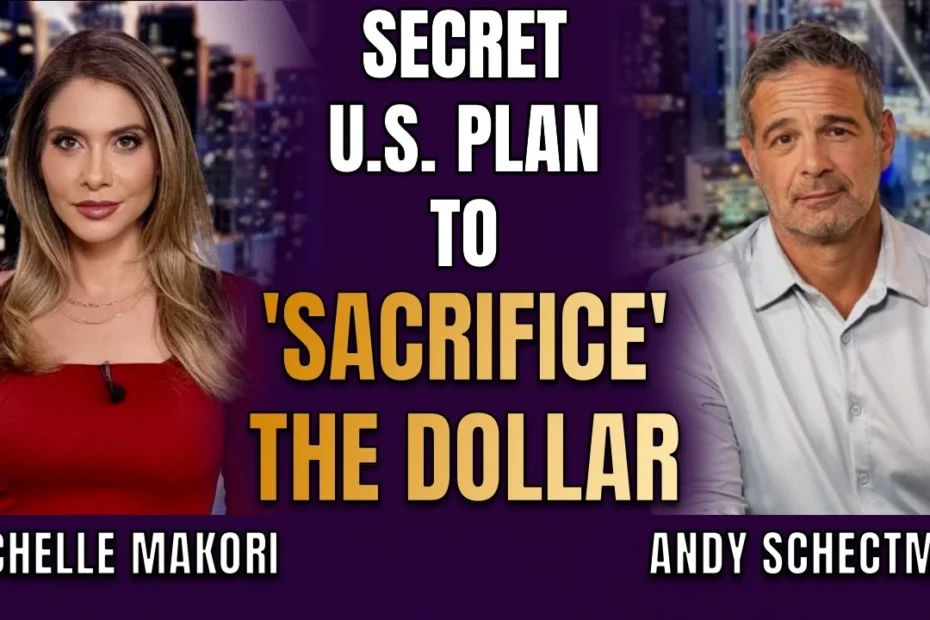
Read the full transcript of Michelle Makori, Editor-in-Chief and President of Miles Franklin Media in conversation with Andy Schectman, CEO and Founder of Miles Franklin Precious Metals on “Kill the Dollar, Save the System? The Secret U.S. Gold Reset Plan”, July 23, 2025.
The Gold Reset Theory
ANDY SCHECTMAN: I do think that gold is being brought back into the country and is quietly being reintroduced to the system to back the US treasury market, to lower borrowing costs. They’re going to let the dollar die. I think they’re going to sacrifice the currency. They’re going to destroy the currency to pay down the debt.
Since November, we’ve become a net importer. Close to $100 billion worth of gold has come into this country, just into the COMEX that we know of. This is as unusual as 4 feet of snow in the Florida Keys in July. Doesn’t happen. I’ve been doing this 36 years. This has never happened.
The point of it is, where there’s so much smoke, where’s the fire? And if you have to bring it back at that level and do so quickly, well you better do it quietly because loose lips sink ships. Maybe they want to reset the system and blame it on someone else. “Do not say a word because it’s national security.” If we don’t do something unconventional like this, then it’s going to be not just a hard landing, it’s going to be a complete and total reversal of everything. That’s when you get the reset.
The Foundation is Cracking
MICHELLE MAKORI: Hello, I’m Michelle Makori and welcome to the very first episode of the REAL Story where we go beyond the headlines, beneath the surface and behind the curtain to see what’s really happening with money, markets and power.
Right now the world is watching a slow motion crack in the foundation of the US-led financial order.
Now when people like Elon Musk start raising red flags, questioning the sustainability of the system and the future of the dollar, trying to fix the problem and failing to ignore the dollar’s decline becomes impossible even for the mainstream. But the dollar is not only facing risks from within, it’s also being attacked from outside. As President Trump put it recently, the BRICS nations are setting up to destroy the dollar.
DONALD TRUMP: “What they’re trying to do is destroy the dollar so that another country can take over and be the standard. And we’re not going to lose the standard.”
The BRICS Challenge
MICHELLE MAKORI: The BRICS – Brazil, Russia, India, China and South Africa – just wrapped their latest summit in Brazil with new member states at the table. Their message: they view tariffs as sanctions. They want to move away from US Dollar dependence. They’re increasing trade in local currencies and moving ahead with the effort to build a global settlement system that cuts the dollar out of the equation and challenges dollar dominance.
And beneath it all, there’s gold. Gold is being bought by central banks at record levels. It’s being repatriated, flown around the world, strategically stockpiled, and some argue, positioned to play a role in a new multipolar monetary system.
Even Treasury Secretary Scott Bessent has stated that we’re in the midst of a Bretton Woods realignment. Now, that is significant because Bretton Woods is what made the US dollar the world’s reserve currency after World War II, backed by gold until the 1970s. So if the Treasury Secretary is signaling a potential shift in that system, it matters.
One of the first people to make the case that a reset is happening, that gold is being reintegrated into the global financial system, that the BRICS nations are laying the groundwork for a monetary architecture that could sideline the dollar and reshape the financial world order, was Andy Schectman.
Andy, you have been connecting the dots on this global monetary shift way before it was on anyone’s radar. This is a huge macro theme. So it makes sense, of course, that we kick off the very first show with you. Good to have you.
ANDY SCHECTMAN: It’s good to be here, Michelle. Thank you for having me.
The Monetary Bifurcation
MICHELLE MAKORI: Well, we have a lot to discuss. And as I said, you really have been ahead of the curve with pointing out the bifurcation of the global monetary system and gold being reintroduced. You’ve been tracking this for years. You noticed how the de-dollarization trend was accelerating, particularly after the excessive weaponization of the dollar by the Biden administration, with kicking Russia off the SWIFT system being a major tipping point.
You started to notice how central banks around the world were moving away from dollar-denominated assets and Treasuries and buying gold at record levels. Then you pointed out how the BRICS coalition was growing, expanding, saying they want to move away from the dollar and expanding trade in their own local currencies.
Then you were saying, “Okay, looks like they’re setting up to launch a common currency, some alternative global payment system.” And all along you’ve been saying that gold is the way it’s going to happen, that it’s being quietly reintroduced into the system, not with fanfare, but subtly through strategic action by central banks and the BRICS coalition.
ANDY SCHECTMAN: Exactly.
MICHELLE MAKORI: And now you’re saying that the US may actually be forced to do the same and that it may actually help stabilize the system and preserve or extend the US’s lead in the global financial system.
ANDY SCHECTMAN: Exactly.
MICHELLE MAKORI: Okay, so that’s nailed it.
ANDY SCHECTMAN: We’re done.
MICHELLE MAKORI: So that’s what we’re going to dig into. We’re going to dive deep, but I’ll let you make your core macro thesis in your own words and then we’ll dissect the details.
The Core Thesis
ANDY SCHECTMAN: Well, I mean, I think you can make it very simple. You can start with the Global South and say that they are trying to break free from the Western hegemony largely because of the mismanagement of our monetary system, our fiscal irresponsibility, and the weaponization of the treasury market.
As far as what’s happening here, you nailed it. I do think that gold is being brought back into the country and is quietly being reintroduced to the system to back the U.S. treasury market to lower borrowing costs. There are very few ways that I can think of where you can actually have demand for the treasury without raising interest rates high enough to break the system.
So if it’s pegged to gold, which I believe it will ultimately be, you lower your borrowing costs to a level that actually might allow us to reshore our manufacturing and grow our way out of this problem. I think that’s where we’re heading.
The Failed BRICS Launch
MICHELLE MAKORI: Okay, we have to differentiate between gold being introduced and backed by gold and pegged by gold, but we’ll get into that. Let’s maybe pick things up where we left off last time. And that was after our last formal interview, which was right before the BRICS meeting in October in Kazan, Russia.
The expectation there was that the BRICS would come out with the unit, a common currency backed by gold, in a basket of other currencies, and that they would also launch Project mBridge. The meeting happened, but these initiatives did not come to fruition, at least not as expected. So what happened there?
ANDY SCHECTMAN: The BIS, in an act of espionage – taken from a James Bond plot – pulled out at the 12th hour saying that they would not be able to be part of a system that would allow countries to sidestep Western sanctions. And I joke typically when I talk about this and say it’s as if the innovation hub of the BIS, who had been developing this with China, Hong Kong, Thailand and the UAE for four years, just came to the realization that Russia was the “R” in BRICS.
This was done in a very dirty way and I think it really upset the BRICS, and rightfully so. So to say that we weren’t given what we had hoped – well, I think that’s fair to say. But if we go to the meeting before that meeting, when the BIS pulled out, we were told indeed that Dilma Rousseff, the former President of Brazil and the head of the New Development Bank, said, “Yeah, we’ve agreed in principle to a new settlement system traded over mBridge. And the new settlement system is called the unit. It will be 40% gold backed, redeemable, 60% a basket of BRICS-plus currencies.”
That’s what we were expecting. That’s not what we got because of this. But if you look closely now, I think it’s coming.
MICHELLE MAKORI: All right, so the BIS was full of BS and it was an intentional attempt to derail this.
ANDY SCHECTMAN: Agustín Carstens is not the most trustworthy fellow, if you ask me. Well, he looks like Augustus from Willy Wonka, only grown up. And what he did was just awful. You wouldn’t make this statement at the 12th hour if it wasn’t done for effect. It was a drive-by shooting, if you ask me.
China’s Alternative Path
MICHELLE MAKORI: Okay, so that derailed that launch, but you’re saying that China has taken matters into its own hands in a more discreet way and is launching a global payment system somehow linked to gold in a way to globalize and internationalize the yuan. So break that down.
ANDY SCHECTMAN: Well, let’s start with the global payment system. It is mBridge. They call it the Renminbi Cross Border Settlement System, which is mBridge. And they announced about three weeks ago they connected 11 Asian countries – the countries in Southeast Asia – with five Middle Eastern countries connected to this system, which is mBridge, and allows settlement in seven seconds versus three to five days that SWIFT takes.
You don’t have to go back and forth between the dollar twice in order to achieve your transaction. A 98% reduction in fees without any SWIFT interference. That’s the rails. Now we’ll get into the gold discussion, I’m sure, but it’s important to know that this vehicle is operational.
This is what the BIS Innovation Hub pulled out of in 2022. They did $22 million in cross-border payments from 20 central banks with their respective central bank digital currencies to prove that it was actually operational. And indeed it is operational. And now connecting these countries in Southeast Asia and the Middle East, which right now represent nearly 40% of global GDP, just proves not only is it operational, but it’s expanding. And there are countries that are willing to sign on. These are the first.
MICHELLE MAKORI: Okay, so it’s a cross-border settlement system that you’re saying is faster than SWIFT.
ANDY SCHECTMAN: Seven seconds versus 3 to 5 days. It’s remarkably faster. And a 98% reduction in fees.
MICHELLE MAKORI: And countries have been using this instead of SWIFT?
ANDY SCHECTMAN: Countries will be using this instead of SWIFT. The 20 countries doing $22 million in transactions were beta tests. So it does work. The countries that have subsequently signed up here just recently will be using this, as will many other countries, to facilitate cross-border trade with one another free from SWIFT intervention at a massive reduction in fees and a massive acceleration in efficiency.
The Petrodollar’s End and the Trust Problem
MICHELLE MAKORI: Okay, and now I know there’s a gold angle here and I recall that distrust among the BRICS countries has always been a major theme. I remember when you flagged that the end of the petrodollar agreement was coming, you mentioned that would be very significant because other countries would be buying oil, not using the dollar.
Now just as a recap for our viewers, the Petrodollar agreement was made by the Nixon administration after Nixon took the US off the gold standard in 1974. The Nixon administration went to Saudi King Faisal and said, “You promise to only sell oil in dollars in exchange we give you US military protection and other perks.” And then those dollars were sent back into the US buying treasuries. The Saudis did this and then other OPEC countries also started to sell oil in dollars. And that helped cement the dollar’s position on the world stage, especially after being taken off the gold standard.
Now I remember you flagged this agreement and it lapsing about a year ago when we spoke and you said that this would be very significant because other countries would start selling oil for other currencies. But the issue you said was that these countries still don’t really trust each other and that gold would somehow be worked into the system to eliminate that problem.
The Petrodollar System and Bretton Woods 3
ANDY SCHECTMAN: So walk us through that couple of points of clarification. First of all, the agreement that wasn’t re-upped, the 50-year agreement that wasn’t re-upped, said we’re not going to not take dollars, but we’ll take other currencies too. But the key to the petrodollar deal, which is really the key to my thinking in all of this, is not so much the dollar being sold for oil globally. Sure that’s huge, but more along the lines of reinvesting all reserves in the US Treasuries which fund our spending addiction. That’s the key, really, to understanding a lot of this.
So, yes, that is true. And that’s where Zoltan Pozsar comes into all of this. And Zoltan Pozsar is someone I followed for a long time, who used to work at the New York Fed, understands the plumbing and the financial system maybe better than anyone. I think he’s at UBS right now, but he calls where we are right now Bretton Woods 3.
Bretton Woods 1 when we took over for the pound sterling after World War II. Bretton Woods 2 loosely, to your point, when we became the petrodollar. And that kind of ended, right? That ended when the Saudis say, “Well, we’re going to take other currencies too. No more exclusivity.”
Bretton Woods 3 right now, a system that’s all about transparency. Blockchain, mBridge, instant settlement, instant veracity, instant auditing, and gold. The function of gold acts in this case not to replace the currency, but to replace what stands behind the currency. In this case, it would be the treasury market is trust. And when put on a distributed ledger with instant auditing, instant veracity, yes, you are getting as close to that trust situation that is needed as you’ll ever find.
China’s Gold-Backed Settlement System
MICHELLE MAKORI: Okay, so how does this work exactly? Because I know you’re saying that China is globalizing the yuan, using mBridge as a settlement system, but that gold is a layer, securing this and adding that element of trust which as we said, has been missing from the other currencies in the other countries, and also expanding the Shanghai Gold Exchange, and I believe you’re saying building vaults around the world, so break that whole system down for us.
ANDY SCHECTMAN: It is to internationalize the ability for traders or clients, I guess you could call them clients, which would be central banks, other countries in the Middle East, in Africa, in Asia. Let’s call it the Belt Road. The idea is to internationalize the yuan for trade amongst the Belt Road, which is all throughout this area, in particular Asia and Africa, eventually into South America, to facilitate trade over the mBridge system, which is instant settlement, free from SWIFT intervention, and settle any and all imbalances in gold, which will be built amongst a series of multi-jurisdictional vaults.
The first vault built by the Shanghai Gold Exchange, operated by the Bank of China, will be in Hong Kong. Wherever, whenever there is deliveries out of China, it has to come out of Hong Kong. So it would be deliverable right now in China. For any country that’s doing business with China and accepting yuan in payment, they can deliver that directly to the Shanghai Metals Exchange in Hong Kong and take delivery off of the exchange if they want, or store it there if they want.
The next one that is going to be built will be in Saudi Arabia, and then from there on it will be sprinkled throughout the Belt Road, eventually throughout Asia, Africa and South America, as a way to disintermediate, if you will, or to break up from having one player hold all of the metal. It will be sprinkled amongst all of these jurisdictions to even establish more trust so that it’s not jurisdictional that everybody has some gold amongst all of these jurisdictions.
And it makes it much easier, rather than say, like the COMEX or the Bank of England holding everyone’s gold, it will be spread around this entire new ecosystem to not only provide the legitimacy that gold does and the settlement and authenticity that the blockchain does, but to have it spread amongst various jurisdictions. So you don’t get the moment like the Bank of England saying to Venezuela, “Yeah, it’s your gold, but we’re not giving it back to you. Sorry, we don’t want to see that.” And this is, I think, a way to really make it more foolproof in terms of its acceptance and of its legitimacy.
Multi-Jurisdictional Gold Storage
MICHELLE MAKORI: So other countries that China does trade with will also be putting their gold in these vaults?
ANDY SCHECTMAN: Absolutely, absolutely. And it won’t be the country’s vaults, the country’s gold, rather it won’t be the People’s Bank of China’s gold or Saudi Arabia’s gold per se. What it will be will be gold that will allow these countries to facilitate trade. Right. It’s not the gold that’s owned by the People’s Bank of China or the gold that would be owned by, in this case, the Central Bank of Saudi Arabia. It would be more along the lines of the gold that they want to facilitate trade through probably a series of their largest commercial banks.
It’s a way to trade and settle in gold, not to post your own country sovereign gold. So there’s a little bit of a distinction there, but nonetheless, it’s using gold as the, in essence, as the reserve or as the authenticity of a system that is trying to find trust in a world that seems to have gone astray from trust.
Logistical Challenges and Security
MICHELLE MAKORI: I get that. But it sounds like this is very logistically challenging. Right. Because, you know, who is securing these vaults? Who’s making sure that the gold is there? If there’s some kind of transaction, do you need to move gold from, you know, one vault to another? Who’s the auditing, all of this?
ANDY SCHECTMAN: All of that is done on mBridge. First and foremost, the auditing and the instant settling there will be auditing done, I’m sure by, you know, whoever is running the vaults, whether it be the Shanghai Exchange or auditors within the countries, that these vaults are spread throughout. The exact details of things like that, who’s auditing, aren’t really available at this moment. But look at it this way, if they’re trying to be legitimate, if they’re trying to do this the right way, the last thing they’ll do is allow any type of questions as to that.
MICHELLE MAKORI: But these countries don’t trust each other. So great, you have the gold there, right? But is China really putting gold in a vault in Saudi Arabia and not having any sort of security?
ANDY SCHECTMAN: Yes, because it’s… Well, I would assume so. But it’s deliverable. It’s deliverable and that’s the most important thing. And when it’s on the blockchain, it has to be. The whole purpose of the blockchain is to give veracity, to give immutability, and that’s what mBridge is, instant settlement, instant veracity.
Now, as far as who’s auditing it, I’m sure that’s, I don’t want to bypass it, like saying it’s not an important detail, but I assure you those details will be worked out so that all the players who are depositing their gold amongst all of… And that’s the thing, it’s not just in one vault. If it were in one vault, I would understand that it will be amongst a series of multi-jurisdictional vaults and everyone will sprinkle their gold in there to eliminate this kind of problem.
MICHELLE MAKORI: Do you have to physically move the gold from one vault to another?
ANDY SCHECTMAN: You could, you could either move it from one cage to another. Here’s the, you know, here’s China’s, here’s Saudi Arabia’s, here’s Russia’s, here’s whatever, or they can have it delivered. So part of the plan is it can be stored or delivered. And that was also the exact same thing with the unit. Deliverable upon request, doesn’t need to be delivered. It can be held within this ecosystem.
But look, you know, the same thing could be said about COMEX. It should be. The same thing could be said about the LBMA. It should be. And this is the whole concept of rehypothecation with these two exchanges. This is not rehypothecation. And the way that it isn’t, it’s cash and carry. I want it right now, I’m going to pay for it, I’m going to exchange it. Bang, give it to me. And if it’s not there and if there’s a delay very quickly, it just derails the whole thing.
Yuan-to-Gold Conversion Mechanism
MICHELLE MAKORI: Okay, but just to be clear, they have the option of converting the currency to gold right now?
ANDY SCHECTMAN: They do, and it’s not a necessity. They don’t have to, but they can. And that’s the difference. So it’s not a currency backed by gold. It’s not like the dollar is backed by gold. But you have the option of buying gold with dollars off of COMEX. It’s the same thing here that the real delineation is the ability to convert yuan into gold at yuan prices off of the Shanghai exchange immediately.
MICHELLE MAKORI: So has there been a transaction where the yuan has been converted into gold? For example, has China bought oil from Saudi Arabia, United Arab Emirates and then say it’s the UAE, have they said we don’t want the yuan, we actually want to convert it into gold? Has that happened yet?
ANDY SCHECTMAN: The test trades, the first two test trades were between the UAE and China for gold and for oil. Not off of this new system which has just been introduced. It’s just been announced that they are now trying to internationalize the yuan and make it redeemable in gold through the Shanghai Metals Exchange in Hong Kong. And so you can store it there or you can take delivery. It’s just been announced.
So whether or not it has happened, it will happen. And then they said phase two is to build the multi-jurisdictional vaults. The first one in Hong Kong, the second one that is about to be built is in Saudi Arabia and then from there all throughout the Belt Road.
China’s Strategy vs. BRICS Common Currency
MICHELLE MAKORI: So is this China leading this initiative? Is China taking over the idea of the BRICS common currency or is this like a China club or do the BRICS enter this picture at a later stage?
ANDY SCHECTMAN: No, I think what it is is exactly that. I think, look, Trump isn’t going to be president forever. They got a couple of years. They’ll wait him out, they’ll wait them out and they’ll build the rails. And that’s exactly what this is. The unit was trading over this same platform. So instead of the unit, they’re trading the digital yuan.
So now Trump says, “Anyone that does any form of a common currency,” remember this is a common settlement currency. Each one of these countries in the test they did 22 nations or 20 nations and 22 million here, it will be just the digital yuan trading over this platform with other central banks. Right. So Central Bank of Saudi Arabia can trade with the Central Bank of China. They can trade amongst one another and settle in gold.
And if Saudi Arabia doesn’t want to hold yuan, they can immediately take possession of the gold and have it shipped from the vault right now in Hong Kong to Saudi Arabia. Pretty soon they’ll have it right there in their backyard. But the point of it is, is that it gives them the optionality to do that. It builds the rails, it allows them to wait out President Trump and to build the infrastructure so that when they replace the unit right in or just slide the unit right in, the entire infrastructure is mature, it works.
And it has been beta tested by all of the players who are dealing with China in any form. And look, China is the manufacturing hub of the world. So I’m sure many of these countries do business with China and this will be a way to make sure that it works well and at the same time, stay out of the way of President Trump’s anger.
Trump’s Response and China’s Constraints
MICHELLE MAKORI: And that’s a very valid point because President Trump said that anybody that participates in this will, at one point he said face 100% tariffs, then he said additional 10% tariffs. He said that this is like losing a war if the US loses the global reserve currency status. Well, we will get into Trump and his potential response and reaction.
But I just want to clarify a couple of details here still, because wouldn’t having a gold, I guess, convertible system, it’s not backed system, prohibit the People’s Bank of China’s activities, doesn’t it curtail them? Are they now not like limited to the gold that somebody may want to convert the yuan into?
China’s Gold-Backed Payment System: Not a Traditional Gold Standard
ANDY SCHECTMAN: Yeah, well, that would be if it was backed. Right. So it doesn’t inhibit it at all any more than it inhibits the United States, because there are no currencies that are backed by gold any longer. It just means it’s redeemable in gold. And it’s the exact same thing here in the United States.
When you have a gold standard, you can only print as much money as is tethered to the gold standing behind the currency. This isn’t what that’s saying. This is saying that, hey, you can exchange your yuan for gold. And so they will continue, I’m sure they’re the largest producer of gold in the world. They will continue to add gold for trade purposes into this system.
But it’s not the People’s bank of China that’s putting their gold in there. It’s not the state’s gold and it’s not gold tethered to the yuan, but just like the dollar. And the dollar is the currency in which gold is typically valued in. You can buy COMEX contracts and stand for delivery. It’s the exact same thing here. Not a tethering but an optionality in yuan.
Not having to convert to dollars first so you can keep it in yuan and take it right from the Shanghai exchange. And this is going to keep things private, if you will, masked because they’re trading it over the mBridge. Swift has no idea what’s going on, nor would the US for that matter. And instead of first converting the dollars, which would do so over Swift, which would then flag it, bang, bang, bang, they’re able to buy it right from China using yuan over mBridge and take delivery from the Shanghai exchange. This is very much undercover.
China’s Massive Gold Accumulation Strategy
MICHELLE MAKORI: Well, we do know that China has been hoarding gold for years. The central bank has been purchasing gold. We don’t know what the official, I mean what is the official number we have?
ANDY SCHECTMAN: It’s like 2,700 metric tons. And if you believe that, I have a bridge to sell you.
MICHELLE MAKORI: Right. And we also know that China has been encouraging state banks to change their foreign reserves and buy gold. They’ve raised the quota of how much gold state banks are allowed to and.
ANDY SCHECTMAN: They’ve had insurance companies add 1% of their reserves. What if it goes to 5%? And they have plans for Chinese housewives to buy gold through state accumulated and state sponsored gold accumulation plans through the Shanghai Metals Exchange. And this is one of the reasons you see so much metal being taken off of the Shanghai Metals Exchange. The people in China are saving their wealth in gold and silver and they’re taking possession of it. This is a trend that isn’t just for the state.
Alistair McLeod, who might be one of the smartest guys I’ve ever met three years ago said that China had 38,000 metric tons by his estimation, 20 by the state, 18 by the people. Well, that’s almost what, five times more than we supposedly have here in the United States. So I don’t believe it at all.
Not to mention their numbers, their import numbers have been flagged where they said for quite some time “we’re not buying any.” No, that’s not true. They were flagged by the import export numbers and the estimates coming out of the IMF right now and out of analysts from TD Bank that they’re. The accumulation by the central banks in China in particular is as much as 10 times underreported. And it’s probably more than that.
Why would they want anyone to know how much gold they’re accumulating, if indeed this whole ecosystem is going to be a function of or a backing of gold ownership? And you wouldn’t, you’d want to keep it close to the vest. And that’s probably why they don’t want to report it. I wouldn’t want to report it.
BRICS Unity and China’s Leadership Role
MICHELLE MAKORI: In that case, what about the idea of BRICS unity? I mean this does sound to me like a very China led initiative. Like is India going to go along with this? You say that this may be laying the groundwork for the potential BRICS unit or BRICS settlement system. India is trying to make nice with the United States trying to cut a trade deal. Are other countries going to participate if China takes such an aggressive lead so early on?
ANDY SCHECTMAN: Yeah, but remember, this is China, right? And what it is is that then at some point, let’s just say Trump were to lose the midterms. Pooh, pooh, pooh. Let’s hope not. But if he does, or let’s say he’s know that this party is out next election, you now have a very mature ecosystem that they’ve proven works with a whole infrastructure of jurisdictional vaults all around the Belt Road that say, hey, it works, you can settle in gold, you can see instant settlement. You can trade in your own currency. You can do so over mBridge. There’s no swift interference. Now it’s time to introduce the unit. They’re biding their time. I think they’re waiting out this administration.
MICHELLE MAKORI: Well, China plays a long game.
ANDY SCHECTMAN: Well, they do. And Russia and Saudi Arabia, I mean India and Saudi Arabia are straddling, you know, Saudi Arabia’s actions. They were a. Right before the BIS pulled the plug on mBridge, Saudi Arabia became the fifth full participant. Even though they didn’t help design it or develop it, they became a full participant in mBridge.
And Saudi Arabia didn’t re up the petro deal and Saudi Arabia did say we would take other currencies and Saudi Arabia is selling their oil for yuan. So even though they have still made nice with President Trump, their actions are at least one foot deep on the other side. And you could say the same thing about Russia. I mean, excuse me, about India.
The Strategic Timing of BRICS Moves
MICHELLE MAKORI: Well, you know, it makes sense because this meeting that happened in October was before the elections and perhaps nobody was sure how those would turn out. And Trump on the campaign trail said that he would take any action like this from the BRICS very, very seriously. So perhaps that’s Also why the BIS also had a change of heart after Trump came into power there.
It’s interesting though, because at this BRICS meeting, President Xi Jinping was conspicuously absent. He did not attend. But right after the meeting, we had Russia and China meet at the Shanghai Cooperation Organization summit, an organization that you have highlighted in previous conversations and in terms of its scope of trade and representing the world’s population. So they met there. Sergei Lavrov met with President Xi, and Putin and Xi are meeting in China September 3rd in what will be commemorations marking the end of World War II in Asia. They’re meeting in China.
And this comes at a time, Andy, that Russia is also launching physical gold trading. The St. Petersburg exchange is expanding into that. Do you see potentially a connection there? Do China and Russia then take the lead with this sort of gold convertible payment system and vault system?
Alternative Gold Pricing Mechanisms Challenge Western Exchanges
ANDY SCHECTMAN: Yeah, I mean, it’s a direct move to challenge the LBMA and the COMEX first and foremost. And there’s been a large increase of 80 or 90% increase in volume on the Moscow Exchange too. That’s exactly what it is. It’s an alternative gold pricing mechanism. This is what these are all being set up for.
It’s become very obvious that the LBMA and the COMEX are rehypothecated exchanges. And we’ve talked about that ad nauseam. The exchanges that are being built throughout the world, whether it be in the existing exchange in Russia, the new exchange in St. Petersburg, the new exchange in Singapore, the new BRICS exchange that is being built, the Shanghai exchange, the exchange in Dubai, all of these exchanges are more or less cash and carry. They’re not futures exchanges. So you pay and you get.
My feeling is that there will come a time when there is such little offering on the COMEX or the LBMA because they’ve been bled dry, that you will see that these exchanges across the globe, which appreciate and understand gold far better than the west does, which accumulate gold and integrate it into their lives far more than we do, will take the lead and you will see a new benchmark system that will come out of the east. At least that is the playbook, I think, unless someone in this administration gets wise to it, and that might actually be happening, they may actually be trying to front run the BRICS.
The IMF’s Role and Gold’s True Nature
MICHELLE MAKORI: And that is definitely a point I want to hit. It’s a huge part of this conversation. Before I do that though, I do want to mention the role of the IMF, the International Monetary Fund. That was a big topic of conversation at this BRICS Meeting the BRICS nations were calling for reform. We’re calling to change the voting quota. And perhaps it’s because in 1978, the IMF formally stripped gold of its role as a standard of value and banned linking currencies to gold. Is that a happy coincidence that they’re setting up this gold loosely backed system and at the same time they want to make the IMF change its position on gold?
ANDY SCHECTMAN: It does. And I wrote something down here, I just want to read one paragraph because I think they understand what gold is. This is from the IMF. “Gold, as per the IMF, is the only universally accepted financial asset that is not someone else’s liability. It is treated as a financial asset because of its special role as a means of financial exchange and international payments by monetary authorities and as a reserve asset held by monetary authorities.”
In other words, the IMF may say that because they’re a Western institution that was founded at Bretton Woods, but they know darn well what gold truly is and they’re calling it a financial asset that has no one, no other liability. And that’s a very powerful statement. So. Yes, exactly. Not only do they know it, but these countries, these BRICS countries are saying, look, we don’t need to be beholden to the Western system. We would rather have an asset that is of no one else’s liability. We do not want to be beholden to the West.
And if we are going to integrate and play nice with the BIS and the IMF and the World Bank and these institutions, these Western institutions, then it needs to be a level playing field. And so, yes, not only is that true, but I do believe the IMF knows exactly what gold is and that’s why they tried to delink it from fiat currency a long time ago.
MICHELLE MAKORI: Well, right when the Nixon administration took the dollar off the gold standard. It was roundabout then. So does it matter though, if the IMF changes its tune or not? Like, do we care? Do the BRICS care? Well, you know, is it significant if it doesn’t change its classification?
ANDY SCHECTMAN: It is, because ultimately, at the very beginning, I found it kind of interesting and that in looking at the statement that came out after the BRICS meeting in Kazan, they talk about their, their desire to integrate with the IMF, with the World Bank, with the United Nations, with the Bank of International Settlements, even with the World Health Organization, I was very surprised by that.
In other words, what this organization is trying to do is not to replace the dollar, but to find an alternative to the dollar. And I think the dollar dies, maybe slowly as it becomes less relevant in this ecosystem. Now, the way that Trump is pushing back is that it’s an all or nothing type of thing. And that’s not what they were trying to do. They were trying to play nice and integrate within the IMF.
Trump’s Response: “Like Losing a World War”
MICHELLE MAKORI: But, well, it is a big deal. It is an all or nothing type of thing, if you view it from President Trump’s perspective. And that’s a good point, to now transition into what we can expect from the Trump administration on this, because this is President Trump. This isn’t the Biden administration. He’s been very, very vocal about this. He has identified this shift even before he was president, speaking about it, saying that there will be hell to pay, that there will be Trump wrath. He said that this is like losing a world war. He recently spoke about it, and I’ll. We’ll put it in his own words. Let’s play that sound bite.
ANDY SCHECTMAN: “BRICS was set up to degenerate our dollar and take our dollar as the standard, take it off as the standard. And that’s okay if they want to play that game, but I can play that game, too. So anybody that’s in BRICS is getting a 10% charge, but what they’re trying to do is destroy the dollar so that another country can take over and be the standard. And we’re not going to lose the standard at any time. And if we lost the world standard dollar, that would be like losing a war, a major world war. We would not be the same country any longer. We’re not going to let that happen. The dollar. You ever hear the expression dollar is king? The dollar is king. Going to keep it that way? Okay.”
MICHELLE MAKORI: I mean, Trump is not going to let this happen under his watch. He said this would be like losing a major world war. He’s not going to let the dollar be dethroned. At least it sounds like it under his watch. He’s a legacy guy. Right. So what can the US do about this?
The Dollar’s Dilemma: Fiscal Policy vs. Global Leadership
ANDY SCHECTMAN: Maybe get their financial house in order, which they have done a pretty poor job of doing. In fact, here again, a $3 trillion deficit this year. Maybe stop alienating our allies through threats and tariffs on countries like Japan and Mexico and Canada, countries that we have good relations with.
Maybe stop acting in a way that is coercive or is aggressive, and start extending the olive branch. In other words, it’s strange the way that it’s happening. Yes, he talks about wanting to maintain dollar supremacy, and at the same time, we’re destroying the dollar through irresponsible fiscal policy and pushing the world away through what is called a tariff, but is a veiled threat or is a sanction. So on one hand he says that, on the other hand his actions say opposite.
MICHELLE MAKORI: Well, we can debate the merits of tariffs and whether they actually do help balance the global trade field, which has been unfair, as President Trump says it, and it may actually help to onshore manufacturing in the long run. But in terms of an immediate kind of response here, right. I mean, do the BRICS really want to antagonize President Trump?
Can he do anything beyond, I guess, threaten sanctions and tariffs economically? Do the BRICS really want to be cut out from the top consumer market in the world? And if you’re saying it’s not even the BRICS because sort of China is taking the lead here, is that the wrath that they want to incur?
Beyond BRICS: A Global Alternative System
ANDY SCHECTMAN: No, I don’t think it is the wrath that they want to incur. I think that that’s why China is taking the lead here. But I will remind everyone what Sergei Lavrov said just a couple weeks ago. He said that this new technology, this new technology is being open to non-BRICS nations. So keep this in mind. This isn’t just the BRICS. What he’s talking about would be the Shanghai Cooperation Organization, would be the Belt Road Initiative.
MICHELLE MAKORI: Would be, would it be European countries?
ANDY SCHECTMAN: Maybe those in Eastern Europe countries that have expressed, you know, countries like, I don’t know if you would call Turkey in Eastern Europe, but certainly countries like Hungary, certainly countries like perhaps even Poland that would break free or countries that like Turkey who are part of, so NATO allies. Yeah, well, Turkey is part of NATO and has express interest in joining BRICS. So, yes, I think it could be.
But you know, again, this is a situation where, no, they don’t want to antagonize them, but the infrastructure is being built. This is a trend that won’t stop. It just might be slightly delayed with the unit introduction until perhaps Trump administration is over. I mean, I think that the actions that the United States have taken haven’t changed anything at all. In fact, have probably increased the reasons that we’re seeing the Belt or the BRICS join each other.
And that’s one of the reasons Lavrov came out and said that this technology will be open for non-BRICS nations. You’re talking 90% of human population. If you throw in the Belt Road, which is highly connected to the BRICS, if you throw in the Shanghai Cooperation Organization, which is highly connected to the BRICS and all of these units, even the Asian Countries and the Middle Eastern countries, they’re not in the BRICS, but they’re all connected and we’ll trade with them.
So by connecting all of these countries and saying it’s open for non-BRICS nations, except it’s not compatible with the dollar, the pound, or the euro, you’re kicking the west out of this.
MICHELLE MAKORI: That’s an aggressive challenge.
ANDY SCHECTMAN: Yes, it is an aggressive challenge, but it’s not the BRICS. So this is a technology that is just an alternative, and it’s not the BRICS alternative yet. But it to me is probably the most important development that we’ve seen coming out of the BRICS in five years. And that is that the pushback is that the BRICS aren’t legitimate enough. And Trump even says it, you know, they’re nothing.
You add it and allow other countries other than the west to transact over this system and settle imbalances in gold, you’re opening it up to 90% of humanity, the majority of the commodities, the majority of manufacturing, the majority of rare earths and rare earth refining and the three or four largest nuclear arsenals in the world. This is nothing to underestimate.
This is not just the BRICS. It’s a way to quickly help industrialize and blow up this, this ecosystem without it being a BRICS ecosystem. And I think it’s kind of hard to stop that when it’s all of these countries. What are they going to do, go to war with 90% of human population?
The Military Option: When Economic Stakes Turn Existential
MICHELLE MAKORI: I get that, and I get that it diffuses the focus from the BRICS and adds most of the world into the game. So it makes it very difficult to either isolate the whole world economically and…
ANDY SCHECTMAN: Then the US slips in when they’re ready, after Trump is gone, or whenever they decide to do it into a mature ecosystem.
MICHELLE MAKORI: But couldn’t you take action at who’s leading the directive, though?
ANDY SCHECTMAN: If you think we’re going to go to war with China, then we’re all in big trouble.
MICHELLE MAKORI: Well, you know, military action is definitely not off the table when the stakes are this high. I mean, Trump has said that this would be like losing a major world war. Yes, he’s got three and a half years left in his term. But as I mentioned, I don’t think Trump wants it under his legacy that the dollar got dethroned and that the Swift system was swapped out.
And, you know, you look at these recent strikes on the Iranian and nuclear facilities. Now, whether or not you think that helped maintain a global peace and global safety, that’s a whole other conversation, whether or not you agree with the move. But it was a decisive symbolic act that showed the US and Trump in particular, will use military action if and when needed. This is a big deal. I mean, can you really rule out some kind of military response? I’ve said this when we spoke before that I just. When all else fails, they take you to war.
Understanding Triffin’s Dilemma: The Reserve Currency Trap
ANDY SCHECTMAN: Well, Iran and Iraq and Syria, this isn’t China and this isn’t Russia in a real war and this wasn’t a real war against Iran or it would have been a whole lot worse. This was surgical attacks on their nuclear facilities, period. And that’s it. And it wasn’t. It isn’t a full out war. And if we think that going to war with China is a good solution, well, God help us all. And I think that cooler heads would prevail.
I’m not saying that the US will just take this slang down, but maybe they will. Maybe they will, because maybe what they’re trying to do is quietly incentivize this. They are quietly antagonizing not just our foes, but our allies and with massive tariffs. And I want it to be known that the White House understands very, very well what being the world reserve currency is. They understand Triffin’s Dilemma. Vice President Vance has talked about this. He wrote about it on White House letterhead saying being the world reserve currency at this stage of the game may not be all it’s cut out to be.
And without going into a big dissertation on what Triffin’s Dilemma is in a nutshell, it means if you are the world reserve currency, everyone needs dollars to trade. You must export more dollars than you can provide the world through trade alone. Therefore, your dollar will always be in demand and be high. Other currencies sell their currencies to buy dollars, which weakens their currencies and strengthens ours. So our manufacturing naturally moves over to these parts of the world where the cost is much lower. They can make these things for us at a fraction of the price.
Therefore, you eviscerate your manufacturing base and have a trade in balance. This is what has kept goods cheap, asset prices high and interest rates low. This is a byproduct of the world reserve status. They know this. So if they know this, why are they bitching and saying it’s unfair and adding these tariffs in a way that is very, very aggressive?
Could they really be trying through mismanagement of the currency? Even with Doge citing $2 trillion, they agree on only $80 billion. Congress can’t get their act together even when it’s all Republican. Basically. They can’t get their act together and ratify this large amount and they come up with $80 billion, which is 38 hours of spending by the government.
You look at the things we’re doing. The previous administration was too idiotic to be stupid. I mean, everything they did was right in your face. Everything I rallied against the borders, the election, the wokeness, the mismanagement of everything and the whitewashing of our culture. This time it’s not as in your face, but it’s a little bit more subtle. Is it the wisest decision, what we are doing? Are we trying to have our foes make a move away from the United States and dump dollars? And I mean, I don’t know.
MICHELLE MAKORI: Why would we want to do that?
The Reset Theory: Orchestrated Decline or Strategic Miscalculation?
ANDY SCHECTMAN: Well, because maybe they want to reset the system and blame it on someone else. It’s very, very complicated to figure this out, what their actions are, because their actions are not, I think, inspiring any form of unity. Their actions are not making these countries want to stop any aspirations of joining together and finding safety in numbers with the BRICS.
Ultimately, it just doesn’t make sense to me. It truly doesn’t. And maybe they’re trying to reset the system, either that way or trying to preserve the system from within with their gold importation. We can go down both roads. But I’ll just simply say that whatever they’re doing with these tariffs, with the mismanagement of the currency, with the continual threats, makes no sense from a standpoint of trying to reintegrate back into the good graces of the world.
MICHELLE MAKORI: Well, look, the mismanagement of the currency, one could argue as Trump did, its politics. You have to pander to the people. You have to win the next election. Right. A point that Elon Musk did not take very well. But just carrying on the system as it’s always been. Now I get the Triffin’s dilemma. And as you say, that in order to maintain global reserve currency status, you need to have a trade deficit. But if you have a trade deficit, then the fundamentals of your economy, look…
ANDY SCHECTMAN: Maybe they don’t want to be the world reserve currency anymore, is what I’m ultimately getting at.
MICHELLE MAKORI: But that’s the exorbitant privilege it was. It doesn’t sound like Trump wants to give it up.
ANDY SCHECTMAN: Well, that’s the, that’s the kind of guy he is, the art of the deal. He doesn’t want people to think that, but his actions are saying otherwise. In other words, maybe we want to be more nationalistic, maybe want to bring manufacturing home and take care of our people from within. This is a very complex plan or system. But I will just simply say his actions and the comments out of the White House tell me that being the world reserve currency isn’t exactly what he wants any longer. And, and I think it’s a bigger game than that. I truly do.
Historical Precedents and Current Realities
MICHELLE MAKORI: Well, look, he does change his tune. We do know that about President Trump. But again, I can’t help but go back to military action. It’s not anything that I’m rooting for. But if you keep in mind that the way that the US became the global reserve currency in Bretton Woods was after winning World War II, and after…
ANDY SCHECTMAN: World War II, our currency was backed by gold. We had a surplus, we weren’t completely indebted. And now we’re at a point if rates go up, we blow up the entire system. And if we inflate, we ultimately raise rates and bolts.
MICHELLE MAKORI: But you have Trump now also changing his tune on NATO, for example. Right. He’s saying NATO is no longer obsolete. He’s just made a big $10 billion arms deal with NATO. He’s taking a different position on Russia. Russia, the R in BRICS. Is military action just something. And again, it’s not something that I’m rooting for, but it seems to be if you follow history, the way that these issues sort of get resolved.
ANDY SCHECTMAN: So now you’d be talking about weaponizing the dollar based system to the nth degree and making many of these countries that are straddling like India, like Saudi Arabia, choose sides. And I think you’re talking a major escalation and you’re talking maybe a further drive away from the U.S. that’s a gamble I don’t think he wants to take.
If this is true with NATO, I think it’s a major turning point and a major escalation and it’s a gamble. You may find that these countries choose sides very quickly away from the United States and find safety in numbers with all of these countries. I wouldn’t bet against it.
The Gold Strategy: If You Can’t Beat Them, Join Them
MICHELLE MAKORI: Okay, let’s now go back to the point that you said some of this could potentially be by design to get rid of the global reserve currency status because in the long run it’s hampering the US economy, it’s hindering manufacturing, and we know Trump wants to onshore manufacturing and make the US independent again. That’s big been a big theme here. And you’ve said that as the US is looking at the BRICS creating this gold backed system or a system that involves convertibility into gold. That they may be thinking if we can’t beat them, we have to join them.
ANDY SCHECTMAN: Yeah.
MICHELLE MAKORI: You’ve been saying that perhaps the US is taking a look at this and making moves to bolster its own gold positions.
ANDY SCHECTMAN: Yeah, I think it is.
MICHELLE MAKORI: And bring the system, bring gold back into the US system in one way or another.
The Currency Sacrifice Strategy
ANDY SCHECTMAN: Yeah. The way they bring it back is not to back the currency. I think they’re going to sacrifice the currency. They’re going to destroy the currency to pay down the debt.
Look, we have $28 trillion in debt that comes due in treasury due treasury maturing treasuries in three years. In 2028 we take in 5 trillion a year in tax revenue. He wants to lower tax revenue, yet his spending is increasing. You can’t do both. You have, if you lower taxes, you got to lower spending. You can’t do raise spending, lower taxes.
But if we have 28 trillion, let’s say he doesn’t even lower taxes. 28 trillion due in three years. With 15 trillion in tax revenue coming in, you’re halfway there. Doesn’t take into account all the spending we’re doing over the next three years. We’re in trouble. That’s a big for certain. That’s a trouble.
And they’re going to inflate the currency. I believe they’re going to destroy the currency. It is the only way that they can pay down this debt. There has never been a country that’s crossed 130% debt to GDP that has an outright defaulted or hyperinflated. We’re at 125% if you only count the 37 trillion, not the unfunded liabilities.
Gold-Pegged Treasuries: The Alternative Solution
So instead of pegging gold to the dollar. No, you peg gold to the treasury market. And that is the key to all of this as far as I’m concerned. Because both roads lead. Whether it be tightening and austerity and normalizing your balance sheet, interest rates spike. If you go the other direction and lower rates and inflate, ultimately the dollar begins to lose more and more and more value.
The only way to compensate and find demand for Treasuries is to jack rates up. The market will do so. The market will demand it. When interest rates spike in either, in either example, stocks, bonds, real estate, the banks and the insurance companies implode. That’s the reset moment you and I have talked about for four years now or three years. The moment where rates go parabolic and it spikes.
So why peg gold to the Treasury? Because it allows you, if you do that To Judy Shelton’s point, I’m sure we’ll talk about her. If you peg gold to the treasury and you make it a long enough duration, in her mind it’s 50 year. You can make it a zero coupon treasury and redeem it in gold. Because gold represents the inflation hedge. Gold takes the place of much higher interest rates.
Gold has doubled the performance of the 10 year treasury over the last 25 years. Gold is up 40% last year and the 10 year treasury up 4 this year. On a 10 year treasury, halfway through the year, you’re up 2.5% but the dollar’s down 10, so you’re negative 7.5% real return. And gold’s up 35. So gold’s up 35 and the dollar’s down 10. That’s a 55% gain versus a 7% loss.
My point is you can have zero coupon bonds redeemable in gold at maturity, to Judy’s point, and destroy the dollar at the same time to pay off and pay down your debt. And if they revalue gold, well that’s a whole other game where you can actually start to work your debt down.
And the ultimate goal of this, Michelle, in my opinion, so you can inflate, you can default, or there’s a third option which is like a soft default on the dollar, not on the treasury market. If you give people incentive to buy Treasuries, it’s always in the form of higher interest rates. You take that out of the equation and put gold there. You revalue the price of gold, let them pull the gold out at maturity.
You now have very, very, very, very low borrowing costs to hopefully over time reshore your manufacturing and to grow your way out of this problem instead of defaulting or hyperinflating. Yes, it’s unconventional, but you know what? Being the world reserve currency indeed was a exorbitant privilege that we squandered. And now this far down the road, we have very few options that don’t lead to massively higher interest rates which blow up the entire system. This might just work.
MICHELLE MAKORI: Okay, that is a lot to dissect and unpack there. But before we get into whether a gold backed gold redeemable treasury can actually save the system, maybe kill the dollar, but save the system. Before we get to that, I think it’s important to say that you touched on revaluing the gold and that you’ve mentioned before that you think that the US is secretly bolstering its own gold reserves.
The Secret Gold Accumulation Theory
ANDY SCHECTMAN: I do. Make your case for that since November, we’ve become a net imported. Close to $100 billion worth of gold has come into this country, just into the comex that we know of. Every single month, month over month, we’re seeing record deliveries.
This is as unusual as 4ft of snow in the Florida Keys in July. Doesn’t happen. It’s an anomaly from a historical context. I’ve been doing this 36 years. This has never happened more than a quarter here and a quarter there. You’re talking maximum, maximum deliveries into the comex month over month over month. The May contract was the biggest ever in the history of the exchange. And who’s buying it?
MICHELLE MAKORI: Well, that’s the question. I mean, I hear your point that the US has become a net importer of gold, but do we know that it’s the US Government that’s buying it?
ANDY SCHECTMAN: Nor would we, if it indeed was the US Government under the guise of national security. Why aren’t we hearing hedge funds say, “Yeah, we bought it”? Why isn’t Warren Buffett said, “Yeah, I bought it. It’s part of my new Berkshire Hathaway holdings”? Why don’t we hear any of that? Because this is a very big deal.
It’s no different than the People’s Liberation army buying it on behalf of China. This is a very, very, very national security type of deal. And I think someone got into Trump’s ear and said this to him. And the minute he won the election, he, they, they called. Everyone said, “Start bringing it home now and, and we’ll call it tariff threats.” And that’s what we’re going to use to, to get it sent over here.
But if people knew we were going to really on short, because it’s going to be part of a new monetary system, everyone would run to get it and it wouldn’t be sent back. But under the guise of tariff threats to temporarily bring it here. Great, that will happen. And I think that’s what they’re doing. Someone said to him, “This is happening around the globe.” I’ve been screaming this. Maybe he’s been listening to me. I don’t know. I’ve been screaming it since he’s been on Fox News.
MICHELLE MAKORI: Maybe because he loves Fox News.
ANDY SCHECTMAN: Well, that’s the thing. I’ve been, since 2020, I’ve been screaming it. And maybe someone said, “If you don’t do this, we’re dead in the water on a future basis. So start bringing it back.”
Legal Mechanisms and Constitutional Questions
MICHELLE MAKORI: I mean, okay, I get the idea of secrecy because the minute you start to emphasize that you undermine confidence in the dollar but legally, right. What is the mechanism that the US can add to its reserves?
ANDY SCHECTMAN: Because the US legally even matter anymore, Michelle, in this country, seriously, does it legally matter on anything anymore? How many things have broken the rule of law? How many things on the Constitution are just disrespected? The very fact that we have money that isn’t species gold and silver is treason. They tell us what we need to know.
And if this indeed was according. Look, Scott Bessent has the right through the Exchange stabilization Fund to buy gold and if it’s national security and keep his mouth shut and if it’s done through a proxy bank like JM or Citibank, they’ll keep their mouth shut. Eventually it shows up on the balance sheet. Eventually. And I would argue that we know what we’re supposed to know. Even the stuff that is declassified, they still reback stuff because you know, when it’s national security. Well, this is national security on a much, much bigger level. National security for our grandchildren’s futures. Not just national security.
MICHELLE MAKORI: I’m not necessarily disagreeing with the strategy here. I do want to point out that gold hasn’t been added to the US reserves officially since 1950 and we do have a very divided government. So yes, you do need to report this to Congress. And because we’re so divided, sometimes the Democrats don’t necessarily act in what is the best interest of the country, some would argue. But what is has the most maximum effect in an anti Trump way.
So if you did this, you’re saying it would need to be, you know, behind the scenes. But at some point I believe through the Gold Reserve act, the exchange stabilization fund can buy gold. The President can authorize the Treasury Secretary Scott Bessent to do this whole you’ve mentioned before is a big gold bug and we’ll explain why shortly. But doesn’t it need to get to Congress at some point eventually?
ANDY SCHECTMAN: Sure it does, eventually. But after the threat of national security subsides and if your goal is to reshore the gold that has been leased out and sent out and we’ve been at exporters forever, we’ve been exporting the gold, maybe leasing it and making a return on it through the banking system, but instead they’re bringing it back. And if you have to bring it back at that level and do so quickly.
MICHELLE MAKORI: Right.
ANDY SCHECTMAN: Well you better do it quietly because you know, loose lips sink ships. And I believe in my soul that whoever’s bringing this back isn’t just Joe and Jane six pack and it’s not even billionaires. This is in my opinion, the treasury or the Federal Reserve. And they’re bringing it back using the exchange stabilization Fund and doing it through proxy banks like JM and Citi. And they’re being like, “Shh, do not say a word, because it’s national security.”
And there will come a time when it comes out. But I can think of a million things over the last few years that were illegal that just kind of happened and nothing happened about it. And I think legality and the Constitution is a convenient piece of paper, if you will, for these politicians when they need it. And if not, if it’s too important for us plebes to know what’s going on, well, that’s how it goes. And we’re sorry, but it was for all your own good.
The Scale and Mechanics of Secret Gold Purchases
MICHELLE MAKORI: All right, so an illegal shadow program that is secretly buying gold. Why not buy more of it then?
ANDY SCHECTMAN: Well, I think they probably are. Again, through proxy banks, you can print.
MICHELLE MAKORI: As much dollars as you like.
ANDY SCHECTMAN: They probably are.
MICHELLE MAKORI: Why not? Wouldn’t we see that reflected in the price of banks?
ANDY SCHECTMAN: Not if it’s not at. Well, maybe, maybe not. Not if it’s bought on other exchanges. See, the way that the west has been doing it forever is by suppressing the paper price. But China caught on. And what I think China is doing is joining in on suppressing gold and silver on the comex, which suppresses the price. And then they go all around the world and they buy it up from places that do not reflect an increase in the price.
They buy it from the miners directly. They buy it from other exchanges that don’t have an effect on the price. The price is set in the West. And if they drive the paper price down with futures contracts, which we see all the time, they can then go buy the real thing at subsidized prices immediately around the globe. And it doesn’t change the price. So I would argue the west is doing the exact same thing.
Let me just say one thing. You know, I take pride in knowing that I’ve been right on a lot of stuff, but a lot of stuff I said I had to connect the dots, and there are missing dots. And either I’m stupid or I’m courageous enough to say it publicly. And some things I’ve been wrong on, some things I’ve been right on. You can look at Occam’s razor, connect as many dots as possible. And what does Occam say about it?
Occam says that this is not just some normal tariff play. This is far deeper than that. And you look at the comments being Made by Trump. “He who has the gold makes the rules.” You look at our Treasury Secretary who says we’re going to remonetize the balance sheet and is a self proclaimed gold bug. You look at Judy Shelton who talks about gold backed 50 treasuries, 50 year treasuries next year, where she says, “July 4, 2026, it’s coming.” She said, she told me that it’s coming. He told me it. It’s a big deal to him.
The point of it is, is that there’s so much smoke. Where’s the fire? Occam’s Razor would say, yeah. And I’m courageous enough to say this is what I believe. I guess we’ll see if I’m right. Only time will tell. But I would bet, I would bet my bottom dollar that it’s closer to this than what we’ve been led to believe by the talking heads of arbitrage between London and the US and tariff threats by Trump. It’s way deeper than that.
MICHELLE MAKORI: Well, Occam’s Razor says the simplest explanation is often the right one. You mentioned people keeping their mouth shut. Scott Bessent hasn’t kept his mouth shut. You know, we have a soundbite of him making a comment that he thinks that there will be a Bretton woods realignment. That’s one of many comments that he’s made. We can play that right now.
The Great Realignment and Bretton Woods 2.0
ANDY SCHECTMAN: Let’s do it. I also felt very strongly that we’re in the midst of a great realignment and of a Bretton Woods realignment coming in terms of global policy, global trade.
MICHELLE MAKORI: A lot of what I taught at.
ANDY SCHECTMAN: Yale, I’ve been studying my whole life. I’d like to be part of it, either on the inside or the out.
Monetizing the US Balance Sheet
MICHELLE MAKORI: But you know, very curious comments from the U.S. secretary of the treasury you’ve mentioned. He said something about monetizing the balance sheet. The exact quote: “We’re going to monetize the asset side of the US Balance sheet for the American people. There’ll be a combination of liquid assets, assets that we have in this country as we work to bring them out for the American people.” February of this year, what are the assets that could be monetized?
ANDY SCHECTMAN: He backtracked from that. No, I wasn’t talking about gold. I think someone said, “Scott, what the hell are you doing? Dude, shut up. It’s February. We’re still trying to bring all this back.” May was the largest delivery in the history of the COMEX. “Scott, shut up. You’re too early.” Because he means it. I think he slipped up because if you look at the asset, the asset side of the U.S. balance sheet, it’s 5 trillion bucks.
The largest asset, student debt, about 45%. Not monetizing that. The second largest asset is military. You’re not going to monetize tanks and aircraft carriers. The third largest asset of the US government, remember, it’s only 5 trillion. Just over is land. You could monetize land by putting national parks and hotels and putting amusement parks inside of a national park or a hotel or whatever you want to do with land. I guess it’s possible to monetize it, but that’s not it.
I think he was talking about the gold and to remonetize it, because gold is held on our balance sheet in an account called the gold revaluation account, and you can’t even make that up. And it has been revalued three times in this country. In 33, in 72. And in 73 it was revalued. And so to monetize the asset side of the balance sheet, what does that really mean? Well, that means to create value out of these assets, what asset on the balance sheet could we monetize? In my mind, it’s the gold. And I think they revalue gold and monetize it and tie it to the system to lower borrowing costs and keep the system alive at the expense of the US dollar. In a nutshell, that’s my thesis.
Scott Bessent’s Gold Bug Confession
MICHELLE MAKORI: All right, let’s unpack the revaluing the gold pot. But I just want to take this opportunity to bring up another interesting quote by Scott Bessent speaking to Tucker Carlson in April of this year. He said, “When I had my fund, people might have called me a gold bug. Gold historically has been a store of value. Gold can’t have a fiscal problem. Gold cannot have a gigantic budget deficit. Gold cannot have a war.” So that’s, you know, very curious words from the man who is running the U.S. treasury.
Now, you have said that the way to do this would be to first revalue the gold. The official U.S. price of gold hasn’t changed since 1973.
ANDY SCHECTMAN: Correct.
MICHELLE MAKORI: It’s at $42.22 per ounce, the market price, give or take $3,400, right?
ANDY SCHECTMAN: Yep.
MICHELLE MAKORI: Even if you were to do this right, even if the US suddenly marks to market the gold that it has, it really wouldn’t make much of a difference in terms of that $37 trillion of debt. Because, and correct me if my math is wrong here, the US officially reports holding 261 million troy ounces of gold. At the official rate of $42.22, that’s $11 billion in book value. Mark to market, it would only be $875 billion, which is not even one year’s worth of interest payments on the debt. So even if you were to revalue the gold, marking it to the current market price doesn’t really give you much.
ANDY SCHECTMAN: But doesn’t that just explain why people don’t want to hold the dollar as a reserve currency anymore, why people are shunning dollars? I mean, that’s just the, that’s just crazy that almost a trillion dollars is nothing.
MICHELLE MAKORI: But I guess my point is, would you want to revalue the gold at a much higher rate? Because at the market price it’s not, it’s not making a dent.
The $24,000 Gold Revaluation Strategy
ANDY SCHECTMAN: You would have to. And James Rickards talks about $24,000. And the way he does it is dividing the money supply, I think M2 into the amount of gold that we supposedly have, which hasn’t been audited since 53. And at $24,000, let’s put it this way, every $4,000 increase in the price of gold gives the Treasury General account $1 trillion free and clear.
And the way that that works is the treasury issues gold certificates to the Federal Reserve. And those gold certificates give claim on the fiat dollar value of the gold, not the gold itself. It belongs to the American people under the Treasury. But they give the treasury certificate or the gold certificates to the Fed, who then prints the money out of thin air and gives it to the Treasury. So they would get $6 trillion in that example, to pay down their debt, maybe to buy more gold, whatever it is they want to do.
But in that example, this completely supports my thesis. If they do that, the dollar gets wickedly devalued. It becomes very inflationary, hurts the average Joe and Jane for a while, no question about it. And that does so by inflation and the higher cost of living. But what it does is it allows at that level. It allows us now for sure, you could peg it to 50 year treasuries and the ability to stand for delivery on gold at maturity eliminates the need to have uber high interest rates based upon that devaluation and based upon that inflation and based upon our debt burden which we’re trying so hard to work out.
And if you have those, in essence, Judy talks about a zero coupon bond where gold is the interest rate, gold is the inflation hedge. And if you have those kind of super low borrowing costs, you might actually be able to onshore and reshore your manufacturing a little bit easier to eventually for our children and our grandchildren. You’re going to see if I’m right. President would come on TV and say “We need to do this for our children and our grandchildren and this is something that needs to be done.” And by doing it with these borrowing costs at next to nothing, at a much higher gold price which devalues the dollar, makes it easier to pay down the debt, you could actually try and grow your way in the future out of this problem. It is probably the most bullish thing that I think could be done for the United States ultimately.
Calculating the Optimal Gold Price Point
MICHELLE MAKORI: Well, okay, so again, a lot to dissect there. But let’s start off with what price point would make sense if you’re revaluing the gold at what number?
ANDY SCHECTMAN: Well, if you just backed it by M1, which is the way it used to be back. See, I don’t think it’s going to back the currency, but if it did, you’d see gold at just under $10,000. Like $9,800, $9,900 is what it would be. If you took M1 and divided it into gold. Well, that would give the Treasury $2.5 trillion. If you put it at $24,000, which is the way Rickards said he thought it would be, that’s a great price. And who does it benefit other than the United States? Well, just about every central bank on the planet.
MICHELLE MAKORI: We have the gold. That’s assuming we have the gold in the first place. Because those Fort Knox audits didn’t happen even though they were promised. Elon wanted to live stream walking through Fort Knox. Let’s assume we have vaults.
ANDY SCHECTMAN: That’s because Epstein island is actually inside of the Fort Knox vaults. And they don’t want to, they don’t want to bring that up. No, the point of it is why haven’t they, why haven’t they audited? You know, and people say, “Well, who trusts China?” Well, who the hell should trust us if the gold is supposedly there providing credibility to the United States? Well, why won’t they audit it? And even after a light is shown.
MICHELLE MAKORI: Upon it, maybe they don’t want to audit it because there’s more of it. To your earlier point, because there’s actually more of it because they’ve been secretly buying it.
ANDY SCHECTMAN: Or maybe they’re secretly buying it to refill it. Who knows what the motivation is. But you’re right. Maybe they are indeed buying more of it because they need more. Just like China says, they only have 25 or 6 or 700 metric tons and Alistair says they have no. They have 38,000 metric tons. Three years ago, he said that. So any nation that ultimately believed that gold would be reintegrated into the system would be as silly as a mud wall to tell the world how much they have and how. And what their intentions are, aspirations are in accumulating it.
The $42 Book Value Loophole
MICHELLE MAKORI: You know. But before we get into Judy Shelton and the gold bond, you mentioned conspiracy theories as a really good one with regards to how this gold purchasing could actually be snuck into the balance sheet. And it has to do with the fact that, as we mentioned, the $42.22 book value loophole of gold, as we said, gold is currently on the books at $42. And if you do use the ESF, you could use that book value and then report it to Congress sometime down the line. But that’s not going to sort of cause any major red flags because it’s such a lower amount if you’re using the book value of $42.
ANDY SCHECTMAN: You know, there’s a fine line between conspiracy and reality. I’ve learned that a lot over the last several years. But I think as far as Congress, if, if, if they believe that this is a true national threat to the sovereignty of this country and its future, then they’re going to keep their mouth shut and as they should. You know, I mean, there are people who believe that we never landed on the moon and we haven’t heard yet. So the point of it is, is that if there are things that mean so much to this country, I mean, there are, you know, there’s. Listen, that’s a whole other Stanley Kubrick, actually, they said, was the one filming it.
MICHELLE MAKORI: Who knows? I mean, that.
ANDY SCHECTMAN: And that would just. That would destabilize this country too, wouldn’t it? If we never really were there, Wouldn’t. Would we lose credibility? Yeah, we would just.
MICHELLE MAKORI: I’m not so sure we were.
ANDY SCHECTMAN: Yeah. And, you know, watch the Y Files. There’s a great episode on that. And I love the Y Files on YouTube. Check it out. But the point of it is, is that if it’s really that big of a deal, I think they probably. And, and I, again, I’m. I’m going off, off, you know, way off script here and just simply saying at that level, I would believe there’s an unspoken rule at that level, if this means. If this means we’re doomed or we’re going to tell Congress and follow the rules, what’s going to happen. Shut your mouth. Don’t say a word. This is what’s happening, period. And we’ll ask for forgiveness later. That’s what has to happen. It has to. Because this is not about being forthright. And if we were, we live in a world where, bang, information travels across the globe that fast.
MICHELLE MAKORI: Right.
ANDY SCHECTMAN: You’ve just cut off your nose.
MICHELLE MAKORI: Despite your future’s fate, national security secrets need to be held for, you know, arguably the greater good. And I hear your point there, because if the US were to openly reintroduce gold into the system, that would automatically undermine the dollar.
ANDY SCHECTMAN: I think those things have we heard where they’re like, “Well, we’re not going to release it for like 25 or 30 or 40 years.” Like the Kennedy files where they kept them quiet. “We have to keep it quiet for X amount of years, you know, for the public’s good or whatever.” It’s just that, to me is a technicality that seems ridiculous. If it’s in, if it’s in the vein of it being as important as it is for the future of this country. And I do believe it is, and I do believe this administration believes it is too. I honestly do.
The Secret Gold Accumulation Strategy
MICHELLE MAKORI: Okay, so let’s sort of recap the US catching wind that the BRICS are doing this. Somebody gets into Trump’s ear saying, “You better prepare for this monetary reset.” The US secretly bolstering its own gold supplies, buying gold. That’s why they don’t want anyone.
ANDY SCHECTMAN: In the guise of tariffs and arbitrage, that’s the veil that they can bring it back under.
MICHELLE MAKORI: Okay, they’re secretly buying gold. There is a plan to.
ANDY SCHECTMAN: I’m sorry to interrupt, I really am. That’s the key though, right? The world sees that all this gold’s coming here. “It’s just tariffs. Don’t worry about it. This is tariffs and arbitrage. It’s nothing more.” A lot of people believe that. And these people are very, very, very off base, in my opinion. So please continue.
MICHELLE MAKORI: Okay, so we’re secretly buying gold for the greater good. We don’t need to tell anyone about it. The plan is then to revalue the gold and then issue a Treasury bond that can be redeemed for gold. A 50 year treasury bond that can be redeemed for gold is.
The Gold Bond Strategy: Timing and Implementation
ANDY SCHECTMAN: Well, so the only caveat to that would be, I don’t know that you need to revalue it before you issue the bond. Maybe you do. The bond will be valued, redeemable in 50 or whatever the face value is in gold in 50 years. So either you let it go much higher organically or revalue it along the way. I have a feeling that they will revalue it along the way. But when is the point they do it? I don’t know that it needs to be done before that.
MICHELLE MAKORI: Well, this is a good point to now actually dig into this gold bond conversation. You had an interview with Judy Shelton. Judy Shelton was a Trump nominee to be on the Federal Board of Governors in his first term. She was not nominated because of her love of sound money, many would argue. And she told you what that on.
ANDY SCHECTMAN: She said she, and you’re right, she is an Austrian economist by trade and a very cool, really smart lady. And she said to me, “Andy, when I was on the transition team previous administration, President Trump told me in no uncertain words that July 4, 2026 was a very, very, very big deal for him. That’s the 250th anniversary of the country and he’s going all out on whatever he wants to do to show that and that he will issue, he told me she said he will issue gold backed Treasuries on that day to re inspire confidence in the treasury market.”
Judy Shelton’s Vision for Gold-Backed Treasuries
MICHELLE MAKORI: Well, I think we can hear it from the horse’s mouth. We should have the sound bite of Judy Shelton saying that to you on your show little by little. “What I’m suggesting, which will be called radical and dangerous, is one specific doable initiative. We have those 261 million ounces that are worth about 700 billion. We are carrying them on the books at the Fed and Treasury at a value, a book value of 11 billion. So there’s a huge windfall profit in there. Those are the family jewels. We are in a family emergency. From a fiscal sustainability point of view, I think it would fit in beautifully with what President Trump is introducing in terms of a renaissance of American economic recovery based on entrepreneurial energy. And I love that he refers to a golden age for America. I think on July 4, 2026, which he plans to celebrate big time as the 250th anniversary of our nation’s founding. U.S. treasury for the first time in over 50 years should establish a link between the U.S. dollar and gold by issuing 50 year treasury bonds. Do a 50 year bond and at maturity it’ll have a face value of the dollar. At maturity, bondholders can take either the dollars or the gold fixed rate of convertibility preset so they know they can have gold.”
Okay, so Judy Sheldon says that next year, July 4th, the US will be issuing bonds redeemable in gold.
ANDY SCHECTMAN: Yes.
MICHELLE MAKORI: How does this inspire confidence in the dollar to me it works the other way. No, it’s because you’re thinking, oh, we don’t even have faith in the dollar. We need to back it by gold.
Kill the Dollar to Save the Treasury Market
ANDY SCHECTMAN: They’re going to let the dollar die. And I think anyone who is discerning whatsoever understands that the dollar is in big trouble. The dollar isn’t the issue here, it’s the treasury market. So as the dollar continues to inflate, it would only make the treasury bond worth more at redemption. Because as we see more and more inflation and more and more debasing of the value of the dollar, the price of gold goes higher and higher and higher and higher. So the value of that treasury bond in essence at the end is worth far, far more.
The deflating or the devaluing dollar allows us to work down our debt at a much easier clip. But the treasury bond is what and redeemable in gold is what will create demand and integrity. And it replaces the high rate of interest as the inflation hedge. And you can’t have high rates in this system because everything is inversely correlated that it all implodes. It’s the only way to keep borrowing costs low.
MICHELLE MAKORI: So kill the dollar or stifle the dollar in order to save the treasury market.
ANDY SCHECTMAN: Yes.
MICHELLE MAKORI: Which is ultimately what the whole financial system in the world sort of runs.
ANDY SCHECTMAN: Right. And now along the way. Right. So you do that for a series of years. The dollar sucks, our borrowing costs are low. But the rails of the treasury system allows, you know, people to have confidence in it the way they have for a very long time, because they know they can get it in gold at the end. And then she said ultimately we’ll issue shorter duration treasuries backed by gold and stablecoins issued off all of them to get even further demand.
But this idea of keeping borrowing costs really low enables the United States to then begin to reshore its manufacturing and grow our way out of this problem. It’s either that or default or hyperinflate. They’re isn’t like there’s all of these choices because that’s what happens when you suppress interest rates for a long time and become the greatest debt. The country with the most debt in the history of the world, that’s us. And you know, we’re near over 200 trillion in debt.
Scale and Implementation Challenges
MICHELLE MAKORI: So you buy time and at that time enhance the fundamentals of the economy by using the weak dollar to onshore manufacturing. How much would you have to issue for this to have an impact? Like how many 50 year gold bonds would need to be issued? Assuming there’s a robust market for them for this to actually be significant.
ANDY SCHECTMAN: No, that’s why you have to revalue gold, I’m sure, quite a bit. I don’t know. I don’t know how. I mean, look, what are we doing each year, 2, 3 trillion a year? A lot, you know, that’s a lot.
MICHELLE MAKORI: But you’re saying you wouldn’t revalue gold before you make this announcement? Because that would mean. You said July, July 4th of next year.
ANDY SCHECTMAN: Yes, that would be cool if they did. It be great for all of us. But remember, these are 50 year duration. So if the plan is to give it some runway, it really doesn’t matter when you revalue it. I guess it would be best if they revalue it before then. Certainly make it much higher. They’re not giving a certain number of ounces that are due at maturity. It’s the face value. So if someone buys a million dollar bond, it’s a million dollars worth of gold in 50 years. Well, what will that be? Who knows what that will be?
You look at the way that the inflated dollar has become worth so little. It may only be a handful of ounces by then, you know, I mean, and that’s silly to say that, but in 1971, gold was 35 bucks an ounce. It’s lost 100 times its value in the last 50 years. So what’s 100 times 3301 ounce would be worth $330,000 in that same situation. If we take the last 50 years with the same type of analogy. I mean, so could it be that at the end it’s 3 ounces of gold they get back at a million dollars? I’m not saying that’s going to happen, but what I am saying is that over the last 50 years that the dollar has lost 100, almost 100 times its value in gold.
The July 4th, 2026 Scenario
MICHELLE MAKORI: So next year, July 4th, what do you think would happen if we take Judy Shelton at her word, if she is correct, how does the scenario play out?
ANDY SCHECTMAN: They come out and they say, we’ve been. Here’s our audit of Fort Knox. I think that would have to come first. Here’s what we have. We’re continuing to mine and produce and onshore more. Maybe they don’t even say how much they have. I don’t know. But what they do say is that we are addressing a problem that is very obvious. That we’ve gone too far down the indebted path and we’re taking this very seriously. We intend to grow our way out of this.
And the first step is to establish credibility and trustworthiness in the most liquid asset it on the planet, US Treasuries. And instead of tying it to an interest rate, we’re going to tie it to gold so that it doesn’t matter how many dollars we produce, the more dollars and the more inflation we produce, the better it is for the holders of our bonds. So you want to take those bonds and, and you can trade it very, very quickly and easily and they’re very liquid and stable coins offering the whole nine yards. But you’re going to do this because in the end you’re going to get gold and that is the, is far better than any interest rate we would promise you.
MICHELLE MAKORI: So then why would you want to buy non gold backed treasuries?
ANDY SCHECTMAN: You wouldn’t.
MICHELLE MAKORI: So what does that mean for the rest of the treasury market?
Impact on the Existing Treasury Market
ANDY SCHECTMAN: Well that’s. What does it mean for the rest of the treasury market? I don’t know. I don’t know. I mean what does it mean? Maybe they’re ultra short duration. That’s the only things that you’ll find. Maybe they, you know, maybe there isn’t any demand for the 20 year or the 30 year treasury anymore. Maybe after time maybe they do revalue it first and then they do peg it to the 30 and they, and not just the 50, they go to the 30 into the 20, who knows? These are questions, the what if questions you can’t answer.
But what I will say is simply this is that, you know, if it’s a question of pegging it to the treasury market or not, I don’t know of any other option that allows us to get out of this. So she did say in her book that ultimately it will be shorter durations also. This is the beginning. And maybe she says, look, we’re going to start with 50 year treasuries, we’re going to continue to accumulate, gold’s going to continue to rise and we’ll start issuing each year shorter duration treasuries. I’m not sure what their plan is, but I do know that if we don’t do something unconventional like this, then it’s going to be not just a hard landing, it’s going to be a complete and total reversal of everything.
That’s when you get the reset, when the world completely lose confidence in this country and just dumps dollars and dumps treasuries. And that’s your Operation Sandman moment where that happens in a tsunami and rates spike to the moon and everything resets. So let’s hope they have a plan to figure that question. And it’s just like you to ask the tough questions and it’s a fair one. What would happen to the rest of the treasurer? She does say that they would issue shorter duration over time. Maybe. They say this marks the beginning of our sound money movement. We’re starting with 50 year and here’s our plan to roll out shorter durations over time.
The Question of Timing
MICHELLE MAKORI: A couple of points there, one of them being timing. Why would you do this until you absolutely have to? You just said Operation Sandman, which as you’ve said, the world coordinates to, to dump the dollar. I mean, I get that this could be the US’s Plan B, but we’re not there yet.
ANDY SCHECTMAN: Are we? Not there yet? I mean, you know China’s been selling Treasuries. They’re now number three. You look at where July 4th next.
MICHELLE MAKORI: Year seems a little closer.
The Treasury Market Crisis and Global Demand Collapse
ANDY SCHECTMAN: Yeah, but the Fed is already coming in and buying Treasuries. They’re saying they’re doing quantitative tightening, but a month ago they came in and bought $48 billion in 10 and 30 year treasuries because no one was buying them. Then the next two weeks in a row the treasury came in and bought back longer duration Treasuries by issuing short term debt because no one’s buying them, China’s not buying them.
And we’re supposed to believe that the number two holder now is the United Kingdom. So two broke countries are buying each other’s debt. It’s like two drunk guys leaning on each other. And then of course you got the Cayman Islands as number three or four. The point of it is, is that the people or the countries that have been supporting us are no longer doing so. In fact, they’re selling, or talking of selling.
The bank of Japan is hanging on an edge right now. In fact, last night, and I can’t confirm this, but Robert Kiyosaki texted me last night and said he was just told through credible sources that two or three of the members of the bank of Japan committed suicide last night. Now I can’t confirm that. Robert, I love you. Thank you. But my point is that they have a trillion in our Treasuries and they’ve been talking about having to sell those Treasuries to get their own house in order.
So what happens when everyone starts selling Treasuries? It’s a big, big, big problem. It truly is. Because the demand globally is not what it once was. Because of where we are, because we have to inflate and if we inflate and rates go higher, then those Treasuries become worth less and less and less. And not only that, the face value becomes worth less and less and less through inflation holding duration.
Treasuries right now is as stupid as a mud wall. And I think the world knows that. And I think God bless someone like Judy who’s smart enough to say something about it. We’re all having our head in the sand to pretend that our indebtedness doesn’t matter. It’s a lie, and it does matter. And it’s destroying the viability of this country and the demand of the U.S. treasury market.
So destroy the currency and save the treasury market is the only pathway that I see that allows us out of this quandary or a hope of it, without literally resetting the whole system just like that.
Who Has the Authority to Execute the Plan?
MICHELLE MAKORI: So who can do it? Who has the authority to do this? I mean, Judy Shelton has the idea. She doesn’t have any might, she doesn’t have a position. Who in theory in the government could make this call? Is it the Treasury Secretary?
ANDY SCHECTMAN: When does Powell’s tenure end?
MICHELLE MAKORI: Well, it depends who you ask.
ANDY SCHECTMAN: Well, I think supposed to end because Trump.
MICHELLE MAKORI: Trump wants to get him fired. Well before.
ANDY SCHECTMAN: Right. But do you know when it ends? Next year? I think it’s sometime like in June, if I’m not mistaken. May or June. Well, I wonder who he’s going to nominate this time. And maybe it’s Scott. That’s the rumor. Maybe it’s Judy.
MICHELLE MAKORI: Kevin. Kevin Warsh is another.
ANDY SCHECTMAN: Well, I’m sure whoever it is, it will be properly coached in this plan.
MICHELLE MAKORI: But it’s the Fed that does this. Who has the, again, you know me, legal authority within the system. Who has the legal authority to do this?
ANDY SCHECTMAN: That’s the Federal Reserve.
MICHELLE MAKORI: So that’s the Fed.
ANDY SCHECTMAN: Yes, with coordination. The treasury tells the Federal Reserve to do it, in essence. So it’s a coordination of the treasury and the Fed.
Timing and Political Considerations
MICHELLE MAKORI: You know, speaking of timing, you’re saying it could happen as soon as next year, but again, is it a good look for the President for this to happen under his watch?
ANDY SCHECTMAN: Well, maybe the President is being honest and I think that’s really what it’s about. Look, hey, we can keep pretending this isn’t a problem, but it is. I mean, and that’s what we need. We need someone to address the problem instead of kicking the can down the road further and further and further.
A trillion seconds ago was 31,688 years ago. We have a $200 trillion in debt that might even be before the earth was formed in seconds ago. It’s too big of a problem to not address. Either you continue to kick it down the road until everyone just says, “We’re done with this, this is the BRICS,” or you address it and try to get in front of it and give yourself a fighting chance to remedy the problem by allowing you to bring back your manufacturing and grow your way out.
Because as it is right now, with 60% of the country not being college educated, if you don’t do this, we’re in trouble and our children and our grandchildren are in bigger trouble.
MICHELLE MAKORI: And, you know, as always, it’s all about the spin. I guess it’s the way you position it. If you say, “All right, the dollar’s too strong, it’s been hurting us economically. This way, we’re bringing down the dollar. It allows us to onshore manufacturing,” but…
ANDY SCHECTMAN: We’re saving the treasury, make our goods cheaper in the meantime.
MICHELLE MAKORI: So I guess it depends on the spin. It’s also perhaps a good time to point out that the President’s son has actually made some interesting comments about buying gold and the demise of the dollar.
ANDY SCHECTMAN: He even mentioned his father is going to revalue it, if I’m not mistaken.
Donald Trump Jr.’s Gold Revaluation Comments
MICHELLE MAKORI: No, you’re not mistaken. There is this ad where Donald Trump Jr. has said that his father’s administration may revalue. Now, granted, he is saying this in the capacity of a paid spokesperson for a gold company, but still, it’s a very bold message.
Here’s the ad. In his own words, he says, “Patriot, did you know the US Government has the legal power to change the price of gold with a stroke of a pen.” He goes on to say, “My father’s administration is exploring a powerful economic tool, the Gold Reserve Act. This law gives the treasury the authority to revalue America’s gold reserves on the national balance sheet from their outdated book value of $42 to current market prices.”
“Why would my father’s administration do this? It would immediately strengthen America’s financial position, signal gold’s renewed importance in our monetary system, prepare America for a new era of sound money principles.” And then Don Jr goes on encouraging people to invest in gold.
All right, so when you have Donald Jr. telling the people to buy gold. Now, granted, he could have other incentives behind doing that, but actually, himself highlighting that the dollar is losing purchasing power, it may be a signal there.
ANDY SCHECTMAN: Yeah. And so as his father’s saying, “The golden are negotiating, he who has the gold makes the rules.” I mean, really, what’s that all about and when his son comes out and says, “My dad’s going to revalue the price of gold,” I don’t know. I mean, here again. Crumb, crumb, crumb, crumb, crumb, crumb, crumb. Connect the dots. Take a leap of faith and say what you believe. That’s my motto and that’s what I’m doing.
Now. I may be wrong, but all I can simply say is this, that gold is taking on a far different role than anything I’ve ever seen before. And it is becoming very obviously important to very, very, very wealthy, sophisticated, high up people in this country. But it’s been that way around the globe for the last several years. We’re just catching on a little bit later.
And maybe that’s why they have to be so quiet, because we’re running out of runway and if they are planning on doing something next July 4th, they have less than a year to accomplish all this. We’re getting close. So yeah, keep your mouth shut, bring as much in as you can, drop a few crumbs, let people know. But don’t be forthright about what you’re doing.
MICHELLE MAKORI: Well, you will see how that one plays out, right? Maybe, maybe for the greater good. We’ll see the timing. We’ll know soon enough.
ANDY SCHECTMAN: Well, I can’t wait to do a podcast with you July 4th next year and say I told you so.
MICHELLE MAKORI: You know, in a way I think I would like to hear you say that in another way. I’m not so sure I would because I’m still earning dollars and I like my dollar strong, especially when I travel overseas. But that’s…
ANDY SCHECTMAN: Well, you just need to convert your dollars into gold the way that the smart people do and let your gold appreciate for you. That’s exactly what this is all about. It is, you know it is. And the way gold has been performing the last couple years, that would be a smart idea.
Challenging the Timeline: The Role of Stablecoins
MICHELLE MAKORI: Regardless, let’s though try challenge this a little bit and buy some time because to me July 4th seems pretty soon. You mentioned of course that the treasury market the problem is the de-dollarization and the numbers show foreign holdings of U.S. treasuries declined to about 31% of publicly held debt. The Chinese hold the lowest level of treasuries since 2009. Japan does remain the largest foreign holder. Don’t know if what Kiyosaki said there about the bank of Japan has any relevance there, but we’ll see.
ANDY SCHECTMAN: Because they know they’re in trouble. Well, they’re going to have to do something Maybe sell treasuries to fix their own.
MICHELLE MAKORI: Well, that’s pure speculation. But the point is the de-dollarization trend is real. Now you mentioned stablecoins and some have said that that could be a lifeline, perhaps extending the treasury market. The US Senate is waiting to pass the GENIUS Act that would regulate dollar pegged stablecoins Trump percent. They’re fully behind this.
And the idea is that this will boost the demand for U.S. treasuries around the world, entrench the dollar’s dominance against stablecoins pegged one to one to the US dollar. And to issue these stablecoins you actually need to have the collateral. So you need to have equivalent reserves, usually short term US treasuries or cash. We have tether that has $90 billion worth of treasuries to back its stablecoin May not save the system, extend a lifeline. How significant do you see stable coins?
ANDY SCHECTMAN: It’s filling a vacuum for the countries that aren’t buying it anymore. You even said yourself that 80 or well, what do they have? How much does tether have?
MICHELLE MAKORI: 90 billion.
ANDY SCHECTMAN: 90 billion? Well, what’s that? That’s less than two days of spending by the government. It amounts to a bunch of nothing. But it does fill a vacuum and it does, oh, kick the can down. But the thing about stablecoins that is interesting is that it doesn’t create more inflation, it just creates demand for treasuries. You’re not creating dollars when you’re creating dollar stablecoins.
And dollar stablecoins are primarily, back to your point, by US Treasuries. And every time they use a stablecoin it’s created. And then that created stablecoin gives more energy to back the treasury market. So the ironic part about the whole stablecoin market is all the people who are using them within the ecosystem, probably one tenth of 1%, really understand that they’re actually supporting the legacy system they’re trying to get out of.
And it is an interesting thing, but it doesn’t provide the same type of organic demand for the treasuries. It’s kind of a backdoor demand. And that might be why you’re seeing such a willingness by this administration to embrace, if you will, stablecoins and allow the proliferation of things like Bitcoin and talking about it the way that they do in a very positive light. Even Senator Lummis from Wyoming who advocates for revaluing gold, believe it or not.
MICHELLE MAKORI: In order to buy bitcoin.
ANDY SCHECTMAN: In order to buy bitcoin. But so what she said only a portion of that revaluation would go to buy Bitcoin. But look, we can debate the merits of bitcoin or gold and we will. And I just would simply say central banks are buying gold and putting it on their balance sheets.
And with the rise of quantum computing, holding Bitcoin may or may not be the way for a sovereign government to hold its wealth. Holding gold in a vault outside the matrix seems a little bit safer, but it doesn’t mean it couldn’t be part of a sovereign wealth fund. And I’m okay with that. The point I’m getting at is though that to me the perfect vehicle for it and what we’re seeing by the actions of the world would say that this would be gold.
The Bitcoin vs. Gold Debate: A Question of Trust and Technology
MICHELLE MAKORI: Okay, well, seeing as you touched on bitcoin and viewers know that I’m very pro gold and very pro bitcoin, I’ve always been of the belief that you don’t have to choose that. The same philosophy underlying both assets, although one does have thousands of years of track record and history behind it and the other one has much higher appreciation potential.
But you’re making this argument and the bitcoin Maxis would agree. Yes, the fiat system is broken. A sovereign debt crisis is looming, is on the horizon. We need to restore trust. But they say that the answer is Bitcoin. They say that it serves the same purpose but even more convenient. The solution is bitcoin according to them.
And we already have the US holding 200,000 bitcoin under the strategic bitcoin reserve. China holds around 190,000 bitcoin. Even though it bans crypto trading, it does have bitcoin that it seized other countries around the world. The UK has 60,000. At the same time, we’ve got public companies, Trump backed firms loading up on bitcoin as a Treasury asset.
So you know, if you have this reset and it is coming, Bitcoin is being embraced by the larger financial system. Why wouldn’t it be bitcoin? I mean, you mentioned the gold and the vaults and that brings in all of these logistics that bitcoiners would say, “you don’t have that, you don’t have that with bitcoin.” It’s trustless, it’s permissionless, it’s portable, it’s instantly verifiable. A lot of the logistical issues that we were discussing earlier with this gold vault system don’t exist with bitcoin. Why wouldn’t the solution be bitcoin? Or as I would like to think some kind of combination.
The Case for Gold: Time-Tested vs. Quantum Threats
ANDY SCHECTMAN: Maybe it’ll be a combination. I just don’t think it’s barely a teenager. Gold is 6,000 years old. The central banks agree on gold. They don’t agree on Bitcoin. The rise of quantum computing. All you got to do is Google the Google Willow chip.
You know, you and I had had dinner with a man not too long ago and we talked about quantum computing and you saw what he said. He said he was scared by it. And this is a guy that knows exactly what crypto is. He’s a crypto influencer. And a very good one.
And Google Willow chip will do in 10 minutes what the fastest supercomputers in the world right now will do in 10 septillion years. Now, I didn’t know what septillion was. It’s 10, I think, to the 21st power. And it does it in 10 seconds or in 10 minutes. So that’s the Google Willow chip. Now China just came out and said they have a chip that’s even faster than the Willow chip.
When you start to get to that level of quantum computing, is anything really safe? I don’t know. And maybe that’s the benefit of having this kind of stuff in a vault. Old school, if you will. Now I’m not saying that there won’t be ways to use quantum computing to make the bitcoin safe. Maybe there is. I’m not the right guy.
But part of the reason I brought you on board here and wanted you here so badly was because of that, your open mindedness. I have said for years that these two communities are far stronger. Not only their portfolios, but their argument. If they embrace both sides, or in this case all three sides of the coin. The front, the back and the middle. The ridge. And they’re somewhere in between.
To your point, why not go down the ridge instead of one or the other? The mutual exclusivity is stupid in my opinion because if you never listen to someone else’s viewpoint, you never learn. Ever. And you’re right when you say that we see the world very similarly. If it’s a door of a house we walk in, we all walk in the same door. Maybe for the same reason. We see the problems monetarily, fiscally, geopolitically, politically, morally, socially, we see it. So we go in that door.
Now the bitcoin people seem to go this way to make a profit, and the gold people go this way to preserve. But why not find a marriage between the one that makes all the money and the one that saves all the money? Geez, your portfolio is a whole hell of a lot stronger and your argument is stronger and your knowledge base is stronger. So maybe, just maybe, they will do something along those lines.
But what we see so far doesn’t support that. It supports the fact that they understand it and there’s accumulation and it could take a part in a sovereign wealth fund or in a strategic fund. But as it is right now, every central bank in the world’s been buying gold. You cannot say that about bitcoin.
And in a world where quantum computing is accelerating and AI is accelerating so fast, what would you rather have if your life is depended on it? A billion dollars of gold in a vault or a billion on Bitcoin? Some people who we respect a lot may say we’d rather have the bitcoin. Some people would say, “I don’t want anything to do with that digital matrix. I’m out. I want it right there where I can touch it and see it.”
So, you know, I think sometimes even the old school things, there’s reason that they’ve lasted the test of time. It doesn’t mean we should ignore the new kid on the block. We shouldn’t. But I think for this particular facet, to me, gold fits the bill maybe slightly better than anything, including bitcoin, which might be a close second. But I think that the rest of the world’s central banks don’t quite agree.
Finding Common Ground in an Uncertain Future
MICHELLE MAKORI: With that yet according to their reserves to date, they do not. And yes, quantum computing is a threat to bitcoin, but there are bitcoiners working on a hard fork solution. Should there be a quantum computing that challenges the cryptography of bitcoin? But yeah, that is something that keeps me up at night. And I know I sleep better having some physical gold.
But again, I see the potential and the appreciation of bitcoin as a digital solution and have the faith of thousands of years to back me up with gold. But again, it could be a system where the two have somehow integrated. The idea though, as you say, is that the dollar and the fragility of fiat is becoming more and more obvious and more and more exciting.
ANDY SCHECTMAN: Let me say it this way. There’s a whole community that I’ve been talking to for the last 35 years that should probably learn a little bit more about bitcoin. And that’s why I’ve enjoyed my conversations with you, with Mark Moss, with Natalie Brunel, with a lot of the bitcoin people.
And there’s a whole community on that side of the table that should understand a little bit better what gold has to offer so that you are not putting all of your eggs just in one basket. And that’s really what I hope we bring, Michelle, to this community through our media efforts is open mindedness and expansion of our beliefs and listening. It doesn’t mean you have to agree, but if you never listen, you never grow.
So take points from everyone’s viewpoint and then sit back and listen and maybe you find yourself in the center of the coin on the ridge instead of on one side or the other. And that’s a great question. I just think that for where we are right now, at least where we are right now, the system is pointing towards gold and they’re pointing towards bitcoin as an asset that can strengthen the balance sheet. But I don’t think they have it as an asset backing the balance sheet.
MICHELLE MAKORI: We’ll have a much more detailed conversation about bitcoin and gold.
ANDY SCHECTMAN: I’m sure we will.
MICHELLE MAKORI: But I appreciate that you crystallize the essence of the real story and that is open mindedness and being receptive to different viewpoints, different perspectives, giving people the nuance and allowing the viewers to make informed decisions. We’re running out of time, so we do have to wrap up here. Broadly speaking, what could derail your thesis?
Potential Challenges and Global Implications
ANDY SCHECTMAN: Of course it would be you that would ask that question, Michelle. And I don’t know what would derail it. I certainly am not prepared mentally to even try and contemplate that because I think about this nonstop and to me, gold is the perfect answer. It’s a perfect answer to back the treasury that allows us the ability to have low borrowing costs, have confidence in the treasury and the confidence that is seen across the globe all the way up to the central banks and at the same time allows us to work down our debt and maybe, just maybe bring our manufacturing back and reshore the ability to grow our way out of this.
And I think that’s in my mind the best option. But I do want to say that this isn’t an either or situation. It isn’t. And I think there’s room for bitcoin on our balance sheet. Just not backing the balance sheet. To me, that is best served for gold. And the central banks seem to be showing that.
MICHELLE MAKORI: So how would the other central banks react if the US did this?
ANDY SCHECTMAN: They’d be, they’d all benefit. They’ve been buying gold hand over fist, every one of them, and they all own it. So it would benefit all of them.
MICHELLE MAKORI: So this would be supported by US allies and US enemies is what you’re saying?
ANDY SCHECTMAN: I think it would benefit our foes every bit as much as it would benefit us. That might be a drawback to it, but it’s either that or blowing up the entire system and forcing a reset upon the United States.
The interesting thing about that whole idea of a reset by the way of the 200 plus trillion dollars that we owe only about 7 trillion is to the rest of the world. It’s all owed to us. Medicare, Medicaid, Social Security, the pensions and all of the treasury issuance that’s been bought over the last several years, much of it has been by Americans chasing yield. So in essence we’d be resetting on ourselves.
So look, the bottom line is simply this. I don’t see a better path out. I don’t think this is a debate upon what is the best solution other than to say gold has been proven for all of eternity to be immutable wealth that everyone throughout all of time has agreed upon as a rock of stability. And here we are 6,000 years after it was mentioned 400 times in the Bible and the most well informed traders in the world can’t stop accumulating it.
And maybe even more an indictment of the system, repatriating it, removing any and all counterparty risk. It seems to be the path and the playbook they’ve chosen. I don’t seem to see any reason why we should deviate from that. Which I think is pretty well thought out.
The Question of Timing
MICHELLE MAKORI: You know, it may come to it. I just have a big question mark on the timing. I just don’t see the timing as…
ANDY SCHECTMAN: The timing is the very difficult part to get and timing is everything, but it is unequal.
MICHELLE MAKORI: Timing is everything and we are out of time.
ANDY SCHECTMAN: Well look, we live in a world of inevitability and of probability. There are no absolutes and guarantees. So whether it be derailing or trying to find a time, I would choose a probability pathway that seems to make sense according to our friend Occam. That’s my belief, but I will agree with you. The timing is the difficult part and maybe we’ll get lucky, but maybe we’ll be prepared and be early. I’d rather do that than be 10 seconds late when this changes.
Closing Thoughts
MICHELLE MAKORI: Okay, well timing is everything and we have run out of time for our very first show of the real story. Andy, I can’t wait to have you back on to discuss this as well as other topics. And of course as I’ve mentioned before, you and I will have different voices joining us as panelists and I will continue to also do one on one interviews with other guests and push back the way you always as I do and it doesn’t mean that I don’t agree.
ANDY SCHECTMAN: No, I understand and it challenges me and it challenges all the guests and that’s overwhelming comment I’ve heard from people in the industry. “I love when she interviews people and respectfully with great knowledge pushes back” and thank you for that. It makes us all better.
MICHELLE MAKORI: All right. Well thank you for being our first guest. Look forward to more conversations and a big thank you to our viewers for watching the real story where we give you the real facts, the real risks, the real shifts and the real opportunities. So make sure to subscribe to our channel. Follow us on X Follow us on social media for me, Michelle Makori and the rest of the team. Thank you so much for watching. We’ll see you next time. Stay sovereign.
Related Posts
- Colin and Samir Show: with MrBeast (Transcript)
- All-In Podcast: with Scott Bessent on Fed, Tariffs and 2026 Economic Vision (Transcript)
- WTF is Finance #Ep 2: Ray Dalio on Money, Bubbles, and Playing the Game (Transcript)
- The Diary Of A CEO: MrBeast on Building a Billion‑Dollar Creator Empire (Transcript)
- Does The Wild West Of Crypto Still Exist?