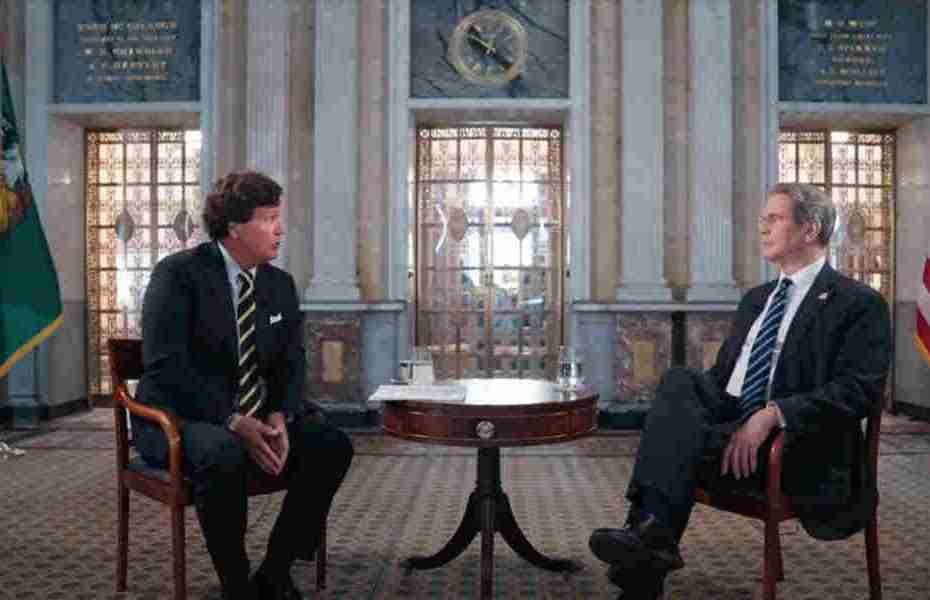
Read the full transcript of U.S. Treasury Secretary Scott Bessent’s interview on The Tucker Carlson Show episode titled “Trump’s Tariff Plan and Its Impact on the Middle Class”, premiered on April 4, 2025.
Listen to the audio version here:
The interview starts here:
Introduction to the New Tariff Policy
TUCKER CARLSON: Mr. Secretary, thank you very much for joining us. So we’re at the Treasury Department. President had a press conference yesterday next door in which he announced a whole new tariff regime globally. He’d been promising to do this, well, for 40 years really. It came not out of nowhere, but it was clearly his intent all along, as stated. But it did rattle people, including some of his supporters. So I just wanted to ask you, big picture, where do you think this leads?
SCOTT BESSENT: Well, Tucker, and thank you for having me. And as you said, the president’s been talking about this for four decades.
TUCKER CARLSON: Yes.
SCOTT BESSENT: And this is transformational for the American economy, for the American worker, and for the new Republican alignment. It’s a combination of old and new ideas. Some of the old ideas were put away. I always tell everyone, and they don’t want to hear it, the original tariff man was Alexander Hamilton. And he used tariffs to fund the new nation and to protect American industry.
President Trump has added a third leg to the stool, and he uses tariffs to negotiate. But I think this is not unlike when I was a freshman in college when Ronald Reagan came in in 1980 and “New Day in America.” And when I talk to people now and they look back and they look at the Reagan years so fondly.
TUCKER CARLSON: Yes.
Historical Context and Economic Transformation
SCOTT BESSENT: I remember what it was like. And it was choppy. Very choppy. President Reagan stood the course. At one point in the early 80s, a farmer showed up with a shotgun at the Federal Reserve to kill Paul Volcker for raising rates. So like I said, that’s not an invitation for any action, but it was a tough time. And then in 1984, President Reagan won reelection with 49 states. And I think they may have even let Mondale win Minnesota, just so it wasn’t a skunk, just to be nice.
That’s what President Trump is doing now. For years, the American worker middle class has been eviscerated. American workers have taken it on the chin. And, you know, we’re just starting to see some of the research now. Like we’re seeing research on what’s called the China shock from 2004. It’s just coming out now. And it’s what I know. But finally, academics are saying, “Oh gosh, the American workers never recovered from the China shock.” What a surprise.
And President Trump, since 40 years ago, but out on the campaign trail starting in 2015, up until last year, he has promised the American workers that the old standard of living can come back. Because what we’ve seen over the past at least 20 years, since the China shock, but more like the past 30, are these massive distributional problems where the coasts have done great.
TUCKER CARLSON: Yes.
Addressing Economic Inequality
SCOTT BESSENT: And the middle of the country has just seen quality of life, life expectancy decline. They don’t think their children are going to do better than they are. And a lot of people don’t care. And President Trump cares. This administration cares. And this is the first step towards realigning that.
A lot of our trading partners, including some of our allies, have not been good partners. If tariffs are so bad, why do they have them? Or if the American consumer is going to pay all the tariff, then why do they care about tariffs?
TUCKER CARLSON: Right.
SCOTT BESSENT: Because they’re going to eat them. So I think that this is the beginning of a process. We’re going to re-industrialize. We have gone to a highly financialized economy. We have stopped making things, especially a lot of things that are relevant for national security.
I think one of the few good outcomes from COVID was we had a beta test for what maybe a kinetic war with a large adversary could look like. And it turned out that these highly efficient supply chains were not strategically secure, so that we don’t make our own medicines, that we don’t make our own semiconductors, that we don’t make our own ships anymore.
So I think if I were to say, was there any good outcome from COVID? It was. It woke the world up to these supply chain problems. So economic security is national security. President Trump and I have talked about that a lot. So this is a national security issue that we’re seeing here, but it’s also an economic security issue. And it’s to give working Americans real wage gains and enhance their lives.
And I’ve said out on the campaign trail, one of my most frequent mottos was, “Wall Street’s done great. It can continue doing well. But it’s Main Street’s turn.” And that’s what we saw yesterday. It’s Main Street’s turn.
Wall Street vs. Main Street
TUCKER CARLSON: So over the course of my life, 55 years, Wall Street really has been a commonly recognized measure of economic health. Like, how’s the Dow doing? We’ve got entire TV channels devoted to tracking its progress, which mostly been up during the course of my life. So if the average of the equity averages fall, if the stock market falls, that’s seen by a lot of people as like a measure that the economy itself is in decline. Do you think that’s a fair measure?
SCOTT BESSENT: Look, the market goes up and down. Warren Buffett has a saying: “In the short run, the market’s a voting machine.
In my former business, I commented on market structure, market ups and downs a lot. I’m trying not to do that. But for everyone who thinks that these market declines are all based on the President’s economic policies, I can tell you that this market decline started with the Chinese announcement of DeepSeek.
TUCKER CARLSON: Right.
SCOTT BESSENT: The so-called Mag7, the tech stocks have been doing very well for about 18 months, led the market. And I think that there was kind of a real dose of reality in what was going on in AI. I think US is going to remain the leader in AI, but the AI related stocks started coming down. So if I were to analyze in my old hat, and this is the only time I’m going to talk about it, what’s happening with the market, I’d say it’s more a Mag7 problem and not a MAGA problem.
Funding Government Through Tariffs
TUCKER CARLSON: So it’s a deeper issue. So actually the markets are, you’re saying in this specific case with tech stocks, are taking like a real measure of the value of companies relative to foreign companies.
SCOTT BESSENT: Well, it’s that. But if we look with the equal weighted S&P, even after today’s move down 4% in the year, in a long-term chart, you wouldn’t even notice that.
TUCKER CARLSON: Yeah.
SCOTT BESSENT: And I think the most important thing that we can do, that I can do as a Treasury Secretary, that President Trump wants to do, is put in sound fundamentals for the underlying economy. And if the underlying economy is good, if taxes are stable, businesses have predictability, we have cheap and plentiful energy, if we deregulate, if we treat our workforce well, then we’re going to have a great stock market.
TUCKER CARLSON: The President suggested in describing his plan for tariffs, he said, look, you could conceivably fund a lot of government with tariffs and that would suggest that taxpayers fund less of the burden. And so do you expect that these will be accompanied by a congressionally improved tax cut for the middle class?
How Tariffs Work
SCOTT BESSENT: I just want to go back for a moment too, that one of the things that the tariffs are doing is we are pushing back against other economic systems. So the Chinese have a very different economic system. They have low cost, some would call it literally slave labor. They subsidize industry with subsidized loans. They have a lot of non-tariff barriers. Your show can’t be shown there.
So we’re pushing back against that. And with the tariff income it can be substantial. If we think like a classical model of tariff income would say if there’s a 10% tariff then the currency would appreciate about 40% of that. So 4% of it. Then the producer in the other country would eat about 4% and then the US consumer might have a one-time price adjustment of 2%. So in a 10% tariff, maybe the consumer pays 2% of it.
We saw there was a study out recently from a group at MIT that shows with President Trump’s first China tariffs, which were approximately 20%, the price level went up 0.7%. So to answer your question, if we could put on a 20% tariff and have the foreigners pay that and use that money to bring down our government deficit and keep taxes low here, that’s a very unique formula that hasn’t been tried in this country for a long time.
Congressional Involvement and Budget Scoring
TUCKER CARLSON: And do you think… But it would require congressional participation to get there to move. Tax rates of course are set by the Congress.
SCOTT BESSENT: Well, what we’re going to have now, we are in this very odd, what I would call betwixt in between, between the tariff income and what DOGE is doing in terms of cutting government expenses. So CBO scoring, and for 35 years I was on the other side of the wall and I would always say, “Oh well, CBO says this” and I didn’t really realize that CBO scoring is a lot like Enron accounting, that it’s not real.
TUCKER CARLSON: But you assumed it was on the outside.
SCOTT BESSENT: Sure. Well, they’re experts.
TUCKER CARLSON: Congressional Budget Office.
SCOTT BESSENT: It’s the Congressional Budget Office and they’re well-intentioned people. They just have nonsensical rules. Like think about this: when all the scoring is done over a 10-year window, they just assume 1.7 or 1.8% economic growth over the 10 years. And that never moves. Whether you raise taxes or cut taxes, doesn’t move.
So during the campaign when Vice President Harris was announcing all these big tax increases she wanted to do, the CBO was scoring her very well. And President Trump wants to make the 2017 tax cuts permanent. That was kind of a blowout number because obviously growth is going to go up a lot when you cut taxes.
So that was a long way of saying we will not get credit for the tariffs in any bill because Congress is not going to legislate it. President’s doing it with executive authority, but the money will be coming in. We’ve already taken in several hundred million dollars on the China tariffs from his first term. We take in about 35 billion a year just on the old tariffs, not on the new ones.
So in the CBO window, that’s about $350 billion, which pays for a lot of the President’s promises on no tax on tips, no tax on Social Security, no tax on overtime, making interest deductibility on autos made in the US. And think what the President’s doing here. He is backing into an affordability solution for the bottom 50% of wage earners because they are the ones who will benefit from all four of those programs.
Revenue Projections and Long-Term Strategy
TUCKER CARLSON: So looking at, say, a year from now, so next beginning of next April, do you have any sense of how much the US Government anticipates bringing in from the tariffs announced yesterday?
SCOTT BESSENT: It’s going to be a moving target, but could it be anywhere from 300 billion to 600 billion a year? Sure.
TUCKER CARLSON: Okay, so that’s meaningful revenue.
SCOTT BESSENT: Very meaningful. But what will happen with tariffs over time? The ultimate goal of the tariffs – and the President says all the time, “bring your factory here” – that’s the best solution toward getting away from a tariff wall.
So move your factory from China, from Mexico, from Vietnam, bring it here. So what will happen over time? We’ll have substantial tariff income in the beginning. Manufacturers will build their factory here, the tariffs will drop, but the revenue from the factories, from income taxes from all the new jobs will go up. So we’ll be taking it in domestically as the tariffs drop. And why are the tariffs dropping? Because we’re making it here and our trade deficit’s dropping.
TUCKER CARLSON: So you’ve obviously thought this through. You think that the United States has the necessary labor force for this transition?
Reshaping America’s Economic Future
SCOTT BESSENT: I think we do. I think with AI, with automation, with so many of these factories going to be new, they’re going to be smart factories that I think we’ve got all the labor force we need. What we are doing on the other side, one of the reasons, other than my support for President Trump, that I came out from behind my desk is that I had a pretty good life and I wanted to come out and really tell people that I was worried about an impending financial calamity given the high level of government spending that were leading to high levels of government debt.
So what we are doing on one side – the president is reordering trade. On the other side we are shedding excess labor in the federal government and bringing down federal borrowings. And then on the other side that will give us the labor that we need for the new manufacturing and we’re going to re-leverage the private sector.
The private sector in essence has been in recession during the Biden years and this is an opportunity to right size the federal government and unleash the private sector again because it’s been hemmed down by excessive regulation and it’s been crowded out by the government.
TUCKER CARLSON: Do you ever think since your job is to forecast the effects of these policies that you have – we’ve got probably one out of six people in this country here illegally, maybe 50 million illegal aliens and the president said he wants to deport them. Then you have AI and the projections there are massive labor market disruption, fewer people needed. You alluded to that a minute ago.
Then you have the tariffs and we can guess their effect but we don’t really know because we’ve never done it. And then you have the reaction from the rest of the world to those tariffs. Like there’s so many huge factors that are effectively unknown, that are black boxes really. Do you ever think like, wow, you know, it’s kind of hard to know what’s going to happen?
Navigating Economic Uncertainty
SCOTT BESSENT: Look, it is. And I always think that you can never be 100% sure, but you can stay within sight of guardrails and keep moving forward. I can’t remember which Sunday morning show I was on a couple of weeks ago, the commentator asked me, she said, can you guarantee me there won’t be a recession? And I said I can’t guarantee you anything. Look, there’s nothing that tells me there should be one.
So I believe that this is going to work just like President Reagan believed that supply side economics was going to work. But what I do know is that the old system wasn’t working. I think that’s right. And if you look at a system that’s not working, you got to be brave to change it.
What wasn’t working would have been really fun for me to come in and just keep issuing a lot of debt. It’s almost like a bodybuilder taking steroids. Outside looks great, you’re muscular, inside you’re killing your vital organs. That’s what was going on here. But it would have been easy to keep pumping up the economy, borrowing a lot of money, creating a lot of government jobs. There was no controversy when we’re doing all that.
But you were going to end up in a calamity. If you go back and look at the financial crisis in 07-08, economy looked great right up until then. You go back and you look at the end of the dot com bubble and then the whole credit problem of the fraud at WorldCom, Enron, some other companies, economy looked great until it didn’t.
And I think one of the things that we won’t get credit for but that this administration will have done is avoiding a financial calamity. Think about it, they’ve done an analysis that one of the reasons 9/11 happened was because the airlines didn’t want to pay for reinforced doors. They kept pushing back, FAA didn’t push hard enough. And now, you know, we’ve got the reinforced doors. So I look at it, we’re putting on the reinforced doors before the crash.
The Impact of Universal Tariffs
TUCKER CARLSON: What’s the lobbying scramble by foreign governments going to be like over the next three months? Because the president said yesterday, you know, we’re putting a universal tariff, one standard. But then of course each country’s adjusted according to a lot of different factors, trade deficit, currency manipulation, regulation and then tariffs. But, you know, this is all, as you said, a moving picture. It’s a developing situation. So, like, if I pick a country, you know, Vietnam, China, I mean, I’m going to really try to bring pressure to bear on this administration to adjust those numbers. Like, what’s that going to be like?
SCOTT BESSENT: It’s going to be the president’s decision. And I think his view is this has been going on for a long time for friends and foes, and we’re going to see where this plays out. I think what’s going to be more important than the discussion with countries is the discussion with companies.
So what do companies want to do? As President Trump said yesterday, best way to get around the tariffs, build your factory here. And what can we do here at Treasury to help that? We’re pushing to get the tax bill done so we can guarantee the low taxes, full depreciation within the first year. We’re working with Secretary Bergam and Wright on energy security and we’re working on getting the regulations down.
The president, I don’t know whether he talked about it yesterday or the day before – Taiwan Semiconductor, just the biggest semiconductor manufacturer in the world – Lee Zeldin, the EPA commissioner, is working to push through all the permits that they need because we’ve just gone into this regulatory morass where it takes so long to get things done in this country. So I think what will be more interesting are the individual company announcements more than the country announcements.
TUCKER CARLSON: You want to sell to Americans, you got to make it in America.
SCOTT BESSENT: Sure. Or pay. Pay the tariff.
China’s Response to Tariffs
TUCKER CARLSON: So how is China as a nation going to – I mean, this is such a big challenge. It’s directly in their face. It’s every country on the globe. But it’s really more than any other country about China, I think it’s fair to say. How are they going to respond? What’s the retaliation look like?
SCOTT BESSENT: Well, I don’t know if they can retaliate for a couple of reasons. If you look at the history, and I used to teach economic history, and when you look at the history, we are the debtor nation.
TUCKER CARLSON: Yes.
SCOTT BESSENT: We have the trade deficits. The surplus nation is in the weaker position because the Chinese business model and Tucker, by the way, the Chinese business model and the economy are the most unbalanced, imbalanced in the history of the modern world. We’ve never seen anything like this in terms of their export level relative to their GDP, relative their population.
So I think it is going to be very difficult for them to try to change the model. They are trying. They’re in a deflationary recession slash depression right now. They’re trying to export their way out of it, and we can’t let them do that. But I think that when you think the Chinese manufacturing system is like that old Disney movie with the brooms carrying the buckets. There’s nothing you can do. Like, that’s their business model. It’s not going to stop.
Now, what could happen if you were to say, Scott, what’s the dream scenario? That somehow there could be a deal where the US and China, we want more manufacturing, which would mean smaller part of the economy’s consumption. The Chinese have this imbalanced economy with too much manufacturing. And actually the Chinese consumers really get the short end of the stick.
So Chinese households, they’re called in what’s called the middle income trap – could we do something together to say, okay, you rebalance, you consume more, manufacture less. We are going to consume less and manufacture more, and we’ll be military rivals. There’ll still be an economic rivalry, but we’re going to level the playing field by a lot.
Now, that’s not going to happen tomorrow. That’s not going to happen in a month. But over the next few years, they may have to come around because I think their business model is broken. I think President Trump’s broken their business model with these tariffs.
TUCKER CARLSON: So you’re describing, you know, the famous scenario where if you take a bank loan, the bank is in charge, they can repossess whatever they borrowed…. you borrowed against. But if you take a big enough loan, you’re kind of in charge of the bank.
SCOTT BESSENT: Exactly. And they’ve just got such a big deficit with us that they need our markets. They can’t survive without them.
TUCKER CARLSON: Are you confident that there’s like a clear enough channel of communication between the two governments that the details can be worked out and that nothing will go crazy in the meantime?
SCOTT BESSENT: Well, I think what gives me a lot of confidence is the relationship between President Trump and Chairman Xi. That when you have a direct line of communication at the very top, then I think it’s very difficult for things to go haywire.
Global Economic Realignment
TUCKER CARLSON: Interesting. What about the rest of the world? What about Europe?
SCOTT BESSENT: Look, the Europeans, we look back and there was a famous meeting where President Trump told the Europeans, you’re insane for building Nord Stream 2. What are you doing? You already get most of your energy from Russia and you’re going to double down on it. And they did, and look what happened.
TUCKER CARLSON: So we blew it up.
SCOTT BESSENT: Somebody did.
TUCKER CARLSON: Somebody, probably Putin.
SCOTT BESSENT: I know some Norwegian fishermen bumped into it, is what I read. But look, the Europeans go kicking and screaming, but I think they’re going to have to rebalance, too. Germany has a very imbalanced export economy and they were on the verge of deindustrialization. They were the opposite of us. They had expensive energy.
TUCKER CARLSON: Yes.
SCOTT BESSENT: They were depending on Italy and the countries in the south to keep the euro suppressed. And they were selling into China and now China is becoming their competitor.
The Timeline for Economic Transformation
TUCKER CARLSON: So you said at the outset, the first example, the analogy that you used was President Reagan’s first term, you know, obviously, big win in ’80, recession of ’82, wipeout, and then like the biggest landslide in history in ’84. So you’re suggesting by saying that, that, you know, the fruits were obvious within the first term, within four years..
SCOTT BESSENT: They were. Only difference now is there was a lot of competition back then, but there’s a level of civility. And the real danger here, if there were a midterm wall, and I don’t think there has to be, you know what’s going to happen. I know what’s going to happen. Democratic House is going to go immediately to impeachment for something, of course, like the lawfare is going to start again.
TUCKER CARLSON: Yes.
SCOTT BESSENT: And I think the American people are going to hate it again. So Einstein’s definition of insanity, doing the same thing again and again, expecting a different outcome.
TUCKER CARLSON: Do you think that, and this is really aimed at the people who support President Trump and who agree with you wholeheartedly that the current system was really bad and like, drive across the country, you’ll see how bad it has been. Horrible. It lowered life expectancy. But the people who are hoping that yesterday’s move will lead to a demonstrably brighter future within four years, is it your sincere prediction that with, you know, within four years, we’ll say actually, that kind of worked.
SCOTT BESSENT: I believe that it’s going to work and I know that what we were doing wasn’t working.
TUCKER CARLSON: Yes.
Trump’s Economic Vision for the Middle Class
SCOTT BESSENT: So I think we have to try this. And I have a high confidence ratio it’s going to work. I have a very high confidence ratio. The good news is we have President Trump’s previous term when everyone said none of this was going to work. Oh, the China tariffs are going to do this. They’re going to cause inflation. They didn’t. This is going to happen to working. It’s going to be bad for working class Americans.
Well, guess what, working class Americans, that hourly workers did better than supervisory workers. The bottom 50% of households, their net worth increased faster than the top 10% of households. And look, I’m not happy with what’s going on in the market today, but the distribution of equities across households. The top 10% of Americans own 88% of equities, 88% of the stock market. The next 40% owns 12% of the stock market. The bottom 50 has debt. They have credit card bills. They rent their homes, they have auto loans. And we’ve got to give them some relief.
TUCKER CARLSON: That’s the message right there. Just as a bystander, I’m like, wow, okay, all right.
The Two Americas
SCOTT BESSENT: I like the examples. And I was really struck by two different statistics. Last year, summer of 2024, Americans took more European vacations than they had in history. Summer of 2024, more Americans were using food banks than they ever have in history.
I went into two food banks near my hometown to ask what’s the story. And they said, you know, it really takes for a lot of people, it’s a loss of dignity to walk in a food bank of course. But they were seeing something, a new phenomenon that it wasn’t their traditional clientele, wasn’t people who’d lost their homes. It wasn’t people out on the street. These were working families who could no longer afford a hundred dollars at the grocery store, that basket of groceries every week. They were missing five, six, seven things. And they were coming to the food bank to top up.
So that’s not a great America – record European vacation, record food banks. And no reason we can’t keep the record European vacations going. But we’ve got to take care of these other people.
And you know what? They don’t want handouts. The Democrats had this strategy called “compensate the loser.” So first of all, the name of that strategy. I don’t think the bottom 50% of Americans are losers. I think the system hasn’t worked for them. I think that they are winners. It’s just a bad system. So we are going to fix the system.
And look, they want good jobs. They want their kids to do better than they do. They want to own a home. They want to pay down their debt. This isn’t hard. And I think that we can do this in the next four years.
TUCKER CARLSON: You grew up in a middle class, working class background. You were very successful. Lived in rich person world for a long time while this was all going on. And I just have to ask you candidly, were you ever at dinner with people were like, wow, you know, we’re doing great. I live in rich person world too. I’m not criticizing you at all. But like, did anyone at dinner ever say, wow, you know, I just tried to drive somewhere for 100 miles. This country doesn’t look good. Like, people are not thriving. Was there any sense of that among people you knew?
The Disconnect Between Elites and Working Americans
SCOTT BESSENT: No, they were more “My NetJet was an hour late. I had the worst day. My NetJet was an hour late. You can’t believe, oh my God, I’m going to switch charter companies.”
And look, Tucker, I’m especially attuned to what I think is going on with the United States because, you know, I will tell you, my family, very affluent early settlers. We were very affluent for about 250 years. My dad made a lot of bad financial choices. So when I was born, first, six, seven, eight years, we were affluent. He lost everything. And so I’ve seen what that’s like. I’ve seen both sides. Yes. I was fortunate enough to be able to make it back and I know what economic insecurity is like and I don’t think people should have to have that or if you want to work hard and people want to work hard.
You were out on the campaign trail with President Trump. I was out on the campaign trail. And I got to say one of the most… So I went for the final two stops in Pittsburgh, Grand Rapids, Michigan, Pittsburgh, in the Duquesne Arena. Walk in and there are the union workers, the steel workers. They got on their hats, they got on their vests. They’re with their children. And it’s very moving.
Like they just want a better life. They want their communities to be sound. They want their kids to do better. They want Little League baseball. Like, they don’t care what’s going on in Madison Avenue. They don’t know what the hot new restaurant is in Paris. And President Trump somehow has assembled this incredible coalition of Elon Musk, the richest man in the world, and those folks who were in the Rose Garden yesterday and those people I saw at the Duquesne Arena. And I think it’s unbelievable.
TUCKER CARLSON: Interesting. What do you worry about as Treasury Secretary? Obviously, probably like lying in bed and thinking about all the things that could go wrong with the US Economy. What are your, if you could be honest, like, what are your biggest worries?
Managing Economic Risks
SCOTT BESSENT: To the extent that in my business career I had a strong point, I think it was risk management. So I do myself two things to the United States. Leading bond salesman.
TUCKER CARLSON: Yep.
SCOTT BESSENT: And I think that with what’s going on, I’m going to have a better and better story to tell as we’re getting our economic health and our fiscal health in order. And then I try to imagine what could go very wrong. What would we do if there were another outbreak similar to Covid? You can’t worry about things like that. But I worry about a kinetic war somewhere. What would we do in the event of something that happened?
And what I try to do is create the situation where I can worry a little less every day. So I’ll tell you, I came in, I was confirmed on January 28. And during the month of January, 10 year interest rates, which is probably the most important rate in the country. Mortgages are based on that, business and capital formation is based on that. I came in and it almost spiked to 5%. And I think 5% can be an uncomfortable area for the economy for treasury, who has to issue a lot of bonds.
And you know, now that I’ve gotten in, I worry a little less, but I still worry we’ve got a tremendous amount of debt to roll and I worry that we aren’t going to do these smart cuts and the focus on waste, fraud and abuse, I worry that that gets sidelined. And then on the other side, I worry that the tax bill somehow gets bogged down. We could have the largest tax increase in history or you know, I worry that the normal geopolitical things, whether it’s Iran, Taiwan, that something goes haywire between Russia and Ukraine.
TUCKER CARLSON: So you began your job description by saying you’re a bond salesman, you’re selling America’s debt to the world. And I know that was like a big part of the portfolio as the transition was envisioning it. Like who can make the case for American bonds to the world? How would your case. Are you confident you can do that and how is your pitch changing after yesterday?
America’s Fiscal Future
SCOTT BESSENT: Well, as I said right now we’re in this strange betwixt and between because we are going to take in substantial tariff revenue and what DOGE is doing is substantially cutting expenses. But we’re not getting credit for it right now. But I think markets are starting to get a hint of it.
So the 10 year bond having almost peaked at 5 is now through 4. Way to think about it is every 100 basis points is about $100 billion in savings. So we’ve saved $100 billion and that’s probably not going to happen that quickly again. But I think that we are setting the sails for much better fiscal times and people don’t have to say the US is out of control, the US is going to default – we’re not. And I think every day my case gets better.
And if we were to just imagine a very reductionist formula for government. So G equals S minus T – spending minus taxes.
TUCKER CARLSON: Right.
SCOTT BESSENT: For spending, our side, the Republicans, we like to spend, but less than the Democrats. But both sides like to spend and then minus T. Democrats like higher taxes, we like lower taxes. What if the S actually went down? And I think to me that’s the exciting part, that that’s been unthinkable in everybody’s calculation.
TUCKER CARLSON: No one’s even really seriously raised it. Including Ronald Reagan, by the way.
Learning from History and State Models
SCOTT BESSENT: Yeah, and look, I think President Reagan had a different agenda that he ramped up defense spending and remember. “Oh, he’s crazy. This is going to break the budget. Star Wars is crazy. He’s a madman.” And then the Iron Curtain fell. We were able to… it’s actually a Soviet term. And he used the Soviet strategy on this, on themselves, on the Russians – escalate to de-escalate. So we escalated military spending. They tried to keep up, and then they collapsed.
So, you know, again, everything’s easy in hindsight. But I think here, what we’re doing in terms of bringing down these incredible levels of spending, but more importantly, I tell anyone who will listen, I said, remember, DOGE is the Office of Government Efficiency, not elimination, not extinction. So what if we can actually do a better job with less? Seems inconceivable.
But when I see what’s going on in a lot of these government agencies, it’s unbelievable. And like, if you think I’ve lived in Manhattan, I’ve lived in Florida. Roughly, State of New York, State of Florida have the same number of people. Actually, Florida has a few more now. So New York budget is about $235 billion. Florida budget’s $125 billion. How do they do that? Oh, and there’s no income tax in Florida. Oh, yeah. And the roads are better. And you go and get your driver’s license, and it takes 15 minutes, not five hours.
So I think, can we make the rest of America look more like Florida and less like New York? Or one day is New York going to look more like Florida?
TUCKER CARLSON: So do you think after four years, we will see an actual net reduction in government spending thanks to DOGE?
SCOTT BESSENT: Inflation adjusted? Yes.
TUCKER CARLSON: Huh. How long do you think Elon’s in for?
The Impact of Elon Musk on Government Technology
SCOTT BESSENT: I think that Elon that day to day, I don’t know. But I think his imprint is going to be with us a long time. The mainstream media has tried to demonize DOGE and all the folks who work with him. We have a couple at Treasury and a couple at IRS. They’re Treasury employees who I hired, I interviewed.
There’s this one fellow, Tom Krause, he was on TV with Bret Baier the other night. Tom’s incredible. He’s done $100 billion of tech workers with my investment business. I would have hired him. I don’t think I could have afforded him. And he is doing this for the good of his country. He came in without touching any of the pavement systems that the mistruths were spread by the Washington Post. He has analyzed the system and within six weeks pointed at all the vulnerabilities.
There’s a young man named Sam Kirkos who was on Laura Ingram with me the other night. That was my idea. Let’s bring him out of the shadows and let’s make this demonization stop. This young man, other than the fact he only owns one pair of pants, which he likes telling everyone, you or I would be happy if our daughter brought him home. He’s a patriot, he’s working hard for the country and he’s analytical.
The things that he’s seen at the IRS just in their tech systems and that’s all he does. You know, Elon has a shirt that he wears under his jacket. He’ll flash it every once in a while. It says tech support. And that’s what we’re getting is we’ve got a blockbuster style government and we should be on Netflix where we’re hailing cabs and we’re in an uber economy. Why can’t the government be in the gig economy? Not hard.
TUCKER CARLSON: So we’re not positive that cryptocurrency is the future of finance, but we do know that what we have now is broken and dangerous. Debt has never been higher in this country. Many of our so called leaders are getting rich, serving you. It’s a scam. So where does it go? Well, thankfully there are options. Donald Trump has said repeatedly he wants the United States to be the crypto capital of the world. He’s already created the Crypto Advisory Council and recently signed an executive order to establish a bitcoin strategic reserve. This could give normal people an alternative to the government’s failing system and frankly to the US dollar.
[Advertisement content removed]
The Federal Reserve’s Role and Focus
TUCKER CARLSON: A weird question. Who runs The Federal Reserve? I don’t really. How can you have this pivotal entity, institution that obviously has like the most direct effect on markets. Many and it does seem outside of political control. What is that?
SCOTT BESSENT: Well, look, during my confirmation hearing—and I was actually at a dinner that Jerome Powell was at last night—at my confirmation hearing, I said I’m only going to talk about the mistakes the Federal Reserve has made in the past. I won’t talk about the ones they’re going to make in the future.
But I think it is important for monetary policy that they are walled off. Some of the other things they do, regulation, they got into DEI, they got into climate. I actually think that that impinges on their monetary policy and makes them vulnerable. So I think that they should focus on monetary policy, doing the best that they can for the American economy, the American people keeping inflation low and then the rest. There are a lot of other banking agencies too.
TUCKER CARLSON: So the Fed controls the weather now too. What were they doing with climate?
SCOTT BESSENT: Well, I will tell you, there’s something that the Treasury Secretary chairs called the Financial Stability Oversight Council and it’s all the financial regulators. I think it was two weeks before Silicon Valley Bank went under, FSOC issued a report and guess what? They said the biggest risk to the financial system was climate.
TUCKER CARLSON: Really?
SCOTT BESSENT: Not that there was a large bank in California that was having a slow motion run on its assets and that it would cause another bank failure than another bank failure is climate.
So as far as I can see, climate’s been pretty good. They failed, the regulators failed. And I think that’s what people are getting sick of. And it’s back to one of my favorite phrases that President Trump uses, common sense.
TUCKER CARLSON: Yes.
SCOTT BESSENT: Look, it’s just common sense that if you have a whole bunch of deposits that could leave your bank with a click, you shouldn’t have all these long term assets. But they were too busy worrying about the weather. And there was also some degree of regulatory capture. Seems hard to believe to the average citizen. The CEO of Silicon Valley Bank was on the board of the San Francisco Federal Reserve who was his chief regulator. They’re going to tell that guy what to do.
Gold as a Global Store of Value
TUCKER CARLSON: Why is gold moving around the world in such huge quantities right now?
SCOTT BESSENT: Well, a couple of things. It’s moving physically, it’s moving because of potential tariffs here. So it was unclear whether we were going to exempt gold from tariffs, which I believe we have. So there was a big move out of vaults in Switzerland, out of vaults in London to get it into New York.
Look, there are a lot of different stores of value over time. Bitcoin is becoming a store of value. Gold has historically been a store of value. I think what’s interesting is where do we see the gold demand coming from? A huge amount is from China. Where, as I said, they’re in the middle of an economic recession, slash depression. People don’t trust the Chinese currency because they have capital controls. There are 1.4 billion Chinese who all want to get their money out and they won’t let them. They will let them buy gold.
TUCKER CARLSON: So that’s a response, you think? But it’s just. Do you find it interesting that even now, 2025, when everything is abstract and digital, that gold is still widely believed globally to be a reliable store of value?
SCOTT BESSENT: I think gold has a lot of history going with it. A friend of mine’s grandmother, during Russia’s financial crisis in ’98, when they had a big inflation, went out and bought 18 bicycles and put them in her apartment. And that was her store of value.
TUCKER CARLSON: So how did she do on the bike investment?
SCOTT BESSENT: Great, great. I wish I did that well. But look, gold also has other applications. A lot of applications. Jewelry in India. But it’s something that historically people have all agreed on and gold does not have a fiscal problem. Gold cannot have a gigantic budget deficit. Gold cannot have a war. So just the fact that it is this isolated thing makes it very interesting. And the fact that the entire global trading system, until Richard Nixon took us off, was tied to gold.
TUCKER CARLSON: So you’re not anti gold?
SCOTT BESSENT: Oh, no, no, no, no. When I had my fund, I think people might have called me a gold bug.
Negotiations with Ukraine
TUCKER CARLSON: How did you wind up interacting with Zelensky?
SCOTT BESSENT: President asked me to go to Kyiv. Well, he actually asked me to lead the economic agreement that was part of his peace plan. And I think it’s important to look at the arc of President Trump’s peace plan. And he had sequenced it really well. It was, we’re going to sign a deal with Ukrainians and it’ll do several things. One, it will make the US and Ukraine partners, link us closer together. Two, it will be a symbol to Russian leadership that the US is not abandoning Ukraine. But importantly, three, it will show the American people that we have an economic stake and that we haven’t just been doing these massive grants, which has been the history of US aid, of course. So Ukraine succeeds, we succeed, and it could be a long term partnership.
Now, I thought it was important to take the agreement to Kyiv and present it to President Zelensky. Everyone was telling me, “Oh no, have him meet you in Vienna, he’s going to be at the Munich security conference a few days later.” I said, no, I want to go there and discuss it with him. And that’s how I ended up going to Kyiv.
Very interesting going to Kyiv. Fly to Poland, then you get on this night train for 10 hours and you arrive at Kyiv at 8:30 in the morning. And for anyone who said, “Oh, the President Trump is selling out to the Russians,” not selling out to the Russians. The Russians bombed Kyiv four hours before I got there. They hadn’t bombed since November. So the Russians didn’t like the look of this deal because it thought that it was actually something durable for the US people and the Ukrainian people.
TUCKER CARLSON: So what happened?
SCOTT BESSENT: President Zelensky was in the mood to sign the deal that day. We had a spirited discussion and I said to him, “You’ve got 50 reporters out there. I am here to show that there is no daylight between the American people, the Ukrainian people, between the American leadership and Ukrainian leadership. I said, you’ve opened up daylight, size of the Grand Canyon. What are we going to go out and tell those people?” He said, “Tell them I’m going to sign the deal in Munich.” I said, “So you’re going to sign the deal when you see Vice President Vance and Secretary of State Rubio in Munich?” “Yes.”
He didn’t sign it there. There’s a lot of back and forth the following week, they’re begging to come to the White House. Should make him sign the deal before he comes. And then he got to the Oval Office and blew up what should have been the easiest thing to do in the world. He was supposed to show up, have a press conference. We were going to have a private lunch. If he had anything on his mind, there were going to be nine of us, nine of them in the White House dining room he could have aired his grievances in. And there’s a famous photo in the East Wing ballroom of everything laid out on the table to be signed. And it never got signed.
TUCKER CARLSON: So this is an unelected president of a client state whose bureaucrats are being paid directly by American taxpayers, including their retirement accounts are funded by us.
SCOTT BESSENT: And they have the lowest retirement age in Europe. It’s 60. Put it in contrast, France is 62 and Italy 67.
TUCKER CARLSON: And we’re paying for that. And so at a certain point, you know, you wouldn’t expect a man like that in a highly precarious position. I think it’s fair to say to like assume a high handed tone with American officials and berate them and sniff a lot and say, you know, basically act like a crazy person. Like how do you account for that? The arrogance. What is that?
SCOTT BESSENT: Look, a couple of things. He was a performer.
TUCKER CARLSON: Yes.
SCOTT BESSENT: Kind of a vaudevillian and he was an ordinary person thrown into a fraught time. Rose to the occasion.
TUCKER CARLSON: Yes.
SCOTT BESSENT: Was heroic.
TUCKER CARLSON: Yes.
Ukraine Economic Partnership
SCOTT BESSENT: And I think is stuck and I think under a tremendous amount of pressure. I think that some of the government officials around him and the cabinet are very good. I think some of the people around him, he’s not getting the best advice that his advisors are not perfect.
And I think if we go back to the agreement, I think one of the great things about the agreement is it makes sure that the money comes to the American people and the Ukrainian people. Because Tucker, let me tell you what the agreement wasn’t. It wasn’t one of these rapacious Chinese deals where it’s sign over your mine, sign over your port or it wasn’t a loan to own. Here’s the loan. You’re never going to be able to pay it back. We’re going to get this.
It’s a genuine economic partnership that they put in assets. We can put in loans from our overseas banks. We put in American know-how and we don’t make any money unless they make money. And you know who doesn’t like that? People with their hand in the till. Right, right. Because we were regulating the flow of the money. So I think that’s part of the glitch.
I am hopeful that it was a bug, not a feature of the system and that that’s been fixed. We’re expecting a Ukrainian technical team beginning of next week and I’m hopeful we can get this thing signed and go back to a win-win situation.
Because President Trump, I didn’t give you the full arc of the deal. President Trump wanted to create this deal with the Ukrainians then be able to go to Russian leadership with and show them that we do stand with the Ukrainians but they are on an economic basis and then the Russians would be incentivized to come to the table also. And so the sequencing has been thrown off. But I think we can fix it.
TUCKER CARLSON: Are we ever going to get an audit of where all of our billions went? All the weapons we sent. What happened? All the cash, all the pallets of hundred dollar bills, like, where are they now? Why is it hard to get an audit of what happened to the money?
SCOTT BESSENT: I don’t know, Tucker. In my life, I always try to look forward.
TUCKER CARLSON: Yeah.
SCOTT BESSENT: And I think if this deal works, then that money could end up being small change.
TUCKER CARLSON: Yes.
SCOTT BESSENT: A good way to think about it. When the Iron Curtain came down, Ukraine and Poland’s economies were roughly the same size. Poland is three and a half or four times larger now. Poland is going to have one of the highest per capita GDP in the world. Higher than some Western European countries, for sure. Ukraine, to your point, because of various kleptocracy aspects, has been held back.
TUCKER CARLSON: Yes.
SCOTT BESSENT: So hopefully, with US Assistance and President Trump engineering this peace deal, Ukrainian people can have a better future.
Tariff Policy and Administration Messaging
TUCKER CARLSON: For a Treasury secretary, you’re a very capable diplomat, I must say. Very diplomatic language. Last question. How do you—because this is also new, just going back to the tariff announcement yesterday, and because it’s like, it really is a total departure from what all of us have grown up with and our expectations and however much you support, it’s like it’s new and people are freaked out about it. How do you keep message discipline in an administration, in any administration, in this one specifically, how do you decide how you’re going to explain this? Who’s going to explain it? How do you keep messages from contradicting one another? What is that process like?
SCOTT BESSENT: We all take President Trump’s lead. We had a meeting yesterday morning. We had a meeting after the announcement in the Rose Garden before we went out doing media. And as you know, he’s his own best spokesman. Nobody can do it better. And then we fan out and we are all unified behind this and his vision. That’s why we’re here. If you didn’t want to be part of it, shouldn’t be here.
TUCKER CARLSON: But do you ever say, like, you know, maybe this is someone who can reassure potential bond buyers, investors in markets. This person scares the crap out of markets. Like, let’s get the guy who reassures markets.
Dollar Policy
SCOTT BESSENT: Well, the one thing I will say, that no one should listen to anyone in the markets talk about the US Dollar other than President Trump or myself. We are the only ones who speak for this administration, the United States government, on dollar policy.
I can tell you we have a strong dollar policy, and we are putting in all of the necessary ingredients to make sure the dollar is strong over the long run. Can it go up and down on a Bloomberg terminal over the short run? Sure. Can individual bilateral moves happen between the dollar and the Mexican currency, the dollar and the yen? Sure. That’s what I made my living doing. I’m glad it does it.
But over time, if we put in solid economic fundamentals and do this transformative program, then the dollar is going to do great and the American people are going to do great.
TUCKER CARLSON: Secretary, thank you very much.
SCOTT BESSENT: Thank you.
TUCKER CARLSON: Appreciate it.
Related Posts
- Transcript: President Trump’s Bilateral Meeting w/ Iraq Prime Minister Ali al-Zaidi
- Tucker Carlson Interview: Jack Neel Podcast (Transcript)
- Transcript of Rupert Lowe Interview: Joe Rogan Experience #2524
- Transcript: President Trump Remarks on Trump Accounts Launch
- Transcript: Trump’s Remarks At July 4th Freedom 250 Celebration in Washington