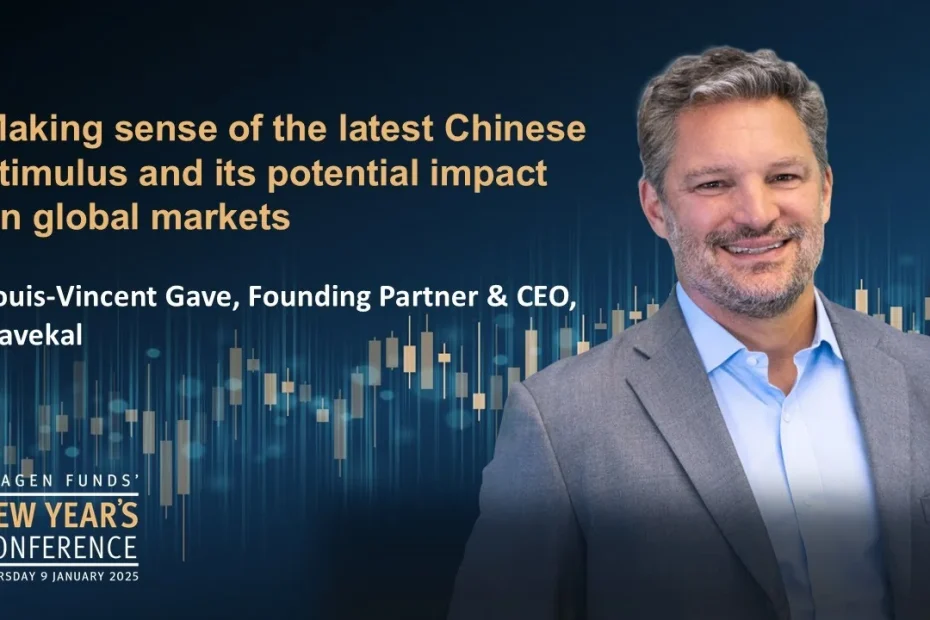
Read the full transcript of Gavekal CEO Louis-Vincent Gave on Making Sense of The Latest Chinese Stimulus, Feb 14, 2025.
Listen to the audio version here:
TRANSCRIPT:
LOUIS-VINCENT GAVE: Thank you so much, Andreas. Thank you to everyone at Skagen. I’m so honored. First of all, I’m so happy to catch up with so many friends in this room, but also deeply honored to be here. I think, actually, it’s my fourth time presenting at Skagen.
I was commenting on this to your Chairman, and I said, “I’m so honored and flattered that this is my fourth time here.” And he said, “Don’t worry. We’ll keep inviting you until you get it right.” These were, in fact, very appropriate words because it’s been a hell of a year. It’s been a hell of a year, and I would say especially a hell of a fourth quarter, where if markets are there to keep us modest, I feel, at least as far as I’m concerned, that they definitely did their job in at least the second half of last year.
Reviewing Recent Market Outliers
What I’d like to do with you today is perhaps start off with reviewing what, to me, were the biggest outliers of the past few months, the things that, frankly, most of which I didn’t expect, a few I did, but most I didn’t expect, the things that wrong-footed me. When markets go in a different direction than what you expect, I think you always have to take a step back and think, “Okay, what am I missing? How do I explain this? How does this all fit together?”
I’ll briefly go through the events, and then I’ll propose three separate narratives, one of which is centered on China. That will be the one that I will spend the most time on because that is perhaps the one that some people in this room will be the least familiar with.
Surprising Market Developments
Let me go through all the various, frankly, surprising events for me, starting off with perhaps the most extreme of recent months, the doubling of the market cap of the broader crypto space. Today, the broader crypto space global market cap is above that of the global energy sector, which, frankly, leaves me a little baffled.
I know that if tomorrow the energy sector disappeared, a lot of us in this room would be in deep trouble. Our lives would be pretty deeply affected. If the crypto space disappeared tomorrow, none of our lives would be changed. Our lives would be exactly the same.
Beyond the two trillion dollars increase in crypto market cap over two months, I have to say that I was particularly taken aback by the 850 billion dollars increase in Tesla market cap over the space of two months. To put things in context, EUR 850 billion, which is the increase in two months in the Tesla market cap, represents the total market cap of the next ten biggest auto companies put together.
Now if you had asked me three months ago what was my outlook on Tesla, given what I am seeing every day in the Chinese auto space, and I’ll come back to that in a second, I would have said that Tesla was completely screwed. I would have said that of all the MAG Seven, Tesla was probably the last one you’d want to own. And that shows you what a fool I am since it went up 850 billion dollars.
Another, to me, big surprise of the past few months has been the complete face plant in U.S. Value stocks. I would have thought that the promise of cutting of red tape, less regulation, less taxes would probably benefit industrial stocks and energy financials in the US, but not at all. What you saw is the big tech platforms that deplatformed Donald Trump on January 6th of 2021 were the ones that benefited the most from his reelection, while value stocks in the US went on a fourteen day face plant, something they had never done before, fourteen consecutive down days.
And if you look at the U.S., it wasn’t just a value versus growth dichotomy. It was also small versus large. Last year, small cap U.S. Tech stocks were actually down for the year. They were down one percent, while large cap U.S. Tech was up thirty percent, a kind of performance divergence that, frankly, we’ve never seen.
Global Market Divergence
And so if we’ve had a divergence between small and large, between growth and value, we’ve also had, frankly, a divergence between large in the U.S. and pretty much large everywhere else. If you take the top ten market caps in the U.S., last year, the worst performer was Microsoft. It was up only twelve percent. NVIDIA obviously went up 3x. So basically, for the first time since 1999, all ten of the top ten market caps in the U.S. went up double digits or more, sometimes triple digits.
Now compare this, for example, to Europe. In Europe last year, SAP did great, sixty-four percent. Hermes saved their year basically by having a fifteen percent gain in December. Up until December, they were actually down for the year. And everybody else of the top ten market caps in Europe were down.
So last year, you have Eli Lilly up thirty-five percent on the back of GLP-1 drugs and the fact that we’re all going to be shooting up fat melting drugs from now on. Meanwhile, Novo Nordisk goes down thirteen percent. So lots of surprising events. And again, I’ll tie all this to China in a second.
Less Surprising Developments
There were other interesting developments, perhaps that were less surprising. For me, less surprising was the fact that U.S. Treasuries delivered a fourth consecutive down year for the first time ever. So if you feel sad for value managers, if you feel sad for small cap managers, if you feel especially sad for small cap value managers, spare a thought for fixed income managers.
They’ve had it particularly rough.
Now I say less surprising because that actually reflects pretty much deteriorating fiscal situations all over across the Western world. To a certain extent, and this is another anomaly in our system, we’ve just had 2024 growth come out much better in the U.S. than anybody expected, just as it did in 2023. And the same is true in most Western countries, but yet budget deficits came out worse.
In the U.S., you’re now running budget deficits of seven point five percent of GDP with full employment four years into an economic recovery. This has simply never happened in history.
Here’s something else that also seldom happens. Gold prices were up twenty-six percent last year. They were up twenty-six percent at a time when long term bond yields rose and the U.S. Dollar was the strongest currency. They also rose when pretty much, if you look at the second half of the year, all other commodities, whether you look at energy, whether you look at copper, whether you look at platinum, whether you look at nickel, they all went down to the point where, arguably, gold is starting to be pretty expensive. It’s expensive against other metals. It’s expensive against energy. It’s expensive against things like the amount of time you need to work to buy gold in the US. The average worker now needs to work two point five weeks to buy an ounce of gold. So it is looking all pretty stretched.
The China Factor
But perhaps—and this is where I start getting into China—perhaps the single most interesting divergence of the past couple of months has been the extreme divergence in bond market performance between China and the United States.
In China, bond yields essentially fell from Donald Trump’s election by fifty basis points. In the U.S., they rose by one hundred basis points. So you’ve had one hundred and fifty basis point gap opening between the two. So if you look at the spread between U.S. ten year bonds and Chinese ten year bonds, it’s now a three percent spread. It’s never been this high historically. China, in local currency terms, is now borrowing at a three percent rate cheaper than the United States.
And by the way, China started to borrow at a lower rate than the United States right around the time when Russia invaded Ukraine and when the Western world imposed financial sanctions on Russia and confiscated Russian holdings. Perhaps this is not a coincidence.
When the Western world decided to confiscate Russian holdings, essentially, the message we, the combined Western world, sent to pretty much every emerging market is that if you thought that the U.S. Treasury was the risk-free asset in the world, it is the risk-free asset depending on who you are, depending on where you live and depending on who your government is.
So we changed the very nature, not only of US treasuries, but of Western bonds in general. When we, the Western world, confiscated the assets of Russian oligarchs because they were Russian, we essentially changed the rules of the game. And here, we should make no mistake about it. The greatest comparative advantage of the West has always been property rights and rule of law. It meant that you could be black, white, brown, Muslim, Jewish, Christian. If you bought assets in the West, these were yours.
Then we added an asterisk to this. We said except if you’re Russian. If you’re Russian, we don’t need a court of law. We don’t need decisions of parliament. We can just take your stuff.
“You say confiscated. Is that the same as frozen?”
Well, if you’re Russian, it feels the same. If you’re a Russian oligarch and you have no access to your money and it’s going to take you five or ten years of court time to get access, it feels pretty much the same. And especially, you know, the reason you buy U.S. Treasuries is it’s your safe money. If the world goes to hell, I’ve got access to this money. And if that’s the money that disappears, then all of a sudden, these U.S. Treasuries are not what I think they were.
And so the message we sent to the world is if the U.S. Treasuries aren’t what I think they are, then I have to find—if I’m Saudi, if I’m from Bahrain, if I’m from Indonesia, if I’m from Malaysia—I have to find an asset class that can replace the attributes that U.S. Treasuries used to have. So that might be gold, that might be Bitcoin, or it might be Chinese government bonds, i.e., the three assets that have gone up incessantly since these sanctions.
China’s Trade Surplus: The Most Important Outlier
Now all of this, I could go on with the outliers, but I want to focus especially on one that I will come back to. Because for me, today, this is the single most important outlier. What you’re looking at here is the Chinese trade surplus.
Now remember, six, seven, eight years ago, the Western world decided that China was not a good partner for the Western world, that we needed to reduce our dependency on China. Since then, China’s trade surplus has gone from twenty billion a month to ninety billion a month. China right now is running trade surplus of one, one point one trillion dollars a year. No country in history has run trade surpluses of that size. This is gargantuan. The biggest trade surpluses up until now were roughly three hundred billion dollars.
Three Potential Narratives
And so that brings me to the three potential narratives to explain how can you tie up all these really odd developments in the markets, the widening spread between the U.S. and China, the bonds, the outperformance of U.S. Equities, the concentration of the U.S. Equity markets, the crypto, the gold, how do you tie it all together?
And I think there’s really three major narratives that you can latch on to. The first one is the narrative of U.S. Exceptionalism, and that’s the one that you get every day. I’ll come back to it in a second. The second is what we’ve called in our research “going Turkish,” and the third is linked to China’s confident collapse.
U.S. Exceptionalism Narrative
I’m going to go through very quickly the first two, partly because when it comes to the U.S. exceptionalism narrative, I think you’re all very familiar with it. You’re all very familiar with it because that’s the narrative that we get every day in the media. The reason the U.S. is doing so great is because they’ve got the best companies, and they’ve got the best productivity, and you’d be a fool to be invested anywhere else.
It’s also a narrative that has been going on, frankly, for the best part of the past fifteen years. What you’re looking at here is the relative performance of U.S. Growth stocks to global value stocks. And as you can see, since 2007, the U.S. Growth has outperformed global value every year except for 2016 and 2022.
And I would say what you’ve seen is almost pretty typical of a bull market. You get your first phase of the bull market, and that was really linked to the launch of the smartphone and the US shale revolution. All of a sudden, the U.S. had a cheaper cost of energy. Given that economic activity is energy transformed, U.S. is in a great place.
Then you get to 2016, and you realize, hold on, massive capital has been misallocated in the shale patch. Huge write offs need to be taken. And you start to see US rollover, then Trump comes in. You got the tax cuts, the deregulation, make America great again. You get another leg. And then you get massive stimulus with COVID. And with COVID, you also get, all of a sudden, a concentration of the importance of tech. We’re all stuck at home. And so you get the blowup phase in a market, very typical, sort of steady, and then you get to the blowup phase.
China’s Economic Narrative vs. Reality
And in 2022, it all rolls over. At that point, most of my firms think, “Okay, that part is done.” And this is where we get wrong-footed. We get wrong-footed because ChatGPT comes out, and all of a sudden, you get a whole other wave of excitement. But a wave of excitement that is actually extremely concentrated around a few key names.
Concentrated to the point where it brings you to the big question of the U.S.: It’s 4% of global population, 25% of global GDP, 33% of global profits, and 66% of global market cap.
How can you have two-thirds of global market cap account for a third of global profits? That only makes sense if over ten years, basically, the U.S. becomes two-thirds of global profits. But how can that be, being 25% of global GDP? The math doesn’t add up, just like it didn’t add up in 1990 when Japan was 45% of global MSCI and 15% of global GDP. I’ll skip all this.
I’ve got a ton of slides. You’re all familiar with the U.S. exceptionalism narrative. At this stage, either you believe in it or you don’t, and I’m not going to try to convince you one way or the other.
The “Going Turkish” Narrative
I’m going to try to show that there are two other narratives. The second possible narrative, one that in our research we’ve called “going Turkish,” is simply that across the OECD, governments have essentially decided to sacrifice bond markets for the benefit of equity holders.
Now the reason to think that this might be a possibility is, of course, that we’re now seeing the Fed cut interest rates when the inflation rate is nowhere near their 2% target. The Fed has very clearly sent us the message that if 2% inflation used to be the ceiling, 2% inflation is now the floor. As you get close to 2%, you now start to see rate cuts. And sure enough, as the Fed starts to cut, instead of rallying, bonds sell off. Gold goes up. Crypto goes up.
The China Narrative
I’ll skip this whole explanation to really bring you to perhaps the more interesting narrative and the one that I think in the Western world is completely forgotten: the possibility that a lot of what we’re seeing in the markets right now has a lot to do with China.
When you look at the narrative that is unfolding in China today, it is primarily a narrative of an economy that is struggling. If you pick up the Financial Times or The Wall Street Journal, you’re told that China is imploding, that Xi keeps messing up, and that the whole place is a complete mess. And the recent collapse in Chinese bond yields feeds this narrative of an economy that’s imploding.
Now China’s obviously an emerging market. I see there’s a few gray hairs in this room, people who’ve gone through a cycle or two. Out of curiosity, how many of you have experienced an implosion in an emerging market with collapsing bond yields? You have? No.
Oh, sorry. Because I haven’t. Collapsing emerging markets leads to rising bond yields. It doesn’t lead to collapsing bond yields. So there’s something a bit off here.
China’s Technological Advancements
Look at the headlines that we’ve seen in China. This is just the headlines of the past two weeks:
China releasing DeepSeek, which is basically a much cheaper version of AI that is actually outperforming ChatGPT and the Facebook AI
China releasing six stealth fighter jets
China releasing a new 450 kilometer high-speed train, which is the fastest high-speed train ever released
China releasing a new space-to-ground laser, which basically has beaten Starlink to the punch and means that China is now moving towards 6G telecom standards
None of these headlines are what you would expect about an economy that’s imploding. None of these headlines are telling you that economies that are imploding don’t, at the same time, have technological breakthroughs in industry after industry.
China’s Market Performance
Here’s another funny thing. Honestly, before you look at this chart, how many of you in this room knew that last year, China was the one major market that outperformed the U.S. equity market? One. One person in this room. And this is a room of financially savvy people.
You will be told all day that China’s imploding, showing a collapse in Chinese bonds. Nobody will tell you, “Hold on. Chinese equities are doing fine” to the point where if you think of your typical investor being 50-50 invested, 50% in bonds, 50% equities, that investor last year in China was up 25%. That same investor in the U.S. was only up 5%. In Europe, in Japan, in most other emerging markets, that investor lost money.
And if you think it’s a debt cap balance, let’s look over three years. Over three years, the 50-50 investor is the only investor who made money in China. Over the past five years, the 50-50 investor has done just as well in China as he has in the U.S.
Imploding bond markets have a cost. And in the Western world, we’ve decided we’re going to sacrifice our bonds to help our equity markets. In China, they’ve decided to focus on the bond markets, save the bond markets.
So you’re now in a situation where if you look at the starting point right now, you have, in China:
Record low interest rates
Government stimulus
Record low real rates
An economy that is starting to reaccelerate with data picking up, including on real estate
Equity valuations in the bottom quartile
In the U.S, you have:
Rising interest rates
Record high valuations
Interest rates that are rising
Where would you rather be? The place where interest rates are going up and valuations are high or interest rates are low and valuations are low? You make your choice.
Signs of Economic Strength
Now here’s another couple charts for you. How many markets have you seen that are economically imploding where you have record car sales, record tourism, record restaurant sales? China today has record car sales. That’s unusual for a place that is supposedly imploding.
So how do we square this? How do we square this media narrative on the one hand and the reality on the ground that seems to be really quite different?
The Turning Point for China
If I can leave you with one chart today, I’d like it to be this chart, which really illustrates what’s happened in China over the past few years. The breaking point, the sort of turnaround for China occurs in 2018.
In 2018, this is when the U.S. Government says nobody is allowed to sell semiconductors to China anymore. And this was a cold shower for the Chinese leadership. This is when they thought, “Okay. It’s not a trade war. It’s a tech war. The US is out to curtail our growth. It’s semiconductors today. Tomorrow, it could be car parts. It could be chemicals. It could be any number of things. We have no choice but to become self-sufficient in every single industrial vertical.”
Therefore, they tell their banks: “No more loans to real estate.” What you’re looking at—the red line—is loans to real estate. Instead, “Put all your money in industry.” The banks were told this, and when the banks are told something, they typically do it if you don’t want to find yourself in jail for one reason or another.
And so you see this massive shift in the Chinese economy. Now what the entire Western world focuses on is this red line right here, a red line that shows a massive real estate bust. And I think there’s many reasons we focus on this, not least of which that we, the Western world, went through a real estate bust in 2008. And so we thought, “Oh, we went through it in 2008. They’re going through it today. I’ve seen this movie before. I know how this ends. Banks are going to implode, etc.”
Banks did not implode. In fact, last year, Chinese banks were the best-performing banking sector in the world. Banks did not implode because they were lending somewhere else.
China’s Industrial Transformation
And now we wake up five, six, seven years later, and we wake up to all of a sudden a new reality where:
China is the biggest car exporter in the world
The biggest industrial robot exporter
China is producing better trains
China can produce nuclear power plants at half the cost that we can in the Western world
Pick any industry that you care to think of, and the West has been leapfrogged, literally any industry. And even fighter planes now. Fighter planes are one of the hardest things to produce.
And, you know, here’s the fun thing. While we’re all focusing on the red line and talking all day about whether Shanghai real estate prices were going to go down another 10% or not, something that impacts absolutely nobody’s life in here, this was happening. Now this impacts everybody’s life and everybody’s portfolio.
Because if China is about to take over the global car market, this is very problematic for Germany, much more so than the Shanghai real estate price. This is much more problematic for Sweden if China takes over the industrial robots market and so on and so forth.
And it is happening. For the past three years, every year, China has put in more industrial robots than the rest of the world combined. China is changing the auto markets as we speak.
The BYD Example
The BYD Chin that you see here is a revolutionary car. It’s a hybrid car that goes 2,300 kilometers on one tank of gas. You can drive from London to Rome and not have to fill up again. This is a car that potentially destroys the EV industry because you get to such high gas mileage that it’s like, “Well, even if I really worry about my carbon footprint, it’s now so low.”
BYD is a terrific example. That BYD Chin, when it first started, is like the Toyota Corolla. When it first started, it cost 220,000 renminbi in 2008. And BYD workers, there were about 100,000 BYD workers, and they were paid 11 renminbi an hour.
Today, there are over 700,000 BYD workers. They get paid six times as much, 68 renminbi an hour. And the BYD Chin, which is a much, much better car—none of you would have wanted to buy this car in 2008, but everyone in this room wants to buy this car now—that car, the BYD Chin, that goes 2,300 kilometers, sells for 100,000 renminbi, 14,000 US dollars.
This is a revolutionary car. And the reason you have record car sales in China is that it now costs less than ten months for a BYD worker to buy this car. And it’s cars, and it’s that deflation you find absolutely everywhere. The price gap that has now unfolded between China and the US is just enormous, and the rest of the world. Come and spend your holiday in China. You can stay at world-class hotels for $200 a night.
The Trade Surplus Paradox
I bring you back to this important chart, and I know I’ve got to take questions, so I’m wrapping it up. We’re in charge now, please, so we can just keep on going. No. No. I’ll wrap it up.
I’ll bring you back to this all-important chart, the trade surplus. Because usually, what should happen is that a country running massive trade surplus sees capital inflows. As the capital comes in, the exchange rate goes up. And the guys making the money turn around and they buy themselves nicer homes or they build new factories because they’re so productive or they buy local assets.
And so you get a stronger exchange rate and stronger asset prices. With that, you get stronger domestic consumption. And with the stronger domestic consumption, the trade surplus abates. This is how nature heals itself. This is your typical cycle.
But what is happening in China? In China, you’re seeing massive surpluses, and the people earning these surpluses, very often earning these dollars, their confidence has been absolutely crushed. It’s been crushed both by the decisions of their own government—the crackdown on property, the crackdown on tech, the crackdown on education—and by all the trade uncertainty.
Today, in China, if you’re running a factory, maybe you’re super productive, and you’re making all these profits abroad. But you keep being told, “Oh, there’s going to be 60% tariffs in Europe. Oh, there’s going to be 80% tariffs in the US.” So you don’t build another factory. You just say, “You know what? I’m just going to sit on my cash.”
Entrepreneurs typically anywhere in the world just want to know the rules of the game, and then they get on with it. In China, they keep being threatened with big rule changes. So the natural decision is to say, “I’m either going to keep my money at the bank.” And because there’s no demand for bank loans, Chinese bond yields fall to new lows. Or they buy gold, with gold imports in China being at record highs, and gold is in a bull market, or they decide to keep US dollar cash offshore.
And that brings me—and perhaps I’ll conclude with that because I know we’ve got to take questions—but that brings me to perhaps what is the single most important question that nobody is asking themselves. If you look at the amount of U.S. Dollar cash deposited in Hong Kong banks, it’s gone up by $220 billion over the past eighteen months. Billion with a B.
The Rise of an Asian Dollar Market
That’s a lot of money. Like, two hundred twenty billion dollars in cash increase. What you’re now seeing in Hong Kong is not that dissimilar, except on a bigger scale, to what you saw in Europe in the 1960s. In Europe in the 1960s, European currencies were very cheap. Europe ran trade surpluses with the U.S. They started to have too many dollars in Europe, and these dollars found their ways into London banks, which ended up creating the eurodollar market.
This created a eurodollar market where dollars were essentially being lent outside of the US completely out of the control of US authorities. The US Treasury, the Fed had no idea what was going on, a multiplier effect on the dollar that was occurring outside of the US.
Now let’s ask ourselves this. Just as you had a eurodollar market created in the sixties in London that would end up triggering massive inflation in the U.S. in the seventies, could we be seeing right now the same thing, not in the euro dollar market, but in Asia dollar market? With lending reaccelerating both U.S. dollar lending outside of the U.S. through Hong Kong as a financial center, either through the US dollar or perhaps through the Hong Kong dollar.
Think of India. India wants to buy oil from Russia. What’s the simplest way to do it now? Borrow Hong Kong dollars in Hong Kong (there are six different Indian banks with banking licenses in Hong Kong). Give them to Russia to buy the oil. Pay for the oil in Hong Kong dollars. Then Russia can use those Hong Kong dollars to buy Chinese cars. And you end up with a multiplier effect that nobody is thinking about.
So when you think of what is happening in the markets, perhaps this collapse in Chinese confidence, this one trillion dollars a year on which China is sitting, that explains the soaring gold, that explains the collapse in Chinese yields, that explains the strong dollar, that explains the outperformance of the US, that explains the trade surplus, doesn’t so much explain the rising USD yields.
Potential for Change in Chinese Consumer Confidence
But the reason I’ll finish with this. The reason I think this is important is that while consumer confidence has been absolutely crushed in China for the past five years, I think there’s a lot of reasons to think that this could change in the coming year.
It could change because first, you have a U.S. Treasury Secretary, Scott Besant, who is very keen to do a deal with China. He’s come out many times. He was asked, “Look, it sounds like you want a new Plaza Accord.” He said “You must mean a new Mar-a-Lago Accord,” highlighting that he’s even got a name for what he wants.
And so you have a treasury secretary that wants a deal with China, and I’ll just highlight that since he was reelected, President Trump has bashed Europe. He’s bashed Canada. He’s bashed Mexico. He’s bashed Panama, and he invited Xi Jinping to his inauguration. And there’s been no China bashing since he got elected. So I think there’s big appetite for a deal.
And then when it comes to China itself, you have a government that has very clearly signaled its desire for reaccelerating growth. And basically, every month that comes by, you get new stimulus measures. And at some point, if these stimulus measures start getting traction, that means you have a lot, a lot of money on the sideline, money that perhaps has gone into other assets, whether you’re MAX seven in the U.S, whether gold, that could be redeployed pretty quickly in domestic assets.
So I’ll leave you with this. Today in China, again, economic data bottoming, fiscal stimulus, monetary policy stimulus, interest rates at record lows, record level of cash on the bank, China now outperforming every market, and nobody cares. Thank you very much.
Q&A Session
“Thank you. I certainly didn’t want to interrupt you. We’ll just cut the break that we have later on before we let David Einhorn join us from Wall Street. Do we have any questions here in Stockholm? If there is a question, I would ask you to pick up the microphone next to your chair and just push the button, and your question will be looped in, hopefully.”
“So please, sir.”
“Yes. Talking about the demographic challenges of China, we’re talking about that in Europe as well. But in China, it’s pretty obvious. Is that going to affect the market in the coming years, like, profoundly?”
“To be honest, I think that’s a super important question, and it’s the main reason why the Chinese government is finally stimulating. I have a chart here highlighting the total births in China. And as you can see, basically, five years ago, we were at roughly sixteen, seventeen million births a year. We’re now at nine. This is a collapse in births such as you witnessed during the Great Leap Forward or during the Cultural Revolution.
“You know, during the Great Leap Forward, you had thirty million people literally dying of starvation. So this collapse in births is a genuine challenge for the political leadership.
“The main reason for this collapse in births, I’ve got here a chart that looks complicated, but it’s actually quite easy. It illustrates consumer confidence in China divided by generations, so Gen Z, millennials, Gen X, baby boomers, and by where people live. And what you find today in China is there’s really two very miserable cohorts.
“Old people who live in the countryside, they’ve been left behind by prosperity. By the way, old people who live in the countryside are miserable everywhere, so China is not that unique there. But what’s unique to China is basically millennials living in first and second tier cities, which incidentally is probably one of the reasons you only hear bad news about China.
“Because when journalists come to China—I don’t mean to bash journalists, but when journalists come to China, they go to a first tier city, and they talk to people who speak English, which ends up being the millennials. This is your cohort that speaks to journalists right here. And they’re miserable because they all bought real estate at the wrong time on leverage, and their balance sheet has been blown out of the water. So they’re not having kids.
“So you need to fix this. And really, if you want to fix the demographic problem, you need to fix this. And really, the only thing you can do to fix it is get real estate going again.”
“Since, also, we’re five minutes late, I guess Stockholm can be five minutes late, too. So, we have room for one more question. Yes, sir, back there.”
“I would like to ask about the renminbi. Why is it so important to keep it so strong? And number two, they have stopped reporting net capital flows. And I think that adds to the fact that Western investors believe that it’s an investable market. What’s your view on this?”
“Why is the currency so important to them? I think it goes back again partly to 2018, this belief that the US is out to get me. And if I believe the US is out to get me, if I’m Xi Jinping, my biggest vulnerability isn’t even semiconductors, and it’s not oil. It’s my dependency on the dollar.
“And if the US ever did to me what it did to Venezuela, what it did to Iran, what it did to Sudan, what it seems to do to another country every third year or so—if it did that to me, my economy would be in deep trouble. So I have to dedollarize my trade as quickly as possible.
“And, you know, if I turn to Thailand or Indonesia or South Africa and say, ‘Hey, let’s trade in renminbi rather than dollars,’ you can only do that if the renminbi is strong. You know, nobody wants to save in a Greek drachma. People want to save in a German Deutsche Mark. So they need the renminbi to be strong, to be credible in order to internationalize it. And this focus on keeping the renminbi strong has been one of the reasons the Chinese bond market has done very well too.
“As to your second point, yes, they have—I think they’ve done everything they could to make China as little attractive to foreigners as possible. And your highlights on the disclosing less data is just one of many examples. You could have picked ten.
“And I think that goes partly into this belief of ‘the Western world is out to get us, so we don’t want to be dependent on Western capital nor do we still need to be.’ Behind the outperformance of Chinese balanced funds relative to almost anywhere else is a new reality of China, which is the birth of domestic pension funds.
“You know, ten years ago, we as a firm basically had no clients in China. Today, we have a large number of pension funds that just came into existence in the past ten years. And that month in, month out, now buy equities, buy bonds. China does not need our savings. They have the highest savings rate in the world. They have a trillion dollar trade surplus.
“So I think if you’re Xi Jinping, you’re probably thinking, ‘You know what? We don’t want these foreign savings. They come in at the wrong time. They come out at the wrong time.’ So, yeah, let’s do everything we can to get these guys out. And they’ve done a very good job at it.”
“Thank you so much, Louis. I know Stein is waiting to get on stage. So sorry, Stein. But good luck on stage. And thank you, Siri, for a great connection. And thank you, the audience here in Stockholm, for engaging.”