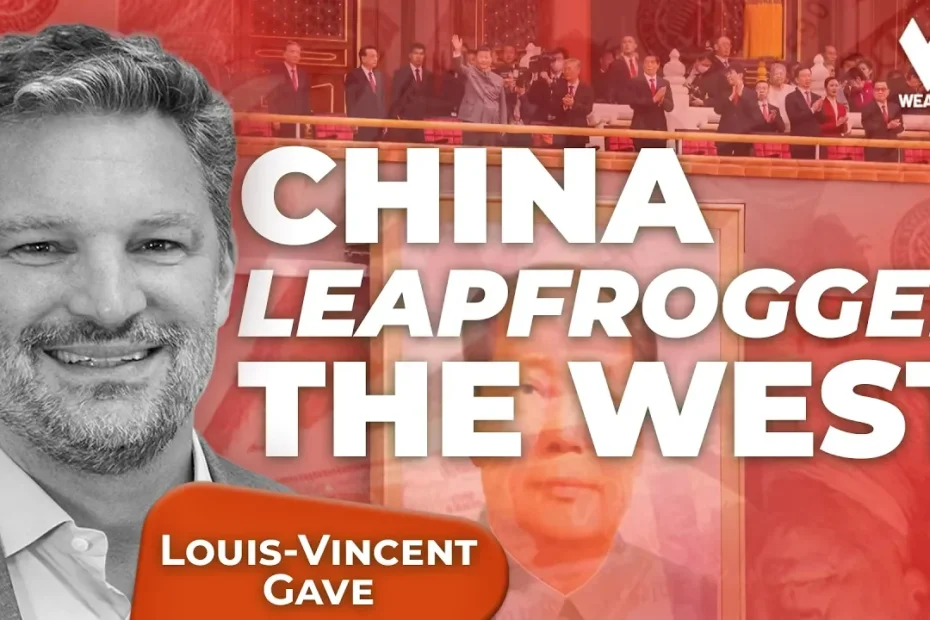
Read the full transcript of a conversation between James Connor and Louis Vincent Gave on a discussion titled “China Has ‘Leapfrogged’ the West”, premiered on Jan 28, 2025.
Listen to the audio version here:
TRANSCRIPT:
JAMES CONNOR: Hi, Louis. Thank you very much for joining us today. How are things in Hong Kong?
LOUIS VINCENT GAVE: Thanks a lot for having me. Things are dark as you can tell outside. But, yeah, things are great. Good to be here.
JAMES CONNOR: I want to focus our discussion today on the US and China. Together, these two economies represent fifty percent of the global GDP. So what happens in these two countries impacts the entire world. You and your team have done a lot of research on China and the Chinese economy. What’s your view of the Chinese economy right now? Have the policy changes that were announced in September and October of 2024, have they had a positive impact?
China’s Economic Transformation
LOUIS VINCENT GAVE: So how much time do you have? Because just putting a coin in that machine, I could ramble on for hours. But, look, I think, the way to conceptualize the Chinese economy is you had an economy for roughly twenty years that was a real estate driven economy. For all intents and purposes, you had twenty million people moving from the farms to the city every year, and that required a lot of infrastructure investments, a lot of real estate investments, and that drove a very strong growth rate.
In 2018, I think this model was basically completely torn apart by the US’s decision to stop the export of semiconductors to China. And when that happened, the Chinese leadership basically freaked out, and they thought, “Okay. The US is preventing us from growing. It’s semiconductors today. Tomorrow, it might be auto parts or petrochemicals or you name it. We have no choice but to become self sufficient in pretty much every industrial vertical.”
And so the government told the banks, “Look, banks. No more loans to real estate, and from now on, you’re only lending to industry.” And so you had a period of roughly six, seven years, 2018 to today, where loans to industry shot up and loan to real estate collapsed.
What I think every foreign commentator focused on was the collapse in real estate because for twenty years, the growth had all been about real estate, but also because we’d gone through a real estate bust in the western world. So everybody’s like, “Oh, I’ve seen this movie before. I know how this is going to end.”
And while they were focusing on the real estate bust, they completely missed what I think was the biggest story, which was basically China leapfrogging the west in industry after industry. Where we’re seeing it very blatantly today is in autos, but it’s also true in industrial robots. It’s true in solar panels and nuclear power plants and batteries, trains, road building, tractors. You name it, China is now producing at a quality level that’s often better than—usually better than the West and a fraction of the price.
And that’s a much bigger challenge for our economies. Now I think having basically achieved this industrial independence, China can now afford to relax a little more. So you had six years where it was like I said, all the money has to go to industry. It was almost like being on a warpath footing. And now having gone to the point where they’ve leapfrogged the West, it’s like, “Okay. We can relax a little bit, and we can have some subsidies to consumers.”
So now you’ve gone from real estate driven markets to industrial driven markets, and now you’re trying to shift to boosting consumption. And so you’re starting to see a lot more stimulus on the consumption side. You’re obviously seeing absolute collapse in interest rates, which makes consumer loans, mortgage loans, etcetera, much more attractive.
You’re seeing a bunch of measures taken to make real estate pick up again, things like it used to be you needed to put thirty percent equity down to buy a house. Now it’s only ten percent. And so you had a huge transition in 2018, and I think we’re starting a new transition again today. Long winded answer to your question.
China’s Strategic Advantage
JAMES CONNOR: That’s a great back story. And I couple of comments. First of all, I find it interesting that you say China’s been trying to become self sufficient now because every country in the West is trying to do the same thing, especially the US, and they realize this, especially after Russia invaded Ukraine, that they were reliant on a lot of these other countries for a lot of resources.
And the other comment I would make is, I think China has done an exceptional job of just being way ahead of the curve compared to countries in the West. And I look at EVs and also lithium ion batteries. If you’re EV manufacturer, you have to go to China to get these lithium ion batteries because they’re the only ones with the technology to do so. And they were working on that ten, fifteen, twenty years ago when nobody else cared about it.
And I look at what’s happening right now with the nuclear energy and also uranium. They’re doing the same thing, and they have the world’s largest nuclear reactor build out in the history of mankind. They’re building a hundred and fifty reactors between now and 2035, and they virtually produce very little uranium, but they’re acquiring all this uranium right under the noses of all these western countries. And so there’s another industry that they’re dominating.
LOUIS VINCENT GAVE: Well, they have the advantage on that. Sorry to interrupt you. Their next door neighbor, Kazakhstan, is one of the two big uranium producers in the world. Right? There’s Canada, and then there’s Kazakhstan.
But they’re next door to one of the biggest producers, so that helps. And what China’s been doing with Kazakhstan, with the countries in Central Asia, the countries in Southeast Asia, elsewhere is coming in, building infrastructure, and the idea being pretty simple. It’s the story of every empire through history as you build roads to bring in commodities cheaper, transform them into higher value added goods, and then export the goods again. Those goods might be cars or they might be batteries as you point out, so they might be solar panels or whatever they might be.
And that is, again, the story of every empire. Every empire fundamentally is a road building exercise. That’s why in Europe—I’m French. In Europe, we say all roads lead to Rome because that’s what empires do. They build roads.
And today, China’s presence into Kazakhstan is multiples of what it was just ten years ago. And on this, if you’re interested in this, one of my colleagues, Tom Miller, who’s been working on Gafgal for twenty years, went around all the Central Asian countries and looked at the various projects. And he wrote a really fun read about it, a fun book.
And so I’ll plug his book. It’s called “China’s Asian Dream,” and it’s a very fun read. It’s like a travel book, but going to places like Kyrgyzstan and Tajikistan are places that most people would struggle to put on a map and basically explaining what China was doing in all these places. I recommend it.
Political Systems and Policy Consistency
JAMES CONNOR: I’ll be sure to check it out. I think one of the big issues with countries in the West is that we have these new governments every four or five years, and so there’s no constant direction. And if you look at the US economy right now, of course, we had the Biden administration. They pushed forth this inflation reduction act, and they allocated trillions of dollars toward renewables and solar and wind and, I guess, a little bit toward nuclear. But now you have the Trump administration, and they’re going in the completely opposite direction. So I want to ask you a little bit more about China.
LOUIS VINCENT GAVE: Can I interrupt you there? Because I think I’m smiling because one of the jokes in China is that in China, we don’t change politicians, but we change policies. And in the West, they change politicians, but they never change their policies.
They still end up with the same health care policies. They still end up with the same agricultural policies. They still end up with the same foreign policies. They still end up with the same energy and environmental policies almost regardless of who you vote for.
Now in fairness to your point, I think that’s been true for quite a while that in essence, it didn’t really matter who you voted for. The policy was driven by essentially a government bureaucracy that just sort of turned on. This is the big question, of course, today with the US. Does Trump upend all this?
Now he promised to upend all this back in 2016 to drain the swamp and to bring power back to the people and all that stuff. Very Andrew Jackson like, and he didn’t do it. So it’ll be interesting to see if it happens this time.
But, I think, actually, in China, you actually get changes of policy. You don’t change the policymakers, but you change the policies. In the West, what’s the difference in the US health care policies? US health care has to be one of the biggest challenges. Or for that matter, health care is a huge challenge in Canada, and it’s a huge challenge in the UK, and it’s a huge challenge in France. And tell me the difference between the various politicians of the past twenty years in terms of their health care policies. It’s always been the same.
Industrial Policy and Chinese Capitalism
JAMES CONNOR: I guess the point I was trying to make is that the government, let’s just say in China, they’re going to say, “Okay. Lithium ion batteries, we’re going to spend ten years or fifteen years building this technology out.” Whereas in Canada or the US, you’re never going to get that because every government has their own ideas, so they’re never going to pick one course and then go with it.
LOUIS VINCENT GAVE: I apologize for interrupting you. I guess what you’re pointing to is sort of industrial policy. Right? It’s the way that China says, “Okay. We’re going to be doing EVs or we’re going to be lithium ion batteries.”
Now I think the way this is perceived in the West is that the government decides to do EVs and does a bunch of subsidies, and then you get an EV market out of the ground. But in fact, Chinese capitalism works a little bit differently. It doesn’t work exactly like that.
What happens in Chinese capitalism is that Xi Jinping at the top says, “Hey, guys. The future is EV, and we gotta produce EVs.” And then, basically, every mayor of every major town, every provincial governor, every party secretary picks up his phone to his local bank and says, “Hey, bank. Xi Jinping, the big man, just said we need to do EVs, so you’re going to give a loan to my EV maker.”
And before you know it, you actually have hundred and thirty EV producers in China, which is what you have right now. You got hundred and thirty guys that are all very well funded by the banks, and then starts what I’ve come to call the hunger games of Chinese capitalism.
You got a hundred and thirty guys, and they’re just going at each other’s throats. And, eventually, you have four or five who survive. This happened in the lithium batteries. That’s exactly how it happens. Like, “Oh, we need to be better in batteries,” and a hundred fifty guys get funded and only five survive.
And now the consumer is the end winner of this because the consumer gets a cheaper car at a better price and a better car because to survive, you have to put together the best car. The end losers, of course, are all the banks and the private savers because the way the system works is because there’s capital controls and there’s basically financial repression, people have no choice but to put their money at the bank, and the bank’s going to turn around and lend this money on competitive terms to businesses that are always in structural overcapacity. And so it’s a very different system.
So the way we do it in the western world is we say, “Okay. Electric cars, that’s the future. So either we’re going to give subsidies for people to buy electric cars, or we’re going to subsidize that. We’re going to pick a winner, i.e. Tesla, and we’re going to give Tesla a bunch of subsidies.”
And the end result is Elon Musk is worth whatever it is, two hundred billion dollars. I’m picking the number out of thin air. I don’t know, but I think it’s somewhere around there. Elon Musk gets to be two hundred billion dollars. And instead of having electric cars that are sub ten thousand dollars, which is what there is in China, you know, you want to buy a Tesla, it’s fifty thousand dollars.
The Chinese Consumer and Economic Dynamics
JAMES CONNOR: I want to ask you about the Chinese consumer now. In the US, the consumer represents seventy percent of GDP. What’s the comparable number in China and how would you characterize the health of the Chinese consumer right now?
LOUIS VINCENT GAVE: That’s a tough question. I think fundamentally, you’re comparing apples and oranges. Out of that seventy percent in the US, you have, like, eighteen percent for health care. In China, it’s less than half that. You could say you get much better health care in the US, but then you look at the metrics and you get a better life expectancy in China now than you do in the US even though China spends a fraction of what the US spends. So you’re comparing very different things.
The reality in China is that you’ve just had a six or seven year transition where all of the focus was on building up industrial capacity. That brings you to today where the industrial capacity has far outpaced the consumption capacity. China is producing today roughly six million cars more than it can consume, and it’s consuming roughly thirty-four million cars. It could produce forty. But, actually, it could probably produce forty-five or fifty if it really wanted to, if it was working flat out.
So you’ve got this excess capacity and underutilization of industry. Most people look at this and say China’s not consuming enough. Now the reality is China’s consumption growth has continued to click on. China today consumes twice as much beef as the United States. It consumes eight times as much fish as the United States. It consumes three times the number of smartphones per year that the United States consumes. It consumes roughly two times the number of cars, so on and so forth. But relative to the production capacity, there’s room for consumption to pick up. No doubt about it.
I think that this is what a lot of the stimulus you’re now seeing is about, to basically get consumption picking up. You’ve gone from a focus amongst policymakers of “we need to be self-sufficient industrially on everything” to now, all of a sudden, the focus being “we need to boost consumption.” And that’s fairly recent. The first time the policymakers really came out and said, we’re going to need to boost consumption here was in September of 2024. So that was just four, five months ago.
China’s Massive Trade Surplus
JAMES CONNOR: As you alluded to, China is a large exporter. It has the world’s largest trade surplus growing at a hundred billion a month. So I believe the number’s over at seventy dollars.
LOUIS VINCENT GAVE: Yeah. It’s nuts. Massive number.
JAMES CONNOR: But maybe you can just speak to that and what this is going to do to the economy. And I guess I also want to know where that excess money is going to.
LOUIS VINCENT GAVE: I think that’s a great question. I want to know it as well. I was hoping you’d tell me.
Look, the reality is today China’s running one, maybe one point one trillion trade surplus per year. That’s probably going to be the number for 2024 and for 2025. To put things in context, up until a few years ago, until China started to reach these kinds of numbers, the biggest trade surpluses you’d ever seen in the world were two to three hundred billion dollars. Japan at their top, Germany at their top. So this is an enormous outlier.
Logically, what should be happening, the fact that China’s running these master trade surpluses tells you that the industry there is super competitive, which we know they’re producing great cars for ten thousand bucks. They’re producing phones that are much better than Apple’s for three quarters of the price. If you want to book yourself into the Four Seasons in Shanghai, Beijing, it’s going to be two hundred bucks a night. The economy is super, super competitive.
Most foreigners who go visit—there’s not a lot of them who still go visit—but most of them who do are like, “Wow. Things are so cheap. And everything works, and the trains are on time, and they’re clean.” Relative to what China was fifteen years ago, it’s literally night and day.
Usually, what should be happening for an economy that is that competitive is the guy making shoes for Nike should be earning money, and he should be turning around and building another factory, or he should be turning around and buying local assets. Historically, that’s what happens. And as he does, the exchange rate goes up, local asset prices go up, domestic consumption picks up on the back of a stronger currency and stronger asset prices. And as the exchange rate comes up and consumption comes up, the trade surplus abates. That’s sort of how nature heals itself. That’s how the invisible hand sort of fixes things in the background.
Uncertainty and Capital Flows
I think what’s happening in China today is all these entrepreneurs who are making very good money live in a world of absolute and utmost uncertainty. They have uncertainty internationally, of course, where they don’t know, “Is Trump going to do sixty percent tariffs? Is Europe going to do sixty percent tariffs? Are we going to get sanctioned because we’re trading with Russia?”
But then even domestically, they’ve gone through five or six years where they felt that instead of helping them, the central government kept tripping them up. You had the real estate crackdown and the tech crackdown and the education sector crackdown and then three years of COVID lockdown. So even their own faith in their own government has been seriously tested.
Most entrepreneurs, most business people, they just want to know the rules of the game, and then they get on with it. They just want to know what the taxes are going to be, what the regulations are going to be. And then from there, they decide if they’re going to make that investment or not. But if they don’t know what the rules of the game are, then they sit on their hands. They wait and see.
So right now, all these guys are making tons and tons of money, and they don’t know what the rules of the game is going to be for the next six months, twelve months, two years, five years. So they get all this money, and they do one of three things:
One, they buy gold, and you can see China’s gold imports going up and gold prices going up in spite of rising yields in the US and rising US dollars.
Two, they keep their cash offshore if they have an opportunity to do so. So you look at Hong Kong as an example. In the past eighteen months, US dollar bank deposits in Hong Kong have grown by two hundred twenty billion dollars. That’s a lot of money. Hong Kong is tiny—we’re eight million people here in Hong Kong or seven point seven, and it’s a small place. Two hundred twenty billion is a lot of money.
And then the rest of the money, I think, is coming back to China, to be honest, just sitting at the bank. And the banks have nothing to do with it because there’s no demand for bank loans. The banks have nothing to do with it but buy Chinese government bonds. And so Chinese government bond yields go down every single day.
I think some of the anomalies that you see out there—gold doing well in spite of a strong dollar and rising treasuries, Chinese bond yields collapsing even as US treasuries soar—a lot of these things are linked to the recycling of this just gargantuan Chinese trade surplus combined with the lack of confidence today amongst Chinese entrepreneurs.
Foreign Real Estate Investment Changes
JAMES CONNOR: You didn’t mention real estate in Toronto or Vancouver.
LOUIS VINCENT GAVE: In the old days—no, you’re absolutely right. In the old days, if I was a rich Chinese guy, I did buy real estate in Toronto and Vancouver or in Sydney or in London or LA or San Francisco, lots of different places. Although you’re right that Toronto and Vancouver were very high on the list of places to buy real estate.
I think this has been shaken by a number of things. Of course, Canada started to put tax on foreigners trying to buy real estate in Canada, started to put taxes on buildings that were left unoccupied. But perhaps most importantly, what really shook the Chinese faith in “let’s keep buying Vancouver and Toronto” was the seizure of the Russian assets.
When the combined Western world said, not only are we going to seize the assets of the Russian government, which was one thing, but we’re going to seize as well the assets of all the Russian oligarchs. If you’re a rich Chinese guy and you own a house in Vancouver, you think, “Hold on. If tomorrow Xi Jinping decides to invade Taiwan, something I have absolutely no visibility or influence on, then the Canadian government’s going to confiscate my house.”
I bought this house in case things went bad in China. And now if you tell me in case things go bad in China, I’m going to lose it? So this house isn’t what I thought it was. It was my sort of safe money, my fallback in case things go really bad. And what you’re telling me is if things go really bad, I lose it. So all of a sudden, I’m not that interested in it anymore.
With a trillion dollar trade surplus, to be honest, the Vancouver real estate market should be going nuts. It should be going absolutely bananas. So should Sydney, and so should Auckland and Toronto, but it’s not. Because that recycling into Western real estate, I think, has really stalled following the Russian confiscation of assets.
China’s Growing Trade Despite US-China Tensions
JAMES CONNOR: And it’s amazing to see this trade surplus grow in the past eight years when this Cold War has been going on between China and the US. So who are they selling all the goods to?
LOUIS VINCENT GAVE: I think that’s a super important point you just made there. Six, seven years ago, when the US said we’re going to block semiconductors to China, the idea was to basically desinify our supply chains, to say China’s a bad actor, we’re going to trade less with them. Back then, the trade surplus for China was roughly two hundred fifty billion a year. Now it’s a trillion.
So the whole idea that we’re going to desinify our supply chains and make China less relevant in the global trade equation has been a complete and utter failure. I think if policymakers were ranked on results, that has obviously failed. That should be an F. You get an F grade for your attempts to isolate China.
What’s happened in the meantime is that China’s growth into other emerging markets has gone bananas. Today, China exports more to emerging markets than it does to developed markets. In fact, China now exports more to ASEAN countries—Indonesia, Malaysia, Philippines, and the like, the Association of Southeast Asian Nations—China exports more to ASEAN than it does to the United States.
What’s fascinating is that the export mix of China is now like fifty-five percent emerging markets, forty-five percent developed markets. Emerging markets are growing very fast. So pretty soon, in a few years, we’ll be at like two-thirds, one-third.
And what they export to emerging markets is higher value-added goods that are higher margin. It’s the cars. It’s the nuclear power plants, the railroads. It’s the turbines. It’s the industrial robots.
And increasingly, what they sell to the developed markets is either Apple, other consumer electronics, which are very hard to move somewhere else because of complicated supply chains, or increasingly the pretty low value-added stuff—the shoes, the Tupperware that you buy at Walmart, the cotton socks that you’re probably wearing right now, all that stuff that you find at the big box stores all over the US and Canada. That is increasingly what China knows it’s going to lose gradually, like the plastic toys you buy for kids over Christmas. All that stuff is going to be moving to Vietnam, to Indonesia, to Bangladesh, to wherever else. China knows it’s going to lose that.
So when the US says, “Hey, we’re going to do big tariffs,” I think China increasingly is like, “Okay. So you’re going to tariff Apple. That’s your issue.”
China’s Strategic Perspective on Trade
LOUIS VINCENT GAVE: You’re going to tariff all the consumer electronics. Okay. That’s a bit of a bummer, but we know that can’t move because it’s complicated supply chain, so that’s not going anywhere either. And it’s definitely not coming back to the US. And you’re going to tariff all the low value-added stuff that we were destined to lose over the next five to ten years anyway, so maybe we lose it a little faster.
We don’t really care because our future—I’m talking like if I’m Chinese, I’m not. But, you know, if you’re Chinese, you think our future is not selling Tupperware at Walmart. Our future is selling BYD cars to Brazil. It’s selling long haul machinery to Indonesia. It’s selling nuclear power plants to Saudi Arabia.
That’s what I—that’s what if you’re the Chinese Ministry of Commerce, that’s what you care about, much more so than selling Tupperware at Walmart.
JAMES CONNOR: And now that we have a new administration in the US, do you see things improving? You’re probably quite familiar with the cabinet. Are there a lot of China hawks on the cabinet? And do you think Trump will want to renegotiate the trade deals?
LOUIS VINCENT GAVE: Trump will definitely want to renegotiate the trade deals. Absolutely. You know, Trump loves negotiating trade deals. I mean, when he went to Joe Rogan, he was asked, you’re seventy-eight years old, seventy-nine years old. I can’t remember. But, you know, why are you still doing this? And he said, “Look, what gets me really excited is negotiating great deals for America.” So I think that’s how he sees himself. That’s how he likes it.
So there’s no doubt he’s going to want to sit down with Xi Jinping and hammer out some kind of deal. Now the bigger question is, is Xi Jinping going to be interested in a deal? I think there’s a fair amount of bad blood that’s happened over the past eight years. China’s felt very targeted by the US.
You know, I think it’s easy to criticize people. The old Steve Martin joke: “Before you criticize anyone, you should walk a mile in their shoes. Like this, when you criticize them, you’re a mile away and you have their shoes.”
But when you look at China from their point of view, the US messed up massively with the mortgage crisis. The world almost imploded. They came in and they did a big stimulus, which, in their view, basically saved the global economy, got the global economy back on track. They did this with great risk. They put on more debts, and it also led to a lot of corruption in China. But they feel like in 2008, we were good global responsible citizens, and then the US turns around and plants a knife in our back. Now I’m not saying I agree with this view, but I’m just saying that’s how they view things.
So how keen will they be to have a deal, especially since, remember, they’ve spent really the past eight years cushioning their economy from potential US attacks. So they may very well feel, “Look, you want to tariff us? Have at it. We don’t care.”
We don’t care all the more since I think deep down they know that eight years ago, what everybody was worried about was deflation. Today, what everybody’s worried about is inflation. And, politically, can Trump really surf on a wave of higher inflation, to the extent that he got elected, thanks to a wave of higher inflation? You saw that in Americans who earn less than fifty thousand dollars a year, you had a sixteen percentage point swing from Democrats to Republicans. And what drove that swing was first and foremost inflation.
So I highlight this because it’ll be interesting. I think Trump will want to sit down, will want to make a deal. How interested China will be, I think that’s up in the air.
The TikTok Situation
JAMES CONNOR: And we have this back and forth going on with TikTok. So right now, TikTok is still operating in the US. Trump gave it I think it’s a seventy-five day break. But do you think he’s going to use this as a bargaining tool with the Chinese?
LOUIS VINCENT GAVE: I think if you’re Xi Jinping, you don’t give a hoot about TikTok. I mean, the ownership of TikTok is sixty percent US VC firms. It’s twenty percent the staff, mostly based in the US, incidentally, and twenty percent the founders. Now, TikTok is a global business. If they have to shut down the US, I think if you’re Xi Jinping, it’s like, what do I care? It’s absolutely no skin off his back.
Now I know the perception in the US is, “Oh, no, it’s like a tool of the Chinese Communist Party to control the minds of our youth,” so on and so forth. So if you believe that, then you think, okay, what’s Xi Jinping going to do? There’s still no reason to give it to the US. So the whole “if you do a deal with us, we’re going to give you TikTok”—I think if you’re Xi Jinping, what do you care? If American VCs that own sixty percent of the company have to take a huge hit, I don’t think it prevents you from sleeping one minute less than you would have otherwise.
In fact, if you’re Xi Jinping, you might want to go all the way through and say—because then you show the world, “Look, America pretends that they’re the land of business and that they’re the land of free trade, but as soon as you go over there and you’re successful, they try to steal your business from under you. And if you don’t give in to their terms, then they shut you down. So how really is it the land of capitalism that it claims to be?”
So I think for Xi Jinping, he might actually rather close it down. It’d be a better propaganda coup for him than selling it to the US.
China’s Market Valuation
JAMES CONNOR: So in summary, it sounds like things are definitely improving in China. And in the past, you have said China was the most undervalued market in the world. Do you still think it is?
LOUIS VINCENT GAVE: I think it is. It’s less undervalued. I was just in Oslo, and one of my slides in my presentation is the performance of the big country ETFs, so Japan, India, etcetera. So last year, the SPX, the S&P 500 essentially, was up twenty-four percent. The FXI, the biggest Chinese ETF, was up twenty-eight.
So I asked this room of big pension funds—about a hundred Scandinavian pension funds—”How many people here knew that China last year, Chinese equities, the FXI actually outperformed the SPX?” And out of about a hundred pension fund managers, only one put his hand up, which told me that not only are they not invested in China, they’re not even looking at it, which I find interesting.
So it is less undervalued than last year. It’s gone up. But if you take a step back, what do you have in China? You have a market that is basically in the bottom quartile of its valuation at a time where all of a sudden, the policy uncertainty has been lifted. The government since September has been very vocal of, “Look, we’re going to keep throwing money at this until the economy picks up. We’re going to do fiscal stimulus. We’re going to do monetary policy stimulus.”
And they’re doing the monetary policy stimulus because bond yields are falling every day. Now why are bond yields falling? Because the PBOC keeps buying Chinese bonds. Their balance sheet is exploding. It’s like going through QE just like we did in 2009, we being the Western world.
So I look at this and I think, okay, I have the opportunity of buying a cheap market with policy support and at a time when the differential between the dividend yield and bond yields has never been this high. So I know that every Chinese pension fund, insurance companies, etcetera, today has to sell bonds and buy equities.
Meanwhile, I look at the US, and in the US, I have a market that’s in the top decile of valuations. I have massive policy uncertainty because I have no clue what Trump is going to do. And more importantly, I also have no clue how the Fed is going to respond to whatever Trump does. So there’s really two levels of uncertainty.
Meanwhile, I’ve got bond yields that are going up every day. And what’s fascinating to me is everybody’s like, “Oh, yeah. You want to buy the market where bond yields are going up every day, and you want to sell the market where bond yields are going down every day.”
And I’m like, well, actually, that’s not how it works. Falling interest rates is a pretty strong tailwind for asset prices. Rising interest rates are a pretty strong headwind for asset prices. So, yeah, personally, I’d rather buy the cheap market with falling interest rates and policy support every day of the week and twice on Sunday.
US Economy and Inflation Concerns
JAMES CONNOR: Okay. So you just mentioned that the US economy is overvalued, and I was going to ask you about that because when you look at the US economy, the Q3 GDP number just came out. It was revised upwards for the third time to three point one percent from two point eight percent. I never understand these revisions. They happen all the time with the government. But, also, the most recent non-farm number came in very hot. Two hundred and fifty-six thousand jobs were added versus expectations of a hundred and fifty-five thousand jobs.
And you also made mention of the fact that with the Trump administration, there’s a lot of unknowns. We don’t know what they’re going to do with taxes and tariffs, deregulation, deportation. But those elements I just mentioned, a lot of people are saying they can be inflationary. Do you see a threat of inflation heating up in the US? And so instead of cutting rates in 2025, maybe rates are left unchanged. Maybe come Q3 or Q4, they lift rates. What are your thoughts?
LOUIS VINCENT GAVE: Look, I’ve been an inflationista for quite a few years. And simply put, the way I look at it is I love Jacques Ruff’s definition of inflation. Jacques Ruff was a famous economist in France, but he was also De Gaulle’s economic adviser, and he was the one who advised De Gaulle. He was looking at the twin deficits in the US. He was looking at the guns and butter policies of Johnson, funding the Vietnam War plus the great society. And he said, “Look, they better repatriate our gold,” which the Americans were really upset at the French for. But we basically brought all our gold back.
And Jacques Ruff used to say “inflation is subsidizing expenditures that give no return with money that does not exist.” And to be honest, I think we’ve done a lot of that in the Western world in recent years.
Look at it this way. Today, you mentioned the very hot nonfarm payrolls. For all intents and purposes, the US is running at full employment. I mean, if you want a job, you can find a job in the US today. Unless you’re in a very few regions that are perhaps struggling. But by and large, in the US today, the job market is super tight, and you’re running budget deficits of seven and a half percent of GDP. It’s absolute madness. In recent years, you’ve gone from five and a half to seven and a half percent of GDP, massively procyclical fiscal policies. So you gotta pay it somehow, and the way you end up paying it is through inflation. So, yeah, I absolutely do remain an inflationista.
The way I look at it is we’re still far from the Fed’s two percent target. The Fed started cutting for the first time. Usually, it never cuts until the inflation gets to two percent or below. This time around, basically, the Fed started to cut when inflation was at two point six. The message the Fed sent to the market, I think, was two percent used to be the ceiling, and it’s now the floor. As we get close to two percent, we start to cut. So two percent is now the floor on inflation, which means that through the cycle, you are going to be higher. If two percent is your floor, you’re going to end up higher.
And so I look at the past year, you had every reason for inflation to be weak—energy prices were very tame, you had a very strong dollar, super weak yen, super weak China, commodities outside of gold were really soft. And you had easy year-on-year comparisons.
China’s Economic Stimulus and Global Inflation Outlook
LOUIS VINCENT GAVE: And with all of this, still, you couldn’t get back to two percent. So now, fast forward to 2025, and what do I know? I know I’m getting massive stimulus in China, which I think does matter for things like commodities and just overall growth. I think as soon as the German election is behind us, you’re going to get more stimulus in Europe and more rate cuts in Europe.
You’re going to get to the question of what you get in the US. Do you get protectionism or not? If you get protectionism, that’s inflationary. Do you get more fiscal pump priming by the Trump administration? If you do, that’s inflationary.
I’m left wondering, and you’ve got oil inventories at record lows. Everybody came into 2025 thinking oil is going to keep going down, and it keeps grinding higher. If by chance you have an end to the Russia-Ukraine war, then you’re going to have all the reconstruction of Ukraine, which is going to be pushing commodities higher.
I put it all together and think, what’s going to be the big deflationary force in the next year or two? You could say it’s going to be China exporting all this excess supply. But remember, China is now stimulating its domestic consumption, number one. And number two, we’re talking about putting tariffs on this Chinese excess supply.
I am an inflationista. I have been, and I remain one.
Investment Outlook for the US and Global Markets
JAMES CONNOR: So you’re bullish on the US?
LOUIS VINCENT GAVE: The US is a massive economy. I’m definitely bullish on US value stocks. I’m very bullish on US financials. I’m not bullish on the market per se because I think the market in the US is distorted by the extreme concentration that such as you’ve never seen.
If I was going to buy the US, I’d buy the equally weighted S&P 500 more than the market-weighted. I don’t want to have six percent of my portfolio in NVIDIA and six percent of my portfolio in Microsoft and six percent in my portfolio in Apple—Apple that hasn’t grown in sales for four years now and that is trading at whatever it is, thirty-five times earnings for a company that’s no longer growing.
Beyond that, is the US economy going to do okay? Is real estate going to do okay? I think it is. Are the banks going to piggyback on the real estate doing better? I think they will.
But if you look around the world, I think there’s way more attractive opportunities than the United States on a valuation basis and just on a fundamental basis. The US today has mortgage rates at seven percent. Energy prices are creeping up. The US dollar is very high, which is going to hurt corporate earnings. I’m not bearish the United States. I just think there’s more attractive opportunities elsewhere.
Rising Interest Rates and Treasury Yields
JAMES CONNOR: So you just touched on interest rates and mortgage rates at seven percent. And interest rates, in spite of what the Fed is trying to do, they’ve slashed the short-term rates by, I believe, a hundred basis points in the last three meetings. But at the same time, you get the long end of the curve going up. I believe it was around 3.80 in September, and right now, it’s at 4.60, 4.70. What do you think the ten-year is trying to tell us?
LOUIS VINCENT GAVE: I think you can make many scenarios. You start to see an acceleration in the sell-off in US treasuries post the presidential election result. From there, you could say the market’s getting excited. Trump’s going to make America great again. He’s going to deregulate. He’s going to cut taxes. So it’s going to lead to a lot of growth. That’s one possible explanation.
I think there’s another because while US bond yields have been shooting up, Chinese bond yields have been collapsing, which is highly unusual. Usually, they sort of move a little bit together. But for them to basically open up by 160 basis points in the space of a few weeks is simply unprecedented.
I personally wonder to what extent when Trump got elected, whether it was Xi Jinping or Li Chung or the PBOC telling CIC SAFE, who manages the Chinese reserves, but also telling the pension funds: “Look, Trump’s back in. He might bash us. He might not. Who knows? But better be safe than sorry. Why keep so much exposure to US treasuries? Just start bringing the money home.”
That could have been contributing to the sell-off and the rally on the other side as you get a reallocation of a lot of Chinese flows away from US Treasury.
Because the reality is if you’re a foreigner, Trump might not be that compelling of an investment proposition. I mean, you’re Canadian. Did you expect for Trump to come right out of the gates and bash Canada the way he has? Probably not. And does that make you more likely or less likely to buy US treasuries?
If you’re Canadian, you’re probably thinking, “I know I’m not going to get my money confiscated in the US.” But what if you’re Chinese? What if you’re Qatari? What if you’re from Bahrain? If you’re from Bahrain and Trump wants something from you, he’s going to beat you up until you give it to him. Could that involve losing access to your treasuries?
If you spit in foreigners’ eyes, maybe foreigners take their ball and go home.
Just on this—if you’re China and you’re a little worried about what Trump is going to do to you and you see how he’s treating Canada, who if you’re China, you think Canada and the US are like this—they’re like big brother and little brother. If he treats Canada like this, what’s he going to do to me?
Canada’s Leadership Vacuum
JAMES CONNOR: Let me ask you about Canada. What’s your perception of what’s happening in Canada?
LOUIS VINCENT GAVE: First, I don’t know if I’m a great foreigner because my wife is Canadian, and I have four Canadian kids who go to boarding school on Vancouver Island. So I do pay a lot of attention to what happens in Canada.
I do think most foreigners don’t really care, to be honest, because Canadian politics aren’t that interesting. You’ve mentioned there’s a vacuum today. I would argue there’s been a vacuum for ten years. You’ve had a lack of leadership.
You look back at the past ten years, what has been the big achievement of Trudeau? You had ten years to build pipelines to free the oil from Alberta, go put it through BC, ship it onto China, ship it onto Japan, or wherever else in the world. That didn’t happen.
Post Russian invasion of Ukraine, Olaf Scholz came to Canada, sat down with Trudeau, and said, “Look, we desperately need your gas. We desperately need your oil. We’ll come. We’ll build the terminals. We can build them quick. We’ll pay for it all. We’ll sign you twenty-year deals.” He was literally throwing money at Trudeau to get the gas that he needed.
And this is Germany, a NATO ally who at the early days of the war, is in deep trouble because they’ve been so reliant on Russia. In essence, he comes and says, “Look, I’ve been reliant on Russia. That was a mistake. I now want to be reliant on you.” And what does Trudeau do? He tells him to take a hike because of climate change.
The end result is that Canada has left itself completely dependent on the United States. It’s done nothing in the past ten years to reduce this dependency on the United States. And that is such a failure of leadership by Canada because you had a warning shot in 2016.
Trump gets elected in 2016. He says he’s going to turn NAFTA apart, slaps Canada around a little bit, but not too bad. On the back of this experience, Trudeau should have said, “I got caught with my pants down here. Let’s not have that happen again. Let’s boost my trade with EU. Let’s boost my trade with Asia.” He did absolutely none of that, none of the infrastructure spending that was necessary.
I think they just took it for granted that Trump was just a bad dream, and it won’t happen again. And instead, here we are, and now he’s caught. It’s not that he’s caught with his pants down. He’s caught with his pants off.
You said we have a lack of leadership today. I would argue you’ve had it for ten years. And, hopefully, that changes. It’s the old story. If you’re going to plant a tree, the best time to plant a tree was twenty years ago. The second best time is today. There’s been a cruel lack of leadership in Canada for ten years, but hopefully, that gets remedied soon.
JAMES CONNOR: And to your point, what happened—
LOUIS VINCENT GAVE: Sorry if that was a little politically biased.
JAMES CONNOR: Not at all. I wasn’t expecting that, and I didn’t realize you had relations to Canada. But this is what happens when you have a left-leaning or socialist government who’s more focused on using the right pronoun and sending gender advisors to Ukraine than they are on building up the economy and creating a higher standard of living for its citizens.
LOUIS VINCENT GAVE: To be honest, I don’t think it’s even a left-right wing thing. It’s virtue signaling because of how the left has evolved. In France in 1981, when we elected Mitterrand, who was socialist, he powered ahead on the need to build nuclear power plants. He saw that as a comparative advantage for France and as a way to maintain France’s geopolitical independence.
Energy is economic activity transformed. Everything starts with energy. If you don’t have an energy policy that makes sense, your economy is going to hit the wall at some point. In the past, you have had left-wing governments that have energy policies that make sense.
In the older days, proper left-wing governments would have said, “Great, let’s build a pipeline, jobs for the boys, jobs for the unions, jobs for guys with big tattoos, big arms, lunch boxes, hard hats.” The left used to like these kinds of things. And they’ve turned their back on those voters to embrace virtue signaling.
Fortunately, I think the reason why this time around, the left in America isn’t up in arms against Trump is that I think half the left is actually almost relieved that this page is being turned on the virtue signaling, on the woke ridiculousness, and they can go back to being what they always were, a party defending the workers.
I’m a very right-wing guy, but you want a left wing that defends workers, that defends the infrastructure in your country. You want that as a counterbalance. That’s a healthy counterbalance because it doesn’t divide society into an “us against them” kind of thing like all the woke nonsense does.
JAMES CONNOR: Very good points. So, Louis, before we wrap it up, I just want to summarize a few of the points you made.
Economic Outlook and Investment Opportunities
JAMES CONNOR: So first of all, you think the Chinese economy is turning around, and it’s on its way up. Things are definitely improving there. You still think things are fine in the US. The economy is still very strong, but you don’t see any trouble there. But at the same time, you think there’s better value in other parts of the world like China. Do I have those points right?
LOUIS VINCENT GAVE: Yeah. That’s it, and, you know, I know a lot of people don’t like China. They’re like, “Oh, it’s a communist regime, this, that, and the other.” And, you know, long term returns, equities in China, poor, etcetera.
There’s lots of places where you get great value. You know, Brazil right now is being given away in the streets. You have great value in other parts of Asia. Now if you’re more of a growth guy, you’ve got great growth opportunities in India. So, yeah, I still think it’s an exciting world, and there’s things to do in different places.
Energy Prices: The Major Risk Factor
LOUIS VINCENT GAVE: I think the real big risk for the US, for everywhere, let’s go for Canada, but for everywhere, the real big risk is that energy prices continue to grind higher because I think most entrepreneurs, most households can take one punch. So if interest rates creep higher, we mentioned mortgage rates at seven percent, people can take that punch. But if at the same time, filling up your car every week keeps on getting more expensive and paying your heating fuel bill and paying your electricity bill. If those go up at the same time, then you get squeezed. Most people can take one punch. The second one knocks you out.
And so today, for me, the big risk like I said, I’m decently sanguine, but I fear that if we move from seventy-five dollar oil to a hundred dollar oil, I’m talking US dollars, then we move into a much more complicated world. So I continue to believe that having big energy positions, if only as a hedge, you have your energy positions. And if oil stays at seventy-five, they’re not going to do very much. If oil goes down to fifty, then they’re going to go down.
But if oil goes down to fifty, the rest of your portfolio will absolutely fly. So, it’s how you build. You build a portfolio knowing that not everything is going to do well, but you built some cushions in there. And today, the best cushion you can have is not government bonds. I’m not even sure it’s gold anymore. I think the best cushion you can have is energy.
Closing Thoughts
JAMES CONNOR: Well, that was a great discussion. It was very all encompassing, and I want to thank you for spending time with us today. If somebody would like to learn more about you and the services that your firm offers, where can they go?
LOUIS VINCENT GAVE: Yeah. Absolutely. So we’re Hong Kong based. The easiest is to go to our website. It’s called gavekal.com, G-A-V-E-K-A-L. We really do three things. We have a sort of independent research business for institutions. We have an institutional asset money management business, and we have a private wealth business. So feel free to go to our website. I also have I’m on Twitter or X. My handle is Gave Vincent. I post every now and then, not all the time, but I’ll post a paper that I write on there every now and then. So feel free to check me out there as well.
JAMES CONNOR: Louis, one final question about Hong Kong. You have lived there for many years now. What do you enjoy most about that city or that region of the world?
LOUIS VINCENT GAVE: I think Hong Kong is a super exciting city. It’s a very easy city to live in. If you’re into the outdoors, most people don’t realize this, but there’s beautiful beaches, amazing hiking. You know, fifteen minutes from my office, I can be in the middle of the jungle hiking into just really beautiful scenery. So I definitely enjoy that.
I enjoy the fact that it’s super safe. As a parent of teenagers, living in a crime-free environment is very, very nice. And then as a businessman, to be honest, I enjoy the minimal red tape, the fairly pro-business, pro-light regulatory touch government that we have in Hong Kong. So it’s an easy place to run a business. It’s an easy place to raise a family, and it’s an easy place to escape from when you want to escape.
JAMES CONNOR: I’m going to have to check it out sometime. Once again, Louis, thank you. Thank you very much.
JAMES CONNOR: Well, I hope you enjoyed that discussion with Louis Gave. As Louis mentioned, there’s a lot happening throughout the world right now and a lot of turmoil. And if you need help in understanding how these events will impact your financial future, consider having a discussion with a vetted financial adviser at wealtheon.com/free. It will only take a few minutes of your time, and there’s no obligation whatsoever to work with any of these financial advisers. Once again, you can find out more information at wealtheon.com/free. Thank you very much for being with us today, and I look forward to seeing you again soon.
Related Posts
- Transcript: President Trump Remarks at Wheeler High School in Marietta, GA
- Transcript: What It’s Really Like Inside Trump’s World w/ Maggie Haberman & Jonathan Swan
- Transcript of Rolling Stone Interview: Zohran Mamdani
- Transcript of Tucker Carlson Interview: The Mishal Husain Show
- Transcript: President Trump Speaks at FIFA Reception in New York City