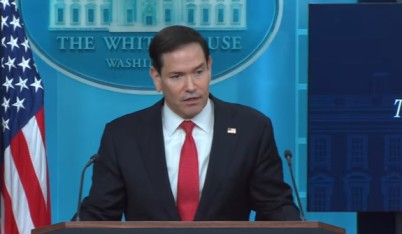
Editor’s Notes: In this press briefing from May 5, 2026, Secretary of State Marco Rubio addresses members of the media at the White House to provide updates on key administration priorities and foreign policy developments. The session highlights the United States’ current diplomatic engagements and underscores the strategic objectives of the Trump administration. Secretary Rubio concludes the briefing by taking questions from the press, offering further clarity on the government’s stance regarding pressing global and domestic issues.
TRANSCRIPT:
Secretary Rubio Opens Briefing on Project Freedom
SECRETARY RUBIO: Hello. Thank you guys for having me today. I’ll be filling in for Caroline today, obviously. So I’ll have brief remarks and then we’ll get to your questions.
Project Freedom: Rescuing Civilians Trapped in the Persian Gulf
As you know, over the weekend, the President announced Project Freedom. And the goal of it is to, frankly, if you want to talk about it, it’s to rescue almost 23,000 civilians from 87 different countries that are trapped inside of the Gulf and left for dead in the Persian Gulf by this Iranian regime.
For more than two months now, these innocent sailors and commercial crew members have been stranded out at sea because Iran is conducting something that’s not just criminal — it’s criminal for sure — but it’s desperate and destructive, this blockade of the Straits of Hormuz. Nations from around the world, the overwhelming majority of whom are not even engaged in any military hostilities, are now at risk not just of losing their cargo, but the lives of their own citizens because of this blockade.
These ships — you don’t leave a ship out there for this long — you start running out of food, you start running out of potable water, essential supplies, and they’re at the mercy of this piracy. What it is, it’s piracy. And not only that, but some of them have been open fired on and rained down senseless attacks on several civilian ships already.
So frankly, the way to put it, these are innocent bystanders. These are countries — and ships and so forth — that have nothing to do with any of this and nonetheless are being caught in the middle of it and being held hostage merely because Iran could do that. Just as the regime brutally slaughtered tens of thousands of their own citizens for the crime of peaceful protest, because they’re unhappy with the quality of life — or the lack of quality of life — in Iran today.
And so they’re sitting ducks, they’re isolated, they’re starving, they’re vulnerable, and at least ten sailors have already died as a result. So already many nations privately and some publicly have asked the United States to help free their ships and to restore freedom of navigation in the Straits of Hormuz in this critical artery of global trade.
President Trump Directs U.S. Military to Guide Stranded Ships to Safety
And so President Trump, as he always does, stepped up and answered the calls for their help. And he’s directed the United States military to guide these stranded ships to safety, to provide a protective bubble under which they can operate and move product and get themselves out of there and out of harm’s way. And this is the first step towards reopening the strait and bringing this regime’s last ditch act of economic arson — bringing that to a close.
We’re doing it not only because we were asked, but because we’re the only ones who can. Only we have the power to sort of take the steps that we’ve taken now. Under this president, under President Trump, the United States will help our friends, we’re going to stand up to rogue regimes like the one in Tehran, and we’re going to be unashamed to use our power and our abilities to project military power in the service of our national interests above all else.
A Defensive Operation: No Shooting Unless Shot At First
Now, what’s really important for you to report and for everyone to understand is this is not an offensive operation. This is a defensive operation. And what that means is very simple. There’s no shooting unless we’re shot at first. We’re not attacking them. But if they’re attacking us, or they’re attacking a ship, you need to respond to that. You’re not going to let some fast boat come up on a ship and shoot it up. We’re going to respond to it.
And we’ve been successful at it. I don’t know what the exact number is, but I know a number of those fast boats have now been targeted, and will continue to be if they pose a threat to our forces. We’ll shoot down drones, we’ll shoot down missiles, but it’s defensive in nature. This is defensive.
Freedom of Navigation in the Strait of Hormuz
So if you hear stories about attacks and launching of firing back and forth, it’s not back and forth. We are only responding if attacked first. This is a defensive operation. And that’s what’s occurring here.
Just about the importance of the Straits for a moment. This is approximately a quarter of the world’s oil trade, along with significant volumes of fuel and fertilizer that operate through the Straits of Hormuz. The Iranian regime cannot be allowed to dictate who uses this vital waterway.
I don’t think this is also being reported enough. Maybe you are reporting. I don’t read everyone. I don’t know who you all are. I mean, I know who some of you are. But I will say this about it. This is an international waterway. This is an international waterway. And international law is very clear. And I love it because everybody always talks about international law. International law on this is very clear. International waterways, no country can control them. There is no international law that allows you to say, “I’m going to put mines in an international body of water and I’m going to blow up ships that don’t listen to us and try to go through.”
That’s what Iran is doing.
Early Results: U.S. Ships Safely Through the Strait
So far, as a proof of concept and as a proof of function, two U.S.-flagged merchant ships have successfully transited the Strait of Hormuz in the first stages of this project and are now safely on their way. The U.S. military is deploying the necessary assets to extend this defensive umbrella over commercial shipping.
But there should be no mistake. And as I said this already, this is a defensive operation. I want to reiterate that point. This is important to understand. If no shots are fired at these ships and no shots are fired at us, we’re not firing shots. But if we’re fired on, we will respond and we will respond with lethal efficiency.
U.S. Military Assets and Iranian Fast Boats
The assets supporting this project, by the way, include guided missile destroyers, over 100 land and sea-based aircraft, multi-domain unmanned platforms and 15,000 of the finest military service members on the planet. These forces have already destroyed, as I told you earlier, I thought it was six, it’s seven Iranian fast boats that failed to heed our warnings. And by fast boats, we’re talking about, you know, some of these things look like Boston Whalers. So these are not like Navy ships. But nonetheless, they come fast at these boats, try to swarm them, try to harm them. We’re not going to let that happen. So seven of them now sit at the bottom of the sea, along with, by the way, the rest of Iran’s Navy. That’s where you can find their Navy today. And we’re going to continue to systematically clear this passageway through the straits to restore freedom of navigation.
Operation Economic Fury: Maximum Pressure on Iran
Now, while this project steadily progresses, Operation Economic Fury — I’m sorry — continues to impose maximum pressure on the Iranian regime and what remains of their already frail economy. Today, inflation in Iran is 70 percent, and their currency is in total and complete freefall.
U.S. sanctions enforcement is stepping up. It’s moving in lockstep with the naval blockade to degrade Iran’s capacity to generate, to move and repatriate revenue. It directly targets the regime’s primary revenue lifelines. The blockade alone is costing Iran as much as $500 million a day in lost revenue. Ninety percent of total Iranian trade has been halted, causing permanent damage to Iran’s oil infrastructure as wells are forced to shut in.
Again, all of this is in response to their piracy. It cannot be that you have these straits and they blow up any ship that moves and the only ships they get to go through are theirs.
The Blockade, Sanctions, and Iran’s Choices
You can’t have a situation in which the straits are closed to everyone else, but they benefit from the piracy. That can’t happen. That’s why the blockade is in place, and that’s why these sanctions are crippling them. Any foreign financial institution or commercial actor that enables Iran’s sanctions evasion is going to face secondary sanctions exposure and a loss of access to the U.S. financial system.
As President Trump has said, and the facts clearly bear out, the United States of America holds all the cards. There is no scenario here in which if they decide to join a ladder of escalation, they wind up getting the last say. But our preference is for these straits to be opened to the way they’re supposed to be opened, back to the way it was. Anyone can use it. No mines in the water. Nobody paying tolls. That’s what we have to get back to, and that’s the goal here.
Every day the conflict continues, however, our leverage on Iran will continue to increase, and their position will continue to weaken, especially as the blockade really begins to divide in conjunction with the sanctions.
Iran Must Make a Sensible Choice
So look, the time has come for Iran to make a sensible choice, and it’s not easy for them to do that, obviously, because they have a fracture in their own leadership system. Apart from that, the top people in that government are, to say the least, insane in the brain. So we need to address that, and it’s difficult because it’s hard to get past that in their system. But it’s important for them to make a sensible choice and the one that’s right for their people.
The President, our President, has proven time and again that his preference is peace. But Iran must accept the reality of the situation and come to the negotiation table and accept terms that are good for them but ultimately good for the world. The diplomatic path, if there’s a real diplomatic path — I’m not always going to be one, but if there’s a real diplomatic path and we continue to explore it — Steve and Jared are working on that very hard. If there is one there, it could be one that leads them to reconstruction, to prosperity, and to stability, and to not posing a threat to the world. The alternative is growing isolation, economic collapse, and ultimately total defeat.
I know what the right choice is for Iran. I hope that the people over there making decisions will make the right one.
The last point I would make, and it really is important for them to understand this, is they really shouldn’t test the will of the United States, at least not under President Donald Trump. He has proven time and again that he will back up what he says. And if they test him, ultimately they will lose. The hard way, the easy way, the long way, the short way, they will lose.
And with that, it’s time for your questions.
Q&A: Iran’s Nuclear Weapons Program
REPORTER: Hi. Captain Barron. I’m an independent journalist. Secretary Rubio, have you seen any recent indications that Iran is willing to give up this nuclear weapons program that is credible, verifiable, and that would lead to an immediate de-escalation?
SECRETARY RUBIO: Well, look, this is a long-standing problem for them. They have always said they don’t want a nuclear weapon. That’s because they’ve always said that. They just don’t mean it. And why do you say, well, how do you know they don’t mean it? Well, we don’t mean it because they’re doing all the things, and historically have tried to do all the things that you do if you want a nuclear weapons program.
For example, they innovate and try to innovate long-range delivery missiles that now, in some cases, are capable of reaching much of Europe. They build these large underground centrifuges for enrichment activity. There are countries in the world that are involved in the enrichment business, but these guys do it in mountains and in caves and in hiding.
Iran’s Nuclear Program: Civilian or Military?
They’ve always had secret components of their nuclear program undisclosed to the world, and we know for a fact that they retain highly enriched uranium at 60 percent, that they did so, and that has no civilian use, none, zero, whatsoever.
So they have an opportunity here to agree to something that will make it clear that they’re not interested. One thing is to say we don’t want a nuclear weapon. Another thing is to do the things that prove you don’t want a nuclear weapon.
By the way, if what Iran wants is a civilian nuclear program for power plants and stuff like that, there are a lot of countries in the world that have that, and they don’t enrich. They import the enriched material. They could have that if that’s what they wanted, but they’re not acting like that’s what they wanted. They’re acting like they want a military nuclear program. That’s unacceptable.
The Diplomatic Process and What’s Being Negotiated
So that’s the process we’re engaged in now to create. That’s the object of this diplomacy, is to come up with some level of understanding about what are the topics that they’ve agreed to negotiate on. We don’t have to have the actual agreement written out, and one day this is highly complex and highly technical, that is very clear about the topics that they are willing to negotiate on and the extent and the concessions they’re willing to make at the front end in order to make those talks worthwhile.
That’s what Steve and Jared and the whole team is working on, and I hope to have good news on it. That’s the outcome we would prefer. That’s the outcome we would have preferred a year ago. That’s the outcome I think most of us would have preferred a long time ago, but that’s not the option they’ve given us given their activity.
Questions from Reporters
There’s no way I can figure out who to call. I’m just going to press right in the middle, right there. In the back row. I’ll go to you next.
REPORTER: Thank you, Secretary Rubio. Welcome to the White House. What’s that? Are you talking to me, sir?
MARCO RUBIO: Yeah, to you.
REPORTER: Yes, sir. Thank you. I have two questions on two separate issues that come under your umbrella.
MARCO RUBIO: You can ask me two questions. I’ll give you one answer.
REPORTER: Thank you very much. And I’ll pick the one I like better. Thank you, Mr. Secretary. The first has to do with the blockade. There are lawmakers from both parties who claim the blockade is an act of war. What do you say to that? And my second question has to do with the fuel embargo of Cuba. How long, Mr. Secretary, will that last?
MARCO RUBIO: Okay, two things. All right, good. I’ll answer both your questions because I like the second one too.
On the Blockade and the Strait of Hormuz
The first one on the blockade, and so why do we have a blockade? We have a blockade because they shut down the streets. So I don’t know which members of Congress you’re talking to, but here’s what I would ask them. I would ask everybody here. It’s very simple.
These guys have shut down the streets of Hormuz. This is what Iran is saying. We will shut down the streets. No one can go through. No country in the world can go through unless we allow you to go through and you have to pay us. But our ships can go through, meaning the Iranian ships, as much as they want. That’s crazy. Who would agree to that?
So how are we going to have a situation where they get to close the streets to everybody and the only people who are allowed to go through there 100 percent without paying anything are the Iranians? If you do that, they’ll keep the streets closed forever. They’re trying to make this some new normal. Under no circumstances can we ever allow them to normalize the fact that they get to blow up commercial ships and put mines in the water.
So the response to that is we’re going to blockade your ships. If everyone’s ships are not getting out, your ships are not getting out either.
On Cuba: Oil, Economic Failure, and a Failed State
That’s not an act of war. That’s a defensive measure. It’s a counter to what they have decided to do. You know what is an act of war? Putting mines in the water. Why don’t the members of Congress, whoever it is that’s complaining about it, they should be all over that. These guys put mines in the water. Mining in the water is illegal, period, under any circumstances. And they’ve done it. This is crazy stuff, but this is what they’ve done.
On Cuba, oil blockade on Cuba. There’s no oil blockade on Cuba per se. Here’s what’s happening with Cuba. Cuba used to get free oil from Venezuela. They used to give them a bunch of free oil. They would take like 60 percent of that oil and resell it for cash. It wouldn’t even go to benefit the people. So the only blockade that’s happened is the Venezuelans have decided we’re not giving you free oil anymore. And you can only imagine nowadays the way oil prices are. No one’s giving away free oil, much less to a failed regime.
So the problem with Cuba is worse. Their economic model doesn’t work. It doesn’t work. And the people who are in charge can’t fix it. And the reason that I can’t fix it is not just because they’re communists. That’s bad enough, but they’re incompetent communists. The only thing worse than a communist is an incompetent one. So incompetent communists run that country. They don’t know how to fix it. They really don’t. And we have 90 miles from our shores a failed state that also happens to be friendly territory for some of our adversaries. So it’s an unacceptable status quo. And we’ll be addressing it, but not today.
Vatican Visit and Relations with Pope Leo
REPORTER: Secretary Rubio, Secretary Rubio. You are going to the Vatican to meet with the Pope. Is this an attempt to smooth things over with the Pope given the rhetoric between President Trump and Pope Leo?
SECRETARY RUBIO: No. No, I mean, it’s a trip we had planned from before. And obviously we had some stuff that happened. No, look, there’s a lot to talk about with the Vatican. I’ll give you one example. The Pope just returned from a trip to Africa where the church is growing very vibrantly. And we have shared concerns about religious freedom, religious freedom in different parts of the world. We’d love to talk to them about that.
The topic of Cuba. You know, we gave Cuba $6 million of humanitarian aid, but obviously they won’t let us distribute it. We distributed it through the church. We’d like to do more. We’re willing to give more humanitarian aid to Cuba, by the way, distribute it through the church, but the Cuban regime has to allow us to do it. They won’t allow us to give their own people more humanitarian aid. And we’re willing to do it through the church. So there’s a lot to talk about.
REPORTER: And the President recently said that the Pope is endangering a lot of Catholics as a result of his rhetoric around the Iran war. Is that a sentiment you agree with?
SECRETARY RUBIO: Well, I don’t think that’s an accurate description of what he said. I think what the President basically said is that Iran can’t have a nuclear weapon because they would use it against places that have a lot of Catholics and Christians and others, for that matter. It goes back to the central point. I think the President, without trying to speak for him, but I think I can characterize it this way. He doesn’t understand why anybody — leave aside the Pope. The President and I, for that matter, I think most people, I cannot understand why anyone would think that it’s a good idea for Iran to ever have a nuclear weapon.
Look what they’re doing with the straits right now. They’re holding the whole world hostage. They have these sailors on commercial ships that are going to starve to death out there. They don’t care. They don’t care that this is melting down economies around the world, even of their own allies.
Iran and the Nuclear Threat
This is what they’re doing with the straits. What do you think they would do if they had a nuclear weapon? They would hold the world hostage with that nuclear weapon. That’s what they would do. They would do exactly to the world with a nuclear weapon what they’re doing now with the straits.
I think the President’s point is how anyone cannot see that as an unacceptable outcome and an unacceptable risk is beyond him. It’s puzzling, and someone has to do something about it. The difference between this President and, like, the six Presidents that preceded him were that he’s the only one that’s actually been willing to do something about it. Everyone says Iran can’t have a nuclear weapon, but you’ve got to do something about it at some point, and he’s been willing to address that threat. That’s what he promised he would do when he got elected, by the way, is address threats like this.
Weapons Provided to Kurdish Groups
REPORTER: Thank you so much, Mr. Secretary. Mr. Secretary, the President has said multiple times that weapons were provided to the Kurdish groups to pass on to the Iranian people. However, Kurdish political parties and the regional government say they have not received such weapons. Even some claim these weapons remain in the U.S. base in the region. Can you clarify who those weapons were given to and whether you intend to retrieve them or still want to pass to the Iranian people?
SECRETARY RUBIO: Yeah, look, ultimately, what the President is expressing and I think has repeatedly is he wished the Iranian people had — look, he’s heartbroken by these images. You think about it. You’re an Iranian, okay? You’re unhappy that your economy doesn’t work for you. You don’t have freedom. You don’t have an opportunity to express yourself. You know, you’ve got friends that have been shot in the head because they’re out protesting. And he just — it’s heartbreaking to him to see that these people are abused in this way and have no measures to take against their own government as a result of it.
By the way, this goes back — if you guys remember the protests in 2009 where they slaughtered people in the street. This is a vicious regime, guys. Okay? These are people that hang people from cranes in the town square so everyone can see. They continue these executions of people and have done — continue to do so for over a decade and a half now.
And so I think what the President is expressing is the desire that he wishes the Iranian people had an ability to fight back against some of these things that are happening to them. And I would view that as distinct and separate from the specifics of this operation that was ongoing before it concluded and certainly different from the operation that’s going on now.
Lebanon and Israel: The Hezbollah Problem
REPORTER: Regarding Lebanon, Mr. Secretary — on Lebanon, are we in a peace fire or less fire? And the second question, do you think you would be able to achieve an agreement between Lebanon and Israel without risking a civil war in Lebanon?
SECRETARY RUBIO: No, I got it. I got the gist of your question. So look, here’s the challenge with Lebanon, okay? There’s no problem between the Lebanese government and the Israeli government. Israel doesn’t claim any land in Lebanon belongs to them. And by and large, I think a peace deal between Lebanon and Israel is eminently achievable and should be.
The problem with Israel and Lebanon is not Israel or Lebanon. It’s Hezbollah. Hezbollah operates from inside of Lebanese territory. They terrorize and attack Israelis, but they also are inflicting tremendous damage on the Lebanese people. The reason why Lebanon gets attacked by Israel is because of Hezbollah, because Hezbollah is hiding in some house, launching rockets against Israelis, and then they get hit.
Israeli Responses and the Path to a Lebanese Ceasefire
So what you’re seeing now is Israeli responses to either attacks or perceived threats. And this is going to be — this is not new. This has been going on for a very long time. What is our hope? Our hope is to engage the Lebanese and Israeli governments under our mediation at the table to achieve this, and that is having Lebanese armed forces and a Lebanese government, not just with a willingness but with the capability to begin to challenge Hezbollah and disarm them because the Lebanese people are also victims of Hezbollah.
Iran Behind Every Bad Actor in the Region
And by the way, on the topic of Hezbollah in Lebanon, who is behind Hezbollah? Why do they exist? They’re an agent of Iran. If you go to that Middle East and you identify every problem — Hamas, Hezbollah, to some extent the Houthis obviously and others — behind every one of these groups is Tehran. So apart from the nuclear weapons, apart from all these other things, these guys are behind all the bad actors. Hezbollah is a wing. It’s an extension of Iranian desire to destabilize the region.
So we’re very committed to this process. It’s not going to be easy. You’re asking me a complex question. You know this has been going on for a very long time. It’s not going to be easy. We’re going to do everything we can to make sure that both sides continue to talk so that progress can be made on some sort of permanent ceasefire that isn’t constantly spoiled by Hezbollah and by Hezbollah violence.
U.S. Ships and the Strait of Hormuz
You mentioned the two U.S. ships that safely crossed the Strait of Hormuz. Are other ships being told it’s safer to get back to regular levels or are we still going to see limits in place for the foreseeable future?
For obvious reasons, I’m not going to broadcast who we’re talking to or who we’re telling them to move. I mean, we want these operations to be safe and I think as it unfolds and ships get through, we’ll make those announcements after the fact just for operational security purposes.
But the goal here is pretty simple. Establish a zone of transit that is protected by a bubble — the United States, both naval and air assets — and then allow ships who want to move to move through there and get to market to begin to increase confidence in the ability to do so. That doesn’t happen in 12 hours. It takes time to set up that bubble and gain that confidence but that’s the goal.
We have been in touch — we’ve been in touch, I don’t know, with a bunch of different liners about moving — and we’re hoping to continue to improve the security situation and we’ll start to see some of that movement and we’ll announce it as it happens after the fact. We’re not going to be broadcasting, “Hey, tomorrow at 12, ship X is going to be coming through,” for obvious reasons, because that degrades the security. But we feel confident we’re going to be able to achieve that.
Challenging Iran’s Unlawful Control of the Straits
Look, it’s not going to solve the whole straits problem. It’s going to solve a lot of it but it’s important to challenge what Iran is doing now. Guys, again, I wonder if you take anything away today — and I can’t tell you what to write — but Iran cannot be allowed to normalize this control of the straits. It’s completely unlawful, illegal. It’s outrageous and every country in the world should be joining us and condemning it and doing something about it, but the United States has stepped up and is trying to do something about it.
Southcom Meeting and Cuba
Regarding Colombia, Mr. Secretary, we’ve had several tourists —
I’m sorry, we’ll see if we get to Colombia today. Go ahead.
Mr. Secretary, Tom Aguilar, Daily Mail. I was curious about your meeting with Southcom earlier. There was a picture, a map of Cuba behind you. What did you discuss with Southcom about Cuba?
I’m not going to tell you what I discussed with Southcom.
But it had to do something with Cuba.
Cuba is in Southcom. It’s the closest part. Our ambassadors were in from the whole Western Hemisphere.
On Diosdado Cabello’s Bounty and U.S. Policy Toward Venezuela
REPORTER: Today I checked the webpage of the State Department and there’s still a $25 million bounty on Diosdado Cabello, the Secretary of Interior, for drug trafficking and narco-terrorism. I was wondering if that has been put on hold or if you’re negotiating with President Rodríguez to turn him over.
SECRETARY RUBIO: I don’t have any updates for you on that. The website is what it is and that’s where it stands. That policy hasn’t changed. But guys, let’s be mature here a little bit. I’m not going to tell you what we’re talking about with the leader of these countries.
REPORTER: Does the State Department still consider Diosdado Cabello a narco-terrorist and a narco-trafficker, as stated on the webpage of the State Department?
SECRETARY RUBIO: The policy of the United States on that topic hasn’t changed. And when it does, we’ll let you know. The policy of the United States on that topic hasn’t changed. When it does, obviously we’ll inform you, but I don’t have any news for you on that today.
On Gas Prices and the Strait of Hormuz
REPORTER: The average price of gas in the country right now is $4.50. Do you have a thought on how long Americans are supposed to accept this? Do you think it will affect Republicans’ majorities in the midterms?
SECRETARY RUBIO: I’m not going to speculate on the politics of it. Look, it’s obviously being driven by global events. That was true during the Russia-Ukraine war as well. Look, we don’t benefit from the Straits as much as other countries. I don’t know if you’ve seen what the gas prices are like in other parts of the world that are really suffering big time.
So we’re very fortunate that the United States, I believe right now, is the world’s largest net exporter of oil and natural gas as a result. Not because of this war, but because we have this capacity. So we’ve been insulated to some degree. We’re obviously still vulnerable to some extent to global prices. But in the end, we’re more insulated than other countries, and it certainly is one of the circumstances of it. There are people who are predicting we’ll be much higher at this point, but we’re not taking that for granted.
Think about it this way. If Iran had a nuclear weapon and they decided to close the Straits and make our gas prices like $9 a gallon or $8 a gallon, we wouldn’t be able to do anything about it because they have a nuclear weapon. A nuclear-armed Iran could do whatever the hell they want with the Straits and there’s nothing anyone would be able to do about it. And that’s one of the many reasons, apart from the massive loss of life and the nuclear strike, why Iran can never have a nuclear weapon.
So this is an example of, if they had a nuclear weapon, they’d close the Straits and they’d tell the world, “What are you going to do about it? We have a nuclear weapon, we can attack you with it.” That’s the world none of us want to leave behind. It won’t happen under this president’s watch, but some future presidents and future Americans will have to deal with this. So just one more example of why these guys can never be allowed to have a nuclear weapon.
Human Rights in China: Will It Be on the Table With Xi?
REPORTER: You’ve long been a leading voice on human rights in China, including religious persecution and forced organ harvesting. So President Trump prepares to meet Xi Jinping next week. Do you expect human rights concerns to be on the table?
SECRETARY RUBIO: Well, we always raise those issues and they remain true. And I think we’ve proven in some cases it’s most effective to raise them in the appropriate setting. But we always raise those issues. They’re important to us, among with others, of course. But those issues remain prominent in our view and in our conversation about these things. And we’ll continue to raise them in the appropriate forums.
Project Freedom: How Many Countries Have Offered Help?
REPORTER: You mentioned earlier that some countries have privately and publicly indicated their willingness to help with Project Freedom. Can you say how many have reached out to the U.S. with the offers of help and what kind of capability?
SECRETARY RUBIO: Well, I mean, thank you for your question. That’s a good question. I mean, multiple countries have said we’ve got to do something about it and fix it.
REPORTER: Is it like dozens or single digits or more than 100?
SECRETARY RUBIO: I don’t know. I don’t put a number on it. I would just tell you that here’s what I would say about it. Capabilities is the issue. A lot of countries would love to do something about it. They don’t have a Navy. Or they can’t get there in time. Others — less that some, unfortunately, do have a Navy — are saying, “Oh, we’ll be involved, but we’ll be involved after it’s over.” Well, after it’s over, it’s kind of like — that makes sense. So we’d like to have it. There may be some utility in a post-closure mission. I’m not downplaying that. But I think that’s been the challenge. Unique ways that they can help. And I don’t want to get into who these countries are for obvious reasons. Because they are prepared to help us in certain ways, but maybe don’t want that publicly disclosed. For no other reason than it would impact their foreign policy. It could have some domestic ramifications.
But ultimately, I don’t want to mislead you. The primary responsibility for this Project Freedom is on the United States. Because we’re the only country that can project power in that part of the world the way we’re doing now. This is a favor to the world, because it’s their ships that are stranded. It’s their fuel supplies that are stranded. By the way, there’s humanitarian aid destined for different countries in the world that’s stranded in the Persian Gulf right now. It’s the fertilizer that they need for their food and crops that’s stranded in the Persian Gulf. Not our fertilizer. Their fertilizer. So we want to be helpful, and that’s why the President stepped forward. Because we’re the only ones that can. Frankly, we’re the only ones that can.
Iran’s Nuclear Material: Are We Any Closer?
REPORTER: On the rising oil and gas prices, the President has said that this is a small price to pay for getting rid of a nuclear weapon. But 10 weeks in, are we any closer to getting rid of Iran’s nuclear material?
SECRETARY RUBIO: Yeah, but look, here’s the way to think about Iran. And this is what I described at the very beginning of this. What was Iran’s plan? You have to understand what their plan was. Their plan was they were going to build this conventional shield where they would have so many thousands of missiles and drones and rockets that they couldn’t be attacked. And behind that conventional shield that they were trying to build — we told you guys from the very beginning, and we’re very consistent in this messaging — the operation that has concluded was going to destroy their Navy. They have no Navy left. They don’t. Not a Navy.
Iran’s Degraded Military Capabilities
They have small boats and Boston whalers, but they don’t have a Navy left. They don’t have an Air Force. I challenge you. When is the last time you read or heard about an Iranian jet flying anywhere? They don’t have an Air Force. Their missile launching capability has been substantially degraded. And their defense industrial base has been severely damaged. So their ability to build a shield behind which they could hide their nuclear program was wiped out. That’s a very substantial achievement, and that was the purpose of this operation from day one.
Nuclear Material and the Negotiation Process
What do you think of their nuclear material in order for this war to end? Well, that’s one of the topics that needs to be discussed. I don’t know about – I think you’re linking it. The operation is over. Epic Fury is a president-notified Congress. We’re done with that stage of it. We’re now on to this project of freedom.
As far as the negotiation is concerned, I think the President’s been clear that part of the negotiation process has to be not just the enrichment, but what happens to this material that’s buried deep somewhere that they still have access to if they ever wanted to dig it out. That has to be addressed, and that’s being addressed in the negotiation.
I’m not going to go further on what progress has been made on that topic because I don’t want to endanger the negotiations, but suffice it to say that the President and this entire team is aware of the centrality of that question, and that will have to be addressed one way or the other.
Q&A: U.S. Participation in Negotiations and Project Freedom
REPORTER: Right there. Right there. Yes. Thank you. Secretary, I have another two-part question for you.
MARCO RUBIO: Okay.
REPORTER: First, are you taking part in those negotiations that you just detailed there? And then secondly, President Trump has made it clear that the U.S. doesn’t rely on the Strait of Hormuz. So why should Americans even care about Project Freedom and these shipping tankers going through?
MARCO RUBIO: Well, I think on the second point is the one I want to address first, and that is why should Americans care and why it matters to us? Because ultimately these things have an impact on the global economy, which ultimately has an impact on our economy in the long term. That’s number one.
Number two, because if we live in a world where a rogue state like this Iranian regime is allowed to claim as a new normal control of our international shipping lane, it will not be long before you see that happen in multiple shipping lanes around the world. I can identify for you six or seven vital shipping lanes around the world that some countries can decide, guess what, if Iran was able to do it, we’re going to do it too. We’re not going to start charging tolls, and it will get closer and closer to us. That’s unacceptable.
We cannot live in a world that there’s a lot of time and energy been invested behind the idea that international waters are free for the free flow of goods. The stuff we make in this country and export has to go through international shipping lanes. And for us to live in a world where a country can decide, now we own the international shipping lane and you have to pay us if you want to use it, that is a normal that we will never be able to accept, and that’s what the Iranians are trying to get us to do.
Taking the Case to the United Nations
So we’re doing two things about it, and we haven’t talked about the second one enough. The second thing we’re doing is we’re going to the UN. Everybody loves the UN, right? We’re trying to go to the UN, and we’re saying, OK, countries of the world, condemn this. Say that it is wrong for you to put mines there. It is wrong for you to shoot at commercial vessels.
Guys, that’s what we’re talking about here. These guys are bombing commercial vessels. They’re not bombing naval vessels. They’re bombing commercial tankers. It’s just outrageous. That needs to stop, and it needs to end.
Taiwan, Iran, and U.S. Policy in the Indo-Pacific
And if it doesn’t, then the world should be diplomatically and economically isolating Iran as well. But if we live in a world where global shipping lanes can be taken over by countries, that will have a direct impact on Americans in the short and the long term, and we can’t let it start by Iran doing it. And we’re the only ones that can do anything about it.
All right. Right there in the green. Go ahead. Yes.
REPORTER: Mr. Secretary, does the President intend to press Beijing on its Taiwan policy when he visits China next week?
MARCO RUBIO: I’m sure Taiwan will be a topic of conversation. It always is. As you know, we understand that the Chinese understand our position on that topic. We understand theirs. And I think both parties, again, without getting ahead of myself of what will happen in the talks, but I think both countries understand that it is neither one of our interests to see anything destabilizing happen in that part of the world. We don’t need any destabilizing events to occur with regards to Taiwan or anywhere in the Indo-Pacific. And I think that’s to the mutual benefit of both the United States and the Chinese.
REPORTER: How does the State Department interpret the President’s recent remarks when he said, quote, “the Iranian people need to have guns and I think they are getting some guns,” end quote. What did he mean? And do those comments relate to any ongoing or potential U.S. actions like supplying those weapons?
The Iranian People and the Regime
MARCO RUBIO: Well, I think it goes back to the question I was asked a moment ago. I think the President thinks it’s heartbreaking that the Iranian people are abused by this regime the way they are. In the end, I mean, this regime is not — guys, I know I’ve said this. I think I said this in my hearing before the Senate when I got confirmed. I don’t know of any country in the world where there’s a bigger difference between the people and the people who run the country.
This country is run by radical Shia clerics. And that’s not what Iran and the Iranian people are. Now, they may be Shia, but they’re not radicals and they’re not clerics and they just want a normal life and a regular life and, in many ways, a very cosmopolitan country with an incredible history, incredible history and incredible legacy and the like.
So there’s this huge divide between the people of Iran whom we sympathize with and who the President sympathizes with because they’re the ones suffering. Look, the world is a victim of Iran, okay? The world is a victim of Iran because they’re terrorists because of what they’re doing now in the streets. But the people of Iran are daily victims of the regime and the President has deep sympathy for what they’re going through.
And I think he’s just expressing that sympathy and that frustration that they don’t have the ability to do more to get rid of this regime that has crushed this country and isolated it from the world, which is a country that shouldn’t be isolated from the world because its people are phenomenal.
All right. I wish I had, like, a dice. Go ahead. No, no, no, no, no. Right there. Because I’m going to Italy. He’s Italian. I know him. He used to cover Capitol Hill. You’re Italian, right?
Questions on Italy, the Vatican, and Hezbollah in Lebanon
REPORTER: For many years. For many years. So I have two short questions for you. First, as you head to the Vatican in Italy, how do you view the Pope’s global role amid current geopolitical shifts and what are your objectives in Italy? One is strictly tied to recent remarks by the President suggesting Italy has not been as poor as expected. And the second one is about the Hezbollah in Lebanon. On a recent interview on Fox News, you raised some concern about stronger vectoring within the Lebanese armed forces. What do you make? Can you elaborate a little bit?
MARCO RUBIO: I’ve answered the first one about the Vatican. Look, I mean, the Pope is obviously the vicar of Christ, he’s a Roman Catholic, you know.
Engagement With the Vatican
He’s the head of a nation state. And it’s an organization that has a presence in over 100-something countries around the world. And we engage with the Vatican quite a bit because they’re present in many different places. I’ve already outlined to you two examples. We work with the Catholic Church on the distribution of humanitarian aid in Cuba. We share with the Catholic Church a concern about the destruction of religious liberty, the persecution of Christian minorities, and also the challenges that are being faced by Christians in Africa where the Pope just recently visited.
So we have a lot to talk about with them, and I engage with them quite a bit on that front. So the trip is really not tied to anything other than the fact that it would be normal for us to engage with them, and other Secretaries of State have done that in the past.
On Lebanon and Italy’s Role
On the second point about Lebanon, also a question that was asked earlier. What was the Italian question? About the expectation that the President… Oh, no, look, I mean, the Italians have been involved for some time in training the police and training their forces, so we’d love to hear their input on it. And in the way, look, we welcome everybody’s help eventually.
What has to happen in Lebanon, what everybody wants to see, is that you have a Lebanese government with the capability to go after Hezbollah and take Hezbollah apart. There shouldn’t be a Hezbollah and a government. There should be a government. Everyone should fold underneath it. And if we do that, then there will be peace between Israel and Lebanon. But we have to build the capacity of the Lebanese to do it, and I think Italy could be helpful in that regard.
The U.N. Resolution on the Red Sea
All right. Did I call on you already? You already got a question? In the green? Did I call on you already? Okay, all right. Go ahead.
REPORTER: You mentioned the U.N. resolution that you announced today. Can you talk about what the goal is with that resolution? And there was a similar one last month that was vetoed by China and Russia. You spoke to the Russian foreign minister. Do you have an assurance that Russia will be on board with this now?
MARCO RUBIO: Well, we don’t know. Look, I mean, everyone would want to see this vetoed again, and we’ve made some slight adjustments to the language. I don’t know if it’ll avoid a veto or not, but the language isn’t very complicated. And I think it’s a real test for the U.N., right, as a function, as something that functions, that can solve global problems.
What is the purpose of the U.N.? The U.N. was supposed to be a place where you could peacefully resolve global conflict. Right now you have a country who is unlawfully, criminally, and illegally taking possession of an international waterway and blowing up commercial vessels and putting mines in the water. I don’t know if people appreciate how outrageous this is, how unacceptable it is that any country would fire and try to sink commercial vessels or put mines in the water. Both of these things are illegal.
And so we’re going to take it to the U.N. and we’re going to give it another chance to be a forum in which we’re not even asking people to commit troops to the region and help blow up their Iranian boats. All we’re asking them to do is to condemn it, to call on Iran to stop blowing up ships, to remove these mines, and to allow humanitarian relief to come through because there’s humanitarian aid that’s trapped. That’s it.
This is a very modest request. If you’re telling me that the international community and hundreds of countries cannot rally behind that, then I don’t know what the utility of the U.N. system is, if it can’t even solve something as straightforward as that.
Hope for America’s Future
And I think to both the Chinese and the Russians, I would argue and have argued that it is in their interest for that resolution to pass and for pressure to be brought on Iran because it is in their interest not to see international waterways, including the Straits of Hormuz, be closed down and cause economic chaos to dozens and dozens of countries around the world.
Okay. Back row, yellow tie. Back row, yellow tie. Yeah, yeah, yeah.
REPORTER: Faith for God and country. At the end of the day, with all that you’ve been involved in, you’ve been extremely busy, as we all know. I’ve got to ask you, what is your hope for America at a time such as this? And how do you personally deal with that?
MARCO RUBIO: My hope for America? Yeah, look, I mean my hope for America is what it’s always been. I think it’s the hope I hope we all share. We want it to continue to be the place where anyone from anywhere can achieve anything. Where you’re not limited by the circumstances of your birth, by the color of your skin, by your ethnicity, but frankly it’s a place where you are able to overcome challenges and achieve your full potential.
I think that should be the goal of every country in the world, frankly, but I think in the U.S. we’re not perfect. Our history is not one of perfection, but it’s still better than anybody else’s history. And ours is a story of perpetual improvement. Each generation has left the next generation of Americans freer, more prosperous, safer, and that is our goal as well.
But it is a unique and exceptional country, and as we come upon this 250-year anniversary, I think we have a lot to learn and be proud of in our history. It is one of perpetual and continuous improvement, where each generation has done its part to bring us closer to fulfilling the vision that the founders of this country had upon its founding.
Iran-China Relations and U.S. Sanctions
All right. I have time for two more questions. All right, right there in the pink. No, no, no, you right there. No, that lady. No, the one right next to you in the pink. No, no, no, the pink. I’m sorry, but I pointed at her. I need to get a laser pointer. Not you in the pink jacket. The lady right there.
REPORTER: Thank you. Thank you very much, Mr. Secretary. I have a question on Iran-China relations. Okay. What’s your reaction to Iranian foreign minister visit to China? Also, Beijing instructed its firms to ignore U.S. sanctions. Could you also address that?
MARCO RUBIO: Well, I’ll direct you to Treasury on that front. There are options that we have. If you ignore our sanctions, you’re going to face secondary sanctions, and I don’t have an announcement for you on that today, but we don’t do these things for symbolic purposes.
On the first point about the visit, it’s fine. I hope the Chinese tell him what he needs to be told, and that is that what you are doing in the Straits is causing you to be globally isolated. You’re the bad guy in this. You guys should not be blowing up ships. You should not be putting mines. You should not be trying to hold hostage the global economy. I hope the Chinese bring, whether it’s done privately, but I hope it’s done directly, that that’s the message they deliver to them.
As I outlined earlier today, China is an export-driven economy. I’m not here to speak on behalf of what’s in the best interest of China, but it’s obvious. China is an export-driven economy. That means they depend on other countries to buy from them. Well, you can’t buy from them if you can’t ship it there, and you can’t buy from them if your economy is being destroyed by what Iran is doing. So it is in China’s interest that Iran stop closing the Straits. It’s harming China as well.
REPORTER: Another question about the China-Iran relationship. You said at the beginning of your comment at the top that every single financial situation will be targeted.
Sanctions on Iran: Serious Consequences and the Straits of Hormuz
REPORTER: Does that include Chinese banks? Would the President sanction Chinese banks for preservation?
SECRETARY RUBIO: I don’t have an announcement for you. That will have to come from Treasury. But we have sanctions in place, and sanctions don’t mean anything unless you’re going to do something about them. So I think that’s been clear. I think the Treasury will follow up with any specific announcements. Suffice it to say, we’re serious about our sanctions.
A cost needs to be imposed on Iran for what they are doing. Otherwise, if they get away with this, guys, if they get away with pulling this thing off without paying a price for it and backing down, you’re going to see multiple places around the world where other countries are going to be tempted to do the same. This is unacceptable.
Again, I want to reiterate the point. We keep arguing back and forth about the war and the shooting and this and that. These guys have shut down an international waterway. The Straits of Hormuz do not belong to Iran. They don’t have a right to shut it down and blow up ships and lay mines. And that’s what they’ve done. That needs to be addressed.
And it cannot be normalized under no circumstances until we live in a world where we accept, okay, this is normal. You have to coordinate with Iran. You have to pay them a toll in order to go through the Straits of Hormuz. Not only is that unacceptable in the Straits, you’re creating a precedent that could be repeated in multiple other places around the world.
The whole world should join us in this combination. And the whole world should join us in doing something about it, by the way. It shouldn’t just be us. We’re hoping to get countries. We’re going to give them a chance to do something about it at the United Nations.
Iran’s Nuclear Ambitions and Economic Pressure
SECRETARY RUBIO: All right. And that last question. All right. That lady right there in the white. Thank you, Mr. Secretary. I’ll do two more and then I’ve got to go. Yeah, go ahead.
REPORTER: Iran has shown that it’s been able to withstand a lot of pressure. And yesterday, President Trump has said that they may run out of oil storage in two weeks. Do you believe that will be the thing that gets them to the table to give up their nuclear ambitions? And if not, what will be that thing?
SECRETARY RUBIO: Well, look, they’re suffering devastating damage to their economy. You’re right. But it’s not that they’re able to withstand pressure. It’s that they don’t care that their people are suffering. You understand, right? There’s a difference between “we can withstand pressure” and “we actually don’t care.”
Now, I think there are people in their system that care more than others. You know, some of the elected people that you see, some of the people you see on television with the suits on, you know, those guys care because they know at the end of the day, they have to live in the reality. And then you have another element of their government, the clerical, the clerics, the IRGC types, who probably are more immune to that and care less. They’re more interested in regime survival at all costs.
A Divided Iranian Regime and the Challenges of Diplomacy
REPORTER: But ultimately, the pressure points are what they are. Are they more divided now than they were before? Because the administration has said that the Iranian regime is divided, making it very challenging.
SECRETARY RUBIO: Well, it’s been challenging to deal with them diplomatically because, for example, an offer will be made and then it takes five or six days to get a response because you have to get it through the whole system. They have to find the supreme leader wherever he hides. They got to get him to sign off and that’s their system. Their system has always been multi-layered in this way. It’s obviously become more complex because of the damage they suffered during the war.
But look, suffice it to say, Iran has to pay a price. They’re not going to change their position out of the kindness of their heart.
On Iran’s Pain Threshold and the Path to Peace
There has to be a pressure point on them that causes them to realize they cannot continue to close the straits or they face crushing economic consequences, but also global diplomatic isolation, which they have proven in the past to be susceptible to. But you’re right, they have a high pain threshold, but they don’t have an unlimited pain threshold. Nobody does.
All right, this has to be the last question.
REPORTER: Many people want to know what is your DJ name?
SECRETARY RUBIO: My DJ name?
REPORTER: Your DJ name.
SECRETARY RUBIO: You’re not ready for my DJ name.
REPORTER: I have a question on the war. If the fighting were to resume, because you’ve said that Operation Epic Fury is over. The President also said that the U.S. would bomb them off the face of the earth if they tried to go after U.S. ships. So if the fighting resumes, are you saying that it would resume under Project Freedom? And I ask as it relates to the War Powers Act.
Operation Epic Fury: Objectives Achieved
SECRETARY RUBIO: Yeah, look, Operation Epic Fury is concluded. We achieved the objectives of that operation. We’re not cheering for an additional situation to occur. We would prefer the path of peace. What the President would prefer is a deal. He would prefer to sit down, work out a memorandum of understanding for future negotiations that touches on all the key topics that have to be addressed, a full opening of the straits so the world can get back to normal. And he’d prefer that that be negotiated through the route that Steve and Jared have been working and that all of us have been supporting. That’s the route he prefers.
That is so far not the route that Iran has chosen. And so the result has been that the United States has to do something about the fact that we’re the only nation on earth that can do anything to open up a lane within the Straits of Hormuz to get product and to rescue these people that are trapped in there. And that’s what we’re undergoing now. What that may lead to in the future is speculative. I’m not going to speculate about what it would take or what it would do.
But look, the message to Iran — these guys are facing real catastrophic destruction to their economy, generational destruction to their economy, generational destruction to the wealth of their country, imposed on themselves by the actions that they’re taking. They should check themselves before they wreck themselves in the direction that they’re going.
On the War Powers Act
REPORTER: Does the White House believe that these votes coming up in Congress are a moot point then? It’s about the War Powers Act.
SECRETARY RUBIO: Look, guys, I love talking about this topic. I was hoping somebody would ask. All right, hold on. Hold on. No, no. You don’t let me answer. I’ve got to answer the question. Okay. And I love it. I’ll tell you why I love it.
Because even as a senator, I said something. The War Powers Act is unconstitutional, 100%. Now, this is not the position of me. This is not the position of the President of the United States now. This is the position of every single president that has occupied this position since the day that law passed. It’s completely unconstitutional.
Now, we comply with it in terms of notification because we want to preserve good relations with Congress, right? And we do that. But even as a senator, I would say that the War Powers Act is 100% unconstitutional. And look, I know some of you — whatever you want to say — but this is not this president’s position. That has been the position of every single presidential administration since the day that law passed. It’s an infringement on the President’s constitutional powers.
We don’t acknowledge the law as constitutional. Nonetheless, we comply with elements of it for purposes of maintaining good relations with Congress. And we want them to be involved. And we want them to be informed.
I have gone on Capitol Hill, I don’t know, four times this year for all senators and all House members and Intel Committee and Gang of Eight. We want them to be involved in this. But I want to be clear on the point of the War Powers Act. It’s unconstitutional. And every president and every administration has taken that position. All right, guys, I gave you 50 minutes. Thank you. Thank you, guys.
Related Posts
- Transcript: Trump Delivers Remarks at Anduril Industries in Baltimore, MD
- “He BETRAYED MAGA” – Tim Dillon On Donald Trump @ Uncensored (Transcript)
- President Trump Remarks @ Trump Accounts Event (Transcript)
- Transcript: President Trump’s Speech at Midterm Rally in Mobile, Alabama
- Transcript of This Past Weekend #687: w/ Zohran Mamdani