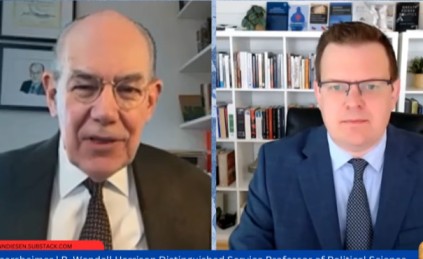
Editor’s Notes: In this episode, Professor John Mearsheimer joins Glenn Diesen to analyze the collapse of the US-led alliance system and the transition into a volatile multipolar world. They discuss how structural shifts and the unilateralist approach of Donald Trump are dismantling the global order that has existed since the end of WWII. The conversation focuses on the grave consequences of conflicts in Ukraine and Iran, highlighting the dangerous potential for nuclear escalation when great powers face existential threats. Together, they explore the limits of military power and the critical importance of prioritizing political solutions over brute force in modern international relations. (May 4, 2026)
TRANSCRIPT:
John Mearsheimer: Alliance System Collapses & Risk of Nuclear War
GLENN DIESEN: Welcome back. Today is the 4th of May, 2026, and we have the great privilege of being joined by Professor John Mearsheimer. So thank you for coming back on the program.
JOHN MEARSHEIMER: Glad to be here, Glenn, as always.
The Cracking of the Post-War International System
GLENN DIESEN: I wanted to start off before we go into specific events, take a step back on the wider picture of what’s happening in the world, because since the Second World War, we’ve seen the United States build an international system, not just around its economic power, but also around an alliance system. Now, I tend to think that inclusive security architectures are better to mitigate security competition, but again, that was the time after World War II, and we’ve seen this alliance system essentially being the source of power projection for the US, but also stability.
Now, however, we’ve seen from the Middle East to Europe and East Asia that a lot of these alliance systems are coming under great stress. And if it’s struggling in one place, for example, the Gulf states questioning it, then this can’t help but to spread to East Asia or Europe. I was wondering, do you see a similar shift, or is this sustainable, or do you think we’re experiencing a massive crack in the way the international system is set up?
Structural Changes and the Rise of Multipolarity
JOHN MEARSHEIMER: I think there’s no question that fundamental changes are taking place in the sort of basic structure of the international system. And I think it’s due to two sets of forces. One is just changes in the structure of the system over time, and I’ll say a bit more about that in a minute. But then the second factor is Donald Trump, who is sui generis. I mean, we’ve never seen an American president like him, and he is in many ways a one-man wrecking ball. So when you take the structural changes that were inevitable and you marry that to what Trump is doing, you see that the world that we knew when we were younger is rapidly going away.
So let me just first start by talking about the structural changes that are taking place. During the Cold War, we lived in a bipolar world and you had the United States on one side and the Soviet Union on the other side. And the United States and the Soviet Union did very little economic intercourse. They were mortal rivals for almost all the Cold War. And what the United States was able to do was set up an order on its side of the Iron Curtain, as we used to say. So we created institutions like NATO, the European Community, and all sorts of other international institutions that were designed to facilitate the West’s waging of the Cold War.
And that was a world that I grew up in, but it went away in 1989 when the Cold War ended, and then in 1991 when the Soviet Union came apart and we moved into the unipolar moment. And what you want to remember about the unipolar moment is what we really did — and I’m talking about the United States in cahoots with the Europeans, and our East Asian allies, including the Japanese and the South Koreans — is that we took that Western order that had been created during the Cold War to wage the security competition with the Soviet Union. We took that Western order and we expanded it all over the globe. It became an international order, not just a Western order.
And what that meant was that you got things like NATO expansion into Eastern Europe, you got EU expansion into Eastern Europe, you got globalization. All of these moves that were basically directed by the United States during the unipolar moment were again designed to take that Western order and expand it across the entire globe. So although the scope of the order changed, in many ways the order remained intact. NATO remained intact. The European Community became the European Union. Globalization, which of course had started during the Cold War, grew by leaps and bounds, especially in 2001, when we allowed China to come into the World Trade Organization and so forth and so on.
The Shift to a Multipolar World
So this is the world that exists up until about 2017. But what happens in 2017 is that we move into a multipolar world and we have now three great powers in the system. And you want to remember, Glenn, we have not seen anything like this since 1945. In fact, I was born in late 1947. I was born into a bipolar world, and I had never seen a multipolar world. But here we are from 2017 up to the present in a multipolar world.
And not only are we in a multipolar world, but very importantly, for the first time in American history, East Asia becomes the most important area of the world for the United States outside of the Western Hemisphere. For virtually all of our history between 1783 when we get our independence and up until about 2017, Europe is the most important area of the world.
But with the rise of China in this new multipolar world, the United States for the first time in its history prioritizes East Asia over Europe and of course over the Persian Gulf. So you have at a structural level fundamental change taking place. And of course, if you’re going to pivot to East Asia to contain China, which the United States does — it first starts talking about that in 2011 when Hillary Clinton enunciates that we’re going to pivot to East Asia, but really it begins when Trump moves into the White House in 2017 — if you’re going to pivot to East Asia, you’re going to pivot away from someplace else. And that place is naturally going to be Europe. Europe is going to be number 2 or number 3 on the list of American strategic priorities outside of the Western Hemisphere, once you’re in a multipolar world where China is the real peer competitor.
So you see these structural forces at play that I just described that are going to cause that Western order that we saw during the bipolar era of the Cold War, and then we saw expanded in the unipolar moment, to basically come apart. There’s just going to be fundamental changes that take place because the structure of the system has changed and the US-China competition, which did not matter very much during bipolarity or unipolarity, is now front and center.
Trump’s Role: From Trump 1 to Trump 2
So a lot of what’s going on today, I believe, is accounted for by these structural changes that I just described. But then on top of that, you get President Trump. Now, President Trump in his first term was more or less a traditional American president in terms of how he conducted foreign policy. And you want to remember, by the way, that Trump moves into the White House just as we’re moving into the multipolar world that I described. And unsurprisingly, Trump abandons engagement with China and he adopts a policy of containment of China. And then when Joe Biden comes into the White House in 2021, he actually ramps up that containment policy. So you can see, starting with Trump 1 and then going to Biden, we are beginning to adjust our foreign policy to accommodate the structural changes that I just described.
But that was Trump 1. Trump 2 does not equal Trump 1. Trump 2 is really something else. We’ve never seen anything like this before. And Trump has no shackles on him. He is free to pretty much operate however he wants. He figured out in his first term how he could run the White House without having to worry about people hemming him in, constraining him. To put it in slightly different terms, he broke out of the iron cage.
And the thing about Trump 2 is, we see that he is a unilateralist in ways we’ve never seen before. He has unmitigated contempt for international law, unmitigated contempt for international institutions and the rules that come with those institutions. And he has unmitigated contempt for allies, especially the Europeans. And he’s free to act on those impulses. So this is really going to matter.
The War Against Iran: A Catastrophic Decision
And up until February 28th of this year, he was in many ways a one-man wrecking crew that was doing significant damage to that Western/global order that had been created in the bipolar world and then spread worldwide in the unipolar moment. So he was doing more than the structural change called for. He was, again, a one-man wrecking ball.
And then on February 28th, he made a fatal mistake, and he started the war against Iran. And as you and I have talked about before, and I’m sure we’ll talk about later on the show, this was a catastrophic decision. We, the United States, are going to lose this war in a very clear way. It’s really going to be a devastating defeat for the United States and for Israel as well. And in this situation, Trump is flailing around. He’s trying to figure out how he can get out of this disaster that he’s in. And of course, in my opinion, there’s no way he can get out of this disaster. It’s going to end up very unhappily for him and for the United States, and I believe for the rest of the world, no matter what he does.
So what I’m saying to you, Glenn, is fundamental change is taking place for sure. A lot of it is structural, and a lot of it is due to Donald Trump and the fact that he is a unilateralist of the first order. And a lot of it has to do with what’s happening in Iran, which is playing out before our very eyes. So that’s a long-winded way of answering your very important question about what’s taking place in the world today from a macro perspective.
Was Trump a Necessary Disruption?
GLENN DIESEN: No, that’s very interesting. Well, it seems as if after World War II, you can argue that there were two international systems playing at once. One was the common inclusive architecture organized around the United Nations. But at the same time, you had the Western system under US leadership. But after the Cold War, it looked like we could have gone two ways. One could have gone with something looking like multipolarity in Europe. That would have meant including the Russians in the pan-European security architecture. We had some deals going that direction in 1990 and ’94, but the alternative model, which we did go for, was to expand essentially the transatlantic system. That meant NATO expansion, interventionism.
And yeah, I remember — I was in the army in ’98 and ’99 — within a 2-week period in March of ’99, first we expanded NATO, and then 12 days later went to war with Yugoslavia without a UN mandate. And this is essentially when I think we definitely went with the unipolar system instead.
But what we saw since then is essentially in the political West, a consensus organized around this path we took. And that’s why I was wondering how you assess Trump’s role here in history, because did he appear out of a vacuum? Because I got the impression, and many people in the United States voted for him for this reason, they wanted to throw a wrench into the system. Because if you have a consensus for a system that no longer works — if the US, for example, can’t compete with China, if financing Europe’s security is preventing the US from adjusting to a multipolar system — there are a lot of things the US has to do in order to reorganize to this new world, and it couldn’t be done with the current political class. Didn’t the US need someone who was essentially anti-establishment, prepared to throw a wrench into the system?
This is not a statement of support, by the way. I’ve just seen in Europe, people vote for people who criticize the status quo, but once they’re in power, they essentially bow and toe the line. So one gets the impression it doesn’t matter who you vote for. With Trump, it certainly did matter who you voted for because he did follow through. I’m just wondering if we’re going to see some of this in Europe as well. If we assume that Trump is a symptom of a system that no longer works but isn’t able to reform itself, so we went kind of with the radical alternative.
Three Fatal Strands of American Foreign Policy
JOHN MEARSHEIMER: Jaime, let me answer your question again at the macro level. I don’t disagree with anything you just said for sure. I think if you think about where we are today, there’s sort of three strands of American foreign policy that have really got the United States and the Europeans into one heck of a lot of trouble. The first strand has to do with NATO expansion. The second strand has to do with the global war on terror. And then the third strand has to do with the Iran war. And let me just say a few words about each.
As you know, Glenn, in the early 1990s, roughly in 1994, the Clinton administration decides that it’s going to expand NATO eastward and the Russians scream bloody murder about this. They’re deeply opposed, but they can’t do much about it. So the first tranche takes place in ’99. This is when we bring Poland, the Czech Republic, and Hungary into the alliance. And then in the second tranche in 2004, we brought in the Baltic states, Slovenia, Slovakia, Bulgaria, and Romania. And then in April 2008, we made the fateful decision to bring Ukraine into the alliance.
And this of course led to a major crisis breaking out in 2014, February of 2014, that is. And then 8 years later in February of 2022, the present ongoing war in Ukraine broke out. And that has caused enormous damage to relations between Russia and Europe and Russia and the United States. And it’s going to poison relations between Russia and Europe and maybe even Russia and the United States for as far as the eye can see. So that’s the first fatal decision that we made, bringing Ukraine into NATO.
Then the second thing that happens after 9/11 is that the United States under George W. Bush launches the Global War on Terror. And we end up going to war in Afghanistan first. And then we go to war against Iraq and we get into what are commonly called the forever wars. And these forever wars are disasters. We lose in Iraq. We lose in Afghanistan. We interfere in Libya and that’s unsuccessful.
And what happens is that by 2016, the American public is sick of the forever wars. And it wants the United States to be much less interventionist around the world. It looks at what’s happening in Europe in terms of the Ukraine war. It looks at Afghanistan and Iraq and it says, you know, enough is enough. And Trump, who ran against engaging in those kinds of wars, who ran against the forever wars, gets elected in 2016 and moves into the White House in 2017.
And this supports your point. It was again the NATO decision to bring Ukraine into the alliance, number one, and then the global war on terror, which undermined the foreign policy establishment and traditional American foreign policy inside of the United States in ways that allowed an outsider like Donald Trump to get elected in 2016.
And by the way, Glenn, you want to remember that if the Democratic establishment had not intervened in 2016, Bernie Sanders in all likelihood would’ve been the Democratic nominee, and you would’ve had Bernie Sanders, not Hillary Clinton, up against Donald Trump. And the mere fact that you might have had Bernie Sanders up against Donald Trump tells you that the American public was fed up with the foreign policy establishment in the United States. And by the way, in 2020, had the Democratic establishment not intervened, it would not have been Joe Biden, in my opinion. It would have been Bernie Sanders who was running against Donald Trump.
So I think your basic point is correct, that Trump got elected in ’16, narrowly lost in ’20, and then won again in 2024 because the American public was fed up with the foreign policy establishment. This is not to deny, by the way, that economics matters as well. And the public was fed up with the establishment’s running of domestic economic policy as well.
And then the third big mistake that we made was on February 28th when we invaded Iran. And what’s amazing about that decision is that Trump, in a very important way, started another forever war, another regime change war. These are exactly the kind of wars he said he would never start. He ran against the establishment for engaging the United States in forever wars. And then he goes out on February 28th and he starts a war against Iran.
Of course, he doesn’t think it’s going to be a forever war. He doesn’t think he’s going to fail. He thinks he’s going to win a quick and decisive victory. But he doesn’t win. And the end result is we are in one giant mess involving Iran. And of course, we are in one giant mess involving Russia and Ukraine, which falls out of that April 2008 NATO decision.
The Rise of Political Disruption and the Iran Question
GLENN DIESEN: Well, soon, yeah, China could also be a great mess as well if this relationship goes south. But yeah, because people often point to Trump as a massive disruptor, but I think that’s what we’re inviting in Europe. Because if you look at the polls for Starmer in the UK or Macron in France or Merz in Germany, I mean, Trump is doing better in the polls than Merz. I think he’s the most unpopular leader there is.
And you’re now seeing the largest party now in Germany by far in the polls is AfD, which was completely, well, very recently established only, what, I think 14 years ago. And again, the leader there was saying that Zelensky should return the money to Germany. And the rhetoric is very different from what you see of any of the mainstream parties. So one gets the impression if the political establishment holds on without reforming for too long, you know, radical alternatives will emerge. But often they don’t necessarily have the right answers, but at least they have a finger on the discontent in which, yeah, the political elites aren’t following the demands of the public anymore.
But I did want to ask you about Iran though. Why is it such a fatal mistake for the United States? What is it that makes it so much worse than Iraq or, you know, what was done against Gaza? Is it an economic component or is it the breakdown of an alliance system or is it the petrodollar? How do you see the severity of this?
Iran vs. Iraq: Why the Stakes Are Far Higher
JOHN MEARSHEIMER: Well, just two very quick points. One is, at least in the Iraq case, we won a military victory to start. We invaded Iraq and we defeated the Iraqi army quickly and decisively, and we overthrew the regime and we replaced the regime with a regime that we thought would operate to our benefit, meaning the United States mainly. And this is why President Bush could land on an aircraft carrier and say, “Mission accomplished.” But there’s a difference between winning militarily and winning politically. And war, of course, is an extension of politics by other means. And politically, we lost. Because we failed to produce the peace and harmony in Iraq and in the wider Middle East that we thought would come with knocking Saddam off. So it was a lost war. But it at least appeared successful at first.
In the case of Iran, that’s not true at all. It was clear almost immediately that we were not going to win a military victory, and it’s clear now we’re not going to win a military victory. So that’s one big difference.
But I think the more important difference is that the ramifications of what is happening in the Iran War are just much greater than the ramifications of the Iraq War. The Iraq War had significant ramifications in the region, in the Middle East. There’s no question about that with the rise of ISIS and with the change in relations between Iraq and Iran once you put a Shia government in place inside of Iraq. And we could go on about that, but there’s no question that the Iraq War really shook up the Middle East, but the global consequences were minor at best. Just didn’t matter that much.
It’s a fundamentally different situation with the Iran War. I mean, there’s a real danger that we are going to cause a worldwide depression if this war isn’t shut down soon. The economic consequences all around the world, but especially in Asia at this point in time, are grave. And they’re cascading through the system. And if President Trump were foolish enough to start the war up, the actual shooting up again, I think that would move us towards the precipice at an even faster pace than we’re now moving.
So this is a much more consequential war. And this, of course, is why the Chinese and the Russians and other countries as well, including the Europeans, are putting significant pressure on the United States to shut this war down. Because all of these countries around the world are being hurt. So the Iran War is in a different category than the Iraq War.
The Strait of Hormuz Dilemma: No Easy Exit
GLENN DIESEN: How would he shut it down though? If, you know, President Trump had the wisdom of picking up the phone and calling you and asking, you know, what should we do instead of listening to Witkoff and Kushner and others? What is a great path now? Because I often hear that he should just claim victory and go home, but without the Strait of Hormuz, it looks as if the entire Middle Eastern region would shift very, very quickly to the advantage of Iran, as you and I have spoken about before as well.
It’s once, well, when Iran has control of the Strait of Hormuz, they can get the reparations. They already indicated that they’re going to put a higher toll on countries who have joined in on the attack of Iran or sanctioning Iran, so they can get rid of the sanctions. They can get countries to play ball. They can probably extend it, put a higher toll on countries which threatens Iran by hosting US bases. So you can see a lot of the system, well, regional structures or even the global system unravel just because of this one strait.
So it seems very important. So on one hand, the US can’t afford to leave it in Iran’s hands, or it could, but then it would have to accept huge changes in the world. But also can’t defeat Iran. So what is the solution? Because it is, yeah, quite a mess Trump has gotten himself into. So I guess he could use some good advice.
The Three Options: Status Quo, Escalation, or a Deal
JOHN MEARSHEIMER: Well, at the risk of being a bit repetitive, let me tell you what I think the three options are, which two of which I think you clearly defined.
One is we can maintain the status quo, which is just to keep the blockade on. The American blockade of the strait stays on and the Iranian blockade of the strait stays on. And the operating assumption there is that we will be able to do so much damage to Iran that they will throw up their hands and surrender and we will get a victory.
The second option is you believe that’s not going to work. That’s due in large part to the fact that blockades take a long time to have an effect, and we don’t have time on our side — we meaning the United States. So what we have to do — and you see lots of people on the right and lots of people who supported the attack on Iran making this argument today, you see it in the Wall Street Journal editorials, for example — is that the blockade alone is probably not going to work. So what we have to do is go back to bombing as well. And the argument there is that bombing plus the blockade, those two instruments in tandem, will do the job. That’s the second option.
And the third option is to cut a deal with Iran. But the problem is if you cut a deal with Iran, Iran wins. And this would be a bitter pill for President Trump to swallow. And furthermore, Israel and its supporters in the United States, who have huge influence, do not want that under any circumstances. So this is the difficult position that President Trump is in. He’s got these three options.
Why None of the Options Work
And just to go back over how viable each one is. With regard to maintaining the status quo and just keeping the blockade on, the problem is it’s not going to work. And that’s the reason that the Wall Street Journal is saying that you need the blockade plus bombing. The blockade alone won’t work because it can definitely inflict massive punishment on Iran — there’s no question about that. The blockade, the US blockade, and what the United States did to Iran in terms of sanctions before February 28th has inflicted great damage on Iran. No doubt about it. But the Iranians are not going to surrender, no matter how much punishment we inflict on them, because we represent an existential threat. The United States and Israel are an existential threat to Iran, and they’ll fight to the last person before they surrender. They would be nuts to surrender. So that option’s off the table.
Then you can bomb plus keep the blockade on. But once you go to bombing, the Iranians will retaliate, and this will just increase the speed at which we head towards the precipice. It’ll do great economic damage. Furthermore, we don’t have the weaponry to continue the war. We’ve used up a huge amount of our precious weaponry in the early stages of the war, and the last thing we want to do is use up the rest of it in the next stage of this war, especially since it won’t matter because the Iranians will retaliate and they will not surrender. They didn’t surrender at first and they’re not going to surrender now. So going to war makes no sense.
I would also add to this, Glenn, and we could talk about this — I think from Iran’s point of view, it would be a good thing if the war started up again. If I were an Iranian leader, I’d hope that the Americans start the war up again, that they start bombing again, because that plays to my advantage. It gives Iran more leverage.
But anyway, maintaining the status quo and the blockade plus bombing option — those two options just don’t deliver the bacon. So you’re left with cutting a deal. And in my opinion, that’s the only thing Trump can do. And when the economic pressure becomes great enough, that’s what he will do. But in the meantime, he can’t do that because Israel and its lobby here in the United States won’t let him do it.
The Four Goals America Has Failed to Achieve
You want to remember that we went into this war with four big goals, and we have failed to achieve any of them. Zero. No regime change. Iran’s ballistic missile force remains intact and is formidable. They’re still supporting the Houthis, Hezbollah, and Hamas. And in terms of their nuclear enrichment capability, we may cut a deal that’s better than the JCPOA, but the key point is they’re not getting rid of their nuclear enrichment capability, which was one of the big four goals. So we failed.
And then when you look at what else has happened — Iran, which did not control the Strait of Hormuz on February 27th, now controls it and has a toll booth in it and has no intention of giving up the strait. Furthermore, on February 27th, we had a very impressive alliance structure with the six GCC countries in the Gulf. That alliance structure has been shattered. Furthermore, on February 27th, we had all these bases in the Persian Gulf that looked very impressive. They’ve either been destroyed or badly damaged.
On February 27th, we had done a very good job of pivoting to Asia — not perfect, but starting on February 28th, we started pivoting away from Asia. Our ability to contain China has diminished significantly since February 28th because we’ve been moving military assets out of East Asia. And furthermore, we have been burning up precious weaponry in the war against Iran.
I could go on and on. What I’m telling you very simply is we have not achieved any of our goals, and we’ve created a lot of problems since February 28th that didn’t exist on February 27th. We’ve lost. How can anybody plausibly spin out a story that we’ve won this war, that we’ve achieved what we set out to do?
And the economic situation continues to deteriorate, and the pressure on President Trump to settle is very great before we go off the precipice. So I am sure behind closed doors he is trying to figure out how he can get some sort of deal that he could possibly sell as a victory. How he can do that, I don’t know. But I think that’s what they’re trying to do.
But meanwhile, you can rest assured that the Israelis and their supporters — their many powerful supporters in the United States — are telling him in no uncertain terms that he can’t cut a deal with Iran that reflects the fact that Iran won and we lost. And this is why there is no end in sight at the moment. And I don’t believe the end will come, or something approximating the end, until the economy is really seriously threatened.
The Risk of Irrational Escalation
GLENN DIESEN: Well, I’m wondering if there’s another option out, because we often assume rationality and restraint. But whenever the West faces — and the US here faces — a massive defeat, rationality often goes out the window.
Just by comparison with Europeans, it’s worth remembering that back in 2022, they were a bit reluctant to go in and fight the Russians before Biden convinced them. But there’s so much at stake now for the Europeans. They see that if they could defeat the Russians, then they would have a powerful Ukrainian shield in front of them, which they could use to weaken Russia. Behind them, they would have the big powerful United States. So it would be a good position to be in, and essentially unipolarity would have another go, perhaps, if they’re being very optimistic.
However, if they lose against the Russians, Ukraine will be diminished, partly absorbed by Russia, and the United States would then likely pack up and go, as we see now with the US pulling some troops out of Germany. So there’s a lot at stake, and for this reason, you see now a massive rationality on the European side. I get the impression the leaders are prepared to go to war with Russia if necessary. The journalists, the politicians — it’s kind of frightening to see the way they talk. Rationality doesn’t seem to be a good defining characteristic at the moment.
But to compare it to Iran though — if the US has so much to lose from losing this war, and a lot to gain if it’s able to defeat Iran in terms of weakening China, Russia, restoring or regaining Israeli dominance in the region — do you think it’s unthinkable that the US might go very far up that escalation ladder, considering even nuclear weapons, something to essentially break the backs of the Iranians? I often make this point when I talk to Iranians: you don’t want to defeat the US too much, because you don’t want to make a very powerful country too desperate.
The Nuclear Dimension: Israel, Iran, and the Logic of Deterrence
JOHN MEARSHEIMER: Yeah, great question. Now, I think it’s very important when you talk about the United States and Iran that you realize that you’re not just talking about the United States, you’re talking about the United States and Israel. These are two countries that are what I like to call a tag team. They’re joined at the hip. And the truth is that they look at Iran in different ways.
Iran is not a serious threat to the United States. It just isn’t. You can’t make that argument on rational legal grounds. But from Israel’s point of view, Iran is an existential threat. And one could argue this is a bit simplistic, but nevertheless, there’s a large element of truth in it. If it’s an existential threat to Israel, it’s an existential threat to the United States. And therefore the United States is forced because of Israel to treat Iran as an existential threat.
But even if that’s not completely true, the fact is that Israel treats Iran as an existential threat. And the most worrying scenario from an Israeli point of view, and even from an American point of view, because again, they’re joined at the hip, is if Iran has a nuclear weapon. And if Iran maintains its nuclear enrichment capability, which it is almost certain to do, from Israel’s point of view, this is the same as Iran being able to get a nuclear weapon. They’ll be on the road to acquiring a nuclear weapon as long as they have a nuclear enrichment capability.
So I think there is a real chance that if a deal is cut and Iran basically wins and keeps its nuclear enrichment capability, that the Israelis will be tempted to use nuclear weapons against Iran. I think that’s a real problem, and I think there’ll be real limits to what the United States can do to prevent that.
Now, your question was, would the United States use nuclear weapons? I find that hard to believe, but that may be wishful thinking on my part. And we want to remember that President Trump has talked about wiping Iran or Iranian civilization off the face of the earth and making it so that Iran could never come back from the dead. He’s threatened this kind of genocidal policy, which is consistent with using nuclear weapons against Iran. So it is possible that the United States would countenance using nuclear weapons against Iran.
I think all of this gets back to the basic logic that you’re spinning out, which is that when countries get desperate, when they see themselves being in a desperate strategic situation, you don’t want to underestimate the risks that they might be willing to take. Now you would argue, I think, that Israel using nuclear weapons is irrational, but I’m not condoning that idea for one second. But you could make an argument that from Israel’s point of view, that’s the rational thing to do. They view Iran with nuclear weapons as the coming of a second Holocaust, and therefore it makes eminently good sense to pursue that policy. Yes, it’s risky. It’s extremely risky. Do we want to do it? No. But do we have any choice? No. It would be that kind of argument.
So I think you don’t want to underestimate the extent to which Israel will think seriously about using nuclear weapons in the future against Iran. And maybe even the United States would do the same.
Karaganov and the Russian Nuclear Logic
And if I could make one more point, just going back to the Ukraine case, because you see a similar logic at play there. You and I both know Sergei Karaganov, and you know him quite well. Sergei, for those in the audience who don’t know, is a Russian strategic thinker of about my vintage, which means he goes back into the Cold War days. And he has been arguing that the Europeans have lost sight of the fact that we live in a nuclear world. And the Europeans think that they can do things to Russia and act in ways, hostile ways towards Russia, as if Russia didn’t have nuclear weapons and nuclear deterrence and nuclear weaponry don’t matter.
And Karaganov’s point is the only way you’re going to put an end to this kind of thinking, which he finds remarkably foolish, and I agree with him on that, is for the Russians to use a few nuclear weapons against Ukraine or against the West. In a demonstrative way. In other words, Karaganov is not talking about starting a general thermonuclear war, but he’s talking about employing a handful of nuclear weapons to remind the Europeans that we live in a world where there are nuclear weapons and there’s a chance that we’ll get incinerated if they’re used.
And what Karaganov wants to do is throw the Europeans and the Russians out on the slippery slope to oblivion, and basically remind the Europeans that the last clear chance to avoid nuclear catastrophe is for them to wake up and understand that they cannot threaten the Russians in an existential way.
Now you might say that Karaganov is crazy or that this is irrational, but I think you can spin a plausible story that although we hope very much that this doesn’t happen, that from the Russian point of view, it is a rational strategy. It’s filled with risks for sure. But the argument that someone like Karaganov would make is that the risks of allowing the Europeans with help from the United States to wreck Russia is just unacceptable, and something has to be done to stop that. And if that involves using a handful of nuclear weapons, so be it. That is the smart strategy. Regrettable, but smart.
I’m just laying out the logic of using nuclear weapons in Ukraine and in the Middle East that show you why the situation in both places is so dangerous.
GLENN DIESEN: Yeah, no, I get the difference. I often make the point to people, because there’s often a lot of confusion when one says — because you and I also spoke in the past about Iran — it’s rational for it to acquire nuclear weapons. It’s not a normative argument about what we wish would happen. It’s the incentives of states as they compete for security.
And just for context on Karaganov, he’s been quite influential both in the Soviet Union and in Russia. He wrote speeches for Brezhnev. Advised everyone from Gorbachev to Yeltsin and Putin. Indeed, he had a very key role in pushing for the change in Russia’s nuclear doctrine and convincing Putin to do so. I was in the room more than, well, twice when Karaganov, on the Valdai setting, was advocating for changing the nuclear posture of Russia and when Putin was essentially pushing back. But eventually Russia changed its nuclear posture by essentially lowering the threshold because of Karaganov. So one can’t say that he’s not influential.
But the rationality, the way I see it, is that Russia needs its deterrence because that’s one thing that gradually got chipped away over the past 4 years. And I often make the point in Europe, or in the West, that this idea of celebrating how Russia is not standing up for its red lines — we have to be careful what we wish for, because now one has set in place anger in Russia among many in the establishment that we let our deterrence slip and now it has to be restored.
Even when you see drones attacking Russia coming out of the Baltic states, I mean, is this the new normal? The Europeans can just launch attacks at Russia and Russia doesn’t dare to do anything? They really say now that this has to come to an end. And I’m actually having him, Karaganov, on this program on Thursday, so I will ask him — yeah, if we should wait for judgment day now, because we are going down a very different path, but a dangerous path.
But that kind of goes into my same argument with the Americans. You don’t want to defeat the Americans, humiliate Americans too much in the Middle East either, because one could end up pushing them into a corner, same as the Israelis, for that sake. So you don’t want to defeat your enemies too much, is my point, which I also made to the Iranians. But where do you see all of this going then, given that we now appear to be returning into warfare between the US and Iran?
The Kursk Offensive and the Erosion of Nuclear Norms
JOHN MEARSHEIMER: Before I go and answer your question on Iran and where I see that one headed, I just want to go back to the Ukraine-Russia situation for a second. The two events that really profoundly shocked me were, number one, when the Ukrainian army with support from the United States and Britain invaded Mother Russia. This was the Kursk Offensive. I believe it was in 2024. Just think about that. Ukraine, with help from the United States and Britain, invaded Russia. This would have been unthinkable during the Cold War. Unthinkable.
During the Cold War, I once had a lengthy discussion with some policymakers about the question of what the United States and NATO would do if you had a war in Central Europe and the Warsaw Pact defenses cracked and we had the option of moving deep into Eastern Europe and maybe eventually moving into the Soviet Union itself. It was a hypothetical situation, but everybody understood that you would not want to move deep into Eastern Europe, much less invade the Soviet Union, threaten the survival of the Soviet Union, a country that had many thousands of nuclear weapons.
Well, here you are in 2024. Ukraine invades Russia with ground forces. It conquers territory. Truly amazing.
Then the second thing that happens is that the Ukrainians, again with assistance from the Americans and the British, launch attacks on one leg of Russia’s strategic nuclear triad. You remember that the Ukrainians targeted Russian strategic bombers. This is their strategic nuclear forces. It was unthinkable that you would do that in the Cold War, even if you had the opportunity, because you understood full well that this might invite retaliation by the Soviet Union and you might end up in a general thermonuclear war. But we didn’t seem to mind at all that the Ukrainians hit one leg of the Russian strategic nuclear triad. Truly amazing to me.
So all of this, I think, supports Karaganov’s basic point that the West, and this includes not just the Europeans but the Americans as well, seem to have lost sight of the fact that nuclear weapons are present in the system and they should affect how great powers interact with each other. And we appear to have forgotten that lesson. And again, Karaganov’s point is that the West needs to be reminded.
But I just wanted to talk about those two incidents. And by the way, you could add a third incident. This is when it looks like the Ukrainians were trying to decapitate the Russian regime by firing missiles at Putin’s home. And that again is something that would have never happened in the Cold War.
The Middle East: A Conflict Without End?
Anyway, to go to the Middle East — where are we going from here? I find it hard to believe, because of Israel and because of the lobby, that we’re ever going to get a meaningful peace agreement. I find it hard to imagine that the United States and Iran could work out a deal that puts an end to this conflict once and for all.
I think if there was no such thing as Israel, if Israel didn’t exist and the lobby didn’t exist, the United States and Iran would have little difficulty working out a modus vivendi. But the fact is Israel does exist. It’s not going away, and the lobby is enormously powerful in policymaking circles in the United States. And because the United States and Israel are therefore joined at the hip, it’s going to be almost impossible for President Trump to negotiate some sort of meaningful peace agreement that lasts for a long period of time.
So I think, Glenn, you and I will be talking about the Middle East and on US-Iran and Israeli-Iran relations for a long time to come.
GLENN DIESEN: Well, it’s just that, going back to what we discussed earlier on how much the world has shifted — can’t — well, historically, such huge shifts in international distribution of power have not happened in peaceful ways. Because keep in mind, only a few years ago we were told that there was only one center of power in the world, that is the United States, but organized under the political West. We had the whole political class in Europe raised under this idea that there was one center of power, so there would be no more great power rivalry. This one center of power was liberal democracy, so now we’re going to have democracy and human rights set as a key pillar of international rules and order.
And suddenly, within the span of a few years, we now see China becoming the most competitive economy. We see this, as you said, war with Russia — and when we say Ukraine did it, none of the things they’re doing, I think they could do without the West. So with assistance, we’re also attacking Russia now. And in Iran, we see Iran essentially leaving the US no military option of victory. It’s quite a remarkable shift in a very short period of time.
And it’s not easy for political leaders or even the public to get used to this new division of labor, or the distribution of power, in such a short period of time. And one can always be pragmatic and say, well, perhaps the US and Iran could set up a regional partnership to adjust to a multipolar world, same with Russia. It doesn’t seem like this is built into human nature though. I’m not sure if you have any thoughts before we wrap up.
The Interconnected Regions: East Asia, Europe, and the Gulf
JOHN MEARSHEIMER: I want to make one final point, Glenn, and that is that when I talk about the changes that have taken place in the world, I tend to treat East Asia, Europe, and the Gulf as the three areas that we should focus on. And I treat them pretty much by themselves. But I talk about China in East Asia, Russia in Europe, and of course Iran now in the Gulf.
But if you think about it, those three areas are tied together in very important ways. The Russians are providing all sorts of assistance to Iran, and the Chinese get a huge slug of oil from Iran through the Persian Gulf. And therefore China and Russia are involved in what’s going on in Iran in a quite serious way that is likely to increase with the passage of time.
And when you think about the war in Ukraine, it is seriously affected by what is happening in the Persian Gulf, in the war against Iran. Just to give you two obvious examples, one is that the United States had to take sanctions off of Russia to increase the amount of Russian oil that’s flowing into global markets, which improved Russia’s economic position and Russia’s position in the war against Ukraine. And furthermore, it’s now quite clear that the United States is going to send much less weaponry to Ukraine than it has been up to now because we’ve used up so much precious weaponry in the war in Iran.
And furthermore, the Russians and the Chinese both have a deep-seated interest in making sure that Iran does not lose the war against the United States. And by the way, countries in the Middle East like Turkey, which is a NATO member — Turkey has a vested interest in making sure Iran doesn’t lose the war against the United States and Israel because the Turks understand the Israelis have their gun sights on Turkey, right?
So when you begin to look at these different regions, what you see very quickly is that there are significant connections among them. And that tells you it is possible. I mean, you could tell stories where a war that spreads in a place like the Persian Gulf ends up including both the Chinese and the Russians, or just one of them. And you could end up in a great power war that spills out of the Persian Gulf. And as I said before, I think this becomes more likely with the passage of time, not less likely. So we live in dangerous times for sure.
Managing Security Competition in a Multipolar World
GLENN DIESEN: The world was clearer, I guess, in the Cold War because you had two centers of power, two incompatible ideologies. I mean, it’s much more difficult to control the different variables at play in this multipolar world, as you pointed out with Turkey, for example, how they do not have, even though they have the problems with Iran. So even Saudi Arabia can make this point. To what extent is it in Saudi Arabia’s interest to actually defeat your opponent? And I don’t — yeah, I think they also would be worried about Israel’s territorial ambitions after a defeat of Iran.
So I think the whole shift in mentality as well, that peace derives from defeating adversaries — I think we have to return to the basic idea that we should manage the security competition. I think for the Iranians to defeat America, for the Europeans to try to defeat Russia, I think all of this is just a recipe for disaster. But yeah, no, that’s the path we’re going down, it seems.
The Limits of Military Force: Clausewitz and the Lessons of History
JOHN MEARSHEIMER: Yeah. And people also ought to remember Clausewitz’s famous dictum that “war is an extension of politics by other means.” And really the key variable you want to focus on here is politics. I think in the West, this is especially true in the United States, we like to talk about military power, and of course the Israelis do as well. And the idea is that any political problem we see out there can be solved by military means. Just bring out the big stick and engage in big stick diplomacy and we’ll solve the problem.
And I think what we’re seeing both in the Ukraine war and in the Iran war, and the Israelis are seeing in places like Lebanon and Gaza, is that there are just limits to what you can do with military force alone. And the politics matters enormously. And you can win a war or be very successful militarily in a conflict, but lose it politically.
I always like to talk about the Vietnam War, which is a central event in my youth, right? Between 1965 and 1975, the United States won every battle that it fought. We were never defeated on the battlefield by the North Vietnamese and the Viet Cong. We won all the battles, but we lost the war. War is an extension of politics by other means. And there are just real limits to what you can do with military force. And we’re finding that out both in the case of Ukraine and Iran. And hopefully the lesson we learn will stick in our head for a while.
GLENN DIESEN: Well, on that somewhat optimistic note, we can leave it there. Learning a lesson from history is important. So yeah, thank you very much for taking the time.
JOHN MEARSHEIMER: You’re welcome, Glenn. It was my pleasure being here.
Related Posts
- Transcript: Trump Delivers Remarks at Anduril Industries in Baltimore, MD
- “He BETRAYED MAGA” – Tim Dillon On Donald Trump @ Uncensored (Transcript)
- President Trump Remarks @ Trump Accounts Event (Transcript)
- Transcript: President Trump’s Speech at Midterm Rally in Mobile, Alabama
- Transcript of This Past Weekend #687: w/ Zohran Mamdani